The Hitter’s Response: How the Grip, the Swing, and the Strategy Evolved Around the Ball
The Hitter’s Response: How the Grip, the Swing, and the Strategy Evolved Around the Ball
The Hitter’s Response: How the Grip, the Swing, and the Strategy Evolved Around the Ball
A Companion Essay to “Men Against the Avalanche”
In the preceding essay, we established that the baseball is the control variable of the sport — the single factor around which the entire competitive ecosystem reorganizes whenever it changes. We examined the phase changes from the pitcher’s side: the deflationary dead-ball equilibrium, the live-ball explosion, the 1930 singularity, the steroid-era compound disruption, and the impossibly small list of pitchers who survived the worst of it.
But every action has a reaction. If the ball is the force that reshapes the game, then hitters are the organisms that adapt to it — and the record of that adaptation is written in the physical details of how men held, swung, and thought about a wooden bat across 130 years of baseball. The grip moved. The swing path changed. The philosophy inverted. The body type shifted. And in every case, the dominant adaptation was a direct response to the physics of the ball.
There were always outliers — Deadball sluggers like Gavvy Cravath who swung for the fences before anyone thought it sensible, live-ball contact men who choked up long after Ruth had made the home run king. Individual variation is real. But the macro pattern is unmistakable: when the ball changes, the dominant hitting strategy reorganizes around whatever the ball rewards. The outliers prove that individual agency exists within the system. The pattern proves that the system is governed by the ball.
This is the story of hitting as a response function.
Phase 1: The Deadball Grip — Hands Apart, Choke Up, Survive (1900–1919)
The Physics Demand Contact
In the Deadball Era, the ball was soft, scuffed, tobacco-stained, and often nearly invisible by the fifth inning. It absorbed energy on contact rather than returning it. A pitcher could legally doctor it with spit, mud, or emery paper, making it dance and dive unpredictably. A single ball was kept in play for the entire game — sometimes for over 100 pitches — until it was literally unraveling. The ball was, by construction and by use, dead.
Under these conditions, the physics told the hitter one thing: power is irrelevant. It did not matter how hard you swung, because a soft, scuffed, waterlogged ball would not carry. A perfectly struck fly ball died in the outfield. A line drive to the gap was as much power as the physics could sustain. The home run was not a strategic option — it was a near-impossibility. On thirteen occasions between 1900 and 1920, the league leader in home runs had fewer than ten. Frank “Home Run” Baker earned his nickname by leading the American League four consecutive years — with totals of 11, 10, 12, and 9. Baker, notably, swung a 46-ounce bat — a weapon of mass, not speed — and gripped it at the end, making him something of a proto-Ruthian figure trapped in an era whose physics wouldn’t reward his instincts. He was the exception that proved the rule: even a man determined to hit for power in the Deadball Era could manage only a dozen home runs per season.
The hitter’s rational response to a ball that would not fly was to abandon the pursuit of flight entirely and optimize instead for contact, placement, and speed.
The Cobb Grip
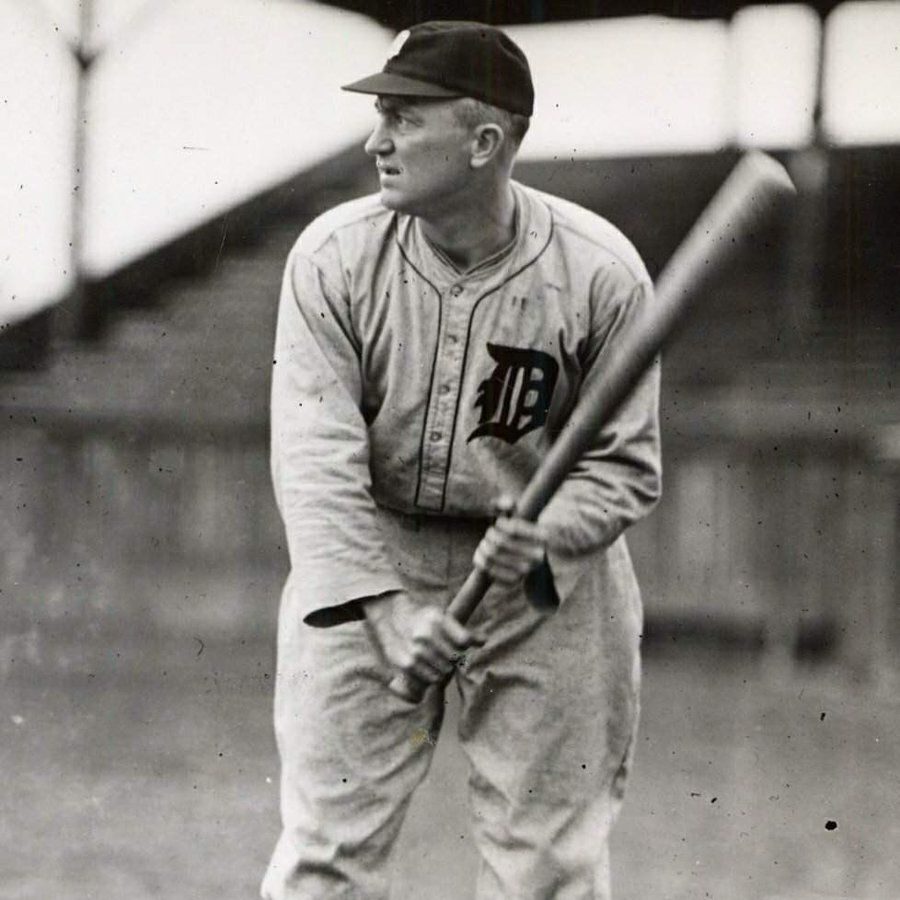
The definitive Deadball hitter was Tyrus Raymond Cobb, and his grip was the physical embodiment of the era’s philosophy. Cobb choked up on the bat — leaving an inch or two of handle exposed below his bottom hand — and, most distinctively, separated his hands on the grip, leaving a visible gap between them. This split-handed grip sacrificed leverage (and therefore power) in exchange for bat control. It allowed Cobb to adjust his swing at the last possible instant, directing the ball to any part of the field with surgical precision. The photographs from the Hall of Fame archives are unmistakable: Cobb’s hands sit visibly apart on the handle, the bat held like a tool of placement, not destruction.
Cobb’s own instruction was explicit: “Don’t grip your bat at the very end. Leave at least an inch or two.” He also advised: “Don’t slug at full speed. Learn to meet them firmly, and you will be surprised at the results.” And perhaps most revealingly: “My idea of a real batter is a man who can choke up on the bat when he feels like it or slug from the handle when it is necessary.” This last quote is critical — Cobb understood that the grip was situational, that the relationship between hands and handle was a dynamic choice, not a fixed identity. But in the Deadball Era, the situations that rewarded choking up vastly outnumbered those that rewarded slugging.
Cobb hit .366 for his career — the highest in history — won twelve batting titles, hit .400 three times (.420 in 1911, .410 in 1912, .401 in 1922), and stole 892 bases. He was not weak. He led the league in extra-base hits three times, ranks fourth all-time in doubles, and is second all-time in triples — the true power statistic of the Deadball Era, when spacious outfields and the inside-the-park game made the three-bagger what the home run would later become. But his approach was calibrated to the physics of the dead ball: make contact, place it, and run.
Honus Wagner used the same split grip. So did Wee Willie Keeler, the 5-foot-4 master of bat control whose philosophy was distilled into the most famous sentence in hitting history: “Hit ‘em where they ain’t.” Keeler’s trademark was the “Baltimore Chop” — a deliberate downward strike that bounced the ball high off the hard dirt in front of home plate, giving him time to reach first before the ball came down. This was not a swing designed to produce distance. It was a swing designed to exploit the specific physics of a dead ball on hard ground. The very geometry of the stroke was dictated by the ball.
The Strategic Architecture
The grip dictated the swing, and the swing dictated the strategy. Deadball hitters used a short, controlled, level-to-slightly-downward swing path designed to put the ball on the ground or on a low line. The bunt was an offensive weapon, not a sacrifice. The hit-and-run was a primary tactic — the runner broke from first as the pitch was delivered, and the batter was expected to make contact and place the ball through the hole vacated by the fielder covering second base. Stolen bases were not a bonus; they were a core method of manufacturing runs. Cobb studied pitchers’ timing and delivery mechanics the way a safecracker studies a lock — his 892 career steals were acts of intelligence as much as athleticism.
The entire offensive identity of Deadball baseball — small ball, scientific hitting, the stolen base, the sacrifice bunt, the inside game — was a direct consequence of the ball’s physics. When the ball will not fly, you do not swing for the fences. You choke up, you spread your hands, you meet the ball firmly, and you use your legs. The game becomes chess. Every run is manufactured, one piece at a time.
Phase 2: The Ruthian Revolution — Hands Together, Grip the Knob, Swing From the Heels (1920–1930)
The Physics Change, the Grip Changes
When the ball changed — the banned spitball, the clean-ball rule, the livelier construction, all arriving in a cascade between 1919 and 1921 — the physics of the bat-ball collision changed with it. Suddenly, a well-struck ball would carry. A fly ball that had died at the warning track in 1918 now cleared the fence in 1921. The dead ball was alive, and every assumption that had governed hitting for two decades was instantly obsolete.
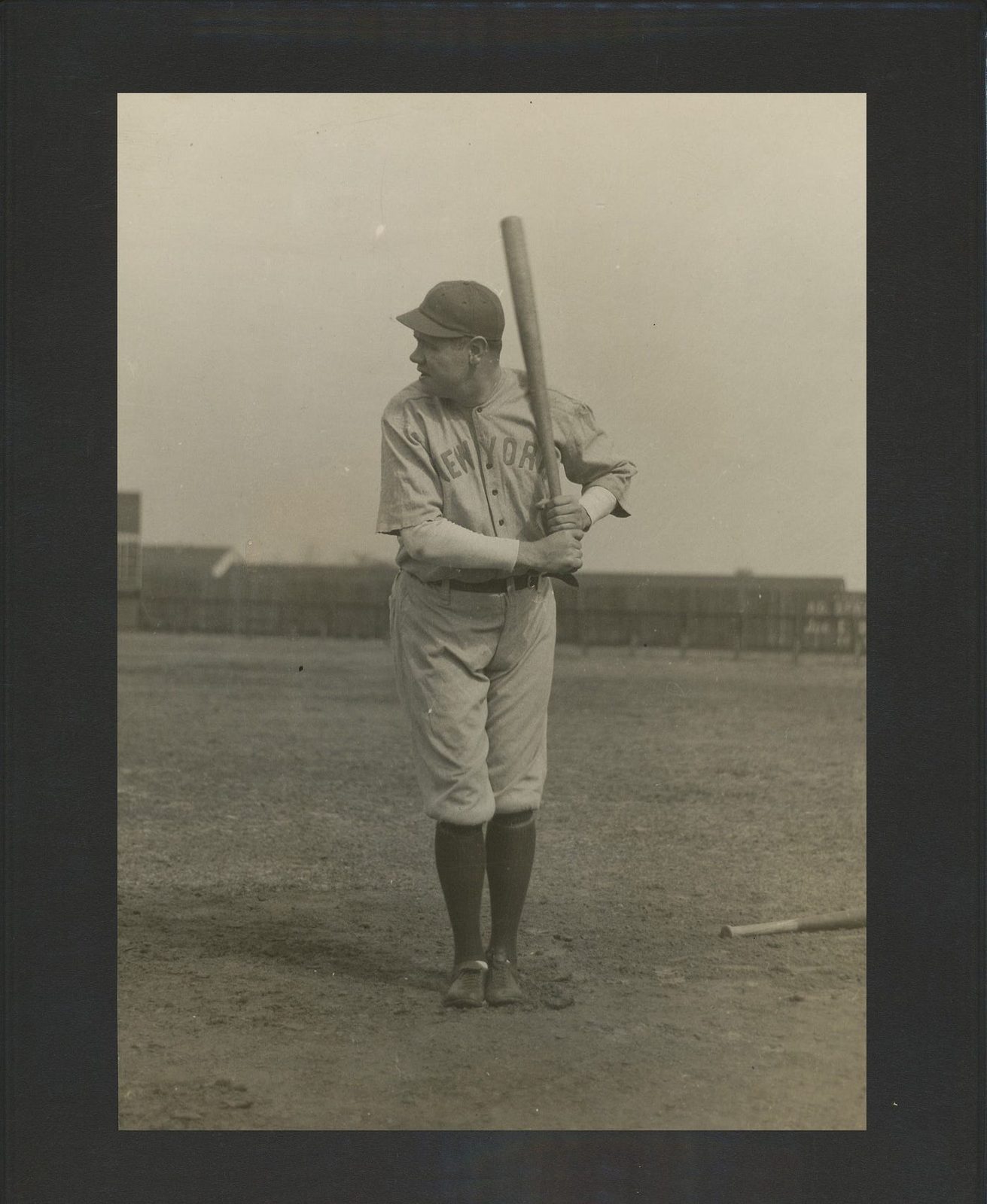
The first man to fully exploit the new physics was George Herman Ruth, and his grip was the anti-Cobb. Where Cobb choked up and spread his hands, Ruth gripped the bat at the very end — right at the knob — with his hands locked together. This grip maximized leverage. It created the longest possible lever arm between the fulcrum (his hands) and the point of contact (the barrel), which translated directly into bat speed and, therefore, power. The tradeoff was control: Ruth could not direct the ball with Cobb’s precision. His at-bats had a binary quality — devastating contact or violent miss — that was entirely foreign to the Deadball game.
Ruth learned this grip as a boy at St. Mary’s Industrial School in Baltimore, imitating Brother Matthias, a priest who would toss a ball in the air and swat it enormous distances. “I think I was born as a hitter the first day I ever saw him hit a baseball,” Ruth later said. The young Ruth copied Matthias’s style — gripping the bat tightly down at the knobbed end, taking a massive swing — and never fundamentally altered it. A surviving booklet from Hillerich & Bradsby, the makers of Louisville Slugger bats, shows photographs of Cobb and Ruth side by side: Cobb’s split grip is pronounced, his hands separated and choked up; Ruth’s fists are jammed together at the base of the handle, every ounce of leverage extracted from the wood. The two grips are the visual thesis statements of their respective eras.
The Swing Path
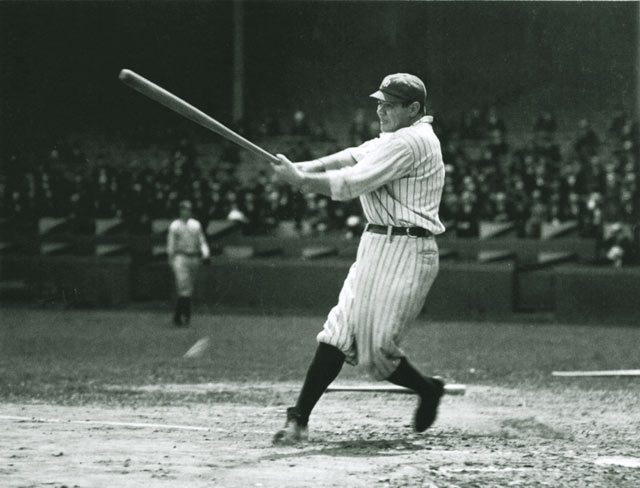
Ruth’s swing was revolutionary not merely because it was powerful but because it was oriented upward. Where Cobb and the Deadball hitters used a level or slightly downward path — optimized for ground balls and low liners — Ruth’s swing had a natural ascending arc. Film analysis suggests his actual in-game swing was flatter than the popular legend implies (the dramatic corkscrew finishes that sportswriters loved to describe occurred more often on misses than on home runs), but relative to everything that preceded him, Ruth’s swing path was unmistakably tilted toward elevation. This was not a flaw. It was an optimization for the new physics. The live ball, struck on an ascending plane, would carry. The dead ball would not have rewarded this approach; the live ball rewarded it spectacularly.
Ruth’s stance complemented the grip and the swing. He stood with his feet just eight to nine inches apart — far narrower than Cobb’s stance — putting the bulk of his weight on his rear foot. When he swung, he transferred that weight forward in a violent rotational motion, his hips and shoulders firing in sequence, generating torque that the end-loaded grip converted into extraordinary bat speed at the barrel. Ruth himself once said that if he shortened his swing and tried to hit singles, he could bat .600. He chose not to — because the live ball had made the home run more valuable than six hundred singles.
The purists were horrified. John McGraw and Ty Cobb both believed Ruth was ruining the game. Cobb’s contempt for the power game was open and lifelong. But the numbers were unanswerable. Ruth’s home-run totals exploded from 11 in 1918 to 29 in 1919 to 54 in 1920 — a near five-fold increase in two seasons that directly paralleled the changes in the ball. By 1927, he hit 60. Sportswriter Grantland Rice wrote that watching Ruth swing and miss was almost as exciting as watching him connect — but it was the connections that changed the sport.
The Cascade
Ruth’s grip and swing were not merely personal choices. They were the template for a new species of hitter. Lou Gehrig adopted a similar end-loaded grip and power-oriented approach — hands together at the knob, weight transfer through rotation, a swing designed to drive the ball in the air. Jimmie Foxx followed. Hack Wilson followed. Chuck Klein, Al Simmons, Babe Herman — the entire generation of 1930 sluggers who produced that season’s absurd offensive numbers were, in mechanical terms, Ruth’s children. By 1930, the entire offensive philosophy of baseball had reorganized around the Ruthian model: grip the end, swing hard, elevate the ball, let the live ball do the rest.
The transition from Cobb’s grip to Ruth’s grip — from split-hands-choked-up to fists-together-at-the-knob — was not a matter of fashion. It was a direct, physical response to a change in the ball’s coefficient of restitution. When the ball absorbs energy, you optimize for contact. When the ball returns energy, you optimize for force. The grip is the mechanism through which the hitter interfaces with the bat, and the bat is the mechanism through which the hitter interfaces with the ball. Change the ball, and the grip changes. The adaptation is dictated by physics.
Phase 3: The Equilibrium Hitters — Williams, Musial, and the Science of the Swing Path (1940s–1960s)
The System Settles
After the NL deadened the ball following 1930, after the Depression thinned the rosters and the war took the stars, the run environment gradually stabilized. The ball was live but not absurdly so. Power hitting was established as a core strategy but was no longer the only viable one. The game found a middle ground between the Deadball contact game and the Ruthian home-run derby.
In this equilibrium, a new type of hitter emerged: one who could hit for both power and average, who understood the physics of the swing at a level that neither Cobb nor Ruth had articulated, and who synthesized the two traditions into something more sophisticated than either.
Ted Williams and the Swing Plane
Theodore Samuel Williams was the most important hitting theorist in baseball history. His contribution was not merely practical but intellectual — a framework for understanding the geometry of the bat-ball collision that would not be fully validated by technology for another forty years.
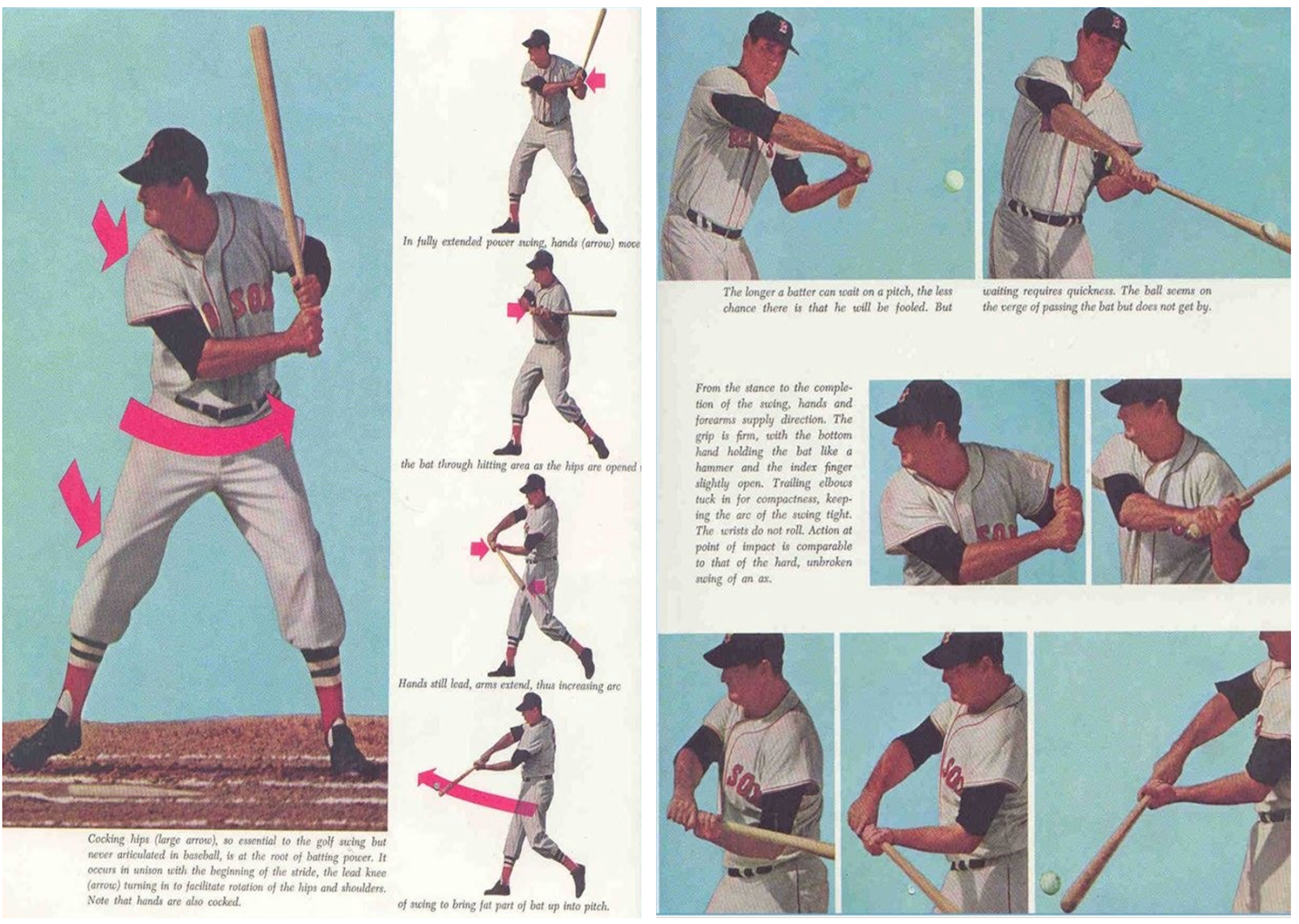
In his 1971 book The Science of Hitting , Williams articulated a principle so far ahead of its time that coaches spent decades ignoring it: the swing path should match the plane of the incoming pitch. A pitch descends toward the plate at an angle of roughly 6 to 10 degrees. If the hitter swings level — as generations of coaches had taught — the bat and the ball are on intersecting planes, and the margin for solid contact is razor-thin. The bat and ball meet at a single point. If the hitter swings with a slight upward angle — approximately matching the pitch’s downward trajectory — the bat and ball travel on the same plane for a longer stretch, widening the contact zone and maximizing the transfer of energy from bat to ball.
Williams’s insight was that the slight uppercut was not a flaw but an optimization. He advocated pulling the ball through rotational hip action — “the hips lead the hands,” he repeated endlessly — with the wrists staying firm through contact rather than rolling over. “Up, up, up is the way to hit with authority,” he wrote. His grip was conventional by post-Ruthian standards: hands together, near the end of the bat. But his swing path was deliberately calibrated to the physics of the bat-ball collision in a way that transcended both the Deadball contact game and the Ruthian power game. He was not choking up for placement like Cobb. He was not swinging from the heels like Ruth. He was engineering his swing to the geometry of the pitch itself.
Williams hit .344 for his career, slugged .634, walked more than he struck out in every full season, and remains the last man to hit .406 (in 1941). He lost nearly five full seasons to military service in World War II and Korea — service as a Marine Corps fighter pilot, not a desk assignment — and still finished with 521 home runs. He was the proof of concept for the idea that understanding the physics of the swing — the relationship between attack angle, pitch plane, and energy transfer — could produce both power and average simultaneously.
Stan Musial arrived at a similar synthesis through a different mechanical path. His distinctive corkscrew stance — coiled and closed, peering at the pitcher from behind his own front shoulder — unwound into a smooth, slightly upward swing that generated exceptional bat speed through the zone. Where Williams was a scientist, Musial was an artist who painted the same conclusions by instinct. He hit .331 for his career with 475 home runs, 3,630 hits, and a consistency across two decades that made him the National League’s answer to Williams. Like Williams, he was an equilibrium hitter: too powerful for the contact purists, too precise for the power-only crowd. Both men were adapted to a ball that was live enough to reward intelligent force but not so juiced that brute strength alone would suffice.
Phase 4: The Steroid-Era Swing — Maximum Force, Maximum Leverage (1990s–2000s)
The Physics Demand Force Again
When the ball juiced again in the 1990s and 2000s — compounded by steroid-enhanced bodies — the hitting response was predictable: the game swung back toward maximum force. The equilibrium that Williams and Musial had inhabited was abandoned in favor of a more extreme version of the Ruthian model.
The steroid-era hitter optimized for exit velocity above all else. Bats evolved — thinner in the handle and wider in the barrel, the opposite of the thick-handled Deadball-era clubs, maximizing the whip effect and concentrating mass at the point of contact. Grips moved firmly to the end of the bat. Swing paths tilted upward. Body types shifted toward massive upper-body strength: McGwire’s Popeye forearms, Sosa’s cannonball shoulders, Bonds’s expanding helmet size. The physical architecture of the hitter himself was being rebuilt to exploit the same physics the ball was exploiting.
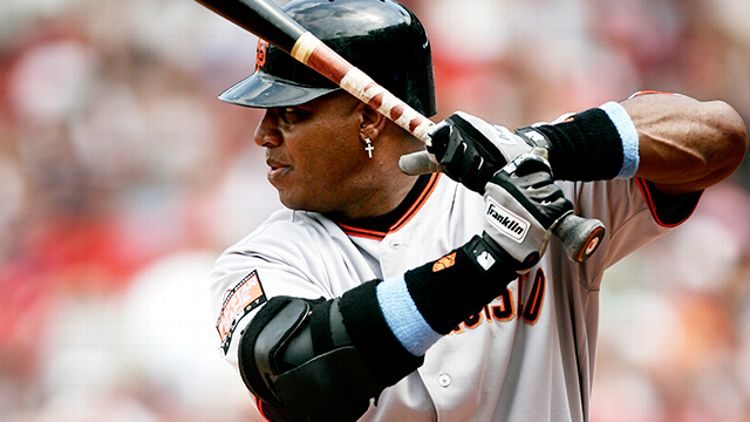
Barry Bonds — paradoxically — choked up on the bat, one of the last elite hitters to do so. He swung a 34-inch, roughly 32-ounce Sam Bat and moved his hands up approximately two inches from the knob. But his choke-up served a fundamentally different purpose than Cobb’s. Cobb choked up for control in a dead-ball environment where contact was paramount. Bonds choked up for bat speed. He said so himself: he hated getting jammed on inside pitches, and by shortening his effective lever arm, he could whip the barrel through the zone faster and still catch up to pitches on his hands. The combination of that bat speed, his chemically enhanced strength, his preternatural pitch recognition, and the juiced ball’s coefficient of restitution produced exit velocities that sent baseballs into McCovey Cove with an ease that looked almost contemptuous. The same mechanical adjustment — choking up — served opposite strategic purposes in different eras because the ball dictated different optimization targets. Cobb choked up to place the ball. Bonds choked up to destroy it.
The steroid era also saw the near-total extinction of small ball. Stolen-base attempts dropped. Sacrifice bunts became rare outside of the pitcher’s spot. The hit-and-run, Cobb’s signature play, was abandoned by most managers. Why manufacture a single run through three consecutive acts of precision — the bunt, the stolen base, the contact single — when a three-run homer could do the same work in one swing? The inflated run economy made single-run strategies inefficient. The ball had, once again, dictated the strategic architecture.
Phase 5: The Launch-Angle Revolution — Williams Vindicated, Cobb Extinct (2015–Present)
The Data Catches Up to the Theory
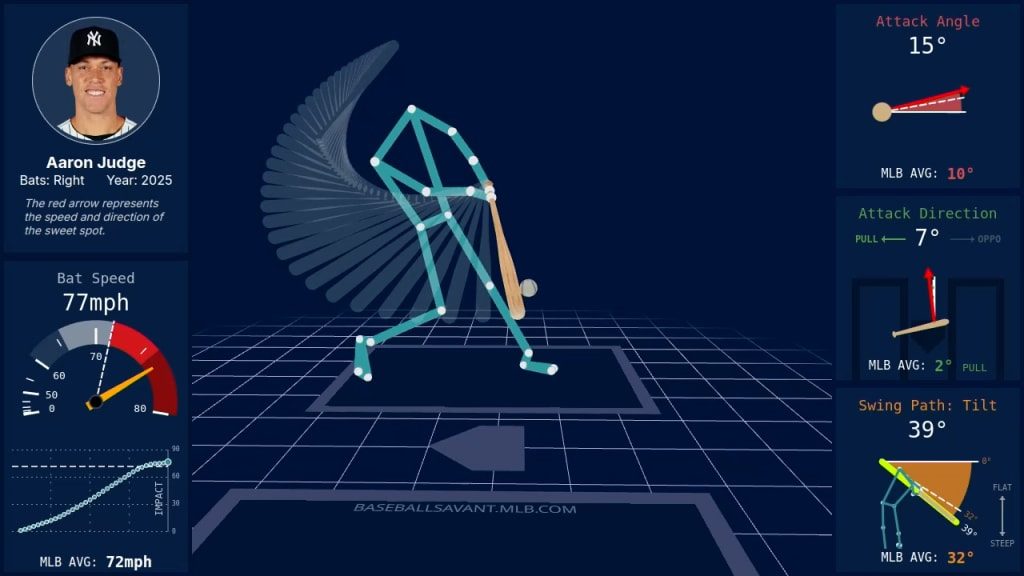
In the mid-2010s, Statcast technology began measuring launch angle and exit velocity on every batted ball in the major leagues. For the first time, the sport had precise, universal data on the geometry of the bat-ball collision — and the data confirmed what Ted Williams had argued in 1971. Balls hit in the air at high exit velocity produced dramatically more offense than balls hit on the ground. The optimal launch angle for a home run was approximately 25–30 degrees. The optimal launch angle for batting average was around 10–15 degrees. The sweet spot — what Statcast would label “Barrels,” the combination of exit velocity above 98 mph and a launch angle in the 25–30 degree range — produced the highest expected batting averages and slugging percentages in the game. Williams had been right all along. The slight uppercut was not a flaw. It was the physics.
The response was immediate and dramatic. Hitters across the majors began deliberately increasing their attack angles — swinging with steeper upward paths to elevate the ball. Josh Donaldson publicly credited a swing overhaul focused on launch angle for his 2015 AL MVP season. Daniel Murphy retooled his swing to pull the ball in the air and transformed from a league-average hitter into a monster who slashed .347 across two postseasons. J.D. Martinez rebuilt his entire approach around optimizing exit velocity and launch angle and went from a player the Houston Astros released to one of the most feared hitters in baseball, averaging 36 home runs per season from 2017 to 2019. Justin Turner, Chris Taylor, Marwin Gonzalez — a wave of hitters who had been marginal became productive by adopting the same principle Williams had articulated forty-five years earlier.
The grip migrated further toward the knob. The swing path tilted further upward. The choke-up grip of Cobb’s era was now almost entirely extinct — only a handful of players, like Joey Votto, still employed it regularly, and typically only with two strikes. The thick-handled bats of the 1930s and 1940s gave way to increasingly thin-handled, barrel-heavy designs that maximized whip effect. The physical apparatus of hitting — the bat, the grip, the swing — had completed its century-long migration from Cobb’s choked-up, split-handed, contact-oriented, ground-ball philosophy to a full commitment to elevation, rotation, and power.
The Cost
The launch-angle revolution came with a cost that Ty Cobb would have predicted and Ted Williams might not have endorsed: strikeouts exploded. By the late 2010s and early 2020s, major-league strikeout rates reached historic highs, as hitters swinging with steep uppercuts were more vulnerable to high fastballs and had less margin for timing error on off-speed pitches. The attack angles many hitters adopted — 18 degrees or more, well beyond the slight uppercut Williams had advocated — created a swing path that, if the timing was even fractionally off, produced either a fly ball to nowhere or a ground ball to the pull side. Balls in play declined. The game became a “three true outcomes” sport — home runs, walks, and strikeouts — with less and less action in between.
Williams had advocated a slight upward swing — 5 to perhaps 15 degrees — matched to the plane of the pitch. The launch-angle revolution took that insight and pushed it past the point of diminishing returns, steepening the attack angle well beyond what Williams had intended, sacrificing contact rate for launch probability. It was Williams’s theory, overclocked and overextended, applied as a blunt instrument rather than the precision tool he had designed.
This was the terminal consequence of a century of adaptation to an ever-livelier ball. When the ball rewards elevation, hitters swing up. When hitters swing up, they miss more. When they miss more, the game loses the contact, the movement, the strategic texture that once defined it. The ball dictated the swing. The swing dictated the strategy. The strategy dictated the spectacle. And by the 2020s, many observers were arguing that the spectacle had become impoverished — that the game had lost something essential in its century-long pursuit of the home run.
Conclusion: The Bat Follows the Ball
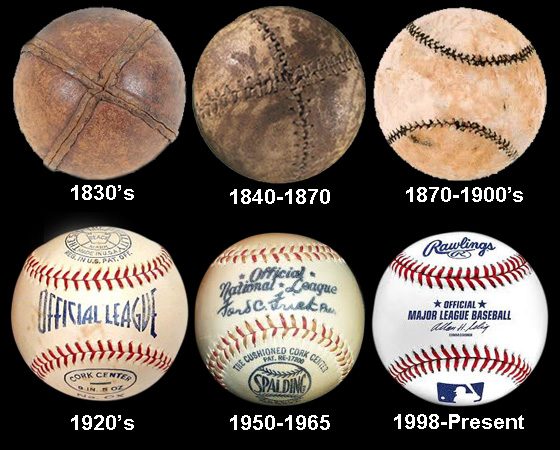
The history of hitting is not a history of individual genius, though it contains geniuses. It is a history of adaptation to a changing physical environment, and the environment is set by the ball.
Ty Cobb’s split grip and choked-up bat were not personal eccentricities. They were the rational response to a dead ball that would not fly — a ball that demanded contact, placement, and speed, and punished any hitter foolish enough to swing for a fence that physics would not let him reach. Babe Ruth’s knob grip and ascending swing were not reckless. They were the rational response to a live ball that rewarded force — a ball that suddenly carried, that flew, that turned fly outs into home runs and made the bunt an act of self-sabotage. Ted Williams’s carefully calibrated swing plane was not academic indulgence. It was the rational synthesis of contact and power in an equilibrium environment — a geometric proof, decades ahead of the data, that matching the bat’s path to the pitch’s path maximized both the probability and the force of collision. Barry Bonds’s choke-up-for-bat-speed was not a throwback to Cobb. It was the rational exploitation of a compound steroid-and-rabbit-ball era in which the ball was already engineered to fly and the hitter’s task was to make it fly faster. And the launch-angle revolution of the 2010s was not a fad. It was the logical conclusion of a century of adaptation to a ball that kept getting livelier — Williams’s theory, finally proven by data, then pushed by economics and incentive structures past the point of grace.
Every grip change, every swing-path adjustment, every strategic reorientation in the history of hitting traces back to the same source: the physics of the ball. When the ball is dead, hitters choke up, spread their hands, swing level, and play for contact. When the ball is live, hitters grip the knob, close their hands, swing up, and play for power. When the ball is somewhere in between, the greatest hitters — Williams, Musial, the equilibrium masters — find a synthesis that honors both the geometry of contact and the physics of force.
The bat follows the ball. It always has. The question baseball must answer is not whether hitters will adapt to whatever the ball does next — they will, because the physics demand it — but whether the ball the sport chooses to put in play produces a game worth watching. A game with stolen bases and sacrifice bunts and hit-and-runs, or a game with only three outcomes. A game where Ty Cobb’s intelligence matters, or a game where only Babe Ruth’s leverage does.
The answer to that question has never been in the hitters’ hands. It has always been in the ball.