The Hitting Profile of Dave Orr: The Statistical Shape of Pure Hitting
The Hitting Profile of Dave Orr: The Statistical Shape of Pure Hitting
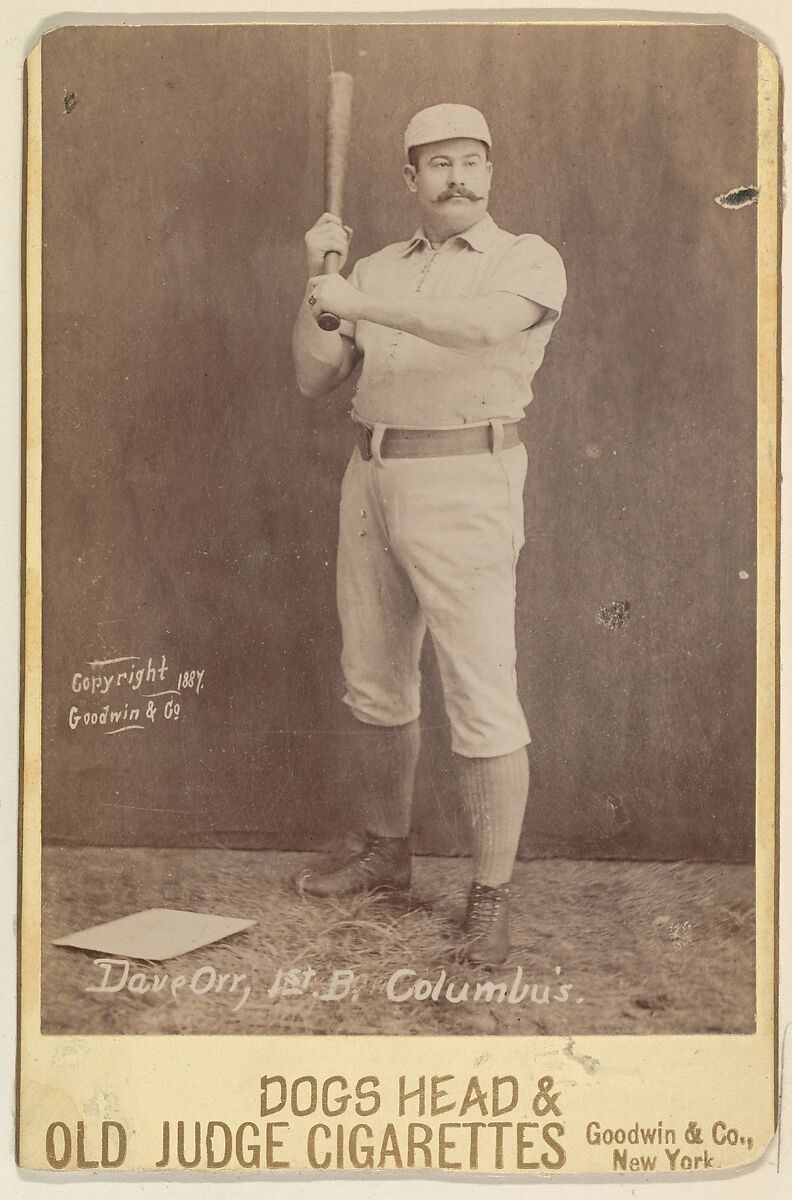
The Hitting Profile of Dave Orr: The Statistical Shape of Pure Hitting
Dave Orr and the Elimination of the Walk
Among nineteenth-century hitters, Dave Orr possesses one of the most unusual offensive profiles in the history of the sport. His statistical line combines several elite traits simultaneously:
.342 batting average
1.42 hits per game — the highest rate in major-league history
.502 slugging percentage in the 1880s
0.12 walks per game
Each number on its own is impressive. What makes Orr extraordinary is that they occur together. The key to understanding the profile lies in the structure of his plate appearances—specifically, his extraordinarily low walk rate.
The Walk Rate Gap
When Orr is compared with the other great hitters occupying the same hits-per-game tier, the magnitude of the difference becomes immediately visible.

All three hitters belong to the same elite class. Their batting averages and hit frequencies are nearly identical.
The separation comes from walks.
Delahanty walked more than three times as often as Orr.
Thompson walked nearly three times as often.
Because walks remove at-bats, this difference dramatically alters the structure of their plate appearances. A hitter who walks frequently converts many trips to the plate into passive outcomes. A hitter who rarely walks converts those same opportunities into balls put into play.
Because batting averages among these hitters are nearly identical, the separation in hits per game emerges almost entirely from differences in walk frequency , which determine how many plate appearances become actual at-bats.
In nineteenth-century baseball—where strikeouts were already rare—walks were essentially the primary mechanism by which a hitter could exit the hitting process without making contact.
Orr almost never did.
Even Among Contact Hitters, Orr Is Extreme
The scale of Orr’s walk suppression becomes even clearer when he is compared with Willie Keeler , one of the purest contact hitters the sport has ever produced.

Keeler is famous for the philosophy “hit ’em where they ain’t.” He represents the classic late-nineteenth-century contact approach.
Yet even Keeler walked more than twice as often as Orr.
And Keeler himself was already considered a low-walk hitter by the standards of the era.
When the comparison expands to the broader elite tier, the scale of the difference becomes unmistakable.

Most elite hitters in this group walked three to six times as often as Orr.
His walk rate is not merely low—it is structurally extreme.
Eliminating Passive Plate Appearances
Because strikeouts were already suppressed across the era, the true plate-appearance tradeoff for nineteenth-century hitters was simple:
walk vs. ball in play
Every walk removes a potential contact event. Every contact event creates the possibility of a hit.
By almost completely eliminating walks, Orr forced a much larger share of his plate appearances into true hitting attempts.
Nearly every time he stepped to the plate, the ball entered play.
Contact Without Compromise
Ordinarily, such an aggressive profile carries a cost. Hitters who swing constantly tend to sacrifice batting average because poor pitch selection leads to weaker contact.
Orr shows no such decline.
Despite eliminating walks and dramatically increasing his number of balls in play, he still produced:
.342 batting average
1.42 hits per game
His success rate remained essentially identical to the other elite hitters of his generation.
He did not merely swing more often.
He succeeded when he did.
Power Within Contact
The profile becomes even more distinctive when power is considered.
Orr’s career .502 slugging percentage was enormous for the 1880s. From his 1,125 hits , he produced:
198 doubles
108 triples
37 home runs
Approximately 30 percent of his hits went for extra bases , an unusually high proportion for the era.
This means the additional balls he put in play were not weak contact events. They were frequently hard contact capable of producing multiple bases.
His aggressive approach worked because the contact itself was productive and forceful.
Addendum: The Shape of Pure Hitting
The statistical pattern revealed in Dave Orr’s record identifies a very specific offensive configuration—one that rarely appears in baseball history.
Most hitters distribute their offensive value across several channels. Some combine patience with power. Others rely on walks and on-base percentage. Still others generate value through extra-base hits while accepting higher strikeout totals.
Orr’s production followed a different structure.
His profile largely removed passive outcomes from the offensive equation. Walks were almost entirely absent, and strikeouts were already rare in the era. The result was that nearly every plate appearance became a true hitting attempt.
Ordinarily such an approach reduces efficiency. Hitters who swing constantly tend to sacrifice batting average because weaker pitch selection produces poorer contact.
Orr did not experience that tradeoff.
Despite eliminating walks almost entirely, he maintained a .342 batting average , produced the highest hits-per-game rate in major-league history, and generated substantial power relative to his era.
The result is a rare offensive shape defined by:
extremely low walk frequency
constant contact events
elite hit conversion
meaningful power
In effect, Orr collapsed the normal distribution of offensive outcomes into a single dominant channel: successful contact.
Most hitters rely partly on patience to generate offensive value. Orr did not. Instead he converted an unusually large share of his plate appearances into balls in play and then turned those opportunities into hits at an elite rate.
Dave Orr’s record therefore represents a rare offensive configuration: a hitter who almost completely eliminated passive outcomes while sustaining elite contact and meaningful power.
That statistical shape—aggressive contact frequency combined with elite hit conversion —is one of the clearest expressions of pure hitting ability the sport has ever produced.