The Impenetrable
The Impenetrable
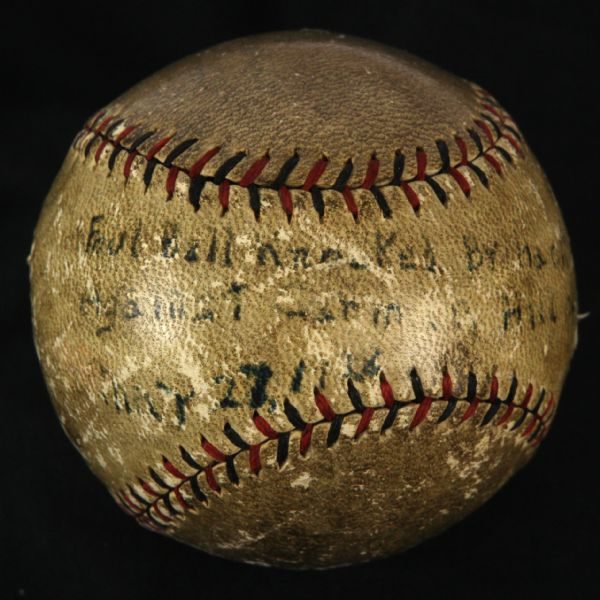
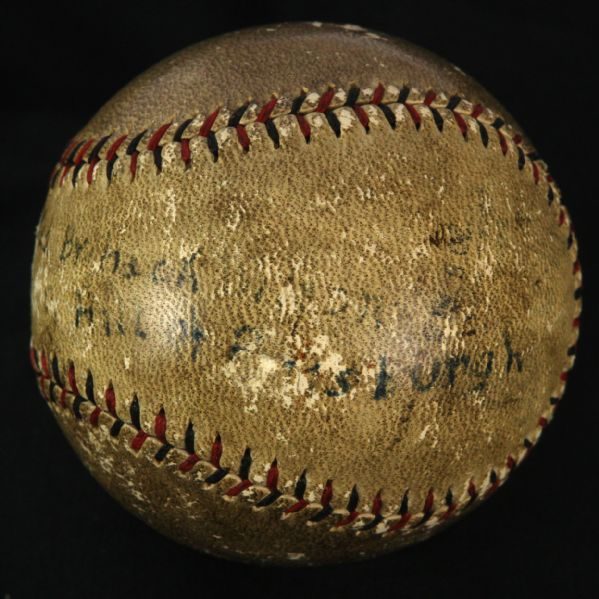
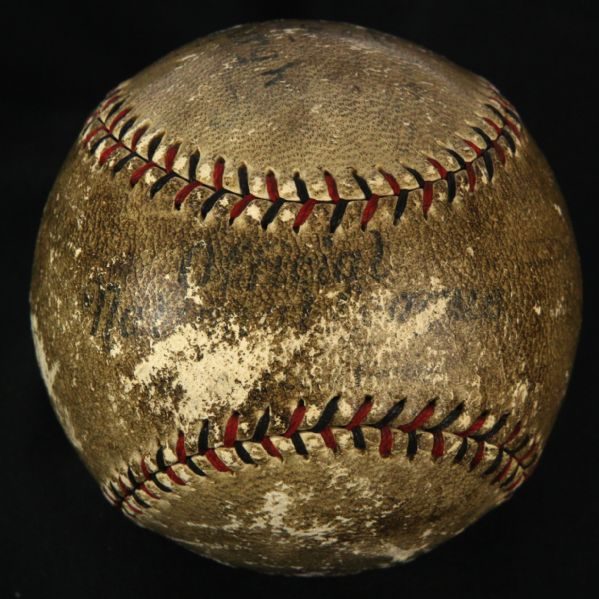
Three panel images of a red & black stitched Spalding Official National League John Heydler baseball, which was hit foul by Hack Wilson of the Chicago Cubs off of Pittsburgh Pirates hurler Carmen Hill during the Cubs 3-0 victory over the Pirates on May 27, 1928 at Wrigley Field. “Foul Ball Knocked by Hack Wilson Against Carmen Hill Pittsburgh May 27, 1928” is handwritten in faded period ink on the baseball.
The nature of time is a signature to which we wish to return, if only to visit the compound sensation. Like the whiff of a smell of an archetypal era; the theoretical, full body radio of Hack Wilson’s home run swing in the friendly confines of old Federal League Wrigley field in the years leading up to his explosive 1930 season.
Time, in this way, is a total sensation of the architecture of place — which has fulmigated for an aeon until this point. It has built up, crafting, via ritualistic recursion and interspersion of different pockets and packets of information, a total, compound sensate experiential possibility.
To reach back into the early American realm of the baseball divine is to seek recall primarily through object consciousness. It is to behold and engage and encounter the transcendental object which mediates the past which marks it; the period between the moment of its marking and the future which negotiates it into being in this present moment in time.
The artifact itself both retains and expels the possibility of return; in this sense it is like a geode, built around itself with refractory stone. The era captured within the Hack Wilson foul ball from 1928, aged with time, dissolute and yet remaining — still remains present within the very ball itself; yet, the surrounding context of Chicago, Wilson’s duel with the Babe; the fashion itself of the era of America’s emergent industrial consciousness has been buried, like the footprints of a Roman centurion, in the very ground and land upon which such feats and colorful tales of times past stand.
The compound understanding that we have of a time that is not ours; a time that we experience in the genetic and cultural body but yet have no firm, somatic, architectural total frame of reference for as in embodied experience — is an understanding that is peripheral yet utterly real — it is an understanding that is graspable at the level of the deepest most somatic neural experience of physical, genetic, incarnate consciousness; yet, it is mediated by images, stories, and artifactual objects. It is a collective experience of mankind’s past; particularly genetic past of landedness, locality, and language — an experience which is deeply encoded into the body as in ancestral memory; furthermore, collective civilizational memory of the species in culture and in the human body itself as time developing information.
This is how time itself acquires a body: it is dual mediated by the incarnate, sensate form which beholds it; in the artifact consciousness of a culture as externalized body which perennially seeks to recover what is lost outside the linguistic spool of the genetic thread — the solid object of cultural memory: statue, totem, or ball — which is a direct, physical portal into time as a mediating perception. The ball holds all of its origins; all of the time that led up to the physical encounter of observation, perception, apprehension; touch of the archivist.
The human function, which we perceive to be a genetic function of information transmission and transmutation of the encoding of the fleshly body — is not human. It is inhuman in that it is a time function, applicable to all objects in space and time, which are transmuted vis a vis the observation of the archaeologist of time; the encounter with one who understands their journey. This is the abolished border and thin thread between the concept and construct of sentience — perception retrieves the cultural object of mankind from historical oblivion. One must be present to behold it, perceive it, and preserve it within the grand linguistic domain of that which is important or essential to any given culture, civilization, or order of existence. The artifact of time is all things; the artifact of time is redeemed by the one with eyes to see; hands to touch.
The development of sentience as a human potentiality is to alter the blind occurrence of time as an unconscious unfolding of space-time interactions; chemicals, elements, densities, fields, and magnetisms of properties in discourse in the field. It is to be able to perceive with novelty and systems clarity and association; to reach out with hands and thus order and reorder nature. The Hack Wilson baseball is a natural outcome of human sentience — it is a construct of leather and twine for the conscious purpose of swinging a bat, not to fell a tree or swing a sledge hammer in a locomotive factory (as Wilson did as a youth). All technology, including felling a tree for firewood; swinging a sledgehammer in an industrial workshop; carving a bat to swing at a leather and twin ball — are acts of profound human sentience altering the constructs of nature as a phenomenon unfolding via a discourse of impelled properties: characteristics of shards of natural glass finding indelible formation.
The human course is one of, in the forebrain potentiality, to accept or decline these invitations; to analyze them and be in discourse with the possible roads and chart a course in relation to them. The nature of gravity and the passage of time as a entropic field of half lives is a field in which the incarnate body moves. Culture emerges necessarily from the observation of this perennial encounter; the situations the human being constructs in navigating them.
What remains of Wilson on the Chicago Cubs in 1928 is a total body of artifact, which is now strewn across the body of the earth like the body of Osiris; what the dismemberment of Osiris represents is the function of time — the eternal of the present broken into a field of play in which the body of time is hidden, obscured, or veiled. The moment just as Wilson swung and lifted the ball is a moment of indelible fracture — when the whole ensouledness and totality of the present moment is rifted into millions of shards; glass pieces, which are then hidden and dispersed in each of the thousands of witnesses, the ball itself, the bricks of the factory just outside the stadium; the seats; the sounds which disperse like microwaves into the air and dissipate. This momentous fracture of time is the creation of the artifact consciousness; the genesis moment of creation which is imminent, perpetual, endless, and recombinative.
The artifact, in this way, does not die. It ferments and reaches an impossible height of sophistication — so much so that its true gravity is veiled by the opacity of its form. The archivist seeks the artifact that has lived absolutely; has worn and lived the encounter of all possibility of life. And this occurs, precisely, with time. All civilizational meaning and value is viewed most coherently; simultaneously, the most opaquely, thousands of years into the future. Paradoxically, it is the very total dissolute and dissolving function of time which brings to light the singularity of memory itself — the last relic and relics which now hold the whole body of the language spoken ten, fifteen, twenty epochs prior — a language now entirely veiled to reason and the contemporary constructs, apparatuses, technologies, and devices of the human mind; yet, paradoxically, a product of the very same human mind with minor evolutionary deviation over the span of a thousand years prior.
The apparatus of perception itself hasn’t changed, but the very fracture of environs has entirely terraformed. The artifact of the industrial revolution; the shedding of the skin of humanity from the agrarian to the smokestack is an artifact which pronounces, in the highest contrast, the period of the break between the ancient world and the hyper-modern one, the world of the 21st century. It is a period that, due to the hyper-acceleration of how the industrial revolution functioned — in waves of increasing abstraction, speed, digitization; compression — accelerated humanity thousands of years in the span of a few time-feet.
Hack Wilson’s world was obliterated even as he was living in it. Caught, like Jake Daubert and Stan Coveleski, miners to his locomotive factory, hammer, and lead plate labor, between a world of absolute imminent change; unable to return to a world he never knew, yet lived in linguistically. It was, in this span of 1900-1930, that the old world was dead and the new world was being born; that new world would exist but for some decades then be obliterated again by digitization; further atomization, compression, acceleration and abstraction — octaves higher pitch.
When we return to Wilson’s world, we return to a hinge between all that was before; thousands of years, tens, even hundreds of thousands — and exponential acceleration: epochal shattering of the limits of consciousness. The fabric of the agrarian torn asunder; to be torn asunder exponentially, further, in the decades to come. Humanity had entered into a hyperbolic chamber not seen since man was changed to man in a genetic linguistic sense; since man had acquired the forebrain itself as a technological capacity of thought.
We do not look at Wilson’s world, or the summit of the might of Wilson’s industrial carved power applied to the baseball in his greatest seasons at the turn of the 1930s, and see the humanity of sticks, mud, cave, and stones. We see the power of applied steel, steam, and the outcomes of how, where, and when humanity is torn from ancient ancestral rhythms; applied to factory time.
All of this is in the body of the Hack Wilson baseball. Touched by the applied pressure of the torque of his swing; the full body thrust of his spirit, built up like an industrial locomotive applied to the baseball through the emergence of a paradigm shift in humanity’s technological ecosystem. It was the era of power; but for a moment Wilson outshone even the great Babe Ruth in his own invented system — a method of the sport which became universalized.
The artifact contains all of this; it is itself this moment. And this is the essential key of artifactual consciousness — even the smallest glass shard resonates directly with the unified sea of its origins. The moment of contact; the moment of fracturing. This moment is perennial; perennially exists. We just must find; composed, inquiring — keep our eye on the ball.