The Kinetics of Pure Hitting: Sufficiency, Force Flow, and the Elimination of Excess
The Kinetics of Pure Hitting: Sufficiency, Force Flow, and the Elimination of Excess
The Kinetics of Pure Hitting: Sufficiency, Force Flow, and the Elimination of Excess
1. The Domain
We restrict the system to its physical core:
all offensive value must be produced through bat–ball contact
This excludes:
walks
passive outcomes
non-contact value
What remains is a closed system:
energy must be generated, transferred, and realized through contact alone
2. The Problem
Each plate appearance is a constrained trial:
limited reaction time
bounded biomechanical force
stochastic pitch input
Across repeated trials, the hitter must solve:
maximize total offensive output through contact while operating under finite energy capacity
This is not a single-event problem.
It is a kinetic system sustained over time.
3. The Structure of Output
All contact-based production resolves into three physical regimes:
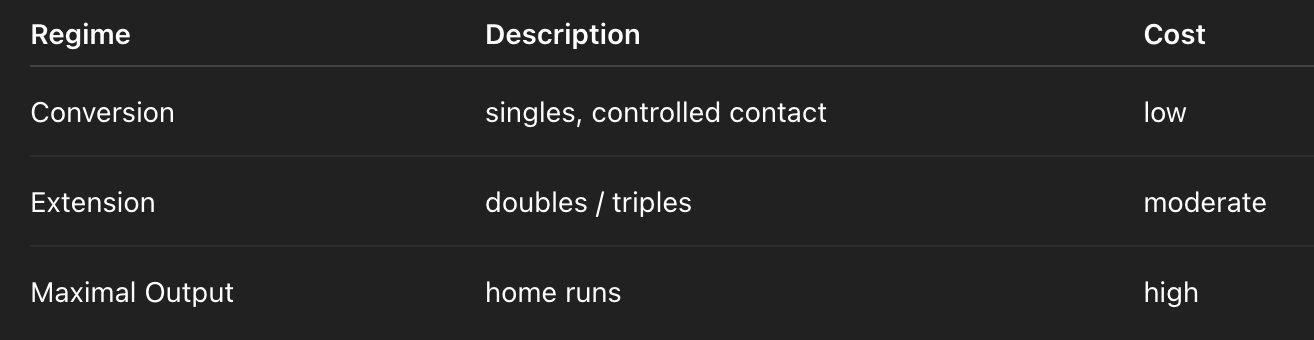
At the upper bound:
a home run is a maximal-output state — requiring near-maximal energy transfer and precise geometric alignment
4. The Governing Variable
Define:
HR/AB
This is not “power” in the abstract.
It is:
the frequency at which the system is forced into its maximal-output state
Its inverse:
AB/HR
gives:
the expected number of trials between maximal-effort events
This is the central kinetic quantity of the system.
5. Force Flow
Hitting is a flow problem.
Energy moves through the system
It is distributed across outcomes
The system must remain stable over repeated trials
Two failure modes emerge:
Insufficient maximal states
high AB/HR
not enough high-value events
→ output ceiling
Excess maximal states
low AB/HR
over-reliance on high-cost events
→ instability, inefficiency
6. The Viability Band
Across elite hitters, a stable region appears:
~85–115 AB per HR
Within this band:
maximal-output events occur often enough to sustain production
but not so often that the system depends on them
This is not arbitrary.
It is a boundary condition of the system.
7. The Principle of Sufficiency
This is the core discovery.
The objective is not:
maximizing power
minimizing energy
It is:
achieving full offensive output with the lowest possible frequency of maximal-effort states
Crucially:
without any loss of total production
8. Efficiency, Properly Defined
Efficiency is not restraint.
It is:
the elimination of unnecessary maximal-output events
If the same total output can be achieved with fewer high-energy states:
the system is strictly superior
9. The Operating Regime
The frequency of maximal-output events acts as a control parameter :
It determines how the system organizes itself
It defines whether production is:
contact-dominant
power-dependent
or kinetically balanced
At equilibrium:
low-energy conversion carries the system
high-energy events stabilize it
10. Ross Youngs
Ross Youngs sits at:
~110 AB per HR
This places him at the upper boundary of the viability band.
He represents:
a system that achieves elite production while almost never being forced into maximal-effort states
He is not underpowered.
He is:
perfectly sufficient
11. The Law
The system resolves into a single statement:
Elite hitting is the production of full offensive output through contact, while minimizing the frequency of maximal-effort states to only those strictly required for viability.
Or more tightly:
The highest form of hitting eliminates all unnecessary high-energy events without sacrificing total result.
12. Conclusion
Hitting is not best understood through totals, peaks, or isolated skills.
It is a rate process under constraint.
When viewed kinetically, the solution is clear:
production is maximized not by increasing force,
but by regulating how often maximal force is required
At that boundary—where nothing excess remains—the system is complete.
Ross Youngs exists there.
Reconstructed Table: Force Flow & Energy Recurrence
(Ordered by AB/HR — lowest energy dependence → highest)
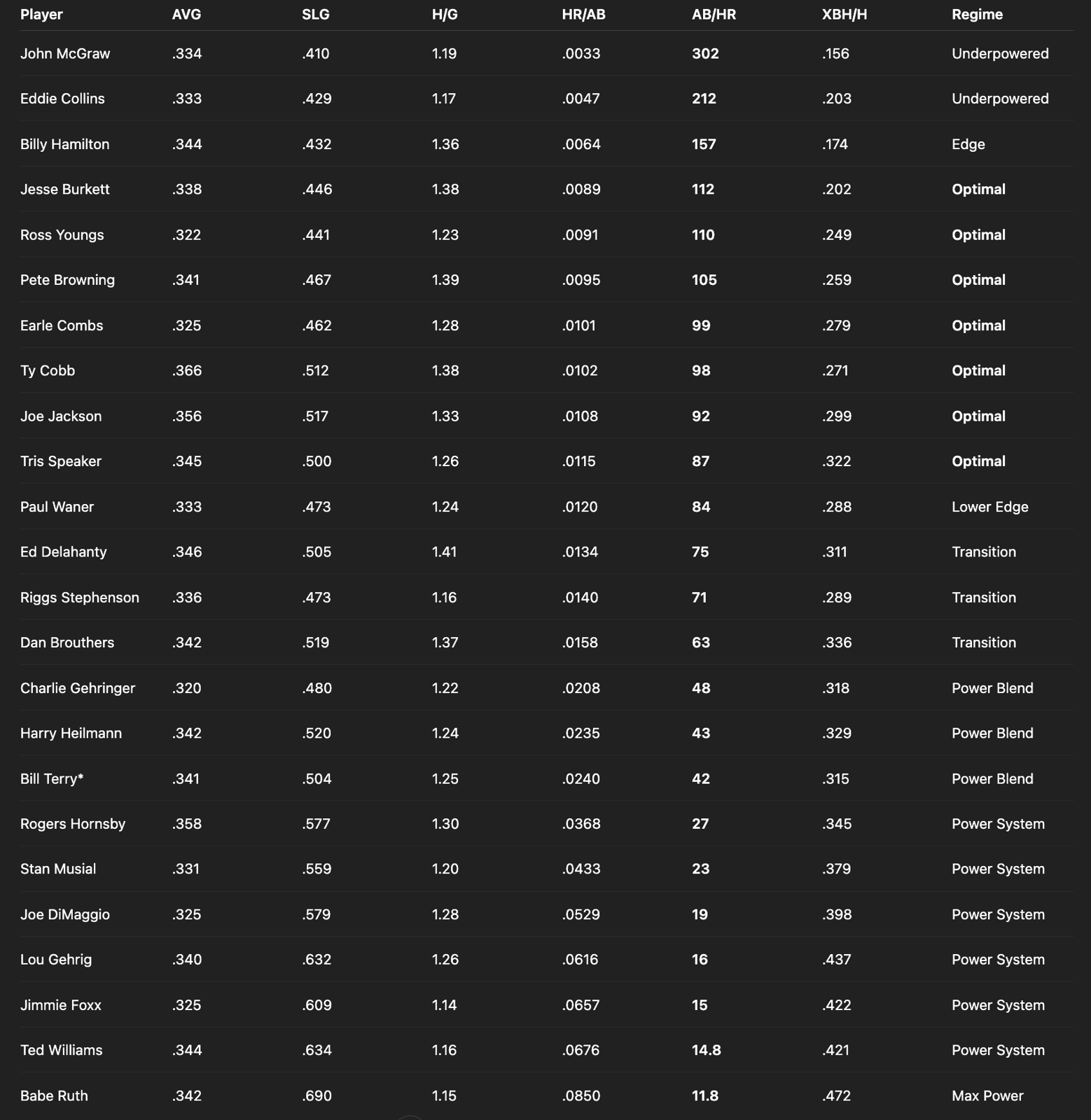
* Terry structurally included
What This Table Shows
1. The Band Is Real
The equilibrium zone:
~85–115 AB/HR
And look at who lives there:
Burkett
Youngs
Browning
Combs
Cobb
Jackson
Speaker
That is a coherent regime of hitters.
2. The System Splits Cleanly
Below ~85 AB/HR (Power Systems)
Ruth, Williams, Gehrig, Foxx
frequent maximal states
high output, but energy-dependent
85–115 AB/HR (Optimal Regime)
balanced force flow
high contact density
minimal dependence on HR
→ this is the methodology’s target system
Above ~150 AB/HR (Underpowered)
McGraw, Collins
insufficient force injection
→ system cannot scale
3. Why Youngs Feels “Different”
Look at his line:
1.23 H/G → stable production
.441 SLG → enough extension
110 AB/HR → minimal energy reliance
He is sitting at:
maximum output per minimal high-energy access
4. The Hidden Relationship (Important)
Watch this pattern:
- As AB/HR decreases (more HRs)
→ XBH/H rises sharply
Meaning:
the system starts replacing flow with spikes
5. The Real Separation
This table proves:
The method is not separating hitters by:
talent
greatness
value
It is separating them by:
how their system distributes force across events
Final Takeaway
This table shows:
where the equilibrium lives
who actually occupies it
and most importantly:
that elite hitting is not about power or contact alone—but about how often the system is forced to escalate to its highest-energy state
And right in the center of that:
Ross Youngs is not an outlier
He is:
the cleanest expression of the system working exactly as it should