The Legibility Problem in Baseball History: Billy Hamilton and the Invisibility of Infrastructure
The Legibility Problem in Baseball History: Billy Hamilton and the Invisibility of Infrastructure
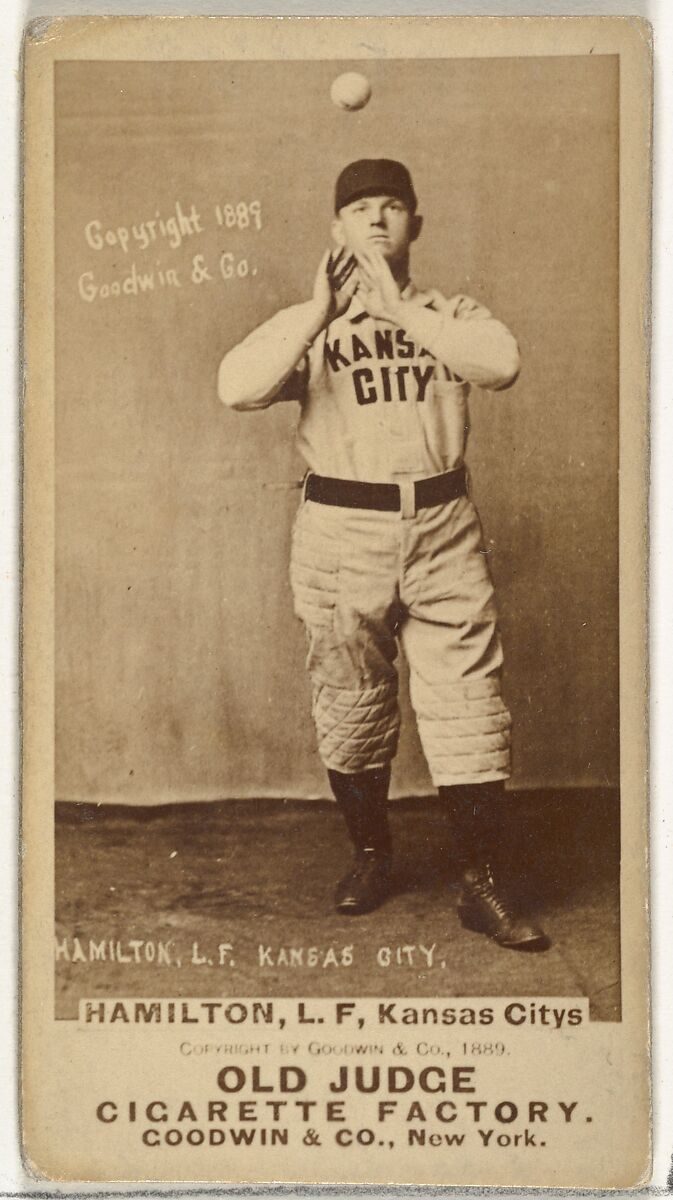
The Legibility Problem in Baseball History
Billy Hamilton and the Invisibility of Infrastructure
Baseball does not forget at random. It forgets according to legibility.
The sport preserves what it can easily narrate: spectacle, rupture, visible separation. It remembers towering home runs, 300-win milestones, singular feats that photograph well and compress into mythology. It struggles to remember infrastructure.
That asymmetry explains why Billy Hamilton appears marginal in popular memory yet stabilizes near the top of the historical record when evaluated through sustained on-base dominance.
I. The High-Volume OBP Filter
Apply a narrow historical constraint:
At least 7,000 career plate appearances
Elite career on-base percentage
Multi-season durability across structural shifts
The list contracts immediately.
At the summit stand:
Ted Williams — .481 OBP
Babe Ruth — .474 OBP
Billy Hamilton — .455 OBP
No other player with comparable volume sustains an on-base percentage at that altitude.
Williams represents the formalization of strike-zone science.
Ruth fuses possession with unprecedented damage density.
Hamilton predates both and yet stands directly behind them in sustained defiance of the out.
That result feels extreme only because baseball history is rarely sorted this way.
II. Structural Legibility and Asymmetry
Pitching greatness is inherently legible. Run prevention has always been evaluated relative to environment. ERA, ERA+, innings totals, and win accumulations are already compression-aware metrics. When we encounter the résumé of Kid Nichols—361 wins, nearly 5,000 innings, a career ERA+ around 140—dominance is immediately intelligible.
Hitting greatness, by contrast, is culturally encoded through spectacle. Slugging, home runs, and visible damage anchor memory. When reviewing Dan Brouthers and his .520 career slugging percentage with a 171 OPS+, the separation registers instantly because power remains narratively vivid across eras.
Hamilton’s profile does not spike in the same way. It accumulates.
III. Infrastructure Versus Event
Hamilton’s record is defined by scale and persistence:
7,609 plate appearances
1,189 walks
1,697 runs scored
914 stolen bases
.455 career OBP
These numbers describe process control:
Outs avoided
Innings extended
Run expectancy stabilized
Sequencing pressure maintained
They represent structural efficiency rather than episodic spectacle.
Infrastructure sustains the system without announcing itself. As a result, it rarely becomes myth.
IV. The 1893 Shock as a Case Study
The legibility problem becomes most visible in 1893, the first season after the pitching distance was moved to 60 feet 6 inches. The geometry of the game changed abruptly; offensive output surged.
Hamilton’s response:
.490 OBP
1.014 OPS
167 OPS+
110 runs in 82 games
In the hinge moment of modern pitching distance, he reached base nearly half the time.
Had that season been defined by home-run spectacle, it would anchor collective memory. Instead, it was defined by 63 walks, relentless base occupancy, and inning extension.
The dominance was infrastructural—and infrastructure does not photograph well.
V. Compression and the Invariant Skill
Periods of greatest compression clarify baseball’s invariant law. When run environments shrink and margins narrow, the marginal value of each avoided out increases.
On-base percentage becomes the constant.
Hamilton developed this skill in a volatile 19th-century landscape and sustained it across the 1893 structural shift. It later becomes refined under Deadball compression and fully formalized by Williams in the mid-20th century.
Hamilton discovered that outs were costly.
Williams demonstrated that they were mathematically intolerable.
The competitive density changes; the skill does not.
VI. Why Hamilton Feels Forgotten
Hamilton is not absent from the statistical record. He is underweighted within narrative memory.
Several forces converge:
Pre-1900 discounting of competitive conditions
Lack of cinematic power identity
Absence of modern visual documentation
Cultural preference for visible damage over possession efficiency
Pitchers remain legible because their greatness is framed through scarcity metrics. Power hitters remain legible because their dominance produces discrete events.
Hamilton’s greatness lies in the refusal to surrender the inning.
That is more difficult to narrate.
VII. Reordering the Hierarchy
When baseball history is sorted by spectacle, Hamilton recedes.
When sorted by sustained, high-volume defiance of outs, he stabilizes near the apex.
He does not surpass Williams or Ruth; their combination of possession and damage exceeds his total offensive impact. But he occupies the same structural tier of sustained on-base mastery at scale.
From Hamilton to Williams, baseball clarifies around a single durable principle:
The refusal to make outs is the deepest offensive constant.
Hamilton did not vanish from history.
He became difficult to see.
When the evaluative lens shifts from event to architecture, he returns—not as anomaly, but as foundation.