The Literary Pursuit of Baseball: Barber, Povich, Dean; The American Spirit Made Word & Flesh
The Literary Pursuit of Baseball: Barber, Povich, Dean; The American Spirit Made Word & Flesh
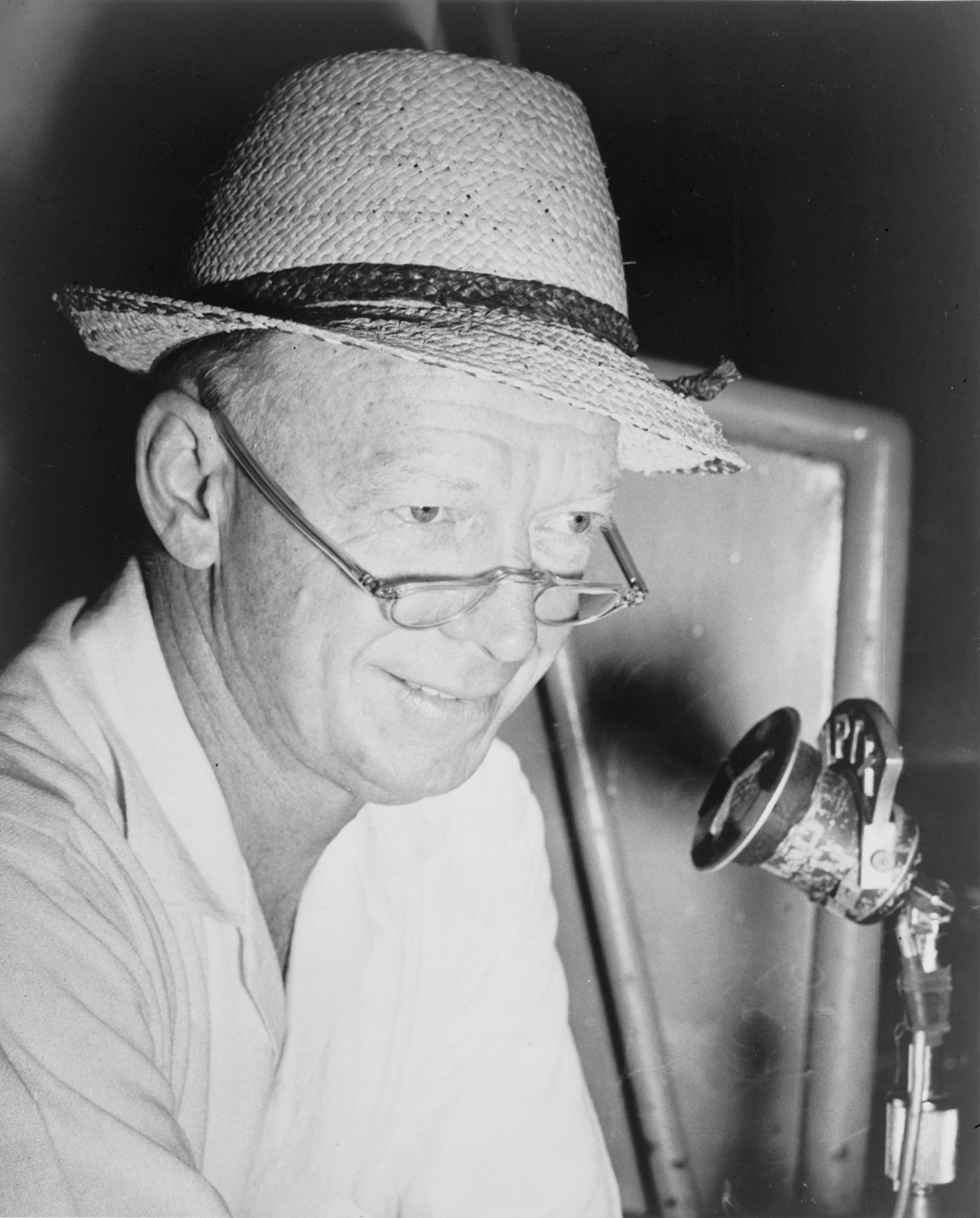
Red Barber, famed Brooklyn Dodgers announcer, author of “the catbird seat”, among other sayings.
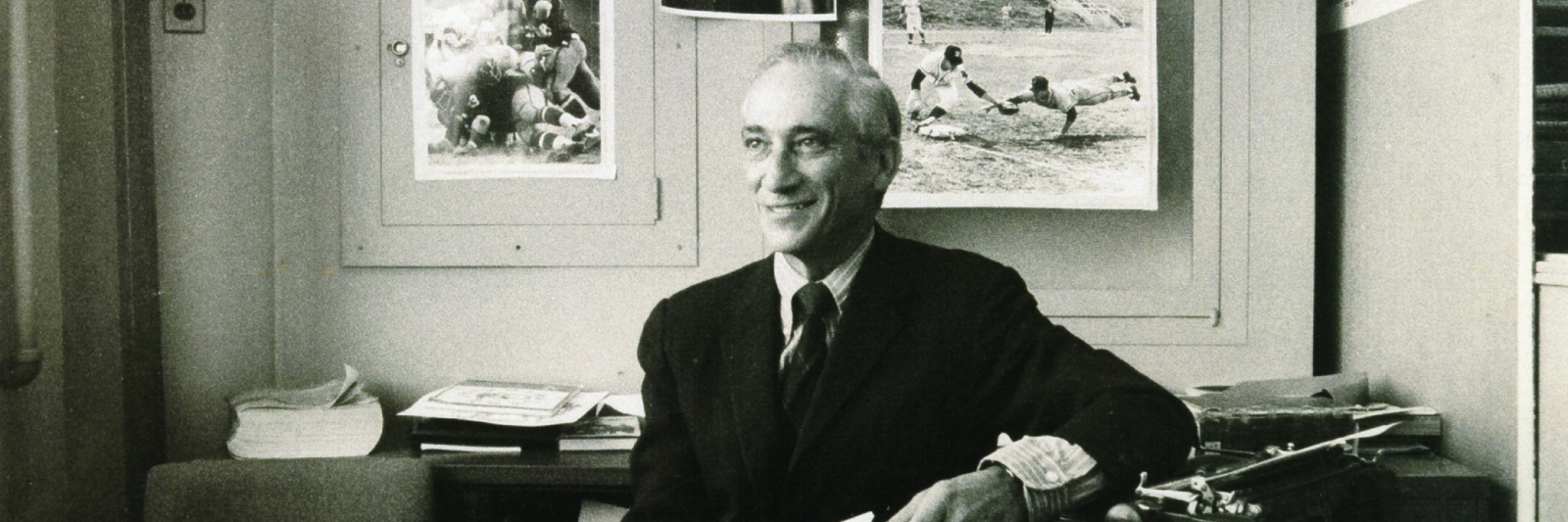
Shirley Povich, “master of the declarative sentence”; baseball sportswriter for the Washington Post.
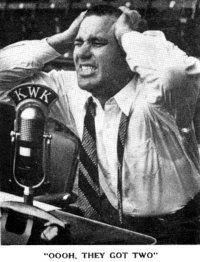
“Dizzy” Dean, former Gas House Gang Cardinals pitcher, at work for KWK Radio.
The literary pursuit of baseball is the game of gifting sounds and sentences to an otherwise silent story of the heritage of concentration, skill, discipline, and athletic motion and movement. It is an act of translation — drawing this legacy and story of the silent ballet out into the light; depicting it with the proper mythic density, anticipation, tension, and pace as is required to elucidate the true cultural meaning and importance; metaphysical and existential act of the ballgame itself: as it takes place in human being space and time.
It is an economy of expressiveness; a tight poetic economy, declarative and foundational, Povich’s perfect game prose: “The million to one shot came in. Hell froze over. A month of Sundays hit the calendar. Don Larsen pitched a no-hit no-run no-man reach first base in a World Series.”
It is a linguistic economy of bending light toward sound and making the English language work for the ballgame: “Runners ‘slud’…batters ‘swang,’…pitchers ‘throwed’ the ball with great ‘spart’ [spirit]…a hitter could look ‘mighty hitterish’ or stand ‘confidentially’ at the plate.” (Curt Smith on Dean’s grammarianism).
It is an economy of direction, orientation, height; perspective: Barber’s ‘catbird seat’, pole position, describing the dimensions of the lofty, towering fly ball off the bat of Hodges, Henrich, or Campanella; “No Brooklyn batter turned left toward second base, they all turned right”.
The language must move around the American game; in this way linguistically the sport is a passionate prose first; a prose of triumph and ecstasy and total participation which forces linguistic bending and breaking in order to communicate the spirit of the game proper. The egalitarian game, the southern game, the working game; the men in it whose language was a method of communication to accomplish and achieve task. Calling the fly ball, developing signs and signals to convey pitches and hit and runs: baseball is the freedom of sign as it is redirected and reoriented toward the sole purpose of emboldening and describing, anticipating and communicating in a secretive fashion: movements, battle plans, feats of power, speed, synchrony.
Thus the literary pursuit of the American game is the bright opening; the hole in the language which allies itself directly to cultural theatre as apostolic function: returning language to its fundamental pre-symbolic purpose of describing the energetic function of the movement of the crowd; the sun leering on high; the correct descriptive altitude of a Ruthian swat or a Hornsby liner.
It is, therein, a historical theatre whose speech is returned to sanctified human grounds, as it aspires to no heights only egalitarian depths of joy, fervor; communal mass participation. Early beat writers like Charles Dryden painted the game with poetic description that drew life out of the ordinary and supplanted the mythic in its place:
"These young pitchers along the string bean circuit, who are supposed not to have anything but the glove and a return ticket, bother the [White] Sox more than do hurlers who have a rep.” — Dryden, Chicago Tribune (1907).
The literary and poetic function of the beat game was critical to the mythological process of early modern baseball, as were the colorful nicknames bestowed upon the players; how they were known on the ballfield. “Schoolboy” Hoyt, “Three-Finger” Brown, “Big Six” Mathewson; “Cannonball” Redding; “Preacher” Rowe.
BILL WAMBSGANSS: “Ray Chapman was the regular shortstop when I got there. A great one, too. Ring Lardner was writing sports in those days, and he must have gotten intrigued by my name — he wasn’t the first, nor the last. I’d hardly joined the team before I read the limerick in the newspaper:
The Naps bought a shortstop named Wambsganss,
Who is slated to fill Ray Chapman’s pants.
But when he saw Ray,
And the way he could play,
He muttered, ‘I haven’t a clam’s chance!’ ”
This is a total environment; a network of speech that combined with the colorful reporting and slang of the era ratcheted up to excesses typical of baseball’s reputation as entertainment; equally, a sport for entertainers. "Schoolboy” Hoyt, leading pitcher for the Murders’ Row Yanks of 1927, was a vaudevillian in nights. Many other ballplayers shared his affinity for the stage and circus, such as Rube Waddell and Jack Glasscock. This environment around baseball, loose, rickety, filled with feats — was ample opportunity for the industrial and individual literary minds (including within the sport, as it was with Dean, Hoyt, and Satchel Paige) to flex their craft as bardic figures constructing the sound and word and tome of baseball as a way of speaking, thinking, and being.
This critical mode was shared by decidedly “un-literary” figures. Unpronounced next to great American figures like Douglass, Sexton, Poe, and Faulkner, wordsmiths like Barber, Povich, and Dean set to work carving out the language of America’s lived, breathing motion: ritualized in beat reporting and radio broadcasting of methods of bringing the game to life while it was still swinging; in the brief moments and early mornings of inspiration to recap the witnessed feats of the night prior. Many more names abound — particularly in the early game — who depicted the composite affects of the unfolding drama of baseball:
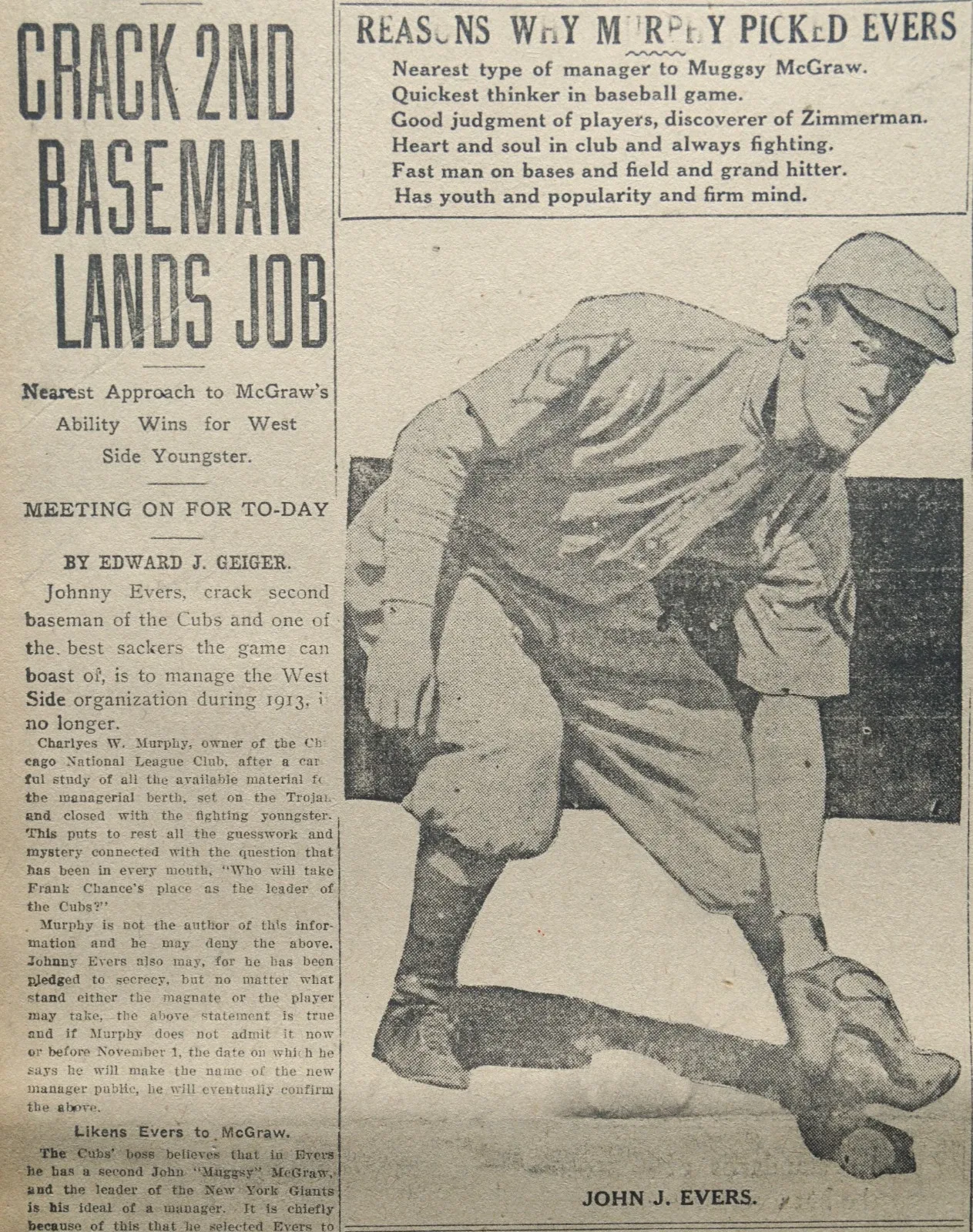
A Chicago October 1912 paper depicting the ascent of Hall of Fame second baseman Evers to manager.
Poetry, slang, satirical cartoons; as the game found increasing technological foothold — the voices of Dean and Barber — created a fantastical realm for coloring baseball; a literary form bridging distances in depiction; through space and time:
Cheney and Cicotte Billed for Slab Work: A fine scrap was on the bill. The Cubs figured that if they would trounce the Sox in to-day’s battle they would be the logical favorites in the series. They could then meet the mighty Walsh on the morrow…
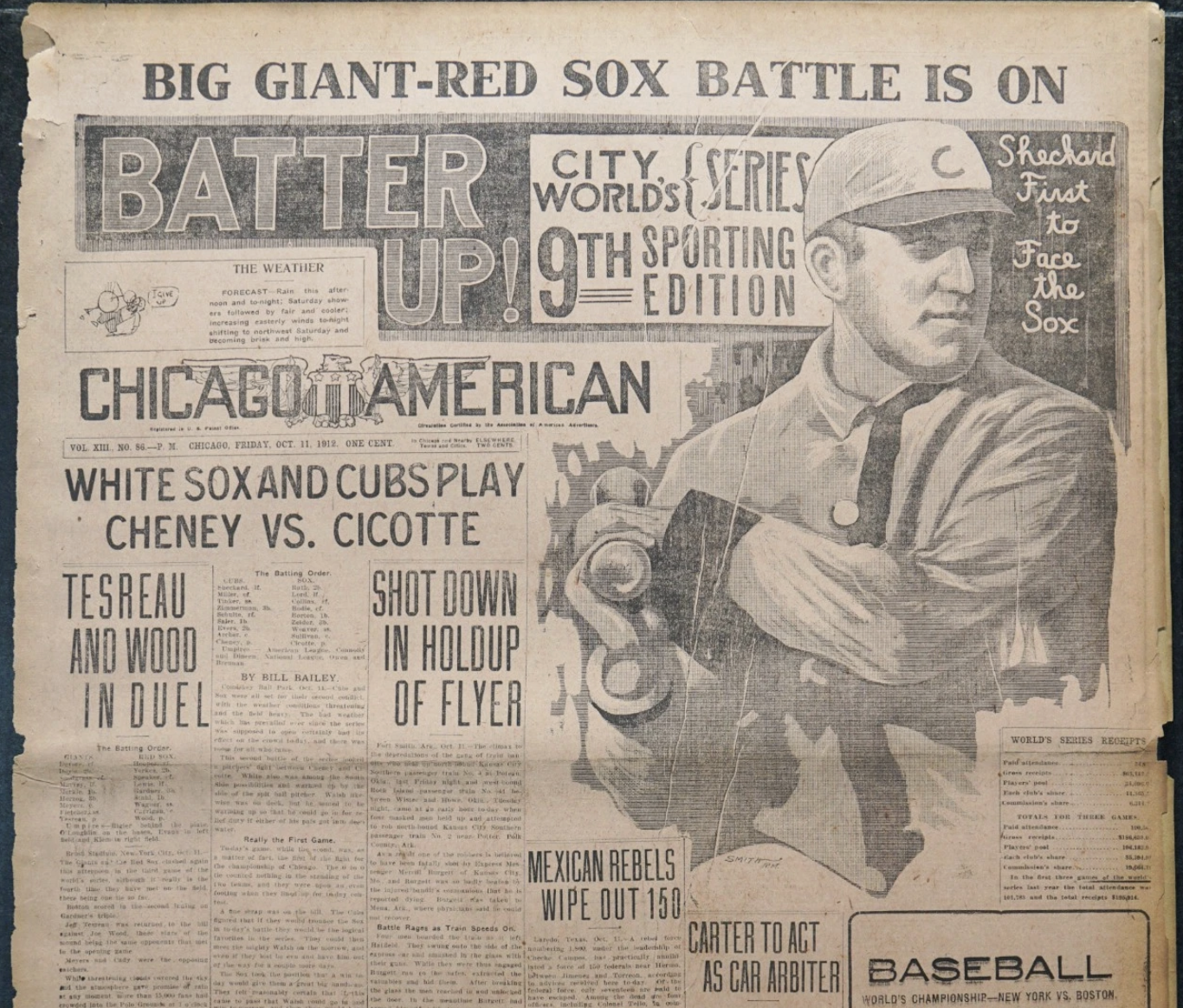
The composite illustrative and design beauty of the aforementioned Cheney/Cicotte advertised bill.
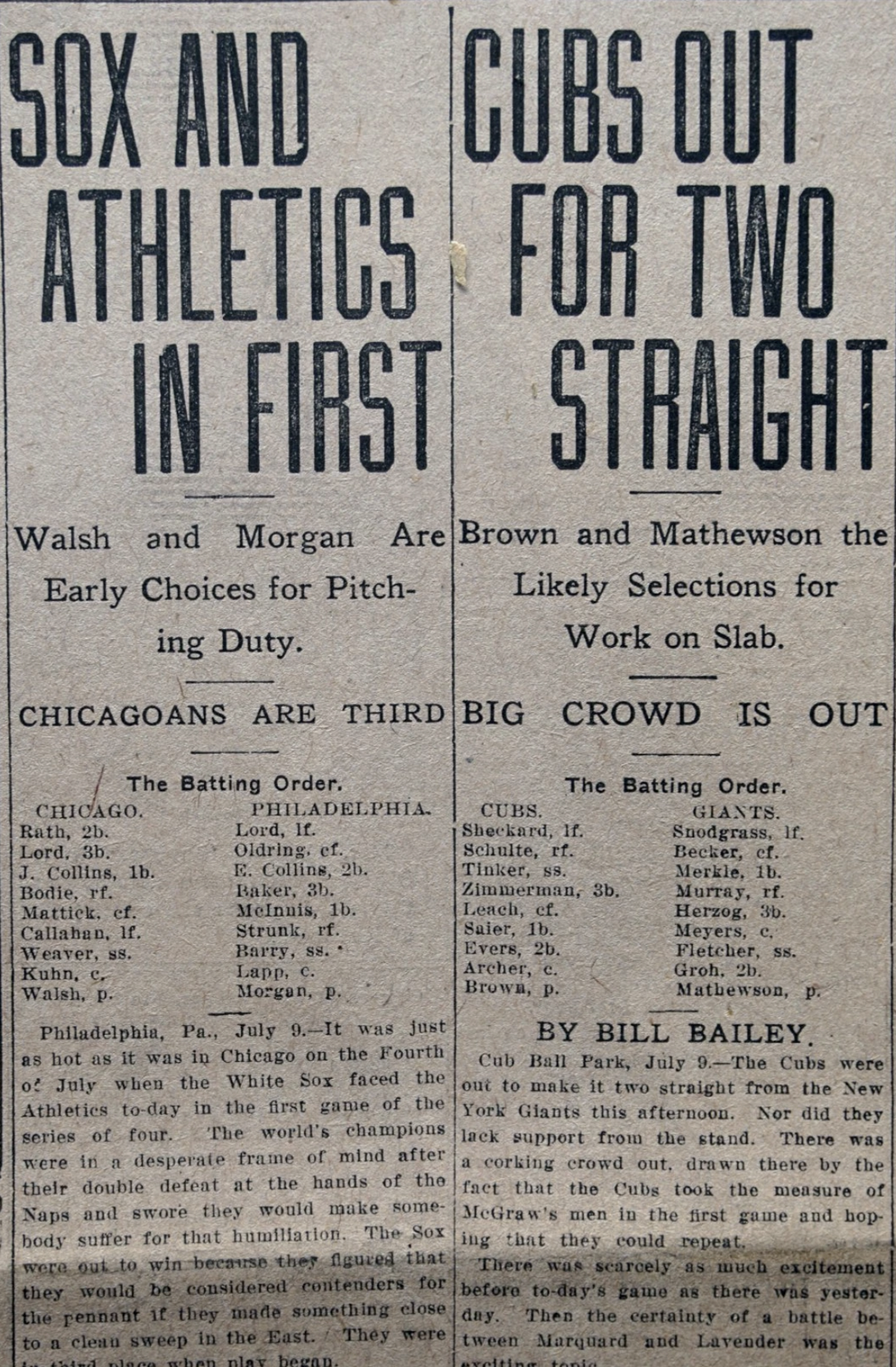
Another fantastic example from a 1912 Chicago paper.
The beat-writing was clear, to the point, slang filled; colorful. Painting a depiction of the scene of the game in the common, colloquial democratic speech; written in a way the common American could understand. This was the key faculty which unified the work of the preeminent trio of Povich, Barber, and Dean — they were imminent writers in the public domain for industrial media outlets, painting the picture of America’s game for America’s citizenry. And thus, their literary endeavors must be broad, holistic, and all encompassing — an open door for the near illiterate, the factory worker, the salesman; the bureaucrat alike. This common language of baseball was then rendered according to that which it required: the mythic, playful color and plaintive banter; plain spoken, affirmative, workmanlike; with the egalitarian ethos of the working class — that reflected America’s soul back unto it.
It was a natural production, which accommodated exactly what was required of it: the fitting of each man, woman, and child into the grand stadium of America’s dream-state. Therein, economy, fancy, the breaking of decorum, slang, and storytelling would be of the utmost: to captivate and attend; make attendance to the ballgame possible by ear and eye leagues from the site of the event itself.
And thus it was manufactured with no highfalutin claim to literature; to merely give aid and voice to the nation’s pastime in a language authentic to the greatest common of the souls of the nation itself. To enrich and open up the ballgame to all. This common act is the true backdrop of any great literary tradition: to avail the deeper, inner meaning of the existential dilemma of man to the greatest possible audience; to let the whole of mankind into the ineffable drama of the universe — drawn out in the twin bill of the ballgame; "Big Six” vs. “Three Finger”; in the color and use of word that brings life to language; language to life.
The creation of the mythic dimension of baseball would not have been possible without the word — as the word was the gateway between purely descriptive, documentarian English and the language of the heart, sweat, and blood of the ballgame. Dean’s “slud” is a critical intervention in the English language; as are Povich’s telegram-esque sentences; Barber’s poetic leaps, ramblings, and wanderings in describing the total scene and historical consequence of any given October night of baseball. They are interventions of style, technique, inversion of hierarchy; old tribal depiction to grant space in the circle of a large, ritual communal event of the mythic history of an emerging American civilization.
Without Dean’s discretions, Povich’s telegram style, and Barber’s poesie, Americans are left with the rote facts, a war ledger or a laundry list of ballgames, stats, basic depictions which emerge from the same cool temperature of the basic human life and times. Baseball was meant to be; required to be an escape of transcendental magnitude; an event, theatre, and coliseum of legends and titans pulled from America’s underbelly; her gutters and her machinist floors. As such, it needed to distill and condense these mythic, historical proportions into a depths that besoothed it: cartoonish, larger than life, illustrative; steeped in proletarian slang, irreverent, short, to the point, quick bursts, descriptive sentences; quick, powerful, muscular movement.
The prose and poetry of baseball is the game itself, distilled. It is not only a genre of literature, but an American way of thinking, speaking, and being about the ballgame. In the collective collaboration of literary baseball’s construction, we find the remains: an American way of being which distilled the character of the common American soul into a behavioral and linguistic practice of the everyday. The language needed not just a way to communicate the literary nature of American being, but the American way of being, imminently, in time; to be able to communicate that historical, earthly, bodily timeliness across time: wire, paper, radio.