The Organic Task of the Hitter: Dave Orr and Billy Hamilton
The Organic Task of the Hitter: Dave Orr and Billy Hamilton
The Organic Task of the Hitter: Dave Orr and Billy Hamilton
When evaluating hitters historically, it is useful to separate two different offensive functions that occur within a plate appearance.
The first is the organic act of hitting itself —the physical process of striking a pitched ball and converting that contact into a successful hit.
The second is the broader strategic act of reaching base , which includes walks and other passive outcomes that do not require the ball to be put into play.
Many of baseball’s greatest players combine these two functions. But occasionally a hitter emerges who represents one side of this divide in its purest form.
The contrast between Dave Orr and Billy Hamilton illustrates this distinction with unusual clarity.
Dave Orr and the Act of Hitting
Orr’s statistical profile reveals a hitter who almost entirely eliminated passive plate appearances.
.342 batting average
1.42 hits per game — highest in major league history
0.12 walks per game
Because Orr walked so rarely, nearly every plate appearance became a direct engagement with the pitcher. The plate appearance resolved not through patience, but through contact.
In practical terms, this means Orr’s offensive value was generated almost entirely through the organic task of hitting : seeing the ball, striking it, and converting that contact into a base hit.
Ordinarily such an aggressive profile would lead to a decline in batting average. Hitters who swing frequently tend to sacrifice efficiency.
Orr did not.
Despite eliminating walks almost entirely, he maintained a .342 average and produced the highest hits-per-game rate in the history of the sport. At the same time, his .502 slugging percentage in the 1880s indicates that the contact he produced was not merely frequent but powerful.
His offensive profile therefore represents an unusually pure expression of the hitting act itself.
Billy Hamilton and the Expansion of the Plate Appearance
Hamilton represents the opposite configuration.
While he was also an excellent hitter (.344 average), his offensive engine relied heavily on walks.
.344 batting average
1.36 hits per game
0.75 walks per game
Hamilton walked roughly six times more often than Orr.
This dramatically altered the structure of his plate appearances. Many of Hamilton’s trips to the plate ended without the ball ever being struck.
From the standpoint of run creation, this approach was extraordinarily effective. Hamilton’s .455 on-base percentage is one of the highest figures in baseball history, and his speed turned many of those walks into immediate scoring threats.
But the mechanism of production is fundamentally different.
Where Orr resolved the plate appearance through contact, Hamilton often resolved it through patience.
Two Different Definitions of Hitting
Seen together, the two players reveal two distinct ways offense can be generated.
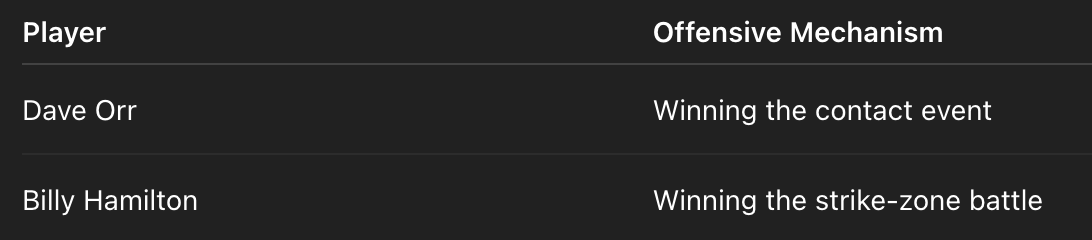
Hamilton maximized the probability of reaching base.
Orr maximized the probability that a swing would become a hit.
Both approaches produce tremendous offensive value. But only one isolates the act of hitting itself.
The Meaning of Pure Hitting
If offensive value is measured broadly—incorporating walks, baserunning, and total run creation—Hamilton stands among the most effective players in baseball history.
But if the focus is narrowed to the organic task of the hitter , the ability to turn swings into successful contact, Orr’s profile becomes uniquely compelling.
By nearly eliminating passive outcomes and succeeding at an elite rate whenever he put the ball in play, Orr produced one of the most concentrated statistical expressions of hitting ability the game has ever seen.
In that sense, the contrast between Orr and Hamilton does not simply describe two great players.
It reveals the difference between reaching base and hitting the baseball.