The Powers: Greenberg, Robinson & the Emergent Historical-Material Properties of Heroism
Video
The Powers: Greenberg, Robinson & the Emergent Historical-Material Properties of Heroism
00:00
So I want to show you this profound arising of the historical and material conditions for heroism, which emerge natively out of the substratum, out of the roots of consciousness, which is a perennial contradiction, which reaches a moment of dialectical tension, which necessitates the emergence of the heroic act.
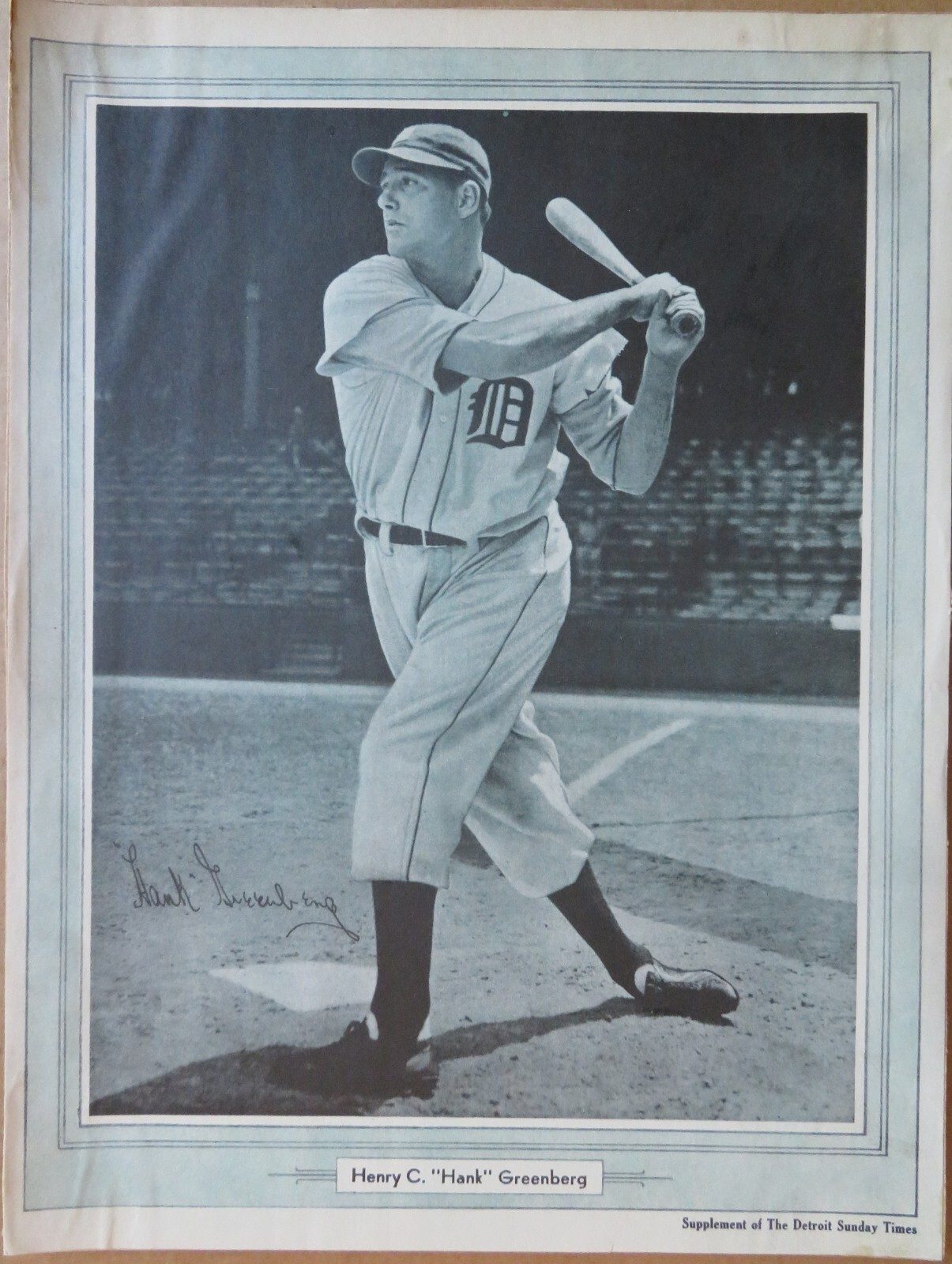
So here I have this 1935 Detroit Sunday Times newspaper supplement of Hank Greenberg. I want to talk about history as a form of disclosure, as way of being in a grand cosmological sense, which forces disclosure through paradigm shifting acts of heroism, which emerge radical new forms of consciousness through the heroic act.
00:56
As a rise of the grand, the epic, the heroic, transcendental self as in the higher self or the God self, the emergence of the God self through the creation of the possibility historically for the heroic circumstance. So there must necessarily be a contraction within the field of being proper.
Such as World War II, the rise of global fascism, mass ethnic discrimination, right? I’m just kind of listing off these different possibilities. Jackie Robinson in 1947 with the protracted discrimination against black people in the United States of America. We’re looking here at these mass historical unfoldings, which themselves are the presentation within the field of consciousness… as opportunity for the heroic act to reveal the latent potentiality in humanity, which is to say the rise into power of being — a radical form of truth or love or justice or consciousness or participation or strength or courage… into that field of consciousness, in the face of this kind tensile darkness.
02:19
I’ll bring up Heidegger again. Heidegger calls this the waiting midnight of history, where there is this turning in the dark that necessitates some sort of emergence from the foundation or the cosmic fabric of being to alight the darkness, or this void, or this abyss of history. And so much of what we know of human history, you could call it in a kind of an esoteric way calamity or destruction or chaos, in the unfolding of the unconscious survival-based instincts of individuals as they interact with space and time and others and objects and are themselves moving the chairs of historical material consciousness, which is to say revolutions, wars, power regimes, racial hierarchies, discrimination, slavery… abuse and abuses of power and control and force, right?
So you have these historical and material conditions which themselves are always necessarily in a grander biological evolutionary state of consciousness, a fertile ground for the emergence of the heroic act. So what is necessitated in the heroic act is again through this darkness and calamity and abyss of history, rising of a power of consciousness or a figure or group of figures who transfigure this darkness through revelation as in a state of play or a state of being or a way of being — which in itself is the carving of another path out from the abyss into the light of consciousness. This is traditionally, conventionally, historically, archetypically, archetypally the realm of the heroic.
04:17
So what I was kind of synthesizing here, I wrote myself a quick note, is this idea of creating a meta text here for this next essay regarding how history moves from the literal embodiment of passage of time, which is to say presence of being in the moment or momentousness — into image objects or relics or... whatever remains from the fragmentation of that present moment into past, as in the stepping of that present moment into a futurity, when then that present moment becomes a historical stone or sedimentary fracture off from that presence of incarnation, which is to say maybe this newspaper supplement is a good example.
Those fragments are then obtained as relics or markers or artifacts, which then are the recalling of that field of being back into the present. This is the mode of the historical object.
So what we’re looking at here are these radical recapitulations. And again, I’m contextualizing it through baseball. These recapitulations, which is Greenberg, which is Robinson — I think the two of them in particular are just the most notable when we’re talking about this kind of historical emergence as it exists through baseball. The necessity of the heroic act… and I might add Bud Fowler or Fleet Walker into this.
05:55
Who else would I add here? Maybe Emilio Sabourin, right? Where we discussed him in Cuba as a revolutionary who was also a baseball player. We’re looking at these moments in time and history which avail themselves to us as the heroic potentiality of human life. Which again, as we discussed in the last essay, there is this latent potentiality for the metabolization of the will, which is to say the human metabolism, thermodynamics, entropy, the biochemical existence of the organism itself — which is dedicated usually to rote tasks such as survival, reproduction, the daily or the everyday, so to speak.
So there’s this churn which the Russian poet Vladimir Mayakovsky would call the byt, B-Y-T, byt. And it would be the realm of the everyday. Which is the rote mechanization, the wheel that keeps turning and turning and turning of humanity in a biological evolutionary sense, which is glacial. It’s a glacial form of progress in the evolution of consciousness as it pertains to the organismic body. So what we’re talking about when we’re talking about the availing of the historical material moment of heroism is to say there is this possibility, this mass latent possibility within history which is made available to us, right? This is a recontextualization and uh a re-perspectivalization of history, the historical, the way of viewing history as maybe calamity or chaos or destruction, and maybe that primal response of fear of scarcity or the survival of the organism, right? Which again, would just lapse back into the everyday.
07:51
There is almost consistently… and again, right, you see historical epochs that emerge, such as the contemporary one, or maybe if you wanted to go back to World War II, you wanted to go back to the civil rights era in the United States of America. There are these historical pockets where these mass forms of consciousness contradiction, as in maybe, let’s say, the awakening to corruption or the awakening to globalization or the awakening to discrimination, right, all of these different forms of consciousness realization that are occurring in collectives or communal spaces — are availing human consciousness of the potentiality of the heroic act, which is a sort of hyperspace of consciousness evolution toward the realization of integral unity in space and time through the act of cultural or social or spiritual enlightenment — the envisionment and creation of that in space and time as a manifestation of the emergent teleological unity… the coming of God, so to speak — in that integral realization of the primordial self in space-time.
This phenomenological emergence of the heroic integral unity in form — which is not reliant on the glacial form of teleological evolution of the organismic body, which is to say reproduction, reproduction, reproduction into maybe growing another part of the brain which is able to process things different psychically, is able to visualize space differently, or it’s able to have discourse beyond the normal sensate realm which we are supposed to knowing… which would of course be an evolution in consciousness, evolution in perception. Right? And this is what William Blake talks a lot about. He talks about if the gates of perception were cleansed, man would see everything as it is and as it was, infinite.
09:16
This is the problem of history, which is addressed by tens, if not hundreds of metaphysicians who are working in different fields, whether that’s philosophy or science or different forms of humanism, et cetera. There’s this focus on the sensate limitations of the human being, which can only really evolve through glacial evolution, which is to say species level evolution of hundreds of thousands of years, really.
So there’s this angle, right, which is so much to say a reliance or a dependence or a submission back into the field of nature to be reclaimed and to be repurposed and to be re-technologized and to hopefully bring about again this another post-lapsarian moment in human history which would allow for grand species consciousness to emerge as an enlightenment revelation through this new vehicle of perception which would be the organism, the post-human being maybe so to speak, whatever the species name would be or would be called.
10:15
So beyond that, you’re basically laying in wait for this transformative moment to emerge as an apocalyptic… this is kind of the psychology of the second coming or the psychology of the penitent who is waiting for God to emerge. This is again, this is the beauty of the... the revelation of consciousness through a historical material lens — is that history is actually presenting the heroic moment to us and making it available to us.
So in this period of time in history, which is so profound, Walter Benjamin writes the the Theses on the Philosophy of History, which is perhaps one of the most profound philosophical treatises ever written, where he talks about the angel of history, which is a fantastic philosophical concept. That’s not what I’m going to talk to you here about.
I’m going to talk to you about what happens to him in 1940, where he’s fleeing from the persecution of the Jews in Germany. And he commits suicide, I believe, on the Spanish border in 1940. The anniversary of his death was actually just yesterday or two days ago. So we’re talking about a historical moment here, which is a very much so a life or death moment, especially when it relates to the Jewish ethnicity and the availability of the presence of the heroic act — which would be to say, let’s just say go to war or contribute in a meaningful way to assuring the safety and success and livelihood and health and well-being of a vast majority of a group of people.
This would be to say in a large... large sense, a heroic cause en masse. We could just frame it and contextualize it this way. There being this mass genocide that’s occurring. So what is one to do about this? So in so many ways, I just want to expand that and generalize it and make it a metaphysical concept. What history and historical materialism as a form of consciousness is doing is presenting us over and over and over again phenomenologically with the possibility of the heroic act as a raising of consciousness as a way of a sort of hyperspace of evolution, a hyperspace of phenomenological power in the heroic act itself.
12:57
And what the heroic act does is it represents… represents the essential power of the will toward the integral — toward the integral whole, which is the striving of all life toward, you could say, universal love or God or wholeness or total unity with the foundational fabric of being itself, as in the essence of the will to be reunified with the source or the force of all things that constructs and creates this reality that we experience phenomenologically through the sensate body, through the organism, through the biochemical interconnections which form our nervous systems and our bodies; the genetic chain, which is the information which forms our bodies and our experience.
This seeking towards reunification with that wholeness is itself the heroic quest. This is the heroic quest which you would see most commonly in the monk or in the metaphysician or in the spiritualist, in a historical archetypal figure like Hercules. In the remembrance of the lived body as in a return from dismemberment or crucifixion of the physical self which is common to the fragmentation of the form in the mythos of Osiris, Dionysus; too in Christ — as in a symbolization, a metaphorical telling or a mythical telling of that quest back towards wholeness.
Again, the heroic quest of going into and descending into as Dante would descend into the cave or the depths of hell to retrieve this fundamental aspect of the soul or of the self in the materialization and in the incarnation of the body. Bring that back up to the light and thus be reunified in a primordial way with the source itself. This idea that there has been something that has been lost in incarnation, which is to say a unity with God or a falling of the Spirit from the plenum, as is in the case with the Gnostic Sophia, into form, which is the Divine Spark.
And that Divine Spark is seeking to be reunified with the wholeness of the plenum through realization or through wisdom or through presence.
14:51
So this is something that occurs with being in time. This is exclusive to being in time. And this is the experience of being human or being incarnate as an organism or being incarnate in this larger grand fabric of the universal superstructure of being itself, which is on this greater journey of the evolution of consciousness through and over time through this kind of alembic-style experimentation that is occurring… the chemical recombination and elemental recombination, which creates forms in space and in time, over time.
So there’s this aspect that’s occurring. And then to drill it down representationally, again, culturally — and this is the critical aspect of consciousness — is that consciousness is not only altered by this grand trajectory and grand arc of the evolution of the organism itself, which is to say maybe something super structural about that in terms of the existence of forms — it is also altered by the presentation, the radical presentation of conscious material into the field of being itself, which models a radical new possibility.
So we’re talking about evolution in two ways. We’re talking about primates to Einstein effectively, right?
So this is modeling of a radical new mode of potentiality is built into, let’s say, the hardware of Einstein, which is being actively utilized and expressed into the field of being itself, which is his theory of relativity. You have, again, let’s say with Hank Greenberg, this propensity towards athleticism or athletic achievement, which is being harnessed, expressed, practiced, perfected, and then again, realized into the field of being in this harmonious unity with the potentiality that is thrown into existence — as in the historical moment in which Hank Greenberg himself intersects with history, right? He rises into being and into the fullness of his athletic form and ability at this precise moment in which this historical moment of heroism is gifted to him without even necessarily…
17:11
This is not something that is... in the field of the normal, so to speak, quote unquote. He’s not calling for that, at least not in and at the literal form of his historical being — but perhaps he is being called towards it existentially in terms of an incarnate universal force — you see? It’s profound spiritual unity and intersection, right, of the rise of the individual spirit into its expression of self, into this fullness of being — in relationship to the historical material conditions — which are themselves always already a call for heroism.
They’re always already a call for this profound fundamental spirit level revolution of consciousness, which nature is kind of slowly recombining in the background of history and working at this alembic container of the form or the body of the organism… and growing opposable thumbs or a new part of the brain, which is slowly revealing. a level of phenomenological or psychic consciousness or awareness, sensate awareness of space and time and the intricacies of how things form across space and time and slowly coming into a more cognizant sense of what being is.
But this is actually, precisely… this process is the call for heroism in the sense that it is incomplete. There is an incompletion at the level of history, at the level of historical materialism, the very real historical conditions of time itself, themselves… which is an unrealized field, again, a fragmentary field, a separative field — in which these natural phenomenological conditions, these phenomenological conditions naturally emerge, such as this discrimination against Jewish people, discrimination against black people. This is an incompletion at the level of revelation through the aperture of the form of the individual or the organism — at the level of the incarnation or materialization of the Godhead proper.
19:08
How else? Genocides and wars, these conflicts which are based in this animalistic, organismic, individualistic perception framework of consciousness, which is necessarily separative, which is necessarily distinguishing and is living in and from a mode of the survival of the organism as a space of primacy, which again, it’s evolutionary biological condition of being.
It’s a condition of awareness. It’s a condition of perception. It’s a condition of relativization of space. It’s a condition which is most closely linked to the earliest stages of evolution of organisms on the planet Earth, which is to say single-celled organisms or fish living in the deep ocean or slowly crawling out onto land, right? Or primates seeking for food.
We are experiencing this profound genetic language, this genetic information, which has yet to be resolved. And this is the state or condition of being human, the existence of being human. It’s this unresolved, latent, mass biological, primordial sludge of information, so to speak, which is being experienced in the physical time of the human body as an organism’s relation to its entire genetic history, its entire genetic past… and the necessary present of surviving and then passing that seed of information back forward into the future one more time. This is being experienced as the present tense aperture and lens of perception of the organism itself. It is the status of the organism itself in relation to the unfolding of consciousness proper — in uterine development of the revelation of the unity of the primordial self through this developing lens aperture technology of being — the vessel and lens of the organism proper.
20:36
It’s this constant wheel of sacrifice, which would be called the wheel of karma. Again, as we discussed in the Buddhic sense or in the Hindu sense, this is what is being experienced at the level of the organism. So the organism lives, dies, consumes, reproduces, excretes.
We have… from this actual precise historical material phenomenon, which again has been occurring for thousands and thousands and thousands of years in a human sense, and hundreds and thousands and millions of years in a transhuman sense — in a grand multi-special evolution — where there’s these evolutionary leaps of consciousness as Darwin describes, of this shifting in the aperture of the lens of the perception which is the grand ancestry of humanity proper and the history of all life on earth and organisms on earth.
This is an aperture which has been slowly, slowly, slowly, slowly, slowly opening and widening. You have these exceptional elements which again push forward the possibility of consciousness proper.
22:02
But more so in this idea again of the historical material heroic act — and to gesture to Greenberg, this is the possibility of a collision course of history, so to speak, with the individual… which again is living in this field, which we could just say is the field of unconsciousness, the field of unrealization. This is the field of history. An in utero of the development of the powers of revelation unto the salvific which is the unitary, integral force of consciousness — biological God consciousness of the self proper as in a transcendental unity of the organismic or the incarnate with the salvific eternal.
And within that field of unrealization, there’s naturally a call for salvation. And that call for salvation is indistinguishable from, equivocal to, the self-realization. And what I mean by self-realization is the realization of the total powers of the self within the individual.
22:29
And what that is, is again, the most clear parallel to that historically and culturally is Jesus Christ — especially in the West, Western civilization. So much of Western culture is a reflection on this allegory and presence of Jesus Christ historically and culturally. What that represents in terms of the seeding of self-realization in the individual, which is again, in the context of Western civilization, it’s the seeding of God or the Godhead into the individual.
So this is incredibly important. So what we need to understand about that here is that consciousness itself is always calling out for… at its most implicit, at its deepest level, all of its drives, right? The drive to reproduction, the drive to food or water or shelter, right? The drive to these very basic essential survival instincts. Beneath that foundationally is the call to the realization of the will of the self, which is to say the realization of the Godhead — which would be to move beyond this procession of survival into something profoundly, profoundly… like antecedent maybe is the word for that. In that there is this return to a place which has never been before, which is to say a total, total realization of the powers of the universe within the self and thus the individual self is returned to the place where it has never fully been — because the only way that it could have ever been there previously is to be entirely disincarnate and totally unified in a primordial, wellspring way with that field of being itself, which you could… there’s many different ways that you could term that field of being.
You could say the matrix of potentiality or the field before the creation of the universe, which was and is the propensity or the potentiality for the field of space-time relationship to emerge.
24:33
So you would just say this is the field of being, this is a priori to space and time. But then again, this is also something… this kind of natural vacuum or plenum or abyss. And again, we could put that in quantum mechanical structures — what is necessary is to understand it more so.
Is that that is something that’s native to the human.
And again, right, this is something that’s explored in depth by the existentialist philosophy of this exact period of time of Hank Greenberg, as well as the quantum physicists. These are apertures into the veil of perception to the depths of the foundation and foundations of being itself proper.
This is all connected, because it’s a realization of this principle in the field of the collective consciousness, perhaps for the first time in history in a mass global sense. In a variety of different cultural apertures and measures as in disciplines of attempting to understand and know that which is.
The realization of this profound presence of this abyss, this emptiness, this absence.
25:29
This is where Samuel Beckett writes Waiting for Godot, which again… why this concept of waiting for the salvific is so important — because the historical condition of the organism is to survive and wait for the salvific presence of God to return the organism to the plenum or the wholeness of the powers. This is a timeliness of the glacial evolutionary field of the techne as in the bodily and sensate powers necessary to reveal and revelate that which is hid beneath the opacity; the appearance of the phenomenological world. The revelation of the transcendental force and will beneath it; the unitary essence and force beneath and behind all things; the sensate organism itself intimately.
And this is the field of self-realization — which is again, the field of sages or mystics or those who have the experience of this profound unity… is also a large part of, in my perception, the Taoist Wu Wei, which is the entry into the field of presence through athletic flow and movement, right?
This paradox and this contradiction of movement and stillness is philosophically the realm of the unification of being and becoming. Presence and absence, movement and stillness, eternity in the ephemeral — which is also, interestingly enough, the realm of baseball photography, which is something we have very much so been exploring.
26:29
So. The heroic moment. This is the moment in which we realize… and one of the greatest moments of this realization is actually in a biography by Ross Woodman, Marion Woodman’s husband. Marion Woodman, the fantastic depth psychologist. Her husband, Ross Woodman, writes this book on Percy Shelley. And he makes an observation in his book on Percy Shelley that I’ve rarely seen… and never seen anywhere else in regards to the conversation that Percy Shelley has with William Godwin, the anarchist philosopher who is the father of Mary Shelley, the author of Frankenstein, of course. Godwin is the husband to Mary Wollstonecraft, who writes The Vindication of the Rights of Women, a profound text for the realization of the humanity and the real humanistic presence of women in history — especially in England at the time.
He has this conversation with William Godwin, where William Godwin kind of digs out Shelley’s idealistic propensity toward the idea, right… and this again is a form of idealism which is uninformed by science, that humanity would achieve this progressive enlightenment in his lifetime.
And what Godwin says is that this is a phenomenon that occurs naturally. And really what he says is it’s some sort of abbreviation of the concept of biological evolution or specie-al evolution — is that this is something that occurs naturally over vast swaths of time. And so this is Percy Shelley’s real entire mission philosophically and poetically and literarily and artistically, is to bring about that revelation through archetypal work, right? Through myth work, through poetic work — is to bring about that revelation, which is to say strike that necessary chord within the cultural aperture of consciousness itself and thus reveal this higher level of potentiality, this higher self potentiality and realize it in the political field of humanity in real time in his lifetime.
29:03
And this is of course, this gestures immediately back to the heroic act that we are discussing here historically and materially. But I think part of the issue with that is again, this intellectual realm is so exclusive.
It’s such an exclusive field and his project is not really well understood in his time. And after this conversation with Godwin, in many ways, I think he’s just sitting with that realization and digesting it and giving himself again to the powers of nature for nature to, over this course of millennia — to resolve this conflict through its natural, chemical, elemental processes of the recombination of humanity and organisms and life to create new higher forms which naturally would have the apperception and the aperture to achieve this. And Percy Shelley of course is an intellectual and spiritual genius in so many words.. so he’s this kind of seed soul or seed presence who is perceiving this possibility in real time before him and actually within him, realizing it himself and waiting for this seed to turn, right… but again this is a seed that is actually a biochemical seed, which is latent within each individual, which necessarily needs to germinate over millennia.
30:02
So these visionaries who come, who make certain aspects of consciousness available to a collective which is attempting to metabolize its basic survival — which is between animal and God, again as Nietzsche says… which is between this survival in the deep ocean to… between that and perception and unification with the plenum of all existence.
And this is the history of ancient Egyptian mystery traditions, Greek mystery traditions. This is the history of world spiritualism, which is the realization and reunification of the soul with the spirit or the individual with the powers.
30:53
So when we look at this cultural aperture, this is something I’ve given some significant thought to — is that there are different ways, right? There’s this Shelley mechanism of the intellectual revolution. And you can see this perhaps best realized in Vladimir Mayakovsky, who becomes a wildly popular and populist Russian poet at the moment of the Red Revolution in what would become the Soviet Union.
And Mayakovsky, I think, is actually deeply feared in many ways by Lenin and Trotsky, who are the political and policy leaders of this movement… because what, again, Mayakovsky is calling for is a spiritual revolution of consciousness, which is a revelation of the profound powers of the self and the unity of the self, which is clearly expressed in his poetry… creative powers of the self — wherein and whereas the political revolution that is occurring there at that period of time is expressly about political power. It’s about policy and control and bureaucracy and how the everyday is to be performed. How it is to be structured.
And so he’s calling for a much deeper liberation, which is actually, if you zoom it out a little bit, he’s calling for the same liberation that Nietzsche is calling for — which is a liberation of consciousness, a revelation of the self from within the powers of the human and thus an ascendancy into that true title, that existential title, that title of existence… the priority of that personality, that identity — and for humanity to emerge into that.
32:45
And that is the heroic dimension. So we can understand — that is the heroic, because within those powers and within that plenum, the presence of being… this is actually naturally a radical politics.
And so what happens to get us there collectively is these moments, these cultural moments like Hank Greenberg: ‘Every home run I hit, it felt like I was hitting one against Hitler’. And he was.
33:22
Every home run was visibility for the Jewish people — this powerful ability of Hank Greenberg on the national cultural stage of the most powerful nation in the world.
Winning the MVP award the year that this supplement was produced, 1935. And again, I think in the early 1940s. Jackie Robinson": ‘a life matters in how it impacts other lives’.
He understood what he did and what he was doing in 1947 was to step on that field for the entire black community in America. And it was one of the most revolutionary political acts in American history, if not the most revolutionary political act in American history — because of what it represents. And again, this is the burden of the heroic, because the heroic is introducing something which is almost so radically against the domain of the political and social and cultural consciousness of the collective at that period of time… in that it is showing a greater integral force which seemingly counteracts the political and social consciousness of the time itself. Which again Galileo or Socrates is a great example of this.
It’s the introduction of a radical integral perception, this integral force, which is actually revelation, right? Whether this is a cosmic or physical revelation… whether this is a revelation of the powers, which is to say the Babe Ruth, who is a more secular version of this in terms of his heroism is a realization of a latent force — which is essentially universally celebrated, not without impact to his personal individual form and his organism, but is universally celebrated, right? Whereas Greenberg and Robinson have to endure substantial societal pushback for their integral movements, which are movements that are ethnic and racial inclusion, integration, acceptance. So a form of humanity which is deeply inclusive of these groups, especially in the face of profound… and in Robinson’s case, protracted violence.
35:51
So this again, this is just the incredibly fertile… and I think this is a perspective that’s not articulated very much, is that the historical material conditions of the fragmentation of consciousness that we just discussed with Shelley and Godwin’s conversation… these precise circumstances, these critical conditions, which you could describe as a species level, organismic level, existential crisis of existence itself, which is to say the unresolved, the irresolved state of nature as it is traveling towards its realization of itself.
And the way that you can see this, teleologically, I just think very simply, is that genius occurs. Is that genius occurs, which is… what genius is, is the integral realization of the whole.
36:50
Such a figure as da Vinci would be a fantastic example of this. One of the greatest figures in human history that we conceptualize as genius, or maybe you could talk about Christ or Buddha — is that these are integral realizations in the field of the whole itself, the total powers of the plenum, the will, the Godhead — within the human life, within the ephemeral, right? Again, within the organism.
So this is a process which is occurring over a mass scale of time, which is producing these… almost these isolated incidents that are themselves revelations, which have an impact on that collective consciousness field through culture — because culture is the way in which that revelation, that experience, that aperture of perception is communicated. Language, images, et cetera, et cetera, et cetera.
37:43
So you have this opening historically, which is the domain in the province of genius’ heroism.
And so when we talk about genius, there’s also athletic genius. Hank Greenberg and Jackie Robinson. Again, athletic genius — the genius of baseball is the genius of the demos, as I discussed. It’s a genius of the democratic. It’s a genius of the field and theater of the collective. So what is, what’s necessary to understand there is it’s actually an even moreso radical opening for the heroic — in the sense that the ability for one to perceive the achievements of Einstein or da Vinci, unless there was actually an ability to, through the aperture of the self or the individual that was experiencing that to translate it in a meaningful way and to metabolize those realizations or to have a similar experience… that’s actually a radically few amount of people historically.
But when we’re talking about other forms of cultural genius, particularly performative heroism on the field of the athlete, particularly in terms of baseball as America’s cultural pastime, America’s cultural artifact — you are looking at the possibility of radical consciousness arising naturally through participation in this ritual. In this rite, this theater of the game itself.
39:42
As is in the case with Hank Greenberg… this is something that arises with incredible organic synchronicity. Greenberg, at the time in which his powers as a baseball player, as a hitter — become their greatest, become their most undeniable… again, he has some of the greatest seasons in baseball history of all time; some of the most important in a greater cosmological context as well, right?
Because the intersection of his powers… in many other ways, this would just be a great athlete or a great baseball player. But the intersection of his powers with the historical material conditions of his time produce a existential heroic moment which is only vaguely and abstractly gestured to by the tradition of existential philosophy which informs his time.
40:10
This is what is so profound because this again, this is an experience of the possibility of heroism which is availing itself naturally, environmentally through the contradictions — again in consciousness, through the separative contradictions in consciousness — which are incarnate in the human experience as an evolutionary process, which is glacial.
And of course, through this profound fragmentation… the natural contradictions and unrealizations which emerge from, in the Blakeian sense, man perceives things through narrow chinks in his cavern. If the doors of perception were cleansed, he would see all things as they are, infinite.
If he were to perceive in that integral sense, as da Vinci says, realize that everything is connected to everything else. If he were to perceive in that integral sense, you would have this resolve contradiction that is innate in history and to history, and particular to humanity as in the human condition — which is unrealization, self-unrealization, which is productive of all of the historical and material conditions that we observe today as political, social, and cultural phenomena — which require and require the resolve of the heroic, the introduction of the heroic dimension.
41:30
So you can see that this is actually the higher spiritual teleological purpose of human life as it exists in the individual organism at a period of time. The greater larger movement of consciousness itself is from this rupture, this growth that needs to occur from below, which is the development of the organism over massive swaths of space-time. The body, the blood, the digestive fluids, the biochemical garments and architecture, which are continually formed and reformed through the evolutionary process of recombination of genes.
In that process, naturally, as because this has to grow from below, this is an incremental historical process from effectively nothing, very, very base elements that are disjected from stars, really the furnace of stars… that need to be recombinated into complex organisms that are perceiving this oncoming emergent revelation of thousands and millions of years.
In those circumstances, you observe all of history, which is actually native and natural to that process. So when you witness historical atrocity or violence, I’m not diminishing these things, but I am saying they’re intimately a part of and productive from the much more fundamental evolutionary biological circumstance which is the utter confusion and chaos of the survival instinct of the organism in total primacy and an absolute lack of revelation of the total self. Which is to say the powers, the plenum, the universal force of the will or the substance of the will or the source of the will which is a priori to humanity and all things as in the essence of being itself, the absolute primordial truth of being.
43:19
So in those historical material circumstances, what naturally emerges are the predicate conditions for the heroic. What is presented in the human tablet, what is called for in the human tablet and native again to the human condition is the introduction of the heroic. And the question is, how will this be fulfilled?
And I think the answer is some combination of the fulfillment of the realization of the self, which again, let’s say the native powers, whether that’s a Goethe or a da Vinci or a Greenberg or a Robinson. We’re looking at a self-realization, which is the fulfillment of the native powers. As Ramana Maharshi says, the greatest gift one can give to the world is one’s own self-realization.
44:09
Which again — is part of the key that turns the lock here for me in terms of the existential spiritual purpose of humanity as a condition. Because again, right, you could say that the purpose is eat, excrete, reproduce, sleep and die in a very, very, very basic biochemical way. I’ll give you that. I will allow that. But in a greater spiritual psychic, real consciousness based context in terms of real purpose, real power, real meaning, real force in the revelation again of the total powers — which is consciousness itself and the evolution and revolution of consciousness progressively in time through these two modes, one being basic biochemical evolution glacially and the other being the heroic.. that’s something that’s already occurring naturally. It’s like background noise. It’s like the microwave radiation in the universe. It’s there already. It’s already happening. It’s already occurring.
The heroic dimension is that which is the human purpose in that we strive towards it and realize it through ourselves in our own self-realization. And in that self-realization, that is an intersection of the full realized powers of the human being in relationship to the historical material conditions, which are always already calling for the heroic act.
45:35
So Hank Greenberg’s skill and ability on the baseball field; Jackie Robinson’s skill and ability on the baseball field and the characters that are forged in this practice…
45:44
This is the self-realization of the individual in the context of a historical material political moment, which is crying out for the heroic act, which is crying out for the emergence of Greenberg, crying out for the emergence of Robinson to introduce the heroic resolve. And what I mean by heroic resolve is the resolution of the terrible contradiction of this phantom of the imagination, which is possessing a collective consciousness, which cannot observe phenomenologically via its powers of consciousness, a deeper inner truth, and it must emerge through the heroic presence of the individual.
The heroic presence of the individual reveals this deeper, latent unity and integral truth from within the chaos and fragmentation of being, which is the historical, political, material condition of humanity itself over thousands and thousands of years, and all of the profound and violent and absurd contradictions that emerge from that state and status of consciousness.
47:22
So this… all of all of this is to say that the heroic act doesn’t need to be as Shelley I think theorizes it and frames it — this grand cosmic or cosmological revelation which which through language or through art or through culture as a mirror for awakening.
I think the most profound acts here, again, to gesture to Hank Greenberg and Jackie Robinson — the most lasting acts are this presence on the field of being, which we’re saying again, particularly through the American culture and the baseball American context… this presence of embodiment in the field of being, which is revealing truth — which is revealing this truth which stands and flies in the face of the entire grand and absurd mythos prior of history.
48:10
And especially in the civilizational context. Greenberg in a more acute sense with this massive rise of antisemitic force that occurs in this period of time. But for Jackie Robinson, a much longer span, a 200-year span of discrimination against black people in the United States and slavery.
So we’re talking about possibilities, ultimately, with the heroic dimension. But none of these possibilities could have been realized, especially in an American civilizational context — and Greenberg more so in a global context because of what his presence on the baseball field, even in America, comes to mean in non-baseball speaking countries… which is to say the cultivation of the method or the venue or the avenue for the realization of the powers of the self, which themselves are self-transcendent.
49:09
I don’t think Greenberg or Robinson could have anticipated the abilities and the powers that were revealed to them and through them in the presence in history and time, especially through their embodiment on the baseball field. But that presence in those powers which were cultivated, this richness, this fertilization of those powers in the practice, in the discipline, in the presence, in the attention…
Those powers themselves reverberate and reverberated outwards to change the very fabric of consciousness. And that’s an immediate revelation. That’s an immediate revolution. That does not require thousands and millions of years of evolutionary change to produce an evolutionary prosthetic which reveals another layer of existence or reality. That heroic dimension is available to us now, because the historical material moment, by necessity of that fragmentation — the level of the consciousness of the species itself and of existence itself calls out for the heroic act to resolve.
50:40
That’s pretty much it. I think I laid this out here. I wasn’t really sure where this was going or what it was going to do. But this is the path, right? And you hear it and you see it across civilizations, across cultures.
51:00
But to understand and to hear it articulated in a historical context is to make that path available and to leave us from this waiting for the salvific truth to emerge… wherein those powers can be cultivated and expressed, informed by some, yes? But there is the heroic possibility and that dimension is consistently available through the powers of the human being, through the realization of those powers — again, in whichever way those are to be realized in the individual, emergent into the historical material presence of the field of being at that moment in time — to make possible radical cultural collective change through the aperture of culture. Again, which is language or baseball or whatever that field is, but especially through participation in that field.
And that is truly how things change foundationally, but they change through perception. So we use the powers of perception that are available — and we proceed to make available powers of perception that change that field and mass.
That don’t reiterate the same fragmentary fracturing images or methodologies or perceptions. But instead introduce integral ones.
52:40
And that’s the path of heroism. And it is available to us now. So that’s what I got. I’ll catch you on the next one.