The Pure Hitters: Identifying the Greatest Pure Hitters in Baseball History
The Pure Hitters: Identifying the Greatest Pure Hitters in Baseball History
The Pure Hitters: Identifying the Greatest Pure Hitters in Baseball History
Baseball has always known how to measure destruction. Home runs, walks, slugging percentage — the architecture of modern offensive analysis was built to capture the damage event, the inning-altering blow.
But there is another form of offensive greatness that this framework was never designed to see.
The pure hitter. The man whose value flows not from the walk or the home run but from the hit itself — sustained, relentless, across every dimension the act of hitting contains.
To find him, you need a different filter.
The Four Thresholds
To identify the pure hitter we impose four strict career requirements.
BA ≥ .330 — elite contact ability
OBP ≥ .410 — elite ability to avoid outs
SLG ≥ .445 — real extra-base power across eras
H/G ≥ 1.30 — extreme hit density sustained over long careers
Minimum 3,000 Plate Appearances
Each threshold isolates a different dimension of the same thing. Individually, none of these benchmarks is extraordinarily rare. Together they isolate something that is.
Step 1 — The Balanced Offensive Profile
The first filter identifies hitters whose careers combine elite contact, on-base ability, and real power. Among players with a .330+ career batting average, only a small subset also reach .410 OBP and .445 SLG.
Ty Cobb — .366 / .433 / .512
Rogers Hornsby — .358 / .434 / .577
Shoeless Joe Jackson — .356 / .423 / .517
Jud Wilson — .356 / .436 / .535
Ed Delahanty — .346 / .411 / .505
Tris Speaker — .345 / .428 / .500
Oscar Charleston — .348 / .430 / .569
Turkey Stearnes — .348 / .416 / .620
Ted Williams — .344 / .482 / .634
Josh Gibson — .366 / .451 / .694
Babe Ruth — .342 / .474 / .690
Lou Gehrig — .340 / .447 / .632
Dan Brouthers — .342 / .423 / .519
Jesse Burkett — .338 / .415 / .446
Stan Musial — .331 / .417 / .559
These hitters represent some of the most complete offensive profiles ever produced by the sport. But this list contains two fundamentally different organisms. The second filter separates them.
Step 2 — Hit Density
The second filter is where the category is actually defined.
Hits per Game = Hits ÷ Games played. Hit density measures something the slash line cannot capture — the actual volume of contact a player generated relative to the time he played. A hitter can maintain an elite batting average through selective at-bats or walk inflation. Hit density forces the batting average to be real, sustained, and present at the game level across a long career.
Sustaining 1.30 hits per game across thousands of plate appearances is extraordinarily difficult. For perspective: 1.30 H/G across a 162-game season is approximately 210 hits.
When the ≥1.30 H/G threshold is applied to players with at least 3,000 career plate appearances, only 22 hitters in baseball history qualify. Among them:
Ichiro Suzuki — 2030 H / 1426 G = 1.423 H/G
Dave Orr — 1125 H / 791 G = 1.422 H/G
Ed Delahanty — 2596 H / 1835 G = 1.414 H/G
Sam Thompson — 1979 H / 1407 G = 1.407 H/G
Ty Cobb — 4189 H / 3034 G = 1.380 H/G
Jesse Burkett — 2850 H / 2067 G = 1.380 H/G
Dan Brouthers — 2296 H / 1673 G = 1.372 H/G
Shoeless Joe Jackson — 1772 H / 1332 G = 1.330 H/G
Josh Gibson — 1277 H / 958 G = 1.333 H/G
Turkey Stearnes — 1443 H / 1084 G = 1.331 H/G
Most historically great hitters fall well below this threshold. Their offensive value comes from home runs and walks rather than the continuous production of hits.
Babe Ruth — 2873 H / 2503 G = 1.148 H/G
Ted Williams — 2654 H / 2292 G = 1.158 H/G
Stan Musial — 3630 H / 3026 G = 1.200 H/G
These are among the greatest offensive players in baseball history. But they are not pure hitters. Their greatness is partially downstream of the walk and the home run — damage events rather than hitting itself.
Ichiro represents the opposite extreme. His hit density is the highest of the modern era. But without sufficient power, his profile is incomplete — the purest contact hitter in recent history who nonetheless falls outside the final class because pure hitting requires all four dimensions simultaneously.
Step 3 — The Intersection
The crucial step is combining both filters.
BA ≥ .330 / OBP ≥ .410 / SLG ≥ .445
AND
H/G ≥ 1.30 · Minimum 3,000 PA
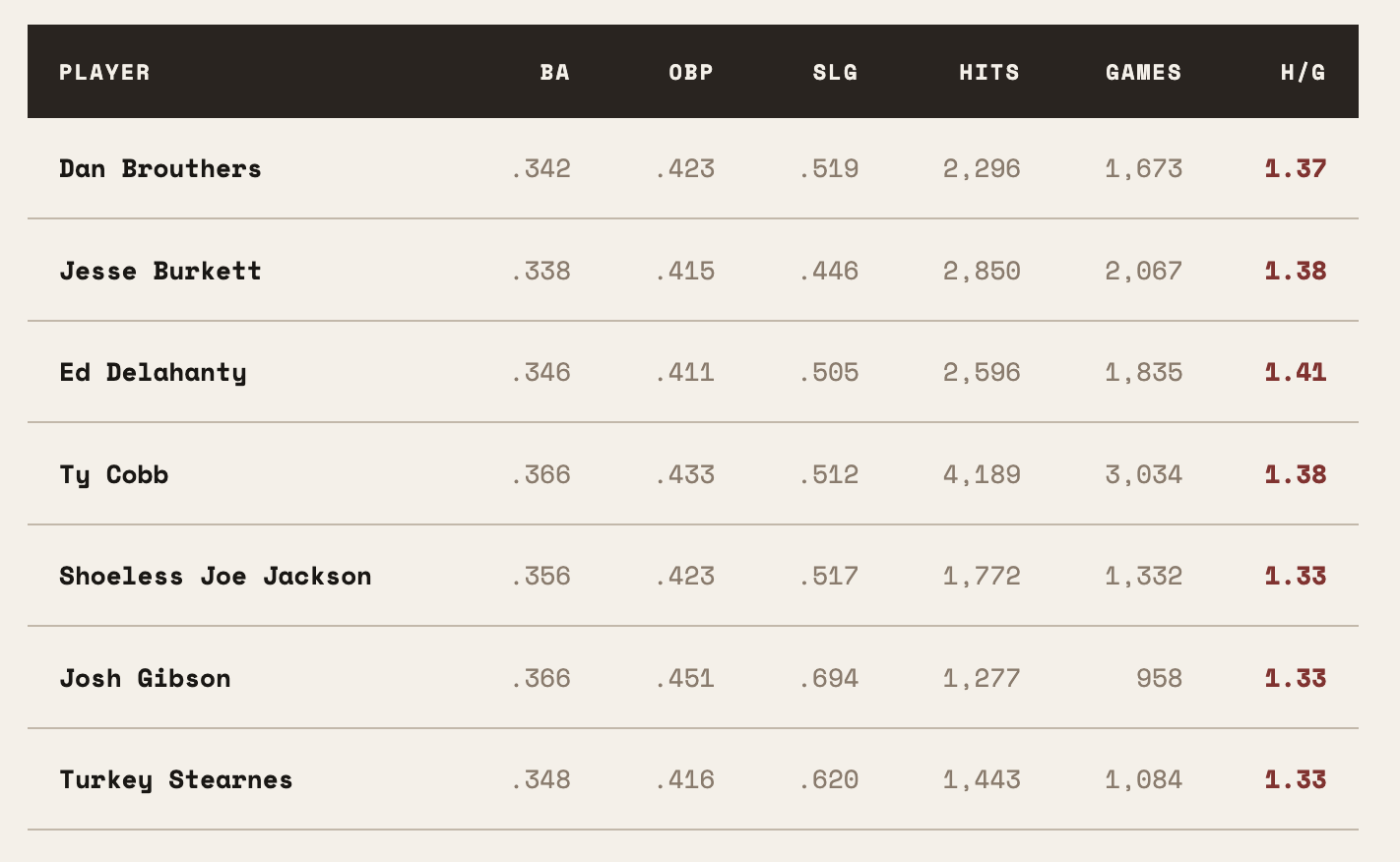
When both requirements are enforced simultaneously the population collapses dramatically. Across the entire history of professional baseball, only seven hitters satisfy every condition.
The Pure Hitters
Two Offensive Species
This analysis reveals two fundamentally different offensive mechanisms in baseball history.
The damage-dominant hitter generates value through fewer but more destructive events — home runs, walks, extra-base hits. Ruth and Williams are its supreme expressions. Their offensive greatness is real and overwhelming. But it is built partly on outcomes that can coexist with impure hitting.
The pure hitter dominates through continuous contact. His offense relies on extremely high batting averages, relentless accumulation, and strong but not overwhelming power. He is present in every game, in every at-bat, in a way the damage hitter is not required to be.
These are not different points on the same scale. They are different organisms.
A Historical Lineage
The seven pure hitters form a chronological chain spanning more than half a century of professional baseball.
Brouthers → Burkett → Delahanty → Cobb → Jackson → Gibson → Stearnes
Three nineteenth-century hitters form the foundation. Cobb and Jackson carry the lineage through the Deadball era into the modern game. Gibson and Stearnes complete it through the peak years of the Negro Leagues.
After Stearnes, the archetype effectively disappears from the historical record. Integration, expansion, and the increasing structural premium placed on power and patience reshaped what elite offensive production looked like. Ichiro arrives decades later as an echo — the purest contact hitter of the modern game, but without the power dimension that defines the complete profile.
The pure hitter may be an extinct organism.
The Rarest Form of Offensive Greatness
Hitting is supposed to be what baseball is. It is the central act of the game.
And yet across more than 150 years of professional baseball, only seven men were truly elite at it across every dimension simultaneously — contact, on-base ability, power, and hit density — over long careers.
Not the greatest run-producers. Not the greatest damage events. The greatest pure hitters.
Dan Brouthers. Jesse Burkett. Ed Delahanty. Ty Cobb. Shoeless Joe Jackson. Josh Gibson. Turkey Stearnes.
Seven men in 150 years.