The Purest Hitters: Solving Baseball’s Hardest Problem
The Purest Hitters: Solving Baseball’s Hardest Problem
The Purest Hitters: Solving Baseball’s Hardest Problem
Baseball has never lacked for ways to measure hitting.
Batting average tracks conversion.
On-base percentage tracks control.
Slugging tracks force.
But each of these isolates a single dimension.
They describe parts of the system—not the system itself.
Reframing the Problem
If we strip hitting down to its most elemental form, every plate appearance resolves into one of three outcomes:
Hit
Out
Walk
Remove power from the equation entirely.
Now the problem becomes:
How often can a hitter generate hits while still avoiding outs?
This produces two competing demands:
Contact Throughput
H/G = Hits/Games
The rate at which a hitter produces hits.
Control
OBP
The ability to avoid outs through selectivity.
The Constraint
These forces oppose each other.
More swings → more hits, but more outs
More discipline → more walks, but fewer chances for hits
So:
No hitter can fully maximize both simultaneously
The act of hitting becomes a balancing problem.
Measuring the Balance
To identify the hitters who solve this problem best, we combine both forces:
Pure Hitting Score: (H/G) x (OBP)
This captures:
Frequency of successful contact
And ability to avoid outs
at the same time.
What the System Reveals
When applied to elite hitters, a different group emerges.
Not those who dominate one axis.
But those who sustain both.
The Purest Hitters
Filtered by minimum .340 BA; 1,000 games played:
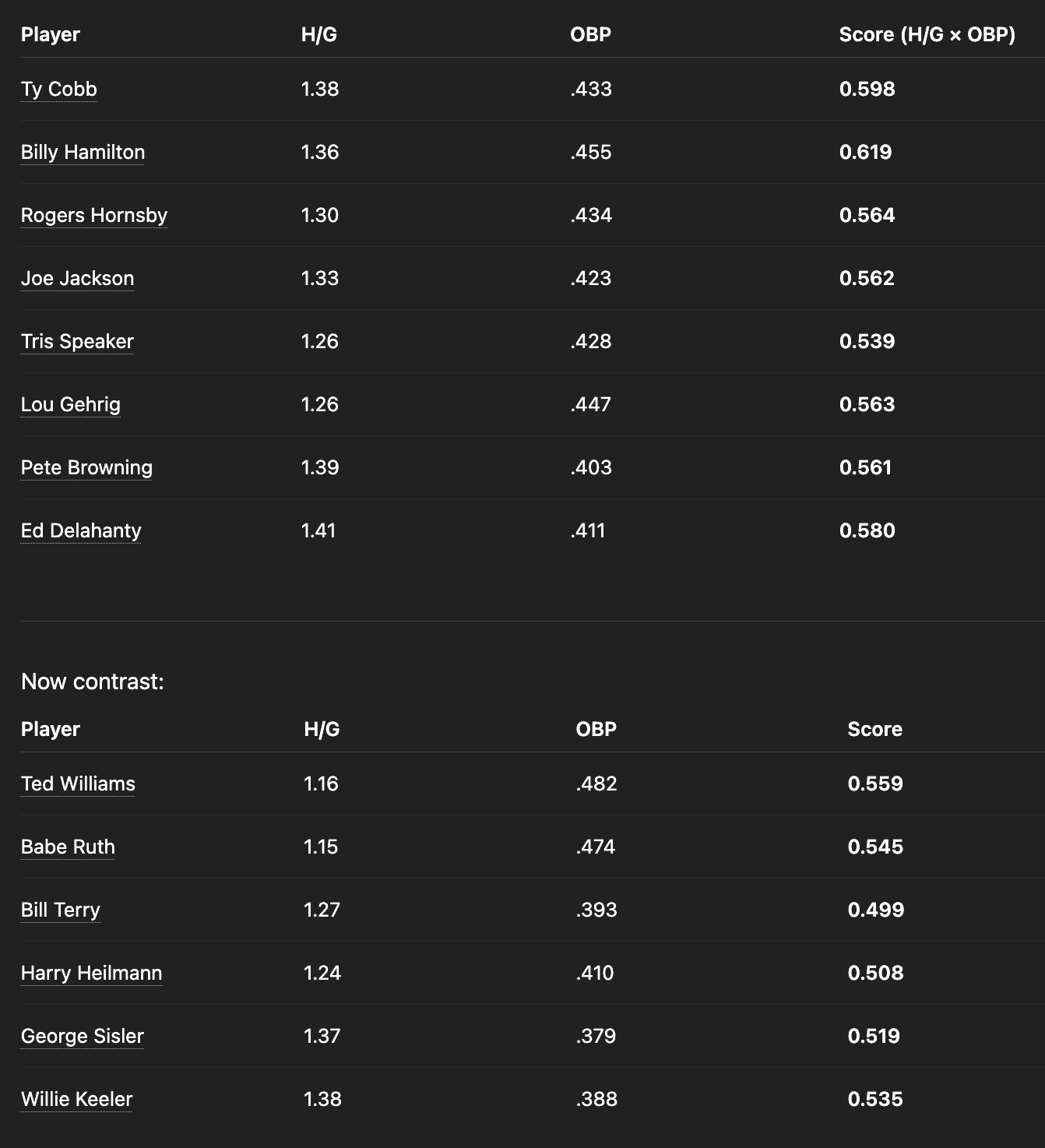
Billy Hamilton
The highest score in the system.
Exceptional on-base ability
Sustained hit generation
A profile built on speed, contact, and discipline
Ty Cobb
The most extreme hit generator in baseball history.
Maximum contact throughput
High OBP driven primarily by hits
Minimal reliance on walks
Ed Delahanty
The most balanced early-era solution.
Strong hit frequency
Strong control
No collapse in either dimension
What This Means
These hitters are not the most powerful.
They are not the most patient.
They are the closest to solving the core problem:
Generating hits continuously without surrendering control of the strike zone
Why Others Fall Short
Ted Williams and Babe Ruth maximize control, but reduce participation in contact
George Sisler and Willie Keeler maximize hit frequency, but sacrifice control
Each dominates one side.
Few sustain both.
The Final Insight
The rarest hitters in baseball history are not those who maximize hits or walks in isolation, but those who sustain both—continuously generating hits while still avoiding outs. This requires operating at the boundary between engagement and restraint, where every decision carries opposing consequences. Most hitters resolve this tension by moving toward one side. Only a few remain balanced at the edge.