The Resolution of Experience and Perception: The Emergence of the Forebrain as the Locus of Being (11/9/26 Lecture)
Video
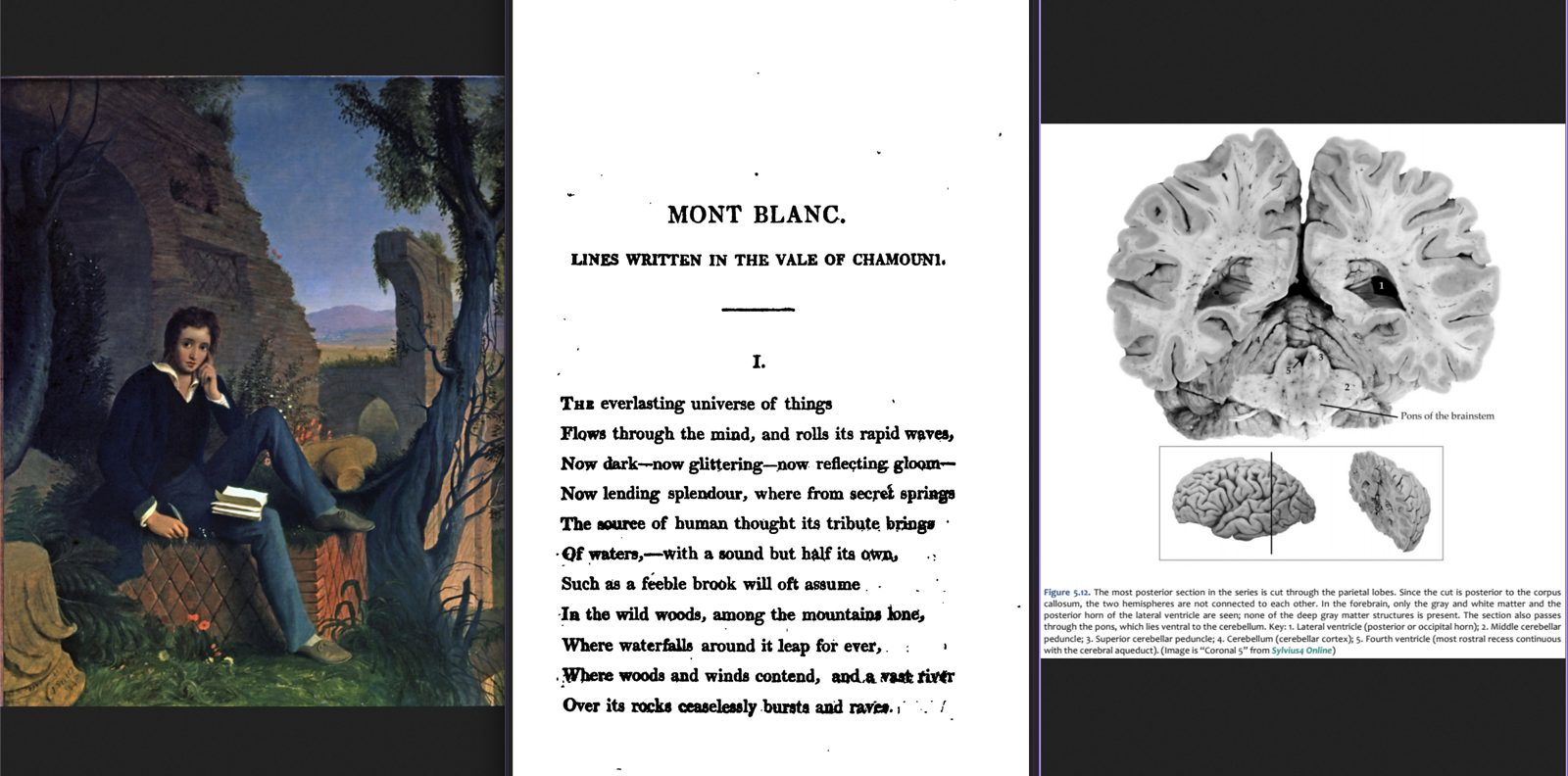
All right, I’d like to get us to another station here in our journey, talking about resolution of experience and perception.
I’m thinking in particular about Baudelaire and Shelley. And I already remarked on Shelley’s metaphysical disposition, the way that his mind orients a language, the extremely high cosmological and ontological abstraction which we experience in his works.
And I would particularly gesture to Mont Blanc, I think, is a perfect example of what I’m talking about, that Shelley’s nervous system architecture, and we just talked about this in my now previous lecture regarding general intelligence and the primary operationalization of the forebrain, Mont Blanc is a perfect example of what I’m talking about.
We see this in Lermontov with, I would say, a sense of fearlessness, particularly in his dueling and the character Pechorin, which deeply mimics his own biography. A man who kind of gave short shrift to everything that the world had to offer, participating in some of the highest circles of Russian history and his time and saw them as effectively empty, pointless, and useless.
What I’m trying to get at is the evolutionary drag that the species experiences at large. And then there’s the emergence of these high cognitive faculties, which, of course, we were talking about measuring an intelligence quotient, and there’s other ways to do this in terms of mapping the function and movement of the brain using scientific instruments.
But what I want to direct this to is the actual internal existential experience of these figures, and this is why I bring up Shelley, or Baudelaire, or Lermontov.
And with Mont Blanc and Shelley, we have the experience where, formerly, you would have, in human evolutionary history or Earth biological evolutionary history, the encounter with the mountain would be an encounter of survival and reproduction, right?
The script that would be playing out perceptually in terms of the experience of the organism would be a search for food, a search for shelter, et cetera.
Shelley experiences Mont Blanc from this position of heightened metaphysical perception. He’s seeing within and within to the mountain, and perceiving this deep time, geological and ontological stance, or position, or character of the mountain itself.
This is an incredibly sophisticated mode of thought, which, again, this is where, I would say, history at large and literary history gets hung up on the term Romanticism.
What I’m suggesting is these are actually figures expressing an existential form of experience of perception, which is operating an entirely different structural resolution.
And the fact that Shelley and Byron were friends, I think, is no exception. Byron articulates this quite differently, especially in terms of the Byronic hero, which Lermontov then takes and runs with in his Caucasian mode, right?
So what I’m talking about with these figures, and I would say Baudelaire as well in the poetry, is they are simultaneously operationalizing the forebrain to hitherto unexplored and unexperienced extents in the grand arc of human evolutionary history.
Since the advent of the forebrain, and the hundreds of thousands of years that the species has been operating with this device or this prosthetic, much like the opposable thumb, but that they are also in the process making transparent the neurotechnological architecture and scaffolding of the experience of this systemic architecture from within.
We have to understand this through the lens of literary and linguistic craft.
They are communicating subjectivity. They’re binding subjectivity to language for articulation, externalization, expression, and cultural symbolic codification of the interiority of the self, right?
So these two things are bound together, they’re web together, and this is the historical argument that I’m making for a sort of recursive model of civilization and human history, that civilization itself is scaffolded upon the realizations of these figures, whether we want to say Maxwell or Boltzmann, et cetera, Clausius, or we want to talk about von Neumann.
That these findings, right, in spacetime, these findings of the composition of the cosmos, which is to say the physical laws, the informational laws of the cosmos in spacetime, then become operationalized as technological scaffolding, which then build the civilizations, which make available further extents, right?
The former evolutionary pressure of finding food to survive, right? Participating in these premodern tribal and agricultural societies, which were bound to the body, right, in terms of the hindbrain experience, which we previously discussed in the last lecture.
That the emergence of these figures is itself creating the civilizational architecture at the species level, which creates more existential gap for the experience of these architectures to emerge.
So when we have the superfluous man, which emerges precisely at the crux of modernity, as well as Rimbaud, we have these figures who are then thrust into, we could call it, the ennui or the malaise of modern civilization.
But in reality, what modern civilization is, at its deepest root, is the increasing stepping away from the primordial human experience, the hindbrain architecture, and the emergence of increased space due to atomization, due to, let’s say, privatization, due to, like, let’s say, sedentary labor, right?
Digital space in which information and goods flow at increased speeds across increased distances.
The condensation of spacetime in a global civilizational sense, for the communication and transmission of information, that these figures then emerge at an even further scope and step further into the resolutionary experience of this perceptual architecture, which is in reality the emergence of a natural organic neural technology from the background of genomic evolutionary history and cosmological evolutionary history.
So what we have with Lermontov or Shelley, we have the emergence of these radical new forms of forebrain-oriented beings, which are springing from the wellspring of human evolutionary history, which has formerly, and still to this day, in large part, is bound.
Again, human evolutionary history is glacial. It’s occurring over hundreds of thousands and millions of years in a prosthetic revolutionary sense, in terms of the forebrain or opposable thumbs.
Slowly, these implements emerge through selection pressure in terms of survivability, right? The iteration of persistence against constraint, which we formerly discussed.
And these figures then emerge who are utilizing, right, they have this ingrained capacity, architectural capacity, this expanded neural synaptic capacity, which we measure using intelligence quotient.
Which is speed and efficacy.
Again, this can be measured with scientific instruments in the brain itself.
We’re understanding that these are operationalizations of new technological architecture over time, and then these figures emerge with this high-resolution faculty of experience and perception that is not only perceiving things as they are, which is to say maybe Darwin or Einstein, but perceiving them from a different place, from a different ontological zone.
Whereas formerly beings are experiencing existence or being or the self from a position of survival, reproduction, which is effectively a scarcity of the lone biological organism searching for safety, which is, again, much of human history and evolutionary history, in an earthly sense.
We can understand this as the history of the organism proper for millions of years.
Then we have the emergence of these figures who then are understanding reality at such a sufficient depth, such a proclivity towards depth, that they are then, they’re stepping into this mode of, let’s say, mastery of the hindbrain, so to speak, I think is a good way to put it.
That the forebrain is no longer checking or interpreting the hindbrain experience, but the forebrain is the leading edge of the perceptual experience of the being itself, which is the metaphysical quality of Percy Shelley’s perception fundamentally.
That his way of seeing is, in fact, a way of being, and this is an architectural phenomenon, which, wherein he has cultivated this extremely precise, profound, and literate linguistic craft, which then becomes what we read in Prometheus Unbound, or his lectures, or essays on politics, existence, poetry, et cetera, right?
The many things that Shelley participates in in a critical and thoughtful way.
So, again, this returns us to subjectivity, and what I’m talking about is a revolution in subjectivity, in terms of forebrain technology, which then becomes the locus of perception in the human being, architecturally.
And this is what we understand rather vaguely as genius in a human historical sense.
And I would also count Goethe in this field as well as perhaps da Vinci.
So my work is really fundamentally about the transparency and dissolution of the subjective, right?
The deeper groundswell beneath, between, and behind the architectural framework, which is evolutionary, that is informing the way that human beings perceive, experience, and participate in reality, or in world, or in self.
And what is beneath that is, again, the thermonuclear superspheradic kind of informational dimension, which is cascading down different thresholds, again, from star to cell.
And this, the way that the genome functions in an informational technological sense, is, over time, harnessing that energy through, let’s say, the jungle of the real or the jungle of the world, in the attempt to survive and reproduce, is then creating—
Again, I’ve said this as a blind rat in a maze, right, as this evolutionary technological sense, or being, is then creating implements or prosthetics through selection pressure to expand the possibility of persistence against constraint for any given species or organism.
This is not only the epigenetic experience, but the genetic experience itself proper.
And so, from that and behind that, we’ve already talked about the fundamental state of play, which is creation, that behind persistence against constraint is the play and experimentation of being, which is to say, creative methodology in space and time in the attempt to produce prolonged states of beings.
So, I’ve got here, I’d say Kafka, Lispector, and Céline, and specifically Kafka’s Metamorphosis.
We are talking fundamentally about the existential experience of these, let’s say, nodes of perception, which are tipping onto vertiginous to this moment of species-level change, paradigm shift in informational technology, as in the genome, wherein the, again, the forebrain is becoming the locus of being.
And so these beings themselves are perceiving reality differently.
And so this is why, again, I’m going to gesture back to the importance of reading and understanding, I would say, specifically literature, or the written word, or the spoken word, in an existential primary sense.
And I would, again, say Lermontov’s A Hero of Our Time as existential primary sense document, of course, behind the character of Pechorin.
But to read these texts as elucidations of this neural architectural technology.
The literal scaffolding of these advanced systems architectures, which are emerging from the unconscious natural process of recombination at the human species genomic level.
And the importance of these texts is that they give us what scientific measurement cannot give us.
We can measure speed and efficacy of thought in the brain, but we cannot measure the dynamic experience, which is to say maybe being conscious or being sentient within that framework, the resolution of the experience of being within that technological framework, within that apparatus, within that perceptual mode.
And that’s what is provided and bound to language in the articulation.
It is then codified, as we’ve discussed, in Channel Two architecture.
Symbolic codification, which then becomes cultural, an expression of that radical interiority, that radical self.
We already discussed this in terms of the Vedanta, in particular, in figures such as Ramana Maharshi, where this neural architecture is leveraged to perceive what is beneath the subjective entirely.
That what, in large part, we experience, whether it’s Shelley or Lermontov, we experience the breaking apart of the socially or culturally, familiarly, or religiously construct itself, in the sense that the subjectivity of the being lies not only behind the cultural or phenomenological, but within this literal neural architectural mode itself, and then, furthermore, within the creational force, which gesticulates this character, this being into being, right?
And this is, of course, the foundations of ontology.
So it is this very resolution of experience which emerges from these advanced architectures, which makes available ontological perception.
And I’ve already stated, in my previous lecture, that these beings themselves, I would say, in accord to, we could say, general intelligence or measurable intelligence quotient, live fundamentally and primarily with increasing consistency, and I would say, at a certain threshold, entirely within the metastructural realm or the meta-architectural realm.
That they’re experiencing total recursion of self, and are, in fact, examining fundamentally the cognitive architecture of their own being, externalized within and within the world.
And again, this is the Mont Blanc phenomenon, and Shelley.
And this is critical, understanding that he is having, what is in effect, a hindbrain experience, which is to say, being a being in space and time, which is subject to thermodynamic entropy, right?
That Shelley is a beating heart, which, of course, is kept by Mary Shelley, that in space and time, perceiving this mountain from the position of the human animal, and yet what emerges from his perceptual experience of this mountain, which is to say maybe an objective phenomenon, is the metaphysical implications of the mountain.
The metaphysical situation of being present in relation to the mountain, which is the ontological proclivity of Shelley’s perception.
That when we read Shelley’s writings, his concern with the, let’s say, the liberation of common people, or the justice and legislation, which is possible in the poetic project, in a communal, civilizational, and global sense.
We are reading the composition of a mind, which is so forebrain-oriented, that the survival architecture, which is to say the survival system of checks and balances, in the hindbrain, which is dominant in the vast majority of human architectures, and the forebrain acts as, at best, a minor checkdown of this hindbrain pressure.
That, for Shelley, the forebrain is so dominant in his experience, and he’s backgrounded, fundamentally within his architecture, then, furthermore, the training of his architecture, in terms of thinking and contemplating philosophically and linguistically.
That he is inhabiting, with increasing proclivity and acuity, a literal, an entirely different sphere or plane of perception.
We already discussed this in terms of digital technological architecture, and the opposable thumb, creating solution space where previously there was none.
It opens up an entirely different terrain of experience.
And so within the forebrain, the possibility is to inhabit, obviously, through scaling the architecture of the physical organism.
It’s the scaffolding upon which the forebrain stands as an evolutionary leading edge.
The possibility of inhabiting a terrain, which is effectively inhuman, insofar as we understand humanity.
It is a mode of subjectivity, which is ensconced within the ontological or metaphysical question or space of being, which is transpersonal, which is synthetic, which is integral.
And we see this across contemplative and mystical traditions around the world.
But we see it particularly in Shelley, due to his acuity and craft, which is really the individuation of his language, which is common, I would say, in large part to modernizing Western civilization, which is the creation of, let’s say, the literary author.
This is why I gestured to Baudelaire, Lermontov, or Rimbaud, that this individualism is critical to understanding individual neurosynaptic architectures.
Understanding, in a cosmological evolutionary sense, how the forebrain within the forebrain epoch itself over the past several hundred thousand years, has become increasingly dominant or prominent within these architecturally exceptional individuals.
Right? This is our evidential terrain, and this requires a total revaluation of philosophy, literature, poetry, prose, existential experience, let’s say the confessional narrative, to understand that what we are really reading is not simply a tale or a story or a poem or a philosophical essay, et cetera.
We are reading what is fundamentally a transparency.
In a larger cosmological evolutionary sense, of this leading technological edge, which we exceed and experience in man, the forebrain, which is becoming, in a cultural and biological evolutionary way, detached or experiencing the possibility of remove from what formerly grounded humanity within a natural world, which we understand is maybe a Paradise Lost metaphor, the necessity of the hindbrain survive, reproduce plane of informational technological perception.
This is a change to being in time in an evolutionary drift or procedure, which we are experiencing within the forebrain epoch, which is to say it is the leading edge of prosthetic technology, which is making available an entirely different experiential plane.
Which, of course, is harnessed genomically in these exceptional individuals, but then, of course, when we experience perhaps Shelley or Lermontov, it is trained.
It is further harnessed and excelled within the studies of these individuals, Shelley with Plato or Lermontov with Byron, and so on and so forth, to create the possibilities and circumstances for articulating or expressing, which is to say, make legible in a cultural civilizational, outstanding, and existential sense, making legible to even oneself.
The capacities and proclivities of the architecture of this creation, which was not created by oneself.
You see the sophistication here?
This is an habitation of architectural solution space.
And this is, in many ways, a genomic roll of the dice.
It is the gamble in an evolutionary sense, which produces Shelley or Rimbaud or Lermontov.
And then in the adequate training, right, in the adequate presence for this architecture to be expressed, communicated, experienced, and thought through in a metaphysical and linguistic way.
This, then, is what produces, for the subject themselves, and then, of course, for the totality of the human species, the artifact of the highfalutin, which is to say the highest intersection of training, cultivation, and craft, intermingled with this advanced cutting-edge, vanguard evolutionary informational technological architecture of the neurosynaptic system.
Which is shifting gears effectively or shifting modes of perception into an increasingly forebrain-dominant state of being, which then makes available, again, this more persistent state of metacognition, whereas the hindbrain becomes backgrounded.
Where, again, in most people, the hindbrain is the predominant noise of the existential experience of being.
So when we have genius, what we have is metacognition is actually the existential state of being of these individuals.
And again, this requires substantial amount of energy to sustain.
These are highfalutin systems.
High-powered systems of cognition, which are running at extremely high speeds and breakpoints and are operating in a perilous terrain.
We see this, I think, in all three of the figures that I mentioned, Lermontov, Shelley, and Rimbaud.
Not to mention how these figures, literally in terms of their, their, the architecture of their very being in a neurosynaptic sense, intersects with culture and civilization, which themselves are a mass phenomenon of precisely what we are discussing, this hindbrain epoch of survive and reproduce, which is fundamentally a, let’s say, a scarcity-oriented paradigm towards self-preservation.
These are closed systems oriented towards very limited sphere and terrain of information, most of which reflects immediately upon the organism’s life or death circumstances and comfortability, et cetera.
This is all obviously thrown to the wind by Rimbaud, Lermontov, and Shelley.
And we see the consequences in their lives of this position.
What I’m suggesting here, it’s strongly suggesting, is that this is an architectural phenomenon, in that we must observe it scientifically as such, and receive the evidence, not only as remarks made by great figures of contemplation of the human experience.
Again, allowing both, maybe, the rotten and corrupt, as well as the beautiful and sublime, that not only as these profound acts of contemplation and existential reflection, but as documentation of a cosmological-level change, a cutting edge of evolutionary informational systems technology, which is making available the ontological ground of being in ways never before seen.
Specifically, again, in the individual or individual-oriented Western civilizational or cultural milieu, which is what creates or allows for the character of Rimbaud or Lermontov or Shelley to emerge.
These are the articulations of the true individual unbound by religion, culture, propriety.
Which is the authentic integral depth expression of these genomic systems architectures.
And to have this is really what is substantially a fossil record of the experience of what we are witnessing before our very eyes is the emergence of, quite literally, a new human being.
Thank you.