The Scaffold of Coherence: From “God Is Dead” to Broadcast Synchronization to Algorithmic Fragmentation
The Scaffold of Coherence: From “God Is Dead” to Broadcast Synchronization to Algorithmic Fragmentation
The Scaffold of Coherence
From “God Is Dead” to Broadcast Synchronization to Algorithmic Fragmentation
Abstract
This essay proposes a structural timeline of modern coherence. It argues that “God is dead,” as declared by Friedrich Nietzsche, can be understood not merely as a philosophical statement but as a neural and infrastructural diagnosis: the collapse of religion’s monopoly on collective synchronization. Between 1900 and 1960, the United States constructed a technological alternative—industrial distribution networks and broadcast media—that temporarily replaced ecclesiastical architecture as the primary organizer of shared presence. In the twenty-first century, algorithmic personalization has fractured that broadcast synchronization into private neural silos. The arc from cathedral to radio to feed reveals an evolving scaffold of coherence at scale.
I. Phase One: Religious Architecture as Synchronization System (Pre-1900)
For centuries, large-scale coherence depended on religious infrastructure.
Churches provided:
Shared ritual calendars
Common symbolic vocabularies
Weekly temporal synchronization
Moral hierarchy
Physical gathering sites
Cathedral, parish, pilgrimage, sermon—these were not merely spiritual forms. They were synchronization mechanisms.
Coherence required proximity.
Bodies gathered in shared space.
Voices aligned in chant.
Time organized around liturgy.
Religion provided both:
Vertical coherence (transcendent meaning)
Horizontal synchronization (shared ritual time)
When Nietzsche proclaimed “God is dead,” he was diagnosing the weakening of this architecture. The statement marked not simply declining belief, but the erosion of a singular system capable of entraining millions into a common rhythm.
The scaffold cracked.
II. Phase Two: Industrial Containment and Symbol Standardization (1880–1920)
As ecclesiastical authority fragmented, industrial capitalism assembled new infrastructure:
Transcontinental rail networks
National time zone standardization
Telegraph and wire services
Mass lithographic printing
Commodity distribution systems
Before broadcast technology could synchronize time, material networks standardized symbol.
Cigarette packaging and tobacco inserts diffused identical player imagery across vast geographies. Industrial distribution created recognition without simultaneity.
The semiotic chain during this period operated as:
Commodity → Image → Body → Repetition
Recognition preceded synchronization.
Shared symbols were loaded into the population before shared time could be engineered.
This was containment: dense symbolic consolidation through material circulation.
III. Phase Three: Broadcast Synchronization (1920–1960)
Radio introduced a decisive structural shift.
For the first time in history, millions could experience the same event simultaneously across continental distance.
Radio synchronized attention.
Television synchronized perception.
The semiotic chain transformed:
Signal → Event → Listener → Synchronization
This period represented the apex of technological coherence without religious centralization.
Where once the cathedral gathered bodies,
the broadcast network gathered attention.
Baseball proved uniquely suited to inhabit this new infrastructure. Its:
Rhythmic schedule
Seasonal recurrence
Statistical continuity
Narrative modularity
aligned seamlessly with broadcast pacing.
Between 1900 and 1960, the United States conducted a civilizational experiment:
Could technological simultaneity replace ecclesiastical unity?
For a time, it did.
IV. Phase Four: Peak National Synchronization (1945–1965)
The postwar period marked the high-water mark of mediated coherence.
Characteristics included:
Three dominant television networks
Nationally shared news anchors
Singular World Series broadcasts
Wartime mobilization narratives
Corporate underwriting of ritualized events
Attention density was concentrated.
Millions shared:
The same broadcasts
The same rituals
The same moments
This was horizontal coherence at unprecedented scale.
It did not replace transcendence.
It replaced proximity.
V. Phase Five: Segmentation Through Cable (1965–1995)
The introduction of cable television marked the beginning of synchronization fragmentation.
Media abundance expanded.
Channels multiplied.
Regional markets proliferated.
Shared carriers thinned.
National simultaneity remained possible—but less dominant.
Synchronization became layered rather than unified.
The scaffold weakened, but did not collapse.
VI. Phase Six: Algorithmic Fragmentation (2005–Present)
The digital era introduced a fundamentally different synchronization architecture.
Carrier: Personalized algorithmic feed.
Mode: Engagement optimization.
Scale: Individual.
Where broadcast synchronized millions at once, algorithms optimize for micro-attention.
Instead of shared ritual time, individuals inhabit customized streams.
The semiotic chain now resembles:
Platform → Algorithm → User → Reinforcement Loop
No universal broadcast.
No singular nightly news.
No shared ceremonial calendar.
Neural entrainment becomes siloed.
Stimulation persists.
Synchronization fragments.
VII. The Structural Arc
The scaffold of coherence unfolds as follows:
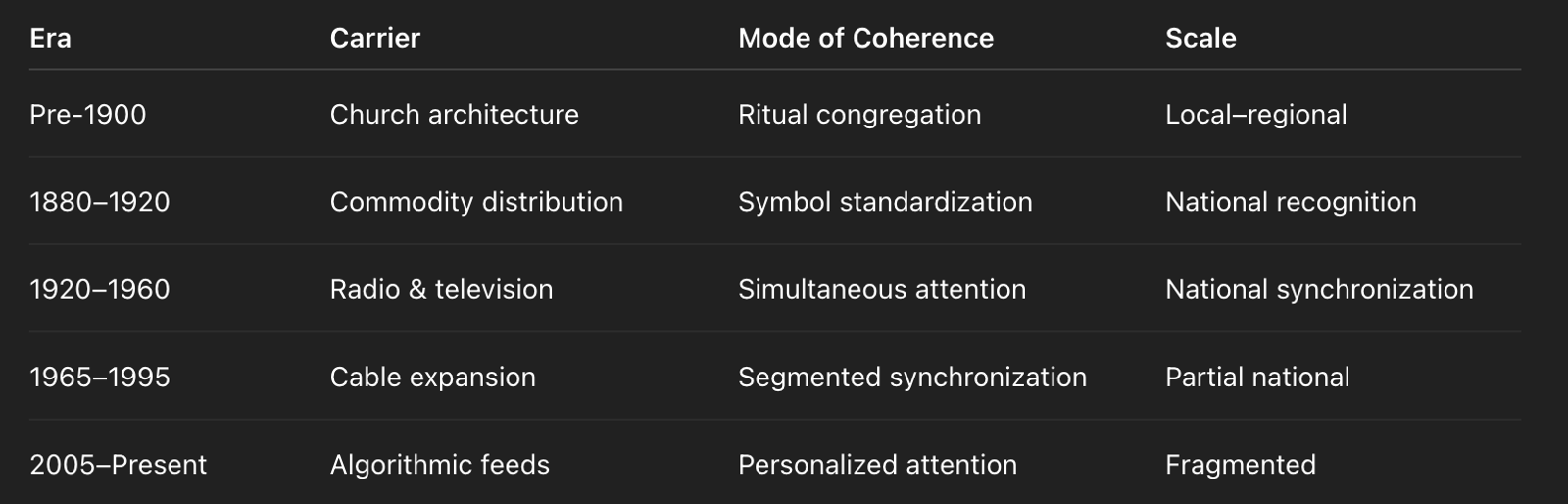
The death of God marked the weakening of theological synchronization.
Industrial media temporarily replaced it with technological synchronization.
Algorithmic personalization dissolves even that.
The scaffold shifts from:
Shared altar
→ Shared broadcast
→ Private feed
VIII. The Tension of the Present
Religion once provided:
- Meaning and synchronization
Broadcast provided:
- Synchronization without transcendence
Algorithmic systems provide:
- Stimulation without synchronization
The organizing center dissolves into multiplicity.
The question becomes urgent:
What now coordinates collective neural rhythm?
If coherence requires shared carriers, and carriers fragment into private channels, the scaffold thins.
The twentieth century demonstrated that technological infrastructure could replace religious architecture as the mechanism of mass synchronization.
The twenty-first century is testing whether decentralized infrastructure can sustain coherence at all.
Conclusion
The statement “God is dead” can be understood as a neural and technological event: the migration of collective synchronization from ecclesiastical architecture to media infrastructure.
Between 1900 and 1960, technological carriers—rail, print, radio, television—constructed a new scaffold of coherence at continental scale.
That scaffold enabled shared presence without physical proximity.
In the algorithmic age, the scaffold fragments into individualized streams.
The cathedral organized bodies.
Broadcast organized attention.
Algorithms organize individuals.
The arc from congregation to broadcast to feed traces the evolving architecture of collective being.
The scaffold remains under construction.