The Structural Outliers: Jack Glasscock, Hugh Duffy, and the Birth of the 200-Hit Season
The Structural Outliers: Jack Glasscock, Hugh Duffy, and the Birth of the 200-Hit Season
The Structural Outliers: Jack Glasscock, Hugh Duffy, and the Birth of the 200-Hit Season
For most of baseball’s early history, a 200-hit season simply did not happen. The reason was not a lack of great hitters. It was the structure of the game itself. Nineteenth-century baseball operated under shorter schedules and a different pitching geometry than the modern sport. Those conditions placed a natural ceiling on how many hits a player could accumulate in a single season. When the milestone finally appeared, it did so under two very different structural circumstances. One belongs to Jack Glasscock in 1889, the first player ever to reach 200 hits in a major-league season. The other belongs to Hugh Duffy in 1894, whose extraordinary hit rate remains one of the most extreme offensive seasons the sport has ever produced.
To understand why these seasons matter, we have to begin with the early structure of professional baseball. Major-league schedules in the late nineteenth century were far shorter than those that later defined the game. Seasons in the 1870s often contained sixty or seventy games. By the early 1880s they had grown to roughly eighty or ninety. By the middle of that decade they hovered around one hundred games, and by the early 1890s most clubs played around 132 games. The familiar 154-game schedule would not become standard until the end of the century. These shorter seasons made very large hit totals mathematically difficult. Even a brilliant hitter had fewer opportunities to accumulate hits.
Against this backdrop, Jack Glasscock’s 1889 season stands out immediately. Playing for Indianapolis, Glasscock recorded 205 hits in 134 games. That total made him the first player in major-league history to reach the 200-hit threshold. Baseball-Reference and SABR’s historical records both confirm the line: 205 hits across a 134-game season. The significance of the achievement becomes clearer when one remembers the pitching conditions of the era. Glasscock produced that total before the major rule change that would redefine the sport’s offensive environment.
Prior to 1893, pitchers delivered the ball from a position much closer to home plate than they do today. The pitching box effectively placed the pitcher about fifty feet from the batter rather than the modern sixty feet six inches. Historians of the game widely agree that the sport repeatedly struggled to balance offense and pitching during this period. When the league finally moved the pitching distance back to sixty feet six inches in 1893, it fundamentally altered the contest between pitcher and hitter. The change gave hitters more time to react and immediately produced a surge in offense across the league.
Glasscock’s 1889 performance therefore occupies a unique place in baseball history. It is not just the first 200-hit season. It is the only one that occurred before the game adopted the modern pitching distance. His 205 hits in 134 games translate to roughly 1.53 hits per game, a rate that comfortably clears the pace required to reach 200 hits in a season of that length. What makes the season remarkable is that it occurred under pitching conditions that were generally less favorable to hitters than those that followed.
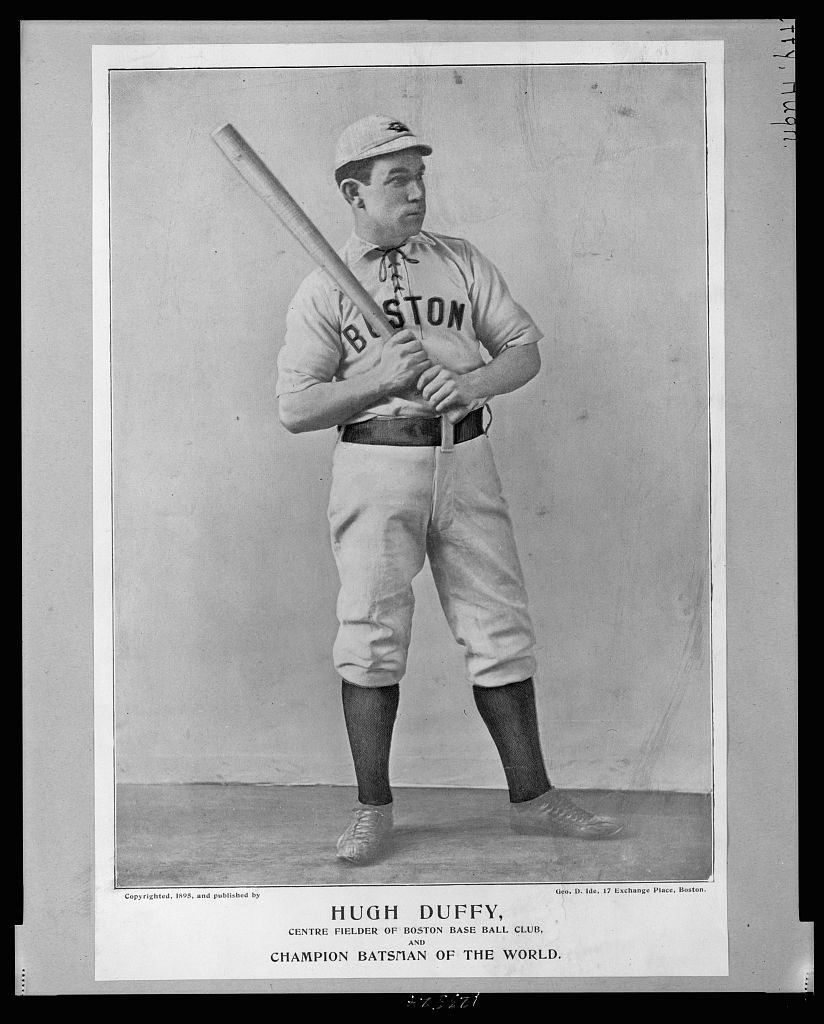
Five years later the game produced an offensive season that pushed the limits even further. In 1894 Hugh Duffy of the Boston Beaneaters recorded 237 hits in 125 games while batting .440, a mark that remains the highest single-season batting average in modern major-league history. The Hall of Fame and Baseball-Reference both confirm the statistics for Duffy’s 1894 campaign. The raw totals alone would be enough to make the season memorable. When viewed through the lens of hit rate, however, the season becomes almost surreal.
Duffy’s 237 hits in 125 games equal approximately 1.90 hits per game. Among nineteenth-century seasons played in schedules approaching a full major-league length, that rate stands dramatically above the rest. Willie Keeler’s famous 1897 season, in which he recorded 239 hits in 129 games, works out to about 1.85 hits per game. Jesse Burkett’s 240 hits in 134 games in 1896 produce roughly 1.79 hits per game. Both seasons are extraordinary. Duffy’s remains more extreme still.
This does not mean that Duffy holds the absolute single-season hits-per-game record across every early professional league. Some earlier seasons played in very short schedules—particularly in the National Association of the early 1870s—produced even higher per-game hit rates. Ross Barnes’s 1873 season, for example, produced 138 hits in 60 games. But the structure of those seasons was radically different. The schedules were far shorter, the competitive environment less stable, and the statistical context far removed from the later nineteenth-century major leagues. When we look at the longer-schedule game that emerged by the 1890s, Duffy’s season becomes one of the most concentrated offensive performances ever recorded.
Glasscock and Duffy therefore represent two different kinds of structural outlier. Glasscock’s season sits at the edge of the old game. It is the first time a player broke through the 200-hit barrier before the sport adopted the modern pitching distance. Duffy’s season sits at the opposite side of the structural divide. It appears immediately after the pitching distance change and demonstrates the explosive offensive potential that the new geometry of the game made possible.
Together the two seasons reveal something deeper about baseball statistics. Milestones such as the 200-hit season do not arise solely from individual brilliance. They also emerge from the architecture of the sport. Change the distance between pitcher and hitter, lengthen the schedule, or alter the rules of play, and the statistical landscape shifts with it.
Glasscock’s 1889 season shows that the old game still allowed a singular hitter to reach the milestone even under tighter pitching conditions. Duffy’s 1894 season shows how dramatically the game’s offensive ceiling expanded once the pitching distance moved back. Seen together, the two seasons mark the moment when baseball’s statistical world changed shape.
They are not just records of great hitting. They are records of the game itself evolving.