The Symmetry Line: A Method for Identifying Complete Hitters
The Symmetry Line: A Method for Identifying Complete Hitters
The Symmetry Line: A Method for Identifying Complete Hitters
Baseball offense is typically described through isolated traits—batting average, on-base percentage, and slugging percentage—each treated as a separate axis of performance. This fragmentation obscures a deeper question:
When do these components resolve into a single, unified structure?
The line .340 AVG / .400 OBP / .500 SLG provides a precise answer. It functions not as a measure of greatness, but as a geometric condition —a point at which the three fundamental dimensions of hitting align in proportion.
I. The Three Axes of the System
Each component represents a distinct constraint:
AVG (.340) → conversion
The rate at which opportunities become hitsOBP (.400) → survival
The ability to avoid outs and sustain plate presenceSLG (.500) → force
The capacity to generate extra-base impact
Individually, these metrics describe partial skills. Together, they define a closed system in which all three constraints must be satisfied simultaneously.
II. Why This Line Forms a Symmetry
The defining feature of this threshold is not its magnitude, but its proportional balance.
OBP extends AVG by a controlled margin (~+60 points), indicating disciplined reach without reliance on walks alone
SLG extends AVG by a larger but still bounded margin (~+160 points), indicating real power without dominance by extra-base output
These relationships create a stable structure:
conversion is primary
reach supports conversion
force amplifies conversion
No axis overwhelms the others. No axis is underdeveloped.
The result is a symmetrical configuration , where each component contributes without distortion.
III. Constraint Enforcement
This line cannot be satisfied through specialization.
A high AVG without OBP fails the survival constraint
A high OBP without AVG allows walk-driven inflation
A high SLG without AVG or OBP introduces inefficiency
Each threshold acts as a boundary condition:
.340 AVG eliminates unstable or context-dependent contact profiles
.400 OBP ensures that conversion is fully realized into base presence
.500 SLG requires consistent extra-base production, not incidental power
Because all three must be met, the system resists compensation.
It enforces simultaneous completeness rather than partial optimization.
IV. The Geometry of Proximity
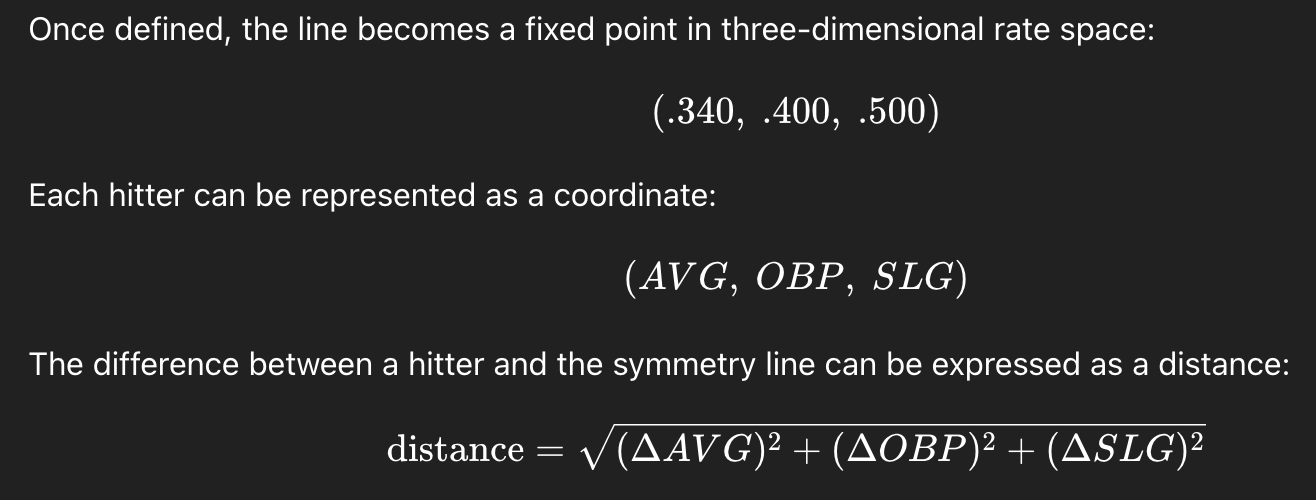
This produces a field of proximity :
hitters near the point approximate the symmetrical form
hitters further away exhibit structural imbalance
direction of deviation indicates the type of imbalance (conversion-heavy, OBP-driven, or power-skewed)
This framework separates two distinct concepts:
magnitude (how productive a hitter is)
symmetry (how proportionally that production is distributed)
V. Interpretation of the Field
Within this geometry, different classes emerge:
Central forms → minimal deviation across all three axes; balanced systems
Directional forms → strong in one axis but extended away from symmetry
extreme forms → exceed the structure entirely by overshooting one or more dimensions
Importantly, distance from the symmetry point does not imply inferiority. It indicates departure from proportional balance.
A hitter may be historically dominant yet geometrically distant if one dimension expands beyond the equilibrium defined by the line.
VI. What the Line Does
The symmetry line serves three methodological functions:
1. Defines completeness
It identifies the minimum conditions under which all three offensive dimensions are fully expressed.
2. Prevents compensation
By requiring all thresholds simultaneously, it eliminates profiles built on imbalance.
3. Enables geometric comparison
It converts hitter evaluation from ranking to positioning within a structured space.
VII. Conclusion
The line .340 / .400 / .500 is not an arbitrary benchmark. It is a structural threshold within the geometry of hitting.
It marks the point at which:
conversion is elite
survival is sustained
force is present
and all three exist in proportion.
At this point, hitting is no longer a collection of traits.
It is a unified form.