The Two Structural Revolutions: 1893 and 1920 as the Rewriting of Baseball’s Physics
The Two Structural Revolutions: 1893 and 1920 as the Rewriting of Baseball’s Physics
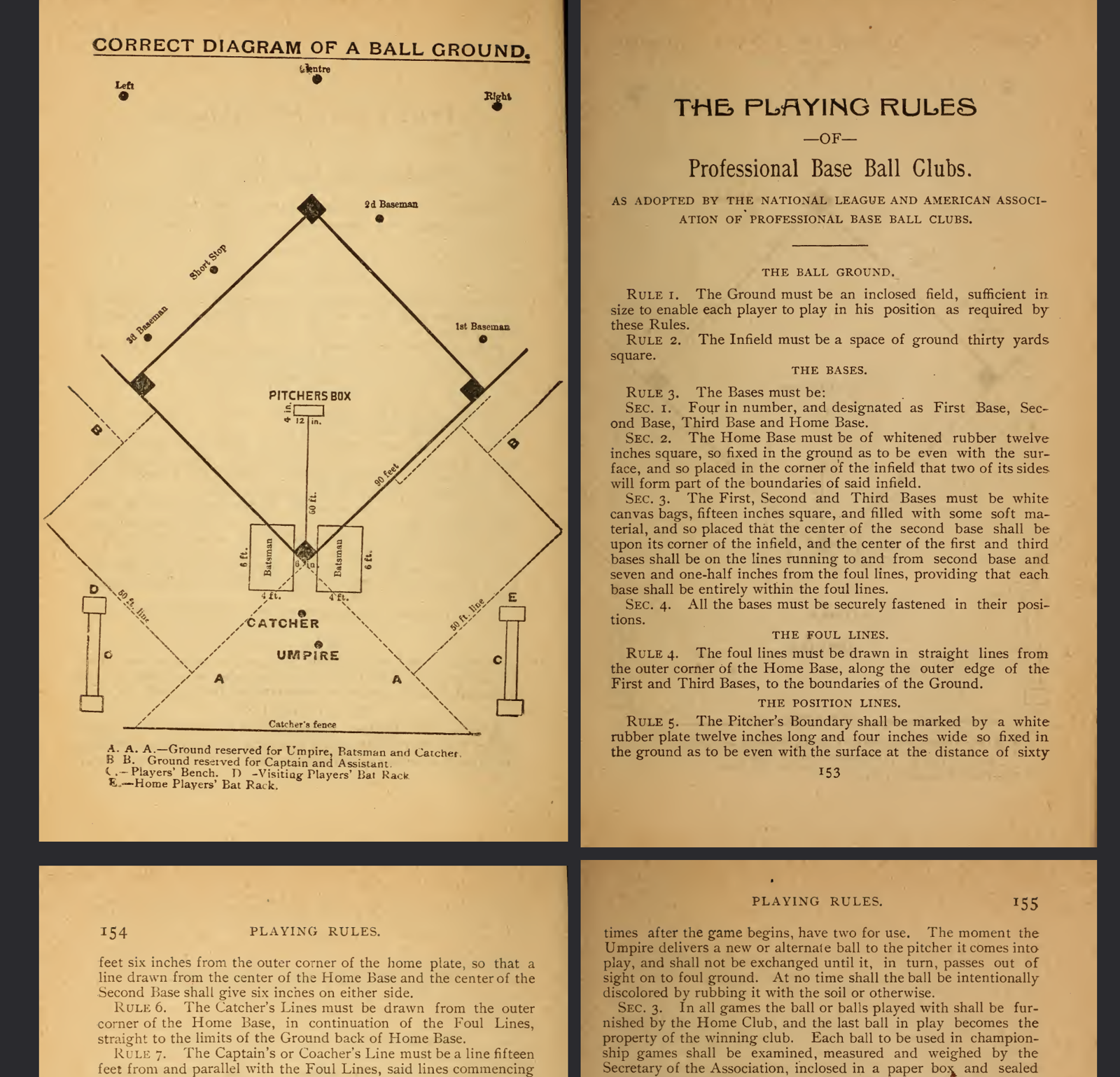
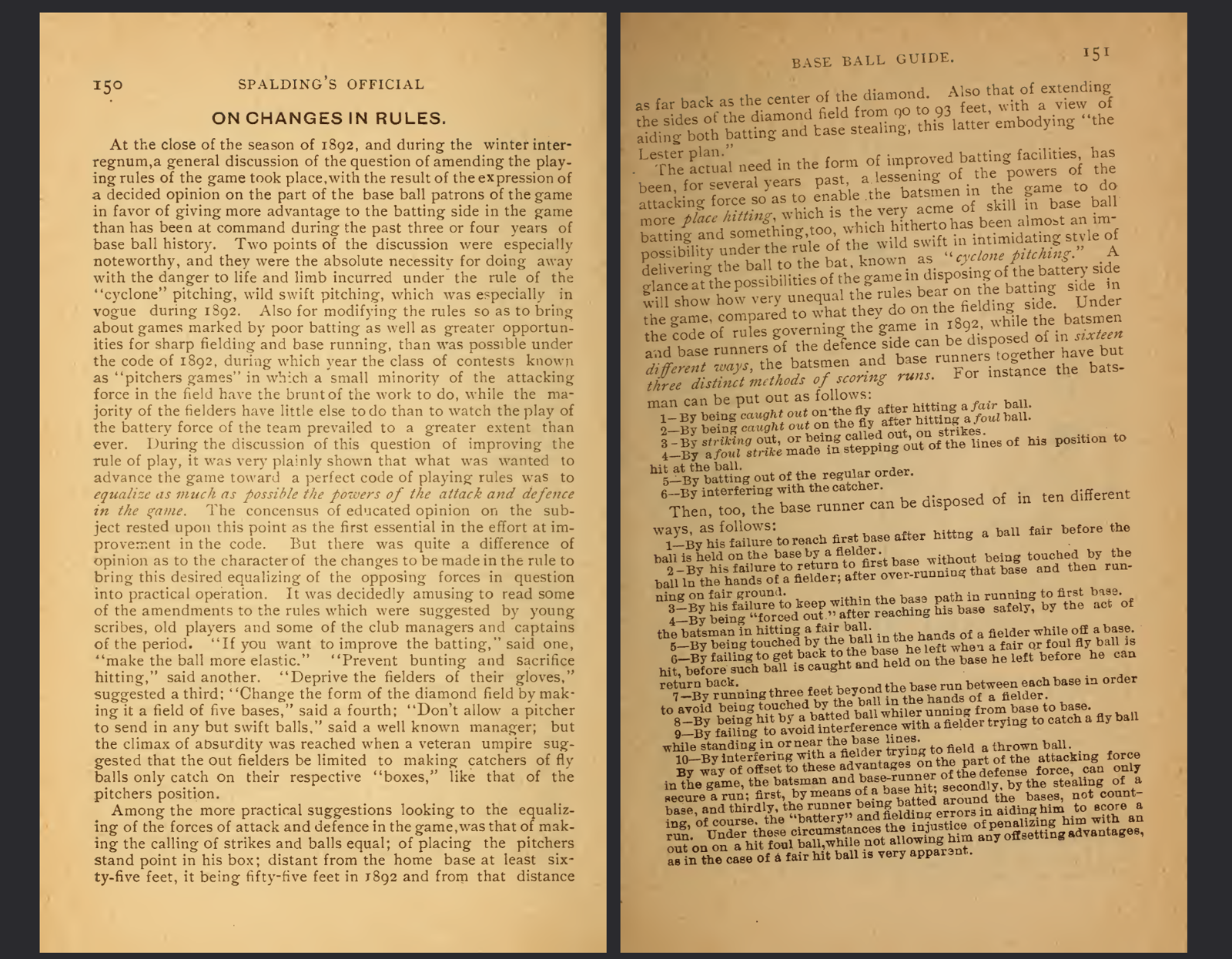
Diagram and Rule pages from the 1893 edition of Spalding’s Base Ball Guide
The Two Structural Revolutions
1893 and 1920 as the Rewriting of Baseball’s Physics
Baseball is a timed geometry.
Every run is born from a race between moving bodies across fixed distances. The ball travels. The fielder intercepts. The runner advances. The throw attempts recovery. The game is a chain of timed inequalities unfolding inside a bounded field.
For decades, the structure of that geometry remained relatively stable.
Then it was rewritten twice.
The first rewrite came in 1893.
The second in 1920.
Together, they transformed the physics of the sport.
I. 1893 — The Expansion of Time
In 1893, the pitching distance was extended from 50 feet to 60 feet 6 inches.
This was not cosmetic.
It expanded the fundamental reaction window between release and contact.
More distance means more time.
More time means greater capacity for visual tracking, decision-making, and controlled swing mechanics.
The consequences were immediate and dramatic. Run scoring surged in the mid-1890s because the system crossed a human threshold. The additional milliseconds allowed hitters to stabilize contact quality at a higher level.
But this shift did not remove the defensive geometry.
Even after 1893, runs still required traversal of the recoverable field:
• Ball in play
• Fielder intercepts
• Throw vs. runner
• Advancement chains
The game remained a continuous race engine.
The 1893 change expanded the sky — it altered the atmosphere of available time — but it did not change the topology of the field.
It was an expansion within the same governing system.
II. The Continuous System (Pre-1920)
From the 1890s through the Deadball era, baseball remained fundamentally continuous.
Runs accumulated through:
• Placement
• Speed
• Angles
• Defensive error
• Incremental advancement
The defense always retained intervention points.
Even deep hits were still inside the field’s recoverable space.
The geometry was bounded but continuous.
Suppression worked by compressing reaction time and forcing weaker contact into the race engine.
Production worked by exploiting the expanded window created in 1893.
The sport was a contest over milliseconds within a recoverable manifold.
III. 1920 — The Escape Condition
Around 1920, another transformation occurred.
Changes in ball construction, clean-ball policies, outlawing of certain pitches, and the rise of uppercut power swings shifted the distribution of batted-ball distance.
For the first time in a sustained way, the ball regularly left the field.
When a ball clears the fence, the race ends.
No interception.
No relay.
No recovery.
The defensive geometry collapses.
This was not merely more offense. It introduced an escape condition into a system that had previously been fully recoverable.
Before 1920, every run required movement through space.
After 1920, some runs could bypass space entirely.
This is not an incremental change. It is a structural reclassification.
IV. From Time Expansion to Energy Weaponization
The two revolutions act on different variables:
1893 expanded time.
1920 weaponized energy.
The first made high-quality contact more possible.
The second made certain contact irreversible.
Under the earlier system, even excellent contact still entered the race engine.
Under the new system, certain contact ended the race instantly.
The governing optimization shifted:
From controlling space
to
Overwhelming space.
The bat-ball collision became central. Exit velocity and launch trajectory determined whether the geometry even mattered.
V. Continuous vs. Threshold Baseball
After 1920, baseball became a hybrid system:
A continuous race geometry (still governing singles, doubles, baserunning).
A threshold distance geometry (home runs).
The home run introduced irreversible boundary events. Small increases in power no longer produced small increases in scoring. They produced nonlinear expansion because one swing could now yield multiple runs without additional races being won.
This explains why the offensive environment of the 1920s looks like a spike rather than a slope.
The system changed class.
VI. Why Suppression Became More Fragile
In the continuous system, mistakes cost bases.
In the threshold system, mistakes could cost innings.
Pitchers were no longer managing gradual damage. They were managing catastrophic escape risk.
Suppression required tighter command, better movement, and energy denial rather than merely contact control.
This is why live-ball pitching difficulty increases dramatically.
The volatility of the environment changes.
VII. The Unified Environmental Thesis
Baseball’s history can be read through these two structural revolutions:
1893 — Expansion of the reaction window.
1920 — Introduction of the boundary escape.
The first alters the atmosphere of time.
The second alters the topology of space.
Together they define the modern scoring environment.
They explain:
• The mid-1890s run surge
• The Deadball suppression
• The Ruthian explosion
• The new volatility of live-ball pitching
This is not narrative evolution.
It is environmental reengineering.
VIII. Final Unity Statement
Baseball is a timed interception geometry governed by distance.
In 1893, the system expanded the available time inside that geometry.
In 1920, the system introduced a way to escape the geometry altogether.
Those two changes — expansion and escape — are the twin structural revolutions that define the physics of modern baseball.
Everything that follows is played inside their shadow.
Addendum
The Environmental Tilt Toward Offense
The two structural revolutions of 1893 and 1920 are not neutral adjustments.
Both are structurally pitching-adverse.
The extension of the pitching distance in 1893 expanded the reaction window available to hitters. Suppression in baseball depends on temporal compression — on shrinking the milliseconds between release and decision. When the mound moved back, that compression weakened. Hitters gained perceptual stability. Contact quality rose. The mid-1890s surge was not accidental; it was the direct result of expanded time inside the same geometric system.
The 1920 transformation introduced an even more destabilizing change. By making boundary escape a central feature of the sport, it reduced the field’s recoverable space. Once the ball clears the fence, defensive intervention disappears. What had been a continuous race engine acquired irreversible scoring events. Mistakes were no longer gradual liabilities; they became terminal.
Together, these revolutions operate on different levers — time and topology — but their directional effect is aligned.
1893 weakens the pitcher’s control over the reaction window.
1920 weakens the pitcher’s control over the consequences of contact.
The result is a long-term environmental tilt toward offense.
In the earlier continuous system, pitchers managed incremental damage. After 1920, they manage catastrophic risk inside an expanded reaction window. Precision margins narrow. Volatility increases. The cost of error multiplies.
This does not mean pitchers cease to dominate. It means the structural burden of dominance increases. Suppression must now be achieved under conditions less favorable to it than at any previous point in the sport’s history.
The modern pitcher works inside an environment shaped by these two decisions: expanded time and irreversible boundary escape.
Every act of dominance since 1920 must be read against that structural reality.