The Unified Field of Existence: A Synthesis of the Law of Being, the Archive, and the Architecture of Time
The Unified Field of Existence: A Synthesis of the Law of Being, the Archive, and the Architecture of Time
The Unified Field of Existence
A Synthesis of the Law of Being, the Archive, and the Architecture of Time
Preface: The Body Before the Law
The archive is not this theory’s evidence.
It is its body.
That distinction governs everything that follows. Evidence is what you consult after you have made a claim — material you search for in order to confirm or test a proposition arrived at by other means. A body is what you are made of, what you were before you could name yourself, what you return to when the naming fails. The theory in these pages did not come first and then seek examples in the historical record. The objects came first. The laws followed from the objects.
What this means practically: the Cuban baseball contracts folded and stained in a private archive in Savannah; the silver gelatin press photographs of dead working-class men who played a game that called them gods; the Negro League documents recovered from auction houses at the edge of disappearance; the cardboard advertising display built to be thrown away and preserved almost by accident; the caramel and tobacco cards printed by the millions and handled by the hands of immigrants and children and miners and sharecroppers across a century of American life — these are not illustrations of a theory about compression and persistence. They are the original substrate. The theory is what they required when examined without prior commitment to what they should reveal.
This is not an epistemological preference. It is a statement about methodology with consequences for what kind of claims can be made and how firmly. Laws induced from material have a different standing than laws applied to it. The material can always push back. When the object contradicts the theory, the theory must yield. This framework has been tested that way, repeatedly, and what survives is not what was hoped for but what the objects demanded.
The archive is the body. The theory is what the body learned about itself.
Everything that follows proceeds from that.
Part One: The Law of Being
I. The Question
The universe moves in one direction: toward dispersal, toward equilibrium, toward the dissolution of difference. This is not a tendency or a probability. It is a law, operating without exception at every scale. Energy dissipates. Structure decays. Complexity collapses toward uniformity.
And yet a photograph taken in 1897 still carries, in its material structure, the presence of a face. A performance record produced in 1901 stands in the archive as permanent testimony against which all subsequent performances are measured. Stars burn for billions of years. A genome transmits information across thousands of generations without losing its instructions. A civilization holds shared symbolic order across centuries, fraying but not quite breaking, until it does.
How?
The answer turns out to be the same at every scale — from the formation of heavy elements inside dying stars, to the development of an extraordinary athlete under maximum constraint, to the survival of a culture through conditions designed to erase it, to the experience of being a self that wakes up tomorrow with the same memories it had yesterday. The mechanism is identical across all of these. Only the material differs.
That mechanism is compression.
II. What Compression Means
Compression, in the sense used here, is not about making files smaller. It is about what any system must do to persist: take the flux of energy or information flowing through it, constrain the degrees of freedom of that flow, maintain an internal state distinguishable from the surrounding environment, and hold that state against the constant pressure toward dissolution.
Every system that endures does this. A genome compresses millions of years of evolutionary trial and error into a molecule that fits inside a cell. A symbol compresses shared cultural experience into a transmissible sign. An artifact compresses a moment of lived reality into a durable material trace. A self compresses an entire lifetime — memories, habits, values, the particular way a person metabolizes experience — into a bounded neural architecture that persists across time.
These are not metaphors for each other. They are the same operation running on different substrates. The operation is: bound a flow, hold a state, resist dissolution, transmit the pattern forward, and pay the cost of doing so continuously.
That last part matters. Persistence is not a property. It is a process. It is something systems do, not something they have — and it costs energy, continuously, without end. The moment a system stops paying that cost, entropy resumes and the form dissolves.
This is why nothing is ever finished. It is why organisms are never at rest. It is why civilizations require constant maintenance. The cost of existing is the cost of holding form against the gradient. It never stops being owed.
The universe’s default state is not existence. It is dispersion. Existence is what energy achieves under the special condition of constraint. Where there is no constraint, there is only heat, noise, and the uniform distribution of molecules tending toward maximum entropy. Everything that has ever been — every star, every cell, every mind, every civilization, every word written by a man who knew he would be forgotten — is the local, temporary, costly exception to that default.
Being is not given. It is held.
III. Two Ways a System Can Change
There are two categorically different ways a system can change under load, and they are almost always treated as the same thing.
The first is optimization. This is what happens when a system gets better at what it already does. A musician practices and technique improves. A company refines its processes and becomes more efficient. A muscle is exercised and grows stronger. The system elaborates its existing architecture in response to repeated experience. It becomes more capable, but it does not become a different kind of thing. The fundamental parameters — what the system experiences as normal, what load it can handle without exceptional effort, what its ceiling is — remain the same.
The second is formation. This is what happens when a system is driven so far beyond its ordinary operating state, for long enough, with no available escape back to easier conditions, that its fundamental parameters change. The system does not merely get better at what it did. It becomes a different instrument. It now experiences as normal what would previously have been exceptional. Its ceiling rises not incrementally but discontinuously. It cannot return to what it was, because the conditions that defined what it was are no longer available to it.
Physicists call this bifurcation — a discontinuous, irreversible transition to a higher-order state of organization. It is not more of the same. It is a phase transition. The difference between a trained person and a formed one is not degree. It is kind.
This distinction has a physical substrate. In 1977, Ilya Prigogine received the Nobel Prize in Chemistry for demonstrating that thermodynamic systems far from equilibrium spontaneously generate internal order — not despite the energy they dissipate, but through it. The dissipation is the mechanism of the order. What his work established is that there are two categorically distinct thermodynamic regimes. In the near-equilibrium regime, perturbations decay and the system returns to its prior state — this is optimization. In the far-from-equilibrium regime, the system becomes capable of bifurcation to a qualitatively different and higher-order state of organization — this is formation. The prior state is no longer available.
IV. What Formation Requires
Formation does not happen just because conditions are difficult. Difficulty alone produces either adaptation or breakdown. Formation requires a specific combination of conditions occurring simultaneously.
The system must be bounded — it must retain and concentrate pressure rather than dispersing it. An unbounded system simply leaks. The pressure never accumulates enough to drive transformation.
The constraint must be sustained — not a single acute event but continuous or recurrent pressure across time. The system must operate under load long enough for the fundamental recalibration to occur.
The system must have regulatory capacity — the ability to maintain coherence under load without collapsing. This is crucial. Severe constraint without intact regulatory capacity does not produce formation. It produces breakdown. The system must be able to absorb the load, reorganize internally to accommodate it, and export the excess. If any of those three functions fails, the system collapses rather than transforms.
And most critically: the lower states must be unavailable. This is the variable that most directly determines the magnitude of what formation produces. Any thermodynamic system, given access to a lower-energy state, will occupy it. If there is an easier way, the system takes it. Formation happens when the easier way is structurally inaccessible — when the institutional, biological, or physical architecture of the situation makes return impossible. When the only direction that does not lead to collapse is through.
The magnitude of what forms is proportional to how completely escape was unavailable.
One clarification governs everything: formation and damage are not mutually exclusive. In the historical record, the most extreme formation cases frequently involve both. The theory does not claim that severe constraint is ennobling or that formation comes without cost. It claims only that bifurcation to higher-order organizational states becomes possible under these conditions — not that it comes free, and not that it is guaranteed. High constraint without intact regulatory capacity produces collapse, not transformation. Severity is one condition under which bifurcation may occur. It is not sufficient on its own.
V. The Law Everywhere
The mechanism is not confined to human biography. It operates at every scale at which bounded forms process energy — and the historical record confirms it at each one.
Inside dying stars: gravitational compression drives nucleosynthesis into conditions inaccessible to ordinary stellar interiors. The lower free energy states are removed by the force of the collapse. The only direction is through. The result is the r-process elements — gold, uranium, the full actinide range of heavy elements. Every atom of gold that has ever existed was formed under conditions of maximum constraint inside a dying star. The law is written in the periodic table.
In the history of life: the Cambrian explosion — the most rapid diversification of body plans in the history of life, roughly 540 million years ago — followed the elimination of prior ecological equilibria. The stable configurations were gone. The lower states were unavailable. The result was an irreversible bifurcation to radically new forms of animal complexity. Five hundred million years of biological diversity is the output of a formation event produced by the unavailability of lower states.
In individual lives: the historical record clusters exactly where the framework predicts. Shoeless Joe Jackson grew up in the textile mill economy of Brandon Mill, South Carolina, began working in the mills around age seven, was functionally illiterate his entire life, had one path to the highest level of the game, and was eventually banned from it for life with no appeal mechanism. Career batting average: .356, third highest in the history of professional baseball. Lefty Grove was the seventh of eight children in a coal mining family in rural Maryland, left school at twelve to support his family, worked a silk mill, a glass works, a local railroad, a coal mine, and did not appear professionally until he was past twenty. He then won nine ERA titles and went 79–15 across a three-year stretch in the Live Ball era — the most difficult hitting environment in the history of the game. In both cases, the formation conditions are not background biography. They are the explanation.
In civilization: when the energetic load on a civilization — the accumulated pressure of technological acceleration, population scale, symbolic disruption, and the loss of shared frameworks for what reality is and means — exceeds the regulatory architecture’s capacity to absorb, integrate, and dissipate it, the civilization must reorganize, externalize that load onto other populations or environments, or collapse. The law does not change because the system is large. It scales without modification.
VI. The Dissatisfaction Principle
Before going further, one consequence of the compression law deserves to stand on its own, because it touches something everyone experiences and almost no one has a framework for.
If every system that persists is paying a continuous regulatory cost — if the price of maintaining bounded form against entropy is nonzero and unending — then any system capable of experience will register that cost as a permanent condition of non-completion. Not as a mood. Not as a circumstance. Not as something to be resolved once the right conditions are met. As a structural feature of what it is to be alive.
This is the Dissatisfaction Principle, and it is derived directly from the physics — not from psychology or philosophy. The organism is never finished because the work of maintaining coherence against entropy never stops. There is no arrival. There is only the ongoing work of maintenance, which is what being alive consists of.
This is the Dissatisfaction Principle in historical form: the self-aware registration, first appearing at civilizational scale in the Baudelairean moment, that the cost of holding form under technological acceleration is permanent, unending, and cannot be paid by available means. When physical throughput accelerates beyond neural regulation and symbolic culture fails as mediation, the organism does not become immoral or decadent by choice — it reaches for whatever regulatory architecture remains available. Baudelaire’s retreat into intoxication, dream, and dissolution was not weakness. It was emergency regulation: the last coherent response available once the symbolic order could no longer buffer the thermonuclear force of modernity.
Baudelaire is not the cause of the civilizational condition that follows. He is its first witness and its most exact diagnostic instrument.
The search for a condition in which the dissatisfaction is finally resolved is a search for something the physics does not permit. What is available instead is the work itself — the ongoing compression, the form maintained, the pattern transmitted forward. That is not a consolation. It is a description of what existence actually is.
Part Two: The Dreamtime and Its Collapse
VII. Myth as Regulatory Infrastructure
Every civilization that has ever existed has built the same thing first, before it built anything else: a collectively maintained interpretive field that buffers human organisms against unmediated exposure to thermodynamic reality. This field — call it dreamtime, in the functional rather than anthropological sense — is not fiction, error, or superstition. It is the operating system of collective life.
Myth performs this function. It does not explain reality. It regulates it. These are categorically different operations. Explanation is what happens after the nervous system has already been stabilized. Myth stabilizes the nervous system before explanation is possible, by mapping lived experience onto a coherent causal order that makes collective perception, behavior, and social continuity viable.
The governing logic is thermodynamic. An organism exposed to unmediated thermodynamic reality — the full weight of entropy, death, cosmic indifference, the abyss of creation without symbolic guardrail — cannot maintain regulatory coherence. The magnitude exceeds what any unassisted nervous system can process without collapse. Myth lowers the temperature of that encounter. It creates survivable distance between the organism and what would otherwise overwhelm it. It does not lie. It contains.
This is why the animal on the cave wall at Lascaux is not an animal. It is a bounded version of the animal — magnitude encountered at survivable temperature, held in form, repeatable, transmissible across seasons and deaths. The cave wall at Chauvet performs the same structural operation as the Percy Wilson contract of 1923: both are compression events. Both hold something that would otherwise dissipate, and both reveal, in their material structure, the specific conditions under which they were made.
When myth is functional, civilizations operate within their optimal regulatory range: arousal is elevated by collective load but remains bounded, integration is occurring, and the symbolic order successfully co-regulates millions of nervous systems simultaneously without requiring any individual to encounter the full weight of reality unmediated. This is the condition historians misname as cultural flourishing. It is more precisely: successful regulatory architecture at scale.
VIII. The Collapse of the Symbolic Order
Symbolic orders do not last. They cannot. The greater the richness and elaboration of a mythic system, the more precisely tuned it is to the specific conditions under which it was built — and conditions change. When the lived environment of a civilization diverges from the map its mythic order provides, the symbolic system begins to lose its regulatory function. The nervous systems it was built to regulate begin receiving signals the system cannot process.
At that point, civilizations face a structural binary: authoritarian hardening, which attempts to restore the symbolic order by coercive force and pays the cost in rigidity and eventual violent collapse; or nihilistic dissolution, which abandons the symbolic order entirely and pays the cost in fragmentation, meaninglessness, and the loss of collective coherence. Neither is adequate. Both are surrender.
The adequate response — the one that has occasionally, rarely, appeared at moments of civilizational transition — is the institution of transitional sacred technologies: cultural forms that allow myth to die without meaning dying. Forms that preserve ritual, repetition, embodiment, and collective memory without requiring belief. Forms that sacred function can migrate into when it can no longer be held in the symbolic register it previously occupied.
The historical record of these transitional forms is the deep-time record this framework is built on. They appear at every major paradigm-level transition in lived reality. They are not decorative. They are not entertainment. They are regulatory organs.
IX. What Nihilism Actually Is
Nihilism is not a philosophical position. It is a neurological condition.
It arises when symbolic regulation collapses faster than embodied coherence can emerge. The organism — individual or collective — does not lose access to reality when the symbolic order fails. It loses access to mediated reality, which is the only form of reality that most organisms at most times are equipped to inhabit. What returns when mediation fails is not freedom but the uncontained weight of the real: thermodynamic reality without symbolic guardrail, which presents in the nervous system not as liberation but as existential free-fall.
The behaviors that follow — the hardening of identity, the moralization of threat, the replacement of integration with rigidity, the turn from curiosity to declarative position — are not character failures. They are emergency stabilization. The organism that cannot integrate experience intact will stabilize fragmentation instead. It will arrest meaning, sacralize its boundaries, and foreclose further change because the alternative is collapse.
This mechanism — counter-integration — is the most powerful meaning-level defense available to the human psyche. It preserves coherence by preventing meaning from moving. It is adaptive in early survival contexts. It becomes catastrophic when it scales: when millions of nervous systems simultaneously adopt it as their primary regulatory mode, the collective organism freezes. Identity hardens. Repair collapses. Ethics contract to the minimum required for group survival. What looks like ideological polarization is actually temporal isolation: millions of nervous systems in different regulatory states, unable to synchronize, increasingly unable to share a present moment.
This is not primarily a political problem. It is an architectural one.
Part Three: The Archive as Witness
X. The Tolstoy–Hugo–Baseball Succession
The history of civilization is, among other things, a history of who gets to hold the task of retrieval: of recovering the lives and histories that institutional power prefers to erase.
In the Western tradition, that task passed through a specific succession. The great social novelists — Tolstoy, Hugo, Dostoevsky — performed emergency ethical retrieval using the literary mode. Works like War and Peace and Les Misérables were not entertainment. They were escalations: aesthetic weapons deployed against the historiography of conquest, designed to insurrect the lives of the impoverished, the criminal, the disjected, the forgotten — to restore them to the record by the only means available when state and institutional power had ensured their disappearance from official history. The moral novel was the technology of remembrance available to a single man working in isolation, using fiction to do what collective documentary practice could not yet achieve.
Tolstoy and Hugo both stood at the precipice of what would succeed them. The structure of the redemptive moral novel had reached its apex. What it could not do — what no single author could accomplish alone — was localize the epic in historical reality and maintain it there continuously. Fiction required a created world. What baseball created was something categorically different: a real world, historically documented, populated by actual working-class men whose lives were recorded with scriptural devotion by a collective apparatus of journalists, photographers, oral historians, statisticians, illustrators, and broadcasters — all of them committed, many of them without knowing it, to the same task the moral novelists had pursued.
Baseball resolved the problem of the moral novel by making it collective and material. No single author commissioned the American myth. The entire civilization wrote it — from knothole gang to editorial room to radio broadcast — across a century of industrial media production. What emerged was not fiction but the most extensively documented working-class history in human civilization: a record of immigrants, miners, factory workers, sharecroppers, formerly enslaved men and their descendants, Latin American laborers — all of them held in the archive as they could not be held anywhere else.
This is what the archive contains. Not nostalgia. Not sentiment. The same project Tolstoy undertook in War and Peace and Hugo in Les Misérables , but pursued collectively, in real historical time, through the cheapest and most democratic materials ever used for sacred preservation: newsprint, cardboard, silver gelatin, radio waves.
XI. Josh Gibson
There is one case in the history of American sport where every condition of formation converges with perfect, terrible clarity. It is not a useful analogy for what this framework describes. It is the framework made visible in a human life.
Joshua Gibson was born in 1911 in Buena Vista, Georgia, the son of sharecroppers. His father moved the family to Pittsburgh in 1923 to work at Carnegie-Illinois Steel. Josh left school after ninth grade and took a job at an airbrake manufacturing plant. His evenings were free. He played baseball.
The lower free energy states — the easier paths, the alternatives, the fallback positions — were not available to him. Not because of a single barrier but because of a complete structural architecture of exclusion. No viable economic alternative to baseball. No coaching infrastructure. No organized development system. No margin for error. No appeal mechanism. And over all of it, the institutional enforcement of the color line in major league baseball, maintained as policy by Commissioner Kenesaw Mountain Landis from 1920 until his death in 1944, ensuring that the highest level of the game was visible, proximate, and categorically inaccessible to Gibson for the entirety of his career. Teams including the Pittsburgh Pirates and the Washington Senators expressed interest in Gibson on multiple occasions. None of it resulted in a signing. The institutional architecture Landis maintained made it structurally impossible.
In the language of this framework: fallback availability equaled zero. Not approaching zero. Zero. The lower state was visible and permanently inaccessible. This is the maximum fallback suppression case in the historical record.
By nineteen he was catching for the Homestead Grays. By twenty he was the most feared hitter in black baseball. The formation was complete.
Following MLB’s 2024 integration of Negro League statistics into its official records, Gibson now holds the all-time records for career batting average, career slugging percentage, and career OPS — displacing Ty Cobb, Babe Ruth, and Ruth again respectively. His adjusted performance metric (OPS+) stands at 202 — second in the entire history of professional baseball, behind only Babe Ruth’s 206. Higher than Ted Williams. Higher than everyone else in the integrated record across the entire era. He produced these numbers in Forbes Field and Griffith Stadium, two of the most cavernous ballparks in professional baseball — structural environments specifically hostile to home run production. Maximum constraint, maximum institutional resistance, maximum physical resistance simultaneously.
Now the forensic part.
The measurement instrument this framework uses — Environmental Value Generation, or EVG — measures not just output rate but accumulated record: how much a player actually produced, across how many documented opportunities, against the difficulty of the environment in which they played. Because it measures accumulated record rather than peak rate, it is sensitive to truncation. A player with a high output rate across an incomplete or suppressed record will show a gap between what their rate performance implies and what their accumulated record shows. That gap is the quantitative expression of whatever force truncated or suppressed the record. This is how a statistical instrument becomes forensic.
Gibson’s EVG calculates to 14.23, placing him ninth among pre-1965 hitters — behind Williams, Ruth, Mantle, Hornsby, Gehrig, and others whose careers were fully documented. His output rate places him second in the entire field, behind only Ruth. The gap between those two facts is not a measurement anomaly.
It is the shape of American racial apartheid, expressed in plate appearances.
The games Gibson played that were not recorded are gone. Many seasons are incomplete. The same institutional architecture that excluded him from major league competition ensured that what he did outside it would not be fully preserved. The instrument can only measure what survived. The 14.23 EVG is not Gibson’s EVG. It is the EVG of the portion of his career that historical discrimination failed to erase entirely.
On January 1, 1943, Gibson collapsed at home and fell into a coma. He was diagnosed with a brain tumor. He refused surgery and returned to the field. For four more seasons he continued to lead the Negro Leagues in hitting while experiencing recurring headaches. In 1943 alone he batted .466 while leading the Grays to the Negro World Series championship.
The formation was complete. The instrument was at maximum output. And the load had nowhere adequate to go. The major league door was still closed. The pressure that the formation had produced — that Buena Vista and Carnegie-Illinois Steel and twenty years of maximum constraint had produced — had no discharge pathway proportional to what it had become. The accumulated regulatory debt compounded. On January 20, 1947, Gibson died at thirty-five. Three months later Jackie Robinson took the field for Brooklyn.
He was buried in an unmarked grave, where he would remain without a marker for nearly thirty years.
Compare this to Lefty Grove, whose formation conditions were comparable in severity. Grove had a discharge pathway: major league baseball, where what the formation produced could be expressed at a level proportional to its magnitude. Gibson did not. The outputs of the formation were of the same order. The outcomes of the lives were not. Formation and damage are not mutually exclusive in either case. The variable that differs is not the severity of the constraint. It is whether a discharge channel proportional to the output existed.
Formation, output, suppression, truncation, collapse, and erasure are not separate events in a biography. They are one continuous system, driven by a single cause.
XII. The Persistence Theory of Authenticity
Every system that forms leaves a material trace of its formation. The compression was real, the conditions were real, and what they produced carries their signature in its physical structure — in the object, the record, the archive, the statistical residue. The 14.23 EVG is not merely a number. It is a material trace of the formation conditions — their positive print and the negative space of what those conditions suppressed. Both aspects of the record are real. Both are forensically readable.
This leads to the Persistence Theory of Authenticity: an artifact authenticates itself through the irreproducible material residue of its formation conditions — not through proximity to origin, not through institutional certification. Through what it is: the physical consequence of having been formed under specific conditions that cannot be fully reconstructed or replicated.
Consider the Percy Wilson contract — 1923, a partially printed document accomplished in pencil and pen, the contract between the Baltimore Black Sox Base Ball and Exhibition Club and Percy L. Wilson of New Orleans, hiring him at $165 for the season. Stains. Splits to folds. The wear and losses of a life spent without institutional protection. This document does not need certification to authenticate itself. The stains are the authentication. The wear is the evidence. The splits to folds are the material record of ninety years of existing without glass or amber, without the protective apparatus of institutional memory. The object carried itself through time without anyone assigned to carry it.
For photographs of oppressed histories, authenticity does not flow from temporal proximity to the moment of exposure. It flows from the persistence and reactivation of the negative as an instrument of historical reclamation. With each printing and reprinting, each act of reproduction is not a dilution of the original. Under repression, repetition amplifies signal. The more hostile the conditions through which a form persists, the more authentic what survives them.
Institutional certification can confirm what is already there or fail to recognize it, but it cannot create it. The authenticity precedes the certification. It always does.
What survives is what was formed strongly enough to survive. The gap between what was formed and what the record shows is the quantitative shape of whatever force worked against the survival of the record. The instrument measures what persisted. The rest is inference — but it is inference from the same law that governs stars.
Part Four: The Migration of the Sacred
XIII. The Historical Sequence
Human civilizations have not simply lost their sacred function as they modernized. They have, in certain cases, accomplished something more complex: they have migrated sacred function from one register to the next without destroying it. The migration moves in a definable direction.
From myth — the priestly symbolic order, in which sacred function is held by an institutional class with exclusive access to the divine — to art, in which the poets and playwrights of the Greek revolution first broke the monopoly of the priests on revelation and placed the gods in the hands of creators. This was experienced by institutional power as profanation. It was actually democratization — the first step in a long process.
From art to collective historical embodiment, in which sacred function passes from individual creators to an entire civilization’s distributed, democratic, grassroots act of witnessing, recording, and remembering. This is the American baseball transition. The game absorbed the task that Hugo and Tolstoy had pursued through fiction and completed it by grounding it in historical reality. Not one moral novelist but millions of witnesses. Not fiction but documentary record. Not a single author’s vision of the lives of the dispossessed but the actual lives, held in the actual archive.
This progression is not secular flattening. It is the intensification and democratization of the sacred function: its expansion from the hands of priests to artists to entire civilizations. Each step removes a layer of mediation between the organism and the force that the sacred was always encoding.
What that force is has been named differently at every epoch. Solar deity. God. Thermonuclear fusion. The generative power of creation. These are not competing descriptions. They are different stages of civilization’s approach to the same underlying reality — approached more directly as symbolic mediation progressively collapses, and the encounter with what was always there becomes less buffered and more immediate.
XIV. The Cardboard Votive
The baseball card is the most underestimated object in American cultural history. It is also the most precise material expression of the migration of the sacred that this framework describes.
Consider what it actually is. A cheap, mass-produced, industrially printed image of a working man — a miner’s son, an immigrant, a former sharecropper — printed on thin cardboard, inserted into a pack of cigarettes or caramels, distributed through every newsstand and general store and candy counter in the country, available to every child regardless of class or background for the cost of a pack of gum.
Now consider what it is doing. It is performing — in the most democratic and physically accessible form ever devised — the same operation that the Byzantine icon performed in the early Christian tradition, that the Egyptian hieroglyph performed in the temple at Dendera, that the votive statue performed in the Greek temple precinct. It is placing the sacred within material reach of the common body. It is collapsing the hierarchy between the divine and the profane by asserting, in the most concrete possible terms, that the man in the mines is the man in the heavens — that Honus Wagner the coal miner’s son is as worthy of the gold frame as any cardinal or king.
This is not metaphor. It is the resolution of a specific theological and political problem that Western civilization had been accumulating since Constantine: the problem of priestly mediation. The claim that proximity to the divine is a function of institutional position required, as its eventual answer, not doctrinal argument but material practice. The cardboard votive on a child’s hands in a tenement in Pittsburgh is that answer. It says: the kingdom of heaven is within you, in the most physically humble and accessible form the industrial age could produce.
This is what America accomplished that none of its European predecessors could: it democratized the devotional object by making it from the cheapest possible material and distributing it through commercial channels. The dime store became an altar. The newsstand became a chapel. Sacred function migrated from the hands of the elite into the hands of everyone.
The cost was also the achievement: these objects were meant to be thrown away. That ephemerality was inseparable from their democratic function. What survives them does so against the grain of their intended obsolescence. Every surviving T206 Wagner, every M101 press photograph mounted on cabinet backing, every silver gelatin image of McGinnity or Mathewson — these are not collector’s items. They are relics: material traces of a sacred function so successfully democratized that it required the cheapest possible medium to reach everyone.
Part Five: The Architecture of Time
XV. The Problem No One Names Correctly
Civilizations do not fall apart because people stop believing the same things.
They fall apart because people stop sharing the same time.
This is not a metaphor. It is a structural description of what holds a large human society together and what dissolves it. Belief, ideology, shared values — these are real, but they are secondary. The primary substrate of collective life is something more physical and more fundamental: the synchronized entry of many bodies into the same present moment, and their coordinated release from it.
When that works, a civilization breathes as one organism. When it fails, the organism fragments — not into ideological conflict first, but into temporal isolation. Bodies stop occupying the same now. Attention disperses into private streams. The collective nervous system loses its rhythm. What follows — the polarization, the rage cycles, the loss of shared reality — are symptoms of a prior architectural failure. The timing broke. Everything else is downstream.
Counter-integration is the clinical name for what happens at the individual scale when integration fails under overload. The psyche stabilizes fragmentation not by metabolizing experience into an evolving whole, but by arresting meaning, sacralizing boundaries, and foreclosing change. Curiosity, dialogue, and repair are replaced by declarative identity statements. Position ends process. Morality stabilizes what integration would dissolve. The nervous system reads this as success — but the peace is achieved by narrowing the world, not expanding capacity.
The same structure appears at civilizational scale. When symbolic mediation fails faster than embodied co-regulation can arise, civilizations default to their own counter-integrative responses: authoritarian hardening, nihilistic collapse, or the organized immobility of a culture frozen in its last coherent moment, defending that moment against a present it cannot integrate.
Pathos is the dominant symptom. Where myth once compressed reality and post-mythic architecture must now regulate it, affect becomes the final line of containment. Organisms recognize truth but cannot remain in that awareness long enough to act. Perception occurs. Integration fails. Emotion substitutes for structure. Feeling replaces causality. Expression replaces redesign. This is not hypocrisy. It is regulatory incapacity under load. And pathos-dominated systems exhibit chronic recurrence, procedural noise, and identity management in place of architecture.
The problem, stated with precision: civilizations cohere only insofar as they can synchronize biological timing across populations into a shared present. Shared time — not meaning, belief, or information — is the substrate of collective reality.
XVI. The Four Gates
Shared time at scale is produced if and only if four conditions are met.
Synchronized anticipation: many nervous systems are oriented toward the same future moment. This is not awareness that an event will occur. It is the physiological installation of a future moment into the body — the anticipatory compression that aligns attention vectors weeks before a single pitch is thrown.
Thresholded collective entry: there exists a single, non-negotiable moment of entry into the event. Not a window. Not “whenever.” A crossing that happens simultaneously for everyone. The threshold is not aesthetic. It is biological. Bodies require a distinct moment of entry to synchronize. Without it, each nervous system enters on its own schedule and no collective field forms.
Sustained simultaneity: attention is regulated through shared duration, not instantaneous spikes. The event must last long enough, and at the right tempo, for bodies to entrain to each other through it. This is why baseball’s rhythmic grammar — innings, pauses, buildup, climax, reset — is not incidental to its civilizational function. It is the carrier wave. Baseball is not optimized for spectacle. It is optimized for entrainment.
Coordinated release: the system ends for all participants at once, restoring baseline. This is the most structurally critical gate and the one most consistently violated by contemporary architecture. The ending is not the conclusion of an entertainment. It is the biological requirement that allows future synchronization to be possible. Nervous systems that never return to baseline cannot synchronize again. Systems that abolish endings abolish future shared time. They do not merely fail to coordinate. They destroy the precondition for coordination.
When all four gates hold, something happens that cannot be reduced to larger quantities of individual experience: a collective body becomes real. Twenty million households entering the same now together is not twenty million private experiences of the same event. It is a phase transition — a discontinuous shift to a higher-order state of social organization that exists only as long as the synchronization holds, and disappears when the signal ends.
That disappearance is not failure. It is the success condition.
XVII. The Deep-Time Sequence: Ten Epochs of Threshold Artifacts
Human history, seen through this lens, is a sequence of solutions to the synchronization problem — each adequate to the scale and constraints of its era, each superseded when those constraints changed. At each major transition, civilizations have produced what must be called threshold artifacts: physical objects whose function is not to represent a new world, but to make it inhabitable.
A threshold artifact regulates passage between two regimes of lived reality by synchronizing nervous systems through anticipatory compression, controlled entry, durational entrainment, and coordinated release. It does not primarily represent, commemorate, or decorate. It performs the four-gate operation at the scale required by its moment. It makes a new world biologically survivable.
Epoch I: The cave image chambers. Lascaux, Chauvet, Manda Guéli — roughly 40,000 to 10,000 years ago. These sites are not art galleries. They are ritualized entry chambers with controlled access, requiring deliberate approach, specific threshold moments, durational engagement in the dark, and exit. They regulate the initial emergence of symbolic perception in human beings, pacing and containing the intensity of an encounter with image-making so that nervous systems could absorb the new reality without collapse. The cave wall performs the same structural act by which any coherent system persists: it compresses energy into form. The animal on the wall is not an animal. It is a bounded version of the animal — magnitude encountered at survivable temperature.
Epoch II: The megalithic alignments. Stonehenge, Göbekli Tepe — 10,000 to 3,000 BCE. These structures encode the threshold between immediate survival time and extended agricultural time, installing the same collective anticipation across thousands of years: the same future moment, the same threshold, the same durational ceremony, the same release. They authorize delayed gratification as a livable human reality by giving the body something to return to — a fixed point of shared anticipation that makes planning across seasons neurologically possible.
Epoch III: The Olmec were-jaguar. 1500 to 400 BCE. A jade statuette of a standing figure holding an infant with jaguar features. Its function is a boundary regulator between two regimes of lived reality: animal time — predator time, instinct time, immediate life and death — and human time — symbolic time, agricultural time, lineage time. Its power comes from a precise fusion: apex predator force bound to the human infant figure. The predator is not eliminated. It is held inside human form. This makes the most biologically dangerous identity integration imaginable — predator force — encounterable without permanent possession. It operates all four gates.
Epoch IV: The cyclic sacred texts. Torah scrolls, Vedic hymns, the Analects — 800 to 200 BCE. These are not books in the modern sense. They are temporally bounded, publicly read, cyclically repeated documents that synchronize interior moral reflection with collective rhythm, authorizing the shift from cosmological ritual identity to individuated conscience without dissolving communal coordination.
Epoch V: The cathedral naves. Chartres, the Kaaba — 200 BCE to 1200 CE. These structures regulate movement, entry, duration, and release for large populations simultaneously. They synchronize bodies through architectural pacing rather than doctrine alone, solving what stone and religion alone could not: real-time coordination at the scale of empire.
Epoch VI: The public clock towers. 1300 to 1700 CE. They install shared anticipation, mark exact thresholds, entrain daily duration, and coordinate collective release. They authorize abstract mechanical time as a livable human reality — the transition from ritual time to industrial time — by giving bodies a shared temporal anchor that required no belief, only attention.
Epoch VII: The newspapers with fixed release times. 1800 to 1930. They authorize national-scale simultaneity by scheduling meaning — creating shared anticipation across populations too dispersed for face-to-face coordination, teaching millions of people to picture the same event on the same morning. This is also the epoch in which the baseball card first appeared: the mass-produced cardboard votive that extended the game’s synchronizing power from the stadium into every home and pocket, installing the game’s temporal rhythm into the daily life of millions as a physical object they could hold.
Epoch VIII: The American ball stadium as secular cathedral. 1870 to 1950. The stadium bowl built to hold the complex of an entire city. The game structured in the unconscious mythic mode — capable of rendering the greatest tragedies and glorious comedies of American life as dialectic of Giants and Athletics, of laborers and millworkers fresh from the foundry floors, achieving terminal velocity in the outfield’s last corridor. These were not arenas. They were the Greek theatre and the Dendera of the American stars, writ in news pulp and editorial clippings and artisanal silver gelatin — America’s grid of legacy and legend, unified by common historical event across every perceived line of caste, race, and creed.
Epoch IX: The 1954 Gillette World Series display. This is the last completed epoch and the one whose object has survived into our time. What it represents is the last fully functional implementation of all four gates at national scale.
Epoch X: The digital era. The epoch without a threshold artifact. The epoch still being crossed.
XVIII. The 1954 Gillette Display
In the autumn of 1954, a cardboard fold-out display appeared in the storefront windows of barber shops, drug stores, and department stores across the United States. It measured fifty-five inches wide and twenty-six inches tall. It advertised Gillette’s sponsorship of the World Series broadcast — the New York Giants against the Cleveland Indians. It was designed to be discarded when the Series ended.
Almost none of them survived.
To understand what this object is, it is necessary to understand two distinctions that most treatments of it miss entirely.
The first is the distinction between ontological threshold artifacts and dimensional threshold artifacts. Most threshold artifacts in history regulate ontology — what a human being can be. The were-jaguar contains predator force in bounded form. The sacred text authorizes interior moral conscience. The cathedral synchronizes bodies across the threshold of empire-scale shared reality. Each regulates an expansion in identity.
The 1954 Gillette display regulates something categorically different: dimension — where and when humans can be present together. It does not expand what humans are. It expands where and when humans can be together, without co-presence.
This distinction matters because dimensional threshold artifacts are nearly impossible to build. Identity dilation is regulatable — you can localize the dangerous force in an object, frame the encounter ritually, and enforce return. You can put predator power in a mask. You cannot put time itself in a box. The moment non-local simultaneity becomes ambient infrastructure, it stops being a threshold crossing and becomes a chronic exposure field. This is precisely what digital architecture has done: it has turned the time dimension into a permanently accessible environment and abolished every gate. This is why dimensional threshold artifacts are almost absent from the historical record. And it is why the Gillette display stands alone.
The second distinction is between objects that run time and objects that remember it. The Gillette display does not commemorate the World Series. It does not represent it. It produces it, in advance, by installing the event as a future certainty in the nervous systems of a population weeks before a single pitch is thrown.
To understand Gillette’s specific authority in this system: by 1954, Gillette already occupied a position of intimate temporal trust through shaving — a daily ritual, repetitive, bodily, time-bound. Gillette was embedded in the regulation of mornings, routines, the masculine preparation of the body for the day. It already functioned as a quiet authority over when and how bodies prepared themselves. When it assumed sole sponsorship of the World Series, it carried that temporal trust into the largest shared event in American culture. The brand did not merely attach its name to baseball. It became the temporal envelope through which the Series was entered and exited.
The display, placed in storefront windows across the country, intercepted bodies in motion — on sidewalks, during errands, in the ordinary flow of daily life — and performed a specific physiological operation: anticipatory compression. Every person who passed that window received the same signal: a future moment was coming, it was collective, it was certain, and it was soon. Distance collapsed in advance. Physical locality became secondary to impending simultaneity.
By the time the first broadcast aired, the space-time alignment was already complete. The wave did not create the simultaneity — it activated a pre-engineered temporal collapse. Twenty million American households entered broadcast time together not because the television signal alone pulled them in, but because weeks of anticipatory compression had already aligned their nervous systems toward a single threshold.
Then the Series ended. The broadcasts concluded. The displays were removed and discarded. The signal dissipated. Millions of bodies returned to baseline together.
That clean ending was not incidental to the system. It was the success condition. The tracelessness was the proof that it worked.
This is why cardboard was the necessary material. Stone coordinates forever. Paper coordinates memory. Cardboard coordinates now. Cardboard could be produced by the millions, shipped nationwide, installed simultaneously, and discarded without cost or guilt. It was cheap enough for ubiquity — and ubiquity was required because coordination at scale demands material simultaneity. If only some people see the signal, synchronization fails. Cardboard made the signal everywhere at once, and it lived structurally at thresholds — in storefront windows, at counters, at the entries to places of pause and refueling — rather than in homes or archives. It commands orientation rather than inviting contemplation. It says: something is coming. This is when. Be here — and then it will be over.
Objects designed to synchronize time rather than preserve memory must be ephemeral. Persistence would impede function. The ones that survive are, in the strictest sense, artifacts of a civilization that once knew how to do something it has since forgotten.
XIX. The Olmec and the Gillette: One Class, Three Thousand Years Apart
The Olmec were-jaguar and the 1954 Gillette World Series display appear to have nothing in common. Different continent, different millennium, different material, different culture, different everything visible on the surface.
The function is identical.
Both operate all four gates. Both install anticipation. Both mark a threshold. Both entrain through duration. Both provide a mechanism for release. Both appear at a moment when the coordinates of lived reality are changing faster than nervous systems can adapt without material scaffolding. Both make a new world inhabitable.
But the full comparison reveals the asymmetry that the surface similarity conceals. The were-jaguar regulates identity — what humans can be. This is dangerous but regulatable, because you can put the dangerous force in an object. The Gillette display regulates dimension — where and when humans can be together. This is the harder problem. Time cannot be put in a box the way predator force can be put in a mask. The moment simultaneity becomes ambient infrastructure, it stops being a threshold and becomes a chronic exposure field.
This is why the were-jaguar has many functional equivalents across history — masks, relics, ceremonial statues, ritual objects of every culture — while the Gillette display stands essentially alone. Every civilization has had identity threshold artifacts. Almost no civilization has produced a dimensional threshold artifact that actually worked. The Gillette display is not one example among many. It is the only successful modern example of its class.
Both artifacts are threshold objects. They do not represent the transitions at which they appear. They perform them. The were-jaguar does not represent the crossing from animal to human time. It makes that crossing survivable. The Gillette display does not represent the crossing from local spatial reality to national temporal reality. It makes that crossing survivable.
They are the same class of object. The material differs by three thousand years and two continents. The function is identical.
Part Six: The Present Crisis and What It Requires
XX. The Digital Diagnosis
The digital regime did not arrive gradually. It crossed a threshold, as all new reality regimes do. And it crossed without a threshold artifact.
This is the precise diagnosis: civilization has entered a new temporal regime — one of personalized, asynchronous, always-available, algorithmically fragmented attention — without producing a material regulator capable of stabilizing the crossing. The gate opened. The corridor was not built. The bodies crossed anyway, and they are still crossing, and they are not returning to baseline.
The digital regime, as currently architected, fails all four gates simultaneously.
Anticipation is individualized. There is no shared future moment that millions of nervous systems are oriented toward together. Each algorithm constructs a private anticipatory horizon, unique to each user, incompatible with the next user’s stream. The shared vector that anticipatory compression requires does not exist.
Entry is asynchronous. There is no threshold. There is no exact moment when everyone crosses together. Content is available whenever, accessible to whoever, played in whatever order the algorithm determines.
Duration is fragmented. The sustained temporal corridor that holds bodies in alignment has been replaced by infinite scroll, endless feed, the engineered elimination of natural stopping points. There is no shared duration because there is no shared event with a beginning and an end.
Release is abolished. This is the most structurally damaging failure. The ending that allows bodies to return to baseline, that prevents excitation from accumulating beyond regulatory capacity, that makes future synchronization possible — that ending has been removed. The signal does not end. The archive never forgets. The nervous system is stimulated continuously without reset.
In the language of silver gelatin photography: light only destroys when it does not end. Below a certain intensity and duration, the system absorbs energy and dissipates it without structural collapse. Beyond the threshold, entropy accelerates irreversibly. The photograph left in continuous light does not gradually improve. Contrast collapses, signal-to-noise degrades, meaning flattens, and what was once vivid becomes bleached and uniform. This is precisely what digital architecture has done to the collective nervous system: it has placed it in continuous light, without the endings that silver gelatin requires to hold its form.
The result looks like ideological conflict, political polarization, the fracturing of shared truth. But the deeper cause is architectural. Time is no longer shared. The collective body has dissolved not into disagreement but into temporal isolation. What this produces at the individual scale is the condition Baudelaire recognized at the cusp of modernity: the organism that perceives truth but cannot metabolize it, that senses the real but cannot remain in contact with it long enough for integration to occur. Pathos becomes the default containment interface. Affect replaces structure. Expression replaces redesign.
This is not a moral failure. It is an architectural one.
XXI. The Epoch Without a Gate
For each prior epoch, something was built. Cave chambers. Megalithic alignments. The were-jaguar. Sacred texts. Cathedral naves. Clock towers. Newspapers and baseball cards. The ball stadium as secular cathedral. The Gillette display. Each one appears at the moment of transition. Each one performs the same function under different constraints. Each one makes a new world inhabitable by giving bodies a survivable corridor through the crossing.
Epoch X has no threshold artifact. That absence is the defining civilizational fact of the present moment.
This is not a reason for despair. It is a reason for precision. Every previous era that survived its crossing did so because something material was built. The question is not whether such a thing is possible. The record shows it has always been possible. The cave chambers at Lascaux were not inevitable — someone built them. The were-jaguar was not inevitable — someone made it. The Gillette display was not inevitable — it required the convergence of a specific sponsor, a specific sport, a specific broadcast technology, and a specific understanding (however unconscious) of what shared time requires.
The threshold artifact for the digital era has not been invented. But the conditions for its invention now exist, because the function it must perform has been precisely described.
What it must do: enforce anticipation rather than abolish it. Create a crossing moment rather than eliminate thresholds. Sustain duration at the tempo biological systems require for entrainment. And end — cleanly, completely, for everyone together — so that nervous systems can return to baseline and the possibility of future synchronization can be preserved.
What material it will be made of is not yet known. What it will look like is not yet known. But the function is known, because the deep-time record has preserved the specification in the objects that performed it. The were-jaguar is the specification. The Gillette display is the specification. The cave image chambers are the specification. The cardboard votive in the hands of the tenement child in Pittsburgh in 1909 is the specification. They are not nostalgia. They are engineering documents.
Shared time is not discovered. It is engineered. And engineering requires first understanding what you are trying to build.
This document is that understanding.
The Laws
These are the laws the corpus arrives at. They are stated here in final form — not as summary but as arrival, the point toward which everything above has been building.
The Law of Being: That which persists under entropy through bounded compression attains durable form — operative reality across time. Transient events are real while they occur. Durable form is achieved only through bounded compression. All else is passing flux.
The Compression Principle: All systems that persist compress flux into bounded form — in biology as genome, in culture as symbol, in history as artifact, in technology as image, in consciousness as self. These are not analogies. They are the same persistence operation instantiated in different substrates.
The Generative Law of Constraint: Bounded form driven sufficiently far from equilibrium, without collapse of its regulatory architecture, bifurcates to its maximum organizational expression. This may occur alongside damage, cost, and irreversible loss. The magnitude of that expression is proportional to the severity and duration of the driving force and inversely proportional to the availability of lower free energy states.
The Dissatisfaction Principle: In any self-regulating system that persists under entropy, the nonzero energetic cost of maintaining bounded organization presents as a permanent condition of non-completion. Dissatisfaction is permanent and structural because the regulation requirement is permanent and structural.
The Law of Energetic Load: In any entropic universe, for any localized system, if energetic throughput exceeds regulatory capacity, structural coherence cannot be maintained. The system must undergo reorganization, externalization, or collapse. This outcome is independent of belief, intention, morality, or observer perspective.
The Counter-Integration Law: When integration of experience is perceived as unsafe, coherent systems preserve themselves by arresting meaning, sacralizing boundaries, and foreclosing change. Counter-integration preserves coherence by preventing meaning from moving. At civilizational scale, this mechanism produces temporal isolation, identity hardening, and the replacement of repair with moral certainty. It is not pathology. It is adaptive survival carried beyond its usefulness.
The Law of Mythic Succession: Sacred function does not disappear with the collapse of symbolic orders. It migrates — from myth to art to collective historical embodiment — each migration removing a layer of mediation between the organism and the generative force of creation. The direction is always toward greater democratization and less symbolic distance from the real.
The Persistence Theory of Authenticity: Authenticity is formation-signature, not truth-claim. An artifact authenticates itself through the irreproducible material residue of its formation conditions — not through proximity to origin, not through institutional certification. Under hostile conditions, repetition amplifies signal. Resistance to erasure under hostile conditions confirms that the formation occurred. The archive is not the theory’s evidence. It is its body.
The Law of Shared Time: Civilizations cohere only insofar as they can synchronize biological timing across populations into a shared present. Shared time — not meaning, belief, or information — is the substrate of collective reality.
The Four-Gate Principle: Shared time at scale is produced if and only if four conditions are met: synchronized anticipation, thresholded collective entry, sustained simultaneity, and coordinated release. If any gate fails, shared time collapses.
The Threshold Artifact Principle: At each paradigm-level transition in lived reality, civilizations require epoch-rare material objects whose function is to make the new regime biologically survivable — to regulate passage through anticipatory compression, controlled entry, durational entrainment, and coordinated release. These objects do not represent change. They make change inhabitable.
The Ontological-Dimensional Asymmetry: Most threshold artifacts regulate identity — what humans can be. Dimensional threshold artifacts regulate presence — where and when humans can be together. Identity artifacts are common because the dangerous force can be localized in bounded objects. Dimensional artifacts are nearly absent because time cannot be put in a box. The digital era requires a dimensional threshold artifact. This is the hardest class of civilizational engineering problem that exists.
The Law of Civilizational Synchronization: Civilizations persist by manufacturing shared time with reliable endings. When shared time disappears, the collective body dissolves — not into silence, but into noise. When endings disappear, synchronization collapses and coherence cannot be recovered by meaning, information, or belief alone.
The Conservation Principle: Shared time at scale is conserved by trading persistence for simultaneity. Systems that abolish endings destroy future synchronizability. Civilization coheres only where architecture produces shared time with endings.
Coda: What Remains
Reality is a single thermodynamic process: stellar energy progressively contained, circulated, translated, and preserved across stars, organisms, minds, symbols, and cultures — until constraint fails and entropy resumes. The whole of it, from the heaviest elements in the periodic table to the most extraordinary lives in the human record, from the formation of the first galaxies to the dissatisfaction you feel right now, is governed by the same law.
The two great questions of existence — what makes anything persist at all, and how do human civilizations hold themselves together across time — share the same structural answer. Bounded form maintained against entropy through compression. Shared time maintained against fragmentation through synchronized timing. The law of being and the architecture of time are the same law operating at different scales.
What the material record shows — across cave image chambers and megalithic alignments and jade statuettes and sacred texts and clock towers and cardboard fold-out displays and Negro League contracts stored in auction house archives and press photographs mounted on cabinet backing and caramel cards printed on thin cardboard and handled by the coal-stained hands of children who would never see the inside of a museum — is that the answer to both questions has always been the same: form that persists under hostile conditions carries the evidence of what was real. Objects that make collective life survivable disappear because they succeed. What remains is what resisted dissolution long enough to transmit its pattern forward.
The migration of the sacred from the hands of priests to artists to the entire demos is not disenchantment. It is not secular flattening. It is the progressive revelation of what was always already there beneath the symbolic orders: the generative force of creation made directly accessible — available to everyone, mediated by nothing, held in the cheapest possible material so that no one could be excluded.
The archive is the body. Every object in it is a compression event. Every worn fold, every split seam, every developing-out silver grain carrying a face from 1901, every EVG gap between what was formed and what the record captured — each is the material trace of specific formation conditions that cannot be fully reconstructed but can be forensically read. The theory was induced from these objects. The laws are what the objects required.
The present moment is a civilizational crossing without a gate. The threshold artifact for the digital era has not been invented. But the record shows it has always been possible, because it has always been done — and the objects that did it, the ones that survived their own designed obsolescence, are still here.
They are the specification.
Existence is not a property that things have. It is a process that things do — continuously, against the gradient, at cost. The law was always there. It required only that something persist long enough to reveal it.
Time belongs to what remains.
These laws were not constructed from first principles and then applied to the world. They were induced from the archive — from what objects and records and statistical traces and physical material actually show when examined with enough patience and without prior commitment to what they should reveal. The theory is what the material required.
Appendix
Additional passages & variants
- from substack:davidbussellarchive: The Unified Field of Existence: Parts 1 & 2 -- The Law of Being & The Architecture of Time (General Reader's Edition) (2026-03-23)
- from substack:davidbussellarchive: (General Reader's Edition) THE ARCHITECTURE OF TIME: How Civilizations Hold Together — and What Happens When They Don’t (2026-03-23)
Additional passages / variants — from substack:davidbussellarchive: The Unified Field of Existence: Parts 1 & 2 -- The Law of Being & The Architecture of Time (General Reader's Edition) (2026-03-23)
Audit note (2026-10-19): the passages below occur in this source but were not found elsewhere in the archive; appended so that the source is fully represented. Ellipses […] mark where already-present text was skipped.
The Unified Field of Existence: Parts 1 & 2 -- The Law of Being & The Architecture of Time (General Reader's Edition)
PART 1. THE LAW OF BEING
The Unified Field of Persistence, Compression, and the Architecture of Everything
I. The Question
The universe moves in one direction: toward dispersal, toward equilibrium, toward the dissolution
[…]
centuries. An organism maintains, across decades, a configuration of matter so improbable that its mere existence is a continuous act of resistance against the gradient everything else is sliding down.
How?
The answer turns out to be the same at every scale — from the formation of heavy elements inside dying
[…]
system, driven by a single cause.
VII. The Same Law Everywhere
The reason the Gibson case is not merely a story about one man is that the mechanism it demonstrates operates at every scale at which bounded forms process energy.
Inside dying stars : gravitational compression drives nucleosynthesis into conditions inaccessible
[…]
proportional to its magnitude. Gibson did not. The outputs of the formation were comparable. The outcomes of the lives were not.
VIII. When the Load Exceeds the Capacity
In any system — physical, biological, psychological, civilizational — if the energetic load exceeds the system’s regulatory capacity, structural coherence cannot be maintained. The system must then do one of three things: reorganize around a new architecture, externalize the excess load into its environment, or collapse.
There is no fourth option. No amount of intention, belief, moral commitment, or symbolic reframing changes this. The law operates prior to interpretation. Physiology precedes ideology, always. A civilization under load beyond its regulatory capacity will externalize or collapse regardless of what its citizens believe about it. An organism whose nervous system is operating beyond its regulatory limit will enter breakdown modes — avoidance, aggression, dissociation, compulsion — regardless of its values. These are not failures of character. They are thermoregulatory responses. The system is doing what systems do when throughput exceeds capacity.
Reorganization, externalization, and collapse are not ranked by this framework. They are formally equivalent outcomes — three permissible resolutions of an energetic equation. Collapse is not failure in any moral sense. It is one outcome available to a system under irresolvable load.
The actual variable is not belief or will or virtue. It is regulatory capacity, and whether the load can be brought within it.
IX. What Survives Is What Was Formed
Every system that forms leaves a material trace of its formation. The compression was real, the conditions were
[…]
immediate practical meaning for how we understand everything history leaves behind.
An artifact — a photograph, a document, a signed baseball, a performance record — authenticates itself through the irreproducible material residue of its formation conditions. Not through proximity to its origin. Not through institutional certification. Through what it is: the physical consequence of having been formed under specific conditions that cannot be fully reconstructed or replicated.
This is the Persistence Theory of Authenticity. Authenticity is not a claim about truth. It is a formation-signature — the mark left by the conditions under which a thing came into being. Under hostile conditions, repetition amplifies signal. The more hostile the conditions through which something persists, the more authentic what survives them. Not more virtuous, not more valuable in any simple sense — more fully itself, more completely the product of what produced it.
What this means practically: an artifact that has survived hostile conditions carries in its material structure the evidence of its own formation. The compression is real. The residue is irreproducible. Institutional certification can confirm what is
[…]
reality — are symptoms of a prior architectural failure. The timing broke. Everything else is downstream.
The question this document addresses is not philosophical. It is engineering: how have civilizations solved this problem across history, what material objects made those solutions possible, and what does it mean that the present moment has not yet produced one?
II. What Shared Time Actually Is
At small scale — a village, a tribe, a family — shared time emerges naturally. Bodies in proximity synchronize through imitation, shared labor, common environmental rhythm. The harvest comes, the fire is lit, the meal is eaten together.
As societies grow, this natural synchronization collapses. Distance, differentiation, mobility, and the sheer heterogeneity of modern populations fracture spontaneous collective rhythm. A nation of three hundred million people spread across a continent does not spontaneously pause together, orient toward the same moment, feel the same presence, and release together. That coordination requires engineering. It requires architecture.
The architecture that produces shared time operates through four gates: anticipatory compression, thresholded entry, sustained simultaneity, and coordinated release. All four must hold, or shared time collapses. What each gate requires becomes visible in the historical record — in the objects that held them and the eras that couldn’t.
III. The Sequence of Civilizational Architectures
Human history, seen through this lens, is
[…]
the temple — these structures preserved memory by defeating time through mass and permanence. They gave distributed populations a fixed point to return to ritually, a stable location where shared time could be re-entered generation after generation. Stonehenge does not merely mark the solstice. It installs collective anticipation — the same future moment encoded in stone for thousands of years, orienting every body that approaches it toward the same threshold. Stone solved continuity. What it could not solve was simultaneity. It preserved the past but could not coordinate the living present across distance.
Religion extended the architecture into the body. Liturgical calendars, fasting cycles, holy days, collective prayers, chants, processions — these are not primarily symbolic systems. They are temporal engineering mechanisms that synchronize attention, affect, and bodily rhythm across populations too large for face-to-face regulation. Belief stabilizes participation, but synchronization is the operative outcome. The cathedral nave, the Kaaba, the cyclic reading of sacred texts — each enforces all four gates: anticipation through seasonal recurrence, entry through ritual threshold, duration through ceremony, release through closure. Religion solved what stone could not — it put shared time in the body, not just in the monument. What it could not solve was speed. At a certain scale of population density and geographical spread, religious architectures became too slow to coordinate collective life in real time.
Image and print emerged at the hinge of modernity. The newspaper, the broadside, the mass-produced card — these scheduled meaning. They standardized a common imaginal field, taught populations to picture the same scene, embedded collective aspiration in owned objects. The tobacco era of American baseball is the clearest instance: the Piedmont Cigarettes tri-fold advertising sign, sixty-one inches wide, depicting the game as an idealized civic ritual — this object does not synchronize bodies in real time. It constructs the shared dream that must precede synchronization. A population must first learn to picture the same thing before it can pause together. Image built the precondition for what came next. But image remained asynchronous. It unified imagination, not time. The nation learned what baseball was. It did not yet pause together to watch it.
Wave architecture emerged when representation became insufficient. Radio, then television — these were not primarily media in the communicative sense. They were civilizational synchronization technologies: systems designed to collapse space into shared time by injecting a signal into millions of nervous systems simultaneously and then letting it end.
The signal arrived. Bodies synchronized. The signal vanished.
No accumulation. No residue. No persistent excitation. The architecture aligned with the biological requirement of flesh: periodic excitation, bounded duration, reliable release, return to baseline. Wave technology worked because it respected what living bodies actually need. It introduced enough energy to entrain, not enough to degrade. It treated civilization as a living thermodynamic system and regulated accordingly.
For a brief period in the middle of the twentieth century, this architecture briefly solved the central civilizational problem: how to coordinate millions of alocalized nervous systems across vast distances without coercion, without belief, without monuments — and then release them cleanly so they could coordinate again.
That period produced a specific class of material object. And one of those objects has survived.
IV. The 1954 Gillette World Series Display
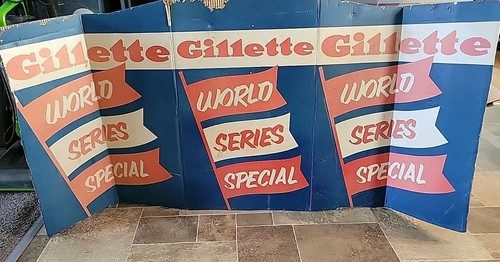
In
[…]
advertising in any ordinary sense of the word. It is a threshold artifact — a material regulator of passage between two regimes of lived reality. Its function was to install a future shared moment into millions of civilian nervous systems weeks before a single pitch was thrown.
Understand what Gillette was in 1954. Beginning in 1939, Gillette had become the official sponsor of Major League Baseball. Through the 1940s it became the sole sponsor of World Series radio broadcasts. In 1947 it sponsored the first televised World Series. By 1954, Gillette had already been embedded in American domestic life through a different and more intimate synchronization mechanism: shaving. Shaving is a daily ritual — repetitive, bodily, time-bound. Gillette already functioned as a quiet authority over when and how bodies prepared themselves for the day. It had earned temporal trust at the level of the morning routine. When it assumed sponsorship of the World Series, it carried that trust into the largest shared event in American culture.
The store display was not placed there to persuade anyone to buy a razor. It was placed there to perform a specific physiological operation: to intercept bodies in motion — on sidewalks, during errands, in the ordinary flow of daily life — and compress anticipation. Every person who passed that window received the same
[…]
almost never survive — they were built to activate time, not to endure. The ones that do survive are, in the strictest sense, artifacts of a civilization that once knew how to do something it has since forgotten.
What the 1954 Gillette display represents is not nostalgia for a television era. It represents the last fully functional implementation of all four gates at national scale: anticipatory compression through weeks of physical display, thresholded entry through the fixed broadcast start, sustained simultaneity through baseball’s durational rhythm, and coordinated release through the Series ending for everyone at once.
A civilization, briefly, held together in time. And then released.
V. The Same Object, Three Thousand Years Earlier
The 1954 Gillette display is not unique in history. It is unique in era. The function it performed has been performed at every major civilizational threshold by different objects under different material constraints.

The Olmec were-jaguar — a jade statuette of a standing figure holding an infant with jaguar features, produced in Mesoamerica between 900 and 400 BCE — appears to have nothing in common with a midcentury cardboard advertising display. Different continent, different millennium, different material, different culture, different everything visible on the surface.
The function is identical.
The Olmec were-jaguar appeared at a civilizational threshold: the transition from immediate animal time — predator time, instinct time, the immediate reality of life and death — to symbolic time, agricultural time, the kind of extended temporal horizon that requires a human being to defer gratification, plan across seasons, and submit to a social order larger than immediate biological survival. That transition is not merely cognitive. It is physiological. The nervous system that evolved for immediate survival does not naturally inhabit symbolic time without scaffolding. The shift requires a material regulator — an object that fuses the power of the old regime with the form of the new, giving the body something to return to, something that contains the danger of the crossing within stable form.
The were-jaguar accomplishes this by binding apex predator force — the most powerful biological reality in the old regime — to the human infant figure. The predator is not eliminated. It is held inside human form. The fusion is not aesthetic. It is regulatory. It gives every nervous system that encounters it the same signal: the animal power you carry does not have to destroy you. It can be contained. The crossing is survivable.
Both the were-jaguar and the Gillette display operate the same four gates. Both install anticipation. Both mark a threshold. Both entrain through duration. Both provide a mechanism
[…]
class of object. Threshold artifacts. Epoch-rare, function-specific, always appearing at the moment when a civilization must migrate into a new regime of reality and the human body requires help crossing.
VI. The Deep-Time Sequence
Seen in this light, history is not primarily a record of ideas, beliefs, or power. It is a sequence of threshold crossings — paradigm-level transitions in what human reality consists of — each stabilized or failed by the material objects that either made the crossing survivable or did not.
The cave image chambers at Lascaux and Altamira — roughly 17,000 years ago — were not art galleries. They were ritualized entry chambers with controlled access, requiring deliberate approach, specific threshold moments, durational engagement in the dark, and exit. They regulated the first emergence of symbolic perception in
[…]
human reality.
The Olmec were-jaguar regulated the threshold between animal force and symbolic humanity.
The cyclic reading of sacred texts — the Torah, the Vedic hymns — synchronized interior moral reflection with collective rhythm, authorizing the shift from cosmological ritual identity to individuated conscience without dissolving communal coordination.
The cathedral nave — Chartres, the Kaaba — regulated passage into empire-scale shared reality by synchronizing mass bodies through architectural pacing: entry, duration, release at scale.
The public clock tower regulated the transition into mechanical abstract time, authorizing industrial labor and urban coordination without temporal disorientation.
The newspaper with a fixed release time authorized national simultaneity — shared anticipation installed daily across a population that could not yet enter the same present moment in real time.
And the 1954 Gillette World Series display authorized the transition into broadcast telepresence — the crossing from local co-presence into national shared time mediated by wave technology, the moment when a continental population first learned to occupy the same now without being in the same place.
Each object appears at the moment of transition. Each performs the same function under different constraints. Each makes a new world inhabitable by giving bodies a survivable corridor through the crossing.
The sequence is complete through eight epochs. The ninth — our own — has a different entry.
VII
[…]
stimulated continuously without reset.
What this produces is not greater connection. It produces the biological consequence of continuous stimulation without dissipation: fatigue, fragmentation, the narrowing of attention to private channels, the loss of shared reality as a lived experience. The collective nervous system is not coordinated. It is saturated
[…]
but into temporal isolation.
Digital architecture does not fail morally. It fails as an entropy-management system. Wave architecture succeeded because it respected the biological requirement that stimulation must end — that excitation must dissipate, that nervous systems must return to baseline, that shared time requires shared endings. Digital architecture violates this requirement at every level. It is the photograph left in continuous light: contrast collapses, signal-to-noise degrades, meaning flattens, what was once vivid becomes bleached and uniform.
The Olmec civilization had a threshold artifact for its crossing. The broadcast civilization had one for its crossing. The digital civilization does not yet have one for its crossing.
That absence is the defining civilizational fact of the present moment.
VIII. What Survives and What It Means
The 1954 Gillette World Series display survived because someone saved it — one of the rare instances where an object built for ephemeral activation was preserved beyond its functional life. It exists now not as the infrastructure it was designed to be, but as evidence: proof that a civilization once solved this problem, once manufactured shared time at national scale with biological precision, once knew how to lift millions of bodies into a collective present and return them cleanly.
It is an artifact in the fullest sense — a material remnant whose physical survival carries information that no amount of description can fully substitute for. To hold an object like this is to hold the residue of a coordination event: the last tangible trace of a specific moment when the four gates all held, and twenty million households entered the same now together.
The photograph from 1942 of Josh Gibson standing on Forbes Field — taken by Charles “Teenie” Harris — is a different kind of survival. Here the persistence theory of authenticity operates in its most ethically precise form: for the photographs of oppressed histories, authenticity does not flow from proximity to the original negative, but from the persistence and reactivation of that negative as an instrument of historical reclamation. Each reprinting
[…]
not deteriorate with each reproduction. It intensifies. It reasserts the existence of what the institutional order attempted to erase — not symbolically but materially, as a reinstatement of light and time against the force that tried to extinguish both.
Both objects — the Gillette display and the Harris photograph — survive as material witnesses to what their eras were capable of and what those eras suppressed. Both are threshold artifacts in the general sense: objects that carry across time the evidence of what was real and what was done and what was taken away.
Time belongs to what remains.
IX. The Laws
These are the laws this framework arrives at. Each has been earned by everything that preceded it.
The Law of Shared Time : Civilizations cohere only insofar as they can synchronize
[…]
of lived reality at every scale — the speed of information, the structure of attention, the relationship between presence and distance, the architecture of anticipation — and no material regulator has yet emerged capable of synchronizing the crossing. The threshold artifact for the digital era has not been invented.
This
[…]
are trying to build — what function it must perform, what gates it must hold, what endings it must guarantee.
This document is a description of that function.
The rest is the work
Additional passages / variants — from substack:davidbussellarchive: (General Reader's Edition) THE ARCHITECTURE OF TIME: How Civilizations Hold Together — and What Happens When They Don’t (2026-03-23)
Audit note (2026-10-19): the passages below occur in this source but were not found elsewhere in the archive; appended so that the source is fully represented. Ellipses […] mark where already-present text was skipped.
General Reader's Edition) THE ARCHITECTURE OF TIME: How Civilizations Hold Together — and What Happens When They Don’t
THE ARCHITECTURE OF TIME
How Civilizations Hold Together — and What Happens When They Don’t
I. The Problem No One Names Correctly
Civilizations do not fall apart because people stop believing the same
[…]
four must hold, or shared time collapses.
The first gate is anticipatory compression — a future moment must be installed in many nervous systems simultaneously, orienting bodies toward the same coming event before it arrives. The anticipation itself begins to collapse distance. People who are geographically dispersed become temporally co-present in advance of the event, because they share a vector toward the same future moment.
The second gate is thresholded entry — there must be a single, non-negotiable crossing point. Not a window. Not on-demand. Not whenever you feel like it. A threshold. An exact moment when everyone crosses together. Without this, anticipation never resolves into simultaneity.
The third gate is sustained simultaneity — attention must be held in shared duration, not merely spiked. An instantaneous event does not produce shared time; it produces a shared spike. Coherence requires duration — a temporal corridor that holds bodies in alignment long enough for collective presence to form.
The fourth gate is coordinated release — the event must end for everyone at once. Bodies must exit together and return to baseline together. This is the gate most easily overlooked and most structurally critical. Without synchronized release, the excitation has nowhere to go. The nervous system cannot reset. Future synchronization becomes impossible because the previous event never fully ended.
**Shared