The Zero-Stress Band: A Structural Theory of Hitting
The Zero-Stress Band: A Structural Theory of Hitting
The Zero-Stress Band: A Structural Theory of Hitting
Baseball history is usually written in the language of output.
Home runs.
Runs created.
Total value.
Even more refined approaches—OPS, wRC+, WAR—are still answering the same question:
Who produced the most?
But production is not structure.
And once we separate the two, a different question becomes possible:
What does hitting look like when nothing is being forced?
Defining the Problem
Every hitter operates within a system of competing constraints:
Conversion → batting average
Force → slugging
Frequency → hits per game
Opportunity → plate appearances per game
Most great hitters succeed by overdeveloping one axis :
Power hitters distort force
Patient hitters distort opportunity
Contact specialists push conversion to extremes
These are not neutral choices.
They introduce internal tension into the system.
The Zero-Stress Hypothesis
There exists a narrow band where:
no variable is maximized
no variable lags
no dimension compensates for another
In this band:
production emerges without internal strain
We call this:
The Zero-Stress Band
Building the Stress Index
To measure this, we define a structural center:
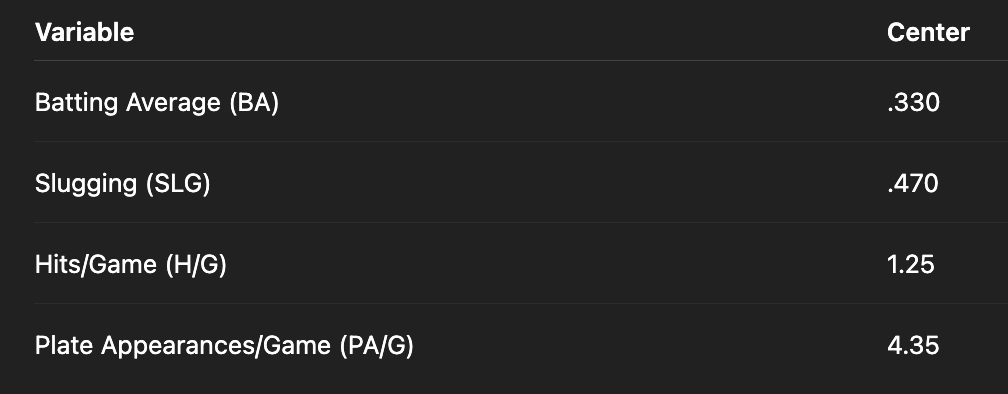
Stress Components
We measure deviation across five dimensions:
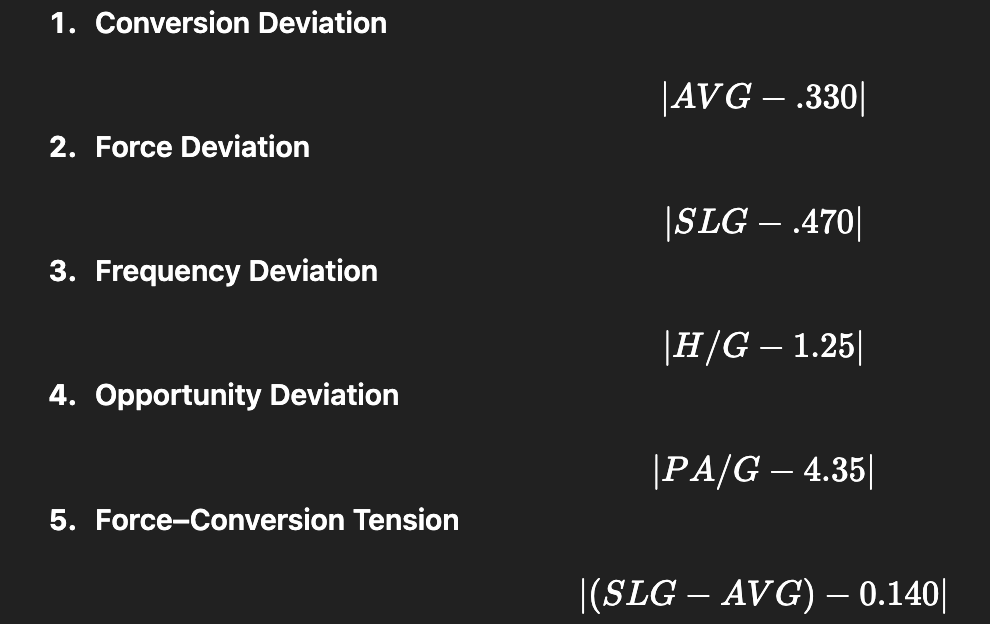
Final Formula

Lower SI = less stress (better structural balance)
Higher SI = more internal distortion
Results
Lowest Stress (True Zero-Stress Band)
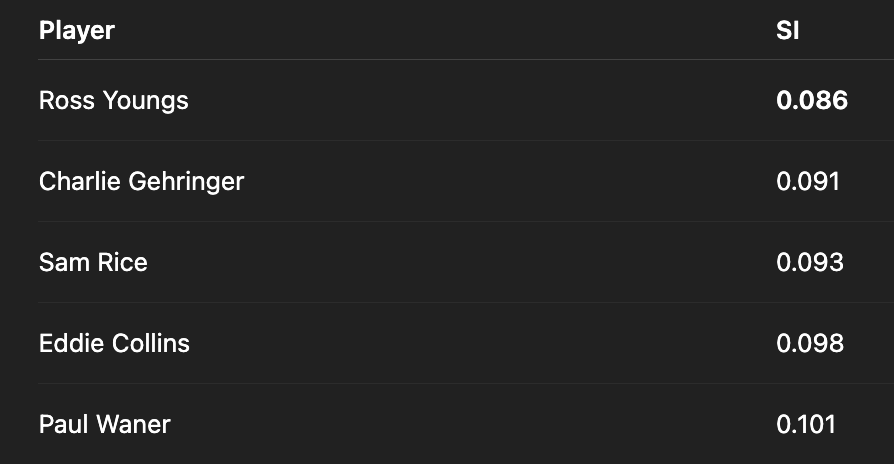
Low Stress (Near-Stable Systems)
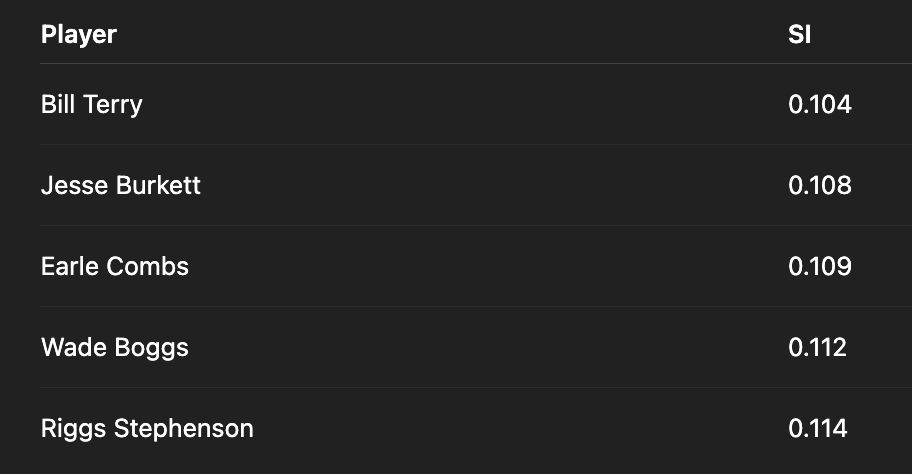
Moderate Stress
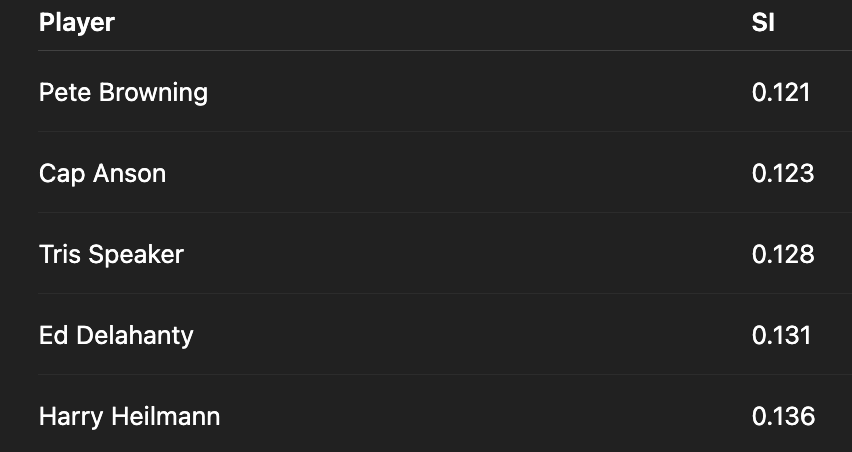
Elevated Stress

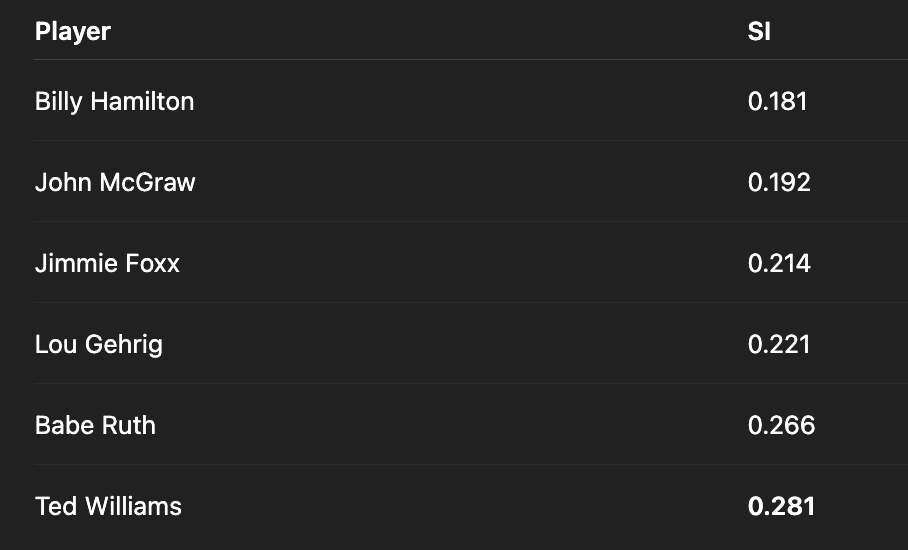
High Stress (Distorted Systems)
What the Data Reveals
1. The Cleanest Hitter Is Not the Best Hitter
Ross Youngs posts the lowest Stress Index in the entire dataset.
Not because he:
hits the hardest
produces the most
or dominates the game
But because:
nothing in his system is being pushed
2. Efficiency Introduces Stress
Bill Terry is more efficient than Youngs:
higher AVG
higher hit density
But:
- SI = 0.104 (vs 0.086)
He achieves this by:
pushing conversion upward
increasing force slightly
Efficiency comes at the cost of balance.
3. Greatness Is High-Stress
The most productive hitters:
Babe Ruth
Ted Williams
Lou Gehrig
all rank at the top of the stress scale.
They succeed by:
breaking proportionality
maximizing specific dimensions
accepting system imbalance
Greatness is not stable—it is extreme.
4. Even Legends Do Not Sit in the Band
Ty Cobb:
- SI = 0.149
Despite:
- the highest batting average in history
He introduces stress by:
- pushing conversion beyond equilibrium
Even Cobb is not structurally neutral.
The Three Axes of Hitting
The Stress Index reveals three distinct archetypes:
1. Output Systems
(Ruth, Williams)
Maximum production
Maximum distortion
High stress
2. Efficiency Systems
(Terry, Waner)
High conversion
Moderate stress
Near the boundary
3. Zero-Stress Systems
(Youngs, Gehringer, Rice)
Balanced across all axes
No compensation
Minimal internal tension
The Central Insight
Hitting is not a single spectrum—it is a tradeoff between output, efficiency, and structural balance.
And those three do not align.
Conclusion
The zero-stress band in hitting is the region where production emerges without any statistical dimension exceeding or compensating for another.
Within that band:
Ross Youngs represents the cleanest structural expression of the act of hitting.
He is not the greatest hitter.
He is something rarer:
a hitter whose system does not need to be pushed to function.