THM and the Hidden Structure of Elite Hitting
THM and the Hidden Structure of Elite Hitting
THM and the Hidden Structure of Elite Hitting
Baseball history is usually organized around categories.
Power hitters.
High-average hitters.
On-base specialists.
These categories describe traits. They do not describe structure.
When the act of hitting is collapsed into a single system—one that forces all core dimensions to operate simultaneously—a different picture emerges. Not a taxonomy of skills, but a field of constraint , where certain players cluster into a hidden band of total mastery.
Defining the System
Hitting reduces to four irreducible forces:
Conversion → Batting Average (AVG)
Access → On-Base Percentage (OBP)
Force → Slugging Percentage (SLG)
Continuity → Hits per Game (H/G)
Each is necessary. None is sufficient alone.
When unified, they form a single scalar:

This is not a value metric. It is a structural index :
Total Hitting Mastery (THM) measures the degree to which a hitter sustains simultaneous pressure across all dimensions of the game.
Because the system is multiplicative, imbalance cannot be hidden. Strength must be continuous.
The Unified Field
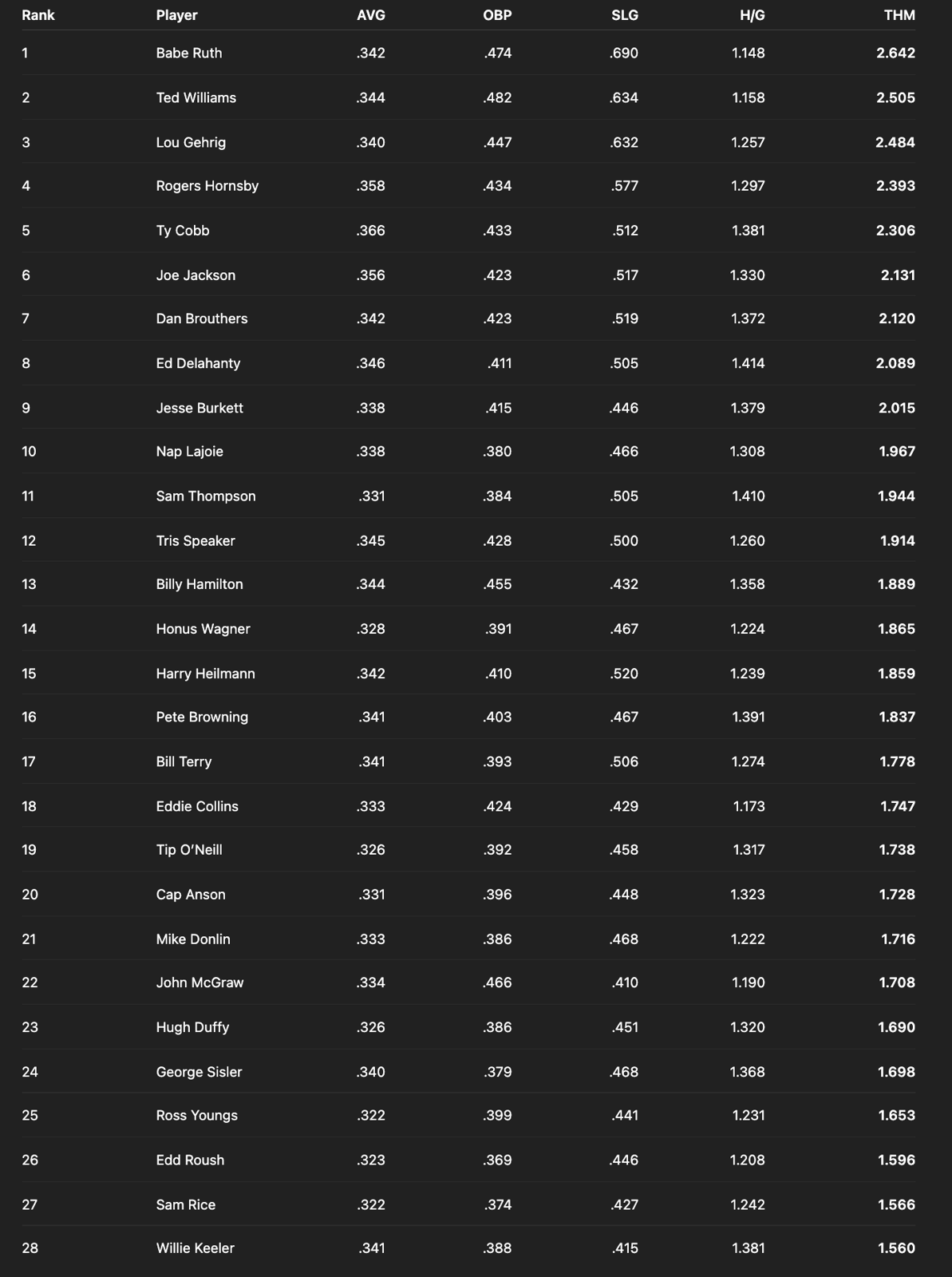
When both bands are combined into a single ranking, the structure becomes visible.
THM — Full Integrated Ranking
*** Players with career batting averages of .322+ and at least 1,000 games played**
The Hidden Band
Once unified, the hierarchy no longer splits cleanly at .340.
Instead, a different structure appears:
The True Elite Band (~2.00 and above)
Babe Ruth
Ted Williams
Lou Gehrig
Rogers Hornsby
Ty Cobb
Joe Jackson
Dan Brouthers
Ed Delahanty
Jesse Burkett
This is the hidden band of total hitting mastery.
Not defined by:
era
style
category
But by:
the ability to sustain multiplicative pressure across all four axes simultaneously
What About .340 AVG?
Batting average still matters—but differently than initially assumed.
It is not a hard cutoff.
Instead:
.340 AVG strongly correlates with entry into the top band, but does not exclusively define it.
Evidence:
Jesse Burkett (.338) → 2.015 (enters elite band)
Nap Lajoie (.338) → just below
Sam Thompson (.331) → nearly enters
At the same time:
- Several .340 hitters fall well below the band
(Terry, Sisler, Keeler)
Reframing AVG
Batting average is best understood as:
a stabilizing force that increases the likelihood of full-system activation
It contributes to:
H/G (continuity)
OBP (access via hits)
SLG floor (volume of bases)
But it does not guarantee elite placement.
What Actually Defines the Elite
The top band reveals the real law:
Elite hitters are those who maximize total multiplicative output, not those who optimize any single dimension.
This produces three pathways into the band:
1. Power-Amplified Systems
Ruth
Williams
Gehrig
High OBP + SLG compensate for lower H/G.
2. Continuous Pressure Systems
Cobb
Delahanty
Burkett
High H/G + AVG sustain constant field pressure.
3. Hybrid Systems
Hornsby
Brouthers
Jackson
Strong across all axes without collapse.
The Middle Field (1.70–1.95)
This is the zone of:
near-complete hitters
balanced forms
partial systems
Includes:
Speaker
Wagner
Heilmann
Terry
Lajoie
These players:
have no major weakness
but lack sufficient multiplicative amplification to enter the top band
The Core Insight
Traditional metrics fragment hitting into parts.
THM recombines them.
And in doing so, it reveals:
There exists a narrow, stable band of hitters who fully solve the system of hitting.
Not stylistically.
Structurally.
Conclusion
The hierarchy of hitting is not built from categories or archetypes.
It is built from constraint satisfaction.
When all dimensions are forced to operate together:
most players fall into partial solutions
a smaller group approaches completion
and a rare few fully enter the system
That group—the hidden band around THM ≈ 2.00+—
is where hitting stops being a collection of skills and becomes something else entirely:
a unified, sustained expression of total offensive mastery.