Three Mechanisms of Offensive Greatness: Orr, Hamilton, and Burkett
Three Mechanisms of Offensive Greatness: Orr, Hamilton, and Burkett
Three Mechanisms of Offensive Greatness: Orr, Hamilton, and Burkett
Baseball history is often written through accumulation statistics—career WAR, total hits, or Hall of Fame elections. But when early players are normalized to comparable opportunity—similar numbers of games or plate appearances—a different picture begins to emerge. The comparison between Dave Orr , Billy Hamilton , and Jesse Burkett reveals something deeper about the structure of offense itself.
When their production is evaluated over roughly the same scale of games (around 800), the three hitters separate into distinct archetypes of offensive disturbance. Each dominates the game in a different dimension.
The Statistical Comparison
From the normalized sample:

At first glance the numbers suggest a simple hierarchy. But what they actually reveal is three fundamentally different offensive mechanisms.
Dave Orr: The Damage Engine
Dave Orr stands out immediately in one category: OPS+.
His 162 OPS+ means he produced offense 62% above league average —a staggering level of dominance for the 1880s. Even more striking is his .502 slugging percentage , which towered over the power environment of the time.
In an era when league slugging percentages often hovered around .330–.360 , Orr’s power production represents a massive deviation from the norm.
Orr’s archetype is therefore:
Damage generation.
He did not merely reach base frequently or accumulate singles. He produced disproportionate offensive impact per hit , compressing the defensive system through extra-base contact.
Billy Hamilton: The Energy Injector
Billy Hamilton represents the opposite mechanism.
His dominance lies not in slugging but in base creation.
Career profile:
.449 OBP
543 stolen bases in the sample
extraordinary run scoring rates
Hamilton continuously injected baserunners into the system. Every plate appearance carried a high probability of avoiding the one event that destroys offensive potential: the out.
Once on base, his speed amplified that advantage. The stolen base totals illustrate how Hamilton converted baserunners into immediate scoring pressure.
His archetype is therefore:
Offensive energy injection.
He expanded the offensive system by continually generating new baserunners and destabilizing defensive positioning.
Jesse Burkett: The Hit Density Amplifier
Jesse Burkett occupies a third position in the offensive structure.
His defining trait is sheer hit production.
Burkett’s line shows:
.348 batting average
1166 hits in the sample
balanced OBP and slugging
Rather than relying primarily on walks or power, Burkett overwhelmed the system through relentless contact generation. His peak seasons regularly produced extraordinary hit totals—often exceeding 200 hits in an era with shorter schedules.
Burkett’s archetype is therefore:
Hit density.
He generated offensive movement through the constant accumulation of safe contact events.
Three Distinct Disturbances of the Run Environment
What emerges from the comparison is not a simple ranking but a structural insight.
Each hitter disrupts the equilibrium of run production in a different way:
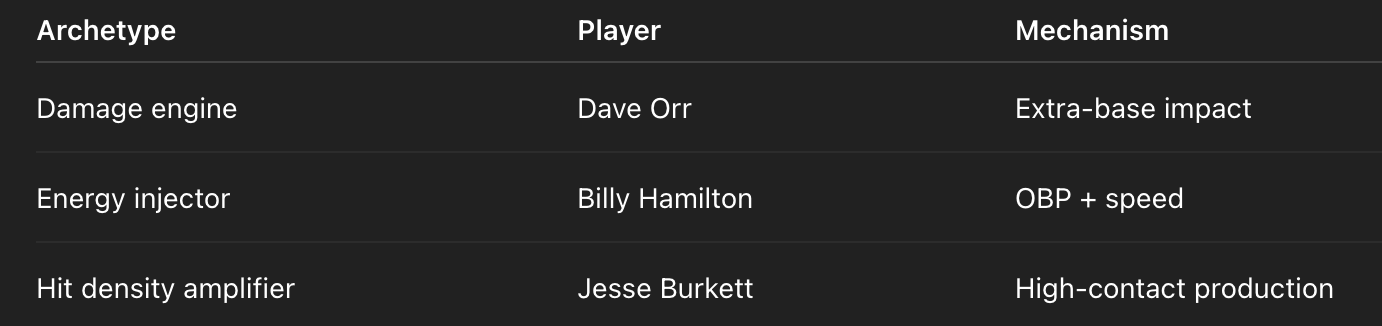
All three mechanisms ultimately serve the same goal: increasing run production relative to the environment. But they accomplish that goal through different pathways.
The Hidden Implication
This comparison suggests that great hitters should not always be evaluated as if they represent a single offensive template.
Instead, offensive greatness may be better understood as different forms of disturbance within a run-producing system.
Some hitters create baserunners.
Some convert contact into power.
Some overwhelm defenses through sheer volume of hits.
The careers of Orr , Hamilton , and Burkett illustrate these three pathways with unusual clarity.
Taken together, they reveal that baseball’s offensive history is not the story of one type of greatness—but of multiple mechanisms capable of destabilizing the equilibrium of the game.
Addendum: Jesse Burkett, George Sisler, and the Structural Primacy of On-Base Percentage
The framework proposed in this essay—that on-base percentage functions as the trans-historical modifier of offensive value —produces illuminating results when applied to historical player comparisons. One particularly instructive case is the comparison between Jesse Burkett and George Sisler.
At first glance, the careers of Burkett and Sisler appear remarkably similar. Their aggregate value, as measured by Wins Above Replacement, is nearly identical.

Both were elite contact hitters, both combined batting average with speed, and both accumulated large career hit totals. Yet a closer examination of their offensive structure—particularly through the lens of on-base percentage—reveals a significant difference.
To make the comparison structurally consistent, the final season of Burkett’s career was removed so that the two careers align much more closely in games played and plate appearances. This adjustment equalizes the opportunity structure of the comparison and allows the rate statistics to be evaluated on nearly identical offensive workloads.
Once normalized in this way, the rate statistics show a clear separation.
Burkett’s line:
.344 AVG
.420 OBP
.454 SLG
142 OPS+
Sisler’s line:
.340 AVG
.379 OBP
.468 SLG
125 OPS+
The most consequential difference lies in the 41-point advantage in on-base percentage held by Burkett.
Across roughly nine thousand plate appearances, that gap represents hundreds of additional times reaching base. Within the structural logic of baseball, this difference is enormous. Each avoided out preserves the offensive system and extends the possibility of run creation.
This reinforces the central claim of the essay: the avoidance of outs is the foundational event of offense.
Every inning is constrained by the fixed budget of twenty-seven outs. A hitter who more frequently avoids those outs sustains the conditions under which runs can be generated. In this sense, OBP measures the rate at which a hitter prevents the collapse of offensive opportunity.
The OPS+ comparison reflects this same reality. Burkett’s 142 OPS+ indicates offensive production 42 percent above league average , while Sisler’s 125 OPS+ places him twenty-five percent above average. Even after adjusting for differences in offensive environment, Burkett emerges as the more dominant hitter relative to his league.
This comparison illustrates an important principle. Hitters whose greatness is rooted primarily in extreme on-base ability are often undervalued historically because their dominance is less visually dramatic than that of power hitters or single-season milestones. Sisler’s legendary 257-hit season , for example, has long shaped his reputation. Yet when offensive production is evaluated structurally, Burkett’s superior ability to reach base generates greater sustained offensive pressure.
Seen in this light, Burkett belongs to a lineage of hitters whose defining skill was the systematic refusal to make outs. Players such as Billy Hamilton , John McGraw , and Burkett himself represent a form of offensive dominance rooted not in spectacle but in structural efficiency.
Their greatness lies in a deceptively simple act: they kept the offensive system alive.
And because run creation begins with the presence of baserunners, this continual preservation of the offensive state remains one of the most powerful—and historically consistent—forms of offensive excellence the game has ever produced.