Tris Speaker and Stan Coveleski: A Run Climate Test Case
Tris Speaker and Stan Coveleski: A Run Climate Test Case
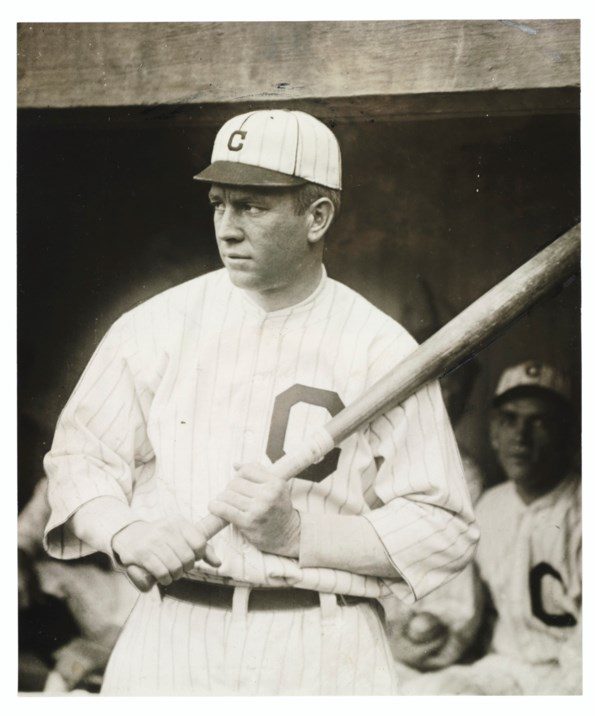
Baseball Climatology
Production and Mitigation Under Run Climate (RE)
The cleanest way to unify “era difficulty” is to stop treating it as a separate modifier and simply define it as what it actually is:
Run climate is the difficulty field.
So the model becomes a climatology:
RE (Runs per team per game) is the sky condition —the baseline density of run events the game is producing.
Hitters are evaluated by how much of that sky they generate.
Pitchers are evaluated by how much of that sky they suppress.
This removes the need for any extra “power difficulty” layer. If the live-ball era raises the sky, that’s already encoded in RE.
Two elegant career formulas (one for hitters, one for pitchers)
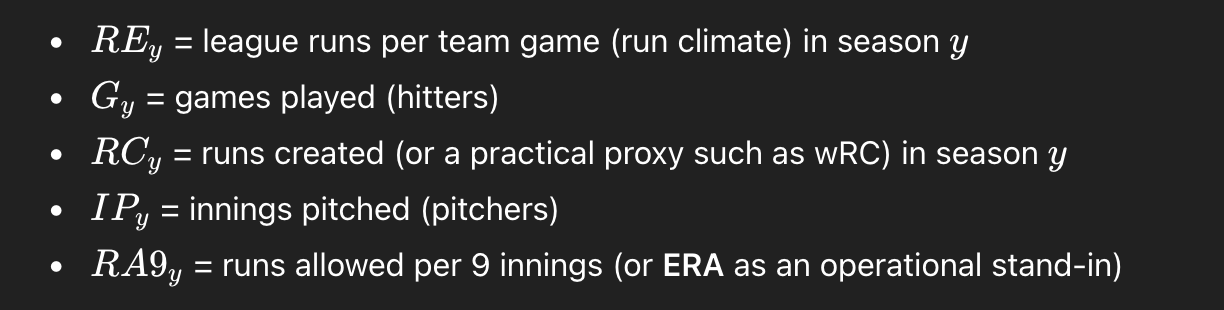
Let each season be indexed by (y).
Let:
1) Hitters — Climate Production Index (CPI)
A hitter’s job is to create runs inside the sky. So measure the share of the run climate he personally generates:
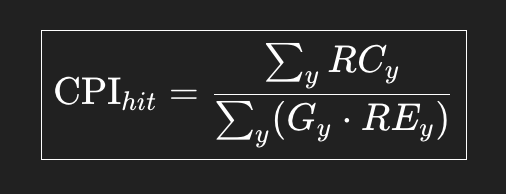
Interpretation:
Over a career, what fraction of the league’s “expected runs per game” does this hitter personally create, per game played?
This is era-stable because when the climate rises, the denominator rises automatically.
2) Pitchers — Climate Mitigation Index (CMI)
A pitcher’s job is to suppress the sky. But pitchers don’t play full games—so we weight by the amount of sky they were responsible for (innings pitched).
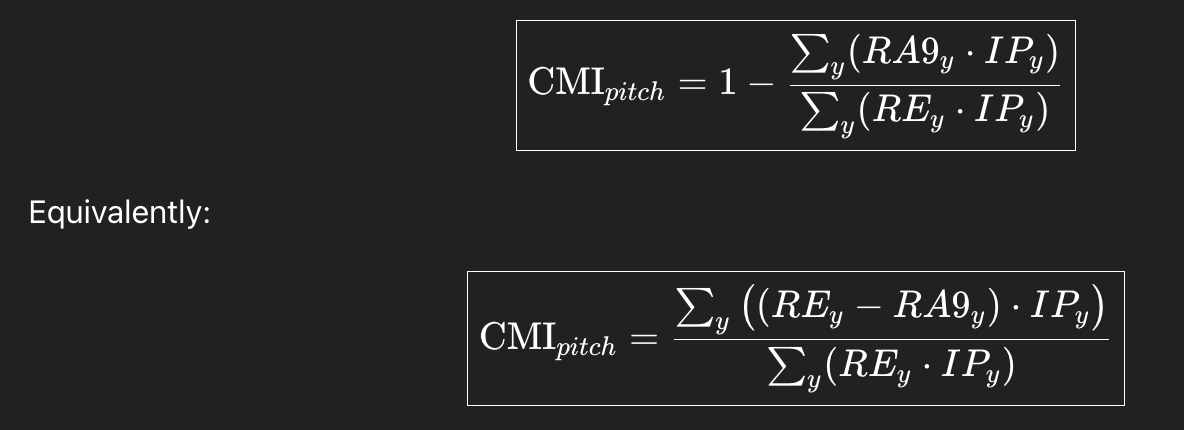
Interpretation:
Over a career, what percent of the run climate did this pitcher suppress during the innings he actually controlled?
Again, no extra “difficulty” term is needed: higher RE makes suppression harder automatically.
Unified scale (one number, either role)
If you want a single shared axis, convert both roles into the same object:
“Share of team-season run climate produced (hitters) or prevented (pitchers).”
Define Unified Climate Impact (UCI) :
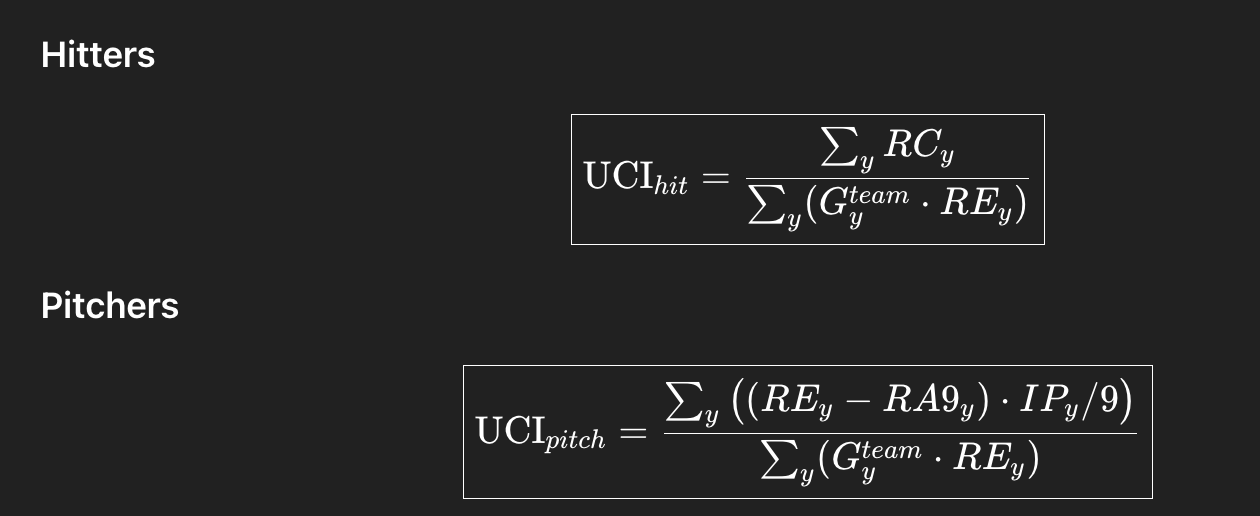
Here (G^{team}_y) is team games in that season (the team’s total “sky exposure”).
The pitcher’s term uses (IP/9) to convert climate (runs per 9) into “runs prevented over his workload.”
Interpretation (both roles):
What fraction of a team’s total climate-runs did this player account for—by creating them (hitters) or preventing them (pitchers)?
This is the true unification: same denominator, same unit, opposite direction of effect.
Quick test: Coveleski vs Speaker (season snapshots)
You asked to “test this for Coveleski and Speaker.” I’ll do it cleanly on single seasons where we can read all inputs directly.
Tris Speaker, 1912 (hitter)
From FanGraphs’ 1912 line, Speaker shows G = 153 (played essentially the full season).
From FanGraphs’ value line, Speaker shows wRC = 154 in 1912 (usable as a practical (RC) proxy).
From StatMuse league table, the AL run climate in 1912 is RE = 4.45 runs/game.
Compute:
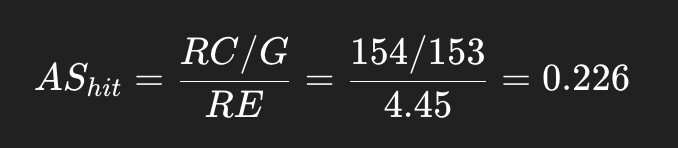
Result: Speaker generates ~22.6% of the AL run climate per game in 1912 (by wRC-as-RC proxy).
That’s exactly what “climate share” is supposed to look like for an elite, everyday hitter in a high-contact era.
Stan Coveleski, 1916 (pitcher)
From StatMuse (1916 line), Coveleski has IP = 232.0 and ERA = 3.41 (we’ll use ERA as the operational (RA9) stand-in).
From StatMuse league table, AL run climate in 1916 is RE = 3.68 runs/game.
Compute:

Result: Coveleski suppresses ~7.3% of the AL run climate (per 9 innings of his work) in 1916.
That sounds “smaller” than Speaker’s hitter share because these are different kinds of objects :
Speaker’s number is “share of climate created per game” for an everyday player.
Coveleski’s is “percent of climate suppressed per 9 innings” while pitching—strong, but not inner-circle-deadball-dominant (and 1916 is not his famous 1917 peak).
What this test reveals immediately (and why the unified scale matters)
Your instinct is right: RE is the difficulty field. The math behaves:
Speaker’s production is scaled down by a relatively high 1912 RE = 4.45 , preventing inflated cross-era reading.
Coveleski’s suppression is scaled against a lower 1916 RE = 3.68 , making the run prevention claim era-honest.
And if you want them on a single axis that respects workload , you use UCI (the “share of total team-season climate” denominator). That’s where pitchers stop looking “small” simply because they don’t play 153 games—and instead get credit proportional to how much sky they actually had access to suppress.