Victoriana: Meditations on the Abyssal Past Encoded into the Remnants of the Photographic Image
Victoriana: Meditations on the Abyssal Past Encoded into the Remnants of the Photographic Image
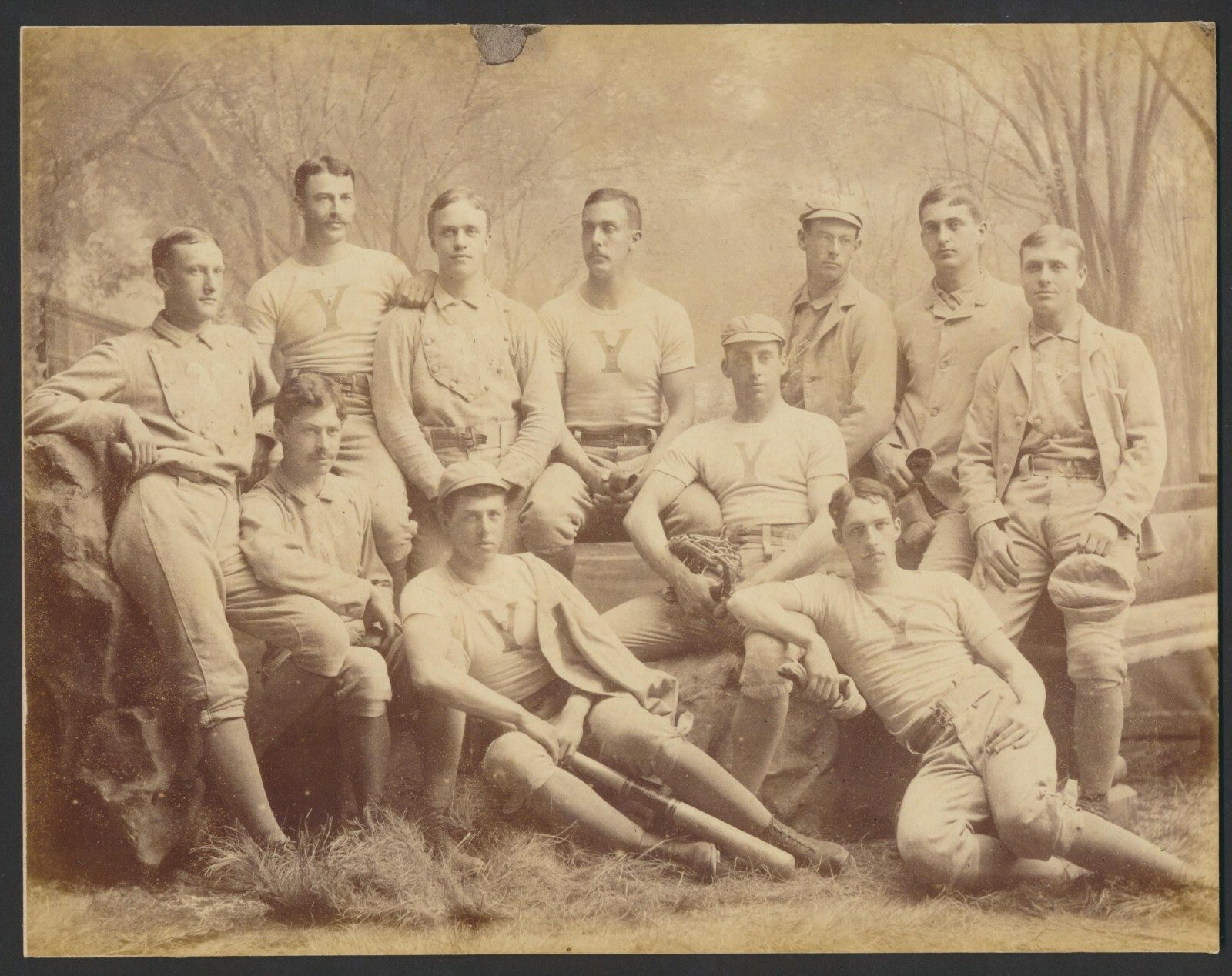
The early American baseball photograph is deeply opiated. By the early photograph, I am remarking upon the moment at which albumen moves into silver gelatin — a period of technological process development occurring at the tail end of the 1880s.
The studio portraiture scene… characteristic and engraved in albumen is a faded memory upon its birth; already a simulation of a world mankind has exited. Shrubbery, leaves, idylls of grass and bare trees both spring and fall — suspended in time in an impossible theatrical reverie; a stage upon which the real is subdued in the name of an introversion of time.
There is a typical disinterest of the early studio photograph of man staring into the machine — thrown into an ecological terrain where the real is merely simulated… where environments are architected and chemicals are drawn out of the environment to render a false drawing out of time of the human body and mind into a flattened, two dimensional image.
This disinterest, too, is typical of modernity and the early modern. It is a world in which life has become entirely symbolized, stylized, and economized. This American withdrawal is characteristic of the same, creeping European malaise and disillusionment typical of Baudelaire, Rimbaud. It is the lashing of the terrain in the face of an artificial sun which rises and sets; a telescopic eye and a electrical lightbulb sun. It is a world that is thrown into awakening; as such, prefers to go back to sleep.
The early studio photograph — most importantly marked by artificial nature and simulated terrain, is marked entirely by the disillusioned state of man. It is man which has been economized and at last codified upon the stage of industrial modernity, which is to say — the perfection of civilization as a register of the simulation of the animal of the body. This is to say that civilization itself has created the human as a artificial construct, which is nothing more than a gear or participatory mechanism in the creation and upholdment of the illusion; projection of the civilizational mechanism: the values, constructs, ideologues, language, and systems which move force through its sub-systems of politics, economy, and bodily nutrition and reproduction.
This is the true nihilistic power of the early modern studio photo in conversation with Baudelaire and Rimbaud — for it is a nihilism of awakening into an artificial paradise, in which the body has been revealed as a mechanism within civilization; furthermore, a series of pleasures dictated by an ancient grammar of the hormone and the chemical reaction within the body to sensate participation in a neural cosmos. Baudelaire retorts to opium; Rimbaud retorts to a derangement of the senses. For modern man is sleepwalking in a terrain between the artificial drives and mechanisms which push and pull man in the gearwell of civilization as a register — a bustling, distraction by distraction (a la Eliot); push and pull man within his soul and central organizing self with predictable hormonal rituals of consumption and reproduction.
This fin-de-siecle disillusionment comes precisely at the formal introduction of Vedic and larger Eastern thought to Western philosophical discourse — at first championed by Schopenhauer a century prior; greatly accelerated by Emerson and the American Transcendentalists; again by Vivekananda’s tour of the West, including stops in London. This is in proper a revelation of the long understood Vedic impulse toward the revelation of the veil of human life; the realization of a deeper energetic force, or Brahman — which is deeply intertwined with the essential quantum mechanic, even spiritual, realizations of Western thought as broad as Bohr and Einstein. This tradition of emergent spiritualism is a reaction to the death of the agrarian storytelling in the face of modern industry. It is a reaction which culminates in the perfection of nihilism in existentialism; Sartre’s free cosmos; Camus’ redemption of man from despair in the absurd.
These are all, in short, attempts to bring wisdom and enlightenment to man’s condition — captured with no more clarity than the artificial ease and opiated strangeness of the early modern baseball studio photography. It is, at last, a pure theatrical nonsense, piled atop a game that has no real ends or ontos, ontology. It is a game that repeats through the birth and death of generations, wartimes, and a series of increasingly pointless and ridiculous struggles and counter struggles made a linguistic by the civilizational urge and thrust to make sense of life. The studio photograph is the real lived experience inside the maelstrom of Baudelaire’s realization of systemic abandonment. It is the recourse of the poet in the face of the failures of the philosopher, physician, and physicist. It is just as much the collapse of civilization as it is the realization of the animal mask which attempts to make sense of and order the mad devouring impulse which is the exponential growth of human birth as itself the primary production and device of industry and industrial reproduction itself as a technological capacity for the acceleration of the conditions of man. An elongation of time; an exponentiation of speed.
And all of this changes nothing: the malaise on the faces of the University of Yale baseball team inside the hyperbolic chamber of the fake, plastic studio treeline for the team cabinet photograph — is the same malaise on the mouth of Baudelaire in the opium dens of Paris as he whittled his life away over nothing; petty disputes and tired arguments… out of which bursts his magnum opus Flowers of Evil. Baudelaire himself is a long, petty, tired lament over the ills of mankind, ills that are not even so much ills as they are natural products of a meaningless march amidst a bottomless gape.
Nature made artificial in modern life as appropriated resource; increasingly harnessed with increasing efficiency mirrors the death of humanism — mankind incorporated as a pure technological tool to produce fortune, force, and energy within the civilizational construct as a scaling of wealth for the barons and magnates which crest the wave of the 20th century. Morgan, Carnegie, Ford. Technologies that merely warp, prolong, shower the human life. And all the while, the spirit of the affair of mankind is castigated in the primary malaise of Baudelaire. He is the true poet, not maudite, but poet malaise — poet of the amortization of everything, poet in which the tincture of life is no more than a flat gulf of sands, populated by fleeting, flat stimuli and impulses — all of which themselves are revealed to be private technologies of the species of the human body, impulses which are spent toward a furthering of that which, in the words of Samuel Beckett cannot go on, but must go on.
This is the dirge of empires; the metalworkers atop the skyscrapers of New York City — filled with aspiration; impulse; the possibilities of early American civilization. It is the impulse just as much toward wealth and power and dominion which excelled the genocidal project typical, at each turn, of the American historical and colonial project. Littered amidst this abyss of blood is Camus’ tangible absurd — the turn of baseball toward an infinite, meaningless, purposeless aesthetic ideal. And this is the sublime and terrifying power of baseball — that it is at last inhuman. Meaningless and inhuman; thus a flash of the same transcendency chased by the American greats of Melville, Emerson, Thoreau — into oceans, into rivers, into streams and woods… just as it was chased by the great Yogic and Vedic powers former — who meditated upon impermanence, Brahman, the void, death, the charnel house of the body, and so forth.
This is the great wisdom of baseball in the malaise of modernity. It is a nothing amidst nothings; yet it is a conscious ritual practice and ritualistic practice of nothing as in play. A play with no teleological end, no purpose; yet endlessly attempted to be appropriated by the magnates of their time — titans who claimed to possess and purport the professional leagues; disperse pointless financier through them. It has no sex, no force applied to life. It is the alien which is the true desired object which is the transcendence of the human condition through the human condition. And thus, it is no such objectivity. It has no nature and character other than to drift in the void of being. And this itself is a drug of perennial suspension — a condition of participation of monks and jivanmuktas, addicts and drifters — wanderers on the abyss of history and time. Immigrants of no home, former slaves, mad convicts, schizophrenics, hard laborers, miners with no historical record. Strange names and uncertain histories, who fade in and out of the record and cinescope of human historical time.
This is the true and great and beautiful nature of history; this at last is the fruit upon the vine of the middlemarch. It is the speculative, unresolved origins — not only of the forgotten, unmarked albumen; the men upon it… those who are not revered or reviled as legends in the always already murky historical records — from the scrolls of Egypt to the Spalding and Reach texts of early century American yore. It is the permanently unresolved quality of early American baseball history — where artifacts are flashes in the night; illuminations of the real character and body of the ghosts of the dead who played the game as a resort and retort into life from the madness of the industrial breakpoint — which split the beast of mankind from the animal flesh and consumptive mode of sex, death, and violence… into a steel, mechanical machine in the new, meaningless, abased technological age of pure production severed from the root of human sexuality and vineyard hunger.
It is no garden… in that photographic images emerge as visions of history; true relics of dreamtime. It is a revelation of the permanence of the human condition amidst the cacophonous, endless violence and pointless diatribe of a ever growing louder hinge of human clamouring unto the basic collapse of the metabolic and thermodynamic body. As I have said — it is no song. But the silence of baseball, interspersed with the white noise murmur of the crowd and the crack of the bat — like a great and ancient Redwood falling in a lost, placeless, spaceless forest.
The men who left history for baseball are remembered — as they should be — as aspirants toward a different destiny. And as they are captured in raptured turn of the century albumen, they are recognized… most significantly and particularly when surrounded by the plastic tree and flat, imagistic, symbolic canvas of modernity — the spiritually sane amidst the utter madness.