Walk Rate and the Introduction of Chaos
Walk Rate and the Introduction of Chaos
Walk Rate and the Introduction of Chaos
The real separation between Dave Orr and the other elite hitters at the top of the hits-per-game leaderboard—particularly Ed Delahanty and Sam Thompson —is not batting average and not meaningfully hits per game. Those numbers sit in almost the same range.
The difference is walk rate.
When the three players are compared directly, the contrast becomes immediately clear.
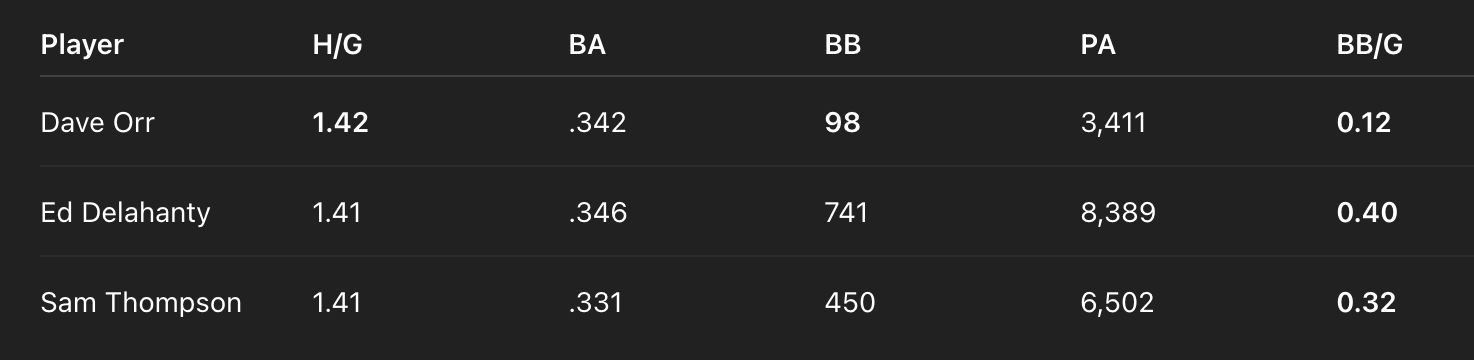
All three hitters belong to the same offensive tier:
batting averages clustered between .331 and .346
hits per game clustered between 1.41 and 1.42
But their walk frequencies differ dramatically.
Delahanty walked more than three times as often per game as Orr. Thompson walked nearly three times as often as well.
This difference fundamentally alters the composition of their offensive events.
The Structural Mechanism
Hits per game can be understood as the interaction of two variables:

Because Orr, Delahanty, and Thompson all hit for nearly identical batting averages, the key lever becomes at-bats per game.
Walks remove at-bats. Each walk converts a plate appearance into a non-contact outcome and eliminates the possibility of producing a hit.
Orr’s extraordinarily low walk rate—0.12 walks per game —means that nearly every plate appearance he took became an at-bat and therefore a contact opportunity. Delahanty and Thompson, by contrast, allowed hundreds of plate appearances to terminate in walks.
Those walks reduced their opportunities to convert plate appearances into hits.
In effect, Orr maximized the percentage of his plate appearances that could produce a hit.
The Broader Pattern
When we expand the comparison to the other great hitters surrounding Orr on the leaderboard, the pattern becomes even clearer.
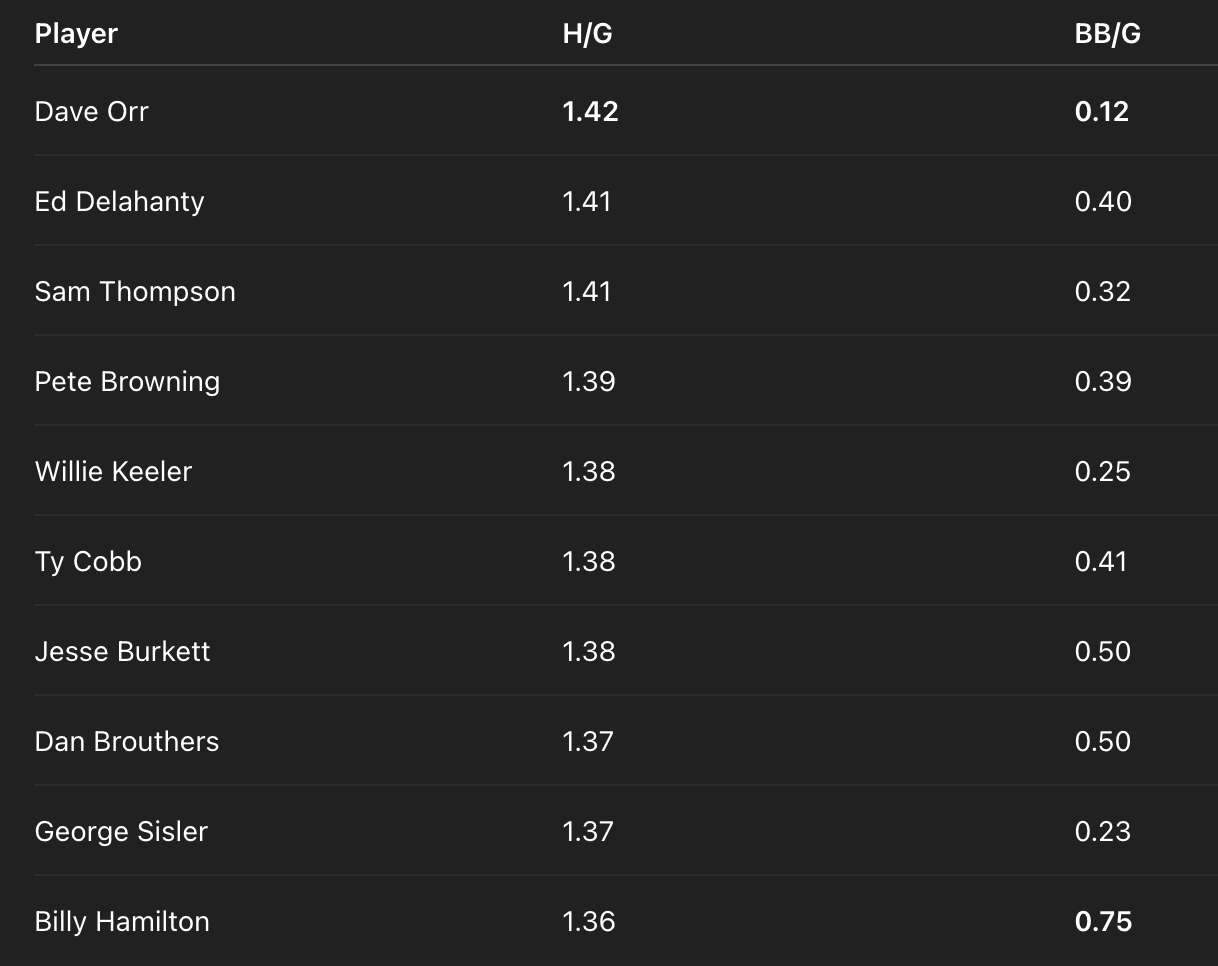
Among the elite hitters clustered around 1.36–1.41 hits per game , most walked between 0.25 and 0.50 times per game. Some, such as Hamilton, walked even more frequently.
Orr sits far outside this pattern.
His 0.12 walks per game is not simply low—it is an extreme outlier relative to the offensive norms of his peers. He walked between two and six times less frequently than the other great hitters occupying the same statistical tier.
Walks and Offensive Stability
This difference matters because walks and hits produce fundamentally different types of events within the game.
A walk produces a stable outcome. The batter advances to first base, no ball is put into play, and the defensive structure of the inning remains unchanged.
A hit introduces immediate instability. Once the ball enters play, defenders must react, runners advance, and the outcome becomes uncertain. A routine single can quickly become multiple bases through aggressive baserunning, defensive misplays, or throwing errors.
Where a walk guarantees exactly one base, a hit opens the possibility of multiple bases and cascading runner advancement.
Orr’s Offensive Profile
Because Orr walked so rarely, he forced the game into motion more frequently than his contemporaries. Nearly every plate appearance he took produced a ball in play, and each ball in play carried the possibility of a multi-base outcome.
With a batting average already at an elite level, this approach increased the number of opportunities for doubles, triples, defensive errors, and extended runner movement.
Delahanty and Thompson, by contrast, combined elite batting averages with substantial walk totals. Their approach maximized on-base percentage and offensive stability , but it also removed many plate appearances from the pool of potential contact events.
The Key Insight
The striking feature of Orr’s record is therefore not that he hit dramatically better than Delahanty or Thompson. Their batting averages and hit rates demonstrate that they belonged to the same elite tier of nineteenth-century hitters.
What distinguishes Orr is the structure of his plate appearances.
Where most great hitters balanced contact with walks, Orr almost never allowed plate appearances to resolve in walks. Instead he converted nearly every opportunity into a ball-in-play event.
In doing so, he maximized the number of chances for multi-base outcomes and defensive disruption.
Orr did not simply accumulate bases. He maximized the frequency with which the game itself was forced into motion; as such, the possibility of game breaking, game destabilizing events in favor of the hitter.