What Baseball Cards Can Tell Us About Who We Are As A Culture
Video
What Baseball Cards Can Tell Us About Who We Are As A Culture
00:02
Hey y'all, so here's another video. Actually, I'm pretty excited to make this one because it's very quietly profound, this topic. It's about chasing scarcity and baseball cards and this whole mentality and ethos that I think is very common, not only in the collecting community, but also in terms of archives, artifacts, relics — generally things that people own or people proclaim to be important.
00:31
This is a really cool topic, so hang in here with me on this. The whole real idea, I think, of what is valuable or what is important — is something that's culturally valuable and culturally important. People will tie that to different things. It's like maybe you have the Maserati or the Bugatti or whatever it is. It's a perspective, it's an outlook.
01:01
People will place this perspective or outlook or idea — and base it in and around scarcity. It's this idea of I have the only one of this in the world. There's that common trope of the people who are hunting for the gold or for the treasure, right? And so what really needs to be removed from that mindset is the idiocracy of — I'm the only one that has this only thing in the world and this makes me or it special, important, powerful, et cetera.
01:31
People will chase this forever. They'll go on this road of — I have this thing, so it makes me this, and now I'm that. And the whole time, they're just miserable. Because the whole idea is I'm making myself important by separating myself, or I have this one thing that separates me from everyone else. And I want to connect this back to, interestingly enough, mid-century baseball cards. It's something that's so important because —
01:59
I talked about this -- the mid-century baseball card is the totality, it's the sum of everything that baseball cards build up to for 50 years. From 1900 to 1950; then you have the 50s and 60s, where baseball cards really come into their own. You have Topps, which emerges as the monopoly of the baseball card and it declares the design ethos, the power of the card, the stats, the cartoons. Everything is very summed up in terms of the history of the development and identity searching of the baseball card, and it reaches its peak --
02:28
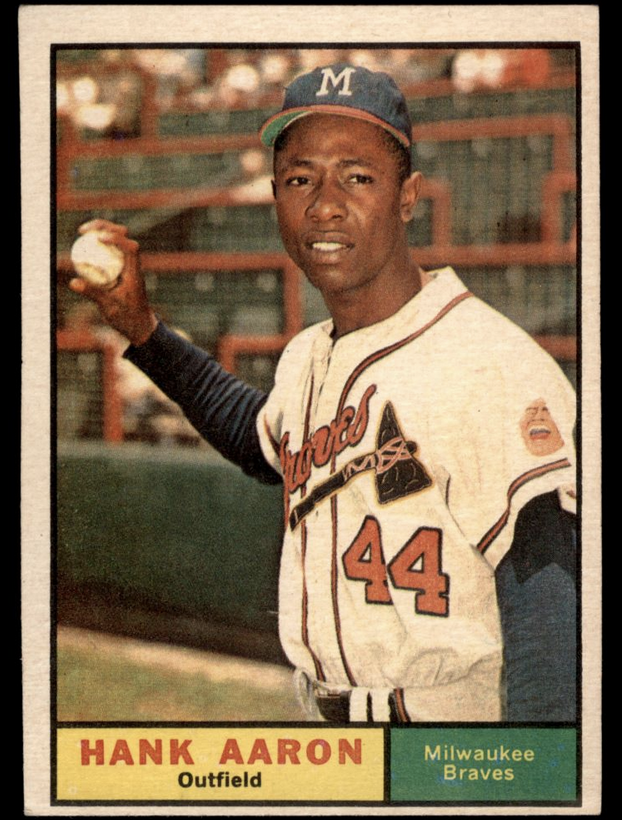
right as the United States actually, as well, reaches its cultural and economic peak, post-World War II. These two things cannot be separated, because the baseball card is emblematic of America's rise into modernity and establishment of itself as a world force or a national identity. What's so powerful here; this Hank Aaron card is a great example of this, is this is a card that could be had;
02:57
can be had, still can be had — en masse — it's mass produced and it's mass available. That's precisely what's so important and so powerful about this card: is that you have something that is deeply iconic and representative of a post-integration baseball league, which again, post-integration is the sum and embodiment of modernity in terms of — not only baseball, but in terms of global modernity at large.
03:26
To reiterate: modernity is acceptance, collaboration, integration; a transfusion of different cultures, ideas, people, forces. It's not segregated. You're dealing with two separate battling ideals, in a philosophical, but also an economic sense. You have scarcity, which is a more conservative viewpoint of I am the only one that has this thing and it makes it and/or me more valuable than other things. And then you have
03:55
quote unquote, more progressive ideals: which is the integrative, the in-common(s), the communal, the commonality, the shared. And you see this tension manifest, in baseball cards, because you have that whole classical idea of supply and demand. And really what you want is you want high demand and high supply. Really. Because what that means is that you have enough for everyone,
04:24
but everyone also wants to participate. Right? A flawed, or dysfunctional, or failing economic system has low supply and high demand, but people often think of that economic system as being powerful, from a place of ignorance and a failure to understand economic conditions as global ones, not just based on personal egotism. If I have the supply and everyone else wants this, that's not good. But that’s power right? And power surely is good? No — it's not good for a society. It's not good for a culture. It's not good for a civilization — it creates a really toxic, competitive environment because everyone either wants or needs the thing that there's not enough of. And that’s a world you have to live in. That becomes the everyday reality and lived experience of the collective ecosystem. It’s an awful thing.
04:53
It's just very simple, basic and straightforward logic -- but people just fail to see it and fail to engage with it because they think that scarcity — which again, is low supply, high demand — they think that scarcity elevates them on a personal level. It makes me a certain way that I have this and now it makes me better or it makes me important or singular. A lot of the basic Western cultural myths are based on this. It's the person who
05:22
ascends to power and thus has accumulated all of these different things or status symbols. This is what makes this person important or valuable above other people. And it's just a story. It's a narrative — because in reality, nature doesn't function like that. It's not like all of sudden a human being is endowed with incredible powers that separates them from nature or anyone or anything. It's an interconnected network. It's an ecosystem.
05:48
This is all mental. These are stories that people tell themselves. It's an ego story. And so when you look at a card like this, the Topps 61 Hank Aaron. This is the embodiment to me of what is so important about many if not most mid-century baseball cards. It's that it's not an artificial inflation. And I'm going to say that the Mickey Mantle card is artificial inflation. I'm going to say a lot of the stuff that's going on in the pre-war environment is artificial inflation.
06:17
These cards — they are scarce, right? I mean, it's the supply and demand principle. The supply is low, the demand is high, so the prices are elevated. They’re desirable in a personal, subjective sense. You're looking at something that ultimately ends up creating a toxic environment. That's, again, that's not what you want as a culture or a community. You want an environment where there is more than enough of what is important and that what is important can be and is truly being shared among people. And I think that's a lot of what baseball cards are about and what baseball is about.
06:47
I've gone into this in my other essays — it's a communal force. It's a collective force. It's a global myth-making force which has real power and real importance in terms of how nations and communities determine and identify themselves. So when you're looking at something like this, as opposed to let's say, I don't know, like a very rare Babe Ruth or Ty Cobb card, there might be this kind of internal pull that you have towards it where you're like — oh, if I have this — it's almost like the
07:17
the Lord of the Rings principle, with the ring. It's like if I have the one ring, then all of a sudden I have all this power. But really, in reality, what happens there is you lose everything that's really powerful and meaningful about nature or life or even baseball and baseball cards — because you're so bent on this pursuit of power for yourself, or to create or possess elevation. And that's really what low supply, high demand ecosystems are. They're highly dysfunctional, highly toxic, highly competitive — and they're all based around the pursuit of power.
07:43
Whereas — you have a high supply, high demand ecosystem. You have a thriving environment where people are collectively, communally participating successfully in the circulation of resources and energy. These are the most successful ecosystems in nature. So this is just, it's a great example. This is why the 50s are such an important period in American history because...
08:09
you look at that environment, and again, this comes with a lot of historical baggage. Don't get me wrong. We went more in depth into that in past discussions. That’s not something we’re overlooking here. But you look at American history in the 50s, there's a very high supply, high demand environment, collectively. This leads, naturally, in a global historical sense, to the deeply powerful cultural and social revolutions toward communality and collectivity in the 60s. But you also see this interestingly reflected in the artifacts from the period. Topps makes thousands and thousands and thousands of these cards. They're mass produced by one industrial superpower. It's been mega monopolized by Topps at this point.
08:39
Baseball cards have been totally
08:43
singularified, so to speak. And so you have this this influx of post integration baseball legends… you can get a Hank Aaron card from the height of his playing career for 40, 50, 60 bucks. Same thing with Clemente or Mays — you name it. Maybe cracking 100 for some of these cards. So this is the issue that I have with collecting — I'm not interested in this whole almost like ego match — the shouting match of who has the
09:12
best or rarest cards, and I see it everywhere all the time… it's just not what's important. People miss what's important because they're so bent on chasing the status symbol or the coolness of having any one card or any one thing. You're so bent on having the rarest car or whatever it is that you just forget what's important about being on the road and driving with other people. It's a mindset issue.
09:38
And it's really indicative of the collective cultural illnesses that Western society and Western civilization has. This is something that allows us to reflect on the greater cultural, social, and economic circumstances of the society that we participate in — and we can do it perhaps most clearly through baseball cards. That’s the funny part — because its all just pieces of old cardboard at the end of the day! It’s all the same thing. It’s just the projection and illusion of the images that changes. Whether or not you want to call it a society, it's an ecosystem. It's a community that functions on mass participation and mass engagement and mass involvement. This Aaron is the height of success. You have one of the...
10:06
greatest baseball players of all time, one of the most iconic sets of all time, and this is readily available, still, to this day. This is over, what, 60 years later now, isn't it? This is a way of participating in the mythic history of the country, at the height of American civilization, so to speak, in a way that is available to you and the person next to you, and it's something that you can share in — you can share in the joy of participating.
10:35
This is also a diagnostic of the economic and social troubles of America post the height of itself. Because you have people who are spiritually and culturally lost, even among the perceived social riches and spoils of war. The height of America’s industrial and world power. Because the cultural economy has accelerated in a decline of deifying scarcity. It's the same principle as celebrity.
11:03
That this one person or this one thing has this kind of exaggerated, blown out sense of proportion and meaning. It's the concept of a billionaire, right? It's like this person has so much more power and money and meaning than anyone else. And you create a society or a culture or civilization that functions on that framework. It's the elevation of a mental illness to a place of priority. And so you're...
11:32
unconsciously infiltrating and poisoning the water, the well of the ecosystem itself, by trying to perpetuate this illusion because it makes a couple of people feel good. And the worst part of it all is that something like this emerges from a kind of natural ennui or boredom of a civilization that is spoiled and is spoiled of itself. It has an embarrassment of riches due to plunder and war; then turns to seek to self satisfy itself in delusion to fill the vacuum of its sins and the ills that achieved it prosperity! To forget history and through wealth achieve a scarcity narrative in an attempt to create a dark mirror of self aggrandizement which is a false elevation in the midst of the real wake of the violence of history; conquering, slavery, exploitation, you name it. It’s a spiritual illness. We fail to achieve real collective meaning through life, so we turn towards ourselves and our ego projects of control. This is the dark thing about it — because a lot of the very scarce cultural artifacts of baseball history, these are for museums. This is an archivist thing. It's almost like the Indiana Jones principle.
12:02
All of those movies are about Indiana Jones going on these missions. It's not to get the artifact for himself, it's to restore the artifact to its social prominence in a museum public setting. But then you have this very pernicious background noise of these people who are chasing these artifacts to create political power for themselves or for the Nazis or the Russians, whatever sort of
12:32
enemy that's been installed in those movies. But there's something that's deeply true behind it because, again, you see this culturally and socially and economically. It's that these people have created these methods of participating in the scarcity system. There's a certain point of scarcity where it's... this has nothing to do with money — it has to do with preserving history. Its not that things are scarce, its that they’re important historical documents of civilization and human history. And it's not preserving history for you,
12:59
or for you to own it, it's preserving history for the collective to remember it and participate in that remembering process. That's the function of a museum. That's a function of a public institution. That's the function of archivists. That's the function of historians. These are people who are doing a public or social service by remembering, reconstructing the collective history of a region, of a nation, of a culture, of a civilization, of a species.
13:27
You have these people who, it's like — I'm going to assume this history, I'm going to assume this object because it creates, or it looks like it creates, the illusion of status for me. And people will clothe themselves or adorn themselves in gold, so to speak, because it's supposed to reflect on the state of yourself. And it's a form of a deeply spiritual or a psychological toxicity because this has nothing to do with the real status of yourself.
13:55
The real work, or the real gold that you do with yourself, your honesty, your integrity, your authenticity, the real nature of who you are. This is what makes real relationships, connection, and meaning possible. What you've cultivated within yourself — an ability to see truth or to recognize yourself and have real self-awareness. Those are the things that are truly important. Because that's the stuff that’s not dependent on some sort of outside thing or force, but people mistake that out of a place of fear. Because to actually do that kind of work is difficult.
14:24
It's hard to actually take a real look at yourself. So instead of really looking in the mirror, they try to create a proxy mirror, which is some crazy high status symbol or object that attempts to elevate them artificially. And for a moment you might get that rush of possession or accumulation. But ultimately all of those systems come crashing down because the Bugatti doesn't change who you are as a person. And ultimately you confront that, whether that's now or whether that's on your deathbed. So this is actually a really deep topic. And it's interesting how clear it is to see in baseball cards.
14:54
I love the 61 Topps Hank Aaron because it's just an iconic card, one of the all-time greats, and it's something that other people can have too. So I can have a conversation with someone and it's like, I have this, you have this — we're able to share it with each other. It's not based on me having something that you don't, and I'm just, I'm pushing that in front of you, right? Because all that does is create resentment. It's a form of creating cultural and social resentment, and you have people who are at war and at odds with each other to get something, to feel something, to participate in something.
15:23
It's not a space of collaboration. And ultimately, honestly, if there's something that's out there that nobody can really have, and you're maybe the only person that has it, it's probably meant to be in a public institution. It's probably not meant to be for you. And that form of hyper-possessiveness is so much of what's wrong with our culture, whether that's relationships, whether that's objects or material, whether that's a sense of status or power. Because people only become concerned with what they can get out of real history and real culture for themselves. It destroys meaning and real historical memory out of a self centered egotism.
15:53
There’s that concept of the more power there is, the less love there is and vice versa. You've created this environment that's so highly toxic and so based on status that you don't really have real connection with anyone or anything — especially and including yourself. You don't have real relationship. And even when you do or you attempt to do it, you're still so possessed by this necessity of elevating yourself, right? You’re actively self sabotaging any real possibility of meaning. Having that one thing that no one else has and you're poisoned by your own mindset. And a lot of people live this way.
16:24
It's a way of reclaiming community. I think that's a lot of what baseball and baseball cards can do. A lot of it is about shared language; language is about sharing. It's a two-way street. You have to be able to communicate. I understand your language, you understand my language. The point of language is to share, it's to create a bridge. It's not to create an island, right?
16:53
Some thoughts here. I think this is a great episode — it encompasses a lot and says a lot in something so innocuously present like this Hank Aaron card. So have a good one. I'll see you on the next one.