Williams Completed the Ruthian Revolution by Formalizing Vision as Science -- The Ruthian Curve Completed: Ted Williams and the Formal Science of Seeing (1939–1960)
Williams Completed the Ruthian Revolution by Formalizing Vision as Science -- The Ruthian Curve Completed: Ted Williams and the Formal Science of Seeing (1939–1960)
Williams Completed the Ruthian Revolution by Formalizing Vision as Science
The Ruthian Curve Completed
Ted Williams and the Formal Science of Seeing (1939–1960)
If the Ruthian curve (1920–1935) represents the reopening of baseball’s reaction window, then the story does not end with Babe Ruth.
Ruth demonstrated that the expanded sky could be conquered through elevation and power.
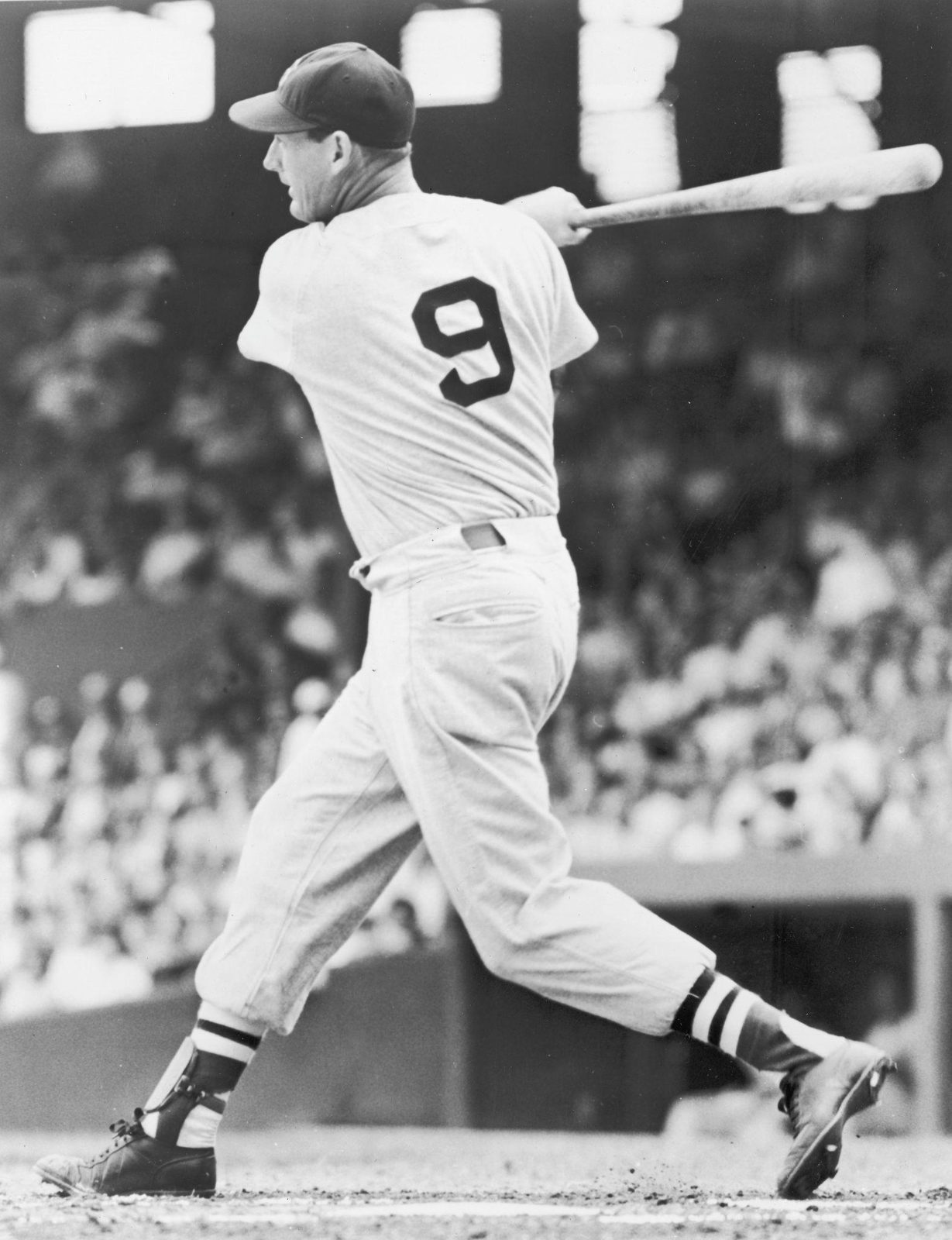
But it was Ted Williams who made explicit what Ruth embodied intuitively:
Hitting is a problem of vision, geometry, and decision timing.
Williams did not merely exploit the widened reaction window of the modern era.
He analyzed it.
He engineered it.
He formalized it.
I. From Power to Perception
Ruth’s revolution was architectural:
elevate
drive
convert time into power
Williams’ revolution was epistemic:
divide the strike zone
quantify probability
swing only when expected value justifies commitment
Where Ruth demonstrated that the reaction window had expanded, Williams mapped its interior.
II. The Strike Zone as Decision Matrix
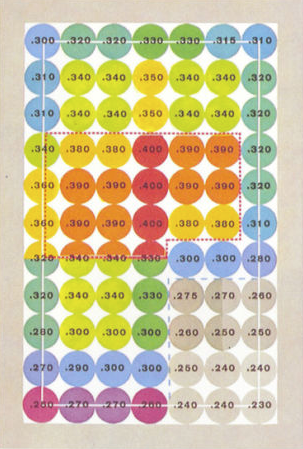
Williams famously conceptualized the strike zone as a grid — dividing it into smaller cells and ranking them by batting probability.
This was not folklore.
It was a cognitive model.
Within the reaction-time economy, there are two battles:
Recognition — What is the pitch?
Selection — Is this worth committing to?
Williams’ innovation lies in the second.
Expanded visibility does not mean swing more.
It means refuse bad time allocations.
In his framework:
A low-outside pitch might yield .230 average.
A middle-in pitch might yield .400+ average.
Therefore:
Not swinging is an act of time discipline.
Williams weaponized patience as a reaction-time filter.
III. The Neurophysics of Commitment
Swing commitment typically begins within ~150–200 milliseconds of release.
The batter does not have full trajectory information before initiating movement.
Thus hitting is not passive observation.
It is probabilistic anticipation under time compression.
Williams trained himself to:
track early trajectory
identify spin cues
resist marginal offerings
and commit only when location intersected high-probability zones
The modern era provided legibility.
Williams maximized it.
IV. Vision as Competitive Edge
Williams’ eyesight was legendary — often cited as 20/10.
But acuity alone is insufficient.
The decisive factor was interpretive discipline.
The hitter’s task becomes:
Convert milliseconds of visual input into binary commitment decisions.
Swing.
Do not swing.
Williams minimized regret by narrowing his personal strike zone to maximize expected run production.
Reaction-time economics became conscious theory.
V. 1941 as Proof of Concept
Williams’ .406 season in 1941 is not anomaly.
It is the full maturation of:
expanded modern visibility
selective discipline
geometric contact optimization
and power mechanics inherited from the Ruthian revolution
He did not chase average.
He optimized pitch value.
The historic outcome was the byproduct of systematic perceptual control.
VI. The Structural Arc
Deadball:
Time suppressed. Visibility degraded. Contact scarce.
Ruthian:
Time reopened. Power discovered.
Williamsian:
Time quantified. Decision formalized.
Ruth proved the sky had widened.
Williams measured its dimensions.
VII. Why This Matters to the Run Curve
The Ruthian curve is often depicted as offensive inflation.
Its deeper meaning is intellectual evolution.
Environment shifts →
Players adapt physically →
A player emerges who models the environment consciously.
Williams’ The Science of Hitting is the first explicit articulation that baseball is governed by:
geometry
timing
probabilistic selection
visual processing
He brought the hidden engine into language.
VIII. The Mechanics of Movement: Swing Physics Under Time Constraint
Seeing is necessary.
But without efficient movement generation, perception cannot convert into impact.
Williams refined both.
1. The Kinetic Chain
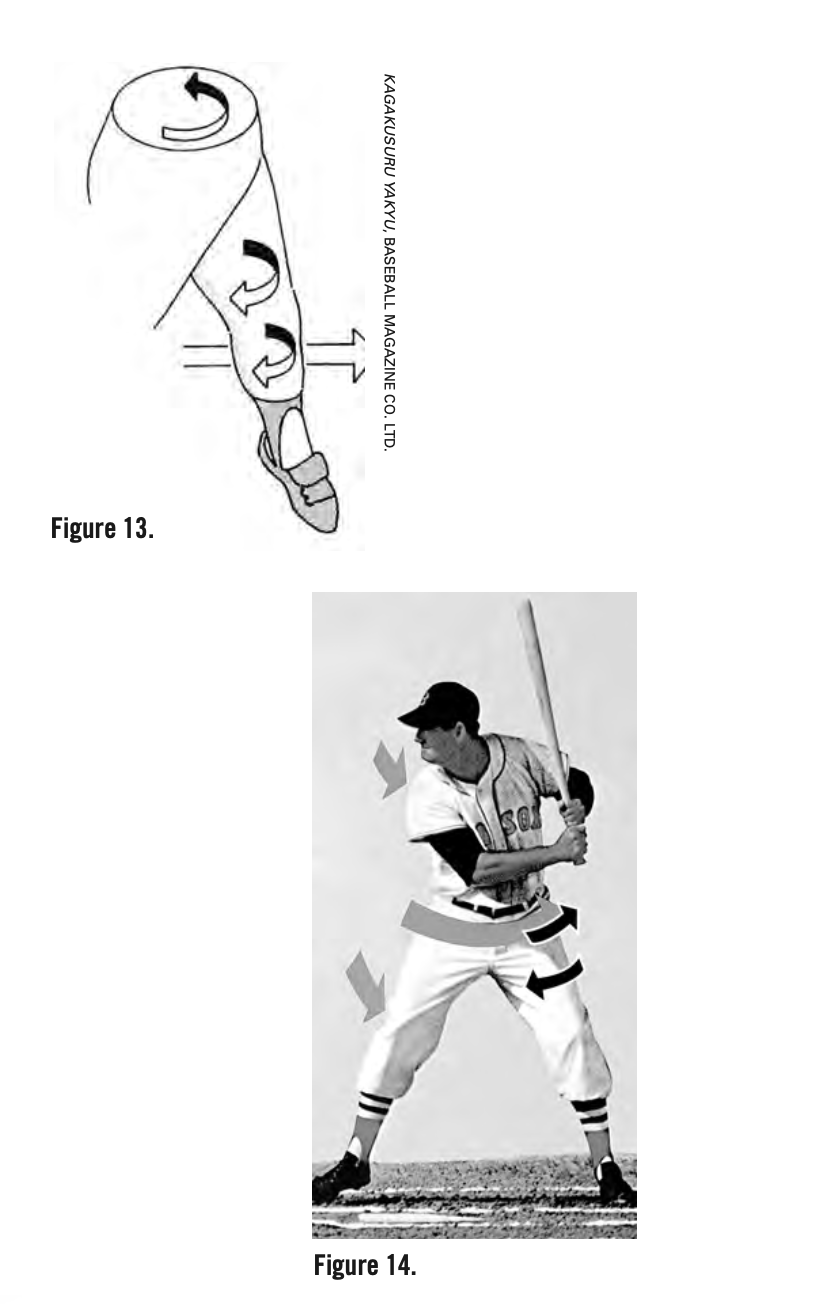
A swing is sequential energy transfer:
ground force
hip rotation
torso separation
lead-arm stabilization
bat lag and whip acceleration
This chain must unfold inside a constrained reaction window.
Williams’ swing minimized mechanical noise:
controlled stride
balanced load
quiet hands
efficient torque sequencing
Mechanical economy reduces motor uncertainty.
Reduced motor uncertainty increases usable reaction margin.
2. Bat-Path Geometry
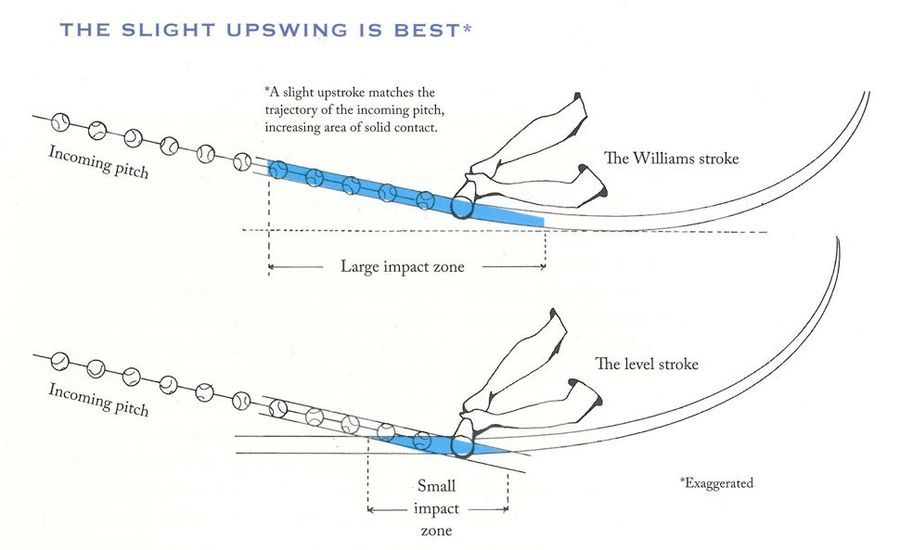
Williams’ bat path was slightly upward, long, and extended through the zone.
A longer barrel presence increases tolerance for small timing error.
In reaction-time terms:
A steep path demands perfection.
An extended path permits adjustment.
He built a swing that could survive imperfection.
That is physics applied to uncertainty.
3. Reaction-Time / Torque Coupling
Reaction Window = Perceptual Time − Motor Initiation Threshold
If mechanics require ~120–150 milliseconds to unfold, commitment must occur before full pitch knowledge.
Williams reduced the initiation threshold.
His mechanics allowed:
later commitment
preserved adjustability
elite rotational force
Perception without mechanical stability collapses under velocity.
Mechanics without perceptual discipline produce weak contact.
Williams unified both.
IX. The Completion of the Modern Hitter
With Williams, the reaction-time economy becomes fully internalized:
Perception becomes conscious strategy.
Decision becomes probabilistic discipline.
Movement becomes optimized energy transfer.
The modern hitter is born from the integration of:
milliseconds of perception,
disciplined non-action,
rotational physics executed with precision.
Williams does not merely extend the Ruthian curve.
He stabilizes it at its highest rational equilibrium — where seeing, deciding, and generating force become one continuous system.
Conclusion: Seeing as Sovereignty
The Ruthian curve is the story of expanded time.
Ted Williams is the story of owning that time.
The hitter who governs perception governs the game.
Ruth changed the scale of impact.
Williams changed the scale of awareness.
Together they define the modern offensive epoch — not as excess, but as disciplined mastery of the reaction window.