Working Class History: How Baseball Changed the American Mind and Revolutionized the Political Imagination
Working Class History: How Baseball Changed the American Mind and Revolutionized the Political Imagination
I. The Costs
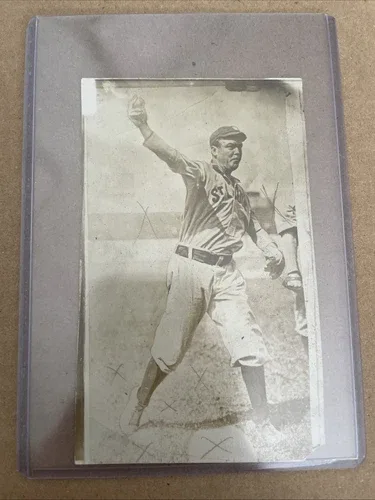
A 1908 press photo of “Bugs” Raymond. Nicknamed for the slang word “bughouse”, or insane asylum, New York Giants manager John McGraw considered Raymond one of the best pitchers he ever worked with. Among the best pitchers in either league in 1908 and 1909, Bugs faded immediately from professional baseball — dying at age 30 from alcoholism and violence. Born in Chicago, Illinois, he started his life as a pressman; continued it as a bartender. After his career ended due to his alcohol abuse, Bugs returned to Chicago and press work, where he died in 1912 due to a head wound from a conflict that occurred at the field where he played baseball as a youth.
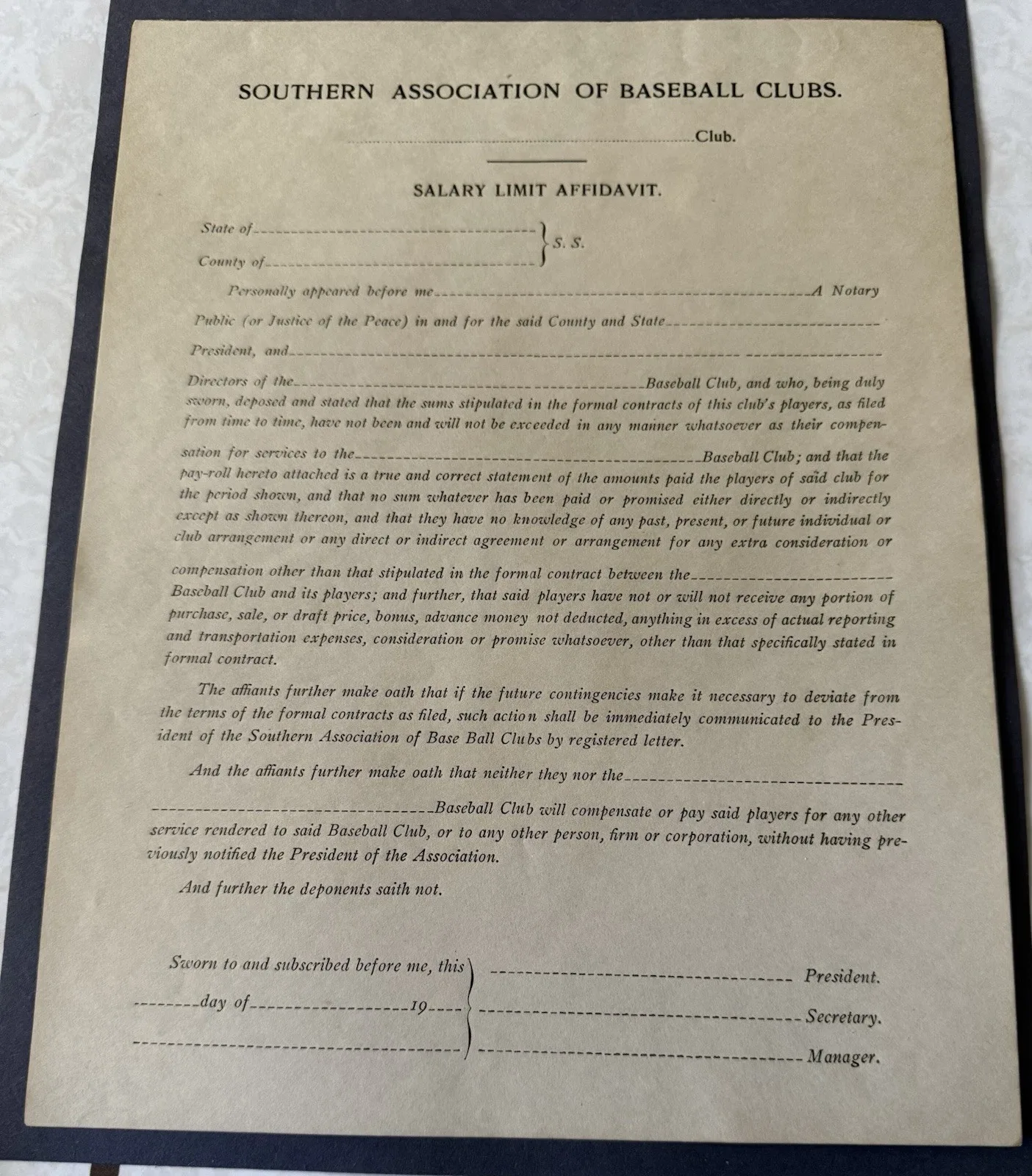
A 1908 salary limit affidavit from the Southern Association minor leagues. Bugs played in this league just before he made his debut in 1907 with the St. Louis Cardinals.
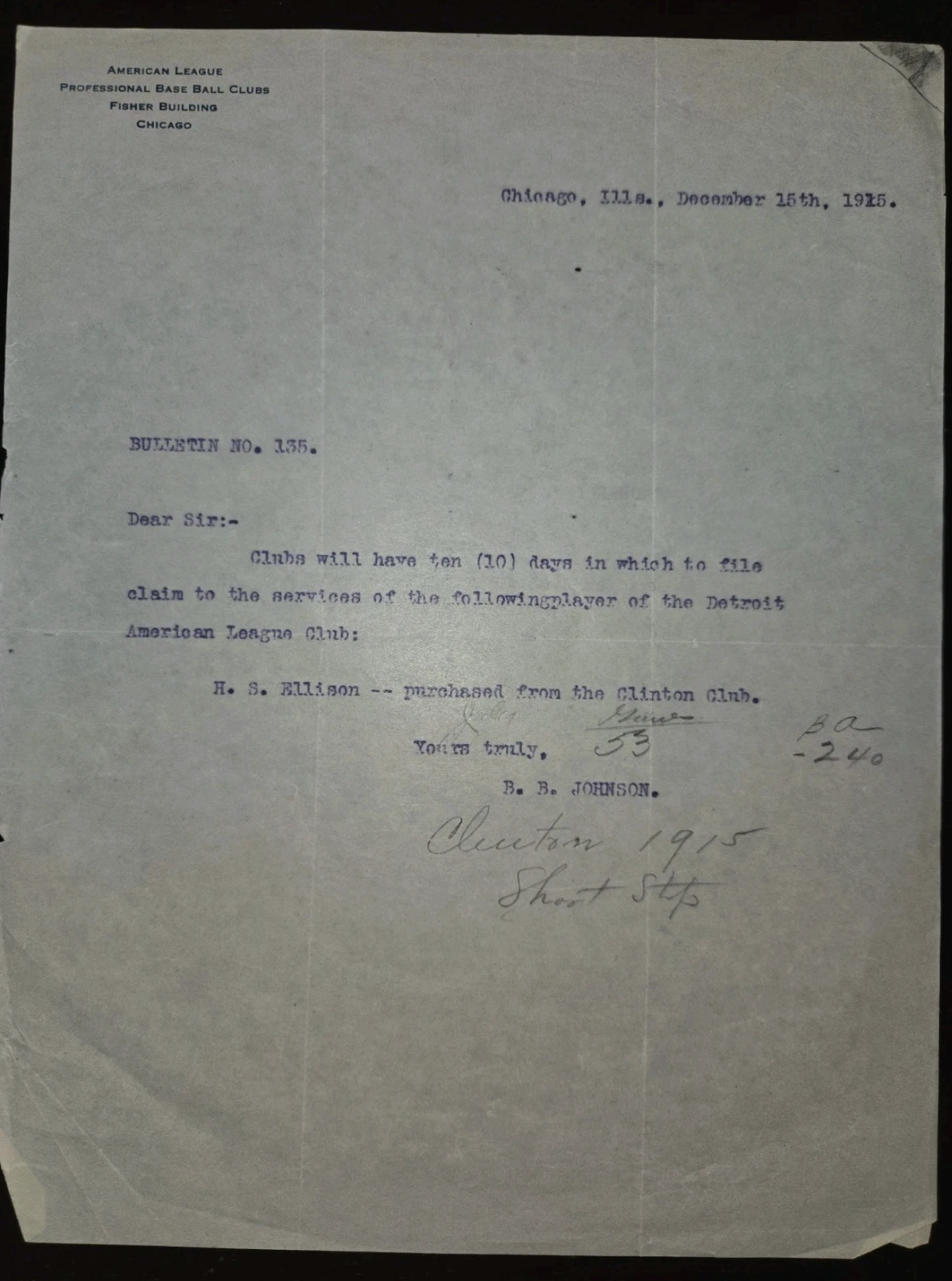
A 1915 American League waiver notice detailing the purchase of a player named H.S. Ellison’s services. Issued by President and Organizer of the American League, Ban Johnson.
The struggle for the control of baseball was a control of money, power, influence, and how the game was to be conducted. The Wild West of the early game was contested grounds until the catalytic moment of the 1919 Black Sox World Series; the subsequent events resulting in the banning of Chicago players including the beloved Joe Jackson; the antitrust exemption of 1922, cemented in the Supreme Court with organized baseball’s primary early century combatant, the Federal League.
As observable in the documents above, baseball was — along with being America’s pastime —a direct representation of the capitalistic and colonial impulse of her nation’s founding, an impulse directly implicated in the genocide of the native peoples which established the early American territories and states; the enslavement of African peoples in and through the trans-Atlantic slave trade — as well as violent, merciless, and murderous initiatives which implicated European immigrant child labor in the early 1900s in the factories and mines of the Northeast, Chinese labor on the American railroads; Mexican labor in the fields of 20th century America.
This long history of exploitation and abuse of power and labor is detailed with extreme clarity in the annals baseball leaves us — annals rife with abuse of power, control, and the treatment of the player; the worker as commodity material and human resource — as labor to be extracted from until there was no more left to extract.
This history is also ad nauseam the history of American trauma — the trauma that is seeded in the land and grounds of the country; its legislation; its past; its perpetually returning predilections. With a brief reprieve in the workers’ rights initiatives that resulted from the work of early century reformers such as Eugene Debs, Emma Goldman, Upton Sinclair, Lewis Hine and others — the iron jaw of American monopoly and corporate exceptionism would re-emerge in the late 20th and early 21st centuries — a powerful and pertinent reminder of just how delicate reform law and legislation is and can function; ultimately collapse, in just one hundred years’ time.
Bugs Raymond, as detailed in the above artifacts and documentation, is a simultaneously exceptional and representative figure to discuss in regards to this phenomenon of abuse, exploitation, trauma; ultimately, untimely death at the end of his labor’s extraction tenure as an early modern American. Bugs, like Hack Wilson, clearly struggled with a debilitating illness of alcohol abuse — likely induced by a combination of ancestral trauma, genetics, and the historical, economic, and political circumstances of his existence as a working class man who died penniless as a result of his condition.
Even Bugs’ nickname — slang for asylum — is a key clue to how his trauma and illness were treated in the American historical context. Fellow players such as Mysterious Walker, mere footnotes; large keys alike in the great ledger of baseball history when it comes to achievements, suffered with significant mental illnesses and alcohol and drug addictions. Those who likely suffered with both conditions (who were many, like Bugs) did not live in a world where these conditions could be addressed with awareness and compassion. Many were ultimately interned in asylums, like the founder of the Negro Leagues, Rube Foster, or else died young due to breakdowns into violence, poverty, and self destruction.
This incidence may be easy to pin solely on internal causes at first glance — but history tells us another story. The pervasive environment of abuse and control that the early modern American worker is a story of death; the perpetual threat of death in unsafe working conditions, wherein there was little to no agency for the impoverished man; the worker, who was chained to hard labor for any meagre source of income. And of course, for men like sons of former slaves such as Frank Grant and Fleet Walker, the implications of the American economic rite of exploitation was a mark clear as day; imminent and conscious in the culture and flesh in which they were born and raised.
These conditions — conditions of the mechanization and dehumanization of the human being to become a cog or a laborer in the factory or in the field of America’s machine of rapidly industrializing production — were chief and first as a national and even global atmosphere wherein a standard and a norm was set of how human beings were to be seen and treated: as subjects to industrial production; the generation of material wealth for their “owners” — whether those be the owners of the mines who set men and children to work; the factories; the plantations, the mills. The working class man of early modern America was set to work and die; although baseball was an escape for men like Ed Walsh or Bugs Raymond, it was truly no different circumstance, no more substantial ethics or compassion.
Owners would ruthlessly keep and hoard players; collectively organizing to suppress salaries and prevent players from unionizing or advocating for themselves. Players like John Montgomery Ward, George Stovall, and Jake Daubert were some of the first and principal organizers of the labor movements that occurred within baseball; they occurred within the face of a system whose entire modus operandi was the prevention of a collective bargaining agreement to keep laborers suppressed, in line, and producing the product of baseball for their organization to absorb maximum profit without equitable distribution to the very individuals who produced it.
The reserve clause, implemented in 1879, allowed teams to own players for life — preventing them from bargaining or soliciting offers for their work. Players who left would be blacklisted. When the Federal League formed in the 1910s and began soliciting players with large raises, players who left organized baseball were promptly banned. And when Ward created the Brotherhood for ballplayers in 1885, the owners refused to recognize the group; dealt only with individuals.
The above documents — the 1908 Southern Association salary affidavit and the 1915 waiver from the hand of Ban Johnson — use prominent language, typical to colonial projects; projects of empire. The purchase of Ellison (softened ever so slightly by ‘the services of’ in the prior paragraph); the association of Southern clubs’ agreement to severely limit how, where, and when players received compensation is typical of how the laborer and the working man was treated as a resource in early modern America. This treatment extended to the concept of land as jurisdicted property; state records of individuals; the caste system of race and sex which dictated who was able to own wealth and thus possess political power in America — a systemic procedure of social hierarchy which only began to break in the latter half of the 20th century as women were permitted personal bank accounts; the Civil Rights movement began to shift the possibility of black economy and black wealth in American history.
This process is a total field of exploitation with a language — a language that the Harvard Law educated Ward and the Shamokin anthracite mines educated Jake Daubert both knew explicitly. The extreme consolidation of power in the American North post Civil War was an advancement of the precepts and founding principles articulated in the American South. They were principles of ownership of human beings as human bodies; property of empire and the generative machines of power that maintained it and reproduced it as a system of commodities, goods, services, and forces at work on American soil — soil made “American” by the murder of the indigenous people of the Americas — who had a very different conception of life and worldview, one in which all of nature was ensouled; a part of a great circle, a sacred hoop of energy and life force.
The institution of colonial systems in and through American history ran simultaneous to the intersecting fates and destinies of the Cuban people — colonized by the Spanish; made sovereign in the Spanish-American War at the turn of the 20th century. The Cuban people — upon liberation — immediately integrated baseball across racial and class lines. The game transformed, as it was returned to a native dialect. And yet America continually asserted her will in Cuban history; on Cuban soil even in regards to baseball history with the institution of a organized minor league team, the Havana Sugar Kings. However, it was Cuba that served first impact — as founders such as Esteban Bellan and Nemesio Romaguera brought baseball back to Cuba from their adventures onto American soil in the mid 1800s; accordingly, brought players as diverse as Oscar Charleston and Pete Hill along with them — just half a century later — to play in the newly integrated league, the first professional integrated baseball league in the Western Hemisphere.
This method of colonial subjection of the human being through caste, race, ethnicity, sex is proprietary to empire; it was and is America’s experiment upon its own people as an experiment of wealth production and human destruction at all costs as a central ethos — an ethos which holds the seed of its own demise. And this is what is observed with and through American baseball — a game that was the nation’s passion that died through the nation’s own passage into total financialization and commodification. The sport became an advertisement; a stage for consolidated corporate power — a spectacle, increasingly voided of the soul of the common, working American men who not only built the country with their bare hands, but performed acts of miracle and might upon its primary historical stage of dirt and leather. Their passion was exchanged for manicured fields; training programs for the country’s elites.
Baseball held, for a brief moment as it transitioned from wood and mud and natural fields remarked by Whitman to steel, bitcoin, and scientific tracking of the speed and location of the baseball, a magic and a power which is and was the play of passion, the play of the human soul; the possibility of the baseball field as a place of freedom and expression in a world of suppression and enslavement and exploitation for corporate profit.
This possibility directly tracks with and maps onto the work of Franklin Delano Roosevelt, the New Deal, and the efforts made by figures such as Debs and Sinclair on American soil to bring soul and conscience back to America — chief reformers and abolitionists like Frederick Douglass and W.E.B. Du Bois, making it clear the real impacts and horrors of slavery upon the conscience and the psyche of the individual, the collective; the American people. Great thinkers and innovators like George Washington Carver advanced the public American perception of black intelligence; formed schools for young black children in which they could advance themselves and their standing socially, culturally, and economically. The great Satchel Paige of Mobile, Alabama was one of these students.
It was a window, amidst and unto the cataclysmic collapse of the United States economy in the Great Depression of the 1920s and 30s — a window which was in truth a clash that is held and witnessed in the body and being of the unknown and largely forgotten Bugs Raymond: a clash between humanity and the soul and the witnessing of the inner nature and child which is directly expressed in the joy of baseball; the ruthless powers of financialization, commodification, and control of land, earth, and body which is the missive of what is today known as the corporate; is merely and in truth a technologization and advancement of the original spirit which initiated the genocide of the native peoples of North America; the subsequent enlisting of African slaves and Chinese railroad workers to build the economic and infrastructual foundations of what is known today as the modern American empire.
These efforts were redoubled in the 20th century with the enlistment of child and immigrant labor — people of desperate times and measures — in the mines and factories of the rise of the American North after the victorious destruction wrought of the Civil War just decades prior. This memory was still fresh in the mind of every son of freed slaves in the Jim Crow era, riding on buses and sleeping on benches to play baseball in the newly organizing Negro Leagues; in the mind of every second and third generation European immigrant now enlisted not to war, but to the mines or the factories. The generations that arrived and immediately followed, due to destruction or famine, were forced into the mills and factories and mines as well, by the nature of the urgency of their impoverished conditions; the limited faculties availed to them as newly arrived and naturalized citizens.
All of this method condenses with absolute clarity in the black mirror of baseball history; the ugly mirror of America’s past — spat right back out into its face through the looking glass of its one true and great passion — crushed underfoot by the very principles, precepts, ideologies, and practices which made America “great”, if only in political power, influence, prestige, and wealth; to say nothing of the soul of the life that is and was lost under the dirge of the growth and accumulation of the garish wages of the war and genocide of power. It is the soul that is and was torn in the life of a man who was and is a footnote of American history — once thought to have the potential to be one of the greatest arms in the game — lost almost immediately to his all consuming addiction. An addiction, to be sure, which masked profound pain which could not retrieve absolution from the bottle. And this profound pain, too, to be sure, emerges in and from — directly — political and historical circumstances.
This was the battle of the young men of American empire — first, second generation immigrants; sons and grandsons of slaves. This battle still reverberates through the ledger of history, which calls together all accounts imminently in the body as a memory of oppression, trial, and suffering — encoded into the genome and passed down culturally as ritual, rite, practice, and behavior. This long memory is that which America carries imminently into the zone of the future; bears as a burden which, as long as it is not spoken about, seen directly; as such, given clear eye — will continue to haunt and dissemble and crumble the American attempt to find passion, joy, youth and soul amidst the riches which corrode to rot which mark the true nature and urge of American culture. As gold melts to the twisted face, so too does America’s passion and possibility of beatific life and joy meet its untimely grave.
Men like Bugs paint for us the long arc of trial, trauma and suffering. He returned to his roots, likely to seek salve and stability amidst a rapidly unraveling life. His time in the game was over; he was refused return by McGraw, who remarked “I have enough troubles”. McGraw even went so far as to hire a private investigator to keep Raymond sober; would forward Raymond’s paychecks directly to his wife. At one time, McGraw bought Raymond a suit; Raymond immediately exchanged it for a cheaper edition, using the refunded seven dollars to buy alcohol. One of the greatest managers of all time, McGraw clearly believed in the powers of Raymond. He was one of the game’s earliest instances of the “power pitcher”, throwing with speed and a series of breaking stuff that challenged even the greatest hitters in the game — wherein, in one instance as a low rung minor leaguer, Raymond struck out the .341 lifetime hitting Willie Keeler three times.
Raymond was given every opportunity; he could not accept it, ultimately squandering his chances at baseball and his life to the substance which could not numb his pain, only exacerbate and prolong it unto death. We cannot know the true extent and the depths of their histories — as men like Bugs are not celebrated. They are the forgotten men, the lost men — the unknown laborers, drunks, madmen, slaves; the murdered, tortured masses — at the hands of American empire. The consequences, the costs, the casualties of the methodology of American bookkeeping and murder of the soul by way of the reduction of human life to numbers, statistics; profit and shareholder reports. American life was grown out of the now vague memory of a world which ritually observed the unity of birth and death, the mystery of the cosmos; the profundity of life which existed in each animal, plant; wondered at the stars. Men like Emerson, Whitman, and Thoreau sustained this compassionate awe in the midst of the trials and madness of emergent American modernity. However, the works of a few great men are not enough to redeem a world of suffering at the hands of corrupt principles and agonizing, spiritually genocidal methods of the consumption of the individual. There must be further, deeper, more fundamental action at work.
This very consumption is what ate tens of millions of early American men, women, and children — caught underfoot of an ideological precept of technological, industrial, and agrarian advancement to construct towers of wealth for the advantaged few. The Carnegies, the plantation owners; the factory and mine owners who systematically organized early American modernity; composted the infrastructural systems of laboring bodies which churned this very contemporary world into being. It is this legacy which is the history we must observe in order to alter its course; to ineluctably change it for the better; for the possibility of more and more of our constituents; more and more of the hearts of men, women, and children. To observe this history is to observe America’s great love, ripped apart by the very forces which claimed to nurture its growth. For a brief moment, the spirit of the common man had the stage of American history — a brief possibility of democratic culture; witnessing the trials and tribulations of a soul neither falsely raised nor falsely oppressed by constructs of power, wealth, and claims of divine right or divine abjection.
This is the true possibility of baseball as a moment; as momentous reckoning of the truth of the soul. That a common man, Fleet Walker, son of a freed slave, could step onto the diamond and write his name into history — not as a conquerer of men, but as a conqueror of the realm of his soul — through practice, discipline, trials, and self overcoming. This is the true legacy of the American night — the true legacy of the hearts of the men who built this nation — even as they are forgotten; suppressed; barely remembered to the cold, silent stone of the buildings which loom ominously over their graves. The death of Bugs Raymond at age 30 is not only the death of a forgotten man, but an impossible man — a man who never was, nor was he allowed to ever be. And thus, to baseball and to American history; to the ledger of all time, his was a story of what could have been; what might have been; what is forgotten due to the loss of his story to time in a world in which his memory was unimportant — suffering the injury which killed him upon the very field, amidst the very game he loved as a boy.
II. The Rising Tide
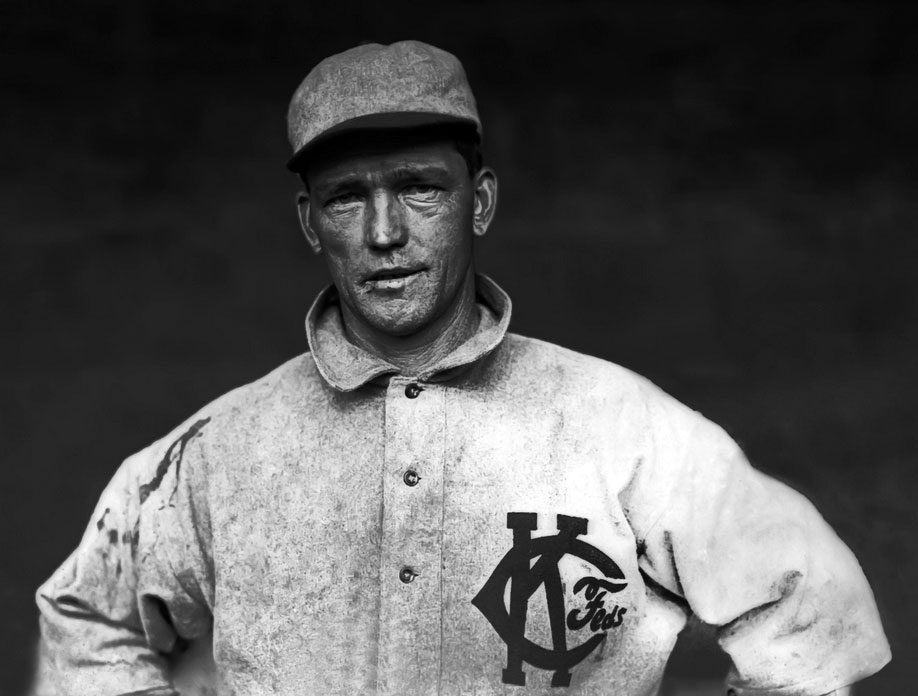
George “Firebrand” Stovall: Chief labor leader among players and organizer and promoter for the rival Federal League.
The rising tide of laboring men in baseball history who advocated for the underclass of those players who did not receive a fair shake or wage is numerous. Pictured above is George Stovall, an Irish-American who was raised on a farm; after his parents died, was raised by his sister. He was both a butcher and a farmer with a penchant for open hearted leadership, including his decision to declare his team on strike the day of Addie Joss’ funeral, April 17th, 1911.
Stovall regularly defied ownership, management, administration, and even umpires — and regularly stood up for his fellow ballplayer. One of the chief organizers of the institution of the professionalization of the Federal League at the turn of 1914, Stovall’s advocacy, even in the face of blackballing by the American and National leagues, allowed for many professional ballplayers to receive higher salaries and better treatment in the nascent professional league.
From the founding of the Players’ Fraternity at the hands of lawyer Dave Fultz; Ty Cobb and Jake Daubert in 1912 to Stovall’s continued player advocacy during this same period, the early modern industrial period of baseball history was spearheaded and perhaps most pronounced in its labor revolution — even moreso than its field of play. The tides were shifting in America. As muckrakers and photographers and reformers brought increasing advocacy to worker’s rights through documentation; figures like W.E.B. Du Bois rigorously detailed and described the effects of Reconstruction in the black South, baseball was experiencing its own revolution of working class history.
After over two decades of rapidly escalating corporate and ownership class exploitation of the industrial American worker — children, women, and men alike — a backlash in political consciousness was beginning to occur: a retaliation of humanity.
Stovall’s work as a player-manager and a leader was his chief characteristic. A sound hitter and intelligent fielder, Stovall’s propensity to stand up for his players; his fellow player in the face of any indignity or attack or reproach from any level of governance was foremost and admirable. It was this same intensive nature of egalitarian leadership which drew Jake Daubert to the head of the nascent Players’ Fraternity; this union was initially seeded by a conversation had between Chicago pitcher Ed Reulbach and that very same Addie Joss just several years prior in 1907. Stovall’s strike as a direct notice to American League President Ban Johnson in the face of Joss’ death and the players’ solidarity to honor Joss’ death was, and is often considered as such by baseball historians, a chief blow that led to the formation and strengthening of the Fraternity by example of courage, backbone, and leadership of men.
Attorney Dave Fultz said of the organization in a piece with Baseball Magazine :
“The National Commission is composed of three members: the presidents of the two major leagues and a third person selected by them; this person at present time is a club owner … The player who has a grievance goes before a body composed of men paid and chosen from the very faction with which he has his controversy. This is contrary to the basic principles of equity.
It is argued the player is well paid. That he is well paid is no reason he should not organize. The star is well paid, the average player not so well, and some players very poorly.”
The intimations and founding of the Fraternity in 1912 was not the first instance of player organization and unionization within professional baseball, but it was notable in the sense that it replicated the formula first established by John Ward and the dual function of the Brotherhood and the Players’ League — which is to say, the creation and establishment of, simultaneously, an organization that advocated for ballplayers’ rights as a union of labor; the establishment of a professional league (in Ward’s time, in 1890, the Players’ League) to stand alongside it; draw talent toward new opportunity that centered not around the stultified, bureaucratic norms and power dynamics of the existing National League structure, but around players’ rights, fair treatment, and a democratic association of ballplayers.
This would be, in economic terms, a league of the players’ own — something approximated with more distance in 1914-1915 with the birth of the Federal League in conjunction with Fultz, Cobb, and Daubert’s Fraternity. The League itself, as was later acknowledged by Fultz and others, including baseball historians, was a great cover for the Fraternity to gain power and influence; make advances for the player’s rights — which were later fulfilled to much greater measure as the 20th century advanced. The Federal League posed a direct economic and cultural threat to the powers of the American and National leagues; while the structural power of professional baseball dedicated its focus and attention to legally and socially dismantling the fledgling league of entrepreneurs which produced Wrigley Field as perhaps its most enduring artifact, Fultz and his players were able to pose, renegotiate, and pass several critical legislation packages — including players’ ability to negotiate with teams upon ten days notice of their release; with ten years of service, unconditional release if a club did not exercise their option on him.
Even to note the language of release and negotiation of terms as radical moments in the turning of the labor history of baseball demonstrates just how clearly in the larger grand scale and scope of labor in American history the worker was treated: as a number, a resource, a possession; a piece of property. Du Bois’ advocacy for the rights and suffrage of American women — black and white alike — elucidated this same principal awareness of how the human being and human body was treated and conceptualized in and under American empire. This system of caste and control and ownership extended into professional baseball — wherein, in the minds and corporate documentation of the executive, the player was a commodity to be traded, used, and discarded at will — given the bare minimum severance, regard, pay, and resource.
This labor history extends deeply into the Negro Leagues and early black baseball, as systemic social, political, existential, and economic oppression of the black American became the chief force behind the limitations and potentialities of organized black baseball. Teams worked with little to no money; suffered consistent losses and disbanded regularly outside of the highly resourced organizations, as with upper class owner “Cum” Posey, owner of Diamond Coke and Coal Company; business partner of Henry Frick.
These early attempts at organization were signs within professional baseball of the fomentation of a political consciousness within the fiercely moral leaders who headed the early baseball squads. Player-managers and captains such as Stovall and Daubert were instrumental in setting the stage for an explosion of unionization and players’ rights as the 20th century went forth. These negotiations and refusals came not from contractual obligation, but from a sense of moral righteousness and solidarity with their fellow worker — particularly in Stovall’s case in relation to Joss — a solidarity that was and is the solidarity of one’s teammate; one’s compatriot, in the face of an unfeeling, soulless industrial bureaucracy focused solely on production and consumption.
This emergent and resurgent consciousness in baseball history echoed Montgomery Ward’s attempts and work with the Player’s League and the Brotherhood just two decades prior. These works as historical echoes of one another were not just mere coincidence, but rather the resurgence of a coming generation in the face of escalating corporate and executive consolidation of baseball as a merciless power of control and economy — wherein the player became a digestible, reusable resource. Players like Daubert understood this underlying economic standpoint — a standpoint which would later become known as and called “fascism” — a perspective and state of mind which empties the human being of humanity and views the human being as a labor point, a piece of data; a cog in a sphere of production whose sole use is to produce profit for the industrial man, the factory owner; the plantation owner.
This foundational economic perspective at the back of American history is founded in the plantation, chattel slavery of the early American South; a chief infrastructural mechanism behind the cultivation of private wealth in both the American South with enslavement and oppression of black life and black opportunity; in the American North with the enlistment of European immigrant families — including children — in highly dangerous and often fatal work — children as young as four years old — in the factories, mines, and mills of early modernity.
This was the understanding lived, seen, heard, felt, and expressed in experiences as diverse as Daubert’s, Du Bois’; the educated political consciousness of Douglass, Lewis Hine, and Dave Fultz. It is a consciousness of compassion which required no literature and no formal education, nor did it require the ability to write or speak eloquently. Stovall’s example is one such example — an example of uncompromising, existentially human leadership in the face of a cold, callous, bureaucratic organ which consolidated power and treated Stovall’s fellow man, worker, and teammate as a function within a profit generating machine.
Accordingly, this rising tide was composed of men and women who spoke and lived and felt from the heart; thus lived with a moral orientation that Antonio Gramsci articulated:
“One must speak for a struggle for a new culture, that is, for a new moral life that cannot but be intimately connected to a new intuition of life, until it becomes a new way of feeling and seeing reality.”
Stovall’s declaration of solidarity in the wake of Addie Joss’ death and Ban Johnson’s insistence that Cleveland play their scheduled game the day of Joss’ funeral was the act that articulated and insisted upon both the coming birth of the Fraternity just a year later; Stovall’s later chief and prime leadership in helping organize — in the face of Johnson and the American League ownership and bureaucratic management — a mass migration to the Federal League in 1914 for better treatment, salaries, and opportunity for many professional ballplayers.
It was for this act that Stovall may best be remembered — for it is a greater act than any one ballgame, moment, or career statistic can pronounce. Stovall, certainly, was a great ballplayer in his own right in his time — but baseball was never in truth about statistics, nor was it about performance on the ball field that could in any way be measured. It was the stage upon which America’s most mortal, grounded, egalitarian men of little means articulated the most important political statements of their time — statements which were not grand, literary, nor particularly memorable in their poetry or oracular force. They were statements of the most human kind: statements of witnessing of their fellow man; the refusal to budge in the face of powers which would see them abandon the witness of the humble man — the teammate seated next to him.
III. The Moral Ledger of History
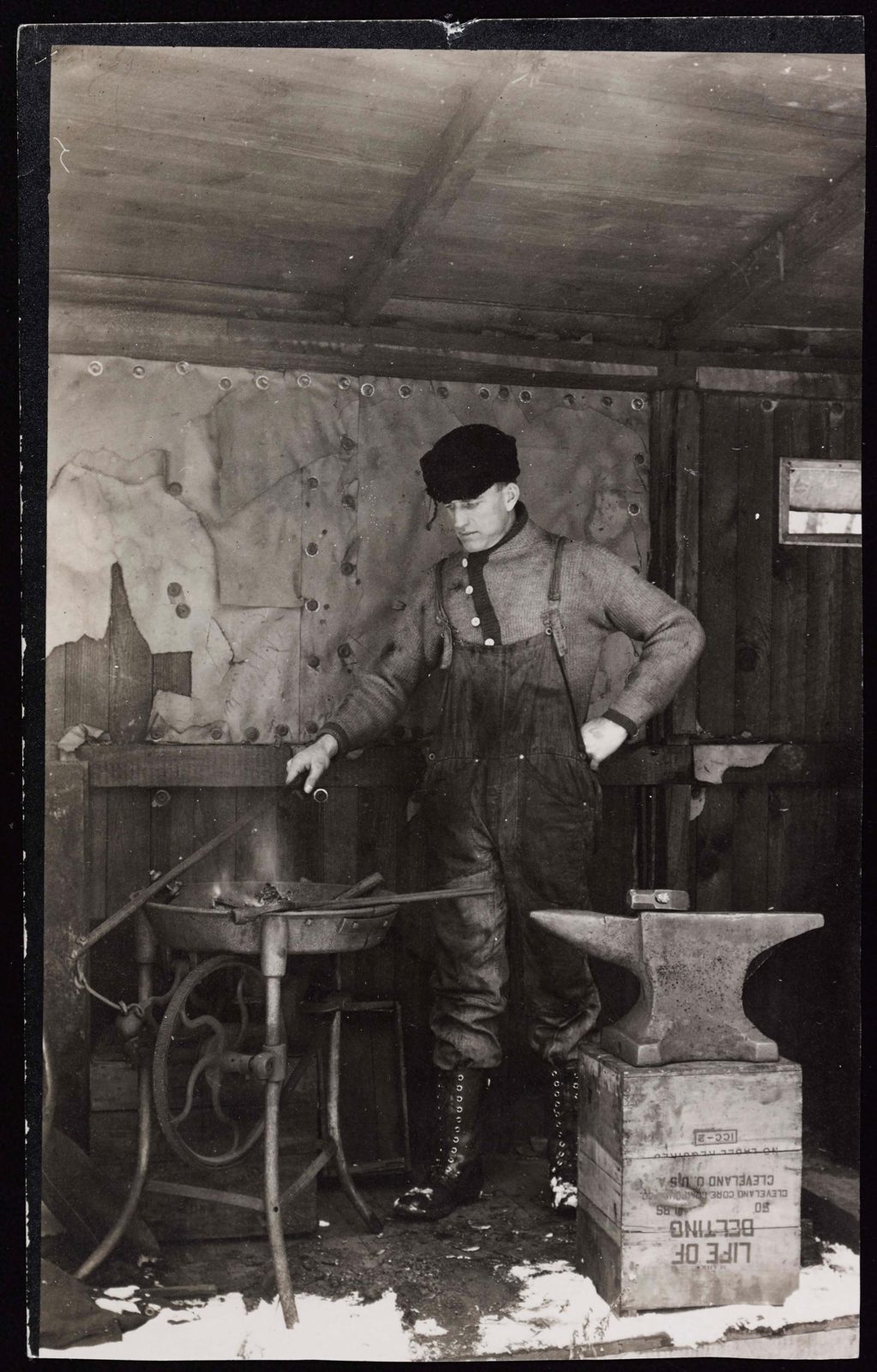
This image of was included in an envelope of four pictures, part of a scrapbook donated to the National Baseball Hall of Fame and Museum by Jake Daubert’s son, George Daubert. Written on the back in pencil script is “Jake Daubert at Coal Washery.” BA-SCR-219-2-006. (National Baseball Hall of Fame and Museum)
He stands in a shed, wearing a heavy, woolen shirt, buttoned up to his neck and thick work overalls, stained from coal and dirt. Snow still sticks to his black boots, laced up halfway to his knees. He holds an iron rod over a fire. An anvil, shiny from years of wear, sits in the foreground. Handwritten on the back of the photograph is “Jake Daubert at Coal Washery.” — (National Baseball Hall of Fame)
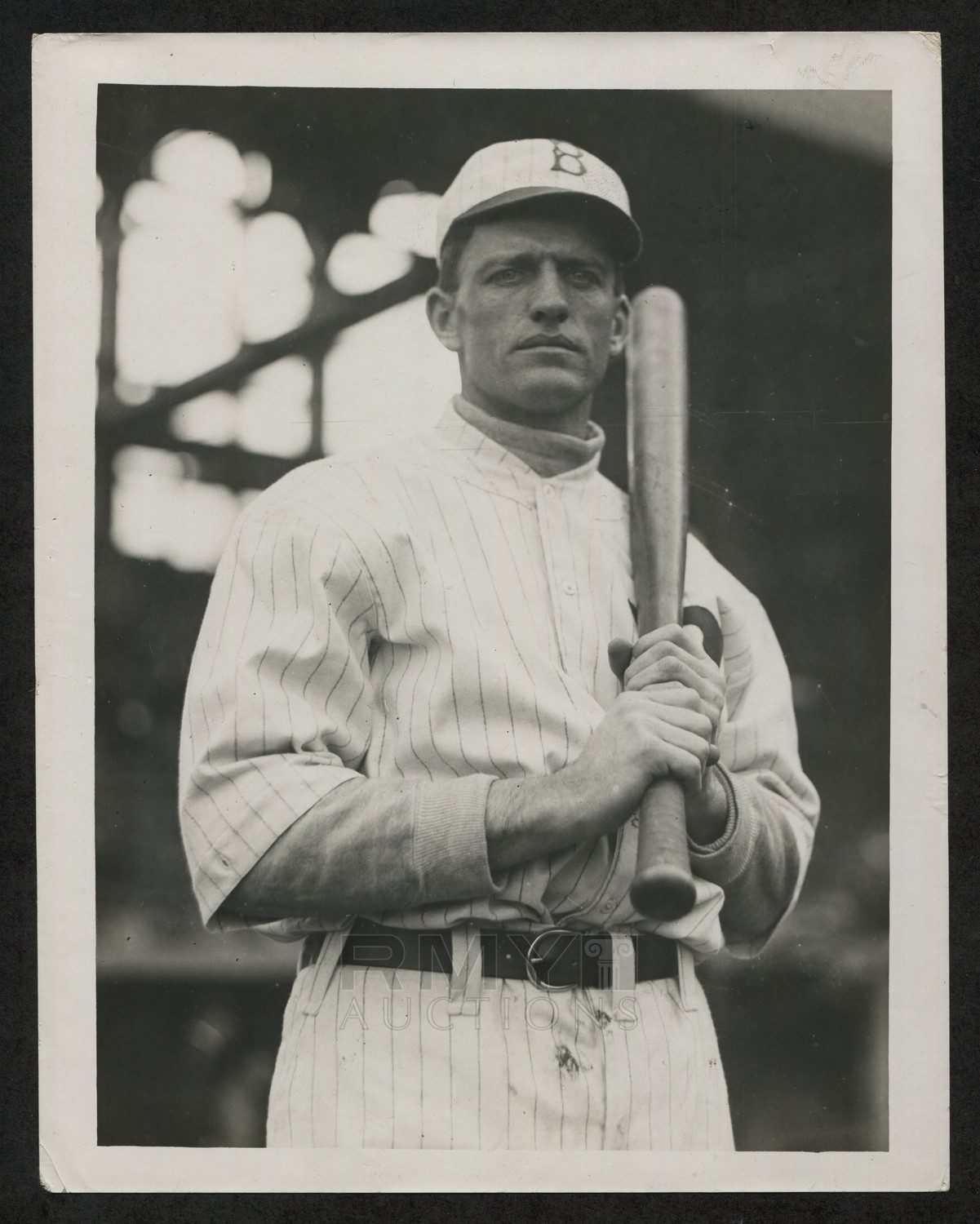
Portrait of Jake Daubert, first baseman, 1914. Taken by Paul Thompson.
The moral ledger of history comes from unsuspecting places. It springs up, like a vine weaving its way through cement or concrete. The impenetrable, improbable truth of history always rears its head: the truth of the costs; the unlived lives; the lives lived amidst the turbulence of deceit, corruption, and abuse — the abuses of power which characterize the rise and fall of each civilizational order.
The history of the oppressed is history itself — rooted far beneath the conventional narratives of Egyptian pharaohs; religious beliefs that seemingly “justify” the abuse and punishment of the deemed lesser; the tycoons, madmen, and tyrants who grab history by its throat and shake its purse. These are the histories of event — psychosomatic explosions and expulsions of latent psychic energy into the field of play; the field of being. Beneath these wide and broad explosions (as is in the case of Alexander and Napoleon, masking an impotent fury and immature, feigned grandiosity), there is the history of those who live, work, and love amidst the collapse of the psychological condition of those who “rise” and inevitably fall from the chairs and thrones of power — due to their own greed, avarice, and confusion as to the nature of reality and existence itself proper.
There was always the notion of divine right of kings; the false elevation of some above others. The early 20th century philosopher and activist Emma Goldman proclaimed: The struggle for freedom is not about gaining power over others, but about creating a society of mutual respect and equality. Goldman witnessed the world atrocities of the impacts of American slavery, child labor, and the treatment of women as possessions and second class citizens. Goldman, like the later philosopher and economic and social thinker Gramsci, understood that humanity is a great matrix of psychological conditions, presumptions, and conduct; that the enlightenment of history and mankind would inevitably entail a reckoning with the harms and violences caused by egoic and false perceptions of self elevation at the expense of the suffering of others. This would be a reckoning of the bloody course of mankind; just as it would be a reckoning of the social orders and political structures established by those who sought power over others; thus, necessarily laid the ground and infrastructure for oppression and violence against others as a rule.
This moral ledger comes not merely from the great moral thinkers of our human history, such as our Isaiahs and our Goldmans, but rather from our Isaacs and our Jobs — the men, women, and children who stand in the fire of the sacrificial fury of human history, and thus are waiting for our remembrance and recovery of their lives; our contemporary sanctification of their forgotten and disremembered histories. The moral witness of mankind has been cast into the fire of a history written by the haughty, egoic inscription of Percy Shelley’s Ozymandias, the egoic conqueror who stands in the wastes of the sands of time; even as the stone of the bridge of his nose falls to the ground, proclaims his victory over life in the catacombs of utter destruction and waste.
This remembrance of our true fellows; the moral, level ground of history without false elevation and condescension is a history of the common man, common woman, and common child. And thus, it is a history of those who labored in fields, worked in mine shafts; milked goats and begged as paupers on the city streets of London, Paris, Mumbai. It is a history of the grand totality of mankind — a history perhaps too immense to contemplate; naturally resulting in a recourse to a linear history of events in the minds of many.
The moral ledger is one of Jake Daubert, Brooklyn Nationals first baseman, former breaker boy and labor activist — at a coal washery as a grown man. It is of “Bugs” Raymond, prodigy pitcher, who suffered the injury that caused his death at the baseball fields of his youth after alcoholism and trauma forcibly removed him from the ballfield. It is of Lange’s Migrant Woman; it is of the possibility within the photographic image to let presence speak as a primary form of witness — without description. And it is the spoken word interview, documented and preserved for posterity, in such works as The Glory of Their Times and Voices From the Great Black Baseball Leagues , where players and laborers such as Bill Foster and “Smokey Joe” Wood detailed the trials and tribulations and victories of their lived experience in early 20th century America and in intersection with the founding and eventual integration of professional baseball. It is, too, in the preservation work of Alan Lomax — traveling across the American country and to the Caribbean and Europe to preserve folk music for posterity.
The moral ledger is a witness of unlikely preservation; preservation of the conditions and witness of common folk as history’s bridges are burned and icons are defaced. It is a work first and foremost of preservation — preservation in the living wreckage of lives, stories, beings, bodies, faces, and memories — deemed unworthy by the powers that be of any given time of being saved. These are the men, women, and children who were thrown from slave ships, condemned to the mines, and who toiled in the fields and lived and died in poverty and as property and possessions. This work of preservation remembers and preserves their culture, lives, passion, and loves as meaningful, important; fundamental and primary organs of the history of mankind and mankind’s great works on earth. The people of the earth; their ground — the humble service to one another; the culture of community and celebration of roots, of finding the glory and joy in the rubble of the presumption of conquerors — this is the art, music, and baseball of true world’s history.
It is a witness that balances the books, with a fierceness that understands the story is necessarily incomplete until history is told in the words and lives of those who lived through it. Those who experienced that which is written as a line of time — with academic detachment and bureaucratic language — a line item of suffering, murder, and conscription noted down to quantities, dates, and conquered territories. This prophetic witness resides always already within the rubble of history. It simply must be recovered, remembered; spoken into the light of the present day as a recovery — not an interpretation — of the words, lives, bodies, souls, and beings of those who lived it.
This is made possible through documentation and preservation; stewardship and the eye and mind for articulation of the web of life beneath the surface of the charnel house of the world’s past. It is a literary mind, much in the way and vein of the great Hugo and Dostoevky — but applied directly to narrative recovery of history in its total scope and existential wonder as a proletarian history of lives, dreams, and stories — from the breaker boy to the immigrant at Ellis Island; from the slave ship to the great great grandson. The recovery of this total arc is the recovery of history — not as an ideal, a dream, or a straight line — but the recovery of the true lineage and trauma of mankind. And thus, as such, the possibility of real, authentic, grounded healing and change — through the memory, recollection, and conscious course redirection of today.
IV. The Skeleton Key
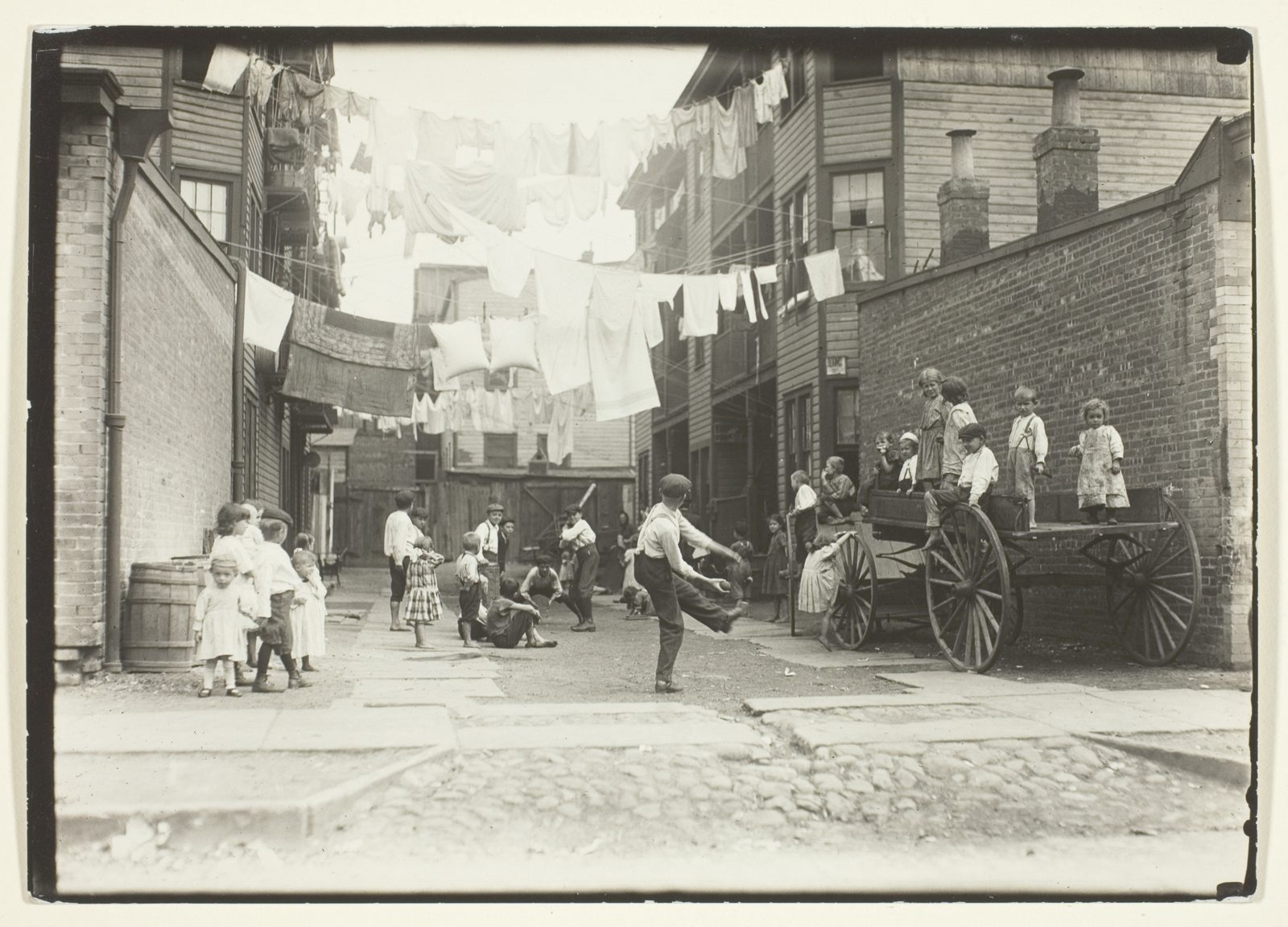
Playground in a Mill Village (Playground in a Tenement Alley), Boston 1909. Lewis Hine
My work has circled around the documentary quality of early modern American proletarian photography as a method of profound social change; an escalation of the true heritage of the American social democratic photo — the works of Victor Hugo, Leo Tolstoy, and Fyodor Dostoevsky.
These historical works are the lineage of the great masters of world literature; what they have in common above all else is the raising of the poor and desperate to equal footing and gravity in the world history of mankind.
The escalation therein in a modern sense with the incoming of figures like Lewis Hine, Charles Conlon, and Paul Thompson; unnamed and hitherto unknown news syndicate photographers across America is a bridging of this historical paradigm shift into working class prominence by the introduction of the street photograph, documentary photograph; journalistic photograph — as a way of depicting and thus giving voice and name to the unknown women, children, laborers, and ballplayers of American history — those who are the ground and foundation of the history of the world proper — in their existence, unfettered by concerns of achievement, conquering, dominion, or territory of the mind and heart.
This true proletarian vision is a vision of the heart of humanity — perhaps best catalogued in letters through Hugo’s Les Miserables , Maxim Gorky’s The Lower Depths , Tolstoy’s What Should We Do? or the dramatic works of Anton Chekhov. What is shared among the great minds and hearts of literary history is not only the capacity to elucidate the human condition but the compassion and delicacy and presence to paint the full hearted life of those who have been most abased or abused by the social order at hand in their times; by speaking directly and immediately through the body; the lived, living condition of those abased, to right the ledger of history and time; balance the books of the human soul in the march and dirge of civilization proper.
This tradition was passed and arguably surpassed in the grounded historical immediacy of the reformist and abolitionist documentary American photograph of the early 20th century. It gave place and name; body and face without illustration to the civilizational populace at large. Perhaps most notably, in the case of Lewis Hine, the documentary photograph brought the early modern American population face to face with the effects and violence of child labor throughout the industrial furnace of the transformation America underwent in the early 20th period; in doing so, raised and transformed the collective consciousness and conscience about the consequences of child labor — which was conducted with secrecy in factories and mines and mills around the country. Hine himself, in order to capture these photos for the National Child Labor Commission, had to dress up in a variety of disguises, such as bible salesman, industrial photographer, fire inspector, and postcard vendor, in order to capture these images — often with threats of violence and death from factory police and foremen.
Hine’s contribution is not simply a contribution to the fundamental alteration of worker’s rights, human rights; labor rights in the United States, but a contribution to the literary history of great works; masterworks and mastercrafts of the human mind, heart, and soul — which are first and foremosts advancements of the most destitute, ill, impoverished and in need. They are prophetic works of accounting, using image and the written word to alter the syntax of civilizations; right their moral code and order in the face of outrageous corruptions and wrongs — including child abuse, violence, genocide, slavery, and class suppression.
This, too, is the key behind early baseball photography and the baseball card as seemingly innocuous bits of ephemera and material. Not yet sanctified as critical artifacts of the American cultural political conscience proper, these image artifacts were a slow work and emulsion of sanctifying the body, heart, passion, and spirit of the American worker; as such, raising the condition of the American worker through the cultural construct of baseball and baseball history. The millworker, the farmer, the sharecropper, the son of slaves, the common man — these were all men who were dignified and preserved and honored through the code of baseball — the putting on of the uniform of play and stepping out onto the field; over and over again iterating the memory of the game; the practice of it.
This is the secret history of baseball which unifies it imminently with the works of Lewis Hine; as such, the works of the great masters of literary history. Hine himself captures the bridge image in his above Playground in a Mill Village (Playground in a Tenement Alley), Boston 1909. It is no coincidence that the tenement children in Boston were playing stickball at this time, as in Boston the game of baseball had utterly captured and enraptured the city since the latter decades of the 1800s with the Boston Beaneaters; the Royal Rooters led by “Nuf Ced” McGreevy and their host of song. Players such as “Kid” Nichols and Hugh Duffy of the 1890s Beaneaters dynasty would be enshrined in baseball’s Hall of Fame. Nichols was the son of a butcher; Duffy, the son of an Irish millworker.
The social democratic documentary photograph epitomized by Hine and founded equally in the baseball lexicon was brought to peak heights in the American political, social, and cultural consciousness with the Works Progress Administration photography and initiatives of the 1930s. The WPA, through cultural and practical initiatives of creating jobs for the unemployed and formally uneducated to bolster the nation’s infrastructural grid, was a roaring success not only in helping the most disadvantaged of the American people survive the Great Depression, but in creating profound communal awareness of the condition of their fellow man.
The photography therein, immortalized in such works as Migrant Mother and Migratory Mexican Field Worker’s Home , created a profound impact on the global American psyche when it came to understanding and empathizing with the condition of others. By creating such an immediate and visceral glimpse into the lives of the working poor, the unemployed, the homeless, WPA photography took the project of Hine and Tolstoy alike and instituted it as a moral public works project of humanizing the condition of the American people; as such, redeeming the nation and its culture amidst the atrocity, corruption, and gutting of the economic structure which once barely kept these individuals alive.
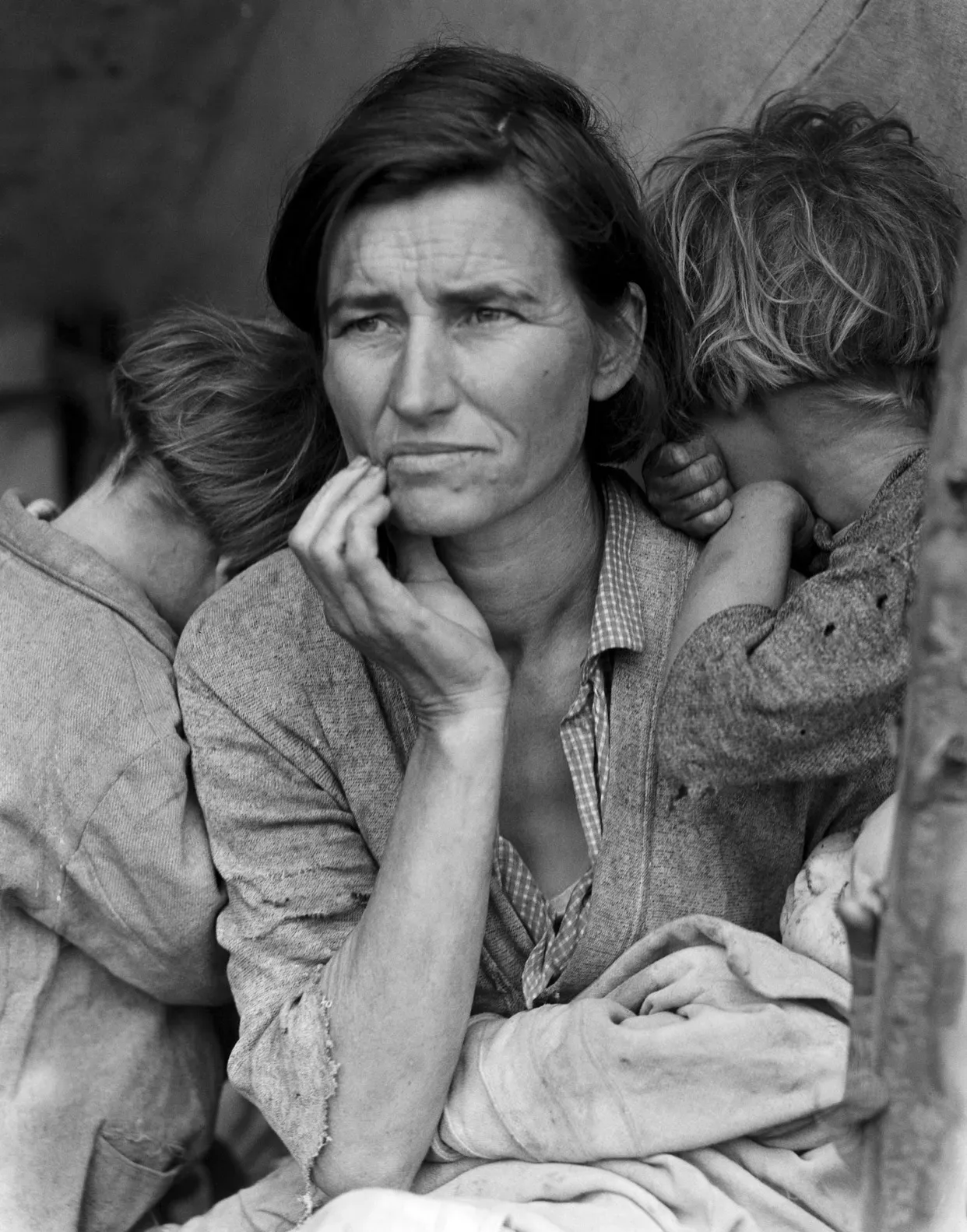
Migrant Mother by Dorothea Lange, 1936.
Photographs such as the aforementioned work by Lange and the works of Hine constitute a direct confrontation of the human psyche with the works it has produced — which is always already a political project of the reckoning of mankind, civilization, and society with the consequences of its actions. This is traditionally the mode of the accountant-prophet, a lineage that stretches as far back as Moses, Jesus, and the Hebrew prophets in the Western lexicon.
The creation of the photographic device, an instrument of light capture and transference and thus preservation of a momentous image of time, is the skeleton key that advances this history epochally from the scribe work of the ancients and the early moderns such as Tolstoy and Dostoevsky and Hugo alike. The medium of the documentary photograph — the unvarnished depiction of the muddy mine-worker on the ball field in 1909, or the field laborer and his home in 1936 — creates a direct and immediate implication of profound humanization: seeing, feeling, and experiencing face to face the suffering, triumph, joy, and struggle of another human being. It is an emotional experience of a psychedelic confrontation, a psyche revealing of the soul of another — the compound nature of time worn on their face as the work of a lifetime; the experience of a profound misery or a profound ecstasy.
This is the advancement of visual art into the term of the literary masters, unseen since the visceral depictions of Caravaggio of biblical and mythic scenes. Caravaggio with his play of light and shadow and his hyper-realism perhaps stood closest to the capacities of the social democratic possibilities of the documentary photo, which retrieves from the ashes and hell of modern life the possibility of redemption in the retrieval of the profound humanity of the forgotten and the disabused; restoring them to the pantheon of light and memory which is the collective experience and witnessing of the full spectrum of life incarnate — without exception, without distortion, without dehumanization.
This is a forced reckoning. It is a reckoning which does not require literacy, only the eyes to see and even the minute potentiality of the heart to feel. The photograph can be, as it was, transmitted across great lengths via newsprint; contemporarily, digitally, via the internet. It is a reckoning which bypasses the need for symbolic work, as is in the letter of Dostoevsky and Tolstoy — symbolic work which ultimately always already requires translation. The American social democratic photograph was an explosive advancement in political consciousness; in the very nature of the medium, a profound advancement in art history toward the only true goal of art and literature — the liberation of human life; by extension, the compassion and presence, witnessing, focus, and attention of all life on earth.
V. The Art of the Proletarian Image: The Industrial Gospel of the Modern Dispossessed
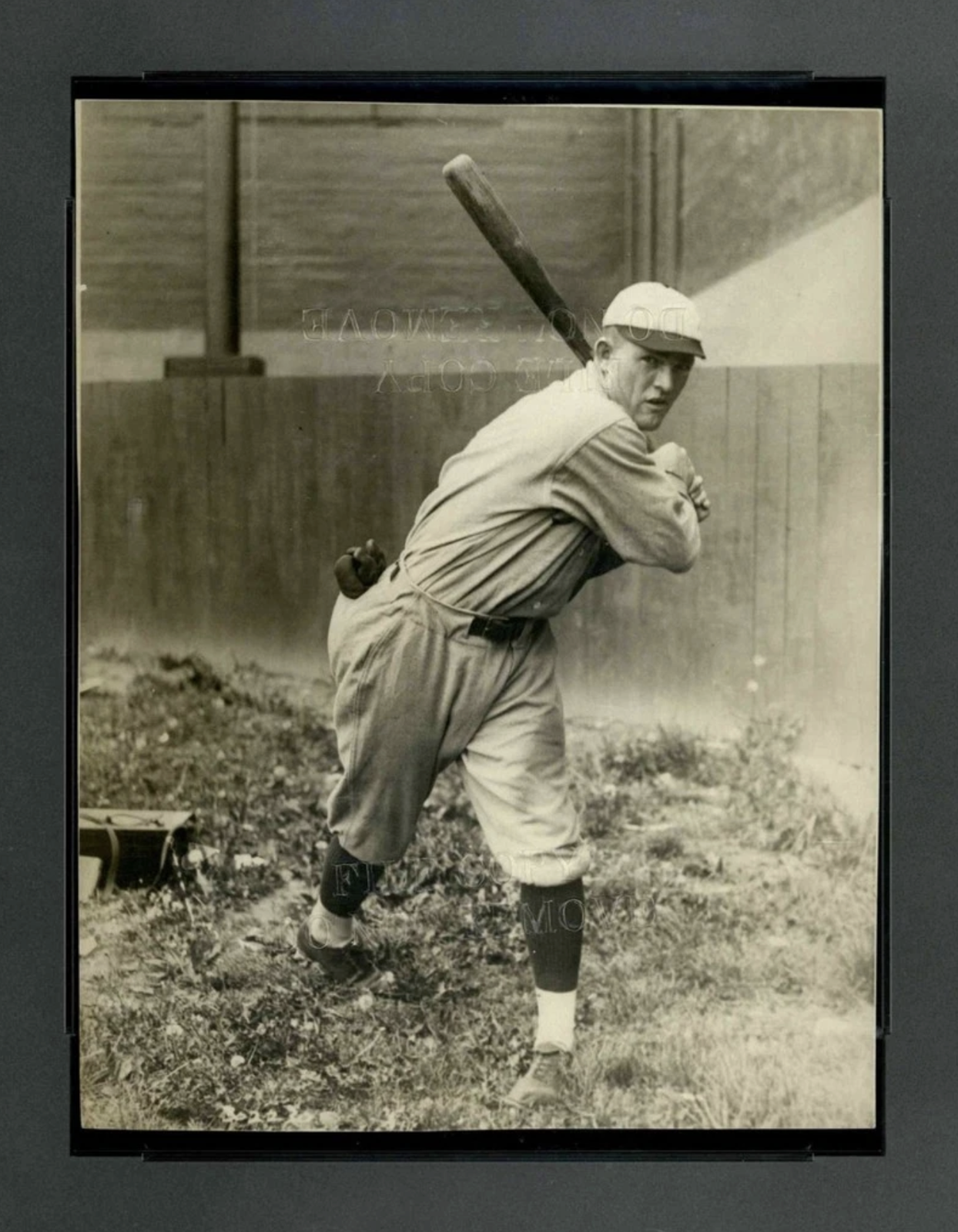
c.1920s Underwood & Underwood photograph of Rogers Hornsby.
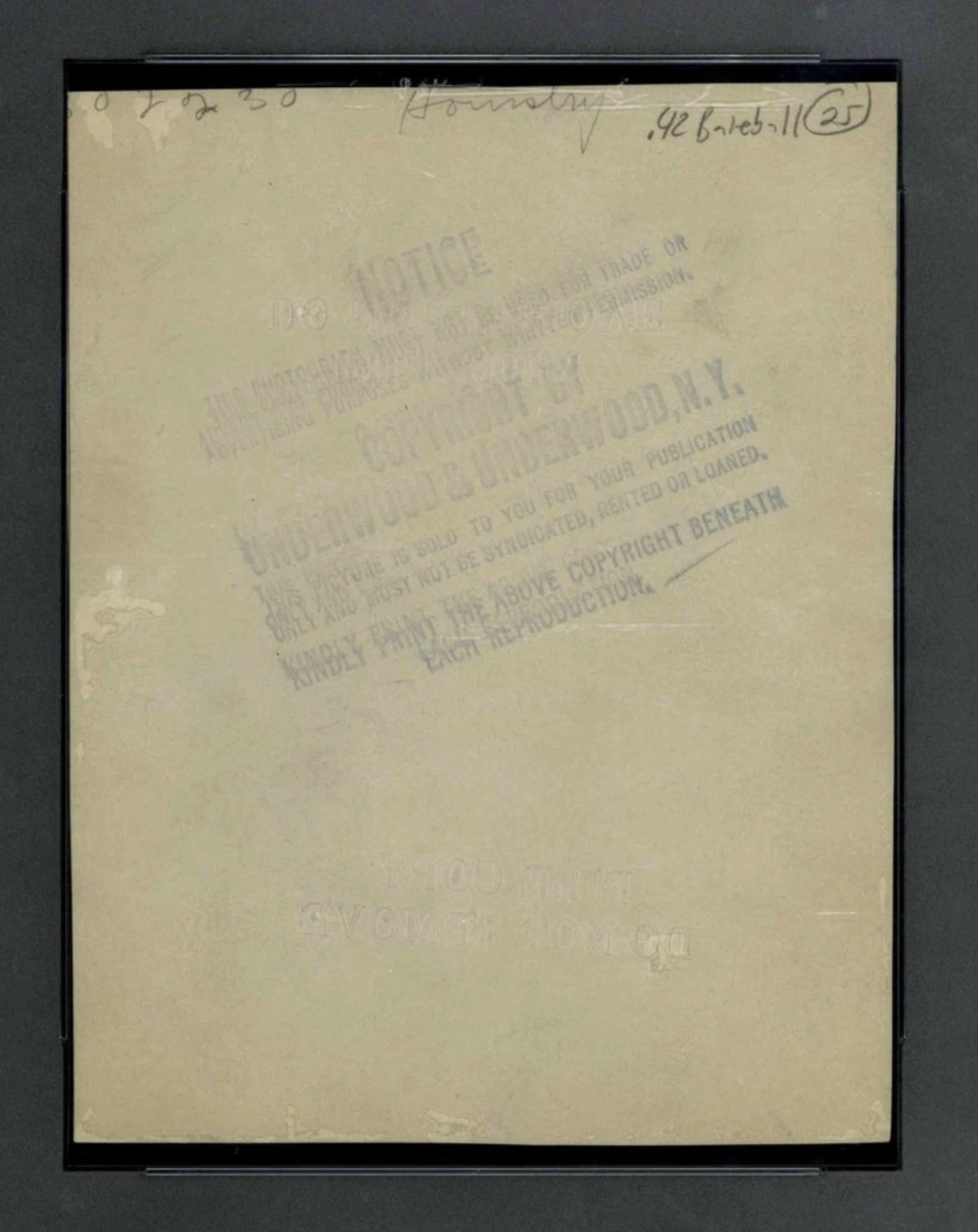
Verso.
The art of the proletarian image is a total, absolute art of transference of the power of the image — both creation as in craft, medium, and depiction — to the seat of industrial production and labor. And in doing so, it is the removal of the artist from the seat of power; the introduction of the laboring body — subject, artisans, and machine of production and distribution — as visibility.
All of the traditional hierarchies — from the rendered image itself to the process of rendering — are inverted. Depicted is Rogers Hornsby, messenger boy at a Texan meatpacking plant; swinging an aged wooden bat in an overgrown field of plants, shrubs, and metal fixtures; backed by a wooden fence. He is dressed in non-signifying workman’s linens; perhaps with a sparsely adorned city name across his obscured chest. On his face is not a scowl nor a proud smile or haughty glare, but rather a face of gritted determination and focus — a man of action, unencumbered by notions of status and propriety in depiction. His body is coiled forward, like a panther executing a strike. This is no common Victorian portrait.
The photo is cut unevenly; on the verso simply and loosely scripted with archival name and numbers: “ 02230, Hornsby, .42 Baseball ” with an encircled “ 25 ” in the top right corner. The photograph is stamped with the news syndicate Underwood & Underwood copyright and reproduction notice in the center of the photographic back. The image itself is utterly unbranded — with the exception of Do Not Remove, File Copy impressed upon the front of the image, which actually corrupts the gelatin surface — with any sort of signifying identity of the artist who captured and rendered the image in silver gelatin for distribution within the Underwood editorial system; as such, the artist is, as plainly stated, the Underwood syndicate as an industrial super-system: photographers, photo editors, copywriters; those who formatted and transferred images for print. It was an unbroken system of industrial production; a gearwell and a machine; as such, there was no conception of the individual artist within the industrial mode of mass production.
The reason why these images are not recognized as utterly revolutionary is that they are buried within the inverted logic of industrial capitalism — a logic which erases historical Western notions of art and identity and replaces them with the nameless, faceless machine of mass production; in doing so, paradoxically enables a low class, seemingly low art elevation of the democratic, egalitarian media object. Here, namely, the subject at hand is the .400 hitting Hornsby from a family of meatpackers. This photograph was captured for print distribution in the news via Underwood’s permission for publication; as such, it was not designated as an important work of art, but rather a piece of disposable, temporary information. And yet, this is precisely what makes this posed shot of Hornsby revolutionary art. In its candid unconsciousness, it unseats the conventional form of Western portraiture and replaces it with the face and faces of the new, modern world of the industrial furnace; in doing so, unseats a historical form and format based on falsity, class, image hyper-consciousness; projection of power as a project of ideology and narrative construction.
The proletarian baseball image of modern America does this by simply depicting the true life and conditions of the American underclass; in such a way that the documentarian news photograph is elevated beyond social realism into an existentially honest and integral vision of contemporary life through the eye of the photographic artisan, who was using new image technologies and highly proficient technological training at fast speeds of production and distribution to churn out highly unique art objects through negative creation and the rendering of period authentic prints for reproduction in newspapers.
This is what makes these objects and artifacts so fascinating to encounter after one hundred years have passed since their creation: that they are so novel in their unselfconscious ease of documentarian statement, as they were images produced at speed to satisfy the mechanism of industrial production and reproduction. It is also, therein, that they are so obviously and clearly critical and profound documents of philosophical art, remarking directly and without commentary on the condition of the American working class and participating directly in this grounded reportage while simultaneously functioning through pose and action to construct the mythic backdrop of early American baseball as history remembers it today. They are and were simultaneously documentarian news artifacts and critical image artifacts in the book of American mythology — an Odyssey, Iliad, and Metamorphoses of the reproduction of images and image based content — in which the working class heroes of American baseball history existed in pinned up cabinets photos; in caramel cards; in the newspaper headlines of the minds, dreams, and memories of America’s youth as sigils of possibility, striving, triumph, glory, passion, and excitement.
The art of the proletarian image of American baseball, in this way, was not simply an overturning of Western historical precedent in both content and method and form, but rather the act of synthesizing history and mythology — unifying the Platonic instinct of the Ancient Greek with the active historical material context of conscious Western modernity. Through the proletarian image of baseball, America was simultaneously dreaming itself into being and consecrating the myth of its own workers — a myth in which Rogers Hornsby, meatpacking plant kid from Texas, became the .400 hitter with the magical batter’s eye, immortalized in the Baseball Hall of Fame.
“Son, when you pitch a strike, Mr. Hornsby will let you know.” — Umpire Bill Klem to a rookie pitcher who disputed calls while Hornsby was at the plate
The collaborative, civilizational effort it takes to construct a myth is one not only of images, but literature. And this was the main function of reporting and the newspaper in relationship to baseball as both a storytelling device and a image reproduction device of America’s sluggers and fastballers.
“Can I throw harder than Joe Wood? Listen, my friend, there’s no man alive can throw harder than Smoky Joe Wood!” — Hall of Fame pitcher Walter Johnson
It was a myth of tall tales and intrigue, forgotten historical records, unseen feats; constructed in large part by both a failure of documentation (which allowed for players to fabricate and construct and paint histories); a success of documentation — which allowed for the news media to supply and distribute colorful depictions of games with language; convey gritty images such as the above Underwood photograph of Hornsby to the general population.
Roar Greets the Teams.
At twenty minutes of two there was a tremendous roar. The teams were emerging from the club house. It was much like an opening day, except that the men did not come across in line. The Giants strode in one bunch; the Athletics in another. The one party stepped lively, determined and confident. As the band struck up “Give my Regards to Broadway,” another howl went up.
Ah, you could see those Giants were confident. McGraw, in the middle, had a chip on his shoulder.
“Knock it off,” his expression said plain as day.Thousands in the place had never seen the Athletics. They were a myth. Now, here they swept over their bench, a living reality. But New York sat back—…
— The evening world (New York, N.Y.), October 10, 1905, (Evening Edition)
This was a combined effort made possible by the new technologies of mass reproduction of photographic images interspersed with colorful news journalism — which allowed for the full literary force of the emerging American epic in novel form with literal historical photojournalism interspersed with color commentary — commentary which, as the later radio broadcasts led by poetic figures such as Red Barber continued and consecrated, blended the mythic, the poetic, the interpretive, and the historical reality of the current event. The world was depicted as narrative device; baseball was given the leeway of theatre; emboldened with color; stories of grandiosity, cowardice, braggards, and onward. Baseball was a form of entertainment; simultaneously a game and a real historical event. This allowed for the game itself to be treated with a looseness that bent the rules of truth, history, and event — giving it a mythic dimension; a practical dreamtime which absorbed fans of all ages, both in the papers; in the cards; in the images, and at the ballgames.
This field of play and narrative and language was the collective dreamtime of early modern America. And it was built through the practice and process of the elevation of the mundane through the construction of the baseball field as a diamond of repetition, an inward mandala of silence, rhythm, contemplation, and somatic action which allowed for the creation of a trance state; a lull and a rhythm broken by grand and extraordinary acts of wizardry: the Mathewson screwball in a pinch in the 1905 World Series, or a staggering line drive off the well trained bat of the eye of Hornsby — a man who would not read at risk of throwing off his well-timed vision. These men were, like the kings of old elevated by claims of divine right and mythic ancestry — elevated by their culture. But they were not elevated in the claim of being something or someone else — rather, they were elevated as ordinary, lower class and impoverished men who, through their feats on the ballfield, captured the mythic imagination of a young civilization which was incarnated with a secular foundation; necessarily dreaming of and desiring gods and a mythic pantheon of their own.
In the vacuum of religious society; in the wake of the establishment of a secular nation, America unconsciously, out of need and out of desire to craft the god-myths of a new cultural order, created baseball as this secular substitution; in doing so, revolutionized the world history of art and image and symbolic order out of necessity. To make the most impoverished men of one’s time gods is to fulfill the Christic project: that the son of god, or the demic hero is Hornsby. The demic hero is Ruth or Gibson. And in doing so, they commissioned the industrial news media and emergent photographic syndication mechanism to conduct perennial portraiture of their new idols and icons, much in the manner of the Byzantine works of Christ and the Christian pantheon of beatific and saintly figures. This mythic impulse is foundational to civilizations — as all of mankind seeks elevation out from under the normative, oppressive conditions of the drudgery of everyday animal life, sustenance, and survival. And this mythic urge is the underpinning of all literary, creative, artistic, and religious traditions — as the cultivation of elevation and transcendence from the mundane.
But what happened in America is that transcendence was constructed through the mundane. Salvation was not abstracted, in the skies, temporary, future promised — it was immediate, imminent, in the pits and the bowels of Shibe Park and Yankee Stadium with the bat of Hornsby or the glove of Ty Cobb. It was the imminent act of creation worked through physically as a process of embodiment and the immediacy of physicality which was the beatific missive The kingdom of heaven is within you repeated over and over again as managers met to exchange lineup cards; Cobb laced up his spikes with a wild fervor in his eyes. And the American images captured this, with something of a perfect, sanctified, corrosive messiness which condoned the body, condoned imperfection; condoned the process of industrial reproduction which released the nameless, faceless, unowned artwork of the beatific image of American history; released it into a true and accurate depiction of the human condition — freed from self-consciousness; freed from class constraints; freed from the status signaling and presumption of high art in materials and craft of the Western art history of yore — replacing it with modern images of dirt, labor, and the human face born from immigration, poverty, and existential struggle. These were the new spiritual sigils of trial, purgation, revelation, and beauty.
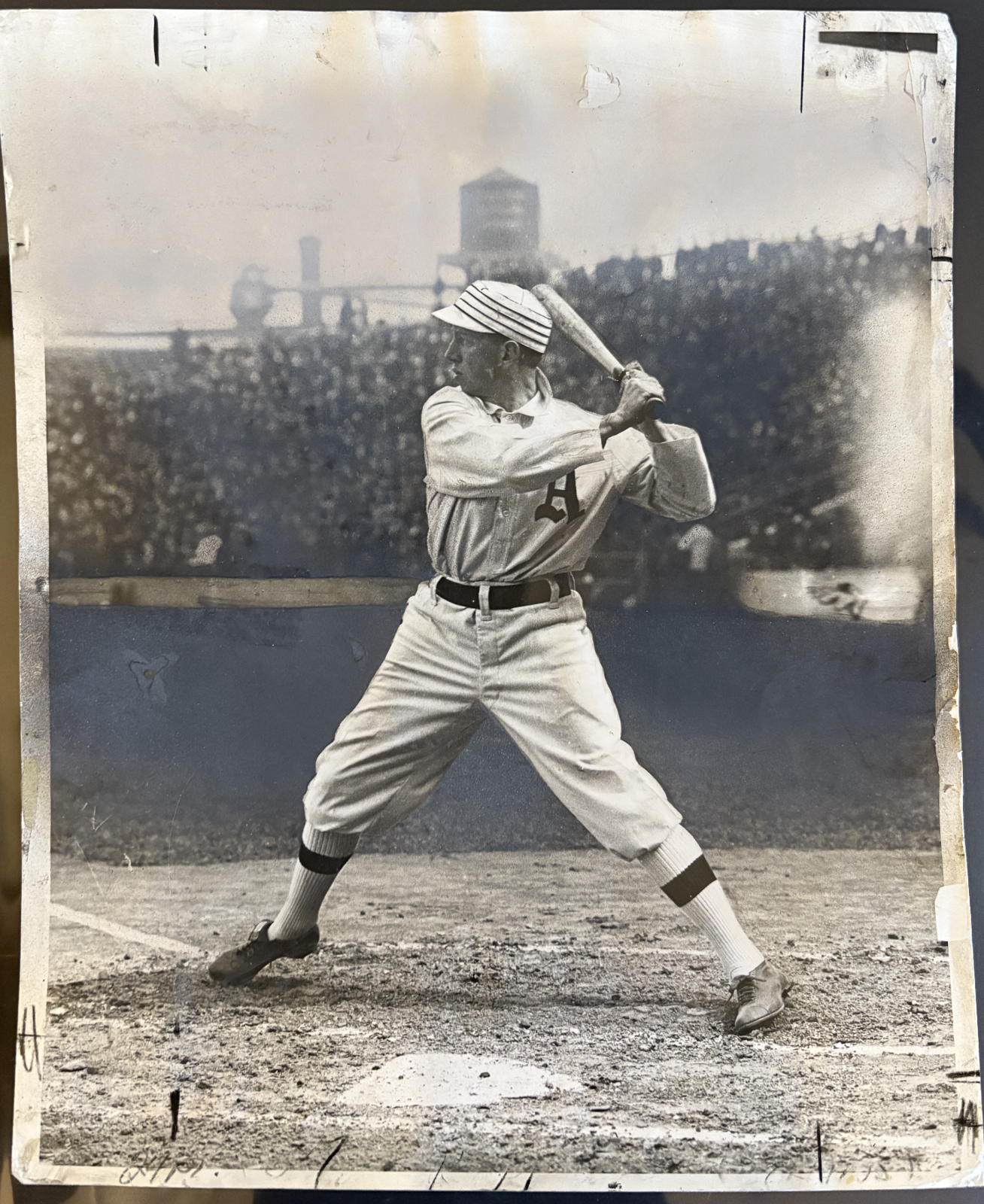
A news media edited photograph of the Philadelphia second baseman, Eddie Collins, from the early 1900s. This image was prepared for print, giving it the ghostly glow and aura which makes the primary figure of Collins pop from the page.
The proletarian image of baseball in modern America, in this sense, was an ongoing, ritualistic process of repeatedly inducing and creating and forging; sculpting and carving as a collective spiritual artistic practice and project — the image and face of baseball as the iconographic source and foundation for the representation of spiritual striving and the existential condition of the Industrial Age. The victors of the coal mines and the factories displayed their titanic powers on the fields of play to massive crowds; these victors would be sung into newsprint by the colorful, poetic prose of the editorial; depicted in action by artistic composites and well edited photographic images which dramatized their feats and athletic postures, stances, and movements. This gave America something extra-historical — it gave the nation an imminent, unfolding history and drama of baseball, a modern Iliad in real time, to be sure — and it gave the nation a real religious sense. A religious sense that there were incarnate powers; that there was a drama of incarnate powers occurring through the civilization proper — powers that were not just relegated to a higher, externalized sphere of godliness, while mankind suffered war, famine, and misfortune down below.
These powers were not intellectual or scientific, as other forms of modernity and antiquity attempted to espouse and promote. Nor were they purely natural, as ancient civilizations such as the Olmec practiced and observed. These powers were theatrical. They were the intersection of mankind’s physical ability and prowess — cultivated in the early modern days in the fields, farms, mines, factories, and mills — combined with the costume, uniform, and stage that baseball provided to exercise these powers and thus display the native potentials within mankind to accomplish physical feats and psychological feats of self overcoming in space and time: to track baseballs with impeccable focus and spin pitches with incredible drops and weaves through the air; thus to show America what is possible within man. These potentials were not merely gestured towards or articulated as possibilities — they were exhibited and displayed as phenomenal realities.
And this is the magnitude of the photograph — that the American industrial proletarian photograph is a secular religious artifact of how early modern American civilization captured its spiritual sensibility — the way in which it saw the world and glimpsed the possibility between mortality and the realm of the everyday and the immortal realm. Much like the Olmec did with green serpentine were-jaguars (man-jaguar hybrids), the American used press and media photography to capture its proletarian heroes in the midst of physical transformation — as proto-shamanic forces gathered from the very grounds of its industrial milieu — representatives of the achievement of the physical feat which was cultivated every day in the mines and factories and on the farms and sharecropping fields — as phenomenal collective witnessing of the functional power which moved and shaped the very body of modern American civilization proper.
This body was itself the field of energy in and through which the collective force of American labor moved — the will which impelled the skyscrapers, the presses, the automotive factories; the hands in the fields. It was a primary, metabolic consciousness — to which intellectual or abstract, academic capacities could not possibly hope to relevantly apply. The American mass needed an American myth and an American spirit which suited the truth of its reality as an intensively laboring nation. A nation which was, in truth, deeply undereducated; suffering from substantial class and race division; struggling deeply to find its identity and sense of self. Poets like Whitman emerged; moral consciousnesses like Douglass — but America was not an intellectual or spiritual power like Europe or India. It needed a form of mythic and religious consciousness that suited the reality of its nature. A nation of industry, movement, physicality, and production.
“Baseball is the very symbol, the outward and visible expression of the drive and push and rush and struggle of the raging, tearing, booming nineteenth century.”
— Mark Twain (Samuel Clemens), April 8, 1889.
“That’s beautiful: the hurrah game! well — it’s our game: that’s the chief fact in connection with it: America’s game: has the snap, go, fling, of the American atmosphere — belongs as much to our institutions, fits into them as significantly, as our constitutions, laws: is just as important in the sum total of our historic life.”
— Walt Whitman
America was the train whistle, the rushing street, the factory gear; the industrious spirit. The push and pull between Union and Confederacy at the midpoint of the 19th century was just as this; it is fitting that both Whitman and Twain speak to it at the precise hinge of this time. America was industrializing; leaving behind the agrarian mode for new forms — both of cruelty and of hyper-acceleration of the drive to produce and consume. It was integrating new technologies of mass production; investing deeply in steel, coal; the machines that would skyrocket its energy production and consumption and firepower into the future; the future wars that would define its legacy globally.
As such, the American myth and the American religion and its icons could not simply be abstract. They were myths of grounded will, sweat blood and dirt — combined with the Christic ethos which impelled the early American aspirations, even as they so often failed, toward equity, justice, truth, and goodness in an early age. The miners and factory workers whom it elevated were the only fitting candidates to assume the elevated realm of the American pantheon, as they were those that Christ himself would lift — the same ethos as Hugo’s treatment of the poor in Les Miserables.
The American intuition and the vacuum left by the turn of the 20th century in relation to America’s secular foundations — which were simultaneously imbued with deep roots in Christic tradition — created a fusion event of incarnate religiosity, where Christ principles and ethics were applied to a wide-eyed, child-like and yet adult in the function of devotion and worship, ritual practice and attendance to the collectively built temple and church of baseball as an event which slowly but surely unified the nation across all class, racial, and ethnic divisions upon and at the field of play.
This process, of course, was not smooth by any means — colored with segregation, Jim Crow, gambling; losses of faith. It was the process of a young civilization finding its feet improvisationally using a cultural device as a method of transference and purgation of the profound traumas and violences it wrought both within and without; incurred in World Wars and inflicted in the consequences of slavery and child industrial labor which profoundly colored how baseball was played, organized, and depicted. Baseball is America’s great mirror — because it is America’s devotional lens. The proletarian icons therein were America’s saints: the poor, the desperate, the broken; at last, the redeemed, through the nation’s cathartic vessel for her own sins. Ritually induced purgation through baseball became the norm, as it was in the Greek tragic sense of catharsis: where national trauma, violence, and exploitation became so grave and so grief inducing — baseball was regularly the only cultural outlet for such profound, unspoken, unprocessed mass suffering. Child labor, immigration, poverty, the Great Depression, World Wars, slavery — all of this was poured into baseball as an alchemical alembic for the transmutation of suffering.
And baseball could hold it — because baseball was mass created to serve this exact purpose. It was a dream and a mechanism built and reified by mass cultural participation and construction; disseminated by the very industrial machine that America used baseball to ritualistically escape from. The energetic monster of consumption and production that was America’s drive, spiraling rapidly with the new modernizing world out of collective control from — was the monster that allowed for a new collective myth and religion advancing Christic principles; grounded in history as an advancement of Hugo and Dostoevsky’s literary projects. It was a continuation and yet a breakthrough going all the way back to the foundations of Western religion; even world religion in the pantheons of the Egyptian, Greek, and Hindu. But instead of Vishnu, Osiris, and Perseus, America had Rogers Hornsby. The temple wall and the epic poem were the newspaper; the press photograph.
America, through her unconscious need and desire for a secular-religious foundation, modernized the world historical template of religious mythology. And in doing so, it advanced the very Christic principles upon which it was founded — finding historical ground for the world mythic tradition that was so long required: a sanctification and deification of the human being; what it is to be human in the grand nature and design of the cosmos. By elevating the most dispossessed in its cultural pantheon of beatific images — dispersed en masse by industrial newspaper and photojournalism — it sanctified the very ground upon which it stood. America made clear to the world; the history of mankind — perhaps for the very first time — that even the poor and the dispossessed are of the kingdom of god; as such, in their American sainthood, helped found an entirely new template for conceptualizing what it is and what it means to be human in the cosmos.