WWII, Baseball & the End of History as Cultural Revelation of Being in Time
Video
WWII, Baseball & the End of History as Cultural Revelation of Being in Time
00:01
So what I want to begin by stating is that my project and Sartre’s project are effectively the same. And I want to explain why, specifically… it’s constellated around World War II as the moment that connects my project deeply with the existentialist project and the multi-disciplinary, sort of transcendental of disciplinary project of Sartre, which is to say the question of human being and the question of evolution of consciousness in space and time.
The marker that reveals this in history phenomenologically, again, through baseball and through culture, is the American civilizational… it’s almost unspoken or implicit that baseball will continue. Right?
00:55
That baseball in a deeper sense, even through the largest fracture of violence… I think there’s an Erich Fromm quote where he says, violence is the last refuge of the incompetent. The political sphere and the churn of political power, which is the story of civilizations, the story of epochs and empires, you hit these critical tensile breaking points, which we discussed in the previous essay regarding heroism, right?
The emergence of heroism in these tensile historical material breaking points of the contraction of consciousness toward fragmentation and separation — and heroism emerging, whether that’s intellectual or physical or on the stage of culture — heroism emerging as a unitive force or an exemplar or a phenomenological emergence or appearance of the unitive, of the Godhead within history as this force of primordial reunification and re-identification with the source material of existence itself.
02:18
So you have baseball in these two critical moments, and I brought up the first one before in World War I, where you have the 1916 World Series — and across the nation… you see the headlines of newspapers, these World Series headlines are front page top of the paper news. Even in front of this massive outbreak of World War I and all of this global detailing of these various phenomenological emergences of happenings that are occurring around the world which are the ramping up of this first global war.
This is number one in terms of the American political, social, and cultural consciousness — that baseball still has this place of profound primacy… even in the midst of this emerging conflict. This global conflict which America of course becomes involved in.
And then you have in World War II, much to a similar effect — but you see even more so the profound investment, even as many of the game’s most prominent players go off into the war effort, similar to World War I.
Christy Mathewson, Grover Cleveland Alexander, and in World War II Ted Williams, Hank Greenberg, etc. Even amidst that you see the American political and cultural consciousness — that baseball goes on… and not only does it go on, it retains primacy in the awareness and presence and thought and consideration of the American social, cultural, and communal mind.
And even more so, it contributes again via relief efforts, bond advertisement materials, relief games, right? All of these different ways that baseball actually intersects with this larger global political unfolding of World War II.
04:10
But this is what’s so interesting to me about baseball and the necessity of baseball as a physical physical culture or spiritual ritual — because it represents an emblematic opening of the possible, the terrain of the possible, the improbable… through the physical extension of being and the body — which is the human experience, which itself is transcendental and transcendent of all history, all time, all material, all consequence, even as it pertains to the survival of the organism.
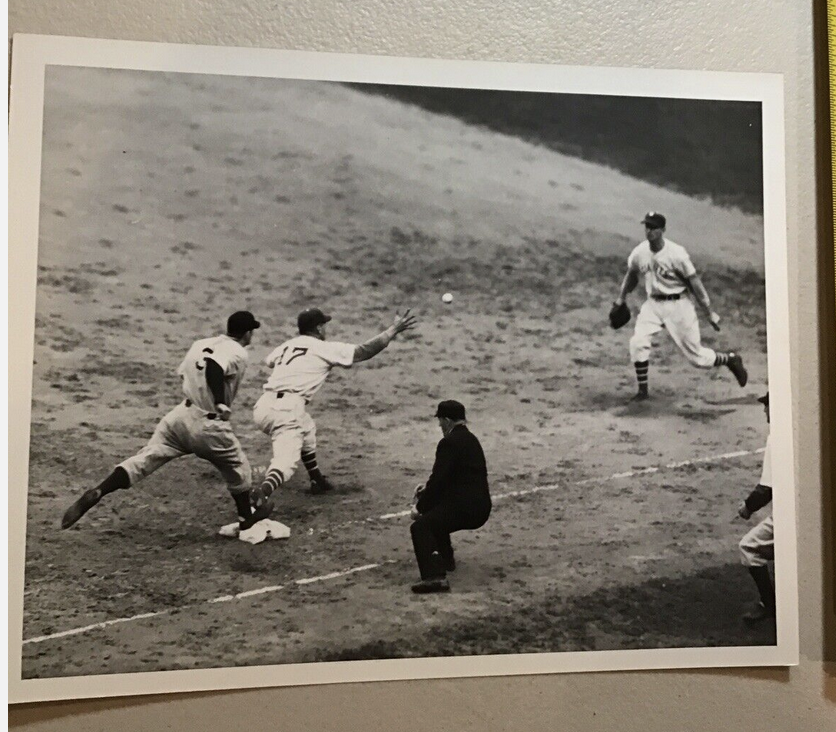
So we’re actually looking at this larger spiritual possibility, this unfolding of the possibility of presence in precisely these moments as depicted photographically here and above. There’s a fair amount of these moments that are detailed in the archive itself. I believe this is the 1937 World Series. You’re watching this play where the pitcher who’s covering first base is reaching out with his outstretched bare right hand in an attempt to catch the ball that’s floating towards him from the first baseman’s feed as the runner’s foot is about to hit the bag.
05:11
You’re looking at these momentous space-time transcendental moments of the emergence of possibility in the millisecond, in the absolute minutia of time which the field of baseball itself as an archaeology presents, which is the availability of the terrain of the quantum mechanical or the primordial or the essential substratum of being… the moment in time where time ceases to become time and reveals the timelessness, reveals the essence of being in this creative ritual play — which is itself the very architecture which reveals this to us. It is a self disclosure at the level of the numinous quantum architecture of being itself. The totality of the powers present and revealed from within their field. The veil, as such, lifted in presence… visionary presence of being.
06:06
And in this sense, it is very similar to war — in the sense that with war, there’s more of this life and death. It’s more of an organism participation in this unfolding of time, which reveals the critical breach or the psychedelic breach of existence… you have this revelation of the finitude of being in terms of the organism coming face to face — a confrontation with its own mortality and morality… its own kind of existential terms and conditions in this synthesized theater of violence.
This does not make available to us the deeper phenomenological material. We’re not witnessing a true aesthetic stage. We’re more deeply ensconced in the organism’s survival drive. This is a descent as opposed to an ascent as a revelation or an unfolding in the light of day, which is to say consciousness — which requires a theater to make available the intersection between the physical terms and conditions, we would term physics…
This again, the science itself being the phenomenological laws which govern the appearance of being in time. And then through that ritual participation, again, this is the critical aspect of physical participation as revelation, as form of revelation, physical culture in particular — through participation in those fundamental elemental laws, the revelation through space, through time, through movement of the momentous terms of the will itself… which is phenomenologically veiled through the appearance of things and in the appearance of things.
The moment that is made available of this pregnant possibility — for this moment that you see… the ball in the air and the outstretched hand, again, much like Michelangelo’s Last Judgement.
08:03
Adam and God, the outstretched hand, this moment where the essence of being is revealed out from under and beneath and beyond time, again as revelation as we so often discussed here. And so you can see this primacy… and you could make a moral claim and you could say, oh, there’s this war of morality that is occurring here and the necessity of the focus on this war of morality — which is the violence against an ethnic group and the necessary heroism… whether or not that’s the actual terms and conditions of the United States’ engagement in World War II is obviously up for debate, or World War I for that matter… whether or not that was actually a moral engagement or if it was an economic or political engagement for power on a global stage.
Those are two different discussions, neither of which actually matter here, which is really where we’re getting to the sweet spot of this discourse and this discussion because… understanding on existential terms what needs to be revealed and the revelation of being itself being the absolute of the absolute essence in a larger consciousness sense — you can see the priorities of American culture; American community in this specific moment in time.
And the reason that you can see that and observe it so powerfully is simply through the way that the American public engages with baseball through these war time efforts. Right? We have to ask ourselves — I think that meaning emerges very naturally. It doesn’t need to be forced. It doesn’t need to be convinced.
09:59
It doesn’t need to be convicted… and through observing history, we ourselves can actually observe being reflecting upon itself and knowing rather innately and intuitively the true ontological orientation it has and must have towards itself as a revelation. Where it finds itself in being in time. And so we view maybe history as individuals or we view history as nations and we say, oh, these nations or these individuals should be behaving in some certain way. If only it were revealed to them that they should behave in this way.
My register of that is no, individuals are behaving in the way that being is ontologically calling them back to themselves itself. And so to analyze and to reflect upon historical material culture and historical material civilizations is to actually realize being itself before itself.
Interconnecting all of these seemingly disparate civilizations and their archetypes, their foundations of meaning, their cultural symbols and signifiers, and unifying them integrally in a larger metaphysical realization and identification of this understanding of this is how being is fundamentally ontologically oriented towards itself, perceiving itself, perceiving itself, and as such we are making available the truth just by acknowledging history, not by asserting an opinion or an interpretation or this history and being should actually be oriented this way toward this XYZ value or concept or construct or idea, but rather that history is always emerging naturally the terms and conditions of being. And to observe that is actually the skeleton key, which turns the lock of being itself and the revelation of being in time. Right?
As Ian Curtis says; this is an eternal existential reflection on the aperture of man, ‘I exist on the best terms I can’. Individuals find and seek revelation where they can behold it, to the degree they can behold it accordingly. And this is all reflected culturally; symbolically; archetypally — as a level of mass perception and revelation through collective language and dialogue through images and symbols and cultural rituals and rites — through which being is supposedly revelated or made apparent to the degree that it is and can be grasped through the existing aperture of the organism itself proper.
11:51
So when we look at these two critical moments in the larger architecture of American civilization and global world civilization and modernity itself, globalization, World War I and World War II — probably the two most important events in globalization as it occurs as a pretty much just strictly a 20th into the 21st century phenomenon of the rapid scaling of the integration of the entire network of global civilizations and communities through the internet, through digital technology, through airplanes, through cars, right, through various different forms of advanced information transportation — both of bodies and of digital or wire-based material… whether that’s images, texts, symbols, data, etc.
So looking at those two moments and seeing the ontological orientation, I mean, there could be this approach of horror that you could say that people should have been and should be dedicated and devoted towards this highly moralistic cause, which is the rescuing of the global human condition. And that’s, it’s a viable claim, right? I mean, obviously you could construct a significant, sophisticated, and pretty straightforward moral argument toward that orientation of purpose in a larger humanistic sense and to say all of these efforts should be dedicated toward this purpose, which is at large a rescue of humanity.
And I think maybe one of the more difficult angles or avenues or venues to pursue there is to say there’s actually this ontological revelation of being which is occurring in time, in real time, all of the time. And in the most critical moments of fracture and contraction in consciousness, at least as we observe on a species level, which is to say, the outbreak of a mass world war, right, which is implicating every, every single kind of land based culture and regional community and global civilization in this larger struggle, whether that’s for political primacy and power or control of information or establishment of legalistic terms and boundaries of different places and spaces on this global map of ethnicities and cultures.
14:30
When you actually look at what happened and what is happening, you see critically through the media that is produced and being produced in these periods of time, the redoubled emphasis and importance on baseball, especially in American history. And you could say, oh, this is an attempt to make a distraction or create a distraction or an escape. And again, in some ways that is correct in my opinion and my vantage of the situation historically and materially. But in another, I think far greater and more profound sense, this is a redoubled effort of the true orientation, again, the unforced orientation in a moment of political contraction and historical and economic and social contraction toward the truth of being, the profound, I’ll say, native ethnicity of being, the absolute essence of being itself, which is the revelation of being in time, the formless essential in time through the gravitational pull of the cultural artifact and the cultural object, the cultural ritual and the cultural repetition, which makes available this transcendental object in time. Again, critically through time.
And I would say this is the highest endeavor and effort of human experience, which is toward the aesthetic transcendental object in time, which is graspable and is grasped through this aesthetic, cultural, ritual practice and participation… which, as in this moment — which is being depicted in this photograph… critically during the outbreak of World War II, making available, as stated in the last essay, the fullness of the powers in time in a way that the human experience is transformed. It’s transmuted and made transcendental through its participation in this native ethnicity, this primordial ethnicity of being. In space and in time, beyond space and beyond time, through this moment, which is, we call it the kairotic moment, through this moment, the eternal is revealed.
16:40
The eternal is made visible, made possible. And this is, as we discussed again in the last essay, the entrance of the heroic. It’s the opening of the aperture of the heroic dimension, which itself is indistinguishable from the mythic dimension. And when those apertures are opened or revealed, that is what makes meaning possible in human being. Right? So you could say, again, maybe there’s a biologically and chemically oriented meaning in human being, which is to say, hormonal, which is to say sexually reproductive, which is to say in terms of the pleasure of the senses, which again, this form of hedonism is not necessarily so much a revelation of being as high aesthetic practice as much as it is a... cultivation of the aperture of the organism and through the organism experiencing the sensation of being being made available.
Pleasure in this way is a level of the witnessing of God and the Godhead in this sense, to return to the Curtis quote. Organisms are continually seeking this reunion with the plenum, whether that is absolution and dissolution as in taste, touch, the intercourse of tastebuds, the fleshly touch, the orgasm. And this is not for a moment to suggest this mode of the sensate is profane — rather it is critical to the unitary powers of consciousness in time. It is absolutely critical. The entire lens of this metaphysical apprehension of a unitary cosmos through the aperture of the organism and the individual is predicated upon it; the realization of it at the highest levels of being and presence and seeing; feeling, witnessing, experiencing in the innately and embodied sense.
But this is not a phenomenological appearance of being in the sense that we would talk about the incarnation of Christ, for instance, as a great example. That’s a phenomenological cultural emergence of being in time, which is made readily available, physical and apparent to existence to reflect upon itself as an incarnate and embodied experience and realization of the powers of the plenum through the flesh and form and phenomenological formal self and appearance and existential witness of being — and thus reveal beneath the clothes and the garments and the feast of the senses something apocalyptically profound. Something ruptural at the root and level of being; not at the level of ephemeral sensation — which also can touch rupture at this point and level.
18:37
And I think this is where we get to the territory of obliteration and terror, which again is native to this specific time that we’re looking at, 1937, which is straddling this crossroads of profound nuclear annihilation… just the same as it’s revealing through the golden age aperture of baseball these historical moments which are being mapped culturally onto news media, particularly the news photographic cycles, which are themselves the catalog and documentation of the visual history of baseball. These moments which are captured, which again are so profound in the sense that they are being in time or as Plato would say, as I often reference, time is the moving image of eternity… that unify in this momentous, kairotic moment, the eternal within the ephemeral and depict movement frozen in time… which reveal this essential striving, this heroic revelation, this heroic aperture which is made available through being in time as culture, again, particularly as baseball, through this millisecond… this window, this window of effort where the human metabolic thermodynamic biochemical organism is utilized or brought towards — or the force of will of the individual is brought towards this metaphysical object in time, this high aesthetic object in time, which is the revelation of being.
That force of the individual, the organism is dedicated towards this revelation of the higher will, which again is the… you put on the baseball uniform and the striving of the organism, which would formally be oriented towards pure survival and reproduction, the perpetuation of the organism, that willing, that metabolic willing of the organism — is devoted towards and dedicated towards this high aesthetic art or this high aesthetic practice, which is the ritual unveiling of meaning and being in time.
20:35
Through this momentousness, through this kairotics.
20:40
And so when you have a ritual like that or when you have a culture like that or when you have a cultural ground like that, that is everything. It’s more important than life and death, if you can understand that, because life and death itself is trivial in the face of the revelation of meaning, which is to say the timeless and the eternal and the formless identification of truth in being.
21:08
When you have this radical aperture available and being made available and again and again and again you return in this ritualistic opening of time to the eternal, this ritualistic opening of the kairotic moment to the essence and truth of being, that’s an absorption of humanity in a high spiritual context, in a high metaphysical context, in a high aesthetic context, which itself is total primacy. Total ritual primacy — which itself is the imminent evolution and revelation of the true essence and nature of humanity.
21:47
And so this is of the utmost necessity. This is the transcendental function. This is the transcendental high art of culture. This is what civilizations strive for millennia towards. I mean, at the end of the day, this is the most important purpose and function of civilization because it’s the creation of the ritual cultural aperture which avails us — much in the way of the sense of the Egyptian mystery school… it avails us of the higher teleological ontological purpose of being and provides us with a locus to achieve and realize and be present with that identity in real time and to embody that identity, to wear that identity and as such to so thoroughly become it that we are in that moment and every moment forward in terms of our ritual participation, in this essential stratum of culture… we are become that.
So this is just the critical importance of culture as it pertains to revelation, as it pertains to human self-realization, which is to say the transcendental revelation and realization of being in real time, again, in space, in time, through the function of participation.
23:16
And so culture is the aestheticization of the metabolic and thermodynamic and thermonuclear architecture of the human being. It is the appearance of that will and the orientation of that will through the cultural aperture, which makes available through perception and experience, literal embodied experience, that revelation.
23:44
We experience the revelation of being. We’re not reading about it, we’re not hearing about it, we’re not having it represented or symbolized before us. We are ourselves within it. And in that revelation, again, the transcendental is being made clear and apparent. This is the function of psychedelia or the psychedelic revelation as a historical phenomenon.
This is the same as Ezekiel or Jacob’s Ladder, Ezekiel’s Wheel or Jacob’s Ladder. This is the prophetic mystical revelation of being, whether that’s through a prophetic dream or prophetic vision or culture as a ritual aperture through which… it’s advanced high aesthetic or high architecture… it creates and primes the environment. It primes the ecosystem. It primes the space of the stadium for revelation.
24:44
So this is something that again, in something like… in a situation like 1937, World War II and baseball, you can see through war, you’re having this… this revelation of biological terror, right? And so you could say this is some sort of strange or perverted revelation of humanity in the sense of the revelation of mortality.
But you can see in terms of the way that humanity consistently and continually orients itself toward the cultural aperture which makes available the transcendental, right? Even if you wanted to say historically through the importance of religion or religious iconography… in terms of the entire history of Western art, right? The importance of liturgical imagery and artifacts in Western art history.
The civilization itself is seeking for that window and aperture — and even if it is only provided representationally or symbolically, this is still a high art or a high value in a civilizational sense because it is providing even the possible image of transcendence. You understand that?
26:03
Liturgical images of Christ, Byzantine images of Christ. This is the symbolic representational presence of the possibility of the transcendent and the transcendental, right? This is the symbolic importance of Christ in the history of Western civilization.
But if you want to take that and actually bring it into the body, which again is the embodied revelation of Christ, the embodied presence of I am the Godhead, or I am the presence of the Godhead within incarnation and embodiment, and the realization of that in a real spiritual metaphysical context, in a real cosmological context, you need to have the cultural ritual or the apparatus which makes available through the staging, through the ritual architecture of its appearance and occurrence and its presence.
You enter into that participatorily, whether that’s on the field or within the stadium architecture, and you have the real time experience of the revelation of the transcendental of being in time. And you are participating in that unfolding.
27:16
This is the critical aspect. And this is the high transcendental ontological truth and revelation that is necessary and above and beyond in terms of being the highest value itself in a humanistic sense. This is transcendental of humanity while incorporating humanity, which is to say that all of humanity’s drives themselves… are, again, as I said before, are dedicated toward this ontological end — even if they do not appear to be so imminently. The drive to reproduction, the drive to consumption, right? The drive to survival. The question is why?
28:05
So.
When we look at a moment like this in this photograph.
Again amidst the utter outbreak and chaos and calamity of World War II… which is the most massive and catastrophic world war, which culminates in a technological revolution of the atom bomb, which is the phenomenological appearance of quantum mechanics in time — which is fascinating considering exactly what we are talking about here. This is the same thing, if you can understand.
28:53
But what we’re looking at here is a real advancement of human consciousness.
Because when we have that revelation, when we have that psychedelic revelation of being in time, in terms of a witnessing of the essential, a witnessing of the existential fundamental, the a priori behind all appearance, behind all humanity, behind all existence, within the aperture and the realm of the human — it’s being made available to us in the kairotic moment, which is the opening of the transcendental, mythic, heroic realm and dimension.
When we have that revelation, our orientation toward life changes. Because we’ve had a revelation of the timeless. We’ve had a revelation of the object at the end of time, the transcendental object at the end of time, as Terence McKenna says. It’s a profound way of visualizing and synthesizing this. Because when time has been realized, when history has been realized in the Hegelian rupture, which is the singularity, as is termed within Hegel’s work, it’s the moment in which the end of history occurs — again with Walter Benjamin or the historical materialistic terms of the conception of existence, when being has been resolved in time and is being shown as resolved in time as the apocalyptic, phenomenological emergence of the event or the opening or the aperture which realizes being in time.
30:24
This is a profound form of self-realization, which is realizable phenomenologically on the plane of the apparent, which is it can be seen, observed, and beyond that participated in, embodied and experienced. So we’re talking about transcendental realization being made available through culture, through ritual culture, through the architecture of culture, which presents the kairotic moment as an opening for the participation in and embodiment of the transcendental.
And so you can see, I mean, whatever sort of chaos or calamity arises on the grand political stage of the rise and fall of empires and the chaos and the gossip and the dirges and laments and the noise and the distractions of human civilization, especially in modernity, as they continue to exponentially arise, right, in terms of it’s just the babbling language of the attempt to understand and comprehend the true nature of humanity. When you have this revelatory, civilizational, cultural technology embedded in ritual, developed in time and in history and steepened and deepened in this historical emergence, this continued presence and revelation over and over over again — which becomes the myth and legend and history of baseball as it continues to self-sophisticate, particularly in the early 20th century into the 1950s…
Amidst this profound global revolutionary transformation of consciousness through data, through information, through transportation, right? All of which is transforming consciousness in real time in a profound, acute way.
A massive historically unprecedented way. You see baseball not only continuing but becoming more and more and more important and more and more more popular. And the question is why? The answer is because it’s a high contrast moment. It’s a high contrast moment of the asserted political meaning, the asserted political humanity and concerns of humanity — and the realization… and the implicit, the innate, the intuitive knowledge and realization amidst this dirge and this calamity and this chaos and this crisis… of the real importance, the total ontological importance of this revelatory cultural device which makes available in a sort of hyperspace of event the kairotic moment which is the opening into the transcendental revelation of being in time and the perception of the object at the end of history and the end of time. Over and over and over again. This is, to put it in Western phenomenological and theological terms, a form of imminent rapture of the self into the powers; into the plenum. And this is, again, what realization is all about in and upon the plane of being as it is manifest and incarnate and realized physically in space and in time. It is a unity in remembrance.
Because it produces these moments. Because baseball produces these moments. This is the cultural and existential importance. It is the revelation of the powers. Again, moments like this, which is captured here, very importantly, in this historical artifact of the photographic object which documents the essence of baseball, which documents these profound, profound moments wherein you witness emergence of the essential at the the crossroads or the the sort of the X, the X mark, in terms of X as a visual symbol.
33:58
This moment at which the opening of time shifts and multiple different realities and potentialities emerge. And within that moment, you can perceive the multi-directionality of space and time. The actual realm of possibility emerges. And again, this is precisely the real philosophical and practical architecture of the quantum mechanical and the quantum physical which is utilized to construct the atom bomb at this precise moment in historical time as a technology. But this ritual technology… and as a real cultural phenomenon which makes available the the full width and breadth of the quantum mechanical and the quantum physical as it pertains to consciousness as a revelation within the aperture of the human — which is what is what is necessary for us to see and to be revealed. We are talking about the real embodied experience of the superstructure as in imminent awakening — not symbolic knowledge or representational wisdom or elucidation. The experience.
35:20
Again, to see and to be revealed in the sense of our native essential fundamental identity. To see and to be revealed and to extend that into our human experience. And as such, the former and fundamental identity is, if not almost obliterated and entirely obliterated, but absolutely obliterated. To reveal this true nature of the self and this true essence of the being and that which we truly are.
To experience that, be ensconced in that, to inhabit it and to embody it as in the real time experience of such an endeavor as baseball or this participation of being in time and the embodied physicality which in these moments the transcendental is revealed as in time out of time.
35:55
Kairotic moment.
36:00
And this is something that is… this is what humanity is going towards and moving towards and looking towards in terms of the larger essential identity of existence itself. And this is the question of the existentialists and existentialism.
And so Sartre with his degrees and certificates in physics as well as philosophy and psychology, the attempt is to understand the full aperture of the impact and importance of this possible quantum mechanical realm of potentiality, this locus of consciousness which is necessitating through the phenomenological appearance of being in time… and the slow evolution of biological and biochemical life forms in space and in time — the evolution of organisms which are apertures to reflect upon and experience this space-time phenomenological emergence of being — which is the unfolding of the universe to experience within that the revelation of the self, which is that deeper architecture.
So that’s what I got. I’ll catch you on the next one.