American Mythology: Orations on Baseball, History, and the Human Spirit
Canonical source: local: 11Copy of american_mythology (4).pdf (454 pp)
Lectures & recordings
- 1. The History of Baseball (Deadball, Industrialization, Labor, and Modernity)
- 2. Cy Young, Satchel Paige; The Unknown Darkness of Early Baseball History
- 3. Photographic Memory and The Deadball Era
- 4. Cuba (1864-1908): The Origins of Modern Baseball, Dreaming the Nation into Being, and 'An Ode to Baseball'
- 5. Venezuelan Baseball Cards & Cross Cultural Transmission, Translation, Connection + Unity
- 6. Baseball Cards as American Language
- 7. Monopolies -- Baseball, Topps, and America's Rise out of WWII in the 1950s
- 8. Baseball Hellennia -- Plato, Homer, and the American Myth-State
- 9. Financialized Nihilism - The Downfall of the American Spirit and Baseball post-WWII
- 10. American Mythology -- Perseus, Mantle, and Baseball as Profound Spiritual Form
- 11. The Mythic Ascent of Lefty Grove & The Deeply Spiritually Cathartic Function of Baseball
- 12. The Aesthetics of Austerity - 1939 Play Ball & The Energetics of American Transformation
- 13. The Confrontation of Meaning: Culture, Chaos & Creation of Civilizational Self Image
- 14. Baseball Midrash: Remembering Our Sacred Humanity
- 15. A Vision of History
- 16. Human Possibility: The History Beneath Baseball
- 17. Hank Greenberg
- 18. Lou Gehrig -- Baseball as Self Overcoming and Spiritual Self Realization
- 19. Profound Spiritual Initiation: Coveleski, Walsh, Grove and the Rust Belt Mines
- 20. Institutional Memory, the Abyss of History + the Baseball Card as Preservational Act
- 21. Jose Mendez and The Call of Humanity Through Spiritual Portraiture
- 22. Identity and Loss -- Cuban Baseball History
- 23. Alejandro Oms: Digital Archaeology and the Corrosion of Light
- 24. Lost Subjectivities: A Global Working Class History of Baseball
- 25. A Return to the 1886-1887 Habana Championship Composite Photograph
- 26. Cuba in 1900 -- Baseball as a Political Possibility of Global Humanity
- 27. Tales of Liberation from the Borderlands: Heroic Global Working Class Liberation and Baseball
- 28. The Political Underground: The Design and Architecture of Revolutionary Black Baseball
American Mythology
Orations on Baseball, History, and the Human Spirit
Contents
- The History of Baseball (Deadball, Industrialization, Labor, and Modernity) — May 24, 2025 (p. 5)
- Cy Young, Satchel Paige; The Unknown Darkness of Early Baseball History — May 24, 2025 (p. 19)
- Photographic Memory and The Deadball Era — May 24, 2025 (p. 28)
- Cuba (1864-1908): The Origins of Modern Baseball, Dreaming the Nation into Being, and 'An Ode to Baseball' — Jun 06, 2025 (p. 38)
- Venezuelan Baseball Cards & Cross Cultural Transmission, Translation, Connection + Unity — Jun 14, 2025 (p. 105)
- Baseball Cards as American Language — Jun 15, 2025 (p. 114)
- Monopolies -- Baseball, Topps, and America's Rise out of WWII in the 1950s — Jun 18, 2025 (p. 123)
- Baseball Hellennia -- Plato, Homer, and the American Myth-State — Jun 19, 2025 (p. 137)
- Financialized Nihilism - The Downfall of the American Spirit and Baseball post-WWII — Jun 22, 2025 (p. 148)
- American Mythology -- Perseus, Mantle, and Baseball as Profound Spiritual Form — Jun 24, 2025 (p. 165)
- The Mythic Ascent of Lefty Grove & The Deeply Spiritually Cathartic Function of Baseball — Jun 26, 2025 (p. 176)
- The Aesthetics of Austerity - 1939 Play Ball & The Energetics of American Transformation — Jun 27, 2025 (p. 199)
- The Confrontation of Meaning: Culture, Chaos & Creation of Civilizational Self Image — Jun 28, 2025 (p. 221)
- Baseball Midrash: Remembering Our Sacred Humanity — Jun 28, 2025 (p. 240)
- A Vision of History — Jun 28, 2025 (p. 254)
- Human Possibility: The History Beneath Baseball — Jun 29, 2025 (p. 264)
- Hank Greenberg — Jun 29, 2025 (p. 275)
- Lou Gehrig -- Baseball as Self Overcoming and Spiritual Self Realization — Jun 30, 2025 (p. 287)
- Profound Spiritual Initiation: Coveleski, Walsh, Grove and the Rust Belt Mines — Jul 09, 2025 (p. 296)
- Institutional Memory, the Abyss of History + the Baseball Card as Preservational Act — Jul 10, 2025 (p. 313)
- Jose Mendez and The Call of Humanity Through Spiritual Portraiture — Jul 15, 2025 (p. 325)
- Identity and Loss -- Cuban Baseball History — Jul 15, 2025 (p. 338)
- Alejandro Oms: Digital Archaeology and the Corrosion of Light — Jul 19, 2025 (p. 352)
- Lost Subjectivities: A Global Working Class History of Baseball — Jul 21, 2025 (p. 374)
- A Return to the 1886-1887 Habana Championship Composite Photograph — Jul 22, 2025 (p. 391)
- Cuba in 1900 -- Baseball as a Political Possibility of Global Humanity — Jul 23, 2025 (p. 405)
- Tales of Liberation from the Borderlands: Heroic Global Working Class Liberation and Baseball — Jul 27, 2025 (p. 418)
- The Political Underground: The Design and Architecture of Revolutionary Black Baseball — Jul 28, 2025 (p. 434)
1. The History of Baseball (Deadball, Industrialization, Labor, and Modernity)
May 24, 2025 · pp. 5–18
00:02
The idea here… I think the thing to go after, and I've been circling this for a while in my studies and my research, is the labor history of baseball — and how there's an entire ecosystem that you can see through the lens of baseball that maps out the larger social, political, and economic condition of American history.
This is a huge topic. So I think the idea for this essay is to just keep it very narrow and focus on, again, my specialty of research is 1909 to 1916.
00:58
A small window of dead ball, which for me is the height of it, the peak, the crest of the aesthetics, values, vision, and emergence of deadball. And the reason it's the height of it is because there is a very rapid and significant shift in the way that American culture itself functions and works. And this is the real industrial age.
You have the innovations that allow for the mechanization of crop production in the country in the 1800s. But you're still living in a very agrarian pre-modern world. But globally, really, before the jump into the 20th century and the springing up of factory towns, tenement housing in New York City… these are all very sudden developments that characterize modernity.
Through the lens of baseball, you have the primary American cultural export of the late 1800s and early 1900s. By far. Hollywood doesn't really hit until the 30s and 40s and 50s. And by then, we're already in baseball's golden age — which I consider baseball’s utmost cultural peak and into its decline in power and influence.
02:24
This period that I'm focusing on, there are a couple of different really valuable insights that actually come from the players themselves. And the biggest issue in deadball was financial; economic.
You have players like Ed Walsh, for instance; Stan Coveleski. These are players that grew up in mining towns. They grew up in coal towns. Christy Mathewson is another one of them. Factory towns. Mickey Mantle, one of the last great American cultural heroes whose background is in mining in the American South. Walter Johnson with farming in the Midwest.
03:23
These are working class heroes of American history. And they're the earliest cultural icons that emerge in American history, beyond political figures like George Washington or Thomas Jefferson. There's a lot to examine there.
The idea of baseball as a working class pastime, of course, is something that has shifted very recently in a modern context due to the vast class differences that are occurring in American history, and have been occurring since the end of the Second World War. In the deadball era, there is a very, very specific phenomenon that occurs and is occurring because baseball is becoming America's pastime. It is in process, in development. In emergence.
This is a game that rose out of the mud of common playing fields and rudimentary architectural structures and skeletal laws and rules and in the course of doing so catches on. This is baseball’s formative period, a period of identity formation. It is as well for modern America at large. It catches on in the 1800s through magazines like Harper's Weekly. The institution of the AL and the NL; the AL at the turn of the century.
The early, prescient disputes of labor power in the Players League; players that foster that development of the baseball athletic figure in the collective cultural consciousness like Cap Anson and Cy Young. Casey at the Bat. The archetypes and scenes and theatres of baseball begin to emerge in the dominant, dormant collective imagination; vision of America as a baseball loving nation — and America itself, with the cultural character of baseball at its heart, core, and center.
04:46
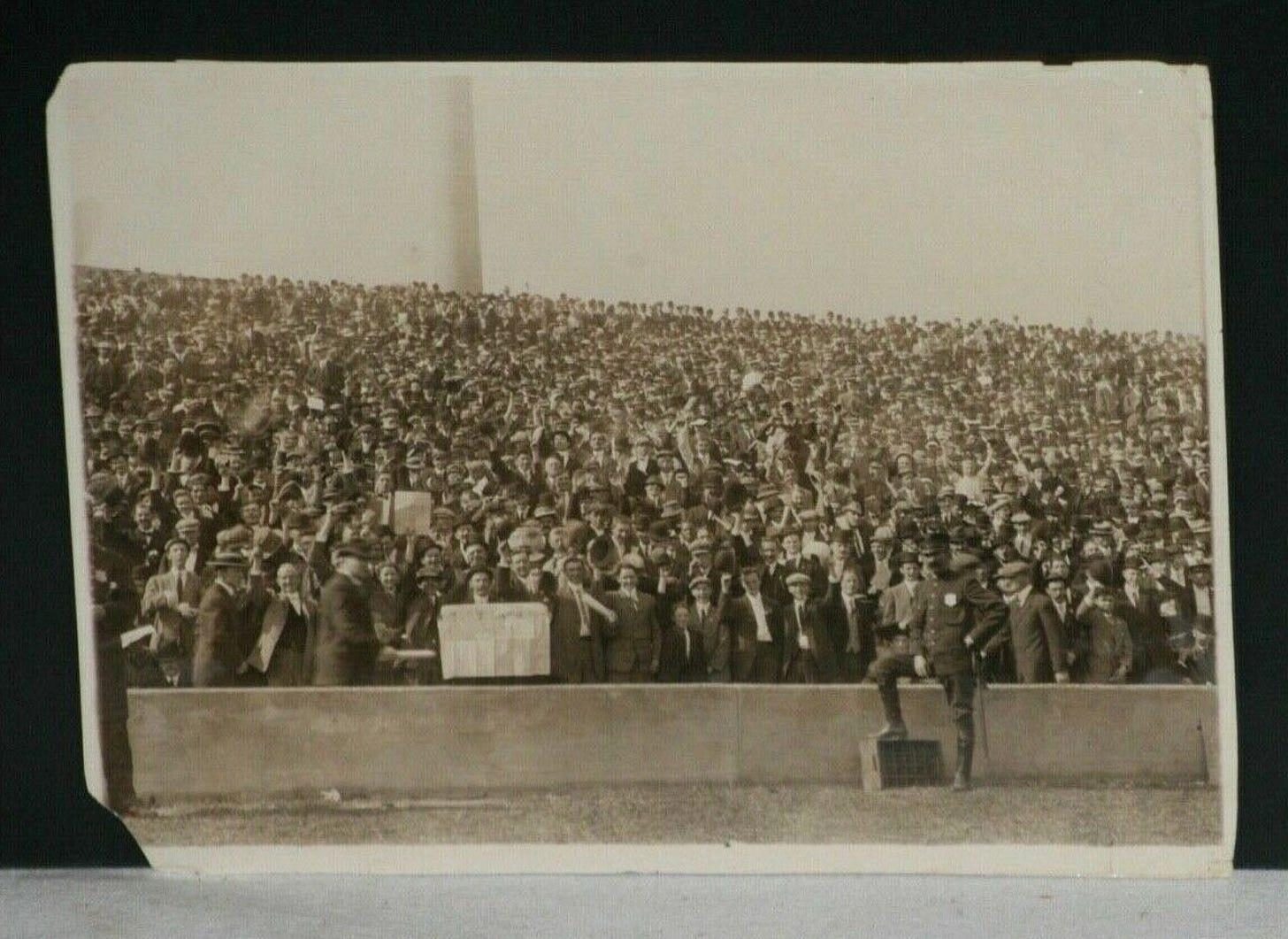
As baseball becomes America’s pastime, there are some great images — perhaps I can show them here if I can find them… of the crowds at these early World Series games. It's truly something profound. I have an image of Shibe Park at the 1910 World Series. Game One — an image of the fans.
05:15
This is a crowd that stretches back — really as far as the eye can see on these risers.
This is something that is a kind of infatuation that America has, right… so much of the media exports and productions of this time in history are around baseball. This is why 1909 to 1916 is so crucial because, what we're dealing with is the collision of media institution, which is the technology of photography, which is the technology of videography — the subtle and very, very, very quick moving, fast moving nationalization of media and information (textual and visual) through photojournalism circuits, news circuits, and eventually wire photography.
07:06
This is couched within the wider phenomeon of the globalization of information, perhaps no more aptly summed up and exhibited than in World War I. That's one of the first moments that you can really point to and say — this is the globalization of information through really a direct physical encounter, as well as the media information of photography that documented it historically and through the airwaves of news journalism, so to speak.
07:29
The industrialization of America is inseparable from the industrialization and globalization of the world at large. And this is a large part of what a dead ball itself is dealing with. This is not something that is occurring in a vacuum.
And this is early America. There's not a big population in the country at the time. I could pull up the specific numbers, but the population changes have been drastic since this moment in time. Absolutely drastic — not just on a domestic level, but on a global level — in large part due to technologies that sustain and prolong life and reproductive possibility. What we're dealing with with deadball and why it's so powerful is that its America's cultural institution in real time encountering two factors, industrialization and globalization.
08:23
And the economic tensions that occur through that — precisely because of the culture of baseball itself as an emergent heart center, or fixture in America’s mytho-poetic vision of itself as a national spirit, a spirit of the time and place. Hegel calls this ‘a spirit of the age’.
During this period of time, [Christy Mathewson is an anomaly, in the sense that he's the icon of the college boy or the American ideal of baseball] — but in reality, most of the players that emerged from this period, and even in the golden age — people like Lou Gehrig or the Dean brothers, Paul and Dizzy Dean — came from very, very poor families, poor immigrant families or rural American families. They grew up on corn farms or they grew up in an environment like Gehrig did, in New York City to an immigrant family that was just barely scraping by.
09:22
This is the tension that deadball deals with, and you can see this through the early World Series games. Owners like Charles Ebbets — these business savvy, titans of industry people. People who get in early on in the process of globalization and industrialization due to previous accumulation of resources, family inheritances, investing in the right innovation or method to mass produce in factory or in agricultural industrial production, so on and so forth.
These people become the owners of baseball, literally and figuratively speaking. They dictate its market and movement. And of course, one of the biggest parts, if not the biggest part of dead ball — which defines it in my opinion — is the Federal League.
Because all the Federal League was is that these Federal League owners, these are industrialists, very, very rich upper class people in America wanted in on the honeypot, so to speak, of baseball as it became America's pastime. These were in large part younger industrialists of new wealth at this moment.
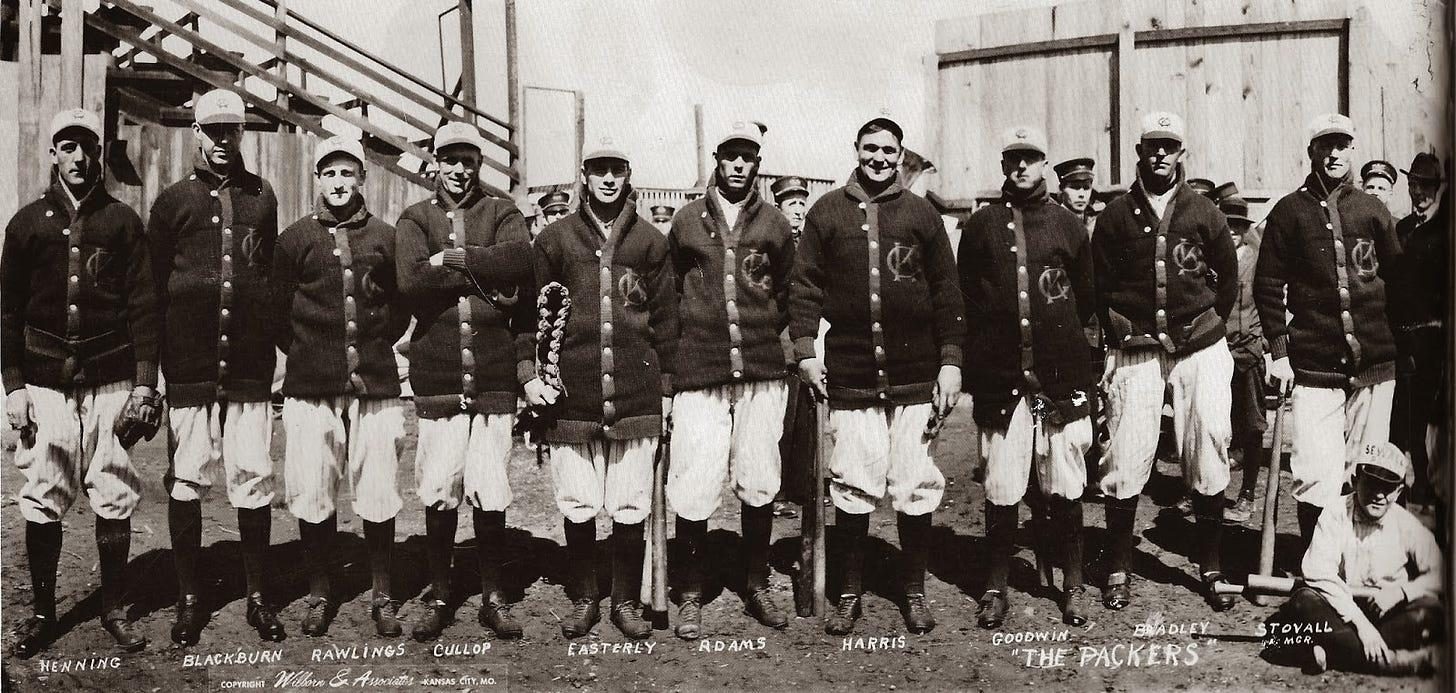
Their movement was spearheaded in large part by the vast wealth inequalities that were present in baseball at the time in regards to player salaries. Players like Walter Johnson, Joe Tinker, Frank Chance, George Stovall… Stovall being, I think, the most important because he was the first to move the institution of baseball to the Federal League; acted as its player-spokesperson and recruited a lot of the players that would come later. People like Mordecai Brown, Charles Bender as well — Eddie Plank.
Some of baseball’s biggest stars of all time.
This is a very important thing to understand in terms of baseball history because it defines everything that comes after. And it is the tension of everything before — in the sense that the people who defined the culture of baseball, for the most part in the modern age, were not, they were not upper class, even middle class individauls.
These were people who came from impoverished and often utterly destitute circumstances — whether that was industrial, factory or mining, farming, what have you.
Baseball was staged in these larger city centers of the Midwest and Northeast, import-export centers like St. Louis… or they came from very, very rural America, again, very poor agrarian backgrounds — the pre-modern roots of America.
12:17
What has been constellating for me is that baseball is really a labor history.
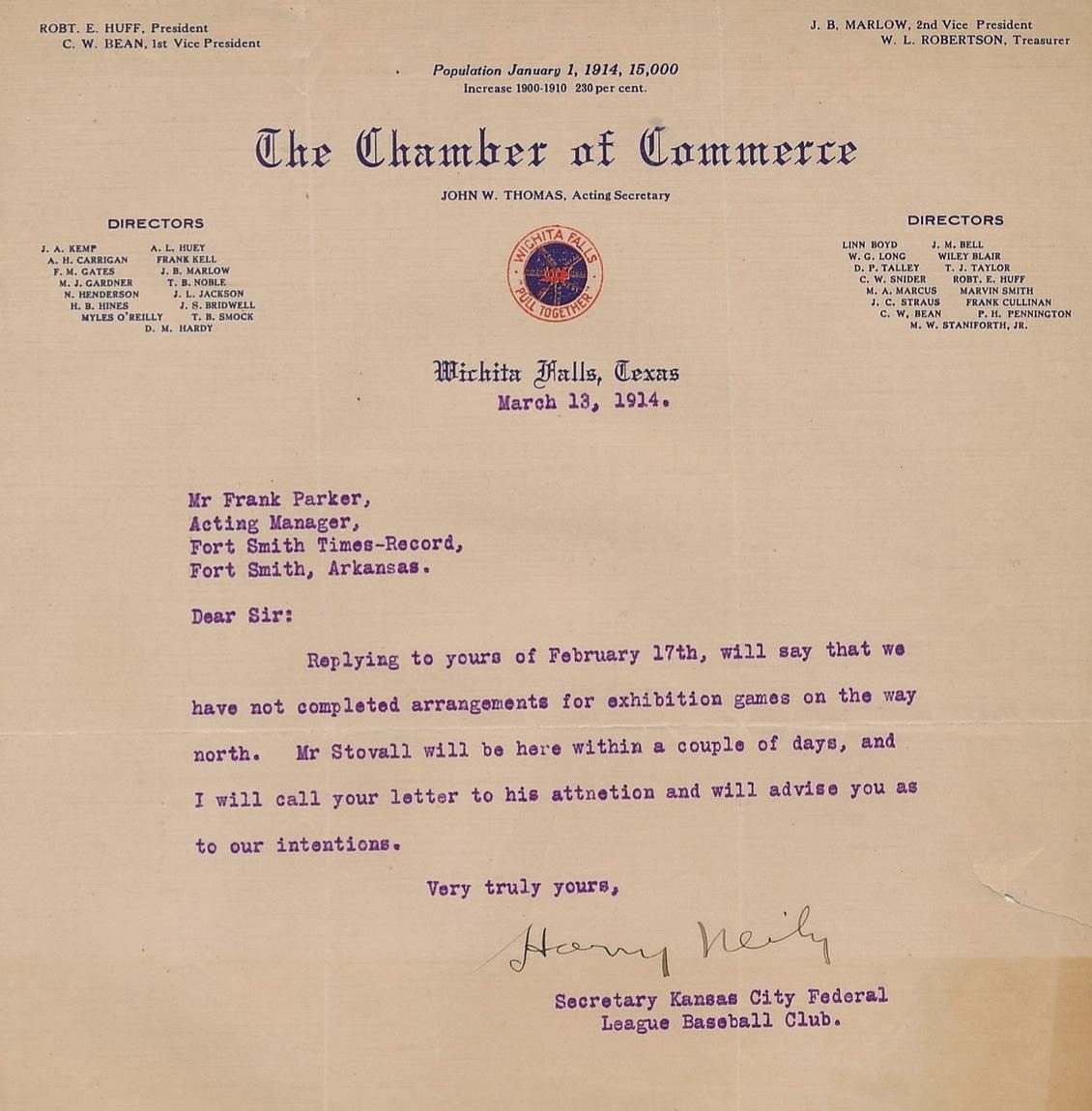
Here is a letter. There's no need to go over it in too much detail… describing George Stovall reporting for the first time to the Kansas City Packers, which is the Federal League team that he became the player manager of in 1914. It's spring of 1914 where he's reporting for the first time. This is what is hidden, not discussed as much.
There's a really great cover of Baseball Magazine, April 1915 with Walter Johnson…
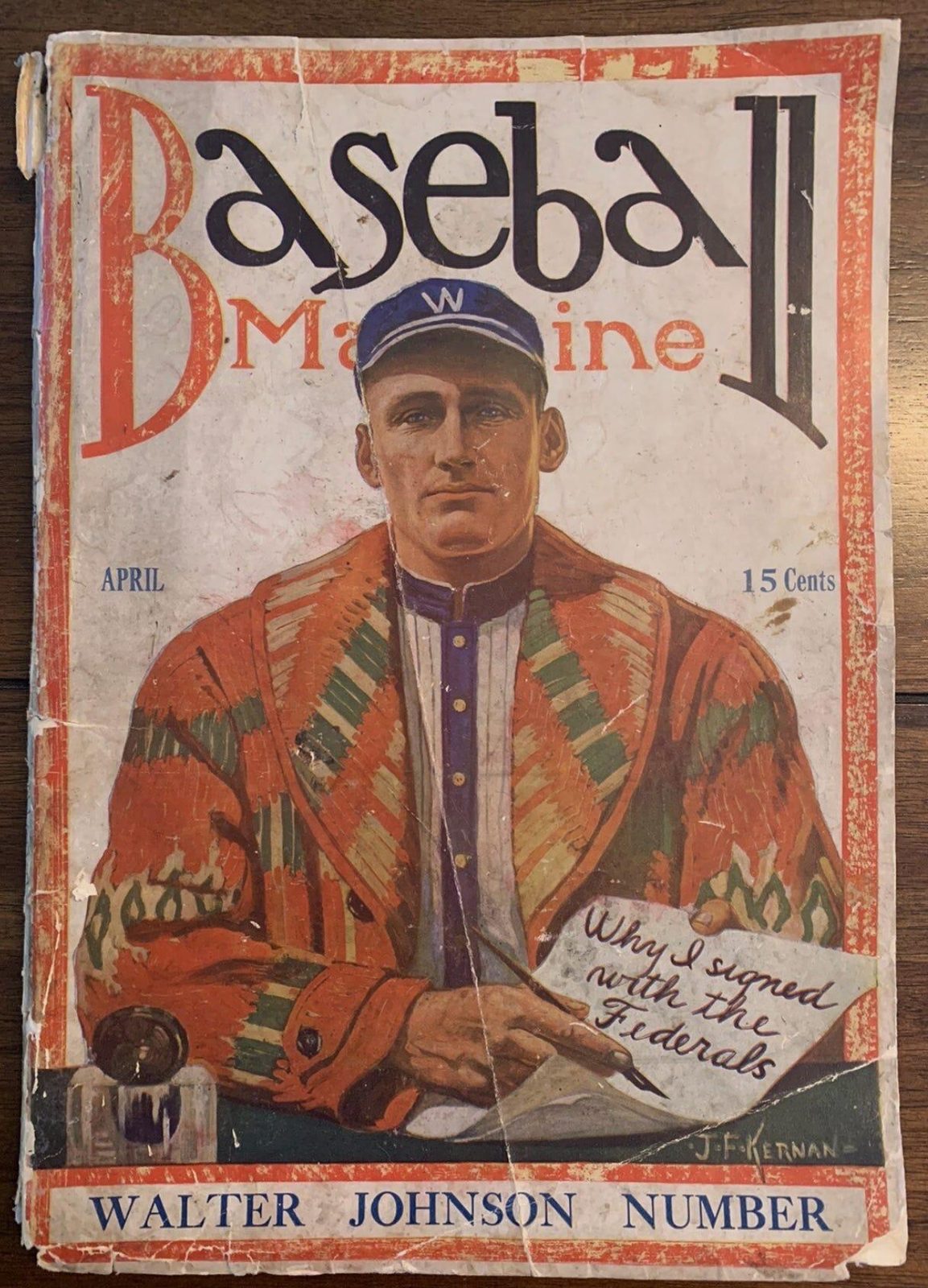
Johnson actually signed to the Federal League for a huge contract at the time. 3 years, 17.5k yearly, with a 6k signing bonus. This was a lot. What baseball would do is that they would buy these players back as soon as they signed, convince them to return with huge raises. And this, of course, leads up to the trust lawsuits of the early 20s that directly coincide with the Black Sox scandal of 1919.
And the individual who wrote that Stovall letter, Harry Neily is his name — actually played a very institutional role with Ben Johnson researching that 1919 scandal, as one of the most prominent sportswriters in the Midwest in this period.
Again, the thing that combines these two markers at the end of the dead ball era: the Black Sox scandal, as well as the Federal League — is and are economic conditions, right? There's simply no reason to throw a game if you can make enough money or more than enough money to sustain yourself playing baseball. And this was the primary issue of the time.
There's plenty of examples of this. Tris Speaker and Ty Cobb gambling, Heinie Zimmerman gambling. Shoeless Joe Jackson; Hal Chase is another good example.
This was really the primary moral and ethical theme of the time — not only in baseball, but in the emergent extreme class divisions that defined industrializing America. The workers, and the exorbitantly rich magnates and titans of industry.
14:23
Of course, there was this idea in the fans’ minds of baseball being this clean sport.
But you have to reckon with the reality that these are people who — the quotes from Ed Walsh and Stan Coveleski, I'll bring them up again. They said, in so many words — I experienced the mines. And I was just not going back to the mines.
A lot of the material that propelled these players to the level of greatness that they ended up achieving — both of those players, Hall of Fame legacy pitchers — is that they came from circumstances that are incredibly difficult. And to them, these circumstances were not going to work. They had to climb out of this bad, bad situation. And baseball was a way out. This is something that runs hand in hand with Negro League history. It runs hand in hand with players that you see like Satchel Paige that become the mythic thread or the essence of baseball in the 30s and 40s and 50s.
15:20
This common labor theme is something that you see emerge later on with the Curt Flood case and free agency. You see this emerge all the way up to the present day — including the massive Juan Soto contract signed coming into the 2025 season. This is not a coincidence. This is a historical timeline of 150+ years of labor evolution — not only of baseball, but in America; the disputes and legislation that define and delineate and change this essential tension. And what has changed in baseball, I think fundamentally, is this player leverage did not exist in dead ball. And it began in full force with the Federal League.
15:47
The Federal League was the first instance of players gaining true leverage by way of a third league — a leverage that culminated in profound legislative, infrastructural, and institutional attempts to stem the tide of its revolution. A third league that was willing to pay them far, far more and give them better living conditions. This is the real underpinning of baseball as a culture. Moments like the Players League lead up to this… but with the Federal League, you have a rupture in the labor consciousness of baseball in and from which there is a before and after.
The institution of baseball as a protected national trust — even in the face of the anti-trust fervors of just years prior. And so when you say the culture of baseball is different today, what we're talking about is an economic condition, it's a class condition underlying this history — a class condition combined with the integration of the league and the establishment of the organized Negro Leagues with Rube Foster in the 1920s. Most of the Negro Leagues teams, with the exception of a rare few which which has the absolute best players like the Grays, like the Monarchs — et cetera, Birmingham — most of those teams played in just destitute conditions. The owners would not pay the players. They would struggle to have places to play.
17:08
So this is the deeper layer and substratum of what really distinctly defines the dead ball era. You have the titans of industry in the upper class of baseball who had both controlling interests and front row seats to this revolutionary moment and era. And these players were — with risk of exaggerating perhaps, essentially gladiators in a rising modern American civilizational construct of extreme class division — where they were not paid anything; they would all work jobs in the offseason mining or in factory or as salespeople.
And even so, those jobs would often make more money for them than baseball would.
That's a cultural, historical, and political context. And so the shift of baseball over the past 120, 130 years — is essentially solely subscribed to that; this moment of evolutionary shift in labor consciousness as a culmination, or a ‘revolutionary war’
within the pillars of the epicenter or polis of baseball as an empire, or as empire.
18:33
When you look at the culture of baseball, through photography or through stories, you're looking at an era that existed and was defined and thus appeared to be, imagistically and aesthetically as it manifested — in large part due to this crux, right? This moment of change. The agrarian early America and the modern industrial America and this line that hits right at World War I.
It's a rise from 1909 with the institution of press photography and industrial production just really, really, really hitting hard in America; thus changing the whole landscape at a irreducible, core level. Literally, the landscape shifts. Factories spring up. Cities massively develop. Technologies are introduced at a rapid rate. The tens, the twenties; obviously the thirties — you go forward on; it just becomes more exponential. That kind of industrial reproduction defines the way that baseball goes.
You have in the twenties the purchase of Babe Ruth's contract; the offloading of so many Boston players, the Red Sox players who defined the success of the 1910s.
20:03
That has to do in large part with New York completing its claim, not staking its claim, but completing its claim as the industrial media super center and industrial factorial superpower — not only of America, but of the world. And so when it does that, there's a large amount of concentration of wealth; political, social, economic power in the city of New York, and thus so much of what baseball is and does moves through New York City.
The 20s, 30s, 40s, 50s — baseball is New York City. It's the Brooklyn Dodgers, it's the New York Giants and the New York Yankees. This is a battle for supremacy pretty much localized in the city of New York, with the exception of several very strong St.
Louis Cardinals teams; Detroit Tigers teams, et cetera. Brief moments and flashes of challengers externally. And it is no coincidence that St. Louis and Detroit were very, very important industrial and trading centers in America at that time — because this is the purchasing power that goes into how these teams are assembled. The owners of these teams are the titans of this era of industry.
They are the contributing factors of wealth and thus resource to purchase players;
build and grow these enterprises — supplemented by things like fan attendance — which is in large part due to the skill and ability of the players representing their locality and township. All of these different micro factors go into the purchasing success and purchasing power of these teams. So again, today with the New York teams, this still holds true in large part — as well as with Los Angeles and California.
These are the epicenters of American industry in terms of profit, power, and production — and thus the power, the organizational power flows through them essentially in baseball. This is really what this is about. Because you can see Cleveland, St. Louis, Boston, Detroit, Pittsburgh, especially Pittsburgh — the Pirates with Honus Wagner and the early pitching strength of Vic Willis and these kinds of players.
This shift happens right in that period, 1909 through 1916. It's a balance of power that's disrupted by the mass factorial industrialization of America that flows into, through, and finally culminates in New York City. What's lost is these Cleveland teams, Shoeless Joe Jackson, the Chicago teams, Frank Chance, Joe Tinker, Mordecai Brown; Ed Walsh on the White Sox. And then obviously the 1919 White Sox team.
The balance of power is consolidated in New York. Starkly, at the outset of the 20s.
And Babe Ruth’s contract marks this. And you lose Cleveland, you lose St. Louis, you lose Detroit, with brief moments and periods of re-emergence.
22:51
There's a reason that baseball is constellated on the eastern seaboard; in large part in the mid-Atlantic and the northeast — into the rural, agrarian, industrial city centers of Detroit, Cleveland, St. Louis at the time; furthermore, still to this day and age.
Because this is the way that America is politically structured in terms of its import, export, production, and industrial manufacturing — whether it's farms or whether it's coal mines or whether it's factories. This is the underpinning of the shift happening right at that period of time, 1909 to 1916. It’s very crucial.
There's so much to say about this — the reason I leave off at 1916 is because of World War I. This is the end of Christy Mathewson, the end of the icon who defines this period of time, I would say, in large part — in the American cultural consciousness. It is the end of this idea of American isolationism. America being its own field of political determination. WWI is globalization in shocking actuality.
You have this American kind of agrarian, very dysfunctional to say the least, vision of the country which is broken up; its nationalism is broken up by the globalizing conflict of World War I in unison with the factory fervor of mass production;
accordingly, mass reproduction of the technology of humanity. And you break at that point, you come back; you have these war shortened seasons, and you have the Black Sox scandal, and then you have Ray Chapman. And the game is forever changed. It's gone. Dead ball’s gone, and the culture of everything that comes with that. So you're looking at a shift — Ruth and his massive contract with Ruppert, inheritor of a brewing company — like the foundational shift of what America was being confronted with. A new paradigm that I would say we really are still in. It's just been technologized. Industrialization digitized. Made faster, more toward the speed of light. The new paradigm being mass industrialization and globalization — that just continues to build and transform.
25:03
And so it's just a strange moment where there are photographs, right? There are baseball cards. There's a proliferation of images that allow us to access this period of time by way of seeing again, or seeing through history. A vision, or a visionary window into history which just decades previously was impossible due to the lack of image technology beyond the hand made drawing or painting. But this period of time was neither here nor there. It was not the pre-modern kind of Victorian history of baseball, which was defined by lithographs and illustrations and maybe cabinet photos.
It's mustaches, it's these very Victorian baseball outfits. It's almost unrelatable. It is out of our time of modernity and into another age; another paradigm entirely. The late deadball era is not that. It's this very scrappy, gritty, proto-industrial emergence of modernity. A factory working, flashpoint technological modernity. And you can see it through baseball; the image artifacts that this era of baseball leaves behind in its wake. It's very powerful. I think this has been a pretty good summary. I hope you enjoyed.
And I'll see you on the next one.
2. Cy Young, Satchel Paige; The Unknown Darkness of Early Baseball History
May 24, 2025 · pp. 19–27
00:00
So we're back for another episode. This one's gonna be about the myths of Satchel Paige and Cy Young. This is, it's very abstract… almost a metaphysical thing to talk about here. Because what defines both of these figures in baseball history to me is absence. It's not presence.
Whether that's of statistics, of knowledge… Satchel Paige is defined by story. And a lot of the story around Satchel Paige that constitutes the myth and the figure of Satchel Paige is stories that he tells himself or stories that are told about him. In the constellating mythology of the Negro Leagues and of early baseball. He himself tells the story that resides next to history. His story and his myth become, irreducibly, history itself. He is the orator, or bard, of early baseball.
00:54
And Cy Young is complimentary to this, because his story is one that is balanced on the precipice of the pre-modern era of baseball and the modern era of baseball.
Young plays with Addie Joss at the end of his career, experiences the first modern World Series; throws the first pitch in the first World Series… but also lives in and embodies this time of pre-modern baseball where there was no image. He exists prior to the image field and his career opens up into the creation of it. He crosses and straddles two paradigms — the agrarian and the industrial. And yet, he is one the defining players of all time.
And so really what we're talking about with Cy Young and Satchel Paige is this open field of imagery — that they become almost mythological gods or scriptures within the greater canon of baseball history, precisely because so little is known or can be known about them; in unison with their utterly otherworldly feats of mastery, genius, and play. This information age that we're in is an age of technology and industry.
And when you look at the period of 1910 onward, 1909, 1908 onward, the modernization of baseball has to do with a transparency of baseball. And what I mean by transparency is an opening or a window or an aperture through which the game itself can be perceived and the narratives become more more clarified. Its an enlightening of history through media technology as a form of documentary remembrance of the culture. This is something similar that you see with social media, news media; moving images when it comes to television and things of that like.
02:48
You have an aperture that opens, and by aperture I mean lens — to perceive history, document history, and record it. An aperture that Satchel Paige and Cy Young, for two different reasons, balance on the precipice of. Satchel Paige because the Negro Leagues archives are so difficult to access. There's so little information compared even to early baseball history because it's so diffuse; undocumented — dependent on oral story telling and fragments pre- and post organization of the leagues themselves.
Black baseball itself was deeply, deeply grassroots.
So this gets me to the aspect of modernity that's so important — that baseball embodies on its very precipice. It is documentation.
A lot of what people who are collectors or archivists or historians all orbit around is the documentation of early baseball history that can be accessed, accumulated, stored, archived, et cetera, et cetera. Things that can be archived. Paperwork. These are the scraps. These are the mementos. These are the things that remain.
What constitutes our memory of history are the artifacts through which we can perceive it. Those artifacts themselves are a kind of aperture, right? They're lenses through which we can perceive the past in that they remain through the past, beyond just like an oral tradition. So a lot of what baseball history, especially early baseball history constitutes — are artifacts through which we can perceive. Whether that's a photo, whether that's a letter, whether that's a document.
And what makes Cy Young and Satchel Paige very, very, very important archetypal figureheads of and for this process is that we are trying to piece together an understanding of these essential baseball figures. Two of the best pitchers to ever live, bar none. Both of which had a monumental impact on baseball itself. We're trying to perceive them, understand them, know them — but it's precisely because of the lack of knowledge and information that they become mythological or legendary.
It’s not because we know. Rather it is because we simultaneously do and not know;
are simultaneously balanced on the razor’s edge between the darkness and abyss of history and void of knowledge; enlightenment as to the full nature of their forms, stories, humanity. This razor’s edge, so to speak, is the ledge of myth; the ledge of legend.
06:36
This is a lot of what I think is so intriguing about early baseball history — is that so little is known and can be known because there are limitations. There's limitations of documentation, primarily. Even through the lenses of photography, through baseball cards, through letters, through newspapers, magazines, et cetera — we are attempting to reconstitute an entire landscape and ecosystem of a reality, right, of the existence of this very, very firm environment that was in the process of rapid change… especially from 1900 to 1920, or for my purposes, 1909 to 1916. It was an ecosystem undergoing a rapid state of change that even if we were to capture it — let's say through a series of photographs or cards or documents, that gave us what we could suppose to be a strong amount of insight — we would still be missing, missing valuable critical information.
It was moving faster than the speed or aperture of light, film, text, media, that was available or possible to capture it. It evades; is evasive. It is a blur at best in image; an interpretation at best in text. And between the lines is the real. What we are left with is a history that is itself a mythology; a legend — and the figures that emerge from it are archetypal memories, distillations of the real. And that's what's so illuminating to me about this process of recall. Because this is a collective archetypal mythology that exists very firmly in history, but we are reconstituting it through memory — a memory constitution that is always partially imaginative, again, to the best of our ability. And it so often tilts, naturally, as in the real cultural hagiographical code of humanity, into the stories of creation and genesis around the tribal fire of being and becoming. And this is what Satchel Paige knew — with such masterful visionary ability.
Whether that's stories that have been told, whether that's remaining documentation and artifacts that can be pieced back together — they're fragments. They're almost like runoff of the essential historical event. And that process is always necessarily incomplete because that time itself can never be fully recovered. It is time lost to time; irreducibly shards, clippings; a charnel house of burned off fuel, detritus, memory. This is, to me, what characterizes the myth and the legend of Cy Young and Satchel Paige in particular.
08:32
If you take figures from the Golden Age, let's say Lou Gehrig. There's a lot of rapid, significant, extreme transformation that occurs in his childhood that isn't fully documented or known as well. This is transformation at the fulcrum of his character;
the ontological mechanism of his compass. How and the way his being is steered toward precipices of futurity. Gehrig, or Stan Musial or Mickey Mantle — these people… they grow up in an age and in a state of place (early New York City, or toward mid century America) where there is a public archive of information;
something approximating a nascent collective documentary institution; his history can be readily identified and constituted and at least understood in terms of an essential, basic narrative timeline of events and cruxes of formative development and change, at least outwardly.
ou can create something of an architecture of how Lou Gehrig came to be Lou Gehrig. Whereas with Satchel Paige, specifically because of where and how he grew up as well in the deep south as a black man, it was hard, I believe, to even know how old he was, right? His age was always in dispute. It was something of a running joke in the news media and in the culture, but the underpinnings of that old collective story are a much deeper well and river of human depth and truth.
It was hard to know about his childhood because you're talking about a period of time of American history where so much was in the dark and so much was in the process of changing — especially regarding Black history in America; how Black history was respected and disrespected. Archived and removed. A lot of things escaped narrativization and a lot of things escaped information technology. And obviously we live in a very different time now, although not so different in regards to how Black legacy and history is treated in America.
09:58
We are among this kind of hyper modern surveillance technology — everything's documented, archived, catalogued; the internet, personal technology devices. The archives have become a massive digitized realm of immanence of history. It is and becomes very difficult to evade capture, so to speak — where history is out of grasp and cannot be remained in this hyper-technologized modern archival state. Satchel Paige is coming from a very different period of time and place, right? As is Cy Young. Let’s say we're talking about the 30s in New York City — it is going to be very different than the 1910s or even 20s in the deep south of the United States. Just a century ago, there are deep archival wildernesses — not only in the consciousness, but in the architecture and landscape of the emerging modern America.
This is a period of time that history has not conquered and could not conquer in the sense that it could not be remembered or archived or catalogued. It is always already escaped from view. And what little was archived and catalogued, I think, is highly disputed or disputable, especially in regards to the Negro Leagues — which is really powerful… because this, to me, suggests that recovery work is near impossible, but it's something that's worth doing because we can piece together from this darkness of history a cohesive, comprehensive — something like an understanding or something resembling a map to a period of time which otherwise is totally lost to us.
It is the construction of a light in the midnight ruins of history.
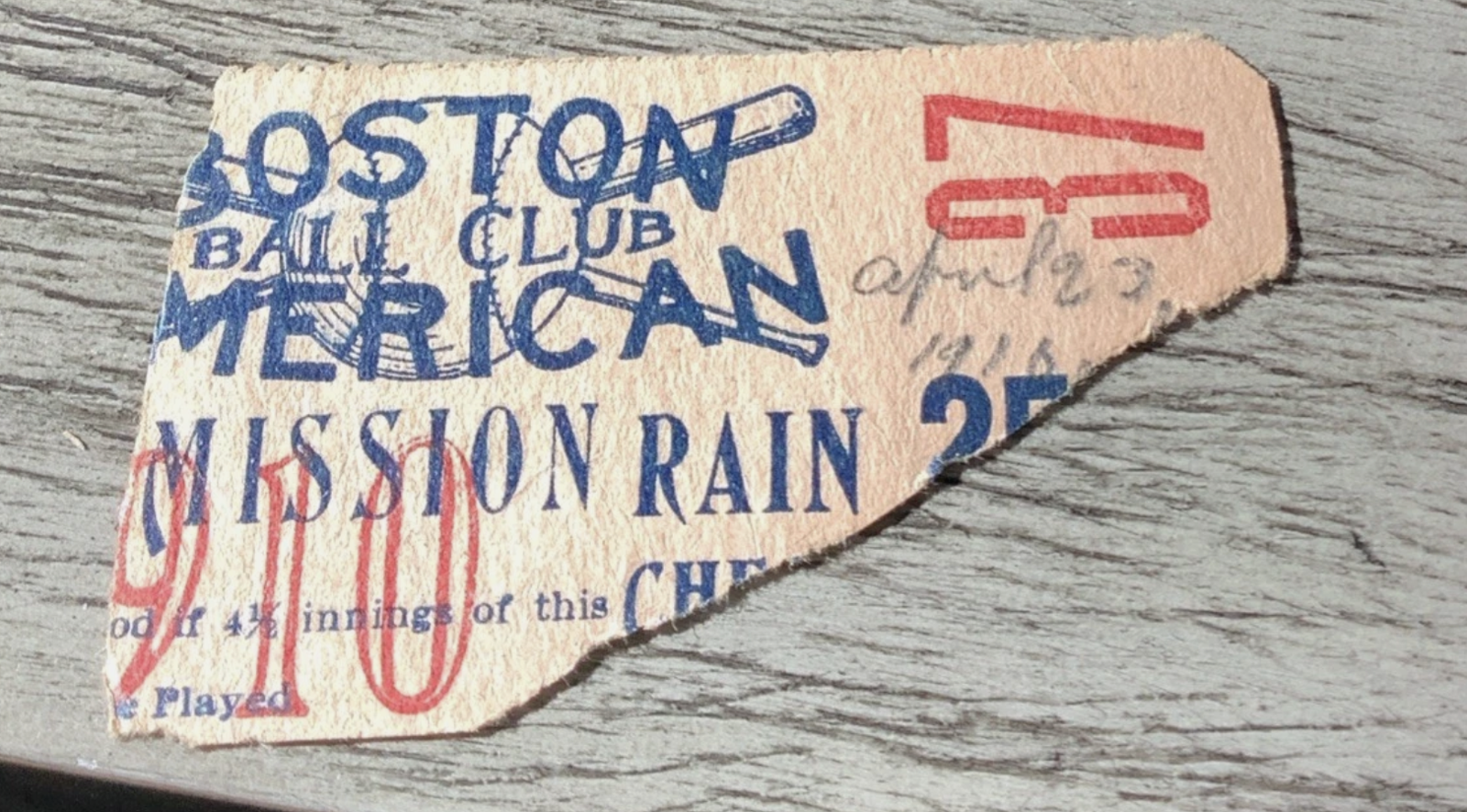
So I think for example, a 1910 Boston Red Sox Huntington Grounds ticket. It's a fragment that was pulled from a scrapbook. It's like a chip or a shard. I called it potsherd. And I was talking about this concept of ostraca, or ostracon — remnants or pottery shards that were used as writing surfaces. They were repurposed and some of those are some of the only historical memory we have of epochs and eras of early civilizations. Egypt in particular, it's one of the more powerful and illuminating remnants that we have of Egypt — to understand the contemporary everyday culture, at least. These fragments are where I'm talking about dead ball era history and this moment in time in American history as a sort of lost civilization.
And what we're doing with press photography or cards or documents is reconstituting something that is so little understood. I would say that even the best baseball historians of this time period are still very in the dark as to what happened, why, and the full picture at a human, spiritual level. The full scope or the full world of this unfolding, precisely because it happened at the crux of modernity — which is the crux between an agrarian, rhythmic natural unconsciousness; information being exchanged through Harper’s Magazine. This is a… it's an accelerating modernity — but the archives themselves, they exist as, really, a surface level narrative right now.
It's a sort of timeline that's been constituted and there's an accepted agreed upon timeline, behind which or under which there's this massive tectonic plate-shifting — culturally, socially, economically, politically in America. And the personal stories which are threaded as root systems underneath what we perceive on the surface to be deadball era America. There's a lot there. And to return to Cy Young and Satchel Paige, because I don't want to lose that essential thread… these two figures to me represent exactly what it means to recover this period of time.
Cy Young himself is the world figure of baseball. The Cy Young Award is the perfect example. He's ubiquitous and yet entirely unknown. This is a man who existed straddling the modern world. And Satchel Paige as well. He's born even as Cy Young’s career is ending. He as well symbolizes this darkness from which our cohesive understanding of baseball and American history emerges. I think there's this idea that we would like to have that we understand even 100 years ago, what was going on; what was happening and why. But I think the lack of information is just so in our faces, right?
Beyond the newspaper scraps, beyond the photos. Having a real constituted understanding of that ecosystem is a lot of what I think my work is about. And trying to understand the figures and forces at work there. Because there's a lot of beauty that's there to be illuminated. And in order to do so, we are working with fragments.
It's almost like the bones of history, or you're excavating a archaeological site in many ways. You're doing that through media, media documents, media objects, media instruments — to cultivate, and create a better and deeper understanding of exactly what was happening and why.
15:57
So that to me is the importance and the beauty and the mystery; the strangeness of the Dead Ball era. You see this shift right through Young and then Paige. Satchel Paige is almost like the beginnings of an illumination moving from an oral history into a religiously documented information technology era ecosystem of history. It’s two modalities being stretched thin by the emergence of the institutionalization of history juxtaposed by and with the oral legends and mythologies of the storytelling method and modality of history. What you see is there's this emergence from fragmentation into this idea that all of the information is readily accessible and constituted.
There's these archives, whether it's Baseball Reference or whether you want to talk about biographies or documentaries or lots of primary sources rapidly accelerating over the past 100 years. Photos, newspapers, census bureaus. And you lose this element of the recovery of history, or this idea of the importance of the recovery of history; even the mystique of the archeology that comes with the recovery of history which is essential to the oral method of historical transmission — because the transparency is so one-to-one, especially with video technology.
It’s a method or mode of terraforming the human experience by way of technologies of documentation. Paige’s mythology illuminates this through profound contrast.
You get this increased hypermodern transparency of information, materials, documents. So, in turn, you have this belief that you understand, or at least you have this belief that you understand the constituted history that's being presented to you in media form. There’s something profoundly hubristic about this. Because history loses this razor’s edge of oral transmission as the myth, the legend; the storytelling mode of historicity and historical transmission which necessarily includes the human — even at the sacrifice of the statistic, or precision of documentation. I think Satchel Paige is one of the last real remnants of that archaeological myth of human history.
17:35
You don't have it — the historical truth — and I think the idea is realistically you never will.
17:43
But you will have a tapestry or a mosaic or a… it's like stained glass windows. Where there's these different fragments of shattered glass through which you can perceive the looking back through the light of history. Walter Benjamin has a metaphor called the angel of history. The angel of history is looking back, even as it is moving through the ruins, which are history being constituted in a past tense, ruins of civilization. There's an archaeological dig there, there's a resurrection process of bringing light to a very complex, compound, and multiplicitous historical ground.
There's such a rich ground of the dead ball era, it's almost like a rich soil that's the bedrock or the fertile essence through which the entire… — or you could say fertile crescent — of the entirety of baseball history as it springs up. And so I really look at that as a foundation of modernity. You can see a lot of America through it, as well as a lot of the changes that are happening in humanity at the time through that lens. So I think that sums up this episode. You're using this as an entryway into something deeper.
19:11
Good talking with you. I'll see you on the next one.
3. Photographic Memory and The Deadball Era
May 24, 2025 · pp. 28–37
00:01
So this is just going to be a fantastic episode. This is going to be about photographic memory and the dead ball era.
You have a cutoff period where photography ceases to be the dominant form of memory and myth making in American culture and global culture. Which is the advent and rapid proliferation of the moving image as documentary and creative method. Some people would say that's the onset of television, but I would actually say it's the onset of film and cinema. So it's a little earlier. We're looking more at the 20s and 30s. Photography as a medium and a technique and a technology has a very brief period of time as the dominant visual form… a 40 or 50 year window.
But when you look at the advent of photojournalism and really when photojournalism becomes incredibly mainstream — you're looking really at the exact dead ball window, which is fascinating.
01:38
It's just a really, really, really beautiful use case to talk about media and the concept of photographic memory. Because when you're looking at the wide sweep of history, there's very little image memory that exists in the so-called data banks of humanity.
You have paintings, you have lithographs, you have woodcuts… a la the Harper's Weekly woodcuts that I mentioned earlier — in the 1800s. The mass, widespread use of lithography in the 1800s for posters and prints to distribute images publicly; for art in the common person’s home. I wrote a lot about this in a essay on the T3s — being a combination between the idea of the cabinet card and mass-produced lithography by way of the handmade painting. Really fascinating, innovative, fine art objects.
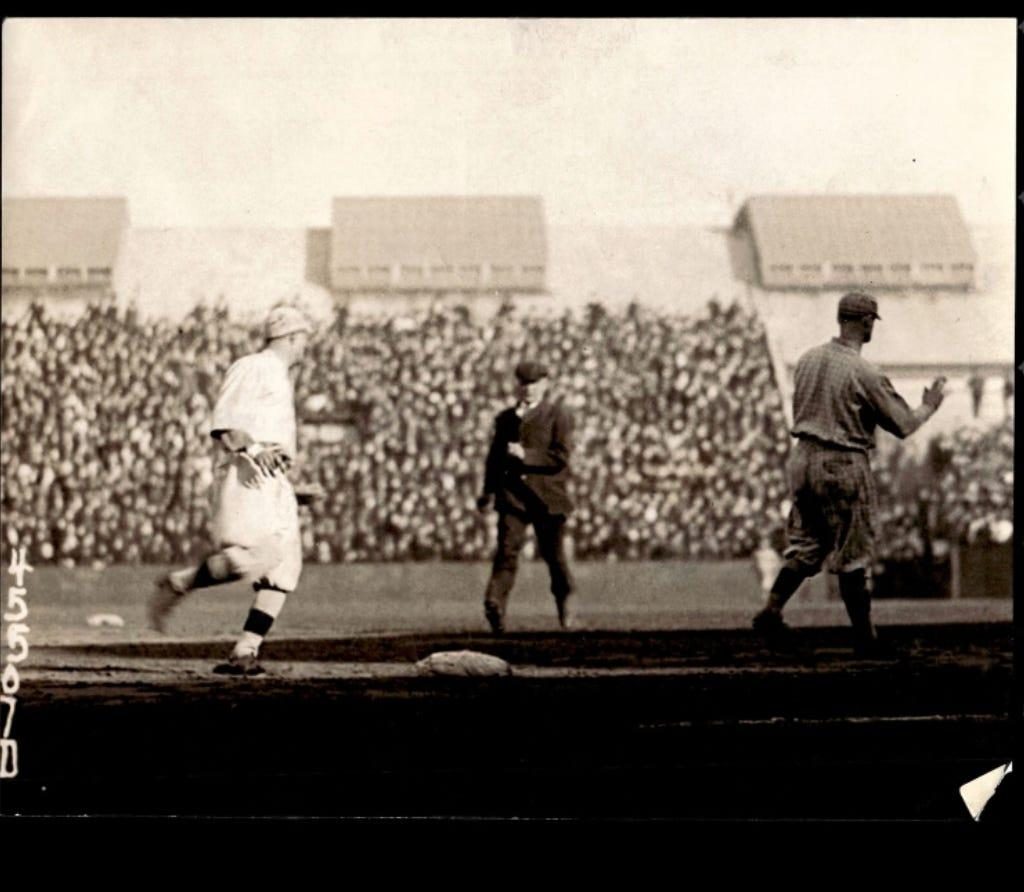
So this photographic image, to me, is a great example of what we are talking about here with photographic memory. This is from 1916. Dick Hoblitzell hits a triple that ends up becoming the first run of the 1916 World Series. This moment for me is a really great example of how photographic memory becomes constituted. This is a field level shot. Just a couple of feet away from the action of Hoblitzell touching third and rounding the bag and checking to see where the ball is. The third baseman is holding his hand up. He's just saying there's no play; the umpire is running towards the play at the bag.
You can see in the background — very very full stands. This is at the Boston Braves;
field, Game One of the World Series. They hosted it there for additional fan capacity.
03:50
This is what remains of this period — which is just so fascinating about the World War I era and early media technology. The acceleration of photography and photojournalism as media objects — in the way that images circulated during this period of time, directly coincides with the rapid acceleration of globalization of information and WWI plays a huge part in that.
All of this occurs within a very narrow span; photography is one of the primary methods of documentation. The photograph itself becomes a documentary remainder that in real time serves to transport reality across space and time. Some of the first photojournalism is from the Civil War, right? To bear this in mind: the combination between war and sport, they're so entangled and so entwined.
The call for baseball imagery is higher than ever for the 1909 World Series, during and after. The matchup between Cobb and Wagner. An epic matchup of two of the biggest stars the game has ever seen. And this is a stage that is set for the 1910s going forward and some of these matchups — the eight game 1912 World Series with the phenomenon of Joe Wood; the Miracle Braves of 1914. There's a lot of history there and a lot of myth — these epic frames of these gladiatorial battles occurring in early American coliseums. Shibe Park, the Polo Grounds. Architectural feats of early modernist grandeur.
I'm using this language very deliberately because this really is what we're talking about — the civilizational mythology and the theaters that defined early modern America. And how images capture not only the documentary reality of that phenomenon, but are themselves the frame for the aesthetic, spiritual, and political concerns of the entire nation’s imaginative, creative sense and state of consciousness at the time.
So when we look at an image like this, we are looking at a window. And that window is so specifically perspectivally oriented — that we're looking at a very limited window. It holds only so much space and mass. A limited window that we have and we're attempting to reconcile the image with the larger cultural and social context — the historical, political reality — even of the game itself, right, if you think of the stadium as a theater. We're trying to envision and gain perspective in an environment where and in which, otherwise, we are not gifted that.
For a lot of the modern broadcasts, you get these large zoom-outs at the stadium.
These are all recorded and logged to video. Documented and archived. Unbroken, moving images in high definition color videography. They can be watched digitally, purchased, et cetera.
What we're looking at when we look through the window of the photograph and through photographic memory is something that is lost to time with this rare exception of a perspective-based shot. A couple of cut based shots, that even then — many are lost to the dirge of history as physical documents and forms. To fire, water, the elements… time. And a level deeper than that — we are looking at a mode of being that is lost to time — in the reality of the cut photograph and perspectival rupture as mode of being, juxtaposed to the modern wide lens full color, sweeping, moving image shot in extreme high definition. In many ways, early photography is prior to the power of the eye; the modern, high technological moving image supersedes it. Detail, memory — these are the characteristics at stake and in state of change over just decades of years.
06:45
There's usually very few of these photographs that remain from this era; there are usually more from the World Series games, as they received more substantial and total press coverage. But if you're trying to reclaim the essence of baseball, right, you're looking at spring training, you're looking at day in and day out, you're looking at practices; you're trying to gain perspective of the characters of the players themselves. The spirit occurring in real time through all of the different perspectival visions of the game as it unfolds in real time.
07:13
There’s a deep kind of rootedness to the entire character of the sport at the time. It is a rootedness in the earth, in the soil and the dirt of an agrarian past rapidly being overtaken by a metallic, steel skyscraper of a futuristic industrial one. And baseball, as a game itself, is born from that agrarian mode. It’s a nature and in nature entirely — like the consciousness from which it sprung — a consciousness right on the precipice of a paradigm shift into technologization for over a century forward.
So photographs are a window towards that. There's the motion, the heads are turned, the umpire's face is somewhat veiled by shadow and there's this deep black shadow on the ground… a combination of the sun and the awning of the stadium itself.
07:43
You are called into relationship with history in such a way that you're trying to understand by filling in the blanks. And we talked about this in the last piece about Cy Young and Satchel Paige; about what is absent and what is present. And this aspect of dead ball era photography really does beg the question of how photographic memory allows us to see what we are able to see through the photograph.
What do we gain here that we lose in high definition videography; vice versa. The craftsmanship of the photo itself. Because beyond this, when we're looking at the Dead Ball era, there are letters, there are contracts, there's various different documents, maybe uniform purchases, photographs of game action, off-field moments.
But you have a limited window to try to surmise not only the character of the game itself at the time, but the character of the figures that were defining it and shaping it.
Sculpting it and moulding it in real time. And I think Hoblitzell is a great example — very, very rich dead ball era figure. Played a huge part in these mid-10s Red Sox teams and had a pretty significant career. He actually ended his career by becoming a dentist in WWI. He was going to dentist school while he was playing; worked as a dentist in the offseason. A large part of their infield with Jack Berry this year.
The photograph — it's a window, but it's a question of how you meet the window.
The window has been decided… long ago. The window meets you with the aperture it avails. It was snapped in light and put to photographic paper. Silver gelatin. A lot of these photographs can be very standardized — maybe a raised perspective looking down at third base and there's a play going on there. That's very field limited.
09:37
It's very field specific and field limited. So sometimes I'll look and I'll see what can I find. Something with the stands? Can I find something with signs? Or can I find something that shows me the city? Because this is such a context rich period of time.
And we're working with fragments. It's like stitching together fragments to create the whole, multi-dimensional picture — to capture the full richness of this time. And this is, again, this is something that is very time frame limited in human history. You have the period between the institution of the photograph, the beginning of mass photojournalism; then you have the start of cinema… wire photography is also meshed in with that — where images are put through wires, their quality and photographic consistency is altered.
And then you have television, right? This is a very small window where photography takes the place historically of painting, drawing, etching as ways to communicate reality or depict life. And photography comes obviously much closer to being a true window. It is a true technological leap on the greatest terms, realistically, since Caravaggio’s method or Michelangelo or da Vinci… far greater than anything else, even if it is limited to the photographer or the photojournalist's perspective.
This is a Brown Brothers photo. There's a fair bit of different photojournalistic agencies that were active at the time. Thompson, Bain, Van Oeyen. It becomes a huge industry, and obviously for good reason, because it's illuminating the structure of reality in a way that hitherto had not been possible. The demand is near insatiable — especially for the cultural phenomenon. The beloved sport of the national pastime.
11:29
And through the cultural export of baseball, you're gaining insight in real time to the formation of the deepest cultural heart of American history. The most important, most richly grounded national heritage in American history. You're witnessing it in real time in its formation. And its precise period of nascency to maturity — really in the exact span of 1900 to 1920. Deadball to Ruth. And you're watching it historically in this way that has never before been possible — through the lens of photography.
These photographs are translated into newspapers, they're translated into magazines; they're translated into pictorials. Inserts into the New York Times, what have you.
So for the first time in human history, you're getting insight. Fundamental reality availed through the aperture of the photographic lens. Unfiltered by interpretation but by where the photographer points the lens; the process of developing the photo, or coaxing the image from the negative onto paper. Again, World War I. Pictorials from the fall of 1919 that have the Black Sox right alongside World War I news.
You're having documentation of something that otherwise could not be seen unless it was experienced through first-person perspective. This photograph is a great example of on the field first-person perspective that would transmit this game from Boston to California. The subjective lens translated through vision completely.
12:55
And this is an artifact that, unlike film and television, this remains in hard copy form. This is a document. An immediate document, to be read by the technology of the human eye without mediation. From paper to eye. It's something thats time sealed and time limited, and it's a single object. It's not a series of frames.
So what the Deadball era is, is a tapestry woven with photography and illuminated by the historical documents which timeline or historically map the different events that occurred therein — such as Federal League documents transmissions; photographic agencies staging their preparations for the World Series, uniform orders, these kinds of things. This is what the Deadball era now literally is in this moment in time. This is what truly remains of it. The present has shattered at the moment of the photograph; what is left is the fragmentary image; the shard of light that is broken off from the moment’s illumination of the sun. The flashbulb replicates this metaphysical process.
We're looking for the full-bodied richness of the era, and none of these pieces can be discounted. And this is what's so important about the Deadball era — is they're all physical. This is all physical, paper-based documentation. Fragments of a scroll of time, so to speak. Obviously you could include bats or gloves, what have you, and that's a popular choice for the Smithsonian or the Baseball Hall of Fame.
14:20
I would say that it's a really important and interesting project for me to conduct because this is very open terrain; it's interesting how it's open terrain because this has already come to pass. The future from the past is effectively infinite in the capacity to recover memory. Infinitely complex and vast and powerful. This is something that's happened, but it has never been recovered or fully recollected in such a way. We would like to say we know the dead ball era, but… every so often; I would say pretty regularly, I see a photograph such as the Addie Joss Day photograph with all of the players seated and looking into the camera, as well as the one, there's a panorama of the players lined up.
You get an illumination into the real time-based historical fabric of the era, which goes far beyond anecdotes, statistics, names; moratoriums of lists…

15:17
as well as in documents and letters. It's easy to say that you these things — convenient, even — but they are revealed to you through the literal, artifactual presence of the historical documents. Which itself are the tapestry of illumination, which is the era itself. The relics now in ruin, looking back into history — they are the era itself. In that what remains is what is. History fragments past into present.
The wholeness of the era has been transformed; transfigured into dust, particles, atoms, and photographs. Fragments of tickets. Oratory transmissions of memories down through generations. Old packs of cigarettes. And this is very particular to Dead Ball, right? Because it starts to expand. The forms of media become faster and more multifarious.
With video, you gain more. You gain more information, but I think sometimes in gaining more information, you actually lose something essential and profound. You lose the essence. It's easy to lose that thread. When you're working with pictures and still images from this early technological era, you can start to piece together and understand exactly how things were formed, what caused their formation, and how those progressions interwove and functioned in the real time.
There’s a meditative stillness. There’s an opening in the breakage of time. In presence and absence. In what is lost; what is gained through the imagination of what is lost. The space between parts, particles, papers. This is more a deep model of historical excavation, which is a very rich and open terrain. This photograph of Hoblitzell is a great example of photographic memory and how it functions, especially because it's so multifaceted. It's not just the game action, it's the stands, it's the stadium.
16:41
You're gifted a window into multiple different dimensions of what's unfolding and how. In this way, it shows the political culture of the game of baseball as environments, landscapes, gatherings; mutuality of events and unfolding of spectacles which influence the public, collective consciousness. I showed you that Shibe Park crowd photo in one of the earlier pieces, and that's a great example. But you're ultimately looking at something that's so compound and complex that it is pretty difficult if not impossible to know it all in a very intimate and comprehensive way. This openness is the majesty and magic of history.
We can gesture towards the idea of dead ball, what it signified and what it did — but you have these kinds of surprise encounters with the image, which are very, very profound. The images emerge again from the soil of history and radiate what was commonly lost and forgotten. Hidden images become esoteric emergences of truth.
Stashed away in a lockbox, an attic, an old inheritance from a photographer of the early 1900s. They are sometimes if not always entirely unexpected in that they add another kind of sedimentary level or layer to the ground — the historical ground that you're dealing with — and ultimately enrich your perspective. Histories like these are not missing, but rather missing from view in the obscuration of time.
17:35
I've had that experience with photographs and with documents as well as with baseball cards. The E90-1s are a great example of that to me — the printing and production method and the strangeness of the designs. T3s and T206s are also very notable. You get a sense for the communal atmosphere that was present in these cities; the importance of baseball as a unifying aspect, and ultimately how industry functioned alongside the growth and development of baseball teams as a community-based, local, regional culture of collective experience.
For instance — in Pittsburgh with the 1910 Tip Top Bread card when the Pirates won the 1909 World Series — that's a local bread production company. Support your Pittsburgh team. That's who printed these cards. That's why it's region-specific and it's team-specific.
18:33
You also have that with the E90-2 baseball card for the Chicago teams. You're looking at a very different fabric of existence — which was primary communal, regional, industrial, and very site-specific. The images were the production and productive mode which shared and circulated the artifact of communality.
We'll get into this more, but this is an introduction to photographic memory and how it functions, why it's important; we're stitching together the entire tapestry of the dead ball era in real time.
19:32
Good talking with you. I'll catch you on the next one.
4. Cuba (1864-1908): The Origins of Modern Baseball, Dreaming the Nation into Being, and 'An Ode to Baseball'
Jun 06, 2025 · pp. 38–104
00:17
When we left off previously we were talking about American civilization and baseball as its chief mythology.
00:46
A question came to mind for me on a phone call with Dennis Goldstein in dialogue about the underpinnings of labor history in baseball. It was very telling because it's at the root of what I'm about to discuss here. It's the question of myth versus history.
And I have… I don't even know how to describe the past couple of days. I've been deep, deep, deep in this.
01:10
Almost like in meditation on what's really going on here. And the main figure was Rube Foster. We could go a little deeper in talking about America, but what I've discovered here is through Rube Foster. It’s going to shift our lens substantially — to Cuba.
01:38
I was feeling called to him; feeling that he was at the root of so much that was coming to bear in my study of the history of the game and modernity. I asked, what do I need to understand here? Because he's really calling me right now. There’s something profound here. He’s very present. I was doing my research; digging, looking, listening… and I found a 1908 photo — team photo that includes him, Pete Hill, and Home Run Johnson. Three of the greatest black baseball players in American history. Its a photo of the 1908 Habana Cuban team.
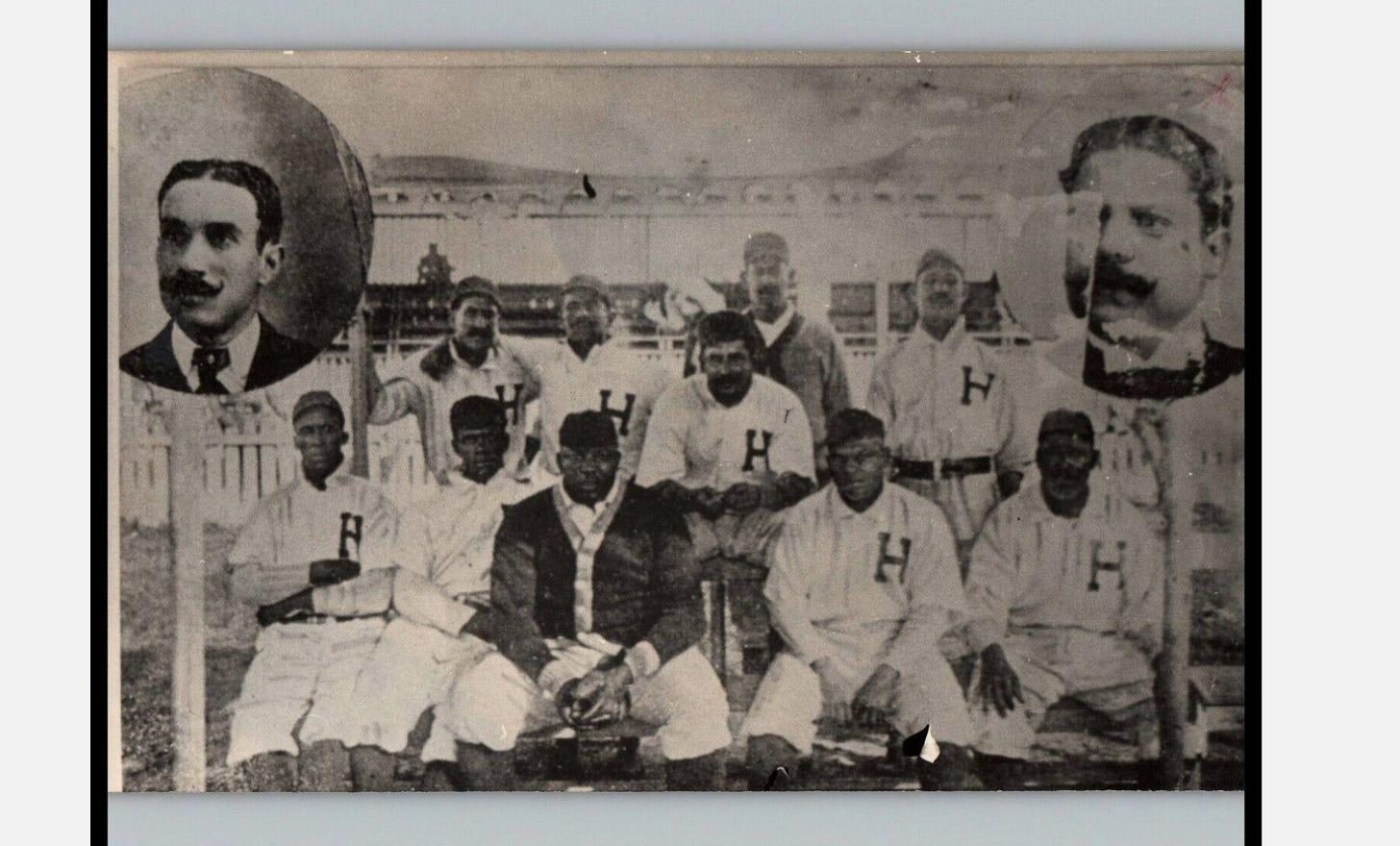
1908 Habana Club team composite photo from the Bohemia Magazine archives.
02:07
I looked at this photo and I thought about the timeline of the Negro Leagues. I thought about Rube Foster's career, particularly with the Leland team and the Chicago Giants — early on, before his founding of the Negro Leagues. Staying in this particular decade long time frame. I’m sitting here… and I’m thinking there's something that's not really, fully understood here yet. There's something that's not understood here yet that needs to be more understood.
And to me, I understood the Chicago Giants team. Understood Leland. I understood the framework and the fabric of the very specifically American fraught racial, ethnic boundaries and borders that existed in the United States of America that Foster was working with and working through. The social and cultural and political frame that led to the YMCA meeting in the 20s that became the Negro Leagues themselves.
This is something… I mean, this is really what got me into baseball history, I think, in a more fundamental way as a kid.
The stories and legacies of the Negro Leagues. The myths and the legends. I'm looking at this photo and I'm like, this is just so strange. It feels like something from history emerging actively, presently. Because this is something that if you read most of Rube Foster's biographies, it's not talked about much, if at all. Furthermore, its very rare to find photos of Pete Hill whatsoever.
And I'm just looking at this and I'm thinking about it… and I'm like, okay, I need to understand the Habana team now. That’s what this is. So I go deeper into the Habana team in Cuba and I start to understand, okay, this Habana team housed most every significant Negro leagues player at one point in time. The legacy is stunning.
And I find out that this Habana team in Cuba is one of the first teams to integrate at the turn of the 1900s with Black Cuban and Black American baseball players. And of course, Foster ends up there, because what I've come to understand is that this league was integrating the best talent available, period. Quite simply, this is modernity in its sum. A full opening to best outcomes by way of a radical new ontology, or inclusive approach — in this case, to baseball.
04:32
And so much of my work is around that, understanding modernity and understanding the root threads that construct modern baseball. The two intertwine deeply — as we’ll get into more here in progression. I'm looking at this history in relation to the archival image; I'm like, this is crazy. I mean, this is huge. It's just not talked about enough. It’s not in its rightful place in baseball history in terms of magnitude, power, or importance. Nowhere near. John Thorn, for example, writes about Cuban baseball history a fair bit — you see aspects of what I’m speaking to in some of his essays. You find it here and there, but not to the full extent that you need to to truly understand the magnitude and significance of what we are about to talk about here today.
05:00
I'm going deeper into this team and I'm understanding, more and more, the total terrain at play in Cuba at the time; how and why this became reality. Right around 1900, they have some of the best black baseball players ever to set foot on a baseball field playing alongside Cuban natives, alongside white people, alongside immigrants.
They're just fielding the best possible teams. You don’t have anything approaching a real context for this until after television becomes contemporary and popularly accessible in the U.S. This is the era, in terms of Cuban integration of baseball, where cars were still rare.
And so I'm going a little bit further back to piece this emergence all together; there’s independence wars and revolutionary wars and slave liberation movements that are occurring all on this island nation of Cuba in a 50, 60 year stretch of the development of this highly modern league — all the way up until the Big Bang of its integration in 1900, which directly coincides with the establishment of Cuba as a sovereign nation, freed from Spanish colonial governance. You have someone like Emilio Sabourin, who is a freedom fighter in the Cuban independence movement and the Habana second baseman and one of its founding members. A Cuban baseball Hall of Fame figure.
And I go even deeper and I find out that the (co-)founder of Cuban baseball, Nemesio Guillo Romaguera — Nemesio and his brother, Ernesto — A halftone image of Nemesio Guillo Romaguera from a Cuban magazine archive in the 1930s.
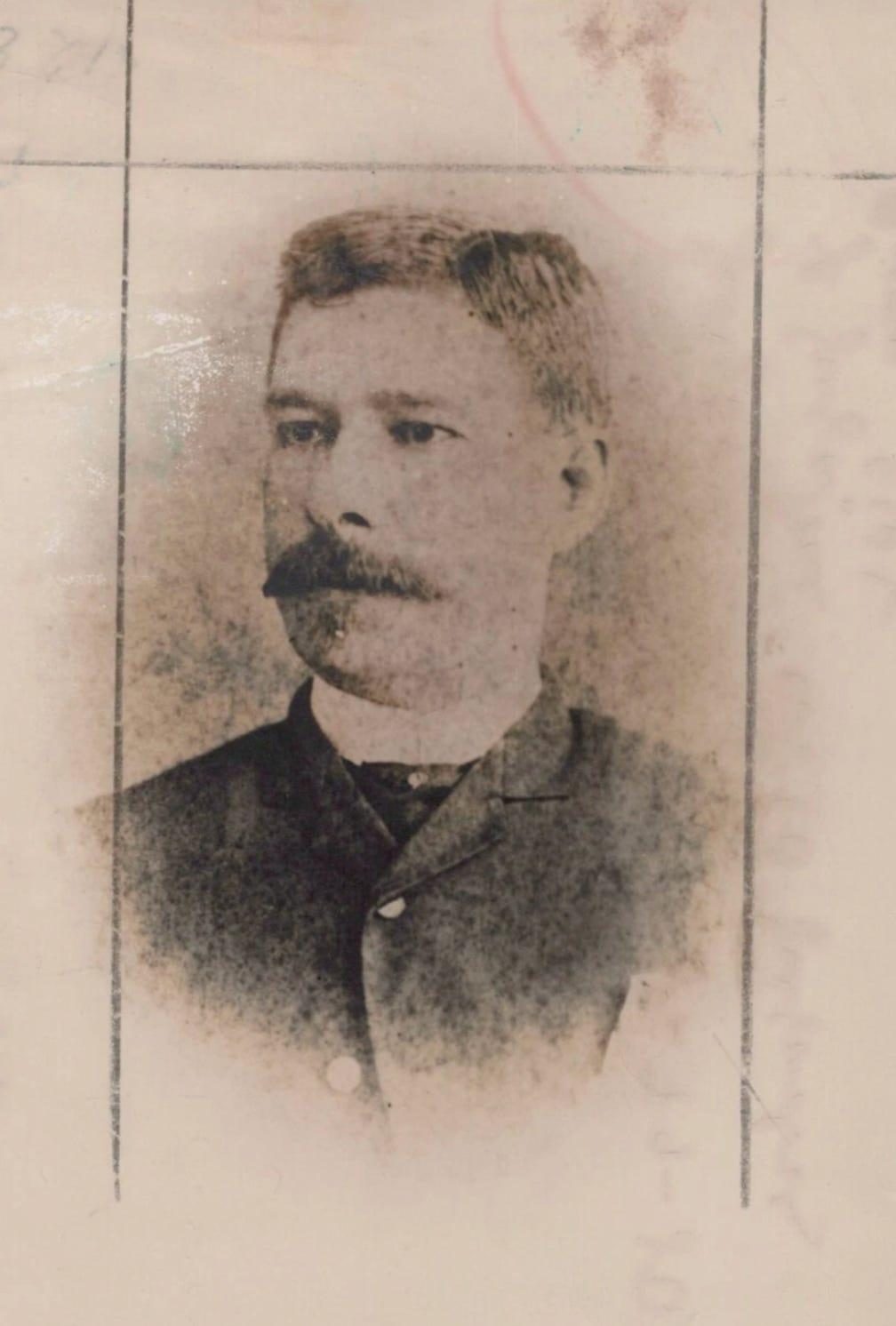
brought baseball to Cuba after attending Spring Hill College in Mobile, Alabama, private Roman Catholic school founded in 1830. They went there in 1858. Bear in mind, this is peak American Civil War era. They're coming back from school in America to Cuba in the midst of this state of mass conflict in both nations — and they're introducing the game of baseball to an emerging revolutionary Cuba; a Cuba on the cusp of national liberation and abolition of slavery... all at once.
06:59
Within the span of 10 years of Romaguera’s return, you have this highly professional baseball league, rapidly scaling, modernizing, and organizing to new heights — all in line with the rapid social and political changes occurring in Cuba proper at the time.
And I find these documents — they're stretched from the late 1880s to the early 1890s. The revolutionary movement is occurring at that very moment in Cuba.1895 is when things just really get set off.
07:27
Documents as late as the late Spring of 1894; they're signed by, apparently, one of the biggest figures in Cuban baseball — Enrique Melendez. Something to note here:
names like Melendez and Romaguera are lost to much of the contemporary mind, vision, and consciousness of baseball history. This is the line between history and myth: memory. Returning to and regarding the documents: they're certifying games with state police supervision; government consent and oversight. These documents are marked and legislated at the very breaking point of the existing colonial state, even as it is certifying these massive games between Habana and Matanzas for crowds of devoted Cuban baseball enthusiasts.
Habana and Matanzas are two of the three biggest teams in Cuban professional baseball at the time; they're playing these huge matches in the capital. And Melendez is saying, over and over again in these documents (some of which include different matchups and iterations of teams): we need police control, we need crowd control because these are going to be massive games. And one of the visiting teams is bringing their huge crowd of supporters, so on and so forth. What you really have in Cuba, realistically, is a high level of cultural sophistication and collective presence and devotion in regards to baseball that happens in the blink of an eye — from introduction to absorption into the very framework of the social system of Cuban culture at large.
Massive crowds and state sanctioned events for these teams of Hall of Fame caliber players. The Habana teams in the late 1800s, they're all Cuban baseball Hall of Fame players. Of course, you just never know how well they would have performed elsewhere, or in the American leagues at the time — but these are players who are playing just a decade later alongside the greatest Negro Leagues players of all time in advanced, integrated competition — as well as alongside American major league teams who would travel to play against them.
These same teams would face American professional teams in the late 1800s as well as the early 1900s. And we know a great many of the Black American players who came and joined these rosters upon integration to be bar none. Rube Foster taught Christy Mathewson the screwball; he’s being compared to Cy Young on a daily basis.
You have to look at this picture that's being painted here. Because I think for so long, baseball history and its origins — specifically the origins of modernity, or the turn of baseball from the agrarian history of its formation into the industrial image of might and superpower as a cultural steam-engine of myth and image have been proclaimed and situated specifically in the United States. And that narrative just doesn't work for me, because I've looked at it and the spark is just not there. The revolutionary spark is not there. And I look at Cuban baseball, I look at the origins of Cuban baseball through these intense revolutionary periods of colonialism unto sovereignty;
the upheaval that's the Cuban independence… I look deeply there and I see and hear and witness the clanging and the fervor that is the forging of modern baseball through the radical, revolutionary mode of integration and rapidly scaling devotional power — a power that utilizes all civic mechanisms to create and distill emergence.
10:30
You look at these players, like Sabourin. You're looking at the revolution of modern baseball through the revolutionary upheaval of an entire culture — from colony to sovereignty. You've got Rube Foster playing on an integrated team in 1908 in a highly, highly, highly competitive league. He’s playing integrated, organized baseball for teams which beat American pennant winners to such a degree that it disturbed and disrupted the American baseball establishment with significant alarm.
This is a league that draws almost every single great Negro Leagues player, period — right through time. And it all started with me through that 1908 image of the Habana team with Foster, Johnson, and Hill. That was the gateway, the window, the way of sight.
11:20
I can't overstate how important this is because in my view, baseball is created in the United States and then it's handed off — because America isn't ready to do the real work that's required for baseball to achieve its true, total modern emergence. So the real work to me is being done in Cuba. Again, modernity is the heights of possibility through radical inclusion. The opening up of processes to the highest capacities.
Opening all the doors and windows and boxes of consciousness. The harnessing of technologies, new methodologies, et cetera — to produce greater outcomes. This is the true engine of progress. It’s perspectival.
Baseball is founded in the United States; it's a very fraught history going forward.
There are some Black players that are allowed to play, then they're not, then they are.
And there's this whole debate about who's allowed to do what; who is allowed to be included and what it means for certain people to play or not to play. And there are all sorts of justifications for why or why not. It's not a mature enough society to handle the full scope of what baseball is capable of being. We don't see anything remotely close to that till mid- 20th century. And even then, it is clear to see how the fans and players treated Jackie Robinson in 1947 onward.
This is a sport that's handed off in the 1850’s to a college student — a Cuban native attending college in Alabama in Civil War era America. And he takes the sport back to Cuba and builds, there's no other way to put it, a highly sophisticated, rapidly developing parallel professional league that's arguably, if not actually just fundamentally greater both in the caliber of play and in the excellence that it draws in relation to the American movement, the United States movement.
The caliber of play is lesser under the Spanish colonial regime of segregated ball, but the moment Cuba is liberated and full integration of the league is established, the Cuban teams are regularly beating the highest caliber pro teams in open exhibitions.
In the meantime, you have a degree of ‘white’ Cuban players becoming full time American professionals — even as the best black ballplayers in America regularly travel to Cuba to engage in competition. What is at play; what creates for such a complex dynamic is America's refusal to integrate baseball until the 1940s.
13:17
You keep players like Rube Foster out of the game, it's very, very, very hard to make an argument that the caliber of play and the sophistication of the league itself is great. The Negro Leagues are founded in the 1920’s and there's still a huge amount of Negro League play in Cuba. It continues to grow.
But my focus is on this turn of modernity. It's this turn of origins…
I don't know how I can emphasize this enough. I think at this point, it's just going to be a matter of really showing people and changing these narratives — because it's so entrenched and it's so linear, this narrative that America founded baseball and all through the 1800’s, baseball was America's sport and America's sport only. I cannot deny the aesthetic and historical importance of Deadball to modern America.
14:56
The 1910’s, it's just very, very, very important. It's very interesting. It mirrors and mimics all of the fundamental changes that America is undergoing as a rapidly industrializing nation and emerging world power. But when we're talking about the 1850’s, 60’s, 70’s, 80’s, 90’s, even 1900 to 1910, it's very hard to argue with the revolutionary power and the historical importance of what is being created in Cuba.
This is because of the tenets of the very league itself — evidenced by its radical integration from the moment it can assert its full sovereignty. Cuba, this is a colonial nation that's grappling with liberation; the possibilities of liberation.
The approach is very different than America as a colonizing empire; a former subject of the English empire that never quite fully left England behind in its methods and social infrastructures. The approach is very different in how it is allowing and structuring play, specifically from racial and ethnic standards; the way that it's allowing certain people to play and barring others from playing.
16:19
There's a lot there for Cuba and in Cuban history. Insofar as I'm aware, the understanding of the founding of baseball itself in Cuba is still not completely understood, especially with Nemesio, and his brother, Ernesto.
Emilio Sabourin as a patriot and a revolutionary figure is very well renowned, as well as the first player from Cuba that went to the major leagues, Esteban Bellan. He ended up going to baseball's first professional league with the Troy Haymakers and the New York Mutuals 1871 to 1873.
In the winter of the latter year, 1873, Bellan returns to Cuba and starts the Club Habana baseball team with Sabourin and Nemesio Guillo. They played in the first organized baseball game ever played in Cuba. December 27, 1874, at Palmar de Junco Field. Club Havana beat Club Matanzas — 51 to 9. Crazy. For this reason, he is regarded in the US as the father of Cuban baseball.
17:48
Referencing John Thorn's article there. This is from ‘Cuba, the U.S., and Baseball: A Long If Interrupted Romance’. He names three different founders, Romaguera (Nemesio Guillo), Bellan, and Sabourin.
This article was really helpful. By Thorn. Because it's a history that is not commonly acknowledged; this is part of what I'm about to broach — that how memory works in different colonial spaces is different. With the linear mode of American history as a colonial empire itself, it has primary source artifacts for everything. It's like a colonial archive in the sense that the history is well-documented. It's been cemented in story and narrative in a very national sense; in a nationalistic way.
The myth has been outlined and reified. There’s something to be said for the idea that America knows the story it wants to tell about itself before it even begins telling it. A story of heroism and triumph. Whereas in the Cuban emergent sense [and I make this argument with Cuba as well as Venezuela], it’s like the history occurs and then there's this recursive remembering process. In the process of remembering, artifacts and documents are created from the remains of what was.
This is Cuba coming out from under colonization and putting together the formation of its emergent national identity, mythology, and collective self. It's a secondary mythologization through the process of remembering; primary source documents emerge through that process — from magazine and newspaper clippings; remains of books — which are then re-digested and metabolized into new sources such as photographs, cards; monuments to the past that has come to pass once more in remembering.
20:06
These events happen: baseball is founded in Cuba by someone who most, if not all,forget. This figure, Nemesio Guillo Romaguera, comes back from Alabama and founds Cuban baseball in the 1850s and early 1860s. He comes together with Sabourin and Bellan and forms the Habana team. The institution of organization.
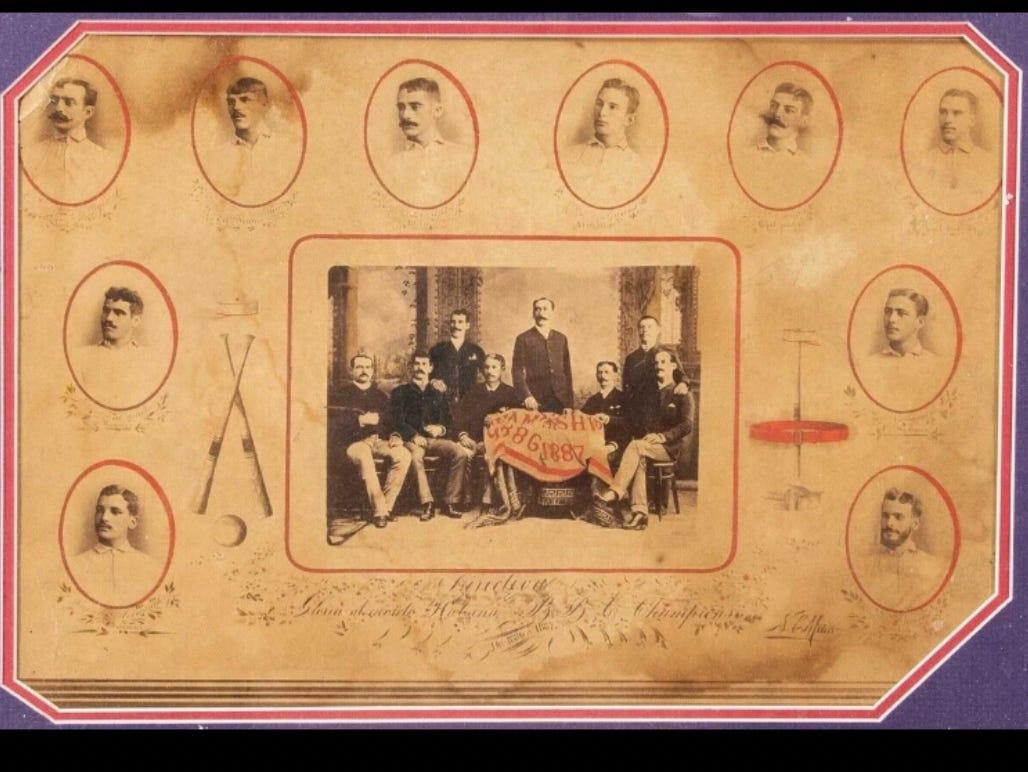
A composite photograph celebrating the Habana Club as league champions in 1886-1887, as noted on the flag in image center. Standing on far left is the freedom fighter and Hall of Fame second baseman Emilio Sabourin.
And this national baseball environment rose right around three emergent, constellated professional baseball teams in ritual civic competition to the point of which the Spanish colonial state began sanctifying and protecting these massive sporting events that would happen in the nation's capital — events which well are documented through text artifacts — government-certified, stamped, and signed documents of approval and assignment of resources to cover these matches. This is happening in a rapidly destabilizing and fragmenting colonial environment, which is increasingly fraught between the native Cubans and the colonial empire, the colonial government itself — culminating in this massive independence war at the end of the century.
We’ll go into the revolutionary periods. This is already well in motion in the mid-1800s, I believe. It's the Ten Years War… 1868 to 1878, and then the Cuban Revolution of 1895. These are massive, potent revolutionary periods and uprisings against Spanish colonial rule that are happening coincident with the founding of baseball. I mean, this is a very different atmosphere than what is comprehensible to the American spirit of the time.
21:54
I'm going to pull this in a bit of a comparison to the American Civil War. There is a massive independence movement within America, too, occurring side by side within a matter of years with the 10 Years War. And you have Romaguera attending Spring Hill College in Mobile, Alabama in the middle of the Confederacy in 1858, three years before the Civil War starts in the United States. And he comes back to Cuba in 1864; returning to his home country toward the end of the Civil War. He learns baseball; brings it back with him to Cuba in 1864, and then four years later the 10 Years War starts in 1868 — and lasts till 1878. So that process is in movement while Bellan goes to the United States; plays for Troy and New York in 1871 and 1873.
Again, this is happening [Bellan becoming the first Cuban player in American professional baseball] just after the Civil War.
And then he comes back and starts the Club Habana baseball team for the first organized baseball game ever played in Cuba in 1874 — right in the middle of the Ten Years War, which ends in 1878. He starts this team with Romaguera and Sabourin.
This is just, it's just mind boggling to think about that this is happening all at once, in such a condensed, clarified, immediate and rapid period of time as an interchange between two nations, both of which are undergoing deep and profound ruptures to their national psyches on multiple levels. And this exchange is occurring through the cultural medium of baseball — a passion and pastime that both countries share to perhaps the greatest possible degree. This is probably the most fertile revolutionary environment for a radical baseball league to emerge, a radically integrated organized professional baseball league with some of the best professional baseball players in the world. You look at these Habana teams, these are all Cuban Hall of Fame members. They're all well-documented; most of them are actually inducted in the first class of the Cuban Baseball Hall of Fame.
So then you have this period, this very fertile period where you are between revolutions and uprisings, which ultimately culminates in the Cuban Revolution of 1895. The text documents from this time show this increasingly solidified, organized professional baseball league that becomes better and better and better, more and more organized — particularly the documentation from Enrique Melendez in coalition with the colonial government.
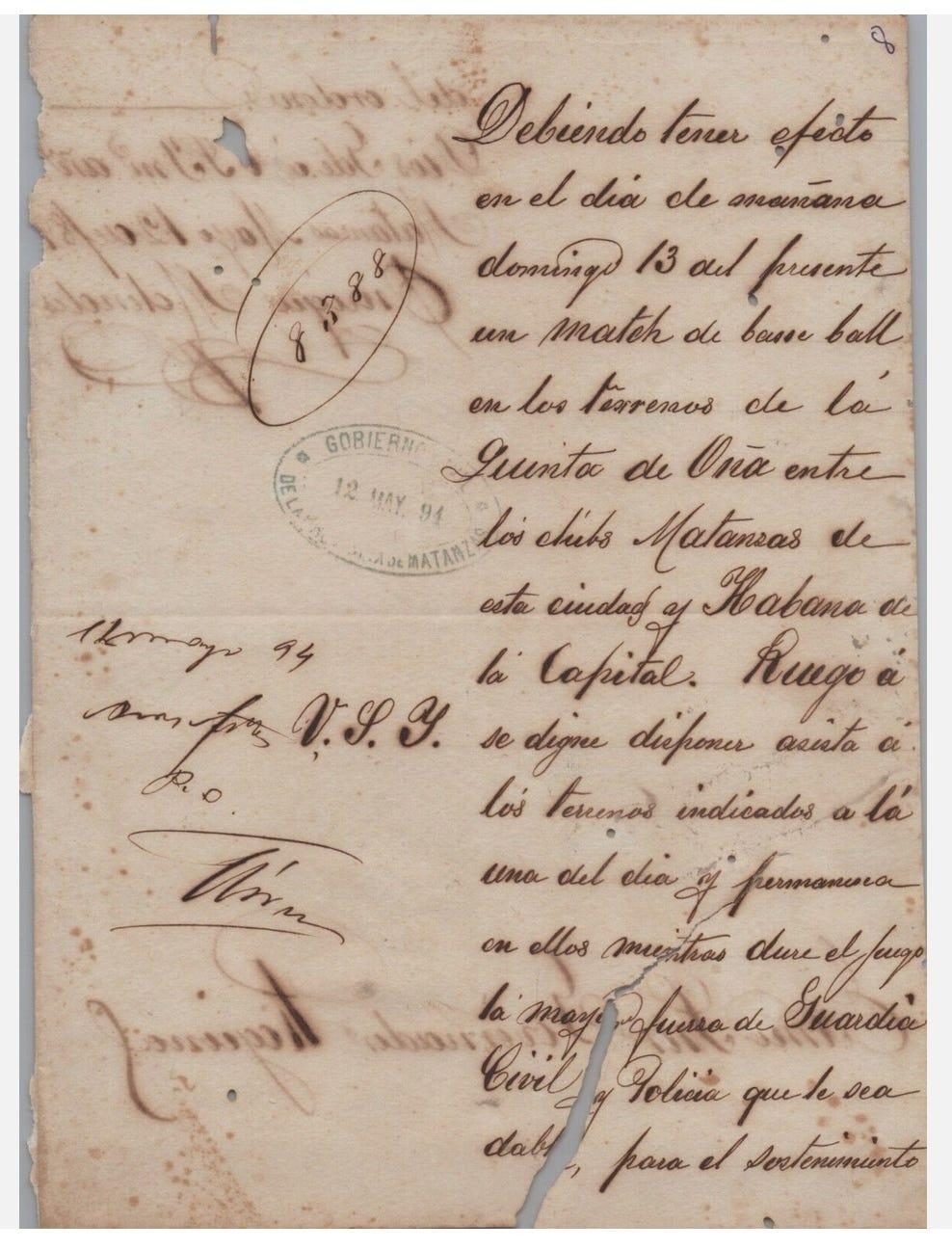
Page 1 of the May 1894 Melendez document regarding the spring Habana Matanzas game.
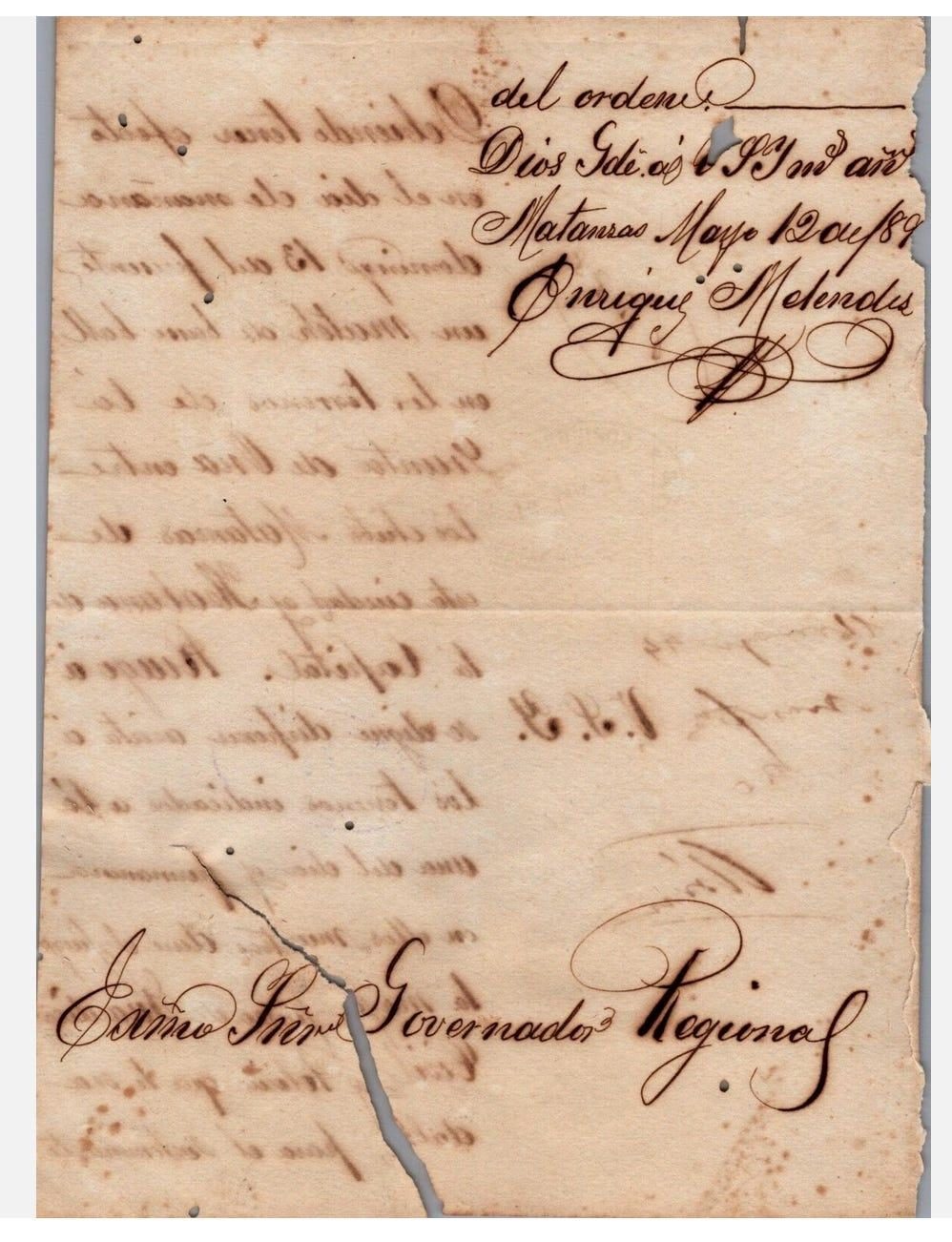
Page 2 with signature From what I've been able to garner, Melendez played an essential role in legitimizing professional baseball in Cuba at that executive, bureaucratic position and level in relationship to the state. I found this archive of legal documents that show him requesting police presence for these games over the span of several years — the late 1880s into the early 1890s in particular.
He’s notifying the state government that these games are occurring; creating relationship to ensure stability and that the league can conduct these matches. These documents — they show a fraught relationship between the native population and the colonial government.
Under the veil of the pleasantries, what is happening here is a negotiation between the colonial fear of the emergent Cuban native passion and joy of baseball — something that is not state sanctioned, yet must gradually become (over the span of the years of these documents) increasingly codified to the point of and for mutual assurance in an increasingly destabilized colonial state. This is a public rift in the code of values. Melendez must gradually introduce and normalize this increasingly popular ritualized sporting event, even as it is far out of the code of traditional Spanish normative social and cultural behavior; empirical conduct.
The last of these documents that I found is May of 1894, which of course is just several months before this spark plug of the Cuban Revolution occurs. This is a full-on war for independence at this point.
27:25
It's a constant, constant, constant, constant environment of revolution. The Ten Years War, 68 to 78, the Little War, 79 to 80, and then you have this period called the Rewarding Truce from 79 to 1888 after the end of the Ten Years War.
27:50
Social changes were occurring rapidly. Cuba maintained slavery and was under colonial control. The island received economic benefits from their connections to the Spanish because of their supply of sugar. White upper-class minority in Cuba had concerns that the island would fall in Haiti's footsteps after their revolution, which caused them to maintain support for Spanish rule. Abolition of slavery in October of 1886. Freedmen joined the ranks of farmers in the urban working class.
The economy can no longer sustain itself with the shifts and changes. Therefore, many wealthy Cubans lost their property and joined the urban middle class. Sugar mills dropped in number and efficiency increased.
28:37
This rapidly changing social and economic circumstance — there's a lot of interesting ways it almost exactly mirrors a lot of what's going on at the United States just a couple of decades prior, especially in terms of slavery and the end of slavery; the end of the Civil War and the attempted reconstruction of the country.
You have this final outbreak of utter war for national sovereignty, December 25, 1894 — There were three ships that were seized by American authorities in December.
The insurrection began outright in early 1895. This is just months after the last document from Melendez that shows this very mature Cuban National Baseball League with the expectation of state police presence to conduct the now well mutually understood major Cuban cultural event of sporting in the center of the polis.
This May ‘94 document where Melendez is basically just saying to the state government, Hey, you guys know the drill. This huge event is happening in the Capitol as it always does; we have all come to expect it and know it to arrive. It's Habana and Matanzas. You know, this is going to be really big. We're going to need the police there as usual, et cetera. Just months after that, you have the massive, massive war that uproots the colonial foothold of Spain — the Cuban independence war.
The Manifesto of Montechristi: — War was to be waged by blacks and whites alike.
Participation of all blacks was crucial for victory. Spaniards who did not object to the war effort should be spared. Private world property should not be damaged. And the revolution should bring new economic life to Cuba.
During the war, around 40 % of military officers were men of color. Black people were significant players in the war and had the ability to consolidate power in a way they never were able to before.
30:37
So bringing this back to Sabourin… he is this massive figure, not only in Cuban baseball, but in fighting in the Cuban War of Independence. Was arrested by Spain in 1896 on charges of stealing ammunition from the government. Serving 12 or 22 year sentence, Sabourin died in 1897 in prison in North Africa. Elected to Cuban Baseball Hall of Fame in 1941. This is one of one of the main three founders, the first Cuban player to go to play professional baseball in the US (Bellan), Sabourin, and the founder of baseball in Cuba himself, who we discussed, Nemesio Guillo Romaguera and his brother.
You have this massive war for independence, all out war for independence and then you have the Spanish-American War. And you have Sabourin, right in the epicenter of the biggest Cuban native cultural changes as one of the most important baseball figures on the biggest team in Cuba, the Habana Club; in the midst of this independence war, becomes a scion and a carrier of the clarion call for revolution.
Continuing here: the US then entered the war; it has also been argued that the main reason the US entered the war was its failed attempt to purchase Cuba from Spain.
United States and Spain signed the Protocol of Peace, in which Spain agreed to relinquish control over Cuba. Then in 1898: United States and Spain signed the Treaty of Paris, which demanded the relinquishment of all Spanish claim over Cuba.
This is the farewell salvo to the 19th century and Spanish rule; the remains and ruins of of which everything that emerges into the 20th in Cuba with Castro was sculpted from.
The 20th century in large part would be the attempt of Cuba to establish itself internally and in the world in light of what was; what is after Spain’s colonial regime;
construct an active, grounded vision of what is to come. This, too, was a deep cultural struggle for true collective sovereignty and statement of collective self. This is such a rich historical background for the fomentation of baseball as modernity.
Immediately after the liberation of Cuba, Habana opens its doors to United States Black players in full. Foster, Pete Hill, Home Run Johnson, and then you have more and more and more of the absolute best that America has to offer in Black baseball — coming to Cuba to play in the Cuban leagues.
34:05
I look at American baseball history in the latter part of the 1800s, and what I see is a flat, racially segregated landscape that is telling itself a story. Maybe I'm being superficial when I say this, but it's just an uninteresting story. It does not have the dynamism of a rapidly modernizing, integrating league — a league which is in radical political, social and economic circumstances; coming to grips with profound questions of national identity, circumstances, and values — such as that its value system is wide open and it is looking to create the best possible, most fertile circumstances for the creation of a truly great league. You can't argue to me that baseball in the United States was truly great, at least until it attempted to open its doors in 1947 in a real, broad, integrative sense.
Of course, you have players like Bender and Native Americans like Jack Meyers; you have players like Marsans — players that come from Cuba to play — ‘white’ Cubans.
But you basically have a racially, socially, and culturally immature nation that’s trying to foster the sport of baseball, which undeniably is the national pastime of America.
Do you see this complication? Baseball — as it has proven through modernity and inclusion — has proven to be far greater than any one nation, even the nation of its birth. It has proven to be a global phenomenon with a myth and legacy with roots and different powers and languages that stretch far beyond the originary, uterine terms of its birth.
If you understand baseball as a global movement — what Cuba does; the strange fraught circumstances of Cuba being between Spanish colonialism and independence and how closely its tied to the United States, you see the events — particularly in the mid-century of the 1800s — as intimate if not exact and vanguard to the evolution of baseball itself and its revolution into modernity.
You're looking at the most fertile, profound, revolutionary ecosystem that baseball could have possibly existed in from the mid 1800’s to at least the early 1900’s, especially with Foster taking that trip to Cuba with Home Run Johnson and Pete Hill in 1907 and 1908, because it creates the foundations for a truly radically integrated modern league — both in Cuba and, eventually and inevitably, in the American professional circuit. Perhaps, without that trip, you may not have the organized Negro Leagues; the power that is generated through a organized Black united front in the rapidly scaling, industrializing, modern American baseball terrain. This is an independent historical variable with a potential domino effect. And it starts in the revolutionary mind and creativity of a figure named Rube Foster coming back from a season in Cuba.
36:28
To return to the Cuban integrated league: you’re bringing in the best of the Black players within the United States and the best of any players. Whether they're Cuban natives, whether they're immigrants, whoever, they're coming to play in this league because the opportunity allows them to create an ecosystem and a cultural environment where the best players play, regardless of race or socio-economic background.
I look at Foster as an example of this, and there's no way to overestimate just how important he is to baseball history. I mean, this is the guy who taught Christy Mathewson his best pitch. He's compared to Cy Young. He in his own right is probably one of the best pitchers of all time beyond a shadow of a doubt. And he is a longtime manager of the best black baseball teams in history. And he creates probably the most important baseball league in history in the Negro Leagues.
37:10
A league maybe only overshadowed in deep, foundational, revolutionary historical importance by the Cuban league. And all you can do is just try to piece it together.
But I can only imagine he takes this trip and starts to play in Cuba and he sees the radical potentials of their integrated league and what they're doing there. I mean, this is the forefront of baseball at the time, the early 1900’s.
37:39
He goes there and he's sitting there and he's thinking to himself, he's saying, how can I build something like this in the United States? How can I build something like this to get the best of black baseball participating? How can I build an organized league like the one I'm witnessing in Cuba, which is harnessing the greatest possible potential of baseball?
And so in the 1920’s, he has that YMCA meeting and he forms the Negro Leagues. I have to imagine that that experience with Havana and with Pete Hill and Home Run Johnson played a significant role. And that for me is the crux. Him taking that trip opened up for me the understanding. Diving into the origins and foundations of Cuban baseball, specifically through this Havana team. Diving into that revealed to me a radically more powerful, different, expansive, revolutionary vision of baseball, a revolutionary environment for baseball. That far surpasses, to me, the environments that the United States was capable of in the mid to late 1800’s.
Again, I'm not discounting dead ball at all. The early 1900’s of American baseball are some of the most radical and formative decades of any era. But that's because of what's happening in America at the time. Rapid industrialization and America's first movement into the international stage of World War I.
This is going to be something that I'm going to continue to talk about — because to me, the development and integration of the Cuban league is at the center of modernity. This is at the center of the most radical truth of the origins of baseball.
And it's the direct, explicit connection between the Negro Leagues and the Cuban National Baseball Leagues.
39:55
And the through-line is this Habana team. The founding of it by the three main founding members of Cuban baseball. These radical changes that Cuban baseball undergoes during this early modern period of 1864-1908, it's this protracted, fertile, transformative revolutionary period in Cuban history, which also is the integrator and the generator for Cuban national baseball itself. This is a rapidly accelerating development that occurs over the span of just a few decades.
It goes from baseball is introduced to Cuba to two, three, four decades later, they have probably the most advanced, radically modern integrated league that exists in the world. And this is where Foster goes. This is where the greatest Negro league players go well into the first part of the 1900’s.
We're going to need to understand this moment and period in history more. Some of the best ways to understand this are going to be through the documentation and artifacts that exist. For Cuba, it's a radically different way that history is metabolized.
Again, as I was saying before, with American history, it's the history of a colonial empire — something that has all of these real-time artifacts and documents that are actively mythologizing its development — catalogued, processed, arranged and constructing a narrative of its myth, power, dominance, and divine right.
41:16
It's almost like it's telling its own story to itself as it's happening. It's very self-aware.
But in this self awareness, as we are exploring here, its selectively telling itself a dream-myth that excludes inconvenient truths. This is not a myth of history, but rather a myth of dreams with America at the center. This is how and why the Cuban revolutionary modern contribution to the fabric of baseball is forgotten or disestablished by all but the few.
But with Cuba, you have this fomenting revolutionary power. It's a movement that's almost chaos, or very chaotic, because of the radical independence movement that's occurring. There are deep forces of nature at work that are making and unmaking the very fabric of its civilization in a matter of years, months at a time. All of this is at the cusp of industrial, global modernity in the form of the coming first World War.
It's the environment in which this vision of baseball or this version of baseball is fomenting. And so in that environment, you have… not a lot survives. So much is changing, so much gets destroyed, very little gets documented.
This is similar to the early days of the Negro Leagues; prior to the founding of the Negro Leagues in the 1920’s, where you have black barnstorming, semi-pro teams.
Very little is documented that remains to the retrospective eye of history, time; the attempt to assemble stable, congruent, fluid cultural archives. We talked about this with Satchel Paige.
We talked about this with very early American Deadball baseball which was specifically segregated, right? It's still the same principle that's active. But this is something in Cuba that you have… the national memory is referring to itself backwards. It's remembering backwards; it has to recollect by using what remains;
reproducing what remains and creating a self-referential looking back in time mythic consciousness through retroactive documentation. The reproductions become the primary documents. The present day remembrances carved into paper and stone become the relics and artifacts.
This is something that I brought this up with the Retirados;
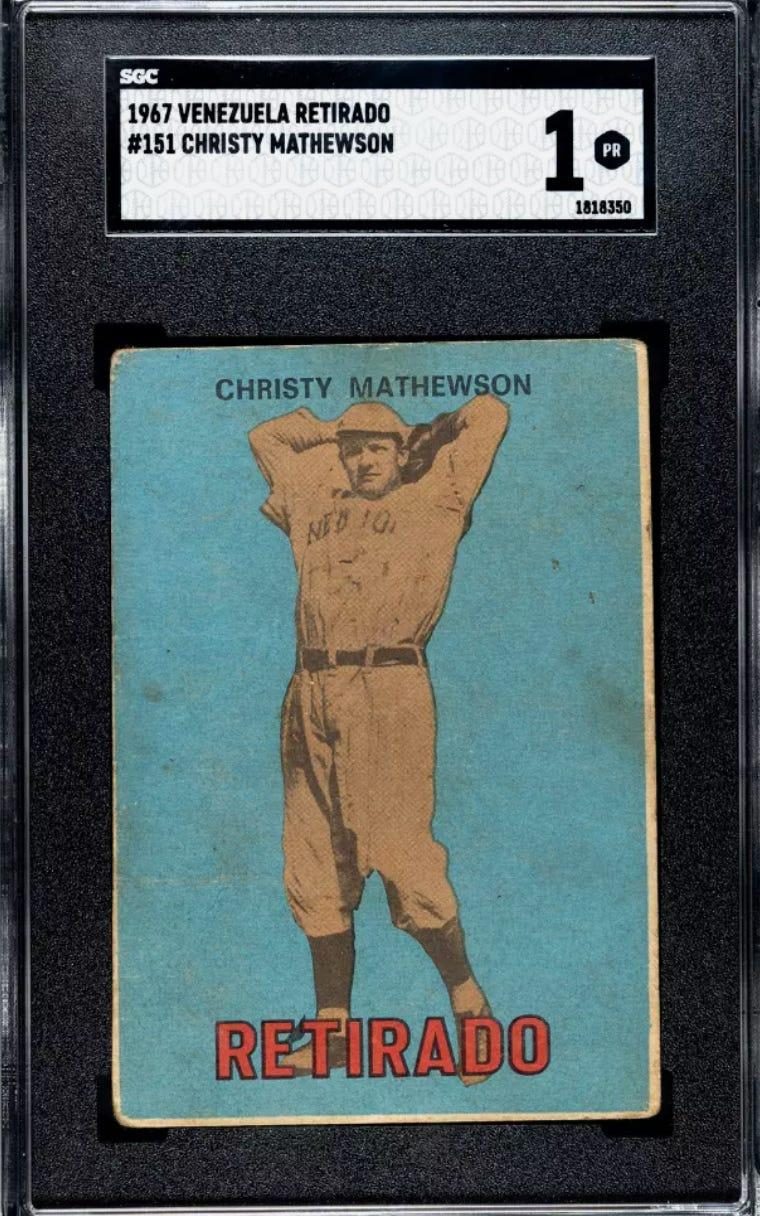
A Venezuelan baseball card depicting the Deadball era icon and American baseball legend, Christy Mathewson.
that I first started to understand with the Retirado baseball cards in Venezuela. And what we're talking about is a radical native consciousness that's wrestling with colonial roots as severances, fragmentations; identity crises as native cultures and traditions are rifted and remade through colonizations and independence movements; the introduction of radically ulterior modes of conceptualizing being (such as the Spanish religious and cultural modes of existence); having to grapple with having these modes transposed across and atop traditional cultural and civilizational fabrics which previously were the ground and foundation of cultural nativity. What happens through that process? What happens ever that?
It's a process — cultural identity — that’s happening in real time through chaos and emergence; destablization of regimes; the attempt to excavate a true national, collective, even personal self-identity through the rubble of control, power, and colony. This is a sovereignty story. These radical periods of economic, social, political instability are occurring in terms of the separation and individuation of a nation out from under colonization.
43:10
And in that radical fomentation, documents, artifacts, things are created, many are destroyed, lost, never recovered. This is a crisis of memory that survives through orality and what can be recovered. But through the ashes and remnants and remains of that, there rises the mythic consciousness of an emerging nation. This process of remembering is quite literally the post-war recovery of traumatic self. So when you have the Retirados or the Sport Grafico cards themselves, separate from Topps — where in 1970, Sport Grafico made its own set, that centered its own formation of mythological national consciousness.
This was a deeply Venezuelan release, away from the American baseball consciousness as a dominator of the field in the assertion of mythic possibilities in terms of its history, terminologies, and icons. It is a way of forging the personal national identity, perhaps in reference to the field of the existent, but not determined by it or dictated to from it.
As well as the Bohemia Magazine in Cuba, this is the main national mythological consciousness — they're reproducing half tone photographs and prints from the original negatives and composites of what remains of the mythic consciousness of baseball in the mid to late 1800s and into the integration era. They’re reproducing these images in the 1930s and 1940s for this national cultural publication. Bohemia Magazine touches baseball but expands far beyond it — its a cultural document doing significant work in constructing and reconstructing the mythic memory and understanding of Cuba by Cubans on Cuban terms. It ends up becoming deeply politically divisive; there is a war for control over its message, sway, and influence.
This is a part of the process of achieving sovereignty at a deeper level — just because Spain is removed from the place of colonial government, this does not mean that the memory and scars of the assertion of colony are easily removed or healed;
furthermore, what happens when the vacuum of political and social power and control is created therein, upon the vacation of colonial claim?
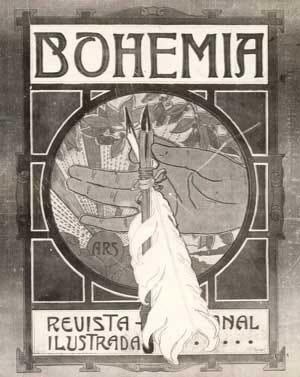
Cover of the first issue of Bohemia after returning to publication — 1910.
44:37
You see with Venezuela and Cuba the national mythic consciousness or the legend mingled with the history of baseball through the recollection of these artifacts and reproducing them through a time informed lens which is a chosen recollection in personal myth construction, whether it's a Venezuelan legends card or a Retirado card, which shows a retired great, or notable figure from both the Venezuelan and American baseball histories. They have cards in the 1970 Sport Grafico set called Immortals, A 1970 Sport Grafico produced card of Jose Perez Colmenarez, a Venezuelan legendary figure for his contributions to the 1941 Baseball Cup national victory over Cuba; a pioneer of the sport’s growth and development in Venezuela proper.
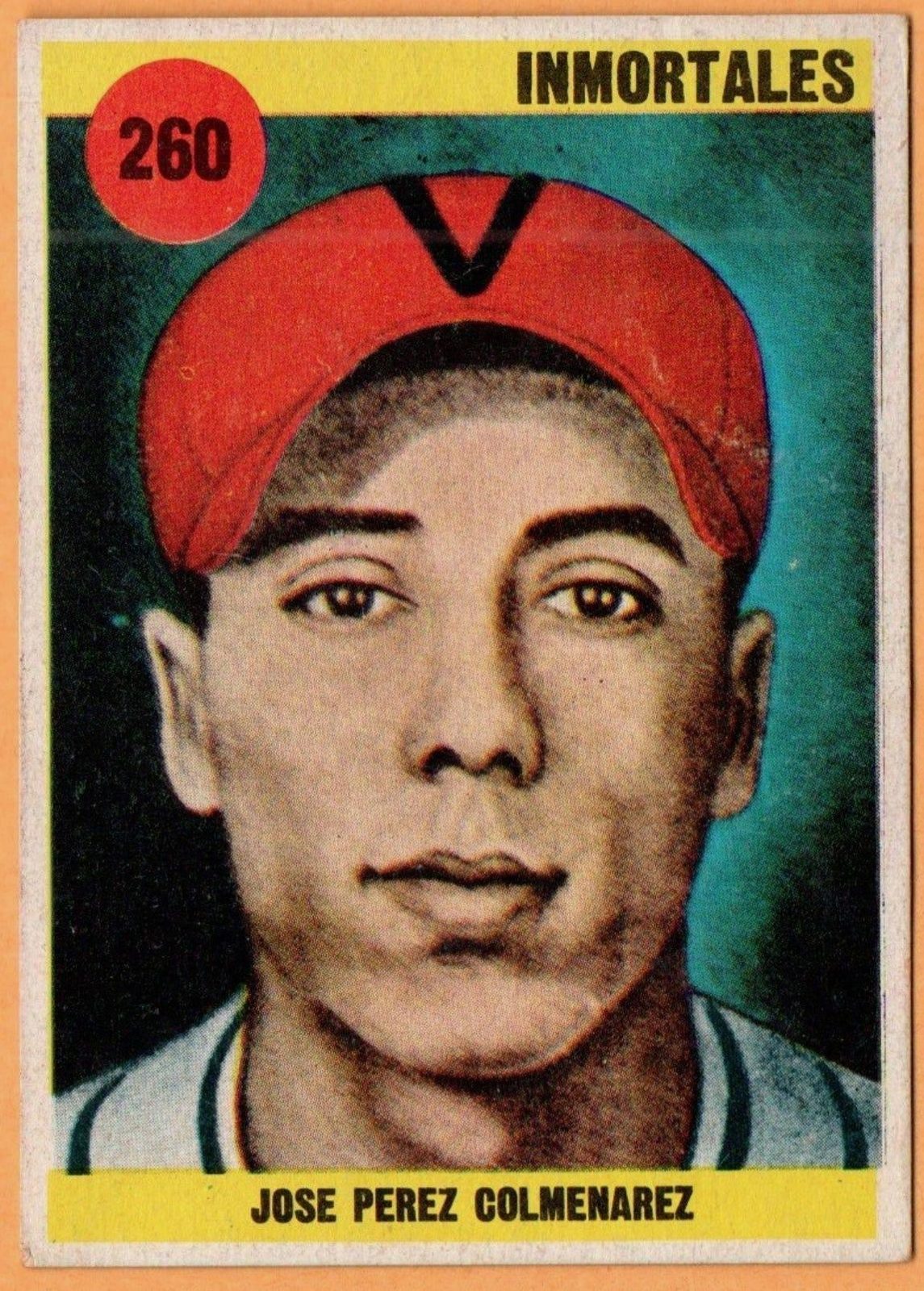
who are part of the founding fabric of Venezuelan baseball in the early part of the mid-century in the 1900s. This same principle is active as well within the mid 20th century Bohemia magazine, wherein I've discovered more and more their photographic prints and archives and documentation; the function that was occurring at that time through cultural mythic memory. The cultural memory of baseball is being remembered through this recollection of the national historical consciousness of Cuba — in a popular public magazine.
45:35
They're looking back at the past hundred or so years and it's almost like, okay, we've been through all of this chaos and destabilization and fragmentation and we've emerged as a nation — as a sovereign state or a sovereign nation. And now we are digging through the rubble, excavating our culture; our nation’s soul, piecing together who we truly are, who our identity truly is.
And it's incredibly powerful in both contexts — both in the Cuban and Venezuelan context — to witness that process in action historically. Particularly in the Cuban.
With that amount of radical political and social instability, as well as the simultaneous emergence of probably the most important unstated and unsung revolutionary baseball movement in history… you have that alongside decades of this fraught independence movement, this fraught colonial independence movement;
abolitionist movement… you have some of the most important parts of baseball history which are just now barely even being remembered anywhere. Precisely because of this retroactive mythic and historical consciousness which has to grapple with and through the shards, ruins and ashes; reconstruct the national identity through a period of extensive protracted colonial fragmentation.
This is a deeply mournful endeavor — both for what is lost, and for the sense of self that hopes to emerge through it; from this process of excavation; archival, archaeological remembering.
This is where, for me, looking at that period of Deadball that I was elucidating to you in prior essay; talking about the photographic image-based consciousness through which baseball was constructed almost as a mosaic — it's like there's this foundation of American baseball based almost purely on its creation or birth, and then it drops off into this insane period of intense revolutionary fomentation in an entirely different political and economic ecosystem and locale. And then you pop right back out at the 1910s. It's almost like you have, you have Deadball here, at one point. The cliff of American modern baseball.
48:02
And instead of just going from Deadball straight down to the 1800s in America like you’d assume — in a very linear way — it's almost this zigzag. You go from Deadball and you take an unexpected, careening trip to Cuba and you understand that there's maybe half a century in Cuba where that is the single most important time and place for baseball history between the 1850s and maybe up until 1908, 1909.
You have to let go of the national American-centric narrative for baseball's growth and development and allow for a potential understanding that baseball is created and founded in the United States. There's these rules and regulations and the basic template of baseball as a sporting and cultural phenomenon that emerges in the United States. But during this radical revolutionary period of fomentation — I would almost say the moment that baseball sets foot on Cuban soil at the end of the 1850s and the beginning of the 1860s, all the way up until, and even maybe a little beyond…
all the way up until, let's say at least 1908 with Rube Foster, Pete Hill, and Home Run Johnson on that Habana team — you have the most important moments in baseball for that half century, bar none.
These formative years of modern baseball are occurring in Cuba. They’re the true lead up to Deadball. The undercurrent; the underground of everything that culminates mid 20th century in the American integration of Black baseball. This half century, these years — they're occurring specifically through the creation of the Habana team in the opening of the era and the radical integration of the United States black players at its closing, all through this highly intense revolutionary Cuban independence movement from Spain, which again compounds the Spanish-American war. This is an environment, a prism — it's like a storm that's fermenting. And through that, perhaps the most important unsung movement in baseball history rises, which is this Habana team, which integrates black players (alongside teams like San Francisco) for the first time in history in at the onset of the 1900s — starting with some of the absolute best the game has to offer.
50:17
And not only that, the Cuban league itself at large holds some of the greatest baseball players of the period, well into the 20th century — to the point of which they were able to repeatedly, successfully defeat the best of the segregated American leagues. The power of Cuban baseball during this period is well documented, including players like Jose Mendez: whose prowess on the pitchers’ mound was compared to that of the famous Walter Johnson by Philadelphia catcher Ira Thomas.
So — pretty powerful stuff. I think this is incredibly fascinating and I think it really is and will be just a matter of time before you look at the history of baseball fundamentally differently. Really what happens is that the forefront of baseball is Cuba for a good 50 years. And then obviously, of course, you have the Honus Wagner and Ty Cobb World Series of 1909. And then you have the decade of the 1910s of Deadball, which is highly transformative and a turning point — with the Federal League and World War I, as well as the mythic World Series match-ups of 1912 and 1914. Then you have the Black Sox and of course Babe Ruth headed into the 1920s.
It becomes very hard to make the argument at that point that the Cuban League, or even the newly founded Negro Leagues at the hand of Rube Foster, is anything other than parallel at that point in time. American baseball is exploding with the onset of the Ruthian, live-ball fervor. However, of course, the Cuban League by the 20s is integrated and thriving with the absolute best of Black American baseball talent.
51:50
Look at the creation of the Negro Leagues with Rube Foster here, squarely. That's something that I think the American consciousness is still reckoning with. It’s that important. Far beyond baseball into Black American sovereignty at a cultural institutional level in America itself, not outside of it — but from within. At the same time, it's hard to make a claim that what’s going on at that point in Cuba or in the US with Foster’s league is at the epicenter just because of how important Babe Ruth and the Yankees and Lou Gehrig become. Murderer’s Row. You're entering into entirely new, fully fledged, very… culturally fluent version of baseball.
This is the American institution of baseball entering its period of the total consolidation of power which is ‘the golden age, or golden era’. And at that point, it almost becomes a matter of time before the Negro Leagues integrate into that, just because of how institutionally solidified baseball becomes. Sheer monolithic power with huge, huge industrial financial backing. This is why New York baseball becomes so big in the 1920s. New York becomes, without overstatement, the industrial center of the world. And a lot of that happens, additionally, in terms of baseball’s consolidation of power… directly because of the antitrust suit of 1922, which is the outcome of the Federal League attempt.
52:49
The institution of baseball itself becomes very solidified and very singular after that moment in time. The Federal League fails. 1915. 1916, you have the World Series with Brooklyn and Red Sox. Immediately after that, World War I with United States involvement. You have war seasons. Then you have the 1919 Black Sox scandal. Ray Chapman.
53:16
And as the 20s hit, you have the antitrust suit; the institution of the live ball coupled with the rise of Babe Ruth as a pop cultural force unlike anything baseball or America had ever seen before. It's the entire consolidation of the institution of baseball in America into a mythic, cultural-industrial unit which is protected by the highest civic courts in a fully matured empire; emergent world power. It's also the consolidation of black baseball in America with Foster’s league; this is an important aspect. And then you have these two institutions which are firmed that are essentially destined to merge.
Throughout this destined convergence as a passage of time, there's lots of documentation — like the Black Yankees would be leasing the Yankee Stadium for games. There's a lot of documentation around that, and similar phenomena. Where there's different facilities or aspects of the game that are being shared, but not integratively. There's talk about contracts. There’s a couple of different instances where integration almost happened in pockets and places. John McGraw wanted to integrate a little earlier actually. McGraw’s mentality was a modern one in that way, which is interesting in juxtaposition to his persistence of style of play as Deadball bled into live-ball. There was a player that he really wanted to join the Giants but it just wasn't going to happen. Foster’s league becomes representative [like the American national professional league at large by the 1920s with the trust suit] of a consolidated power whose growth is syndicated and achieving new thresholds of possibility through ritual organization and the shared mutual assurances therein.
And doesn’t this mimic industrial modernity?
54:40
So I'm going to wrap here. I hope you enjoyed this. This was a big, big conversation.
And I'll see you on the next one.
EPILOGUE
00:01
I do think it's important to create an epilogue here. There's a period we're looking at, 1864 to 1908 — where my main argument is that Cuba is the hotbed, the ground, the foundation, and the soil for baseball's modernity.
00:29
It's not America, it's happening in Cuba. And so I just want to talk over the dynamic that's happening here, I think specifically around slavery, liberation, and how both of the professional major leagues in both nations, Cuba and the United States, structured themselves in a response to slavery; in a response to the liberation movement at hand. In Cuba, this was both a national and racial liberation. In America, it’s a racial liberation on one level, but a perpetuation of the diktats of colony under the guise of liberation at a national level. The question is, who is the nation for, and why? And who is truly allowed to partake, regardless of what the constitution therein proclaims and suggests?
00:57
What I have here is a diagram and an idea to discuss which is based around both of the liberation movements occurring in these countries at the same time. We’ll start there. You have the Civil War and the liberation of Cuban slaves halfway between the inciting of the revolutionary fervor in the 1850s and 60s almost immediately and directly in a grand historical sense into the Spanish-American War and the liberation of Cuba proper — which then results in the establishment of sovereign Cuba and the integration of the national professional baseball league in the 1900s.
How to go about this on the American side of things is that you have the Civil War that happens mid 19th century. And the response to the Civil War and the liberation of black slaves in the South is a reactionary one. Baseball shuts down and draws in.
Black players are pushed out of the league entirely.
You have this mythology of civic national unity, which is really under this singular codified exclusionary segregationist policy which is in turn applied to baseball. It is obviously fundamental part of the civilizational fabric at large of the United States, which ultimately comes to a head in the integration with Jackie Robinson, the 50’s and the 60’s; the civil rights movements of the time in the United States. It's so interesting how the myth of baseball functions in America because it's so patently exclusionary. It’s so deeply contracted.
And you look at what's going on in Cuba from 1850 to 1900 — this radical revolutionary movement that’s, it's almost simultaneous with the Civil War in the United States. There's really only a decade or two that separates them. You have this liberation of the slaves in Cuba and then the Cuban Revolutionary War against the Spanish colonial regime for the liberation of Cuba the nation at large.
03:32
It's a throwing off the chains of this regime that created a racially classed society, which is reflected directly and immediately in how the game of baseball is played and functions in Cuba. As soon as the Spanish American war ends and Cuba becomes a sovereign state, a sovereign nation, the Cuban league integrates. You see how this functions — its a simultaneous movement in space and time — the racial and national aspects of Cuban liberation are almost entirely unified in simultaneity of movement. Whereas in the United States, you have a national liberation movement in the Revolutionary War which occurs an entire century before the racial aspects of slavery are brought to bear in the Civil War context. And even then, the nation itself is highly reluctant to address the racial fabric of the culture therein. We’ll get into this later on.
04:00
In regards to Cuba: they're signing Black Cuban and US players in the early 1900s.
Between 1900 and 1910, there's an influx of the absolute best that the Black American baseball game has to offer in coalition with Black Cuban players, creating a full spectrum integrated professional league for the first time in baseball history.
It's hard to overstate this. Because you have this exclusionary nationalist myth of baseball being totally American and all of its revolutions and innovations occur in America.
The idea is that, sure, there are offshoots in Cuba or Venezuela, what have you, or Japan. But from this vantage point you're missing the real cause and radical revolutionary modernity that's created first and solely in Cuba, not the US. It’s a convenient and typified mythology that misses the real complexity and power of the historical realities that shape the global culture of baseball itself; furthermore, even the real, on the ground realities of baseball in America.
04:54
You feel the shocks that happen within the United States with the Federal League, which is labor disputes in terms of how much players should be paid leading right up into World War One, which is a severe shakeup of the United States' image of itself.
It's a nation for the first time entering into the world scene in a big way. You have that going on simultaneous to America's industrialization. That's a really important aspect of Deadball. Its a nexus of convergences of historical and political inevitabilities; a cauldron of flashbang transformations which in the span of just a decade — or even half a decade if you want to narrow it down to the start of WWI and the US’ inevitable involvement (or the Fed League and the Black Sox scandal) — transform in the definition of baseball in coalition with the transformation of America’s vision of itself into one of the biggest political forces in the world.
And that was previously my main sphere of inquiry; my research node. But then when I got more and more into Rube Foster — I knew he was an important figure in this picture of modernity, but I'm understanding now just how important he was and is to what unfolded at the turn of the century into the 20s’s, specifically based on his relationship to this Cuba Integrationist League. In the US, you have total segregation of black players from the late 1800s all the way up until 1947 with Jackie Robinson. In Cuba, you have total integration by 1900.
05:53
You have these multiple revolutions that happen in Cuba leading up to the turn of the century integration moment — revolutions over the span of just a couple of decades that constitute this ecosystem of integrative emergence; this churn of fervor and political ideals. Therein, its a fast developing professional baseball league which has significant gravitas and skill, even prior to integration with Black American and Black Cuban players. This is well evidenced in the documentation that remains of how the leagues were structured and coordinated — both civically and socially.
But again, baseball is not an integrated social, cultural movement until 1900 in Cuba.
This is still a classist racist league that is exclusionary under the Spanish colonial regime. This rapidly changes. And I can't overstate the importance of Emilio Sabourin in this picture. For his dual role — the baseball player and innovator who helped establish the Habana club; the revolutionary who also plays an instrumental part in the national refiguration and mythos of collective self in the 1890s liberation war against Spain.
He acts as an agitator and ultimately is imprisoned in this scandal of stealing ammunition from the Spanish regime. He dies in a Spanish prison in North Africa.
He’s considered one of if not the most important originary figures in Cuban baseball history. The development of baseball in Cuba is based in a radical revolutionary mode of thinking; directly contributes to the immediate desegregation of the league upon Cuban independence.
07:17
This independence is the reclamation and establishment of the Cuban national native mythic identity as self away and apart from the Spanish colonial rule — which again was so steeped in a caste race-based system of power, as a controlling mechanism of political force. It was a colonial structure of government and culture through and under which national and native Cuban identity was suppressed and oppressed; governed over and forcibly sculpted by the foreign regime which extracted resources and claimed and asserted dominion. This system of hierarchical control was how the Spanish minority maintained their power in native Cuba.
It's a radically different mode of perception and existential self identity and formation between the United States and Cuba in terms of where they are in their national progress and identity — how the nation views itself and is actively crafting and sculpting its myth; what level of agency and layers of myth and institution it has applied to this vision of self actualization through sovereignty. Here, it is important to note that this racial segregation and system of white power and social dominion and control is common to both the US and Spanish colonial Cuba — but these modes are expressed differently — between colonial state (Cuba) and emergent empire with its class of slaves, technically freed from slavery but still deeply chained to the normative social, political, cultural, and economic culture which is the environment of suppression and control through race and racial power at large (the United States).
In short, everything of slavery remained except the active function of slavery itself; in this sense, the entire cultural atmosphere was preserved, even while the economic institution and force of production and active labor and work was, so to speak, eliminated if not deferred into other methods of economic, social, and cultural suppression and oppression of Black American culture and life.
This white exclusionary segregationist myth in the United States — so much of it comes back to and is expressed through baseball as the national pastime in the culture. It is the lens through which America views itself and projects its vision of itself. Its ideal form and forms, its heroism; its heroic arc and self constitution. And you look at that: it's trying to declare itself the foremost, first and foremost professional baseball league in the world. Baseball is born in the U.S., so surely the American baseball league must be the greatest. But we just see that this is patently untrue.
You have, I believe in 1914 or the early 1910s, the pennant winning Philadelphia Athletics come and play in Cuba, as well as the Reds — come and play in 1908. These American professional baseball teams that actually come to Cuba to face the national professional Cuban teams. Some of them came in the late 1800s; others after the turn of the century. And I'll tell you the difference.
08:43
In the late 1800s, there was really no competition. The U.S. professional teams outclassed the Cuban teams, plain and simple — really entirely due to this mutual segregationist policy at work both in Spanish colonial Cuba and 19th century American baseball. Between two segregated ‘white’ colonial national teams, the United States undeniably had the upper hand. But then the U.S. professional teams come back post-integration to Cuba in the early 1900s, and they face up against these Cuban teams that are integrated top to bottom with some of the best black baseball players, bar none, not only from the region and from Cuba itself, but from the United States of America, who traveled to Cuba to play in the new, radically integrated professional league.
They go down there to play these Cuban teams. And they're embarrassed. It’s a rude awakening for the Americans. I think Ban Johnson actually came up with a ruling that said, listen, you're not supposed to go down there and play these teams anymore because they're ‘integrated’. But the reality is you have, supposedly, the foremost professional league internationally, the major league baseball teams of the United States of America going down to Cuba to play integrated professional Cuban teams and they're losing. It’s bad press for the myth. So this is something that has to be cut off and removed from the circuit because it reveals; it tells on the American myth that this segregationist policy is not only not necessary, but it's actively detrimental at large to the social, cultural structure and fabric of America and its institutions because you're losing a great deal of the absolute best that America has to offer in baseball because they're going down to Cuba to play.
And then — 1908, you have that really powerful photo of the Habana team, which I have pictured again here. With Rube Foster, Pete Hill, and Home Run Johnson.
10:31
And this is where to me, again, my speculation or my vision is that he [Foster] goes down there; experiences this radically integrated, extremely well organized league.
Bear in mind, this Cuban league had over half a century to become a highly organized, powerful, generative ecosystem of professional baseball. They cared deeply, with deep passion about the sport. It became a part of the essential fabric of Cuban culture.
And so this process of organization and professionalization happens very quickly. It almost happens alongside the US due to how rapid the acceleration is. Of course, the Cuban league is further behind because they're introduced to baseball as the United States is becoming increasingly organized, but they organize very quickly. Within a couple of decades, they're up and running and they're having these major baseball events among the three essential teams with Spanish oversight and collaboration.
As a colonial liberation project, this Cuban national identity emerges, as it must, at the outset of the 1900s with Spain’s withdrawal and immediately declares itself through this radical integrationist policy in baseball as a set of social, cultural, and political values. And you see this — their approach to the end of slavery which happened just over ten years prior — the national response in the institution of the Cuban free nation applied to baseball. The values expressed in a totally integrated league immediately upon national liberation is radically different than the United States' approach to the end of slavery. There's this deeply conservative reactionary movement to enclose baseball in a very narrow window of who and what is allowed to play baseball, when, why, et cetera. This exclusionary policy is under the guise of maintaining the character and the essence of the sport.
12:19
In reality, what it does is retreat into a national myth that is a closed mindedness that must be protected. It is imaginatively conservative whereas the Cuban emergent national mythology out of liberation is imaginatively revolutionary; integrative.
This mythological dream state of American baseball as being pure or highly advanced or evolved must be protected from what really is the radical threat of this Cuban integrated league. It’s a set of values that disrupt the normative enclosure of the perpetuation of a racially classed economic, social, political, and cultural system which must tell itself the dream by way of regurgitating them back through its cultural outlets in order to preserve the retrograde, regressive state and status of its infancy.
It is the threat of the exposure of the dream state of the national mythic project of the United States that the segregationist policy of its national pastime reflects; Cuba exposes — a fragile dreamstate, based on denial of the truth; of having to wake up to the reality of the nightmare of its wake. Foster, Hill, and Johnson are navigating this somnambulistic, sleepwalking national state; negotiating it between Black American barnstorming, independent teams, the integrated Cuban leagues; as the decade of the 1920s begins, the institution of the organized Negro Leagues.
In regards to Cuba; what is made available in the integrative, opening, expansive approach to the emergent liberation of national myth into a possible expanse… you have the best players in Cuba across the entire racial and ethnic spectrum, as well as the movement of Black players who are being barred from U.S. professional baseball down into Cuba to play on these teams. You're assembling a hemispheric power of great baseball through permissiveness. And again, I can only imagine watching some of these games because of just how fantastic these players were. And this is something that actually accelerates into the 20s and 30s; becomes bigger and bigger in terms of the legendary, Hall of Fame caliber Black American presence — alongside the huge boom of the myth of baseball and the legend of baseball due to press photography and enhanced media technology in the United States’ professional league.
But nowhere else in the world do you get a chance to see all time great players like Oscar Charleston and Pop Lloyd and Cool Papa Bell play alongside the best a whole nation whose national identity is — in large part — based around baseball, has to offer. The trajectory of the birth of Cuban baseball is one that is absolutely steeped in this revolutionary anti-slavery reclamation of national sovereignty — it is this instinct and impulse which is the political and cultural impulse of the time and place. And this is something that's directly reflected in the political policy of Cuban baseball, how it is conducted the moment that national liberation is achieved.
It becomes a looking glass through which we can scry and see the political energy, values, and landscape for what it is and means for Cuban sovereignty to emerge;
accordingly, what the United States does and is doing with its own national-liberationist and abolitionist movements. And you see this exact tension all through the latter half of the 19th century in Cuba, where there's this conflict — the Spanish colonial government has to be appeased, but what the Spanish colonial government observes, and this is well documented, is that baseball is a threat because it becomes this almost indelible part of what represents the Cuban national native impulse, or the narrative impulse of sovereign self, which is fascinating.
I mean, this is a sport that's been adopted from the United States. The founder, Nemesio Guillo, he comes back from Alabama, going to school in the U.S. in the middle of the 1800s during the Civil War. He brings this sport back to Cuba and it becomes adopted as a sort of a primordial national mythology that begins to create a distinguishment between the emerging modern nationally sovereign Cuba as a culture all its own — distinguished and apart from the Spanish colonial government;
the colonial rites, assumptions, norms, and quellings of independent Cuban spirit.
The Spanish colonial government observes this as a threat. And so they're trying to prevent it, but at the same time they can't, because it's such a massive movement that too much restriction poses the threat of violence and conflict, which inevitably emerges just due to the nature of the climbing, intensifying revolutionary state of Cuba at the time.
And through that, you get this at the really just as 1900 hits, you have the first professional integrated baseball league that happens 50 years before Jackie Robinson. And that's just one player. Then you get you get Larry Doby, you get Minnie Minoso. You get these players that slowly begin to integrate ‘white’ baseball in the United States of America.
This is the real state of baseball at the time. You can’t really say baseball in America is fully integrated as a landscape for years after Robinson. And all of what this says, is it functions as a mirror back onto the American political and social conscience and consciousness. The revolutionary power and permissiveness and integration of Cuba’s simultaneous abolitionist and national liberationist movements expose and tell the tale of the United States’ retrograde failure to meet the emergent demands of modern baseball as a call to true greatness, not just a dream state of a self narrated story told in a close room — while the ascent of its real history rages on outside.
Let me think if I need to discuss anything else. I don't… but I just want to reiterate here. You have these abolitions of slavery that occur almost simultaneously historically… America and Cuba. These are abolitions of slavery incurring in real time and real space, parallel — if not simultaneous. Just miles apart. The proximity is insane. But the difference is America's national liberation movement, if you want to call it that, in terms of the Revolutionary War, is a century prior to its abolitionist turn — whereas the national liberation movement in Cuba is occurring simultaneous to the anti-slavery and abolition movement.
16:53
So you have this redoubled revolutionary fervor going on in Cuba in a very condensed period of time. It's a national freedom as well as a racial freedom. There’s a lot at stake all at once. It’s an entire revolution of values down to the core of the social function and the economic process of the infrastructure of the nation itself.
Through the abolition of slavery and reconstitution of how the social and cultural order function in Cuba at this period of time, 50 years, it's happening — bam — simultaneous. All at once. And you’re on the other side into the radical, ulterior new mode of sovereignty and having to build a national construct and consciousness and foundation.
Whereas the American social order post Revolutionary War, you have the development of and cultivation of this further, further, further intensifying of slavery in the United States of America in this reified, doubled down social and cultural system, which depends on this segregationist impulse and strategy to succeed economically and practically. You’re out from under the wing of colonial Britain, so to speak, but you’ve doubled down even harder on the racial, class stratifications that constitute a large part of what colonial rule traditionally looks like in the western world. But you’ve just taken the reins, or assumed command of that machine and pressed it even further into your own service; into faster and more violent action.
Even after the Civil War; the supposed end of slavery in America — the culture and the messaging is quite clear: you're not slaves anymore, but you're second class citizens and you don't receive the same rights. You can't participate in the same social and cultural institutions. Your communities and existences are open to be violated with or without cause. Your resources can be taken and there will be no prosecution. And so forth.
So you have this country that really in large part [socially, culturally, and politically]
— is dependent upon slave labor for the foundations of its economy, plantation slave labor as the engine of its profit and power. And so you have this illusion which must be cultivated and reaffirmed in terms of the social construct of who is allowed to do what, where, when, and why. Because if you don’t have the myth of a slave class constituted by racial inferiority, you don’t have a slave class — a slave class which can be held down by threats of violence and the cultural assumption of inferiority by way of a system of belief, storytelling; the social fabrics and levers which are pulled and expressed and enforced to perpetuate the on the ground experience of this cultural mythology. And this is going to include, perhaps most importantly, the national pastime and main cultural ritual of import, baseball itself. This is the legacy and function of the American culture at work underpinning segregated ‘white’
baseball.
It's a necessary myth that the United States has to tell itself to remain in the place it remains, which is a destructive, toxic, violent social atmosphere based on exclusion, segregation, and racism. Because this is the class, social, economic structure which it is and was founded upon. To collapse that, as the Cuban revolutions reveal, is to collapse the entire infrastructure and function of the nation proper. This simultaneous and true collapse of colonial infrastructure as in dominion, domain, and the racial class system is a ground zero event. And this simply isn’t what happens in the United States with their national revolutionary movement.
America is grown out of a national revolution without a simultaneous desegregation or abolitionist turn; the constitution it creates depicts an ‘all men are created equal’
scenario; the assumption and illusion of a democratic, egalitarian society in language — all while the traditional, colonial, race, class, and gendered boundaries remain firmly in place; are doubled down upon to construct the empire of industry which the United States inevitably becomes at the turn of the 20th century. The end of the British rule over colonial America was not the end of empire — it was merely the exchange of hands. And in doing so, America was never truly formed — yet merely drew out the same colonial legislation and diktats. It remained a colony; never became a sovereign nation capable of true political, moral, and social expansion — because it remained chained to the immature phase of colonial inheritance; failed to transform and revolutionize its political values at the root in terms of inclusion and integration alongside and within national liberation.
19:12
The national mythos of Cuba — in this, again, double way — both through the national liberation movement as well as the abolition of slavery movement [which are occurring simultaneously]… that double revolutionary fervor is a radical reconstruction of Cuban identity through a stripping of the shackles of the colonial government and a development of a national identity as well as a racial identity through inclusion simultaneously.
The Cuban desegregation expressed through absolute integration of the professional baseball league immediately upon national sovereignty says this: regardless of skin or creed, come and advance our ranks; live and work among us as a team of fellows to create a league of excellence. I don't think this can be overstated because in the United States, this development is stratified. You still have all of the racial segregationist problems upon the signing of the Constitution in terms of the Revolutionary War.
They never left; in fact, they just got more extreme with American sovereign control of these stagnant colonial value systems and economic and social principles of power and dominion applied by sovereign nation unto its sovereign political body. You have all of those problems and they just continue because they're not really addressed at all. And then you have the Civil War — and you still have the economic, social, and cultural problems, even though slavery has been addressed, at least in a ‘we do not have slaves anymore’ kind of way. But there's the cultural, social religious sentiments of the nation.
The fabric of the national values; these values are always expressed through and mediated by and reflected in culture. It's by no means rectified. This is still a continuing segregationist policy — again, mirrored in baseball as well as in the social spaces and economic conditions of the nation at large. This has gone on for as long as I think the collective consciousness of the United States can remember or conceive. It still reverberates to this day; this is something that still has not been addressed and is at the foundation of the national cultural identity.
The failure to transform national values at the root literally and practically upon the establishment of national sovereignty; the shallow preservation of colonial values while proclaiming a new paradigm of progress, innovation, and status as a new nation. It’s a classic case of ‘say one thing, do the other’. Proclaim we are turning the page, while retaining the same principles and methods of colonial empire; instead of having them leveraged by an administrative class above us of colonial sovereigns, we become the sovereigns and leverage them down on the underclass that remains beneath us — the slave class.
So it's fascinating to see this unfold in Cuba in a very different order of being because what it tells us and what it shows us through the lens of baseball is an emerging national identity which is radical for the time, or any time for that matter.
It is a radical breaking away from the Spanish colonial regime and the institution of a radically inclusive policy and new system of values — almost as if the entire fomenting period of revolution itself was latent and pregnant with those values at the level of the real national, native spirit of Cuba itself. The repercussion and seismic quality of this total shift in the architecture of the Cuban collective consciousness is superlative; echoes and reverberates in the Cuban national cultural identity through the 20th and 21st centuries… with Castro and its attempts to stabilize economically and infrastructurally as a collective body ever since.
21:06
Castro himself was a baseball player!
21:35
So that will do it for the epilogue here. Great talking with you. I hope to see you on the next one.
‘DREAMING THE NATION INTO BEING’
00:01
So the idea here is baseball in Cuba and the concept of dreaming in a nation into being. This is a really important aspect of what I was discussing in my previous two essays here, because realistically what we're talking about is the revolutionary period in Cuba between, let's say, right around 1850 to 1900 — we can just mark it off as those 50 years.
You have a nation whose formative consciousness has gone through several different stages. The time before colonization; the Spanish colonization of Cuba, and then you have this moment in Cuba's history where it's asserting itself in a radical independence movement which involves Cuban natives, even some Spanish colonists. You have this whole revolutionary milieu which is bringing up the claim and call of the sovereign in response to the Spanish colonial rule — the assertion of Cuban national independence.
This assertion is an identity assertion of self and it's coming at a really critical time in history in terms of the onset of modernity as a concept and a construct. I would almost say one of the easiest ways to define modernity is to look at the writings of Nietzsche and the concept that ‘God is dead and we have killed him’. It is this idea that you're moving into a world which the existentialists articulate towards the middle of the 20th century. Existentialist philosophers proclaimed, quite loudly, a loss of the center of values — the cultural center of values that previously existed and held the stable traditional ground.
This is the ground that held localities in place — localities as cultures or regions that have specific civilizational constructs attached to them, whether that's, the United States or Rome or Cuba, you could name any place as a locus of identity. That locus — that’s unraveling. And the reason why Nietzsche says this toward the end of the 1800s is because of the onset — the rapid onset — of industrialization and globalization as realities. These are political realities that are onset even towards the end of the 1800s and only continue to escalate into the 1900s and just really break open in a major way with World War I.
So what we're talking about here is cultural national identity; civic identity as a collective consciousness and how that's being disrupted by a breaking, foundationally, of borders. It's actually really interesting — there might not be anything that sums this up more accurately and more clearly than the use of baseball as a national foundation and identity construct in Cuba. Baseball was formed and founded in the United States and becomes known as its sole mythic pastime and cultural output. But beyond that, Cuba takes baseball into its own hands and crafts something utterly revolutionary and hyper-modern.
I talked about Nemesio Romaguera and what happens with him the middle of the Civil War. He comes to the American South to go to school and takes baseball back with him. I think he quite literally brought a bat and a ball with him back to Cuba…
and he teaches baseball to Cuba. And so it becomes this really interesting example of the export of a cultural heritage, baseball, which is usually and always tied to the United States.
04:29
Baseball has been exported to Cuba and in doing so, Cuba takes the sport and takes it further than the United States could have ever even dreamed possible, at least until the late 20th century. So what does this say about the revolutionary potentials in Cuba at this time? A lot of the ways to sum up modernity and globalization is actually through the lens of colony and colonization.
04:58
What I mean by that is that there is a long and storied history of global conquest, which historically, right up until the 20th century signified and characterized global expansion; contraction of narratives. So you have the Romans who expand across the Eastern hemisphere. You have… the colonization of the United States of America or the colonization of Cuba by Spain. There are these instances of world exploration.
Genghis Khan, another good example — these instances of world exploration which are almost inevitably and irrevocably tied to the colonization of territories and indigenous peoples. This is a long and storied heritage, the Greeks, Persia, et cetera.
But what you have going into the 20th century that's so significant; again, why Cuba is such an important part of this and why baseball is such an important part of this — is you have a massive radical shift in national cultural identity coinciding with the global onset of modernity as in industrialization. As in the entire world becomes a open, contested space all at once with the onset of World War I. And this has to do with new forms of transportation, planes, cars; more efficient forms of transportation with boats, et cetera. And this in turn, this global movement — is a global movement not only of people, but of information and of goods and services, and obviously cultural exports such as baseball.
06:48
Cuba takes baseball and translates it. Cuba takes baseball and translates it through its position, its moment in time, which is suspended between a colonial regime of traditional Spanish values — which are being superimposed and overlaid upon a native Cuban population — and the rapidly emerging, national descent: which is the attempt to formulate a collective cultural identity construct that will overthrow this assertion of traditional Spanish values on this colony, formerly for the benefit of the empire and kingship of Spain. And baseball actually and actively becomes a revolutionary method of that kind of identity assertion.
07:44
It's well documented how popular the sport of baseball is and has been in Cuba since its growth in the late 1800s all the way up until and through the 1900s to this day. It's waxed and waned several different times, but you have one of the primary baseball loving nations in that area and region. And baseball ends up spreading from Cuba to Puerto Rico… there's a lot of cultural transmission that goes on here.
You have one of the earliest founding fathers of baseball in the nation of Cuba; one of its primary transmitters of the sport regionally; furthermore (and inevitably)
globally. What I want to examine here in terms of Cuba and dreaming the nation into being is how baseball specifically functioned as the transmission device or in large part what allowed for and created, I think, a powerful and primary method of dissent in the Spanish colonial regime — through the development of national identity via culture and sport.
I talked previously about the documents from Enrique Melendez working with the Spanish colonial government to certify and legalize these public events between the massive baseball teams at the time, including Havana.
What's pictured here is a composite, celebratory, commemorative documentary photo of the Havana baseball team in its championship 1886-1887 season. And if you can see there's the furthest to the left standing…
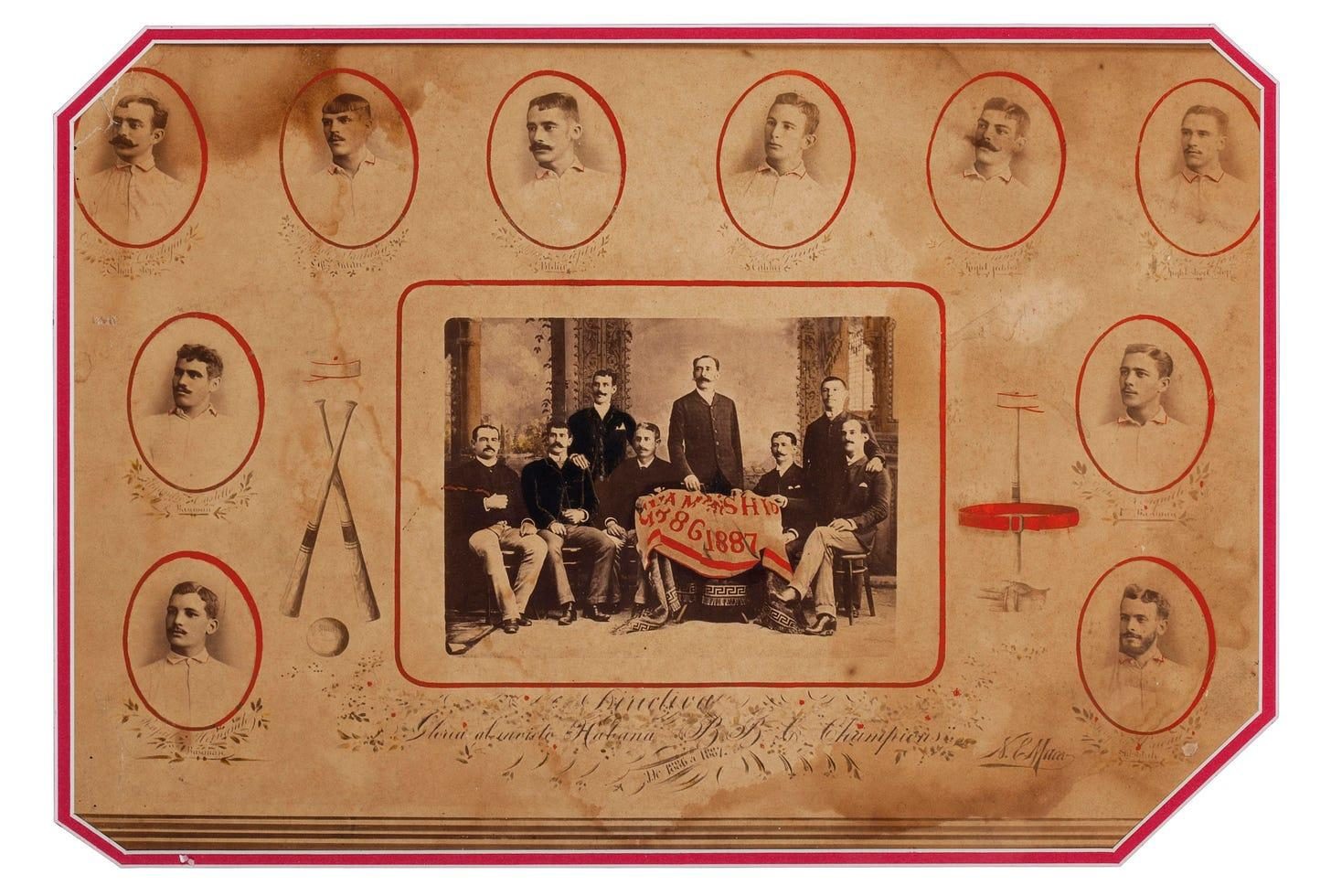
09:42
is Sabourin. We discussed him as a dual figure, both Cuban revolutionary for the independence movement and Hall of Fame infielder — second baseman for the Havana team. He also helped found the Habana baseball team closer to mid-century.
So this assertion of national identity really does run, in a lot of ways, through Sabourin as well as through Romaguera. But specifically in terms of this revolutionary moment, I think Sabourin is the best example of this figure who is in large part enabling and constructing in real time the cultural function of baseball in Cuba as revolutionary force and political phenomenon for collective identity. He's an instrumental figure in founding the Habana team, which is the most dominant team of the period going into the 1900s; the most foundational. And additionally, he is a Cuban revolutionary figure who is now and still currently revered for the things that he did in that national liberation movement against Spain.
So there's this — to pivot slightly here — this method through which a collective, especially a national or regional collective, constructs its identity. There are the laws, the rules and regulation of the polis at large. You have the cultural phenomena, which people gather around, whether that's theater or sport. This is very well documented in Greek philosophical texts, specifically Plato. He talks about this in terms of wrestling and the Olympic games and the idea of… the cultural construct of a national or civilizational identity.
And what you get with the emergence of modernity and globalization — I think which is really notable — and it's very different from the historical manifestations of cross-pollination of ideas, whether that's Alexandria and Egypt or Greece or Mongolia, what have you, this exchange of information, you could say the Silk Road as well… is that with the onset of a truly global world through industrialization — which is the opening of borders, the opening of spaces, and the opening of territories simultaneously through technology, through portability, movement, the ability to move people, the ability to move goods, services, information, which only rapidly scales with information technology —
12:36
you have this opening of a total contestation of time and space, or place, so to speak.
This could also quite literally be compared to the revolutions occurring in the scientific awareness of relativity and quantum mechanics in and during this period with Einstein and Planck.
The national identity, which is like very briefly constructed toward the end of the 1800s and into the 1900s, is rapidly torn apart. The national identity is in large part constructed in terms of contested political borders through war.
13:04
The brief life of the nation is rapidly torn apart by industrialization of information and information technologies, whether that's physical transport or digital transport.
So you're in a crisis of identity, to bring this back to Nietzsche, a crisis of identity that begins in the latter half of the 19th century and just rapidly scales all through the 20th century into the 21st, which is a…. nothing more than a metaphysical, existential crisis of the species. Because for so long, historically, you have these pockets of civilizational cultural context and these pockets are the things that determine the borders and bounds of life. What is true? What is false? What is myth?
What is heritage? What is real? Right? All of these questions that come down to things like the racial and ethnic identity of a culture’s in and out groups… centers of self; cultural identity.
These are the things that traditionally have been more native to the human species in a sense of comfort or comfortability; a sense of stability or normalcy. This is just a matter of what is realistically possible in terms of travel of information and physical forms. You have this identity construct that's solidified. There are these expected things and behaviors that are to happen. And these things happen within the regional or local cultural context because that's the way that the pocket of place and time functions. That's radically disrupted by modernity, just as the science of quantum mechanics and Einstein’s theory of relativity radically disrupt the classical, Newtonian understanding of physics.
It’s a Copernican revolution of conceptual realities applied to culture; a real physical rupture with extreme and foundational implications in regard to civilizational values and conceptions of identity and self.
14:31
During this period, things speed up by the nature of industrialization and technologization, as well as places — open up. So you have this dual factor. And accordingly, you have this cross-cultural transmission that's happening really all at once, very quickly, that's unprecedented. Baseball as a cultural export goes everywhere from Cuba to Japan. You name it. This is the United States’ cultural export at large. Hollywood becomes a huge part of that. But you're looking at this period of time — I mean, there's no moving pictures, there's barely even photography. And really at first, baseball is there as America’s cultural archetype or representative system of collective values, right at and in the early 1800s. And Cuba picks up on this rapidly due to Romaguera's time that he spent in the American South during the Civil War at school.
This moment of Cuban liberation is interestingly; even perhaps predictably, but interestingly — happening right at this crux moment of rapid onset globalization.
This contested narrative of what constitutes the Cuban collective or national cultural consciousness is the territory that is being fought, ceded, and won ultimately in the Spanish-American War and the declaration of Cuban sovereignty in 1900.
This struggle is a great way to envision what is going on around the world at this time because it's a very extreme, high contrast example of the struggle to create a collective mythic cultural consciousness that functions in a contemporary context.
You see this quite clearly post Cuban revolution from 1900 onward — these struggles to actually assert and establish national sovereignty when the very infrastructure of the Spanish colonial regime is torn down; as well as the attempted exorcism and removal of the values that the Spanish colonial regime was asserting in Cuba.
And really one of the biggest cultural successes that you see in Cuba post-revolution is through baseball. They take baseball and apply these radical political values to it and open up the necessary space create some of the best baseball teams that ever existed. As in the Santa Clara Leopardos — which had everyone I think from Oscar Charleston to Jose Mendez. I mean, you could say that that team was one of the best, if not the best baseball team ever created. And it was created specifically through this radically permissive, desegregated, multicultural institution of baseball in Cuba, which included Black American players.
17:55
This cultural permissiveness cannot be separated from the dual function of what is happening there, which is the radical declaration of independence that is Cuba at this period of time, which is both a national and racial liberation. But additionally, through... let's see how I want to put this — through the intersecting force of globalization that is occurring at that time.
So Cuba is attempting to assert its national identity and dream this national identity into being during a period of radical global instability, wherein the nation is a very temporary construct because what the nation really is at the end of the day is just a modernization of these regional or local pockets which were formerly called civilizations.
18:53
Even then, that's disputed jurisdiction and territory, right? There's these asserted identities that spring up from supposed researchers in academic settings and so forth. You have the Mayans or the Aztecs, but really what these identifications are — these are disparate pockets and communities that adhere somewhat closely to something that you could call or resemble a common cultural construct. And so you have this very local, tribal, institutional — in the sense that it's a very tightly communal — way of living that defines all, really, of early human civilization and history, with the exception of, of course, the empires like Mongolia or Rome or Persia.
These attempts to conquer large regions and portions of the globe and institute something resembling a common code, common law, and a common cultural framework through which information, goods and services and so forth can be transmitted through that larger civilizational construct of empire.
This fracture that is occurring — the fracture of modernity — again to evoke Nietzsche… I just want to make sure we're keeping that in mind here. This fracture is occurring simultaneous to Cuba throwing off this colonial fetter and attempting to declare its its collective cultural identity. And then, as as you see — and I think this is the primary difference between the US and Cuba and a lot of the reasons why you see what happens after this independence movement in Cuba — the United States sets this framework and foundation earlier.
This is, we're talking about the mid 1700s into the late 1700s. The United States’
national identity becomes established and it's becoming established under the old dominant order as in a old world with old values intact. This is, with essential importance — before the breach of modernity. They're taking the British colonial missives and taking them into their own hands, so to speak, and running with those in a world, globally, which is still primarily regional. Especially with the United States — you're dealing with a relatively isolated territory, continental territory.
Canada, Mexico, and further down to the south of Cuba and South America… the US is locally close to these spaces of subjectivity and the contestations of subjectivity and culture and colony therein — but insofar as the pocket of nation is concerned and the possibilities of travel and information, you are still dealing with a world that is largely, if not entirely, pre-modern. This changes; is changing quickly. However, at the time, there's not the amount of technological resources, there's not the amount of infrastructural access, which allows for highly contested space and territory in near perpetuum, which is really the definition of modernity. Instant dispute.
The information age has not yet hit the continental United States, and because of that, you have a colonial project which is — it's almost isolated. The French ships, the British ships, the cannonballs — what we’re describing is pre-modern, highly inefficient war for the independence of the United States. In just 100 years’ time, the technology of war and movement radically shifts; explodes into even the differences between World War I and World War II.
22:01
You flash forward 100 years and change lenses to the Cuban revolutionary movement. We're in a radically different frame and a radically different zone where the inevitability and speed at which technologies are being produced, including the light bulb, are almost unthinkable to the previous paradigm. All of these innovations that change the considered framework of reality through technology.
Technology is the bridge to a radical new reality. We can talk about this in terms of AI, just as much as the portable phone, the car, the computer, the light bulb, the plane, you name it. These are things that actually reorient the entire species and we have to reconstruct an identity at a collective communal species level to adapt to these tectonic shifts in consciousness.
22:57
That's something that's occurring alongside the Cuban attempt to construct a national identity. So the national and global borders are being broken apart by this onset information age. And so you see this really interesting attempted construct actually in large part through the lens of an inherited or exported cultural device, baseball. It’s a early globalizing modern technology of cultural consciousness. As in Romaguera bringing the technology of the bat and ball back with him from the U.S.
to Cuba.
You have examples of this historically, particularly in places like the Silk Road. This is cultural exchange through education, trade, and transmission of knowledge and information. We move from this moment into the pixelated screen of the smart phone; world events in real time instantaneously broadcast to a truly global audience.
23:25
It's a fascinating thing. Through this lens, you can see a lot of the fraughtness of the time at a human level through these innovations which collapse social, collective, cultural identities and narratives, as well as personal.
23:56
You can see the fraughtness of the radical nature and state of Cuban baseball; what it opens up as possibility… you can see this as a reflection of the cultural collective crisis that was occurring at the time in Cuba. You have the attempt to establish a national identity in a world in which nations will no longer exist.
And with the onset of World War I, I think with any amount of prescience, that's something that becomes very fundamentally clear. It's that you live now in a globe which is fundamentally connected, even through war or disputed territories, in a way that it's not connected by landmass. It's connected by information. Or connected by colonial control methods that have rapidly escalated into World Wars, for lack of a better word.
25:00
You no longer have the possibility of a local, collective, regional identity which exists in isolation from anything. So you have the death of the nation as well as the death of everything that existed prior to human history. You, formerly, have this age of empires; this age of tribes or localities, which are civilizational constructs, that is happening at the same time.
That age is dying and it's being replaced with a truly global collective mythic identity, which is in formation. That's something that's still in formation in the early 21st century. Its a long road and journey of fragmentation and unity. And baseball is a fantastic example of what is to come and what is occurring. Because you look again at Cuba adopting this cultural framework — the export of the United States as America's pastime — adopting it as an essential foundational part of its mythic national construct, its identity, the way that Cuba conceives of itself — as a baseball-loving nation. You have this with Japan as well, which is also really interesting.
There's a long and storied history of US and Japan relations through baseball, which are disrupted, notably, during World War II. People like Lefty O'Doul and even Babe Ruth and Lou Gehrig played these brainstorming games in Japan; there was a large amount of space that was opened up through this cultural transmission.
And really what we're looking at in modernity is that all of the cultural borders have opened up and this information and these things that previously defined nations, civilizations, small tribal pockets are now part of the collective stream of consciousness. And so what's happening is you have these pockets which have actually really been destroyed because of that. The previously existing information that existed maybe in a small tribe that was located in a borderland in the United States or prior to the United States, in the early Americas.
It’s an acceleration of the damage and work done by colony to indigenous pockets of local consciousness. You now have cell phones, computers; all of these different ways in which you're accessing information which will almost immediately dispute the claims made in any sort of civilizational or cultural context. So you're thrown from this pre-modern identity construct, which is the collective cultural myth, whether that's Quetzalcoatl or whatever sort of mythic religious underpinning that you have that connects your society or your culture specifically — even something like through race or through ethnicity — through common bond of blood or heritage, what have you.
You have this emergence of radical individuality, which is that this terrain is being immediately disputed constantly through the information age. And that only accelerates right through World War I into World War II; the television, the computer. These are all ways of accessing independent information, which puts the foundational, civilizational, and cultural questions into question. So you see that kind of change occur. And Cuba exists in this very transitional moment of the attempt to establish that even as that entire institution or political possibility at the level of humankind is falling apart.
And they take baseball, they take this American export of baseball, and they turn it into something that America could not have dreamed to be possible within their civilizational empire concept — because they create this radical inclusion, which is part and parcel the spirit of revolution in Cuba, which was both racial and economic and national; cultural.
They imbue it with that, as well as the global counter-undercurrent of consciousness, of the collective consciousness, which is this awareness — which is being articulated a little early by Nietzsche — that all of these institutions, these cultural collective institutions, are crumbling because of this coming wave of modernity, globalization, and industrialization.
29:40
So this is happening at a very fraught time, in a very fraught period of human consciousness. And from it emerges something that almost seems like it should have occurred 50 or even 100 years later, precisely because of this radical window of hyperspace where so many things are possible because so many things are changing and falling apart, including basic common concepts of culture and identity.
So this is a great window to articulate and examine because I think you look at the period of the late 1800s and early 1900s; and you look at this period now in the early, approaching mid 21st century and you say there's a extreme overhaul in cultural, political identity being caused by technology. This is something that's common to us and I think it is relatable because you're having a more and more sort of pinpoint locused identity construct which is becoming less and less collective and more and more personal — and yet more and more globally collective — because the technology is the window through which identity is being formulated.
You no longer have these cultural, collective, civilizational constructs of meaning which are mutually abided as a sort of law or reason — precisely because this window has been opened, the technological window through which identity can be;
is almost destined to be — commonly individually asserted. And this has to do with the availability of information. If you live in a tribal or regional construct, you're looking at the common myths, the common knowledges; the common space and territory, which has been clearly defined as what is true or what is possible or what is real.
You open up that space and you break that space with a global information technology; you enter into a space which is radically undefined, unstable, and without foundation, without true foundation in collective, communal agreement, certainty, or even understanding. And that space immediately becomes open to individual interpretation. You're no longer living in that mythic zone of collective cultural identity, which, in a lot of ways, is a form of safety because it's a reification of what we collectively perceive to be true or collectively perceive to be real. And you break that mythic spell by a radical assertion of modernity, which is a radical assertion of context.
Things become global. Information breaks up the territory of what constitutes Japanese identity or American identity. And you have a total collapse and meltdown of those cultural constructs.
It's a context which once existed but ceases to exist because of technological advancement. Science works much in the same way. You have a scientific revelation which is backed by empirical information. And all of a sudden the world that appeared to exist before, whether it's like a classical Newtonian world or a quantum mechanical world, ceases to exist and it's replaced with a new framework which is more informed.
33:00
And through that, you have this constant human attempt to establish a context or establish a framework through which life can be reasonably lived. So I brought up the existentialist philosophers in the mid 20th century, what they're responding to — this idea of a radically free human being which needs to decide or chooses to decide which way to live. A lot of that's from the Sartre.
33:28
They're reflecting on this. They're reflecting on what's happening in Cuba, which is happening globally. But Cuba is just very, very, very high contrast because their liberation project, again, a racial and a national liberation project — is occurring at and through the same time that this collective species level human re-identification is being forced to occur through technology, through portability of information;
through movement, physical movement, which is made possible by technology like cars and the rapid innovation of planes.
34:10
This contextual cultural overhaul opens space. It doesn't close space. It opens space.
It makes things more possible. And in making things more possible, you have a radical destabilization of the former, which is now conservative. It used to be contemporary, but it becomes the conservative approach of: ‘This is all that's possible. We know this. So this is our established identity.’ And when that breaks, when that appearance breaks and you're thrust into a radical new world with radically new precepts and possibilities, the resistance is strong because that's a habituated identity construct.
It's literally programmed into the neurology, the neural patterns of the human being and all of the collective that are constituted under this pattern of existence. This is the real underpinnings of culture: its a collectively constituted neurological movement; an implicit collective biological agreement of familiarity we like to call ‘reality’. It's ‘the everyday’, so to speak, as Mayakovsky would call it, the Russian poet.
So like in Russia, in the 1910s, you have this radical independence movement — which is a response to this crazy global flux of identity and change. This is World War I. This is also happening in many ways in America. These previously established hundreds and hundreds of years cultures are being forced into a confrontation with identity. The tzarist regime; the radical Russian movement, The Red Revolution, this is a response to a very, very old traditional cultural construct which has been retrofitted to a radically new modern reality of global transmission of information and resources, which just no longer fits.
It doesn’t work, it’s no longer contemporary; it's no longer politically possible. At one point it was, and maybe it was the best method — maybe it was the worst, it doesn't matter — but at one point it was culturally possible because of the world that was was possible at the time.
And in turn, this world was ‘possible’ because of the technological infrastructural possibilities of that world vision. The political, technological realities go hand in hand with the manufacturing of the collective dreaming constitution of self. This is the work of culture and belief. It was something that was humanly possible, hand in hand with the story. But you add in this form of immense technological, cultural power, like a bullet train — I think that is a great example. You add a bullet train into the mix of a pre-modern civilization and their values have to be radically trans-valuated.
That's another Nietzschean term — the values have to be entirely overhauled at the root and the foundation to be modern. The technology has overhauled the terrain of the true, the real, the possible; the territory of consciousness and the real political action and movement of people, bodies, materials, goods, information, et cetera. You have to become contemporary and you don't become contemporary through remaining in or retaining the old cultural constructs.
This is the dream of the old world; a reaction to the real political realities at hand — a literal biological action to the availing of new terrain and the corresponding uncertainties and unknowns. You become contemporary by creating new cultural constructs in response to this progressive opening of the terrain. So I think that's a pretty good foundation here for this.
37:06
Cuban baseball is just a great window into this process and how it functions and how it works. Because what you're witnessing here with Cuban baseball in real time is really maybe even one of the earliest examples of modernity. Maybe the earliest example of modernity itself, because this is happening in 1850, in 1860. This is happening at really what I would describe as the very beginning of this period. You have the French poet Baudelaire who writes about this. Walter Benjamin writes about this. Nietzsche writes about this. These are the prophets of modernity, so to speak. Marx. They're witnessing this and experiencing this in Europe, in real time as it's happening.
This is just a different continental eye upon the same process and window of the shifting paradigm of potentialities. This is an opening up of terrain; you see the expansion and contraction of concepts like the European Union coming into the 21st century and these kinds of ideas that once held and hold very strong, but you see them breaking and fracturing under this immense weight of the rapid scaling of modernity and the fractures it makes in former alliances and conceived spaces and territories of the real. Jurisdictions.
This happens in Cuba in the 1850s and 1860s. Baseball is culturally exported across borders. It becomes a huge part of the national identity of Cuba and plays a significant role in the establishment of the Cuban cultural national identity in the midst of the Spanish colonial regime; post regime change in the founding of a Cuban liberated culture and sociality.
And through figures like Sabourin, who serves a dual function in this culture as both foundational baseball and revolutionary figure — you can see that baseball was on the forefront of this radical revolutionary method being applied in Cuba, which was the assertion of a collective cultural identity, breaking down the former Spanish empirical method of colonial dominion and assertion of cultural language as power.
39:03
As I was saying previously; this is a lot like what is occurring in Russia just decades later, where you have Mayakovsky and the Russian poets as this radical avant-garde breaking down the presumed cultural boundaries; Trotsky, Lenin, breaking down the presumed political boundaries and possibilities of the Tsarist regime to bring into being a radical new Russia — or attempt to do so. I think with Russia, as with Cuba, you can see that the fallout of these events was perhaps not as they intended or wished, by any means.
39:32
This is the rule of the time. To attempt to bring in a radically new vision of Cuba, of Russia, of America, what have you… which can actually exist and correspond with the real political circumstances of the burgeoning, emerging, radically global and rapidly industrializing; scaling, growing, disputing modern world.
The demands of modernity must be met with a radically new cultural evaluation; a radically new cultural system — and that's what these revolutionary movements at the deepest foundational level are and represent. These former, old world methods of cultural adjudication may have been the best possible, who knows? I mean — realistically — probably not, right? These methods, regardless of their old world excellence or lack thereof, they're simply no longer realistically viable by any means.
The information is too open, the borders are too open. There's no way to contain within a pocket this cultural narrative or identity construct. It's being broken open by global modernity.
So that’s the talk there. I hope you liked this one and I will see you on the next one.
An Ode to Baseball: For the kids who played stickball against the brick walls of tenement buildings;
skyscraper apartment complexes which stretched upward towards the sun, On the cobblestone streets no different than Rome, peppered with fruitstands, magazine and newspaper salesmen – When the Red Sox won the World Series on the precipice of a nation at war, A World War, stretching from sea to sea that brought that same stickball game to the clay and dirt streets of the Caribbean: It is not war but play; not struggle but strategy; A diamond upon which camaraderie and teamwork function for the sole purpose of collective victory, Where players like Lindor are against no one; smile and sign autographs for the young kids – Knothole gangs and baseball cards, strewn across cement. For the art of the sport, where joy is the beauty of movement, like Mantle’s swing captured by a camera with a high frame – Like photography and the lens were created to remember the sculpture of the athletic play, The all out shortstop’s dive for a line shot grazing the infield grass; The noonday sun, now barely peeking out from behind the rafters; cigarette smoke and advertisements, Suits and the shirtless, sundaes and Cracker Jack. It is a game of images in constant motion, where the summer waits for no one;
pitchers’ duels are sweated out in the August heat, The best against the best, Where Deadball grit is remembered in an extra innings contest between two starters who refuse to relent. Eighteen innings, pitch for pitch, dirt for dirt. Nothing can wrench them from the stalemate but a blooper off the end of the bat by an unnamed player off the bench. It is games like that that can turn the season; journeymen like this who can transform the arc of ages of the game. Musial, Williams, Foster, Paige. The history of the game is written in gold; Remembered and returned perpetually by those who stand by radios, by color television screens; By news stations at the city’s center, waiting for the recreated play by play on diamond bulletins. It is a game that is always returned to the child, as bright as the lights can be on the main stage; It is a game of the child, polished with the iron discipline that creates peaceful, spiritual warriors. It is a game of great men, like Lou Gehrig and Rube Foster. A game of men whose devotion is to the perfection of the craft and the craft alone. A game where the will of a man to build a world where all can play equally can create true, enduring opportunity for others. If Foster had lived to see the legacy of his dream fulfilled, he would have understood – The gifts granted him were greater gifts – To create a river flowering where there was once only dried mud and stone. Baseball remains, through wars, fuhrers, and overturnings of the world. Through technologies, phones, video, and promised trajectories of nations. It remains because it is true – true beyond all politics, true beyond all dogma. It remains because it speaks to the fabric of the soul, for the fabric of the soul is in play and play alone. Each diamond watered, honored, remembered, and forgotten like sacred ground. For baseball is a sacred sport, it is between dirt, mud, and the stars – Where the spirit of man descends to play in the grass; upon the field of the earth; Gazing up at the lights of what is possible through athletic transcendence; in the field of the body; Upon the field of the body alone, the spirit rises. What remains of baseball is art; it alone is the culture and relic of the living and dying empire. It lives, breathes; heaves off photography, memories, video. Like currencies, these are the frescoes left to the earth, a civilization buried and recovered in real time. For baseball is an honored history of learned knowledge and freedom, where political, racial, social, and cultural boundaries are expanded; opened; The game is honored by progression and the expansion of the will of the human spirit to meet the terrain of what is possible within its bounds. Ninety feet along the lines. Sixty feet upon the mound; a bump lowered due to the pitching dominance of a man named Bob Gibson. Wars fought to honor the expanse and difference of the human soul to open up the game to integration. Baseball in Japan, Korea, Cuba, the Dominican. What cultural pastime has spread like this, with such beauty and devotion, with such clean spirit and conscience; with such striving, as the sport of baseball? Even in its worst hours of segregation and racial violence, men strove to open up its terrain. Its greatest history is in the moments just now achieving reverence: The Negro Leagues, the Cuban Leagues. The creation of structures outside of the dominant institutions and narratives which, in turn, created whole worlds of beauty and language. These are the memories of war, slavery; life on the homestead. The Depression, The Dust Bowl. Life as a farmer in the American midwest; as a miner in the Northeast; as a factory-worker or poor immigrant in New York City. Baseball was raised from the mud into wood like Fenway and Majestic Park; Rickwood – Baseball was raised from the mud into wood by working men. It is not the sport of tyrants and magnates, nor is it the sport of the supposed owners. It was spun by farmers like Walter Johnson and Dizzy Dean; It was spun by immigrants like Gehrig and foster children like Ruth. This is its legacy – it is the sport of people of the earth – of men who came from circumstances of great import; who rose through those circumstances to become the legends of corn fields just outside of St. Louis in improbable seasons of greatness and victory; Legends of the broadcast radio and airwaves that brought together people of the world from all backgrounds, races, and nations.
This is the legacy of baseball. It belongs to no one; yet, it is the great unifier. What remains of it is everything that it has become today. What baseball teaches us is that things are born from innocuous; maybe even narrow becomings. But they rise through the whisper of the world like thunder; gift humanity with things they could scarcely have imagined. And it all begins with the wonder and joy of a young child, witnessing the theater of the great game – Hung like a skylight beside a rising moon, A great coliseum on a hilltop, where violence is converted, translated, and sung Into peaceful glory.
5. Venezuelan Baseball Cards & Cross Cultural Transmission, Translation, Connection + Unity
Jun 14, 2025 · pp. 105–113
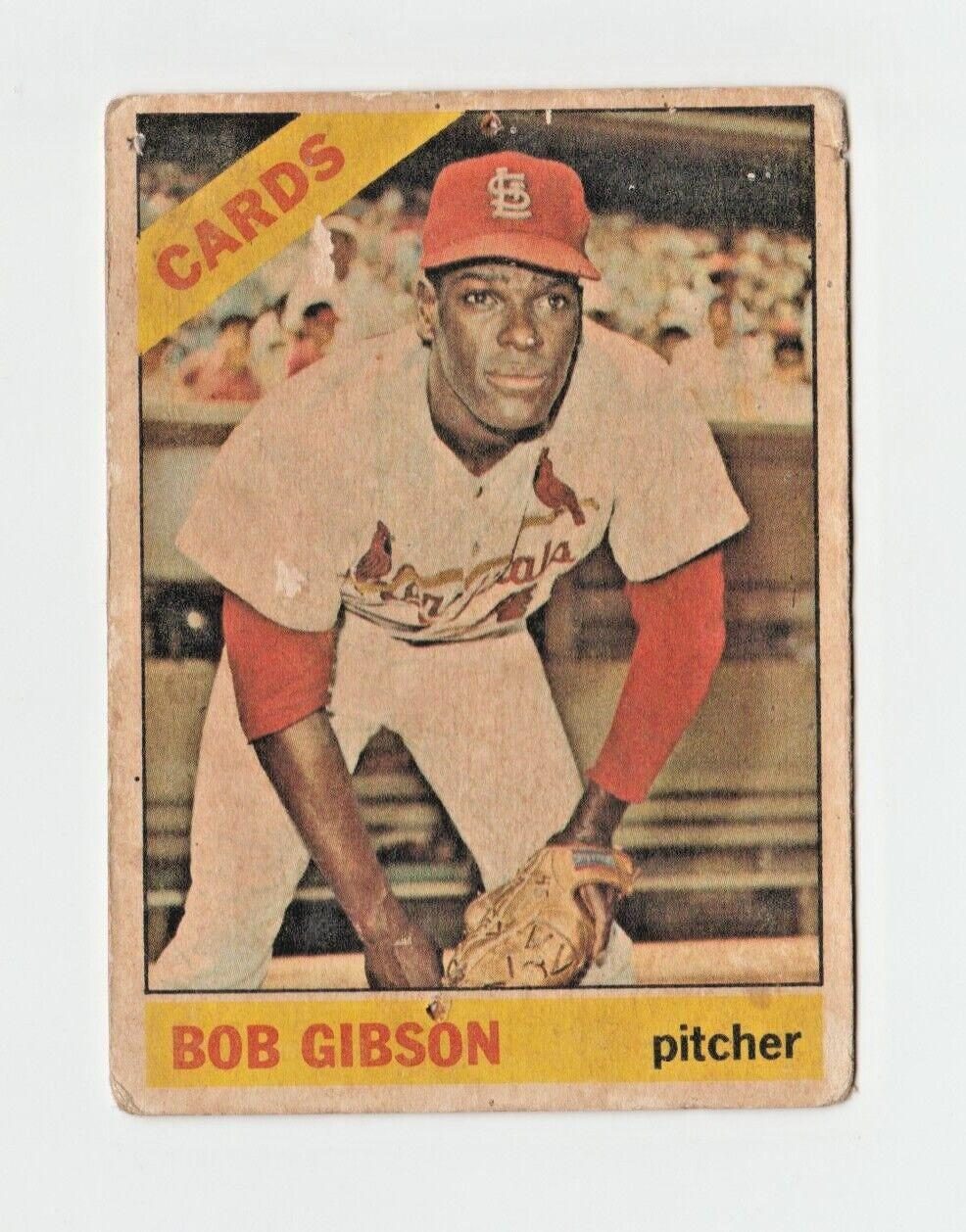
00:01
So the topic here is Cuban and Venezuelan baseball cards and cross-cultural transformation or translation. This artifact here I think is a really good example of what I'm talking about because the — I'll say the Venezuelan cards I think in particular — do a lot of really important cross-cultural work.
You have the translation of, at this point, the very popular 1960s, late 1950s, Topps design and manufacturing signature. You have it translated across cultural bounds and borders to an entirely different cultural context — but a cultural context that holds baseball in a very similar, if not even the same esteem, that it does in its origin;
originary state or status in the United States with Topps.
It's not as clear with the Cuban cards so I'm going to leave that off to the side at least for the time being… with the Venezuelan cards it's very crystalline because of this direct translation in the 60s editions.
01:24
You really have entire Topps sets in the 60s editions. The 67 is kind of a different story because of the Sport Grafico liberties that they take.
It's a slightly different story there. Then going into the 70s, Sport Grafico becomes more and more involved and creates a more… powerfully diverse, specifically Venezuelan mythic and modern creation. It becomes truly nationally owned, away from Topps and the U.S.
But accordingly there, during that period of the late 50s into the 60s and early 70s, you have something that's very, very smooth and very clean and almost seamless happening in the way that cultural information is cross-translated or transmitted.
Here you have Bob Gibson, St. Louis Cardinals. It's almost an exact replica of the United States Topps cards, but these are produced and transmitted in Venezuela.
Already you have a pretty significant transferal of information — cultural information — because Bob Gibson is an era and epoch defining U.S. baseball star.
03:11
The context is shifting, right? It's a change in context in a cultural transmission through the shared love of baseball. This is something that's very different than a literary transmission or an artistic transmission because it's a lived, grounded, culturally mediated experience of participation in the communal event of baseball.
So you might go to an art gallery to look at art or you might go to a bookstore to buy a book. These are solitary, individual experiences that you have. But what baseball does, which is so powerful in a cultural political sense, is that it's a collective experience of passion and joy and play. It’s something that occurs as a gathering.
04:11
It's collective, it's active, it's immersive. You go to the baseball field, you go to the park and you have this entire sensory experience. You're experiencing it with a large group of other people. And again, I'm referencing this in terms of Cuba and Venezuela, but particularly these Venezuelan cards because it would be interesting to see — let's say, theoretically, in regards to the Sport Grafico specific cards such as the Retirado and Winter League sets of 1967, or the independent set of 1970 — Sport Grafico was transmitting that back to the United States as well, and those were being produced at the same time in the U.S., but that was just not the case.
These cards, the Topps Venezuelan cards are coming from a Venezuelan context on a one way trip; a lot of them are just coming back now to the United States and United States collectors are finding out about them and really enjoying them. They're qualitatively different. The prints, you can just see it. It's almost this… they're almost sun-bleached cards, for lack of a better word. You can just see it in the printing style in a comparison between the two — the U.S. and Venezuelan productions. And the qualifications of the cards in terms of what makes them important, I think, is very different. I love this — well-worn pin-holed, some paper loss… they're coming from something different.
05:33
This cultural information is being beamed across borders. These Topps designs are being beamed across borders. They're being received on the Venezuelan end, hundreds, thousands of miles away. It's being translated through the Venezuelan printers and being distributed in a Venezuelan cultural context and experienced there. And then sometimes, and often nowadays — maybe 50 years, 60 years later — being transmitted back. Shipped back and forth to collectors and archivists. The United States is finding out about these cards in a contemporary context and participating in them.
So this is a form of cross-cultural participation through a shared love of baseball — both in the original creation of the cards and their shipment and transference back and forth between Venezuela and the U.S. And that's what these artifacts ultimately are and become, increasingly over time.
That's a very, very powerful thing in my work and what I'm discussing — because what that ultimately is and is about is what is human community, human togetherness, human collective experience, and what are the things that you have a lot of political limitations around? What is integrated? Who and what is allowed to cross certain borders for certain reasons? Who and what is allowed to participate in certain things and why?
You have this revolutionary potential within baseball as a cultural and political phenomenon, which is and continues to be supremely powerful and potent. The entire history of baseball can almost be summed up as integration. It can be summed up as collective participation across borders. It's something that's truly global. And when I say participation, I am again gesturing towards literature and art as being fundamentally different because these are solitary individual pursuits. There might be a sort of collective around them, but they're ultimately solitary, individual, usually cerebral or visual, pursuits.
07:28
Baseball is an entire sensorium of experience that is experienced collectively, whether that's through a television, a stadium, or card collecting. There's a whole ecosystem that surrounds it. And ultimately what it is about is it's a mediation of togetherness. It's a reason and a way to come together and experience the phenomenon of baseball in a very profound and universal way. This is a cultural communion around passion; accordingly, compassion. Compound passion, togethernesses of passions.
So you have the integration of the American leagues in the forties; the integration of the Cuban leagues in 1900; you have baseball that spreads throughout the Caribbean via Cuba in and during that early 20th century period. All of what this is and means is that baseball is being transmitted culturally. It's transmitted across borders, across bounds, across perceived distances and differences and it's being interpreted and translated in a variety of different ways. Its a linguistic spread, or a linguistic virus of passionate play.
08:26
And that's what's so valuable about these Venezuelan baseball artifacts. What they are and what they do is cultural translation and transmission in a way that many more and many other people can experience the phenomenon of baseball — even American baseball — and it can be translated across different cultural contexts.
They’re a bridge to acceptance of differences through the creation of multitudes of celebration of the experience itself.
Baseball is not any one thing. It's created and manifested and changed differently in different cultural contexts. I mean, everything from stickball to different rules and regulations, different cultural methods of participation. The different manifestations of organized leagues and farm systems. People would dance at the early Cuban baseball games. There would be food that was served. There's a lot of different ways that baseball manifests itself. You can see it in an overarching way — this kind of overarching sense and framework — as a primary cultural collective transmission of joy, passion, and play.
09:20
And this is ultimately what is so radically political about baseball. You have these lagging cultural constructs and political perceptions that limit its growth and development specifically in the United States. But you see in other cultural contexts like Cuba how radical political circumstances and revolutionary circumstances advance the game far beyond the so-called timelines and frameworks that history has previously established as modern baseball.
You can see the growth and evolution of baseball proper as a global, cultural phenomenon through Cuban integration; through new methods of play and participation. Baseball is a kind of emergent phenomenon that can be radically advanced and is advancing in a modern context. My framework of baseball's modernity is integration and advancement through integration. So that's not only racial integration, but it's global integration. It’s interconnection.
An advancement of the sport itself through mass collective participation. That's the revolutionary potential that baseball holds. And so when you have cards like these Venezuelan 1960s cards, you can see it's a very clear manifestation and example in terms of these artifacts of cross-cultural translation and the ability to build a bridge culturally, to share something that's profound and passionate and joyful.
10:44
And you're seeing that as an emergent potential through baseball in real time in and through the artifacts themselves. It's not just that baseball was invented in the US and then it's being played in Venezuela or Cuba or Japan or wherever else. It's that cultural artifacts are being exchanged across borders, cultural information, images, statistics, et cetera. And baseball itself is the primary cultural language through which these artifacts exist as languagings, or words of the game — through which it grows and mutates and changes as a global archetype through specific national and international lenses. The archetypes and traditions and languages of baseball are being transmitted back and forth. It's a way of communicating. This is very different than just kind of domestic, enclosed, encased traditional baseball history narratives in the United States, which are obviously very US-centered.
What we're talking about here is a global baseball context, a global baseball culture and mythology. Even a global baseball mycology or bacteriology as in cultural transmission; roots and neural networks of languagings; change — communions and communications across great bounds of cultural contexts and spaces and time. And that's what these cards help create. So it's hard to kind of overstate their importance because what you have here is almost like a precursor to the internet, so to speak, because it's taking cultural information and beaming that cultural information thousands of miles away. And it's being received and understood and translated across cultural lines into, I mean… this card is in English, but some of them are in Spanish and it's also being translated across linguistic borders. People are aware of Bob Gibson as a very important United States pitcher.
It's very important because what cross-cultural transmission and translation does is it forms a network, it forms a creative connection, and what we're connecting here around is baseball and the entwined mythologies, narratives, stories, actions, and larger cultural and political contexts which informs each regional interpretation of baseball therein. You can see Cuba, Venezuela, Puerto Rico, Japan — many, many, many different ways that baseball becomes much bigger than just America's pastime and it becomes a global way and method of creating higher levels of political, social, cultural relationship that transcend the typical traditional methods of colonialism or empire or control or fear, domination.
These very typical, almost rote ways that human beings use fear to attempt to… use and control and manipulate cultural context and information. What's possible here through baseball, right, and this is what's very important — is a real sympathetic, I was using the term syncopated or syncophonic— way of interrelationship, right? It's allowing different cultural languages to speak back and forth to each other through the translation and overall literary construct or power, imaginative power, of the sport of baseball itself as a real live, communal act of participation and construction of event. Through global gathering. It's an outline that can be translated, traced, and transformed; cross-culturally communicated.
So when you're approaching things through that linguistic, right, the linguistic of joy and passion and play, and that's being exchanged as opposed to the attempt to conquer, control narratives, take resources, manipulate people… again, control them — you're working in and with a radically different political framework that generates radically different results. There's just no way to generate a beneficial result out of manipulation and fear, which is the political overtone of much of the colonial history, not only of the United States, but of the world. This is the thousands of years of legacies of the age of empires, civilizations; conquering and dominion of territories.
The imposition of the rule and law and culture of empires. So we're talking about radically re-translating the human experience and how we communicate globally — translating it through play instead of war, right?
This is my… radical overarching theme of the Cuba essays, but it's also apparent here in these Venezuelan baseball cards, specifically the Topps translations. There's only a risk of understating the power and importance of this. Because what is important here is to rid ourselves of a narrow, tribalistic, nationalistic vision of baseball — whether that's an American vision or Cuban vision or Venezuelan vision — and instead understand the larger global universal network and framework of cross-cultural translation and transmission of information through, as, and in baseball.
This is where baseball really gets interesting because it's a language. So you're seeing a universal language form — a language that’s a language without words. Something that can be translated and transmitted everywhere, anywhere, all the time.
Something that was translated around the world before the internet; only continues to become accelerated by technology and global interrelationship. It’s an action — baseball is — and not only an action, but an active cultural exchange that elicits participation in mutual myth forming and the real, sweat and dirt and teamwork of creative joy through movement and cross-cultural memory.
These cards themselves are just an absolutely perfect example. And they go much deeper than just Bob Gibson was a good U.S. player, or this card set is a great set because of this or that feature — these are living artifacts of the global modernization of a vision of a collective that's based around real communication, which is cultural. It's always cultural.
It's always through a joy and passion, whether that's food or sport or whatever it is.
It's a way of communicating back and forth through the sharing of a very honest and authentic human joy. This always transcends perceived or constructed political bounds, borders, and walls of control and power through, power over. It's the real experience of what we love and why we love it, right? And that's what’s being shared back and forth. This card is a living embodiment.
It cuts through everything, right? It cuts through political infighting and wars over resources because what you're trying to do here and what you're really doing — just by sharing this joy, from US to Venezuela or Cuba to the US or Venezuela to the US back and forth, Japan to Cuba, whatever it may be — what you're really doing is you're creating real relationships.
16:51
Creating real relationship based on shared passion and shared joy and through real relationship, anything is possible… because what real, real relationship is is communication, it's collaboration, it's we're working together to achieve a common end which is the mutual prospering of us and our joy, our passion, our experience that we are experiencing together, right? Not only as civilizations but as a globe and as a world culture — and what baseball is — what it really is — is a world culture.
So you're creating that paradise, you're creating that possibility and potentiality through the establishment of cross-cultural communication — through baseball. It's just a radically different method and approach. And so you see in various different periods of time of baseball's cultural history and development… the mid 1800s, early 1800s, all the way up till the present, early to mid 2000s… 2020s… you’re experiencing and witnessing in real time what modernity and globalization are and you're viewing it through the lens of baseball as a primary and perhaps the primary modern cultural global phenomenon.
This connection between the growth and development of global baseball and baseball as the cultural phenomenon of modernity proper is a really great way to visualize it because of this cross-cultural translation and transmission that occurs — across space and time as a linguistic transformation beyond words — a language without words.
So I will leave this here. I will see you guys on the next one. Thanks for watching.
6. Baseball Cards as American Language
Jun 15, 2025 · pp. 114–122
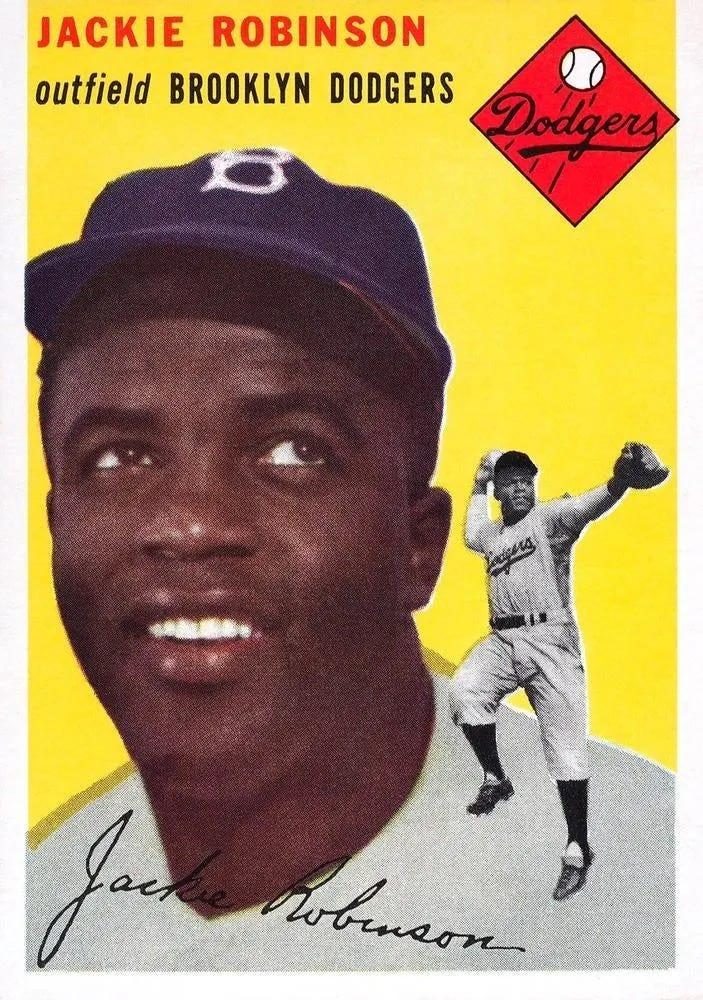
00:01
So my topic here is sort of a continuance of the last essay… baseball cards as American language. I want to delve deeply into this because this is a very specifically American phenomenon. A 20th century American phenomenon — where the baseball card really emerges as a powerful way of translating and communicating the language of baseball to a very large group of people.
It's a way of making the images and the meaning of baseball, as well as the figures who constitute it, immediately accessible. What I have here is the Jackie Robinson 1954 Topps card. And I think this is a really great example because this is when the baseball card really becomes institutionalized with the Topps sets of the 50s.
01:02
Before there was a diffuse — there's tobacco, there's candy — there's many different issues that pop up. Bubble gum, the Goudeys, they pop up and they swirl. They're trying to create ground or establish what is the identity or the fabric of the baseball card. And it coalesces in 1950, 51, 52 when Topps buys out Bowman and establishes itself as the baseball card creator.
And through that you have some of, if not consistently, the most iconic designs in baseball card history. And I would also say, art history and American art history — in these early to mid 50s sets. The reason why I say this is you look at what a baseball card is, it's a very egalitarian form. These are highly, highly accessible at the time when they emerged, right?
It's obviously different now because they're looked back on as history and as artifacts. These are now quote unquote vintage, but you look back at them now — it's hard to imagine how accessible these were. They're made on cheap pieces of cardboard. These are literally images printed on cardboard.
And I want to dig a little more into that specifically because I think that's really the key to understanding baseball cards. For a long time — I talked about this in my T3 essay — for a long time in Western art history you have this very aristocratic art sense. The art is being made for kings or being made for rulers or the upper class, the Medici’s in Italy, for example, in the Renaissance period. These are historical artifacts that are meant to be grandiose.
They're meant to be… significant paintings that depict significant mythologies, whether that's the Christian myth or religion, whether that's Greek mythology, for instance… you have a really radical shift that happens in America around American mythology, specifically American mythology, as it relates to the art or the images of the civilization and the culture at large; the visual images that represent it — in the way that they're produced and distributed.
03:36
These are cheap pieces of cardboard that are distributed in a highly egalitarian way.
There's a lot of these mid fifties Topps sets. We're talking about the mid fifties because this is when the baseball card really solidifies and institutionalizes itself. It declares itself. As opposed to the first 50 years of the baseball card and even 70, if you want to go back to the Old Judges, where it's still figuring out what its identity is, who it is, what it is.
This card, the 54 Jackie Robinson, is a perfect example of American myth and art history intertwining and making a very egalitarian and democratic declaration of what American art is and what American culture is. This is my card that I would choose as representative of all baseball cards period. Not only because of the 54 Topps design, but also because of Jackie Robinson.
It is a level of iconic historical art history that for me far surpasses anything that happens in America otherwise with Warhol or any of these other people who were active in this period, the mid-century period, before and after. Because what it is is it's a declaration of America's collective cultural identity and its principles. The pop art element of baseball cards has been present since the lithographic printing machine method existed, which is all the way back in 1909 with the caramels and the T206s.
The flat color, the pop of figures, the strangeness of backgrounds in juxtaposition with the attempt to establish context, whether it's fielding or throwing or hitting — this is very pop art style and you can see it in American baseball cards all the way back to 1909. That in itself is a revolutionary understanding.
05:48
But it's just so very clear in the 1954 set; the coalescing of this emergent design sense in a perfect iconographic vision and presentation. I think a lot of this is for legibility purposes and reasons, as well as just ease of printing. You don't have these very complex, high contrast backgrounds.
You can just pull the figure out, slap a flat color in the back, and that prints just a thick sheet of yellow; then you have the contrasting color gradients in the figure itself. Dating all the way back to 1909, flat slabs of color create ease of mechanical use and reproduction of design guidelines.
06:17
I think there's that element. But we're talking about this as a holistic visual language.
So there's obviously the components of the image. You have the details on the back.
This card talks about Jackie Robinson's philanthropic work with youth in the country; talks about his skill on the field in terms of his bio. You have all of his statistics. This is a way of documenting.
06:46
I want to make that clear. This is a way of documenting history. These are pieces of art. They're declarations of American identity in terms of America as a culture and baseball as America's culture — as well as ways of documenting America's cultural, political, and social history. So if you think of ancient frescoes or you think of the writings of Plutarch and these ancient Greek and Roman recoveries of history, we have a process here in real time that's simultaneously mythologizing by way of art images — the American myth itself, baseball — as well as documenting in a historical process of marking time with the cultural achievements of our culture's greatest figures.
There's something to be said here with Jackie Robinson in terms of the merging of culture and politics, because you have different kinds of history, right? You have a political history, which is typically wars, conquests, power, economic, class-based issues, race-based issues. You have these constellations of civilizations and the way that they create boundaries and borders. This is more of a political history of a country, whereas a cultural history is usually for entertainment purposes, for joy and enjoyment. That's what's created inside the insulated bubble of a culture or a civilization — is the cultural history. But you have figures, I think Jackie Robinson bar none is the best example, who cross those borders, right? Who make it clear that there is no such thing as a cultural history without a political one and vice versa.
Obviously shattering the color barrier in 1947.
It's a huge moment where America's dominant cultural mythology collides with America's political realities and presents you with a full holistic vision and view of why, in a lot of ways, culture is first and foremost the way in which nations or civilizations politically evolved. Culture is the lens through which a nation or a civilization views itself and then through that lens it reflects upon itself.
09:13
So if we're watching baseball and all of a sudden you have a black player on the professional US baseball fields for the first time in decades, you're asking yourself, why did this take so long to happen? Why am I having a positive or negative response to this, et cetera, et cetera. It's a vision, right? The same way that you think about TV or movies.
These are visions of ourselves as a collective; ourselves as the collective psyche, composed of individual psychic viewpoints and apertures; composed of the legacies of our culture, familial, and civilizational — enfolded into the present moment. The dominant cultural myths and formations are the way through which civilizations envision themselves.
09:44
I talked about this with Plato in terms of wrestling and the Olympic games, as well as the Greek theater. These are all ways through which civilizations achieve a level of self-reflection. And so when you're looking at the baseball card as specifically American, it's a very, very, very revolutionary device because of how egalitarian it is:
the way in which it is produced, and the material upon which it is produced.
I talked about the cardboard, which is very cheap, very plentiful, but you have these really high quality and really beautiful art images that are transposed on the cardboard. In addition to that, the egalitarian method of distribution (again, as discussed in the T3 essay) — these are mass produced, widely available, produced through industrial means.
This is very American economics, American capitalism. Produced through industrial means by companies that become consolidated into a political vision of a cultural product. First, it's to sell cigarettes or sell candy or gum. It becomes consolidated and the cards themselves actually become a product.
First, they're a marketing tool and then they themselves are a product. It shows the emergence of an American art form that actually mirrors American values. Its an emergent materialism; a political, social, and cultural invention of a creative product produced en masse which actually visualizes and envisions and accommodates the American myth and vision of self, in real time itself.
11:08
So if you think about the Constitution or the founding documents of American civilization, you can think about that document and then look at baseball cards through that lens, and it's one of the clearest examples, I think, of American ideals being translated over time into real form.
And so what I mean by that is that you have these very lofty, egalitarian ideals — all men are created equal, they're attempting to establish a secular society where all religions can be respected, or appreciated. They're attempting to create a society which is actually very revolutionary in terms of how inclusive it is, right? And so you look at the development of the baseball card through that lens as a cultural product of America's dominant cultural mythology.
12:03
And you can see broad scale and broad scope through, again, through the material, through the art style, through the way they're produced and distributed — these are all ways of creating that reflection. And this is, it's a complex thing because what we're trying to do here is look at America itself through its primary cultural phenomenon, which I would say in its most formative and world politically declaring years, which is the 20th century. Hollywood gets bigger and bigger, but you're still looking at, especially mid-century — Yankees, Dodgers, Giants. The battle of New York City. You're looking at baseball as, patently, the phenomenon in American culture and society.
And furthermore, with baseball cards, you're looking at its primary cultural product — the way it makes itself available to its political constituents in physical, possess-able, representative, archetypal cardboard form.
13:03
It's a compound topic. We're not just talking about a art historical declaration. These baseball cards are very clearly pop art and pop art being America's art historical, economic contribution to the landscape of art history itself. Everything that pop art represents is the commercialism and the ennui and the confusion of hyper-materialism that in turn represents the American political consciousness, or the American spirit or the American soul.
It's this everything can and will be sold, business marketing perspective that's laid on top of a real history of violence and oppression in order to establish the economic and political possibilities that we now know as American society or civilization. Its cities, its landed borders, its economic powers of production and consumption. Its nationhood. We're looking at that. But we're also looking at the way in which the myth is constituting itself and reproducing itself. Because this is what upholds societies and civilizations. Perpetuations and reproductions of myths and stories we tell ourselves which normalize over time. This becomes ‘everyday life’.
It's almost hidden because these baseball cards, they seem very innocuous, right? But at the same time, they are a way of creating mass produced art, as well as a mass produced narrative and story, as well as a way for the culture at large to actively participate, possess, own, and engage the myth in a way that is not just ephemeral.
They ground down the myth and make it real. These baseball cards last. There's entire catalogs of them. There are thousands upon thousands of these cards from different sets, different years. They're almost being mass archived by the cultural collective memory, so to speak. They're being mass stewarded into the future by people who are deeply devoted to not only the baseball game, but baseball cards.
These are prized possessions for a lot of people.
And so when I think about baseball cards, I think about the fact that they're produced on cardboard. This is something that's deeply meaningful to me because it really hits this space — it's almost like a spiritual space between meaning and nothingness. They're not pretending to be some sort of highfalutin art historical artifacts. They're not being proclaimed as foundational cultural artifacts or documents. They're mass produced and they had sticks of bubble gum with them.
Stuck in packs of cigarettes sold for nickels to factory workers, laborers; people across class lines.
There's an element of childishness and even meaninglessness that's associated with them. But I think that's where the beauty really comes from. And it's something that's very different and almost absurd that is so particular to American culture and American social values. Because what you're grappling with in the 50s themselves, and I talked about this, is the existentialist revelation of hyper-modern, hyper global society and the fallout of the loss of values that occurs during that period of time.
And in a lot of ways, baseball becomes a cultural myth out of almost necessity because you lose a lot of what previously were the traditional values of Western civilization themselves, right? There was a sense of regional boundedness and the regional religious, social and cultural mythologies were very self-contained. They were and remained possible due to the technological and political realities of the time that stabilized locality and pockets where myths sustained themselves in their own bubbles of homeliness, so to speak.
16:58
Through the sport of baseball and through the culture of baseball as an emergent global phenomenon, you have the ability — not only for America — but for countries like Cuba (in its attempt to become sovereign from the colonial empire of Spain) to establish themselves and create a collective cultural identity through that event, through that phenomenon; through that collective experience — much in the same way that the Greeks would gather in the theaters and experience the plays of the great Greek tragedians and have collective experiences in Rome in the Colosseum, et cetera.
So when you look at that, you're looking at these works of art that are cultural forms of documentation and actually establish and uphold the myth itself in their presence.
Because these are moments in time that function to document the ephemeral in the eternal; retain the presence of history in the card itself as a form of cultural remembrance; cultural memory. These are still images that are iconographic. This Jackie Robinson, again, a great example. It's an iconographic still image that holds in time something eternal about the ephemeral nature of the game of baseball itself. It's not proclaiming itself to be a major work of art or a major painting or major photograph, what have you.
These are not considered typically cultural documents, and that's precisely what's so important about them from a very egalitarian social and political perspective. The persistence of them, I think, is incredibly important. That's what I got. That's the riff. I hope you enjoy.
7. Monopolies -- Baseball, Topps, and America's Rise out of WWII in the 1950s
Jun 18, 2025 · pp. 123–136
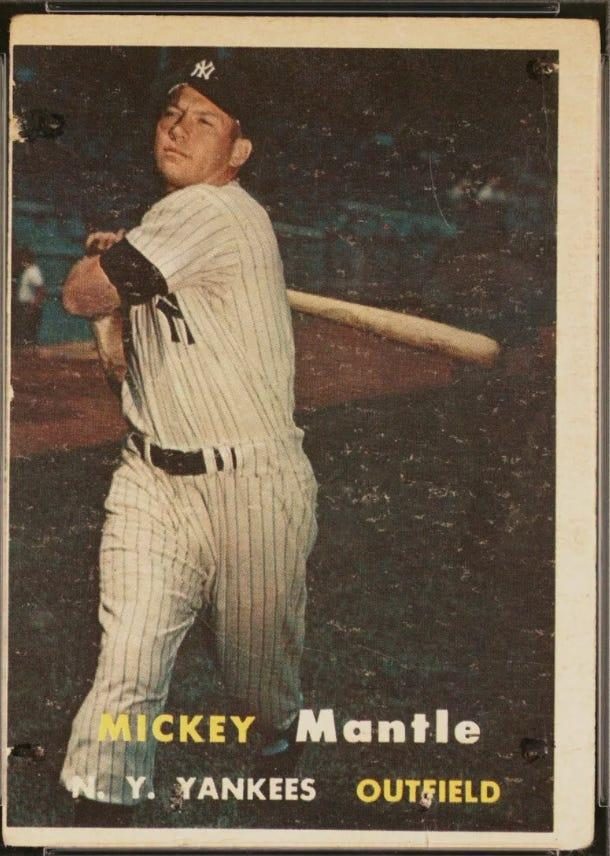
00:00
So the concept for this episode is monopolies within monopolies within monopolies.
00:21
It's to talk about American political power in the birth of the 1950s Topps sets. The idea here is you have a couple of different things that happen around the mid-50s.
And I'll couch this by what happens that actually births the modern baseball card in 1909 with the T206, and the monopoly that happens with American Tobacco. And the antitrust suit that breaks it up.
00:51
This is 1911. They quickly crowd out the market because of their automated cigarette roller that they bought from a worker from a rival company. They bought out his innovation and they quickly dominated the market just because they could produce cigarettes faster, faster, faster, quicker and quicker — with better quality as well.
The whole antitrust thing happens at the onset of the 20th century with a lot of the industrial things that happened in the country at the time. There's this increased technology and people start to corner market shares. This is JP Morgan, the Rockefellers, Henry Ford. There's this massive industrial revolution that's occurring in the country. So you have a political moment where industries are becoming monopolized by superpowers, super industrial powers.
This is not just limited, of course, to the nation of the United States. This is becoming a global political problem. So this goes into World War I, World War II.
And what happens after those two wars, you basically have a bookend, historically, right?
The historical bookend is 1909, the Dead Ball Era, the T206. And then you have this massive world war and then another massive world war immediately afterwards.
02:17
And then you come out on the other side of that bookend in the 40s, 50s. So this is where it gets fascinating because it's almost like there's an immediate bridge that occurs from the T206 innovation, which is directly connected to American Tobacco, which is a industrial superpower of tobacco production, the primary cultural enjoyment of the entire American country. Cigarettes are just absolutely huge and they're huge until… even going into the later part of the 1900s.
You have that on one end, World War I, World War II, and then you have this emergence into an era where America has essentially monopolized the world global stage. It's no exaggeration to say after World War II that America has, in many ways, almost conquered the world. I want to allude to Alexander the Great and his historical project. You almost have that — is what happens at the end of World War II.
America emerges clearly not only on the side of the victors, but perhaps as the chief victor itself, and with all of the political power and might that comes with that in terms of resources; its international constituents — whether those are pseudo colonies or just political cedings of power that are occurring around the globe to America after that war.
03:47
This is when you have a monopoly within a monopoly within a monopoly. You have the monopoly of American world power. You have one of the only monopolies that's actually ever been allowed in America — maybe actually the only one. I'm not sure.
That's not my area of expertise — but Major League Baseball, right? This goes back to what I was talking about with the Federal League and the whole antitrust suit that happens with the Federal League a decade after the American Tobacco antitrust suit where ATC gets broken up and it gets turned into, the Reynolds cigarette company and there's a bunch of other ones.
You can actually still see a lot of the old American tobacco factories in North Carolina and Virginia. They're all still there. Some of them have been converted into apartment buildings and things like that. A lot of them are. But anyways — you have monopoly within monopoly within monopoly. The MLB wins that antitrust suit and it's a legal monopoly, which is just insane, right — against the Federal League. The Federal League is saying that MLB is making it impossible to hire players because they just buy them right back.
The courts are almost declaring Major League Baseball a privately owned national park — this is something akin to what happens in the 20s. It gets declared America's pastime as an institution, but there’s obviously private ownership power there that you can see to this day. It’s a legal private public institution. Some of the richest people in the country own these baseball teams.
05:14
So you have one monopoly, America, the world power, emerging after World War II.
This has essentially monopolized the global scene and you see a lot of the stuff that occurs afterwards in terms of the prosperity of the country stem from this spoils of war… which is very brief because of how the political and economic situation is handled, it's almost an embarrassment of riches and the country squanders it due to just flat out poor management. So you have that. Then you have another layer, which is Major League Baseball, as we discussed. It's a legal monopoly as of the 1920s. The Negro Leagues get ceded into that. All the Federal League stuff including Wrigley Field gets ceded into that and it's over.
A lot of the best Cuban players, Venezuelan players, Puerto Rican players, they all come to the United States as well as Japan, elsewhere — in and by the 1950s onward.
This is something that is and gets set into motion by the larger political and economic circumstances of the globe at the time. And then within… that monopoly of the MLB — reified and redoubled upon integration in 1947 — you have another monopoly, which is Topps baseball cards, right? The 1950s and 60s sets.
Topps buys up Bowman at the beginning of the 50s, middle of the 50s, and it turns into this monolithic cultural product. This is where it gets really interesting, right?
Because you can say that due to the utter singularity of these monopolies, they're almost public institutions that are owned privately. The Carnegie family owned entire towns outside of Pittsburgh at this time in history. You’re talking about a region. Stores, land, the very infrastructural grid. This is an interesting economic concept because you have a lot of economic and political ideologies that you could gesture to out of laziness, but when you have that level of cultural monopoly of product as in Topps or as in Major League Baseball post-integration — which is crucial — you have players from all over the world coming to play in this league. It's almost in the way that the Smithsonian is a cultural product which is both privately and publicly backed.
It's an institution of culture and of humanism. But in the case of baseball, it is in the most part a monopoly of private interest; Topps reflects this. So I really want to set that stage and establish that because if you look at things through that framework, you have the institution of Major League Baseball and the institution of Topps.
Topps is the sort of, you could call it like the White House painter or the national painter, so to speak.
It's the representative image making institution that creates the cultural object, or product, to sum up and distill the cultural ambiance of the essence of the public institution of baseball itself. And this is really powerful because if you contextualize things this way — I was thinking about this in terms of the history of baseball, the full history of it.
It's something that could never truly be told because there are the roots of so many different interweaving stories, both national and international. It's such a broad thing that it's more of a poetry than it is a history, because you could never truly sum it up. Even when you look at someone like Dizzy Dean or Satchel Page, there's such a mythic full history of that individual. Dean’s childhood, Paige’s childhood. These are absolutely essential American historical moments and developmental phases of figures who paint the picture of America’s soul through their lived experience.
That mythic full history of the individual intersects with a large, large, large public denomination of people who are experiencing the legacy and the legend that's playing out on the public stage. It’s almost a massive spiritual church of baseball — where the mythic world historical and the intimate personal as forces of identity collide. That is the Gashouse Gang of 1934 in the midst of America’s economic plummet or Satchel Paige with the Monarchs, as he enters the major leagues; goes down to play in Cuba. Dizzy and Paul Dean working on the cotton field, throwing hickory nuts and practicing their pitching skills.
So you have this very, very, very broad mythic tree, right? With branches and roots that reach far beyond that which any one historian or even an institution of history could ever possibly sum up. There's the experience that many individual people have through that. Our personal experience as a collective unity of baseball. Someone told me this experience that they had of walking through a neighborhood and there was no AC at this period of time — everyone was playing the baseball game on TV and you could hear it through their open windows. They were just trying to get some cool air in. So you could hear the baseball game walking through the neighborhood as you passed multiple different houses.
09:29
I've found some pictures from Cuban magazines of kids playing stickball in the streets, just in the dirt in the streets. You have all of these different memories that constitute the real history of baseball. And the legacy is just an attempt to distill that.
So that's a lot of what historical work and archival work is and attempts to do, to recover the full body of that history — although that’s obviously never possible, right? You're always reaching into the unknown to a certain extent.
09:59
But it's also the importance of Topps, the creation of Topps as a sort of chronicler of the national pastime. You have magazines like Baseball Magazine, or in Cuba you have Bohemia Magazine. All of these different ways, newspapers, the New York Times, that are capturing and distilling and conveying and communicating the language of baseball across the nation and across the globe.
10:29
When you look at cultural artifacts, and this is what's so powerful about what happened with Topps and what's ultimately so important about, I'm gonna say this, it's almost like the public institution as a monopoly. There's a certain point where there's a cultural institution or a cultural history that needs to achieve this status of being exempt, which is really powerful. And the historical tension behind this idea is whether this is publicly or privately owned. The Topps company, with all of the economic thrust that's behind it, it's entirely individual. For the 50s and 60s, you have some brief interlocutions like 63 Fleer and regional releases and bread releases and things like that.
But when you're looking at the full body of what constitutes baseball cards at the most epic high point of American civilization in terms of its global international power and cultural reach, as well as the full body of baseball as soon as it comes into the period of integration and post-integration — its solely Topps as the cultural object maker and chronicler in the mythic, spiritual, artistic way of speech.
You're looking at something that's so culturally distilled — this specific historical moment and all of the nesting eggs of its simultaneous developments. Again, 1950s, it's Giants, Dodgers, Yankees, right? It's the Battle of New York. It comes back full circle. Interestingly enough, you look at that period and connect it to 1920, 21, 22, 23 — which is, again, it's the Battle of New York before mid-century, which is the Giants and the Yankees, the series of consecutive World Series. Then the Yankees ultimately win out. They have Yankee Stadium. They have Babe Ruth’s contract.
12:17
1927 World Series, Murderers Row, you go into the 30s. Babe Ruth's called shot.
DiMaggio. The Yankees at this point are a national cultural institution. People wear their hats from all over the world — even if they don’t know what baseball is. It’s that conspicuous. New York rises in the might of the first World War and the industrialization of America and the world and it just doesn’t relent. It happens in the 30s, 40s, but it's just so big in the 50s with Jackie Robinson, Pee Wee Reese and the Dodgers; as well as Willie Mays and the Giants. And then obviously you have Rizzuto, the end of DiMaggio's career. You got Mantle, you got Maris…
So this is just the core and the reason why I point to New York is because it's the industrial and media cultural super center of the United States. As I said before, was;
you could still say is in a lot of ways the world's capital, right? Not only for industry, but for culture. So this is kind of what I'm working around here, this idea of monopoly within monopoly within monopoly; even introducing New York and New York baseball, within monopoly.
And if you want to take it to that next level, it's New York City, the Yankees, Dodgers, Giants, and then ultimately — the Yankees. And that's all a condensation of political and economic and socio-cultural power. Distilled and drilled down into one Mickey Mantle, Babe Ruth, Lou Gehrig, or Joe DiMaggio baseball card. And that's so much of what the legacy of the United States has been about, its political and economic power, which obviously, as you can see, has little to no concern with ethics or moral standing and is much more to do with the accumulation of power at all costs.
So you can see a lot of the cognitive dissonance that happens there when the United States says it's doing something for maybe moral or humanitarian purposes, but it ends up just being for political purposes.
What we're talking about here is the cultural institution of baseball as it represents the American mythic cultural subconscious of the entire community or the ideological backing of the principle and idea of America itself. It's kind of difficult to talk about, but I mean, the Constitution again is a great example, right? It says one thing and the political reality of America is the accumulation of power at all costs for those who are in positions of aristocratic standing in the country. Not slaves, women.
Landowning white men. It says one thing and does another. The parts of the Constitution which everyone knows are its philosophically declarative cultural statements. Does it do what it says its going to do? What it says it is doing?
And so yo look at the cultural outputs that come from that. Its a founding moment;
from foundations emerge branches. Like seed, roots below and leaves above. And I'm not necessarily saying anything is either good or bad here. I'm looking at this from a place of the attempt to understand history. History is not moralistic, or at least real history isn’t, anyways. It’s objective. What comes out of America, I would argue, first and foremost, is baseball. You have Hollywood, of course, as I said before, but when you look at baseball as a cultural institution that embodied the American mythic heroic identity… and it played out in real time, the attempt to create a mythic cultural history. There’s no candle to that in the dream screens of Hollywood. Hollywood is what America dreams, baseball is what America is, lives, moves; be-s.
15:05
What happens in the fifties with Topps; with America emerging out of World War II and the integration of baseball, you have a sort of high point — which emerges through a tension and a contradiction and a paradox — which is, you have the full fledging of the cultural institution of baseball, which had for so long been in development. It's been a century in utero.
15:35
It's building, it's developing, it's creating its identity. Its nursing in the womb of history and time itself, gesticulating. And then all of a sudden you hit the 50s post World War II and everything falls into place. And I don't think it's a mistake that it does when it does, because that's also when American civilization reaches its high point, right? And it reaches its high point through the creation of global war, global conflict, where the real stakes of the world are being mapped out for the first and second time in history with World War I and World War II. Again, totally, utterly unprecedented.
You could talk about Persia, you could talk about Alexander the Great or Genghis Khan, but never to that extent had the world been in a place of conflict musical chairs, so to speak. So what comes out of that is America as really one of the youngest nations on the scene emerges with an identity that's arbitrated through war. Civil and World War.
And it's interesting to see the parallels between war and baseball, especially in regards to people like Ted Williams or how baseball intersects with the war in terms of how magazines and newspapers convey information to the American public. They both are certainly front page news. I have a great copy of the 1916 World Series news utterly ensconced with global war news on the front page. They're very intertwined.
It’s quite telling. They’re very intertwined. Preoccupations of action, movement, force. Political force — this is deeply American. But you see the real soul of America represented primarily in baseball, not through war.
And I think Hollywood is more of like a commercial industry of dreams. It’s immaterial. It’s selling light and screens, projections which never really come to be.
Its a conman’s game. The heart and soul of America is manifest through baseball, through the striving that's there, in the real work of the flesh and sweat and blood in mythic, athletic endeavor — violence without violence — the perfected sport post Colosseum.
Whether it's Phil Rizzuto or Jackie Robinson or Lou Gehrig... Babe Ruth, these are American cultural histories. All of them. Babe Ruth is a great example in terms of his childhood. Coming from a foster home, a very troubled child and throughout his life dealt with a lot of very significant psychological, physical; mental difficulties and setbacks, but created this larger than life mythic persona through his play on the baseball field. He triumphed, like Mantle, through great existential and personal turmoil through his heroic, mythic ascent on the field of battle without war.
It’s like an Achilles, cleansed of blood, replaced with sweat and monk-like, spiritual toil. So you see, it's this sort of cultural theater in the way of the Romans or the Greeks through which you rise mythically or through sport and through athleticism and through engagement with life on real active terms — through engagement with the potentials of what is possible, really, physically, in real time. The embodiment of real physical political force, the perfection of war to the point of which there is no more war. It’s the art of the sport, paramount; perfected, through centuries of development. The Greek god Aries or the Roman god Mars.
It's that kind of thematic bridge and evolution. Things are playing out through America's development or the ideation and uterine stage of America's development through that active principle. Through active physical force and how to spiritually evolve through real engagement with the potentials of the flesh, movement, and the will. So to go back to the monopolies — there's almost this transcendental alignment that occurs there in the 50s: with Topps, with America emerging from global conflict as international victor; the monopoly of Major League Baseball and its full integration.
And this additional mid-century layer of New York City baseball identity: Jackie Robinson, Willie Mays, Mickey Mantle. There's this sort of mythic core that reaches its utter height at that period of time. Layers within layers within layers, like a fractal. And it's just fascinating to see how it manifests through, I think the lens is really, again — the baseball card. And that's why I keep coming back to that topic, because it's the way in which the myth is represented; its condensed and coalesced through multiple different things.
The T206, which — again — is the first modern baseball card, or the big modern baseball card that emerges at that industrial pivot point which we discussed right before World War I. You have that unfolding of the history of the baseball card, the T206 to Topps. You can see a lot of those early caramel and tobacco releases in what Topps does, especially in terms of the flat colors and the cutout players. That's developing as a through-line, a timeline.
Major League Baseball is developing — right from the late 1800s through the segregation period through the Cuban leagues and the Negro Leagues to the ultimate integration in 1947. You have that which culminates there. And then you have the larger history of American civilization itself, which is developing from the Constitution to the period of internal conflict through slavery and segregation in the 1800s through the period of global war turmoil — in which people of all creeds and colors engaged in this war.
And then ultimately the integration in the 50s and then this period of intense civil fomenting in the civil rights movement, which Jackie Robinson was a big part of, as well as the… massive cultural, social changes that happened in the 60s — connected especially to the Vietnam War, Kennedy, Cuba. Again, big theme, Cuba comes in.
So you can see the network that I'm trying to draw here. There's this massive intersection between baseball history, American history, and world history. It's a picture that could probably never truly be summed up in terms of its magnitude and the difference and the contrast that occur within it.
21:22
But you can see how important it is that Cuba goes through its independence movement at the end of the 1800s, really intersecting a lot with what the US Civil War movement is, does, and is doing in the US internal self narrative. The Cuba independence movement is a national liberation movement as well as an abolition of slavery movement. And then the Spanish American War right at that 1900 period.
Leap forward into the 50s and 60s, Cuban Missile Crisis, John F. Kennedy, Castro.
21:51
These are themes that are emerging, receding and emerging in relationship to and through baseball. When you look at American history through the lens of baseball, you're actually able to see America's attempts to come into being. You can see the myth manifesting. Not the story the nation wants to tell itself, as in cinema and Hollywood — no… the story of the nation itself. Its real, live, living, active attempts to self-realize and self-actualize. It's the medium through which America is actualizing, the same way that maybe an artist has a paintbrush or a musician has a guitar.
22:19
For America, the medium of actualization is baseball. It's a very, very nuanced and subtle thing. And so when you look through the lens of a historian or a philosopher or archivist at baseball, you're looking at how is baseball representing itself, not presenting itself in terms of the action on the field and this and that, but rather how is it representing itself in terms of its cultural artifacts? And so there's a couple of different ways to look at that. You have the photographs, which are — it's not baseball representing itself, it's the news capturing baseball. You have newsprint, similar thing, television.
These are all things that first that you could kind of say, you know, this is baseball representing itself. But you have to look for a mythic distillation of the image. And that's usually iconographic. Its the crossroads between the dreaming and waking state. It’s hyperbolic, religious, spiritual, liminal. It's not literal, it's not documentary.
So when you look for that iconographic imagery, what you find is the baseball cards.
23:17
So the history of the baseball card is the history of the image representation of the American self as it is in the period of its most intense formative development, which is 1900 to 1950 or 1960 — because now we're attempting to distill national liberation;
abolition of slavery with a rapidly emerging industrial global environment and create and cultivate a collective identity that is not segregationist, it's not isolationist, it's involved in a global community. But its still ‘American’. Its still defined. Who is us?
Who are we? What is ‘America’?
Identity is separative. But the world is rapidly breaking and blurring all boundaries and borders. Religious, cultural, racial, technological, national. So you can see how for a young nation that's immediately jarring. There's very little time that America exists in a regional period of privacy, right, as opposed to Italy or China or Greece.
24:13
These are areas, they've existed for hundreds and thousands of years. They had regional relationships, sometimes more semi-global, like with the Silk Road. There's a lot of different areas that are coming into relationship in the Silk Road. In terms of the world historical intersection of the United States' developmental phase; as that relates to the awakening of the world to a truly global reality — its seismic.
When we look at the 50s — I'm just going to reiterate it one last time — you have the height of American political power in terms of the international revolution of the end of World War I and World War II, where America emerges clearly the undisputed global victor of that conflict, even within the victorious faction of the Allies.
25:04
You have the birth of the absolutely condensed, consolidated, typified modern baseball card with Topps. The entire history of baseball card has been distilled and presented through one dominant, mass institution, which is also a private company — which is Topps. This is the summit. The emergence. And the emergence of modern baseball: baseball is allowed to be a monopoly as of the 1920s, but it becomes America's national cultural institution in an entirely integrated and holistic way when integration occurs. 47, Jackie Robinson, technically the official integration of baseball and then into the 50s. Larry Doby, Minoso.
So that's the episode there. I hope you enjoyed this. It's a big picture perspective and there's a lot of moving parts, but I think you can see the picture that I'm painting with a broad brush here.
I hope you enjoyed. I'll see you on the next one.
8. Baseball Hellennia -- Plato, Homer, and the American Myth-State
Jun 19, 2025 · pp. 137–147
00:04
Alright, so what I'm gonna discuss here… I'll just kind of broach these themes because these conversations are getting bigger, right? They're more massive, they're more far-reaching. This is gonna be about the myth state dream of civilizations.
00:34
So it's like an art form or an art force, a mythic legend making through the visionary state of the subconscious. This is usually the realm of poets and art. This realm of the dredging of the subconscious — I'm talking about this at a civilizational collective level, cultural level.
01:00
There's a collective dredging of the subconscious and this is brought to bear in a cultural artifact. Cultural object, cultural force. And this, for me, there's a couple of different frames that I'm going to use. I'm going to use the Greek, the Roman, and the American. The Greek would be the theater and the Olympics. The Roman would be the Colosseum, and the American would be baseball.
01:29
I'm gonna put Hollywood in there too because I think it's helpful to compare that to the Greek theater. You have Homer and Plato — these major, major, major early Western civilizational figures.
The force and thrust of their communication is all about this civilizational myth-making cultural force, which you can sum up really as the collective unconscious or the collective dreaming of cultures. This is the underpinning of all civilizations. All civilizations function through the creation of a mass myth-making force, which is the collective dream space that is inhabited by all people within that civilization.
And that's like the cultural or social or political identity under which you state the claim of the nation or the civilization. And when those civilizations expand or contract, right, they breathe, whether that's through conquering or through war or whatever it is, that's an assertion of the cultural identity of the civilization across borders into new territories. That's the cross transmission of civilizations and cultures — whether it's food or ideas or religions or other influences.
Beneath this collective dreaming is the real thermodynamic genetic language, the species level reality of existence, the thermodynamic entropy that happens in the human body; the genetic language, which is reproduction and the way in which a body is formed through genetic constructs and the passage of genetic language down through generations, millions of years of genomes, and the species level reality of humanity itself — evolving over history and over time through various different forms, even going back into other species. The importance of culture is that it's the lifeblood of life.
So you have the everyday tasks, whether that's cooking or cleaning or the things that keep an empire or a culture or a civilization going, whether that's on the personal level in terms of just everyday life for the individual, the family — as well as the civilization itself. These are the administrative, maintenance tasks, the operations level procedures of a civilization. These are all things that just keep people alive, keep the civilization functional. They are the mechanical mechanisms, the underpinnings through which the real contribution of a civilization rises.
And the real contribution of a civilization is always its culture. So when we talk about Western civilization, we're talking about Western culture.
04:09
We're talking about Beethoven, we're talking about Mozart, we're talking about Nietzsche, we're talking about baseball. So this is the real thing that I'm really, really, really getting at here, is that baseball is the cultural contribution of American civilization in the same way that the Romans and the Greeks made cultural contributions through theater, through the Olympics, through the Coliseum. As well as religion and philosophy.
04:37
This is what we will look back on in terms of America. There will be an exhuming of the American cultural and civilizational myth, just as there was for Greek and Rome.
These things are dredged up out of the earth, out of the ocean. There will be an exhuming of this mass force tens or hundreds or thousands of years from now. There will be this re-experiencing moment. So this this is the real importance of baseball and it can't be gestured to enough. When we're looking at that collective cultural mythic dreaming force, again — it's art.
05:30
It's the realm of the poet, it's the realm of the mystic, and it's the realm of the collective unconscious, which is the cultural, civilizational construct itself. It's the collective identity through which the nation actually evolves. Nations or civilizations don't evolve through politics. They don't evolve through everyday maintenance tasks and jurisdictions, et cetera, et cetera. They evolve through the dream state — because it's a sort of mirror, or a glass reflection or a scrying mirror — through which the civilization can encounter its collective unconscious itself and rise through that encounter.
It's like the myth of Perseus and Medusa, where Perseus uses the shield as a mirror to encounter the deep unconscious or subconscious force that is symbolized in Medusa. And what I mean by that is that through American history, culture, and civilization, there have been some just absolutely brutal violences, whether that's racial, whether that's gendered violence, you name it. There's a lot of different forms of very, very, very unconscious behavior that constitute the real foundations of American civilization. Slavery, genocide. You name it, it's happened here and it's happened to create the power structures that are the American infrastructure itself.
If you look at American civilization as an operations manifesto or a massive machine or superstructure, these are the foundations of it. There's violence, rape, genocide, very, very, very dark history that forms the everyday reality that we experience today or the surface of it.
So the way in which a culture reflects on itself — and this is why Nietzsche is so important, I bring him back — is that Nietzsche is Germany and Europe itself's massive cultural reflection that happens at this very crucial critical moment at the end of the 1800s. He is the dark mirror through which the consciousness or conscience of Western civilization has to reckon with itself. And he does it through religion and he does it through the expose of cultural values. So we look at America, there's a bunch of different ways where this has happened.
And I'm going to kind of throw in a little curve ball here to use the baseball term.
The 54 Topps set, Pop Art and Andy Warhol as a confluence of mid-50s existentialist, very specifically American commercialist statement. Warhol is traditionally known in an art historical sense as being a cultural critic through art. He makes critique statements of commercialism. Here's the note that I have — American pop culture and sedation through the repetition of imagery. Injury is also relevant.
08:20
Injury and imagery. There you go. So the way that he uses a lot of his patterns, right?
He uses these patterns, multicolored… again, the idea of pop art is that it pops off the page through contrast and color. It's something that is almost three-dimensional. It's something that breaks the surface of the canvas. It enters into life. Its the intrusion of art into life and life into art — its hyper-real. That whole style… it's America's self-reflection, it's self-reflection through culture and the rise through the industrialization of America and its superpower worldmaking machine. Again, once we get to the 50s, America is the icon and image of mass industrialization as a power structure globally. Capital, resources, material at all costs, and to produce as much of it as fast as you can as possible to create wealth. So he critiques that — whether you have the Campbell's soup images or the electric chair images. It's a sort of shock value that's dulled through repetition, desensitization, so to speak.

What is interesting, if I put that in juxtaposition with 54 Topps… because in America, it's not art and it's not intellectualism. Let's be clear, this is not, as opposed to Europe and traditional Western cultural values where art and intellectualism are prized — that's not what's happening in America. It's not about the intellectual and it's not about the art world. It's about pop culture. It's about baseball and it's about Hollywood.
So you can see through Warhol's critique, and I'll call it a failed critique because what it does is it retrogressively or retrograde affirms the very structures he's seeking to critique through exclusive class hierarchies in the art world. These are to become millions of dollars prints and works. And he's subsuming it directly into the cultural institutions of capital that he's trying to critique. It’s nullified by the reality of what the work is doing; blunted and dulled by the contradiction therein. It says one thing and does another; again, that’s deeply American.
10:33
And then you have 54 Topps. What 54 Topps does is it recognizes very intelligently:
through the mechanism of capital, through the mechanism of commercialism, through the mechanism of mass industrialization. It's not critiquing these systems through the lens of an artist. It's actually a deepening of this cultural collective of commercial and industrial power.
11:01
And it's using that in intersection with baseball, the preeminent cultural and social civilizational myth. What it's doing there is it's affirming the mythological pop-cultural iconography. It's not gesturing toward intellectualism or critique. It's directly engaging with that mythic impulse that's within American culture that makes it very specific, that makes American civilization very specific. It's an anti-intellectual civilization.
An anti- anything highfalutin civilization. It's pop culture, it's big images, it's blown up billboards. I mean, this is, we're talking about the essence of American civilization, it's soul, right? So again, the importance of culture is the lifeblood of life. It's the real stage on which the spirit and soul is forged. We're moving away from art.
We're moving away from intellectualism. We're moving toward the direct encounter with life in a big, blown up, and serious, intense way. It’s a radical turn and divergence away from the historical principles that found and undergird Western civilization at large and as a whole. Its a revolutionary turn; an about face. This is American civilization; this is the very specifically American spiritual and philosophical, social, and psychological revolution. This is American culture. This is how American capital functions. It's the experience of New York City. It's the experience of a massive industrial empire creating and constructing this blown out factory of impulses and capital and modern sensation...
12:28
The infrastructure is utterly unprecedented. When you look at modern American civilization and its infrastructure, all of its inflows and outflows of currency and material, you're looking at the cutting edge of mass production and spectacle. And so you see places like China that almost grow to mimic this, what happens in America post-World War II. You're seeing this massive, massive, infrastructural civilization being developed that blows a lot of what we understand in history out of the water.
So we're looking at very different cultural and civilizational values. And the 54 Topps set, I think, is so directly implicative of that. It's a pop cultural iconography as an entryway and gateway into the collective cultural participation in that myth.
13:21
It's not even art, it's a cultural object, it's a documentation of the collective American subconscious through commercialism by directly engaging commercialism with the dominant myth structure.
13:42
I have written here a brief note: it goes deeper into that myth structure by directly engaging mass consumption through pop, bright colors, fun, play, and America's pastime, and thus succeeds and rejoices not by turning away from the collective cultural participation in the real American civilizational identity, which again is anti-intellectual. It's towards play, life, and this stage of baseball, which in itself, it's definitely a sport of strategy, but it's not an intellectual pastime. It's a pastime of the mythic stage of achievement and heroism and struggle. And struggle in a very sporting and athletic way.
By turning towards this, as opposed to turning away from it in a critique — which is a redoubling of the Warhol impulse — 54 Topps is more anticipatory of the art of Keith Haring and Basquiat, which are deeply playful, but they're also deeply human impulses — as opposed to Warhol, which is a more cold, critical, removed lens through repetition and through color. The 54 Topps is more forward-looking. It’s almost a generation ahead.
Topps is leveraging a massive commercial infrastructure, again, a monopoly system, to mass produce sacred cultural documents — mass distribute and share the collective cultural iconography of the religious myth engine of baseball. It is that powerful. When you look at the Warhol Campbell’s soup stuff, it's ironic, it's detached, it's removed, it's attempting to critique. But in reality, what civilizations do — their function is to create this collective cultural dream engine. And the idea is to participate in it, because that's what the culture is, and that's what constitutes the real collective.
16:00
You have the famous Margaret Thatcher quote, there is no society. And in this sense, I will agree with it because what there really is a collective cultural civilizational myth engine. That's what holds civilizations together. That's what constitutes a civilization. When you think about Greece, you don't even really think about Greek society first. What you do is you think about the myth structures that constitute the underbelly of the civilization.
Everything that happens on the surface with the day-to-day events and arbitrations and maintenances and politics — you look at that and it's almost like a shell or a shadow — the thing before the real mythic event, the real important thing, which is again, the lifeblood of life, the real stage upon which the spirit and soul is forged.
And if you don't have that, you don't have a civilization, you don't have a culture. You just have a disparate, broken up thing of people milling about and just doing random life sustaining tasks and you have no real meaning. It’s just real political emptiness verging on nihilistic chaos. Because there are no collective values — because there is no culture.
So when you talk about what happens in the 50s with the existentialists and earlier with Nietzsche — the fragmentation of cultural meaning in Western civilization — they're talking about religion. Here what I'm talking about is baseball as a cultural religion.
17:25
It's something that holds the framework of the civilization together through mass participation in this organized ritual of culture. And that's really all there is because it's the language that we speak — in the same way that you have English as a language — that's a collective speaking so that it can be mutually understood. The collective dreaming of cultures through the myth realm of baseball, that's the underpinning of American civilization because it is the collective dream manifest in reality in a way that Hollywood can't do. Hollywood is just screens, it's just images, it's just projections of ideals. You have real event; phenomenal participation in the language of baseball. This is something that's happening and the collective gathers into it, not through a screen, right? It's not being mediated by a screen. It's a direct participation in an event that's unfolding.
This again is the Colosseum, it's the Olympics, it's a mass cultural gathering around this athletic endeavor. Through that athletic endeavor, there's actually a cultivation of the mythic heroism of the representative collective self and it's written into the books of the civilization. Babe Ruth is the rise of the collective self through the iconography of heroism. Jackie Robinson. Baseball history and American history are very, very, very intertwined.
18:47
I'll sum up the first part again because I think it's important — the myth state dream of civilizations. It's a collective dream of a culture, and that's the only thing that really constitutes a civilization. Beyond that, it's just war and fragmentation and confusion. Because most people don't have the adequate understanding of thermodynamics or genetic language or anything regarding species level evolution to the point of which they can really accurately or adequately contextualize the human experience.
19:17
So they're clinging to a cultural, civilizational reality, which in itself is the meaning-making device. It’s a liferaft; beneath it is a profound abyss of neurosis and meaninglessness; emptiness. Nietzsche called it ‘the abyss’. It’s the real encounter with the real depths. And so the cultural, civilizational values are really all we have.
They are the ties that bind. To death, to life, to the human experience, to the collective community. That could be religion, that could be baseball, that could be baseball as religion. I want to really lay that ground because it's very important.
Baseball as religion is a higher power in a way because it's a collective communal device through which people can experience transcendence in real time, and they don't have to gesture elsewhere or into an abstract realm. It’s right here on the field, in the diamond, in the myth ledger of our cultural civilization. Preserved and persevered. A real ground and real framework to stand on that isn’t war or violence, but progress through innovation, collaboration, integration, and global community.
19:47
We create this cultural ledger of legends and stories and struggles and toil through which people, everyday ordinary people like Stachel Page or Dizzy Dean, rise up out of very difficult conditions. Ruth is a good example, or Lou Gehrig — rise up and perform a sort of cultural, civilizational level catharsis that transcends politics and enters into the realm of the mythic, of the legend, of the… major cultural civilizational contributions.
So I do want to say, in terms of when you say Beethoven or Mozart, as I was talking about, or Nietzsche, you also really do have to look at baseball. And you can look at these baseball figures as being primary figures of contribution to American civilization. Nietzsche, Descartes and DiMaggio. And we have to reckon with that.
America is very different. It's founded on different precepts. It has different ideals than the vast majority of Western civilization that preceded it. It’s a revolution of traditional Western history. It’s a civilizational experiment of profound historical magnitude.
20:45
It does take influence, of course, from the annals of history; the past. You have John Locke or Voltaire. You have enlightenment figures that contribute, as well as Plato.
It doesn't forget early Western civilization, but it forges its own path. And it forges a mythic path, not through intellectualism, not through abstraction, but through direct engagement with life in a cultural, phenomenal gathering, which is an evolution of the ancient Greek and ancient Roman traditions of theater and sports and Olympics;
fuses them into a mythic legend-making device called baseball. Very powerful stuff.
That's what I got for you here. I hope you enjoy this. Talk to on the next one.
9. Financialized Nihilism - The Downfall of the American Spirit and Baseball post-WWII
Jun 22, 2025 · pp. 148–164
00:01
Hey y'all, so I'm gonna weave some stuff together here. Should be another pretty big episode. What I'm gonna talk about is the culture of baseball and the culture of the baseball card. So we talked in a multivalent way about how baseball itself is representative of the spirit or the soul of America as its primary cultural heart center.
And then again, through the baseball card, we've talked about everything from the T206 to Topps to the T3. We've traced the entire narrative, the construction and assembly of the early baseball card, going back into the Old judge, the dead ball era photography, the manufacturing innovations, as well as the industrial innovations that allowed for the early baseball card to come into being — as it was finding its identity through baseball in industrial modern America.
It's a multivalent nesting doll situation where baseball itself is representative of emergent American culture and identity, which really crystallizes in the 50s post World War Two, as well as the baseball card. Representation within representation.
So what I'm going to talk about here is really the social, political, and economic forces and factors which lead to the deindustrialization of America. And what I mean by deindustrialization is speculative currency — which in the 70s, the gold standard disappears and it turns to the petrol dollar, as well as a speculative mindset, which is what you see today in terms of Bitcoin and social media.
It's the dematerialization of American culture and society by way of gutting the manufacturing and agricultural backbone which built the real spine of American civilization, culture, empire; political and spiritual self. Social media, Instagram. All of these things that rely on screens and projections. It traces in a lot of ways back to Hollywood in a cultural archetypal sense. It's away from the material grit foundations of baseball.
So I have some primer notes here. I wrote: industrialization is what built the United States. Post-World War II, the United States becomes the world power. This is the epicenter of global power. This is the victor of the victors, the victor of the allies. I was watching this talk by a lecturer whose name is is Jiang Xueqin on American empire. He makes this statement that — I'm pulling it together and I'm interpreting it from the entire lecture — America deindustrializes, seeking ease and perpetual growth through this post-World War II consolidation of world global power. Worker power, which again is the backbone of American industry, American industrialization and modernization, it peaks right at World War II with war production: the production of planes, the production of various different materials and machines that went into the war effort themselves. This is a manufacturing empire.
03:17
This is a productive, active empire. And this is mirrored in the industrial labor history of baseball itself. People like Mickey Mantle or Walter Johnson, these are miners and farmers and factory workers. But post-World War II, worker power is slowly but steadily shifted to financial sector power. And when Reagan comes into play, you have this deep privatization as well as subtle progressive outsourcing of industrial labor to foreign countries. The manufacturing center, which was led by these hyper-industrial cities like the steel city of Pittsburgh or Detroit with cars — is gutted. These were very, very productive epicenters of American social and political culture.
04:07
You think about the Midwest — the farming industriousness of the American early agriculture and mid-century agriculture. They're using farming machines to increase industrial production of foods, well as cotton, as well as corn, etc. Again, Dizzy Dean comes from a corn farm. You gotta piece these things together because the culture of baseball… is a sort of mimesis. It's reflected in and reflecting the very roots of the foundation and soul of America itself. And so when we're talking about a gutting of this soul, we're talking about how and when and why worker power disappears and financial sector power appears in terms of Wall Street, in terms of speculative currency, in terms of betting on stock markets.
This is rife with baseball history too in terms of gambling. Everyone from Pete Rose to Shoeless Joe Jackson and the Black Sox, Ty Cobb and Tris Speaker are suspected of gambling, Hal Chase. This is the underpinning and the undergirding of American culture as well as baseball culture. Speculative grabs at political and financial power.
You have people like Al Capone who attend the baseball games in the 30s and is friends with Hall of Famers like Gabby Hartnett.
There's an idea here, one of the famous Capone quotes, I'm kind of paraphrasing it, is that the rules and laws of America are to benefit the aristocracy or the people in power, and beyond that, there are no rules and there are no laws. It’s a lawless plutocracy of those who grab the stakes and impose restrictions on the ‘without’
class. The rules and laws created by the aristocrats of American civilization don't apply to those people. This is a well founded statement that extends back to the broken treaties early American governments made with the native people of this country; furthermore, in the hypocrisy of the Constitution’s primary statements about equality and the real political truths of gendered and racial inequality, rights, and slavery at the time of America’s founding.
The lawless terrain of financial and political power is something that's known and understood as far back as the 30s and even further back into the 1910s with the gambling and with the betting on games; with players who are trying to accumulate labor power, whereas the owners of baseball are monopolizing the currency, the energy of the institution of baseball itself. Remember, this is the time of Eugene Debs; there’s a strong, strong movement toward labor power in the rapidly industrializing trust and monopoly environment of American civilization itself at the time. The balances and stakes of real political power are deeply threatened by extreme, privatized interest. The many without; the few with.
There's a lot of financial and cultural backing that goes into baseball as it becomes America's pastime. Baseball itself is a terrain for America’s political stakes. And yes, when you look within the lens and prism of baseball there's a huge, huge, huge labor disparity. People like Walter Johnson almost shifted over to the Federal League in 1914 and 1915.
06:22
And a lot of the big players do — Joe Tinker and Three Finger Brown, Eddie Plank — because of this opportunity that the Federal League offers, which is better pay.
Better contracts for these star players who had to depend on baseball, Major League Baseball previously. It offers another opportunity, another option to create financial success. And this is to say nothing for the absolute exclusion of black players from baseball — monopolizing opportunities to advance socially and politically in baseball to ‘whites’ only.
So you can see the narrative and the timeline that I'm tracing here — when we get to… this post-World War II period, it's this gradual financialization and financial management power. People begin to manage excess in the United States. This becomes the locus and desire center of political power. It is how you accumulate and advance political power socially. It’s managerial — not labor based. You have countries like China or Russia where financial interests are funneled back into the United States because the US dollar becomes the global international currency.
There's an emergent managerial financial class which is speculatively betting currency and speculatively betting this massive financial influx of wealth in the United States and what it leads to is a conceptual gutting of the backbone of society.
It's a sort of deep-seated sedentary laziness or celebrity culture. It becomes flat and empty. Its imagistic. There’s no grit. There’s no blood, sweat, soil, soul — investment and building in the flesh. There's no real force, there's no real thrust behind the images that are created, produced, and consumed. It's a dream culture because the backbone of labor disappears.
Labor power that defined the country and struggled to power in the country; was required of and in the country to construct its real political possibilities and realities — which it now takes for granted out of the emergence of a political greed which was rooted deep in the soil all along. This is the slavery that built the plantation empires. The Chinese slavery that built the railroads. The child labor that ran the early factories. The enslavement of women to marriage contracts — wherein only then would they gain even a semblance of political and social rights. The genocide of the indigenous peoples of the country. The enslavement of Mexican labor from the south to harvest crop in the mid 20th century; as industry expanded, the outsourcing of industry to ‘cheaper’ centers of production in China, South America, and otherwise — where people would work for less to make the products the aristocracy of America would consume.
The entire infrastructure of American society and civilization is built by the exploitation of labor. And for a brief period, there’s a sense that labor in America could and would win. And this was true for the average factory worker or laborer in mid-century America. Social and political advancement was possible because of the consolidation of labor power in the country. But post-WWII, all of the manufacturing industries in the United States are slowly but surely outsourced; this rapidly accelerates with Reagan. They leave — stripping labor power domestically to create more outrageous and excessive profits for rapidly divisive and dividing class interests. From a rich and wealthy country, consolidation of power is driven away from labor; further into the hands of those with the most. They can outsource, so they do.
So you have these entire towns and cities, these mining towns up in the Appalachian, the Rust Belt, you have factories in Pittsburgh and Detroit, the steel factories, the car factories. This is the reason why these entire former industrial superpowers regionally decline.
08:14
It leaves these gutted empty towns because the jobs are gone, the manufacturing is gone, the mining is gone, so there's no one there. This is an entire ecosystem. It's a cultural shift toward financialization, which is speculation, and away from the backbone, which is manufacturing and the active construction of the culture. I wrote, it's an eco-cultural overstimulation of excess — which leads to philosophical and cultural underpinnings of nothingness. And then I said, refer to Gehrig, Walter Johnson, Dizzy Dean, Ed Walsh, and Stan Covaleski. So I'll get to Gehrig later probably, but Ed Walsh and Stan Covaleski, they have statements that they make.
Some of them I think are captured in the Ken Burns documentary; others I've pulled from other resources. They basically say the same thing. I came from a mining background from when I was very young.
09:08
And there were basically two options. I would live and die in the mines or I'd become a successful baseball player. And this was the popular sentiment of this time. There were no options, right? They would come into baseball and they'd be playing with guts and grit on display because this is the real fabric and foundation of American culture. Post-World War II, you lose that. It's a culture that's become fattened on the excess of war, the spoils of war, so to speak. And it's lost the legendary American spiritual quality of grit.
This is very powerful. It's the legend of baseball, the legacy of the American spirit, the rising through trials. People like Dizzy Dean, Satchel Paige, or Walter Johnson.
These are people who come from very, very humble industrial agrarian backgrounds.
Mickey Mantle. His father was a miner. He's from the mines.
10:06
These are people who rose through powerful, powerful personal trials. This is the kind of summoning of the Herculean impulse in the traditional Greek mythological sense. This is glory and legacy through sweat and toil, through the overcoming and surmounting of trials. And it's played out on the baseball field for all to see, feel, experience, and deeply resonate with. Because this was the larger spiritual condition of the emergence of America itself — resonating and reverberating across the entire nation at the time. This is what creates the mythic legendary quality of early baseball.
And by early baseball, I mean really everything from the early 1900s up to really the 60s. And what I'm talking about there, it's so crucial that it ends in the 60s. A lot of the last great Topps baseball cards are from the 60s, the iconic designs. And why do I say that? I say that because once we get to 70-71, you have the loss of the gold standard — it becomes the petrol dollar because the US is beginning to overextend itself into speculative debts. The center of value and values shifts and is shifting.
The key word here that I keep generating is speculative.
11:05
It's the whole missions to the moon so to speak. It’s Alexander driving further and further into India; abandoning the core of his empire. You can see this cultural, economic, philosophical excess that's manifest from the spoils of the war, spoils of post-war. This is really the spoils of massive political power. It rots and corrodes the insides of America. It’s greed, excess, the desire for more. It poisons the soil, the grounded root of the spirit of the soul of the country. The inner spirit of America, which is this factory, industrial, agricultural, agrarian grit — is and always has been because it is grounded — this is people who are built through trial, they're built through physical circumstance. Their bodies are built. Strengthened.
11:34
They're built through this kind of, it's sort of like the metaphor of the shaping of the diamond through the pressure and the coal, right? It's the inner spirit of America.
This hardness and strength through trial. Through raw circumstance and the forging of the diamond and the glory. It's gone from the game. It disappears. And you have this very flat, flashy, egotistical, massive contract, inflated asset environment. This again could be summed up quite simply as celebrity culture. Ruth is a harbinger of this in many ways. The home run as candy. You trot around the bases.
It’s again — in a very deep and profound way — an excess of power. And again, what that leads back to, it's similar with baseball cards — you could say the junk wax era through plastic designs and superficial qualities printed at previously unheard of rates — or whatever you wish to call it.
12:03
You could say the struggle over these increasingly inflated contracts and currencies that run through baseball. Baseball becomes this blown up, financialized empire. But it loses, you lose this quality that's manifest. And I will say people like Mantle or Maris are almost sort of the last few. And yet you still see it here and there, particularly from people who emerged from the Caribbean in modern baseball, or from other international countries.
12:33
Players who emerge and emerged from circumstances that require real trial. The industrializing, spirit of American grit that used to be manifest most prominently domestically is actually now much more deeply manifest in a modern sense internationally; through international players.
12:53
This is an asset holding empire in the post WWII, modern sense. And what I mean by that is when people hold assets, they invest themselves into these assets and these assets themselves become proxies for real presence and engagement with life. It's a dead zone through which people live. The objects become their life. There’s a Dorian Gray quality to it. And measuring the value or the quality of the objects, they transfer their life source or their life force into these objects. You have a desacralization that happens corporately, culturally, economically, politically — out of the desire to further advance already booming growth and profits for the corporate enterprises which were built from the domestic labor power of America.
You remove worker power by leveraging international outsourcing of labor and factory jobs, you force American labor into a weakened position. And this is the vast majority of the cultural contribution in terms of policy and political backing by already wealthy asset holders and corporate shareholders in the Reagan era. Extract the power of labor to build empire, then offshore empire to advance the ever growing greed margins of this microscopic class of individuals — its a recipe for the gutting of an entire civilization to enrich a meager few.
13:22
In the modern American civilization, what a modern American civilization and culture is, where the power is, is in speculative finance and asset holding. And what that creates is a very, very, very stagnant, complacent civilization and culture. The assets fluctuate. They remain still. It’s a grave. There's no engagement on the real field of life. There's no real presence on the field of life, which requires that level of being here now, right? Being in the present. The grit of the Cobb slide; the turmoil and struggle of the Ed Walsh complete game; the fury of the Bob Gibson fastball.
These are qualities that are spiritual qualities. They’re conspicuous in a way that isn’t easily summed or pronounced. You notice an absence of this. It’s gone from the game. Instead is the plasticine wrapped body and contract. Replaced is an inflated, financialized diamond.
13:51
This presence is flowing in that moment and devoting oneself to the practice. The game is played with the real and true stakes of life. And that’s what makes it mythic and heroic. This is true legend in the Grecian sense. And that's where I'd bring in Gehrig as a sort of spiritual, warrior monk-like force on the diamond in terms of his perfection of the game. His polishing, his practice. His discipline and devotion. This is someone who came from very, very, very impoverished and destitute circumstances and became one of the greatest legends of American culture that exists in the 20th century.
What I'm trying to summon back here is that essential grit would be the reintroduction of the pre-modern, pre-mortem, industrializing human spirit. This is what built the great cities of America. This is what built New York City. This is what built Pittsburgh and Detroit. It's the human American spirit back from the dead of this flat, fat, bloated modernity, which is just speculative currency. It's asset holding, asset management, gambling, speculative betting, the dopamine shocks from social media, et cetera, you name it. It becomes immaterial. It’s a false spiritualization. It rises toward nothingness thinking this is godliness. It attempts to lose the body; in doing so, becomes neurotic, lost, desperate. It loses the real ground; the real flesh, dirt, and sheer earthly fabric and garments of the spirit.
The game is played in the dirt. It’s Hercules wrestling with the hydra. It’s Jacob wrestling with God. We are incarnate; we are on the field of play of life. We are called and we are called to play here and now in this moment. This is real athletic life; the real trials of ascendancy.
14:47
What I called it in my notes is a financialized nihilism. What happens when you actually leave the field of life and reality and you retreat into the speculative assets, speculative betting, It's people who own houses all across the United States or whatever other sort of acorn, asset accumulation. It's overblown, overextended, it's no longer human. Daresay — no longer even remotely natural, or attuned to and with nature. It creates this softness of a financialized society and it's the loss of the grit which is manifest so clearly and devotionally in early baseball as in reality.
15:15
So my core claim is to restore that grit because it's the essence and it's the project of life itself. What's left when you lose that is just empty images and you see that the loss of the essence in the baseball card because these early baseball cards hold a deep quality of spirit, of soul, right? They capture this industrializing, enterprising.
striving spirit that's so present in American baseball.
They capture this struggle even in the most cartoonish ways because they're conjuring forth not just each individual player — but these sets in their design quality, I'll say Goudey or the Diamond Stars set — they're conjuring up the mythic spirit of baseball. They're deeply devotional, attuned, artistic relics and artifacts.
But what's left when you gut the spirit is just empty images. And I think you can see that in the plasticized turn of the baseball card post 60s. They become less WPA paintings and portraits of presence; and they become more spectaclized, overblown plastic sheen… hyper mass produced, almost like empty paper caskets for the spirit and soul of baseball.
So when you're managing the wealth of foreign and domestic interests, that management actually becomes the power system and power structure of the culture of the civilization itself, you just basically have a glorified bank. And so when you're living in a glorified bank, it's a very sterile, hyper-transactional immaterial. It's based on looking at graphs that document the ups and downs of the stock market, whether things are operating on fear and greed. You lose this really, really rooted earthy connection, whether that, again, that's through mining or through the forging of steel or through farming. These are all very earth-centered.
17:32
Deeply — in an earth sense — domestic practices. These are very grounded practices that involve a spiritual discipline of repetition and presence. Ritual engagement with the real circumstances of nature, the body; of life itself. It's the same way of understanding the principles of how farming works, right? You have to work with moon cycles, you have to work with seasons, and you have to be aware of what works when and what time. A hyper-financialized speculative currency culture or civilization doesn't live in the material world. It's an entire conceptually backed empire that's based on an emptied concept of money.
Again, I'll gesture back to the gold standard and then the oil standard, which explains a lot of what happens post 1970 in terms of the US's interests in very oil rich areas of the world. It’s a question of where the values are located; where the heartbeat and center of the civilization itself is manifested. The US becomes a global project of political power. Post WWII, it wants to expand its already global dominance. Set the US dollar as the world standard currency; extend, extend, extend.
The moon, China, you name it. It’s this demonic greed of rapidly consolidating global political power. And it poisons the roots at home. It guts the very ground which it stands on, which opens up to a yawning spiritual abyss of empty power, currency, spirit, and thrust of the empire. So I say the last great mythic baseball card is 1967.
18:28
I think it really, really does capture the last of the great early modern baseball cards.
And then you experience this deep devaluation through a plastic spectaclization of the baseball card. It doesn't happen immediately, right? But it happens, it happens slowly. The baseball card becomes the vehicle for a demonic, speculative, slot machine soul. It loses its mythic heroism, as does baseball itself; as does the heart of America. It’s poisoned. So this is what I'm observing. It's a cultural problem that's manifest through this and I trace it through the baseball card as well as baseball history.
It's manifest through the early 1900s — you experience this radically formative period, constructive period of the American identity — which is primarily forged through its encounters that it has in the global warfare. And it emerges in the 1950s as a country that has undergone a massive transformative period over 50 years, 50 years of near consecutive forging of the American identity through not only industrialization but through global turmoil. And so you have this period of trial and I think when you look at that period, right, you have these figures like Honus Wagner, Ty Cobb, or Shoeless Joe Jackson, or Walter Johnson. You name it.
Look at 1900 to 1950, even into the 60s. There's a certain quality of epic history that's present there because what the spirit of baseball is at that period of time is the spirit of America, which is being forged through trial. And you see that manifest on the baseball diamond in the character of a figure like Joe DiMaggio.
20:15
It's someone who's incredibly humble, incredibly present and focused on the diamond. And everything is devoted toward the cultivation of the practice of baseball. It's a very spiritual, grounded, present state of being. It's almost entirely non-egotistical. He circles the bases with his head down. He’s focused consistently on the moment. I look at someone like Lou Gehrig, who I also think is similar.
Christy Mathewson is a great example. Jackie Robinson.
These are people who are very spiritually grounded people. They emerge from these circumstances of great trial and they forge the spirit and soul of America. They become these mythic figures that really represent American culture on the diamond of baseball. The grit, the presence, the humility, the devotion to the ground. We are building cultural foundations. We are forging. These become our great mythic heroes of American culture and civilization. And you see at this turn with our two last figures of self overcoming on the diamond — Maris and Mantle — look at where they come from.
Maris, from an immigrant family, who has to overcome this great prejudice against him in the city of New York as he chases and overcomes Babe Ruth's record — even against the golden son of New York baseball at the time, Mickey Mantle. And then Mickey Mantle as a figure right next to Roger Maris emerging from a mining family who becomes this great epic and even tragic figure of baseball through his achievements and his struggles.
There's a great, great, great rich depth there to the sport of baseball in terms of human figures that overcome great struggle on the diamond. The roots are as deep and rich as any epic story in human history. The stories of self overcoming in figures like Mantle and even Ruth are epic mythic heroism on a scale that almost if not surmounts the Homeric. This is what's so important because American culture and the American civilization at large looks at baseball as a lens and a prism for what it is going through and what it is overcoming.
So figures like Jackie Robinson or… Lou Gehrig become a manifestation of the larger cultural and political social phenomenon of labor, of industrialization, of agriculture, of integration. The struggle for belonging, self definition, identity; the rise into the power and the glory in a transcendental sense. Money is nearly a poor approximation for the legend that is constructed and the toil that is surmounted here. How else can you sum up true, true deep, deep wealth? The wealth of souls? Dizzy Dean coming from a farming family or Walter Johnson coming from a farming family. These are real, crystal clear, present representations, embodiments of the American spirit as an industrializing force.
It's the heart center and the heartbeat of the country. They are the heroic embodiments of an entire culture’s striving, an entire civilization’s striving and glory as a push into birth of a sort of Roman totality of history.
22:40
But when you take away that labor power and you replace it with a financialized, empty images of conceptual currency, there's no more industrializing spirit. There's no more agricultural spirit. You empty the power from these real places. This is what built the country of America. And this, the labor power is what founded this nation.
23:08
And then you replace it with a financialized structure that's playing with foreign assets, foreign interests, and foreign asset management. It's not even to generate a profit off of these assets, but it's to speculatively bet them and play with them.
They're like chess pieces on a conceptual board. That's what creates, again, I'll go back to the term I used. It's financialized nihilism.
23:37
What I mean by financialized nihilism is that the real values, the real sweat and toil and body of the American civilization at large has been emptied out and replaced with an empty image machine currency that has no real human being beneath it. And that's what I'm saying is so incredibly dangerous. It appears to be a consolidation of power in the hands of political elites, but what it really represents is the destruction of the real power which undergirds any civilization or culture. It’s the power of the real mythic striving and belief of the collective toward a mutual, collective artistic — spiritual — participation in the fabric of building something together, here, now, at one and at once.
And that's what represents the fall of the American empire or the fall of the American spirit because — you can see very clearly. I'm just going to say there's no one like Mickey Mantle that ever appears again in the history of baseball. And it's the same thing with Jackie Robinson or Satchel Paige. And the reason for that is because American culture has irrevocably changed. Once you get to the point of 1971 and the loss of the gold standard, I mean, it's gone. Even as soon as the end of the 60s, it's gone. And the reason for that is because of this massive influx of wealth that becomes a conceptual pivot point for the American spirit itself.
It becomes less about generating force wealth, spirit, presence, and action into a sedentary removal of self and complacency; the representation of life into and as asset structures and speculative grids. Here — we have to ask ourselves, in almost a philosophical way — what is real wealth? What is real success? A spirit of laziness and emptiness that is created by this massive influx of wealth and this softening of the culture and the loss of the real spirit of grit that's present. What happens is that it becomes this culture of over consumption and excess. And so there's this greedy spirit that really manifests and becomes ever more prominent in a way that perhaps we don’t have context for ever before in human history.
25:32
Just to look at this in energetic terms almost, this greedy spirit that manifests — we can make more money at the top by outsourcing labor, by outsourcing our industries, by outsourcing farming to countries and areas where we can pay substantially less and thus make more as the owners of these corporate empires. And that's what I mean by financialization. It's an emphasis on corporate profit at all costs and a turn toward a conceptual grid. It’s not aqueducts, its digital graphs on how international labor is expanding corporate profit margins. You have a corporatized empire. The work and the real sweat and body is elsewhere. And this also — interestingly enough — coincides with the star power in baseball emerging in a larger and larger force and sense from international players.
26:02
A financialized empire is very different from an industrial empire or an agricultural empire. The latter is based on very real rooted production. They're building skyscrapers, they're building bridges. They’re farming and producing from and on the land. There's funding and backing that's going to domestic and local farming.
These are the industries and practices that are actively growing and enriching a region, a real place and environment. And accordingly, these are things that are being taken seriously as the foundations and roots and soil of the nation. When a nation is divorced from that — from that real political circumstance due to the greed of a corporatocracy which seeks to expand its personal private influence at all costs (ie, an offshoring of an entire industrial and agricultural empire for increased profit margins), when that divorce happens — you lose the human underpinnings of a civilization. It is emptied of itself.
That's what is gutted. The manufacturing's gone, the agriculture's gone, the labor’s gone — because we can just outsource it to cheaper labor sources, or we can outsource it to cheaper foreign interests. It's the same way that wealth as foreign interest enters into America, and America becomes an asset-managing empire. So it's import and export of these foreign interests. Who does this benefit, and what does it ultimately do to the grounded, functional, civilizational fabric of a nation, of a place? A gutting of the American spirit is something that should be taken very seriously. But how do you see or qualify or quantify that?
One way is to look at baseball. Because when you look at baseball, you're talking about the death of a cultural form, which once held great, great, great spiritual power. DiMaggio, Mantle, Robinson, you name it.
27:43
Right? We could go down the list. Josh Gibson. These are figures that… civilizations come and go. I talked about that culture is what a civilization really creates. That's what remains. This is the legacy and spirit of civilizations. It’s the human. So when we talk about Greece, we talk about Plato or Aristotle, or we talk about Homer — culture is what remains.
And so we're examining baseball as the primary cultural output of America. You don't want to kill the spirit of the medium, right? It's like the spirit of the artist. And the spirit of the artist, when you kill that in a civilization, you have nothing left.
Because that's what actually depicts the real mythic struggle. It's like Homer writing the mythic underpinnings of Greek civilization. That itself is the beating heart and the spirit and the soul of any civilization. Its the collective heartbeat. Its the engine, the rhythm that builds any Rome.
28:38
Empires rise and fall, but that's something that people look back on for centuries and millennia. It’s what powers us to movement; to aspiration; to thought of spiritual ascendancy as a cultural medium at large. It’s our heroic reflection of the spiritual self. What that is, is it's the essence of humanity, manifest through the prism or the lens of that specific social or cultural phenomenon, that place in time in human history. Many different forms of it. It could be theater, could be baseball, it could be wrestling, it could be the Olympics, it could be philosophy, it could be literature, it could be art, right? These are all things that — they're the essential steward, the soul and the spirit and the heart of history, human history.
nd that's what we're looking at, talking about preserving, being present with — because if you don't have that you have nothing. And again when I said financialized nihilism… you create that, it's over. Because what you've done is, it's similar to how debt functioned in the Roman Empire. You create a financialized bureaucracy that empties the real labor power, I mean the real manual force and presence of humanity within a civilization or a culture, you've gutted everything about it that makes it possible. It’s something akin to the complete enslavement of the human spirit and soul and collectivity which actually powers and makes any given empire possible.
Possible and meaningful, these terms go hand in hand in this situation. Emptied of drive, nothing is possible.
So that's my hand here. I think I'll leave it there, and I'll catch you on the next one, alright?
10. American Mythology -- Perseus, Mantle, and Baseball as Profound Spiritual Form
Jun 24, 2025 · pp. 165–175
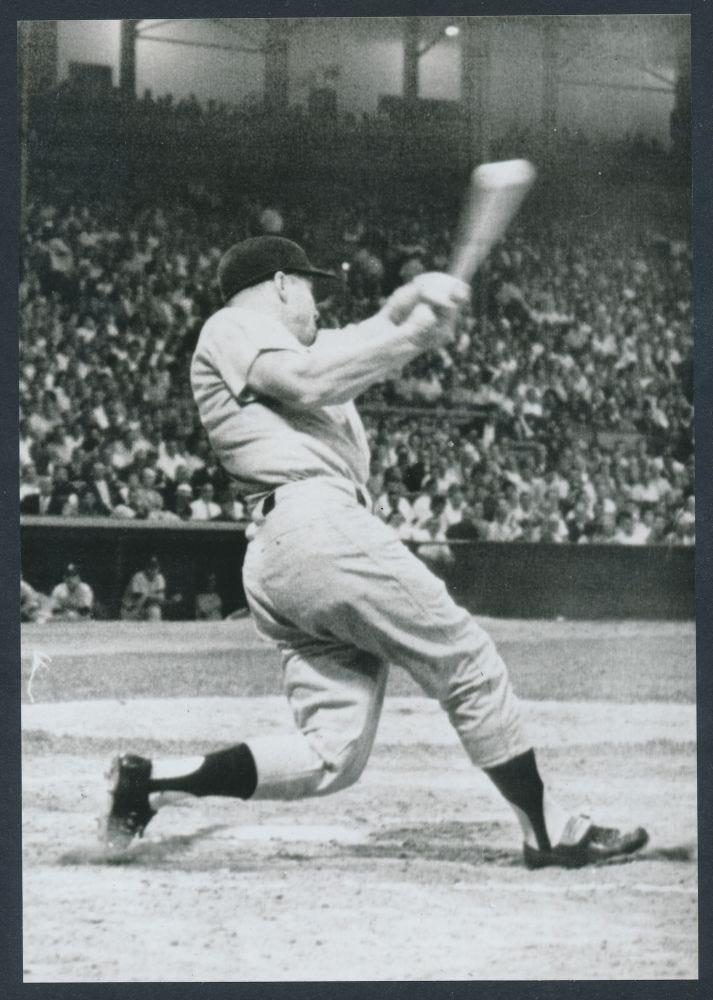
00:01
So in this episode, I want to sum up and reflect on the past couple of episodes because I think a lot of what this is about is a reclamation of the essential humanity and dignity of early baseball.
We've gone into the Cuban leagues, we've gone into the Negro leagues, we've gone into early professional baseball in America through the quote-unquote major leagues, the Federal league as well. What this is really about is it's a dignified reclamation project of the real foundations of the history of not only the sport of baseball, but the foundations of nation building through lived mythology.
00:58
What I mean by lived mythology is with the turn towards modernity, and again, I have this previously — you have the Nietzsche quote, God is dead and we have killed him. It's more complex than that and ultimately more profound because what you have is you have a turn towards a direct, immediate, grounded mythology that's built in the dirt, it's built in the blood and sweat and struggle and toil of a real Jacob wrestling God moment in American cultural history and in global cultural history through sport.
Sport becomes, there's a level of primacy that sport take in terms of a groundedness and immediacy of humanity that was not present in Greek civilization. Sport was more so a entertainment and theater for striving in the Greek sense.
01:56
You still have the traditional Greco-Roman pantheon of gods and mythological traditions which held and bound that civilization together very tightly. When you have the turn towards American modernity or Western Hemisphere modernity, you have nations like the United States or Cuba or Venezuela. They're searching in light of this fractured self-assembling global identity, the nationhood is being shaken, the previously native ethnic religious foundations, cultural foundations are being shaken. What comes in to supplant that as an identity construct as well as a spiritual framework for existence is the sport of baseball.
And this is a global collective mythology that is being built in real time. Like the skyscrapers of New York City, for instance, it's being built by human hands. These legends are human beings. And so it makes me think of the Michelangelo painting, that one moment. I think it's the Sistine Chapel — where Adam and God are reaching out and touching hands. And really what it is, it's not blasphemous. By any means it's not. It's a spiritualization and a embodiment of the human ground of being, a transfer and an awareness that we are the ones who are on the field of life.
And so when you have a figure like DiMaggio or Satchel Paige or Gehrig or Martin Dihigo — you have figures who are in real time this showing us our spiritual form and striving and athletic excellence and cultivation of self through the prism and medium of baseball. I was thinking about this; I was going to refer to the beauty and the power of Mickey Mantle's swing.
So what I mean here is that Mickey Mantle's swing to me almost reflects the essence of baseball because it's a balance of aesthetic beauty and power. And so again, we can again refer to Michelangelo or Da Vinci in terms of the sense of the divine proportion of the human body; the human body and movement. I mean, if you had Michelangelo working in the present day, you'd probably be making a sculpture of Mickey Mantle mid-swing. This is just a power of symmetry and technical perfection that emerges from athletic excellence, cultivation to craft. I was watching another one, a video the other day of Warren Spahn's windup.
05:32
The analyst who was analyzing his windup for sports technique was talking about the fluidity and grace of his motion and how he generated power and force, but also craft in terms of technique and control of the movement and thus where the bat or the ball is going. This is so much of what baseball is. It's a balance between the generative force of being and the technical perfection of athletic movement behind it.
Baseball is much more of like a structural ballet than a sport like football or gladiatorial combat, etc. Because this is not a contact sport. This is not a violent sport. This is a sport of strategy and technical perfection. It's an athletic vision of excellence in which individuals perform great feats in coalition. But no, it's like in the physics sense, no two particles ever touch.
It's a solo effort that's wound up in a mosaic of collective feats, not only on that individual diamond, but in the entire mythology of baseball itself. Of course, you have the rare home plate or outfield collision, but this is the technical perfection of movement. I think of Francisco Lindor at shortstop. He makes these incredible fluid plays and you watch them unfold. It's like he slows down time. He himself is moving in slow motion.
07:00
It's like time has been slowed to almost a stop because of how perceptive and engaged in the practice of fielding that he is and how perfected his technique is and how fluid it is. And this to me is the sign of athletic excellence and greatness, which is directly embodied. I've done a fair amount of work in physics. I've done a fair amount of work in philosophy. And these are all very cerebral abstract pursuits that end in equations. So they end in logic tracks.
07:30
What baseball is, is a total embodiment of the ethos and the ontology of being. And so what I mean by ontology is the real chain and real meaning of being through embodied practice, embodied cultivation of technique. I do a lot of weightlifting as well, and that's something that's very high priority for me, it's a balance between technique and power. Technique and strength. It's this constant mutualized practice.
You build strength, you cultivate technique, you build strength, you cultivate technique, and it's this constant ecosystem of bosons and fermions, so to speak, the two particles that construct the universe. This is again, it's very Nietzschean. It's the Apollonian and the Dionysian. It's the two impulses, order and chaos, and they're always in the process of being balanced. When you look at Mickey Mantle's swing, this is just the direct embodiment of the universal ontology of being itself in power and cultivation of form. Power, strength and control and technique.
So there's these dual impulses that are at work consistently through baseball. And so when you have that seated down into a very perfect medium, such as the game and sport of baseball, how it is played and performed, the pitcher, the hitter, the catcher, all of the fielders, they're all practicing this principle.
And so what I'm really gesturing toward is this is something that people are making.
And so when I say people are making it, it's a labor construct. And this is what we miss so much, I believe, as a modern civilization and Western civilization itself.
There's a deification of not making. This is the contemporary ethos of the collective or culture. It's that in not making or in my laziness or in the fact that I'm not engaged with life and I'm not in this passionate intercourse with the framework and field of life itself, I've achieved success. It's the idea of a CEO who's lounging on the beach in Cabo or something like that, right? It's this idea that once we stop doing this project, we've made it. It's the attempt to escape life. What I'm talking about is going deeper into life.
10:04
I was watching this video actually, it's someone who builds houses and he just turned to the maker of the video and he said, I want my grandchildren to look at this and say, my grandfather built this house. This is the idea that undergirds the skyscrapers of New York City. This is the idea that undergirds the steel city of Pittsburgh or the city of Detroit. These are cities that were made by creative innovation and active building. Pride in the work. Pride in the craft. Devotion to the creation of structural beauty, symmetry, and aesthetic power and meaning incarnate in form. Stone, metal, flesh, blood.
These are cities that were made by people who cultivated with detail and precision and aesthetic honesty and practice. These beautiful landmarks, these artistic landmarks, these churches in small towns or these post offices in small towns, which have long since been abandoned in the Appalachian or the Rust Belt. These are works of art.
And these are works of art of American ingenuity and industrial ingenuity, the creativity of collective laborers. And baseball is and always has been the sport of labor. It's been the sport of the working class, sport of those who do. Mickey Mantle, again, is just a perfect example because he comes from a mining family. I'm conjuring here a mythology, a legend.
11:31
A spiritual consciousness that is very specifically American, which is a laboring consciousness. It's an industrial consciousness, and it's a consciousness of the working class. This is something that's hitherto unprecedented, and it's something that, it lives very close to Christ in the sense that Christ was a champion of the underclass, whether that was the prostitutes or the poor or those who struggled.
So what you have unfolding in baseball is, I'm not going to say a Christian mythos, but a Christ mythos. It's a mythos of the working underclass, the labor class, who themselves, through their very participation, become these mythic, Promethean, Herculean figures in their practice of bringing the spiritual center of being into consciousness, into life. Into awareness, into the everyday, through this ironworks, through this forging of baseball. Again, wood, steel, leather — this very, very earthly and earthbound medium of the sport of baseball. So this is something that's just crazy because of how unprecedented it is in a religious sense. And I do want to make that very clear. It's religious sense, really.
This is — through the creation of the sport of baseball — American culture and civilization itself is grounding down a centuries long history of mythological dissociation or abstraction of the spirit and force and life of being and in a godly sense. And it's being incarnate into the practice, the ritualized spiritual practice of baseball. Again, blood, sweat.
This is being ground down into the human being and we are creating the mythological legends and central figures. Again, I said this in one of the previous essays. The United States is not, this is not an empire of intellectualism. It's not an empire of the arts really at all. It's an empire of baseball. So in Europe you have Descartes, Voltaire, Nietzsche. In the United States you have Mantle, Mays, Aaron.
Right? So it's a very different canon that we're working with here. And it's a beautiful thing. This is something that should be honored and respected and understood for the real contribution that it is. And that's a lot of the work that I'm doing here. It's to understand the American mythological and cultural framework for the beautiful creation that it is.
14:22
Because what it does is something that's arguably more profound than what science can do or philosophy can do or what art can do. Because it's a perfection of the craft, the creation of the craft of baseball, but then the perfection of the craft of baseball through these figures like Gehrig or Mantle. These are people who as individuals undergo significant trial and turmoil in their personal life and they step onto the diamond and they become these larger than life figures, but they are still deeply, deeply, deeply human.
So in Greece, you have Perseus, you have Hercules, you have these stories of the half man, half god, or the demigod figure. These people who straddle the two worlds, they straddle Olympus and they straddle the earth. This is what the sport of baseball avails America, and it avails America of this in a way that… you don't have in Greece – you have a mythological abstraction. Hercules and Perseus are icons, they're iconography, they're religious aspirational figures. So when you look at Christ or you look at Buddha, we're trying to find and create and locate a contemporary mythic epicenter for culture and civilization as an act of spiritual striving toward which people move.
15:49
This is a cultivation of spiritual excellence. And in America, it's through the devotional form of baseball, through the spiritual athletic practice of baseball. This is incredibly profound. And when you look at this picture of Mickey Mantle, you look at this mid stride, mid swing, this is, I mean, it's American beauty in action. It's American athletic form and excellence in action, because he is, you can tell by the leverages — by the angles, by the geometry of the movement pattern that he's cultivated.
This is a man who's dedicated his life to baseball. He has made baseball the spiritual sadhana of his life. And sadhana just means spiritual practice, essentially. It's the everyday spiritual toil. So you have these modern day monks, essentially, or aspirants, who through the sport of baseball rise into mythic legend.
The mythic legend is itself the iron pillars and steel girding of the civilizational skyscraper of America itself. It's a beautiful thing. And again, we have to look at the origins of this sport. It's Gehrig, the child of poor immigrants living in the Bronx.
And he's sleeping in the YMCA and just working there to make his way through his early years, as — I think, part janitor and part trainer. Mickey Mantle, the son of a miner.
Walter Johnson, a farmer, Dizzy Dean, his parents are sharecroppers. This is the real epic mythic foundation of America. And it's so much deeper and more profound than any abstract myth as a civilizational, spiritual, cultural, social, religious backing can avail any other civilization. Because it is us. It’s emerging from the real, grounded, earthly, toward the earth and toward the toil of the earth fabric of what constitutes the foundation, pride, and laboring history of unity and struggle and emergence that is America itself.
So what America has done and did and is doing with the sport of baseball and its epic lens, its historical lens, which has now spanned almost two centuries… what we're looking at here is the grounding down of spiritual truth, myth, grandeur into the blood, sweat and grit of the athletic cultivation of greatness.
Again, in the Herculean sense, in the Persean sense — Hercules and Perseus are figures who undergo great physical trial, which is also spiritual trial, which is also psychological trial, similar to Christ in the desert. Christ fasting, Christ on the cross.
Jackie Robinson enduring what he had to endure to integrate the major leagues.
Rube Foster, the son of enslaved parents — the man who built the revolutionary Negro Leagues and was one of the greatest pitchers the game of baseball ever saw.
These are all spiritual, physical, psychological trials. They're trials of the whole form of the human being.
18:40
These are the modern day myths. Without exaggeration — because what this avails us is — it's again in the Perseian or Herculean sense… these are real people. These are people who come from, I mean, Satchel Paige, you don't even know how old he is because he was born in such a rural, poor area of the American South. There's no records for him. These are people who come from incredibly difficult circumstances and they rise in the American civilizational sense.
And it's not that they rise to a level of wealth where they all of a sudden become these people who disappear from the culture. Not at all. It isn’t about money. And that’s the real secret, hid behind the superficial, surface level American obsession with capital and accumulation. They rise in a spiritual, mythological, epic sense to become the legends of American civilization. They rise through action. Through the beauty and grandeur of the mythic dance of centuries. They rise through the sport of baseball as practice, craft, devotion; athletic beauty. It is as intertwined with their lives at the soul level. It’s not only a mirror for them of spiritual struggle, but for all of us — as examples, as those who lived, live, and work among us — of the beauty of the human spirit and soul. And it is that profound.
So I want to leave you with this. Think this is solid here. Just a beautiful picture of Mickey Mantle. It's the embodiment of athletic excellence because it's just him and the ball. Total focus. Just look at where his head is and look at that line, a diagonal line that goes straight from his front foot to the back of his head. The perfect backwards L that he makes generating force and leverage with the turn of the hip.
Turn of the hip; the force and thrust that moves that bat through the through the plane of the strike zone.
20:08
This is what the Greeks attempted to capture in stone. The American civilization is so much of what the Greek epic mythology attempted to conjure into being through abstract storytelling, mythology. Virgil, Ovid, Homer, you have a whole mythic epic tradition of the early, early, early Western civilizational constructs. Italy, Rome, Greece, Dante.
20:38
It’s a spiritual striving and we have this as the historical lens of American civilization. We have this documented. It's in it's in photos. It's in videos. It's in baseball cards. It is real and it lives. This is the completion in a lot of ways of the foundational Greek mode of consciousness, the foundational teleology and epistemology of being which is articulated by the Greeks. Heraclitus or Plato — Heraclitus, the cosmos is fire, all is fire and returns to fire. That's something that's brought up by Schopenhauer later on that Nietzsche catches on to in terms of striving and the will.
The will is embraced here, not negated — and it's an embrace on the diamond as a form of athletic striving. There's a concept for that in the Greek. It's called arete. It's the striving for excellence, virtue, the striving for greatness. And the baseball diamond itself is the realm in the field upon which this occurs. So when you have people like Mickey Mantle, we look at Prometheus or we look at Voltaire in the Western canon, there needs to be room made here. Mantle, Prometheus, Voltaire.
That in itself is an epic lineage and triptych of the evolution of spiritual consciousness in and through Western civilization.
21:53
There's a different understanding that's been created here in the American civilizational context. And I would argue it's perhaps and maybe even a greater understanding. You have to avail yourself of the possibility of stripping away all of the pretense, all of the logic flows, all of the scientific formulae; the attempt to understand reality and embrace this complete and total embodiment of athletic flow.
It's called Wu Wei in the Dao.
It's total presence, total focus, total embodiment through the practice and the toil. So Mantle straddles this. It's like Perseus the monk. Gehrig, Hercules the monk. It's a beautiful form that comes into incarnation in American civilization. And it's something that we don't really have a political or social consciousness for before.
And it's something that I would argue we do not really fully understand yet. So that's a lot of what this is about here.
Good to see you. I'll catch you on the next one.
11. The Mythic Ascent of Lefty Grove & The Deeply Spiritually Cathartic Function of Baseball
Jun 26, 2025 · pp. 176–198
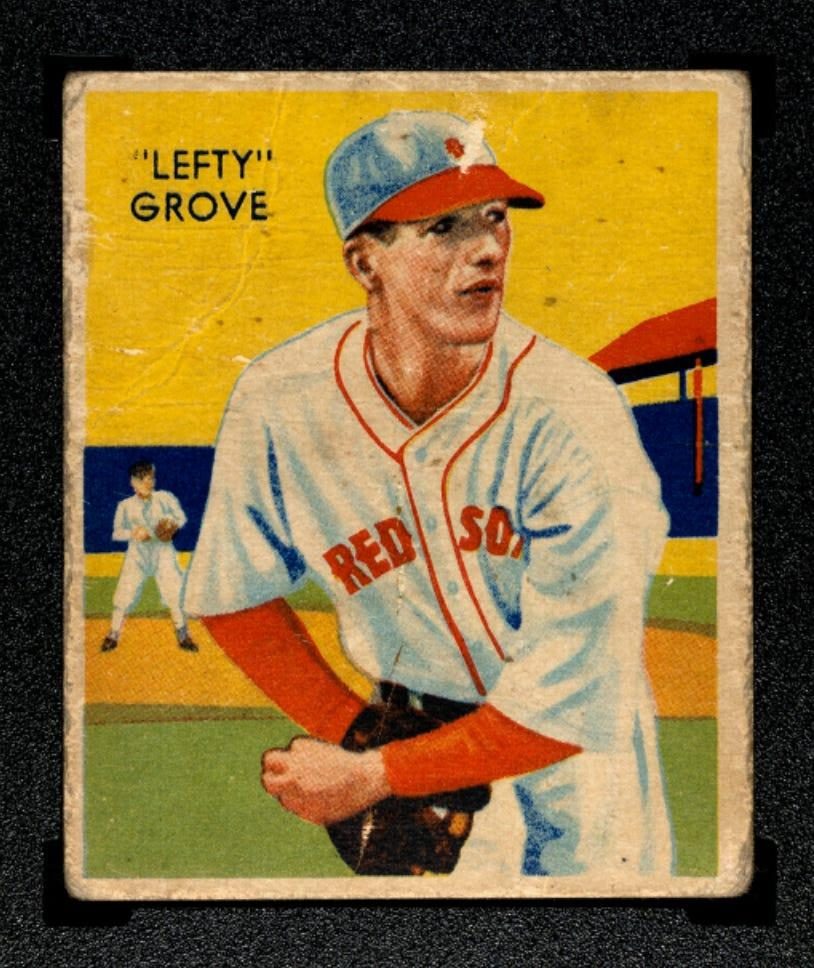
00:02
So I'm gonna condense some really powerful stuff here as an act of service, really.
This card, I'm gonna trace this for you. I'm gonna trace this process because there are certain moments here… and I can tell and I can feel when I'm being led into something powerful because I'm here to give it light, right? To honor it.
00:31
To respect it, to give it dignity, to hold space for the spiritual gravity. I got this card here, the Diamond Stars Lefty Grove, number one in the set. I got that a couple of days ago. I was selling a Jackie Robinson 1953 Topps online. I have a 54 that I just really love. It's my example. So I was selling the 53 online and I ran into this guy. We were having a conversation. He was like, yeah, you know, the Jackie really means a lot to me. I'd love to get this card. I was like, man, that's what it's all about. Let's just make sure you get this card.
Ultimately, I was going to accept pretty much anything on that within reason. And he ended up saying — this is what I have available. I have like 350 bucks. This card is really important to me. I said we could figure that out. It’s no problem. We could do a payment plan or whatever you need. He ended up saying, you know, I actually have a card that I could trade you along with cash. I said that’s fine — let's see what you have. And he showed me this.
And I heard… I've been talking with some people about the Diamond Stars set from the 30s. This will be the first card that I have from it. But I was like, yes, wow, awesome. Like great, you know? I would love this card. I need to get more into Lefty Grove. I need to get more into Diamond Stars. So we ended up working something out. He was very happy. So the card's on the way. I'm going to get him the Jackie Robinson 53 Topps. I'm glad to get him this card because it's something that obviously is so important to him.
02:17
So I'm kind of sitting with this and I'm like, this is strange. Let me look into this a little more. And this kind of spiritual aspect of labor or the devotional aspect… all of this that has been pressing forward lately has been so, so clearly around this incoming sense of meaning or power that needs to be expressed. And it's about honoring... the title for this was going to be the Mythic Ascent of Lefty Grove. This is a man who... I'm going to pull up the exact information.
Here it is. I was looking at this as the best example of the industrial modern man.
The man who rises through this, this milieu of industrialization, globalization, modernism. And this is Lefty Grove. His dad was a coal miner. He was born in Lonaconing, Maryland in 1900.
He laid railroad tracks, shoveled coal, labored in the coal fields. And this is a, it's a mythic ascent. He rises in this small coal mining town, didn't go to college, there was no organized system that developed his game. None at all. He was throwing rocks and doing sandlot pitching and was discovered. I think he actually played for one of the oil or coal teams in the area as well as a semi-pro, briefly, and he was discovered through this — as a laborer.
And there was just this sense he's going to do something here. He's going to do something with this. And he becomes one of the greatest pitchers of all time and perhaps the greatest left-handed pitcher of all time. I mean, him and Warren Spahn are kind of the two. I was a left-handed pitcher when I played. So there's this, there's a sense of resonance there.
This is a man who rose from the pure grit of industrial modern reality. The modern American Industrial Revolution, these coal fields.
05:07
So this is my topic and I've kind of been circling that. It's been ongoing in my work.
05:23
As you can see, right, all of these essays and these writings and these talks, a lot of them had more clarity than this one. But I know I have to be here for this in a way that it's unfolding now. Authentically, uncertainly. To let this emerge in truth, in its own way. The way it wants to and needs to. In its own time.
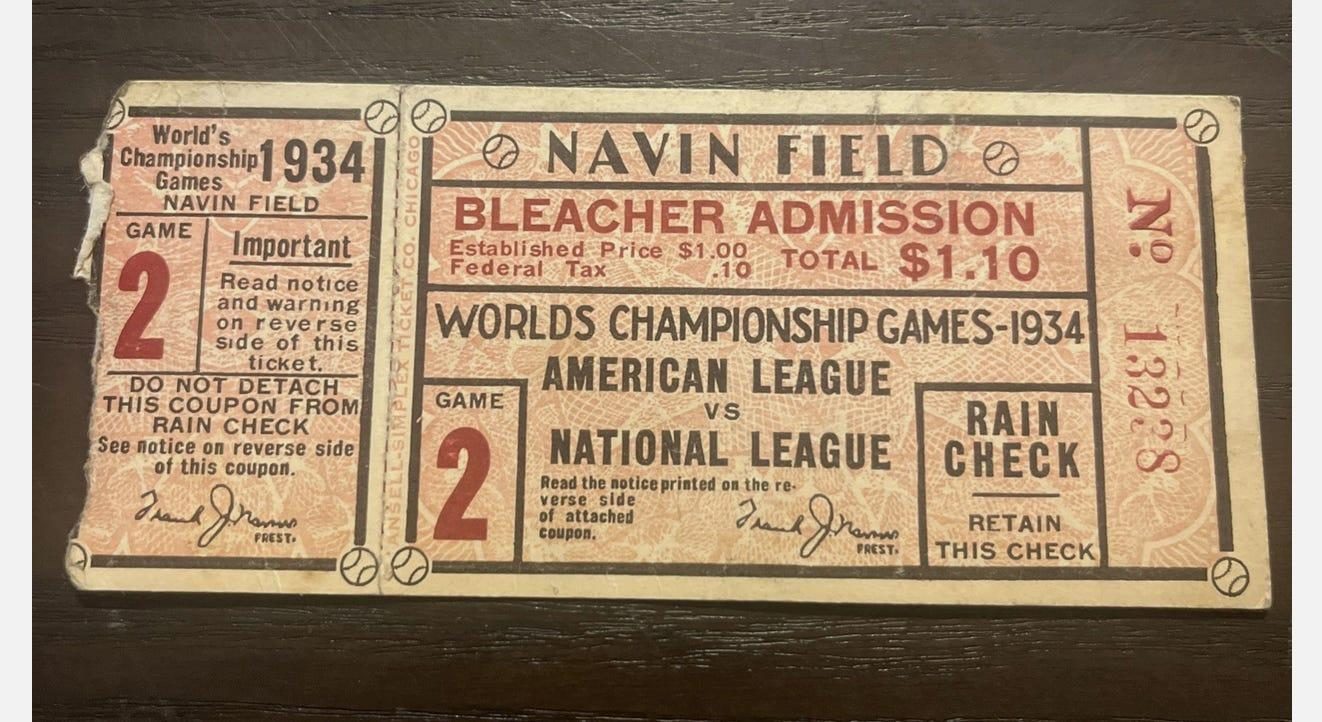
A redeemed ticket for Game 2 of the 1934 World Series — pitting the mythic Gashouse Gang against the Greenberg, Cochrane, and Gehringer led Detroit Tigers.
This game was won in 12 innings by a complete game effort on the part of ‘Schoolboy’ Rowe for Detroit, 3-2.
I was talking about the Rust Belt architecture. I'm looking at the Diamond Stars cards as works of art. I'm looking at the World Series tickets from the 1930s and prior. These are all communal phenomena and these are communal phenomena from a desperate and hard time in American history. This was a time where many people had very little. People like Lefty Grove or Satchel Paige grew up with nothing. Dizzy Dean. Dizzy Dean and Satchel Paige’s famous friendship.
There are men from this age who rise through baseball. There's a mythic ascent.
There's something that happens there. Lefty Grove would have lived and died in the coal mines, just the same as Mickey Mantle would have lived and died in the mines.
Baseball in this way is an opportunity. It's a stage. It's a possibility. Where there otherwise was none.
06:45
I'm just imagining what it's like for someone like Lefty Grove to grow up in Lonaconing. This is very small mining town in Maryland, in the Appalachian. This is as country and rural as it gets in the United States. So much of the Appalachian and so much of the Rust Belt was this mining, these factory towns — further up north and northwest to Pittsburgh, Cleveland, Detroit.
07:16
You're looking at a sooty, gritted modernity. And in the South, obviously problems with extreme Jim Crow era segregation and racial violence and much of the remaining attitudes, plantation attitudes that continued in the farming in the South to try to maintain some form of economic prosperity. This is pre-technologization.
This is America's 20th century industrialization. I would call technologization America's 21st century industrialization.
07:57
This is the real power behind baseball, behind the meaning of baseball — that you have players like Lefty Grove or Ed Walsh, or Satchel Paige or Honus Wagner. Honus Wagner is another great example, coal miners, factory workers. His father was a coal miner and Honus worked in the factories. These are deeply humble, embodied people. Lefty Grove — fiery; fireballer incarnate. A carved and chiseled form of physical dominance and spiritual transcendence through the act and discipline of crafting the pitch of baseball.
These are people who were and are incredibly grounded in the world and come from circumstances that many people in today's America can barely comprehend. We no longer live in this world. Many and most of these mining towns and factory towns are long since gone; converted to modern metropolises or left to quiet, ghostly decay.
Factories in cities like Pittsburgh and Richmond are now apartment complexes — where residents are left mural remnants or outer brick paintings and other strange features and identifiers that mark the passage of time and transformation. The artifacts and architectures remain — inhabited and uninhabited alike. But the memory remains only when it is spoken into presence.
This is the oral tradition of intergenerational memory. This is what imbues history with ground and artifacts with meaning. Because it shows the passage of time; how we got to where we are today from where we once were.
08:51
What we witness with a card like Diamond Stars, which I think is really interesting, as well as Goudey, and as well as 1930s World Series tickets… what you're looking at here is devotional art.
What you're looking at here is something sanctified, something deeply spiritual. And the cards themselves, right — this is why I'm such a fan of a well-worn baseball card, a card that looks like the time that has passed through it — is that you're looking at a time, a period in American and human history where communities were born out of necessity and the thing that held American industrializing communities together at the deepest cultural, phenomenal level was baseball.
What held communities together was mutual survival. So you have even just the architecture of these towns — I alluded to this, the Rust Belt towns and the Appalachian towns. You can still see it today in these abandoned towns. It's deeply devotional caretaking architecture meant to beautify and glorify communal, locally centered life. And the reason for that is that these were communities where people leaned on each other and the work that they did in the community impacted the community directly. They were deeply aware of their interdependence. This gave life and work meaning and value and importance.
10:22
These are people who are living and working in factory towns using scrip. Scrip was the money that the factory would give you or the mine would give you to purchase things from the mine stores or the factory stores in the town. So it was an entire ecosystem based around the factory.
You have to think about that and come to grips with that kind of reality. And the epic stage of baseball in the midst of Depression Era, Dust Bowl Era America. So I've focused previously, I did a little on the 50s, I did a little on the early 1900s. I went earlier in the 1800s, late 1800s for the Cuban leagues. But here we really are at the late 1920s and early 30s.
We're looking at a period of radical economic and political instability between two World Wars where America's financial systems and markets were crashing. There's this huge turn of events. It's also part of the larger global, economic, and political instability at the time which leads directly into the second World War. This is a world that, as we said, is struggling to global political consciousness and to survive as regional pockets whose dammed borders are threatening to burst with conflict, information, and cultural confusion and fragmentation. World war is the outbreak of real movement quickly — with planes, ships, supply, people, and distribution channels. It is a symptom of the emergent factor of globalization.
11:57
But you look at the destabilized ecosystems in and of globalizing chaotic flux at a fractal level distilled down through which someone like Lefty Grove rose. Born in a coal town, worked the railroad, shoveled coal, discovered very late, didn't go to college, was literally pulled from these labor fields. He was throwing rocks and playing in sand lots on oil teams or coal teams.
And on the back of this 30s Diamond Stars card it says he has a the greatest fastball since Walter Johnson. This was a guy who burned through his career. There was just an absolutely extraordinary heights that he reached. You look at what he was able to achieve and you start to see.
The stories. The extent and the power of the stories that are present here. Their deep, inner human meaning. The networks of them. The nodes of them that constitute the true gravity, power, and depth of baseball history. It’s a massive tree — through which each seed, seed pod, and flower — holds a fractal of beautiful, awesome power and wholeness of glory. I brought up Ed Walsh before. I brought up Stan Coveleski. We've talked about Jackie Robinson, where that's more mid-century.
13:53
Here, we’re focusing on players in the coal mines or in the factories, specifically. This is a very specifically kind of Northern industrial, Rust Belt Appalachian context. Its such an important aperture because you're looking at the way in which America transforms at the beginning and towards the middle of the 20th century through different ecosystems. The south and the Midwest being farming. You have Dizzy Dean or you have Walter Johnson, who are from these farming backgrounds. Charlie Gehringer is another good one. Born on a farm.
You have a lot of these these players who are from the south and the Midwest who were born into farming lifestyles. And they say they were built on the farms.
Through the hard labor on the farms. That’s where they built their strength, their bodies, their minds. But there's something so specifically modern about these players who — most of them I would say were born in 1900 or a little later or a little earlier, (in the case of Honus Wagner, it would be a little earlier) — who were born in factory and mining towns in the Appalachian, in the Rust Belt; into these towns where you can still see now the entire architecture.
These were bustling industrial towns where there was a lot of coal traffic, where there was a lot of mine traffic, where there was a lot of factory distribution and production, because what these towns are is they are America's history of modernity.
15:48
The farming towns or farming regions of America, which would conventionally be the south and the Midwest — not to say that there weren't mines and factories there, right, especially in Detroit, and in Mickey Mantle's case, right down south, I believe in Oklahoma.
It's not to say that those were not there, right? But you're really looking at this Northeastern corridor. I've spent a lot of time traveling that corridor, whether it's on road trips or to visit people, et cetera. So I have a pretty solid understanding of what it's like now. These were the glorious epicenters of America's modernizing North, right? America's Northeast… they're gone now. And if they're not gone, they're rapidly dying because what was there has gone.
What was there has left. People don't want to work in the mines anymore. It is hard labor. The mining and factory work has become less and less of an American institution and more and more of an exported, internationalized process. There’s a lot of politicized dispute about which fuel sources the world will use moving forward. And there’s a lot of political tension in and about these towns. Because they once held up America; they were America’s backbone. And now, for the most part, they cease to exist because the money and the work is gone. I went deep into that in the financial nihilism episode. So we're tying this all together here.
17:07
The reason why… I come back to someone like Lefty Grove or Ed Walsh or Stan Coveleski, is that these are players who were forged. They were forged in the iron.
They were forged in the fire of these proto-industrial towns where — Lefty Grove is just such a good example because he's playing with rocks.
He's pitching with rocks, and that's how he's learning how to pitch. It's similar with Dizzy Dean and his brother Daffy. I think they were using some sort of nut or an acorn. And that's how they taught themselves how to pitch. You have to look at this through a beautifully mythic lens. Because when you look at Lefty Grove and all that Lefty Grove is and has done in his legacy in the sport of baseball, you're looking at nothing less than a mythic ascent. A mythic ascent, effectively out of hell. I mean, I think he told his dad, he was like, I'm not doing this. I'm not working in these coal mines. He said, I didn't put that coal there and I have no intention of continuing to dig it out.
I brought up the Coveleski and Walsh quotes about there was no option. They would play baseball or they would live and die in the mines. This to me is the real underpinning of the sport of baseball.
You have Lefty Grove on the field and his achievements are almost bar none in terms of the greatest pitchers of all time. Lefty Grove is always in the conversation. So you look at those achievements and that's one aspect of it. But I would argue the much deeper aspect is the real origin story, the real human spiritual aspect of what happens here. He's pulled from throwing rocks and playing on sand lots to, I believe, a minor league contract with Baltimore — with… actually the person who found him is the same guy who discovered Babe Ruth, interestingly enough, right? Babe Ruth was in a foster home in Baltimore and was playing with teams in the Baltimore area.
He joins this team, and then Connie Mack buys him, I'm just pulling this off the top of my head, Connie Mack buys him for, I believe, one of the biggest salaries at the time after that. And he goes on to have one of the most successful careers in baseball history.
20:11
You look at something like this and how it occurs, and it's almost archetypal, but this is history. This is a true story. This is the story of a man who grew up in coal mines in a small town, in effectively the middle of nowhere in America, and learned how to pitch from throwing rocks — and then became one of the greatest pitchers in baseball history. Didn't go to college.
Was discovered offhand by Baltimore, I think it was International League.
Becomes a member of their team and very quickly moves on to Connie Mack’s Philadelphia Athletics.
So I brought up the ticket and I bring up the card. I brought up the Rust Belt architecture, and this idea of the devotional collective communal mythic craft of baseball and its surrounding artifacts and relics. The reason why you have this, I think, in a lot of ways is because it's necessary.
And the necessity of the myth of baseball is the possibility of there really being something more.
And I think that's something that in a contemporary sense we've lost because we've moved into a simulation of reality through technology. So the something more is something more that you find through a screen, through an illusion, through an image. I think during this period of time in American history, the something more was baseball, and it was very real. And it was happening communally. I brought up the 1910 Tip Top Red baseball cards previously, released in Pittsburgh to commemorate the 1909 World Series Champion, Pittsburgh Pirates. This to me is one of the best examples of what baseball was.
It was a regional collective endeavor. It was a local collective endeavor. It was a way that people in cities and in towns felt deeply connected to one another and to these teams. This was like a center of gravity. It was the community center, so to speak.
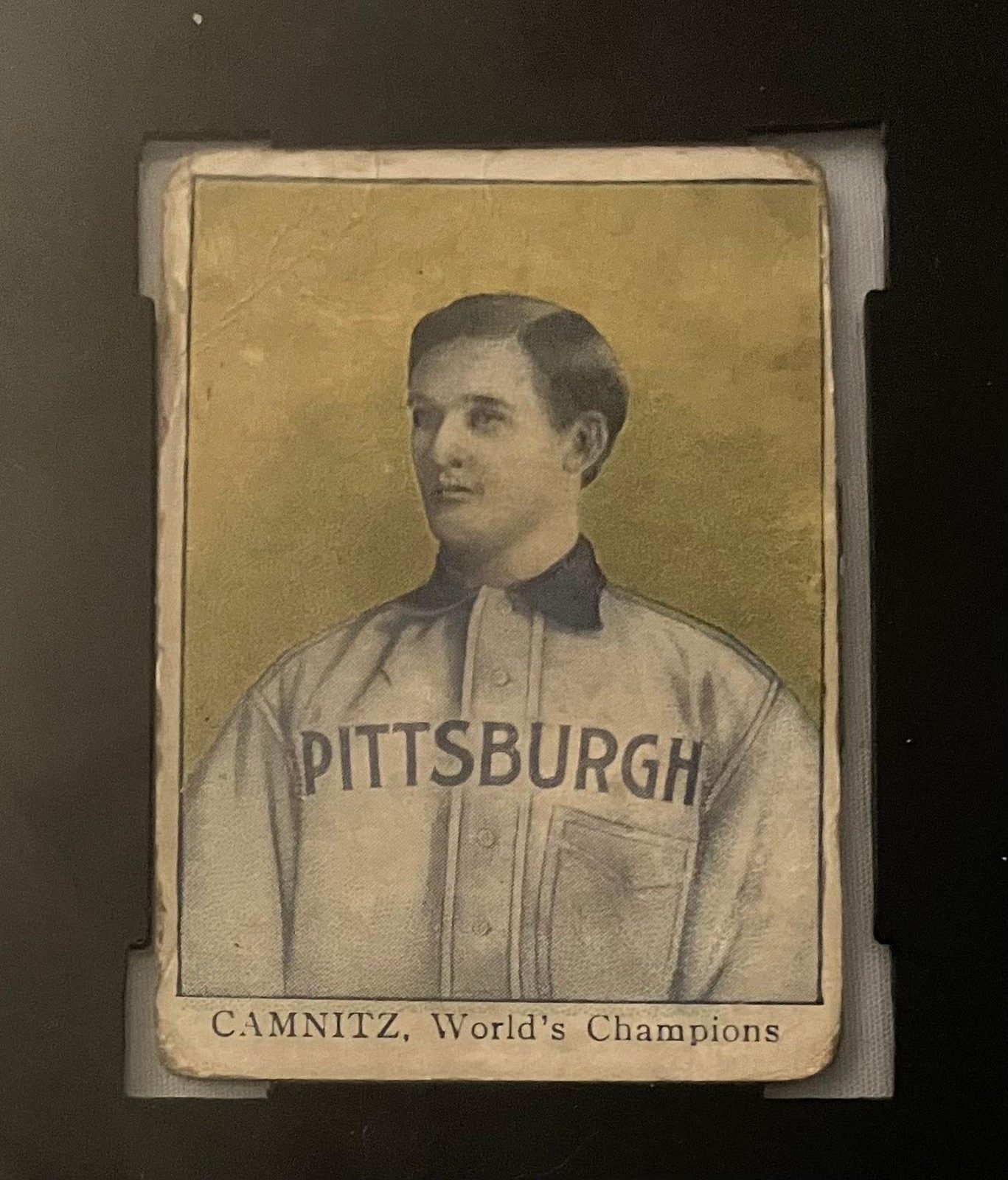
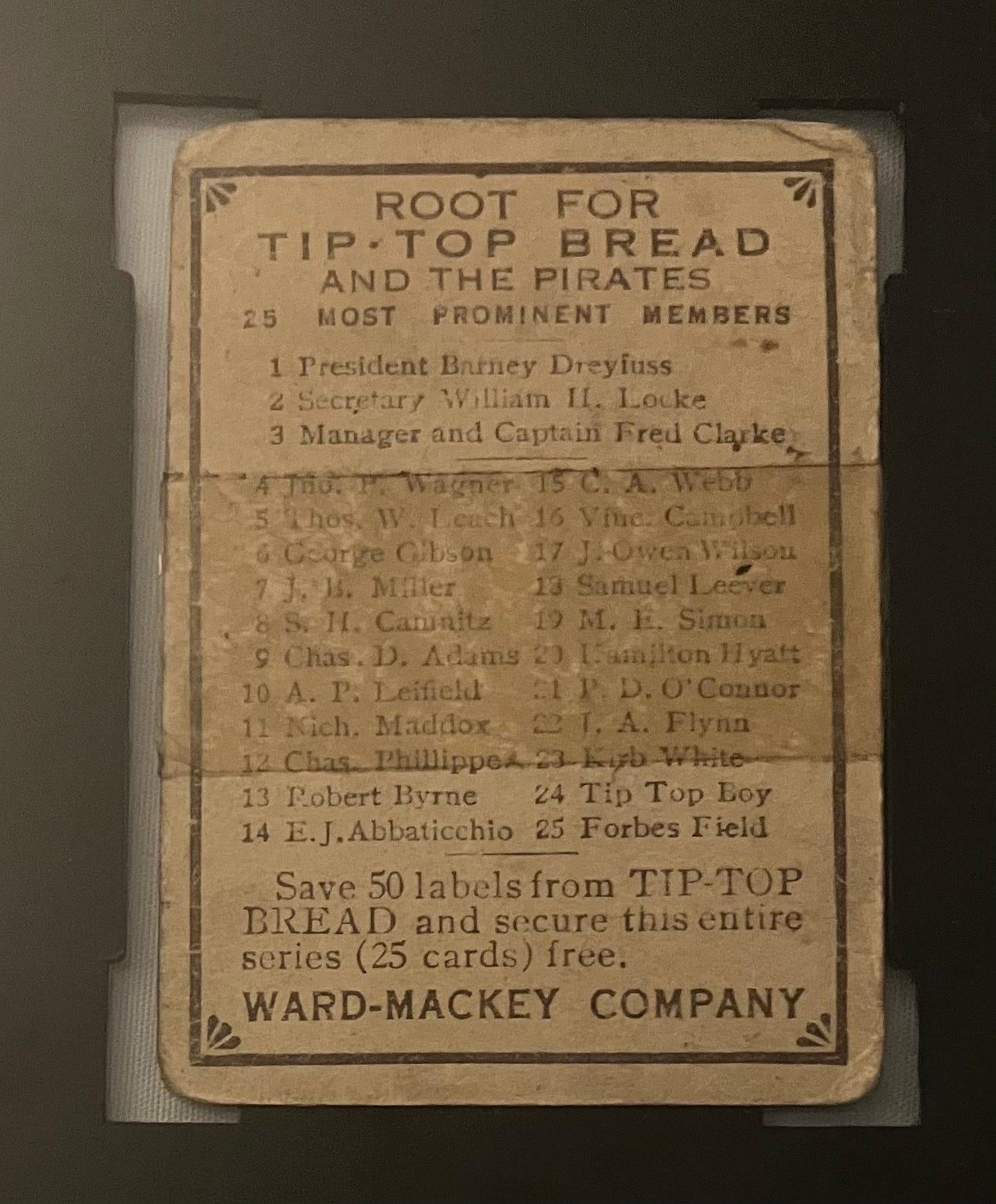
An example, front and back, of the 1910 Tip Top Bread baseball card set. This example features Howie Camnitz, the star pitcher during that period for the Pirates.
Camnitz went 25-6 that year with a 1.62 ERA.
23:00
So you would go watch the Philadelphia Athletics play at Shibe Park, or you'd go see the Pirates at Forbes Field. And these teams really were representative, just as much as maybe the bread company was representative, or the factory that you worked for was representative, or the tailor in your neighborhood, or so on and so forth, or the butcher.
These were real networks that were immediate and they were local that made a deep impact on the collective consciousness, regionally, locally, and nationally. And baseball was the grid. Baseball was the network that connected the entire Eastern seaboard, Northeastern seaboard at least, right? The furthest west that there was was St. Louis at this time in terms of baseball teams. It connected this modern, modernizing corridor of America.
24:05
And each team was essentially a local or regional node through which the laborers, the iron workers, the dock workers, the tradesmen, the farmers would gather and support these teams as effectively community centers. Civic centers. Everything that went on, whether it was the tickets, whether it was the cards, whether it was the architecture, all of this was a devotional community centered effort. A sacred art of baseball as a unifying force and factor that truly functioned as a nationalizing mythos — a mythos that connected regions into a real framework of competing, playing teams for baseball’s crown of victory.
It was a focus that was happening locally in a communal way to cultivating successful group circumstances. This was a mentality, a way of being; an ethos that permeated this cultural node, this fabric, this happening of baseball. And baseball itself functioned as a cultural net, an interconnector — a way of being together powerfully; secularly.
This is in the foundational ideals of the Constitution. A secular sacredness of being.
A community. Truly, to seek and create a community in a human nature.
24:51
So when you look at these early baseball cards — and I think I'd specifically gesture to Diamond Stars and Goudey, you're really looking at sacred art. You're looking at sort of Byzantine iconography almost. You're looking at something with that amount of care and that amount of attention because baseball is that important. So it becomes, at the deepest level and substratum, going back to the mythic ascent of Lefty Grove or this idea of the 1930s Rust Belt architecture just as much as the card or the ticket — it becomes this idea that we are really gathered together here in this place of worship. And the place of worship being the community and the center of community being baseball.
This is just how important baseball was. In the sense that the center of a community at the time would also be a church or something like that, denominational. Just as much as a baseball team allegiances would be denominational. You're looking at the sacred architecture, which is the cultural backbone of any given sort of regional tribe or locale within the burgeoning, expanding, developing, industrializing United States. And so then you have someone like Lefty Grove, again, such a great example of this — who rises out of the underbelly, the literal coal mining underbelly.
26:31
Underbelly of the mines. Underbelly of the fabric and function of the metabolic furnace of American civilization. The real underground power and mythos of it all.
The fiery coal. It’s in his very demeanor and fastball. This is why Mantle was so important in that last episode. He’s the last of the great working class urban legends.
From the mines to the center of American empire. New York City and the New York Yankees. He’s America’s son.
Grove rises out of that from nothing. No college. He's throwing rocks. He's not even playing on an organized team. He ends up playing on the sandlot teams and things like that, semi-organized teams. But he goes from there to becoming one of the greatest baseball pitchers of all time.
This is just something that is very different than the modern time.
27:11
Only in this time would something like that happen in America. And I think in large part it happens because there's so much chaos and disorganization and change and shift that's occurring. That someone like Lefty Grove, he doesn't have any of the benefits, none of the resources. None of the training, none of the education. I mean, nothing. He's making this entirely on his own terms.
And he realizes his talent and his skill on the national stage without really any help.
The who people find him and discover him help him hone his skills, but this is far, far later on. He becomes a pitcher and molds himself out of this raw, primordial cast of his nature. He does this in Lonaconing, throwing rocks. He’s still remembered there prominently to this day. With monuments and the written word — as a risen son and hero of this small community of mining.
It's incredibly inspiring. This is the mythic thread in the fabric that's woven through baseball and perhaps in many ways is deepest with Lefty Grove. I brought up Dizzy Dean and Daffy Dean, Paul Dean before. I brought them up, but there's something still proto-industrial, agrarian about that. They are still on the homestead. They're still on the farm.
Lefty Grove is emerging through the industrial grit of rapidly shifting and scaling America. This is what America becomes. And the first real sense of it are these factory towns and these mining towns. This rapidly spreads and hyper-technologizes.
Skyscrapers into computing, et cetera.
So he's really one of the first sons of industrial America. Not just Lonaconing. And it's quite fitting to see him rise in this early modern baseball setting to the place that he does and the way that he does it. It's a very specific figure in American history.
29:17
And I think what's necessary here is a reclamation of the real legend and the real power of the legend, the real underpinnings. Because people will look at, say, the statistics or the surfaces of events in a baseball sense when it comes to these players or this era of baseball or these teams.
But when you look at someone like Lefty Grove and Dizzy Dean, who and what they really are and what they really symbolize — is the possibility of industrial and agricultural America becoming something mythic, legendary, great, important, powerful. They function as cultural meta symbols. They function themselves in the heroic mode. Dizzy Dean and Lefty Grove, perhaps the two really great examples there — or even Walter Johnson — of the ability to rise up out of very humble and difficult and trying circumstances. In the case of Dizzy Dean and Paul Dean, very humble and impoverished circumstances. Their parents were sharecroppers. Or desperate situations, such as Lefty Grove and the coal mines. Your back is against the wall of a sentence in these mines. A life sentence. These are two different but similar mythic modes.
Dean becomes an icon of the American South, the American Midwest, for what he accomplishes in the early 30s with the Cardinals and the Gas House Gang. But I want to say, this level of mythic power that's at hand with Lefty Grove (or even perhaps a player like Ed Walsh who also is from the coal mines)...
This is — when you think about heroism incarnate, and what it entails — you have this person who comes from, in Lefty Grove's case, very, very little. He's not afforded education or resources or anything. He stands, when he stands on the baseball field, he stands for, toward, and with this entire community of people.
These extremely poor factory workers, these extremely poor miners. This is someone who actually emerges from those circumstances and rises to the greatest heights possible in a civilizational context. He forges himself into a mythic victor, cast in the form of America’s massive cultural project of mythic consequence. He forges himself from the circumstances of these people, his people. They have nothing. And just how much power is present with and within that. I just think it's important to sit with that because it is very important.
This is just no person with a middle-class upbringing who went to school and then went to college and became a good baseball player. This is someone who came up out of the American cultural laboring underbelly of civilization and rose to its heights.
He sculpted himself into a champion. He forged himself in the fire of the underbelly of America’s coal sooted face.
32:22
And so that's the meaning behind baseball. And that's the meaning behind someone like Lefty Grove. It's not stats. It's not. It's the story. It's the real human substance and soul — that when he stands on that mound, he stands in front of his people, right? He stands before them and delivers. I think the idea was in his SABR bio that he always felt most comfortable among his people. And by his people they meant rural people, mining people. People who were living and working in this mining context in these small coal towns. This was understanding.
33:08
So this is the real importance. If we want to get into what really happened, who Lefty Grove really is and what his trajectory and journey really is and represents at a metaphysical, spiritual level — that's really when we start to look at the power of baseball. Not just in terms of what's possible for an individual, but how that informs the entire collective. So I brought up Hercules, or brought up Achilles, or I brought up Perseus in the last episode with Mickey Mantle.
I'm gonna bring it up here at a deeper level because these are the figures who rise in American culture and civilization, at least at the tail end of the 19th century and well into the 20th — ending with Mickey Mantle. Mickey Mantle is my bookend, so to speak. And you have multiple different ways this occurs. I brought up Jackie Robinson. I brought up Satchel Paige. Rube Foster is a huge one. We've gone into Rube Foster. And then I'm gonna say Walter Johnson, Dizzy Dean of course; Charlie Gehringer is a really good one. But Lefty Grove for me really does hit some bedrock here in terms of the entirety of his story.
I think I've painted this pretty well here in terms of the devotional aspect and quality. Baseball is created as a cathartic myth engine operating at the epicenter of American culture and civilization. And it becomes its most powerful, I think, in and by no coincidence during the most difficult times in early modern American history.
1910s, 1920s, 1930s, 1940s, 1950s.
This is through industrialization, through these coal mining towns, through this rapid factory mass production scaling of the real land and political territory of America, as well as World War I and World War II. You are living in such a destabilized, uncertain, constantly shifting, difficult period of time — not only in American history, but in human history. And through someone like Lefty Grove, we can observe how baseball acts. Through him, it becomes perhaps its most coherent.
It becomes its most coherent because Lefty Grove is one of the people. In the truest, truest, truest sense of the word.
This is not some man standing up on a podium who has anything or is gesturing to any sort of power or thing that he got that tells people that he's this or he's that. This is a man who was born and raised with nothing, who lived and would have died in a coal mining town in the Appalachian — but cultivated this skill by throwing rocks, whether or not there was some sort of consciousness there of what that would lead to. And he was discovered playing on sandlot teams and then becomes this. One of the greatest pictures of all time. It's cemented in the Baseball Hall of Fame for the eternity that culture establishes.
37:27
Do you see the cathartic power of something like that? This isn't a theater. We're not sitting in a Greek theater and we're not hearing about stories with characters. This isn't like a puppet show and it's not an art. It’s no caricature. This is real. This is real history that's unfolding. It’s a real spiritual development of the soul of an individual becoming deeply, deeply transpersonally imbued with struggle and transcendence.
And it provides, in a civilizational sense — an entire culture, an entire culture of coal miners or factory workers (or poor sharecroppers, in the case of Dizzy Dean or Walter Johnson)…
It provides you with something powerful. And this is what heroism is. It provides you with something powerful that reminds you simultaneously that you are human and that through your humanity, you can accomplish great things. You can become legend. Mythic. You can strive and achieve and reach the spiritual, transcendental realm of embodied greatness. Through labor. Through discipline. Through practice.
Through cultivation and forging of the soul and body and spirit of the individual.
You can pierce the eternal. Infinity. And so this is as good as it gets because it provides people with an entire other layer.
38:24
It's like a transcendental layer to the fabric of reality. It's the possibility of striving, which again, I brought up the Greek arete, right? It's the striving for excellence or striving for virtue. And this is what the mythic ascent of Lefty Grove really is and can avail us of, and it avails American civilization of. He might be the most powerful mythic figure in baseball because of this.
Just the entire fabric of his story. This is unrecognized and uncelebrated. He's mostly just known for being a legendary pitcher. But if you look at the whole story and you see the power of that story at this specific time in American history, this is the most chaotic, destabilized, in between two world wars…
The economy has crashed. People can't afford food. They can't afford anything. And you have Lefty Grove, the son of a coal miner, having some of the greatest seasons in baseball history consecutively. Undoubtedly the best pitcher of his time. Carl Hubbell comes close. You look at what Lefty Grove does, it's just excellence. It's excellence. Compared to Walter Johnson.
That's the direct comparison they make on the back of the card with his fastball.
This is a guy who's taking center stage in baseball's cultural pastime. It's mythic drama. And I would argue really that you need people like this. You need moments and history like this. You need it embodied. Not just representational. Not just as a story. You need to experience this rise. Locally. Immediately. Because its embodied cosmic heroism. That’s the term coined by Ernest Becker. It’s what creates the possibility for humanity to achieve real spiritual riches. Real wealth. And so it's this sort of deep spiritual synchronicity that's incredibly powerful that he is on center stage at this period of time in history. This is a guy who's mowing down the best hitters of baseball, Babe Ruth, Lou Gehrig. So when these players stand on that stage, again, whether it's Babe Ruth, whether it's Lou Gehrig, whether it's Lefty Grove, whether it's Dizzy Dean — this is not some sort of separated celebrity culture of idolatry or riches. These are real people. People of the community. Gehrig, again, the son of poor immigrants. Ruth, a foster child.
There is a real cultural understanding of where these people came from and who they are. You're watching a member of your community on this cultural stage perform these feats of excellence, these feats of greatness, of legendary athletic ascent or power, technical acuity. Gehrig is the boy down the street who went to Columbia with a plaque in Yankee Stadium. His number in the rafters. Ruth, the foster boy who became larger than life, and yet still deeply, deeply struggled with his hardships. It's a real time art form, real time cultural art form that allows for the transcendental to emerge through the everyday in a cultural collective sense. Through real people.
Through humble, grounded people — who emerged from circumstances of great struggle and turmoil.
41:06
That allowance is the creation of civilization as a collective spiritual evolutionary device and it is the creation of a real society or a real culture or a real community because, again, what previously held civilizations or groups together — or what you could say on another level holds America together — is a sort of common religious sense. In the early American cultural fabric there's these these pockets of church-going people and they gather around the pastor summoning the transcendental, whether that's through a Bible story or oration, and so forth. But when you get onto that baseball field, there's a realization of the transcendental realm. It’s literalized in form. The word made body, the word made form. You see what I'm saying?
The fact that Lefty Grove can be some kid who's throwing rocks, throwing coal probably in a coal mining town in the Appalachian, and then become one of the greatest pitchers in the most important sport, the most important cultural event in America — in the middle of the Great Depression.
That is the realization of the heroic at the most grounded, foundational level. It's the realization of the God realm. It's the realization of heaven on earth. You see, it's like a seeding. It's seeded and it's seeding down into the real world. It's like baseball is the fulfillment of the religious spiritual sense in America in a cultural, philosophical, civilizational sense. It's a communal, cathartic realization of the transcendental human powers within humanity. The powers that merge and draw the human power through the portal of the infinite.
Again, Lefty Grove did not have anything that anyone could have possibly had. There were no resources, he didn't have an education, he wasn't trained to do this. But through him, these great powers were realized. And there is a difference there. There is a difference there. Because it provides these people, whether it's the coal miners or the factory workers, with the knowledge and the awareness that he is one of us, in the truest sense. Shoeless Joe Jackson couldn’t even write his own name. He too can emerge from the most humble, the most desperate circumstances and fulfill something sacred.
He can fulfill not only a sacred cultural or civilizational role, but that he can rise spiritually through trial to achieve a level of personal spiritual greatness within and through himself. That he is the embodied vehicle of his own transcendence and self realization. It is through his own body and faculty and acuity that he is mastering his craft and uniting this form with time to achieve the infinite. The immortality. And the Hall of Fame functions as a proxy to this. The plaque engraved in gold.
43:38
They're witnessing that, right? We all are. We’re witnessing this forging of greatness.
It's the witnessing of that person's accomplishment or achievement. And this isn't he made money off of a scheme or he had a company. This isn't JP Morgan. It's not Henry Ford. Those are people and cultural instances that live and die very quickly.
You bring up Lefty Grove or Walter Johnson, even to people who don't know very much about baseball in modern day America. Walter Johnson, that's a name that will be understood. Babe Ruth. The Yankees. It’s near global, if not so — as well as Jackie Robinson. Because the function here, it's not about memory, so I want to clear that out. I want to get back to the root. The function here is the revelation.
44:28
The revelation of being through trial, which again, I brought up Christ in the last episode and I'll bring up Christ again. Do you see this path that I'm elucidating? It's a spiritual path of trial, the cultivation of the self and of the soul through which transcendental achievement is realized, not only for the individual, but for the collective. The polishing, the forging. The revelation of the genius hid within.
There’s a great Michelangelo quote: ‘I saw the angel within the marble and I carved to let it free’. Lefty Grove stands there.
Son of a coal miner amongst his people. And becomes one of the greatest pictures of all time. This is a deific, devotional act. And that's why baseball history and baseball is sacred form. Because it stands for — you have Lefty Grove, Dizzy Dean, Satchel Paige. These people are not just individuals. They exist in ecosystems of people who struggle through incredible difficulty. Rube Foster, whose parents were enslaved.
This is the man that founds the Negro Leagues and teaches Christy Mathewson in the screwball.
He's easily one of the greatest pitchers of all time. One of the greatest managers as well for the Chicago American Giants. He, is — it's a cultural fulfillment. This is why we preserve cultural memory and cultural history. Because we instinctively understand the function of immortality and spiritual human achievement.
45:53
They are standing among an entire civilization and an entire culture in the midst of trial and the midst of strife, in the midst of incredible deep and great difficulty. And they perform the mythic function on the cultural stage. They perform the mythic transcendental function on the cultural stage and for themselves achieve immortality, a level of immortality in a deep, deep, spiritual sense because it is the striving through which one ascends.
One becomes spiritually ascended. It's through that striving. But it is also serving a dual function as a communal striving. These people are striving with and through Lefty Grove, pitch by pitch, game by game, because it's us, right? Lefty Grove is a spiritual, cultural representation of us. He is the coal miners. He stands here for the coal miners. He stands here for his people.
And just the power in that. This is no mere game. This is what I'm trying to say here.
And I'm saying about baseball over and over and over again. I'm saying this is no mere game. This is serving a deep, deep, deep spiritual function. Not only for the individuals like Lefty Grove, who rise through baseball, but for the entire cultural collective, for the entire spirit and soul of America that is going through this deeply transformative period of time in its history and through baseball.
47:29
It sees itself, it realizes itself, it acquires itself. And it wouldn't happen without someone with the total depth of character and the total depth of story and the total depth of history that Lefty Grove has.
47:46
So when you look at a baseball card of Lefty Grove like this Diamond Stars card, it's incredibly beautiful. It's a devotional piece of art. But at the same time...
47:56
It contains that. It contains that myth. It's holding and preserving and carrying forth that myth. Because it was there and it was telling that story then and it's still telling that story now. So that's what I have. I hope you enjoy this one. Catch you on the next one.
12. The Aesthetics of Austerity - 1939 Play Ball & The Energetics of American Transformation
Jun 27, 2025 · pp. 199–220
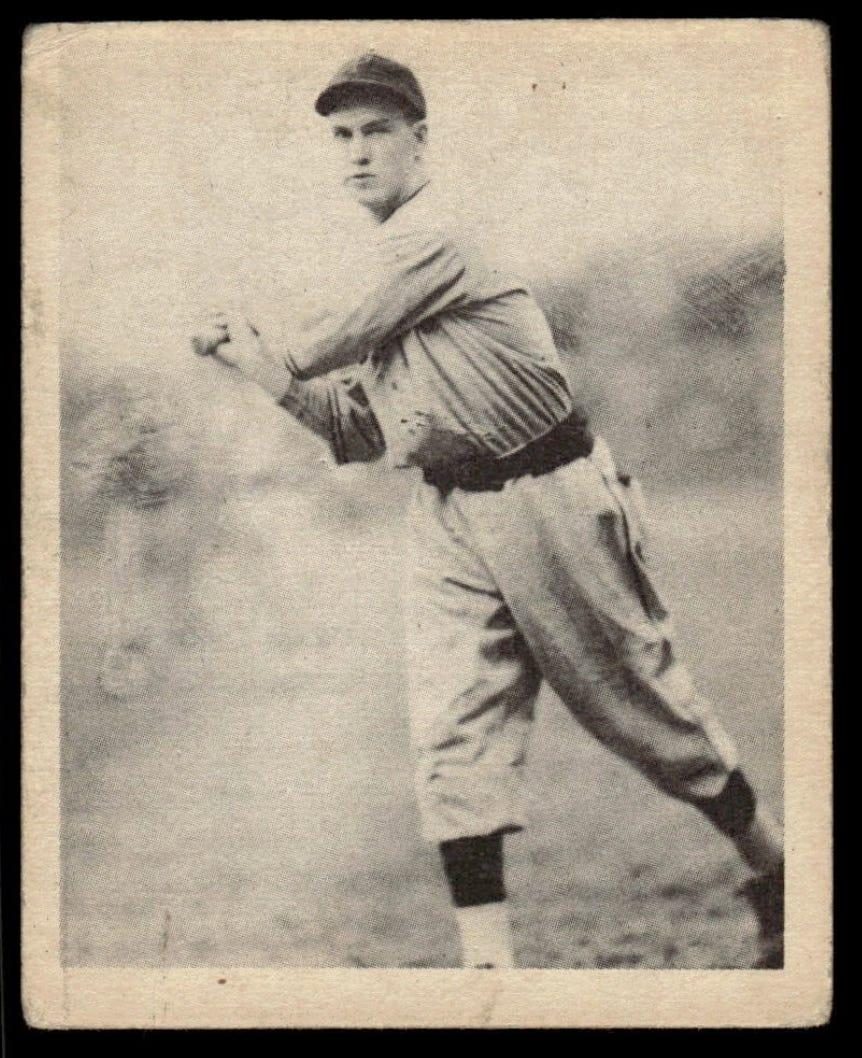
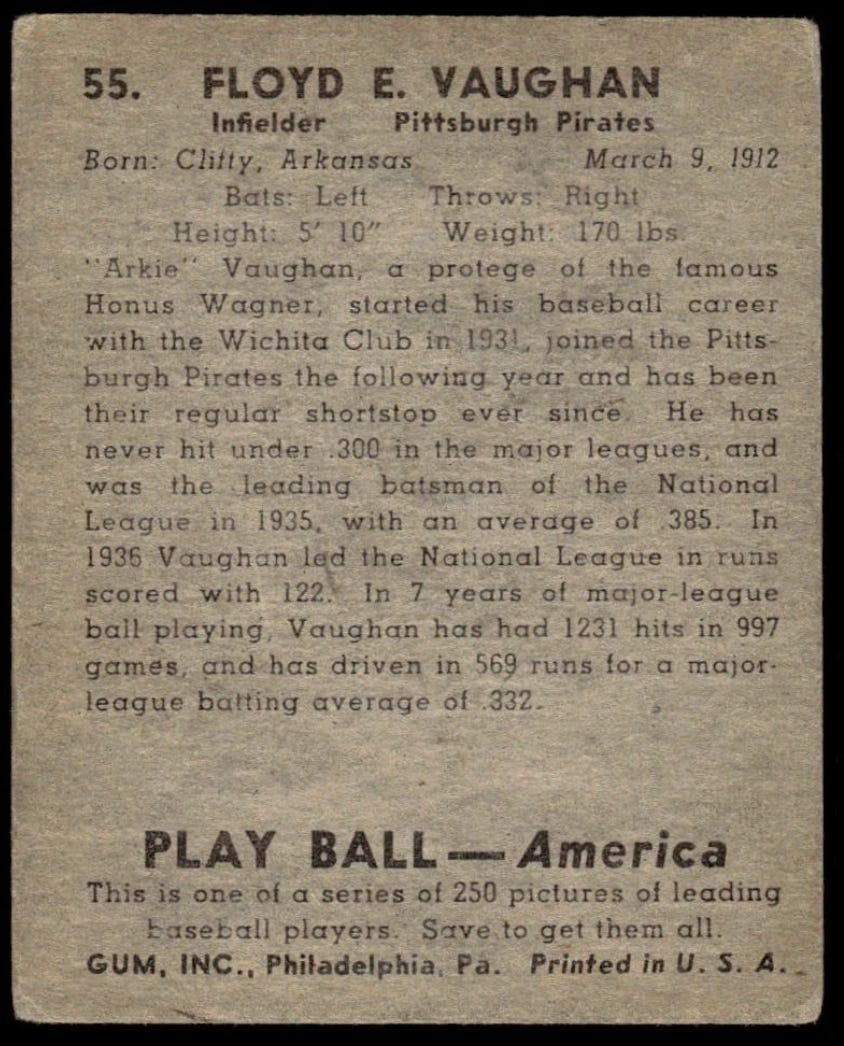
00:01
So this episode is going to be called The Aesthetics of Austerity, 1939 Play Ball. I want to discuss this specific issue. And the card I'm going to use here is the Arky Vaughan, card number 55.
I want to talk about distilled essences; the baseball card really being drilled down into something absolute and fundamental.
00:35
1939 in the US: still recovering from the Great Depression and grappling with isolationist sentiment while witnessing the early stages of World War II in Europe.
Slowly recovering economically with New Deal programs still in effect. Many Americans favored remaining neutral and growing European conflict.
This is the start of World War II, Germany invading Poland. Initial declaration of neutrality, Roosevelt prepares for potential war. The Manhattan Project is on the way. Gone with the Wind.
I really love this issue. And it's just really deeply meaningful to me because it's nothing.
There's just nothing about it. And it's something that I think is to its benefit in that sense — it hasn't really caught on anywhere because you can see the sheer emptiness of this set. When I look at it it's like this void.
02:01
An absence. And as you can see here, I think the Arky Vaughan is a good example with the highly blurred background. It takes it out of time and place, similar to the 34 through 36 Batter Ups. There's a couple of cards in that set that just, they totally disappear the background. It's like they're in this Dust Bowl storm or a sandstorm or an absent environment. And that's something that's common to baseball cards, A 1934-36 Batter Up Frankie Frisch card.
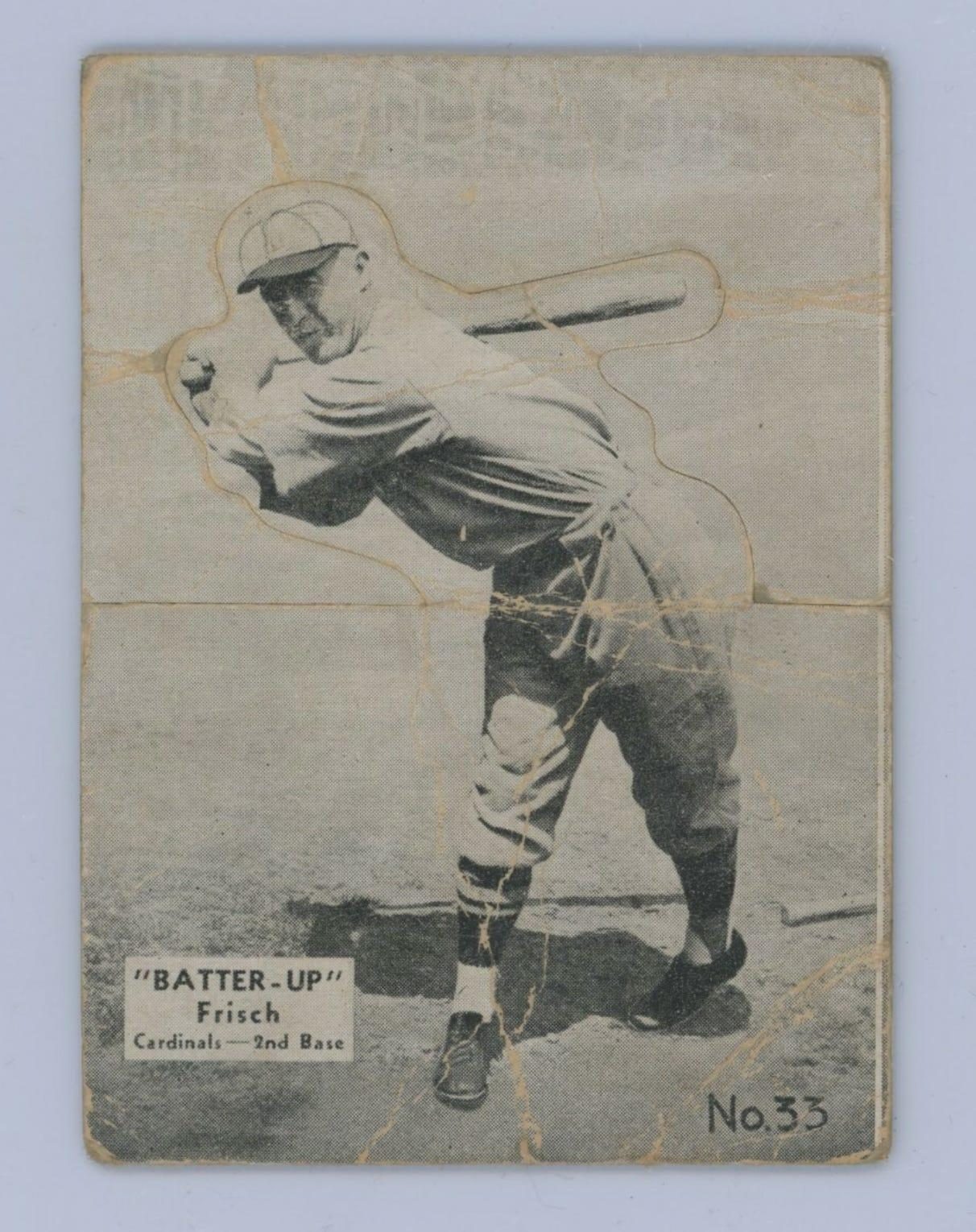
02:30
even going back to the early Caramels or the T206s or even before — with the Carl Horner portraits. It's an abstraction from the environment and abstraction from the backdrop. The figures are torn away into oblivion and limbo. And I think in a lot of ways that's what baseball represents and represented during these critical time periods of American identity formation.
It was something explicit and grounded within a abstract void of an environment that was undefined, unclear, and moving in 15 or 20 different directions at once, whether that was economically, socially, industrially, politically, and globally.
The early modern periods of American identity formation… the one thing, really, when you look at American history that remains stable and constant is baseball. So it's no surprise that out of these voids, whether they're colorless voids, grayscale voids, as in 39 Play Ball, or colorful voids, as in E90-1, or the Anonymous set, the early Caramels; going into the Goudeys, as well as the US Caramel set — these are red, green; you have the purple void of the 1941 Play Ball Joe DiMaggio.
We're talking about an aesthetics of identity formation, which eventually culminates in the pop art movement of the 50s with these bright colored backgrounds in the Warhols as well as the 1954 Topps set, or the end of the 40s Leaf and Bowman sets for baseball cards.
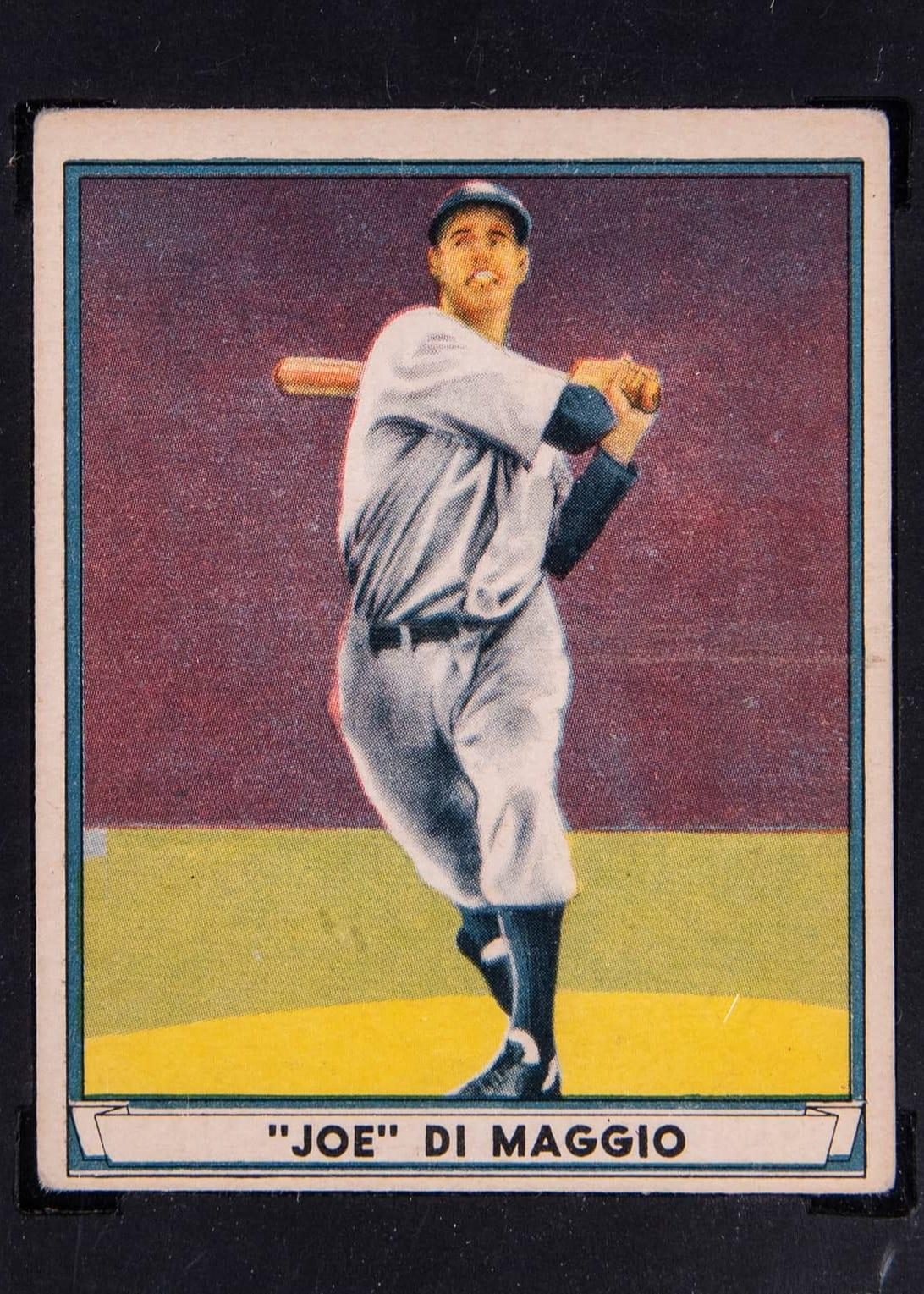
The 1941 Play Ball Joe DiMaggio.
04:26
The 39 Play Ball though, in particular, to me is the quintessential baseball card because it's just so void of any sort of attempt to create a theatrical representation or artistic creative representation.
These cards, when I look at them, the moment they’re made it's almost like they're a memory. And I look at the Paul Wainer too — another good example. That's card number 112 in the set. Again, abstracted background. He's the only figure; he's mid swing.
Paul Waner, #112.
05:22
These are very documentary bare-bones cards. It's basically what you would see in terms of a newspaper photo. The entire front of them, it's just the image of this photograph. Nothing else. And then on the back, you have the basic statistics — kind of player cards, so to speak — words of the different styles of batting, where they're born, when.
05:52
And a very, very, very simple, simple, simple, simple player bio.
06:02
The language is very clear, very straightforward, non-metaphorical. He has never hit under .300 in the major leagues. Was the leading batsman in the National League in 1935. Vaughn led the National League in runs scored with 122. And then at the bottom, you have the Play Ball - America. Gum Inc. Philadelphia, Pennsylvania.
Save to get them all.
This is interesting to me when I think in terms of the economic situation in the United States compared to the onset of the Great Depression with the Goudeys and the Diamond Stars. It's almost like the Goudey and the Diamond Star sets are a sort of reactionary attempt to create meaning or power or beauty in the midst of this very, very bad social, political and economic situation — which is the United States’ total collapse of the economy between the first and the second world wars.
And then when I look at 1939 Play Ball, there's something so grounded about them.
There's nothing flashy. There's no flashy language. There's no flashy poses. There's nothing dynamic. It's almost like they're just, they're this faded memory of a dream, so to speak, to use a funny old quote there. And they just exist. It's, to me, one of if not the most understated baseball card releases ever.
Of course, you have cards with a similar tone to this in terms of the Goudey Wide Pens or the… the ice cream cards of the late 1920s, things along those lines. But this is a very, it's very quintessential and it's well wrapped within the traditional baseball card format and size. These are not redemption cards with a strange size or a strip card with a strange size. Nor are they oversize issues such as the Goudey Pens or image postcards. You've already reached the point where we understand what the conventional baseball card size is going to be. And we have an understanding of what the front and back of the baseball card represents — where you have the bio, the statistics, and the kind of signature of the gum company or the cigarette company or whatever company produces these.
And so what Play Ball did in 1939, and it's different than the 1940 release as well as obviously the 41 with color, is that there is no decoration. It's almost like you have a type one photo on cardboard with the background that's been edited out, similar to as you would see in a documentary newspaper cycle. And you've been given the distilled abstracted representation of the figure and just the absolute utter essential statistics and signifiers of said player on the back of the card.
09:28
And what this represents to me is an aesthetics of austerity. It's almost like there's a moment of brutal clarity that happens in American civilization and American culture. And it happens as the sort of horrible drug of the depression is wearing off.
And meanwhile, you have this second world war beginning to rage in Europe, right?
There's this slow fomentation of the war in terms of what's going on in Germany all throughout the 30s and then the invasion of Poland. And there's this sense, this looming sense that the United States is preparing to get involved. It almost seems inevitable despite these isolationist attempts at declaration of policy.
And there's this moment of brutal clarity that is represented to me in the artlessness of the 1939 Play Ball set. Brutal sobriety of tone and production vision. The image of baseball just flatlined. Dead toned. And what I mean by artlessness is just a total lack of the attempt to manufacture anything. Beauty, meaning, power, something to distinguish these cards, which is so contradictory to the whole project of the baseball card as a marketing device. Art as marketing and sales as endemic to the so specific brand of American capitalism. These are the gum cards for Play Ball.
10:50
I believe the owner of Play Ball was Jacob Bowman. He goes on to found the Bowman card company. And you can see these design aesthetics transfer over to the early Bowman cards, particularly 1948 Bowman — which I think is also an underrated release — but I do think the 39 is better because the poses capture more of the sport of baseball, as opposed to a lot of the close-ups in portraiture that happens in 48. 48 is just a little closer, if that makes sense. The lens and the frame of the cards are more portraits than they are environmental style action shots that you would more traditionally see in a newspaper.
The 1948 Bowman Warren Spahn, a veteran of World War II.
11:46
So you have almost a 10-year layover between the resumption of this… Play Ball design narrative with Jacob Bowman’s 1948 Bowman set, and then it changes and becomes colored images in 49 and 50, 51, 52; into 53 with the color photography.
12:48
A lot of the 1939 Play Ball cards, like the Ted Williams card for instance, is against a void backdrop. There's this blackness and then there's a slight, I don't know if it's like a stairwell or a barrier wall. Its a stark gradient. A contrast of light and form. It’s barren. Geometric.
The 1939 Play Ball Ted Williams card.
13:16
Some of them are less blurred out. Like the Bob Klinger card, card number 90 from the set. You retain a level of environmental awareness, with a subtle focus shift artistic quality that fades to the borders. This is something often observable in the type one photographic techniques of the time — used to prepare photographs for publication in the formal limitations of a newspaper.
Bob Klinger, 1939 Play Ball.
I really enjoy the unadorned nature of this issue because it's almost like the one moment that America is off some sort of collective dream drug, a dream drug of idealism or the attempt to paint over reality with a beautiful narrative or a mythic narrative. I mean, this is wartime baseball, but it's also baseball at one of the lowest and most difficult points in American history.
But it's a couple of years into this process; just years time away from the domestic impact of WWII. 32 is the crash, and then you have these years where it's difficult to grapple with the truth of the situation. The collective psyche is shaken, stunned — in a state of collective disbelief. You get towards 38, 39, and then you're getting into World War II territory; the rise of global involvement, Germany’s emboldened moves on the global stage. And it's a moment to me of critical sobriety between two huge collective, social moments: one more-so domestic and direct in the financial impacts of the crash; one more-so envisioned, distant, a global world war that shifts America’s entire mode of cultural participation, production — but one that happens abstracted, in foreign territories.
14:22
And this is something that… you have some of the issues like Morehouse Baking in the 19-teens that are kind of similar to this. However, this is still a period of what the baseball card is undefined. On the backs of those cards, they're usually either blank backs or they're advertising backs. It’s not a iconographic distillation of the player.
It’s not that multidimensional. The 39 Play Ball is a fully formed, modern baseball card. The format and mode is what you would see on a current baseball card today.
You'd have the player portrait, or the player pose on the front.
Then on the back, you'd have essential statistics as well as a player biography and some of the data on the company that produced it. This is the modern baseball card.
And for me, this is really the first time where you see that synthesis. You have the Goudey Wide Pens and the premiums of the 1930s that have a similar design ethos of austere, high contrast photography, but they're still not this fully formed modern baseball card with the cardboard dimensions; the handheld aspect — as well as the fully detailed and laid out back. This is a unity of the design conventions in its most distilled and minimalist form. Stripped of color, complete with the essential player identifiers and context. And in that, it mirrors, I think, the sentiment at the time at a cultural level in one of the clearest ways.
These cards could almost do with… I almost want to say more blurring and more abstraction — but it would, again, that would bring these cards into art more, if you see what I'm saying. Because it would, you would begin to be messing with the foreground-background dynamics to remove the character from the natural environment. Artificial displacement.
That's why this Arky Vaughn is such an interesting one to me, because it's like a fog.
Not yet liminal or broken from the plane of existence or reality yet, but obscured.
16:22
You can still see — it looks like there's people in the background and he's standing on this baseball field. And it looks like you're kind of looking at it through glass, like through layers. There's like layers of glass that's behind him. You're seeing this refracted scene that's occurring.
It's a really beautiful, just fundamental, basic shot — but obscured and made complex and fascinating with this glass refraction or fragmentation. This is a psychic thing. You have to think about and view these artifacts and cultural art objects through the lens of a collective unfolding that is being seen, felt, heard and experienced as a collective social, political, spiritual, and mythic-psychic condition.
These cards speak it.
16:48
That's the thing about these, there's not too much to say about them because they are so distilled and they are so drawn down to the fundamental and the essential.
And that's what makes them so beautiful. But it's also, I think, what makes them so forgotten as a set. There's no humor or cartoon aspect that you would see in the 38 Goudey Heads Ups. You can see how quickly the mode and tone shifts. That’s one year’s time. There's no beauty or attempt to make art as you'd see in the Diamond Stars or the Goudey sets of just half a decade prior.
It's not commercial at all and yet it's supposed to be. This is the marketing, the yearly manifesto for baseball. And its drawn in a tone that strikes the most somber and yet quietly elegant chord. And that's the beauty of these aesthetics of austerity because the allow for the assertion of something true because there's no real ability to lie. It's almost like the lie either is just not possible from a manufacturing standpoint and or it's not something that would be received.
In the case of the ‘39 Play Balls, it is the latter. The marketing and the cultural art vision or mythos of baseball has been returned to the real in a way that communicates the deep psychic unease and fragmentation of the nation at large between two massive political ruptures in a way that social realism can barely touch.
And they do this through this delicate, subtle jarring of the fade; the high contrast of the player poses — some of them almost unrecognizable due to the wide focus of the zoom.
The country is not in a mode or in a moment to receive a colorful, poppy, bubblegum set of cards that betray an untruth about the nation at the time. And neither is it in a frantic, dissociative mythic mode in which something like the ‘33 Goudey set becomes a way out of terror. The color, the mythic mode becomes utterly necessary as a way to survive.
Baseball becomes a stage for the necessary, dissociative escapism of absolute political turmoil, fragmentation, chaos, and destruction. This sets the stage for one of the more critical and fundamental observations of this talk — the idea and concept that art and the mythic mode of creativity and creation itself is a method of the fractured, traumatic state. And entire cultures can descend into this myth-making.
And as history reveals, insofar as our understanding of the source and function of religions and collective cultural and social mythologies allow — this is actually the root and foundation of all cultures. And as they enter into periods of intense contraction, they regress deeper and deeper into dissociative myth-making as a coping mechanism in the face of real, political reality. When we look at all art and creative thinking — whether at a civilizational or personal level — this is really what we are observing.
The colorful, scenic, beautiful 1933 Goudey set.
18:15
But even when you get into the 1940 and 41 Play Balls, in contrast to the 39 set, you see this attempt to adorn. And this is when it becomes clear the United States is going to enter the war. It almost seems to be a matter of time. And you can see again this myth instinct and myth impulse rising. And I almost want to say… I was reading this quote earlier.
It was — the attempt to mythologize is the entry into a false world. Or it's like the attempt to deal with real, serious psychological or collective cultural trauma in a way that is digestible. It's a dissociative method. The realm of the mythic is the realm of the traumatic rupture or fragmentation. This becomes the creative realm — populated with mystical creatures and fantastical legends and summons of narratives. It’s the abstracted dream world of imagination and of representation. And the baseball card is a collective, civilizational level aperture for this. It is made at the level of corporations, mass produced; is itself a prism for a collective sort of cave-art visionary state in the cultural depiction of reality through the fracture of representation through image production at and en masse.
People that enter the mythic realm usually enter it through a period of great trauma and disturbance, even in a mystical sense, in terms of if you want to talk about the path of the mystic or the path of the shaman. They enter into it through a form of psychological or even physical wounding because it reveals to them the contrast between everyday life and this realm of disturbance. The wound is the breach; the breach is the break or rupture in life which is the pain or the suffering that necessitates the mythic mode as a coping mechanism for said pain and suffering.
That's why it's interesting to see this 1939 Play Ball set appear how it does and when it does — because if you look at the graph of energetic fluctuations, so to speak, in American history between periods of profound traumatic impact — whether that's the Depression or World War One or World War Two — you're hitting this very weird downward sloping in terms of the digestion of the real impacts of the Depression; the attempt to create New Deal initiatives to spark an economic boom in the country, and then this rapidly rising almost immediately after the production of this set of resumption into World War time.
Again, this sentiment of this impending chaos or rupture. It rises subtly and suddenly first through the mythic awareness and visual, vision based image mode of the baseball card. A way of thinking of this is the subtle, intuitive awareness that animals have before a storm or a natural change in fronts. So you have this very short period of time between 1932 and 1939 into 40, 41, 42, where you have this downward-sloping graph into the digestion of this profound rupture that happens culturally and economically with the Great Depression; the country is still trying to digest this and recover from this through the New Deal initiatives. And then World War II starts, right? And the US ends up having to get involved.
The inevitability breaks into the reality of another onslaught of traumatic rupture — interestingly enough, emergent from a different fabric or form. The Depression strikes domestically and is entirely contained in real national scenes of presence with this financial rupture; WWII strikes internationally and strikes American soil only in the rare instance — most notably with Pearl Harbor; several other encroachments upon US soil.
This contradiction of internal and external tensions and pressures is fascinating — again, to observe this like an expanding and contracting ecosystem of breaths, or a breathing microorganism of nations. Where and how are these contractions happening — and how do they spark? The US recoils from WWII, but it is crippled from within by the collapse of its economies. You attempt to trace these origins and realize they are really fluid; products of colliding and intersecting domestic and global phenomena — going back to our conversations about industrialization and globalization — as collective psychic phenomena that transcend and bypass borders into collective human intiations into profound new ruptures which are windows into new paradigms of realities.
20:55
So when you see that energetic graph, it's really interesting to look at those moments, that moment of the dive, which is the digestion or ingestion; then there's another ascent into a critical moment of rupture. This is such a profound time of transformation at the global human level that these dives and ascents are happening in matters of months, not years or decades. This is a rapidly fluctuating environment and psychic collective weather system. You really look at that moment of 1939 Play Ball, I think it's a really profound documentary news — like it's a newspaper in cardboard.
And I really appreciate that and respect that about this set. It's a newspaper and cardboard in a way that nothing else touches. 1941 double play comes close, but its far more abbreviated. It’s not a baseball card, its a telegraph. A short bio, everything is on the front; shared by two players. Often cut to separate the cards into each individual player.
21:53
The 1939 Play Ball is like a handheld newspaper card.
22:02
And I think there's a clarity with that. Clarity in the delivery of the newspaper. A groundedness that’s actually quite meditative and calming. None of the frills. It's like a form of documentary social realism. And I talked a little bit before about WPA photography. I think this is a really great example of that here — distilled in providing information, as a photograph would be integrated into news communication. Whereas in other sets, you have subtle attempts to enhance or create theater or create spectacle. Even 41 Play Ball, 1940 Play Ball — it's much more decorative, on the front in particular with the decorative framing, as well as the player name on the plaque at the bottom. And then in 41, you have this colorization and cartoonization again. The photograph from the 1940 set is transposed into this alternate world and reality filled with unrealistic color gradients and strange interpretations of the faces. This is the pattern observable in the ‘33 Goudey and mid 30s Diamond Stars sets. It's interesting to see this happen, especially when you look at 1932 specifically. 32, there's only U.S. Caramel, but then you look at 33 and 34 Goudey.
A collage of cards which includes the 1940 and 1941 Play Ball sets (‘40 is the black and white set with the decorative border and nameplate at bottom center; ‘41 is the colorized images with same border and nameplate) — as well as 1934 Diamond Stars and 1933 Goudey Cards (Goudey at top, second from right; Diamond Stars in middle row, far left and far right).
23:01
It's this, again, this manufacturing of the cartoonic, mythic, abstracted color, lush environments. And you can see that phenomenon as it fluctuates — emerges prominently, recedes, and returns — throughout the 30s and into the 40s, based on these critical moments of traumatic rupture that are happening in United States history. It's like a civilizational, subconscious impact that's influencing the way that these cards are produced and the way that they're attempting to perform — whether that's art or theater or this sense, America's pastime being this abstracted cartoonish, almost other world. The way that baseball functions as a collective reservoir of psychic force. It's like a form of cultural escapism that occurs there. And I think it's something that's very clear when you look at these sets through the 30s and how they dip; how they ascend in terms of the construct of the card, how it looks, what it's saying, and what it's doing in real time I think it's something that's very, very clear in the 30s because it's such a crux, it's such a turning point as the United States is re-entering World War time; grappling with the brutal collapse of its markets. It is gutted from within; collapsed in the homeland, and is struggling to pick itself up as the pitch of world war rises in a fervor just outside its borders.
24:28
I look at what happens in the early 1900s with the tobacco cards and the caramel cards going into the 19-teens and they become very standardized — still influenced by the affluent art of the American Tobacco cards — but very standardized advertising or blank back cards like Morehouse in the later teens headed into World War I. The images are re-used, unadorned; the backs are reserved either entirely for an advertisement for a company or else entirely blank.
The famous 1916 Morehouse Baking Babe Ruth baseball card.
So there's another example of this phenomenon at hand. Then throughout the 20s, you really just have the strip cards and the Kashin set; cards like the American Caramel E120s and E121s. Black and white photographic representations. Blank backs, or advertising backs. A brief adornment in terms of the ornate border of the E120 set — but this adornment was not limited to the American Caramel release. It was used elsewhere. Repurposed as a design template. But again, these are all still early formations of the baseball card. There's not yet the fully biographical back as well as the statistics of the player — ie, infielder, Pittsburgh Pirates.
I think that formation really starts to happen as you hit the 30s with the Goudey cards. The Goudey card is really the first modern baseball card in my eyes.
Diamond Stars is also a great one, but Goudey is there first in that 33 set. It's just a huge, definitive, declarative statement. The biggest one, I would say, that happens after the T206. And the Cracker Jack, interestingly, is the proto-Goudey in terms of how the front and back of the Cracker Jack function.
It provides that template of cartoonized player dissociated and unmoored from ‘real place’ with biographical back; then Goudey takes it and expands the whole world and universe of it into this multi-colored, multi-environmental, very dynamic, almost like jungle of baseball forms. This is also, quite interestingly, when Disney starts producing color cartoons. 1932. So when you look at the baseball card like that, it's interesting to track it side by side with American cultural and historical developments.
And you can see that influence in terms of how the baseball card is establishing and conveying itself and its attempt to either heighten the sensory experience of the icons of baseball, the legends of baseball, or the idea of baseball as a cultural form — or to have it be this very grounded, fundamental, essential, stripped back, minimalist form — as I said with the Morehouse Baking cards as well as with 1939 Play Ball.
These are things that you can track because they're cultural developments of excess and dreaming and austerity and sobriety that are not separate, they're not mutually exclusive. They're part of this larger ecosystem that's breathing, it's contracting and expanding; creating this whole environment of influence based on the current cultural, social, and political factors of the time. These factors are visual; visible;
made visible by the vision of the collective the fluctuates with its digestion, metabolism, and portrayal of its experience of political reality.
So I hope you enjoyed this one. I will catch you on the next one. See you.
13. The Confrontation of Meaning: Culture, Chaos & Creation of Civilizational Self Image
Jun 28, 2025 · pp. 221–239
00:01
So this essay is going to be called The Confrontation of Meaning. I think it's interesting how this just keeps revealing itself to me to express this and to give it light, to give it honor and word and depth. Because my work is traditionally in metaphysics. It's in philosophy. It's in science, thermodynamics, classical physics, well as quantum mechanics, and fusing the understanding of science with philosophy to create a real human perspective of who we are, why we're here, what we're doing, and to map the larger cosmological trajectory of the development of the human species over millions, millions, billions of years.
To look at the origins of the universe and attempt to understand: what is the essential element of being? What is the thread that runs through all of existence?
And that itself is the thread which we actually embody as a human species. It's a linguistic weaving that is genetics. It's the language of the species that actually assembles the human body through reproduction.
The thread of the gene is life on Earth. So we are something and of something and becoming with something that's inseparable from everything. We are that. That's the expression in the Vedanta, in the Hindu Vedanta. We are all things. So we're trying to understand, in trying to understand ourselves, what we're really trying to do is understand existence. And for a long time, my work existed in this sphere, which you can only really call abstract representation. You have to use metaphors.
02:10
You have to create images to show people this because it's too big. It's too big. You could gesture to a flower or you could gesture to a human being and you can show people that the network of happenings that brought this flower, this human being into being and talk about what is the essence of that thing. But with baseball cards, I think there's something that's very, very humble, very humble, very devotional, very material, it's made present.
This Colmenarez card here is a really, really, really pertinent example because this is a Venezuelan hero. This is a cultural hero who has been memorialized in the concept of the immortal, that's at the top right of this card, memorialized in this piece of cardboard that's exchanged and traded — as an essential cultural figure in Venezuela's national identity formation. So I want to tie that back to what I was just saying, because this is a materialization of a very complex process of becoming — which, for this moment in time, there exists the species of the human being. And we are grappling with our understanding of this deep, deep dark cavern from which we emerged, which is the deep dark cavern and tunnel of history.
And this, as I go back to in the austerity essay, the aesthetics of austerity, is terrifying. Culture itself is a mediation and a moderation of this great and profound fear of death, isolation, individuation, the consequences of being born and the consequences of dying.
04:05
The consequences of being asserted or thrown into reality, as Heidegger would say, thrown into being. And you're grappling with these existential circumstances that you don't understand. You have to learn the body. You have to learn nature. This process where you're thrown into existence. Birth unto death. The entropy of the form of the human being. And what happens for the most part, with the exception of a few, maybe Da Vinci or Goethe — you're thrown into being and what you have to latch onto is a justification or a rationale.
A way of explaining your existence, forming your identity, cultivating a sense of self, which is not, it's not based on truth in a real metaphysical scientific sense.
05:03
It's based on the assertion of an identity which has to withstand the onslaught of nature. It has to withstand and buffer itself against the fear of death. It has to justify itself enough to survive and exist in a world and an ecosystem populated by many other life forms that are also in existential interminable limbo. This is what culture is. It’s a story that explains where reason or logic fails.
05:32
Genius is always a degree of comprehension. It may be several degrees, like Spinoza's genius or Leibniz's genius. These are polymathic forms of genius that are able to comprehend from multiple different perspectives, whether that's science or political theory or history, biology, philosophy, psychology, all of these different… dimensions in which you can penetrate into the essence of being and from seeing by many different angles, you can begin to actually form a realistic holistic picture of what the cosmology of the essence of existence is. It's like a fractal that you can look at the psychology of a human being. If you understand psychology at a deep enough level, you start to look at cosmology, which is the formation of galaxies, and you can start to see the fractal resemblance in existence.
And this fractal existence is something that is elucidated by Da Vinci and Goethe and other polymaths of extreme vision, of extreme presence. These people who are in the human history of genius.
Looking at these cards, you have to understand just how important they are and how powerful it is that they exist in these thin, flimsy pieces of ground up cardboard, right? This memorial, this totem, this way of memorializing and remembering the foundations of a culture of play, of joy, of struggle, of sacrifice and of emergence.
07:20
These players — baseball is not just a game in Venezuela or Cuba or the United States; now in Puerto Rico, the Dominican Republic. Baseball is a way of creating a collective identity. It’s a way of life. It's a way of gathering around the fire in the midst of an abstract perennial void of existence. A deep, dark; for many, utterly impenetrable unknown of the real condition and status and identity of humanity and human beings. And so what culture really is, it's what holds a civilization together.
And when you step back and away from that, the bottom drops out into an absolute void of existence, a void of being, right? An abyss. This is not abstract. This is what I'm trying to communicate to you. It is not abstract. It's a reality of existence. It is lived, felt, experienced viscerally. If you were to step away from the cultural fire of baseball or national mythology, a concept of self that is communally accepted — what happens in that circumstance is you lose the civilizational thread which constitutes the very nature of your being. That has been justified and mutually accepted by those around you. This is the function of religion. It's the function of politics. It's the function of culture. Every single human communal endeavor is based around this necessity of survival through the establishment of common culture.
Stripping that away is when you get into the metaphysical real, but also abstract void of the experience of void. This is a negation of negation. And so this is what I brought up in the aesthetics of austerity essay, because that was, that was that moment in the 1939 Play Ball when I'm really looking at that card set and I'm looking at, this is the moment where the illusion has achieved this level of collective sobriety, which almost constitutes a spiritual awakening. That this country has undergone such a transformative, destructive… ego battering period where the collective cultural illusions have broken or are on the verge of breaking. So this is like a psychological dam, right?
And it moves in historical cycles of, you could almost call it purification because what the human species is seeking to do through culture at any given moment in time is establish a common framework of understanding through which human beings can exist without being in a stage of absolute existential fear and panic, which comes from misunderstanding.
A ground upon which some form of stability can be acquired, even if that ground is false, to to speak. Because this is not ultimately about truth, its about survival. That is the deepest instinct to nature and to living form. So culture is the buffer between truth and absolute utter delusion and chaos — because it has to be. Between truth and delusion and chaos is culture. Truth is the risk of death — the stepping out into the unknown from the collectively assumed safety of the known. But even this, of course, as any major innovation has shown — is always just delusion; illusion of knowing for the sake of survival. Culture holds this line of being the substitute or the surrogate for meaning or the surrogate for knowledge through storytelling, through collective communal participation. All of these things are ways of holding the ball up in the air, so to speak, of a collective human civilizational identity which allows for existence to continue and not to fall or be thrown from the tower of civilization or culture into absolute and utter chaos and destruction.
This is the real power and importance of culture — and I give that a level of sanctification, because what you look at when you look at the history of intellectual or scientific or philosophical genius, you're looking at people who have really penetrated the veil of reality and confronted this void, this depth of void. This is something that's common to the quantum physicists just as much as it's common to the most extreme and far reaching philosophical figures. You look at people like David Bohm or you look at Nietzsche or Heidegger or Heraclitus.
11:25
These are all figures that, from different angles, whether that's through quantum mechanics, whether that's through physics in the case of Newton, or you could look at Einstein, or you look at people who approach it through metaphysics, Heraclitus or Nietzsche. What Nietzsche does in particular, I will say this, is he penetrates the veil of culture and reveals the void, the emptiness, and the negation within it… in the necessity of establishing communal collective culture to keep people in this insane sanity. And what I mean by insane sanity is that the establishment of the collective consciousness functions in and like a cultural archetype.
Let's say baseball is the epicenter of that or educational institutions are the epicenter of that. This is not about truth. It's about the assertion of what creates comfort and stability; the perpetual affirmation of that as a form of narrative stability in the surfeit and upon the surface of human life. It's a cultural story, which again, I said resides between truth and utter madness and dislocation and destruction. It regulates existence from day to day, just a thin veneer or layer writ upon the surface of an abyssal fallout of meaning and destruction of culturally established norms.
12:42
It's the necessary balance that at any moment through the force of nature can be thrown. That cultural tower, a civilizational tower can be toppled. And then people are thrown into the madness of confusion, dislocation, fragmentation, and loss. And so I've been using the baseball card to track this fluctuation, which is almost, it's almost like a, like a seesaw between madness, deification, and truth.
And the balance between madness and truth, especially through this wartime period — World War I, the Depression and World War II — the cultural balance and the creation of the mythology of baseball is thrown into madness and instability. And you can see the collective consciousness oscillate between this kind of candy-coated, hyper-cartooned, hyper real vision and visual form.
13:48
As I was discussing with the Goudey cards or the Diamond Stars cards, it's so surreal, it's so dislocated from reality. The red skies, the yellow skies, the crazy colors. There's no more environment that's recognizable. It's been thrown entirely into a cartoon. As opposed to just five years later, the 1939 Play Ball set, which is entirely real, entirely subdued. Stark representation. Like you're looking at life through cracked glass.
It's been minimized. It's been reduced. So you see what I'm saying? There's this maximalism of extreme color and cartoon wonkiness and strangeness, and then this minimalism of reduced, glass bound, hyper gray scale representation. And this is the seesaw that I'm talking about. And this is all occurring through real human collective experience that is being metabolized not only at the personal level, but at the collective cultural civilizational level. It’s being expressed through the cultural product. The cultural visionary device of the baseball card. It's a it's an aperture. It influences the way people perceive reality; people influence it. It’s a negative feedback loop. They're seeing what they're observing within the culture and they're putting that back into the culture.
This is perpetuation of the rise of a psychic issue or dilemma in a massive collective situation which gradually becomes conscious. It boils or bubbles up from the primordial sludge of the collective unconscious of the origins and psychology of humanity and rises to the light of day in the inevitability of being brought to blows by technology, interconnection; the revelation of difference — different cultures, belief systems; modes of existence and being which are revealed through technologization, industrialization, globalization. This very growth is the revelation of the hidden seed of agony, destruction, chaos — that lies within humanity; the hearts and minds and souls of people.
So as you can see, it's a collective constitution of many people's apertures, which is a perception of a reality. And this is the thing that's so ultimately destructive. It’s what destroys civilizations, what destroys communities and what destroys cultures, because you're attempting to establish a meaning-making system to contain life. To explain it. To make it possible between myself and you, or whoever else is participating.
15:46
But this is not a meaning making system that's based on truth. This is a meaning making system that's based on a proxy for truth. It’s a patchwork solution to a fundamental problem of existence. Because what truth really requires is a penetration into and perception of reality on a level which humanity itself is very rarely, if ever capable of to any degree — whether that's a perception of reality through the lens and aperture of physics or thermodynamics or biology or chemistry.
That level of penetration is always innovation, even if it's just in one discipline. And that level of penetration sparks a deep survival instinct level fear in people who cannot penetrate reality beyond the cultural bounds which afford them a degree of vision, stability, and certainty within the collectively jurisdicted rules and bounds and stories and reasons.
But if that's happening in multiple disciplines, like Spinoza or Leibniz — both of which are great examples — or Goethe, another great example, or Da Vinci… you start to be able to actually form real perception of nature, real perception of existence and being through this multivalent inquiry. This is the bringing of the light, or the fire — consciousness to the subconscious in a civilizational, species level sense. This is the mythological function of Prometheus.
16:52
And so you see here where you have a almost fundamental being at odds. And the fundamental being at odds is between this genius, right? This prophetic level intelligence that's actually able to further cultural perception. Which is an essential contribution at a species level that continues. It’s the story of how the aperture of any culture or civilization or any moment of humanity and the human species widens to reveal a deeper truth; more of the truth. More of the reality. Each person who does this, whether it's at… the level of a single discipline or whether it's at the level of a polymathy, contributes fundamentally to the collective aperture of civilization and consciousness. But what you're doing is you're attempting to drag along a cultural consciousness which resides in what it is capable of perceiving. It's the limit of the aperture of the lowest common denominator of the culture itself.
17:49
You see what I'm saying? It's a huge mass. You're trying to move that mass along.
But that mass is clinging. It's clinging to a myth. It's clinging to a story. It's clinging to an idea of itself that allows it to survive. This is what makes it possible — civilization and life just above the breach of the void of meaning — without total descent into chaos.
This is what it is at an existential level to be at odds — because ultimately what the entire species of humanity is doing is to survive. It's trying to survive, that’s it. It's trying to understand; understanding is in service therein for the vast majority only to survival. Beyond that is throwing oneself into death for the sake of truth. And this is, actually, where truth asserts itself. It’s the feather bed, or the net that catches one who has shed all presumption. Humanity — it's trying to exist in the best way it can on the terms that it knows how to. And you have always throughout history, there's this push and pull of forces. You have the mass, which is the cultural aperture itself — which relies on something like baseball, or relies on something like a cultural story or belief system or cosmology which frames reality in a way that it can understand, a tradition that's been passed down, that's been accepted… that actually creates a deep level of community at a cultural level. This cannot be ignored. Because this is: we all believe and agree on this same thing and we know it to be true. It's almost like the temple of baseball.
We all agree baseball's nine innings, there's this, there's that, the mound is this high and we're all here participating in this communal event, this collective phenomenon.
Its the infrastructure of the game itself and its agreed upon precepts — that are collectively true and understood as in an agreement we make between ourselves.
19:24
So you have this, which is the fabric of reality that has been created within the infrastructure of civilization or any culture. And then you have the artifacts that come from that. And this is why I've come to baseball cards, because baseball was really one of the earliest collective cultural civilizational endeavors that I participated in. It was almost like an introduction into, okay, here's what we're doing here.
And so in my work in, whether it's in philosophy or science or cosmology, there's no cultural connection there because it's not about culture. It has nothing to do with culture — which is the real foundation of how human beings constitute existence through seeking safety and stability in emotion through collective understanding and dreammaking; mythmaking. It's about the fabric of reality and actually understanding that and perceiving it and elucidating it. There’s great risk to those who step into that arena — because as I said, its stepping into the unknown. But the issue with that, the issue that I understand and understood very clearly — is that it's totally unmoored from these cultural institutions. From anything understood and accepted. It's not something that works within them because it shatters them. It takes away the veil of cultural civilizational reality, which is the foundation and the fabric that human beings exist in and upon. You go into the city or you start walking on the street. This is a collectively created existence — from the architecture to the language.
All of it is our common accepted traits as a currency that allow us to constitute ourselves as a group. But when you go down those roads, right, whether it's philosophy, whether it's science or cosmology, this is actually about revolutionizing.
It's not about regressively remaining within the community infrastructure. It's about the truth at the cost of everything that culture and civilization seeks to affirm and protect.
21:16
The bottom falls out of the baseball field and everything that's there, concessions, the vendors, the players, all of it falls out. And you're looking at this deeper abyssal level framework. You're looking at the composition of particles and atoms. You're looking at the composition of chemical compounds and structures. You're looking at the composition of genetics. You're looking at the physics of stars.
21:45
And then what you see behind all of this is energy. What you see behind all of it is energy. And then when you bring that back up to the surface, back on the everyday world of human beings, you can see quite clearly — the energy of cultural participation is a massive force. It's an absolutely massive force. And that force moves history. And so when you look at cultural participation as a massive force that's moving history, how and why is it moving history?
22:15
It's never moving history from the level of truth. It's moving history from the level of belief. The cultural construct of belief, these commonly accepted terms that we have created as a civilization that allow us to interact, create community, create infrastructure and function. That’s what moves trade ships, creates embargos, emboldens empires and armies. If you're to strip that away — again, as we're talking about in this really crucial period of the thirties, into the 40s… there's this deep, deep, deep instability that’s revealed — through foundation in belief, not truth.
There's this anxiety over identity. There's this fragmentation and fracturing that verges on mass psychological chaos and psychosis. And you can see this fluctuation throughout the 30s with baseball cards. You can see this. Are we going into this crazy mythic dream world, multicolored cartoon reality of pleasantries? Or are we descending into this cracked glass, fractured, contrast, grayscale reality. The highs and lows, it's almost like a drug of transformation. The drug is delusion met with the hard facts and truths of reality at the level of nature. Civilization is averse to this truth — because it disallows mythmaking. And mythmaking is the backbone of collective misunderstanding.
23:27
And so this is what you're looking at. It's like a massive civilization level stallion. It's kicking and bucking and it's attempting to establish itself. But the key, right? The key that turns the lock of stability and foundation is not in belief. It's not in culture.
It's in real truth. And what that takes is a level of courage. It takes a level of innovation and it takes a level of consciousness and acuity and presence to be able to penetrate deeply into these disciplines and to unify them. Whether that's science, whether that's philosophy, whether that's genetics or cosmology, whether that's history, whether that's psychology. And to see and understand and work with and learn with humility, all of these different frameworks and apertures and bring them together and create a real multidimensional, multivalent image of existence. And communicate that. That's the hope that we have. Our hope is not to further invest in culture.
24:36
So that's a big statement. So I'll unpack it a little bit. To further invest in culture is to further invest in belief.
24:47
We create these structures of belief to feel safe, to feel comfortable, to feel accepted, to feel like we're a part of community. To feel like we are a part of whatever country or whatever locality we come from. Because if we don't feel like we're part of that, we're cast off into the wilderness. It's a form of — there's a deep human fear of exile that stems far, far back into the kind of primal existence of our early ancestors.
Because if you're exiled in the wilderness, in that period of time in human history, it's it's over. You can't survive. It's very, very, very difficult to hunt, to sustain, to exist, to get water, get food, you name it. You relied upon the constitution of the labor power of your culture to survive. And the labor power is moved by collective belief and synergy, working together, belief in unity. So this is a profound psychological crux and turning point. And I've been tracing it through the 20th century and this mythological fluctuation of the image representation of baseball cards or photography or these other apparatuses of visual presentation.
Because what visual presentation does is it reveals something unconscious psychologically through direct presentation. The image speaks without words and is drawn without interpretation, deep from the mythic and myth bound subconscious.
It emerges through the fracture, through the crack in the glass; seeps up from the abyssal underworld and void of consciousness and perception into presence. Great artists draw in a trance; what is revealed to them is beneath reality. It is subhuman. It is surreal. It is the ghastly emergence of the primordial, forgotten — the wound of existence that is being remembered in the mythic dream image.
Through corporate mass produced baseball cards, you can taste this at a collective cultural level. It’s quite ingenious in the most unconscious way. These are representatives of a mass cultural phenomenon in that they're not being created by individuals. This is not an individual level aperture. This is an attempt to represent a civilizational or cultural level aperture through mass production of image forms;
iconographic art documents.
26:15
It's a temperature gauge on baseball. This is being created and mass produced to present each year or each decade as psychological imaginative construct, the vision of baseball at a cultural level. And that changes, right? It shifts because the psychodynamics of a civilization shift, the tectonic plates crack.
26:45
Certain things are revealed, whether it's corruption, whether it's malice, whether it's the destructive influence of certain beliefs. These are all ways that the tectonic plates crack and shift under the perceived foundations of civilizations. And those are never stable unless they're actually based in truth. So this goes back to Socrates. This goes back to Galileo. This is the entire history of the push and pull in Western civilization.
27:14
Of truth, The onus on truth and the attempt towards truth, which is the work of Socrates or the work of Galileo or Copernicus, it's re-centering our cultural, collective, civilizational, even global view in terms of a species. Re-centering our perception of reality in order to actually see the truth at deeper levels. This is a forward push into reality.
To move further towards the truth and ultimately away from our regressive belief systems that formerly kept us safe but are just no longer keeping us safe. And they barely did before. They were patchwork, tape jobs. These were things that we created to survive out of desperation because we could not perceive the truth. So then when you have an innovation, especially a polymathic innovation, deep philosophical or scientific innovation, what happens is you can reject the truth and rebel against it out of this deep, deep, deep fear of death. Leaving those trappings of culture, it's like a child leaving the womb. It's the trappings of culture that hold you and keep you safe and nurture you. And to actually leave those trappings, whether or not it's regressive, it doesn't matter. It represents a step into uncertainty, the unknown chaos and potential death. Right?
So that's the risk that all great thinkers historically take and have taken. And as is the case with Galileo, or the case with Socrates, or several others, right, we don't need to go into a laundry list — that historically has been met with a fair degree of opposition from the civilization or from the culture. Even in the elucidation of truth… and this is very powerful, because when you look at a card like this, the Colmenarez Immortals card, this is an immortalization, a memorialization of a cultural fabric, a belief system, a structure of baseball, which is human made.
29:23
Baseball was created by human beings as a cultural form, which becomes an institution across many nations.
29:33
Through that, you are building a proxy history. The history of the United States or anywhere else is a proxy history. It's a history of a cultural civilization assemblage.
It's something that you piece together. The names, the places, the laws, the rules. It's assembled. Manufactured. When you look at the laws of physics, when you look at the laws of science, when you look at thermodynamics, when you look at biology.
That's nature. And we have this immense difficulty as a species to even begin to turn toward the laws of nature and to understand them.
To even attempt… even something as simple as metabolism, to attempt to understand that, to even know it at all. As opposed to our mythological ideas of the human body and of existence. These are beliefs run wild and rampant. And they ultimately are the corroded floorboards and pseudo-pillars that collapse under any real weight of change, urgency, or global or local transformation. These are the tensile poles that oscillate and rupture in human history. This is so much of just like what fundamentally war is about, what conflict is about.
Because what we're dealing with is belief systems that believe themselves to be in opposition. We're working at that level of illusion. These frameworks of illusion that are combating to be established as truth. This is the depths of the darkness, the dark age of humanity that continues to spiral on and move forward. Because we are not in truth. We are lost in illusion.
31:12
That belief system or that ideology becomes the thing that we protect and fight for with our lives. You understand this is very powerful and very important because when it comes to culture, when it comes to civilization, what needs to be done is we need to step into reality.
Scientific, cosmological, full perception — including philosophy, including real understanding and recognition of history, to step into a real awareness of time and place, where we came from, who we are, where we're going. And that's not, it's not a story. That can be communicated in a way that uses metaphors, yes, but it's not a story.
It's a reality. And so the failure to know reality and the recourse to myth and dream is the cracked foundation. This is the cracked foundation of any civilization. It's the thing at the heart and the root that is the corruption, that is its ultimate, always untimely destruction.
32:22
So when we look at this baseball card, there's real ground here. This is someone who made an immense impact on his community. And that's incredibly powerful. So there's an honor and dignity and respect that is so important with these baseball cards because they're immortalizations of human accomplishment. Baseball, like food, is something that holds an entire cultural fabric together. It's an event, it's a happening, it's a way that we gather, it's a way that we understand.
It's a way that we communicate. Like language. These are things that if you look deeply enough at them, they're here to be held with a certain level of reverence and respect and dignity. Because beyond that, you're in a confrontation which no one really wants to be in. This is the Nietzschean confrontation. It's the confrontation with the void. It's seeing something that penetrates far beyond culture, far beyond civilization, far beyond accepted beliefs and boundaries and into the deep, deep, deep framework that actually constructs the human being. The real genetic, chemical, thermodynamic constructs. And when you look at that deeply enough, all it is is just shadow and light. It's just circulating energy. It's energy that moves through and releases from systems.
That's the whole network. And when you look at baseball, thermodynamics and energy tension and release is the entirety of the game. It's the coiling of the bat. It's the pitcher’s wind up — looking at Warren Spahn's wind up the way he rocks and moves forward. The coiling of the hips and the shoulders moving back to get the bat ready to move through the zone. The diving play of the center fielder.
34:17
This is reality playing out through the cultural civilizational aperture. The principles are expressed through the narrative construct. It really is a very profound and grounded way to express these deeper, deeper, deeper currents of energy and heat and light, which are the real… framework of being, the real framework of existence.
And the species senses this intuitively and builds refractory zones of understanding in myth and culture. They refract, but they do not entirely proximate without conscious interconnection. And if we can reach that, if we can reach that as a species, and we can start to understand it, then we're stepping into truth, which actually unites instead of divides. But there's so much resistance, and you can sense it, you can always feel it at moments of massive collective change, because you reveal these things.
Let's say you reveal something like quantum mechanics, or you reveal something like James Clerk Maxwell did with thermodynamics and electromagnetics. You're revealing fundamental aspects, character traits of existence; of nature. And you're painting the picture. You're assembling the pieces. When Spinoza talks about the indivisible source, the substance. You have all of these different ways of expressing this fundamental thing. You're piecing it all together.
This is what we're, on a level, we're here for that. Because if we don't know the truth, we're lost. We're lost. And the only things that are holding us together are things like baseball. But interestingly enough, baseball is an expression, as is and are all things, of this fundamental, essential aspect of nature. It’s just not yet transpersonally self conscious; universally literate.
This is groundwork that has been laid across generations, across cultures — to really, really, really try to understand the truth. And understanding the truth is the way in which we can come into a real grounded sense of humanity, who we are, who other people are, what we are. And in doing so, there's a grace, there's a lightness, there's a kindness that comes with that. And that's the next step of culture and civilization.
Because we can't live in this divisive mode of… I believe something that you don't and that makes you evil or something like that. We are moving out of beliefs and moving into real truth. Real nature.
37:10
That is a way in which collaboration is actually deeply possible. So we're seeding that reality. And baseball has been great for me. It's been very fruitful because through this lens, through the simplicity and the honesty; the integrity of a baseball card — it's this small piece of cardboard. You can view the human striving. You can view the grief. You can view the dreams. You can see each of these figures that laid a brick in this massive cultural, civilizational structure of baseball and contributed to something that approximates, if not is actually a real foundation for —not only domestic in terms of a national sense, but global — community. It's a global language that doesn't require words.
You step on a baseball field. If you know anything about baseball, doesn't matter if you're Japanese or you're Korean or you're Venezuelan or you're Cuban. You share that language of joy and passion and play with whoever you're standing next to. And that's a way in, right? That's a real way in. And maybe people can't ultimately understand thermodynamics. Maybe there isn't a real comprehension that connects thermodynamics to psychology, to cosmology for many people, if not nearly all people.
But we can have forms of real cultural, civilizational connection that maybe express a little bit of this so people can understand it. And these forms can become slowly, steadily, progressively enlightened to the inner nature of themselves; their inner workings. And through that slow, steady enlightenment — reveal the truth of the interconnected nature of itself and all things to others.
38:44
Baseball expresses all of these things.
38:50
Baseball expresses the struggle for existence, the struggle for survival, the importance and cultivation of the physical body, the striving of a 12 inning chess match between opposing pitchers in the dead ball era or further on. The coil and recoil of energy. The power and force of the ball hitting the bat. You can see these real human attempts of dignity, of athletic mastery — and that's powerful. And that's something that a lot of people can connect with.
39:26
So really interesting topic here. I will end it there and I will catch you on the next one.
14. Baseball Midrash: Remembering Our Sacred Humanity
Jun 28, 2025 · pp. 240–253
00:01
The intent of this archive is speaking the sacredness of the forgotten and remembering with reverence the humanity. I just wanted to start with that because that's the real tone of this work.
00:23
This is an honoring. This whole project for me first started returning to baseball cards last year, actually on my birthday — with a 1960 Topps Bob Gibson and what this really is about, I mean, I think on the deepest level, there is something very personal about it because my dad's dad sold newspapers in New York City. And he was, he struggled to survive during this period of time in history. This was the fifties into the seventies.
01:10
And he ended up dying of alcoholism. He was a huge baseball fan. The New York teams, particularly the Giants. We’re sure he saw Gehrig, Ruth, Robinson…
DiMaggio. So I grew up with Willie Mays being a New York Giant and coming back around to be a New York Met in the final years of his career.
What there really is here — this is a human history.
01:36
And I pulled up this picture here of Daffy Dean, Dizzy Dean's brother, because it says so much in terms of his expression. This is a man who suffered so deeply. This is a man who was the son of poor sharecroppers in the American South, who went on along with his brother to become one of the best pitchers on a team that not only defined an era, but defined a nation for a whole generation. The Gas House Gang — this was the team of the American South and the American Midwest because that was the team that they had. The other teams were more Northeastern. The Cardinals were their home team.
02:24
This is where concepts of empathy and human feeling and emotion and the dignity of the struggle of others are so important. And it can be deeply, deeply, deeply captured through baseball.
Because what baseball is — Baseball is really fundamentally a history of human suffering and human dignity through suffering. And what I mean by that is that when you look at the vast majority of these players — you even take someone like Christy Mathewson, who was America's golden son during the time that he pitched — he goes off to World War I and dies a horrible, horrible death. He comes back from the war after being exposed to mustard gas and he is never the same.
Grover Cleveland Alexander goes off to World War I and comes back after being exposed to mustard gas, significant shelling; suffers with PTSD and epileptic seizures and alcoholism exacerbated by his experience in the war.
We look at American history or baseball history. You take someone like Babe Ruth whose entire childhood was fragmentation and loss, growing up in foster homes.
I already brought up Lou Gehrig. Growing up a poor child of immigrants in New York City.
You look at what the players in the Negro leagues went through. Rube Foster, the son of the son of enslaved people, had to find a way to create something that would allow him and his fellow black ball players to play baseball in the United States, not just in Cuba. He creates the Negro Leagues, the organized professional black league in America.
04:27
What you're looking at is this real inroad, a profound inroad, and I'm going to say very clearly — a spiritual inroad to consciousness. Because we're not looking at baseball in terms of statistics, who won where, who won what, who was on what team. We are looking at the human being. And what you see here, and this is such a shame to me and an indictment on our current culture, our current art market, you name it. Is that what you have here is one of the most profound portraits of humanity that emerges from America that I've ever seen.
This is taken in 1934. This is taken in the midst of the Dust Bowl. It's taken during this period of incredibly difficult suffering across the nation in the Depression. And this is a picture taken of a man who — he and his brother became two of the best pitchers on the biggest team in baseball. Rose to these great heights.
As children of poor sharecroppers who worked in the fields. And they would just, they would pitch acorns and learn how to play — learn how to pitch a baseball.
If you want to understand the meaning of life, you have to understand and be present with the suffering of others. And this leads me, I have a really great quote from the Buddha actually. It's a really good one.
The quote goes something like: every being holds life sacred and life dear. And with it is a picture of a little boy and a fish in a pond.
Every being holds life sacred and every being holds life dear. Every being treasures life. So if you think about a squirrel or a fox or even a tree. A human being, your fellow human being, right? They treasure life as deeply and as dearly as you do and they marvel at life and appreciate life and respect life and experience life in this profound way. And this is profound way of looking at suffering. It's a profound way of looking at human experience and it changes survival as a perspective into an appreciation of life and a love of life.
08:01
The most important thing about baseball and baseball history is that it is a history of human suffering.
And that the real goal of baseball history is not to document facts. It's not to document events. It's not to do any of that. It is to hold dear and treasure and respect and give dignity and illuminate. Restore.
Restore the lives of those who played a part in the creation, development and unfolding of this great game of baseball. Because what you're doing there is it's a human history, really. It's not an American history. It's not a baseball history. You're looking at the human being here. You're looking at Paul Dean. The son of poor sharecroppers who pursues baseball. Has very little options.
You're looking at Christy Mathewson — someone who stood up for ethics, who stood up for truth, who wanted to play the game the right way. And in doing so gave baseball a new image, a new face, a new name, a new way of being perceived.
09:30
You have these struggles that occur within baseball. They're existential struggles, whether it's labor in terms of the Players League or the Federal League, whether it's over gambling and overthrowing games and betting. These are struggles that are at the deepest level. They're existential human struggles about values, about doing the right thing. Struggles against the atrophy and entropy of consciousness and the fallout of the failure. Of the failure to do the right thing, of the failure to be ethical, of the failure to understand the depth of the experience of the person next to you.
And this to me is the real, it's the real root. It's the real treasure, the real gold, the real secret history of baseball. And you can see it all here in Paul Dean's expression.
This is an incredibly vulnerable emotional portrait.
You can see in his eyes and in his face — the confusion, the confliction, the struggle and the difficulty. This is a man who's risen to the top of his profession along with his brother and you can see the entire weight of the past in his eyes.
This is what a real baseball history redeems, right? So I look at pictures of Rube Foster, like the Rube Foster image I showed you before in the Cuban League essay.
11:44
We need to see and feel more deeply.
12:07
We need to see and feel more deeply to penetrate the veil of human history. To penetrate the veil of experience, to see through time, to see through space and to feel the struggle, the turmoil, the plight, the difficulty. Someone like Rube Foster who raises this league.
He has these experiences of organized, integrated baseball in the Cuban League and raises this league in his home country — a home country that is ruthlessly discriminating against him and his fellow players.
12:48
To see and feel that humanity is again, it's the call of Christ, the call of Buddha, the call of Muhammad, the call of the prophets.
13:01
Because what we're being asked to do is actually to see and feel and experience something much greater through this real ability to bridge the gap, to bridge historical distances, to understand the innate humanity of the struggle of people like Paul Dean or Rube Foster.
13:22
We are being called into this relationship through space and through time. We're being called into the ability to truly perceive. And what that does is it adds real meaning.
13:37
It adds real power. It adds real force because these are not, this is not just an artifact.
It's not just a photo. It's not just a card. It's not just a memory. It's not just a story.
But our only way into that is through real perception.
13:52
Our only way into meeting the true force of human history is to learn how to see.
How to feel. Whether that's baseball, whether that's a national history, whether that's a religious or ethnic history, whether that's a global history of humanity or a history of the cosmos. Our only way into that is through that covenant. It's through that ability to drop my possessiveness or my self-interest and enter into that deep historical covenant with the pain, the suffering and the trials of others.
That's what adds depth. That's what adds power. That's what actually shows us the real meaning of baseball.
Because other than that, it's just a game that's being played on a field. It was being played yesterday and it's being played today. Other than that, that's all it is.
But when we see, right, this is like the roots beneath the surface. We might see the stage and the fields, but if we start looking down at those roots, we see this deep, deep, deep heritage.
Through the struggles, through the trials and turmoils of these people. This is what makes today possible, but it also is what allows us to experience the real meaning of life. Not just that you look at something at a surface level and you ask how much does it cost or how much is it worth or even what does it mean. It's to feel the spiritual power of resonance with these people across space and across time.
15:50
So I'll bring it back to the Paul Dean photo.
Because this is just, it's so up close and personal, right? This is such a direct encounter. He's looking right back at you. And this is not, this is not a veiled emotional state. This is a full state of the expression of his inner humanity. It's almost like he's asking, he's asking, do you see me? And the answer unfortunately is no. He's not being seen. He's being objectified as a player. He's being objectified as someone who has statistics. He's being objectified as Dizzy Dean's brother or the pitcher on the St. Louis Cardinals Gas House Gang team of 1934.
16:32
These are questions of the dignity of our innate humanity. And the failure to recognize it and retrieve ourselves and form that sacred covenant is our failure as a species, as a culture, as a civilization to come into real relationship with the true power, the essence and the existence of being. We fail ourselves in failing that covenant, because we fail to retrieve the sacred. The sacred is the timeless.
17:01
And the timeless is our ability to return through time and touch hands and be present with these people who inform the legacy and the dignity of our tradition.
17:19
This photo is just a way in. It's a portal. It's means of seeing and feeling the expression of the hardship of Paul Dean and his brother.
This is just so deeply sacred because if we get into what these two children had to face… and who they became and what they ended up representing…
I've heard several stories in my experience as a baseball archivist going back all the way back to my time in the Smithsonian, going back to all my research when I was just 15 years old. Several stories where people's grandparents, great grandparents lived and died with the radio, listening to this Gas House gang team in the middle of rural farms and rural farmlands. Many of them never even got to go to any games.
But they experienced this.
They got a glimpse at people who stood for them. And this goes back to the Lefty Grove essay. People who stood for rural America, these impoverished sharecroppers.
They stood for their communities. And these are two young men who stood up on this stage for the 1934 World Series for the Gas House Gang.
And the sense of resonance was so deep because the love of baseball was so deep.
And then you have these young men who are from your township, right? Who are from your community. And they stand on this stage and they captivate an entire region of the country. They captivate the entire nation in their story of their triumph.
One of the greatest seasons in baseball history. Colorful, memorable, magic.
Legendary. They give these people during one of the most, if not the most difficult times in American history… they give these people something to believe in, something to lean on.
A sense of meaning, a sense of purpose in a time when the economy is completely destabilized and destroyed — in a time between two world wars, in a time of racial fragmentation.
20:15
This is the sacred work that was put on the shoulders of these young men. You look at him in this picture, he looks like a little kid.
20:25
He's throwing acorns on a farm. And then before you know it, he's pitching in the biggest cultural event of American civilization during one of the most difficult times — when baseball means more than it ever has.
20:44
Right? There is a man behind this. And it's not Paul Dean, St. Louis Cardinals, whatever his pitching record was or his ERA or what he did on the field.
20:57
And it's the same with Rube Foster and Lou Gehrig and Babe Ruth.
21:03
The way in to our humanity is this gateway. And images can be such a powerful way of seeing. Because they capture feeling. This is more than art. This photo here — I brought up the WPA realism in our earlier photographic essays. This depression era realism. This is something that transcends art and becomes a documentary encounter with the human. Real human emotion and expression unfiltered by concerns of anything other than just capturing that and feeling that and seeing that and experiencing it. Otherwise we would lose this to time. And that's why it's so important that it's preserved. It's not because it's worth anything. It's not because there's some monetary value attached to it or a status symbol about it.
It's because this is a young man who changes the fabric of American civilization, and he changes it coming from nothing. He and his brother. This is a man who had nothing. And you can see in his eyes the struggle and the conflict and the difficulty with coming to terms of his entire childhood.
22:25
This is what we are meant to see and feel that is sacred, that is human, that is deeply, deeply spiritual. And it's something that we forget with the aggrandized modern perspective of images and value and, sort of like the hormone play of modern society and modern culture; screens.
We lose not only our humanity, but the humanity of others. And perhaps we never had it — I would dare say. What do we know about the humanity of Rube Foster?
This is a man who did everything he could to create one of the greatest and most important institutions in baseball history. This is a man who suffered in a gas accident and he ended up getting interned in an asylum before his early death.
23:31
People like Ernie Lombardi. It's called Lombardi's snooze. It was a play in the late 30s — a world series where he gets knocked out on a play at the plate. And I think Joe DiMaggio scored from first base… and he was never able to live it down. He eventually committed suicide. This was a humble, kind man who was one of the greatest baseball players of all time.
What does this all say about us?
What does this say about our ability to recognize the humanity in one another? And that itself being the greatest failure.
24:13
Can baseball redeem this quality? And can baseball history redeem it? The only way is if we learn how to see and we learn how to perceive. We're not looking at objects, we're not looking at their value, we're not looking at statistics, we're not looking at victories. We're looking at the humanity which weaves the real story of baseball, which makes the real story of baseball possible.
24:41
People like Jack Myers, the Native American catcher for Christy Mathewson.
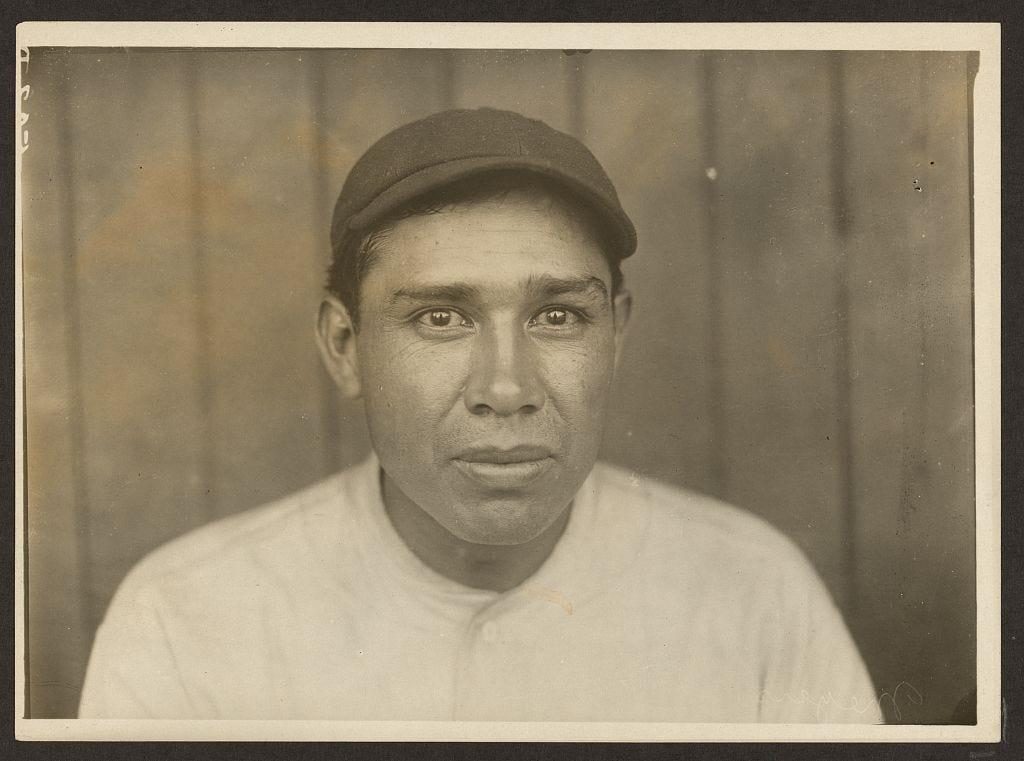
25:52
We need to learn how to see.
26:02
We need to learn how to see one another.
26:07
This being our greatest failing as a species and as a culture, as a collective culture.
We fail to see the inner life, the lived feelings, the emotion, the spiritual state, the dreams, the striving and the struggle of the humanity within. And so a lot of this has been increasingly veiled in modern society with status symbols, with glamour, with distractions, with posed images. And a great thing about these early baseball photographs; in early baseball itself — is that it was very unadorned.
This is not a social media posture. This is not a posture for a magazine. There just wasn't any of that. It just wasn't possible. There was no sort of exaggerated luxury that allowed for this posturing, this pretend, this fakeness of emotion, this fakeness of feeling. None of it. This is a man who's standing before this documentary camera and he's bearing his soul. He's present. We feel the presence of the spirit. The agony.
The turmoil. The trial of the soul.
27:26
So this is what I ask… this is what I really ask of baseball history — is that we learn how to feel and we learn how to see each other through this gap, through this bridge, through space and through time. And that in and of itself is what avails us and allows us to have real, deep, meaningful experience. That is what avails us of profound spiritual life. And the failure to do that is what breaks, fractures and destroys us, our institutions, our cultures, our societies, our communities. The failure to do that destroys us all.
27:58
That's what I have.
15. A Vision of History
Jun 28, 2025 · pp. 254–263
00:01
I want to talk to you about a vision of history. This has all been coming so intensely over the past couple of days, so there's been a lot here happening in a short period. A vision of history around and about baseball as an ecosystem, a container, a vessel for a deep, deep, deep amount of histories.
00:38
So we've talked about baseball players, right? And we've talked about the vision of baseball history that has been sanctified and remembered, whether that's due to Society of American Baseball Research's player biography project, whether that's historiographies done by people like Lawrence Ritter.
There's multiple different ways where baseball history has been remembered. And I've already brought this up — that baseball history is really a working class history.
And what we have conventionally, traditionally, is a model of history that is a history of political movements, social movements.
It's a history of grand trajectories.
01:36
So you talk about war times, you talk about inventions, you talk about turning points that reorient larger civilizational cultural structures, major events. That's the conventional historical timeline — and it moves forward, whether that's 1900, 2000, 1800, et cetera. Baseball history has been conventionally theorized this way and this is usually how human history is theorized — as a linear trajectory marked on a timeline by events. What I'm gesturing to here is a history that allows and uses baseball as a springboard to touch what would really be a true history of the people, working class history. And so through that…
02:34
This image here is great. This is the 1910 World Series. It's game one and it's a photo of the stands at a Shibe Park. The Philadelphia A's stadium. And you can see here what we miss. It's really almost like a poetics of history. And by poetics of history, we lose everything in history, through history, through the passage of history.
What we're left with is just a couple of different spare monuments and stone markers that allude roughly to historical events. A real poetics of history using baseball as a springboard actually allows you to tap directly into the life of working class laborers in America. Farmers, miners, factory workers, machinists.
03:33
This is a springboard. It's almost like you're standing on the edge of a diving board and you jump in and into the water. This is the real pool of history, which is an unfathomable amount of deeply personal political lives that are in this milieu — which baseball itself is a sort of vector through which we can dig into and attempt to understand and remember these human lives.
So I've been circling that in terms of players in baseball and baseball history. But the idea here, furthermore, is to understand the whole ecosystem of baseball, —which is the people who watched the game and loved the game and participated in it, whether they were part of the maintenance of events or whether they were people who helped build the stadiums, people who were in the cities that bore witness to the phenomena and the events and the emergences of different moments in baseball history.
Let's say Christy Mathewson at the Polo Grounds, the 1912 World Series in eight games… these are moments of cultural phenomena, but beneath the surface of them, what you really have is the real history — which is the everyday lives of these people in these cities. Let's say it's 1910s New York. Let's say it's 1930s St. Louis. And then in that ecosystem, which is the place and time, you have all of these different deep personal trajectories of events, happenings, losses, gains, understandings, dreams, hopes. And those are all intersecting, woven. It's a rich, rich, tapestry of baseball history.
And so when I say baseball is a way into truth… a lot of the documentary objects and a lot of the documentary images, including baseball cards, including photos, including newspapers — these are not separate from the historical moment in which they arose. What I mean by that is that they held a deep meaning, a deep political, social, and cultural meaning.
Even when it comes to things like the economy or wartime or manufacturing, these things that were a part of everyday life; they were necessary in order to sustain the ecosystems in and through which baseball emerged as a cultural product and really a spiritual, almost religious phenomenon. Even in the nature of that — baseball itself was this rich ground of gathering through which there was real character, real camaraderie, a real sense of meaning, a sense of pride and joy and locality. I talked about the 1910 Tip Top Bread cards and I'll just bring those back because it helps elucidate that and frame that really well. These are cards that were made by the local bread company to immortalize their team. This local city team of the Pittsburgh Pirates starring Honus Wagner in their championship win over Ty Cobb and the Detroit Tigers.
Think about these two cities. The centers of gravity in these cities. And you go to Pittsburgh now and you can still experience a lot of this old industrial Pittsburgh where you'd be walking around in the middle of the day and you couldn't see the sun because of the amount of smoke that was coming from these factories. And you go into the hills and the larger region beyond Pittsburgh and you have these mining towns. And these are all still there. And what I'm gesturing to is there's this sense of it's such incredibly recent memory, but the way our current cultural and civilizational mode functions… it's like the memory is more 15 minutes than a memory of a hundred years or 110 years. But this is so recent in terms of the the literal sediment of the earth.
If I wanted to gesture to you, let's say — Roman civilization. We're talking about something that was so long ago that you would be digging into the earth in an attempt to recover it. You would be digging into old, old, old cultural customs. You'd be digging into old beliefs. It's a relative structure that's hard to reconcile with the modern world.
08:50
And what's so powerful about baseball is it gestures immediately back to an ancestral past which is still there. These structures are still standing. The Pittsburgh Pirates, this is still very real. The major buildings and monuments of this period of time in Pittsburgh are still there. There just now is a shift that's occurring into a technologized Pittsburgh instead of an industrial Pittsburgh.
We're looking at an ancestral history which is still almost breathing. It's still palpable. It's still in the air. And the lives and dreams of these early industrial metropolises and mining towns and coal towns are still there. And so when I'm looking at these baseball artifacts, let's say this 1910 photograph or the 1935 Lefty Grove Diamond Stars card, you're conjuring something that's so immediate.
It's like it's still whispering. It's still the murmur of the dead. And there's something that's so powerful about that. There's something that's so fundamental about that because we're… there's so much of history that is just so lost, right? When we're talking about artifact recovery, a lot of the time when you're looking at an artifact of ancient Egypt or ancient Greece, these artifacts are so scarce and they're so difficult to interpret and reconcile to a modern concept of existence that you are drawing out from the past something that's almost incomprehensible and untranslatable. It's like it literally is or was from another species, an entirely different epoch.
But going into these artifacts of recent baseball history, you're touching on a time in the nascent emerging American identity where this is all still here — and you can reach back to this origin and you can reach back to this source point and the architecture, the artifacts — they're all still living and breathing and palpable and forming that connection. This is a way into this sort of nodal model of history that I'm elucidating right here.
This nodal model includes. It includes all of these people in this photograph here as well as the factory workers and the steel workers in the city of Pittsburgh who ingested this Pittsburgh Pirates team and whose extracurricular, cultural lives revolved around the sport of baseball. The people who owned these cards, who attended these events. And this to me is a much deeper and richer form of history than a history of the everyday, which is to say basic documentary function; even political documentary functions such as war documents, labor documents, and so forth — because this is the heart of the people. This is the beating heart of the people.
When you look at baseball during this period of time, anywhere from 1900 to the mid-50s, you're looking at the beating heart of American civilization. And this is what people loved.
This is what they felt. This is what they centered their leisure time around. This is what for them held palpable and deep meaning. Immediate, joyful, material, earthy meaning. Many of these people were also religious people, of course, right? But you go to the baseball game and it's materialized. And I brought this up before. The baseball game is a materialization of the spiritual.
12:47
Ritualized… consecration of presence, the community events, the church of baseball, so to speak, in quotes — this shared camaraderie of rooting and cheering on your home team, right? And the power of baseball cards as an emergent media object and a medium to immediately connect you with, you can own a piece of your culture. You can own an icon of your star ballplayer for your city’s team — Honus Wagner swinging the bat.
And this is so radical when you look at Western history. I was going to do a video on the history of Western portraiture, in terms of art history; how baseball cards are such a radical breakthrough in that because you're looking at portraiture of working class men that you would hold this in your pocket. You’d pin it up as a little kid from your caramels in Pennsylvania. You'd be like — this is my favorite player on the Cubs. I got my Mordecai Brown T206, or caramel card from my cigarette pack or my box of candy. You know, like I go and I root for these guys every Friday night after I get off of work at the steel mill or try to sneak into the ballpark after I leave the schoolhouse or get off or work at the family farm or the factory.
So when you're looking at these artifacts, it's very different than almost anything else historically — because these are artifacts of passion and joy and love and real communal heart centered presence. Real sweat dirt. We are here now enjoying the game of baseball, sliding into third. There's nothing else like it.
14:19
If I, look — if I recovered an ancient Greek statue or I was looking at the Dendera temple in Egypt — these are beautiful artifacts, but there's really something to be said about the presence of baseball and the passion and joy of the participation in the presence of baseball. Now you look at those artifacts and you're like, oh, you know, it's all right. Because this, modern baseball, is something that is so shared.
It's so present; it's so enriched by almost like a childlike devotion to a sport that captured the hearts and minds of an entire civilization for close to a century, really.
So when you look at history through that lens, you're really looking at the heart of a culture. And through the heart of a culture, you can perceive something approximating a collective truth, or a spirit of the age. A spirit of humanity in a place, in a time, through a civilizational aperture. It is a meeting ground of souls. A history of the many congregating in the temple of the one.
15:32
And this cuts into the whole idea of a linear narrative of timelines of historical events. It goes more into — there's a soil, there's a ground, and we're looking into that ground. And through that ground, we can see all of these seeds and we can see these these sproutings, right? We're tracing this subterranean myth of baseball as a way of elucidating these hidden, full, deep personal histories of those who lived and died and longed in these larger worlds and states of play. In this entire era of collective cultural emergence.
16:08
And through that, you really get a sense for the power and the beating heart of a time that has just barely passed. We no longer live in this agrarian industrial civilization.
This time has passed. It's become technologized and financialized, as we discussed in the previous essays. So you're reaching back into history, the immediate history, really.
And you're looking at an empire, an entire civilization that was on the cusp of its birth and being born, which is now utterly changed, neigh unrecognizable. And you can go back and you can commune with this period of time and you can understand and hear the stories. How people participated in this emergent cultural phenomenon, what it meant to them; how it helped them endure these difficult times of the depression or industrialization; rapid global shift and destabilization of pockets of life — in New York City or in Pittsburgh or in St. Louis. What this cultural phenomenon meant.
It gives you direct perception into historical meaning. It's not just this person lived this life here and they did this, they did that there. It's what this shared cultural art meant to these people. Its an epicenter through which history can and does come to light through unexpected stories that emerge orally, ancestrally; through artifacts, objects — that held great meaning for these individuals and thus were personally preserved, or writ into memory; in this way, bound and unified of the person who communed with them; gave them and found in them this sanctity or power of meaning. That preservation is our life and light and lifeline between entire epochs of the passage of time.
17:43
So this is kind of a radical framework for history because we're bypassing the conventional modes. And again, that's a lot of what this is about. This is a lot of what this archive is about. It's about discovering the truth, excavating the truth, and archeology of the truth. And to do that, you have to think creatively and think imaginatively to try to understand.
And a great way to do that, a great way to create a more multivalent, a more holistic understanding of history is to look at the cultural phenomena through which people gathered and that which they truly loved. So when I, when I compare baseball to religion and go back and forth on that, there's a really crucial separation. Religion was a metaphysical center through which people were communing with a sense or a power of a higher force.
But baseball, people are communing in this center or this temple of baseball and they're here. This is about what's occurring on the plane of the sweat and dirt and the grit and the body. Its the unity of the sanctity of the metaphysical and the plane of the incarnate. The physical, horizontal; spiritual, vertical planes.
And so that's what I'm talking about in terms of a… epicenter, a ground, a real material. A way of meeting the spiritual humanity on grounded, ritual, physical terms; finding an inroad to the heart as a real historical atlas and map to the spiritual developments and turnings in history; time; through epochs and the passages, comings and goings of empires and civilizations, cultures and communities. And when we're talking about history, we're always talking about material because history is always an excavation of the sediment of the earth. This is the stuff that gets buried.
The stories that get conjured up from physical memory. Experience returned to breath, to life and air. Returned to the surface of earth from earth. And so when you're looking at this, to reiterate again for importance, when you're looking at this period of time in American history, it's basically like looking at another civilization which has just now been wiped out or erased.
19:29
You're performing the immediate archaeology. It’s an autopsy of a flashbang change;
a turning point shift. It's almost like you don't even have to dig into the ground, right? Because these old monuments, these abandoned temples, these ruins of civilization are still there. And they're sitting in the everyday places, so to speak.
They're sitting in marketplaces or in antique stores, or they're sitting in abandoned buildings. They are abandoned buildings.
You're doing this kind of immediate process of recovery from memory to forgetting in people's attics or it's someone's grandfather who was this person and they told this story. And this is now being orated back to a collective understanding. It's being recovered through the ancestral lineage of maybe one or two or three generations.
20:22
This is impactful because it still hits very close to home — because, again, we are still living in American civilization. And we just now have tipped from this 20th century industrial revolution into a 21st century technological revolution. So we're not gesturing back very far. We're living in the ruins of this time. As I said, in Pittsburgh and Richmond and other cities, these factories have been converted to apartments.
These buildings still stand. Some of them get turned into stores or they get turned into other different aspects of the community. This history has been re-appropriated.
It's been converted into something else. Or it's been turned into a marketplace item, a marketplace object. But this reclamation project and this real archaeology can occur now with a level of heart and a level of presence because we're still living in the world of baseball; in American civilization. It still resonates and has impact because it is still in many ways the historical present once or twice removed.
21:31
So with that level of awareness, we're just reaching back a very short period of time, but we're reaching back a very short period of time into a whole web and network and ulterior world of how people's lives were constructed and structured; in many senses, in many ways, centered around baseball too, as a cultural center. The lifestyles are so different, the mannerisms, the ways of thinking, the ways of being.
And yet — still human. And to think about, say Polo Grounds on a Friday night. That is part of the fabric of the city.
How is that event, how was that event impacting the city at the time? And you can look today. It's not all too different.
But the entire ecosystem that surrounds it in terms of the industry, in terms of the other comings and goings, in terms of the existing technology and how that limited or helped advance transmission of information. We really are talking about a different paradigm. And it's all right there. It's just below the surface. This is a history of 110, 120, 100 years.
That's my thoughts here. I hope you enjoyed this one and I'll see you on the next.
16. Human Possibility: The History Beneath Baseball
Jun 29, 2025 · pp. 264–274
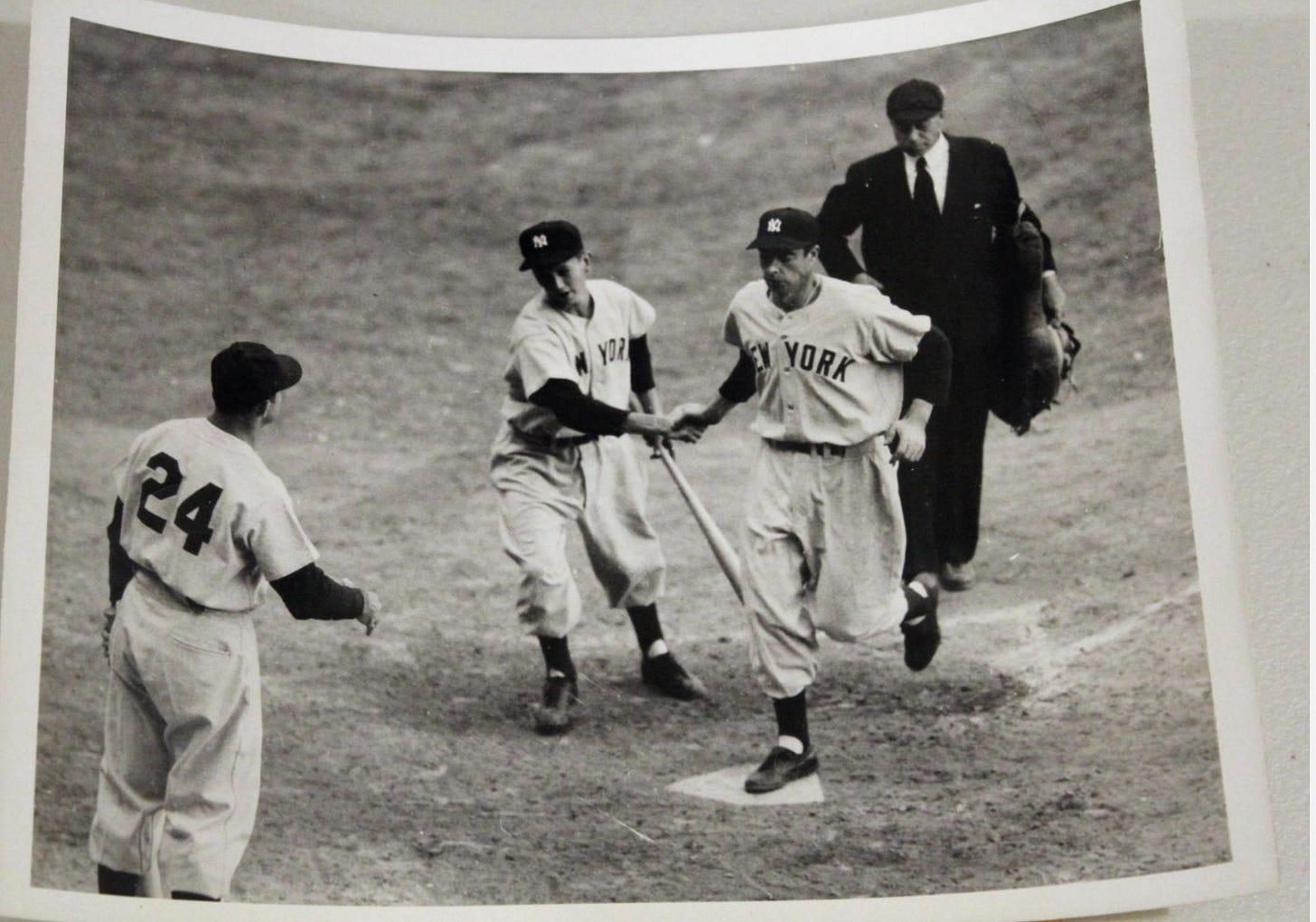
00:01
So this one's going to be called The History Beneath Baseball. And the way that I observe it or perceive it is like a revolving door of brief impacts. The SABR Player Biographies project is something that's very powerful to me because in whole, when you look at this whole archive of the player biographies, which are very descriptive…
they go into stories about each of the players, their backgrounds, their lives, as well as their participation in the sport and the efforts and the endeavors, the bricks that they laid in the foundation of baseball. You are able to grasp in a very meditative sense the impermanent, ephemeral nature of the sacral truth of history.
01:00
The constant itself is the sport of baseball. It's the language. And through the language, you have this running current of human lives, which constitute the contribution to it.
01:19
You have a Plato quote that says, time is the moving image of eternity. You have a Heraclitus quote that says, you never step in the same river twice. And I kind of want to put those two together and look at baseball as a running river of brief glimpses, flashes, so to speak. And I was thinking about Joe DiMaggio earlier, his character. I was going to do an episode on Greenberg and DiMaggio; ethics and character, moral value and baseball. And you see the tragic heroism of the figure of Joe DiMaggio. It's almost like he was built to play baseball and there was nothing more, nothing less to it. Beyond baseball, he faded into the distance. He retreated from life, from the world.
You look at his character on the field — I have a really great image of him here, hitting his one and only game winning home run in the World Series — I think this was 1950 or ‘51, and he's touching home plate with his head down and he's holding the hand of the bat boy; about to congratulate his teammate. It reminded me of the quotes from DiMaggio. A reporter asks him — why do you play so hard? Why do you play so hard every at bat, every game. And he said, I never know if it's the first or the last time some kid in the stands or some child in the stands is watching me play. You get a glimpse there of just this really profound, compassionate humanity.
I look at someone like Hank Greenberg and what he said to Jackie Robinson; the support he gave to Jackie Robinson when he came to the major leagues — or Pee Wee Reese, Jackie’s teammate that stood by him, put his arm around his shoulder in the toughest and most trying times of Jackie's attempt to integrate baseball. These are like glimmers. It's like light from the sun, hitting the water as the river rushes by.
These are glimmers of this profound spiritual humanity that runs through baseball as a current. As it’s real truth and revelation in purpose.
03:37
This is the history I'm conjuring and that I'm summoning here — is that baseball itself retains all of this. This isn't a history of war. It's not a history of self-interest.
The games themselves fade, the statistics fade, and there's something so powerful about these acts of teamwork and leadership. They glow, even in the passage of time.
They are the character of the game.
04:05
They show us even just for these brief moments of these people's lives what is actually possible. So a lot of my work philosophically, I could bring Dostoevsky in.
What we're really dealing with is a battle of darkness and light. We're dealing with a battle of human nature and the attempt to create meaning in an otherwise cold and unfeeling, selfish, perhaps even manipulative paradigm where people pursue things for their own self interest and for their own interest alone. And what baseball itself as a essentially non-contact team sport is ultimately about is fostering these moments of profound collaboration, leadership, and setting moral examples.
This is the vanguard of American and human history. This was a golden part of the fabric of what baseball meant to American culture in the early 1900s. It was far deeper than the sport. It was a glorification of working class values. Of community.
Of humanity and support of others; compassion; hard work.
05:05
Someone like Honus Wagner, Christy Mathewson, Joe DiMaggio, Lou Gehrig. These were examples. Jackie Robinson. These were people who were more so ethical, moral examples at the foundation of American cultural values emerging from working class grit, working class difficulties — surmounting incredible personal trials for the most part through poverty, labor, and humble roots. Living close to the earth. The sobriety of DiMaggio’s discipline, hard-work, and groundedness. Joe DiMaggio's father is a fisherman in California. Just to bring back the foundational grounds here.
These are people who step onto the stage of baseball — Hank Greenberg, for instance, dealing with anti-Semitic epithets. As he's on baseball's biggest stage, having some of the greatest seasons in baseball history in the rising tide of World War II — where anti-Jewish sentiment worldwide is at this all-time high, just crazy fervor. These are people who stand on this stage, and they are morally grounding the culture, morally grounding the society. They are setting the example in their endurance, hard work, and compassionate humanity. They are the moral and ethical compass of an entire nation. These are our athletic and spiritual heroes — who showed through their labor, their craft, their discipline; in Greenberg’s case, his heroic integrity and his real fight — how to endure. How to self overcome. How to become truly, spiritually, humanly great.
06:23
And you wonder about all of these people, all of these figures, these player biographies that come and go — and what baseball itself means and represents in light of that. This is a tide that rises and falls; laps with waves where these legends lay down their heroic contributions and disappear into the gloaming. They fade into the light.
06:38
Because it's much like the course of human history in this sense. You have all of these undocumented lives that are lived in quiet or lived in silence or lived unacknowledged. And you have to ask yourself, what does it mean? What are the consequences of this rushing river that moves on forever? What are the consequences of that?
And I think for baseball, what it is, it's the establishment of the political possibility of something greater for humanity, a greater possibility. These heroes and legends lay the grounds through collaboration, integration, mutual respect and dignity, leadership and teamwork. You have these moments, these flashes — of true, holistic glory. Of a heaven and God’s kingdom on earth. Kindness, valor, courage — and the legacy and legend spun from this golden thread of truth. To me, when I look at the history of baseball, I think about Peewee Reese with his arm around Jackie Robinson.
Or I think about that moment with Hank Greenberg. He says, for every home run I hit, I felt like I was hitting it against Hitler. He stood, like Lefty Grove for the Appalachian coal miners — for the Jewish people amidst World War II. For everything Hitler and the Nazi propaganda was saying about Jewish people, Greenberg with his character, his ethical strength, his behavior and sheer power of selfhood was dispelling this for all to see. Do you see the power of this? Or Lou Gehrig at the moment that he retires from baseball with his illness and gives his utterly famous speech. These are moments of profound humanity. And again, as I was talking about in the previous video regarding the vision of history — that's the real baseball. That's the real baseball.
08:05
And when we look in our world, whether it's political strife, national strife, religious strife, racial strife, we're looking at a world that is empty of values, an empty of meaning, for a large part, empty of culture. We're looking a majority struggling with basic self-serving impulses. Where many have nothing and the few have it all. And the few — they’re doing everything they can to prevent others from getting their fair share. It's the selfish gene, so to speak, I think is one of the terms that's used. And we look at that and I think there's a common sense, especially in the modern world, of a deep, deep, deep foundational corruption, which is a communal neglect, a neglect of basic humanity. A neglect of our innate interconnectivity and the failure to see the truth of our humanity beneath and through our differences — which are used as weapons of power, not of love and compassion. And this descends further and further and further into a poverty of the spirit And when I look around me, I see this foundational legacy of baseball that's still there. It's still breathing. It still has memory. It's a tradition that's been kept. It's a lamp that's been lit and has been kept lit over, really — an age. And I look back through this history and I look back through the ephemera or the light that's cast off from this river of baseball, this endless river and flowing river… of contributions of lives, of struggles, of hardships, of moments of transcendence.
Moments of real presence and real humanity. That Lou Gehrig speech is just one of those great ones as well. Because what he does is he stands there in a profoundly humble human moment on the verge of the end of Lou Gehrig. And he stands there and he says, I'm proud to have been a part of this. I'm proud to have been a Yankee.
I'm the luckiest man on the face of the earth.
10:08
Baseball is full of moments like this. I think of someone like Roberto Clemente and his humanitarian contributions to people who are suffering.
10:22
When we look for a moral and ethical compass in this world, when I look for it, it's easy. You could look at philosophy. You could look at literature.
But what you're really looking for is you're looking for something grounded and you're looking for something rooted and you're looking for something real. And baseball provides a platform for that. And it's very ingenious and ingenuitive method of construction through the necessity of teamwork. Individual contribution to the greater whole, which never can possibly surmount the greater whole. The importance of that.
11:05
The ethical responsibility to your teammates and the importance of leadership through trial. The real, the importance of real leadership. Not superficial leadership.
Because this is a physical active game with real consequences. And it's all contained within 90 feet on the base path and 60 feet, six inches from the mound to home plate, right? It's all contained within this sphere. It can't...
You can't shove off leadership. You can't pretend that it's not there because everything is immediate. Everything occurs within this sphere, this closed circuit, this diamond. So all of the real human moral and ethical problems, all of the dilemmas, all of the cultural baggage, all of the shadows of the human psyche are brought to light and they're staged in that space. And what it requires is the moral and ethical strength, the spiritual conscience to overcome.
Greenberg, Jackie Robinson. Joe DiMaggio's sense of responsibility to the kids who are watching these games. His profound sense of responsibility. His profound sense of conscience. That's really what I'm talking about here. It’s hair raisingly profound.
It’s a vision of the spiritual truth of life which raises us to the level of the creative genius of the heavens. It’s transcendental. It’s the golden, lionhearted spirit of self overcoming; the gift of the beauty of true heroism. It is a gift. It’s a gift of presence that returns profound human possibility to us all. Baseball creates a very, very, very small closed circuit. It's almost like a theater of humanity and a intimate community where everything is laid bare.
Because all responsibility is present. Responsibility to the kid in the stands, responsibility to your teammates, responsibility to prepare yourself because your actions are all present. Responsibility to yourself in the moment of total presence and athletic unity and attention. The twitch of the muscle fibers. The glory of tracking a baseball in flight. It's the swing, it's the pitch, it's the line drive, it's the catch. These are all attempts, these are all symbolizations and representations of human striving. And the people who come and go through that game are themselves reflecting possibilities. This is not, there's no political mask, there's no distractions.
This is a game of pure action.
The silence of Joe DiMaggio speaks volumes. When he’s on the field he’s utterly and totally unified with the game. He’s plugged into the circuit of the innate human genius of movement and athletic creativity. The physical form. And this is the highly meditative and present nature and aspect of baseball through which real human possibilities are revealed. They are revealed imminently. And all real human possibilities are heroic possibilities because they're self-overcoming. Possibility is beyond the boundary. Beyond the present now into something greater, something more holistic. Something more inclusive. Cosmic. So I talked previously about the concept of cosmic heroism, the Ernest Becker terminology. And what that essentially means is that through our humanity, we are finding this transcendent possibility.
We're actually finding new ground.
And when Joe DiMaggio says something like what he says about every single play, every single game, he plays a hundred percent because he never knows if that's the first or last time some little kid is watching him play — what you're really hearing there is a profound sense of ethical and moral responsibility to his fellow human being. And in the same era or in the same paradigm, you have everything that happens in World War II, which shows a profound irresponsibility to your fellow human being. Alongside him is Hank Greenberg saying — at first he disliked being seen as and called a Jew, as he was not particularly religious. Everything that came with it. The jeers, the press. Being seen as a symbol for this entire group of people.
But then he began to understand what it truly meant in this time. The burden and the blessing of this moment. He steps into the light of this. Embraces it. Channels it deeper. It’s an act of political declaration in the face of an entire global network of oppressed and attacked people. He’s standing of his own volition in the face of evil.
So you see what I'm saying. This is something that you rarely find in war. You rarely find in politics. And you'll find it in everyday life, in acts of kindness, right?
14:43
And acts of courage from everyday people. This is why I circled back to a labor history of baseball as a working class history, because it is these everyday people who are creating these heroic acts. They are the spine and the thread of baseball. They are its heroes and its smiths. It’s woodworkers. Its steelworkers. It’s farmers. And what baseball does is it puts a microscope and it puts a lantern, it puts a spotlight on these people. Joe DiMaggio is the son of a fisherman. Mickey Mantle is the son of a miner.
15:13
The idea here, which is so radical — and it's subtle in a way that American celebrity culture usually functions and has become increasingly corrosive — is that baseball is an iconography of the working class. It's a revelation and a celebration of the working class. And so when you see these behaviors, like Hank Greenberg's family were Romanian Jewish immigrants who owned a cloth shrinking company — you see these behaviors on the national and even the global stage from these players who exhibit profound ethical and moral responsibility and kindness, compassion, right?
This spotlight's being created and you're observing the compassion and humanity of working class heroism. The character of the working class. The kindness emergent from toughness. The compassion emergent from incredible trials, pain, suffering, and difficulties. These people who come from deeply humble and impoverished circumstances and their characters have been honed, they've been sculpted and they've been forged and they themselves are crucial spiritual figures that create and center compassion in a civilizational and cultural sense in a way that very few others do. And again, this is the importance of the history of baseball, the importance of remembering this history and this foundational truth in a really clear way.
17:00
That you have these profound contributions from these people who struggle deeply, whether it's with physical, mental, emotional, economic, familial — you name it, these things that could destroy a person.
17:24
They could tear a person.
17:28
And you see through these struggles the cultivation of a real humanity and of a real compassion. And so when you look at these player bios or when you look at baseball history and you really go through it.
17:45
You're reading these stories — very many, very many of these stories of this self-overcoming, and you read deeper into it, and you see this is someone whose parents were slaves and had to find a way to navigate an utterly inhospitable social climate, political climate. Or you see this is someone whose parents were very poor immigrants.
18:19
Or someone like Lefty Grove, that we talked about. This is someone who grew up in a coal mine and learned how to pitch by throwing rocks. And in a lot of these cases, we're talking far beyond great player and into someone who makes a contribution at the level of humanity and illuminates human possibility on the cultural stage.
And that DiMaggio quote, I think, is just a really good summary of that. Because it's not isolated, but it's a profound example of the kind of compassion, humility and humanity that defines a great deal of the contributions of baseball's greatest figures and its most human figures in a way that you will rarely see in other cultural realms or theaters. This is a humanism that recognizes the importance of his contribution.
Understands its severity, and the honor and dignity that comes with being able to fulfill this responsibility. And endures. Celebrates. Creates the way, the path forward into something more, something better. Something more meaningful, powerful, connected. There's something about baseball as a deeply communal act and phenomenon that ripples throughout every stratum of American culture and society.
It's not somewhat gated as it would be in art or in literature or in philosophy in terms of comprehension or education.
It's not limited to a grassroots community organizing endeavor in terms of locality or reach. These are moments in which acts of compassionate heroic humanity are mass broadcast. And these are figures who again become icons; essential documentary forces in the history of America that are immortalized in songs, that are remembered in stories, that are remembered in jerseys and cards. They are carried on and carried forward by the stewards of the game, this ever flowing river.
20:17
And this is what I think about when I think about baseball as a historical river, is that you have these people of great striving and discipline. And this is, of course, not all baseball history, right? You have a lot of self-serving behavior, self-righteous behavior, behavior that lacks compassion and integrity and tumbles into cruelty. But there's something profoundly powerful about a figure like DiMaggio or Christy Mathewson — and what they meant and what they mean to American culture. You have someone like this who is performing in the way that they are on this national cultural stage, but is also the person that they are.
And this is a deeper level of political engagement than essentially all politics.
Because what they're providing is an example; who they are is an example. And this is something that undergirds and lays the foundation of the importance of baseball and baseball history, not just as entertainment — not just as a sort of innocuous cultural phenomenon, but as the real moral, ethical, and humane foundations of American civilization. This is no political power grab. This is a fisherman’s son whose soul is the fluid movement of baseball. This is a first generation college student; the son of a Civil War veteran, a farmer, a post-office worker — who becomes the moral face of a nation.
And this again, this all comes back to who these people are and where they came from and what they endured, their character.
So that's some thoughts here. I will catch you on the next one.
17. Hank Greenberg
Jun 29, 2025 · pp. 275–286
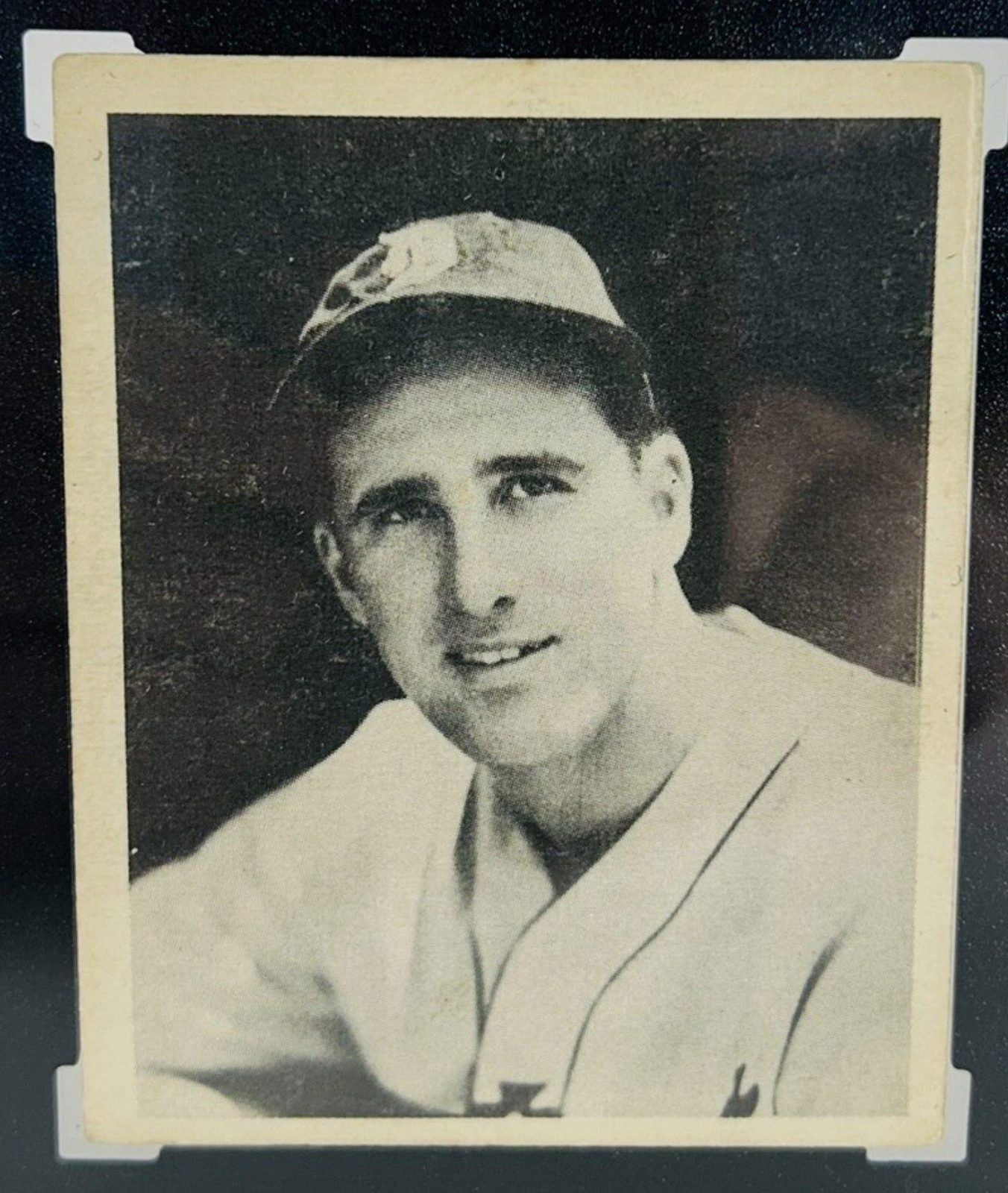
00:01
Alright, so I'm going start this essay here. Jackie Robinson and Hank Greenberg.
And I want to set the stage through what happens with Greenberg. It's this level of unassuming heroism that proceeds and is actually the movement from which a lot of what happens with Jackie Robinson occurs. So Greenberg becomes a massive star in baseball in the early to mid 30s.
00:28
And this is all occurring during the rise of Hitler and Nazi Germany. And what happens with Greenberg being the only Jewish American baseball player is that this the anti-Semitic undercurrent of the fans, other players, the nation of the United States, including Henry Ford in Detroit — Detroit being one of the biggest anti-Semitic cities at the time — this current, this force is very powerful and very strong.
00:55
And what happens with Greenberg, is actually so deeply radical. I mentioned this in the other essay. He said at one point it felt like every home run I was hitting, I was hitting it against Hitler. He's standing on this political, cultural, national stage of baseball at the height of its popularity as one of the game's greatest players. Multiple MVPs, World Series titles. He has one of the best OPSs of all time, RBIs. If he had been in the game the whole time without actually taking all of the wartime that he took… his stats would probably be pretty massive.
But during this period of time, he is actually standing not only domestically as an example of Jewish political power — for lack of a better word, because of his skill and ability and his character on the baseball field… he was standing up and saying, I'm not going to tolerate this bad behavior from people who were jeering him or attacking him, as well as performing these incredible feats on the baseball field. He is standing up as a representative not only of the Jewish American community, but the global Jewish community. He is being tracked all over the world by Jewish people during this period of time because the anti-Jewish sentiment is so high.
And he is standing really alone, with the exception of Einstein, as a counterbalance to this narrative. And with Einstein, there's a lot of theory, there's a lot of intelligence, and it's something that not very many people can understand. They can understand it's important, but they don't know why. But you look at the baseball field and you look at the play and ability of Hank Greenberg, many people can understand that because it's relatable, it's direct, it's immediate.
02:51
It's not abstract, it's material. It's sweat, dirt, it's grit, right? And the working class quality of Greenberg. His parents owned, it was like a cloth-shrinking facility in New York. They were immigrants from Romania, I believe, Romanian Jews.
He is actually standing up in front of the world on a global stage. And so I want to compare this to Jackie Robinson. What Jackie Robinson does in terms of the civil rights movement in the United States is massive. But looking at this situation with Greenberg — and it's so under-recognized and it's not spoken about nearly enough — is that he himself is standing on the international stage as a representative of the Jewish people in the midst of one of the most difficult and brutal periods of time for Jewish people in history. This period of time of Nazi Germany and World War II and the Holocaust. There's not, there's really not a strong enough way to sum this up because you're looking at… this was not something that he intended. He said himself, he said, I don't particularly associate with Jewishness. Especially early on in his career.
He was born in a family of Orthodox Jews and he wasn't particularly religious, but he was brought into, he was almost called or summoned into this act of deeply human heroism by way of the course of history. The course of history called him into this relationship as the only Jewish American player during this period of time that this larger transpersonal anti-Jewish sentiment is reaching a utter peak of insanity and chaos and madness. So you look at this as an undercurrent of American history and human history, and this is quite simply one of the greatest unsung stories of human heroism.
And you look at his contribution later on, 10 years later with Jackie Robinson, he’s actively supporting Jackie and talking to him about his situation — forming a bridge between generations. One of the greatest baseball players of all time, now retired, is talking to Jackie Robinson about integrating baseball. The situations are so deeply intertwined in terms of what both of them face, but the differences are also very abundantly clear. There could not have been a stranger and more brutal time for Hank Greenberg to be the only Jewish person on the baseball field.
05:40
To face what he faced and to face it with the dignity and character and courage that he faced it with is very profound.
There was no movement behind Greenberg. This wasn't intended. This wasn't an integration of baseball. There was no plan, no trajectory. This wasn't a movement that was breaking a boundary that was existent within the current cultural scope or domestic sphere. There were Jewish barnstorming teams actually, like the House of David, that would play black barnstorming teams very early on in the 20th century.
But this… this instance — it's such a fascinating example of heroism and such a deep example of heroism and self-overcoming precisely because it wasn't intended. This was not something that Greenberg actively looked for or embraced or anything like that. He wanted to play baseball.
He did not see himself as particularly Jewish, but the cultural, historical, and political circumstances brought him into a position of not only embracing, but channeling deeper into his Jewishness. And becoming more and more of a figure. It was the truth of his time — he was not just standing for himself on the baseball field.
He was standing for Jewish people around the world because they were witnessing this. This was reported on everywhere in all of these global Jewish communities as well as domestically in a very large scale because of just how powerful he was on the baseball field.
This was a way of holding up to the light and saying these narratives that are being told against Jewish people cannot be and actually are not true. Look at what Hank Greenberg is doing. That's a very, very, very powerful thing.
You have this massive anti-Semitic scapegoating method of ethnic bigotry that's happening. And you have this baseball player who's playing, he's just there to play baseball. And he is just becoming better and better and better. And he is still remembered to this day as one of the absolute best baseball players of all time. It becomes, it's not just about baseball. It's not just about America. And it's not even just about Jewishness anymore. It's about, he's going against the entire tide of this madness and this hatred that is occurring at this period of time in history that's reaching its utmost peak internationally.
This is an existential struggle that the entirety of humanity is experiencing at a spiritual level. It’s a wave, a tidal wave of hatred. And he is standing, bat in hand, really as the sole Jewish mass cultural figure that can be understood by the common person. Again, Einstein, there's a difference there because this is a very profound and complex scientific knowledge that he's communicating. He also has a lot of humanistic texts and essays. He's also very political and cultural.
But with Greenberg, there's no terms for what's happening because it's such a whirlpool of dramatic, quickly rising energy. It’s utterly unprecedented — this kind of globally implicated fervor carrying this massive tidal wave of ethnic hatred all at once in one brutal swell. The anti-Semitism was always there, but it was reaching a fervor that catalyzed and culminated and was an integral part of this massive global war.
09:14
So Greenberg, as the son of these Romanian immigrants who own this cloth company in Brooklyn, in New York City, is becoming one of the best baseball players of all time in Detroit, one of the most anti-Semitic cities in America; with Henry Ford putting out very anti-Semitic texts and information. He's doing all of this as this global situation continues to blow up. And he keeps going. He keeps doing it.
09:44
It's being documented everywhere. People are hearing about it everywhere. And it's a way of reasserting humanity. It's a way of pointing back to humanity in the midst of this outcry against Jewishness globally. These international people who know nothing about baseball are now following Hank Greenberg and his achievements on the baseball field in America. Because he is that example. He is that counter-narrative.
10:17
That level of visibility and dignity and grace that he was able to continually maintain and become better and better and better is almost unfathomable. 1938, he's chasing Babe Ruth's home run record. That's Kristallnacht unfolding in Germany, Hitler in every newspaper, Jewish refugees are being turned away from American shores, antisemitism is mainstream — endorsed by celebrities, politicians, and newspapers.
He's being harassed in the stands constantly, constantly, constantly. Sports writers are talking about him. Players on his own team are against him. One of the players that he played with said he thought that Jewish people had horns. He was like, I can't believe that you're Jewish. This is the American cultural stage. It does not get any bigger than this in the 1930s and 1940s. Baseball is everything.
And while all of this is going on, he hits 58 home runs. 1938.
He almost breaks Babe Ruth's record. He is just that good, consistently that good.
And his character, the way he plays the game and the way he stands up, not only for himself, but for the entirety of the Jewish people, because again, he's being called.
This is not an orchestration. This was not something that was planned. This was the current and the flow of history.
11:58
He is called into this deeper, deeper, deeper relationship.
12:16
Reported: He worked harder than anyone. Always principled, quietly kind.
12:23
Jackie Robinson later said — Class tells. It sticks out all over Mr. Greenberg.
Known as a man of few words, but great weight.
12:36
In Polish ghettos, in Hungarian villages, and in French newspapers, Jews followed the tales of the 6’4” Greenberg playing America's great game. In British Palestine, Greenberg was discussed as a symbol of what Jews could become, a powerful counter image to the European narrative of weakness.
12:55
In refugee communities, he was mentioned. His name resounded. Greenberg.
13:04
This is the idea. This is a symbol, not only as a counter narrative, but a symbol for hope. Greenberg is accomplishing this during this time where our entire international community — this entire ethnicity is being systematically attacked;
rooted out, murdered. This is so much of what heroism is. And it's unexpected and it comes from unexpected and strange places. Unexpected places.
Jewish immigrants in the pogroms; families watching Hitler's rise on the radio, children ashamed of their last names. Hank Greenberg is visible on this national stage, which becomes an international and global stage by the sheer force of his nature intercoursing with the historical tsunami of Nazi Germany and the looming war. And he's undeniable. He is present and he's playing baseball with a physical force and presence that's undeniable. This is something that you can't… you can explain away an idea. This is a physical embodied presence of someone who is overcoming, not only himself, but overcoming the world. With his arms, legs, feet, and hands. His feats are obvious. His feats are clear beyond comprehension. And in doing so, he stands for hundreds of thousands of people.
14:37
Every Jewish newspaper covered his genius. Jewish boys knew his batting average.
Rabbis mentioned him from the pulpit during the high holidays. Families argued over whether he should have played on Yom Kippur or not, but everyone knew why it mattered.
14:54
He is undeniable proof on this stage. Undeniable proof in a time where Jewish people were having to hide under the floorboards of French houses, Polish houses, hide in the attics. He is proof that Jewish people are not what they are saying. A Jewish man is setting baseball’s greatest numbers. He is one of America’s absolute best. He is a legend; a man with character, integrity, strength, morality. He is a man of spiritual power. You do not have to hide on a public stage. That is incredibly powerful.
15:26
And you wonder why it's not spoken about.
15:38
And I think a lot of this is because baseball can be dismissed. It's often dismissed in the cultural forum as it's just a sport. But this is so much more than a sport because of the way it's structured and because of what it means to an entire civilization. It's a stage upon which our greatest hopes, dreams, aspirations, our greatest virtues, our greatest humanity is expressed.
16:18
In the middle of the greatest portion of his career he's drafted into the army — before Pearl Harbor — and serves longer than nearly any major league player. Four years of peak playing time, ages 30-34.
16:39
Refused to play on Yom Kippur in 1934 when Hitler had just risen to power.
16:45
One of the greatest hitters of all time. This is a world historical event. This is a world historical person and figure.
16:59
A sign of dignity, hope, power, and presence in a world bent on erasure of Judaism and Jewish people.
This was never a story. This was never a myth. It was a historical reality that happened in real time. There's no arc. There's nothing fancy or deliberate or even narrative about this.
18:07
To be able to hold that is incredibly powerful. It's almost, it's just everything about what baseball is about, what is possible within baseball.
18:27
He might be the biggest hero in American baseball history and beyond a shadow of a doubt one of the most important heroes in American history. And the huge, massive factor behind this is he accomplishes this powerful, profound form of heroism through baseball. Through a game.
This is what's so important about remembering these stories and giving them the dignity and the presence and speaking the truth of them. To give them the presence and meaning and dignity and to speak the truth of them is to consecrate history. To consecrate history and to give it its fullness and to honor these people.
That's what this project is about. To honor these people.
Greenberg is one of the most powerful figures in baseball in American history for what he did, for what he was able to do. And this is someone who just wanted to play baseball, but he was called. He was called into a deeper relationship. That's just, that's the essence of spirituality. You're called. And he answered the call. And he ends up, after and in all of this, he ends up going into the war. He's drafted.
And then he leaves and he actually enters back into the war of his own volition with the Air Force. He’s stationed in China, Burma, India Theater. Major logistics and operations region. Captain and physical training officer for bomber groups.
Lost five peak seasons, age 30 to 34 when he was still at the top of this game. And he comes back in 1945.
20:37
Hits a home run in his first game. His final at bat with the Tigers in 1945, he hit a grand slam to win the pennant in the pouring rain. They would go on to win the World Series.
20:51
The full bodied aspect of this type of heroism — this quiet, reserved, called into this relationship that is… it's not only about him and his immediate situation. Having to endure this moment in time. He's carrying this symbolic weight of being the only Jew on the international stage. He’s carrying this symbolic weight of the Jewish people in the Holocaust.
And you can compare it a lot to Einstein. This is one of greatest baseball players of all time. Einstein's feats are intellectual. They're cosmological. For Hank Greenberg, his feats are physical. They're existential. They're moral. Einstein's feats are also moral.
This gives people hope. It gives people the ability to say, maybe this is not all lost on me because here's someone who is like me, who is doing this, who is standing up for us in a time when no one else is. He’s succeeding at a level most of the world can scarcely dream of at his calling. He is calling new human possibilities of greatness and self overcoming into being.
And to honor him is to honor that entire history. And it's to honor that historical moment. And it's to honor the impact of something that just one person can do by standing up for what's right. And by pursuing and honing his craft, honing his discipline. Showing up.
22:42
He becomes this example for an entire group of people during their greatest persecution in the 20th century. One of the most cataclysmic collective moments in human history. He stands there and he does this work through himself. And thus it becomes this transpersonal moment of power and dignity and courage — a moment that reverberates around the world. Not through violence or political power, or even through words or ideas. But through baseball.
People around the world; Jewish people around the world. This is not just domestic.
They're following him. Even if they know nothing about baseball, they start to learn about baseball and they start to hear about him. They understand there is a Jewish person that is doing this. These things, these powerful things, these self-overcomings. And this is through him. This is through his skill in baseball.
23:34
A great quote from Ramana Maharshi. Your own self-realization is the greatest gift you can give to the world. And Hank Greenberg is just a great example of that. It's a spiritual example. So I hope you enjoyed this. I'll catch you on the next one.
18. Lou Gehrig -- Baseball as Self Overcoming and Spiritual Self Realization
Jun 30, 2025 · pp. 287–295
00:01
So this one's going to be called Lou Gehrig and baseball as self-overcoming. And this is the epicenter of heroism. Because before we've kind of talked about some of the external forces and factors, particularly social or cultural recognition, that go into forms of heroic baseball practice — in terms of a global phenomenon, a national one, a ethnic one, or a racial one.
00:31
All of these different ways that baseball players stood in front of their communities and in some cases in front of the world and performed a heroic, cosmic heroic cultural act of revelation, effectively. But with Lou Gehrig, you get to this core, this existential core, which is the direct engagement with baseball as a craft.
The respect and the discipline that Gehrig gives to baseball as a craft, day in and day out, the cultivation and perfection of this physical form, which is the human body and the human spirit's relationship to baseball as a communication, as a vessel, as a medium for expression. And my idea of self-overcoming, at least when I term it philosophically, is it's fundamentally physical.
01:30
Because when you're looking at the self, there's one essential binary or one essential paradox of the human form and physicality is that the spirit or the soul, as I spoke about with baseball itself, is something that is immortal. It's ongoing. It continues.
But the physical body undergoes a process of entropy and degradation through time, through essential thermodynamics, through the nature of the forces and factors that act on the physical body as a organic biological vessel. And what you have with Lou Gehrig is something so profound, existentially profound, because of the total humble groundedness by and through which he devotes himself to the craft of baseball.
And of course it can be said he is an American icon or he's one of the most powerful figures in baseball history. All of these things can be said, but when it comes down to Lou Gehrig and who he is and what he does, the relationship is between himself and baseball. It's a direct mirror for the work that he does on himself. And this is what I mean by self-overcoming. It's something that can be done through philosophy. It can be done through art. But I think its most powerful form is physical.
Because it brings you into direct relationship with this paradox of the body and the spirit. The infinite or the eternal nature of the spirit and the physical limitations of the body. And this is like Willie Mays’ The Catch, for instance, right? Willie Mays'
famous catch in 1954. This is a moment of an incredible physical feat. That leaves fans stunned and it becomes this iconic moment in baseball history because… much of Willie Mays' career also acts in this trajectory in the sense that he's accomplishing something that goes beyond the bounds of the realized, the possible, the presumed limitations of reality and existence. Much like Lou Gehrig's consecutive games played streaks, as well as a lot of the records that he set, particularly in terms of RBI's.
What baseball provides — and this is why it's such a fertile medium for discussing philosophy and spirituality — is it provides a theater for the self-overcoming of the soul. Otherwise someone like Lou Gehrig would toil in obscurity, but he's provided this historical stage through which to exhibit this, again, I'll use the term the monk-like, practice of spiritual devotion to the medium. And this is what true discipline is.
He comes in with his head down and he pursues the craft and path of baseball with absolute self-responsibility, absolute self-negation. And what I mean by self-negation is it's not Lou Gehrig doesn't exist anymore or his spiritual center doesn't exist anymore. It's that he is so thoroughly devoted himself to the craft of baseball that he enters into this transcendent metaphysical state of total presence, total devotion.
04:47
And this is usually described in spiritual terms in terms of a devotion to God, right?
In terms of a devotion to the higher spiritual self, which informs and is all things.
And this is what self-overcoming really is. You have the immediate personal physical presence that's rooted and seeded in this body that's subject to degradation, time, wear, and the forces of nature. And what you're finding through this spiritual path, through this medium of devotion and discipline and presence, is that higher self.
You're finding that real communion with the spirit and you're hearing that voice.
And through that pursuit of that path, you come to this point of spiritual enlightenment. And this is what you see with Gehrig, as well as what you see with Hank Greenberg in a different context and Jackie Robinson in a different context.
The reason why these figures are so important to the history of baseball, as well as Lefty Grove — as I discussed… is that in different ways, they are called to make an impact that is not so often discussed or understood in terms of baseball history, American history, or even human history in the sense that baseball provides the modern cultural stage for the realization of these very deep and profound spiritual callings. And the reason for the modern cultural stage is that it provides a recourse that is deeper than myth.
It's the truth of history in the process of self-overcoming that can be witnessed, observed, seen, felt, and understood on a physical, immediate level, not on the metaphysical plane of a story or an abstract tale or an archetype that has to be channeled through mind, or channeled through thought. These people are performing the heroic function of self-overcoming, whether that's existential, whether that's racial, ethnic, global, national self-overcoming.
06:44
And it's something that can be seen, felt, observed, and even imitated. And this is what's so important. It brings me back to that DiMaggio quote about, he plays 100 % every single day, every single play, because he never knows if that's the first or the last time some kid in the stands is going to be watching him. This is the heroic template that baseball affords and Gehrig's existential self-overcoming is the most insular in the sense that his calling is not directed outwardly in any sort of way in a grand political statement. He’s not called to testament in the way Robinson or Greenberg are — to a cultural or political unfolding. If you understand what I'm saying, it's a spiritual calling that is directly between him and his toil and his work; it remains there as a purely human manifestation. He achieves no wider cultural or political symbolism; this is precisely the point.
His day in and day out practice. I brought up the term sadhana before, the spiritual practice or the spiritual discipline. And this consistent devotion and dedication, which itself is a sort of like a drum beat or rhythm — which self perpetuates and grows and furthers this discipline of attention and listening through that devotional act.
08:06
Looking at baseball as this model for the possibility of self-overcoming, particularly in terms of the ritual nature of it that occurs over decades. This is a history of 150, close to 200 years at this point now. This is a fertile medium for the exploration of this process of self-overcoming, specifically because of how ritualized it is, how perpetual it is.
It's a tradition; history of a tradition that allows for participation in a model that's not just private, but it occurs in the theater and the stage of baseball history itself that's being catalogued, that's being archived, that's being remembered. And it's being experienced in the theater of the stadium day in and day out. It's something that — as DiMaggio understands; it's such a crucial understanding and it's such an astute observation by him. It's something that he so clearly integrated at a psychological level. He understands that baseball is a theater for moral and ethical witnessing of the responsibility of the human being to fulfill their highest potential.
And this is something that of course occurs everywhere all the time, but baseball is such a fantastic microcosm for that exploration of the fulfillment of the highest potential of the individual and what that provides an entire community, an entire culture, or an entire species as a template for real ethical devotion and action, bringing the spiritual plane into material physical reality through this relationship, through this dialectical relationship between Gehrig and the craft, or DiMaggio and the craft, or Greenberg and the craft — and the impact that you're able to create through that devotional lens.
09:57
The impact that Jackie Robinson is able to create as one of the most important figures of the civil rights movement in the United States of America. The impact that Greenberg is able to create in terms of dispelling, worldwide — through his action, through his devotion, through his cultivation of this greatness through craft, his cultivation of this attention through craft — dispelling this mythology that is creating this wave of deep hatred and malice and resentment in the world. That's what's possible here. And it does, it all starts in that place. It starts in that Gehrig root form of the existential process of self-overcoming. It's grounded in the immediacy of the practice. It's grounded in the immediacy of the discipline and the devotion. And that's ultimately a choice.
10:54
Babe Ruth told Lou Gehrig at one point, why are you doing this? What's the point?
Just take a rest day. Just take a break. But Gehrig's devotional lens was very different than Ruth's to the game of baseball. His understanding of the game of baseball was very different than Ruth's. His practice was something that was so sacred to him, so fundamental, so part of the rhythm of his spirit, the rhythm of his soul — the rhythm of his presence, that it itself rings on and strikes a very, very, very deep chord because of that relationship.
It's the continued, continued, continued return to that very grounded, very present practice of the routine. He goes onto the field, he hits, he fields, he goes to the weight room. Everything about his life is centered around that devotional practice.
His entire character, his ethical center is centered around that devotional practice.
And slowly what you witness is the real spiritual self emerging, the spiritual self that emerges through that process of trial, through that progression of real spiritual presence and action on this field and terrain of the everyday. Baseball provides this medium through which Gehrig is actually able to achieve and access the higher self.
And so when you hear that speech at the end of Gehrig's career, proud to be a Yankee, he's the luckiest man on the face of the earth, he's been given this opportunity. What that is on the deepest level is a recognition. It's a spiritual recognition in the face of death that he has been given this opportunity. This real opportunity to, through the vessel and medium of baseball, achieve a level of self-overcoming that is a manifestation, a cultivation of deep spiritual mastery disguised as the everyday practice of baseball as it's observed from the outside.
13:11
In this respect and discipline and craft that Gehrig is able to cultivate — it's much more abstract outside of the field of baseball. If you were to look at maybe a practice of art with a paint brush or a guitar or instrument, if you were going to look at the practice of philosophy through books, through writing, through mind… the practice of baseball is a real, grounded, physical devotional act that requires the total presence of the body and mind and spirit in unity. In unity. A unity of striving that in total form stretches the bounds of this triumvirate into new, unprecendented territories of unity of movement, form, aspiration, and striving. This is the physical, athletic feat in motion. And that level of attention is the entire human being focused.
Unmediated, direct and imminent in and on the field of baseball itself. And so when a little kid goes to the baseball game and watches Lou Gehrig play, what they're witnessing is really the highest potentials of humanity. The highest unified potentials of humanity and what is produced from that, which is a, it's almost a sort of transcendental ethics.
When Gehrig makes that speech, you can see this transcendental spiritual humanity emerging from him. So when he actually speaks, it's a culmination of this devotional act. It's a culmination of decades of this devotional act. This is someone who is not particularly outspoken. This is someone who is not making wild and wide political statements or gestures. Nor is reveling in any sort of cultural spotlight for acclaim.
This is not someone who really had much of a character at all. Similar to DiMaggio in a lot of ways. This was someone who was a man of very few words. A quiet, private, respectful man.
But when he spoke on that day in Yankee Stadium, he made that speech. It reverberates all throughout history because it's a culmination. It's a culmination of this deep process, this intimate personal engagement with baseball as self-overcoming.
15:14
It's very profound.
15:26
Providing that template, again, as I said before — and I'm using that Greenberg essay as a bit of a springboard into this one — providing that template, the greatest act of service, the greatest gift you can give to humanity is your own self-realization…
the Ramana Maharshi quote.
That in itself, in its most condensed existential value, is most apparent through Lou Gehrig and Lou Gehrig's relationship to baseball. The forging, the sculpting and the crafting of the character — almost in a sort of Michelangelo fashion, in the sense that the physical form is really a spiritual form, right? This devotion to the sculpting of the human being. The Michelangelo quote that I brought up and I'll bring it up again.
I saw the angel within the marble and I carved to set him free. You have this basic template of the human being. And when brought into relationship with this devotional craft, what you're really doing is you're sculpting and you're forging the soul. You're creating the aspect of perfection and you're incarnating the aspect of perfection through this devotional practice, through which emerges the real possibilities and potentialities of the human spirit through the human form — through this total present intercoursing of the mind-body-spirit relationship.
Through this attention.
16:56
And this is itself what creates the mirror of representation in the theater of humanity, so to speak, that a young child or whoever it is in the stands that's witnessing this process unfolding… there is an immediate intuitive understanding of what this person has done. It's a common human language beneath all words, beneath all speech, that through that action, through that process and manifestation of that devotional action, the perfection of the devotional action… you understand what you're witnessing is someone who has overcome themselves. And that's the essential heroic process. That's the cosmic heroic process because it's the incarnation of the higher self. It's the incarnation of the higher self on the plane of the earth and the earthly, which itself seems to be a paradox, but it's seeded through this perpetual devotional act of spiritual progression through this rote physical routine.
18:01
The level of profundity there can't be overstated because really when we're looking at baseball through this lens, we're looking at baseball as a process, if truly engaged, as something that avails the process of real spiritual self-realization.
And so when we look back at Gehrig, right, at the deepest level, when you look at Lou Gehrig, you look at someone who overcame himself existentially through almost like the Sisyphus task or the Atlas task of this perpetual, rolling the stone up the hill and then eventually he puts the stone on his shoulders. And the cultivation of that is something so profound and it's something so beyond so many of the superficial concerns of this world. It's the real engagement with the possibilities of the soul.
19:08
When we see that through Gehrig or when we see that through what Greenberg does in terms of his achievements amidst discrimination against the Jewish people and the rise of Nazi Germany, or when you look at that in terms of what Jackie Robinson did in integrating baseball, what you're seeing there — it's not just some sort of common surface level legend of a culture or legends of a civilization. They are that, of course. But furthermore, what you're seeing are the spiritual potentials of self-overcoming and the level of existential heroism that's necessary to find, become, embody, incarnate, and express real and true meaning on the plane of the human being. To find real spiritual transcendence on, in, and upon the plane of this world.
So there's the video. I hope you enjoy. I'll catch you on the next one.
19. Profound Spiritual Initiation: Coveleski, Walsh, Grove and the Rust Belt Mines
Jul 09, 2025 · pp. 296–312
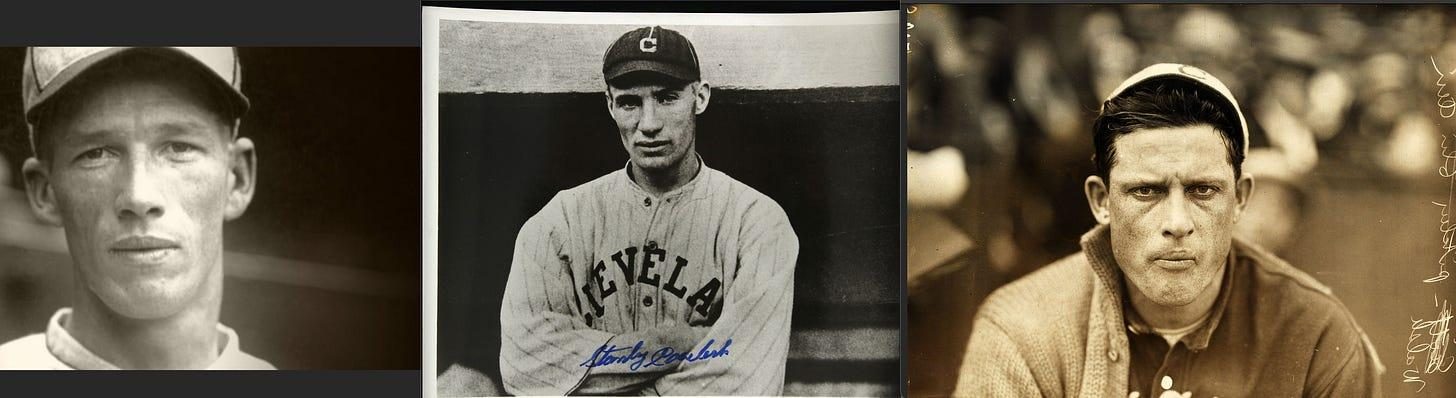
00:02
So what I'm going to go through here is a distillation of what we were talking about in terms of the archetype of Lefty Grove and the spiritual ascent from the mines. But we're going to take it all the way because you have three people here. Lefty Grove to the left, Stan Coveleski in the middle, Ed Walsh on the far right. And what these three figures represent is a very specific nexus in place and time — which is the Rust Belt and the Appalachian in the early 1900s through coal mining towns.
Coveleski and Walsh, Walsh being an Irish immigrant, Coveleski being a Polish immigrant. These are immigrants' children who are working in these coal mines.
So with Coveleski’s experience, he is working 12 plus hour days, making under a dollar in these coal mines. As a 12 year old child, as one of the breaker boys. They're breaking up coal. Ed Walsh does something similar in his teenage years in one of the roughest mines in the country, in Plains, Pennsylvania. These are anthracite coal mines.
I'm going to show you a couple of images here.
Here's one of the mining plants in Shamokin, Coveleski’s hometown — the Glen Burn Colliery in the Lower Gap of Shamokin, circa 1974.
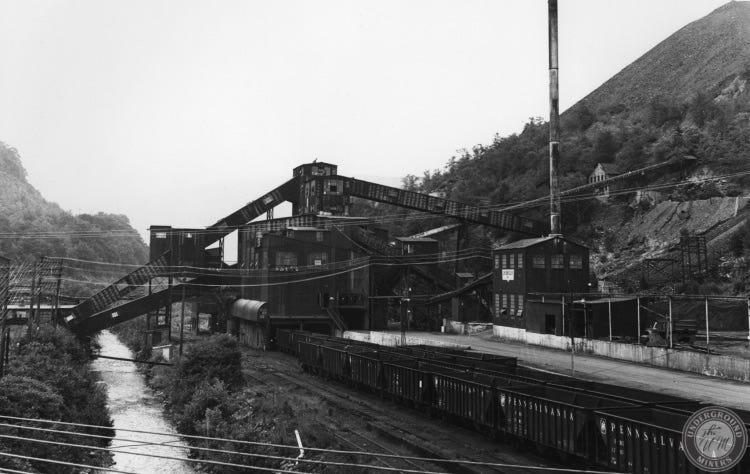
Here's another image.
01:44
The children actively working, breaking up coal — in the Kohinor mines in Shenandoah City, Pennsylvania (1891).
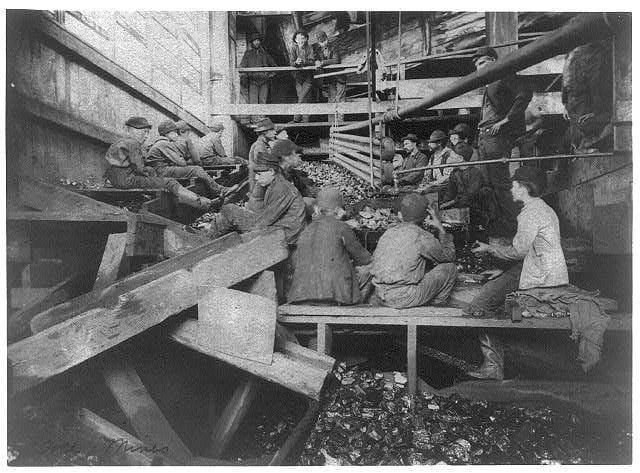
01:48
And here's one of the entrances to the mines — Brooks Mine, an anthracite coal mine in Scranton, Pennsylvania — reopened to educate the public.
So, what I'm going to elucidate here is there is a metaphysical architecture of initiation, which is the descent into hell, the trial, the transformation, and then the ascent. This is something that's present throughout mythological traditions around the world. You have Inanna, in the Sumerian; you have Persephone in the Greek.
Christ goes into the cave; Lazarus. Dante in his epic, The Divine Comedy. These figures descend into hell. They undergo a profound transformative process which often involves suffering and isolation. The witnessing of atrocities, brutality; the existential pits of nothingness; negation. And then they rise up from hell in this profound experience of the transformed, or the one who has mastered this initiatory process. This confrontation, in a Nietzschean sense, with the abyss itself; the beast and the monster in the inferno, the blackness of eternity. This is represented mythologically as dragons, serpents, chthonic evils, beasts, and so forth.
02:48
The metaphor at hand being the underground cavern, which was often used in initiation rites for these ancient cultures to symbolize the descent; quite literally in Dante’s Inferno initiation. He enters in a hole in the ground in the earth; the gates of hell. This is going beneath the earth, going into the earth. It's a metaphor for the spirit entering the body. And you have this in a profound collective sense with the inquiry of humanity going into the mines to retrieve primordial energy to power industrial civilization. Coal. Oil. Drilling into the earth, the body of the world.
Here, to go deeper into Coveleski. He was born in Shamokin, Pennsylvania, and he labored from age twelve, deep in these mines. Six days a week, all day, 12 plus hour shifts, making less than a dollar a day. And then he would leave the mines at the end of the day and he would go and practice pitching by throwing rocks at a tin can that was wedged between tree branches. He was eventually discovered by a semi-pro team, a local semi-pro team called Lancaster. And then from there he was discovered by Connie Mack and the Philadelphia Athletics. Again, a local team in a regional sense.
So what I'm trying to elucidate here is these initiatory myths have long been present in human history. And they've been elucidated in mythological or religious terms, even in terms of when you look at Christ and Lazarus, as figures who go into this darkness or the depths of darkness, which is death; have a spiritual encounter — which is a cave. Which is an abyssal place of no light. And they are transfigured, or are transformed in this encounter with death, negation, the abyss. Nothingness. This transformative experience. And they emerge as messiahs, or wounded healers — figures with incredible force and power of will and life, precisely through their encounter with death, or the wrestling with the void, or the place of no life.
You're looking at a moment in time in human history where time and place — the industrialization, the rapid industrialization of America, which creates these coal mining towns out of necessity to fuel and power the industrialization of an entire emerging world power… which again, through World War I and World War II, just scales and scales becomes this massive force…
04:46
You're witnessing that economic and social intersection with the cultural intersection of baseball as America's pastime; its most powerful cultural export and its most powerful cultural product. You combine those two and you get these figures like Grove, Coveleski, and Walsh — who are born in these small coal towns in the Appalachian, in the Rust Belt, and they rise to mastery through throwing rocks. The most innocuous, grounded, earthly, skeletal pursuit. Raw, bare bones practice. This practice of throwing rocks that creates, for Coveleski — he would later say, I was throwing rocks at tin cans and it created such a mastery of control that when I stepped onto the big league field with Babe Ruth or Lou Gehrig, the home plate itself; the strike zone was massive — because I was so used to throwing rocks at this little tin can.
You have this rise that happens through a very specifically inhuman industrial circumstance where these young children, through child labor at this period of time in American history — are laboring in these deep, dark mines. And this is going to be the life and death of the individual, period. And what is availed is this possibility of spiritual ascension through the cultural technology of baseball.
That's what's so interesting here about this mediation — the industrial technology of the mines itself in juxtaposition with the cultural technology of baseball. It creates a sort of ladder, a sort of extension through which there's a profound spiritual initiation that happens of rise and fall, of ascent and descent. It’s the mythological promise of spiritual initiation, availed in the world, in a worldly sense. Not through initiation rites by priestly codes in ancient civilizations, nor through mythological readings of abstract texts of stories — but in the real, raw, lived experience. In the fleshly body. Through the descent as a child into this dark dirt of these coal mines;
the rise to becoming one of the greatest pitchers of all time, which all three of these men have in common. Grove, Coveleski, and Walsh are all renowned as some of the greatest pitchers in baseball history.
Coveleski pitches three complete game wins in the 1920 World Series after the death of one of his teammates and the death of his wife. You look at these figures and what is created through them, and you can look at the body as a sort of alembic or theater or center for transformation of the spirit. A crucible for transmutation, a thermal, metabolic epicenter of the heart of the will, similar to the industrial epicenter of civilization running on this very latent, sedimentary coal which produces fuel from the ancient history; depths and bowels of the earth. This crucible and alembic which is our psychology, which is the way we view the world, which is our perspective, our experiences, whether that's pleasure and pain or suffering or triumph or trial, whatever it is. And you can see how these cultural institutions, both of this massive industrial push for mining and factory, as well as the cultural institution and technology of baseball, create an ability for the soul to transform.
A ladder or a jungle gym of sorts that is incredibly laced with extreme spiritual difficulty. A ladder of snakes, or roes that appear as snakes. And these men climb this civilizational ladder from the depths of hell. They fall; they fall most deeply into trial and desolation and abyss and darkness; they rise, they rise most profoundly into ascent, light, and glory through the purgation of the will in the depths of hell. I just want to show you. The vision.
08:08
The vision of the entrance to hell or the entryway to hell. This is common across all civilizations and all cultures. This vision is literally, it usually is just a cavern, a hole in the ground. And you travel into this hole in the ground and you experience the substratum of existence, the darkness, the infinite, the void. This is through ritual, or meditation, or prolonged experience of deprivation of sensation or light. Monks and mystics in the Hindu tradition and the Buddhist tradition have often practiced this form of abnegation; interestingly enough, a scholar in a lecture regarding Coveleski termed his motivation and his will as a sort of ‘negative motivation’ toward baseball from the mines. Coveleski called baseball a ‘worrying thing’. Because what it represented was a foothold before this abyss; an uncertain one at that. He could not and did not know when it could possibly cease, or when the bottom could drop out.
A vision of life before infinite death.
What you have is this sort of paradox of this void, of this loss, of this darkness, of this cavern, of toil in an abyss, or almost a like a… penal penalty or a prison culture effectively — of suffering for these young immigrant children.
09:01
Coveleski leaves these mines at the end of every day and practices throwing rocks at tin cans. He's building something akin to a garden, like a spiritual garden in the void for mastery and discipline. We talked about this in relation to Lou Gehrig in one of the previous episodes — baseball as a technology for spiritual evolution, the discipline, the repetition, the routine, the cultivation of mastery. Waite Hoyt, one of the great pitchers for the Murderers Row Yankees talks about pitching itself as a craft. It's less of an art and more of a craft because you're working with the raw materials of each pitcher's potential and character; you're honing it through trial and error and cultivation on a daily basis. It's more like sculpture. I brought up that Michelangelo quote: ‘I saw the angel in the marble and I carved to set it free’. And I don't think it's a mistake that each of these men we're discussing here is a pitcher.
A world-class pitcher — because you are working with the physical toil of the labor of the body in these coal mines and they're perfecting this craft. It's this craft of isolation. Negation. The body. The routine of sorting and breaking in the darkness.
It's almost an existential craft of solitary perfection in the art and craft of pitching.
This is profoundly isolated; negated. It is away from the cities and bustling urban and cultural epicenters that Coveleski approached with such trepidation. He had never been outside of Shamokin. This is a solitary act. Throwing rocks into tin cans wedged between tree branches in the fading dark after hours in the mine shafts. This is such a skeletal process of becoming that is availed through this experience. It is created and forged through real historical circumstances. And it's almost too profound to put into words because they're living and dying in these mining towns that are entirely dedicated to the practice of mining.
In the midst of all of this, as baseball is becoming the cultural product of importance in American history, these mining towns are essentially being sacrificed to the process and progress of America's industrial ascent. In a larger national sense, there's this mythological sacrifice that's occurring. It is of these young immigrant children to the dark holes of the mines to produce the fire for the Moloch of civilization to roar into being. So you can see in modern America, these coal town, these mining towns, these factory towns, now that the labor has been exported out of them — this labor has been outsourced, as particularly is the case for factories…
internationally because it has become cheaper for the owners of these companies and corporations to do so.
It is a corporate profit due to globalization — which perhaps ironically is and was possible due to the mining and factory towns; an end of this old world. You can see how there is this outrage and this wondering what has happened, right? Because these towns were the lifeblood of America for really the entirety of the 1900s. Steel, coal, cars. Manufacturing and mining, factory work these were all domestic outputs.
This was the economic product of the United States. These are entire epicenters of culture and community. And you have these people, you have Grove, Coveleski, and Walsh — all of whom are participating in this profoundly, I would say inhuman, industrial culture of doing something that's radically different than a natural, rhythmic process of interacting with the earth.
You have farmers like… Walter Johnson or Dizzy Dean or Charlie Gehringer. There, you're working with the cycles, you're working with the birth and cultivation of animals. The seasons of planting specific plants and crops. This is something that's very tied to nature, the natural process of humanity. Instead you have this very inhuman, mechanical industrial process that sprouts at this period of time in human history — especially in America, through the coal mines, that these children are participating in… because there's no law against them doing so and they need money to survive. Their families need money to survive. From a very young age, 12 years old, Stan Coveleski is working in these mines and he cultivates and practices that craft.
That is perhaps the deepest descent narrative that is available to us on material and historical terms; even deeper than the mythological terms because of just how striking and piercingly real it is. It materializes the spiritual plane and it shows us through the literal, historical, physical humanity, the spiritual plane.
So I brought up Inanna and I brought up Persephone as representations of that underground myth of initiation where they travel into the earth; travel into hell to be stripped and transformed of their previous identity — and they rise from that with a newfound, deepened understanding of truth, the spirit, reality.
I brought up those myths because it brings us back to that initial point that we discussed — baseball itself is actually a spiritual technology that allows for the realization of these mythological and spiritual concepts, which were previously realized in psychological initiations, trance states; even drug induced experiences, which would be rough approximations through vision states. They'd be symbolic trials that would be presented by the priestly class of these civilizations and these cultures, whether that's Egypt or Greece or Sumer — as theatre and rite.
We're actually now looking at a very different mode: where historical, technological, physical forces are almost conspiring in an American sense to realize these myths of transformation, these spiritual myths of transformation. To realize them in a literal container of the intersection of mine and mastery. If you think about the spiritual power or force or reality that is behind and contained in someone like Stan Coveleski or Ed Walsh or Lefty Grove, what you're looking at is a full spectrum experience of reality that is almost too profound to articulate because it's so grounded in the immediacy of the experience of trial and revelation. There's no real way that you could sum it up. Coveleski’s story is in Glory of Their Times by Lawrence Ritter. He actually tells his story; you can get a glimpse of that. But I think the real question is how could you possibly sum it up?
Right? Even in his words. Because it's something that's beyond language. It's like a spiritual transformation that occurs in an etheric sense in the soul, through the alembic of the body and the sensory experience of the individual which is in many ways beyond words and beyond history. Because its deeply, profoundly metaphorical and yet entirely visceral. The body and the blood. It's like the creation of a diamond from coal, in the most literal sense of the term. The creation of that in the soul, in the very spirit and foundation of the individual as aperture, lens, and experiential body — the sediment of the form through which we experience reality — through pressure and through transformation. It's almost something that exceeds translation.
So here's his story as he tells it:
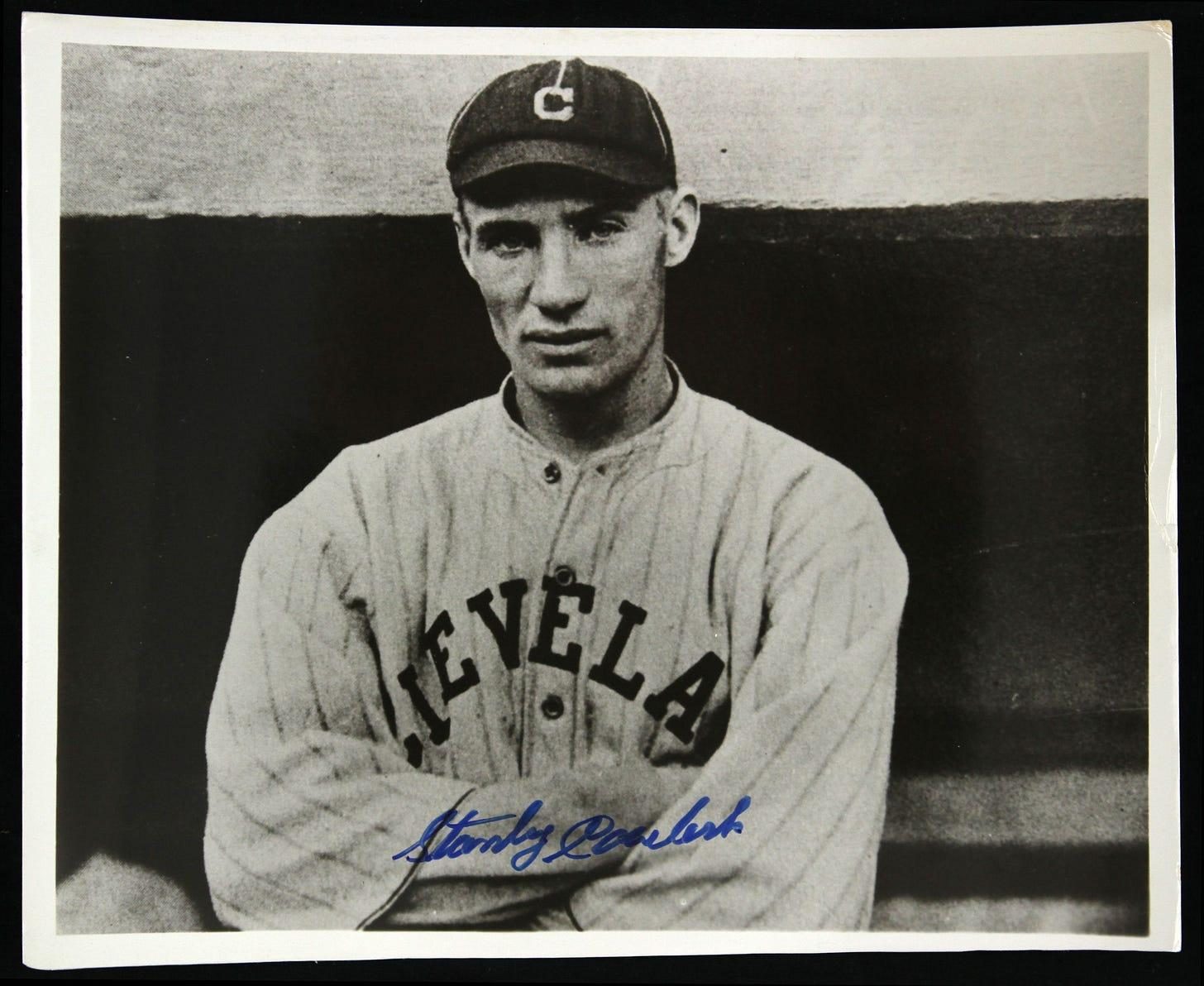
‘Well, the semi-pro team in town heard about me being so good throwing stones at tin cans, and they asked me if I'd like to pitch for them. That was in 1908 when I was 18. Of course, maybe being Harry's kid brother had something to do with it too [Harry Coveleski, one of the great pitchers of the dead ball era as well]. Then before I knew what hit me, I was signed to a contract with Lancaster and I was out of those damn mines for good. Never forget leaving home for the first time to go play with Lancaster. It was the first time I ever rode on a train.
Had to get a new suit of clothes to go off to the big city, but was too bashful to buy it.
So mom and dad went to town, picked one out, and brought it home to fit on me.
Then when I got to Lancaster, I was too shy to eat in the hotel with the rest of the team. I'd go to a hot dog stand and eat by myself instead. Paid for it out of my own pocket. After a couple of weeks, some of the players got suspicious, never seeing me around. So one day they followed me and caught me eating my hot dogs.
After that, they made me go to the hotel dining room with them. I pitched for Lancaster for a few years, then went up for a trial with the Athletics late in 1912 with Connie Mack. Connie Mack was a good manager. He was a very considerate man.’
And then he goes on to say Connie Mack told him he was to start his first big league game.
So you can see here, it's the literal aspects of the story that he's telling. He's retelling his history and his past. He’s retelling the movements that occur on the ground; at and on the ground level which constitute his history. It’s an oral tradition of materialization.
17:08
But what we miss a lot of the time in history and in culture, as well as specifically American history and baseball history and culture — is that we're missing this very profound thread of spiritual transformation, which is so difficult to articulate. And this is so much of what this project is about. Because when you look at this from an architectural, kind of architectonic spiritual perspective, there's so much here that's not said and not being said in terms of this descent into hell; in this rise into mastery. Cultural mastery, civilizational mastery, through craft, through the devotion to craft and technique — which, as I said before with that Lou Gehrig essay, is the spiritual technology and architecture that baseball actually avails as a physical practice, as a discipline, as a honing of a craft.
And that in itself, through its physicality, especially pitching — through the physicality, through the psychology, through this full body holistic spectrum practice of the art and craft of pitching — actually avails this spiritual wealth to emerge, which is actually often mirrored by physical wealth. Where they've crafted this ability within themselves. They’ve forged it in this mythic underpinning; this spiritual ground of the inner forging of self through these trials of void and absence;
negation. There's actually a Meister Eckhart quote, a Christian theologian and mystic. He says— all of the inner gold is all that is manifest in the outer gold, and vice versa. And what he means by that is that inner spiritual cultivation is always mirrored by the external product and vice versa. There is no ability to distinguish that.
And so when you see these three men here, Grove, Coveleski, and Walsh — what you're really looking at is someone who has been spiritually transformed in this inner furnace of turmoil and suffering and confrontation of the very root and substratum of the soul through being torn down to the abyssal void which is literally manifest in the mines that formed the early childhood growing up in these Rust Belt towns. These Appalachian coal mining towns, laboring in the mine shafts for less than a dollar a day for 12 plus hours every day, six days a week. You're looking at a moment in American history, which is a communal, collective, historical moment. A moment of profound psychological transformation, especially in the Rust Belt, especially in the Appalachian.
19:34
But you're looking at the full, this full realization, this full spectrum realization of the potential latent within that movement in that moment in coalition with the cultural product of the civilization that these mines are building. This is the fuel.
This is the energy. This is the primordial energy being dug up from the center of the earth to feed this burgeoning civilization. And Grove, Walsh, and Coveleski are part of this work in an active sense — from the caverns of toil and abyss to the skyscraping heights of genius and legacy. You see them actually climb the cultural scaffolding of this emerging civilization and empire, which is itself its own memory, its own figuration of self. This is the building of a collective center, myth archive, and vision of self at a mass, national level. It’s a huge tribe. They go from this deepest, darkest cavern of existential spiritual isolation and purgation manifest literally in the shape and form of the underground pits of blackness in these mines — and struggle to the heights of this civilization and this culture as markers of greatness.
20:34
Each of them is remembered as one of the greatest pitchers of all time, inscribed in gold in baseball’s hall of fame. So again, to return to this image of the sort of mouth of hell or the gates of hell as the mines of Pennsylvania… this is what the real descent-ascent is. It is no longer myth or myth image or psychological metaphor. It is raw, potent, physical reality.
21:02
The real descent to ascent in a spiritual sense — it's actually availed through this practice of mining as a industrial mechanized, almost inhuman form of suffering and struggle and turmoil, which creates the foundational backbone of an entire civilization as a modernized industrial superpower. It's the fire, it's the coal, it's the energy, it's the heat, it's the real thermodynamic power behind the machine. They descend directly into the darkness of the will that is America. Directly into the heart and hearth of it; emerge covered in soot and coal; channel this primordial negation of the will into the heights of spiritual, existential, and even cultural, civilizational ascendency as mythic figures of revelation. You have these men who are tasked, as children, with descending into this huge kind of mouth of the earth and dredging up the fire. The primordial fire from the depths of the earth to feed to this civilizational mouth. And then what happens is they cultivate this technique, they cultivate this skill, they cultivate this discipline outside of the mines. And it actually creates a method for them to emerge, and to not only emerge — but to ascend.
To accomplish, to empower, to achieve these great heights, not only within themselves as an existential, personal empowerment of spiritual mastery of form — but as cultural and civilizational markers of excellence, greatness, legacy, and mythic heroism of the surmounting of sheer, near impossible trials. Each of them with a very distinct pitching style, which I think itself emerges from this existential confrontation that happens in their early childhoods. This is incredibly spiritually profound material. It’s a character of the self; of the soul — like an artist with a paintbrush. Like the signature figuration of the craftsman. The palette, the toolbox of one who is truly individual; in tune with the mechanism and motion of the center of the spiritual will of himself. And it's something that, I will say — I don't think you see or that you find anywhere else, specifically, again because of the historical circumstances that are emerging at this period of time.
So when you look at these men, these figures, of course they have great statistics; of course there's the baseball story, and that's so much of what is being told. This is the story of these people finding realization and self-realization through baseball. But I argue we have to dig much deeper — and understand the real historical, political, economic, social, and spiritual contexts in full and in symphonic unison to really understand exactly what these people went through, what they experienced, and what is really happening at the transformational level of the self that produces the humanity beneath all of this. Because that's the most important thing. So when you look at someone like Stan Coveleski or Lefty Grove or Ed Walsh, you're seeing this deep spiritual fomentation of years and years of this struggle, this turmoil, this effort in these mining towns to create anything or create something that would allow for the emergence of the self in the midst of this incredibly difficult, difficult, difficult period… prolonged period of suffering and pain and anxiety and uncertainty. The cultivation of mastery in abnegation, desperation, and void. You have Coveleski say, and Ed Walsh mirrors this — baseball is a worrying thing.
And the reason they say this is their entire experience in baseball is being informed by the memory of the mines. So baseball represents, again, economically, a way out of this situation and a way to create a sustainable kind of laboring force or working force in their lives to create a real life, the possibility of a real life out of this protracted, indefinite laboring contract in the mines for nothing. Something that would keep them there forever.
That's really what we're talking about with the technology of baseball. It's a cultural technology. It's a spiritual technology. It's a physical technology; an economic technology of the empowerment of the self.
You can come into spiritual contact with yourself, especially through the art of pitching — because it's psychological, it's physical, it's a holistic gathering of the different aspects of the will and the force of willing. Again, Ed Walsh pitching 464 innings in one season. This is the creation of a will center. A will center of discipline.
25:19
These three men here are forged in the epicenter of it. Iron forged. The most inhuman, brutal darkness and blackness of the epicenter of it. They're in the core of the void, the core of the spiritual void that seems unceasing and without end. And from that, they emerge with this fire of will represented, expressed, and manifest through the cultivation and practice of the art. They emerge with the fire of the coal as the hearth of American industrial modern civilization; they emerge with the fire of the thermodynamic, metabolic will of striving which powers their achievement as masters of the form of the physical willing as in athletic genius, mastery, and greatness. They are in direct communion with the source of power.
25:47
This is the true craft of pitching. The craft of pitching as the sculpting of the character; the manifestation and realization and expression of the soul of the self.
The core.
25:51
So that's the full fire of what we're representing here. And it's interesting that it's thermodynamic in the way that coal was used to power American empire and is used to power American empire. Coal, oil, right? They're digging into the depths of the earth, into these natural fossil fuels. This accumulation of historical sediment. This hidden power left, beneath, buried in the center of the earth. It’s mimicked in the spirit’s descent into the body, into the soul of the form. The latent power of the engine of force that is the human body. The metabolic power that moves the world.
That moves the stars; the cosmos. The infinite unity of the same fire in a stellar, fusionary sense. The same fire that birthed the universe. The center of the will of all things; the core of creation and existence itself. They’re channeling that. They’re finding it in the abyssal darkness of the earth; they’re finding it within themselves.
They're dredging that up for the empowerment of an entire civilization. An entire epoch — really, the industrialization of the world.
But in doing so, they also… they also emerge. They also emerge with this deep… they also pull something up from the depths of hell. Themselves. Their true center and spiritual core channeled through the mastery of the athletic form of self, the synthesis of psychology and will and discipline as a iron force of physicality. A forging of the whole unity of being. It's an experience and then confrontation with the void of self in this descent. It's this fire and darkness, this fire and blackness.
And in that confrontation and in that contrast, you discover what's real, you discover what's possible and you discover what is within you. The physical circumstances of these mines, again, I can't overstate it enough, is essential to the process because it's a realization of this hellscape. Its a physical realization of the mythological form of hell.
And again, when you hear the experiences of Coveleski and Walsh and the way they describe the mines and how baseball was this almost constant state of anxiety for them — because what it represented was the very thin kind of like slipstream or hold that they had before the descent into the mines. It was the one thing that brought them out of that. You can see that dialectical tension in thepressure there or the forging of something incredibly profound. It is a tightrope over the abyss. And they walked it with greatness of self; greatness of mastery of the cultivation of the discipline of the form of the mound. A cultural and spiritual legacy within baseball that utterly transcends all forms; leads us directly into an encounter with the most profound spiritual humanities in existence — sometimes in the most unexpected or unseen places. Places where light maybe does not often go. And to honor that and to see that for what that really is. To witness them and their journey; to honor them for it all; for everything. To raise this to the light. So that's the episode. I will catch you on the next one, alright?
20. Institutional Memory, the Abyss of History + the Baseball Card as Preservational Act
Jul 10, 2025 · pp. 313–324
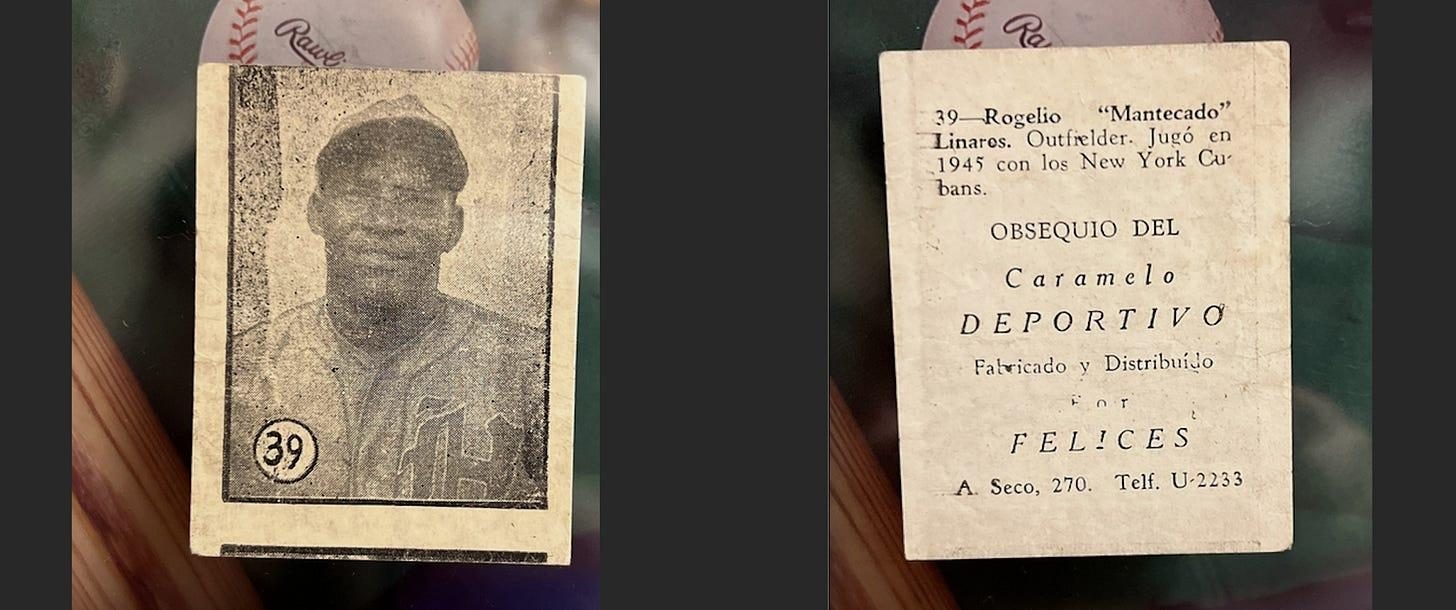
00:01
So I think for this video, there's a couple of different ways to look at this. I have a card here. It's the Caramelo Deportivo of Rogelio Mantecado Linares, born in Cuba.
He played for the New York Cubans in the Negro Leagues toward the very beginning of integration in the United States. And I believe he also spent time in the Mexican leagues.
What I want to talk about here is memory and history as it pertains to something like the baseball card.
The Caramelo Deportivo set is a great one to talk about this. And Rogelio Linares is great figure — because what we're talking about is like the slipstream of history. And I think we went into this a little bit with this Satchel Paige talk, and Cy Young as well — is that there's a difficulty historically with memory. And especially when you look at the island nation of Cuba, when you look at the Negro Leagues, in comparison to the institutionalized memory of the United States as it pertains to the culture and sport of baseball — you're looking at radically different modes of envisioning and remembering the past. And thus, in a almost deterministic way, creating the future. Because so much of what the past is and represents is a blueprint for what we wish the future to become.
And so when I look at a card like this, Rogelio Linares, there's very, very little information on him. It's very difficult to get information beyond a little bit of data from the Seamheads database and maybe some general kind of encyclopedic entries in Cuban baseball websites that briefly detail his playing career. But as we've seen in the previous videos and the previous talks, what we're looking at and we're looking for really is a human perspective of baseball through the spiritual journey that an individual takes — and baseball is a huge part of the cultivation of the spiritual center, a picture of self, so to speak. And so part of the power of baseball cards, I think, especially when we talk about the modern baseball card — which was discussed in the 1939 Play Ball essay — is the back of the baseball card. So the front is the portrait and the back is a brief description of that person's name, where they came from, what they've been doing. It's a way…
03:06
It's almost like a totem of memorializing a moment of time in history. And these are on just little pieces of paper, the Caramelos, even as opposed to cardboard. We're talking about a very fragile state of epilogue. A fragile state of monument to memorialize these people. And so in the grand slipstream of history, so much of what we depend on are these footholds.
03:36
These little pieces of paper, these documents, these slips that allow us to denote and notate history. And to commune with it. To travel back in time with it. That note is like a permission slip of the memory of the time in which it was produced. This is the spiritual nature of historical documents. They bring the past into the future, directly, immanently — in an embodied, physical sense. A sense memory incarnate.
And it becomes difficult, especially in the popular consciousness as a meritocracy of baseball, to truly and fully remember and create a wholeness of political memory.
The great figures are memorialized, and particularly the figures from the United States who played in the white leagues. So this is where it gets very difficult because you're dealing with an entire history of baseball — which is multicultural, many different races are involved, many different ethnicities are involved, many different nations are involved. We have not done an adequate job at cataloging history, and this is not due to a lack of effort on the part of any one nation or any one ethnic group or any one racial group. It is due to discriminatory factors.
04:33
It is due to, for the longest time, the exclusion of Black players, of Cuban players, of players from the Caribbean, of players from Asia. It's a failure at an institutional level and a failure at the level of collective memory. And this really drills us down to some really essential human points here regarding discrimination.
Regarding in-groups and out-groups, regarding who gets remembered and who doesn't. And then the abyss of history that unfolds. There's that common quote that history is written by the victors. And Bertolt Brecht, a really great playwright, talks a lot about this in terms of history as a violent conquest narrative. But when it comes to a sport like baseball, and being a baseball historian or thinking about baseball from a philosophical perspective, what you're looking for is a wholeness of experience, an inclusive wholeness of experience. And perhaps it's destined, but I don't necessarily believe it is… when you look at the richness of the history of Cuba, of the Negro Leagues, of the Dominican, the Caribbean, you're looking at a history that is partially obscured So if you think of historical consciousness as an attempt to establish transparency between past and present and thus be able to determine future — when you look at the Negro Leagues and you look at the Cuban Leagues, you're working with an opacity of consciousness, a certain point where you reach a state of total blackness.
You're reaching into the past to try to understand, but there is no foothold. And so the foothold is an institutional or collective consciousness of memory, which helps us understand history through a sort of narrative trajectory or understanding of individuals’ lives in a grand, illuminated and perennially illuminating tapestry of sorts, woven orally, through documents and texts, photos, et cetera.
And to me, this is a perfect segue from the last essay that we just did on Lefty Grove, Coveleski and Ed Walsh — because the historical documentation there is so rich that it allows for the kind of perspective that we just elucidated, which is this very deep and profound humanization at a spiritual level of what this person went through, incredibly difficult circumstances in these coal mines in the Rust Belt. But what we have failed and what history has failed through our failure to actually communicate and establish memory across ethnic, racial, and national lines… is that we've lost the richness of these entire languages of baseball through our failure to establish, create, and continue collective memory projects.
And again, this is why institutions — I really appreciate Seamheads, I really appreciate the SABR Biographies Project, the Smithsonian American History Museum, the Baseball Hall of Fame. When we talk about the importance of cultural institutions like that, what we're talking about is an archival history, which is a process of recovery.
And what I really want to zero in on is what is lost. And it's difficult to truly know what is lost, or if it is lost at all — because there's a lot that remains in terms of oral histories that is still being communicated in in-groups, whether that's Cuban baseball history in-groups, whether those occur in Miami, whether those occur in Cuba among elders in the community, as well as Negro leagues in-groups. It's... It's this
08:28
This jurisdiction historical moment that's been broken up by segregation, that's been broken up by isolationist policies on the part of the United States, and it's created a fractured or fragmented baseball history through which we attempt to peer and understand — especially to understand someone like Rogelio Linares, who played on some very important teams, including the New York Cuban teams, and was apparently a pretty well renowned power hitter.
There's been a span of around 70 years that have passed since his playing career. But to understand him or to attempt to know him or commune with that historical memory of his contribution to baseball has become incredibly difficult because he's not such a popularly renowned figure as someone like Satchel Paige or even Cool Papa Bell, right?
09:26
Or even someone like Martin Dihigo, or Jose Mendez in Cuba. We're dealing with a real historical consciousness that barely scratches the surface on anything beyond the established historical narratives that are in place…
The question is, what is lost. Or what is being lost and how can we retrieve it?
10:19
Baseball history is a type of human history that goes far deeper than the politicized histories of the battlefronts of nations, ethnic in-groups, of tribal consciousness. It's a collective communal history, across borders, across bounds, across languages. It's a real and true universal practice. And again, I've said this before, it transcends language because it's the immediacy of the game itself. You step onto the field and you play and a lot of the players that come to play in the United States or go to play in Cuba — there's a massive language barrier. They can't communicate with each other, but they can communicate on the baseball field, right? Because there is that innate understanding that supersedes language.
11:16
This is what I love about baseball as a way into a real historical or political consciousness that transcends a lot of the kind of detritus that people mistake for real political consciousness in today's day and age.
11:35
It's a human reclamation project of history. And so when you look at the United States of America, particularly among white ballplayers and white immigrant ballplayers, the narratives are well established and they're well in place in these institutions. We’re in the process of, and I think there's a long overdue reckoning at a collective level of understanding just how important the contributions were in the Cuban Leagues and in the Negro Leagues — and to write that into the data banks of our collective communal history books. And to make sure that that is well founded and that that history is rich and that ground is fertile so that when you have historians and philosophers of the future that come and they pay a visit to these archives and understand the importance of baseball at a global level, the narratives and the stories and the information available is sufficiently rich to the point of that human spiritual level, where you get the full gravity and gravitas of the people who laid the bricks in this foundation of the sport, the collective sport.
So when I look at it now, or when I try to look at it now and I try to enter into this archive, you can see this incredibly rich United States, white only historical consciousness that existed all the way up until Jackie Robinson breaks the integration barrier. And then you have — the institutionalized history shifts, right?
The aperture shifts. And then you have Minnie Minoso, you have Jackie Robinson, you have Larry Doby. You have Don Newcombe. You have the acceptance into the institutional narrative, which is the empirical archive, so to speak.
13:28
And that ends up actually — it actually is incredibly important because what that is, is it's a institutionalized, protected, well-documented, well-serviced, well-funded history. That is the data bank, which is the epilogue, which is the keeper of the keys, so to speak, for the collective communal history of baseball. And the importance of something like that is essential, but it's very clearly connected to and tied to the institutionalized narrative of baseball, which existed upon the institutionalization of baseball in the United States.
The attempt to institutionalize black baseball with Rube Foster and the Negro Leagues was the attempt to create an institutionalized communal data bank, a collective system, a way of being which could be documented, which could be established, which could be exchanged, which could be communicated. That's the importance of the creation of the Negro Leagues.
And it's a similar function with the Cuban leagues — is that you have this simultaneous process of myth-making and myth-keeping, history-making and history-keeping, which is the essential importance of the archive, the historical, institutional, foundational collective archive. It's the collective memory system that we refer to, that we use to recall history. Again, this is the importance of the SABR biographies. This is the importance of the Baseball Hall of Fame.
14:52
These are documents upon documents in archives that allow us to — you have a historian or philosopher enter into that arena and you can assemble a deeper, more rich picture of history than perhaps was even possible at the time that the history occurred, which is a redemption. It's a reclamation and it's a historical restoration of spiritual consciousness within humanity. This is the, I think, the real big elephant in the room, and the big roadblock that's occurring in terms of baseball history — is that from what I've just been able to pull together in my own research and talking with Cuban baseball historians and attempting to understand the foundational origins of Cuban baseball — this history has not been sufficiently protected. And it's a failure on an international level; on a collective institutional level of humanity. A failure to create this global history of communion. Because the importance of this history has been segregated, right? It's been separated by national borders. It’s been separated by racial and ethnic constructs of exclusionary group. And there's been a failure in a humanitarian way. And from a humanitarian perspective, that fails all of us because what we're really experiencing is a lack or an emptiness in the narrative of our collective creation and establishment of the culture of baseball. This is mirrored in our political, global, collective consciousness to the extreme. And a lot of that, just again, it just has to do with racism. It has to do with colonialism.
16:19
It has to do with the fact that the US is trying to control political interests in Cuba for over a century. All of these factors that go into that, but we need to transcend those factors in order to save and preserve our baseball history, which is something that transcends borders. Our baseball history is our human history. It passes through borders. It connects us between perceived racial boundaries. So this is something that is integral to our human consciousness.
16:50
And so when I look at this situation, especially when it pertains to Cuban baseball or the Mexican league baseball or the Negro league baseball — beyond the well-established collective narratives around a lot of the more popular players — like the Negro Southern Leagues, for instance, I think is a very important touch point there. There's something beautiful about the absence, but it's also haunting. Because you have this fracture or this fragmentation in the scrying glass of our ability to see history… that creates this narrative void where you can experience something — like this baseball card, I think is particularly haunting and powerful because you have this very well established and very talented baseball player, Rogelio Linares, who played for the New York Cubans in 1945, as you can see on the back of the card. But there's so little information on him. There's some statistics that have been pulled together from the leagues that kept statistical records that have been put into the Seamheads database. And Seamheads is just such a huge part of what we're trying to establish here and what we're talking about. But you have the bottom of history drop out.
I talked about this in the Rust Belt mines episode just a day ago. But it's in a very different context because you have the bottom of history drop out and you're sort of, you're gazing at the void, which is the lack of historical memory — which is the lack of the ability to see and understand. You have this phenomenon or this emergence of — whether it's an individual or a series of individuals or an occurrence. I experienced this a lot and felt this a lot viscerally looking at the Cuban baseball history and the foundations of Cuban baseball, how it was created and established.
18:51
And this is something that's beautiful about history, but also terrifying and difficult, right? Because you want to understand, but there is the difficulty in understanding that comes from the bridge and experience between past, present, and future, and what can be recalled. So whether that's through an oral history that's transmitted ancestrally — whether that's through a series of documents that are recovered, whether that's letters or paperwork, whether that's through baseball cards, like this baseball card here — that provides detail and insight, however little or however much.
You're looking at a reclamation project of what in reality — beneath culture, beneath civilization, beneath all attempts to preserve or create that data bank of historical memory — is a sort of infinite depth and infinite death of consciousness that is the erasure of history. And that erasure of history on a sort of foundational natural objective level is very real. Again, because without the preservation of an institutional collective or cultural archive, that information just fades into the abyss.
It will be forgotten. It can be and will be forgotten.
20:16
Because that's what culture is. Culture is the data bank of a collective memory that's being created and remembered. It's being kept or nurtured. It's the same way that an oral mythology or spirituality is being transmitted through generations, which forms the backbone of any sort of group or culture or tribe.
And that's the locus or the center of the identity of that group or tribe or culture. So when the bottom of that drops out, and we discussed this in the Cuban baseball history and the origins of baseball in Cuba episode, you have an identity crisis. The center or locus of self has dissipated. Either the collective myth or the collective history no longer functions. It's no longer applicable. It hasn't… survived a, whether it's a political happening or a war or a fragmentation of the culture or a diaspora. So there's this attempt to recover the essential identity that forms a group or a community or even an individual. And this is something that I think is actually native to the real process of history. The process of history beneath and beyond the attempt to establish a collective data bank or memory bank. And so when you have that, it's almost like an inevitable failure of memory.
And that's what we're experiencing with the Cuban baseball history and the Negro Leagues history is that the archival institutional databases are not well founded enough due to, again, discrimination, racism, colonialism, the attempt of the US to control international interests, the attempt of the US to suppress Black consciousness in America. These are very real political, economic, and social phenomena that contribute to the way that this history has unfolded.
22:23
But it also says something very essential about how history really functions, which is the death of empires and the erasure of narratives through the slipstream of history.
The inevitability of the sand castles collapsing on the beach, so to speak, due to the waves of time. And that's what you're really touching. When I look at this baseball card here, Rogelio Linares, I feel like I'm viscerally touching the truth of history. And the reason for that is because the entirety of the way that the history of the Cuban Leagues itself has unfolded, as well as the Negro Leagues, as well as the Mexican Leagues, has... there are these great voids. And these great voids are not voids of untruth. They're voids of unknowing, and they're voids of the real consequence of history, in the same way that the statue that you would think would remain the longest topples into sand. Just by the nature of time.
It's the Percy Shelley Ozymandias poem, the hubris of kings. And there's something powerful and beautiful about that, the way that this history so directly touches that.
The institutional narrative is the foothold before the abyss, but its a temporary foothold before the real truth of history. The oblivion and the total dissipation of forms. It's not been sufficiently mediated by the cultural memory banks of history that allow us to bridge the present and the past with these narratives, and it creates this fracture.
It creates this narrative identity crisis for entire communities and individuals. It is an incredibly difficult thing to deal with in an attempt to recall past and establish present and thus direct future. So you're dealing with a spiritual crisis that's occurring on a cultural level, as well as an individual level. It's occurring for entire groups of people. You think about this in terms of Cuban baseball or the Negro Leagues.
This is not just isolated to baseball. We're talking about a much larger phenomenon of the identity and narrative memory reclamation project of entire nations, of entire groups of people, entire races, entire ethnicities, entire diasporadic groups. So looking at this and experiencing it and attempting to commune with it, and be present with the humanity in this is very powerful. And to sit with that void or in that void state or in that attempt of memory and the difficulty of bridging the personal narratives, the oral histories, the ancestral memories that exist in the body with the real simultaneous attempt to create an institutionalized history or institutionalized memory to memorialize and commemorate and understand and create monument for this history just as it is being swept into the ocean.
This is an incredibly complex phenomenon. And this is why historical memory is so important, even if it is ultimately a failure or failing. And the persistence behind that effort.
25:41
And that's what's so great about baseball history — is that it's fundamentally a human history through play that bridges and transcends and surmounts obstacles that are perceived politically, but through play and through baseball and through this language that supersedes language. That through the language of the play, baseball has been able to bridge politically perceived borders and bounds in a way that very little else can or does.
26:12
So just some thoughts here on this. It's a very powerful topic. And you have to look at the United States. And you have to look at how international behaviors impact a country like Cuba. And what we talked about with what happened in the Spanish-American War and Cuba's fight for its independence, as well as its abolition movement. The abolition of slavery in Cuba. You have to look at… the abolition of slavery in the United States and how culturally there was a deep and profound moral failure of real abolition. It might have happened on a legal or legislative level, but of course that real abolition didn't happen in terms of the political consciousness of America.
So we have to think about these things and how it impacts our ability — because that on a level is what you mourn and what you grieve… is that if there had been real integrity, real political consciousness… which is a consciousness of empathy, compassion, and humanity. You would have a deeper historical memory, a deeper institutional memory, a deeper collective memory, and that you would have an archive that was working together to preserve that in real time. A glorious intercommunion of the tapestry of mutually unfolding and informed languages and legacies of the sport of baseball as spiritual and cultural archetypal emergences of the potentials of humanity.
That's the moral failure that I think we experience a lot of the time when we look back in history — is that this is a fragmentation that could have been, I think, in large part prevented if there was real cooperation and real humanity. And I think there's a lot of hope for that through baseball. Baseball being a lens to establish that and retain that and maintain that through collective cooperation, teamwork, and a transcendental language. A language without words, so to speak. So I think that's essentially it.
28:11
Yeah, very, very powerful stuff here. I think that kind of touches on what I was looking to touch here. So, I will talk to you guys on the next one.
21. Jose Mendez and The Call of Humanity Through Spiritual Portraiture
Jul 15, 2025 · pp. 325–337
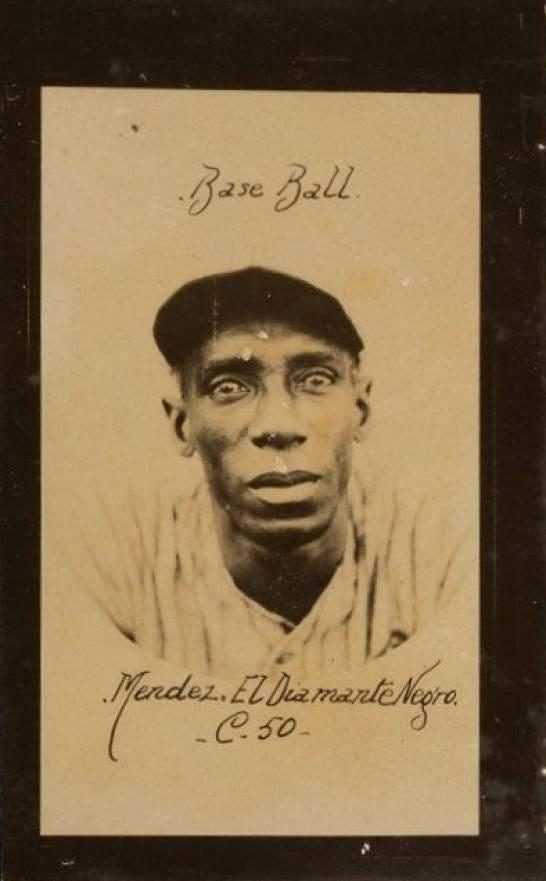
00:00
So this is going to be about the haunting of the baseball card and specifically the card of Jose Mendez here. This is the Nacionales Cigarros 1923 set.
This is the real importance of photography and image relics that in coalition with text — because text gives context, it gives dialogue, it gives circumstances.
01:29
We're looking at a very important topic, which is the dehumanization of black baseball players. The dehumanization of black baseball players, not only in Cuba, but in the United States.
01:56
When we look at Jose Mendez or Alejandro Oms, we're moving into a new context, which is Cuban black baseball players and the struggle for the integration of the Cuban professional leagues; the integration of baseball in 1900.
03:00
And the struggle — not only living in this incredibly tumultuous political, social, and cultural climate of Cuba — but being black in that climate. As much as the Cuban public admired these baseball players, black Cubans were still treated as less than in Cuba, even after abolition.
03:28
They were allowed to play baseball with the white Cubans. And they were celebrated.
Mendez, Oms, Dihigo. These are figures of the Cuban national legacy that were celebrated and revered. Dihigo is a little further on in the 20th century, but Mendez and Oms are really powerful examples of this incredibly tumultuous transitional period in the Cuban national mind.
04:26
Oms survives tuberculosis. He dies pretty young. Jose Mendez also dies pretty young — at age 43. He was born during this period of intense tumultuous uprising, as was Alejandro Oms — Mendez was born at the end of the 1880s.
05:02
When you look at this picture, when you look at this photo on the card… you see something you don’t see very often in baseball cards or even photography as a whole — the humanization of the condition of his spirit; of his psychology and his emotions. It is so transparent and so visceral. This is why I'm terming the haunting of the baseball card or the ghost of the baseball card. The transparency of feeling that is given in this depiction of Mendez, this is what's beneath history.
So when we're exhuming history, we're not really worried about statistics; it's almost like we're not even really worried about details. And this is the really crucial thing. It gets back to this concept of historical recovery, because what we're exhuming when we're exhuming history is we're exhuming the soul and retrieving the soul.
06:26
It's almost like the underworld mission of Orpheus. And it's funny to use that metaphor — because this takes me to Satchel Paige his popular idea and euphemism:
don't look back because something might be gaining on you. And of course in the Orpheus myth, he looks back to make sure Eurydice is still there and she inevitably is taken back into Hades — because he's told that he's not allowed to look back to make sure she is there with him as he retrieves her from hell.
What he's doing there is he's exhuming a ghost. He's attempting to bring the dead back to life. It's to provide and restore the humanity and the dignity. To bring the life back. As a global project of the retrieval of this humanity. And what it comes back to is ultimately that the suffering is denied, repressed, marginalized, silenced — that is dehumanized.
This is an ongoing political and social problem in our world today, around the world, both in terms of immigration and native populations — especially if the color of their skin is dark. This dehumanization has such such horrible effects on the psychology and on the spirit of a human being.
When I look at this picture of Jose Mendez, there is a gift that's being given to us here. A gift of his ability and willingness to bear his soul to the camera.
And it's so easy, I think, when you're discussing these things, to create a form of cultural recourse — which is like a metaphor — to encompass this person's experience; to maybe discuss a physical detail or discuss how they were received in a certain place or to compare them to another person or individual. These are all forms of subtle erasure of the direct, embodied, immanent soul of historical experience of humanity. The complexity and contrast; the hues and powers of the emotional embodiments therein. The real history of human time.
11:04
The gift of this image is a direct encounter. It's not just a portrait. He's gazing back into your soul with his. It's a moment of immense magnitude in vulnerability that has been preserved for the camera, with the camera as a technological device of visceral memory and recounting of countenance and expression. What would we really know of Jose Mendez without something like this? I would say, quite simply — very little.
He could even tell you the story of his life, like Satchel Paige did in his autobiography. So much of what Satchel Pagie created as a mythos and as an imagination is the bounds between myth and history are stretched and contorted.
And this is a large part of Black absurdism and Black surrealism as cultural and literary and artistic movements is that the experience, the traumatic experience of history — as a lived experience — as it is digested and metabolized… there is an imaginative crux that's formed there. Between the literal thing itself and the experience of the thing itself and the psychological ingestion of the experience; then how the figure or the character of the individual is formed through that crux of trauma and impact and burden. In terms of exclusion, in terms of racial violence. In terms of erasure. In terms of being seen and objectified as less than and dehumanized.
This is a really important part of what we are discussing here with the spiritual image and portraiture of Mendez; the importance of acknowledging Satchel Paige as a bard and a black cultural artist and storyteller of the highest order. He is in the same frame and word as the best… Ellison, Baraka. He has woven life; himself through baseball and his human experience has painted a vision of reality among the greatest literary figures of the 20th century; American history at large.
In the portrait of Mendez, you are having a real encounter with someone.
Unmediated by language and speech. In total presence and witnessing of pure soul and being without words. He is not hedging his expression — the soul in his face and his eyes. It made me think of Frantz Fanon in Black Skin, White Masks:
‘I came into the world imbued with the will to find a meaning in things, my spirit filled with the desire to attain to the source of the world, and then I found that I was an object in the midst of other objects.’ (p. 109).
‘“Mama, see the Negro! I’m frightened!” Frightened! Frightened! Now they were beginning to be afraid of me. I made up my mind to laugh myself to tears, but laughter had become impossible… All I wanted was to be a nian among other men. I wanted to come lithe and young into a world that was ours and to help to build it together. But I rejected all immunization of the emotions. I wanted to be a man, nothing but a man… Where shall I find shelter from now on? I felt an easily identifiable flood mounting out of the countless facets of my being….’ (p. 112-114).
It's this idea that he's being seen from the outside as something that is wrong or bad or violent or violating in this highly racialized context, this highly violent context that's being created through this perceived extreme difference in humanity. His humanity, his soul, his inner nature and his desire to know, to build, to share, to love — is not being seen. He’s being objectified as a black man — a man to be afraid of, or separated from, or treated as less than.
13:45
When you have this encounter, the true encounter of soul to soul, the direct unmediated eye to eye spiritual contact of vision between beings — humans, animals, across our entire ecological sphere of totality… because I'm having this encounter now and you have the encounter by the nature of looking at the image — it is a profound depth of suffering, struggle, experience. The experience to be seen, heard, understood — to find language for yourself. For your soul. To express the entire free nature of your being and thus to be fulfilled in this world and thus self realized. To become the artist and painter of your own life. The freedom and the majesty.
The turmoil and almost horror of presence that's been distilled in this image of Mendez. The horror of presence for the witnessing of history for someone who is and has been lucid to it. There’s a prophetic quality to this image. Someone who has been witnessed to things that you're not going to read about. Things that have been eternally submerged and psychically communicated in the thrust and presence of his very being. His stature, his gaze, his facial muscles. The full presence of his form.
This is where I have a very visceral and radical deviation from history and historical materialism — for this reason very reason.
Because of the way that psychological metabolism functions.
The experience that is being detailed.
15:13
Whether that's statistics, whether that's historical events, these things as ledgers do not and cannot account for the psychological metabolism of the experience of horrors, which are encounters that are never encapsulated or encompassed by a physical reenactment or retelling of an experience that someone has.
This is the real, deeper spiritual power of the photographic encapsulation. It allows for history to emerge in full body, to return — that has been compressed and condensed into sediment… literally into rock or into stone or into dirt, just by the nature of the passage of time in terms of the decay and entropy of the human body or the destruction of monuments and architecture and statues, as we discussed.
This expands and restores historical time at the deepest level, at the level of the spirit and at the level of the soul — which is the level of the human experience. And the gift that Mendez gives in this photograph is the total bearing of the vulnerability of the soul and the total presence therein of his humanity, that we are able to then experience and actively commune with now. He reaches across time with the conveyance of the eternality of his nature; of his innate humanity. To be received, to be heard, to be listened.
17:32
This is something that's deeply sacred. And it's sacred because of what it affirms and what it denies. It affirms his humanity. And it denies the myth of his lack of humanity or his dehumanization or his inhumanity, which is the story that has been and is being told. So when we get to this level or substratum of experience, witnessing it and being present with it not only in oneself but in another right is the sacred.
This the sacred act, the religious act or the spiritual act — and again, this is the power and the beauty of baseball in its truest form. It's easy to get caught up in the action right or the movement — both in history and in baseball — and that's a lot of the tension that baseball continually elucidates. It is that we're between two poles.
Being and becoming. Action and the stillness of presence. It's the moment of high action and then the moment of complete stillness and rest. It’s the musicality of time.
And the beauty of baseball is that it restores both and allows for both as essential rhythms and facets of the experience.
And this moment with Mendez in this picture here is complete and utter stillness, which is the being. There's total presence. He's totally engaged with this photographic act. And through his eyes, you are given the opportunity — he's present with the opportunity; providing it through his engagement with the photographic act — to show you who he is and how he feels.
19:37
This kind of historical restoration act is utterly of the essence. Utterly necessary and completely powerful.
This is really what baseball is asking of us, right?
20:09
When you look at baseball history, especially when it comes to segregation and integration; especially when it comes to people who were slaves, who labored in the mines — what baseball is asking of us is to restore our collective humanity. That's the real historical call of baseball beneath the game; beneath the perceived history of surfaces and refractions and glimmers of light, the cultural narratives that are being told.
And in order to do so, I think it's incredibly important that we have these relics and these artifacts — especially these images. This one photograph here, tells us more than almost all of the information that's currently available to us about Jose Mendez and his life. Because we in that sense are on the outside looking in, right? We're trying to understand by way of historical details, which merely serve to accentuate the depths of the real picture of humanity and the human being. The essences; the turmoils, the wrestlings. The notations are something that can enhance the picture.
But without this kind of spiritual encounter, there's a huge hole in our ability to perceive, our ability to understand, our ability to know, and our ability to humanize, and our ability to be human. To commune with another across space; across time.
And this hole is the hole of presence. It becomes absence, negation. The loss of the form of the body. The viscerally metabolized experience of time and struggle. The craft and form of the body as it passes through entropic cycles of being. This is the real wear and drag of time. It cannot be symbolized textually. It is worn, adorned, embodied, encarnate — sensually and physically.
23:23
This portrait to me is an essential artifact — because of what it says… not only about Jose Mendez and Jose Mendez's life, but he also is able to, and through this, speak for his time. He speaks in this vulnerability of presence in a deeper method of engagement. He speaks in this way for and through the soul of his people and the trials therein. He speaks it through emotion, or the art of duende. The art of the soul, the dirt, the fundamental ground of being. In this way, it becomes transpersonal; a cultural embodiment of a community’s experience. This is the way an artist speaks.
Through the individual touching the communal; through the communal touching the eternal.
23:50
It's quite difficult to hear these voices — because you're piecing together these stories and these histories. Particularly in an island nation like Cuba, which underwent so much political turmoil over the 19th and the 20th centuries. Restoring these historical narratives down to the level and the substratum of human experience is very difficult because you're already just trying to piece together the basic historical, physical, fundamental facts of events. Even these legacies are fragmented;
recovered in archival documents in attics, lost to natural events; war and uprising.
24:26
There's a good quote here, from Mendez’s SABR biography:
‘Mendez was the very embodiment — through his name, skin tone, and Yoruba cultural heritage — of the Cuban nation as represented by the ideals that led Cubans to fight for independence during his childhood…
The special Negro Leagues committee, Cooperstown's election of 2006, was likely long overdue and can be justified as a needed antidote to the sport's unforgivable racist past. But quick fixes are often prone to flaws in execution….’
25:01
So an argument about his election to the Cooperstown Baseball Hall of Fame.
This is an issue.
‘Early life details are equally incomplete and shadowy… Nieto's Spanish language volume is mostly hagiography plus endless strings of box scores… Details of Mendez's death are also at best quite sketchy….’
So here you go. This is the realm of myth and legend. Again, connecting this to Satchel Page. This is so important. Because historical black narratives and black history is a legacy of erasure by way of institutional racism. Violence and colonial power, extricating resources by way of force — as is the case in American slavery and Spanish colony; the subsequent American legacy of political control and exertion of force in Cuba at the turn of the 20th century.
25:53
When you're looking at the turmoil of the Cuban nation, it's so difficult to truly understand. A real picture, a real objective picture by any means. Even in a well-established empire, historical narratives are corrupted by bias. The picture that is painted is the picture the political power wants you to see. Empire being the backlogs and institutional archives of libraries, congressional systems; the cultural modes of production therein. Images, texts, newspapers. Et cetera.
Here it is, right? It's so easy to get landlocked into those details and physical events.
And those are disputed grounds. That’s the territory of war. Who writes the resolution of time; whose belief system or ideology of power it favors. Who is human and who is inhuman therein; accordingly, the status symbols and monuments of power and control and authority that are constructed therein.
When you're confronted by a moment like this — a moment made possible in, by, and through historical transmission of the soul — you realize it isn't so much about that, right? It's not about the stories of events. It's not about the disputes of authority, like the Cooperstown induction. That whole thing to me is screaming, silently — you're on the wrong track. You don’t understand. You’re not seeing.
26:51
We are here to really see. It's an argument over something that's inessential. What's essential is the encounter that's present here, that Mendez gives as a gift through time, that is preserved in the object of the baseball card here. This Cigarro Nacionales Jose Mendez card.
This is a historical moment that transcends time. It's a spiritual breach. Its the eternal by way of the temporal. It shatters the passage that we seek to retain and understand and thus construct our identity by reaching back through time to our essential origins as a species. It’s the ancestral incarnate. It’s the voice of the dead.
We're reaching through time into something eternal, which is the real communion.
The real presence between individuals through this. The baseball card, the image, the photograph — it is a mediation that dissolves time as an elixir into the direct perception and experience of truth; the transcendental realm.
This is something that almost bypasses and springboards over and through history, by way of the reality of history, or what history really is — fragments that reveal. Not constructs of narrative and ideology and concept that conceal. This is the real historical materialism. Recovery of soul through the body of that which remains. The artifactual. Because it is the allowance to get to the core and the essence and the center of being, which is the vulnerability and the total presence. Only the remaining image or the soul embodied or imbued object provides this.
Through these artifacts and through these relics, if you just tune in, if you tune the dial a little bit, you're there. You're there. You're in the history, you're in the truth of history because you're no longer lingering on these surface level details to try to form and inform a construct which only tells you about what was going on on the surface anyway. And these constructs are always already incomplete. They’re segments of linear narrativization. Timelines. What is beneath time? The direct unmediated encounter of the soul is present here through the artifact.
28:42
This is what's so important about historical restoration. And this is why it's so important that these artifacts are preserved and that they are made available to the public to be understood and to be engaged with. Again, the purpose of museums, purpose of archives, the purpose of really conscious curation at the public level.
Because it's a historical restoration process and project of humanity. And through the right artifact, you're able to do that and you can accomplish it and you can see it.
You can restore and sanctify humanity that was previously denied — through racism, through discrimination, through nationalism and dehumanization.
And thus you are doing this great spiritual service to the history of humanity and to Jose Mendez in this process. We are restoring our interconnected unity.
29:30
This is the power of the artifacts, especially this kind of very direct, vulnerable portraiture. I don't think you really see something like this very often. This here is very haunting and visceral. You look into his eyes, you look into the way that he engages with the camera. He wants you to experience the fullness and wholeness of his humanity. His dreams, his horrors, his struggle, his emergences.
And to experience his humanity is to, in some ways, understand him. To know him.
There is much about Jose Mendez that will always be unknowable. His internal human experience and the trials of that experience… the suffering, the joys, the elation. There is such a deep privacy to the human experience; that which is unexpressed and perhaps which is inexpressible. The privacy of experience that is metabolized and transformed and transfigures the soul of the being from within. A lot of joy and pride and creation through baseball, I can imagine, through profound mastery of the sport, the craft.
This is a call. This is not a number. This is not a description or list of events. Where someone went, what someone did. This is a call to say, this is the metabolism of my human experience through the entire churn of my lived life. I am wearing it and saying it silently upon me here. And meet me there. Meet me here. So that's the end of this episode. I'll catch you on the next one.
22. Identity and Loss -- Cuban Baseball History
Jul 15, 2025 · pp. 338–351
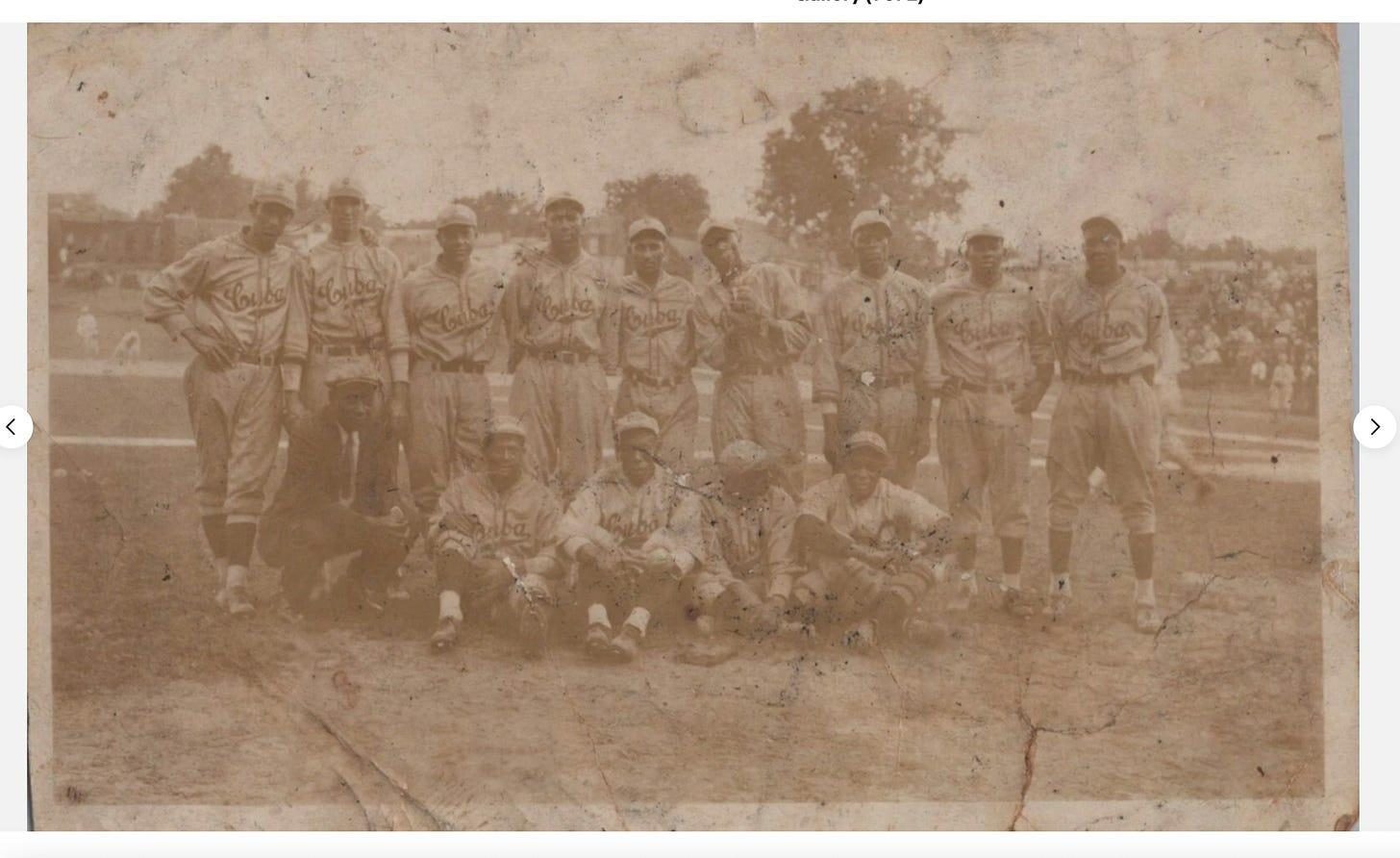
00:01
So the title for this one is called Identity and Loss. This is going to be a meditation specifically on Cuban historical photography and the profound gapes and abysses that emerge through historical engagement with Cuban baseball and Cuban history at large.
It's incredibly profound and it's something that I have so enjoyed going deeper into precisely because of the level of absence that's present in Cuban baseball history.
And the reason I use that syntax to describe this is it's the quality of the object. It is what is contained within the image. And then it is also a failure of provenance.
And so what I mean by a failure of provenance — a failure of provenance means a failure of documentation, a failure of organization — and thus an image object like this represents something unknown, utterly and deeply unknown. It's an attempt to uncover and discover the true nature of history.
So, for instance, let's take the player Alejandro Oms. He got tuberculosis, I believe, at the end of the 1910s into the 1920s. He died before the age of 50 — one of the best Cuban baseball players of all time. Known as the second greatest hitter in the Cuban leagues behind Cristobal Torriente. He was called the Cuban Ty Cobb.
This photo supposedly contains Alejandro Oms. He’s sitting second to the left here, I believe. The issue with actually determining provenance of that or the truth of that is multiple.
02:35
I was going to say manifold, but multiple. First, it's the quality of the image itself. It is incredibly difficult to discern with any clarity — to do any sort of facial recognition. Whether you were going to compare this photo — his image in this photo to another photo. That's stage one. Stage two is the uniforms that are being worn. If you can see here, there's a C on the baseball cap, along with a cursive script across the chest that says Cuba with a line that comes around from the A and underlines the word.
As far as I can tell, having peeled through for hours — hours and hours and hours of team uniform images and logos from the 1910s and 1920s and 30s — I cannot find this specific iteration of this uniform.
03:36
So there's questions. Is this a professional team? Is this an amateur team? What is the status of this organization? And furthermore, how can we tell if Oms was involved?
He played a fair bit with the Cuban Stars teams of the 1920s. And there is evidence in the 1920s of the Cuban Stars wearing a uniform that says Cuban Stars in script. I’ve been able to find one photo on a Cuban baseball historical site and archive. But the uniforms are usually, typically in block letters with a series of stars beneath the word Cuban.
04:12
Next — it's very difficult to determine the actual location of this photo. You can see there’s something resembling brick buildings in the background. It looks somewhat modern in construction. I don't know what necessarily I can make out entirely.
There's some players in the background on the right and on the left, brick buildings in the back, and then there's stands. It looks like an open area field, not necessarily a stadium — one with awnings and substantial architecture. Something perhaps more casual but populated with spectators nonetheless.
What exactly is going on here? And I'm not given any easy answers. So look at the back. The amount of scrapbook residue. And glue is obscuring the writing on the back of this. So to make this out becomes incredibly difficult. I can see a jumble of letters without necessary narrative coherence.
05:13
And so in piecing this together, you have to dig into the history and understand the trajectory of Oms' career. He plays for a team that is simply called Cuba in the 1926-27 season. It was a very short-lived team. There are two or three documents which actually confirm this online — with statistics and reference — which are archival databases, which are pulling this information and establishing it purely as data without much if any commentary or qualitative detail or color.
The supreme lack of documentation of one of the greatest Cuban baseball players of all time… it always begs the question, is there something here that I'm missing? Not only regarding him, but the entire Cuba team, season, and occurrence therein for the ‘26-’27 season — including images, logos, uniforms. All of it. The historical ground is so unsure in terms of the digitized documentation or information that exists… that you sort of make an appeal to history. What is going to answer but the silence of the image — or furthermore, in this circumstance, the silence of the lack of images?
06:12
I messaged a guy that I've been engaging with for the past couple of months named Cesar Lopez. He's based in Miami, Florida. He's regularly working with older Cuban historians. They engage and gather in groups. That in itself is a community of knowledge that isn't necessarily being digitized into an institutional archive.
He created a website called Cuban Ball, which has since been archived. It's been taken down from official operation on the internet; it was regularly called the best English language research website for Cuban baseball history while it is in operation. I have to contact him and say, what's going on here? Do you know, do you have information on these uniforms? I have to look at the... the stirrups, right, and try to find a match and understand — as well as the hat brims being a darker color and the C on the cap.
The possibility that always remains to understand something that has not yet been institutionalized or documented or digitized in a wide way. Or even remembered orally or ancestrally in Cuban historical circles. So this gets back to what I was talking about in terms of the open area of history — which is Cuban history and Cuban baseball history at large.
07:38
Cesar messages me a couple months ago and he says here — here's my best attempt at a timeline for Cuban baseball. And that for me in particular is so telling because he spends time hanging out with his his granddaughter. This is a man who is a little further along in in his lifespan in his years. What he's saying is insofar as I'm aware or I can assemble through the past decades of my research — decades and decades of research — here's a basic timeline.
So we're just at the point of establishing a basic timeline from the people who are the most involved in this process of archival retrieval and recovery and historical recovery in general. These are usually native Cubans who are very invested in baseball history and the history of their homeland; their home nation. We are working from and with the ground directly.
When I'm looking at this phenomenon of memory and identity and loss at large, there’s this understanding which to me is very profound — of the existing limitations of what is possible here and what is happening here. And what is actually being exhumed in real time. The depth of it and the full quantity and quality of it.
This photograph itself is from a man named Victor's archives. He is based in Florida as well. He's getting these photographs from people from Cuba. They're archives from Bohemia Magazine or they are things that have been found in scrapbooks that have come to the United States — whether that's through someone who immigrated here, their archives or their collections, what have you… their grandparents'
collections, as photographers or members of these early teams and organizations…
10:24
The ground there is as such that maybe you step in one direction or another and you're stepping on a fault line of hidden information where the bottom drops out and there's a new historical discovery about an aspect of Alejandro Oms' life — perhaps that he played for a team that previously we didn't know very much, if anything, about. That’s a discovery of an important branch of essential history therein, even just in terms of that primary contact. And perhaps, furthermore, there was a certain thing that happened while he was on that team or that team did a certain thing that redefines or shifts our aperture or lens into Cuban baseball history at large — as well as the personal and human histories that intertwine with that larger cultural narrative and construct.
So this is what's so profound but also so troublesome to me about Cuban baseball history — is the fragility of the existing narratives, because of how they've been established and how they've been maintained.
11:22
How the information has been passed down, whether that's through oral tradition or through the efforts of several individuals, groups, or organizations as historical forces and archival forces to sustain that history and document it. I know there are several different histories of Cuban baseball that have been written — one prominently by Raul Diaz Mauro — that are attempts, continued attempts… as well as Cesar's attempt of Cuban baseball history that he's digitized — to document, contain, and retell this story.
The issue here, though, is similar but different to the issue that's occurring in the United States — which is these are historical documentary efforts which, in turn, are attempts to narrativize history as a construct and history as a timeline.
12:18
I would argue here it's pretty clear, objectively speaking, that the United States has a much more robust institutional archive of historical documentation. Furthermore, the dialogue that is occurring in the United States — whether that's by nature of population expanse or the institution of baseball itself in terms of establishment and thus archival capacity and capability of cultural construct — is much wider.
The aperture is much wider. It's being covered from many more different angles.
And as such, the archives are more robust. So if I was to enter into dialogue with any given part of American baseball history (obviously the earlier on you go, the more difficult it is to understand or discern that information) — this is ground that has been well-tread and well-covered. Not only in terms of the timelines of the occurrences in American baseball as events, but the way in which those occurrences are being interpreted from various different perspectives.
So with Cuban baseball history, we don't even have that. We have a very limited understanding of what even happened. So when you get to a certain point — which is pre-1900 — even getting a basic depiction of one of the most important historical figures or events in baseball history becomes incredibly difficult.
13:39
This is the same as we discussed in the previous episode with Jose Mendez — or in the above dialogue with Alejandro Oms — even getting a basic picture of the personal life and personal history of these individuals is incredibly difficult and complex. These details — significant details like circumstances of death or early childhood and personal life — are in dispute amongst top event historians of the field and these individuals themselves. And thus you’re missing absolutely crucial details to even form a basic aperture on the surface of what's happening and what's going on — for the individuals and figures who define and sculpt the essence and foundation of Cuban baseball history; in that very historical unfoldment at a collective cultural level itself.
So when you get any deeper in terms of added layers of complexity… let's say — did the Cuban Stars team wear different uniforms when they went to barnstorm or play exhibitions or competitions in different locations? Furthermore, did Alejandro Oms play for an iteration of a Cuban barnstorming team that isn't already in the archive?
The question is so… it just resounds in an emptiness. It's an echo that can't necessarily be answered.
14:37
Peeling and peeling and peeling through these archives and these databases and photographs. There's already very little. Pre 1930 in terms of Cuban baseball history, there's already very, very, very little. You're already working with such a small digitized archival database of information that I'm circling through the same photos over and over again. And I'm thinking to myself, okay, where am I going to have the breakthrough? Right?
Where am I gonna get that information that's gonna springboard me into a real awareness of what's happening here? And the breakthrough just isn't happening.
Because there's so little information to access. The threshold for true ontological uncovery is limited to the barrier and border of what is known and what is unknown.
And so much is unknown that creating a linkage of context or text or a small detail of image into knowledge — especially with quality of documentation in question (preservation and destruction of time and environment) — becomes a rare chance… a small detail… a single rogue text or archival document or detail preserved by an elder on an old forum or artifact.
Even in terms of researching Alejandro Oms — the specific season, Cuba, the team — it's just the name Cuba. 1926 to 1927, the winter season. I can find online two documents that tell the league leaders for those seasons. It's from a Negro Leagues and Cuban Leagues historical database that has just created a PDF archive of simple word documents of this high level data, high level information. Names and statistics, like a ledger of facts. Which is — all things considered, it's a great level of information, but it shows just what we're working with here in terms of digitized database archival information that's readily and easily accessible to the average person. This is about retrieval and what it is to know and what it is possible to know therein within the bounds of collected, preserved material history. These rare databases themselves are a skeletal archival memory.
If you don't have access to this in-group of older Cuban historians that may gather — whether it's in Florida or in Cuba — to discuss this game, and the history of the game… let's say maybe you did… even in that case, right, there still may be this reply —we just don't know. Between us and our oral history and the transmission of the oral history, we just don't know. Even amongst family members, great grandchildren, and so forth — between our ancestral transmission of family information and scrapbooks, we just don’t know.
Even this is a very, very limited group of people. Information and memory and history can live and die in those silos uncommunicated. This is the progressive silence of history and memory. Where is it preserved? Through whom? And Cesar himself only gained access to this party of insiders by coincidence by meeting a shop owner who showed him an archive of old baseball cards and photos he had hidden away — and the mutual interest was established. And then he ended up meeting this in-group of Cuban baseball historians through the shopkeeper.
17:00
Even with that oral, ancestral insider information, you're still left with the very, very high possibility that people just do not know. The basics are essentially established.
There's the three major teams early on that expand and contract slightly. There’s financial difficulties that shift this organizational landscape. You have the integration in 1900 and you have details and events and occurrences therein. The intersection of the political and economic Cuban history with the early documents and images and stories told and recorded in these archival books and put to documentary film.
You have to always wonder in a situation like this, and this is what's so fascinating about examining the Cuban baseball history. This is a phenomenon deeply, deeply present in early American baseball history at large and furthermore through Negro Leagues history — but in the Cuban context the contrast is just so incredibly extreme. I'm always just wondering to myself — is there something here that I'm missing, or is there something here that's not already documented in the historical agreed upon consensus timeline of how this history unfolds, even at a surface level?
Because if I don't have that, my vantage is compromised. I’m seeing something I don’t and can’t understand — that I personally don’t have context for, and maybe no one else even does, with what is left; what remains.
17:54
I'm working off of information which is speculative, just the same as I'm speculating on this photo and trying to discern. Is that even Alejandro Oms? And if so, what's missing in the historical record? Is this a team that he played for that hasn't necessarily been documented yet? Maybe it was a briefly assembled barnstorming team or briefly assembled competition team in the 1920s.
Let's say for instance, these are alternate jerseys that the Cuban Stars or the Cuba from ‘26 and ‘27 used for a competition. When I look up these jerseys, every once in a while, I'll see one thing. One small detail. One small instance. It's the Cuban Stars logo slightly altered in this kind of script — the script that matches the image of the photo. And I'm like, okay, that that's a clue.
But then there's also the Cuba team itself and I have maybe two pictures of the Cuba team’s jerseys from that specific year — and they don't look like this. And then I'm wondering, is this just another iteration of the Cuba team’s jerseys? It would make sense in terms of a literalization of their name. So I have to do some sort of combination of facial recognition, uniform identification; try to discern where exactly this photograph is located based on limited information and there's zero provenance on the back of the photo itself.
And this to me is so representative of the condition of Cuban baseball history at large. Because let's say for your average person, if you aren't already in that in-group of native Cuban historians, or maybe even if you are, right, who's to say here… the way that you're approaching Cuban baseball history is almost like feeling your way around in the dark, so to speak. Because the records that have been kept and the records that are accessible in terms of how documentary they are, even beyond statistics and rosters — the player biographies and the richness of what's going on behind the scenes — is something that is still very much difficult to discern unless you were to, let's say, interview one of the ancestral members of Alejandro Oms’
family or Jose Mendez's family. And even then, who is to say that that kind of personal, human, historical information has been preserved?
20:30
That's what I'm talking about here. It's just very interesting to look at this information and these artifacts and try to cultivate a level of understanding, especially when there is no explicit knowledge layer to hang onto. Let's say I could immediately identify these uniforms, or identify several of the players in dispute because the quality of the photo was very high. I could do a basic facial recognition match and say, hey, I know exactly who that is. I could run that person's name through what teams they played for in their team history and do the uniform match and understand — okay, this was the team that they played for and these were the years they played… and then try to identify one more player and complete that roster and say, okay, these two players played together. Here’s a deeper field match. And then maybe find one more player for an added level or layers of confirmation.
Something like that — to try to narrow down the results and create at least a foundational understanding of who this is, who this group of people is. When and where and why. And so when you don't have that knowledge and you're in that level of unknown, it's fascinating. It’s also quite disturbing. Because this goes back again to the title of this essay here, Identity and Loss — because the the unmoored aspect of this history is that a lot of the time you're dealing with something that you're trying to access or trying to know, but again, there's just this opacity. The history won’t allow you to gain entry. There is no entryway or foothold. And the opacity is there's no archival or digitized information, no compilation of footage or photos that's going to allow you to create a relational capacity — to create context.
Context as a bridge or relational space as the relative space between two phenomena or two objects or two images or two people. When you don't have that and you're kind of floating in space at this level of… I don't know what team this is, I can't confirm any one of these players' identities because the image quality of the photo is difficult to read and truly do a one-to-one — or I don't have the ability to use provenance on the back of the photo, whether that's just a couple letters that have been scribbled down to give some level of context or placement, or a pasted press release or press text…
23:12
That lack of ability to create context leaves you floating in this void of possibilities.
So I'm currently just trying to discern this, right And reaching out to different people I have contacts with to say, do you understand this? Do you know what team this is?
Is this an alternate uniform, like a variation of a uniform? Can you confirm that that's Alejandro Oms?
Do you know exactly when this was? Do you know what it was for? It’s like a battlefield of history. And you’re recovering the histories of the remembered. Doing the work of remembering. Preserving, restoring. There's all of these questions that emerge from a historical document like this, and it's so intriguing and tantalizing because of this unknown factor. There's not even a single element of this I've been able to identify with any level of certainty. So it leaves this space of possibilities. I'm gonna do a little more work in terms of the attempt to identify certain figures in the image itself.
But without that ability to identify, you really are working with a limitation, a pretty significant limitation. And I think that's describes to a degree the powerful and difficult experience of Cuban baseball history, in my experience of it, from the outside looking in. You can see how this relates to identity. National identity, ethnic identity, personal and collective, even familial identity. Cuban and human identity and constructs of self.
Let's say there was someone who was in Alejandro Oms' family who was attempting to recover the narrative past of Alejandro Oms. This could very well be something that reveals another aspect of his history which cannot be found in the most sophisticated documentation of his life, whether that's a player biography, whether that's personal information that's been passed down through the family.
25:15
That level of historical recovery is so present with Cuban baseball history. When I'm working with American baseball history or when I'm working with something that's more modern or has been more institutionalized, the historical ground is already laid so extrapolation is much more possible. We’re already working with iterative, interpretive perspectives around well founded and understood trees and branches and complexes of events and unfoldings and progressions of time and space through actions and reactions. Forces in movement which form entire epochs and constructs within the larger house of American baseball proper, as a whole. Forming a relational context is much more possible.
Working with different eras and epochs of history and doing a comparative analysis is much more possible in a strictly American context. Here, in the Cuban sense, we are still in the place of this could be something that does not even yet exist in the common or even the esoteric understanding of Cuban baseball history. And thus, really, in and at the foundation of modern American baseball history in that Cuban baseball is the real ground of integration and world baseball modernity.
And so something that was recovered in the attic of a family of a photojournalist that survives Cuban revolution and uprising and revolt in the mid-century, or even over the period of revolt prior at the cusp of the 20th century as well — without context, and it just wasn't communicated what this was or what any of these artifacts were...
something like that could actually be a breakthrough understanding in the larger collective conceptualization of Cuban baseball history itself. And accordingly, in Cuban history and American history and baseball history itself — hemispheric and world history human at large.
26:41
That itself could be a fundamental or foundational discovery. And that's not something that's incredibly common. And it has a lot to do with the current state of the historical narrative as it has been nailed down or made clear. Memory and forgetting in revolutionary terms is utterly present in a forgotten or remembered Cuban photograph or document or relic. Something utterly disjected into an attic space or a basement or a small shop in Cuba or Florida, passed down through ancestral lines. And this, again, has a lot to do with how Cuban baseball history has been marginalized, how it has been left to Cuban baseball historians, unsupported and unexplored globally; how it has been misunderstood or just totally not understood internationally in terms of its real importance in the grand scheme of baseball history.
It is, again, right, it is this recovery project of history to one — establish just how important Cuban baseball history is to global baseball history at large as the foundations of moderniy, and then two — to make sure that those stones are laid as a collective effort or endeavor to preserve that history as best as possible.
Because that's what allows for people to enter into the room of history that is Cuban baseball and to commune with it and listen to it and attempt to understand it… and relate it to the entire greater multicultural movement of baseball at large. That kind of understanding reverberates through the nation of Cuba. It reverberates internationally — but it also comes down the chain into specific cultural movements within Cuban baseball history and Cuban national history. And then, furthermore, the human, personal, ancestral movements that occur within Cuban baseball history;
within team contexts. It's a sort of nesting doll effect of history from the personal to the universal that you're turning the locks to in a way that you're searching through the dark to uncover and illuminate as best as possible… in order to create that fertile ground of culture that is preservation — that is the respect and the act of preservation. The dignity of history as a remembrance that is preserved.
So there it is. Good to talk to y'all. I will catch you on the next one.
23. Alejandro Oms: Digital Archaeology and the Corrosion of Light
Jul 19, 2025 · pp. 352–373
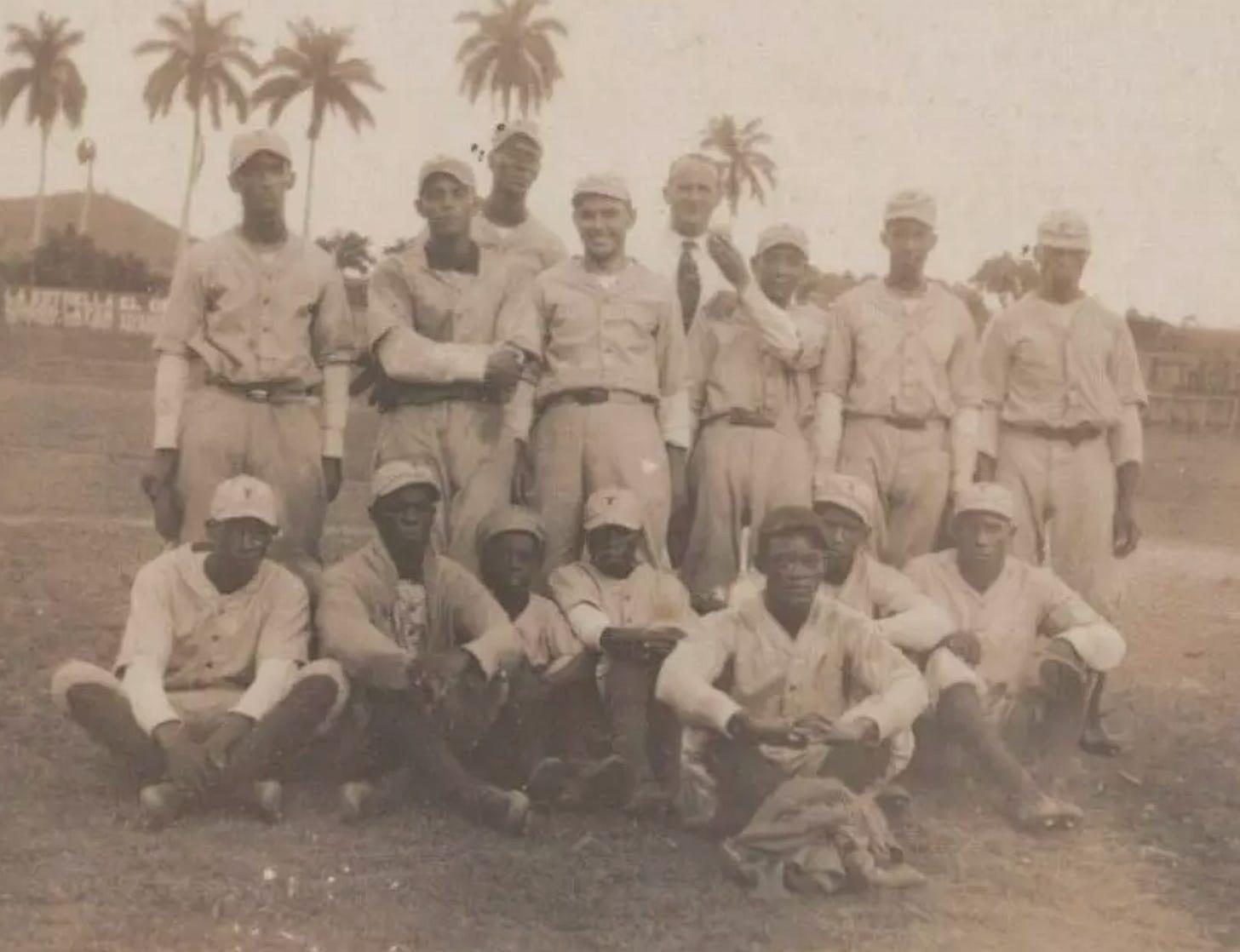
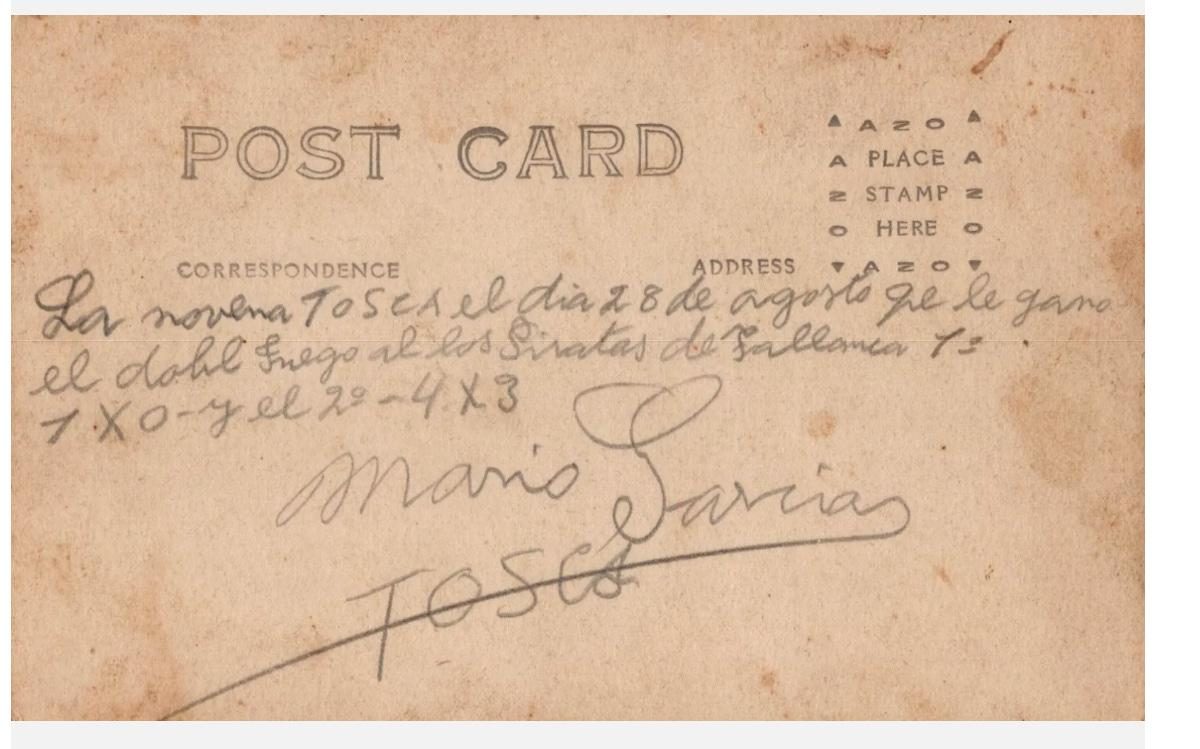
00:00
So I want to talk to you all a little bit about a concept called digital archaeology, specifically as it pertains to Alejandro Oms. This theme or this thread that's been emerging through all of these dialogues. My history is working with artifacts.
Starting when I was in my mid to late teens, with the Smithsonian American History Museum.
This was my first real, deep holistic exposure to the importance or the primacy of the artifact in relation to baseball history and history in general in terms of an active uncovering of the hidden ontology or the source or the nature of history.
My task there was primarily identifying baseballs. I would look at these old baseballs with different signatures on them, some of them very faded, some of them very, very, very old. And going through this process of identification, trying to understand, all right, let's piece together. Okay, maybe I can identify a couple of the signatures. Let's piece them together and see exactly when they were clustered in this specific group at this specific time on this specific team. That was my primary thing. They just had archives and archives and archives of baseballs. So I would be there and I would be analyzing these pieces of history, right? Trying to piece them together, in order to say this is a relic from here, and so forth.
01:38
We're referring to digital archeology, which is an archive or listings of old baseball artifacts. We're using the artifact as a way to uncover and retrieve the material soul of baseball history and actually reveal essential parts of it to us that previously we didn't know about. An artifact or a relic can actually reveal a missing note of history through the nature of its preservation and of its existence.
I think this is a really incredibly profound idea and topic. Because what this means in terms of the artifact and in terms of material history is that it actually avails us of the possibility of recovery. Where it previously was buried, unseen, unrecognized, unheard in its tune or its song. It just takes the right eyes and mind, the right historian or historiographer and historiographical synthesis to piece together its true totality, depth, and meaning.
We went into these concepts of history as a void, abyss, an emptiness which is the void of memory, the un-covery of forgetting. And then the responsibility of the historian or the archivist or the uncoverer, the archaeologist... so to speak — I think archaeology is really the best way to put it because it's digging into the earth. And what that means is a materialism beneath it. That material is the artifact, right?
Whether that's an ancient vase or a piece of ostraca from Egypt, or whether that's a statue from Greece that's unearthed from the basin of a certain body of water…
What we're talking about here is there is an oblivion before the artifact and the artifact itself as it’s uncovered and revealed through the very intensive process of historical restoration, it recovers a piece of history that previously we did not fully understand. So, the image above, this is a postcard that was recovered.
03:54
It was sold by an older Cuban gentleman, a collector of Cuban baseball artifacts to a man named Victor who sells photography in Miami, Florida. He sells old photographs and old pieces of Cuban history in general; Cuban history in the widest sense as a national process. Revolutionary documents, posters, art, you name it.
So there... in that nature, there's a peeling through the archives of his documents and a limited question and answer that comes with that — what do you or your memories of the collector know, or what can you reveal about this or that document as its holder, and so forth — as well as this necessity of a historical reference, where I have to go through all of the catalog of my baseball knowledge in coalition with old documentary histories, whether it's from newspapers or magazines or tributes.
This is a way of remembering Alejandro Oms from the place of historical ontological dissolution and restoring undocumented history and the unarchived to something resembling an institutional archive — which is digital archivism, which is the creation of books, et cetera. The creation of documents which recover, restore, and present these images and these pieces of history so that we can understand. That not only illuminate these documents in terms of presenting them digitally and globally, but presenting them in terms of illuminating their as-total-as-possible context and importance historically and genealogically.
06:05
So this image here is a postcard from 1918 to 1919 documenting the Tosca team.
Tosca was a semi-pro team in Cuba from the sugar mills. And this was a hometown team, along with Santa Clara, which was also a semi-pro team at the time — that Alejandro Ohms played for during the span of 1915-1920. So I have this broader knowledge — and this is available by way of SABR, by way of different Negro leagues and Cuban league historians; by different biographical tributes. Even documents like the tribute that was created for the memorial plaque of Alejandro Ohms on the 130th anniversary of his birth in Cuba.
So there's a variety of different documents that you're sifting through. You're trying to identify, okay, Alejandro Oms did play consistently for Tosca from 1915 to 1920, but furthermore, how can we confirm that he is precisely documented in this image?
So you're doing a process… of, it's almost like facial recognition. Where you're trying to identify essential attributes of the face in these photographs. So I have this image here.
It's just crazy to do this kind of work, especially all over screens and all over digital devices, because you're looking at images with different statuses and standards of quality, then furthermore, the artifacts themselves can be highly corrupted.
07:30
And what I mean by corrupted is corroded by light and corroded by time, but particularly by light. So I'm going to show you another image here.
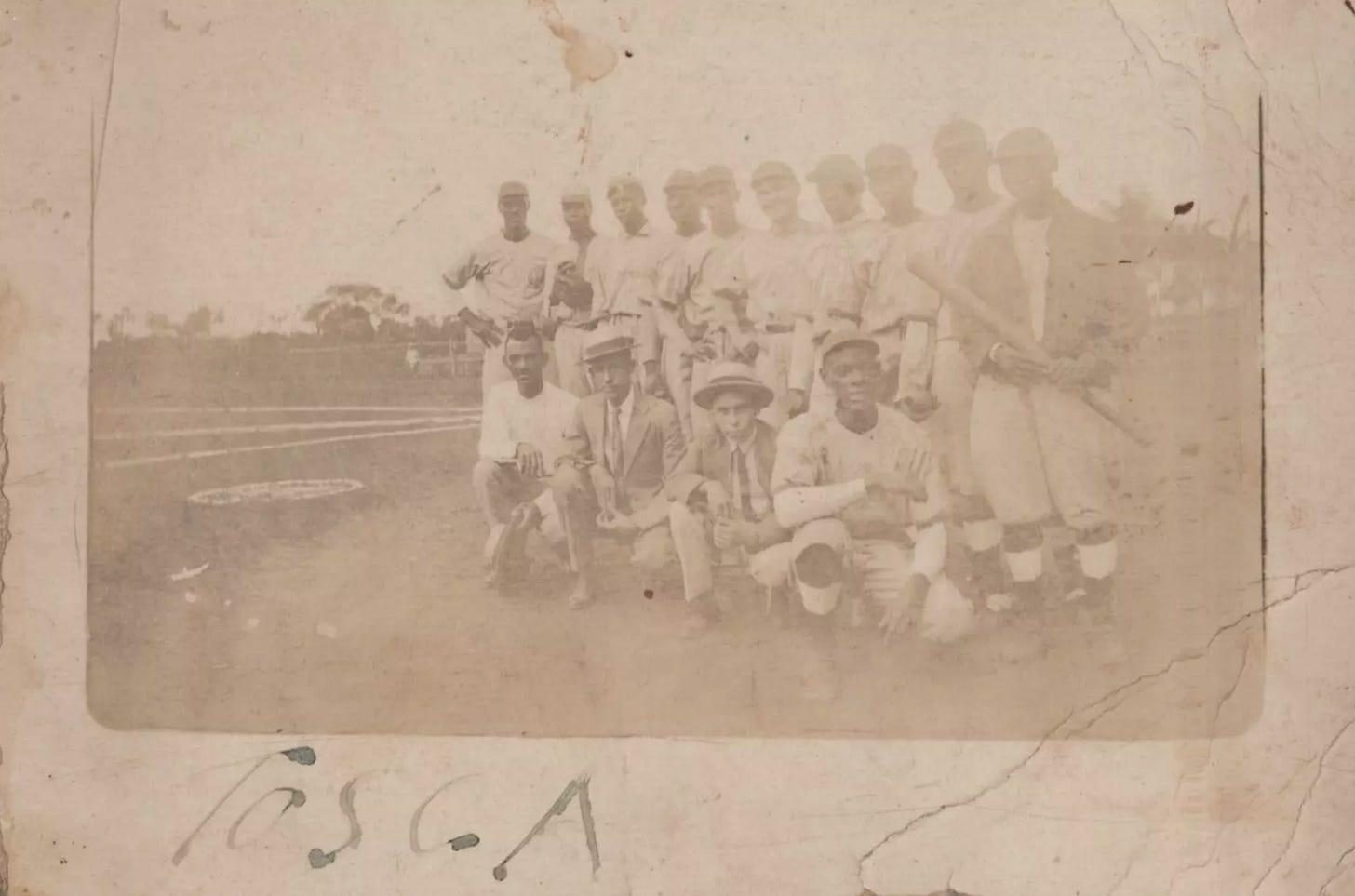
This is a really powerful one, really powerful. This is from the same collector, from the same time period. And you can see the corrosion of the image, which actually makes facial identification near impossible for the first maybe four, five, six, even seven figures in this image.
So half of the document itself creates this problem of identification, this problem of knowledge. And this to me is actually incredibly profound because this again speaks to history, right? The ontological dissolution of time, which creates an impossibility of knowing and understanding. And what we're doing when we're moving through these archives is attempting to understand and attempting to know these essential details.
08:28
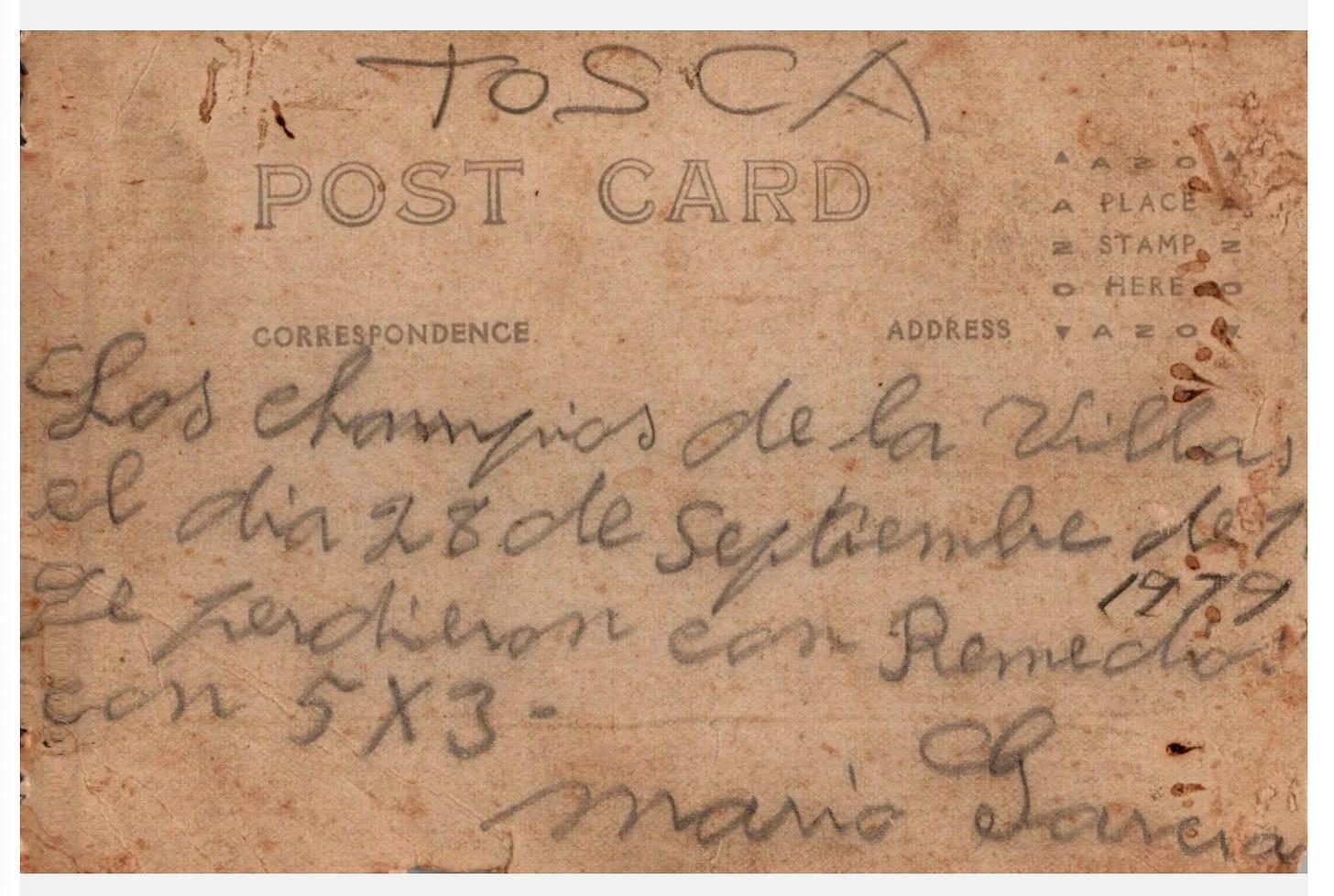
So I have here the back of that postcard that I just showed you. This documents the 1919 Championship of the Villas on the 28th of September against Remedios, where Tosca actually won. And Remedios was actually a pretty well-renowned semi-pro team from this era. In 1915, they played the American Federal League team, the St.
Louis Terriers, in Cuba. Remedios at that time was part of a Cuban Federal League, which was named after the American Federal League.
So you have this time period of Tosca represented in these two photographic postcards. And the way that this interrelationship or relativity helped me turn the lock here between these two images was the presence of the — if you can see third from the left in the first postcard [pictured directly above] — the young child that's there sitting next to who I very much so believe to be a young Alejandro Oms, just to the right of him. And then to the left of the young child, the two brothers that Oms played with on this Tosca team according to biological and historical record. His little brother was named Pedro and then his brothers Tito and Eleuterio were on the team with him.
And so you can see how they are seated. It's a huge key to me. They're seated very close together, very physically close together — even almost separated from the rest of the group. And so when I go through the backlogs of existing archived, at least digitally archived — images of Alejandro Oms, you really have nothing before 1922-1923, when he really started to rise in the Cuban professional ranks… most notably with the Santa Clara Leopardos, one of the most famous Cuban baseball teams of all time.
So you're already dealing with a time delineated difference, just in terms of the facial features and recognition of Alejandro Oms, because these pictures that are on record are of him as a much older and mature person. Furthermore, he got tuberculosis between the period of his known photographic images and the earlier, semi-professional and local days of his youth. So you're dealing with an added layer of life that significantly changed the physical status of his body, the way that he looked, his posture, everything. It's a significant illness to contract. You're already dealing with that.
Layer number two is the corrosion of the archival document. And the difficulty, in terms of the clarity of the physical print object — referring to both of these postcards, right? But particularly the one with the corrosion of light; the extreme difficulty, really, of the high definition, high quality image rendering that's possible here. It's an image that's being conveyed digitally by the owner of a photography shop in Miami who purchased this from an older Cuban gentleman. It’s a rough photograph of a historical, extremely old photographic postcard image.
And then additionally, there is the layer of the family history of Alejandro Oms, which I think is profoundly interesting. To me, that layer was the key that finally and definitively turned this lock. Because I can do facial recognition. I can go through back, I can go back through these historical documents. I can confer with Cuban baseball historians. I can do a number of different things to create this process of verification, of retroactively applying existing knowledge and databases of knowledge to understand and contextualize the unknown, or a deeper well of history.
12:22
But you're ultimately dealing with this fundamental level of the fact that the semi-pro sugar mill team leagues in Cuba pre-1920 are barely documented, if at all.
There is one key historical note here that did significantly help me.
‘Alejandro “El Caballero” Oms, before beginning his career in professional Cuban baseball, played for various local teams in Santa Clara, such as Pastora and Dubarganes, before eventually joining Tosca.
Precisely, it was with that team that Tosca, a name taken from the famous Puccini work, made its first foray into the province of Matanzas on January 22, 1920. The presentation of the famous amateur team took place in Calimete, on the field located at the corner of Castañeda Street, on the San Pablo farm, near the local cemetery, according to historian Jesús M. Fernández González.
Along with El Caballero Oms—so called for his exemplary conduct—the team included his brothers Pablo and Eleuterio, as well as a phenomenal pitcher named Armando López, who blanked the Calimete boys 6-0. At bat, Alejandro was sensational, going 4-for-4 with two doubles and a home run.’ — ‘Traces of the “Oms Knight” in Matanzas’, Francisco Pancho Soriano Bermúdez for Radio 26 Matanzas:
“La radio de tu corazón” (April 5, 2025).
13:54
It is quite profound that this article was published just two months before this exegesis began. So one of the big clues there, is it verifies that he was active all the way up into 1920, which then would include this period of time… 1918 to 1919, of which the backs of these postcards document. It verifies not just by hearsay, but by real historical game record that mentions his name by way of Fernández González.
This is in direct relation to the backs of these postcards in terms of physical fact and historical game documentation.
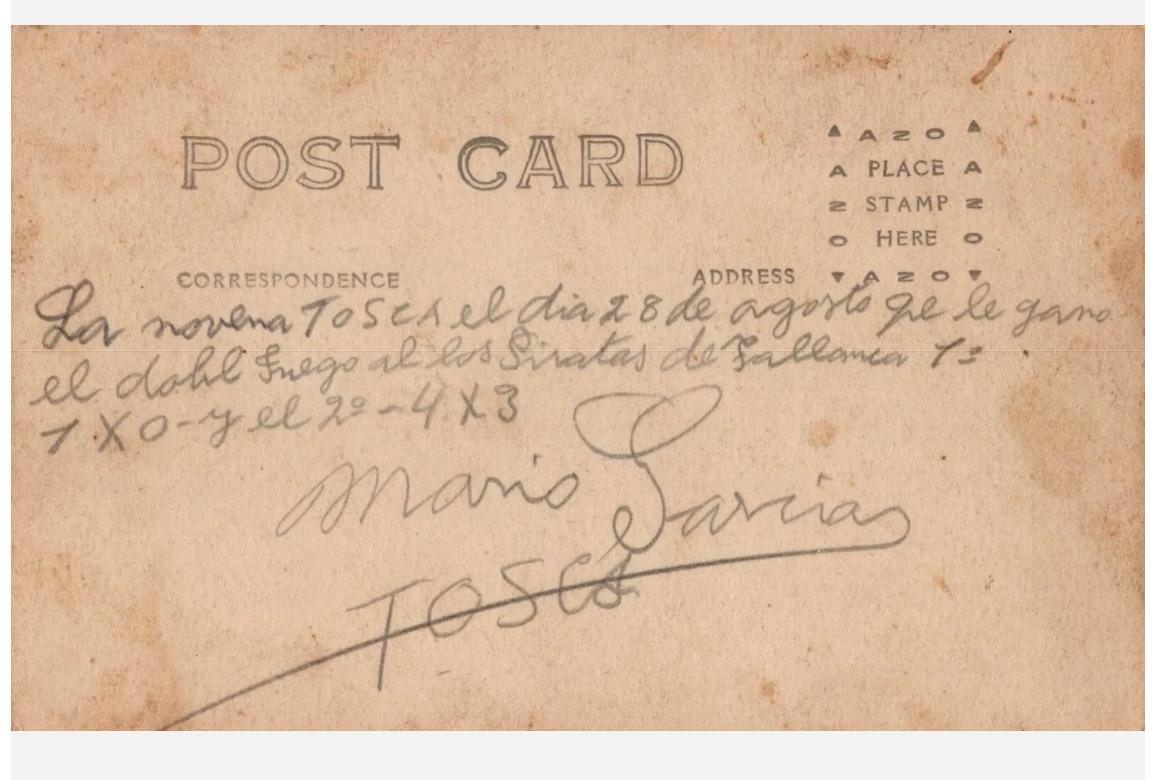
Thanks to the… who I can only assume was the team historiographer — looks like the name reads Mario Garcia. So he's documenting these events. And this here is the back of the postcard with the image clarity that I showed you, which includes Alejandro and his three brothers. It documents two games against another local team that occurred during this same time period. So that was one big thing. The cross referencing of this historical real time data of specific events and mention therein.
14:50
The second is — it's that Alejandro’s younger brother Pedro was identified as the team mascot of the winter team in Santa Clara in 1921:
‘Santa Clara 1921 with the four Ohms brothers: Alejandro right field, Tito first base, Eleuterio pitcher — and Pedro, the team mascot.’ (SABR, Oms bio, indirect quote).
The siblings, the Oms siblings, that are all participating in this act and event of baseball together.
15:51
So what we're looking at here is — as far as I'm aware, right, in the digital archive world… potentially, I mean, there's a physical copy that might be entirely undocumented digitally. There might be someone in terms of, let’s say, a Cuban baseball historian that's aware of this information that has not published it — at least not digitally. But the four Oms brothers together, documented visually, seen, heard, present on the Tosca team for the historical record, visualized.
We know that Eleuterio, Tito, and Alejandro all played together on Tosca from 1915-1920, as well as Santa Clara in that winter of 1921. We know that his little brother Pedro — critically — was the mascot of that Santa Clara team. But what we're looking at in whole is Pedro also sitting in that mascot role, at least in this image, for the 1918-1919 Tosca team.
16:57
As far as I'm aware, none of these images even exist. I mean, Santa Clara, Tosca, any of them — any image which actually documents these four brothers sitting together in a group photo in that semi-pro environment. And this would also be and is the youngest image of Alejandro Oms that exists on record, at least digitally preserved;
that has been digitally archived.
And that was one of the keys for me because I was going back and forth between these two postcards.
You can see here that you have a different young mascot figure who is sitting in on this photograph. This one for me was much more difficult because you're looking at, how do I identify Oms or this narrative thread of history in this image with the amount of artifact corrosion? And this is exactly what I mean by historical restoration. The process of restoring history. Because what that really means is it's a race against time.
An image like this or an artifact like this… you could speculatively say this is an image document of Alejandro Oms at this critical formative part of his career playing semi-professional baseball with his brothers on Tosca between 1915 to 1920 and playing on the 1919 championship team, which is documented here — against Remedios.
But what time has done and the corrosion of light has done is we've lost the ability to preserve that or restore that definitively. There could be object or artifact restoration done here by professional curators, but I'm not sure how much that would do to actually restore the image quality where the light has corroded it.
So then you return to this one, and again, this is just the strangeness and power of history — in that this artifact may be the only artifact that remains. This may be the only way to actually recover this essential part of history in terms of visual documentation.
The most sophisticated knowledge that's available, whether that's SABR, whether that's Negro Leagues restoration projects, whether that's Cuban Leagues restoration projects — the only real information that's available other than that one game that I elucidated to you — that documented the play of Oms on Tosca with his brothers, a real game historiography by the Cuban historian whose name was Jesus M.
Fernandez Gonzalez… the January 22nd, 1920 game where Tosca was presented in Matanzas against the Calimete local team.
This historical documentation critically including Armando Lopez — who actually does have just a couple of pictures — one to two to three pictures that digitally, archivally document Lopez. And I believe he's standing right behind Oms in this postcard above, the clarified image without dissolution — smiling there.
And that was another facial recognition project that I had to run. I had to just try to identify through facial structure and recognizable attributes. Face, nose, lips, eyes, distance of eyes, ears, posture, body type, the whole thing. The same principle applies for Lopez. The existent, digitally documented and archival images of him are all when he is much older, from the later, professional stage of his career.
20:19
So other than that one game, all you have and all you know is that from 1915 to 1920, Ohms played the majority of his time on this Tosca team — and he played with his two brothers, therein. And that's not even fully documented everywhere.
That Oms played on Tosca with his brothers is only documented on a couple of different archival sources. Even fewer than the few who document and explicitly mention, however briefly, his time in semipro ball with the Tosca team itself.
The key is this local familial relationship that's here, with his two brothers that played on the team with him — was well as with Pedro, the younger brother who functioned as a team mascot. That added layer and added level of understanding that in the winter of 1921, Pedro was the team mascot for the Santa Clara team — the younger brother who was far too young to play.
So you can see what I'm doing here, right? And what is really required. What's required is a really extensive, really extensive process — of digging deeply into this archaeology, which represents at its deepest level… the semi-pro sugar mill teams, the local teams in Cuba, through which many of the greatest players, the great players in the Cuban leagues rose. This is something that's very, very, very undocumented and unarchived and unrestored. There is work that has been and is being done on this topic — but to understand — this is the real archaeological context of Alejandro Oms' professional life.
This is his youth and his time playing with his brothers on this local semi-pro team.
22:01
To understand and to know that these artifacts still exist at any level and in any quality is itself the capacity to restore that missing note of history and reveal a deeper layer than we ever knew or understood before. And so in this way, right, I talked about going into the ground or going into the earth. This again aligns with the concept or idea of the underworld of history and the Orphic underground that I discussed in earlier documents — which is going into the earth; retrieving the material soul in the soil of the earth through this artifact, which was believed to be dead or believed to be missing or gone.
In that restoration project is bringing that object or artifact or relic up into the light and saying, hey, here it is. Here's a piece to this puzzle. Here's a way that we can see, know, and understand and get closer and get deeper into real relationship with history and the humanity of history and the history of humanity.
22:59
And this is just incredibly powerful when it comes to Alejandro Oms — because he is already someone who is so under recognized and under presented in the archive itself… of history, of humanity, of baseball. Again, going back to the concept of undocumented history and the unarchived. Oms being a black Cuban man born just at the cusp of Cuba's national liberation and just after the abolition of slavery in Cuba.
There's such a profound foothold there in history — even in terms of Cuban baseball itself, which is just not being acknowledged at the level it needs to. And then Alejandro Oms being this black Cuban man in Cuban professional baseball, who is one of the greatest global players of all time, of any era. There's just so much there; at such rich space.
And to see and feel his humanity here — I mean, looking at the photo itself and the way he's positioned…
23:55
If you look at a lot of the photos of Alejandro Oms, you can really get the sense from his presence, from his stature, from his facial expression. He has such a form to him and way of carrying himself. When you look at those images of Oms, especially the ones that are already documented, you get the sense of a man who is incredibly intelligent and sensitive and present. And the stories and commemorations that are written about him reflect this.
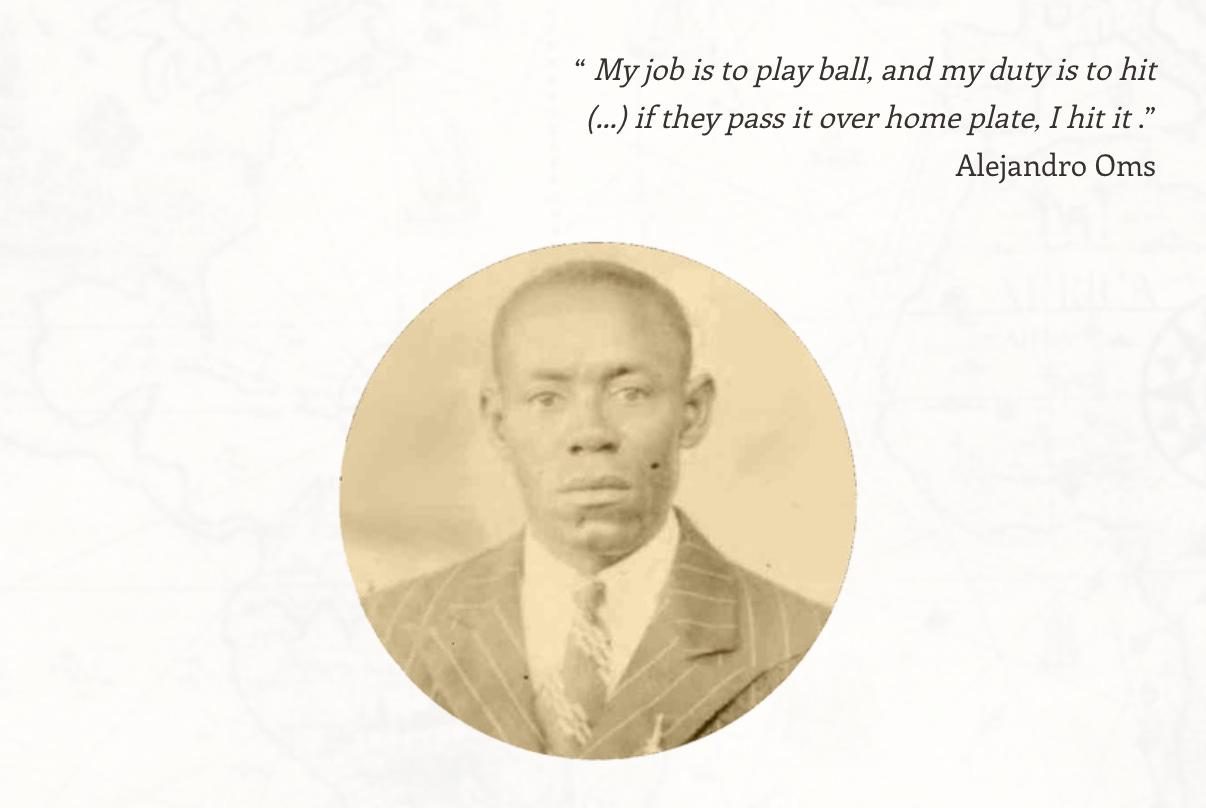
You have a Cuban historian who wrote about him at the time of his death. A sports journalist, Eladio Secades, signed a moving tribute — a portion of which was placed on the marble monument at the 130th anniversary of his life that commemorates him in Cuba.
Let me read it here.
25:15
‘Alejandro Oms wasn't simply a baseball player. He was a master by vocation, because skill came from his soul. When a sport is practiced like this, as Kid Chocolate practiced boxing, it fully enters the category of art. Alejandro Oms's naturalness was clear, precise, and well-honed. He achieved feats effortlessly. To look like a great baseball player, he only had to put on the uniform. His feet were firm, his chest held high, his pupils alert, his divine stakes ready. The pitchers of his era both respected and feared him. Over the years, they hadn't been able to find his weak spot.
Greatness in almost all sports is a matter of harmony. Stardom rarely emerges when there isn't a balanced rhythm between skill and strength. The player who hits a lot and fields little, and the one who is eminent on defense and weak on offense, may advance greatly but never reach the threshold of posterity. Alejandro Oms is equally unforgettable in both sports. Combined, both factors create the combined work of one of the most complete Cuban outfielders of all time. Perhaps the best.
The most compelling aspect of Alejandro Oms was his sobriety. He gave the impression that his brilliance and efficiency were mechanical, within the reach of any artistic talent. He would step into the field at the crack of the hit. That second gained by the privileged is the time lost by baseball 's journeymen , who then have to make up for the delay with titanic stretches and circus-like somersaults.
Alejandro Oms was an outfielder without fanfare or trapeze. He had the stage poise and natural ease of Joe DiMaggio, capable of conveying to anyone new to a baseball challenge the unreal idea that anyone can put on baggy pants, pull on a cap, grab a glove, and go out and play center field.’ — Secades
27:12
A powerful, profound and moving tribute. And this is the real idea here. It just circles back to really everything we've been talking about, which is the recovery of the humanity. The humanity and the soul and the spirit beneath history. And one of the most powerful ways to do that is through the artifact, through the relic.
Especially in the cases where, as we've been discussing with this postcard here — history is restored in a way that there is no memory that's been documented, at least in a digital context. We don't know if this has been documented on a piece of paper or even a booklet that's been created by a Cuban historian anytime between now and then.
What an artifact like this postcard reveals — is a hitherto unspoken and unremembered and uncontextualized moment in Oms’ history which is deepened by the presence and the survival of the relic. And so then there's this responsibility in a historical curatorial sense to restore this archive or this archival information to the light of day; to restore it in a broad sense digitally so it can be remembered and preserved, as well as through books; as well as through documents. Making sure all of those forms and functions are then archived properly for the next generation or wave of people who then become historians of this increasingly broader gulf of history and of time. It expands and deepens as it passes.
28:42
The presence of an artifact like this is probably the most profound statement that history can give, which is to say, something remains and here is what remains. And this artifact then can give us contact and context, and return us to — where is the history and where is the image; provide us light where there otherwise was darkness and oblivion.
And in this way, we can do this act of historical recovery through a group or communal effort.
All of the documents and all of the photographs that I referenced, whether those were by Cuban baseball historians, sports journalists, Cuban national historians and writers, documentarians of the Negro Leagues or the Cuban Leagues, as well as the SABR Biography Project — all of these are different communal, community ways of preserving this history and deepening it. An artifact like this adds to that equation. It deepens it in a critical way because it takes us further into time.
It takes us deeper into the origins of Alejandro Oms and it shows us the way that his relationships with his brothers and his burgeoning personal and psychological development and self formation really formed this critical moment just before his transformation into the Cuban professional baseball star that he became.
30:06
This semi-pro moment, this local sugar mill team moment with Tosca. For those five years, 1915 to 1920, before he took that step into the Cuban professional leagues and became one of the greatest baseball players of all time. And you can see this, right?
You can see the formation of himself as an individual in terms of how he's sitting here. He's sitting very internally withdrawn, even as he's the center of the photo, which was typical. You have the best players seated in towards the center, or you have them standing in the center. He's centralized in the image along with Armando Lopez.
They're two great players; Armando Lopez achieves a level of renown in the Negro leagues and Cuban leagues as well.
30:54
And I think with the term digital archaeology, it's the most powerful thing to me, or just archaeology itself in a historical context — because it is very much so digging into the earth and recovering the artifact. And this is possible digitally. It's a lot of what I've done and what my work has been, whether that's through international bookstores or photography stores or what have you. You name it.
The idea there is sifting through history and having the eye, having the ear — which is the education of baseball history and of global history to understand, all right, this is a specific moment or an important crux. And then going through that process of identification, which is the facial recognition, which is the posture, the tone of the individual present; the other individuals present, the provenances and contexts of the artifact at hand as a device, as an object, as a way back into the sacral, hidden, dark caverns and truths of history and time and identity formation in humanity.
Alejandro Oms is almost very obvious to me in this picture just because of the way that he's seated.
31:55
Very withdrawn, the sensitivity is present — as well as the facial structure, which I showed you in that previous photo here. It's a very sensitive thing to do, this image retrieval and notification, especially when there's obscuration — whether by clarity of photo or image, or by withdrawn presence or partial notice of the figure at hand.
His hat brim is pulled down low. He's not trying to make himself seen or known, particularly in this photo. The photograph of the photo itself sent by the Cuban history and photography store in Florida itself is not particularly great either.
So we're looking at these levels of quality of the artifact and the digital image of the artifact; again alluding to that second photographic postcard with the corroded light that obscures the facial features — these levels of quality and presence that make this difficult. It's difficult to understand and difficult to see. So there's those levels of presence and sifting and contextualizing based on best available information and material that's so integral to digital archaeology. Particularly digital archaeology into highly undocumented zones of information, history, space, and time.
And then again, just the utter importance of this project — which is to add layers and deepen, deepen knowledge and awareness and understanding of Alejandro Oms'
life, especially in a critical moment like this. Where he is still local, he's still at home with his brothers and he's taking those steps into immortal eternal baseball history with the greatness that he achieved.
33:20
I just think this is a great image to show that relationship and that bond, especially as a very young person. He's just barely 20 years old in this photo. So I appreciate your time here. I think this is really important stuff. And I will catch you on the next one.
24. Lost Subjectivities: A Global Working Class History of Baseball
Jul 21, 2025 · pp. 374–390
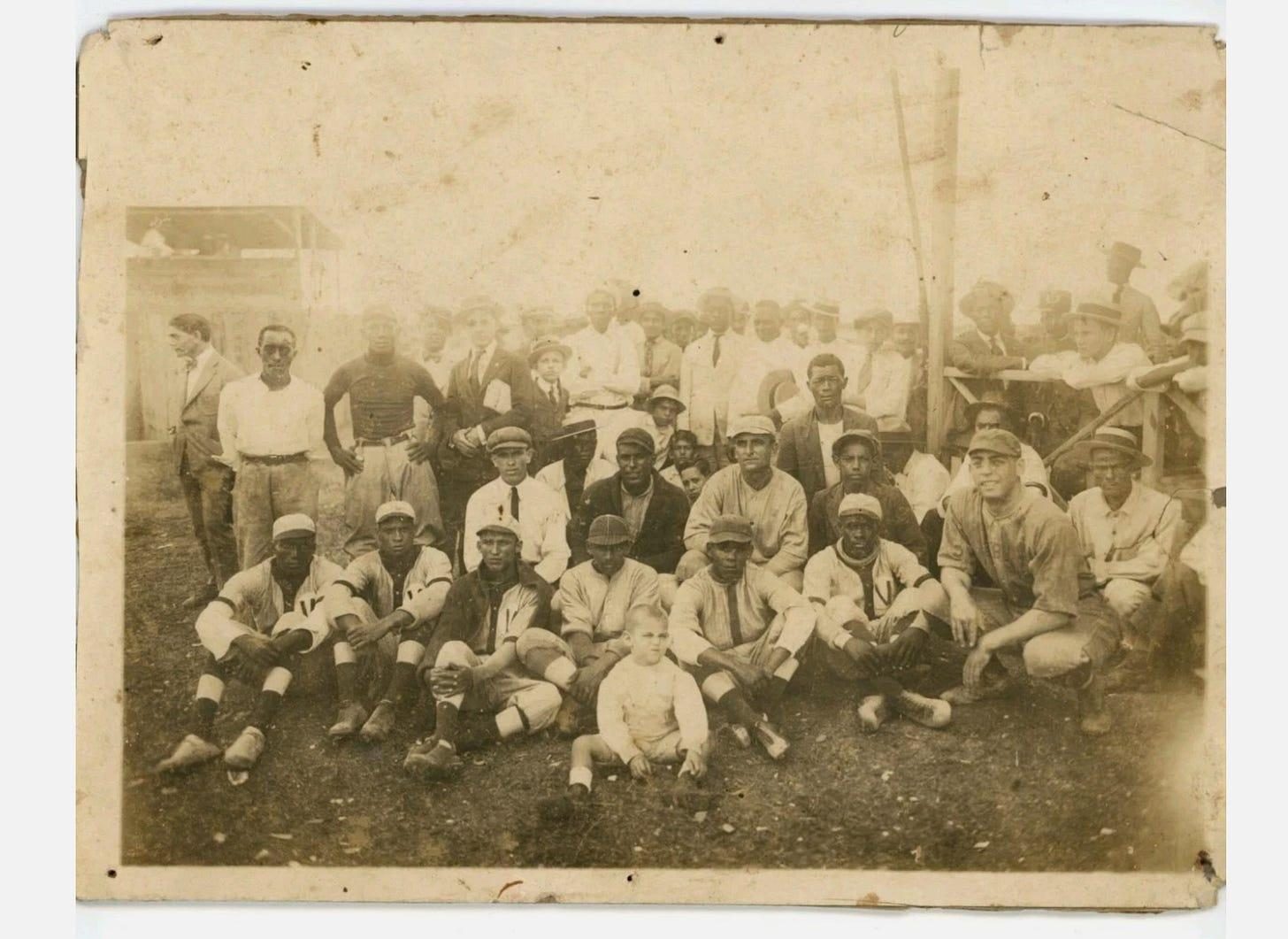
00:02
So what we've really closed in on here and the gold behind this project is a global working class history of baseball. And this photograph alone deserves several book-length volumes of exploration and denotation and discovery because it's such a rich cross-section of what Cuban baseball history, in my best exegesis, is and represents — as well as global baseball history — especially regarding what baseball means as a laboring sport by laborers for laborers.
When you strip away the dross of the attempts to economically control and extract wealth and income from the game on behalf of the owners, ownership, various different various different entities or institutions or organizations or even individuals who are attempting to extract wealth from the game…. through viewership or participation, what have you. When you get to the real root and essence of baseball, what we're talking about is a history of a working class culture.
01:29
Particularly in the Western Hemisphere, but even in places like Japan or Korea. I've really gone deep into the Western Hemisphere and I want to stay there before we keep going because this is an outwardly expanding radius. We tackled the deadball period — which is so fertile in terms of the Federal League, in terms of player salary disputes; in terms particularly of where the players in the deadball era came from, which were very poor working class environments.
Farmers, factory workers, miners, et cetera. We went into that in depth. But again, baseball in America was so incredibly segregated. We're talking about a white working class history of major league professional baseball, particularly from 1900 to 1920 — prior to the institution of the Negro Leagues with Rube Foster. And so then you also have black baseball, which is segregated from white baseball during this period of time; semi pro, barnstorming, all the way up into the organization established based on Foster’s experience, foundation, and profound leadership.
02:28
So you have people like Foster, like Satchel Paige. And this is just such a wealth of knowledge and culture and importance, especially the stuff that we discussed in terms of Paige in particular: cultural memory, and how time functioned in the deep south in the early 1900s. The concept of whether or not a black person was even a human being in the eyes of the national culture, and thus, accordingly, if their information in their life would be catalogued, institutionalized, and archived in a sense of preserving a national or communal history. This has to do with in-groups and out-groups; how institutions function to delineate humanity and inhumanity by way of documentation, certification, citizenship, memory, and so forth. It’s a prioritization of material.
We went into this in the Civilization and the Confrontation of Meaning essay. So now, we've shifted apertures very fully into Cuba and early Cuban baseball photography as a way of focus and an aperture, a lens. This photograph in particular strikes a massive chord. In large part due to the incredibly integrated event style photography. This is very... very impromptu, they're not dressed formally. Some of the players are wearing uniforms, some are just wearing jackets, some are wearing warm-up shirts; others are wearing full suits… these people in the background who I would assume are spectators or local community members.
And you can see in the back just the diversity. There's actually someone who looks like they're wearing a military uniform in the back to the right behind the porch that you can see in the far right corner of this document. What we're looking at is baseball as an integrative communal force. And again, the importance and immense nascent transformation of Cuba's burgeoning modern identity as a nation — nations as a modern phenomenon itself; as a community — out from under Spanish colonial rule in this critical time period of collective identity formation post the Spanish-American War.
04:21
This photograph I would estimate somewhere between 1912 to 1915. You can see a young Jose Maria Fernandez on the right here crouching down and smiling. He went on to go play for San Francisco Park in 1915 and began his professional career thereon. A long, illustrious career in the Western Hemispheric professional baseball circuit. This is a semi-professional team from the best that I can tell.
I haven't done enough research into it yet to make definitive statements on the identity of the team and the uniforms prominently featured, the circle and the V. I'm assuming it is Vedado. Central Havana. But I have to do more research.
The real important thing here though, is when we're talking about this global working class history; baseball as a means for working class people to be and gather together — especially in Cuba with baseball as a way of forming national identity — you can see here how baseball is almost like a way that the wounds of the culture of the nation are sutured through the communal, integrated participation, particularly through the racial and class dynamics which are represented here. It's like you have a full spectrum participation across races, across class lines.
And they're all depicted here very clearly in this photograph. It's almost something surreal. This is like a memory that you wouldn't expect to be able to retain. It’s visceral, present, photography as event and yet incredibly casual and unforced. A documentarian moment in time that reveals the dynamics at hand. Complex, radical, revolutionary dynamics of communal participation.
06:00
So when we're doing this work, it's that this working class history is the real history.
I was talking to my dad about this last night. He was saying something about this quote that he read somewhere, or this idea that he retained over time. The history of kings and nations and empires and war victors, et cetera, that's not the real history.
The real history is the history of the everyday. The history of the everyday person, the events, the culture, the experience they're in. What they share as a group, as a community. As a rhythm of cultural and social life. The sharing of experience and community.
I'll bring up Bertolt Brecht again. It's a very Brechtian idea that this elite-making, colonizing space, energy, and resources perspective is very divorced from any sort of real humanity. And to return to real humanity is to return to cultural institutions like baseball, which of course is not an institution. It is a way of being, a way of self formation; a way of group and communal identity formation by way of participation in the rhythm of the event; the movement of the sport; of being together in time. A collective sound, motion, movement. Based on joy, passion; the exchange of information and language.
As you can see here — a semi-professional organized but also disorganized environment, which is a cultural institution as way of being together which spans borders, boundaries, languages, races; different national cultures and regional identities, religious identities, ethnic identities and cultural constructs. Baseball as a tectonic, seismic through-line into the heart of being — beneath all constructs of separative identity and into collective participation beyond all bounds. National, social, religious, cultural.
07:16
A photograph like this to me is so profound because it penetrates to that level. The level beneath baseball — and you understand the real importance of baseball from a Cuban national perspective in terms of what it did and was doing — in terms of providing a cultural outlet for real social and human integration to occur on and at the ground floor of the land and the space of being together itself.
Real communal gathering outside of the small siloed class and racial constructs which formerly segregated and still to this day segregate populations. Baseball is a unifying force. And the amount of individualities that are captured in this picture, it's almost something that you would see in a sort of valley of the dead, or like a valley of the dry bones in an Ezekiel sense, so to speak. Because what is happening here is there's just such an incredible amount of richness of preservation that has occurred within the span of this photo, this mass group photo, which is allowing for a historical recall to occur which transcends baseball through baseball.
Because the Cuban national mythic identity is being constructed through the participation of all of these different individualities and subjectivities in unison, in harmony, together in ritual presence. Together through the memory of this photo. It shows something profound. Racial, ethnic, class-based siloes in terms of what these people do on a daily basis; the loci of their identity formations and foundations in a tribal, familial, ancestral way — and baseball is the thing that's brought them together… for the opportunity to preserve this memory. It strikes new ground.
08:41
You see what I'm saying there, the profundity behind that: it's that baseball itself has become the nexus for this historical moment to be captured and then reflected upon as a sociological, anthropological document of human meaning and human community. And a new paradigm or mode of representation made possible therein through baseball as a transcendent form of nondenominational, spiritual human unity around the rhythm of the experience and way of being — the life and blood around baseball as a grounded, shared experience and language of participation, embodied participation in reality.
And so something like this is so radical in a larger historical context because it represents the first modernism. The first modernism being integrated community.
And the way that this first modernism emerges is... at 1900 through the Cuban National Liberation and Abolitionist Movement in Cuba, primarily through the cultural institution of baseball as a way of that expression or revolutionary call for liberation and desegregation and the end of slavery being grounded down into ritualized, everyday communal experience and culture of being together. There's singing, there's dancing, there's music, there's food. And it's all around this — it's almost like the center of the polis, so to speak, in a Greek sense. It's all around this performance and athletic event of baseball. And for the first time, maybe in human history, right? I mean, just... just to say it, right?
You have people from all different racial and class strata gathering around this phenomenon. It's not segregated by slaves are not participating. You can obviously see the absence of women here, which is very notable. This is a mens’ pursuit as depicted quite clearly in the photograph. You have this entire class and racial strata, which has been opened up… and this aperture has been opened up for the participation of human beings across formerly bounded spheres of representation, inclusion and exclusion. Baseball has been the modality for that. For this to do so and occur.
10:08
And so you do see in Cuba, women become more and more included in baseball; in terms of the participation in the events of baseball. Particularly in the social and cultural events surrounding the gathering itself. Not in the game, but in the sphere of gathering and connection that the game provides, or creates by its presence or event in space and time as a communal happening. But for the purposes of this document here, what is so important is the cross-section of historical and cultural and individual experience that this photograph avails us. And this sort of transcendent group photography, in my experience, is very unique to Cuban semi-professional baseball.
And I'm just going to show you another image which really does bring this to bear.
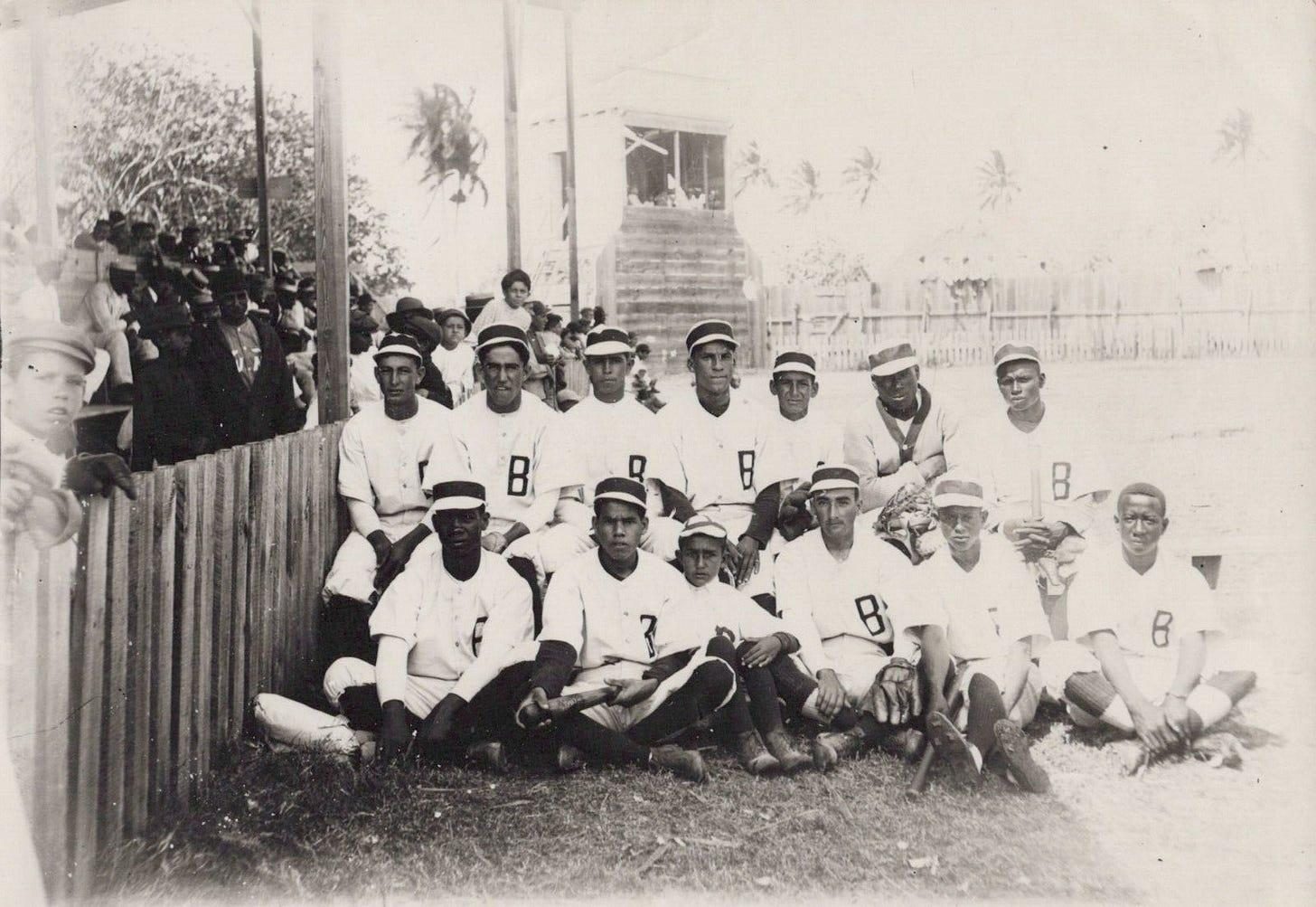
10:44
Really great. Here's another one of what looks like an amateur team... these guys look a fair bit younger, the vast majority of them. What we're able to see is through this aperture of light. And this is the powerful thing about the way that these early cameras were capturing light and capturing information — is that the backgrounds in both of these photos are very similar.
You can see this light fade that occurs, right? It's almost like the huge crowd of figures in the background fades into the mist and your perception of their faces fades slowly into the background and into what is like an empty sky. The sky isn't even being printed due to the light change. It’s open. And the same principle is occurring here in this photograph. I'm gonna go ahead and show you one more.
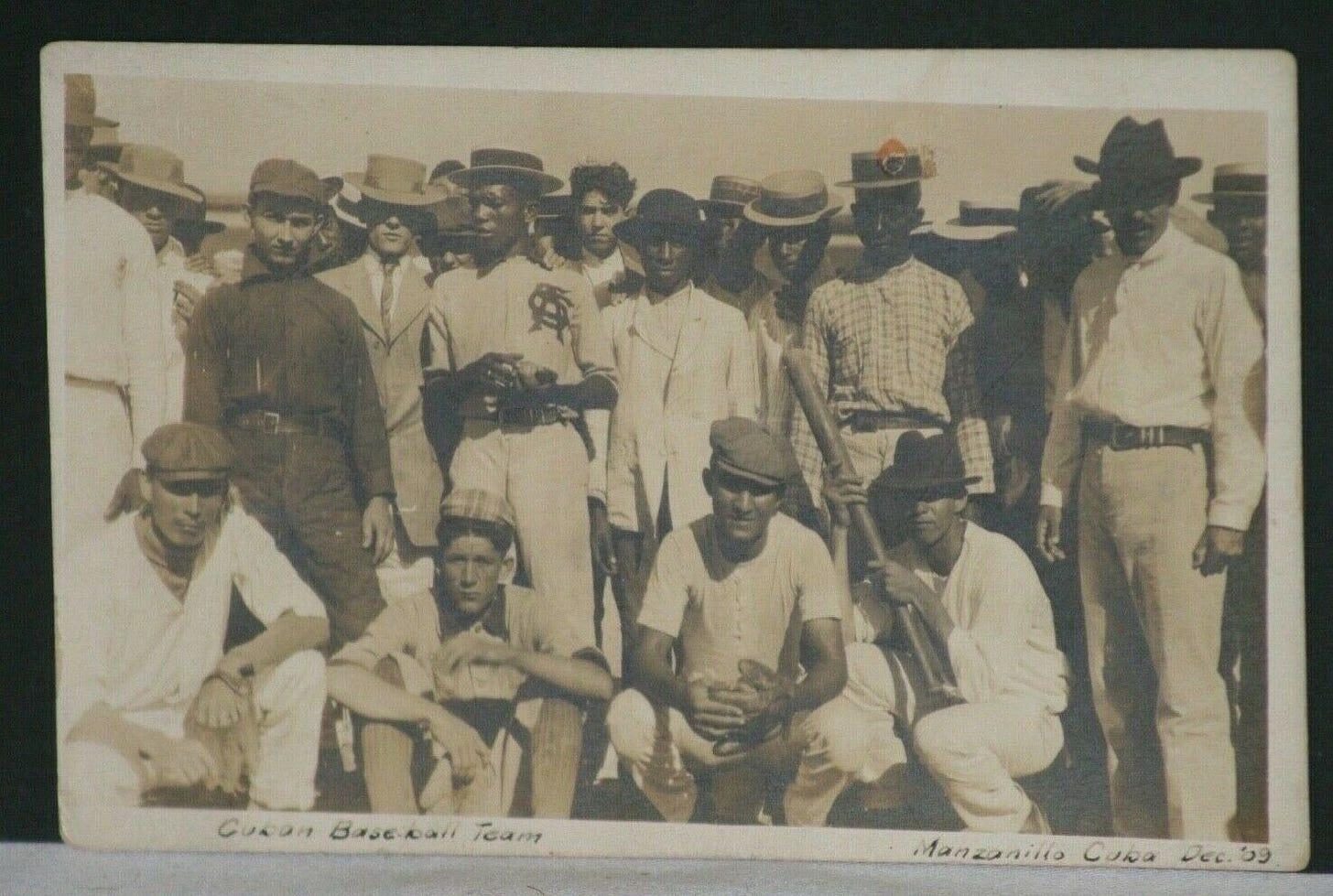
11:41
So this is something that's so profoundly, in my experience, unique and interesting about Cuban early semi-pro and amateur baseball photography in itself — is that it is an exceptional and extraordinary anthropological cross-section of human experience.
It shows how baseball was organized in early Cuba, especially in the semi-pro environments; in doing so, shows how integration functioned therein in, around, and through the historical document and documentation of the culture of baseball itself.
There’s a looseness in a communal gathering sense around it. These are not just baseball players. These are figures from the community. These are different people who are participating in the event. They are still wearing their casual, work, or laboring clothes. Uniforms. People from all different backgrounds are mixing into these documentary group portraits.
Even the way that one of the players is holding the bat in the bottom right. The cross-section is just so fascinating to me. But I'm gonna go back to the first photo here.
12:54
The way that this preserves working class history is… the importance of baseball as an aperture into a deeper level of human reality, which is the everyday experience of everyday people in a civilizational, cultural, and national context — and their passions, their joys, and what they gather around. By choice. By chosen community and communality. The shared agreements of experience; how baseball is a transcendent shared passion, joy, and agreement of entry into experience that crosses many of those conventionally delineated ways and lines that separate.
Furthermore, this is a photograph where you have these individualities and subjectivities that may have and likely have not been preserved in other environments, perhaps in family scrapbooks on rare occasion that have been preserved and things along those lines. But we're talking about individualities that were not prioritized in historical documentation. So we're really talking… perhaps the title of this is really lost subjectivities — because the documentary history of baseball is traditionally gathered around the concept of stardom or performance in a baseball setting. This as well with history in broad and large.
And when I see a photography or an image like this, what it explodes is that very limited aperture of representation and identification. That seismograph is revealed to be a faulty resonance device or machine. Is this individual present, is that individual present. But a photograph like this explodes that aperture and reveals the richness. The fundamental ground and richness of the historical and cultural environment, right, which is the nexus. It's the zone for participation of individualities. Its the fertile unities of being. The energetic exchange of heat, light, meaning, participation — in the commonalities; in the commons of being.
The nexus of early Cuban baseball — especially the semi-pro environment, reveals this in a way of light that is nothing short of epiphany, epiphanic or revelation — particularly due to, I think, the more disorganized aspect of it.
Where a photograph like this may serve as primary documentation of a specific team or group of players. You may have a more traditional posed team photograph where they're all wearing the same uniforms and they're standing in line in specific ways to signify that they are a team and it's captioned as such by a studio photographer or a journalist, et cetera. That would be the professional mode. Here, in the semi-pro, local, mill team and factory team modality — we're reaching that ground of real, real, real historical primacy. This is mounted on a cardboard backing. I'm assuming this was a professional photographer who took this, because that method of backing was common during this period of time. Fiberboard backing.
And you can see the pinholes that were used to pin this photograph up on what I'm presuming is a wall, right, maybe a wall of a salon or a cafe.
15:44
The power of this disorganization, and again — you can see these kids who are poking their heads through into the picture in the center, in the middle of this image.
And at center bottom, the young child just sprawled out in front of the team. Just sitting organically. The power of this disorganization is that it allows everything in.
It allows the full-bodied richness of history, community, and environment into the picture. This photograph toes a very fine line between being staged and entirely improvised. They just told everyone to stand in this picture for a moment.
And that looseness captures such a broad spectrum, a broad aperture, a broad swath of the cultural moment that is and was early Cuban baseball — particularly in this very powerful moment of modernization, which again is integration and inclusion.
Think you can see here, actually, in the background… looks like they're posing outside of the stadium.
16:48
So when you have the effect of the light, which we explored in the Corrosion of Light essay on Alejandro Oms and the uncovering of those postcards of his term on Tosca, the semi-pro team. When you have that corrosion of light, specifically how it functions in the way that this photograph is organized — with people being vertically oriented in the photo — which means they're standing further and further and further back. There's rows and rows and rows of people.
The corrosion of light is almost… to me, it's the moment of historical disappearance because you're losing the figuration and representation of these individuals the further back you go. That effect on this photo due to the nature of time and the production of the photograph again is an incredibly powerful statement on how identities and subjectivities themselves are preserved and or lost and prioritized.
So through the aperture of baseball history, especially Cuban semi-professional baseball history, you're looking at a radical new way of organizing subjectivities and statuses and hierarchies of information and data and meaning. And this is what I am alluding to in my global history of working class baseball — is that the prioritization of subjectivities in terms of, let's say, its status or power… that itself being a denotation of meaning or priority or positioning — misses the real historical aperture and marker that's at work, which is a mass cultural, political, environmental, social network of different meaning-making nodes or matrices intersecting with one another.
The real phenomenon of history itself creates a underground map or network or root system of meeting making. And baseball itself is that meeting place — especially when we look at civilizational crucibles and turning points like early industrial America or post-liberation Cuba. It is the polis, right? It is the cross section wherein people gather. And through that gathering, you… a moment like this or a photograph like this blows up the historical aperture of the prioritization of baseball documentation as specifically even pertaining to the sport. It is far more, far wider.
More expansive and spiritually essential.
And through that blowing up it reveals through the presence of image and light and illumination down and back through time the underpinning or the essence of what baseball is, means, and is about — as a working class communal cross section of how entire modernizing civilizations and cultures organized themselves. How they moved, how they prioritized passions or enjoyments or leisure time between working shifts at the mines or between working shifts at the factories; the new economic and political features of sea changing human and environmental climates… and further.
In this modernizing, industrializing environment — which is a rapidly scaling global economy of production — you have all of these changes that are occurring in the fabric of individuals' lives. Massive changes. But baseball becomes the rhythmic constant. The timekeeper. The underpinning, the cultural, ritual epicenter — which people return to again and again to experience the communal passion and enjoyment of the sport of baseball. And again, so baseball is just the key to that lock.
And when you turn the key to that lock, what is revealed is that global working class history, which is this photograph, embodied. This photograph to me is primary representation of that phenomenon en masse. I may have never seen anything better than this in terms of what a global working class history really looks like. Embodied in formal representation. In terms of the amount of inclusion, the amount of diversity of experience in terms of what these people are doing, where they come from, their backgrounds, all of it, right? And the photograph speaks it before words.
And it's focused, it's focused in this cultural, political moment of baseball, Cuban semi-professional baseball.
21:03
So a moment like that gets us much closer to the truth of humanity than something that may be more propagandized or marketed in terms of prioritizing a certain individual's experience or a certain moment in time as a specific significant historical event. A false seismograph of belief, so to speak. A way of registering history as bangs. Not currents; flows. This moment, this moment which is the photograph… these people gather together for this moment which is being called to the photograph.
It is itself in its normalcy, in its inclusion, in its full spectrum of participation — one of the most profound historical moments and artifacts that's possible to uncover, precisely because of the meaning that is so far beneath and beyond the attempted assertion of meaning in quote unquote significant historical events. It is the distillation of the flows beneath the surface of seeming flashpoints historically. It is the real unison and meeting points that constitute the human; humanity itself.
So this gets us closer, if not even into the everyday and the real experience of baseball as a working class history. And in the working class history, this gets us closer to the essence and meaning of humanity. There's a great Desmond Tutu quote. It says, we have to be human together because I can't be human without you or your humanity.
It's a profound reflection on relation, right?
Co-relation, relation between individuals. There's a similar quote by M. Nourbese Philip. She says, who am I if not in your language? Again, this is a relational dialogue. It's a communication.
The way that meaning is established is through the encounter, through the communication of language, through the transaction of information. It's a way of establishing subjectivities — because if the subjectivity exists in a vacuum, it's an objectivity. It's a total spaciousness. It’s extra-space-time. It's a total openness without a space-time equivalence. This would be pure infinity, or the pure quantum unformed, undistilled. Essence without form, or form as formlessness. The creation of the universe is undergirded by this principle. Planets move in relation to the sun as a primary source of gravitation, as a field.
So the way that things organize themselves in space and time is in co-relationship.
And that's how networks are formed in a galactic as well as in a national, local, communal way. Baseball itself is that force or that institution or that star through which the planetary bodies of individuals gather. And through baseball, we are achieving a level of sociological and anthropological revelation, which is rarely, rarely if ever readily available. Because baseball as a cultural institution becomes a means to photography, it becomes a means to documentation; it becomes a means to biography.
Through that radical means making, you're actually penetrating into the real working class history and lives of people like Walter Johnson or Alejandro Oms. The real grounds of the everyday of being. The rhythmic heart of being itself. People who otherwise without the cultural institution of baseball are just farmers. They're just poor children who are raised in a sugar mill town in Cuba. Baseball raises this legacy to the light and declares it sanctified. Eternal. So this is a radical reorientation and re-prioritization of subjectivities. A celebration of the working peoples of the world.
And baseball is the means and the mechanism to do that.
24:39
So seeing baseball as what it really is — a radical political, cultural, and social mechanism of reorientation of the gravity of meaning in a human sense… a reorientation toward the everyday, the individual, the common person, and the common people as a collective — is itself a massive political statement. And it's formed in such a profound and clear way in early Cuban baseball, 1900 to 1920, precisely because it's so nascent; in this way revelatory in that it is formative.
And the way that it's nascent is that it's this moment of integration in Cuba, radical integration, national and racial. It's a radical integration moment in movement. And in this way its visible, particularly through documentary photography. Its a massive, collective, nationalizing body in motion of determination of self. And it's occurring through the aperture of baseball as a way of documenting that everyday crisis of the revaluation and transvaluation of the foundational values of a civilization which was previously undergirded by Spanish colonial law and custom.
25:38
Baseball itself, as I documented; as we talked about in the late 1800s — was actually a way of subverting those Spanish colonial traditions and identity construct structures and asserting a Cuban national identity. And in 1900, with the integration of baseball, it is an assertion of radical community in Cuba. Radical inclusion in Cuba.
And so this is just the richness here of baseball and what a real baseball, cultural, sociological, and anthropological study can avail us of.
It can actually give us insight into historical moments and documentation that is profound in ways that the everyday cannot traditionally capture because it's so siloed, it's so individualized. Each person goes about their lives in different reality constructs, whether that's a class construct or an ethnic construct or a cultural construct. But through baseball, you're actually given this radical cross section because it's a communal gathering meeting-place that again, as we spoke about, the denomination is baseball. It's not a cultural construct with certain religious or social or political beliefs that silos off communication and relationship. This is not a movement into differentiation or fragmentation through religious or ethnic or political lines. It is a movement into totalizing human community through the integration of those lines into a deeper form and heart and source. A deeper passion and majesty of life, meaning, participation and joy of movement.
Baseball itself is the place where everything and everyone goes. And as such, it serves as such a rich ground for the full depiction of the anthropological and sociological condition of humanity itself.
27:07
And so that essence is readily and radically represented and depicted in this photograph just by the sheer diversity of presence. The sheer diversity of the nature of presence which is availed to us in this photo.
So that in itself, that's the gold to me. That's the real power. That is the deep majesty.
The profound gold. And it comes from this document of the everyday. It's not some profound moment of culmination, even in a baseball sense, a championship or what have you. I mean, it could be, but it's not documented that way or catalogued that way. The photograph is the memory. The fiberboard backing is blank. There is no written, linguistic context. This is just an old photograph. Laid bare in image. This has not been claimed by any institution as being something incredibly significant or monumental. It has not been canonized, so to speak, or co-opted as a specific historical moment in a documentary, narrative history of seismic, titanic shifts of cultures, civilizations, or species. And that's precisely the point.
27:53
So that's what I have here. I mean, even just looking at the photo visually, the profundity of the presence and the multitude of the presence — the nodes and the moments and the subjectivities that are converging in on this moment — make it one of the most profound documents I've ever seen. So thanks for the time. I'll catch you guys on the next one.
25. A Return to the 1886-1887 Habana Championship Composite Photograph
Jul 22, 2025 · pp. 391–404
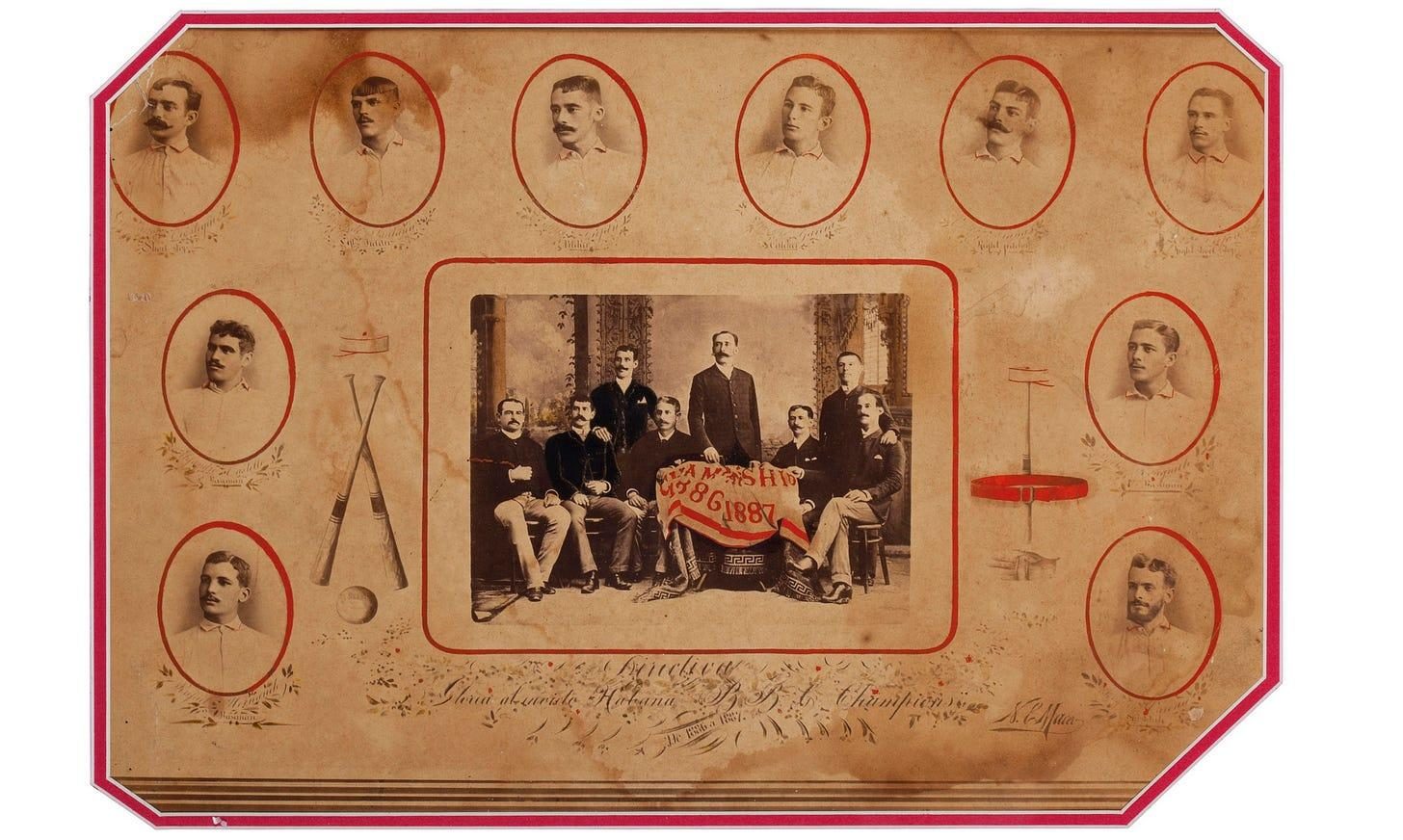
00:00
So I'm returning here to this, the cabinet, the Havana 1886 to 87 championship. It's less of a cabinet and more of like a very unique composite. I actually removed this from the frame and the matting earlier, just now, about an hour, an hour and a half ago — standing over some archival boxes with a butter knife, like surgically removing it from the matting that you see depicted here, so to speak.
This was in the Christie's 2018 Golden Age of Baseball auction. We have to look at this for what it really is. And so I want to do a historical service, right, in the sense of fully exegeting it from its origins and really depicting it. I want to give this… the level of depiction and recognition that it really deserves.
What this is showing predominantly and prominently is Sabourin, who we previously discussed — in the back there. He's the one that's standing with his hand on the shoulder of his teammate toward the left of the inner photo with the darkened, very, very black coat.
01:28
I'll just pull this up because I have some notes. Money that he obtained from baseball actually ended up going to revolutionaries. ‘Sabourin funneled money that he made from baseball into the hands of revolutionaries, among them the poet and journalist Jose Marti. Spanish retaliated by banning baseball in some areas…’ and then he was eventually imprisoned. He was stealing ammunition from the Spanish. Sabourin died in the Spanish fortress Castillo del Hacha in 1897.
When we're looking at this and we're looking at Cuban baseball — the political intersection of this document and artifact here can't be overstated because really what we're working with is the intersection between baseball and the identity formation of nations.
And we've been discussing this a fair bit, but this artifact really takes that thesis to the next level in terms of not only being an origin, foundational origin level document of Cuban baseball proper, but being a foundational origin level document of the Cuban nation proper. This is a form of Cuban nationalism.
Baseball in Cuba was so important because it was a cultural alternative. A cultural origin of self making. It was something that was chosen by the native population of Cuba. It became a national sport under or beneath as a document of resistance — under and beneath the Spanish colonial culture. A subversive form of being.
03:24
Bullfighting was the Spanish colonial culture. There's different, you see the change of mode. You have a violent, very violent, often murderously violent sport in bullfighting. And Cuba instead embraces baseball, which is an egalitarian, strategic, collective, collaborative institution as a cultural underpinning or undergirding. And with the liberation of the Cuban nation from Spain in 1900, you have the integration of baseball at the same time — as a political and national statement of collective identity.
And in this year, 1886, the year of the celebratory composite, slavery in Cuba is abolished. This is a, simultaneously — you can see the tension of baseball being a professional sport reserved for Cuban elites and quote unquote white Cubans in the 1880s and 1890s; all the way up to integration at 1900. You can see that in this document combined with the tension of the exact moment in which this document is created — which is this critical step of abolition of slavery in Cuba leading up to the final definitive revolutionary movement, which ends up culminating in the end of the Spanish colonial regime in Cuba.
05:20
So the idea here is baseball, especially in a Cuban context — because we look at America, baseball isn't like a key to the lock of the cultural, political, social and national liberation of the United States. It's certainly the national pastime, but this is something that develops during the Civil War. This isn't developing during the Revolutionary War in the sense that it's a mass cultural movement of national liberatory identity creation and assertion.
The importance of baseball in Cuba globally — especially in terms of how Cuba communicates baseball across the Caribbean; furthermore, how baseball is used as an identity construction mechanism: as a national collective revolutionary movement spearheaded by none so significant and prominent as Sabourin… literally funneling money that he received from baseball into the hands of Jose Marti, the Cuban revolutionary… and then himself being a revolutionary figurehead in the literal movement itself.
And the function as we discussed with the documentary papers that were signed by Enrique Melendez, who was a prominent go-between between the Spanish colonial empire and the Cuban organizational, political, collaborative cultural powers of baseball as it became more, more, more prominent in the main city centers of Cuba in the 1880s into the 1890s.
07:20
As you see in those documents, there's this assertion of Cuban political, national, cultural identity, and it's occurring through baseball. And this is a way of collaborating, gathering, creating community and culture that is very specifically Cuban. And this was something identified by the Spanish colonial regime immediately, perhaps in a well-founded way, as dangerous — as a threat to the Spanish colonial regime. Because not only do you have Cuban revolutionaries who are participating in the sport of baseball, such as Sabourin… and then you go a little bit further and you understand that Fidel Castro and Guevara were deeply involved in the nexus and net of baseball. Guevara was even involved with Martin Dihigo.
‘… Dihigo meets Guevara in a restaurant in Mexico City and he gives modest financial support to the Granma expedition, which launched Fidel Castro's overthrow of Batista. Castro was a pitcher at the University of Havana in late 1940s and frequently attended baseball games at the stadium in Havana. In the very first days of his rule, pledged to underwrite debts of the Havana Sugar Kings in 1959.’
09:09
Baseball as a cultural force in Cuba signifies a foundation. A foundation of natural identity. National identity, I was trying to say. National identity. And the formation of the national identity and the continuance of it. So you're looking at something really that's so foundationally distilled in the spirit of revolutionary Cuba and then undergirds the entire 20th century of Cuba's political revolutionary upheaval in this continued attempt to establish and found its national identity. To ground and earth it into stable, steady, equilibrious being.
And it's in the most paradoxical and strange and perhaps ironic way that the United States’ continued political involvement in Cuba is kind of haunted by this cultural movement that occurs and origins in 1864 and 1865 with Nemesio Guillo and his brother — they're obtaining of the knowledge and technology of baseball from the American South during the American Civil War when they're in school there and they bring that back to Cuba.
This cultural exchange or this movement of communication of the language of baseball that's occurring between the United States and Cuba is such a strange entanglement that is… it's the foundation at the level and the layer… the unspoken level and layer beneath all of the political attempts to assert power and control sugar and other other forms of economy in Cuba as a resource for the colonial missions of the United States.
10:57
Once Spain is removed from the picture regionally, the United States attempts to assert political power, control, and dominion. And this, again, is a tension that undergirds the establishment of Cuban national identity. So when we look at baseball — and baseball is a revolutionary political tool, a political tool of culture as a technology to assert national identity, to assert collective political national identity.
An artifact like this and perhaps this artifact alone shows this movement. The way that this is styled is somewhat European in its composition… but what it's showing is the adoption of baseball as an assertion of cultural, political, and social pride.
The inscription here is N.E. Maceo. And Maceo was a studio photographer in Cuba, perhaps most renowned for his depictions and work with the other Maceo; in large, his work with Cuban revolutionaries and prominent social and political figures in emergent Cuba. So there are two Maceos, and the photographer Maceo actually has a studio photograph of the second Maceo — Antonio.
12:28
Antonio was a general in the Cuban Liberation Army; fought for the independence of Cuba in the Ten Years War. Numerous battles in the first half of 1869 against the Spanish royalist troops. Was put on trial in Haiti, tried to be put to death by the Spanish consulate based there. Settled in Costa Rica in the early 1890s. There were attempts to assassinate him. Was in communication with Marti and came into relationship with him very prominently in this liberation movement at the end of the 1890s. A critical factor in this larger revolutionary movement in and at large across decades of its evolution.
Just an absolutely essential figure.
14:33
So what I'm kind of circling around here is the intertwining of politics in baseball — particularly as it occurs in the foundation of emerging national identity out from under colonialism in Cuba. And that being perhaps the most significant formation and distillation of baseball and baseball as a revolutionary missive device in history.
The full powers of baseball. In Cuba, what happens in Cuba, its real political revolution and liberation; subsequently Cuba as a communicator of the language of baseball in and throughout the Caribbean.
So perhaps it's easy to say there are specific moments in the baseball world historical timeline that signify — on the field events or movements within the culture of baseball that transform how it's played or how it's displayed or how it's exhibited in terms of a specifically cultural significance. But when I look at this moment and I look at this artifact, what we're really looking at here is a declaration of independence. Right? And it's a subtle declaration of independence if you don't look too closely. Because baseball as a cultural form in the face of the Spanish colonial government in this continued attempt of assertion of the underground through Melendez… through these documents — all of which show and display this continued attempt to assert this cultural, this burgeoning cultural identity, which is rising from the ground, from the grassroots of Cuba in terms of the field that it's being played on; the language of baseball that is being expressed and transmitted through different communities.
Through the establishment of teams. Through the continual attempts to organize baseball. Political certification of events. Permissions. Documents that show the creation of rule books, the logs of the history of the sport, the logs of statistics, famous players. This is well known and preserved in terms of histories of Cuban baseball; many of which emerge… such as the history by Raul Diez Muro — the history of national Cuban professional baseball.
The Cuban Baseball Hall of Fame — which is eventually established to log these feats and accomplishments and achievements in Cuban baseball history. To commemorate and memorialize and remember them. This is the foundation of a national identity through a cultural archive and a cultural performance, which becomes a ritualized theater and a ritualized movement of gathering.
17:46
And then the documentation of that, which is a history. And that's a… when you document a history, you're documenting a history of a people because it's significant enough to be remembered. And who is remembering it and why? The burgeoning Cuban nation is remembering baseball, communicating baseball, transmitting baseball, because it is — it's way of gathering together and it's a way of sharing the enjoyment of life and the passion of life.
This document is exactly that in the way it is organized; the thickness of the board on which this is printed, the intricacy of the design, the painstaking care committed by N.E. Maceo in the process of constructing this document. This is the cutting edge of photographic technology in terms of the embossment and embellishment of the photographs in addition to the way that they're constructed and organized; laid out and formed on the board itself. This is one of the highest technology baseball artifacts that I've ever seen in terms of the care that's been taken to not only compose the photographs, but to compose the actual board and document itself.
19:12
So what this says, again — in the subtle way of a declaration of independence — is we have built the cultural structure of baseball.
And this is our way of remembering it. We're commemorating the 1886-1887 dynastic champions of Habana. Many of these players were immediately inducted into the Cuban Baseball Hall of Fame to be remembered, including and perhaps most prominently, Sabourin — as a Cuban national cultural and political figure of the liberation of the nation itself.
The transmission of political national identity and the construct of Cuban identity by throwing off the fetter of the Spanish colonial government through baseball is absolutely essentially represented here in a way that no other document in Cuban baseball history I have ever seen is represented. And this distills to me absolutely the importance of the technology of baseball as a way of constructing identity.
Culturally collaborating and in the grandest, broadest sense, bringing an entire nation; a national group of people together, or even a global group of people together — under the banner of baseball as a political device and a statement of identity and a statement of shared information, shared culture. Shared passion, pride, and joy of the game. And what this represents again is so radical because it's a revolutionary device in the case of Cuba. The adoption of baseball is perhaps first and foremost the assertion of Cuban national culture during a period of time where Spanish colonial laws, traditions, and constructs were the essence of what was permissible and legal within the nation of Cuba. This is, it's a birth moment.
21:07
It's a birth moment of Cuban national culture at the turn of the 20th century. And so when you have that collision course, that coalition of all of these different forces and factors, the Habana dynasty of baseball genius and excellence; the very beginning of photographic documentation in a powerful, artistic, historically significant way; the creation of something like this… a very creative composite document on a firm board, which is meant to create a legacy, a dynastic effect; an effect that will carry through and reverberate through history as a preserved and preservable artifact.
The collision course of the Guillos bringing baseball back into a revolutionizing Cuba with the general Antonio Maceo in and at a critical moment of political crossroads, who then comes back around and interacts with Marti. Marti’s relationship and connection to Sabourin and baseball as an economic force in the revolutionary movement. And then a century later you have Dihigo, who meets Che Guevara — and you have again — another Cuban revolutionary moment with Castro who perhaps is best known in many ways even before that revolutionary movement as a baseball player.
22:36
When you look at that entwinement, that entanglement of baseball in Cuba and revolutionary political national identity… it's almost inseparable and indistinguishable. So again, this is the power of baseball in Cuba. That's perhaps tenfold of the power of baseball in the United States of America. And there's that hubris of the American perspective, which is baseball is our national pastime.
Baseball began here. It was created here. And every single evolution it underwent occurred here. It's just not true.
Because you look at a moment like this and a preservational document like this — the statement here is a cultural declaration of independence in the exact moment that the abolition of slavery occurs in Cuba. And then 10 years later, you have Sabourin who goes on to be a massive part of the way that the revolutionary movement in Cuba unfolds and is remembered… along with Jose Marti, right in this moment where Marti is entangled — as we spoke about — with baseball.
And I'll just reiterate it again; why we spoke about it. Sabourin funneled money he made from baseball into the hands of revolutionaries — among them the poet and journalist Jose Marti.
24:03
So that cultural declaration of independence in my assessment occurs first and foremost through the formation and development and unfolding of baseball. You have a document like this, which is a political statement of cultural memory, the institutionalization of cultural memory of Cuba as independent nation separate from Spain in its adoption of baseball as a cultural conflagration, a cultural assembly, a cultural communalizing device of national identity… which is so clearly stated furthermore in 1900, when the liberation occurs officially from Spain. That very moment baseball is integrated.
And in this very moment, the moment of the Habana composite — 1886, slavery in Cuba is abolished.
And at this time, there are multiple reports by journalists saying baseball has become an absolute fervor in Cuba. And throughout and through the documents which are bureaucratically published from Enrique Melendez and the Spanish colonial government, there is a continued heightened sense, again, as is also documented through journalists and historians — of Spain's concern for the adoption of this mass movement.
Because as Melendez says, there's going to be major crowds. We need a police presence. These are official events and they become more more more organized and official as a ritual, as a cultural rite that is occurring beneath the surface of the Spanish colonial government. The Spanish colonial government has to authorize or sign off on these events to occur. They are that massive and disruptive as a force, as a force of nature which is the rising fervor of Cuban national assertion and participation of self identification through fervor, through passion, through community and creation of self.
You can see the rising or ratcheting up of the political tension even just between 1886 into the early 1890s. Again, there's this huge tension around baseball and it has to be banned, it has to be pressed down and suppressed because baseball is a signifier. It represents the rising national Cuban fervor of a individual, individuated, cultural, mass political identity, mass collective identity.
26:29
And the assertion of that identity in the integration of baseball in 1900 is so profound in a Western hemispheric and even a world historical sense because it's the integration of a cultural foundation in an emerging liberated from Spanish colonial environment that demands inclusion. You don't have anything like this in the United States. It takes the United States 200 years to even get to that point. Cuba does it immediately. Immediately upon its independence; slavery is abolished 15 years before its independence. Immediately upon its independence, it integrates its most prominent cultural national event of meaning; of identity.
It integrates the foundation of its culture. So Cuba in this is radical, it's a revolutionary nation. It's a revolutionary emerging out from the underpinnings of Spanish colonial control; its a radical assertion of integrated collectivity under the monument and method of its most important cultural form and communal gathering force of the nature of itself. It allows in; it integrates. It modernizes. Even Black American players are admitted into this assembly of self-making and celebration therein.
Enslavement of the native population, enslavement of black people, control of the resources of the nation. This is slashed away; the first thing they do is open up the gates across racial lines to baseball as a gates to the national construct and construction of the self. Not only the Black Cuban self, but the Black American self.
This is an opening up of identity through the joy and passion of baseball even across borders. This is how you end up with a team like the Leopardos of the early 1920s, one of the most legendary baseball teams to ever set foot on a field.
27:53
And that's what this moment represents. This is the moment that is the crux, 1886.
Slavery is abolished and Sabourin goes on to be an essential figure in the Cuban National Liberation Movement and the war against Spain.
1886-1887, the Habana dynasty in in Cuban professional baseball had been so well established and so well cemented. This team was the height of Cuban professional baseball. And again, five of these players go on into the Hall of Fame, the Cuban Baseball Hall of Fame. Several of them immediately, the moment that it's established — because of their performance and their skill; the legacy that they leave in the game. And that Cuban Baseball Hall of Fame is a product of the independence movement of Cuba and the establishment and assertion of the national identity as it is tied to baseball.
When you have Guevara, you have Dihigo, you have Castro — you have every single political movement in the emerging, shifting vision of the national identity of Cuba and the attempt to establish the national identity of Cuba post Spanish colonial and during the United States' attempted involvement to control resources and political power in Cuba… Baseball is there. It's the foundation. It’s there in and through the foundational, original moments of the first strikes of the candle of revolution with Maceo and the Ten Years’ War; growing from the nascent seed. It’s there and explosively so — as the fervor rises as a fundamental synapse in that process of the rising revolution of the idea and ideal of the Cuban liberated self.
29:25
So this document to me… you could just look at this and you could say this is a baseball document. But to me, it's not even a baseball document. It's a revolutionary political declaration of independence. Created as a historical document, as well as a work of art to portray and preserve this moment of the establishment and solidification and declaration of the Cuban national identity out from under Spain in this radically fomenting period between the 1850s to 1900; 1886 being a crux, a turning point — with the abolition of slavery; depicting Sabourin, the most important political national figure to participate in baseball in the 19th century and one of the most important political national figures pre-1900 and onward in Cuba for his participation and for his role in the independence of Cuba itself as a nation. For this role as a foundational baseball player and creator of baseball in and through Habana.
This document here is saying this is our culture. This is our vision of culture. This is our aperture of culture, the technology through which we are asserting our identity as a liberation movement from Spain; away from the cultural mores of Spain and Spanish colonial identity. We are asserting this out from under — as a grassroots movement from ourselves, as this is what we value. This is what matters to us. This is what we organize around and this is what we preserve.
30:59
Right? This is what we are creating. This is not what you are creating and imposing upon us, but this is what we are creating. As us, from us, through us.
The same year that slavery is abolished, 15 years before the independence of Cuba.
During the height of pre-20th century baseball in Cuba. It's reached a full fervor and the height of the dynasty of the Habana team — which wins multiple, multiple, multiple championships; participates in the first game in Cuba, the first professional game — and it's the first professional team in Cuban history. This is the team that's founded by Sabourin and Bellan and Guillo. This is the team.
This is the origin team. And this is the origin document. The origin visual document, which is a representation of the fully formed and fomented Cuban national political device of baseball, which was born from the ground, grown from the grassroots communication, establishment of organized teams, events, games, a professional league. This is all occurring within the rising Cuban national context.
32:06
This is the creation of self.
32:10
And so this document is that to me. This is a revolutionary national political document of liberation, identification and declaration of independence. And you just don't see that. To me, this is the deepest root of baseball. This is the deepest potential of baseball. And this is the deepest strength and power of baseball.
32:30
You just don't see it anywhere else. You don't see it in the United States. This is not how it unfolds in the United States. It's just a national pastime. In Cuba, baseball is a liberation.
32:42
It's a national cultural identity mechanism. It's the formation and foundation of the nation of Cuba. It's the way of creating and imagining collectivity and community and nationality and the Cuban identity. Even in the face of Spanish colonization.
Especially in the face of it. This is the course of revolution; the true underpinnings of culture as defiance as creation of self. The liberation of the self as a political art of imagining self. Sculpting it. Integrating, performing, and embodying it. Radical liberation.
Through Sabourin; through Sabourin to Marti…
It is that level of the real political change that's occurring — the exchange that is occurring through the presence and root and fundament of baseball as a force of revolution. So that's what I got. I just think this is it. This is it. It's just beautiful, incredible document. And it shows us what is possible and what baseball really is just so far beyond the idea of it or even the practice of it or the game of it. It… just what its real potentials and what its real history is in terms of its real ability. What it is.
33:45
What it is, what it has done, and what it really is doing.
33:49
So there it is. Talk to you guys later.
26. Cuba in 1900 -- Baseball as a Political Possibility of Global Humanity
Jul 23, 2025 · pp. 405–417
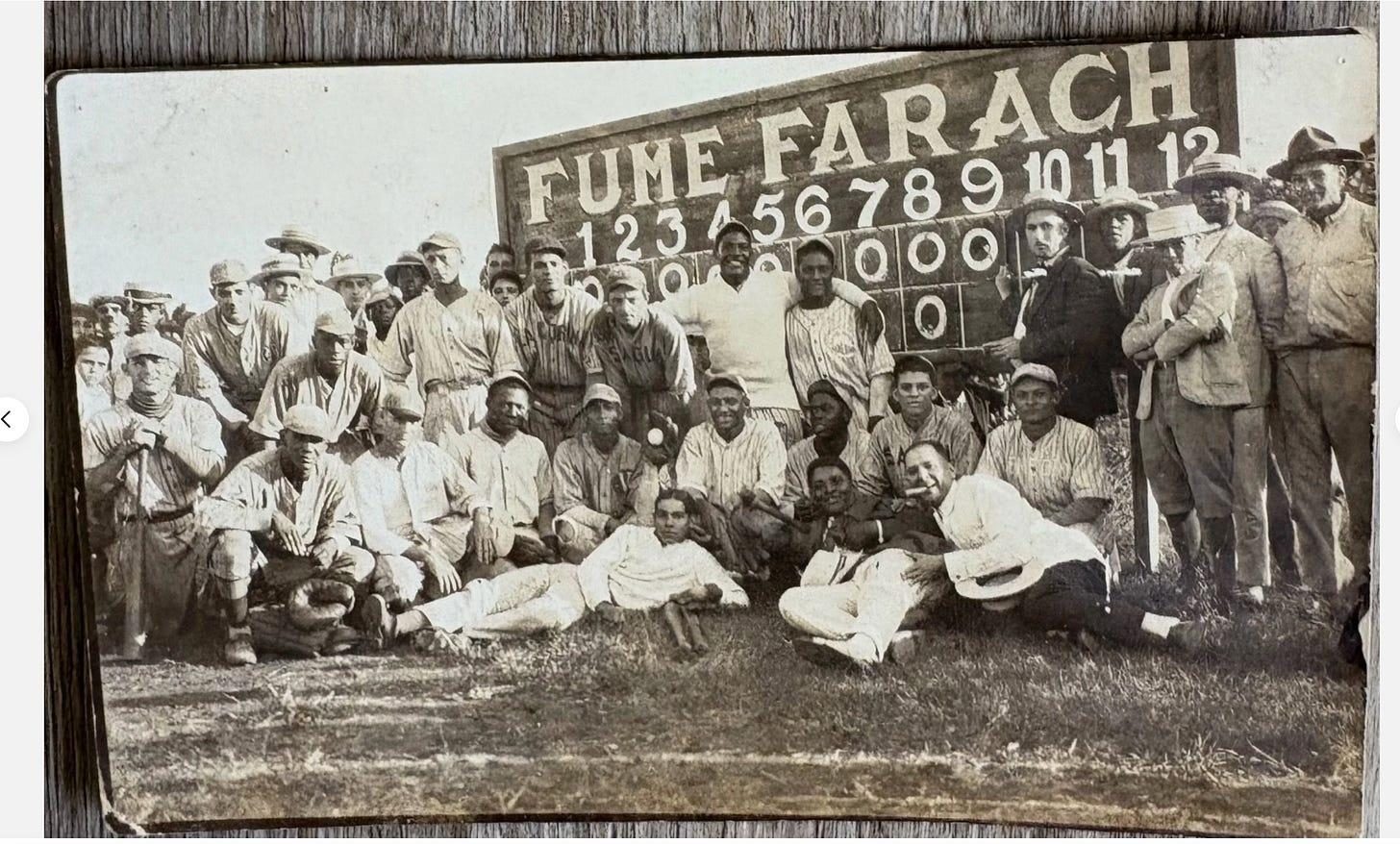
00:00
So this video is going to be called the richness of integrated baseball in the unveiling of real political possibility. Because what we've really drilled down here is 1900 and Cuba as this very crucial, very essential moment, not only in the national history of Cuban liberation — of course, a massive moment — but in the Western hemisphere and globally at large.
Because of the amount of real diversity of experience that is in Cuba at this period of time in terms of native Cubans, in terms of Spanish people, and in terms of Black American people who come to Cuba to participate in the game of baseball because they're disbarred from doing so in their home country.
What you have here is a profound occlusion, like a gathering of different subjectivities that all join together to participate in the game of baseball as a cultural movement — as a way of being together; as such shows us political possibility of collaboration in a way that very little, if anything else in the history of humanity ever has. It's that significant.
Again, this is… we're just striking, striking the gold… striking in the foundation — because this is what baseball has created. This is the great beauty and possibility of baseball, political possibility that's reflected in a modern context to this day. It's the political possibility of gathering together across all borders and bounds, even language barriers. Even language. Gathering together across all of these borders and bounds to participate in this experience of baseball. This cultural phenomenon of baseball.
01:59
What you have in the history of humanity is a constant state of fragmentation, whether that's a fragmentation based on ethnicity, whether it's based on race, whether it's based on religion. It's an in-group, out-group. And we discussed this in Civilization and Culture and the Confrontation of Meaning. The in-group, out-group mentality that characterizes maybe the most primal or animal state of mankind.
Baseball as a radical political force not only undergirds the entirety of the Cuban National Liberation Project — it's tied in at the very foundation of what happens there as a cultural uprising of the Cuban people in the face of the Spanish colonial government and Spanish colonial traditional mores. But baseball in a larger humanistic global sense is something that shatters this very traditional hierarchical way of organizing human beings, whether that's through the color of their skin, whether that's through class hierarchies, whether that's through roles in society, so to speak. It's a way of shattering all of these illusions, these narrative stories that actually themselves are a sort of trauma history of humanity at large, a need to distinguish oneself from the community at large. From the real brotherhood, from the real sisterhood, from the real humanity-hood of being, right.
To actually come into real communion. And a picture like this is so beautiful. This is a semi-professional post game photograph… because what it shows is this real communal gathering around the game of baseball and participation in the game of baseball, which is a leveling of all of these false hierarchies and false status symbol making projects, which are really just ways of elevating the ego.
Because I'm identified to this because I'm attached to that. That means I am worth X, Y, Z. This is a typical project that's continued to this day in terms of the idea of stars and statistics in baseball. But what baseball has always been about at root in the real participation of it and what leadership in baseball really constitutes — is supporting your entire team and bringing that entire team forward into increased ability and increased success together.
So it's a way of creating a real sense of community and a real bond of community through that engaged participation as a group in the sport of baseball, because baseball is a network. It doesn't just function — unless you're Satchel Paige and you call everybody off the field just to strike out the hitter. Baseball functions as an ecosystem and it's a way of teaching at a profound spiritual level the responsibility that comes within that ecosystem.
05:00
So baseball itself is like a spiritual technology, right? Because — and this is elucidated so clearly in 1900 in Cuba — you have this moment of time that's so profoundly politically radical. In terms of the Cuban national situation, in terms of this radical new identity emerging into a society removed from the fetters of the Spanish colonial government. And what they are doing is they've abolished slavery.
They've made black Cubans and native Cubans an essential critical part of the community. Not second class citizens or slaves to the citizenry. And one of the best ways to show that and to exhibit that and to declare that as a sovereign state and a sovereign nation, a native Cuban nation… is to integrate this sport of baseball as the cultural pastime that has quickly become to define the communal engagement proper within the Cuban nation.
In this integration, again, just because of the cultural richness of different backgrounds that exist in Cuba at the time… Cesar Lopez, the man I was talking to previously about different aspects of Cuban history and kind of going back and forth as I was writing the origins of modern baseball essay — he said, we have people from all over the world that were coming to Cuba and are coming to Cuba. Catalans, people from Japan. His father, I believe, was from Catalonia.
06:45
He was saying people from all over the world were coming to Cuba because of this unfettering, right? This opportunity, this opening. Cuba as a place of the celebration of difference and cultural profusion. And this is such a huge part of what we were really looking at with the Cuban nation as it separates from Spain — locally and globally. It's this political frontier of diversity and gathering of different experience.
So this is a really fertile ground for this radical new potentiality of humanity to be exhibited. And if you look at the broader scope of human history, you don't really have moments like this. It's so incredibly modern — in a nation, a recently sovereign nation out from under an empire's control. This is not like a territory that's been conquered by Rome and then has a profusion of different cultural diversity under this empirical relationship. This is a nation that has been liberated by its own means and by its own hand. The United States is a involved, but that's where it gets complicated… a nation that is liberated from this Spanish colonial fetter, and it is now existing in this mode of the sovereign state and sovereign nation. The United States is quickly trying to assert regional power, dominion, and control. Cuba is trying to assert itself as a self creation and relation.
And it has this immense integrative cross-border, cross-cultural, cross-racial, cross-ethnic — across all of these lines, it has this fertile communal cultural device through which it is acting out and representing and symbolizing and practicing this radical new value and this radical new ethos which is the Cuban self authoring. What this authoring is saying and doing is really, it's decades, even potentially hundreds of years ahead of its time.
Because it symbolizes across borders, across space and time, across ethnicity and religion and race — we're participating in a cultural act that brings joy and brings people closer together, right? Against all of these traditional ways of separating people. Creating class hierarchies or creating caste systems, different ways of delineating who is meaningful and who is not meaningful.
09:05
What is so necessary in a human spiritual sense is for a technology like this to come into being, which in itself is fundamentally collaborative in real time practice. If you really play baseball and you know baseball, being a leader on the field of baseball is not being above any of the other players on the field. It's being with them and working through the situations that emerge in a baseball context. It is problem solving with them, helping with solutions, standing up when you need to stand up, supporting the people around you.
This is the fostering of a real community atmosphere through the game of baseball.
Again, this is a non-violent sport. This is a sport of collaboration, strategy, intellect, study. It's a very disciplined, rigorous sport of the engagement of the self in the field of being with other people. This is a practice. It's a cultivated and cultivating practice. So you have this technology which enters into the picture.
It is adopted on the global stage. Not just in the solipsistic United States stage of its own historical understanding of what baseball is and where it comes from and where it's going. But on the global stage it's adopted by Cuba as a national liberation movement, as a way of politically and culturally liberating an entire group of people against a colonial regime. And this adoption occurs in real time as this movement is exploding over the span of 50 years.
So you have, it's just this very fertile ground for this experiment to occur and for this technology of baseball to reveal its real political possibilities. It’s a perfect storm of the insight into what a project like this can really create and reveal and constitute.
These real political possibilities being radical integration at a global level. At a global level, which actually is the creation of real human community. And by real human community, it's world community.
11:00
We're not at odds with each other because we live on a different continent. We're not at odds with each other because there's a different skin color. Or we're not at odds with each other because there's a different religious belief system. The ground of baseball, as we've discussed so consistently, is an embodiment and it's a materialization of the real spiritual conditions of mankind and of humanity. And in real time, you're faced with that. You're faced with the responsibility and the moment that we talked about with Joe DiMaggio and the young child. You're faced with the practice and the discipline that is the spiritual evolution of the self, as we talked about with Lou Gehrig. You're faced with overcoming tremendous odds, as we talked about with Jackie Robinson or we talked about with Stan Coveleski.
All of these things, it's a stage for this spiritual journey, this spiritual transformation project of mankind to be engaged, to be witnessed, and to be metabolized.
12:01
So that's an incredibly powerful thing. The concept and the idea of the baseball stadium as a theater for that spiritual witnessing and that process of transformation through presence and collaboration and the heroic act of self transcendence into deeper self, or world self — as is often conceptualized or visualized in the term of Christ Consciousness or the World Soul — is again something that's so deeply ingrained into the collective unconscious of what baseball is and means.
So when you look at a picture like this or when you study this moment in Cuban history as a movement maybe of even 150 years…. this a movement that really, really turns the lock at 1900. You're looking at something that's prescient. It's almost like a foreshadowing or a prophetic moment in human history. Its a forward step into a previously unknown unity. A transcendental unity, a wholeness. You can in no way overstate it in terms of the real meaning and power of baseball, because what baseball is revealing through its unconscious technology — the way that it's developed the game itself, what it's revealing. is that it's a through way.
It's a way of being that reveals radical new possibilities and new ways of being together, which is a form of human collaboration that transcends difference. It's not that it dissociates from difference. It transcends through incorporating it, human difference. Into a tapestry that is all present in the movement and act of being and becoming through the game and sport of baseball. The event of baseball. The communal gathering of baseball.
13:21
Incorporating human difference is not saying we are all the same. It's saying we are all different, but we are all playing this game. And it's a way of unifying. We don't even speak the same language, but you and I speak the language of baseball and we're playing the game of baseball now. Right? We don't believe the same thing, but we believe the language of baseball or we speak the language of baseball. That's really what's happening at this moment in time in Cuba in 1900.
If you think about that in a global world, historical, civilizational context, what that represents is really fundamentally, it's a developmental leap at the level of the species. And so what I mean by that is that so consistently historically in humanity, you have the attempt to establish hierarchies, whether those are moralized hierarchies or ethnic hierarchies, whatever they are, to delineate who is meaningful and who is meaningless. Who is a servant and who is a king or the peasant-royalty dynamic.
And that manifests in many different ways. It manifests in modern American capitalism. It manifests in feudal Europe. It manifests in slavery in Greece. It manifests in the concepts of divine right. In kings and emperors and warlords in China or Mongolia. There's many different ways that this manifests. And so what we're really getting to is we're coming out of this collective fantasy of constructed difference in a way that allows us to exploit, manipulate, and abuse one another because we have this inflated sense of self that we're attempting to paint with a broad brush and create the economic foundations of an empire with. This empire is a walls of exclusion and inclusion based on celebrated sameness and exclusion of difference. The exile of the other.
That some people are just more meaningful because they believe this or this is the color of their skin or they have this amount of money. It doesn't work like that.
That's not real. It's not real nature. Real nature is that we are a massive species that is slowly evolving over time and slowly changing over time.
So that's something that on a real level evinces the concept of brotherhood, right?
This concept of moving together through history and through time. And that's something, again, it's very far away from war and real conflict and real violence. It is into gamesmanship. It is into play. It's into meeting each other on the field and we are playing this game of baseball. For passion. For joy. For community and being together in time; experiencing our collective humanity and taking joy and wonder in that.
There's something deeply, deeply real about that and the fact that the technology of baseball as a growing device in the Western Hemisphere lines up perfectly with this moment in time in this island nation in the Caribbean… during this moment of national liberation and these political possibilities — are opening up at a radical new level. The abolition of slavery and then immediately the integration of black Cubans and native people into the game of baseball.
16:09
What are we really talking about here? We're talking about the opening up of the cultural aperture in a modern sense. Again, nations are a modern, this is a modern development. Cuba becomes a nation when nations are becoming popular. This is a modern development and you have the opening up of the cultural throughway of the most important fixture, the most important cultural technology of said nation to effectively — all.
Black Americans are coming from across borders to play this game of baseball, and they're being welcomed with open arms, and they're being celebrated. It's not to say that at the abolition of slavery, racism was abolished in Cuba as well. That's not the case. But these Black Americans are coming to Cuba, and they're being celebrated for their achievements on the baseball field. You see this trajectory, this grand trajectory that we're opening up. It's the political possibility of real collaboration and a stripping away of these — again, I'll say the narrative fetters which have so long limited humanity.
In terms of difference as being constructed as meaningful and meaningless or valuable and valueless. And then you look more and you say, okay, difference as being constructed as a collective participation of diversity, which illuminates by contrast and by difference, the full spectrum of the majesty and the experience of humanity or existence at large.
That's what we're moving towards. And baseball itself is a technological bridge, which in this period of time in Cuba is being elucidated very loudly and very clearly in a way that it's almost like you look at these photos…
17:51
You look at these photos and it's like a time out of time because you can see how old they are. You can see that they're a relic from a time past, but then you look at them and you say, how is this possible? All of these people from clearly all of these different backgrounds and experiences, they're gathered together and they're smiling. They're enjoying the participation in this game. This is a boundary breaking event. And this is a boundary breaking culture.
And it's real, it's happening in real time. This isn't an artistic movement. This isn't a literary movement. This is a political cultural movement of community, which is happening through the game of baseball, which in itself is breaking decades, if not a hundred or even hundreds of years earlier. It's breaking this earlier, this dam of constructed power.
And it's moving towards love through baseball. Love is in real collaboration, real community, real grounded practice of gathering together and working through life, participating in life. Through attention, devotion, discipline, presence. Collective, communal responsibility of coming together through this event. And that’s something sacred, sanctified.
Someone who arrives to that field or arrives to that scene who's a different color of skin or believes something different or whatever it is, they're being welcomed in to the game of baseball. Right? As knowledge that it's a global communal participation.
19:16
You're starting to see that again more and more in the modern sense. But what's necessary is that that understanding through baseball is metabolized collectively at a political and cultural level at large. And that's breaking away, again, even from this previously radical concept of the sovereign nation, breaking away from that into an even deeper radicalism, an even deeper political real human truth of global community that we are.
A new paradigm of integration — a whole species, populated with deep, complex diversity — on the planet Earth. And we are all participating in this metaphorical game of baseball. This movement of life and nature and time. So what does that mean in terms of our responsibility to one another? What does that mean in terms of our attempts to create power or our attempts to control and manipulate others for personal gain? This is real ecosystemic awareness. And it occurs first really on the baseball field because you're participating with eight other people on your team at any given moment.
And you have a responsibility to them to maintain your moment, your place in that grand field. It's a microcosm of the macrocosm of real political responsibility and real political community on a global stage. The baseball field is your moment. And then obviously you have the field of being at large. This is a way of learning.
So by opening these gates and opening these doors across racial and ethnic borders, and even national borders — Cuba and America, through Cuban professional baseball in 1900 — you're really seeing a profound moment of breakthrough there.
And I would challenge you, I would say, can you find something like this in history?
You might be able to find something that might approximate it, but with the amount of power and modernity that's present in this moment in history, it would probably be pretty difficult. And this is just a testament, again, to the political possibilities of baseball.
21:15
And that's what we're headed towards, inevitably, because a creation of consciousness or a moment of consciousness and a moment of awakening is the realization that we are a global community. One person's actions, as it is well known — the fabric of space time in a scientific sense — one person's actions on one end of the globe is just going to impact someone else on the other end. And it's certainly going to impact that one person who committed those actions.
It's a simple basic process and part of living in an ecosystem. None of that occurs in a vacuum. Actions are of a responsibility. Always. So you have moments like this in a technology like baseball, which is revealing and unveiling through the unconscious architecture of the game itself as it's constructed. It's almost constructed intuitively through the human unconsciousness and through the human imagining. The game of baseball itself is slowly revealing through culture the truth of nature.
The truth of physics. Bat and ball, the distance of spaces to be covered by the athletic human form. The truth of and reality of being human through participation, not through a story, not through a narrative, but through life, through the experience of being on the field of baseball and playing by those rules, so to speak, which are again, the rules of nature. We're getting close to that moment and that point. So there's a deep richness there that emerges through humanity's preparation to go to this next stage. To this next paradigm of development.
Baseball is a collaborative sport of mutual participation, which requires, regardless of who you are — regardless of where you come from, regardless of all of these different factors — that you play in your role and participate in your role in this field of baseball. As a member of a team. And that your team's success ultimately depends on how well your team works together. This is an ethical responsibility dramatized on a heroic scale of collective participation.
Because one person very rarely is the one who dictates success in baseball. It has to be collaborative because you have many games in a season. No one really holds the deepest, highest level of participation in every single one of those games. You have to pick up your team members. That's another essence of the game. Again, you hit the ball three times out of ten times successfully — you are one of the best players around.
That's the amount of failure that occurs in real time in baseball just because of how hard it is to hit a baseball. It's one of the hardest things to do.
So you look at that and the technology that's availed in that political moment in time in Cuba in 1900 and you can see the future. It's a moment of stepping back in time, but you step back in order to see the future. It's something that was almost… it was so early that it was like a moment of human genius, so to speak. And this is really important.
24:10
Because when you look at this moment of human genius, this is a collaborative, multicultural moment of genius. This is not the conventionally termed individual genius. This is the genius of a political social movement which many people participated in. Many. Including the Cuban National Liberation Movement. It cannot be extracted from or separated from this moment and movement of baseball itself in Cuba and the political possibilities that emerge in 1900.
You have this moment of collective participation, which is so prescient and so unheard of through the technology of baseball… that is expressed and manifested in a moment where it's like, how is this even possible? How is this even happening? And yet it is. And it's happening in such a grand and creative scale that there's dancing, there's music, there's these beautiful stadiums that emerge. There are legends that are grown from the foundations and even the poorest parts of Cuba. Alejandro Oms, Jose Mendez — you have these fantastic players that emerge from this immensely fertile ground. You have Cool Papa Bell who's participating in this. You have Oscar Charleston. You have some of the best players who have ever played the game of baseball, gathering together in this incredibly fertile cultural and political moment in movement.
25:37
To contribute, to participate — because what it is, it's the opening up of political possibility. And when you open that up, you have just incredibly profound and beautiful things that happen. The design of the uniforms, the photography that's captured, the media, all of it — all of it is a distillation of that beautiful, fertile moment in history that itself shows us, and it shows us so early and in such a prescient way… the political possibilities of the future through the most unexpected form — through the game of baseball, through something innocuous, through something communal, through something that's… it’s nine innings on a baseball field.
So that's what I got. I'll catch you all in the next one.
27. Tales of Liberation from the Borderlands: Heroic Global Working Class Liberation and Baseball
Jul 27, 2025 · pp. 418–433
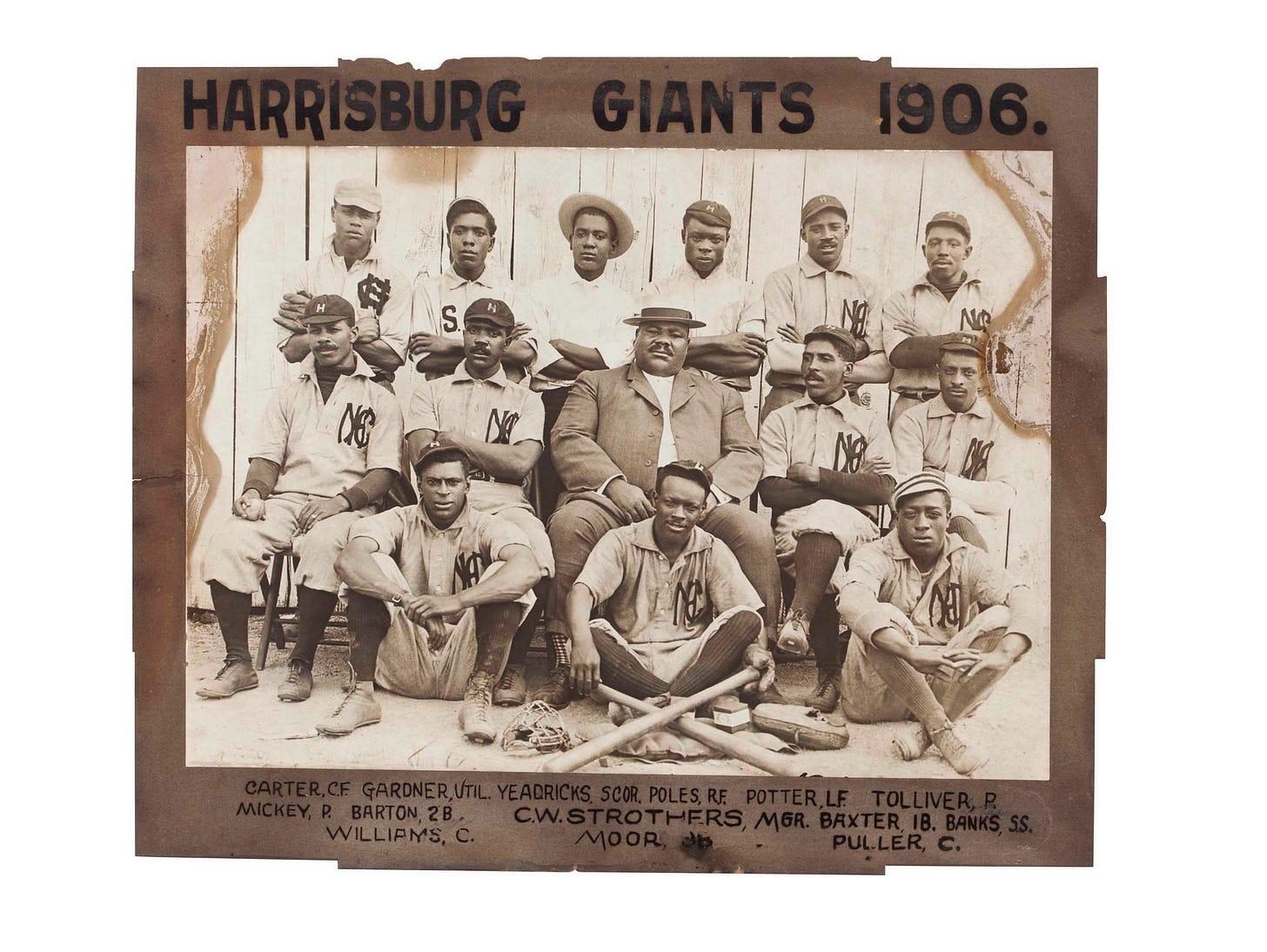
00:01
The title of this one is Tales of Liberation from the Borderlands: Heroic Working Class Liberation and Baseball. So I've been going through this as a political and cultural movement that spans the United States of America, that spans Mexico, that spans Venezuela, Cuba, Puerto Rico. The Dominican Republic.
00:36
Baseball as a cultural movement, foundationally, in the Western hemisphere alone — touches all of these places. We know that in the Dominican Republic, Satchel Paige and Josh Gibson had some major, major impact actually playing for a dictator.
Trujillo, that team in the late 30s.
We know about Venezuela being a haven for some of the greatest Negro League players in history. Cuban League players as well, such as Alejandro Oms, went to play in Venezuela.
We have the Mexican League — where players like Ray Dandridge from the United States of America, Virginia — went to go play. Teams like Veracruz. We're looking at probably the most fertile period being the 30s and 40s leading up to the integration of the American Professional Baseball League in 1947 with Jackie Robinson.
01:52
What I had to ask myself, right — we're looking at this Harrisburg Giants 1906 cabinet photograph. And I asked myself… because this is something that to me holds the utmost magnitude and power. And this is just, this is an old photograph.
A couple of baseball players gathered together for a team photo.
There is really one particularly well-known player in this image, and it's Spots Poles, who went on to become known as the Black Ty Cobb, quote unquote. One of the best hitters in Negro League and Black baseball history. But that's not really what even matters about this photo. What I've realized is that this project... is a liberation movement of the working class.
And you can think about the Cuban liberation movement in the 1800s leading up to 1900, the actions done by people like Jose Marti and Sabourin, as well as Dihigo meeting Che Guevara in the middle part of the 20th century; actually providing money to the Granma expedition to overthrow Batista.
03:23
We look here at this Harrisburg Giants independent team for black baseball that was assembled in early modern America, early 1900s. We look at what Rube Foster did in the 1920s with the Negro Leagues — creating an organized professional black baseball league. We're looking at a network, right? We're looking at a network of possibilities that are being fostered for the Black American working class, the Cuban working class, the Mexican working class, the Venezuelan working class, and the white American working class, particularly the immigrants, in the early 1900s — through baseball.
And that political possibility is multiple. It's a possibility of life, of sustaining oneself — being able to sustain a basic economy of food, shelter, water. But then we are also looking at the essential political possibility of culture. And this is really what's at the essence and root of real political revolution. And we went very, very deep into this in the Cuba essay.
04:53
The reason why baseball is so important in this and why this entire project — which now spans hundreds and hundreds and hundreds of pages — why this project stays centered around and with baseball is that you could look at liberation movements across time and across history, right? Whether that's the French Revolution, the Haitian Revolution, Cuba, the revolutions in America, the revolutions in Rome, Egypt, or what have you. The real idea here is what is the tie that binds these modern liberation movements? What undergirds them in the sense that food, water, and shelter and equal rights are of the utmost essence?
That there must be a sustenance in the sense of a passion, in the sense of a culture, in the sense of a way of life. And what I see when I look at this photo, as well as the other photos we've examined, such as the Cuban baseball league photos… and I've seen some really great Mexican league photos as well, particularly including players like Ray Dandridge or Ramon Bragana.
You see with these players this fertile international network of communication, of participation, of immigration all around baseball. Black Cuban players standing side by side with native Mexican players. Black American players standing side by side with Cuban players on American soil. Cubans of great legacy who grew up in sugar mill townships on Venezuelan teams. Satchel Paige in Puerto Rico; in the Dominican Republic.
06:48
There was a relatively famous, perhaps unknown to many Black American baseball player by the name of Barney Serrell, who played for a while in the Negro leagues, and he received a better opportunity, better economic opportunity in the Mexican leagues — and he went on to become renowned as one of the best Mexican league players in history. He travels down there and never leaves. Similar with Ray Dandridge — he leaves Virginia USA, where he grew up playing in the sandlots… to go play in the Mexican leagues and he actually gets to the point where he might have an opportunity to play Major League Baseball in the US, but he decides to stay in Mexico with his family.
We're looking at something that is the creation of a liberation front for these working class people of all backgrounds, of all races, and of all creeds in the Western hemisphere as a cultural movement. As a revelation of a cultural technology that sweeps the entire Western Hemisphere like an international fervor of participation.
It's almost like baseball is the disguise for this political possibility.
07:44
And as we discussed with Sabourin, his national revolutionary ties are so direct in the sense that he's actually funneling money from baseball to Jose Marti and the Liberation Front in Cuba. It's such a direct tie there. Same with Dihigo mid century in Cuba with Guevara. It’s almost as if history repeats itself.
But when you look at this political baseball movement of the early 1900s, particularly in the United States — with the Black Independent baseball teams; going into the Negro Leagues with Rube Foster, what you're really witnessing is the organization of a political and cultural ecosystem that is allowing for Black creative movement. A Black organized community which is able to sustain itself through the participation in and creation of culture as a source of joy, as a source of community gathering, as a source of pride. And it is international. You see Rube Foster and Home Run Johnson and Pete Hill on the Habana team in Cuba in 1907. And you realize and witness this radical possibility fomenting in real time through that image relic of history.
Similar to how we looked at Stan Coveleski and Lefty Grove growing up in the Rust Belt in these coal mining towns. Baseball serves as a form of political and economic breakthrough. Of the possibility for life, another life. A way of being that allows for survival; even prospering and joy through communal participation in the cultural movement of baseball proper.
09:01
This ecosystem has many different facets and it functions differently in different places and different times. But the one constant is baseball as a political and cultural force for this political underclass of working class people. Whether they be farmers, whether they be former slaves, whether they be factory workers, whether they be miners.
Whether they be, again in Dandridge's case, sandlot players from Richmond, Virginia. There's a very rich, I'm doing this talk from Virginia now — there's a very, very rich black baseball history in Virginia with some of the greatest black baseball players ever to emerge from this state, both in the South and in the North of Virginia. They span all across the history of the Negro Leagues.
09:57
You have.. it's a locus and a reason for gathering and a reason for creation. When I look at the history of Negro League's uniforms and the logo designs, what you're really looking at, as well as a cabinet photo like this Harrisburg Giants photograph — is an artistic and creative movement through sport, through active physical participation, which is an organized network. This is the creation of an international ecosystem of art. Even down to the form of the uniforms and the photographic documentation and written historiographies.
Players, managers, coaches, executives, such as Rube Foster, who performed all of those roles, to create a sort of sovereign state within a highly oppressive and repressive environment of political empire control and dominion — which is what we're speaking about when we're speaking about the United States in relation to its black population; when we’re speaking about the political turmoil in Cuba and the revolutionary movements before and after the crux point of 1900, which is the national liberation of Cuba and the integration of Cuban professional baseball at the same time. The composite, commemorative photo of Sabourin’s Habana team was printed in 1886-87. This year marks the abolition of slavery in Cuba; it is a massive turning point in the national liberation movement and the political composition and organization of Cuba proper.
11:14
We're looking at a sort of political underground, a cultural and political underground of subversive participation, travel, movement, creation, and celebration of life.
Whereas otherwise — you have to think about what the political futures and personal futures of someone like Satchel Paige or Ray Dandridge or Jose Mendez or Alejandro Oms would have been.
Alejandro Oms was born in poverty and died in poverty, but his participation in baseball created a life for him. It created a life for him in Cuba; in the United States with the New York Cubans. It created a life for him in Venezuela. Just the same as it did for Jose Mendez in Cuba and in the US with Kansas City.
We're talking about people, poor black Cuban people, poor black Americans, poor white immigrants in America, poor Mexican native baseball players. This was not a sport that was an aristocratic pursuit… meaning the people who played on these teams came from social positions that — there's really nowhere else to describe it but as low class. Coming from poor sugar mill towns or from the coal mining towns or from the families of ex slaves both in Cuba and the United States. The amount of political, social and cultural disempowerment is perhaps no higher for these marginalized groups than this period of time in history. In both Cuba and the United States, slavery is functionally over in terms of abolition but its legacy remains. It deeply remains. And it manifests in who is allowed to participate in what; where — as well as who is seen as human and afforded the resources to survive. White American immigrants like Coveleski were effectively sacrificed to the industrial power of the American mines. They lived and died in these rooms, deep in the earth.
And baseball, as it emerges in the modern context at the turn of the 1900s, functions as a way of working class intercommunication, interconnection, and networking. A way of survival. A way of being; a way of forming a collective, communal story of ritual empowerment.
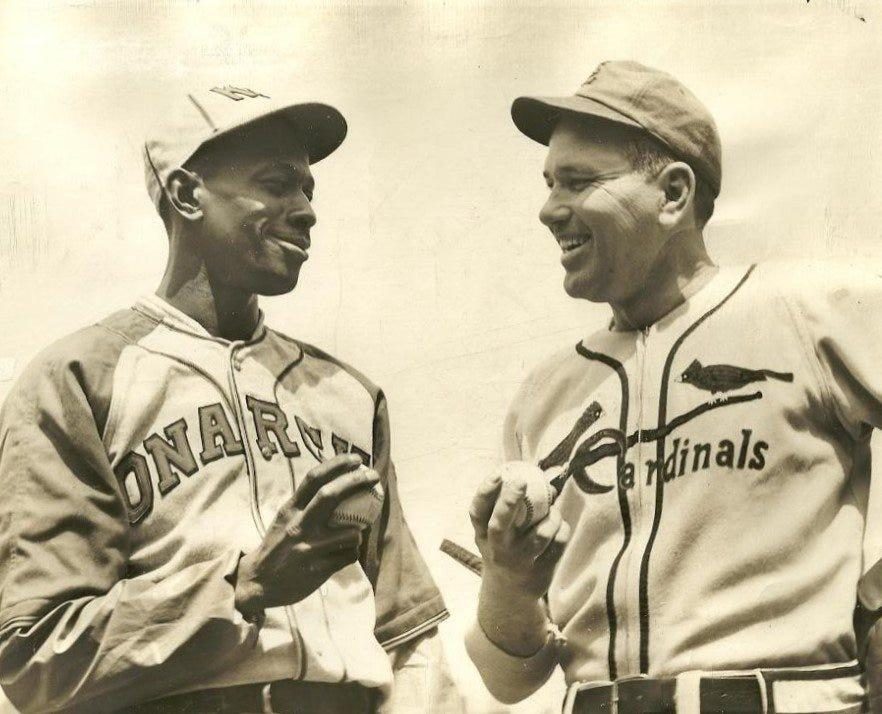
You can perhaps see this no more clearly than the... the famous picture of Dizzy Dean and Satchel Paige standing together smiling, and they're clearly talking about pitching or just connecting, right? You have Dizzy Dean on one hand, who was a very poor farmer from the Midwest, whose parents were sharecroppers. And then you have Satchel Paige, who growing up in the rural American South — there wasn't even the ability to understand or comprehend his real birth information. He told his story. The world didn’t. He was not remembered until baseball remembered.
13:57
You have people who are — across class, racial, and national lines — are classified as a political underclass that is beneath human, in the sense that they don't even exist.
There is no political identity for these people other than as laborers. They are political sacrifices of the engines of greed that power the empires of modernity. And they labor unidentified in St. Louis, in... in Arkansas, in Manati, in Mexico City.
So what we're really talking about is this underclass of lives, which are the lives of incredibly poor working class people across time and place, particularly in this very fertile period of 1900 to maybe 1945, 1946 — that have formed a network based on breaking segregational laws of cultural participation. Black independent baseball, the Negro leagues, Cuban professional baseball, the Mexican leagues, the Venezuelan professional leagues. This is a subversive underground network, which is really functioning beneath the highly racially discriminatory and class obliteration of American baseball as a power monopoly of industrial elitism and political control, manipulation, and siphoning off of the wealth and results and work of labor power.
Again, this is not just in terms of baseball — it is the political reality of empire with its roots in the exploitation of the Western Hemispheric reality; the resources and humanities and cultures therein.
This is something we discussed very clearly and thoroughly in the Federal League and Deadball episodes. Talking about owners like Charles Ebbets and how the struggle for players to obtain working wages functioned in early American baseball — culminating in the Federal League and the the trust suit of the 1920s with the MLB.
16:24
So you have that kind of surface tension that's very visible and clear and usually discussed not only in American cultural history, but just baseball history in general.
Beneath that, you have this deep and profound undercurrent of the oppressed and repressed Black American and Cuban and Mexican and Venezuelan working class communities, which are really under assault by American imperialism in South America and the Caribbean — which is an ongoing project that you see very clearly in Cuba’s history of modernity — but it's also very, very easily identifiable in terms of Mexican laborers who were brought over the border and the Bracero programs of the 1900s to labor, but they're not given citizenship.
This is an ongoing tension in the United States of America and in the Western Hemisphere at large, not only politically in terms of the United States' assertion of empirical power in the Western Hemisphere and the attempt to extract resources from places like Cuba and Mexico, but furthermore to see — fascinatingly — that baseball as a cultural export… I think almost subconsciously and non-deliberately in terms of its creation as a cultural artifact and technology — functions as an underground network of the ability for working class peoples to create profound histories and meaning and lives in this increasingly ratcheted up global tension of imperial powers fighting for world position.
Think of Cuba and Russia in the 20th century. Think of, again, the Bracero program and Mexican laborers and the dialogue between immigration and citizenship in terms of people who are crossing over the southern border of the United States and what they are allowed to do as individuals. If they are being seen as humans, if they're being paid a living wage. If they are being considered citizens with the privileges of American citizenry. Why the United States needs them; how it treats those it needs. This is an indictment of the ethics that cripples the cultural possibilities of America; perhaps ironically creates the precise circumstances for one of the most fertile international and political movements of culture in human history.
19:03
Again, this is the main fundamental tension that's occurring in the United States in terms of black baseball as well. This tension of segregation, which actually cripples American professional baseball and deprives the sport and the culture of the possibility of really achieving true greatness. This is a moment where you could have people like Oscar Charleston and Jose Mendez playing side by side with some of the best of American professional baseball history as an industrial league which is dependent on the mythology of racial exclusivity to prop up its perceived dominance and ability.
This is a moment where baseball as a culture and as a political movement is deprived of the true wealth of what is possible because of this level of discrimination and segregation in order to preserve a false complex of wealth and power and influence for the very few. This is both the power struggle economically in baseball at this time between owners and administration of the league itself and the players; furthermore this racial segregation which separates and thus disempowers the legacy of greatness and possibility of the whole.
Even these white baseball players at this time are not being paid living wages, all but the very best of them, such as Babe Ruth or Lou Gehrig. These are the first real famous big contracts — Walter Johnson, people along those lines. Even players like Tris Speaker famously have these drawn out and protracted salary disputes.
20:17
So much of what early baseball in America really is — the real story that's there — is just an ongoing labor dispute. In terms of the Players’ League, in terms of the Federal League — in terms of the holdouts of players and the demands for a fair salary. An ongoing dispute between the key holders to the league — the owners that are paying the salaries for these players to perform their work, their wage — and the players themselves, who often, if not always, come from these deeply impoverished backgrounds... factories, mines, farms — and are looking to achieve life, a working, functional, possible life.
This again is also the story of black barnstorming independent teams and the Negro Leagues as well. This is an ongoing dialogue. It is what draws the greatest Black American players to the Mexican leagues of the mid century. To Cuba in the early 1900s. Political possibility in terms of economies of life and possibilities of creative play. It's not just segregated and separated to the American white professional leagues. This needs to be made clear. There's this ongoing labor tension between the people who own and operate these independent teams and these sovereign leagues and the players who are participating in them.
So the establishment of this international system, perhaps in the most, I don't know, literary way — as it tends to be… is told through Satchel Paige's life and recruiting some of his fellow players, some of the best in the game — to go play for Trujillo in the late 30s in the Dominican Republic. The dictator of the DR is going to pay them fantastic wages. They must win. The winning pitcher gets a bonus every game, so Satchel says, hey, I’ll pitch every game.
This is a network through which players are traveling to obtain living wages, and they're basically going wherever they can get paid.
22:11
In the creation of this subversive network, you have a very, very rich narrative texture and history. You have the creation of life and lives through baseball. Travels to new places and regions. Baseball is the constant; the rhythm. Lives and personalities that intersect through the establishment of this network of barnstorming and professional leagues across the Western Hemisphere. Wires of communication.
Networks and grids that are rigged up. An international history forged by cultural participation.
It's a narrative history where — you usually have working class history portrayed by everyday life, or you have working class history portrayed by revolutionary movements — such as, again, Jose Marti or Toussaint L’ouverture in Haiti, or even the French Revolution and the French Revolutionary movements of the 1960s.
These are movements which, of course, have their own slogans and their own forms of identification such as propaganda — which are themselves art forms.
This is a form of documentary art — which is the creation of a working-class identity in a certain region or nation. But what makes baseball so particular is that the working-class identity that's formed there is not restricted to any sort of nation. It's a Western hemispheric movement of working-class liberation.
23:30
This is not a tension that's restricted to any sort of larger national political force, although it is connected to United States imperialism that's, of course, very active in the Western Hemisphere at the time. But it is a network created that is across all of these different national borders. And so that's why I use the term borderlands.
It's something that is in many ways larger than any one political phenomenon that's located to a specific region or national or cultural identity. This is something that actually creates a Western hemispheric movement of working class liberation. It expands beyond the traditional political movements that are organized around a certain community, identity, environments, any one of these complexes. They are historically locused regionally.
So you see what I'm saying there, there's the hidden and subversive power of that — is that when you see a black baseball player from the United States of America present on a Cuban team or on a Venezuelan team with Cuban players or on a Mexican team with Venezuelan players… what you're really seeing is this incredibly fertile cross-pollination of political possibility which is itself transcending these formerly historical kind of purely national borders and purely ethnic borders, or historical borders of the liberation of the working class. These formerly pocketed silos.
Modernity through baseball as a revolutionary device and travel and communication — doors that are blasted open by the industrial and cultural revolutions of the early 1900s at large — becomes a politically revolutionary device that internationalizes this liberational front… a front packaged perhaps in the most inconspicuous yet clear method, way, and form — in through, and by baseball as a cultural form.
This method and device is transcendent of the sort of traditional role of revolution as a way of uplifting one class or one group of people or one national group of people (typically through violence or direct, explicit political action against governmental or financial powers at large) — whether that's the working class or labor class of any given nation… and moves into and towards a global working class liberation in terms of the entire Western hemisphere at large. It is, in short, a revolution of revolutionary technologies both in expansion of powers and methodology of transmission and transmutation of political; creative, imaginative possibilities therein. It’s a guerrilla internationalism of cultural communication and meeting place. These teams and leagues serve as international hubs for working class culture, creativity, and way of living; thriving.
25:47
This entire half of the globe is captivated by baseball and is as such creating technologies for baseball to become possible. It is a mutual unfolding of the transmission of the communication of baseball as a language; Cuba becomes a main translator of this form to the Caribbean and southwest of the globe. And so you have this sort of migrant network, both north and south, of players like Alejandro Oms going up north to New York, or players like Ray Dandridge going south to Mexico;
players like Luis Aparicio coming up north and playing in the American professional leagues; Minnie Minoso going to the Negro leagues from Cuba and then going to the American professional leagues.
So you can see this cross pollination of culture, which is occurring especially in this period of 1900 to around 1945 or 1946 — because once integration happens in the American professional baseball league, it actually becomes a monopoly and a monopolizing force of many if not nearly all of the best players in the Western Hemisphere, but in the world at large. And with that, comes a further labor and class delineation and demarcation. Its a consolidation of power.
26:44
So you can see the almost sort of fraught distinction there... is that in a lot of ways, this American segregation and this American bigotry is something that actually allows for one of the most powerful international political movements to occur and unfold. This exclusion. It ripples; has effect. It creates narrative movement; it creates an underground of highly political culture. It's almost like you have international and Black underground baseball as a political ideology of liberation and communication and community that is formed in response.
And you have that being a constellation or constellating network or constellating star through which all of these different nations and ethnicities and cultures are passing through and back and forth and exchanging information and dialogue in the form of baseball as a game and as a culture and as a sport. The uniform logos, the semi-professional leagues and the sugar mills in Cuba, the creation of actually an incredibly wealthy Mexican league — which brings some of the best players from Cuba and from the United States to play together.
Again, we're so focused here on the players because the rules of engagement are the same at the executive and administrative level in terms of how the economies of baseball function at scale. Who is taking the money, who is making the money, the owners and the ticket sales at the gates; so on and so forth. How is that generated wealth returned to the players; how much of it?
But beneath that administrative level, it's this network of players. And I'll refer again to Oms, whose career is so fertile — because he's in the United States and the Negro leagues. He's in the Cuban professional leagues. He's on the sugar mill semi-pro teams in Cuba. He's in Venezuela. You have players who are all across the Western hemisphere. They travel and go everywhere, creating legacies in these different branches of this larger tree of the underground of baseball, the political underground. Leaving their mark. Transforming the game and the culture of this network of revolutionary community.
29:04
It's a network for these players and this community at large, which is really creating this possibility in real time through mass intercultural cross-border participation in the sport and language of baseball. So when I look at stuff like this, like this cabinet photo, that's what I'm thinking. Why is this so meaningful? Why is this so powerful?
It's obviously a great work of art and very painstakingly done by the studio that produced this.
And you can see the history all over it. You can see the passage of time, the wear of time. But you can also see within it the creation of this political possibility and community through the independent baseball team, the Harrisburg Giants. And this is not just relegated to one level. It's not just professional baseball. It's semi-pro. It's the barnstorming teams, the independent teams.
And it's the movements between all of those different nodes in the larger network of this underground movement of baseball. The connections that are formed, the histories that are made and the intersecting identities and personal histories that construct this larger network. It is a global political movement that is forged. And then the artifacts which document it and remember it. So when I think of social realism in terms of art, something like this is the perfect embodiment of that.
Because this is in real time the historical memory of that network being formed and being shaped. The possibilities that emerge from this moment are Rube Foster on the Habana team and on the Fe team in Cuba. Jose Mendez on the Cuban Stars team.
Mendez on the Kansas City team.
30:50
It's a very fertile moment for international and global baseball. And international and global baseball, especially in the Western Hemisphere — if we fully remember this moment — is at roots a working class liberation device and a revolutionary device of communication across borders and participation across racial and cultural lines in a cultural phenomenon. It is the revelation of an international and global possibility of working class liberation in practice at the most profound level. Food, water, shelter; the creation of a creative culture of passion, pride, and joy and communal participation. The legacy is profound, enlightening art. And it is all there to be remembered in these artifacts. In the living history of this legacy.
And as such, the power and meaning and weight behind it is something I rarely if ever have encountered anywhere else — precisely because of that cross-border and cross-cultural function. So when you talk about real political possibilities for global working class liberation, this cultural movement of baseball during this period of time — 1900 to the early 1940s, is really just a profound representation of what is possible there… and the beauty and the kind of fertility of community and culture that's possible when you do that cross-cultural work. And a great deal of it starts in, at, and among that revolutionary political movement of Cuba — the national liberation; the abolition of slavery. That bridging, that active bridging.
So that's what I got. I hope you enjoyed this one. I'll see you on the next.
28. The Political Underground: The Design and Architecture of Revolutionary Black Baseball
Jul 28, 2025 · pp. 434–454
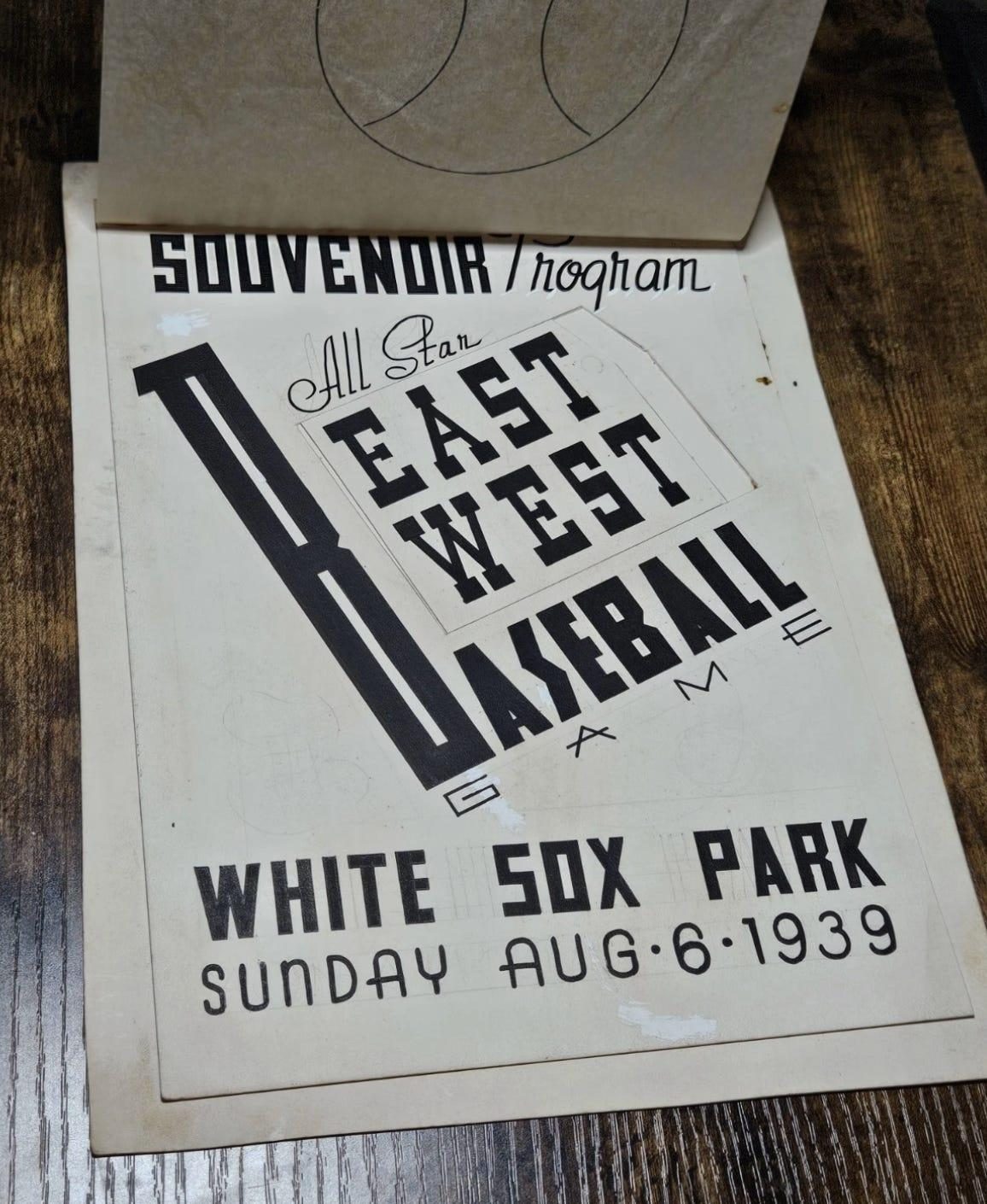
00:01
So I'm kind of piecing this all together here. I want you to think about early baseball as the political theater of America, right? Especially in the periods between, let's say, 1909 to the mid to even late 1950s. And what I mean by the political theater is that it was the stage or the stand upon which the psychological subconscious American dramas… the theatrical heroism that underpins and undergirds the American industrial progressive urge — so when I say progressive urge I mean the force that moves the universe. The force that moves the cosmos; the force that moves a nation or a country or a political identity, social construct, a region, a culture.
So the force that moves in this sense, in a philosophical sense, is the will. It's the force of the will or the thermodynamic force of the cosmos. It's the stellar nuclear fusion of stars. When that is translated down the sort of nesting doll of the the scales and valences and superstructures and circles of size and scope into microstructures of the cosmos, you can localize that phenomenon as a intergalactic universal phenomenon down into the 1910s, 20s, 30s, 40s, 50s, United States of America. You can localize it anywhere in the observable and observing universe. This is the memory of history as a databanks of written and ledgered and transmissed consciousness. Transmissed as in transmitted, passed down, scribed.
01:54
You have different things that compel the human species to reproduce, to survive, to attain a narrative of status — to fulfill expectations placed upon the individual by family, society, culture, to fulfill genetic and biological imperatives, which again are to survive and reproduce. This is where culture gets really interesting. And that...
that humanity in a base biological way is translated and moves through a game, through sport. It is a conversion of the phenomenon of heat will and the biological ledger of genetics into a playful discourse of movement. Of movement for movement’s sake; in this way, art for art’s sake. Creativity as a celebration — this is high culture.
Heraclitus, the Greek philosopher, very early Greek philosopher, pre-Socratic, says:
the cosmos is a child playing with colored balls. He calls it the Aeon — which is the eternal or the grand scale or grand scope of all time, right, which is meant to represent space-time itself or the universal. This intuition of Heraclitus is very astute when you translate it in thermodynamic terms through the scales of human evolution, the grand cosmos, the grand cosmic scheme of genetic evolution — in which humans play a part as one species, at least in an earthly sense, a genetic family that really is the entire Earth.
You look at, again, the differences in the genetic code between a human being and a tree or a snake or a plant… very, very little. It's essentially really the same language and even the same book. So we're looking at creative ways to interpret this. And this is what the cosmos does in terms of biodiversity — it's a cooling system and over time the cooling system from that initial fricative explosion that we think of as the Big Bang, right, or the moment in which there's this immense production of cosmic heat and thermonuclear force that's translated over time into increasingly diverse scales and scopes of being. So you can think of that as the grand cosmic being.
And then that's being translated into all of these different notes and narratives and symbols and signs within the grand cosmic architecture itself. That translation is what we think of when we think of creation or when we think of God or the universe or being itself as the great whole of all things.
04:37
That creativity is the game, is the soul, it is the spirit beneath all things. And that's always what's at play. It's being itself, trying to figure itself out. So with culture, you have this really fascinating mirroring effect that's going on in this grand cosmic architecture, because culture is always at least a little bit about play. Whether that's theater, whether that's art, whether that's sport.
It's always at least a little bit about playing, creating, being creative. And this is a direct mirroring of that universal cosmic impulse of the will itself. The will itself may seem terrifying, it may seem primal, primordial, the unknown, the consumptive urge, the darkness of feeding and sexual desire, etc., etc., etc. But beneath that assumed representation, the beast or even the demonic realm of creation, beneath that there is this pure force of will, this pure thrust — which is itself the creative impulse of the cosmos. That's what's being translated and really, really, really hitting a strong note, a major C, so to speak, in America in the 1910s to the 1950s with baseball.
Because what baseball is, is… it is actually the political theater of America, particularly as it relates to the dynamics of race and class. Power and performance.
Victory and absolution. Failure and triumph. It is a mythic game that realizes these mythic, subconscious impulses. These are men that are playing this game. Women attend the games, but these are men playing this game. So it's primarily a dynamic of race and class. And it's a discussion of who participates, who is prioritized, what narratives and what stories are being seen, how they're being seen, television, radio.
Whose story is upon the script of civilizations? Perseus, Gibson, Paige, Hercules?
06:31
Something like the souvenir program that is depicted here, which is — it's a proof of the program itself… created by an artist who was living in the south side of Chicago for the East West Negro Leagues All-Star Game in 1939. This game was held in the famous Comiskey Park in Chicago — the field typically used for the Chicago White Sox of the American professional league.
It is — the event itself and the artistic proof as a communication of it — a construction of a political and cultural phenomenon located in the stadium itself.
And the very architecture of the stadium — in the Colosseum sense — is a theater.
It's a political, cultural and social theater that is playing out the fraught dynamics of in groups, out groups; inclusion, exclusion of humanity proper as it is located in the United States of America. The emerging and then primary world power at this time in human history.
So this is incredibly important. The only real comparison that you can make is the Colosseum of Rome. And the dynamics there are eerily similar in terms of who is participating in these Colosseum games. The idea of the Olympics in a Grecian sense prior; the idea of the gladiator, the idea of enslaved people performing for the citizens of the civilization or of the empire. This is something that actually is almost, it's mirrored hundreds and hundreds of years later in the Florida Hotel League in the very early 1900s in the United States.
While the Cuban leagues are being integrated just a little further south on the island of Cuba, this Florida Hotel League is assembled where the owner of these hotels brought some of the best black and Cuban baseball players of all time to play for the guests at these Gilded Age hotels. Breakers; the Royal Poinciana Hotel, Palm Beach, Florida. Flagler was the owner, Henry Flagler.
And then you have this very, very, very powerful dynamic of exclusion, racial tension and segregation from the Jim Crow era into the 30s, 40s, 50s that's broken by Jackie Robinson in 1947 — the moment he steps out onto that field of American professional baseball… formerly whites only. What he's doing is terraforming the social and cultural political mind and the landscape of America forevermore. And the reason why it is forevermore is because baseball is the cultural mirror of the consciousness of the landscape of the American psyche. That's just how important baseball is and how invested people are in baseball. 40,000 fans attended this East West baseball game. Fans of all ages.
09:30
This was one of the most well-attended baseball events or cultural events that was occurring in America this period of time, consistently. And it was constructed by the black baseball movement — a grassroots movement spearheaded by Rube Foster in a YMCA meeting in the 1920s. You have to think that the scale of the population in America was radically different at this time as well, compared to the 2020s.
So what I'm talking about… I know that it's kind of like a complicated introduction.
But what I'm talking about is the cultural mirror of baseball as it relates specifically to segregation, racism, and slavery in the United States of America — along with the abolition of slavery and the political consciousness that is shifting and transforming through the apparatus and technology of baseball itself. This is a political imagination of a collective in and through which baseball is a radicalizing force of higher consciousness. Play itself as enlightened throught.
So I think of John Brown. It makes me think of John Brown, the abolitionist. He dies in the late 1800s. One of his last letters says he does not think that the consciousness of the nation can be changed without bloodshed, that these things are so deep rooted and deep set. And I think about that and I think about the cultural technology of baseball and what we've been discussing in terms of a working class revolution that's occurring across the entire Western hemisphere. It's the creation of a working class sphere of camaraderie, of culture, of participation; of events that is inclusive — that includes games, includes music, it includes food, it includes people from such a diversity of experience and backgrounds and cultures. It's a subversion. It's an underground movement.
And so I think of that. And then I think of these Negro Leagues All-Star games, which actually became more popular than the All-Star games in the segregated white league, the quote unquote American professional league. And then I think about that moment of convergence. You have these parallel lines that are destined to intersect, which is the train of Rube Foster's Negro leagues and the train of the American white professional baseball leagues — which actually a little bit before 1900 were not actually segregated and then became segregated in very strict terms.
11:51
You have renowned managers like John McGraw — who went to Cuba and watched a lot of the black players play in America as well; was ready to offer substantial amounts of money to players like John Donaldson to join his teams. Amounts of money that would break contract records in terms of the existing contracts in the white American professional baseball leagues… because of what he witnessed, including players like Jose Mendez in Cuba, for instance. You're watching this collision course. And so you have people like McGraw; you have people like John Brown, the abolitionist — who are witnessing… there's this political consciousness that's fomenting, and then you have these early adopters, or these revolutionary figures who are ready to make this change in terms of an integrative revolutionary, collaborative bringing together two formerly excluded and exclusive in groups and out groups to make something better, greater, fundamentally more powerful, stronger, more creative.
So you're looking at this dynamic tension between outmoded political consciousness and perspectives with the possibility for new creation and novelty. That's the revolutionary mode. There's a famous quote by Hannah Arendt, the most incendiary revolutionary the day after the revolution becomes the greatest conservative. And I challenge that quote. I say it's actually that the mode of being revolutionary is a form of consciousness that is always seeking to revolutionize. It is unceasing. Perpetual.
Always moving forward into a greater, newer, integrative collaboratory fusion. And I ally that directly with that creative, innovative force of the cosmos proper, which is a rapidly cooling, diversifying, expanding in perspective, multiplying in representation and symbolism. It's an added complexity. The fusionary furnace and heat movement of a star is perpetually in recombination. It is always further in burning and creation.
So when you think of the creation of all of the different diversities of being that inhabit planet Earth, whether that's animals, plants, et cetera, bacteria — you're looking at an incredibly complex neurological ecosystem that's all mutually interdependent, which itself forms the world, so to speak. If we were going to conceptualize world, that's what world would be.
And so what you're looking at is it's almost like a mind game of consciousness in terms of what is being complexified and what is being added, what is being included.
And you have this mirrored again in the cultural stage. What is being incorporated into the body of culture? What is being included? What is being innovated? What is being created? So this souvenir program to me is actually such a great example because what this is showing in real time is a black print artist in South Side Chicago preparing the proof for the souvenir program of the East West All-Star Game in 1939.
The back of the program actually has a light drawing of maybe someone like a bartender and there's a bottle; it also has what looks like a name and an address. This is just an artist. This is an independent artist who is who is creating this document and I have I have a similar one. It's a broadside from 1947-48 from the Negro Southern Leagues.
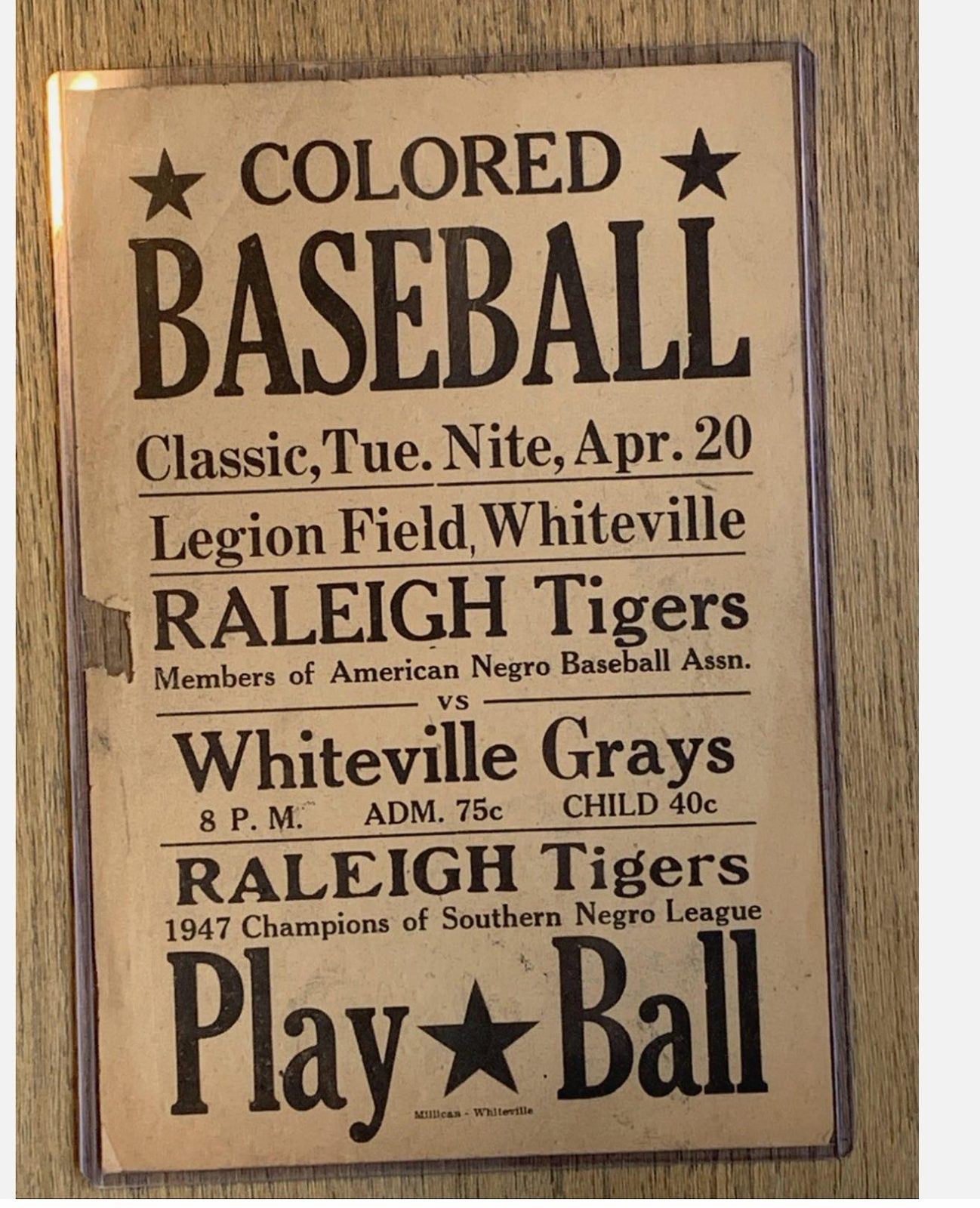
15:49
This is actually happening right at the moment of integration, right, which is what makes that broadside so interesting. And what it is documenting is it's literally just a piece of fibrous paper that was stapled up on a telephone pole, letting people know that black baseball was being played that week or that night. And just giving the date and the time.
Colored baseball classic. Tuesday night, April 20th, Legion Field, Whiteville, Raleigh Tigers, American Negro Baseball Association versus the Whiteville Grays.
Admission 75 cents, children 40 cents, 8 p.m. Raleigh Tigers were the ‘47 champions of the Southern Negro League. And it just says Play Ball at the bottom. What we're looking at here is such a fascinating local history of the play bill, so to speak — the most direct typographic rudimentary form of communication. It is communicating the exact details. There is obviously the design element of the typography itself, but there's no space wasted here. There's no symbol or no sign wasted. It's communicating purely the essential.
And there's this cartoon on the back. This is from an independent printing studio.
You can see at the bottom it says Millican Whiteville, which I'm assuming is the name of the printing group or the print shop that did this, as opposed to on the back of the East-West program. You're looking at what is likely just an independent artist, a solo independent artist who is participating in this cultural event; the creation of this cultural event.
So you have to think of it as an ecosystem of culture building. Print shops, designers, artists, uniform orders. A subversive network of collective, communal engagement to produce these events when they could be produced, where they could be produced.
To advertise, organize; continue them.
You have maybe the biggest, one of the biggest cultural events in America at this period of time, 1939, the East West All-Star game for the Negro Leagues. Josh Gibson plays in this game. Mule Suttles plays in this game. One of the teams is managed by George Scales. You have some of the best Negro Leagues players of all time that are participating in this event. This is taking place actually in Comiskey Park and it took place in Comiskey Park for over 20 years. Every year for 20 years.
And this year was the first year there were two All-Star games. The first one was the usual in Comiskey Park. And the second one was actually in New York at Yankee Stadium, I believe, about two weeks later.
19:31
This is an ecosystem where an event is taking place; where many different nodes of individual consciousness, perception and subjectivity are meeting and converging upon this massive stadium, this coliseum for this theater of baseball. We talked about the spiritual development through the practice and the art of baseball, but what's really happening in the moment and in the event and in the phenomenon of baseball is that many different people are converging to witness this spiritualization of the ritual instinct and cultivation of the will.
Which is athleticism, which is sport, which is the creativity of physical movement.
Again, connecting this back to the thermodynamics of the physical body and the thermonuclear status of the universe itself — which in a nesting doll sense, in terms of scales, right, scales of being, the human being is actively and imminently taking part in at all times. That again is the total self from macro to micro in terms of different concentric circles of greater dimension in a galactic organizing sense; in a more precise, specific localized dimension. This is detail. A zoom function.
So when we're talking about, again, in a local sense, the 1910s to the 1950s in America through the lens of baseball, what we're talking about is we're looking at the cultural aperture for this perception and how massively popular baseball became as an aperture. And through that massive popularity, baseball itself came to be the vessel through how the collective consciousness was established, changed, evolved as a localized cultural phenomenon. You see what I'm saying? This is something that's common to movies. It's common to music. It's common to the moving image. It's common to painting. It's common to architecture. These are the ways that visibly consciousness structures and is structuring itself.
This is a real and literal definition of culture. So if you have a mass art movement, or you have a city like New York, or you have a very popular film, what's going on there is many different people are projecting their visions and ideals and perceptions of reality into this space — whether that's a space of images, whether that's a space of a theater or a stadium, and that space creates a psychic architecture through which people perceive reality as a consensus form.
So when you have laws and regulations that determine the structure of a nation or a civilization, such as religious codes, cultural codes, things that you should do and should not do — that is an unconscious structuring of the psyche, which is a patterning of subjective behaviors. If you do not behave in this way, that's something that is immediately identified in a mass sense in terms of a breach of that cultural code, that religious code. It's very similar to the Ten Commandments in the sense, thou shalt not kill, so to speak, things along those lines.
So baseball as an aperture, what you're looking at with these two artifacts are actually subversive underground code making systems through which meaning, knowledge, information was communicated to organize, project; create the foundational architecture of these events. And the fact that they are so local, so regional, and so independently designed and constructed gives you access to the direct ground of humanity — which is the majesty and the greatness of the Negro Leagues.
So people, there's this common kind of quote that circulates and the quote is, what could have been in regards to the Negro Leagues? But I look at that and I say, what was. Because in my perception the Cuban leagues and the Negro leagues are such a greater and richer phenomenon — precisely because of how do it yourself independent they were. Even in terms of the Cuban leagues, the radical architecture — this was a professional league and you look at how it was created and how local the nation of Cuba is in terms of being a small island nation and what what they were able to accomplish and what they were accomplishing. The radical inclusion.
The international movement. As opposed to the corporatized industrialized architecture of American professional baseball… you have these subversive events and systems through which the Negro Leagues creates itself. Through independent artists, through independent print shops — who are constructing the technology and the cultural forms through which all of these disparate baseball teams are communicating.
24:15
The Negro Leagues themselves are created by Rube Foster and other black baseball administrative and executive figures gathering in a YMCA in the 1920s. This is the creation of a formal informality through which baseball as an architecture is being organized locally. Rube Foster is a player, he's a manager; he's also an organizer, right? So this is occurring very grassroots, this is occurring at a ground level. This is not a massive industrial system, which to me is a lot less meaningful. It takes so much of the humanity out of what it takes to construct. And what you're looking at here are documents of construction.
These are documents of primary architecture that are being made by local print shops. They're being made by independent artists. The league itself and the cultural runoff and detritus and symbolism — the literature of the league itself is being created immanently. On the ground by individual efforts organizing to produce collective meaning in real time. In a non-industrial, localized, communicative, organizing and reorganizing, assembling and resembling way. This is real time creation. And they are constructing the possibility for this imaginative event.
And it's no coincidence that teams like the Black Yankees and the Negro Leagues actually would sign contracts to play at Yankee Stadium, or the East West baseball game was played at Comiskey Park — as it's notated here, the park of the Chicago White Sox, the major league professional baseball team. This is a subversive repurposing of the architecture of America and the bottom line cultural systems and dominant narratives… a subversive repurposing of them to accomplish communal organizing events at a grassroots level.
This is a revolutionary practice. It's something that's occurring again in the political underground through the actions of individuals who are collaborating to construct a cultural event for a group of people who are being actively excluded, marginalized, repressed in the dominant cultural architecture itself.
26:15
So when you look at, again, those two trains, right, the train of the Negro leagues and the train of the white American professional baseball league — and the moment they converge with Jackie Robinson stepping onto the field in 1947 — you are actually looking at the convergence of a underground political movement of black independent baseball… a movement that goes back to the early 1900s and the late 1800s with barnstorming teams. That goes back to the early 1900s with travel to Cuba, as well as toward the mid 1900s with the Mexico teams and the Venezuelan teams.
You're looking at a collision course of an underground radical political movement of inclusion, meeting the exclusionary dominant cultural infrastructure, architecture and narrative, which explodes these two forces of revolution and stasis, oppressive social structure of class and racial and gender based exclusion. Meeting, this is the architecture of the American political consciousness at large — that white people are in a place of political, social and cultural supremacy, and thus dominate the American institutions.
Meeting this underground architecture that has been growing and growing and growing since 1900 and even prior, right, in a political sense of liberation and abolition — but growing since 1900 in terms of an organized force of the technology of black and international professional baseball as a cultural technology of community and underground communication and political and social organization.
Those two forces are meeting and there is an explosion of the American political consciousness proper because what Jackie Robinson stepping onto the field represents is the utter rupture of that dominant narrative being reflected in a representational symbolic sense to the greater American political consciousness — signifying the end of an era, the end of an era of discrimination, exclusion, that there is no going back once he steps onto that field.
To me, it is perhaps the greatest moment of the civil rights movement that could possibly occur because what Jackie Robinson is doing is he's disrupting the primary American cultural technology, which is the narrative and meaning making system in the American political consciousness and the American political mind at large. He's disrupting that by stepping onto the field and it's, it's an action. It's an event, again, to go back to athletics and sports and the force of the will. It's something that happens in real time and his participation in the physicality of the phenomenal and phenomenological event of baseball.
The terrain of the stadium, the action of stepping onto the field of play, is itself a rupture in that exclusion which you can't, it cannot be reclaimed by the American political consciousness because it is an event that has occurred.
29:25
So that's what I mean by this radical novelty and meaning making through the construction of this underground revolutionary political system, which we discussed, in a Western hemispheric sense — players like Luis Aparicio, Minnie Minoso.
And then you have the players that they never actually rupture the institutional system of American professional baseball, like Jose Mendez or Ray Dandridge.
You're looking at this incredibly powerful, creative, independent movement that forms across national borders, across racial and ethnic borders, even across linguistic borders, right? You think of Mexico and Cuba and then black American baseball players from Virginia going to play there.
That system itself as a meaning-making system and a network that is incredibly human and profoundly interconnected across borders and racial and ethnic and cultural constructs — is itself the great meaning. It is itself the great construct of power and art and creativity. And you look at a document like this program or the flyer, the broadside advertising the event, there's such incredible power even in the typography and what is being conveyed with the direct urgency that it's a form of art that is so expressly, directly, political and social. Because it's a form of communication — it pulls no punches in the immediacy and directness of what it needs to say. But it also draws the eye in terms of the creativity and the organization of what it is saying. How and where it is saying and constructing itself in the dynamic of the paper. The lettering. The form and movement of the speech in space and time.
So you're really looking at this incredibly fertile and beautiful movement of creativity. It's not only just in the design and the typography of these events, it's in the events themselves. It's again, I spoke about the uniforms and it's ultimately in the greatest sense in the creation and construction of this network of interconnection and communication — which is the traveling of people to construct different organizational bodies, like the early Harrisburg Giants or the Veracruz team in Mexico, or the team for Trujillo in the Dominican Republic with Satchel Paige.
All of these different movements, right? Its history as a complex, maximalist symphony of creative cultural, social, and political genius. It’s across languages, borders, time. There's different players who are gathering together wearing different uniforms and constructing different political events of social and cultural organization. This is a meaning-making system and a grid. And all of this is occurring beneath this steady fixed constant organization of American white professional baseball, which has several ruptures, like the Players League or like the Federal League — which are ruptures of labor organization, which is the phenomenon of class conflict occurring within American baseball and the cultural architecture of American baseball which is something that is being discussed within the segregated ethos of whiteness, the construct of whiteness in terms of the white owners, the white industrialists and the white economic powers with the poor white immigrants and working class professional baseball players within baseball, such as Walter Johnson or Dizzy Dean.
So there's that fabric. And then you have Dizzy Dean who barnstorms with black baseball players. And then you have other white baseball players who barnstorm with black baseball players and Cuban baseball players. You have players like Christy Mathewson who go up against these players, both in Cuba and the United States. But the meaning making system in terms of that dominant narrative is so fixed and it's so constrained by its fixity, by its conservative nature of what it excludes. And so much is being excluded by white American professional baseball that you have this entire shifting ecosystem by necessity — which you can see very clearly here in the design architecture of the program and the flyer. It’s an immediacy. It’s an announcement.
An exclamation point. Here! Now! When!
33:36
This shifting ecosystem by necessity, which is art within art within art because it's so creative, because it's so fomenting in the humanity which is constructing it of alternatives, of possibilities, of collaborative ventures. It’s so constructed and constructing in real time — away and apart from the rigid stone of empire and the empirical laws of civilizational in group out group exclusion for political power and maintenance of the static, fixity of myth which defines the American political consciousness. It shifts like frozen molasses. Less than glacial. With profound reluctance. And thus it misses the moving music of art.
Satchel Paige picks up from New Orleans, I believe, and just heads off to play for Trujillo because of the offer. He packs his bags, he tells Josh Gibson and a couple other players, let's go. This is what we got. This is what we're going with.
So you have the richness of this almost, again, it's an improvisational ethos, which is represented fascinatingly enough, or perhaps clearly and cleanly enough in the music of the time as well. Satchel Paige hung out with Count Basie in Kansas City as a very culturally rich environment. Louis Armstrong is rising in the American South; New Orleans and into New York City. Two men nicknamed Satchel.
You're looking at the architecture of black culture, black music within America, as well as black baseball. And this level of creativity is just not reached by the dominant exclusionary ethnocentric architecture of white American professional baseball. If anything, you look at the creativity that's present there and it's lacking. There's great beauty in the dead ball era photography. There's great beauty in the design of the...
American professional baseball uniforms of this period of time of segregation. But when you look at the groundedness and the richness and the humanity and the movement of the architecture of black baseball in terms of the Negro leagues and independent teams of the early 1900s — even the photography, cabinet photos, et cetera, the print and design material — as well as with Cuban baseball, you're looking at a radical freedom through improvisation. The grounds are shifting. The terms are shifting. The historical movement is dynamic freedom of possibilities. It is a open field of art form. A canvas freed from institutionalized laws of the out group legislative bureaucracy.
35:29
It is a finding a way that is breaking down the institutionalized racism and segregation of these cultures which fail to metabolize creativity through change and thus are stultified forces of will, delimited forces of will — which are themselves trying to hold on to a myth, a pseudo reality. A dream of fixity of separation, of difference, of supremacy, of power. All through propagation of images and narratives to try to retain an impossible, delusional past in the face of a real, shifting, creative, revolutionary present and futurity.
And in doing so, the stultified failure to change is the suffocation of political possibility through creativity, which again, it does go back to that quote, what could have been — but what could have been applies so much less to the Negro leagues than it does to the white American professional baseball league. What could have been for them if they had included black baseball players and Cuban baseball players, right? What could have been if global barnstorming and integration was prioritized, not banned? If there wasn't this intense racial anxiety of exclusion and subjugation — which goes back to the profiteering greed obsession of white American culture and the ethos of greed and consumption and supremacy of majority and minority of power in that social and political construct of America… the nation and the civilization proper.
So this is itself, the great secret of what these civilizations tell, right, is that their greatest movements occur in the margins, they occur in the shadows, they occur in the underground.
36:57
The political underground of civilization. Everything great occurs in the political underground of civilization. It's like the story of Diogenes and Alexander the Great.
Diogenes is living in a wine barrel and Alexander the Great wants to meet him and have a conversation with him and he's like, what can I do for you? I'm Alexander the Great. Diogenes says, just get out of my sun — because he's standing in the sunlight that Diogenes is attempting to bask in. He's sitting in his wine barrel. And then Alexander the Great says, if I was not Alexander, I would be Diogenes.
The idea there is that you probably shouldn't be Alexander, right? His life was a very unfortunate life. He attempted to conquer as much of the world as he could and was very severely injured, very far away from home and comes home and then dies. All for nothing, really — other than for the pursuit of power, the pursuit of control.
And you see this over and over again, it's a pattern in human history — is that there's this consumption and presumption of power, this desperation of power, which undergirds civilizational movements… which are the attempt to create control groups of greater than and lesser than, which is usually delineated through ethnicity, class, racial dynamics, religious dynamics, you name it. It’s all to create a political overclass of elites who claim to possess this or that. But this whole time, it’s this utter madness of meaninglessness is going on. Everything is devoted to maintaining power at all costs. Its utterly empty. All of the energy is consumed and consumptive in this utter void state. Utter meaninglessness and emptiness. Time and energy wasted to power-void.
Meaning is being created at the ground level through cultural architecture — which is the improvisational construction of meaning-making groups and cultures and communities which traverse bounds. They go, they traverse boundaries. They go across language. They go across national borders. They go across religious and racial and cultural borders. And that's the creation of a richness. It's the creation of a human richness, a tapestry of profound difference in color and contrast and vision and linguistic which cannot be captured and cannot be purchased and cannot be controlled by these attempted structures of political domination. It’s the real meaning and poetry of humanity. These civilizations live and die and burn in meaninglessness because they're pursuing political power for nothing. They're caught up in this survival mechanism, which is the catechism of... how to describe it, basic biological survival, they need to pursue power to survive in a jungle of competition.
And all the while, there's this more advanced, more articulate, more communicative, more creative of meaning and imagination social and cultural and political system — which is the underground of these quote unquote, great civilizations. It’s the real art form of humanity and humanism at work. And that underground is the human community and connection which is formed through these political theaters of grassroots construction, which are not the massive civilizational architecture of the collective psyche proper, but are rather the independent constructions, almost like creative or artistic movements of different communities within that architecture, which are usually excluded, which are usually marginalized, which are usually repressed or suppressed in a cultural sense and political sense and an economic sense.
It is like a traveling shifting of terms. A systemless system which moves; accepts and flows and moves with change. This is the very principle of a successful athletic practice. The terms and conditions of the body shift and change. Adaptation.
Learning in real time with what is called for in the time and space of the body proper. This is the nature and essence of becoming within being. The movement of the fire within essence.
40:18
And they are the ones that are actually creating the meaning that that civilization will likely have.
That when all of the detritus of distraction and commerce goes away; these civilizations perish, what remains is the actual meaning-making structures always made in the political underground, always experienced in and through the political underground, through struggle, through turmoil, yes, but created in and through that political underground. This is the political realization of humanity. Of the expression and possibilities and potentials of humanity through inclusion, collaboration; the increase of diversity in the symphony of space and time which is the production of the epic art of culture.
So that's something to think about here. Pretty big episode. Good to talk with you.
I'll see you on the next one.
Appendix
Additional passages & variants
Additional passages / variants
Passages found only in the Substack editions of these orations.
Substack note on chapters 1–3 ([Archival Episode])
I am currently in the process of archiving past lectures and talks. This is one of them!
Substack subtitle of chapter 4
An improvisational oratory in four parts
Substack edition of chapter 8 (Baseball Hellennia)
It's almost like Planet of the Apes, where at the end of the first movie Charleton Heston finds the Statue of Liberty and he's like oh they did it here, whatever — I wanted to throw that in there — it's a little humor.
Substack edition of chapter 10 (Perseus, Mantle)
And I was thinking about this, I'll pivot a little bit because I'll share this image. This was going to be another part of the essay and image that I'm constructing here. It's… I'll just pull it up right now.