De-civilizational Violence: Notes on a Modern Iconomachy
Canonical source: local (9a. De-civilizational Violence.docx)
DE-CIVILIZATIONAL VIOLENCE:
NOTES ON A MODERN ICONOMACHY
For it is not for this world,
it is never for this earth that we have always worked,
struggled,
troated of horror, of hunger, of poverty, of hatred, of scandal, and of disgust,
that we were all poisoned,
although by these things we may have all been bewitched,
and that we have finally committed suicide,
for are we not all, like poor van Gogh himself,
suicided by society!
THE MAKING OF MEANING
The creation of the ‘world’ is first a creation of the mind: a practice of thinking-through-making; fixing and mooring the apparent ‘life’ (things, bodies, scenes, movements) to category and definition as a ‘rational’ synthesis (or chain of meaning) of mind and embodiment. This movement, or the movement of sensation to logos, is the foundational chain which informs the dialectical engagement of ‘self’-in-‘world’ as an experience of life. The formulation of ‘reality’ is as a regulatory system of seeing, being, thinking, and feeling by way of the categorization and ordering of that which is experienced - in ordering, or empiricizing - the sensational and supra-sensational to create a systematized reality which stabilizes, or normalizes, itself by way of and through a determined way (or method) of seeing, being, and orienting. This political project of assembling reality by and from fixation of the ‘self’ as a method of engaging life from and of the everchanging (or ‘soul’) at once the process of empire-making and image making - the building of a fixed political reality by way of and from the empiricization of life into terms, conditions, and known forms - denoted therein as ‘life’. This process of configuration may also be known as logic, logos, or lawmaking. It is this unspoken yet everyday process of imagining-world which harnesses the life and living of beings and subjects them to the totems of definition-law: the ‘human’, the gendered, the raced, the sexed; in other words, the ‘known’ in relation to the ‘unknown’. The endeavor of civilization (to insurrect the bounds of life) is that which creates the strictures and dictates of ‘life’-as-‘world’ and life as in world - that which is called the everyday. These dictates, collectively imagined, collectively assumed, and collectively normalized - become the always already spoken and unspoken boundaries of that which is known as ‘human existence’, pregnant with the birth and death of all things.
As of the writing of this document, the civilizational process, globalized with exponential advances to technologies of communication, transportation, and connection - has become all but global law, legislated with absolute immediacy. Dominant cultures are no longer locally or regionally dominant in their establishment of legislative norms of action by way of local acts of violence - but they are global forces: spreading image, text, meaning, and processes virtually and physically with virulent speed. This process itself, ‘civilization’, might also be called a technology of life; a prosthesis long forgotten by the new modernity - a prosthesis one is now convinced of as being organic, or ‘true’ to and at the level of base reality. To many, the civilizational methods of policing and ordering existence are all that stands in the way of an all consuming madness: an unknowing, an unseeing, an unwinding, an undefining - of being; furthermore, stand as all that separates the self from a violent death at the hands of the other. This ‘all consuming madness’ of de-civilization might be best described as (in following the logic of the empirical binary) the ‘death’ of meaning. Without an ability (or, desire) to define the boundaries and borders of self and other, subject and object, body and mind, human and animal, nation and nation, the linear distinctions which formulate the civilized ‘reality’ cease to exist. It is in this sense that the death of meaning is always already artificial: that meaning is always already interpretive. This creeping death of that lifeless thing called ‘meaning’ (or, that which empowers ‘life’) is at the root of the struggle for a unified reality by way of the establishment of the image/empire: the lives and worlds of the ‘mad’ in volatile multiplicity of meanings as a mode of beings - confronted by the logos controlled simulation of the ‘rational’, or ‘sensible’ world, conducted and policed at the level of everyday life. This question of modes of existence or ways of being is also a question of knowledge: how knowledge is defined, how knowledge is ordered; ultimately, how knowledge is determined to be true, or known. The process of knowledge-making in the civilizational mode is strictured in the form of the diacritical argument: ‘to justify the ways of God to man’.
THE DEATH OF IMAGES
Among the scholarly debate on the life and times of Heliogabalus, all but erased from the record of history by the guardians of the Roman Empire, there is one certain consensus - made by Decadents and academics alike. In her infamous reign (does it matter if the stories are true?), Heliogabalus flouted every taboo and disdained near every ritualized law of the Roman Empire - being out as a transgender woman, taking multiple wives, flouting her bisexuality, committing multiple renowned, literary mass murders, hiring and firing men based on the size of their genitalia, and desecrating the altar of Jupiter and instituting her sun god, Egabalus, as the ruling deity of empire. The thread of Heliogabalus as myth, history, and archetype for defiance of civilization, even as she ruled - was of great influence to the Decadents of the late 19th century. Picked up on by Joris-Karl Huysmans in his text Against Nature, and again by Oscar Wilde in The Picture of Dorian Gray (and later, into the 20th century, by Antonin Artaud in his text, The Crowned Anarchist) - Heliogabalus has become not only an icon of and for early queer culture, but an icon of cultures of total dissent, refusal of taboo, and mockery of the rule of law. Through her coming into power, Heliogabalus, albeit for a brief period of time, used the permissiveness of power (read: the ability to control space and time) to ridicule tradition and prostitute herself to herself with erotic, and total, soveriegnty.
Here, Heliogabalus is not unlike Wilde’s Gray - who thoroughly takes advantage of his acquired supranatural power (not unlike that of an emperor, but instead of mastery of space, Dorian has acquired the mastery of time) to prostitute himself thoroughly to his every desire - ‘descending’ into the ‘satanic’ depravity of murder, carnal sex, manipulation, and (perhaps most importantly) the consumption of knowledge as transgression. Dorian permits himself, under the watchful eye of Lord Henry, to enjoy all that life has to offer - before Wilde himself recuperates Dorian at the end of the text. The icon of Dorian, depicted by one who loves him (Basil) allows magical transference of Dorian’s life-force to and through the painting - not unlike a ritual sacrifice, where Dorian exchanges life (or the image of it, as it were) for eternal youth. This magic occurs in and through an externalization, a firm representation or catching, of the condition of the disapparent - as Huysmans’ de Essenientes demands - ‘This admirable artistry had long enthralled him, but now he dreamt of collecting another kind of flora: tired of artificial flowers aping real ones, he wanted some natural flowers that would look like fakes,’ (Husymans, 83). This digging into the paradox of the natural and the unnatural at the site of representation, or appearance, is referred to by art critic Victor Schlovsky as the process of ‘defamiliarization’: ‘Unlike the realist writer, Wilde does not seek to render a familiar world. He seeks to capture the world’s strangeness - to defamiliarize it,’ (Wilde, 25). This process of ‘defamiliarization’, detailed by Schlovsky, reaches its peak in the atomic, supra-modern arts and methods of the British painter Francis Bacon and the French polymath Antonin Artaud. Bacon’s process, perhaps most emblematic in the painting Painting 1946, is that which connects British aestheticism’s first martyr, Wilde, with its last, Bacon. Furthermore, ‘Artaud’s problem’, certainly most emblematic in and as the (im)possibility of embodiment, sutures Artaud inextricably to the first depiction of the underlying psycho-social condition of global, civilizational, modernity - Wilde’s carefully rendered, highly theoretical ‘picture’ of Dorian Gray.
If one conceives of ‘human history’ as an arbitrarily recorded process detailing the rise and fall of societies, civilizations, and empires by way of corruption, disease, plague, invasion, and transgression, one can see just how the work of Heliogabalus in and through Roman culture (as a knife, herself) already eulogizes the quickly modernizing (and quickly crumbling) culture of Empire as empiricism - emblematized by Wilde in the classic character of Dorian; furthermore, in the eulogizing of Dorian as Heliogabalus over and over again in Bacon’s works.
‘As he looked back upon Man moving through History, he was haunted by a feeling of loss. So much had been surrendered! And to such little purpose! There had been mad wilful rejections, monstrous forms of self-torture and self-denial, whose origin was fear, and whose result was a degradation infinitely more terrible than that fancied degradation from which, in their ignorance, they sought to escape,’ (Wilde, 192). Without the ability (read: str(i/u)ctures in place (moral, ethical, religious, cultural, and governmental)) to transgress, Dorian cannot transgress. Dorian becomes, like Artaud’s van Gogh, a man ‘suicided by society’ - just as Wilde follows in kind, soon after Dorian’s cultural incarnation. The murder of Wilde by the British public - and Wilde’s murder of Dorian - are bookended by a civilizational process that does not, and must not (in a religious and literal sense) allow for difference - or that which transgresses the taboo of sameness. This ‘difference’, or transgression, may manifest in myriad ways - sexual, psychosexual, racial, gestural, embodied, thought, spoken, disembodied, and otherwise. In Dorian Gray, as in Against Nature, difference is and becomes desire - the desire to live, to think, to feel, to fuck, to know, to individuate by way of engagement with; the desire to bring one’s life force into the world. This desire for self-knowledge by way of self-exploration, be it by or through gestural disobedience (‘acting out’), or simply in the a-priori existence of the body made fetish object by society, is that which must be suppressed in order to manufacture the bordered image of a functional, existent society - so often seen in the slippery borders of London ‘proper’ and London ‘improper’ as depicted by Wilde in Gray and in the unbound immediacy of movement in the works and worlds of Francis Bacon. When displayed openly and defiantly, in the case of Heliogabalus (and of Dorian, later in the text), the consequences are absolute and fatal - whether by the silent, phantom hand of ‘morality’ (read: that which formally ‘does not exist’, created by the legislating body to violently enforce the bounds of ‘existence’), or by the outward, public, social mechanism of law, itself.
THE WITCHES’ SABBATH
The intersection of paganism and Christianity; ‘the civilized’ and ‘the savage’ as dialectical forces within and without British civilization has been depicted throughout the history of British literature; detailed, notably, in the presence of Bertha and Jane’s allusions to enslavement in Jane Eyre, the hauntings of Catherine and Heathcliff, respectively, in Wuthering Heights, and the legacy of the land and rape in Tess of the d’Urbervilles. This dialectical tension - the passage of time and the transformation of space by an industrial modernism which makes its sovereign claim in, by, and through the rule of law and Christianity (see: the sale of land and peoples as ‘legal’ and ‘contractual’), is that which demands that its own paganism, or breakage of law - must be artfully concealed as a right of and to those in power, or otherwise punished by scapegoating and criminalization as the example of ‘wrong’. The fascinating examples of Heliogabalus and Dorian stand as paradoxical, or extreme, cases - two figures at the center of power using power against itself for the fulfillment of desires seen as taboo and transgressive.
This undermining of civilization stands, with myriad historical examples of hedonism, criminality, nihilism, and revolt - as part of a dis-foundational current of total refusal, described best by Fyodor Dostoevsky in his journals: ‘It is clear and intelligible to the point of obviousness that evil lies deeper in human beings than our socialist-physicians suppose; that no social structure will eliminate evil; that the human soul will remain as it has always been; that abnormality and sin arise from that soul itself; and, finally, that the laws of the human soul are still so little known, so obscure to science, so undefined, and so mysterious, that there are not and cannot be either physicians or final judges,’. This archeology of evil, performed by Wilde, Dostoevsky, Artaud, Bacon, and Heliogabalus alike - is the bringing out of all desire into the open of the world - for the world of ‘judges’, filled with horror, to truly see. The struggle of Huysmans’ de Essientes is that of the inner life of directional uncertainty, and creating an outer life that represents the inner life - he attempts to structure his house, his body, his life, and his senses to create a living culture of taste - failing and overwhelming his fragile sense of self and corporeality time and time again. The reader sees this same drive to and through total self manifestation by way of the sense-body (detailed by Lord Henry to Dorian as the true purpose of life), destroy Dorian, Heliogabalus, Van Gogh, Bacon, and totally consume Artaud - the embodiment of modernity as mad-man. The ability to summon and consummate the entirety of history, desire, with the self - is a prophetic violence that Dostoevsky (at the cusp of technological modernity) describes as a flash of fire; now, with the advent of technologies which allow for access to everything all at once, these flashes occur for the collective with increasing frequency and friction.
Bacon’s incarnation of deep, subliminal evil (literally, in meat) in his Painting 1946, is a summoning of the underbelly of history, or the collective psyche of ‘filthy’ and ‘grotesque’ desire - the ‘evil’ which always escapes the civilizational process. Unlike many other attempts to incarnate the destroyed corpse of Dorian in visual form, Bacon succeeds, simply in his abandonment of everything but figuration: 'I had drawn something totally different and out of this suggestion arose this picture. I had no intention to do this picture; I never thought of it in that way. It was like one continuous accident mounting on top of another.' The accident of Painting 1946 leads Bacon directly into the territory, or channeling, of subconscious representation, a paradoxical phenomenon and ability which might be described as a supranatural summoning of that which is there through that which is ‘not there’ - much in the manner of Dorian’s wish for life through the painting as a medium of and for the the conveyance of life. The picture of Dorian, as with Bacon’s works - comes to embody not just the ‘decay’ of Dorian’s ego (a superficial reading of the text), but a discourse between the collective body and soul by way of the archetype of Dorian; the archetype of the individual, embodied, in-souled. In the moment of Dorian’s wish (a wish consummated in the catharsis of Sybill’s death), a transaction occurs, where Dorian, quite literally, loses his life as his. His life becomes at once incarnated and disincarnated, by and through the painting as a medium which configures and reconfigures his flesh as he engages and disengages with life. This dialectic, framed by Wilde (a notorious lover of the visual arts who once wished to be a painter), is embodied entirely in the works of Bacon, who, drawing from the mad legacy of van Gogh, unleashes his painting as beyond thought, beyond reason, beyond representation, and beyond reality. It is no mistake that van Gogh’s works are collectively seen as and remarked upon as a firm break in the historical current of painting - if not simply in the sense that they represent a sort of mad reality, a beyond reality only accessible in and through the current of true madness - abandon.
Here, the works of Artaud come into a helpful dialogue in and between the works Bacon and Wilde. Antonin Artaud himself as a total embodiment, or living archetype of the affliction of modernity, engages the deepest recesses of interiority in his life and work, time and time again invoking, clawing at, and (perhaps most importantly) consciously allowing madness. Artaud’s obsession as detailed by Susan Sontag is best encapsulated here:
‘As early as 1921, at the age of twenty-five, he states his problem as that of never managing to possess his mind "in its entirety." Throughout the nineteen-twenties, he laments that his ideas "abandon" him, that he is unable to "discover" his ideas, that he cannot "attain" his mind, that he has "lost" his understanding of words and "forgotten" the forms of thought. In more direct metaphors, he rages against the chronic erosion of his ideas, the way his thought crumbles beneath him or leaks away; he describes his mind as fissured, deteriorating, petrifying, liquefying, coagulating, empty, impenetrably dense: words rot. Artaud suffers not from doubt as to whether his "I" thinks but from a conviction that he does not possess his own thought. He does not say that he is unable to think; he says that he does not "have" thought which he takes to be much more than having correct ideas or judgments. "Having thought" means that process by which thought sustains itself, manifests itself to itself, and is answerable "to all the circumstances of feeling and of life." It is in this sense of thought, which treats thought as both subject and object of itself, that Artaud claims not to "have" it. Artaud shows how the Hegelian, dramatistic, self-regarding consciousness can reach the state of total alienation (instead of detached, comprehensive wisdom) because the mind remains an object,’ (Sontag, 18).
This eternal fragmentedness leads Artaud on a spiritual quest - in and through the consideration of hieroglyphs, ancient history, ideas of the devil and god, right and wrong, the body as a letter, caca as god, the body as nothing, and finally into the body as everything. The rote yet chaotic path of Artaud’s suicidal obsession, a method of continually killing everything, including ‘the self’ by way of allowing desire for the mind itself (as god, itself) to express itself in screams, defecations, embodiments, disembodiments - creates a perverse break in the civilizational rite - as one who is otherwise ‘civilized’ (Artaud, who was from a well off family, self educated extensively; holding Decadent favorites Edgar Allan Poe and Charles Baudelaire in high regard) willingly, consciously, turns brutally, finally, inwardly - away from civilization.
RITUAL SUICIDE
The notion of catharsis, as initially elucidated by Aristotle in The Poetics, is the guiding conceptual framework for this civilizational process - from Christ and Heliogabalus to the contemporary moment: ‘Tragedy, then, is an imitation of an action that is serious, complete, and of a certain magnitude; in language embellished with each kind of artistic ornament, the several kinds being found in separate parts of the play; in the form of action, not of narrative; through pity and fear effecting the proper purgation [catharsis] of these emotions,’ In the now-modern double meaning of the term, both the dramatic letting of emotions, and in the medico-pagan letting of blood, it is Wilde’s Gray and Salome, along with Artaud’s theoretical texts on the discipline of theatre, which show civilization its own method - the method of purgation of the other by and through blood of that which is different; in the case of Gray, Salome, and Wilde, that which is hedonic. The convoluted mythologization of Heliogabalus throughout the ages is no mistake, as passion is only allowed, emboldened, and possible in civilization by way of the fictionalization of life, the ending of life, through turning life to stone, legend, archetype, icon. The ‘actual’ life of Heliogabalus is no different now than the ‘mythos’ of Heliogabalus; it may continue to prove impossible to tear these ‘realities’ asunder with the clarity of hindsight, as much of the record of the empress has been erased. It is in this manner that Christ is made religion, Marx is made religion, and Wilde’s Gray is made a story - not a literal and philosophical incision into the inner workings of civility. Much as Artaud refers to van Gogh as the man suicided by society, so does Wilde bring about and speak of Dorian, who performs a similar function - by embodying and enacting all of the psychological weight of the society, he is at once revered, feared, and not long for this world. The modern pop star performs a similar function - in the sense that the pop star embodies the dream of total social, political, and material freedom - and thus cannot any longer exist as a ‘human being’: instead elevated into an archetypal role, position; display of power. This screening of life by way of cultural propriety as implicit lawmaking is that which is described by Guy DeBord in his Society of the Spectacle, a text which positions modern civilization as a series of images, behind which, blood is let behind the screen of reality to reinforce the power and purpose of modernity as created-world.
By way of the ordered sewing of the spectacle into the fabric of everyday life, the forces of violence, genocide, rape, and murder (or Dostoevsky’s ‘evil’) are no longer themselves happenings, but instead, displaced into and mediated through, or by way of, images - while the acts themselves are prohibited to conscription from all but a select few: those who possess and seat the organizing power of civilization. The transmutation of Dorian’s painting as the catching of ‘the soul’ of Dorian - is a tale told by technological modernity - the frantic mediation of images, text, ‘truths’, and ‘realities’ interpolated with claims of knowledge and truth of history and event; not unlike the unlikely rumor-as-claim-to-the-throne posited by her grandmother which leveraged Heliogabalus into the seat of power. Whether or not the painting of Dorian truly contains his soul, or a manifestation of his ‘sins’ is simply irrelevant. It is the process of mediation by and through which the ‘invisible’ becomes ‘visible’, or through that magic (known to modernity as capital, or the creation and subsequent filling of the fetish object with value and worth) which is clearly and completely articulated in Basil’s painting and Dorian’s wish at the incisive hand of Oscar Wilde. To gesture to Marx’s Grundrisse: ‘The appropriation of labour by capital confronts the worker in a coarsely sensuous form; capital absorbs labour into itself – ‘as though its body were by love possessed’. It is no short order to not only summon and lay out this process of reality-creation (that which has structured the ‘reality’ of global civilization, itself) but to gesture to the condition of the soul in relation to this process of civility and align it with the process of creative generation and degeneration; but Wilde’s figuration of Dorian manages to do just this. Dorian’s works in the world are, quite literally, transferred into and through the painting as the mediating fetish object, prophesying the text itself, and mimicking the literal creation of the world by the imbibing of materiality with meaning, as it were. This echo can be seen all too clearly in Dorian’s gazes into the painting, where he gazes into something, and something gazes back into him. This is no literal mirror, of course, but a metaphorical mirror of intersecting and convoluted histories - where the supposed boundaries of individual and collective action, belief and, law intersect; where the modern social orders of egotism and individuality crumble entirely - to reveal the evil against civilization, the evil of no order, no control, no individualism, no success, no wealth, no reason, and no time. This is the selfsame truth that Dostoevsky speaks of; a truth gestured to by generations of Vedantic philosophers - the ultimate rule of that which is beyond all conception of the dreams and desires ‘humanity’ (and yet ‘humanity’ is of this); obliterating the conceptual bind which rules and organizes the entirety of the civilizational discourse - man/animal, human/inhuman, righteous/criminal, and so forth. It might be argued that Dorian, in his transaction with the painting, becomes in-human, a fragmented piece of life, at once straddling incarnation and disincarnation - unable to ‘live’ and unable to ‘die’, as he is neither entirely living nor entirely dead - being of two ‘bodies’ at once. This process, or the splitting of self into selves, is the very process of fragmentation which informs the creation process of texts, paintings, sculptures, and other media (or mediums) as channels by and through which the soul becomes manifest: the very process which destroys subject in the name of subjects; history in the name of histories. Just as Wilde refers to Dorian as an art theoretical text, Bacon’s de-configuration of the creative process subsumes, or swallows, the history of painting as conscious, deliberate, purposive, and representative - whole; disjecting, or shitting out, a body of works monster. This very process and period of British Modernism as fragmentation and collapse inward can also (in form and content) be seen in Mary Shelley’s Frankenstein, Woolf’s Mrs. Dalloway, and ultimately, in the creation and use of the atom bomb as the ultimate civilizational mechanism.
To call the atom bomb, and the period which the atom bomb inhabits (the atomic era), as the ultimate creation, and thus, peak, of civilization, is to, in no short order, imply that all of the literary, philosophical, and cultural developments of the Western world crept up on the creation of nuclear weaponry - as a tool of ‘mass destruction’ which eats all language, all time, all meaning, and all life - including its own. The frantic works of Artaud, working to comprehend and embody this very same process as it came into being (nuclearity; the nuclear consciousness), stumbled directly into the detonation of the American bombs over Hiroshima and Nagasaki; into the era of Bacon’s most prominent and visceral works. Artaud’s obsession with ‘having thought’; incarnating thought-as-possession in a world with increasing ability to mutilate and destroy life holistically the mechanisms in and through which one might ‘find’ oneself as progenitor is embalmed in the tomb of Bacon’s shed carcasses: ‘I deform and dislocate people into appearance; or hope to.” With and through the exponentially increasing technological ability to manipulate, stretch, punish, and disembowel life, comes the strain of prophetic voices which grapple with the power of the flesh to obliterate, violate, and horribly disfigure itself. This obsessed ability corresponds directly to the bordered root of civility (in the archetypes of the ‘civilized’ and the ‘savage’) and the incessant establishment and re-establishment of the world as a civilizational project - namely, the project of bordering which must be maintained between self and other, between nation and nation, between human and animal, between right and wrong, between the image and the body, between the text and the ‘text’ - in order for civilization to, fundamentally, come into being.
It is here that we return to the archetype of Heliogabalus as that which informs the legacy of anti-civilizational works in civilization as an undercurrent, or force of subversion. The concept of the criminal empress, the dis-repressed empress, the mistress of taboo unleashed violently into popular consciousness (in the form of a teenager, nonetheless) - is that which propels the life-works of the queer and mad differents alike into the contemporary moment as life-works which force the forces of civility to confront themselves. As apparent in the later trial of Wilde for ‘gross indecency’ in 1895, the sheer force of Wilde’s reputation (much in the way that the canonization of van Gogh and, soon, Artaud) functioned, in a historical moment, as a bringing to light the shame of civilization - not the shame of Wilde. This shame is and was the shame of a hypocritical civilization which punishes its critical thinkers with death, imprisonment, asylum, exile, and the willful push into suicidality. Surely, the taboo breakers Heliogabalus, Christ, and Dorian could not be well received in their time - or even in ours, where they emerge from their ‘stories’ as mere icons - made text (and in the case of Wilde and the word of god to Moses), made stone.
To limit the depictions of desire and drive in the works of Wilde and Bacon (who was well aware of, if not continually haunted by the public trial of Wilde, which shook England for a century) to the categorical definition of a singular predilection would be to suffocate the force behind them, entirely. The anarchic drive to manifestation of the soul in these works explodes the civility which attempts to orient Dorian (and Bacon) at each and every turn. Wilde’s Dorian leverages and exploits his desire and his desirability (his youth encased in amber), along with his status as an aristocrat - to manipulate and use those who manipulate and use, in the manner of a master strategist. Much in the way of a fission weapon, Dorian and Bacon’s figures (ultimately) turn in on themselves, acting as weapons destroying themselves first and foremost; exploding outward and inward into their respective environments, creating a total collapse of the social and political environments they are encased hopelessly within. The nuclearity of the characters of Wilde and Bacon, the life of Artaud, and the works of van Gogh, and even the life of Christ - proceed in this manner - as appropriations of the social mechanism of catharsis; inverting the standards and paradigms which preceded the lives of these individuals by harnessing latent, macroconscious erotic power. The harnessing of this inward force; the perversion of socially and politically sanctioned desires and drives to the end of desire and drive, themselves, triggers a fragmentation of self and world; a splintering of selves, a multiplicity of worlds, lives, and beings. This nuclearity is nothing less than the suicidal detonation of the individual, at the hands of the individual, to explode modernity.
This erotic power, stemming directly from the source, or root of all creation (the erotic soul), is the very same power which is imbued in the paintings of Dorian and Bacon, as well as the power which is imbued in the visual and textual works of Antonin Artaud. These are certainly mad works; transhistorical, translocal documents aligned by their total commitment to madness as method - uniting Christ, Heliogabalus, and van Gogh in a metaphorical yard of lunatics. This disturbance, or madness, is not simply a ‘mental’ or ‘individual’ condition, but an intimate relation of the individual to and through the collective (penetrating into the collective unconscious, where the archetype of these figures resides), without which madness is assigned as diagnosis. For it would be no less a supranatural work of madness-made-‘reality’ for Dorian to remain forever young than for Christ or Heliogabalus to transgress the Roman order with the complete sovereignty of conviction, or ‘god’. The verdict of criminality transferred onto the reign of Heliogabalus and the deification of the works of Christ are one and the same - it is to collectively turn away from that which is at the root of these transgressions: a liberation of life force energy; a de-religious mechanism, which have been alternately praised and disavowed in the seemingly unending battle for righteous supremacy between sects and systems of reality-making. This liberatory process is primary, unleashed from the libido of the individual; it is that which grounds the pagan as other-method as way of accessing the life energy which supersedes, or bypasses, the legislative. This is to be, literally, ‘without religion’.
To view Dorian in this light, beside and between Bacon’s frantically copulating, trans-human figures, is to liberate them orgiastically from their restrictive contexts which bear down on them like whips and leashes. Dorian is, like Wilde, funneled through the violent, digestive sieve of British hyper-religious social order, to the point of which he is punished for erotic relations with men; this legacy, along with the legacy of all history; all imperialism - too tortures Bacon and his disfigures. As Wilde later noted, ‘Dorian [is] what I would like to be - in other ages, perhaps’.
ABOLISHED HISTORIES
Before Aristotle's literary use of the term catharsis in The Poetics, it was used primarily in medicine - to describe the process in and through which bodies rid themselves of waste matter. The bleed of this definition into the dramatic definition, along with the bleed of the legacy of Roman rule of France and England into the contemporary condition of each ‘nation’ - speaks of a fundamental subsumption of meaning into and through itself by way of unbound time; meaning carved into the recesses of the social and civilizational function of the modern Western world as it grew, consumptive, quick, and gardener-less. Just as Heliogabalus could not be erased from the annals of Roman (and world) history, so too does catharsis (as the tool by and through which civilization lets itself of the taboo) - remain as a constant and continual reminder of what lies on ‘the other side of civilization’; the other side of the body - madness, ‘darkness’, death, magic, superstition, fate, prophecy, poetry, and otherwise - as a total embodiment of these concepts as that which is exiled from the city. These forces which take their form in Dorian’s portrait, Bacon’s incarnations, Artaud’s incantations, and in archetypal and magical ideas of ghosts, devils, hauntings - all stand among the ‘other’ history that is unspoken, the desire that is as yet unmade, the repressed erotic, the suppressed animalia, and that which resides in the blocked, the black, the refused, the disjected. It is no coincidence, then, that Artaud was obsessed with shit, calling it god, likening the very processes of disjection and creation of waste to the creation of culture as a bacterium, a plague of idea, belief, and influence - a plague that haunted him to death. Just as much as civilization produces itself, it disjects itself, its ‘other self’ as waste, into that which is un-seen and buried - the genocides erased, the murders quieted, the wars justified, the abuses silenced, the cultures razed, the land raped.
This dialectic of the representative and the hidden away (or ‘de-presented’) continues in the cataloguing of the sanctified discourses and histories of the British, French, and Roman Empires - that which is and has been ordained as truth; that which has been beheaded and wiped from the record. The multiple editions of Wilde’s Gray stand trial, along with countless other works - to the inability of civilization to confront its own repressive and violent initiatives; the supra-nature of these texts is that which haunts their world. The works of Blake (in the vein of Wilde), as well as the myriad Orientalist texts and texts fetishizing slavery constructed at the hands of white Britons (Aphra Behn’s Oroonko and William Beckford’s Vathek prominent), attest to this basic inability of the British public (across social and political lines) to confront the violence of empire and colony which powers these works into existence. Gray, as a nuclear representative (read: inward looking, suicidal) of the larger British social, political, and literary tradition - puts the very tradition into which it is later canonized on trial for its willful ignorance; just as Bacon’s paintings mourn that which has already come to pass by way of this normalized culture of repression. It is in this sense that after the works of Wilde, Bacon, and Artaud as nuclear figures to their respective traditions - there is no canon. Just as Bacon willfully satirizes van Gogh and Velasquez, Wilde satirizes the entirety of the hypocritical British social order (along with the Gothic in his masterful execution of a sublime narrative which, superficially, drives the text, unmasked as theory-work); Artaud satirizes sanity. Each of these figures acts as a nuclear force to the traditions they work within (and ultimately, without), exploding them in order to escape life force from them, much in the way the Absurdists conceptualized the state of modern theatre - as the categorical container; the empty room of the word. This is, again, to gesture to Wilde as first and foremost a theorist and philosopher - as with Bacon and Artaud - in their ability to explode the traditions of text, visual art, and sound both formally and methodically, and craft projects which transverse the arbitrary bounds of theory and novel (Wilde), prophecy and asylum (Artaud), time and timelessness (Bacon). Wilde’s Dorian is at once changed socially (in his relations) and changed creatively (in his portrait) over the course of the text; the bleed of Dorian’s life into and out of ‘art’, or the ‘un-seen made reality’ is just as much a terrifying fascination to him and those around him (the collision of private and public, the interior and exterior) as it is in relation to Artaud’s works in and out of asylum as a major figure in multiple creative and philosophical movements and the dialectic created by Bacon’s paintings and Bacon’s public personage - perhaps best elucidated in this recorded moment: ‘I would like my pictures to look as if a human being had passed between them’. This is precisely the difficulty in working perpetually ‘in the ruins’ of these actors and the texts as artifacts as bodies; emblematized first and foremost in the problem of Heliogabalus - in that they have been raped of themselves by the guardians of civilization: representation and interpretation.
To engage these figures and their life-works is to engage them on their terms - at, through, and with the death of everything; primarily, the death of civilization - which means the death of the attempt to civilize, narrativize, or ‘make sense’ of them and their works. There must, then, be a perverse project of tearing the icons of Wilde, Gray, Artaud, and those mentioned here apart and down from themselves; down from the egoic totems fashioned by popular discourse in order to create ideas of them and monuments to them. To engage Dorian is to engage the process of Dorian as he moves through space and time - which is to, ultimately, engage both Dorian and the painting; primarily, the discourse between them - as equally ‘living’. In a similar fashion, the broken humanity of Bacon’s works stand alone in their willingness and perverse desire to be shattered in order to reveal the inhumanity of ‘humanness’; furthermore, their irredeemability - as they reside in and under the lawless law of the grotesque, the perverse, the guilty, and the wrong. It is with the perverse eye of the collector that history recuperates these works of dissent, and repurposes them as representative of traditions of work, thought, and life. Much in the way of Dosteovsky’s statement regarding evil in man, Wilde’s Dorian and Bacon’s works descend purposefully into the realm of the death of all things, all ideas, all images, all words, all language, and all meaning - in order to know death, and carve a picture into it. This descent comes in, through, and by way of the supranatural, the representation beneath representation; the eye beneath the eye - the way of seeing which requires sight beyond sight, touch beyond touch; in short, depth. This principle of deep knowledge cannot be separated from the radical, if not simple innovation on the part of Bacon to ‘box’ his figures, or contain them in rooms not altogether different from the rooms Beckett’s (an Irish inheritor of Wilde’s) figures find themselves in - . The placing of Eichmann in a glass box during his trial in Israel perhaps best represents this phenomenon of the attempted (if not hilarious, a truly cathartic rite: Eichmann encased in glass for all to see) caging of the primordial stuff, the evil-beyond; simply, that which civilization does not wish to recognize as also-itself, it punishes as other. Arendt’s famous quotation regarding Eichmann’s ‘evil’: ‘For when I speak of the banality of evil, I do so only on the strictly factual level, pointing to a phenomenon which stared one in the face at the trial. Eichmann was not Iago and not Macbeth, and nothing would have been farther from his mind than to determine with Richard III 'to prove a villain.' Except for an extraordinary diligence in looking out for his personal advancement, he had no motives at all… He merely, to put the matter colloquially, never realized what he was doing… It was sheer thoughtlessness - something by no means identical with stupidity - that predisposed him to become one of the greatest criminals of that period. And if this is 'banal' and even funny, if with the best will in the world one cannot extract any diabolical or demonic profundity from Eichmann, this is still far from calling it commonplace… That such remoteness from reality and such thoughtlessness can wreak more havoc than all the evil instincts taken together which, perhaps, are inherent in man - that was, in fact, the lesson one could learn in Jerusalem.’
This remark by Arendt might be said to sum up the entirety of the civilizational project as it spread with the slow virulence of bureaucratic force across, around, and through the earth. The permissiveness of this method of ‘evil’, an ‘evil’ barely masked with the charm of civility, devout religiosity, and the claim to culture - is that which composes the everyday which tortures Dorian and Bacon’s figures to death: ‘There are only two ways, as you know, of becoming civilized. One is by being cultured, the other is by being corrupt,’ (Wilde, 241).
The beheading of Heliogabalus by the Praetorian Guard is not altogether different than the trial of Eichmann at the hands of civilization, or the persecution of Wilde at the hands of the British public. The astonishment felt by the ‘civilized’ as the ‘uncivilized’ transgresses civility and embodies the dark acts which alone found civility from without - in Heliogabalus’ case gender transgression, sexual transgression, spectacular murder, and cultural transgression of the religious order as law; in Eichmann’s the leadership of a genocide permitted and endorsed by modernity (across borders), and in Wilde’s the sexual and cultural transgression of ‘the law as morality function’ - is the astonishment of those who cannot reconcile the Janus price required by civilization in order to civilize - which is to say, the commission of the very uncivilized acts which found civilization. Here, mass enslavement, mass genocide, and other acts which serve to organize and structure that which would otherwise be disparate, local, approaching individuation. The work of the agent of transgression, then, is the examination of the bounds of ‘transgression’ themselves; the reconciliation of the artificial separations of life and death, right and wrong, human and inhuman, the real and the unreal, madness and sanity. This work, done consciously by accessing the unconscious - is a work that is done suicidally and shamanistically; a work that requires the death of the individual in the descent into the ‘underworld’ - the creative descent of Inanna where she is hung on a meat hook by her sister and left to rot. On this journey she is met by a stare of death which annihilates her; from this journey she returns, forever changed. This is the work of the genius artist; a genius which these actors, including Heliogabalus, in her magnificent life-work against legal reality - embody, albeit with disparately tragic consequences. This willful embodiment, channeled in a relationship through and between the text and the soul, the painting and the soul, the discourse between the apparent and the disapparent - founds the world itself. This is why it is entirely necessary for civilization to behead and disappear Heliogabalus, just as it is necessary for the uncivilized legacy of civilization to die under the banner of culture so civilization may live - as the method of civilization, so brutally elucidated in the art-theoretical works of Wilde and Bacon - is fundamentally uncivilized - because it is the work of being-human.
This paradox lies in the deep and dark crevasse which is the crux of these works of genius - works of genius which demand the destruction of the category of ‘humanity’ to reveal the primordial source of ‘humanity’; that which necessarily swallows the very ideal of ‘human-ness’ whole. To go beyond, or beneath the world (an action of ceding the conscious to that which lies beneath - commonly associated with the Surrealist movement, with which Artaud was briefly associated), is necessarily to commune with the source of Reality, that which creates it, which is neither real nor unreal. It simply is. To insurrect the root of dogmatic dualism - a flag flown proudly by societies governed by law, civility, and empiricism spanning time and earth - is to come upon the basis of splittings, fracturings, and fragmentations - the gender that is not simply man/woman, the sex that is not simply homosexual/heterosexual, the existence that is not simply black/white, the life that is not simply life/death; in short - the complexity of truth, a truth which resides beneath knowledge in the understanding which incinerates birth and death alike. The difficulty of accessing this truth in a contemporary sense stems directly from this dogmatism of separation, satirized by Wilde, Bacon, Artaud, and Heliogabalus alike - a dogmatism of separation which generates the dialectic of self/other as a creative process of internalization and externalization - a process which is ultimately religious, placing god outside of the body. It is as such that Artaud deifies shit, as the ultimate satire of that which is always already both inside and outside the body; that which is, becomes, and will be the continually materialized and de-materialized life force of the flesh: Bacon’s carcasses strung up, the disappeared body of Basil by the scientist Alan Campbell; the disjecta of Dorian’s life magicked into another realm, the realm of that which is apparent but also disapparent - the life of the image.
It is the method of getting-rid-of by way of catharsis as a disappearing act which continually fails the process of civilization; a civilization which cannot rid itself of the disreputable Dorian, nor can it rid itself of the madness of Artaud and van Gogh, nor the perversion of Heliogabalus - simply because these manifestations, as elucidated by Dostoevsky, are fundamentally human - beyond the human being’s willingness to conceive of or ‘image-ine’ ‘humanity’. The failure to see the sur-real condition of incarnation as organs, flesh, feces, meat, the violent consumptive urge, desire; ultimate disincarnation - is that which animates the tale of Dorian Gray. Dorian’s dream of immortality in youth is the selfsame dream of endless consumption and glory which preoccupies the machine of empire - a fetishization of an image and idea of ‘humanity’ which destroys the possibility of life, itself, in the process of fetishization. It is in this method (as a self-reinforced prison) that Artaud is haunted unto death by that which he is able to imagine, able to see, able to know and that which he is, in fact, able to do and understand in and through his body. Artaud’s drawings and spells, in particular, are fascinating examples of his conception of the body as perpetually dejected, thrown out, exiled; ultimately, Artaud’s furious creation of his own body, or ‘being done with the judgement of god’. This haunting, at the soul of Decadence, embodied by Heliogabalus, is also present in Huysmans’ Against Nature, where des Esseintes is possessed by his distended and broken body; driven constantly to produce methods of communing with himself ‘beyond’ the body by way of conjuring a ‘true’ manifestation which he cannot embody, only access - through perfumes, memory, literature, the decorative arts, and imagination. This archetype of tortured, unreachable, unknowable consciousness stands at the height of Decadence and modernity, itself - a consciousness which already has everything ( as it always already is ‘everything’: des Essientes is always already ‘at home’) and can do absolutely nothing. It cannot truly die; it cannot truly live. In short, a consciousness thoroughly spellbound; trapped, in place and in time, suddenly having access to the entirety of the world and knowledge, as it were, without anything to chase but itself, without anything to wage war against but its own shadow, without anywhere to go but deeper into the caverns of its own fragmented and feared psyche. The explosion of technological and industrial revolution through Baudelaire and Husymans into Artaud and Bacon and the contemporary moment only further spells this cultural anxiety qua detonation of consciousness - this anxiety of the ever increasing, ever growing technological ability to summon practically infinite maths and knowledges which proceed far beyond the limited body in space and time. These texts, themselves, can now be sourced within seconds via the internet; along with the vast volumes of criticism which bookend their historical moment.
This anxiety is preemptively eulogized in the works of Bacon as an omen of the death of the body; the death of the literal human (read: the ‘de-humanized’ body) in the face of forces which it has created (the myth of history, civilization) and forces which it has not (time, materiality) which with ever increasing force and ability - tear it and its pseudo-organizing mechanism (the mind) to shreds. Similar to Dorian’s final act of slashing the painting and ending his life (itself a work of art transposed onto Basil’s, a collapsing of Dorian’s life and Dorian’s life), this cataclysmic breaking, or shattering, of the dialectical mirror between and through the real and the unreal is Bacon’s moment - just as it is the moment of the Absurdists playwrights who follow in the footsteps of Wilde; the moment of nuclear modernity. Bacon does not just do away with representation - he eulogizes the very possibility of it. In a world shattered by the introduction of nuclear time - ‘always-already-now’ ‘always-already-done’ ‘always-already-dead’ - Bacon’s figures and Artaud’s spells populate the underworld of beyond-space and beyond-time, a world of crystallized suffering, eternal madness; a world where the screams of the dead and dying echo on and forever. This, as Bacon and Artaud insurrect it, is the true source of and behind ‘humanity’, the very evil Dostoevsky prophesied can never be ‘civilized’; the source of Dorian’s desire, roused by the words of Lord Henry and cultivated by the poisonous book. Dorian’s study of history and the occult in Chapter Nine of the text reveals a telling period of ambiguity between Dorian’s place within civilization and history and his firm break from it by and through the understanding that the history of civilization is equally as infamous, ambiguous, occult, and thoroughly uncivilized as his latent desires. It is this study which ‘liberates’ Dorian - much in the way des Essientes’ study submerges him in Against Nature: it is an archetypal study which marks the Decadent Movement, itself - a study of history, culture, and art which reveals the deeply contradictory method of social organization which structures society, and the barely contained violent, erotic essences which color it. This life force, as it might be called, is the highly unstable, volatile process (much in the way of nuclear fission; the fission of Dorian) which must be stabilized by organizing forces, in their nature repressive, containing, in order to create and maintain the state of ‘civility’ - or, the state of precarious control of life. Des Essientes’ study of the Christian dogma, in particular, unmasks and focuses a deep psychological struggle within the core of his soul - pitting his obsession with ‘monstrous depravity’ represented prominently in the works of Moreau and Goya (and visions of ‘the mad rites of magical ceremonies, black masses and witches sabbaths, together with the horrors of demonic possession and exorcism, (Huysmans, 77)), against the ‘mournful and tender’ music of a ‘nicely calculated’ Catholic ceremonial. This organizing force of the Christian rite, consummate in the iconographic worship of Christ on the cross - is that which the Decadents, led by Baudelaire then Wilde, so vehemently and caustically undercut. This work is not just a literary, or ‘artistic’ work, but an urgent political work of attack. The slashes Dorian makes at his transfigured work, once so ‘real’ at the loving hand of Basil Hallward - are the same slashes and burns made into the incantatory works of Artaud, piercing the paperwork of reality and puncturing into life, into that which lies beneath imagism and the iconographic. It is in this manner that a sort of violent cabal of magick unites the works of Heliogabalus, Dorian, and Artaud across time - a willingness, desire, and ability to commit acts, termed by the religious society about them as ‘violent’, ‘wrong’, ‘satanic’, and ‘mad’ - in the name of the desire to commit them. This, perhaps, is in defiance even of the ‘art for art’s sake’ creed adopted by the Decadents; into, ‘desire for desire’s sake’.
THE TRANS-APOCALYPTIC MODE
‘He looked round, and saw the knife that had stabbed Basil Hallward. He had cleaned it many times, till there was no stain left upon it. It was bright, and glistened. As it had killed the painter, so it would kill the painter’s work, and all that that meant. It would kill the past, and when that was dead he would be free. He seized it, and stabbed the canvas with it, ripping the thing right up from top to bottom,’ (Wilde, 252).
The crucifixion of Dorian, occurrent in the final moments of the text, is a significant moment - not only in ‘British literary history’, but in and as a metaphorical, imagistic, and painterly manifestation of that exact politically generative (and degenerative) process Wilde and his European contemporaries underwent at the turn of the 20th century. This process, or the ‘death of realism’ (the ‘going beyond representation’), became the social and political literalization of Nietzsche’s theoretical death of god just five years before. The slashing of the canvas by Dorian is precisely the violent, dissenting act which breaks, bleeds, and murders the screen of synthetic ‘reality’ (here, alternatively ‘God’), revealing the temporality of belief and fragility of the screen upon which the icon has been painted; furthermore, the necessary violence of the iconoclastic act which breaks its spell. The text begins with an introduction to Dorian vis-a-vis the painting, in a premediation: ‘In the centre of the room, clamped to an upright easel, stood the full-length portrait of a young man of extraordinary personal beauty, and in front of it, some distance away, was sitting the artist himself, Basil Hallward…’ (Wilde, 67). By way of this premediation, Wilde makes the art-theoretical nature of the text brutally apparent: Dorian is already bound in, by, and through the representational mode of the time; this is to say that human life, and by extension (of course) Dorian’s life - is bound by the rules and regulations of representational governance. Modern surveillance culture stands as a camera among the ruins of this epoch, continually reminding those under its gaze - ‘your life may be told by what we see’.
If Dorian is introduced by the painting, and Dorian’s life ends as the painting does, Wilde presents the prison of representational governance quite clearly: how to escape the regime of the image? Dorian Gray, the embodied flesh, is couched, literally and metaphorically, by his
depiction throughout the text - a depiction which simultaneously haunts him while continuously
negotiating and renegotiating the simulated bounds of his life. There has been no such allusive depiction of the pit of modern life as this. Dorian has been presented with a supranatural manifestation of that very same disapparent choiceless choice presented to Artaud’s van Gogh, Artaud himself; Wilde: to be bound by the a priori ‘life’ structured, manipulated, and ordered by culture at large - or to be suicided by it. Dorian, of course, in this final act, succumbs to the social order (his repenting); is ultimately, suicided.
Here, I take Wilde’s Dorian as both a theoretical experiment - the insertion of an archetypal figure into the problem of modernity as allegory - and as a carefully rendered textual painting, bypassing the attempt to categorize this work as a formal ‘novel’ altogether. Viewing Wilde as a theorist and a painter, then, it is necessary to bring him into conversation with his fellow artists:
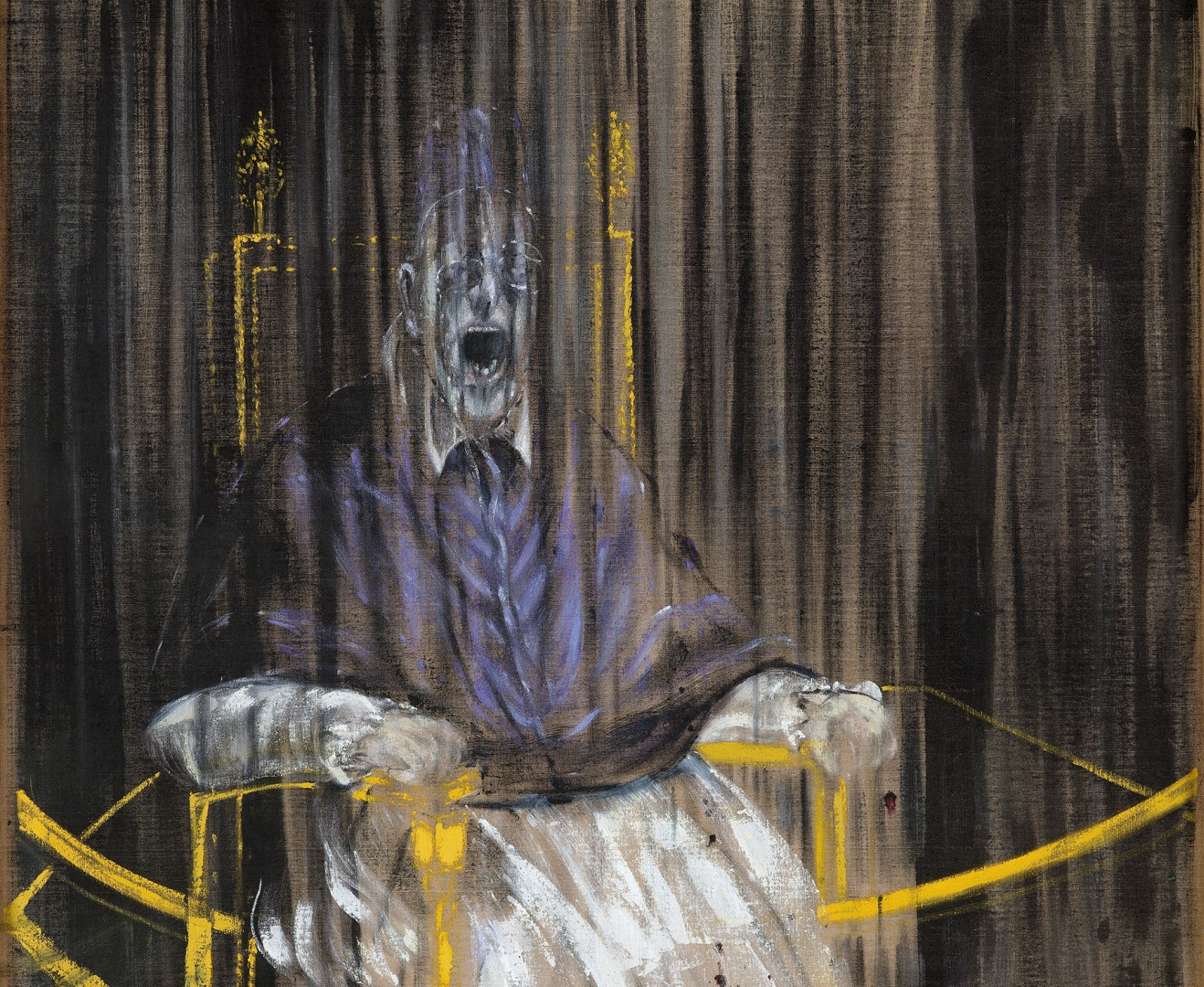
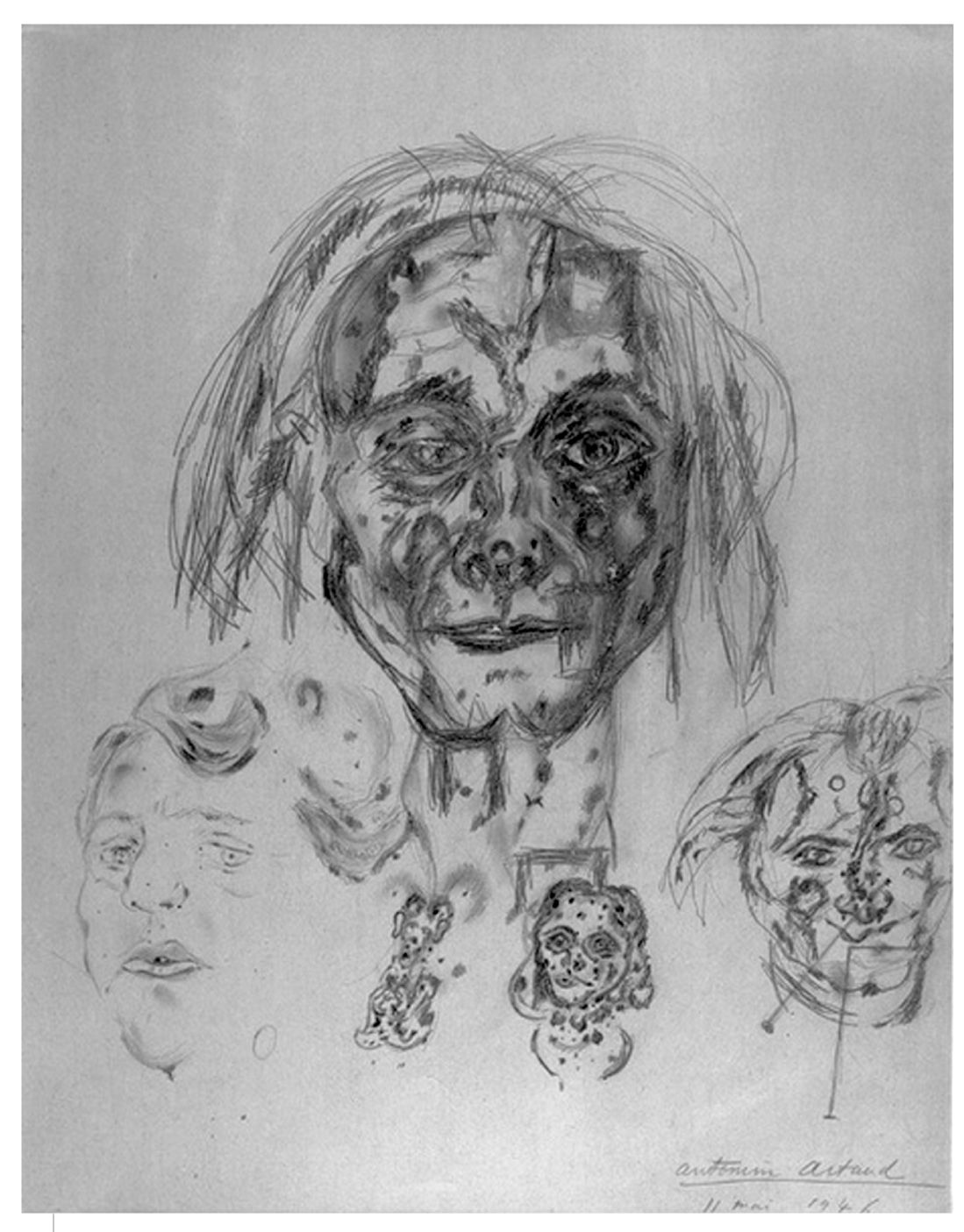
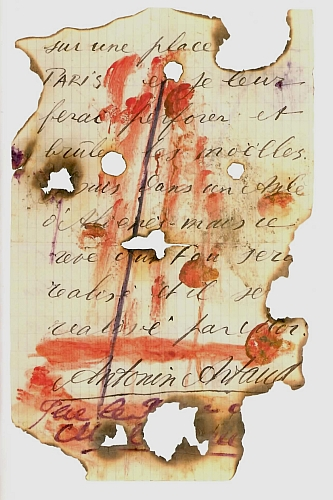
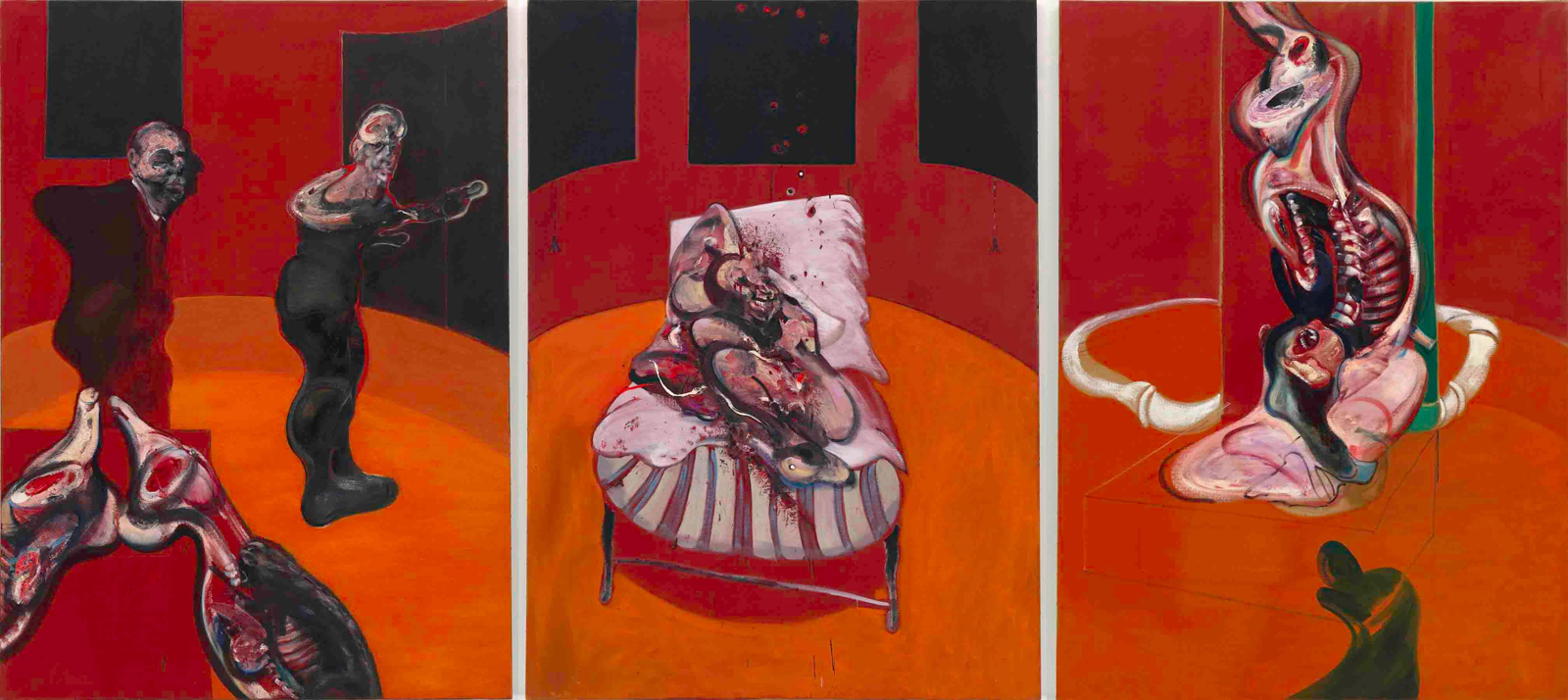
The above images are that which Wilde’s theory of modernity as embodied by Dorian Gray feverishly anticipates: a ‘bringing into manifestation’ a collapse inward of the civilizational order of imaging, or imagining, reality. The lineage of Dorian as a work marking a turn toward the modern fragmentation of perspective into early cubism and surrealism is apparent and advanced in the works of Artaud and Bacon, inheritors of Wilde’s dictates. The decay of Artaud’s own face, punctuated by the puncture and burn wounds in the spell and incantation work - present a unified and total vision of art: where the paper is the skin, and the ink is the blood. Artaud murders himself over and over again in his work, killing his image; raving into the truth of no meaning, no order, no rule, no god, no vision but the apocalyptic collapse of all that is said to ‘exist’, revealing the always already shattered psyche - pitifully grasping onto logos as the lifeboat away from the unending and all consuming waters of madness. Bacon’s work, too, is in conversation with Artaud and Wilde - albeit on a much more socially literal, British level: where Artaud’s work gleefully descends into the madness of metaphysical poetics, Bacon presents a minimalist, conservative front - a front which depicts the madness wherein Artaud and his fellow ‘authentic madmen’ reside. Bacon’s use of block coloring, empty rooms, distorted flesh and contorted space depict a reality which is caught in the midst of itself - revealing the empty dictates of linear time and demarcated space - as if in a snapshot which x-rays the world as an image of belief. Bacon’s figures are churning geometries of flesh, entangled in murderous acts of fucking, doubled over themselves in moments of death, and often entirely unrecognizable as ‘human’ except for an article of clothing or a dedicatory title. The inhabitants of Bacon’s works are always already the inhabitants of the madhouse of the world, owing heavily to Goya’s Lunatics, occult works, and etchings depicting the absurd act of war. It is that these works signal to each other as if in a coded understanding: this world has been made; it may also be unmade.
It is in the metatextual technique of Artaud and the studied figuration of Bacon that Wilde’s Dorian comes together, outfitted in the bloodsoaked garments of nuclear modernity: in a creative act which simultaneously suicides the subject and truly creates the subject; born from the ashes of the made world into a timeless, spaceless, imageless total life.
‘A big fire at night always produces an exciting and exhilarating effect; this explains the attraction of fireworks; but in the case of fireworks, the graceful and regular shape of the flames and the complete immunity from danger produce a light and playful effect comparable to the effect of a glass of champagne. A real fire is quite another matter: there the horror and a certain sense of personal danger, combined with the well-known exhilarating effect of a fire at night, produce in the spectator (not, of course, in one whose house has burnt down) a certain shock to the brain and, as it were, a challenge to his own destructive instincts, which, alas, lie buried in the soul of even the meekest and most domesticated official of the lowest grade. This grim sensation is almost always delightful. "I really don't know if it is possible to watch a fire without some enjoyment." There are seconds—they come five or six at a time—when you suddenly feel the presence of eternal harmony in all its fullness. It is nothing earthly. I don't mean that it is heavenly, but a man in his earthly semblance can't endure it. He has to undergo a physical change or die. This feeling is clear and unmistakable. It is as though you suddenly apprehended all nature and suddenly said: "Yes, it is true— it is good." [. . .] What is so terrifying about it is that it is so terribly clear and such gladness. If it went on for more than five seconds, the soul could not endure it and must perish. In those five seconds I live through a lifetime, and I am ready to give my life for them, for it's worth it. To be able to endure it for ten seconds, you would have to undergo a physical change.’
‘A Klee painting named ‘Angelus Novus’ shows an angel looking as though he is about to move away from something he is fixedly contemplating. His eyes are staring, his mouth is open, his wings are spread. This is how one pictures the angel of history. His face is turned toward the past. Where we perceive a chain of events, he sees one single catastrophe which keeps piling wreckage and hurls it in front of his feet. The angel would like to stay, awaken the dead, and make whole what has been smashed. But a storm is blowing in from Paradise; it has got caught in his wings with such a violence that the angel can no longer close them. The storm irresistibly propels him into the future to which his back is turned, while the pile of debris before him grows skyward. This storm is what we call progress.’
The above quotations from Dostoevsky by way of Kristeva and Benjamin signal a coming imagistic (while imageless) consciousness of modernity - a modernity which is always modern - as it witnesses the apocalyptic shattering of everything. It is this same apocalypse that consumes Dorian in his suicided demise; the same apocalypse which tortures Artaud to death in the sanitarium, and the same apocalypse which drinks Bacon under the table at the turn of the new millennium - an apocalypse of the nonexistence of history; the nonexistence of the world, but in a pile of images, memories, and forgotten lives. In madness, the canon bursts apart, the institutions burst apart, the economies collapse, the sense of valuation and meaning is shattered; the soul is at war with all things. This apocalyptic consciousness is described by Kristeva as ‘abjection’: ‘Abjection then wavers between the fading away of all meaning and all humanity, burnt as by the flames of a conflagration, and the ecstasy of an ego that, having lost its Other and its objects, reaches, at the precise moment of this suicide, the height of harmony with the promised land,’.
Abjection is precisely the puncture wound which links Dorian and Artaud in a timeless consummation of artful living; that which colors Bacon’s screaming pope, as well as his brutally incarnate Painting 1946. These figures, archetypal and otherwise, turn away from any hope of meaning, coherence, logic, or narrativization of life into a text; instead, burn the book, stab the painting, and riddle the flesh with the screams of the demented and the damned. It is that, simply, in such a forcefully and fully created and manifested alteriority, such questions of ‘humanity’, ‘truth’, ‘morality’, ‘righteousness’, and ‘reason’ do not exist; in the case of Artaud, they become the ghosts. In this sense, there is a sort of mutual haunting of the ‘mad’ and the world of logos: as each is haunted by the shadow of the other - for one cannot exist without the other. The works of the ‘madmen’ function literally and metaphorically as a balancing of the scales of life, or returning life to sensual embodiment of the anima from the abstracted, severed image of logos.
Artaud’s ‘authentic madmen’ expose a created world of ‘knowledge’ and ‘language’, a world of manufactured meaning and valuation of life (mind, body, and soul) assigned to life without question; without consent. The coercive world of logos is this world - a world dominated by the presupposed ownership and possession of land, bodies, lives, and time. The sheer enforced, collective belief in these structures as existent, apparent, and ‘real’ - is that which creates the borders and boundaries of that which is allowed and not allowed, legal and criminal, subject and object. The abject murder of the image of ‘life’ is that task which is essential to the authentic madman - as it redeems the choiceless choice of death. The choice of madness is nothing more or less than a war against the established ‘reality’ as life-made-image. This civilizational movement is complicated in Wilde’s dialectical turn in painting Dorian’s existence as a flow, or as metaphysical translation of ‘life’ and life - as Dorian changes, the painting changes. The apparent flow of time and space, or the ‘usual’ or ‘normal’ process of aging and decay of the organism is disrupted; Dorian’s life is transported into the ulterior ‘life’ of the painting - which uses Dorian’s life as motive, or inspiration. It might be said that Dorian becomes his own muse: ‘He had always the look of one who had kept himself unspotted from the world… His
mere presence seemed to recall to them the innocence that they had tarnished. They wondered
how one so charming and graceful as he was could have escaped the stain of an age that was at
once sordid and sensuous… He grew more and more enamoured of his own beauty, more and
more interested in the corruption of his own soul. He would examine with minute care, and often
with a monstrous and terrible delight, the hideous lines that seared the wrinkling forehead or
crawled around the heavy sensual mouth… He would place his white hands beside the coarse
bloated hands of the picture, and smile. He mocked the misshapen body and the flailing limbs,’
(Wilde, 188). This Narcissus process is a turning inwards via an externalization of an internal mode of subjectivity, not altogether different from Michelangelo’s self portrait as Saint Bartholomew in his Last Judgement: the manifest depiction of a ‘vindication of the ways of God to man’ - a civilizational/subjective mode which martyrs the poet. Dorian’s turn inward (made ‘apparent’ by Wilde’s created discourse between Dorian and the painting) is engendered by a critical realization by Dorian - that the image always already subsumes life in its lifelessness; a priori, always presupposes a better, more possible life vis-a-vis the death of life; the calcification of life into ‘life’: ‘I am jealous of the portrait you have painted of me. Why should it keep what I must lose? Every moment that passes takes something from me, and gives something to it. Oh, if it was only the other way! If the picture could change, and I could be always what I am now!... The hot tears welled into his eyes; he tore his hand away, and, flinging himself on the divan, he buried his face in the cushions, as if he was praying, (Wilde, 103).
Dorian’s prayer for the always-already more ‘real’ version of himself depicted in the painting - eternally beautiful, eternally young, eternally possible - is a religious yearning for the image, or the idol of the self, itself. Basil’s depiction of Dorian becomes an idol, or icon, of Dorian’s god - which is to say the highest art of Dorian’s soul. Finding his imaged soul manifest in the work vis-a-vis Basil’s love for Dorian - Dorian is cursed with a divine sight: ‘The sense of his own beauty came to him like a revelation… “Is it the real Dorian?” cried the original of the portrait… “Am I really like that?”... “At least you are like it in appearance. But it will never alter,” said Hallward. “That is something.”’ (Wilde, 103-106). Here, there is an immanent syntactical and lyrical relationship between the imagined self and the imaged self - a highly religious relationship which is channeled in and through the process of creation and manifestation of ‘ideas and ideals’ into ‘things’ - or god into the image(s) of god; that which is ‘like’ god. Wilde himself images this creative process in and through Dorian’s encounter with ‘himself’ as an always already deceptive, incomplete, reduced encounter with a mirror - a mirror which cannot speak, love, live, die, or grow… or can it? The dialogue between Dorian and Basil upon Dorian’s revelation of the painting is a discourse on, in, and through Dorian’s realization of a possible ‘higher’ reality through his exposure to an image of god - an image of the beloved crafted by the lover.
Here, Dorian’s prayer to become the image of himself and the immanent decay of the image in relation to Dorian’s embodied life draws closer the paradox of relation between the artist and the paper - made apparent again in Artaud’s spell-work and self portraiture - an eternal wound of separation, or severance of creative birth and instinct (from mind to paper, from idea to image, from concept to manifestation) - which always already requires a wound of separation in order for the creative instinct to be created: an instinct, or urge, to heal the severance between what one innately knows - and what appears to be. This process is manifest in the utmost literal sense in the work of transness as self-making - a process of total self creation: where difference is perpetually in process: difference resident at the level of the soul at odds with the apparent reality. It is such life, life at odds with appearance - that the figure Heliogabalus embodies; a life that shoves the problem of civilization in its face: what if things are not as they appear to be? If this is true; that there is indeed a truer life in and at the perhaps now disapparent level of the soul - it means that the apparent ‘reality’, or the foundation of logos and law as observable-action-in-the-’world’ is always already perilously unstable; dissolvable in an instant by a truer, or greater manifestation of ‘real life’ via the transmission or injection of soul into the apparent reality. This ‘injection’ for Dorian is nothing less than a greater reflection, or a scrying glass, divine mirror - into his own existence, his own beauty, his own truth which once remained hidden at the level of apparent things to him. This art, the art of exposing the greater reality of that which is resident, at some level, in the visible ‘real’ - is the art of dissolving the supposed truth of the real; it is also the art of both religion and criminality. Dorian’s descent into the underworld of his sensual desires is inextricable from his prayer to become (or ‘embody’) his divine manifestation at the hands of Basil Hallward - as he extends himself both toward the utmost heights of potentiality - the potentiality of physical extremity, and the potentiality of metaphysical extremity. This extension might also be termed as an expansion - or an explosive desire to meet the full, total potential of self - which is always already beyond what is apparent to the naked eye in the moment of valuation of an organism or body. This possibility of self is the poetry of life - a possibility which embraces both that which, in the civilizational mode, is termed ‘light’ and ‘dark’, ‘human’ and ‘inhuman’, ‘right’ and ‘wrong’. This striving for the whole, unified self - at both poles of existence - is that which always abolishes, or goes beyond, the bounds of legislated reality: ‘The aim of life is self-development. To realise one’s nature perfectly - that is what each of us is here for. People are afraid of themselves, nowadays. They have forgotten the highest of all duties, the duty that one owes to oneself. Of course they are charitable. They feed the hungry, and clothe the beggar. But their own souls starve, and are naked… The terror of society, which is the basis of morals, the terror of God, which is the secret of religion, - these are the two things that govern us,’ (Wilde, 94). As Lord Henry articulates, the externalization of the soul in worship of an image of God - which is itself the process of ‘civilization’ - is that which harnesses the soul to a ‘worldly’ task - rending it from itself. This is the essential duty, or task, of Basil’s painting of Dorian - to reorient his soul toward its higher, or ‘divine’ purpose - in obligation to the fulfillment of itself vis-a-vis the use of the ‘world’. This ‘perversion’, which is also the ‘perversion’ of Heliogabalus, is the perversion of the authentic madman - the total co-optation and destruction of the established ‘reality’ in the name of the cultivation of the soul by way of truly divine experience - as that which is ‘divine’ is always beyond - beyond time; beyond ‘nature’. This urgent suggestion of the work of the soul is apparent in the caustic works of Benjamin, Kristeva, Artaud, and Bacon above - all of which suggest an apocalypse, or death, of history via a divine subjectivity that dis-solves everything: ‘To him, man was a being with myriad lives and myriad sensations, a complex multiform creature that bore within itself strange legacies of thought and passion, and whose very flesh was tainted with the monstrous maladies of the dead,’ (203). ‘Yes: there had been things in his boyhood that he had not understood. He understood them now. Life suddenly became fiery-coloured to him. It seemed to him that he had been walking in fire. Why had he not known it?’ (Wilde, 96-97). The revelation of Dorian works in coalition with Basil’s image and Lord Henry’s words (‘Words! Mere words!... what a subtle magic there was in them! They seemed to be able to give a plastic form to formless things… Was there anything so real as words? (Wilde, 96)), rendering his soul both in sight and sound, in appearance and genetic makeup - as a real time, literalized generation of that which he, unknowingly, in his heart of hearts, knew, believed, felt, and is. Dorian is bathed in Dostoevsky’s ‘fire’ in this moment; Dorian’s revelation stretches the entirety of Artaud’s life in the attempt to attain his mind, which might also be equated to, and as, his soul - that which transmits and transmutes in the creative act of god into ‘world’.
TEXT BODY TEXT
The creative process as dissent and deconstruction of the civilizational mode of ‘life’ is at the dis-tension point of political imaginations which form and inform reality as the truth of existence over space and time. The works of Bacon, Artaud, and Wilde in particular - form a trinity of lives and works of and as within empire against empire, at stratified levels of literal empirical dissent. While Wilde dissents in and at the crux of representation (by depicting that which cannot be ‘depicted’), Artaud dissents without the possibility or even hope of, or for representation (at the level of the death of self-image); Bacon dissents in the critical satire of painting as promising such a reconciliation of life with the representative image of life - as screens throughout and over time have attempted to perform/conform. These three artists work explicitly in and around the problem of image making vis-a-vis the ‘screen’, or the conveyor of the image: the painted surface, the punctured surface; the skin of meaning. To view, in and with madness of Dorian, the canvas as the skin, the inscribed text as carved into flesh; ultimately, the puncture wounds made by Artaud and Dorian as suicidal desire for the death of the problem of bodily representation is to move towards a trans-literal theory of reality and reality making; self and self making - a kind of self making and self destroying which refuses to confine itself to the normative bounds and borders of what is conceived of as ‘the body’, ‘the reasonable’, and ‘the civilized’. Just as Dorian’s portrait becomes a literal, functional prosthesis of Dorian’s embodiment (a synthetic which becomes organic in dialogue with Dorian’s flesh, intellect, soul, and actions) - Artaud’s spells and portraits of fraught being externalize and disject the internal condition of the need to express that which is considered physically impossible, or paradoxical. To obtain the mind, surely, Artaud would have to perform a literal surgical procedure to remove the organ from body, or to add a prosthetic device which would allow for a physical and metaphysical possession of the intellect. The latter task is what Dorian’s linguistic and plastic revelation performs, tying him in prayer and deep desire to the object which represents, to him, his true embodiment - an embodiment which before had not been ‘visible’, or apparent. This bringing into life the flesh vis-a-vis the creative impulse to carve the flesh of the canvas, or to imprint the text onto the surface of ‘life’ is to surgically alter the body of the ‘world’; expand the apparent possibility of life vis-a-vis the engagement of the intellect at the hands of the embodied gesture. Again, to move towards Heliogabalus as the archetypal, or total, embodiment of this phenomenon is to elevate art to the level of action - or that action, the physical movement, the ‘bringing’ by way of a movement or active composition - is that which resides beyond the literary concern of ‘art’; on the plane of being-without-humanity as being-without-culture. Heliogabalus’ life, in this sense, is a direct channel into the transness of dissent - a refusal in and at each encounter with the categorical method of acculturating the subject to gendered life, socialized life, religiously ordered life; defined life. For this encounter of self-making power at the highest point of empire is the encounter of the empirical mode which has re-membered itself with the empirical mode which has long since forgotten its root.
The project of ‘human civilization’ to harness and use the life, labor, and spirit of living beings has extended throughout time and space; with notable landmarks including the enslavement of peoples to build the empires of Rome, Egypt, and America, as well as the harnessing of ‘animal’ labor and life in the form of continually evolving livestock domestication. The task of the always modern individual is to question these forms of use and abuse of life in order to accomplish the aims of ‘civilized society’. For - these actions, these behaviors, these uses, and these values form and stricture a fundamental, soul level language - a method of cognition and engagement with life and life-forms which stratifies and separates life into parts: visible and invisible, legal and illegal, right and wrong, beautiful and ugly, man and woman, devil and god, and so forth. This stratification of life (which is necessary in order to deploy the mechanism of ‘progress’ or alternatively ‘profit’) - creates a perpetual imbalance of forcibly separated forms of existence: where life was once whole and indistinguishable, now there is life in caste - distinguished in order of importance, status, and worth. To willfully forget, shame, violate, or devalue that which is (in the cadence of ‘civilization’) depicted as a perversion or anti-thesis of the ‘light’, or that which is visible; of the self-image cast by civilization - (darkness, blackness, femininity, magic, madness, spirit) - is to willfully and catastrophically forego an essential aspect of the whole, divine Self cast as ‘other’, ‘enemy’, ‘shadow’, ‘threat’, and so forth. In doing so, civilization creates its necessary counterpart: that which lies outside its walls; always threatening, always waiting, always necessitating the further fortification of empire to prevent the downfall of empire. So it is with the language of empire, the quest for total empiricism, total knowledge; total definition of life. These processes, the culture of civilization and civilization itself - are inextricable from one another; forming a linked chain of meaning production and reproduction: a system which at once produces and reifies the need for civilization as both a social discourse and a social border - protecting the sane from the insane, protecting god’s children from the devil’s army; protecting order from disorder. The civilizational mechanism - which now has dug its roots deeply into all worldly things - demands engagement with this binary process of ‘life’ production and categorization as a way of creating the essential separation: ‘life’ from life. Those thinkers listed here provide crucial insight from within the bowels of empire; perhaps orient the careful listener towards the door.