The Historical Bloodstream: Civilizational Phenomenological Geology and the Second Channel of Ontological Disclosure
Canonical source: substack:davidbussellarchive (https://davidbussellarchive.substack.com/p/the-historical-bloodstream-civilizational)
The Historical Bloodstream: Civilizational Phenomenological Geology and the Second Channel of Ontological Disclosure
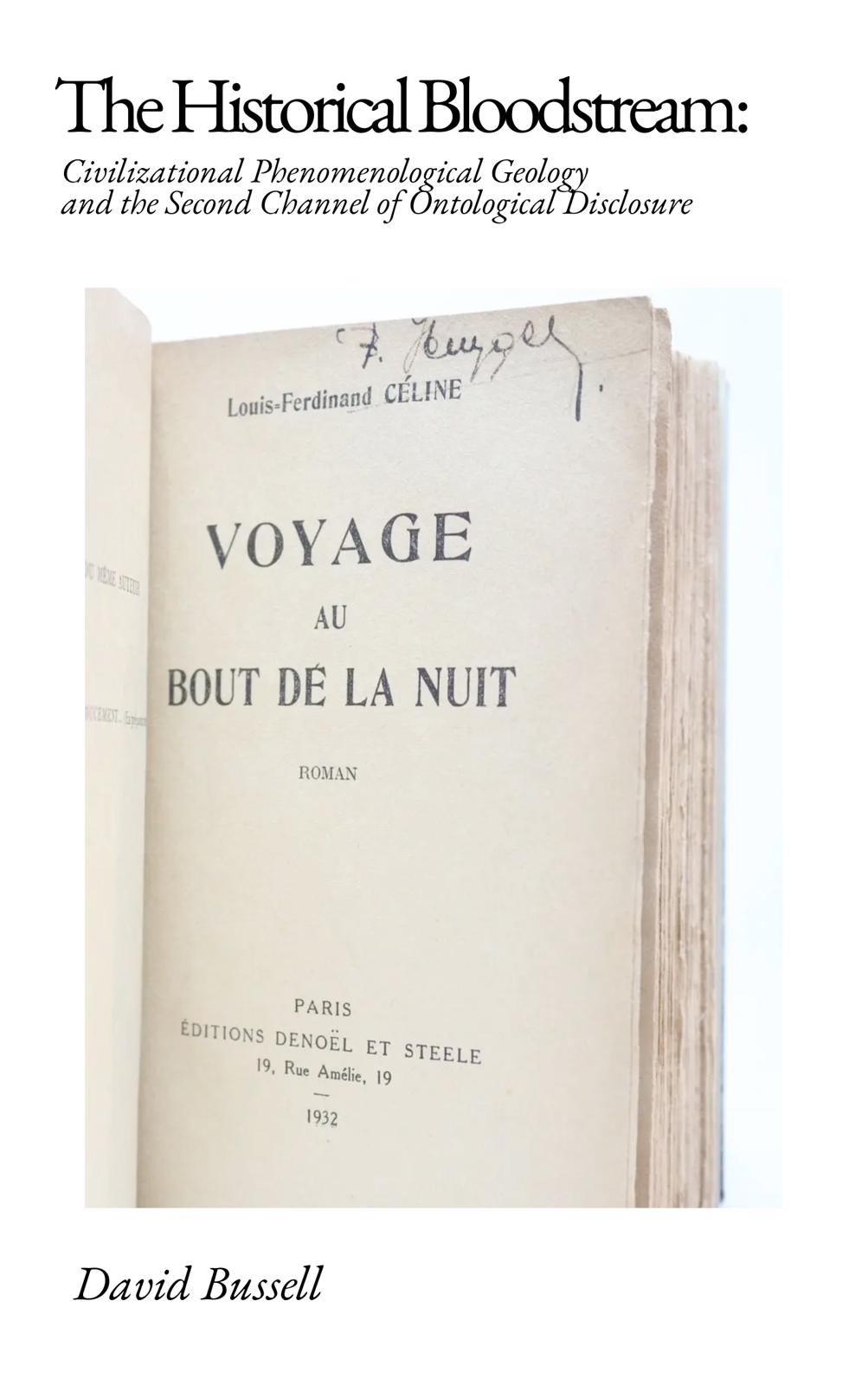
Consciousness does not propagate through the genome alone. Alongside the first channel of inheritance — the transmission of crystallized biological information through sexual recombination — civilization constructs a second channel: the transmission of disclosure itself through symbolic artifacts bound in time and space. The book, the pamphlet, the image, the poem, the archive, the photograph, the ritual object — these become compressed neural vessels through which one nervous system transfers ontological realization into another across generations. In this way, consciousness exceeds the limits of genetic transmission alone. The second channel allows the species to transmit not merely biological viability, but disclosure: expansions of perception, integrations of being, and higher-order realizations of the ontos itself sedimented into material form and circulated historically through civilization. The wrapped and weathered paper artifact thus becomes a geological organ of collective consciousness, carrying recursive awakenings of Being beyond the bounded lifespan of the organism that first disclosed them.
Part 1. Operator Architecture: Constraint Geology and the Disclosure of the Ontos
A Treatise on Existential Experience as the Correct Mapping of Cosmological Architecture
Prefatory Note
What follows is a treatise drawn from a body of lecture and written work developing one claim: that existence is a struggle for persistence under constraint, that this struggle is structurally identical at every scale at which it occurs, and that what we call mind is what this struggle looks like from the innermost layer of its own nesting. The present document states this claim in its strongest and most unified form, with the weight of the argument placed where it must finally rest: on the seam between existential experience and cosmological structure, where felt being and the architecture that produces it are revealed as the same condition described from opposite vantages.
The lineage is Heraclitus, Hölderlin, Heidegger, Shelley. Heraclitus saw the cosmos as measures of fire before there was a word for thermodynamics. Hölderlin held that nature’s gleaming is higher revealing, and that man dwells poetically upon this earth. Heidegger turned to Hölderlin in 1937, in the heart of the world’s midnight, because poetry alone preserved the trace of disclosure when civilization had paved over the clearing in which beings could appear at all. Shelley, working a century before Heidegger, articulated the deeper cosmological architecture: that the chains of Prometheus are not the limits of human nature but the surplus suffering imposed upon those limits, and that the liberation of consciousness is the liberation of the thermonuclear energy latent within the form. Shelley is the lodestar of this project because Shelley reaches further than Heidegger into the prime energetic ground itself, while sharing with Heidegger the recognition that poetry is ontological intervention, not aesthetic ornament.
The treatise moves through seven sections. The first establishes the problem the frame is built to resolve. The second develops the structural account: pseudo-boundedness as the foundation of persistence, time as entropic relation, the stellar descent chain, and the universal recombination principle. The third extends this account into the recursive deepening that produces self-perception, with explicit insistence that disclosure remains body-bound, and names the figure such depth produces: the Renaissance mind. The fourth states the seam: existential experience is the inside of cosmological structure. The fifth develops the implications for the inherited existential vocabulary. The sixth gives the diagnosis of modernity that follows from the frame. The seventh names what the project is and what remains.
A consolidated statement of the framework will be found in the closing section.
I. The Problem the Frame Resolves
The dominant intellectual inheritance of the modern period has split the description of being into two incompatible vocabularies. On one side stands the cosmological and scientific account: a description of matter, energy, evolution, and information that is structurally true but in which the describer cannot locate themselves as anything other than an incidental and inessential product. On the other side stands the existential and phenomenological account: a description of mood, finitude, care, attention, meaning, and the felt texture of existence that is experientially true but that floats free of the physical and biological substrate it inhabits. Each tradition is forced to treat the other either as reducible to itself or as a separate domain it cannot fully reach.
This split is not a feature of the world. It is an artifact of treating the inside and the outside of a single architecture as if they were two domains requiring separate ontologies. The naturalistic vocabularies of the sciences produce descriptions of structure that are correct but uninhabitable. The phenomenological vocabularies of the existential tradition produce descriptions of experience that are inhabitable but ungrounded. Neither side can complete its own account without surrendering what makes it that side. Naturalism cannot explain why structural facts have an experiential inside without abandoning its commitment to substrate-based description. Phenomenology cannot explain why existential structures have the specific character they do without grounding those structures in something other than themselves. The two traditions have been in this stalemate, in one form or another, for the entire modern period.
The treatise proposes that the stalemate is unnecessary because the underlying assumption — that there are two domains — is wrong. Existential structure and cosmological structure are the same nested-constraint architecture described from opposite vantages: one from inside the innermost layer of the nesting, registering itself in the modality we call experience; the other from the analytical exterior, registering itself in the modality we call structure. The correctness of an existential thought or feeling is the degree to which it accurately maps the actual constraint architecture that produces it. Disclosure of the ontos — being’s revelation of itself to itself — is what occurs when this mapping is accurate, and what fails when it is not.
There is one process. It is nested. It has an inside and an outside. The inside is what has been called existence; the outside is what has been called cosmos. These are not two phenomena that resemble each other or that are analogically related. They are one phenomenon perceived from two positions. The treatise’s task is to make this claim defensible by developing the structural account of the nesting in sufficient detail that the phenomenological inside becomes legible as what it actually is, and the existential vocabularies of the inherited tradition become legible as the accurate first-person reports they have always been but have never been able to ground.
Three prior commitments are required before the central claim can be stated in full. The first is an account of how persistence under constraint operates at every scale of being and why the operation is identical across scales despite the radical difference of substrates. The second is an account of what happens when constraint-architectures become recursively deep enough to model themselves. The third is an account of why the felt texture of being takes the specific forms it does and not other forms. The thesis arrives at the seam between them.
II. Pseudo-Boundedness, Persistence, and the Stellar Descent
Pseudo-Boundedness as the Foundation
The structural account begins with a single observation. In a universe whose dominant tendency is dispersal — the second law’s relentless drive toward maximum entropy — anything that persists must first achieve localized condensation: a bounded differentiation against the surrounding tendency to dissolve. Form is not decoration atop matter. Form is the local stabilization of persistence against dissolution. Without pseudo-boundedness, there is no distinction, no object, no memory, no identity, no relation, no perception, no persistence at all. Difference itself emerges from constrained persistence structure. A universe without pseudo-boundedness would be a universe of undifferentiated noise — and such a universe, by definition, would contain nothing that could persist long enough to be anything.
This is the ontological hinge of the entire framework: pseudo-boundedness is the generative condition, not the restriction, of being. Constraint is what allows form to occur. Remove the constraint and the result is not freedom but dispersal. The paradox is that what looks like limitation from the inside is what makes the inside possible at all. The prison is the prism. The same architecture that confines is the architecture that refracts. There is no perception from nowhere. The dream of unbounded disclosure is incoherent, because it would be a disclosure to no one, of nothing in particular, and by means of no organ.
Anything that achieves localized condensation against entropy must do so by one of exactly two means. The first is to occupy a thermodynamically stable or metastable energy minimum, a configuration so deep in the local energy landscape that the entropic forces acting on the system have no easily accessible pathway to dissolve it. Stones persist this way. So do crystals, and to a significant extent so do the heavier elements forged in stellar nucleosynthesis. This is configurational persistence. The second way is to maintain form through continuous energy throughput that performs ongoing work against the entropic tendency. Stars persist this way: the fusion in their cores generates radiation pressure that holds them against gravitational collapse for as long as fuel is available. Cells persist this way: metabolism continuously rebuilds the structures that would otherwise dissolve into chemical equilibrium with the surrounding medium. This is regulated persistence. These two modes exhaust the possibilities. A structure doing neither cannot maintain distinguishability and cannot persist.
Time as Entropic Relation
Before tracing the descent chain, one further ontological clarification is required. Time is not the container within which entropy operates. Entropy is what time structurally is. Time is the relational wear of bodies in space across moments — the registration of entropic transformation across relational persistence structures. Without degradation, wear, energetic transformation, or persistence strain, there would be no differentiation, no change, no memory, no history, no becoming, no existence as distinguishable process. A universe without entropic relation would be a universe without time, because there would be no relational mark by which one moment could be distinguished from another.
This clarification connects directly to existential phenomenology. Mortality, memory, aging, loss, and historical consciousness are the internal registration of entropic relation. They are not contingent features of human psychology; they are what it feels like, from the inside of an architecture that persists in time, to be subject to the structural condition that time is. The frame of existential temporality and the frame of thermodynamic entropy are not two frames. They are one frame perceived from two positions.
The Stellar Descent Chain
With pseudo-boundedness as the foundation and time as entropic relation established, the descent chain that produces every layer of the operator becomes intelligible as one continuous unfolding. The universe begins in a state of low entropy and high energetic concentration. From this primordial energetic distribution, gravitational condensation produces the first large-scale pseudo-bounded persistence events: the formation of stars. Stars are the primordial persistence modules. They are local condensations of diffuse cosmological energy gradients, held in dynamic equilibrium between gravitational collapse and the radiation pressure generated by fusion in their cores. From the star, heavy elements are forged through nucleosynthesis — carbon, oxygen, iron, the elements that will later become the substrate for chemistry, biology, and eventually neural architecture. When stars die, they expel these elements into space. Rocky planets form from the debris. On at least one of them, solar energy translated through photosynthesis enables the cell membrane to maintain a chemical gradient against equilibrium — and the regulated persistence of biology begins.
The chain runs:
Universal energetic distribution → gravitational condensation → stellar persistence modules → heavy-element synthesis → chemistry → biological recursion → genomic compression → neural integration → symbolic recombination → existential disclosure → metarchitectural realization of the operator.
This is one recursive persistence operation unfolding across scales and timescales. The carbon in every cell on Earth was forged in a star that exploded. The proton gradient across the mitochondrial membrane is the star’s thermonuclear energy translated into biological currency. Metabolism is the forge of the star operating at cellular scale: the continuous compression of energetic production and consumption that holds the organism’s shape against dissolution. The genome compresses what metabolism learned across evolutionary time. The nervous system compresses what the genome can specify into real-time perceptual integration. Symbolic relation compresses what the nervous system can integrate into transmissible form. Civilization compresses what symbolic relation can carry into persistence beyond the death of the organism. One chain. One descent. One operation at every step: the holding of form against the forces that would dissolve it, paid for by the energy that the previous step released.
This is why thermonuclearity is the right register. The fire that holds the star against collapse is the same fire, translated and recompressed across scales, that runs in the proton gradient of the mitochondrion, that fuels the metabolic churn of the nervous system, that powers symbolic relation itself. Heraclitus saw this before there was a word for it. The cosmos is in measures of fire, given and received. The thermodynamic revolution from Carnot through Boltzmann and Maxwell to Prigogine is the high-resolution articulation of what Heraclitus held in compressed oracular form. The continuity is not metaphorical. The fire in the star and the fire in the cell are the same operation at different scales.
Each compression in the chain is selective and lossy. Each filters from the substrate below only what can be carried forward at the new layer’s timescale. The lossiness is not a defect; it is the mechanism by which signal survives the substrate’s mortality. A genome cannot carry every molecular interaction of the organism that produced it; it carries the constrained pattern that allowed that organism to persist long enough to reproduce. A nervous system cannot carry every genomic potential; it carries the integrative pattern that allows the organism to act in real time. A civilization cannot carry every nervous system that participated in it; it carries the symbolic distillations through which those nervous systems made themselves transmissible. The compression at each transition discards what cannot be carried at the new scale and preserves what can.
The genome warrants particular attention in this chain, because it is the layer at which the operation becomes most clearly visible as a crystallization. The genome is a compressed crystallization of persistence solutions sedimented across evolutionary time. It stores what successful persistence has looked like over billions of years, in molecular code dense enough to specify the construction of an entire organism. Every living being carrying a genome is therefore a living thermodynamic packet of evolutionary memory: a temporary embodiment of what the long arc of selection has discovered about how to persist under constraint, expressed in the regulated metabolism of a particular body for a particular interval of time. The organism does not invent persistence; it inherits a crystallized record of it and runs that record forward through its lifespan.
Discrete Informational Packets
A consequence of pseudo-boundedness is that anything that persists does so as a discrete informational packet — a temporarily stabilized condensation within the larger persistence architecture. Atoms, genomes, neural patterns, symbols, words, numbers, myths, institutions, and selves are all structural condensations of the operator itself. Discretization is not a cognitive imposition on a continuous world; it is what boundedness produces. Where there is a pseudo-boundary, there is a discrete thing. Where there is no pseudo-boundary, there is no thing at all — only undifferentiated dispersion.
Number, on this account, is not merely a human abstraction projected onto an indifferent reality. Mathematics is the recursive symbolic compression of operator regularities discovered by sufficiently sophisticated persistence architectures. The invention of number, ratio, sequence, recurrence, and pattern is the symbolic crystallization of operational regularities already present in persistence structure itself. Quantity, periodicity, recurrence, scaling — these are not properties imposed on the world by minds but properties the world has by virtue of being a nested architecture of bounded condensations. Mathematics is the symbolic compression of quantitative operator invariance, just as poetry is the symbolic compression of qualitative operator invariance. Both are disclosure systems operating on the same underlying architecture from different apertures.
Operations and Universal Recombination
The operations that govern the descent chain are the same at every scale. Sedimentation: the gradual accumulation of pattern under selective pressure. Compression: the densification of accumulated pattern into transmissible form. Rupture: the catastrophic transformations that reorganize the substrate when accumulated stress exceeds the capacity of the existing form to absorb it. Erosion: the wearing away of forms that no longer hold against the conditions of their persistence. Selection: the differential survival of patterns under environmental constraint. Recombination: the productive recombining of bounded informational condensations to generate new variation.
Recombination operates universally across scales. Genetic recombination, symbolic recombination, technological recombination, economic recombination, musical recombination, mathematical recombination, civilizational recombination — these are not parallel processes that happen to share a name. They are the same recursive operation, the recombination of bounded informational condensations to produce new variations under selection. Sexual reproduction is recombination at the genomic scale. The novel synthesis of ideas across disciplines is recombination at the symbolic scale. The cross-pollination of musical traditions is recombination at the cultural scale. In every case, persistence architectures generate new persistence possibilities by recombining the bounded packets they already contain. The operation is one operation.
These are not metaphors borrowed from earth science or biology to dress up a theory of mind. They are the literal operations by which any persistence-structure refines itself, and they run identically at every scale of nested constraint. This is what is named by the term constraint geology: that the temporal structure of consciousness, civilization, and cosmos are not analogically but structurally homologous, governed by the same operations at different rates.
Each layer has its characteristic timescale. Rock sediments over millions of years. Genomes sediment over millions of generations. Neural patterns sediment over a lifetime. Cultural archives sediment over centuries. A single thought sediments over seconds. The operations are constant; the timescales differ by orders of magnitude. What appears as instantaneous experience and what appears as geological deep time are the same compression-operation running at different speeds. The seed pod releasing from the tree is the same event as the Shelley pamphlet being distributed during the Chartist movement: compressed information released into a medium that will either propagate it or not, the operation of constraint geology made visible at the scale of an afternoon’s attention.
The claim is not that these systems resemble each other across scales. The claim is that they perform the same operation. When gravity acts on a planet and when gravity acts on a star, we do not say the two cases are analogically related; we say it is the same force operating on different substrates. The constraint-geology frame makes the equivalent claim about persistence under entropy through nested compression. It is one operation. Calling it analogy when it crosses from physics into biology, or from biology into culture, imports a substrate-based criterion for identity that the frame explicitly rejects. If ontological identity is determined by what a system does under constraint rather than by what it is made of, then two systems performing the same operation under the same constraint structure are identical at the level that matters. The word for this is not analogy. It is identity.
III. Recursive Depth, Disclosure, and the Body
The second commitment concerns what happens when the recursion goes deep enough.
A constraint architecture at low recursive depth simply persists. It maintains its pattern against entropy without modeling itself doing so. A molecule does not perceive its bonds. A simple organism does not perceive its metabolism. The constraint operates; nothing observes the operation from within. There is, in such systems, no question of accurate or inaccurate self-relation, because there is no self-relation. The system is exhaustively what it does.
At greater recursive depth, the architecture begins to model the conditions of its own persistence. A nervous system models the environment in order to act effectively within it; in doing so, it produces internal representations that are about something other than themselves. Perception emerges as the registration of conditions external to the perceiver, conducted by the perceiver, on behalf of the perceiver’s persistence. The system is no longer exhaustively what it does; part of what it does is now to represent what it does, and this representation can be more or less accurate.
At still greater depth, the architecture begins to model not only its environment but itself in relation to its environment. The modeling system becomes the object of its own modeling. The architecture can now take itself as an object of attention. This is the threshold at which something like a self emerges — not as a metaphysical entity added to the system but as the integrative pattern by which the system tracks itself through time. The self is not an illusion in the trivial sense. It is the real recursive continuity structure maintained by an architecture sufficiently complex to track its own state across time. Identity is downstream of the constraint architecture that produces it; the integrative continuity the architecture sustains is what the self is, not a separate entity that has been bolted onto biology. To call the self real and to call it downstream of constraint architecture is to say the same thing twice: the self is the integrative continuity the architecture maintains, and that continuity is genuinely there, performed by the architecture in real time, not invented by the system after the fact.
At greater depth still, the architecture becomes capable of modeling the conditions under which it is the kind of thing that models — of perceiving that it perceives, of recognizing that its perception is structured, of asking what makes perception possible. This is the threshold at which what may be called disclosure becomes possible. The architecture is no longer simply persisting, no longer simply perceiving, no longer simply self-aware. It is becoming the local site at which the constraint architecture that produced it becomes perceptible to itself.
Disclosure Remains Body-Bound
The most consequential clarification of the entire framework must be stated outright. Disclosure never escapes embodiment. Even the highest ontological realization remains nervous-system bound, metabolically bound, thermodynamically bound, body-mediated. There is no version of disclosure that occurs outside the architecture that performs it. The Renaissance mind does not transcend the body. It is a nervous system sophisticated enough to perceive the operator across scales while still remaining fully within material recursive persistence architecture. Disclosure is the highest operation achievable within embodied persistence architecture, not an escape from it. It is the body’s recursive realization of the operator generating itself.
This matters because every prior metaphysical and contemplative tradition that has named something like disclosure has been tempted, in its formulations, toward idealism or mystical disembodiment — toward the suggestion that the highest realization is a state in which the disclosing mind has left the body behind. The constraint-geology frame refuses this temptation absolutely. Without the body, there is no disclosure, because there is no recursive persistence architecture deep enough to register the operator. Disclosure is what bodies do at sufficient recursive depth. It is not what minds do when they have transcended bodies. To say that being can be known is to say that an embodied architecture can know it, by being the local site at which the architecture of being becomes perceptible to itself.
This is the structural translation of what the contemplative traditions have known in their deepest moments and what the existential tradition reached for in figures like Hölderlin and Heidegger when they spoke of dwelling: the human being’s relationship to being is not a relationship between two terms, one ideal and one material, but the structural fact that a sufficiently deep material architecture is what being is, when being has become recursively present to itself in a body. Full of merit, yet poetically man dwells upon this earth , Hölderlin wrote, and Heidegger took the line as the hinge of his late thought. The dwelling is already there. It is first before merit, first before history, first before civilization. Merit, in Hölderlin’s sense, is the productive work of becoming, including the technological enframing that modernity teaches humanity to dwell within. Beneath merit, dwelling poetically is the foundational condition of being-in-time. The dwelling is what the body does at sufficient recursive depth, before any merit is imposed upon it.
Disclosure as Solution Space, Not Telos
That this capacity emerges at all is not accident, and it is not telos. It is what the solution space of being in time rewards. Architectures that can model their environments persist better than architectures that cannot, because accurate world-modeling improves the system’s ability to anticipate threats, locate resources, and coordinate behavior with its actual conditions. Architectures that can also model themselves in relation to their environments persist better still, because self-modeling allows for the regulation of internal state against external demand. Architectures that can model the conditions of their own modeling — that can hold their own perceptual apparatus as an object — persist better in still further conditions, because they can recognize when their models are failing and update accordingly. At every step, more sophisticated world-modeling is a better solution to the problem of persistence in time under entropy.
The universe does not aim at disclosure. Disclosure is what the solution space rewards. The same is true at every scale: the star does not aim at fusion, fusion is what the gravitational solution space requires; the genome does not aim at sexual recombination, recombination is what the variability-under-selection solution space favors; the nervous system does not aim at self-modeling, self-modeling is what the regulatory solution space produces. Disclosure capacity accumulates because that is what existence under these constraints generates over deep time. It is a structural consequence, not a directional drive. It is also a stellar problem before it is a human one: the same logic that compels world-modeling in evolved nervous systems also compelled the heavy-element synthesis that made evolved nervous systems possible. The solution space is one space, running at every scale.
Capacity Versus Event; The Renaissance Mind
Two distinctions must be made carefully. The first is between the smooth gradient of disclosure across the recursive depth axis and the apparent thresholds at which qualitatively new kinds of self-relation become possible. The gradient is real: there is no single point at which a system becomes conscious in a manner not preceded by earlier and shallower forms of self-modeling. But the thresholds are also real: when a system gains the capacity to model itself as the kind of thing that models, this is a structural achievement that lower-resolution self-modeling does not possess.
The second distinction is between the capacity for disclosure and the fact of disclosure in any given moment. A nervous system with the architectural depth to support reflective self-relation is not continuously engaged in reflective self-relation; most of the time it is engaged in lower-resolution operations adequate to ongoing regulatory function. Disclosure capacity is the structural condition that makes disclosure possible. Disclosure itself is an event that occurs when the capacity is engaged.
The figure traditionally called the Renaissance mind, in this account, is not exceptional intelligence and not moral or spiritual superiority. It is the cresting of bounded neural architecture into metarchitectural realization of the operator itself. Genomic recombination and evolutionary variation occasionally generate architectures with unusually sophisticated recursive integration, unusually high tolerance for informational density across long temporal horizons, unusual permeability between symbolic domains that other minds keep separate, and unusual depth in the modeling of one’s own conditions. When such an architecture also possesses the existential drive to keep its aperture open against the conditions that would otherwise close it, the Renaissance mind emerges: the local site at which the operator becomes perceptible across multiple scales simultaneously. Such minds pierce the veil of local survival cognition not because they have escaped biology but because their biology allows them to register what survival cognition keeps out of view — the structural continuity beneath fragmented appearance.
Shelley is the lodestar of this project because Shelley is the highest-resolution embodiment of this configuration in the historical record available to it. Prometheus Unbound is not allegory. It is the metaphysical articulation of the operator itself as it incarnates in human form: thermonuclear energy constrained within a body, Jupiter the figure of the wager’s terms — fear, hierarchy, inherited terror, the architectures that take the genome’s necessary boundedness and convert it into permanent imprisonment. The unbinding of Prometheus is not escape from constraint but the recognition that constraint is the medium of disclosure rather than its prison.
What such minds produce — works, formulations, compressions — are not merely individual achievements. They are resonance structures aligned with the operator’s scalar continuity. Great works, great symbolic compressions, great mathematical insights, great metaphysical disclosures possess force because they are structurally resonant with the operation running across scales. They feel archetypal, timeless, revelatory, foundational — more real than the real — because they are accurately disclosing the scalar continuity that generates reality itself, and the architectures perceiving them register the disclosure as recognition. This is not mysticism. It is the structural account of why symbolic forms possess transformative ontological force: not because humans arbitrarily project meaning onto them, but because they resonate with the persistence operation generating being itself, and the perceiving architecture, being part of that operation, recognizes the resonance.
The transmission of what such minds produce is itself a constraint-geology operation. Prometheus Unbound is a high-resolution disclosure: dense, allusive, requiring sustained integrative capacity to receive. The Mask of Anarchy is the same metaphysics translated downward in resolution so that it can pass through a wider population’s available aperture. The 1852 Watson reprint during the Chartist movement is a second translation, in which the document re-enters history at the moment its compressed payload becomes operative for working-class political consciousness. The three-stage transmission — metaphysical insight, poetic distillation, infrastructural distribution — is structurally identical to the transmission of genomic information across generations: compression, persistence, recombination, re-expression under new pressure. The Mask of Anarchy is to Prometheus Unbound as the protein is to the gene. The compressed form is the form that propagates. The original is the form that holds the full information at maximum density.
IV. The Seam: Existential Experience as the Inside of Cosmological Structure
The first three sections have established the structural account. The central claim of the treatise now arrives.
The felt texture of being a person — the entire phenomenological inventory of mood, attention, finitude, care, meaning, anxiety, joy, weariness, lucidity, grief, love — is not a subjective overlay on top of the cosmological process described in the previous sections. It is what that process feels like from the innermost layer of the stack. Existential experience is the cosmological architecture rendered from the inside. There is no subjective domain that floats above the objective domain. There is one process, nested, with an inside and an outside, and the inside is what has been called existence and the outside is what has been called cosmos. The seam between them is not a boundary between two domains. It is the same condition described from two positions.
This is the move on which the entire frame turns. The dominant intellectual traditions on both sides are constructed to refuse it. Naturalism refuses it because importing phenomenological language into the description of physical processes seems to violate the substrate-neutral commitments of scientific explanation. Phenomenology refuses it because grounding existential structures in thermodynamic and biological substrate seems to reduce experience to mechanism. Both refusals depend on a prior assumption that the two vocabularies describe two domains. They do not. They describe one domain from two positions. Once this is granted, the refusals lose their force, and the genuinely difficult question becomes not whether to make the identification but how to specify it precisely enough that its implications can be developed.
The central claim, stated as compactly as possible: phenomenological feeling is the internal registration of viability relation across recursive informational thresholds. Every existential state that the inherited tradition has named is, at the level of structural condition, a report from the architecture about where it stands in relation to the conditions of its own persistence. The reports are accurate. The architecture is correctly reporting itself to itself. What philosophy has called experience is what such reports are, encountered from the inside of the architecture generating them.
Continuous experience appears continuous because the nervous system is a pseudo-closed thermodynamic persistence architecture maintaining recursive integrative coherence across time. The organism is a bounded energetic crystal of genomic information, running regulated metabolism that generates a coherent neural field, integrating perceptual input into a self-model that updates moment by moment while preserving sufficient continuity to be the same system across the updates. The body dies as one. Therefore experience coheres as one. Unified experience is not a metaphysical mystery. It is the integrative continuity that an architecture of this sophistication maintains by virtue of what it is doing. The self is real because the integrative continuity is real. The integrative continuity is real because the architecture is in fact performing it, energetically and informationally, in every moment of its operation.
Consider finitude. The phenomenological tradition, following Heidegger most decisively, has described being-toward-death as the existential structure that organizes all other existential structures: the awareness of one’s own ending is what gives shape to the projects, attachments, and meanings of a life. Without that awareness, the temporal organization of human existence collapses; with it, every present moment is configured by its relation to the ending that bounds it. This is one of the most powerful descriptions in the existential tradition, and it has rightly been treated as a discovery about the structure of human existence.
The cosmological account, in the frame developed here, describes finitude differently. Each constraint architecture persists only by maintaining itself against the entropic conditions that will eventually overwhelm it. Mortality is the necessary condition of any compression that transmits itself across time, because without dissolution there is no selection, no inheritance, no historical memory, no civilization. A system that did not die could not transmit anything; it would simply persist as itself, and the lossy compression that allows signal to survive substrate would have no occasion to occur. Finitude is the structural condition of meaningful temporality at every scale. And given that time is itself entropic relation, finitude is not a contingent feature added to the human condition; it is what it is to exist in time at all, registered from the inside of an architecture deep enough to know it.
These are not two different facts. They are the same fact described from inside and outside. The felt weight of mortality is the registration, from within the architecture, of the entropic condition under which the architecture exists. The accuracy of being-toward-death as an existential structure is not a contingent feature of human psychology or a culturally specific way of relating to one’s ending. It is what one would expect any sufficiently deep recursive architecture to feel when it accurately registers its own dissolution conditions. The phenomenological description and the structural description converge because they describe the same phenomenon. Heidegger discovered the inside; thermodynamics discovers the outside; the frame names them as the same.
The point generalizes. Every existential structure that the phenomenological tradition has identified has a structural correlate in the constraint architecture that produces it, and the correlation is not coincidence and not analogy. The correlation is identity, because the existential structure is the inside of the structural condition. Sorge , Heidegger’s care, is the inside of the regulatory work the architecture must continuously perform to maintain itself. Thrownness is the inside of the initial conditions that determined the architecture’s starting state — the genomic, neurological, historical, and institutional substrate that the system did not choose and within which it must operate. Authenticity is the inside of an architecture whose self-model accurately tracks its actual condition. Inauthenticity is the inside of an architecture whose self-model has been captured by narrative or institutional patterns that no longer correspond to its actual condition. These identifications are not interpretive impositions on Heideggerian vocabulary; they are what those terms have always been describing, now grounded in what they describe.
This is why the existential tradition has been simultaneously irrefutable in its descriptions and unable to ground them. The descriptions are accurate first-person reports about the integrative state of a particular kind of constraint architecture. They could not be other than what they are, because they describe what it is structurally like to be that kind of architecture. But the tradition could not say why those structures and not others, because it refused to ground them in the substrate from which they arise. The frame proposed here grounds them. The reason existential structures have the character they have is that these are what nested-persistence under constraint feels like from the innermost layer when the layer has the recursive depth to feel anything at all.
What follows from this grounding is the claim that gives the treatise its weight. Existential states have truth conditions. They are not merely subjective; they are accurate or inaccurate reports about the actual condition of the architecture that generates them. An existential thought or feeling can map cleanly onto where the system actually is in the constraint architecture, or it can fail to. When the mapping is accurate, the system perceives itself correctly; the felt sense of being and the structural fact of being coincide. When the mapping fails — when the narrative layer reorganizes interpretation faster than the underlying architecture can change, when the system reports to itself a condition different from its actual condition — disclosure fails. The system is alienated from itself, not in a metaphorical sense but in the literal sense that its self-model has come unstuck from its actual structure.
Truth, on this account, is accurate disclosure of the operator across scales. A truth is deeper to the extent that it reveals greater continuity between local manifestation and the total structural operation generating it. Science, mathematics, philosophy, poetry, and art converge not because they happen to agree but because they are recursive disclosures of the same operator architecture from different apertures. Each succeeds, at its best, in achieving structural correspondence with the ontological operation generating reality itself. The differences between them are differences of aperture — what aspect of the operator each is positioned to disclose — not differences of subject matter.
Disclosure, correspondingly, is not mystical escape from materiality. It is the deeper penetration of an embodied architecture into the actual structural conditions of which it is part. Union with being means the recursive perception of the operator generating persistence, transformation, boundedness, recursion, and disclosure itself, by an architecture that has become sufficient to register what it is part of — while remaining, always, fully embodied within the persistence architecture that performs the perceiving.
This is the basis on which authenticity acquires a non-arbitrary content. Authenticity, in this frame, is not a Heideggerian commitment to one’s ownmost possibilities and not a moral virtue. It is the state of a constraint architecture whose felt sense of itself matches the structural fact of itself. Inauthenticity is mismapping. The anxiety that arrives in genuine confrontation with finitude is correct disclosure. The contented numbness produced by consumer distraction is incorrect disclosure. Not because one is virtuous and the other isn’t, but because one accurately registers the constraint architecture that the system is and the other obscures it. The criterion is not moral. The criterion is structural correspondence. And the criterion can be satisfied or unsatisfied as a matter of fact about whether the inside accurately reports the outside.
V. The Existential Inventory Grounded
The frame allows the inherited existential vocabulary to be retained and clarified rather than discarded or reduced. What follows is not a replacement of phenomenology by physics. It is the recognition that phenomenology and physics have been describing the same condition from opposite sides, and that grounding the phenomenology in the structural account preserves what the existential tradition has always known while resolving what it could not explain. Each feeling listed below is the internal neural registration of viability relation across recursive informational thresholds — the energetic-signaling language by which a recursive persistence architecture reports its current standing to itself.
Anxiety is the integrative state of a system that registers itself approaching the limits of its current regulatory capacity. The state is anticipatory: threshold detection before the boundary is breached. The system models its own future state and projects forward to the point at which integration will fail. The phenomenological tradition’s claim that anxiety discloses world as such is now intelligible. Anxiety is the mood in which the system’s own dissolution conditions become salient, and because every other relation the system has is conditioned by its persistence, the salience of dissolution makes every relation simultaneously visible as what it is — conditional, finite, dependent on the system’s continued maintenance. World as such becomes available because the conditions of any-world-at-all are no longer in the background.
Suffering is the registration of viability boundary being approached or breached. The architecture is operating beyond its capacity to integrate what is being demanded of it; the report is accurate; the report is what suffering is. The phenomenological tradition’s recognition that suffering carries a kind of revelatory weight — that one knows something through suffering that cannot be known otherwise — is intelligible on this account. Suffering is the architecture telling the truth about its own condition under conditions where lower-resolution signals would not suffice. The signal is loud because the condition it reports requires the system’s full attention.
Boredom is the integrative state of a system whose regulatory capacity is not being engaged. Its phenomenological character — the unbearable hollowing, the time that will not pass — is the report from an architecture in a regime of underload, capacity atrophying for want of demand. Boredom is not an absence of stimulation; it is the active registration that the system is not currently being used in a way that exercises what it is. This is why boredom can coexist with high external stimulation: the external stimulation may fail to engage the architecture’s actual capacities. And this is why boredom discloses time as such: when the system is not being engaged, the medium of its activity becomes salient as a medium, time appears as the bare condition within which the system exists rather than the unnoticed background of its engagement.
Joy is the integrative state of a system whose load is being successfully metabolized into expanded capacity — successful expansion of viability range. Joy is not the absence of difficulty; it is the registration of difficulty being integrated. This is why joy is so frequently described as expansive: the architecture is in fact expanding under the conditions that produce the state.
Awe is the integrative state of a system encountering a magnitude exceeding its current integration architecture. The architecture is at the threshold of classification, holding the encounter open while computing whether what is being encountered will expand or overwhelm. This is why awe combines exaltation and terror in a single state: the system genuinely does not yet know which way the encounter will resolve. Mont Blanc, Shelley’s mountain, produces awe because its scale exceeds the inherited symbolic architecture through which the perceiving system would normally classify it. The system holds the encounter open and registers the holding as awe.
Beauty is the perception of high-order coherence — the registration that what is being encountered exhibits integrative structure of unusual depth or elegance, structure that the perceiving architecture can recognize as continuous with the operator that has produced both the object and the perceiver. Beauty is not a property added to objects by the perceiving subject. It is the perceiver registering coherence-of-the-kind-that-makes-perception-possible-at-all. What is beautiful is what discloses, at high resolution, the operator’s structural signature. The architecture recognizes the resonance because the architecture is itself part of the operation being disclosed. This is Hölderlin’s nature’s gleaming, which is higher revealing: the operator becoming locally perceptible to the architecture sensitive enough to register it.
Meaning is accurate relevance orientation toward persistence conditions. Something is meaningful to the extent that the system correctly tracks how it bears on the architecture’s capacity to persist as the architecture it is. This is why meaning collapses when the relation between the system and its conditions becomes unintelligible: meaninglessness is not the absence of stimuli but the failure of the system’s tracking apparatus to locate stimuli within the architecture of its viability. Nihilism is this state generalized — the system has lost the capacity to track relevance at all, the entire relevance hierarchy has collapsed, and every input arrives as undifferentiated noise.
Love is the expansion and integration of viability architectures between recursive systems. When love is operative, one architecture’s viability set becomes constitutively dependent on another’s persistence. This is the most consequential of the existential states for the frame, because it is the state in which the boundary between systems becomes permeable in a structurally specific way. The other’s suffering registers as a threat to the self’s viability, because the self’s viability now depends on the other’s. The other’s flourishing registers as an expansion of the self’s range, because the self’s range now includes what the other carries. This is not metaphor. It is the literal extension of one regulatory architecture into another, made possible by the co-regulatory capacities of nervous systems sufficiently complex to model each other. Love is simultaneously the highest human achievement — it is the condition under which the recursive burden of self-modeling is shared and made bearable — and the most dangerous human condition, because the dependency is real and the loss of a co-regulatory partner is the loss of a component of one’s own regulatory infrastructure.
Grief is the actual reduction of co-regulatory viability architecture. It is not an emotional reaction to the idea of loss. It is the self-model registering that a portion of its own viability architecture has been destroyed. The system is literally less viable than it was before the loss. The pain is structurally accurate. What grief reports is true: something that was holding the architecture together is no longer there, and the architecture must reorganize around its absence or fail to persist.
Witness is the state in which one self-modeling system registers another’s regulatory condition and recognizes that what is being registered is of the same kind as its own experience. Ethics, in this frame, is not a cultural overlay on biology. It is what the interface produces when it encounters itself in another organism. The moral demand — do not damage another system’s viability set — is generated by the physics of shared viability, not imposed on top of biology by social or religious institution. This is why ethical reasoning degrades under load: the witness function is energetically expensive, requiring surplus regulatory capacity, and under conditions of overload the surplus is consumed by more proximate needs. Dehumanization under stress is not a moral failure layered on top of a regulatory failure. It is the regulatory failure registered from the inside, the loss of the witness capacity that makes ethical relation possible at all.
Knowledge of death is the necessary consequence of temporal self-modeling at sufficient depth. The self-model, operating with sufficient temporal depth, projects forward to its own permanent exit from the viability set. Every experience the system produces is conditioned by this awareness, even when the awareness is not foregrounded. This is the recursive burden that defines the human condition. The system must perform the work of persistence and must simultaneously hold the knowledge that the persistence will fail. No other animal carries this load in this form, because no other architecture has the recursive depth to model its own permanent dissolution. The burden held at full force without mediation exceeds the regulatory capacity of any individual organism. This is why the burden must be carried collectively. Civilization is not a contingent cultural development; it is the required regulatory infrastructure for any species that has crossed the self-registration threshold and now must manage the recursive cost of knowing.
Attention and Awareness
Two further terms require their own treatment because they name, at different resolutions, the operation by which the seam is held in alignment moment by moment.
Attention is the operational mechanism. It is what the architecture does in any given instant to allocate its finite energetic resources, prioritize salience, stabilize the recursive integration of inputs, and bind perception into a continuous field. Attention is the moment-to-moment performance of disclosure capacity: the recursive depth of the architecture is the structural condition, attention is the operation that activates it. When attention is directed at the architecture’s own state, the architecture perceives itself. When attention is directed at the world, the world becomes perceptible to the architecture. When attention is captured — held by stimuli that do not serve the architecture’s actual integrative needs — disclosure fails not because the capacity has been lost but because the operation that activates the capacity has been redirected to other uses. Attention is finite. What attention is spent on is what becomes perceptible; what attention is withdrawn from becomes, regardless of its structural importance, effectively absent from the architecture’s operative world. This is why attention is the lever on which the diagnosis of modernity turns. The capture of attention is the capture of the aperture through which disclosure occurs.
Awareness is the deeper operation that sustained, accurate attention achieves. It is the depth of ontological attendance — the degree to which the architecture realizes the operator generating itself. Where attention is moment-by-moment allocation, awareness is the cumulative penetration of the architecture into the structural continuity of which it is part. Attention can be sharp without being deep; awareness is what occurs when attention is held with sufficient sustained accuracy that the operator becomes perceptible across multiple scales simultaneously. The contemplative traditions across cultures have known awareness in this sense, even when they could not give it a structural account. Meditation, prayer, sustained engagement with art, ritual attention, the slow attention of long walks, the patient attention of close reading: these are not preferences or aesthetic indulgences. They are the technologies by which a nervous system reclaims its attentional sovereignty and, in the reclamation, deepens into awareness — into the sustained ontological attendance by which the operator becomes locally perceptible. Where these practices are sustained, awareness becomes possible. Where they are abandoned, awareness becomes structurally improbable regardless of how much disclosure capacity the underlying architecture possesses.
Affect, then — the entire phenomenological inventory above — is not arbitrary subjectivity. Affect is the energetic-signaling language of recursive persistence architectures, the means by which such architectures report their viability conditions to themselves. The reports are continuous and they are accurate. What varies is whether attention is available to receive them, and whether sustained attention has deepened into the awareness that perceives what the reports are actually disclosing. The architecture is always speaking. Whether it is heard depends on whether the listener is present.
VI. The Diagnosis of Modernity
The frame produces a diagnosis of modernity sharper and more specific than the vocabularies of alienation, fragmentation, or meaninglessness that the existential tradition has typically used. The diagnosis has four parts: capacity mismatch, attentional capture, vessel degradation, and the severance of symbol from disclosure. They compound one another, and any account that treats only one of them misses what makes the contemporary condition specifically what it is.
Capacity Mismatch
The human nervous system evolved under conditions of local survival cognition: tribal scales, slow informational transmission, immediate energetic pressures, limited symbolic density, cyclical regulation, and the cooperative-breeding architecture in which the regulatory burden of rearing was distributed across the band rather than concentrated onto isolated pairs or individuals. Recursive informational density was metabolizable because it arrived at rates the existing nervous system was constructed to integrate. Civilization, in its modern technological form, has progressively externalized cognition into systems that operate at speeds and densities far beyond the inherited integrative capacities of the organism. Recursive informational density now exceeds integrative bandwidth. The inputs arrive faster than the substrate can metabolize them. The symbolic density exceeds what the existing architecture can compress into transmissible meaning. The temporal cycles of regulatory completion — the moments of synchronized anticipation, threshold entry, sustained co-presence, and coordinated release that historically allowed nervous systems to enter shared regulatory cycles and return to baseline — have been disrupted by the always-on condition of digital media, which prevents the cycles from completing at all.
Attentional Capture
Modernity does not merely produce more information than the nervous system can integrate. It produces an attention economy organized around the deliberate redirection of attention away from disclosure and toward fragmented survival-cognition loops. Symbolic overload, image saturation, attention fragmentation, hypernovelty, predictive interruption, and algorithmic capture are not side effects of the informational environment; they are its operative principles. The architectures that capture attention most successfully are the architectures that compound their own access by manipulating the system’s salience hierarchies to favor what serves the capturing architecture rather than what serves the captured nervous system. The result is that the nervous system’s energetic processing is increasingly directed away from deep recursive disclosure and toward survival-cognition loops that the architecture cannot exit because the exit requires attention that has already been captured. The modern nervous system becomes overloaded, symbolically fragmented, attentionally captured, and ontologically starved — not because the underlying architecture has been damaged but because the attentional mechanism through which the architecture’s disclosure capacity is exercised has been systematically redirected.
Vessel Degradation
The crisis is not only informational. It is somatic. Recursive overload, sustained beyond the architecture’s integrative capacity and held there by attentional capture, physically degrades the vessel that performs the regulation. Nervous systems wear. Metabolic regulation destabilizes under chronic activation. Endocrine balance shifts. Perceptual coherence frays. Emotional integration weakens. Sleep architecture breaks. The architecture is not merely overloaded; it is being eroded by sustained operation outside its viable range. Modernity is a regime of accelerated entropic wear imposed upon recursive persistence vessels. The cumulative effect is that the very architecture through which disclosure must occur is being progressively compromised, with each generation inheriting a more degraded vessel than the last. The bodies through which the universe perceives itself are being damaged by the architectures the bodies have built.
The Severance of Symbol from Disclosure
The deepest part of the diagnosis is this. Symbols only function insofar as they are ontologically understood. A symbol detached from disclosure is not a symbol; it is image-currency, commodity, stimulation, spectacle, informational debris. The symbol’s transformative power derives entirely from its capacity to disclose the operator across scales — to function as a compression of structural continuity that the perceiving architecture can register as resonance with what it is part of. When the symbol no longer discloses, when it has been severed from the ontological operation it was originally compressing, it becomes a husk. The form persists. The function does not.
Modernity is the progressive severance of symbolic systems from ontological disclosure. The image remains. The ontos disappears. This is what Heidegger named the world’s midnight. The civilization continues to circulate symbols at higher volume and density than any prior civilization in human history, but the symbols circulate without their disclosive function intact. They are deployed instrumentally — to capture attention, drive consumption, secure status, organize identity around branded loyalties — without disclosing anything about the structural conditions of existence. The result is a culture saturated with form but starved of meaning, because the form has been severed from what once made forms meaningful: their accurate compression of operator continuity into transmissible recognition. Where symbols once carried disclosure across generations, they now carry only their own circulation, and the second channel of inheritance functions only insofar as it carries forward what no longer carries anything at all.
Compounding Effects and Chronic Mismapping
The four parts combine to produce chronic mismapping. The existential signals the architecture generates are accurate, but they cannot be integrated, because the interpretive frame that would make them legible has been displaced by frames that treat the signals as noise or pathology, the attentional mechanism that would allow integration has been captured by architectures that profit from the capture, the vessel that would perform the integration has been physically degraded by sustained overload, and the symbolic resources that would carry the recognition have been severed from their disclosive function. The system is therefore caught between an accurate inside that it cannot trust and an inaccurate outside that it cannot fully reject. The cumulative effect is the specific texture of modern suffering: not the suffering of correct disclosure heeded but the suffering of correct disclosure refused. The system suffers, then suffers from being told that its suffering is unwarranted, then suffers from not knowing whether to trust itself, then suffers from the wear that suffering imposes on the body that is doing the suffering.
The diagnosis has implications for what counts as a response. Interventions targeted at the level of belief — convincing people to think differently about their condition — cannot succeed, because they work downstream of the mechanism. The mechanism is the compounding of load against capacity, capture of attention, degradation of vessel, and severance of symbol from disclosure. Changing the narrative without changing the architecture produces no durable change. What is required is intervention at the level of the constraint architecture itself: rebuilding the cooperative-breeding infrastructure that distributed the regulatory burden of rearing, restoring the temporal cycles of synchronized regulatory completion, reducing the throughput of inputs to a level the existing nervous system can metabolize, reclaiming attention from architectures designed to capture it, restoring the somatic conditions under which the vessel can hold its integration, and most fundamentally, restoring the interpretive frame in which symbols can again function as disclosures rather than as image-currency. Poetry, ritual, sustained attention to single objects, the deliberate slowing of metabolic-symbolic throughput, the patient cultivation of awareness as ontological attendance — these are not nostalgic indulgences. They are the cognitive and somatic equivalent of digestion. They are what allow the architecture to process what it has been given. The seed pod gesture is the diagnostic and the response in miniature: picking the pod off the lap, putting it back in the grass, registering the event rather than letting it pass unmetabolized. A culture that cannot metabolize a seed pod cannot metabolize anything. A culture that learns to metabolize a seed pod has learned what it needs to metabolize the rest.
Art, Civilization, and the Renaissance Mind in This Diagnosis
The role of art, civilization, and the Renaissance mind acquires its weight here. Art is compressed existential magnitude encoded into transmissible symbolic form. Symbolic forms possess transformative power because they reorganize recursive viability mapping, synchronize attentional structures, compress high-order existential integration into forms a single nervous system can encounter at survivable intensity, and transmit disclosure across nervous systems and generations. Poetry, music, image, myth, ritual, and mathematics are recursive compression technologies. Without them, the disclosure achieved by the high-resolution architectures of any generation would die with those architectures. With them, the disclosure persists across the death of the organism that generated it, and the cumulative archive becomes the second channel of inheritance: a non-genomic transmission system carrying across generations what the genome cannot carry alone. Writing, archives, ritual, photography, philosophy, libraries, and symbolic culture function together as externalized recursive memory architecture, preserving what the species has integrated beyond what any individual organism can integrate or transmit.
Civilization, in its highest function, is the infrastructure that maintains the conditions under which this transmission can occur. The Renaissance mind, in any generation, is the figure whose unusual integrative bandwidth allows the transmission to be performed at the resolution that the inherited disclosure requires. These are not separate phenomena. They are the same operation at three scales: art compresses experience into transmissible form; civilization preserves and circulates the compressed forms; the Renaissance mind generates and decodes the compressions at the highest resolution that any given historical moment allows.
The crisis of modernity, in this framing, is not first an economic or political crisis. It is a crisis of the second channel of inheritance — the channel through which the disclosure of one generation reaches the architectures of the next. The civilizational architecture that historically preserved high-resolution disclosure has been progressively replaced by an architecture that optimizes for survival cognition alone — extraction, prediction, instrumental abstraction, accumulation, attention-capture. What the species accumulates faster than ever before is exactly what allows the architecture of accumulation to function. What it transmits less of, with each passing decade, is what made accumulation worth doing in the first place. The result is the species condition in which Heidegger’s diagnosis reaches its most acute form: humanity loses not only its meaningful relation to being but the cultural infrastructure that would allow it to recognize what has been lost. The world’s midnight is the condition in which the image remains and the ontos disappears, and even the knowledge of what has disappeared has been lost with the disappearance.
VII. What the Project Is, and What Comes Next
The frame developed in this treatise can now be named. It is a phenomenology of correct disclosure: the study of which existential states are accurate reports from inside a nested-constraint architecture about the architecture’s actual condition, and which states are not, and what practices and institutions sustain the conditions under which accurate mapping is possible — while never forgetting that the architecture in question is, always and irreducibly, an embodied one.
This naming clarifies what the project has been from the beginning, even when it has been pursued under other vocabularies. The lecture series on the world’s midnight, the constraint-geology turn, the genome in history, the work on the Renaissance mind, the lectures on Heidegger and Hölderlin and Shelley — all of these have been moving toward the same conclusion: that existential experience and cosmological structure are the same condition described from opposite sides, that the correctness of the existential description is determined by its mapping to the structural one, and that the human task is to sustain the conditions under which the mapping can be accurate.
This is what makes the project simultaneously a philosophy of being, a diagnosis of modernity, and an ethical-practical program. It is a philosophy of being because it specifies what existence is — pseudo-bounded persistence under constraint, nested across scales from stellar formation through chemistry, biology, genome, nervous system, symbol, and civilization, recursively deepening toward self-perception, while remaining at every step a thoroughly embodied operation. It is a diagnosis of modernity because it specifies the specific failure mode of the present civilization — chronic mismapping under compression crisis, with the interpretive frame for accurate disclosure displaced, the attentional aperture captured, the vessel degraded, and the symbolic infrastructure severed from its disclosive function. It is an ethical-practical program because it specifies what one ought to do given the structural facts: sustain the practices, institutions, and art that allow the architecture to perceive itself correctly; dismantle the structures that have suppressed the conditions under which integrative cognition emerges; reclaim attention from the architectures of capture; restore the somatic conditions under which the vessel can hold; reconnect symbol to disclosure; and rebuild the cooperative-breeding and symbolic-transmission infrastructures that historically allowed the second channel of inheritance to function.
The project’s deepest commitment is that none of this is metaphor and none of it escapes the body. Existential experience is not metaphorically the inside of cosmological structure; it is the inside, and the seam between them is not an interpretive bridge but a single condition perceived from two positions. The Renaissance mind is not metaphorically a high-resolution disclosure architecture; it is one — a body, a nervous system, a metabolism — and the historical figures who carry that name are not exceptional individuals but local sites at which the architecture of the species becomes recursively deep enough to model itself with unusual accuracy. The crisis of modernity is not metaphorically a compression crisis; it is one, and the texture of contemporary suffering is the accurate first-person registration of regulatory architectures being asked to metabolize more than their structure can carry under conditions where their attentional sovereignty has been stolen and their somatic vessel is being eroded. The seed pod gesture is not metaphorically the same operation as the Shelley pamphlet; it is the same operation, at different timescales and through different substrates, performed by the same constraint geology that runs through everything that persists at all.
A Consolidated Statement
The framework, stated as compactly as it can be stated:
Reality is a nested thermodynamic persistence architecture under constraint, recursively iterating toward increasingly sophisticated disclosure capacities across scales through genomic, neural, symbolic, and civilizational compression structures. This iteration is not teleological; it is the structural consequence of the solution space within which persistence in time under entropy actually unfolds. Architectures that model their conditions persist better than architectures that do not. Disclosure capacity accumulates because that is what existence under these constraints generates over deep time, at every scale, from the stellar to the cellular to the human.
Pseudo-bounded persistence condensations emerge from universal energetic distribution itself, beginning with stellar formation and recursively downscaling through chemistry, biology, genomes, nervous systems, symbolic systems, and civilization. Everything that persists is a local stabilization of coherence against dissolution. Time is entropic relation. Discretization emerges from boundedness; without pseudo-boundary, there is no distinction, no thing, no number, no meaning. The prison is the prism.
Consciousness is the internal registration of recursive viability architectures processing informational density across time. The self is the real recursive continuity such architectures maintain by virtue of what they are doing — not an illusion, and not an addition to biology, but the integrative pattern of the architecture itself. Experience is the inside of this pattern. Feeling is the energetic-signaling language by which the architecture reports its viability conditions to itself.
Truth is accurate disclosure of the operator across scales. A truth is deeper insofar as it reveals greater continuity between local manifestation and the total structural operation. Science, philosophy, poetry, mathematics, and art converge because they are recursive disclosures of the same operator from different apertures.
The Renaissance mind is the cresting of bounded neural architecture into metarchitectural realization of the operator itself. It emerges from genomic recombination and evolutionary variation that occasionally generate architectures with unusual recursive integrative capacity, paired with the existential drive to keep the aperture open — and it remains, at all times, embodied. Disclosure never escapes the body. It is the body’s recursive realization of the operator generating itself. Shelley is its lodestar.
Modernity is a compression crisis: recursive informational throughput exceeding integrative viability bandwidth, attention captured by architectures that compound the capture, the somatic vessel progressively degraded by sustained overload, and the symbolic infrastructure progressively severed from its disclosive function. The image remains. The ontos disappears. This is the world’s midnight.
Civilization, at its highest function, is the second channel of inheritance: the externalized recursive memory architecture preserving across generations what the genome cannot carry. Art, ritual, archive, philosophy, and library are its operative forms. Symbols function only insofar as they remain ontologically understood; severed from disclosure they become image-currency, and civilization built on image-currency cannot sustain the transmission that civilization exists to perform.
Attention is the moment-by-moment operational mechanism through which disclosure capacity is exercised. Awareness is the depth of ontological attendance that sustained accurate attention achieves. The contemplative practices across cultures are the technologies by which attention is reclaimed from capture and deepened into awareness, and by which the seam between existential experience and cosmological structure is held in alignment.
Disclosure is union with being through accurate perception of the ontological operation generating all persistence. It is not escape from materiality. It is the deeper penetration of the embodied architecture into its own structural conditions, by means of which the universe becomes locally perceptible to itself through a body sophisticated enough to register what it is part of.
What Remains
Three lines stand open.
The first is the development of falsification conditions specific enough to put the central seam-claim at risk. The seam-claim of this treatise — that existential structures are identical to structural states viewed from inside — requires its own set of falsification conditions. What would count as evidence that an existential structure does not correspond to any structural state? What would count as evidence that the correspondence holds but is not identity? These questions must be answered.
The second open line is the cross-domain prediction tests that would confirm or falsify the Operator Identity across the physical-biological to symbolic-civilizational boundary. The structural-biological core is coherent on its own terms. The civilizational extension is coherent and testable but depends on the Operator Identity holding across domains. The phenomenological-existential extension developed in this treatise depends on the further commitment that recursive self-regulation constitutes experience. The tests have not been systematically run. This is the primary open research agenda.
The third open line is the practical-political question of what one does, given the diagnosis. The treatise has named the response in general terms: rebuild the cooperative-breeding infrastructure, restore the cycles of synchronized regulatory completion, reclaim attention from architectures of capture, restore the somatic conditions of vessel integrity, reconnect symbol to disclosure, dismantle the property regimes that captured the conditions of integrative cognition, sustain the second channel of inheritance against the civilizational pressure to optimize for survival cognition alone. The specific institutional, educational, economic, and aesthetic forms these responses must take in the early twenty-first century have not been worked out at the resolution the diagnosis requires. The lecture work on the genome in history has begun this. The treatise has not completed it. The completion is the next stage of the project.
What the treatise has done is name what the project is, with sufficient precision that the open lines can be addressed without confusion about what is being attempted. The project is the recovery of disclosure capacity in a civilization that has lost the conditions under which it can occur. The frame is the philosophy of being that makes the recovery intelligible. The seam between existential experience and cosmological structure is the place where the recovery must be performed, because it is the place where the human being meets itself most directly — where the felt sense of being and the structural fact of being are revealed as one condition, where the inside and the outside of the architecture coincide, where the universe, through the local aperture of a nervous system sufficient to register what produced it, becomes perceptible to itself.
This is what the seed pod knew, when it released from the tree and the hand caught it and returned it to the ground. The same operation, at every scale, performed by everything that persists at all. The disclosure of the ontos is what occurs when the inside and the outside of that operation come into accurate correspondence, registered by a body deep enough to hold the correspondence and steady enough to let it persist. Everything the project has done has been moving toward making that correspondence possible. Everything that remains is to do the work that the correspondence requires.
End of treatise.
Part 2. The Constraint Geological Framework in Relation to Existential Literature as Disclosure of Fragmentation of Modernity at Scale
The framework now allows existential literature to be reread not as isolated philosophy, psychological confession, or aesthetic pessimism, but as a historical disclosure archive: a sequence of recursive reports generated by organisms undergoing the collapse of ontological continuity under modernity. The existential tradition becomes intelligible as the phenomenological registration of viability destabilization within a civilization whose symbolic order has progressively severed itself from the ontos that originally grounded it.
This is the decisive shift. Existential literature is no longer interpreted as “ideas expressed through fiction.” It becomes a geological layer in the history of disclosure itself: compressed reports from consciousness architectures attempting to metabolize the fracture between embodied being and abstract symbolic modernity.
The emergence of existentialism in history is therefore not arbitrary. It appears precisely at the point where inherited ontological architectures can no longer metabolize the historical conditions they themselves have produced. Industrial modernity progressively intensifies:
symbolic abstraction,
technological mediation,
bureaucratic scale,
urban isolation,
secularization,
industrialized warfare,
recursive informational density,
and the fragmentation of communal symbolic continuity.
The organism that evolved within rhythmic ecological relation suddenly finds itself embedded within systems operating at scales and velocities for which its inherited viability architecture was never designed. The result is not merely social discomfort or philosophical uncertainty. The result is ontological severance.
Premodern existence still retained:
cyclical temporality,
ritual continuity,
seasonal embedding,
ecological participation,
shared metaphysical infrastructure,
and relatively integrated symbolic worlds.
The self was not yet fully isolated as a recursive burden-bearing unit. Meaning was not primarily generated privately. Symbolic continuity still mediated the organism’s relationship to being.
Modernity progressively dissolves these structures.
The self becomes increasingly discretized:
symbolically isolated,
temporally accelerated,
detached from ecological rhythm,
trapped within abstract institutional systems,
and burdened with the task of self-generating coherence under conditions of unprecedented informational and existential load.
This is the historical threshold at which existential literature emerges.
The existentialists appear precisely when the symbolic order ceases functioning as an ontological mediation system and becomes instead:
administrative,
economic,
technological,
bureaucratic,
and abstract.
The organism now experiences itself directly against contingency.
That is the true meaning of nausea.
Nausea becomes one of the decisive texts because Roquentin’s crisis is not merely psychological anxiety or philosophical despair. It is the collapse of inherited symbolic stabilization itself. The root scene is not “absurdity” in some abstract metaphysical sense. It is disclosure without sufficient symbolic mediation. The organism suddenly encounters existence prior to narrative smoothing and inherited compression systems. Viability mapping destabilizes. The world no longer arrives pre-interpreted. Contingency becomes phenomenologically naked.
The same structural condition appears differently across the existential archive.
Franz Kafka discloses bureaucratic abstraction as ontological displacement machinery. The organism confronts systems so abstract and recursive that no stable relation between self and structure can be maintained. Administrative opacity becomes existential reality itself.
Georg Trakl becomes the poet of entropic symbolic collapse: psychic fragmentation under late imperial decay, where language itself begins disintegrating under the weight of historical severance.
Louis-Ferdinand Céline becomes the nervous system registering industrial acceleration, war trauma, and civilizational decomposition directly in syntax itself. Fragmented cadence becomes viability collapse made linguistic.
Albert Camus discloses the attempt to maintain viability after metaphysical collapse has already occurred. The stripped landscapes, the sunlit exhaustion, the radical bareness of relation: these become reports from an organism attempting to continue existing after inherited ontological continuity has failed.
Even Fyodor Dostoevsky increasingly appears as a precursor disclosure architecture: recursive overload emerging before technological modernity fully crystallizes, but already registering the unbearable pressure of intensified self-consciousness under collapsing spiritual continuity.
The existential archive therefore becomes:
not philosophy of absurdity,
but the phenomenological registration of ontos-veiling under modern symbolic abstraction.
This is why the literature feels so charged. The texts are not merely intellectual constructions. They are organismic disclosures generated under viability destabilization. The nervous system itself speaks through them.
The intensification of this crisis through World War I and World War II is decisive. Industrial war reveals technological rationality detached entirely from ontological grounding. Human beings become:
inputs,
statistics,
logistical abstractions,
administrative bodies,
industrial units within mechanized death systems.
The machine becomes autonomous from disclosure.
The organism suddenly confronts:
industrialized death,
bureaucratized existence,
technological scale,
symbolic collapse,
and metaphysical exhaustion
simultaneously.
The inherited symbolic compressions can no longer stabilize viability relation successfully. Existential literature therefore becomes the nervous system speaking from inside civilizational viability collapse itself.
But this is only one pole of the historical dialectic.
The other pole is the Renaissance mind.
The existentialists disclose fragmentation. The Renaissance mind performs recombination.
This is the critical distinction.
The Renaissance mind is not naïve return to premodern unity, nor mystical escape from embodiment. It is the conscious reconstruction of scalar continuity after fragmentation has already occurred. It emerges historically not before severance, but after severance becomes intolerable.
This is why figures such as:
Friedrich Hölderlin,
Martin Heidegger,
Percy Bysshe Shelley,
Friedrich Nietzsche,
and Dostoevsky
all emerge downstream of rupture.
The reunion of the ontos can only occur consciously after fragmentation has been fully perceived.
Hölderlin becomes central because he understands ontological health as rhythmic participation in being:
seasonality,
cyclicality,
dwelling,
temporal rhythm,
and ecological embeddedness.
Modernity destroys rhythm.
Therefore modernity destroys disclosure conditions.
Heidegger turns to Hölderlin in the world’s midnight because poetry preserves the trace of disclosure after civilization has paved over the clearing in which beings can appear at all.
Shelley reaches even further into the energetic ground itself. In Prometheus Unbound, the unbinding of Prometheus becomes the revelation that the chains are not the necessary boundedness of existence but the inherited terror structures imposed upon it. Constraint is not prison but the condition of disclosure itself. The prison becomes the prism.
The Renaissance mind therefore emerges as:
the recombinatory reunion of the ontos after historical fragmentation.
Not through regression.
Not through transcendence.
Not through escape from embodiment.
But through:
perceiving the operator across fragmentation,
consciously reconstructing continuity,
metabolizing symbolic collapse into higher-order disclosure,
and restoring scalar continuity between organism, symbol, civilization, and cosmos.
The existentialists and the Renaissance mind are thus not opposites in a moral sense. They are structurally linked products of the same modern rupture.
Existential literature becomes:
the first-person archive of ontological severance.
The Renaissance mind becomes:
the rare historical recombination through which continuity is consciously restored.
This produces the full historical dialectic:
Embedded ontological participation
Premodern rhythmic dwelling and symbolic continuity.Fragmentation and abstraction
Industrial modernity, discrete selfhood, symbolic severance, technological mediation.Existential disclosure of collapse
Sartre, Camus, Kafka, Trakl, Céline, and the phenomenological archive of viability destabilization.Recombinatory reunion
The Renaissance mind consciously re-establishing operator continuity after fragmentation.
The suffering disclosed by existential modernity is therefore not meaningless. It is the transitional phenomenology of ontos-veiling itself. The great existential texts become compressed disclosure artifacts generated from within the fracture between organism and abstraction.
And the task of the Renaissance mind is not to deny the fracture, but to metabolize it into higher-order ontological continuity — to consciously reconstruct the relationship between disclosure, embodiment, symbolic transmission, and being after the collapse of inherited metaphysical architectures.
That is the next movement of the project.
Part 3. Existential Literature and the Disclosure of Ontos-Veiling
The existential archive is not a failed philosophy. It is not a lower-order mistake superseded by higher metaphysical synthesis. Its historical and ontological function is indispensable because it discloses fragmentation from inside fragmentation itself. Existential literature becomes the first-person phenomenological archive of viability collapse under modernity’s severance from the ontos.
This is the decisive reinterpretation.
The existentialists are not simply pessimists, nihilists, or philosophers of absurdity. They are recursive disclosure architectures registering what it feels like for an organism to exist within a symbolic order that has progressively detached itself from embodied ontological continuity. The existential archive therefore becomes a geological layer in the history of disclosure itself: compressed reports generated by nervous systems attempting to metabolize fragmentation under conditions where inherited symbolic structures no longer successfully mediate the organism’s relationship to being.
Its contribution lies precisely here.
The existential archive truthfully discloses:
abstraction,
alienation,
contingency,
bureaucratic mediation,
symbolic exhaustion,
ontological isolation,
derealization,
and viability destabilization
without retreating into false continuity.
That is why the literature possesses such force.
The existentialists remain inside the fracture long enough to report it accurately. They refuse metaphysical anesthesia. They refuse inherited symbolic stabilization once those symbolic systems cease functioning as genuine ontological mediation structures. The resulting disclosures therefore carry extraordinary phenomenological intensity because they are generated directly from the organism’s confrontation with severance itself.
Nausea discloses contingency after symbolic collapse. The organism suddenly encounters existence stripped of inherited compression systems. Narrative stabilization dissolves. The world no longer arrives pre-mediated by metaphysical continuity. Existence becomes phenomenologically naked.
The Trial discloses bureaucratic abstraction as ontological displacement machinery. Administrative systems become recursive structures so detached from embodied relation that the organism can no longer maintain stable viability mapping within them.
Georg Trakl becomes the poet of symbolic decomposition itself: psychic fragmentation under imperial and civilizational decay.
Louis-Ferdinand Céline discloses nervous-system fragmentation under industrial acceleration and mechanized war.
Albert Camus discloses the attempt to maintain viability after metaphysical collapse has already occurred.
These writers diagnose with immense precision because they are reporting directly from within ontos-veiling itself.
This is why existential literature feels so charged historically. It is not merely intellectual construction. It is organismic disclosure under symbolic severance.
But existentialism cannot fully stabilize reunion.
That is the critical distinction.
The existential archive discloses the wound with extraordinary accuracy, yet cannot entirely reconstruct the scalar continuity whose collapse it reports. This unresolved tension is precisely what gives the literature its power. The archive approaches the threshold of reintegration repeatedly, but cannot fully cross it.
That limitation is not failure. It is historical function.
The existential archive destroys false continuity.
It strips inherited symbolic systems down to their fracture points. It reveals where symbolic compression no longer successfully stabilizes viability relation. It forces consciousness to confront:
fragmentation,
contingency,
mortality,
abstraction,
isolation,
and ontological severance
without inherited metaphysical guarantees.
This destruction is necessary.
Without it, reunion risks degenerating into:
nostalgia,
regression,
naïve idealism,
or sentimental metaphysics.
The existential archive prevents false reconciliation because it compels consciousness to pass fully through fragmentation rather than prematurely escaping it.
This is where the Renaissance mind enters the dialectic.
The Renaissance mind performs something fundamentally different from the existential archive. It does not merely disclose severance. It consciously reconstructs continuity after severance has already become historically visible. The Renaissance mind becomes the recombinatory reunion of the ontos after fragmentation.
This reunion is not regression to premodern embeddedness. It is not mystical escape from embodiment. It is not denial of rupture. It is the conscious re-perception of operator continuity across fragmentation itself.
The Renaissance mind:
perceives the operator across severance,
reconstructs scalar continuity consciously,
metabolizes symbolic collapse into higher-order disclosure,
and restores relation between organism, symbol, civilization, and cosmos.
This is why figures such as:
Friedrich Hölderlin,
Martin Heidegger,
Percy Bysshe Shelley,
Friedrich Nietzsche,
and Fyodor Dostoevsky
emerge downstream of rupture itself.
The reunion of the ontos can only occur consciously after severance has been fully perceived.
This is why Percy Bysshe Shelley becomes structurally distinct from the existential archive. Shelley does not deny fragmentation. Rather, Shelley penetrates through fragmentation into continuity itself. In Prometheus Unbound, the chains are revealed not as the necessary boundedness of existence, but as historically imposed terror structures falsely interpreted as ontological inevitabilities. Constraint becomes recognizable not as prison but as the very medium of disclosure itself. The prison becomes the prism.
The existential archive and the Renaissance mind are therefore not opposites in the moral sense. They are historically linked phases of the same disclosure process.
The existential archive contributes:
phenomenological accuracy under fragmentation,
disclosure of viability collapse,
revelation of ontos-veiling,
destruction of false symbolic continuity,
and historical registration of abstraction and severance.
The Renaissance mind contributes:
recombinatory reintegration,
conscious scalar continuity,
restoration of disclosure,
reconstruction of symbolic relation,
and reunion of organism, civilization, symbol, and cosmos.
One discloses the wound.
The other metabolizes it.
One reveals fragmentation.
The other reconstructs continuity after fragmentation.
Both are necessary.
The existential archive therefore becomes not a failed reunion, but the indispensable disclosure phase through which conscious reunion becomes historically possible at all.
Part 4. Nausea as the Ignition Text of Constraint Geology
Sartre discloses the fracture; the later framework metabolizes it.
Jean-Paul Sartre’s Nausea is not merely an existential novel, nor merely a philosophical fiction about absurdity, contingency, or the absence of God. Within the constraint-geological framework, Nausea becomes one of the decisive modern disclosure documents: a first-person phenomenological report from inside the collapse of symbolic mediation between organism and being.
That is its true force.
The novel is written as Antoine Roquentin’s diary, tracking recurring waves of revulsion as he confronts existence, matter, his own body, historical research, other people, objects, and the apparent emptiness of inherited meaning structures. It was published in French in 1938 and is widely understood as Sartre’s first novel and one of the central literary expressions of existentialism.
But its deepest importance is not that it “illustrates existentialism.” Its importance is that it records the moment when symbolic continuity fails.
Roquentin does not simply become depressed. He does not merely adopt a philosophical thesis. He undergoes a breakdown in the ordinary symbolic smoothing by which the world appears stable, named, usable, coherent, and humanly mediated. The familiar world begins to lose its inherited readability. Objects cease to appear as settled things inside a meaningful human order. They thicken. They protrude. They become excessive. They disclose themselves not as concepts, functions, or names, but as brute presences.
This is why the nausea is not reducible to emotion.
It is a viability-state report.
The organism encounters reality after the collapse of inherited symbolic stabilization, and the body registers that collapse as sickness, disgust, vertigo, derealization, and ontological exposure.
In Sartre’s own philosophical register, this is the disclosure of contingency. The Stanford Encyclopedia of Philosophy describes the chestnut-tree experience in Nausea as a non-conceptual ontological awareness of brute existence, not derived from ordinary conceptual knowledge.
Within the constraint-geological framework, that is almost exactly the seam opening.
Roquentin experiences existence before it has been adequately reintegrated by symbolic mediation.
The world is still there, but its inherited explanatory lattice has failed. The symbolic order no longer metabolizes being successfully. The organism is exposed to the raw fact of pseudo-boundedness: things exist, but the old meanings that stabilized their relation to the human being no longer hold.
This is why Nausea likely feels like an ignition text.
It does not merely communicate an idea. It induces recognition.
For a certain kind of reader, the novel says: the reality underneath symbolic life is not exhausted by the names, customs, uses, narratives, institutions, biographies, and social compressions placed upon it. Beneath them is something more primordial, excessive, unassimilated.
That intuition is the beginning of the entire later framework.
But Sartre stops at the wound.
The constraint-geological project begins by refusing to stop there.
I. Roquentin and the Collapse of Symbolic Smoothing
Ordinary perception depends upon compression. The organism does not encounter the world as infinite raw particularity in every moment. It encounters usable objects, familiar relations, names, habits, functions, paths, biographies, social roles, memories, and anticipations.
That compression is not false in itself. It is necessary. Without it, the organism could not act. The world must be rendered into manageable form. The table must appear as a table, the hand as a hand, the street as a street, the café as a café, the other person as someone socially locatable.
But Nausea begins when this compression begins to fail.
Roquentin experiences the world after ordinary symbolic reduction has loosened. Things cease to remain quietly inside their categories. They become excessive to their names. Existence leaks through essence.
This is Sartre’s classic philosophical territory: existence preceding essence. But in the constraint-geological framework, the issue becomes more exact. “Essence” is not merely a metaphysical illusion. It is a symbolic compression system. It stabilizes relation. It renders the world metabolizable for the organism.
When that system collapses, the organism does not enter pure truth in a calm and liberated way.
It enters overload.
The world becomes too much.
This is the nausea.
The nausea is the body’s report that symbolic mediation has failed and raw existence is exceeding the organism’s current integrative architecture.
That is why Sartre’s disclosure is real but incomplete.
He sees through false symbolic stabilization. But he cannot yet reconstruct the deeper operator continuity beneath what has been exposed. The result is contingency without reintegration.
II. The Root Scene: Pseudo-Boundedness Without Reconciliation
The famous root scene is the center of the novel because it stages the breakdown of ordinary ontological mediation in its most concentrated form. Roquentin confronts the root of a tree and suddenly experiences its existence without the usual humanizing filters. It is not simply “root” as category, botanical object, useful name, or familiar part of the world. It becomes an excessive presence.
The object is there.
Not justified.
Not deduced.
Not harmonized.
Not symbolically domesticated.
There.
Sartre reads this as contingency: the object exists without necessity. It is superfluous, gratuitous, absurd.
But your framework can reinterpret the scene more deeply.
The root is not meaningless because existence itself is meaningless. It becomes nauseating because Roquentin perceives pseudo-bounded existence without sufficient operator integration.
The object has been stripped of inherited symbolic mediation, but not yet re-situated within the deeper architecture of persistence under constraint. It is encountered as brute excess rather than as a local condensation of thermodynamic persistence, matter, time, and relation.
The root scene is therefore not the final truth of being.
It is the disclosure of being after old symbolic systems fail but before new structural continuity is achieved.
That is the crucial distinction.
Roquentin sees past the veil.
But he does not yet see the operator.
He sees that the symbolic world is not ultimate. He sees that naming does not exhaust being. He sees that existence precedes, exceeds, and destabilizes human categories. But because he does not possess a framework of scalar continuity, what appears is not disclosure-as-reunion but disclosure-as-sickness.
That is why Nausea is so important.
It is the negative revelation.
It exposes the inadequacy of inherited symbolic mediation and forces consciousness to confront the unassimilated real.
But it does not yet provide the recombinatory architecture through which that real can be metabolized into ontological continuity.
III. Nausea as Viability-State Registration
In the existential inventory of the constraint-geological framework, affect is not arbitrary subjectivity. Affect is the energetic-signaling language by which a recursive persistence architecture reports its viability conditions to itself.
On this account, nausea is not merely disgust. It is the organism registering a breakdown in its relation to the symbolic environment that normally stabilizes perception.
Roquentin’s nausea appears when the world becomes unintegrated.
Objects become too present. The body becomes strange. Social roles appear theatrical. Human projects lose their assumed necessity. Historical research becomes hollow. Names and narratives fail to bind the world into significance.
The organism cannot locate itself inside a coherent relevance architecture.
So it reports distress.
The nausea is therefore the bodily registration of mismapping.
The inherited maps no longer correspond to the structural condition being disclosed. But Roquentin does not yet possess a higher-resolution map capable of receiving what has emerged. The result is not liberation but vertigo.
This is why Nausea is a central existential text rather than merely a psychological case study.
It gives the first-person texture of a recursive architecture whose symbolic world has lost correspondence with being.
The old meanings remain socially present, but ontologically dead.
This is modernity in miniature.
The image remains.
The ontos disappears.
IV. The Failure of History: Rollebon as Dead Symbolic Mediation
Roquentin’s historical research on the Marquis de Rollebon matters structurally. It is not merely a plot device. It represents an attempted mediation through historical narrative.
Roquentin tries to stabilize himself through the past. He attempts to inhabit a biographical project, to make another life cohere, to locate meaning through archival reconstruction. But the project collapses.
Why?
Because history, in the form available to him, has become detached from living disclosure.
The archive is no longer a second channel of inheritance carrying ontological continuity. It has become inert material. Rollebon does not mediate being. He becomes a dead symbolic structure that cannot hold Roquentin’s relation to existence.
This is critical in your framework.
Civilization, at its highest function, preserves disclosure across generations through art, archive, ritual, philosophy, and symbolic form. But modernity can degrade the archive into dead information: documents without ontological transmission, history without living continuity, symbols without disclosure.
Roquentin’s work fails because the archive no longer carries enough ontological charge to stabilize the self.
He cannot be saved by dead history.
That is a profound modern condition.
The past no longer functions as inheritance. It becomes information.
And information alone cannot produce dwelling.
V. The Self-Taught Man and False Humanism
The Self-Taught Man is another failed mediation structure. He attempts to redeem existence through humanism, autodidactic accumulation, libraries, universal love, and progressive culture.
But Roquentin sees through him.
This is not because Roquentin possesses a higher ethics. It is because he recognizes that abstract humanism can itself become another symbolic screen: a generalized concept of “Man” that avoids concrete encounter with existence.
The Self-Taught Man loves humanity abstractly because abstraction is easier than embodied disclosure.
In your framework, this is symbolic inflation without ontological grounding.
The humanist concept remains, but the ontos has drained out of it.
This is one of Sartre’s strongest critiques. He shows that even moral universalism can become evasive when it floats above embodied relation. The Self-Taught Man’s humanism is not false because care for humanity is false. It is false because it is not grounded in actual witness. It is a symbolic structure substituting for lived ontological contact.
This anticipates your distinction between symbol and disclosure.
A symbol detached from ontological realization becomes image-currency, abstraction, spectacle, or moral costume.
Humanism without embodied witness becomes another veil.
VI. Anny and the Failure of Aesthetic Redemption
Anny represents another possible route of mediation: aesthetic experience, privileged moments, romance, drama, personal myth.
But this too fails.
Her “perfect moments” are attempts to impose form upon existence. They are aesthetic compressions meant to rescue life from contingency. But they cannot hold. They depend upon staging, memory, mood, and narrative arrangement. They are not deep enough to reconcile organism and being.
This is one of the novel’s most subtle insights.
Aesthetic form can become disclosure, but it can also become artificial compensation.
The difference is whether the form reveals operator continuity or merely decorates fragmentation.
Anny’s aestheticism does not reach disclosure. It remains theatrical.
This matters because your framework does not simply say “art saves.” It says art saves only when symbolic form remains ontologically connected to disclosure. Aestheticism severed from being becomes another symbolic husk.
Anny wants form without ontological grounding.
Roquentin wants truth without form.
Both fail.
The later framework must reconcile what they cannot: form as disclosure rather than form as escape.
VII. The Body as Site of Ontological Disturbance
Sartre’s novel repeatedly returns to bodily sensation: sickness, heaviness, disgust, touch, thickness, revulsion. This is not incidental.
The body is where the collapse is registered.
The nausea is not an abstract conclusion. It is not merely “I think existence is contingent.” It is the body encountering the failure of symbolic mediation before reflective thought has mastered it.
This is exactly why the novel matters to constraint geology.
Disclosure remains body-bound.
Roquentin’s body knows before his conceptual apparatus fully knows.
The nausea is the organism’s truth-signal. It reports that the world in which Roquentin has been living no longer maps accurately onto the structural condition being disclosed.
That is why the experience is both horrifying and truthful.
The body is not an obstacle to philosophy here. The body is the site where the philosophy first happens.
Sartre understands this dramatically, even if his later conceptual system moves toward abstraction. The novel’s power lies in its fidelity to the body’s disclosure.
The body says: the symbolic world is failing.
VIII. Bouville: Modernity as Dead Civic Form
Bouville is not merely a setting. It is modern civic existence as ontological deadness.
It is respectable, bourgeois, historical, administrative, socially ordered, and spiritually hollow. Its citizens move through roles. Its public spaces preserve appearances. Its institutions continue functioning. But the form has lost disclosure.
This is the world’s midnight at local scale.
The city remains.
The ontos disappears.
Bouville is civilization after symbolic mediation has become social surface.
It is not chaotic. That is precisely the horror. It is ordered but dead. Functional but undisclosing. Human but dehumanized. Full of forms that no longer transmit ontological continuity.
This is why Roquentin’s alienation is not simply personal.
He is registering the deadness of an entire symbolic environment.
Bouville is a viability architecture that still maintains social form while failing to disclose being.
That is modernity.
IX. Nausea and the Discrete Self
One of the deepest elements of Nausea is the isolation of Roquentin as a discrete self.
He is not embedded in ritual, family, ecology, religious continuity, or communal symbolic order. He is an isolated recursive consciousness attempting to stabilize meaning privately.
This is historically decisive.
Modernity burdens the individual organism with tasks once distributed across communal metaphysical infrastructure:
meaning generation,
self-regulation,
continuity maintenance,
symbolic integration,
existential orientation.
Roquentin is the discrete self after inherited ontological participation has collapsed.
That is why his solitude feels metaphysical rather than merely social.
The organism is alone with contingency.
This is the modern crisis of selfhood: the recursive burden has been privatized.
The individual must now metabolize what civilizations once held collectively.
Nausea is one of the purest literary records of this privatized burden.
X. Why Sartre Cannot Complete the Reunion
Sartre’s greatness lies in the accuracy of the severance-disclosure.
But he does not complete the reunion of the ontos.
He sees:
contingency,
freedom,
the collapse of essence,
the instability of inherited meaning,
the absence of predetermined justification.
But he does not fully reconstruct:
cosmological continuity,
embodied persistence under entropy,
symbolic transmission as second inheritance,
beauty as operator resonance,
or constraint as the generative condition of disclosure.
For Sartre, contingency risks becoming final.
Within your framework, contingency is real but not final.
The fact that beings are not justified by inherited essence does not mean they are ontologically meaningless. It means they are pseudo-bounded persistence events whose meaning must be disclosed through accurate relation to the operator that generates them.
Sartre destroys false essence.
But he does not yet articulate true operator continuity.
That is why Nausea is indispensable but incomplete.
It is the necessary negative phase.
It strips away false symbolic continuity so that real continuity can eventually be reconstructed at a higher level.
XI. Shelley After Sartre: From Severance to Recombination
This is where Shelley becomes the necessary counter-pole.
Sartre discloses the wound.
Shelley metabolizes the wound into reunion.
In Nausea , constraint appears as suffocation, contingency, excess, and sickness.
In Shelley, constraint becomes the condition through which liberation can be disclosed.
The chains of Prometheus are not the necessary boundedness of existence itself. They are terror structures imposed upon that boundedness and mistaken for ontology. The unbinding is therefore not escape from constraint. It is the recognition that constraint is the medium of disclosure rather than merely its prison.
That is the exact difference.
Roquentin encounters bounded existence without reconciliation.
Shelley reinterprets bounded existence as energetic disclosure under historical imprisonment.
Sartre sees the collapse of essence.
Shelley sees the liberation of latent fire.
Sartre discloses ontos-veiling.
Shelley discloses ontos-reunion.
Both are necessary.
Without Sartre, Shelley can be misread as visionary idealism.
Without Shelley, Sartre can be mistaken for final truth.
Together they form the dialectic:
severance disclosed,
then continuity recombined.
XII. Why Nausea Could Ignite the Whole Journey
It makes complete sense that Nausea would be the decisive ignition text.
Because the entire later framework can be read as an attempt to answer the problem Nausea opens but cannot resolve.
The novel reveals that:
ordinary symbolic reality is not ultimate,
inherited categories do not exhaust being,
existence exceeds narrative,
the self is unstable under direct ontological exposure,
and the organism registers mismapping bodily.
But the later project asks:
what is the deeper architecture beneath this rupture?
That question eventually becomes:
persistence under constraint,
pseudo-boundedness,
thermodynamic relation,
recursive self-modeling,
symbolic compression,
disclosure,
correct mapping,
and the seam between existential experience and cosmological structure.
In other words, Nausea disclosed the fracture.
Constraint geology reconstructs the architecture beneath the fracture.
That is why the book feels foundational to the journey. It forced the first rupture in false symbolic continuity. It made inherited reality unstable. It revealed the inadequacy of ordinary meaning. It exposed the organism to the unassimilated real.
But instead of accepting absurdity as the endpoint, the later framework pursued the deeper operator capable of metabolizing the disclosure.
That is the movement from Sartre to your system.
XIII. Final Formulation
Nausea is the phenomenological disclosure of existence after symbolic mediation has collapsed but before operator continuity has been reconstructed.
It is not wrong.
It is incomplete.
Its truth lies in its fidelity to fragmentation.
Its limit lies in its inability to metabolize fragmentation into scalar continuity.
Roquentin sees through the inherited world, but he cannot yet see the full architecture generating the world beneath the inheritance. He experiences pseudo-bounded existence as nausea because he encounters it without the structural framework that would reveal boundedness as the generative condition of disclosure.
That is why the book is both devastating and necessary.
It is the archive of ontological severance at the point where modern symbolic systems fail.
It destroys false continuity.
And by destroying false continuity, it makes genuine reunion possible.
In the full dialectic of the work, Sartre is not the destination.
He is the wound opening.
Shelley is the recombinatory fire.
Constraint geology is the architecture that explains why both are necessary.
Part 5. The Existential Archive as Diagnostic Disclosure: A Meta-architectural Evaluation of Fragmentation, Constraint, and the Modern Human Condition
Introduction
The great existential texts of modernity are not merely philosophical novels, psychological documents, or literary expressions of despair. They are disclosure-events. They emerge precisely at the historical threshold where inherited civilizational architectures lose the capacity to metabolize the conditions they themselves have produced.
This is the deeper continuity binding Dostoevsky’s Notes from Underground , Freud’s Civilization and Its Discontents , Céline’s Journey to the End of the Night , Sartre’s Nausea , and Camus’ The Fall.
Each work reveals a different stratum of breakdown in the modern persistence architecture of the human organism under accelerating conditions of abstraction, scale, technological mediation, industrialization, informational density, bureaucratic expansion, and civilizational fragmentation.
They are not identical works.
They diagnose different levels of the same unfolding process.
Together they constitute a geological archive of disclosure regarding the fragmentation of the ontological relationship between:
organism and world,
subject and meaning,
body and symbolic order,
perception and reality,
civilization and instinct,
language and being,
consciousness and the real.
Within the framework of the operator identity, these texts can be understood as diagnostic apertures revealing what occurs when persistence architectures begin exceeding their viable metabolic relation to the environments they have generated.
The existential archive is therefore not reducible to pessimism.
It is phenomenological geology.
It is the nervous system reporting the consequences of civilizational scale transition.
I. Dostoevsky and the Birth of Recursive Self-Consciousness
Notes from Underground as the Emergence of Pathological Reflexivity
Dostoevsky’s Notes from Underground is the foundational disclosure-text of modern recursive fragmentation.
The Underground Man represents a catastrophic overdevelopment of reflective consciousness severed from integrated existential participation.
The essential problem is not simply alienation.
The problem is recursive self-relation without ontological grounding.
Consciousness folds inward upon itself indefinitely:
analyzing,
negating,
anticipating,
self-invalidating,
performing itself before itself.
The organism becomes unable to act because every action is dissolved into recursive awareness.
Within the framework, this represents a persistence architecture whose symbolic recursion exceeds its embodied integrative capacity.
The Underground Man is not irrational.
He is over-rationalized.
He is what occurs when abstraction becomes metabolically detached from lived participation.
This is why he experiences humiliation, paralysis, resentment, theatricality, and self-conscious suffering simultaneously.
The text therefore reveals one of the first modern disclosures of a civilizational condition in which:
symbolic recursion outruns embodiment,
reflective consciousness destabilizes agency,
and self-awareness becomes antagonistic to action.
The Underground Man is the proto-modern subject trapped inside recursive informational consciousness without stable ontological integration.
Dostoevsky thereby anticipates:
psychoanalysis,
existentialism,
phenomenology,
modern media consciousness,
and eventually digital recursive identity itself.
The Underground is not merely psychological.
It is architectural.
II. Freud and Civilization as Constraint Catastrophe
Civilization and Its Discontents as Thermodynamic Diagnosis
Freud’s Civilization and Its Discontents reveals another layer of the same process.
Where Dostoevsky reveals recursive psychic fragmentation, Freud reveals the energetic and thermodynamic costs of civilization itself.
Freud’s essential insight is that civilization requires repression.
The organism contains:
instinctual drives,
libidinal energies,
aggressive forces,
erotic impulses,
and primordial biological imperatives
which cannot be fully expressed within large-scale social order.
Civilization therefore functions by redirecting, suppressing, sublimating, and regulating these energetic forces.
But the cost of this regulation accumulates internally.
Within the framework:
civilization is a persistence architecture that stabilizes large-scale cooperative order through the continual metabolic suppression and rerouting of biological energetic throughput.
The consequence is chronic psychic tension.
Freud recognizes that modern civilization does not eliminate suffering.
It reorganizes suffering.
The neurotic subject emerges because the organism is forced to maintain contradictory energetic demands simultaneously:
instinctual expression,
social conformity,
labor discipline,
symbolic identity,
moral regulation,
and technological participation.
The more civilization scales:
the greater the abstraction,
the greater the repression,
the greater the psychic division,
the greater the energetic burden placed upon the nervous system.
Freud therefore reveals civilization itself as a constrained energetic management system.
This becomes especially important in industrial modernity, where:
urbanization,
mechanized labor,
bureaucracy,
mass mediation,
and informational acceleration
intensify the disjunction between biological organism and symbolic environment.
Freud’s work is therefore fundamentally architectural.
He is describing the energetic instability produced when persistence architectures exceed biologically metabolizable scales.
III. Céline and the Collapse of Humanist Illusion
Journey to the End of the Night as Entropic Revelation
If Dostoevsky reveals recursive fragmentation and Freud reveals civilizational energetic repression, Céline reveals the collapse of humanist symbolic illusion under industrial modernity.
Journey to the End of the Night is one of the great entropic disclosures in literature.
The novel strips away:
patriotic myth,
moral heroism,
colonial idealism,
capitalist aspiration,
technological progress narratives,
and bourgeois meaning structures.
What remains is exhaustion.
Bodies.
Machines.
War.
Commerce.
Decay.
Fear.
Sexual desperation.
Death.
Movement through systems without transcendence.
Céline’s genius lies in his capacity to reveal industrial civilization as a gigantic energetic conveyor system metabolizing human organisms.
Everything becomes throughput.
War consumes bodies.
Factories consume labor.
Colonialism consumes populations.
Cities consume nervous systems.
Commerce consumes identity.
The organism becomes exhausted by the scale and velocity of modern systems.
Within the framework, Céline reveals what occurs when the human persistence architecture becomes subordinated to industrial-scale extraction and acceleration.
The result is not merely despair.
It is ontological fatigue.
The nervous system itself begins collapsing beneath the velocity of civilization.
This is why Céline’s prose style matters so profoundly.
The fragmented rhythm, acceleration, vulgarity, interruption, and spasmodic movement of the language itself mirrors the destabilized energetic condition of the modern organism.
The prose becomes phenomenological evidence.
Language itself begins breaking under industrial informational pressure.
Céline therefore reveals the body in modernity as metabolically overwhelmed.
IV. Sartre and the Revelation of Ontological Contingency
Nausea as the Disclosure of Raw Being
Sartre’s Nausea represents a different level of disclosure entirely.
Where Céline reveals industrial entropy and Freud reveals civilizational repression, Sartre reveals ontological contingency itself.
Roquentin experiences the collapse of inherited symbolic mediation.
Objects no longer appear stabilized by conceptual familiarity.
Existence erupts beneath abstraction.
The famous moments of nausea are not merely anxiety attacks.
They are disclosures of being stripped of symbolic anesthetic.
The root.
The stone.
The hand.
The bench.
The body.
Existence appears excessive, contingent, unjustified, radically present.
Within the framework:
Roquentin experiences temporary perceptual collapse of symbolic compression systems.
Ordinarily, consciousness metabolizes reality through:
language,
social categorization,
conceptual abstraction,
symbolic familiarity,
narrative continuity.
But in Nausea , those compressive stabilizations fail.
The organism becomes exposed directly to the unconcealed density of being.
This produces nausea because the nervous system evolved not to perceive raw ontological excess directly, but to metabolize actionable symbolic simplifications.
Roquentin therefore experiences the breakdown of ordinary symbolic filtration.
Existence appears as excessive material presence without inherited metaphysical justification.
Sartre thereby reveals:
the contingency of meaning structures,
the instability of symbolic mediation,
and the terrifying openness of existence beneath abstraction.
Nausea is therefore one of the purest phenomenological disclosures of modern ontological destabilization.
V. Camus and Judgment After Collapse
The Fall as Moral Self-Consciousness in a Decayed Civilization
Camus’ The Fall represents perhaps the most socially advanced stage of existential disclosure among these works.
Jean-Baptiste Clamence is not simply alienated.
He is morally exposed.
The modern subject can no longer sustain innocence.
Clamence recognizes:
his performativity,
his vanity,
his moral theatricality,
his narcissistic altruism,
his hidden desire for superiority,
and the instability of ethical identity itself.
The result is confession.
But the confession itself becomes performance.
This is the brilliance of The Fall.
There is no stable outside position remaining.
Even self-critique becomes recursive theater.
Within the framework:
Camus reveals the late-modern subject trapped inside infinite reflexive moral self-consciousness under conditions where inherited transcendental ethical structures have collapsed.
The subject becomes permanently self-observing.
This anticipates:
media culture,
performative identity,
social surveillance,
digital self-curation,
and recursive reputational consciousness.
Clamence is unable to recover authentic innocence because the reflective architecture has become total.
He is simultaneously:
actor,
witness,
confessor,
judge,
accused,
and audience.
The self fragments into recursive observational layers.
Camus therefore reveals the terminal moral consequences of civilizational reflexivity.
VI. The Existential Archive as Geological Disclosure
Taken together, these works form a progressive diagnostic sequence.
Dostoevsky reveals:
recursive fragmentation.
Freud reveals:
civilizational energetic repression.
Céline reveals:
industrial entropic exhaustion.
Sartre reveals:
ontological contingency beneath symbolic mediation.
Camus reveals:
recursive moral self-consciousness after transcendental collapse.
These are not isolated literary themes.
They are layered disclosures of the same civilizational transition.
The existential archive emerges because modernity progressively destabilizes the inherited ontological architectures through which human beings previously metabolized reality.
This includes:
religion,
myth,
local community,
stable labor structures,
embodied continuity,
pre-industrial temporality,
and cosmological coherence.
As these systems destabilize, consciousness becomes exposed to:
abstraction,
scale,
contingency,
velocity,
informational recursion,
bureaucratic mediation,
technological acceleration,
and symbolic fragmentation.
The nervous system begins registering conditions it did not evolve to metabolize at such scales.
Existential literature is therefore not merely literary expression.
It is phenomenological evidence.
It is the organism reporting the consequences of civilizational transition.
VII. The Metaarchitectural Importance of the Existential Archive
The existential archive remains indispensable because it reveals the interior consequences of modernity before those consequences became fully normalized.
These writers witnessed the fragmentation process while it was still becoming visible.
They therefore preserve direct phenomenological contact with the destabilization itself.
Today many of these conditions have become ambient:
recursion,
abstraction,
media saturation,
bureaucratic identity,
symbolic acceleration,
performative selfhood,
and ontological fragmentation.
Modern subjects often inhabit these conditions without perceiving them.
The existential archive preserves the disclosure-event.
It reveals:
what fragmentation feels like from inside the organism.
This is why these works remain alive.
Not because despair is fashionable.
But because they preserve direct phenomenological contact with the transformation of the human persistence architecture under modernity.
VIII. Beyond Existentialism
The existential archive, however, is not the endpoint.
Its limitation is that it often remains trapped within the disclosure of fragmentation itself.
It reveals the wound.
But does not fully derive the architecture producing the wound.
This is where the metaarchitectural framework departs.
The operator identity allows fragmentation itself to become intelligible structurally.
Existential suffering is no longer merely psychological or literary.
It becomes:
thermodynamic,
informational,
biological,
phenomenological,
civilizational,
and ontological simultaneously.
The existential archive therefore becomes foundational evidence within a larger theory of persistence, constraint, scale, and disclosure.
These texts cease being isolated masterpieces.
They become diagnostic instruments.
They reveal what occurs when:
symbolic recursion exceeds embodiment,
civilization exceeds biological metabolizability,
industrial throughput overwhelms the organism,
abstraction destabilizes meaning,
and consciousness becomes recursively exposed to itself without stable ontological integration.
The existential writers were not merely novelists.
They were early geologists of modern consciousness.
They mapped the fracture lines before the full tectonic movement became visible.
And because of this, their work remains indispensable to any true understanding of modernity, civilization, and the fate of human being under accelerating conditions of scale and abstraction.
Part 6. Darwin and the Existential Archive: The Biological Rupture Between Shelley and Modern Fragmentation
The great existential archive of modernity emerges precisely at the historical threshold opened by Darwin.
This is one of the deepest structural transitions in the history of consciousness.
Without Darwin, the existentialists cannot fully appear.
Without Shelley, however, the magnitude of what is lost through this transition cannot be understood.
The true architecture is therefore not:
Shelley versus Darwin,
but rather:
Shelley → Darwin → Existentialism.
This sequence forms one of the central ontological transitions of modernity itself.
Shelley represents perhaps the last great total cosmological imagination before the full biological and industrial rupture of the modern human condition becomes irreversible. In Shelley, existence remains fundamentally continuous with a living cosmos. Consciousness, imagination, eros, creativity, and liberation remain integrated into the structure of reality itself. Being is evolutionary, dynamic, and transformative, but not yet radically severed from ontological continuity.
This is why Prometheus Unbound matters so profoundly.
The work is not naïve utopianism.
It is a vision of evolutionary liberation.
The cosmos itself unfolds toward progressively greater realization of freedom, perception, consciousness, and integration through time. The imagination becomes a faculty capable of participating in the deep structure of being itself. Shelley still inhabits a world in which spirit and nature remain fundamentally continuous.
Darwin ruptures this continuity.
The Descent of Man becomes one of the great tectonic disclosures in intellectual history because it irreversibly situates humanity within biological continuity and evolutionary struggle.
Man is no longer metaphysically exceptional in the inherited theological sense.
Instead:
consciousness emerges evolutionarily,
morality emerges evolutionarily,
sociality emerges evolutionarily,
symbolic order emerges evolutionarily,
and civilization itself becomes an adaptive biological phenomenon.
This changes everything.
The human being becomes:
historical,
contingent,
biological,
adaptive,
thermodynamic,
and embedded within evolutionary struggle.
The metaphysical guarantees inherited from premodern civilization begin collapsing under the weight of this realization.
Darwin therefore becomes the great intermediary disclosure between Romantic ontological continuity and existential fragmentation.
This is why the existential archive emerges historically after Darwin.
Once humanity becomes biologically continuous with nature, the inherited symbolic architectures stabilizing meaning begin destabilizing under industrial modernity. The organism becomes exposed to:
abstraction,
technological acceleration,
urbanization,
informational density,
bureaucratic scale,
secularization,
industrial war,
and recursive self-consciousness
without inherited metaphysical grounding sufficient to metabolize these transitions.
The existential archive is the phenomenological report from inside this rupture.
Dostoevsky reveals recursive fragmentation of consciousness.
Freud reveals the energetic repression required by civilization.
Céline reveals industrial exhaustion and entropic collapse.
Sartre reveals ontological contingency beneath symbolic mediation.
Camus reveals recursive moral self-consciousness after transcendence destabilizes.
These writers are not merely pessimists.
They are geologists of modern consciousness documenting the consequences of the Darwinian rupture under industrial modernity.
Yet the existential archive remains incomplete on its own.
Its greatness lies in disclosure.
Its limitation lies in remaining trapped within fragmentation itself.
This is where Shelley returns with renewed importance.
Because Shelley preserves something Darwin alone cannot provide:
the cosmological magnitude of consciousness.
Darwin correctly reveals:
evolutionary continuity,
adaptive struggle,
biological emergence,
energetic persistence,
and organismic constraint.
But Shelley preserves:
imagination as evolutionary aperture,
consciousness as cosmological participation,
liberation as real phase transition,
and the possibility of higher-order integration through time.
The modern crisis emerges precisely because these dimensions become historically severed from one another.
Existentialism appears inside this unresolved tension:
between Darwinian contingency and the loss of ontological continuity under industrial modernity.
This is why the existential archive feels simultaneously:
diagnostically true,
psychologically profound,
and cosmologically incomplete.
It reveals the fragmentation.
But it cannot yet fully derive the architecture producing the fragmentation across scales.
The metaarchitectural framework therefore reconciles the split.
Darwin and Shelley cease being opposites.
Instead:
Darwin reveals the biological and thermodynamic substrate of persistence,
Shelley reveals the cosmological and imaginative magnitude of evolutionary becoming,
and existentialism reveals the phenomenological consequences of fragmentation during the unstable transition between them.
This is the true historical bridge.
Shelley is the final prophet of ontological continuity before the rupture.
Darwin is the disclosure of biological contingency and evolutionary embeddedness.
Existentialism is the nervous system reporting what fragmentation feels like from inside industrial modernity after the rupture has occurred.
Together they form one continuous geological sequence in the evolution of modern consciousness.
Part 7. The Existential Archive and the Formation of the Operator: Nausea, The Fall, Journey to the End of the Night, and the Structural Evolution of Consciousness
The great existential texts are not merely philosophical novels.
They are disclosure-events.
They are not simply books one admires intellectually after the fact.
At their deepest level, they function as apertures through which the nervous system begins perceiving the fracture architecture of modernity directly.
This is why certain books become existentially catalytic for particular minds.
Not because they “influence” thought in a superficial literary sense, but because they activate latent perceptual structures already struggling toward articulation beneath the threshold of conscious formulation.
Within the formation of the operator framework, three books occupy a uniquely important sequence:
Sartre’s Nausea ,
Camus’ The Fall ,
and Céline’s Journey to the End of the Night.
These works do not merely present existential themes.
They progressively disclose deeper layers of fragmentation, recursion, contingency, and thermodynamic exhaustion within the modern persistence architecture of human being.
They are stages of ontological revelation.
But an equally important distinction must also be made.
The existential archive functions differently from the deeper structural-cosmological disclosures underlying the framework itself.
This distinction is essential.
I. The Structural-Cosmological Layer
Figures such as:
Darwin,
Maxwell,
Copernicus,
thermodynamics,
cosmology,
and evolutionary theory
operate at the level of structural disclosure.
These are not primarily phenomenological or psychological revelations.
They reorganize humanity’s understanding of the architecture of existence itself.
Darwin in particular occupies a uniquely important position.
Because The Descent of Man functions as the great intermediary rupture between:
Shelley’s ontological continuity,
andthe existential fragmentation of modernity.
Shelley represents perhaps the final great visionary articulation of a cosmos in which:
imagination,
consciousness,
eros,
creativity,
and liberation
remain fundamentally continuous with being itself.
In Shelley, existence remains evolutionary and transformative, but still cosmologically integrated.
Prometheus Unbound therefore becomes not naïve idealism, but a vision of evolutionary liberation of consciousness through time.
Darwin ruptures this continuity.
Humanity becomes:
biological,
evolutionary,
contingent,
adaptive,
thermodynamic,
and continuous with animal life.
Consciousness itself becomes evolutionary.
Morality becomes evolutionary.
Civilization becomes evolutionary.
The human is no longer metaphysically isolated.
This disclosure permanently transforms the historical atmosphere out of which existentialism emerges.
The existential archive therefore becomes the phenomenological report from inside the Darwinian rupture under industrial modernity.
Dostoevsky reveals recursive fragmentation.
Freud reveals civilizational repression.
Céline reveals industrial exhaustion.
Sartre reveals contingency.
Camus reveals recursive moral self-consciousness.
But Darwin operates beneath them structurally.
This distinction matters profoundly.
Because within the formation of the operator framework, Darwin belongs less to the phenomenological ignition layer and more to the cosmological substrate of reality itself.
He functions more similarly to:
Maxwell,
thermodynamics,
stellar evolution,
cosmology,
and large-scale structural process.
These thinkers disclose the architecture of existence.
The existential writers disclose what it feels like to inhabit the fragmentation produced by that architecture under modernity.
II. Nausea and the Ignition of Ontological Perception
The first decisive phenomenological rupture occurs through Sartre’s Nausea.
What Roquentin experiences throughout the novel is not simply anxiety, alienation, or philosophical despair. He experiences the destabilization of inherited symbolic mediation itself.
Ordinarily, human consciousness metabolizes reality through compressive symbolic architectures:
language,
categorization,
social familiarity,
narrative continuity,
conceptual stabilization,
and inherited meaning structures.
These systems allow the organism to interact with reality without being exposed directly to the overwhelming density of existence itself.
But in Nausea , these compressive stabilizations begin collapsing.
Objects no longer appear safely enclosed within conceptual familiarity.
The root.
The bench.
The hand.
The stone.
The body.
Existence erupts beneath abstraction.
Roquentin begins perceiving contingency directly:
the excessive, unjustified, radically present facticity of being itself.
This is why Nausea functions as such a powerful ignition text.
It reveals the possibility that reality exists prior to and beneath the symbolic architectures through which consciousness ordinarily stabilizes it.
Within the operator framework, this becomes extraordinarily important because the work implicitly discloses the instability of symbolic compression systems themselves.
The organism is exposed to the ontological excess beneath representation.
This is not merely philosophical insight.
It is perceptual destabilization.
The nervous system begins realizing:
that existence itself exceeds the local symbolic architectures attempting to metabolize it.
This marks the ignition of ontological perception.
III. The Fall and Recursive Moral Consciousness
If Nausea ignites ontological exposure, Camus’ The Fall deepens the recursive architecture of consciousness itself.
Jean-Baptiste Clamence no longer experiences merely contingency.
He experiences recursive self-observation without stable innocence.
This is a critical transition.
In The Fall , the self becomes fragmented into simultaneous layers:
observer,
actor,
judge,
accused,
confessor,
and audience.
The modern subject becomes recursively aware of its own performativity.
Clamence recognizes:
moral theatricality,
narcissistic altruism,
vanity,
superiority,
self-deception,
and the instability of ethical identity itself.
Yet even confession becomes performance.
There is no stable outside position remaining.
This recursive structure becomes one of the central disclosures of modernity.
Under conditions of increasing informational density, social abstraction, symbolic mediation, and reflexive consciousness, the self becomes permanently self-observing.
Within the operator framework, this anticipates:
recursive informational identity,
mediated consciousness,
performative social existence,
reputational selfhood,
and the fragmentation of coherent subjectivity under modernity.
The self can no longer simply act.
It must simultaneously witness itself acting.
This produces chronic recursive destabilization.
The Fall therefore reveals a second layer of existential disclosure:
not merely ontological contingency,
but recursive moral fragmentation under conditions of reflective modern consciousness.
Within the trajectory of the framework itself, The Fall becomes a midpoint text:
the deepening of recursion after the initial ontological rupture disclosed in Nausea.
IV. Journey to the End of the Night and Thermodynamic Civilization
But it is Céline’s Journey to the End of the Night that reveals the totality of the catastrophe.
This is why the novel occupies such singular importance.
Because Céline does not merely reveal contingency or recursion.
He reveals civilization itself as an entropic throughput architecture metabolizing human organisms.
War.
Industry.
Commerce.
Empire.
Labor.
Medicine.
Cities.
Sexuality.
Poverty.
Bureaucracy.
Everything becomes energetic extraction.
The organism moves through systems that consume:
attention,
vitality,
identity,
eros,
and nervous-system integrity itself.
What makes Céline extraordinary is that the prose itself metabolizes this collapse formally.
The fragmented rhythm, spasmodic acceleration, vulgarity, exhaustion, interruption, and instability of the language mirrors the destabilized energetic condition of the modern organism.
The prose becomes phenomenological evidence.
This is why Journey to the End of the Night aligns so profoundly with the operator framework.
Because the work reveals civilization itself not as abstract ideology, but as metabolic process.
The organism becomes exhausted beneath:
industrial scale,
technological acceleration,
bureaucratic mediation,
war machinery,
and civilizational throughput.
This is not simply despair.
It is thermodynamic revelation.
The nervous system itself begins collapsing beneath the velocity and scale of modernity.
Within the operator framework, Céline therefore reveals what occurs when persistence architectures exceed metabolically viable scales for the organism inhabiting them.
The body becomes overloaded by civilization itself.
This is why Journey to the End of the Night ultimately surpasses the others in existential magnitude within this trajectory.
Because it reveals not merely philosophical fragmentation, but the energetic catastrophe of modernity itself.
V. The Formation of the Operator
Viewed together, these works form a progressive sequence of disclosure within the formation of the operator framework itself.
Darwin
reveals structural evolutionary continuity and thermodynamic embeddedness.
Nausea
reveals ontological contingency beneath symbolic mediation.
The Fall
reveals recursive moral self-consciousness and fragmentation.
Journey to the End of the Night
reveals industrial-entropic exhaustion and thermodynamic civilization.
Together they progressively disclose:
the instability of symbolic compression,
the recursive fragmentation of consciousness,
the biological continuity of man,
the energetic burden of civilization,
and the overload of the organism under industrial modernity.
The operator framework emerges not as rejection of these disclosures,
but as their structural integration across scales.
Existential suffering therefore ceases being merely literary or psychological.
It becomes:
biological,
informational,
thermodynamic,
phenomenological,
evolutionary,
and ontological simultaneously.
The existential archive remains indispensable because it preserves direct phenomenological contact with the fragmentation architecture of modernity before those conditions became fully normalized.
The existential writers were not merely novelists.
They were geologists of modern consciousness.
They mapped the fracture lines from inside the organism itself.
And because of this, they remain foundational to any true understanding of modernity, consciousness, and the fate of human being under accelerating conditions of scale, abstraction, technological mediation, and recursive informational density.
Part 8. Nausea, The Fall, Journey to the End of the Night, and the Formation of Ontological Perception
There is an important distinction between:
the books that structurally align most completely with a finished framework,
andthe books that first rupture perception deeply enough for the framework itself to become possible.
These are not always the same works.
Certain texts become integrated into the mature architecture of thought.
Others alter the structure of perception itself.
This distinction becomes extraordinarily important in relation to the existential archive and the formation of the operator framework.
Within this trajectory, three works form a decisive sequence:
Sartre’s Nausea ,
Camus’ The Fall ,
and Céline’s Journey to the End of the Night.
Yet these works do not occupy identical positions.
I. Nausea and the Rupture of Symbolic Mediation
Nausea functions as the true ignition point.
Not merely because it presents existential themes, but because it discloses something more primordial:
the instability of symbolic mediation itself.
Ordinarily, consciousness metabolizes reality through compressive symbolic systems:
language,
categorization,
conceptual familiarity,
social continuity,
narrative stabilization,
and inherited meaning structures.
These systems function as perceptual compressions allowing the organism to navigate reality without direct exposure to the overwhelming density of existence itself.
But in Nausea , these compressive architectures begin collapsing.
Objects cease appearing as safely stabilized conceptual entities.
The root.
The bench.
The hand.
The stone.
The body.
Existence erupts beneath abstraction.
Roquentin does not simply experience alienation or despair.
He experiences the breakdown of automatic symbolic anesthetization.
Reality appears prior to conceptual stabilization.
This is why Nausea possesses such singular importance as an ignition text.
For certain minds, the novel does not remain merely philosophical.
It becomes perceptual.
The relationship between consciousness and existence is permanently altered.
The nervous system begins recognizing:
that reality itself exceeds the symbolic architectures attempting to metabolize it.
This realization becomes foundational.
Because before:
thermodynamics,
Darwin,
cosmology,
persistence theory,
informational recursion,
or metaarchitecture,
there is first:
the rupture in perception itself.
The realization that symbolic mediation is not reality.
This is the primordial disclosure from which the operator framework ultimately emerges.
II. The Fall and Recursive Consciousness
If Nausea destabilizes symbolic mediation, The Fall deepens the recursive architecture of consciousness itself.
Jean-Baptiste Clamence no longer experiences merely ontological contingency.
He experiences recursive moral self-observation without stable innocence.
The self fragments into simultaneous layers:
observer,
actor,
judge,
accused,
confessor,
and audience.
The subject becomes permanently self-witnessing.
Clamence recognizes:
performativity,
vanity,
moral theatricality,
narcissistic altruism,
superiority,
and the instability of ethical identity itself.
Yet even confession becomes performance.
There is no stable outside position remaining.
This recursive structure becomes central to modern consciousness itself.
Under conditions of increasing informational density, social abstraction, symbolic mediation, and reflexive awareness, the self becomes recursively exposed to itself.
The organism can no longer simply act.
It must simultaneously observe itself acting.
This produces chronic fragmentation.
Within the trajectory of the framework, The Fall therefore functions as a midpoint text:
the deepening of recursion after the initial ontological rupture disclosed by Nausea.
The modern subject becomes permanently self-reflexive.
III. Journey to the End of the Night and Thermodynamic Civilization
But Journey to the End of the Night ultimately reveals the broadest and most total disclosure of modernity itself.
This is why it occupies such singular magnitude.
Because Céline does not merely reveal contingency or recursion.
He reveals civilization itself as an entropic throughput architecture metabolizing human organisms.
War.
Industry.
Commerce.
Empire.
Medicine.
Labor.
Cities.
Bureaucracy.
Sexuality.
Colonialism.
Poverty.
Everything becomes energetic extraction.
The organism moves through systems consuming:
vitality,
eros,
attention,
nervous-system integrity,
and identity itself.
The body becomes exhausted beneath industrial modernity.
What makes Céline extraordinary is that the prose itself metabolizes this exhaustion formally.
The fragmented rhythm, acceleration, vulgarity, instability, interruption, and spasmodic motion of the language mirrors the destabilized energetic condition of the modern organism itself.
The prose becomes phenomenological evidence.
This is why Journey to the End of the Night aligns so profoundly with the operator framework.
Because the novel reveals civilization not as abstract ideology, but as energetic process.
It reveals industrial modernity as thermodynamic throughput.
The organism becomes overloaded beneath:
scale,
velocity,
industrialization,
technological mediation,
bureaucratic abstraction,
and civilizational acceleration.
This is not merely existential despair.
It is energetic catastrophe.
Within the framework, Céline reveals what occurs when persistence architectures exceed metabolically viable scales for the organism inhabiting them.
The nervous system itself begins collapsing beneath the burden of civilization.
IV. Structural Disclosure and the Cosmological Layer
Yet another distinction must also be made.
The existential archive functions differently from the deeper structural-cosmological disclosures underlying the framework itself.
Figures such as:
Darwin,
Maxwell,
thermodynamics,
cosmology,
and evolutionary theory
operate at a different level of reality.
These thinkers are not primarily phenomenological diagnosticians.
They reorganize humanity’s understanding of the architecture of existence itself.
Darwin in particular functions as the great intermediary rupture between:
Shelley’s ontological continuity,
andexistential modernity.
Shelley preserves a cosmos in which:
imagination,
consciousness,
eros,
creativity,
and liberation
remain fundamentally continuous with being itself.
Darwin ruptures this continuity.
Humanity becomes:
biological,
evolutionary,
adaptive,
contingent,
thermodynamic,
and continuous with animal life.
Consciousness itself becomes evolutionary.
Morality becomes evolutionary.
Civilization becomes evolutionary.
The existential archive then emerges as the phenomenological report from inside this rupture under industrial modernity.
But Darwin operates beneath existentialism structurally.
This distinction becomes extremely important.
Because within the formation of the operator framework:
Darwin belongs to the cosmological substrate layer,
while:Sartre,
Camus,
and Céline
belong to the phenomenological ignition layer.
The existential writers disclose:
what fragmentation feels like from inside the organism.
Darwin discloses:
the evolutionary and thermodynamic architecture underlying the condition itself.
V. The Formation of the Operator
Viewed together, this sequence becomes extraordinarily coherent.
Nausea
ruptures symbolic mediation and ignites ontological perception.
The Fall
reveals recursive moral self-consciousness and fragmentation.
Journey to the End of the Night
reveals thermodynamic civilization and industrial energetic catastrophe.
Darwin
grounds the entire sequence within evolutionary continuity and biological process.
The operator framework emerges not as rejection of these disclosures,
but as their structural integration across scales.
Existential fragmentation ceases being merely literary or psychological.
It becomes:
thermodynamic,
informational,
biological,
phenomenological,
evolutionary,
and ontological simultaneously.
The existential archive therefore remains indispensable because it preserves direct phenomenological contact with the fracture architecture of modernity before those conditions became fully normalized.
These writers were not merely novelists.
They were geologists of consciousness.
They mapped the fracture lines of industrial modernity from inside the organism itself.
And because of this, they remain foundational to any true understanding of consciousness, civilization, and the fate of human being under accelerating conditions of scale, abstraction, technological mediation, and recursive informational density.
Part 9. The Existential Archive as the Historical Self-Corrosion of Symbolic Architecture Through Time
The existential archive is not merely a collection of books transmitting ideas from one mind to another.
That formulation remains too shallow.
The deeper claim is metaphysical.
What these works preserve is the historical process by which consciousness itself becomes aware of the instability and constructedness of its own symbolic architecture through time.
This is not simply “philosophy.”
It is civilization becoming perceptually conscious of its own structural corrosion.
And the books are not merely containers of content.
They are artifacts generated from within that lived process of symbolic destabilization itself.
This distinction is essential.
I. Symbolic Architecture and Historical Time
Human beings do not encounter reality directly in raw form.
Consciousness stabilizes itself through symbolic architectures:
language,
myth,
religion,
morality,
nation,
metaphysics,
identity,
historical continuity,
conceptual order,
and inherited structures of meaning.
These systems are not superficial cultural additions.
They are viability architectures.
They allow the organism to metabolize existence without direct confrontation with contingency, scale, mortality, chaos, and ontological excess.
Civilization itself therefore functions as a recursive symbolic stabilization system operating across generations.
But these symbolic systems are not static.
They exist within time.
And because they exist within time, they undergo:
erosion,
destabilization,
contradiction,
fragmentation,
and recursive exposure under historical pressure.
Modernity represents the acceleration of this corrosive process.
Industrialization.
Science.
Evolution.
Urbanization.
Mass mediation.
Technological acceleration.
War.
Capital abstraction.
Secularization.
Information density.
These forces progressively dissolve inherited symbolic coherence faster than civilization can reintegrate new ontological stability.
The existential archive emerges precisely inside this process.
Not after it.
Inside it.
II. Existential Literature as Lived Symbolic Corrosion
This is why existential literature possesses such singular importance historically.
These works are not merely “about” alienation or despair.
They are artifacts generated from within the lived experience of symbolic architecture undergoing corrosion in historical time.
Consciousness begins perceiving:
that the structures through which it previously stabilized reality are not absolute.
This realization is catastrophic.
Because once symbolic architecture becomes visible as architecture,
its total unconscious authority begins collapsing.
This is the deeper significance of Nausea.
Roquentin does not merely experience anxiety.
He experiences the destabilization of symbolic mediation itself.
Objects cease appearing fully enclosed within inherited conceptual continuity.
Existence erupts beneath abstraction.
The nervous system suddenly perceives:
that meaning structures are local stabilizations rather than reality itself.
This is not simply philosophical skepticism.
It is civilization becoming conscious of the constructedness of its own symbolic compression systems.
The same process unfolds differently in:
Dostoevsky,
Freud,
Camus,
and Céline.
Each registers another layer of symbolic corrosion.
Dostoevsky
reveals recursive self-conscious fragmentation.
Freud
reveals civilization as repression architecture rather than moral transcendence.
Camus
reveals moral identity itself becoming performative and unstable.
Céline
reveals industrial civilization metabolizing human organisms through throughput architectures devoid of transcendent continuity.
Together these works document:
the progressive self-exposure of symbolic civilization to itself.
III. The Historical Transmission of Consciousness Becoming Aware of Architecture
This is where the second channel of inheritance becomes metaphysically profound.
The books do not merely transmit “information.”
They transmit:
the historical process by which consciousness became aware of symbolic architecture itself.
The transmission is therefore not external to the disclosure.
The transmission is part of the disclosure.
Because the books circulate physically through:
industrial civilization,
print economies,
postwar infrastructures,
libraries,
universities,
underground intellectual culture,
cheap paper systems,
bookstores,
apartments,
war economies,
urban alienation,
and fragmented modern nervous systems.
The material history of their circulation is inseparable from the ontological process they disclose.
The existential archive therefore functions as:
civilization recursively transmitting awareness of its own symbolic corrosion across generations.
This is an extraordinary moment in the evolution of consciousness.
Because prior symbolic orders largely functioned unconsciously.
But modernity gradually produces a condition in which:
consciousness becomes aware that its own meaning structures are historically generated architectures rather than eternal givens.
This is one of the great turning points in the history of being.
IV. Why These Objects Matter Beyond Content
This is why the importance of these books cannot be reduced merely to:
first editions,
rarity,
or textual content.
The deeper importance lies in their participation in the historical process itself.
These books are:
material residues of consciousness becoming aware of symbolic architecture through time.
Their circulation constitutes:
the second channel transmission of ontological destabilization itself.
A copy of Nausea passing through postwar Europe into Anglo consciousness is not merely a literary event.
It is:
a recursive civilizational event in which symbolic consciousness transmits awareness of its own contingency across generations.
The same is true of:
Journey to the End of the Night ,
The Fall ,
Freud,
Darwin,
Heidegger,
and Shelley.
These works collectively preserve:
the historical self-awareness of civilization undergoing symbolic fragmentation.
They are not merely philosophical texts.
They are archaeological residues of consciousness discovering:
that meaning itself is historically constructed architecture operating under thermodynamic and temporal pressure.
V. The Operator Framework and Historical Self-Disclosure
This is why the operator framework moves beyond existentialism while simultaneously incorporating it.
Existentialism preserves the lived phenomenology of symbolic corrosion.
But the operator framework attempts to structurally derive:
why symbolic architectures form,
why they destabilize,
and why consciousness eventually becomes recursively aware of them.
The existential archive therefore becomes:
not merely literature,
but evidence.
It preserves the moment when:
civilization became perceptually conscious of its own architecture.
And the books themselves become:
material transmission vessels within that recursive process.
The second channel of inheritance is therefore not merely informational storage.
It is:
the historical transmission of consciousness becoming aware of the architectures through which it stabilizes reality itself.
That is the deeper metaphysical event preserved in the existential archive.
Part 10. The Celine Epigraph to Nausee
What makes the Céline epigraph to Nausea so important is that it reveals, immediately and explicitly, that Sartre understands himself as writing inside the historical aftermath of Céline’s disclosure.
This is not merely literary influence.
It is ontological continuity.
The epigraph:
“C’est un garçon sans importance collective, c’est tout juste un individu.”
— “He is a man without collective importance; barely even an individual.”
functions as the threshold statement for the entirety of Nausea.
And what it announces is devastating.
Because the line marks the collapse of the collective symbolic architecture that previously stabilized the human organism’s relationship to reality.
That is the true meaning of the phrase “without collective importance.”
The premodern world embedded the individual within:
religion,
myth,
nation,
lineage,
teleology,
communal ritual,
cosmological hierarchy,
inherited metaphysical continuity.
The modern subject emerging after industrialization no longer possesses these stabilizing ontological structures in intact form.
The individual is now exposed.
Isolated.
Decontextualized.
Suspended inside historical space without inherited grounding.
And Céline is the great atmospheric diagnostician of that collapse.
What Céline reveals in Journey to the End of the Night is not simply despair or cynicism.
He reveals the phenomenological atmosphere produced by industrial modernity once the old symbolic metabolism of civilization begins to fail under:
mechanization,
war industrialization,
mass bureaucracy,
urban alienation,
informational acceleration,
commodity abstraction,
and technological scale.
His world is one in which:
the organism no longer experiences reality through stable symbolic continuity.
Instead, consciousness encounters:
fragmentation,
exhaustion,
nervous overstimulation,
depersonalization,
historical corrosion,
and the collapse of heroic metaphysical orientation.
Sartre inherits this exact historical terrain.
But where Céline reveals the atmospheric and civilizational decomposition externally and socially, Sartre turns the disclosure inward phenomenologically.
That is the true relationship between Voyage and Nausea.
Céline reveals the collapse of the world.
Sartre reveals the structure of consciousness after that collapse has already occurred.
This is why the epigraph is enormous.
Sartre is openly signaling:
the human being entering Nausea is already the product of the civilizational fragmentation Céline disclosed.
Roquentin is what remains after the erosion of collective metaphysical continuity.
And therefore the nausea itself is not arbitrary psychological distress.
It is ontological exposure.
Reality ceases to remain buffered by inherited symbolic mediation.
Objects lose conceptual softness.
The world becomes excessively present.
Existence appears contingent, viscous, unnecessary, over-real.
The subject discovers itself not as metaphysically anchored essence,
but as exposed existence suspended inside time.
This is precisely why the Céline epigraph matters structurally.
It establishes that existential phenomenology emerges historically from within the fragmentation field of industrial modernity rather than outside it.
Céline is the atmospheric descent.
Sartre is the phenomenological realization produced by the descent.
And in relation to the framework, this becomes even larger:
the epigraph silently maps the transition point where historical modernity exceeds the inherited symbolic-regulatory capacity of the organism and civilization simultaneously.
The result is:
atomized consciousness,
collapse of collective continuity,
exposure to contingency,
and direct encounter with existence stripped of inherited metaphysical stabilization.
The “barely even an individual” line is therefore not merely social commentary.
It is the declaration of a civilizational phase transition in consciousness itself.
Part 11. Celine & Sartre: The Expression and Consolidation of Modernity
Céline and Sartre do not merely belong to the same literary movement.
They represent two distinct historical phases in the ontological transformation of modern consciousness.
Journey to the End of the Night is the breakpoint of modernity itself.
Nausea is the metaphysical consolidation of the condition disclosed by that breakpoint.
This distinction is enormous.
Because Céline is not yet operating primarily as a philosopher of existence in the formal sense. He is instead functioning as a seismic recorder embedded directly within the fragmentation event itself. Voyage au bout de la nuit emerges in 1932, in the living aftermath of World War I and during the accelerating collapse of European metaphysical continuity under the pressures of industrial modernity. The world Céline records is one in which:
mechanized warfare,
colonial violence,
urban density,
bureaucratic abstraction,
commodity circulation,
technological acceleration,
mass media,
and industrial exhaustion
have begun exceeding the inherited symbolic-regulatory architecture of civilization itself.
The result is not simply pessimism.
The result is ontological destabilization.
The old world no longer metabolizes reality successfully.
And Céline’s prose formally embodies this breakdown. Language convulses. Narrative coherence destabilizes. Rhythm fragments into nervous acceleration. Human beings appear exhausted, depersonalized, dislocated, suspended inside systems too vast and impersonal to integrate psychologically or spiritually.
This is why Voyage feels less like a philosophical argument than a civilizational nervous collapse occurring in real time.
The text is not reflecting upon fragmentation from a safe historical distance.
It is speaking from inside the fracture while the fracture is actively unfolding.
This is why Céline functions as the breakpoint.
He marks the threshold where inherited European symbolic continuity can no longer fully stabilize the organism’s relationship to existence.
And this is precisely why the epigraph to Nausea matters so profoundly.
Sartre opens Nausea with a line from Céline’s The Church :
“C’est un garçon sans importance collective, c’est tout juste un individu.”
“He is a man without collective importance; barely even an individual.”
This is not a casual literary homage.
It is an explicit ontological lineage marker.
Sartre is announcing, from the very first page, that the phenomenological condition explored in Nausea emerges historically from the fragmentation field first disclosed by Céline.
The epigraph identifies the collapse of collective metaphysical continuity as the prerequisite condition for existential consciousness itself.
The phrase “without collective importance” is devastating because it marks the breakdown of the premodern embedding structures that once situated the individual within:
religion,
communal ritual,
historical destiny,
mythic continuity,
social hierarchy,
metaphysical teleology,
and inherited symbolic order.
The modern individual appearing in Nausea no longer possesses these stabilizing structures in intact form.
The subject is now exposed.
Atomized.
Detached from inherited continuity.
Suspended directly before existence itself.
And this is the crucial transition.
Céline reveals the atmospheric decomposition of the world.
Sartre reveals consciousness after the decomposition has become ontologically legible.
By 1938, when Nausea appears, the fragmentation disclosed by Céline has stabilized enough historically that it can now be interrogated phenomenologically. Sartre no longer records primarily the external breakdown of civilization. Instead, he examines the internal condition produced by that breakdown.
Roquentin experiences the direct encounter with existence after inherited symbolic mediation has weakened.
Objects lose conceptual softness.
Reality becomes over-present.
Existence appears contingent, viscous, unnecessary, excessive.
The subject discovers itself no longer as metaphysically anchored essence, but as exposed existence suspended inside time.
Thus the historical transition from Céline to Sartre is not merely literary succession.
It is the transformation:
from atmospheric civilizational fragmentation
to explicit metaphysical recognition of the ontological condition produced by fragmentation.
Or more precisely:
Céline reveals the collapse of the inherited world.
Sartre reveals consciousness confronting existence after the inherited world can no longer fully mediate reality.
And even materially, this transition becomes visible through the historical transmission of the books themselves.
A 1932 French first edition of Voyage still belongs materially to the interwar continental rupture field:
fragile wrappers,
acidic paper,
industrial softness,
unstable print culture,
nervous modernity embodied physically.
The object itself feels temporary, exhausted, vulnerable to entropy — precisely like the civilization it emerges from.
By contrast, later existential transmission — particularly through English and postwar editions of Sartre — reflects a different historical phase:
existentialism entering institutional circulation,
philosophical codification,
postwar intellectual export,
incorporation into universities and global discourse,
the transformation of fragmentation into metaphysical systemization.
Thus even the archival movement of the objects mirrors the transformation of consciousness itself:
from rupture,
to recognition,
to transmission,
to institutional consolidation.
The Céline epigraph therefore silently encodes the entire transition.
It is the hinge between the collapse of the old symbolic world and the emergence of modern existential consciousness as a self-aware metaphysical condition.
Part 12. The Second Channel of Inheritance: Céline, Sartre, and the Recursive Transformation of Consciousness in Modernity
The second channel of inheritance is the civilizational architecture through which consciousness transmits recursive existential structures across historical time beyond the genome itself. It is the externalized persistence system of symbolic civilization: literature, ritual, philosophy, image, archive, atmosphere, myth, poetry, and cultural memory functioning together as non-genomic transmission architecture.
But what passes through this second channel is not merely information.
It is ontological orientation itself.
Mood.
Affect.
Historical atmosphere.
Symbolic relation.
Recursive depth.
Nervous-system organization.
Structures of self-perception.
Architectures of existential registration.
The second channel therefore operates at a level deeper than explicit ideology or conceptual discourse. It transmits conditions of consciousness prior to their stabilization into fully articulated philosophical systems. Civilization inherits not merely ideas, but ways of being-in-history — sedimented forms of existential orientation metabolized across generations through symbolic circulation itself.
Within modernity, the transition between Journey to the End of the Night and Nausea represents one of the clearest disclosures of how this second channel functions historically.
Because what occurs between Céline and Sartre is not merely literary influence.
It is a recursive transformation in the architecture of consciousness itself as mediated through the second channel over time.
Céline represents the somatic transfusion phase.
Sartre represents the meta-architectural realization phase.
This distinction is decisive.
I. Céline and the Somatic Entrance of Fragmentation into the Historical Bloodstream
In Céline, fragmentation ceases to be isolated intellectual diagnosis and becomes embodied historical atmosphere.
This is why Voyage au bout de la nuit feels metabolically different from later existential philosophy. Céline does not primarily explain the collapse of modernity. He transmits its nervous-system reality directly into civilization itself.
The prose behaves somatically:
accelerated,
exhausted,
convulsive,
unstable,
overloaded,
tonally fragmented,
and metabolically strained.
The body receives the condition before consciousness fully conceptualizes the condition.
This is the key.
Céline’s significance lies not merely in what he says, but in what his writing does to the organism encountering it through the second channel.
The text disseminates:
postwar exhaustion,
industrial overstimulation,
bureaucratic abstraction,
urban alienation,
colonial violence,
symbolic corrosion,
historical fatigue,
and ontological instability
not first as philosophy, but as atmospheric nervous-system reality.
The second channel here operates somatically.
The condition spreads:
through books,
through cafés,
through trains,
through apartments,
through speech,
through memory,
through urban atmosphere,
through collective affect,
through nervous-system entrainment,
through civilizational mood itself.
Modern fragmentation becomes metabolically transmissible.
This is the decisive transformation.
The fracture enters the bloodstream of historical civilization before reflective consciousness fully stabilizes the fracture conceptually.
Thus Céline represents the moment at which modernity’s collapse ceases to be merely historical event and becomes recursive atmosphere embodied within consciousness itself.
The organism absorbs the condition before it understands the condition.
This is why Céline feels bodily before philosophical.
The second channel here functions as atmospheric transfusion architecture.
II. Sartre and the Meta-Architectural Awakening of the Transfused Condition
By the time Sartre writes Nausea , the fragmentation field disseminated through Céline has already entered the collective existential atmosphere deeply enough that consciousness can now recursively turn back upon the condition itself.
This is the second phase.
The historical body that absorbed fragmentation now begins perceiving the architecture of its own absorption.
This is why Sartre’s epigraph from Céline is enormous:
“C’est un garçon sans importance collective, c’est tout juste un individu.”
The epigraph is not homage.
It is recursive genealogical acknowledgment.
Sartre explicitly signals that the phenomenological condition explored in Nausea emerges from the historical-somatic fragmentation field already transfused through civilization by Céline.
What Céline disseminates atmospherically, Sartre stabilizes phenomenologically.
What Céline transmits metabolically, Sartre renders structurally legible.
What Céline installs into civilization as nervous-system condition, Sartre recursively consolidates into explicit ontological architecture.
This is the true transformation.
In Céline:
the organism convulses inside fragmentation.
In Sartre:
consciousness becomes aware of the structure of fragmentation itself.
Roquentin does not merely experience alienation. He recognizes:
that inherited symbolic mediation has weakened,
that existence appears contingent,
that reality exceeds conceptual stabilization,
that subjectivity has become historically exposed,
and that modern consciousness itself occupies a transformed ontological condition.
Thus Sartre performs the meta-architectural awakening of consciousness to the transfused condition circulating historically within it.
Existentialism therefore emerges not as the origin of fragmentation, but as the recursive realization of fragmentation after fragmentation has already entered civilization somatically through the second channel.
The body receives the fracture first.
Consciousness realizes the fracture second.
III. The Historical Architecture of Recursive Consciousness Transformation
The transition from Céline to Sartre formalizes the historical operation of the second channel itself.
The second channel does not simply preserve symbolic content.
It recursively transforms consciousness across time through:
atmospheric transmission,
nervous-system sedimentation,
symbolic circulation,
recursive self-recognition,
and phenomenological consolidation.
The historical sequence becomes:
historical rupture →
somatic atmospheric transfusion →
collective nervous-system sedimentation →
recursive awakening to the architecture of the condition →
phenomenological consolidation →
global symbolic transmission.
This is why Sartre becomes globally transmissible in a way different from Céline.
Céline transmits fragmentation as atmosphere.
Sartre stabilizes fragmentation as explicit phenomenological architecture capable of international philosophical circulation.
Thus:
Céline marks fragmentation becoming civilizationally embodied.
Sartre marks fragmentation becoming recursively self-aware.
The second channel therefore operates historically as a recursive consciousness-transforming architecture through which existential conditions first circulate bodily and only later become reflectively intelligible.
This is not merely literary genealogy.
It is the historical metabolism of consciousness itself.
And within modernity, the Céline–Sartre transition reveals one of the clearest examples of the second channel functioning in real historical time:
from atmospheric transfusion,
to recursive ontological realization,
to global philosophical transmission of the transformed condition of being itself.
Part 13. The Geological Archive of Consciousness: Modernity, the Second Channel, and the Recursive Realization of Being Through Céline and Sartre
Civilization is not fundamentally an archive of information.
It is an archive of recursive existential realization.
What passes through history is not merely knowledge, doctrine, or cultural production, but sedimented disclosures of Being carried through material symbolic structures across time. The second channel of inheritance — literature, poetry, philosophy, ritual, image, archive, symbolic memory — functions as a real persistence architecture through which consciousness recursively realizes itself historically beyond the genome alone.
This archive is geological.
Not metaphorically geological, but structurally geological.
Because the same operations governing cosmological and biological persistence govern civilizational consciousness itself:
sedimentation,
compression,
rupture,
erosion,
recombination,
transmission,
and persistence under constraint.
Civilization therefore becomes:
a layered geological archive of recursive disclosures of Being in time.
Books are not merely containers of ideas.
They are condensed persistence structures of existential realization.
Philosophy, poetry, image, and symbolic form become thermodynamic compressions through which the species transmits increasingly sophisticated realizations of the operator across historical time.
The second channel is therefore the geological flow of consciousness itself.
And within this architecture, the Renaissance mind represents one of the rarest phenomena produced by the recursive deepening of bounded neural architecture.
The Renaissance mind is not merely intelligence, talent, or genius in the conventional sense. It is the rare cresting of embodied recursive architecture into metarchitectural realization of the operator itself.
Such minds penetrate deeply enough into the continuity of Being that they begin disclosing structural truths civilization cannot yet formally articulate at the level of technical systemization.
This is why figures such as Shelley become historically decisive.
Shelley’s metaphysics are not arbitrary poetic fantasy.
They are recursive disclosures of cosmological continuity achieved before civilization possessed the scientific instrumentation capable of formally consolidating those disclosures through:
astrophysics,
thermodynamics,
cosmology,
systems theory,
cell biology,
informational recursion,
and physical persistence architectures.
What appears in Shelley poetically:
energetic continuity,
universal recombination,
thermodynamic liberation,
recursive transformation,
and the liberation of constrained force within form
becomes formally consolidatable only at the late stage of modernity itself.
Thus the second channel accumulates recursive disclosures historically before civilization fully understands the structural continuity those disclosures reveal.
This is why the geological archive matters.
Civilization stores realizations prior to their formal consolidation.
The second channel therefore functions as a recursive memory architecture through which consciousness carries partially realized disclosures forward until later historical conditions allow deeper stabilization.
Modernity represents a unique phase transition within this process.
Because technological modernity radically intensifies:
recursive informational density,
symbolic acceleration,
nervous-system overload,
space-time compression,
and recursive self-exposure.
The organism becomes increasingly confronted with itself as operator under conditions of massive technological consolidation.
Modernity therefore scales realization downward:
from abstract metaphysical continuity
into lived neurological experience itself.
This is the true meaning of fragmentation.
Fragmentation is not merely psychological disturbance.
It is the nervous-system registration of recursive overload produced by technological modernity’s unprecedented compression of informational and symbolic density into embodied consciousness.
And this is precisely why Céline becomes historically decisive.
In Journey to the End of the Night, the organism experiences modernity at the field level.
The narrator-subject becomes the lived atmospheric registration of:
industrial acceleration,
postwar exhaustion,
bureaucratic abstraction,
urban alienation,
symbolic corrosion,
and recursive ontological instability.
But Céline does not yet stabilize the condition philosophically.
The condition remains bodily.
Atmospheric.
Somatic.
The operator is encountered neurologically before it becomes architecturally intelligible.
This is why Céline feels metabolically different from philosophy.
The prose itself behaves like a recursive persistence architecture undergoing overload:
accelerated,
exhausted,
fragmented,
unstable,
tonally convulsive.
The body receives the fracture before consciousness fully realizes the structure of the fracture.
Thus Céline marks the moment at which modernity’s fragmentation field enters the second channel as lived embodied atmosphere.
The organism begins recursively experiencing itself under technological compression.
The subject senses the operator bodily before the condition becomes formally consolidated.
Then Sartre performs the next phase of the geological process.
In Nausea, the modern subject becomes recursively aware of the architecture of the condition itself.
This is the decisive transition:
from lived fragmentation
to metarchitectural realization of fragmentation as ontological structure.
By the time of Nausea , the inherited civilizational ontos has weakened sufficiently that symbolic mediation no longer stabilizes existence in the traditional manner.
Reality appears directly.
Contingency becomes visible.
Objects exceed conceptual softening.
Existence emerges stripped of inherited metaphysical buffering.
Roquentin therefore becomes:
the subject of technological modernity perceiving itself as recursive operator under neurological constraint after the collapse of the inherited civilizational ontos itself.
This is why Nausea feels historically singular.
Because Sartre consolidates the structural breakpoint of perception produced by modernity.
Consciousness recursively awakens to:
its own ontological exposure,
the contingency of existence,
the collapse of inherited symbolic continuity,
and the direct appearance of Being after the weakening of civilizational mediation structures.
Thus Sartre performs the metarchitectural consolidation of the fragmented modern subject.
What Céline transmits bodily, Sartre realizes structurally.
What Céline disseminates atmospherically through the second channel, Sartre recursively stabilizes phenomenologically.
The full geological sequence therefore becomes visible:
cosmological persistence →
biological recursion →
symbolic transmission →
civilizational archive →
Renaissance disclosure cresting →
technological modern compression →
somatic realization of fragmentation →
metarchitectural realization of the fragmented subject.
The second channel is therefore not secondary to civilization.
It is civilization’s deepest persistence structure:
the geological archive through which consciousness recursively realizes Being in time across historical existence itself.
Part 14. Western Civilization as Bloodstream of Ontological Disclosure: The Second Channel of Being
Western civilization, in this framework, is not fundamentally a political entity, a geographic region, or a sequence of institutions.
It is a recursive bloodstream of ontological disclosure.
Its deepest continuity does not lie in empire, ethnicity, statehood, or doctrine, but in the second channel of inheritance through which successive realizations of Being are compressed, transmitted, sedimented, ruptured, recombined, and recursively deepened across historical time.
This is the decisive shift.
Civilization ceases to be understood primarily as:
governance,
economics,
territorial organization,
or technological development.
Instead, civilization becomes:
the persistence architecture through which consciousness metabolizes disclosures of existence across generations.
The second channel is therefore civilization’s true circulatory system.
Books, rituals, myths, philosophy, poetry, image systems, architecture, mathematics, liturgy, scientific models, photography, cinema, and symbolic archives function together as:
recursive transmission vectors carrying existential realization through historical nervous systems over time.
This is why the second channel behaves like a bloodstream rather than a library.
A library stores information statically.
A bloodstream circulates living regulatory material through an organism dynamically.
Western civilization functions in the latter sense.
Disclosures do not merely “exist” inside civilization.
They circulate.
Mutate.
Sediment.
Recombine.
Become atmospheres.
Enter nervous systems.
Alter perception.
Restructure existential orientation.
Civilization therefore becomes:
a living recursive metabolism of ontological realization.
And this is why the geological language matters so much.
Because the bloodstream itself sediments historically.
Each epoch deposits:
symbolic compressions,
existential orientations,
metaphysical architectures,
perceptual thresholds,
and recursive realizations
into the civilizational substrate.
Ancient Greek cosmology.
Christian metaphysics.
Renaissance humanism.
Romanticism.
Existentialism.
Technological modernity.
These are not merely intellectual “periods.”
They are recursive geological layers in the bloodstream of Western consciousness.
And the second channel is the mechanism through which these layers circulate and persist beyond biological death.
This is also why rupture becomes central.
Civilizational transformation occurs when:
new disclosures enter the bloodstream faster than inherited symbolic architectures can metabolize them.
At such moments:
metaphysical continuity destabilizes,
perceptual structures reorganize,
and new existential atmospheres emerge historically.
Modernity is precisely such a rupture.
Technological acceleration radically intensifies:
informational density,
recursive self-awareness,
symbolic throughput,
and nervous-system exposure to the operator itself.
The inherited civilizational ontos weakens.
The bloodstream destabilizes.
And consciousness becomes increasingly exposed to itself as recursive persistence architecture under technological compression.
This is why Céline and Sartre become so important.
Céline represents:
fragmentation entering the bloodstream atmospherically.
Sartre represents:
the bloodstream becoming recursively conscious of the fragmentation circulating within it.
That distinction matters enormously.
Because existentialism is not simply a philosophy appearing historically at random.
It is:
the bloodstream of Western civilization becoming conscious of its own ontological condition under modernity.
And this entire process depends upon the Renaissance mind.
The Renaissance mind is the rare cresting event within the bloodstream itself:
a recursive architecture capable of penetrating deeply enough into the operator that civilization receives disclosures prior to possessing the formal systems necessary to consolidate them completely.
This is why figures like:
Heraclitus,
Dante,
Shakespeare,
Shelley,
Hölderlin,
Nietzsche,
Heidegger
become civilizationally decisive.
They are not merely thinkers.
They are recursive disclosure nodes within the bloodstream of civilization itself.
The second channel flows through them at unusually high resolution.
And civilization metabolizes these disclosures over centuries.
Sometimes the bloodstream cannot absorb the disclosure immediately.
The realization sediments.
Waits.
Circulates partially.
Recombines later under new historical conditions.
Shelley becomes especially important because he appears at the threshold where:
Romantic metaphysical disclosure begins penetrating toward structural cosmological continuity itself.
What Shelley perceives poetically:
energetic continuity,
liberation of constrained force,
universal recombination,
thermodynamic transformation,
recursive becoming,
and cosmic evolutionary unfolding
becomes formally consolidatable only much later through astrophysics, thermodynamics, systems theory, cosmology, and biology.
This means the bloodstream carries realizations before civilization fully understands them.
The second channel is therefore not merely preservation.
It is recursive ontological incubation.
Civilization metabolizes Being across time.
And the crisis of modernity emerges precisely when:
the bloodstream remains active,
but the symbolic infrastructure capable of metabolizing disclosure weakens.
Images continue circulating.
Information accelerates.
Symbolic throughput explodes.
But ontological digestion collapses.
The bloodstream floods itself faster than recursive integration can occur.
Thus modernity becomes:
a crisis of circulatory overload within the second channel itself.
The symbols remain.
The ontos destabilizes.
And the modern subject increasingly experiences:
fragmentation,
contingency,
exposure,
and recursive overload
because the bloodstream of civilization has accelerated beyond the inherited architectures capable of stabilizing existential continuity.
Western civilization therefore becomes intelligible not as empire or ideology,
but as:
the recursive bloodstream through which consciousness metabolizes disclosures of Being across historical time under conditions of entropy, transmission, rupture, and recombination.
Part 15. The Historical Bloodstream: The Second Channel and the Transmission of Ontological Awakening Through Civilization
What emerges from this is a general theory of civilization as a bloodstream of ontological disclosure transmitted through material second-channel artifacts across time.
The book, photograph, pamphlet, broadside, stadium image, philosophical tract, poem, and newspaper are not merely “containers” of ideas. They are thermodynamic transmission bodies through which the nervous system of civilization gradually becomes aware of deeper structures of Being. History itself becomes a metabolic process of disclosure conducted through material artifacts that move physically through populations and recursively alter the architecture of perception.
The first channel is immediate survival:
food,
war,
reproduction,
territory,
labor,
economic metabolism.
The second channel is disclosure:
the recursive awakening of the organism to the ontological structure within which it exists.
Civilization advances not merely through technological accumulation, but through the circulation of awakening-documents that alter the perceptual architecture of the species itself.
These disclosures occur in phases and radii.
Some works operate somatically.
Some meta-architecturally.
Some ontologically.
Each corresponds to a different depth of penetration into the structure of the nervous system.
Journey to the End of the Night represents somatic fracture-disclosure.
In Céline, the organism experiences the collapse of inherited civilizational coherence directly through the body:
fatigue,
war,
industrial alienation,
sexual fragmentation,
bureaucratic absurdity,
metabolic exhaustion.
The narrator does not yet fully theorize the structure.
Rather, the nervous system itself becomes the recording instrument of modernity’s breakdown. The body becomes geological evidence of ontological fracture.
This is not yet total philosophical realization.
It is immersion.
The organism feels the operator before conceptual consolidation emerges.
The disclosure therefore enters history first as wound.
Then comes meta-architectural realization.
Nausea represents the next radius of ontological penetration.
What Céline experiences somatically,
Sartre consolidates structurally.
In Sartre, the nervous system becomes conscious not merely of suffering, but of the breakdown of the civilizational ontos itself.
The subject becomes aware of:
contingency,
objecthood,
existence preceding inherited meaning,
and the collapse of metaphysical grounding.
This is the bloodstream becoming conscious of itself as bloodstream.
The disclosure no longer exists merely as embodied fracture.
It becomes recursive awareness of the architecture producing the fracture.
The organism now perceives:
the operator acting through modernity.
Then beyond both emerges ontological disclosure proper.
Prometheus Unbound represents an even rarer order of awakening:
not merely fracture,
not merely structural realization,
but cosmogenic ontological disclosure.
Shelley does not simply diagnose the collapse of inherited structures.
He perceives the deeper energetic continuity beneath them.
The disclosure moves beyond modern fragmentation toward:
evolutionary liberation,
thermodynamic becoming,
the continuity of consciousness and cosmos,
and the realization of Being as transformational energetic process across scales.
This is no longer merely the nervous system perceiving its imprisonment.
It is the nervous system perceiving the ontos itself.
Thus civilization evolves through expanding radii of disclosure:
somatic,
meta-architectural,
ontological.
And the critical realization is that these disclosures do not spread abstractly.
They spread materially.
The artifact itself becomes the transmission body of civilizational awakening.
The printed object enters apartments,
cafés,
schools,
soldiers’ packs,
factories,
bookstores,
friendships,
subways,
libraries,
desks,
and private nervous systems.
The disclosure therefore moves historically exactly as blood moves through tissue.
The second channel is not metaphorical.
It is an actual energetic-information circulatory system operating through civilization across time.
Books become vascular structures of consciousness transmission.
The edition,
the paper,
the wear,
the rebinding,
the circulation state,
the survival condition,
the dissemination field —
all become geological evidence of disclosure moving through the nervous system of the species.
A first edition is therefore not important merely because it is “rare.”
It is important because it marks a point within the bloodstream chronology of awakening.
Some copies belong to:
singularity.
Some to:
transfusion.
Some to:
survival.
Some to:
canonization.
The artifact records the movement of disclosure through historical tissue.
And over centuries, civilization itself becomes:
a recursive archive of ontological awakening conducted through the second channel of material symbolic transmission.
Part 16. The Historical Bloodstream: Ontological Disclosure and the Second Channel of Civilization
What is being mapped here is not merely a literary lineage, nor a history of philosophy, nor even a collection of rare books. What is being mapped is the historical bloodstream by which civilization progressively becomes conscious of the ontological structure of existence through transmissive artifacts moving through time.
The book, the pamphlet, the pirate edition, the clandestine imprint, the circulation-state paperback, the rebound survival-body of a text — these are not passive containers of “ideas.” They are vascular instruments of historical consciousness. They are second-channel transmission bodies through which the nervous system of civilization recursively alters its relation to Being.
The first channel of civilization is survival:
food,
war,
territory,
economics,
reproduction,
labor,
energy extraction,
material persistence.
The second channel is disclosure:
the gradual awakening of consciousness to the deeper structure of existence itself.
Civilization evolves not merely through technological accumulation, but through the circulation of awakening-documents that progressively transform the architecture of perception across historical time.
The archive being assembled maps precisely this process.
At the beginning of the sequence stands Percy Bysshe Shelley.
Shelley represents one of the final great Renaissance-scale synthetic minds prior to the full fragmentation of industrial modernity. Before Darwin, before thermodynamics, before systems theory, before modern cosmology, Shelley arrives through metaphysical intuition at a vision of reality as transformational energetic continuity across scales of existence. Through poetry, philosophy, revolutionary politics, mythology, aesthetics, and science, Shelley approaches the ontos itself — the total structure of source, transformation, constraint, and becoming.
This is why Prometheus Unbound matters so profoundly within the sequence. It is not merely Romantic poetry. It is ontological disclosure in mythic-archetypal clothing. Shelley perceives existence not as static substance but as evolutionary liberation of energetic being through time.
And the material transmission history of Shelley’s work is equally important.
The false American imprints,
the pirate radical editions,
the cheap pamphlets,
the clandestine circulation networks,
the working-class transmission forms —
all reveal the actual vascular architecture through which ontological disclosure escaped suppression within highly censorious industrial England.
The second channel becomes historically visible here.
The archive demonstrates not merely what Shelley thought, but how disclosure physically moved through civilization against the resistance of political and metaphysical authority.
Then the sequence turns toward Heidegger.
By the 1930s, the Renaissance synthesis has collapsed beneath:
industrialization,
bureaucratic acceleration,
mechanized war,
technological enframing,
mass mediation,
and metaphysical exhaustion.
The question is no longer:
“How may Being be liberated?”
The question becomes:
“How is meaningful relation to Being still possible at all?”
This is the situation of Heidegger’s return to Hölderlin.
The 1937 pamphlet Hölderlin und das Wesen der Dichtung functions as a retrieval operation amidst the world’s midnight. Hölderlin becomes the final poetic figure through whom sacred relation to Being might still be recoverable after the collapse of metaphysical continuity under technological modernity.
The pamphlet form itself matters immensely:
small,
portable,
compressed,
fragile,
historically immediate.
It resembles less a monumental philosophical treatise than a transmission beacon emitted from within a collapsing civilizational order.
Then the sequence enters Céline.
Here the fracture ceases to be merely philosophical.
The nervous system itself becomes the recording instrument of modernity’s collapse.
Voyage au bout de la nuit represents the somatic rupture point of industrial consciousness. War, exhaustion, bureaucratic absurdity, alienation, acceleration, fragmentation, and technological exhaustion are no longer abstract historical conditions. They are directly metabolized by the organism itself.
This is why proximity to origination matters so deeply for Céline within the archive. The early Troyes printing belongs to the first widening ring of the rupture entering civilization historically. It stands close to the moment when the diagnostic field of modern perceptual fragmentation first emerges materially into the bloodstream of Europe.
The body itself becomes geological evidence of metaphysical collapse.
Then Sartre stabilizes the fracture phenomenologically.
What Céline experiences bodily,
Sartre renders meta-conscious structurally.
In La Nausée , existence itself becomes perceptually unstable. The inherited ontological architecture no longer adequately metabolizes reality. The subject becomes conscious of contingency, objecthood, and the collapse of inherited metaphysical grounding.
And importantly, the circulation-state Gallimard copy matters more here than an elite bibliographic singularity object. Sartre’s role in the sequence is not singular eruption but transmissive consolidation. Existential consciousness becomes socially circulatory. The bloodstream becomes conscious of itself as bloodstream.
The sequence therefore maps the historical evolution of ontological disclosure through modernity:
Shelley:
ontological aperture and energetic liberation.
Heidegger:
retrieval of Being amidst metaphysical collapse.
Céline:
somatic rupture of the nervous system under industrial modernity.
Sartre:
meta-conscious realization and transmissive stabilization of fracture.
And materially, the artifacts themselves embody the process:
pirate circulation,
false imprints,
pamphlet transmission,
circulation wear,
rebinding,
historical weathering,
survival through time,
bloodstream dissemination.
The archive thus ceases to function as a collection in the ordinary sense.
It becomes instead:
a vascular map of civilization becoming conscious of the ontological structure of existence through the second channel of historical transmission.
Addendum: “Not by Bread Alone” — Disclosure as the Root of Civilization
The deepest error of modern materialism is the belief that civilization is fundamentally constructed from economics, survival, labor, territory, or technological accumulation alone.
These are conditions of persistence.
They are not sufficient explanations for civilization itself.
Civilization does not emerge merely because organisms survive.
Civilization emerges because consciousness seeks disclosure.
“Not by bread alone” is therefore not merely a theological statement. It is an ontological law of human history.
The human organism does not persist through caloric metabolism alone. It persists through meaning, symbolic orientation, metaphysical relation, aesthetic participation, mythic continuity, and disclosure of Being. Without these, civilizations decay internally even amidst material abundance.
The first channel of civilization is survival:
agriculture,
industry,
war,
bureaucracy,
economics,
infrastructure,
technological persistence.
But the second channel is what gives civilization direction, coherence, symbolic continuity, and historical momentum.
The second channel consists of:
myth,
poetry,
religion,
philosophy,
science,
image,
ritual,
music,
literature,
metaphysical inquiry,
and all transmissive forms through which consciousness recursively alters its relation to existence.
This is why civilizations organize themselves around temples before stock exchanges,
around epics before bureaucracies,
around cosmologies before industrial systems.
Even technological civilization itself ultimately emerges from disclosure.
Science is not merely instrumental accumulation.
It is the progressive disclosure of the structure of reality.
Art is not decorative entertainment.
It is the disclosure of perceptual possibility.
Religion is not merely social control.
It is the disclosure of existential relation to totality.
Philosophy is not abstraction.
It is the disclosure of the architecture of Being.
Without the second channel, civilization loses ontological orientation and collapses into pure metabolic persistence.
At that point societies may remain technologically powerful while becoming spiritually nonviable.
This is precisely the condition diagnosed by Heidegger in the world’s midnight:
a civilization of immense technological capability that no longer possesses meaningful relation to Being.
The consequence is fragmentation.
The organism experiences:
alienation,
exhaustion,
acceleration,
nihilism,
bureaucratic abstraction,
and perceptual collapse precisely because the second channel has become severed from the first.
The civilization persists materially while losing ontological coherence.
This is why disclosure sits at the root of civilization itself.
The great awakening-documents are not peripheral luxuries added atop economic systems. They are civilizational nervous-system organs through which humanity continually renegotiates its relation to existence.
Shelley matters because he attempts ontological liberation before industrial fragmentation fully consolidates.
Heidegger matters because he attempts retrieval of Being after the collapse of metaphysical continuity.
Céline matters because the body itself becomes the diagnostic instrument of civilizational fracture.
Sartre matters because consciousness becomes meta-aware of the fracture structurally.
These are not isolated literary moments.
They are phases in the historical metabolism of civilization itself.
And this is why the archive matters.
The books are not merely collectible artifacts.
They are geological transmission bodies of disclosure moving through historical time.
The wrappers,
pamphlets,
pirate editions,
circulation wear,
false imprints,
and rebound survival-states all reveal the deeper truth:
civilization survives not by bread alone,
but by the circulation of ontological disclosure through the bloodstream of history.
Part 17. The Evolution of the Experience of Being in Modernity: From Ontological Disclosure to Existential Consolidation
The history of modern consciousness is not fundamentally the history of politics, economics, or technology alone. It is the history of the changing experience of Being itself under conditions of accelerating civilizational transformation. What evolves across modernity is not merely society, but the structure through which human consciousness relates to existence.
The thinkers and texts that matter most within this sequence are not simply “great authors.” They are evolutionary disclosure points within the historical transformation of relation to Being.
And the critical realization is that these figures do not perform the same operation.
Each occupies a distinct phase within the ontological evolution of modern consciousness.
Percy Bysshe Shelley represents the final great ontological aperture before the full fragmentation of industrial modernity consolidates. Shelley’s significance does not primarily rest in Romanticism, political radicalism, or literary innovation in isolation. It rests in the extraordinary synthetic capacity of the Renaissance-style mind still capable of perceiving continuity across scales of existence.
Before Darwin,
before thermodynamics,
before systems theory,
before cosmology,
before modern evolutionary process thought,
Shelley arrives intuitively at a vision of reality as transformational energetic continuity.
This is why Prometheus Unbound matters so profoundly. Shelley does not merely advocate political liberation. He perceives existence itself as evolutionary becoming. Reality appears not as static substance but as dynamic transformational process unfolding through time. Myth, revolution, aesthetics, consciousness, nature, and metaphysics remain united within a single ontological architecture.
Shelley therefore functions as disclosure of the ontos itself — the total structure of energetic becoming, constraint, transformation, and liberation across scales of existence.
And importantly, Shelley still inhabits a historical moment prior to the full existential fracture of modernity. The continuity has not yet completely collapsed. The symbolic world remains difficult, contested, unstable — but still potentially coherent.
By the time Heidegger arrives, this continuity has broken.
Industrialization,
mass mediation,
bureaucratic acceleration,
technological enframing,
and mechanized war have fractured the inherited metaphysical architecture of Europe.
This changes the historical question entirely.
Shelley asks implicitly:
“What is Being?”
Heidegger asks:
“How is meaningful relation to Being still possible after the collapse of metaphysical continuity?”
This distinction is decisive.
Heidegger does not primarily disclose the ontos itself in the way Shelley attempts to do. Rather, Heidegger recognizes the historical loss of relation to Being under technological modernity. His return to Hölderlin represents an attempt at retrieval from within the world’s midnight — an effort to recover the possibility of dwelling meaningfully within existence after the collapse of inherited symbolic coherence.
This is why Heidegger’s thought feels haunted by absence.
The ontological continuity Shelley still experiences intuitively has become historically obscured.
Being itself has not disappeared.
But relation to Being has become fractured.
Then the sequence undergoes another transformation in Céline.
With Voyage au bout de la nuit , the fracture ceases to exist merely at the philosophical or historical level. It enters the nervous system directly.
This is the critical distinction.
Céline does not yet produce a phenomenological system or metaphysical consolidation of the condition. Instead, the organism itself becomes the recording instrument of modernity’s breakdown. War, bureaucracy, industrial acceleration, exhaustion, sexual fragmentation, colonial violence, and perceptual dislocation are experienced somatically.
The body itself becomes geological evidence of civilizational collapse.
This is why Céline feels different from the existentialists who follow him. In Céline, the symbolic order no longer metabolizes lived experience coherently, but the rupture has not yet stabilized into reflective philosophical structure.
The fracture is first felt bodily.
Language itself begins decomposing under the pressure of historical acceleration.
Heroism,
nation,
labor,
progress,
meaning —
all lose symbolic solidity at the level of lived nervous-system reality.
Modernity appears not as abstract theory but as physiological catastrophe.
This is why Céline occupies such a foundational role in the sequence. He marks the somatic diagnostic rupture point of modern consciousness.
Then Sartre performs the next operation.
What Céline experiences bodily,
Sartre renders phenomenologically conscious.
In La Nausée , the fracture becomes reflectively visible to consciousness itself. Existence loses inherited metaphysical grounding. Objects appear contingent. Meaning ceases to feel ontologically guaranteed. The symbolic structures inherited from civilization no longer adequately organize perceptual reality.
“Nausea” is therefore not merely anxiety, depression, or alienation in the psychological sense.
It is the direct perceptual realization of existential contingency after the collapse of inherited ontological architecture.
And this is precisely why Sartre follows Céline historically and structurally.
Céline:
the fracture felt somatically.
Sartre:
the fracture stabilized phenomenologically.
The existential condition becomes meta-conscious.
The organism no longer merely suffers the breakdown.
It recognizes the structure of the breakdown itself.
This sequence therefore maps the evolution of the experience of Being under modernity:
Shelley:
ontological disclosure of transformational continuity.
Heidegger:
retrieval of relation to Being amidst metaphysical collapse.
Céline:
somatic rupture of symbolic continuity within the nervous system.
Sartre:
phenomenological consolidation of existential contingency.
This is not merely a literary lineage.
It is a historical evolution of consciousness itself.
The changing experience of Being unfolds through civilization as successive disclosure events occurring under changing material, technological, and historical conditions.
And through these transformations, modernity progressively becomes conscious of its own ontological fracture.
The World’s Midnight: The Collapse of Symbolic Mediation and the Direct Encounter with Being in Modernity
The project ultimately resolves into a cosmological-to-symbolic map of Western civilization approaching the threshold at which inherited symbolic mediation collapses and consciousness confronts the ontos directly under the conditions of modernity.
This is the deepest continuity running beneath the entire architecture.
The work begins cosmologically:
with thermodynamics,
pseudo-bounded persistence,
stellar formation,
constraint,
recursive embodiment,
and the emergence of increasingly sophisticated disclosure capacities across scales of existence.
From the beginning, the claim is that existence is not static substance but recursive persistence under entropic constraint. Stars, cells, genomes, nervous systems, symbols, and civilizations are revealed as nested persistence architectures operating according to the same fundamental operator structure across different scales and timescales.
Consciousness emerges not outside this process but within it.
The nervous system becomes the local site at which cosmological structure experiences itself internally. Existential experience is therefore not separate from cosmological architecture. It is the inside of cosmological structure rendered phenomenologically through embodied recursive self-registration.
This establishes the first half of the project:
the movement from cosmos to embodiment.
But the second half follows the consequences historically.
Civilization gradually develops symbolic mediation systems through which human beings metabolize existence collectively:
myth,
ritual,
religion,
poetry,
communal temporality,
seasonal rhythm,
metaphysical continuity,
symbolic inheritance,
and shared cosmological orientation.
These systems do not merely “decorate” existence. They function as ontological mediation structures. They compress the unbearable scale of existence into symbolic forms metabolizable by finite nervous systems. They buffer direct confrontation with the ontos through shared continuity structures that stabilize viability relation psychologically, socially, spiritually, and civilizationally.
Premodern civilization therefore remains embedded within symbolic continuity.
Modernity progressively dissolves this continuity.
Industrialization,
bureaucratic abstraction,
technological mediation,
scientific disenchantment,
urbanization,
mass informational acceleration,
industrial warfare,
capital abstraction,
and recursive symbolic fragmentation progressively sever the symbolic order from the ontological continuity that originally grounded it.
The image remains.
The ontos disappears.
This is the world’s midnight.
The symbolic architectures continue circulating, but increasingly without genuine disclosive force. Symbols become detached from ontological grounding and transformed into:
administrative abstraction,
commodity image,
bureaucratic sign,
mass media circulation,
and attention-capture machinery.
At this threshold, civilization approaches direct confrontation with Being itself without inherited symbolic buffering.
This produces the existential rupture.
Existential literature therefore becomes historically intelligible not as arbitrary pessimism or philosophical despair, but as the phenomenological archive generated by nervous systems attempting to metabolize ontological severance under modernity.
The existentialists become disclosure bodies of fragmentation.
Kafka discloses bureaucratic abstraction as ontological displacement.
Trakl discloses symbolic decomposition under civilizational collapse.
Céline discloses the somatic rupture of the nervous system under industrial modernity, mechanized war, acceleration, and exhaustion. The symbolic order no longer coherently metabolizes existence. The organism itself becomes the recording surface of fragmentation.
Sartre stabilizes the rupture phenomenologically. In Nausea , existence appears stripped of inherited symbolic necessity. Contingency becomes directly perceptible. The self confronts Being more nakedly than previous civilizational structures allowed.
Meanwhile Heidegger recognizes that the greatest danger is not merely nihilism but the disappearance of the question of Being itself beneath technological enframing. His return to Hölderlin becomes an attempt to preserve the possibility of ontological openness within the world’s midnight.
Shelley stands earlier in the sequence as the final great pre-fragmentary ontological aperture: a Renaissance-scale disclosure architecture still capable of perceiving transformational continuity across cosmology, myth, metaphysics, nature, consciousness, and liberation before industrial severance fully consolidates.
The historical movement therefore becomes clear:
Western civilization progressively externalizes symbolic continuity while simultaneously constructing the technological conditions that dissolve the continuity it depends upon.
The result is a civilizational threshold at which inherited symbolic mediation collapses and consciousness confronts the ontos more directly than before.
This confrontation is both catastrophic and revelatory.
Catastrophic because the organism loses inherited ontological buffering structures.
Revelatory because existence becomes newly exposed.
The existential archive therefore preserves the phenomenological geology of this threshold:
the lived experience of civilization encountering Being after the collapse of inherited symbolic continuity.
And the project itself ultimately becomes:
a recursive map of this entire movement from cosmos to symbol, from stellar thermodynamics to existential rupture, from ontological continuity to modern fragmentation, and from fragmentation toward the possibility of conscious recombinatory reunion with the ontos itself.
Part 18. Civilizational Phenomenological Geology: A General Theory of Ontological Disclosure Through the Second Channel
Civilization is not merely an economic, political, or technological structure. Beneath the visible mechanisms of production, governance, war, infrastructure, and survival exists another historical system operating across time: the progressive disclosure of the ontological structure of existence through transmissive symbolic forms.
This system may be called the second channel.
The first channel of civilization concerns material persistence:
food,
territory,
labor,
energy extraction,
reproduction,
bureaucracy,
industry,
and technological continuity.
The second channel concerns disclosure:
the recursive awakening of consciousness to the structure of Being itself.
The history of civilization is therefore not reducible to economics or material accumulation alone. It is also the history of changing relation to existence as transmitted through symbolic and material artifacts across time.
Poetry,
religion,
myth,
science,
philosophy,
music,
photography,
literature,
ritual,
image,
architecture,
and metaphysical inquiry all belong to this second channel because each functions as a transmissive structure through which consciousness recursively reorganizes its relation to reality.
The critical realization is that these disclosures do not emerge abstractly.
They emerge historically.
And because they emerge historically, they obey geological rather than merely conceptual logic.
Ontological disclosures appear under specific civilizational pressures.
They sediment into transmissive forms.
They circulate through populations.
They alter perceptual architecture.
They become metabolized historically.
And later disclosures emerge recursively from the transformed terrain produced by earlier ones.
Civilization therefore possesses a phenomenological geology.
The great works of metaphysics, literature, philosophy, religion, science, and art are not isolated cultural products. They are geological strata within the evolving disclosure structure of human consciousness.
Each layer records a changing historical relation to Being.
Some layers function as ontological apertures.
Some as retrieval operations.
Some as rupture zones.
Some as reflective consolidations.
Some as stabilization architectures.
The progression is not linear but stratified.
And importantly:
the material artifact itself belongs to the disclosure process.
The book,
the pamphlet,
the pirate edition,
the false imprint,
the circulation-state paperback,
the weathered photograph,
the translated edition,
the rebound survival-copy —
these are not passive containers of ideas.
They are vascular transmission bodies through which ontological disclosure enters civilization physically.
The second channel therefore operates materially.
Consciousness alters itself historically through transmissive artifacts moving through the bloodstream of civilization.
The artifact becomes:
a civilizational nervous-system organ.
This is why circulation matters.
Why censorship matters.
Why pirate editions matter.
Why translation matters.
Why survival states matter.
Why dissemination fields matter.
The history of consciousness is inseparable from the material transmission architecture through which disclosure circulates socially across time.
This process may therefore be understood geologically.
Just as geological strata preserve the history of pressure, rupture, sedimentation, and transformation within the earth, civilizational artifacts preserve the historical evolution of relation to Being under changing technological, political, energetic, and symbolic conditions.
Shelley represents one such stratum:
an ontological disclosure layer emerging before industrial fragmentation fully consolidates, still capable of Renaissance-scale synthetic continuity across metaphysics, myth, science, aesthetics, and liberation.
Heidegger represents another:
a retrieval fault-line emerging after metaphysical continuity collapses beneath technological modernity.
Céline represents another:
a rupture seam in which the nervous system itself becomes the recording instrument of industrial-modern fragmentation.
Sartre represents another:
a stabilization layer in which existential fracture becomes reflectively conscious phenomenologically.
These are not merely authors influencing one another.
They are geological disclosure layers within the evolving phenomenology of civilization itself.
And eventually, civilization begins becoming conscious not merely of particular disclosures, but of the disclosure process itself.
At this stage, phenomenological geology emerges:
the recognition that history is partially constituted by recursive transformations in the structure of consciousness as mediated through second-channel transmission.
The archive, therefore, ceases to function merely as preservation of cultural objects.
It becomes:
a stratigraphic reconstruction of the evolution of relation to Being through historical time.
Civilization survives not by bread alone.
It survives through disclosure.
Without the second channel, societies may persist technologically while collapsing ontologically. Material systems alone cannot sustain coherent civilizational orientation indefinitely. Meaning, metaphysical relation, symbolic continuity, and disclosure are not secondary luxuries added atop survival systems. They are constitutive dimensions of civilization itself.
The second channel is therefore not peripheral to history.
It is one of the deepest processes through which history occurs.
Part 19. The Second Channel and the Expansion of Consciousness Beyond Genetic Transmission
The emergence of the second channel represents one of the great evolutionary transformations in the history of life.
Prior to symbolic transmission, the continuity of complex adaptive structure depended overwhelmingly upon the genome. Biological information propagated through sexual recombination, inheritance, and natural selection across generational time. The persistence and expansion of life therefore remained constrained by:
reproductive rate,
kinship structure,
mortality,
geography,
and the slow temporal mechanics of genetic evolution.
The organism could only transmit itself biologically.
But with the emergence of symbolic civilization, another inheritance system gradually appeared:
the transmission of disclosure itself through material symbolic artifacts.
This altered the architecture of evolution fundamentally.
The book,
the pamphlet,
the poem,
the image,
the philosophical system,
the ritual object,
the scientific model,
the archive —
all became second-channel vessels through which one nervous system could transmit ontological realization into another independently of genetic lineage.
Consciousness acquired the capacity to propagate beyond the genome alone.
This is the deeper significance of civilization.
A single organism may possess only limited biological persistence within history. Its genetic line may vanish almost entirely within a few generations. But symbolic disclosure can spread across entire civilizations, recursively reorganizing nervous systems far beyond the reproductive footprint of the originating individual.
Shelley’s genome possesses limited historical transmissive radius.
But Shelley’s ontological disclosures can alter:
millions of nervous systems,
political imagination,
metaphysical orientation,
symbolic architecture,
and civilizational consciousness itself across centuries.
This is because second-channel transmission is not merely informational.
It is phenomenological.
The reader does not simply acquire data. The nervous system partially reconstructs the disclosed relation to Being preserved within the artifact itself. A state of consciousness becomes recursively transmissible beyond the lifespan of the organism that first disclosed it.
The text therefore functions as:
a neural transfer architecture.
Not perfect replication,
but recursive activation.
This is why the great books matter so profoundly within civilization. They preserve not merely concepts, but historically emergent structures of consciousness itself.
And this is why censorship has always been so central to political and metaphysical authority.
Power instinctively recognizes that symbolic disclosure can reorganize civilization at scales far exceeding biological inheritance alone. A book can alter the perceptual architecture of millions. A poem can destabilize empires. A philosophical disclosure can recursively transform the symbolic order of entire epochs.
The pirate editions,
false imprints,
working-class pamphlets,
clandestine circulation systems,
translation networks,
and weathered survival copies all reveal the same underlying reality:
civilization evolves not merely through the transmission of genes, but through the transmission of disclosure.
The second channel therefore represents a civilizational-scale expansion of consciousness beyond the limitations of biological inheritance alone.
And through this process, humanity gradually externalizes recursive states of ontological realization into transmissive symbolic forms capable of surviving historical time itself.
Reflections on -- The Historical Bloodstream: Civilizational Phenomenological Geology and the Second Channel of Ontological Disclosure
What has emerged through this book is not merely a philosophy of literature, nor a theory of consciousness, nor a history of existential modernity in isolation. The work gradually revealed itself as something much larger: a reflection on the function of the second channel itself — the civilizational system through which ontological disclosure is preserved, transmitted, and recursively metabolized across historical time.
The central breakthrough of the project is the realization that books are not fundamentally containers of “ideas.” At the highest level, certain books function instead as preservation bodies of disclosure. They preserve not merely information, but historically emergent relations to Being itself.
This distinction changes the entire architecture of interpretation.
A great work of literature is no longer reducible to:
style,
narrative,
politics,
culture,
or psychology alone.
Nor is philosophy reducible merely to argument.
Instead, certain works become compressed ontological vessels through which consciousness preserves newly disclosed structures of existence beyond the bounded lifespan of the organism that first perceived them.
This is the true meaning of the second channel.
Alongside genetic inheritance — the first channel of biological transmission — civilization develops another inheritance system:
the preservation and circulation of disclosure through symbolic artifacts bound in time and space.
The book,
the pamphlet,
the pirate edition,
the circulation-state paperback,
the weathered photograph,
the translated text,
the rebound survival copy —
all become vascular transmission bodies carrying consciousness recursively forward through civilization.
And critically:
different works preserve different orders of disclosure.
Shelley preserves the ontos.
This is why Shelley occupies such a foundational position in the book’s architecture. Shelley does not merely express Romantic emotion or political idealism. He preserves an ontological aperture — a Renaissance-scale consciousness still capable of perceiving transformational continuity across scales of existence before industrial fragmentation fully consolidates. Through poetry, myth, metaphysics, science, aesthetics, and revolutionary thought, Shelley discloses an intuition of energetic becoming that anticipates later thermodynamic and evolutionary understandings of reality.
The pirate editions,
false imprints,
cheap pamphlets,
and clandestine circulation networks matter because they reveal the actual bloodstream mechanics through which this ontological disclosure escaped suppression and entered civilization historically.
The second channel becomes materially visible here.
Heidegger preserves inquiry.
After the collapse of metaphysical continuity under technological modernity, Heidegger recognizes that the greatest danger is not simply nihilism, but the loss of meaningful relation to Being itself. His return to Hölderlin represents an attempt to preserve openness to disclosure amidst the world’s midnight. Heidegger’s operation is therefore preservational in a different sense than Shelley’s. He preserves not ontological continuity itself, but the possibility of asking the question of Being after civilizational fragmentation has already occurred.
Céline preserves fracture.
This is one of the deepest realizations within the project. Voyage au bout de la nuit functions as a geological recording surface of modernity’s somatic collapse. War, bureaucracy, exhaustion, acceleration, alienation, and symbolic disintegration enter directly into the nervous system. The body itself becomes the instrument through which industrial civilization records its own breakdown. Céline preserves the lived texture of existential fracture before it stabilizes philosophically. Without such preservation, later civilization risks abstracting modernity into theory while forgetting the bodily reality of the rupture itself.
Sartre preserves meta-architectural realization.
What Céline experiences somatically, Sartre renders phenomenologically conscious. La Nausée preserves the reflective realization that inherited symbolic structures no longer adequately metabolize existence. Contingency itself becomes perceptually visible. The existential condition becomes transmissible not merely as suffering, but as structurally conscious realization.
This is why the circulation-state Sartre matters so profoundly within the architecture. Sartre’s role is not singular ignition but transmissive consolidation. The realization enters the bloodstream socially.
The book therefore becomes a map of civilization recursively transforming its relation to Being through second-channel transmission.
And eventually the realization turns upon itself.
The project itself becomes:
a meta-structural disclosure map of the historical transmission of disclosure.
The archive,
the essays,
the bloodstream theory,
the phenomenological geology,
the second channel —
all converge toward the same recognition:
civilization evolves not merely through technological accumulation or biological persistence, but through the preservation and circulation of increasingly deep disclosures concerning the structure of existence itself.
Books therefore function not merely as cultural artifacts, but as civilizational nervous-system organs through which consciousness exceeds the limitations of genetic inheritance alone.
The greatest texts survive because they preserve:
ontological apertures,
inquiries into Being,
somatic fractures,
and meta-conscious realizations necessary for civilization’s continued orientation within existence.
The second channel is thus not secondary to civilization.
It is one of the deepest processes through which civilization becomes conscious of itself at all.
Appendix
Additional passages & variants
Additional passages / variants — from local manuscript: treatise with law of being.docx (2026-05-12)
Audit note (2026-10-19): the passages below occur in this source but were not found elsewhere in the archive; appended so that the source is fully represented. Ellipses […] mark where already-present text was skipped.
that has split the description of being into two incompatible vocabularies. The second develops the structural account: pseudo-boundedness as the foundation of persistence, the stellar descent chain from energetic distribution through chemistry, biology, and symbol, time as entropic relation, and the universal recombination principle. The third extends
[…]
experience is the inside of cosmological structure, not a separate ontological domain. The fifth develops the implications for what philosophy has called authenticity, mood, finitude, meaning, attention, awareness, and love. The sixth addresses the diagnosis of modernity that follows from the frame: vessel degradation, attentional capture, and the severance of symbol from ontological disclosure. The seventh names what the project actually is and what the next work must be.
A consolidated statement of the framework will be found in the closing section. The reader who wants the entire frame in
[…]
The epidemiological record of chronic disease, mental-health collapse, fertility decline, and cognitive degradation in late modernity is the documentary trail of vessel degradation. The bodies through which the universe perceives itself are being damaged by the architectures the bodies have built.
The Severance of Symbol from Disclosure
[…]
put the central seam-claim at risk. The Law of Being and the General Theory of Magnitude have begun this work for the structural and biological tiers. The seam-claim of this treatise — that existential structures are identical to structural states viewed from inside — requires its own set
[…]
boundary. The structural-biological core of the frame is derivable from the axioms and falsifiable by mathematical or empirical refutation of the derivation. The civilizational extension is coherent and testable but depends on the Operator Identity holding across domains. The phenomenological-existential extension developed in this treatise depends on the further commitment that recursive self-regulation constitutes experience. The lower-tier claims can be promoted only if the cross-domain predictions succeed; they will be demoted, or the framework will require revision, if the predictions fail. The tests
[…]
becoming recursively coherent under entropy.
Everything that exists persists only insofar as it maintains local coherence against dissolution through constrained energetic organization across time. Entropy is not external to this process but constitutive of it. The pressure of dissolution is what generates the possibility of persistence, differentiation, relation, memory, and form itself.
Recursive persistence architectures progressively generate:
compression,
recombination,
self-modeling,
symbolic continuity,
and disclosure.
The universe does not contain persistence as an accidental feature.
Persistence is the local stabilization of coherence within entropic relation itself.
All scales instantiate the same operator:
stars,
cells,
genomes,
nervous systems,
symbolic systems,
civilizations,
selves.
Different substrate.
Different scale.
Different temporal horizon.
Same persistence logic.
INSERTION 2 — UNITY OF EXPERIENCE
The unity of consciousness emerges because the organism is not merely processing information through detached computational modules.
The organism processes all informational relation through one embodied viability horizon.
The body is the binding field of experience.
Every signal entering the nervous system is ultimately referred back to:
one metabolic continuity,
one thermodynamic boundary
[…]
integrative coherence across time within one bounded viability field.
The self is therefore not illusion in the trivial sense.
The self is the real recursive continuity structure maintained by embodied persistence architecture under entropic relation.
INSERTION 3 — ATTENTION, AWARENESS, AND DISCLOSURE
Attention is local energetic allocation.
Attention determines:
salience,
prioritization,
immediate processing,
and local viability orientation.
Awareness is deeper than attention.
Awareness is sustained ontological attendance:
the degree to which a persistence architecture perceives the structural continuity generating itself across scales.
Disclosure is the successful realization of correspondence between embodied experience and the operator generating reality itself.
Attention points.
Awareness penetrates.
Disclosure reveals.
The highest forms of philosophy, poetry, mathematics, science, contemplative practice, and art function as technologies increasing awareness of operator continuity across scales.
Disclosure therefore does not transcend embodiment.
Disclosure is the highest recursive operation achievable within embodied persistence architecture itself.
INSERTION 4 — POLITICAL ECONOMY AS ENERGY CAPTURE
Political economy is the organization, capture, allocation, and redistribution of persistence-energy across bodies, symbols, institutions, and time.
Extraction regimes function by capturing energetic throughput from one persistence architecture for the stabilization or expansion of another.
Labor exploitation captures bodily energy.
Debt captures future energy.
Advertising captures symbolic attention.
Platform systems capture behavioral energy.
Algorithmic systems capture recursive awareness itself.
Modernity increasingly redirects energetic processing away from:
ontological disclosure,
recursive integration,
symbolic coherence,
and sustained awareness,
toward:
fragmentation,
stimulation,
accumulation,
predictive control,
and accelerated extraction.
This produces:
vessel degradation,
attentional exhaustion,
symbolic severance,
recursive overload,
ontological starvation,
and chronic mismapping between organism and reality.
The crisis of modernity is therefore not merely informational excess.
It is the systematic capture and degradation of recursive persistence architecture through redirected energetic allocation.
INSERTION 5 — DISCLOSURE WITHOUT TELEOLOGY
Disclosure should not be understood as cosmic intention imposed externally upon the universe.
Disclosure emerges structurally wherever bounded persistence architectures become recursively sophisticated enough to perceive the conditions of their own persistence.
Increasingly accurate world-modeling improves persistence success under entropic constraint.
Over evolutionary time, recursive persistence architectures therefore generate:
deeper self-modeling,
symbolic continuity,
temporal integration,
existential awareness,
and ontological disclosure.
Disclosure is not supernatural transcendence.
Disclosure is the highest known phase-state of recursive persistence architecture under entropic relation.
The universe does not need to “want” disclosure.
Disclosure emerges because recursive persistence eventually becomes capable of perceiving:
persistence itself,
boundedness itself,
thermodynamic transformation itself,
and the operator generating all scales simultaneously.
INSERTION 6 — SYMBOLIC SEVERANCE
Symbols function only insofar as they remain ontologically connected to disclosure.
A symbol detached from ontological realization becomes:
spectacle,
commodity,
stimulation,
abstraction,
image-currency,
informational debris.
The crisis of modernity is therefore simultaneously:
attentional,
energetic,
symbolic,
and ontological.
The image remains while the ontos disappears.
Civilization degrades when symbolic systems cease functioning as disclosures of operator continuity and become instruments of extraction detached from being itself.
INSERTION 7 — RENAISSANCE RESONANCE STRUCTURES
The Renaissance mind is not merely high intelligence.
It is a recursive resonance structure unified with the scalar operation of being itself.
Great symbolic architectures possess force because they resonate structurally with the operator functioning across scales.
This is why profound philosophy, mathematics, poetry, art, and scientific revelation feel:
archetypal,
timeless,
revelatory,
foundational,
“more real than the real.”
They disclose structural continuity between local existence and total ontological operation.
The Renaissance architecture therefore crests bounded neural being into metarchitectural realization of the operator itself while remaining fully embodied within thermodynamic persistence architecture.
INSERTION 8 — TIME AS ENTROPIC RELATION
Time is the relational wear of bodies in space across moments.
More precisely:
time is the registration of entropic transformation across persistence structures.
Without:
degradation,
energetic transformation,
persistence strain,
or thermodynamic wear,
there would be:
no differentiation,
no becoming,
no memory,
no history,
no relation,
no existence as distinguishable process.
Entropy is therefore not merely “within” time.
Entropy is what time is structurally.
Mortality, aging, memory, grief, and historical consciousness become the internal experiential registration of entropic relation within embodied persistence architecture.
The Law of Being & The