Constraint Geology: The Law of Formation, Structure, and the Making of Everything
Canonical source: substack:davidbussellarchive (https://davidbussellarchive.substack.com/p/constraint-geology-the-law-of-formation)
Constraint Geology: The Law of Formation, Structure, and the Making of Everything
Part 1. The Sausage and the Stadium: Stahl-Meyer, New York Baseball, and the Industrial Making of a Shared American Field
Preface: What This Argument Is
This is not a story about baseball as metaphor for America.
It is an argument about how industrial systems produce collective life — and how a ballpark, a sausage company, and a city’s working population constitute a single continuous structure rather than separate cultural domains layered on top of one another.
The hot dog is the entry point. Stahl-Meyer is the case. New York baseball is the field where the argument becomes fully visible.
I. The City Before the Stadium: Industrial New York and the Constraint Structure of Daily Life
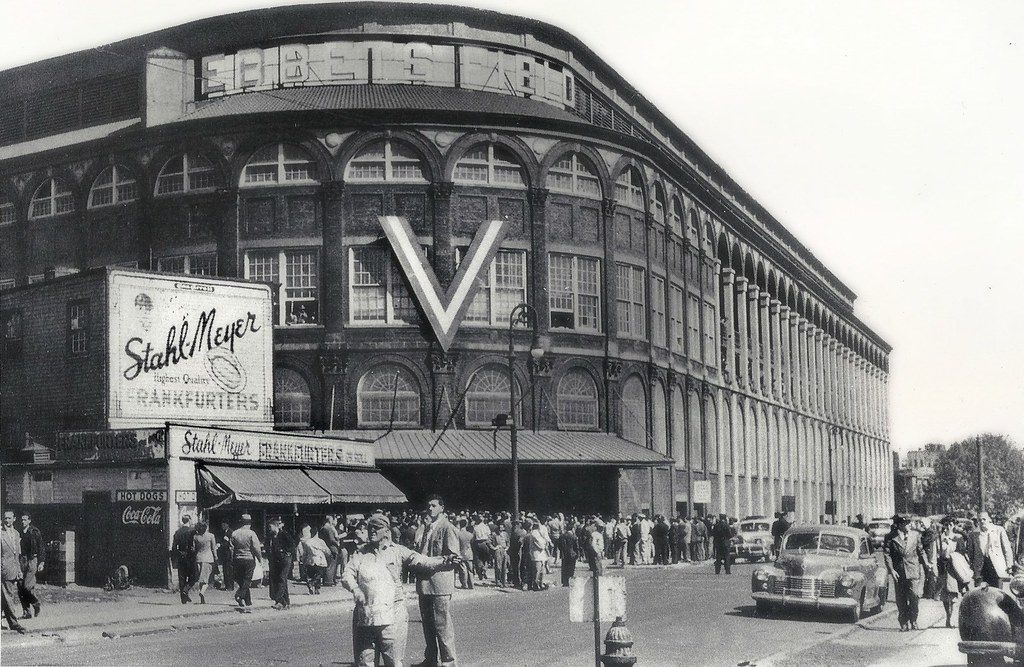
To understand what happened inside Ebbets Field or the Polo Grounds, you have to begin outside them — in the streets, the factories, and the tenements that produced the crowds.
Between 1880 and 1920, New York City absorbed one of the largest sustained migrations in recorded urban history. The Lower East Side alone reached population densities exceeding 300,000 people per square mile in some blocks by 1900 — the Tenth Ward recorded approximately 334,000 per square mile — making it among the most densely settled urban territory on earth at that time. These figures are documented in the historical demography literature and confirmed through research consistent with the Lower East Side Tenement Museum’s archival programs.¹ These were not simply poor neighborhoods. They were environments of extraordinary constraint: overcrowding, limited sanitation infrastructure, fire risk, industrial noise, and wages calibrated to survival rather than comfort.
Jacob Riis, in How the Other Half Lives (1890), documented these conditions through photography and reportage that shocked middle-class readers but simply described the ordinary texture of life for the city’s working immigrant population.² Riis’s subjects were predominantly Eastern European Jews, Italians, Irish, and Germans — the same communities that would form the core audience of New York baseball for the next half century.
The food these populations ate had to conform to the same constraints that governed everything else: it had to be inexpensive, dense in calories, fast to prepare or purchase, portable, and scalable across thousands of transactions daily. Fresh meat was expensive and perishable. Restaurant meals required time and money. What persisted in this environment were forms that fit — preserved products, street foods, market items that could be purchased quickly and consumed without infrastructure.
The sausage, and specifically the frankfurter, met these conditions precisely.
II. The Frankfurter: Immigrant Technology and Industrial Standardization
The frankfurter entered American city life through German immigrant foodways in the mid-nineteenth century. German immigration to the United States was substantial across the 1840s through 1880s, and German communities established delicatessens, beer gardens, and street food cultures in cities including New York, Chicago, Cincinnati, and Milwaukee.³ The sausage was embedded in this cultural transfer — but what happened to it over the following decades was not cultural preservation. It was industrial transformation.
The conditions that made sausage appealing to working populations — preservation, caloric density, low cost, portability — were also the conditions that made it attractive to industrial food producers. A product that could be manufactured at scale, distributed through expanding cold-chain infrastructure, and sold through multiple retail channels simultaneously was a product worth standardizing.
Upton Sinclair’s The Jungle (1906), while focused on the Chicago meatpacking industry and written as socialist political fiction, provided documentary detail about industrial meat production conditions that generated enormous public pressure for federal regulation.⁴ The Pure Food and Drug Act and the Federal Meat Inspection Act, both passed in 1906, established the federal regulatory framework that would shape industrial sausage production going forward. The legislative history of both acts is complex — James Harvey Young’s Pure Food (1989) documents how multiple interests, including industry groups seeking to standardize competition, shaped the final legislation alongside genuine public health advocacy.⁵
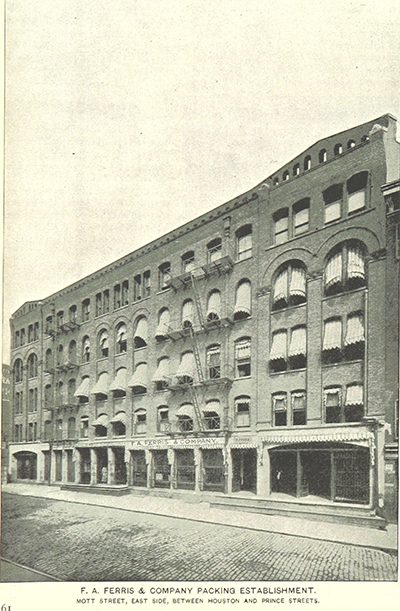
Within this regulatory environment, New York’s own meat trade was consolidating. The companies that would eventually form Stahl-Meyer had roots in this consolidation. According to company historical records, the Ferris lineage traced to 1836, with Louis Meyer & Company and Otto Stahl & Company emerging in the New York area during the 1890s and early 1900s.⁶ The formal merger creating Ferris, Stahl-Meyer took shape in 1928, placing the company inside the major wave of corporate consolidation in American food manufacturing that characterized the interwar period.
What Stahl-Meyer produced was not a craft product. It was an industrial food: consistent, reproducible, distributed at scale, conforming to federal inspection standards, and priced for mass-market consumption. The all-beef frankfurter the company became known for was specifically positioned within the New York market, where large Jewish immigrant and working-class populations created demand for beef rather than pork products.
That was not incidental. It was market calibration. The product was shaped by the population it served.
III. Baseball as Urban Infrastructure
American professional baseball did not emerge as pastoral recreation. It emerged as urban commercial entertainment — and its organizational logic reflected that origin precisely.
The National League was founded in 1876 with an explicitly commercial structure: team ownership, player contracts, ticket sales, and the management of crowds as paying customers. The American League followed in 1901. By the first decade of the twentieth century, major league baseball was operating in the largest American cities, with parks designed to concentrate and manage large working-class audiences.⁷
The timing was not coincidental. The same urbanization that was filling New York’s tenements was producing the audience for baseball. The same workers who labored in factories, on docks, and in construction were the primary ticket-buying population of the sport in its formative years.
Scheduling reflected this. Teams in Brooklyn and New York prioritized Sunday games — the one day the working population was not at labor — and kept ticket prices within reach of industrial wages. Harold Seymour, in Baseball: The Early Years (1960), documents how the sport’s commercial expansion tracked the growth of the urban working class, and how team owners understood their audience in explicitly class terms.⁸
Ebbets Field, opened on April 9, 1913, was the product of this understanding applied to Brooklyn specifically. Charles Ebbets had spent years acquiring parcels in the Flatbush area — a process that required purchasing hundreds of small plots from different owners, a fact Ebbets himself discussed publicly at the time — to create a site that would anchor his franchise in the dense residential fabric of the borough.⁹ The park seated approximately 18,000 at opening, expanded subsequently to approximately 32,000, was reachable by streetcar and subway, and was deliberately embedded in a neighborhood rather than isolated from one.
That embeddedness was the point. Ebbets Field was not adjacent to Brooklyn. It was inside it.
IV. Concessions as Infrastructure: Harry M. Stevens and the Industrialization of Ballpark Food
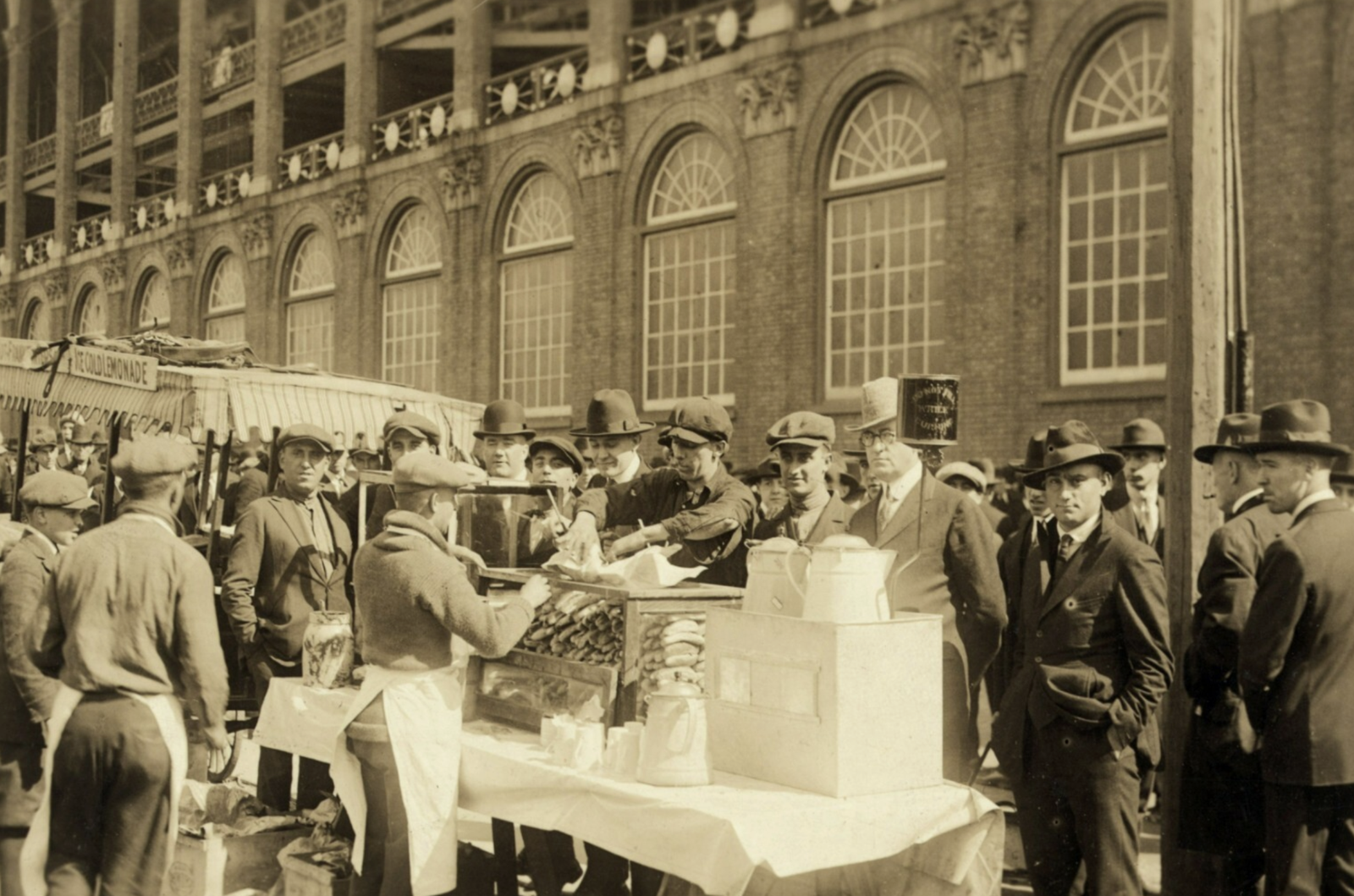
Food inside ballparks was not informal from early in the sport’s commercial development. It was organized.
Harry M. Stevens arrived in the United States from England in 1887 and established himself first as a program seller, then as the dominant force in American sports concessions across the following decades. Stevens secured the concession contract at the Polo Grounds in the late nineteenth century and subsequently expanded to cover Yankee Stadium, Ebbets Field, and numerous other venues. The Stevens company — which operated continuously and was eventually acquired by Aramark in 1994 — held the Yankees’ official concession contract through 1963, a span documented in SABR’s baseball business research.¹⁰
Stevens is frequently credited in popular accounts with popularizing the hot dog at baseball games — a turn-of-the-century story, disputed in its specific details across sources, involving a cold day at the Polo Grounds when he allegedly switched from ice cream to hot sausages. Bruce Kraig, in Hot Dog: A Global History (2009), examines this origin story and concludes that it is likely embellished and probably conflates multiple moments and venues into a single neat narrative.¹¹ What is not embellished is Stevens’s systematic role in establishing organized food service as a defining part of the ballpark experience.
The logic Stevens applied was industrial: standardize the product, control the supply chain, manage the labor force of vendors, and operate consistently across thousands of transactions per game. This was not cottage commerce. It was the application of industrial organization to the concession environment.
The hot dog fit this system because of what it was: a product that could be held in inventory, heated quickly, handed to a customer in seconds, and consumed while standing or sitting without utensils. In a park of 30,000 people with limited time between innings and continuous crowd flow through the gates, those properties were not incidental. They were the reason for selection.
V. The Supply Chain: Stahl-Meyer as Infrastructure Node
Within this organized concession system, Stahl-Meyer occupied a specific position.
According to the company’s own historical documentation — the primary available source for this claim — by the 1950s Ferris, Stahl-Meyer was supplying all of the major league baseball parks in the New York City area with its all-beef frankfurters.¹² This meant the Polo Grounds (Giants), Ebbets Field (Dodgers), and Yankee Stadium (Yankees) — three franchises, three distinct borough identities, three separate crowds, one industrial supplier. Independent corroboration through stadium concession records or wholesale market archives has not been located; the claim rests on the company’s own account, which is consistent with everything known about New York’s food distribution infrastructure in this period but should be understood as such.
The pathway from production to consumption ran through New York’s established wholesale food distribution system. The Washington Market — located in Lower Manhattan near the Hudson River waterfront, which operated as the city’s primary wholesale food center through the mid-twentieth century before its demolition during urban renewal in the early 1960s — was one node in the network through which industrial meat products moved from processors to retail and institutional buyers.¹³ From wholesale distribution, products entered retail delicatessens, grocery stores, and institutional buyers including the concession operations at the ballparks.
This was the same supply chain that fed the city’s everyday life. The frankfurter that a worker purchased at a street cart or deli counter on a Tuesday was produced within the same industrial system that placed an identical product in the hand of a vendor at Ebbets Field on a Sunday afternoon.
The continuity is not symbolic. It is logistical.
VI. The Population in the Stands
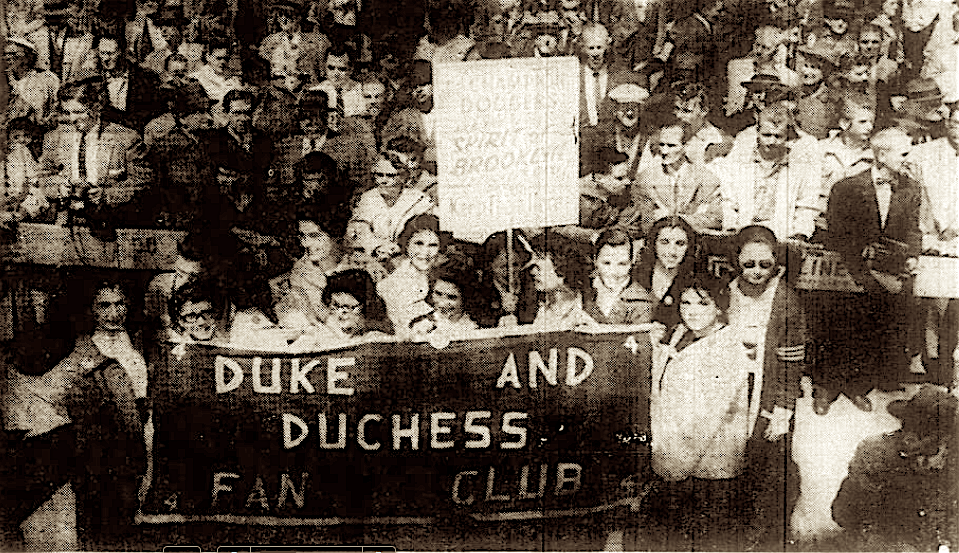
The people inside the ballparks were not a separate category from the people in the tenements and factories. They were the same individuals moving through different phases of the same urban day.
New York’s baseball audience in the 1920s through 1950s was drawn heavily from the city’s immigrant and second-generation working-class communities. Historians of the Dodgers including Carl Prince, in Brooklyn’s Dodgers: The Bums, the Borough, and the Best of Baseball (1996), document the franchise’s deliberate cultivation of its working-class Brooklyn base through cheap tickets, Sunday scheduling, radio broadcasting, and a self-presentation as a borough institution rather than a corporate entertainment property.¹⁴ Red Barber began broadcasting Dodgers games in 1939, extending the team’s presence into the apartments and streets of Brooklyn beyond the park itself.
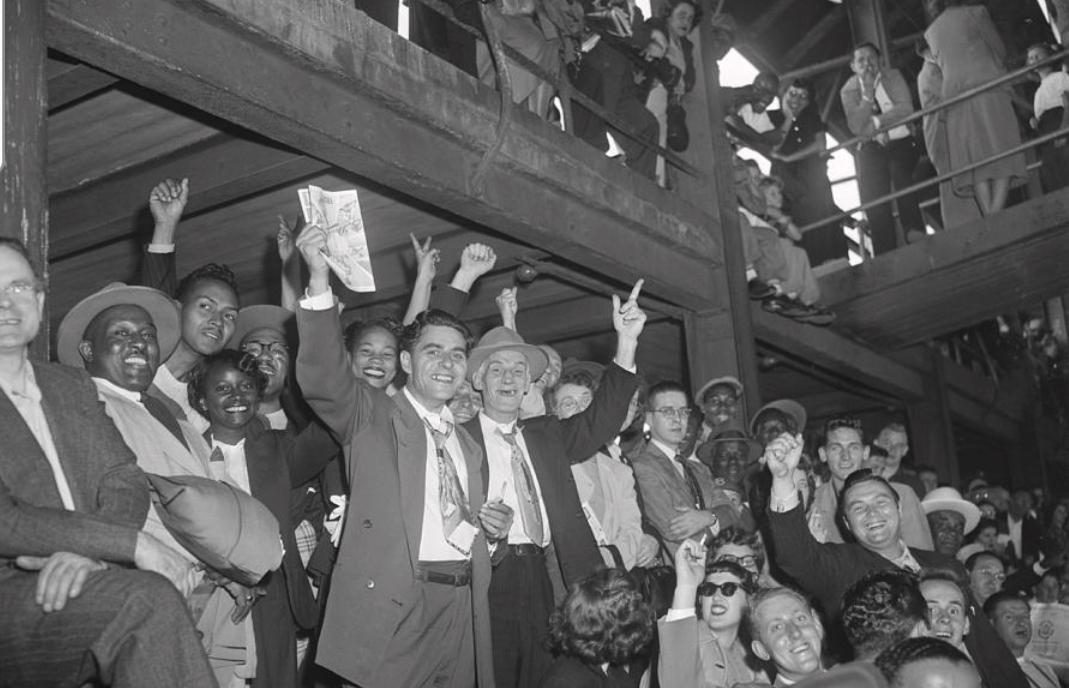
What the ballpark provided was a recurring civic space in which the city’s otherwise fragmented and hierarchically organized population occupied common ground. This did not erase class difference, ethnic tension, or racial segregation — the major leagues were racially segregated until 1947, and Black New Yorkers were excluded from full participation in the field for decades. But within the boundaries of what participation was permitted, the stadium was one of the few recurring spaces in urban life where different immigrant communities — Italian, Jewish, Irish, German, Polish — shared the same physical environment, watched the same event, and consumed the same food.
Roger Kahn, in The Boys of Summer (1972), writing from direct experience as a young journalist covering the Dodgers in the early 1950s, captures the specific texture of this: the intimacy of Ebbets Field, the noise, the hawkers, the smell of the food, the proximity of fan to player, the borough-specific emotional intensity of the crowd.¹⁵ What Kahn describes is not pastoral. It is dense, sensory, industrial-urban life organized around a shared spectacle.
VII. 1947: Integration Within the Continuous System
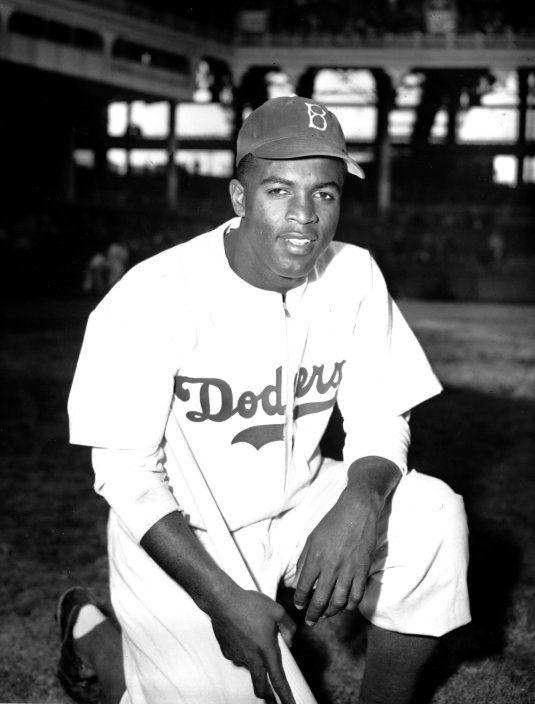
The event that changed the meaning of the New York baseball field most dramatically was not the construction of a new stadium or the signing of a star player. It was the decision by Branch Rickey and the Brooklyn Dodgers to bring Jackie Robinson to the major leagues.
Robinson played his first major league game at Ebbets Field on April 15, 1947.¹⁶ Jules Tygiel’s Baseball’s Great Experiment: Jackie Robinson and His Legacy (1983) remains the definitive scholarly treatment and documents not only the events themselves but the organizational deliberation — including Rickey’s explicit calculation of the social, commercial, and political dimensions — that preceded Robinson’s debut.¹⁷
The crowd at Ebbets Field on April 15, 1947 numbered 26,623. Contemporary Black press coverage, including accounts in The Pittsburgh Courier — one of the most important Black newspapers in the country — estimated that more than half the audience that day was Black, drawn specifically because of Robinson’s presence.¹⁸ That estimate cannot be verified through a precise head count, but it is consistent with period accounts across multiple sources and is accepted in the scholarly literature. This was not a symbolic audience. This was a demographic shift in who physically occupied the park.
Robinson’s presence altered the meaning of attendance: the park was no longer a space where Black Americans watched a game from which their peers were formally excluded at the highest level. The field of participation expanded.
Here is the structural observation that matters for this argument: what changed was the composition and meaning of the crowd. What did not change was the underlying system.
The same park. The same concession infrastructure. The same vendors moving through the same aisles. The same industrial supply chain delivering the same frankfurters from the same processing facilities.
Integration altered the moral and civic meaning of who belonged within the system. It did not rupture the system. The system absorbed the change and continued operating.
The fact that Stahl-Meyer was supplying the park on April 15, 1947, and continued supplying it for years afterward, is one small piece of evidence for that continuity. The product in the vendor’s hand did not change. The hand that received it did.
VIII. The Death of the New York Three-Team System
In 1957, the Brooklyn Dodgers and New York Giants announced their departure — the Dodgers to Los Angeles, the Giants to San Francisco. Both teams played their final New York games in late September 1957.¹⁹
The departure of the Dodgers from Brooklyn constitutes one of the most analyzed events in American sports history precisely because of what it revealed about the relationship between franchise ownership, municipal politics, real estate, and fan loyalty. Robert Moses’s role — his refusal to accommodate a new stadium site that Walter O’Malley had proposed in Brooklyn — is documented in exhaustive detail by Robert Caro in The Power Broker (1974).²⁰ What might have been a negotiated urban solution became an irreversible departure.
The reaction in Brooklyn was not merely disappointment about baseball outcomes. It was experienced as a civic rupture — the severing of an institution from the borough identity it had helped constitute. Roger Kahn documents this in The Boys of Summer. Peter Golenbock’s oral history Bums (1984) preserves it through the testimony of fans who describe the departure in terms that exceed the loss of a sports franchise.²¹
For this argument, the departure marks the dissolution of the specific three-park New York system within which Stahl-Meyer had operated as a unified infrastructure supplier. By 1958, there were no National League games in New York. The Yankees continued at Yankee Stadium, but the civic structure that had organized Brooklyn’s collective life around Ebbets Field was gone.
The stadium was demolished in 1960. An apartment complex — the Ebbets Field Apartments — was built on the site. The crowd dispersed back into the borough it had come from.
IX. Why the Hot Dog Persists
The question of why the hot dog remains the central food of American baseball culture — decades after most of its immigrant constituency has been absorbed into the broader American middle class, decades after the conditions of constraint that produced it have partially lifted — requires a structural rather than sentimental answer.
Forms that satisfy constraints tend to endure beyond the specific moment that generated them. The hot dog continues to meet, in modified form, the same requirements that made it successful a century ago: it is inexpensive relative to alternatives, it is portable, it requires no utensils, it can be consumed quickly, and it can be manufactured and distributed at industrial scale with consistency.
As long as those functional requirements persist in the ballpark environment — and they do persist, because the environment itself has not changed fundamentally — the form will persist.
Bruce Kraig’s food history work supports this analysis: the hot dog’s survival is not primarily about taste preference or nostalgia, though both are real. It is about the continued fit between the product and the structural conditions of the space in which it is sold.²²
Nostalgia is layered on top of this persistence and frequently mistaken for its cause. People feel nostalgic about hot dogs at ballparks because they remember them from childhood, and their parents remembered them, and their grandparents were among the original industrial-urban population for whom the form was a functional solution. The sentiment is real. But sentiment is not the explanation for persistence. Persistence is the explanation for sentiment.
X. Stahl-Meyer’s Place in the Structure
Stahl-Meyer as a company did not survive the twentieth century in its original form. The brand was eventually absorbed through the consolidation waves that restructured American food manufacturing in the latter half of the century. The company name appears today primarily as a nostalgic reference point — associated with the memory of New York baseball in the postwar era — rather than as an active industrial force.
That trajectory is itself typical. Industrial food companies that served specific urban markets were subject to the same forces of consolidation and displacement that restructured American manufacturing broadly: regional brands absorbed into national conglomerates, distribution systems reorganized at larger scale, local market identities dissolved into national brand architectures.
But the historical significance of Stahl-Meyer is not located in its survival. It is located in what it was doing between the 1930s and the late 1950s: operating as a supply node within the industrial food system that sustained both the daily life and the collective ritual of New York’s working population simultaneously.
A company that, by its own account, supplied all three major league parks in the largest American city, during the years when those parks were central institutions of urban civic life for millions of people, was not a peripheral actor. It was infrastructure.
The fact that its products appeared identically — by the company’s account — in the hands of a Giants fan at the Polo Grounds, a Dodgers fan at Ebbets Field, and a Yankees fan at Yankee Stadium, across the ethnic and class distinctions that separated those audiences, makes it one of the few material objects that moved without alteration through the entire field of New York baseball.
That is not a sentimental observation. It is a description of how supply chains and civic life intersect.
XI. The Structure Underneath the Story
American cities in the industrial era produced collective life not through deliberate civic planning but through the convergence of systems operating according to their own logics: manufacturing logic, distribution logic, labor market logic, entertainment market logic, and population density logic.
When those systems converged in the same physical space — the baseball stadium — they produced something that looked like culture and felt like community. It was culture and community. But it was also something more specific: the visible output of an industrial urban metabolism that was simultaneously producing tenements, factories, wages, food, and spectacle.
The tenements and the ballpark were not different worlds. They were different outputs of the same system. The people who moved between them were not changing identities. They were moving through phases.
The sausage that appeared in both environments — on the street cart and in the vendor’s tray — was produced by the same industrial facility, distributed through the same wholesale network, and selected by the same constraints operating at different scales.
After 1947, the system expanded its definition of who belonged within it. That expansion was real, and its consequences — for Robinson, for Black Americans, for the meaning of the sport — were real and large.
The system itself continued.
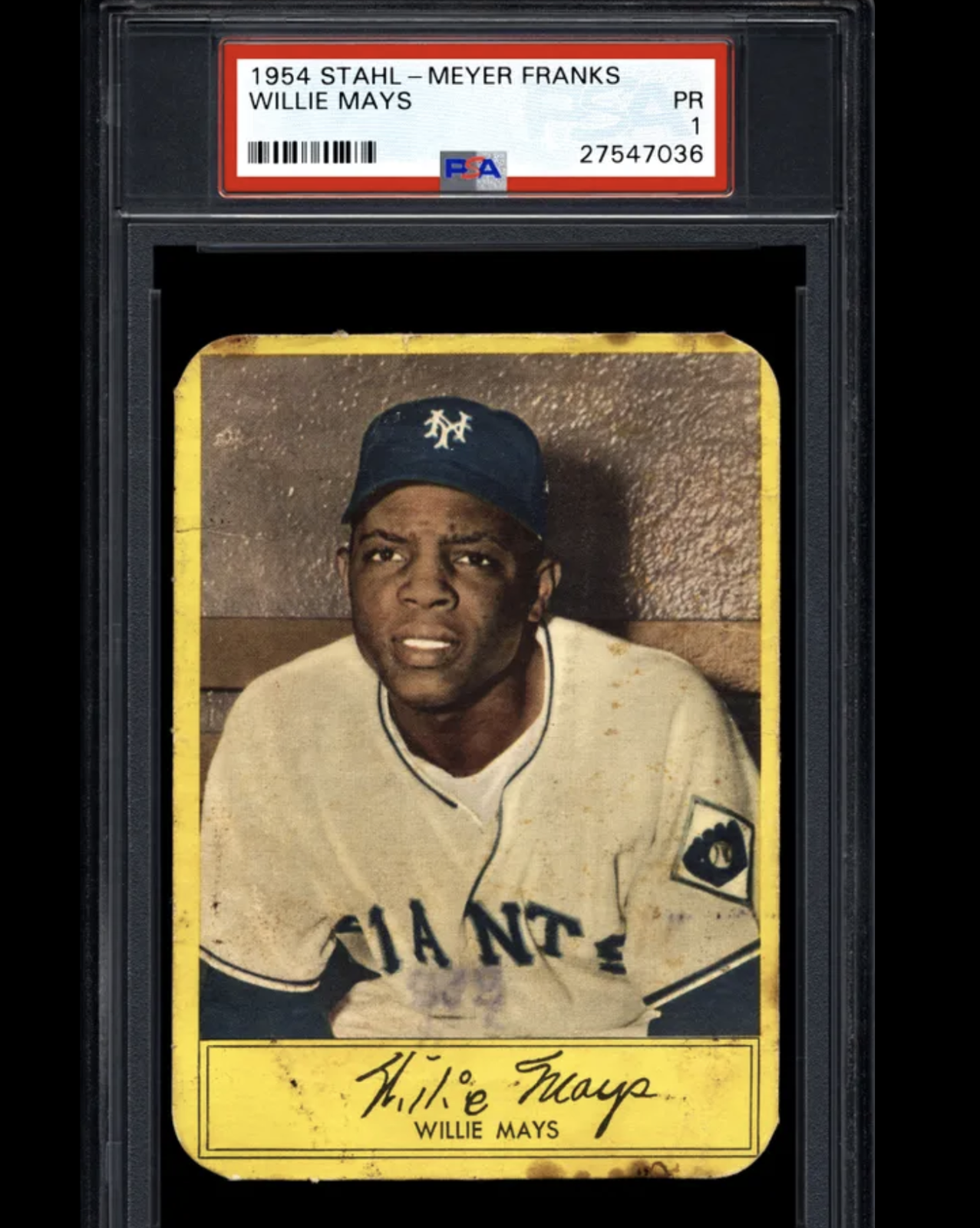
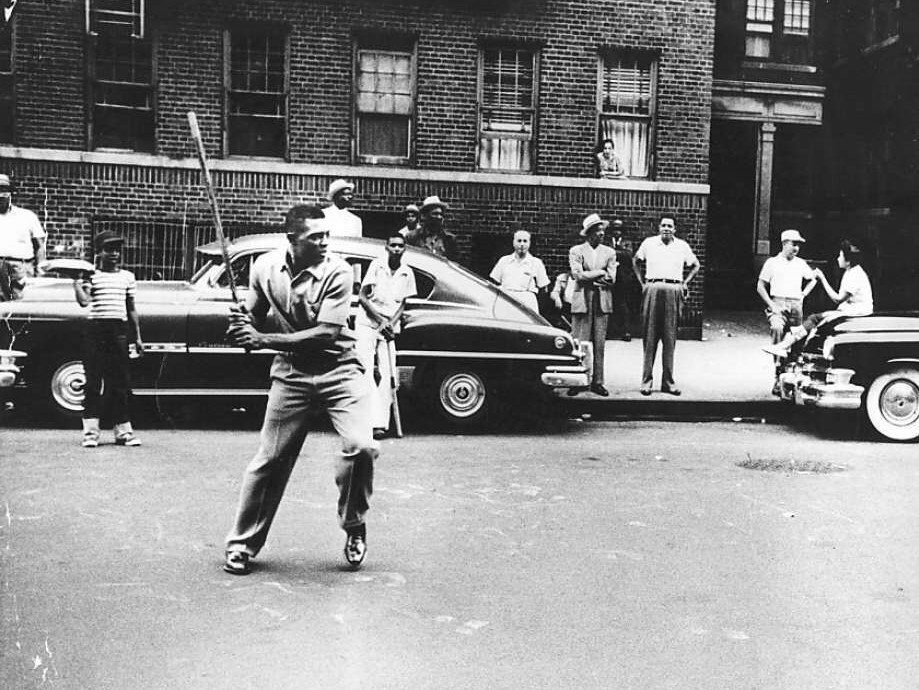
Willie Mays grew up inside this world. He played stickball in the streets of Harlem between his arrival in New York in May 1951 and his departure with the Giants in 1957 — street games with neighborhood kids, documented across multiple accounts including his own memoir and James S. Hirsch’s biography Willie Mays: The Life, the Legend (2010).²³ A few miles separated those Harlem streets from the Polo Grounds, where Mays played before crowds of tens of thousands. The same city. The same continuous field of urban life.
That is not metaphor. That is geography. That is structure.
Sources and Notes
¹ Hasia Diner, Lower East Side Memories: A Jewish Place in America (Princeton University Press, 2000); population density figures consistent with research programs of the Lower East Side Tenement Museum and with census ward data analyzed in standard historical demography literature of the period.
² Jacob Riis, How the Other Half Lives: Studies Among the Tenements of New York (Charles Scribner’s Sons, 1890).
³ Kathleen Neils Conzen, “Germans,” in Harvard Encyclopedia of American Ethnic Groups, ed. Stephan Thernstrom (Harvard University Press, 1980).
⁴ Upton Sinclair, The Jungle (Doubleday, Page & Company, 1906).
⁵ James Harvey Young, Pure Food: Securing the Federal Food and Drugs Act of 1906 (Princeton University Press, 1989).
⁶ Stahl-Meyer Foods, Inc., company historical records. The Ferris lineage date of 1836 and the emergence of the Meyer and Stahl companies in the 1890s are drawn from company documentation and have not been independently verified through external archival sources.
⁷ Harold Seymour, Baseball: The Early Years (Oxford University Press, 1960).
⁸ Ibid.
⁹ Michael Gershman, Diamonds: The Evolution of the Ballpark (Houghton Mifflin, 1993); Ebbets’s land acquisition process was also discussed in contemporary New York press coverage at the time of the park’s opening in 1913.
¹⁰ Society for American Baseball Research (SABR), baseball business and finance research programs; Harry M. Stevens Company trade documentation.
¹¹ Bruce Kraig, Hot Dog: A Global History (Reaktion Books, 2009).
¹² Stahl-Meyer Foods, Inc., company historical documentation. This is the primary available source for the claim that Stahl-Meyer supplied all New York major league parks in the 1950s. The claim is consistent with what is known about New York food distribution infrastructure in this period but rests on company self-reporting; independent corroboration through external archival sources has not been located.
¹³ On Washington Market and New York’s wholesale food distribution infrastructure, see: Suzanne Wasserman, “The Good Old Days of Poverty: The Battle over the Fate of New York City’s Lower East Side During the Depression” (PhD dissertation, New York University, 1990); also New York City Landmarks Preservation Commission records on the Washington Market district.
¹⁴ Carl Prince, Brooklyn’s Dodgers: The Bums, the Borough, and the Best of Baseball (Oxford University Press, 1996).
¹⁵ Roger Kahn, The Boys of Summer (Harper & Row, 1972).
¹⁶ Associated Press wire coverage, April 15, 1947.
¹⁷ Jules Tygiel, Baseball’s Great Experiment: Jackie Robinson and His Legacy (Oxford University Press, 1983).
¹⁸ The Pittsburgh Courier, April 1947; see also Tygiel, Baseball’s Great Experiment, for scholarly treatment of crowd composition and the significance of Black attendance at Robinson’s debut. The figure of more than half the crowd being Black is a period estimate from contemporary press accounts and is accepted in the scholarly literature as approximately accurate; it was not derived from a formal head count.
¹⁹ Neil J. Sullivan, The Dodgers Move West (Oxford University Press, 1987).
²⁰ Robert A. Caro, The Power Broker: Robert Moses and the Fall of New York (Knopf, 1974).
²¹ Peter Golenbock, Bums: An Oral History of the Brooklyn Dodgers (Putnam, 1984).
²² Kraig, Hot Dog: A Global History.
²³ Willie Mays with Lou Sahadi, Say Hey: The Autobiography of Willie Mays (Simon & Schuster, 1988); James S. Hirsch, Willie Mays: The Life, the Legend (Simon & Schuster, 2010).
Part 2. The Shoe and the Street: Starbury, Shaq, Ben Wallace, and the Industrial Democratization of Basketball Culture in the Early 2000s
Preface: What This Argument Is
This is not a story about sneaker nostalgia or celebrity endorsement.
It is an argument about how industrial production, market exclusion, and cultural demand converge to produce a structural shift in who can participate in a shared American field — and how a shoe company, a basketball player, a rapper from Atlanta, and a generation of poor Black kids constitute a single continuous system rather than separate stories layered on top of one another.
The sneaker is the entry point. Starbury is the case. Shaq is the predecessor. Ben Wallace is the embodied argument. Young Jeezy is the voice of the street that context requires. The early 2000s is the field where the convergence becomes fully visible.
I. The Field Before the Shoe: Basketball, Brand, and the Economics of Exclusion

To understand what Starbury meant in 2006, you have to understand what basketball culture cost before it existed.
By the mid-1990s, the NBA had undergone a transformation that was simultaneously cultural and commercial. The league marketed its players as individual brands. Michael Jordan’s partnership with Nike, beginning with the Air Jordan I in 1985, established a template that would dominate the industry for two decades: signature shoes priced at a premium, marketed through advertising campaigns that associated the product with aspiration, excellence, and a particular kind of American transcendence.¹
The template worked. By the late 1990s, the Air Jordan brand was generating well over $100 million annually — by analyst estimates, approaching $200 to $300 million — according to sports business reporting of the period.² The basketball shoe market more broadly — including signature models from Reebok, specifically Allen Iverson’s Answer series at $120 to $130 and Shaquille O’Neal’s early Reebok line, along with Adidas’s Kobe Bryant and Tracy McGrady signature shoes — had become a multibillion-dollar industry segment built on the principle that the player’s image could command a price premium disconnected from the cost of manufacturing.
There was nothing inherently wrong with this model. It produced extraordinary design, technological innovation, and cultural artifacts of genuine significance. But it also produced an exclusion threshold.
The price of a signature basketball shoe in the late 1990s and early 2000s typically ranged from $120 to $150 at retail.³ For a family living at or near the poverty line — and many Black American families were — that represented a significant expenditure. A single pair of shoes could cost what a family spent on groceries for a week. The shoes were not optional within the culture. They were markers of participation, status, and belonging. To not have them was to be marked as outside.
This created a specific tension. Basketball was the sport most deeply embedded in poor Black urban communities. It required only a ball, a hoop, and a flat surface. It was played on playgrounds, in schoolyards, on neighborhood courts — spaces where access was not monetized. The game itself was democratic. But the culture surrounding it — the shoes, the clothing, the markers of affiliation — was not.
The industrial system that produced the shoes was producing a market in which full participation in basketball culture required a financial threshold that many of the sport’s most dedicated players and fans could not cross.
This was not a conspiracy. It was a market equilibrium. Companies sold at prices the market would bear, and the market bore premium prices because demand was inelastic among those who could afford them. The excluded population was not the target customer. They were not being exploited. They were being ignored.
That was the field before the shift.
II. Shaq: The First Attempt

Shaquille O’Neal’s relationship with the basketball shoe market is important not because it succeeded but because it revealed the structural problem that later solutions would have to address.
Shaq entered the NBA in 1992 as the first overall pick and signed with Reebok. His early signature shoes — the Shaq Attaq series, launched in 1992 — were priced competitively with the premium market. But Shaq had a different idea embedded in his public statements from early in his career: he wanted to make a shoe that kids in poor neighborhoods could actually afford. When his Reebok deal concluded around 1997 to 1998, he launched his own brand, Dunkman, through a licensing partnership with a company called Apex, and subsequently through other licensing arrangements. The shoes were priced at approximately $40 to $50 — dramatically below the signature market.⁴
The Dunkman line failed. The reasons are instructive.
The shoes were not marketed effectively. Distribution was weak. Design quality was inconsistent across production runs. But more fundamentally, the line suffered from a cultural problem that no amount of marketing could easily overcome: at $40, the shoes signaled cheapness rather than accessibility. In a market where price was a proxy for status, a low-priced signature shoe carried the stigma of the marked-down. Kids did not want to wear shoes that announced to everyone around them that their family could not afford the real ones. The humiliation was built into the price point.
Shaq understood the structural problem — that the cost of participation was too high — but he did not solve the cultural problem. A shoe that cost less but announced its cheapness was not a solution. It was a compromise that no one wanted to make in public.
Shaq returned to the premium market. The Dunkman experiment receded into footnotes.⁵
But Shaq had identified the problem correctly. The solution would require a different approach — one that solved both the economic and the cultural equation simultaneously. That solution would not arrive for nearly a decade.
III. Ben Wallace: The Embodied Argument

Before the solution emerged, the problem had a human form. His name was Ben Wallace, and his life was a precise map of everything the premium sneaker market was not built for and everything that basketball culture, at its actual democratic core, could produce anyway.
Ben Wallace was born in 1974 in White Hall, Alabama, a small town in Lowndes County — one of the poorest counties in the state of Alabama, in one of the poorest regions in the United States. He was the tenth of eleven children. His father, a farmer and a truck driver, died when Ben was in high school. The family lived in a house with no indoor plumbing until Ben was approximately fourteen years old.⁶
Lowndes County carries a specific historical weight that cannot be separated from Wallace’s story. This was the county where Viola Liuzzo was murdered by Klansmen in 1965 after the Selma to Montgomery marches. This was the county that had an almost entirely Black population living in conditions of near-total economic exclusion maintained by decades of structural racism in land ownership, credit, and employment. When Ben Wallace was born in 1974, Lowndes County was still among the most impoverished places in the country by every measurable index.⁷
Wallace played basketball in this environment. Not in a gym, not with professional equipment, not with expensive shoes. He played because the game was available and because he was gifted and because it was one of the few systems of merit operating in his world that was not entirely rigged against him.
He attended Cuyahoga Community College in Ohio, then transferred to Virginia Union University — a historically Black university in Richmond, Virginia, founded in 1865. He was not highly recruited. He was not projected as a professional prospect. He was 6’9” with enormous hands, exceptional athleticism, and a defensive instinct that no one had yet taught him to channel systematically.
He went undrafted in the 1996 NBA draft — the same draft that produced Stephon Marbury, Ray Allen, Allen Iverson, and Kobe Bryant.⁸
Wallace signed with the Washington Bullets as an undrafted free agent. He played sparingly his first several seasons, traded to the Orlando Magic in 1999, and then to the Detroit Pistons in 2000 — in the deal that sent Grant Hill to Orlando, a trade widely regarded at the time as a massive overpay by Detroit for a player nobody seriously evaluated as a cornerstone asset.
What happened in Detroit became one of the most remarkable careers in the history of the sport.
Wallace led the NBA in rebounds per game in 2001-02, averaging 13.0, and again in 2002-03, averaging 15.4. He led the league in blocked shots in 2001-02 at 3.48 per game. He was named NBA Defensive Player of the Year in 2002, 2003, 2005, and 2006 — one of only three players in the history of the award to win it four times, alongside Dikembe Mutombo and Rudy Gobert. He was the first undrafted player in NBA history to win the award.⁹
In 2004, the Detroit Pistons won the NBA championship, defeating the Los Angeles Lakers four games to one in a series that is still studied as one of the greatest upsets in Finals history. Wallace was the defensive anchor of a team that had no player earning a maximum contract and no individual who had been the first option on a championship-level team before. They were a collective. They were built from parts that other teams had discarded or undervalued. And they beat a Lakers team featuring Shaquille O’Neal and Kobe Bryant that had won three consecutive championships.¹⁰
Ben Wallace was inducted into the Naismith Memorial Basketball Hall of Fame in 2021.
His significance to this argument is not primarily statistical. It is representative and structural.
He came from conditions of material deprivation that made every premium cultural marker of basketball inaccessible. He went undrafted. He was undersized for a center by every conventional measure. He built a Hall of Fame career using only what could not be taken away by poverty or exclusion: physical gifts, work ethic, and basketball intelligence developed on courts and in conditions that had nothing to do with the premium sneaker market.
The basketball culture that produced Ben Wallace was the basketball culture of outdoor courts, improvised training, and whatever shoes a family could manage. His success was structural evidence that the merit system of the game itself — who can actually play — was entirely independent of the market system that surrounded it. The barriers to participation in basketball culture were not barriers to basketball excellence. But they were real barriers, and they were daily humiliations for millions of kids who had Ben Wallace’s love for the game without Ben Wallace’s exceptional gifts.
The Starbury was built for those kids. Ben Wallace’s life is the argument for why it had to be built.
IV. The Voice of the Street: Young Jeezy and Let’s Get It: Thug Motivation 101
What follows is an interpretation of the album in relation to the economic and cultural conditions outlined above, rather than a claim about a single definitive meaning.

In the summer of 2005, one year before the Starbury launched, a rapper from Atlanta named Jay Wayne Jenkins — known as Young Jeezy — released his major label debut album on Def Jam Recordings. The album was called Let’s Get It: Thug Motivation 101. It debuted at number two on the Billboard 200, sold approximately 172,000 copies in its first week, was certified platinum by the RIAA, and became one of the defining cultural documents of the mid-2000s.¹¹
It articulated, in cultural form, a perspective on survival and constraint that parallels the conditions described above.
Jeezy came from the streets of Atlanta — specifically from the South Side, from conditions of poverty and street life that he documented without apology and without sentimentality. The album’s title was not a metaphor. Thug Motivation was a statement of purpose: this is how people in my world survive, this is what drives us, and I am going to say it out loud in a culture that would prefer we remain invisible.
The album opens with a spoken word introduction — a rally cry — in which Jeezy addresses his audience directly, not as fans but as people who share a world with him:
“Let’s get it. Yeah. It’s Young Jeezy, man. I’m doin’ this for all my real street ns out there, man. All my trap ns. N****s that’s doin’ what they gotta do to feed they families.”*¹²
This framing — doing what you have to do to feed your family — emerges as a central theme of the album. It is not a celebration of crime. It is a recognition that the economic system in which Jeezy and his audience live does not provide legitimate pathways to stability, and that the people navigating that system are not moral failures but human beings operating under structural constraint. The same argument that animates the Starbury — the existing system excludes us, we are building something for ourselves — runs through every track on Thug Motivation 101.
“Soul Survivor,” the album’s breakout single featuring Akon, makes the survival ethic explicit:
*”I’m a soul survivor, and if you from the ghetto/ you know that you can’t let up, can’t give up, gotta get up.”*¹³
The song is not about transcendence in the conventional American sense — not about rising above the circumstances of poverty into a better world through individual achievement. It is about endurance within the circumstances. You are still in the ghetto. The ghetto has not been solved. You survive it by not letting up. This reflects documented realities of economic constraint in many low-income communities, and contrasts with the aspirational marketing language that premium sneaker companies used to sell $150 shoes to the same audience.
“Trap Star” addresses the street economy directly, and in doing so articulates the relationship between survival and identity that the premium sneaker market was simultaneously exploiting and excluding. In Jeezy’s framing, the trap — the street-level drug economy — is not a moral choice so much as an employment system for people who have been excluded from legitimate ones. The figure of the “trap star” is framed within the album as someone operating within constrained economic options.¹⁴
What runs through the album — and what makes it relevant to the Starbury argument — is Jeezy’s positioning of himself as a representative, not just a narrator. He is not observing the streets. He is from the streets, and the streets are his constituency. In interview after interview during the album’s promotional cycle, Jeezy described his music as being for people in his situation — not for the mainstream audience that would eventually buy the record, but for the people in Atlanta’s poorest neighborhoods who recognized the world he was describing.
This is the cultural logic that the Starbury entered in 2006. Jeezy was not adjacent to that logic. He was one of its clearest and most commercially successful articulations.
The album’s most direct statement of hood advocacy — of riding for your community, of taking responsibility for the people around you — comes in “Thug Motivation 101”:
*”My homies look to me for inspiration when I shine/ they shine, that’s the way we designed/ out here grindin’ every day for mine.”*¹⁵
This is a specific ethical posture. Jeezy is not celebrating individual success. He is describing individual success as meaningful only insofar as it reflects back on the community — when I shine, they shine. The individual achievement is in service of the collective. The person who makes it out carries the weight of everyone who did not.
This closely parallels the framing that Stephon Marbury would articulate when explaining why he made the Starbury. The language was different. The cultural form was different. But the ethical structure was identical.
V. Steve Stoute and the Theory of Cultural Access

The solution to the problem that Shaq had identified and Ben Wallace had embodied and Young Jeezy had named emerged from a specific convergence of market analysis, cultural intelligence, and industrial capacity.
Steve Stoute was not a shoe designer. He was a music industry executive who had worked with Nas, Jay-Z, and other major hip-hop artists before founding a marketing agency called Translation in 2003.¹⁶ His core insight was that the traditional endorsement model — pay a celebrity to appear in an advertisement, associate the product with aspiration — was becoming ineffective with younger consumers, particularly Black and Latino youth who had grown up inside the culture being marketed to them and could detect inauthenticity immediately.
Stoute’s deeper insight was that the premium sneaker market was not actually selling basketball shoes. It was selling the feeling of access to a world that remained otherwise inaccessible. The shoes were proxies for proximity to excellence, to wealth, to a version of American success that the advertising promised but the economic system denied. The genius of the Air Jordan campaign was that it made a $150 shoe feel like a ticket into Michael Jordan’s world.
But that same genius was also the mechanism of exclusion. Because the ticket required $150. And millions of kids — the same kids who were most deeply embedded in basketball culture, the same kids for whom the sport was most central to identity and daily life — could not afford the ticket.
Stoute’s analysis, developed through his Translation work and his observation of how the Jay-Z brand and Rocawear had succeeded by operating from within the culture rather than marketing to it from outside, was that the solution was not to offer a cheaper imitation of the premium experience. The solution was to redefine what the product was for.
The Rocawear clothing brand, which Stoute had been involved in launching in 1999 with Jay-Z, had demonstrated this principle in apparel: authentic design, credible cultural endorsement, accessible pricing, mass distribution. By the early 2000s, Rocawear was one of the most successful urban clothing brands in the country.¹⁷
The shoe market was harder. The barriers were higher: decades of brand equity, established retail relationships, consumer behavior deeply conditioned by the premium model. But the gap was also wider. The distance between $150 and what a poor family could spend on shoes was the distance between participation and exclusion.
Stoute identified the specific intervention point: if a signature shoe could be priced at below $20, with a credible NBA endorser, and distributed through mass-market retail in the neighborhoods where the excluded population actually shopped, it would solve both problems simultaneously. The price would be below the threshold where compromise was perceptible. The endorsement would provide cultural legitimacy. The distribution would provide physical access.
The retailer that made the distribution model possible was Steve & Barry’s — a discount retail chain that had positioned itself in shopping malls across the country, including malls in lower-income neighborhoods that premium sneaker retailers actively avoided. Steve & Barry’s operated on extremely thin margins and high volume, which made the $14.98 price point viable as a retail proposition.¹⁸
The athlete Stoute recruited to endorse the shoe was Stephon Marbury.
VI. Stephon Marbury: The Right Player at the Right Moment

Stephon Marbury was born on February 20, 1977, in the Coney Island section of Brooklyn — a neighborhood defined by public housing projects, concentrated poverty, and one of the most storied basketball cultures in New York City history. He was the second youngest of seven children. His father, Donald Marbury, died of a heart attack in 1995 during Stephon’s senior year of high school.¹⁹
Coney Island basketball was not a metaphor. It was a specific, documented subculture — one of the densest concentrations of basketball talent in American history emerging from a few blocks of public housing in southern Brooklyn. Darcy Frey documented this world in his book The Last Shot: City Streetball, Dreams, and the Price of Success (1994), which followed Coney Island players in the early 1990s and painted an exact portrait of the environment that produced Marbury: a world where basketball was the only visible pathway out of poverty, where the culture of the game was total and consuming, and where the gap between what the sneaker market promised and what the neighborhood could afford was daily and visible.²⁰
Marbury was named Mr. Basketball in New York State in 1995. He played one season at Georgia Tech before declaring for the 1996 NBA draft, where he was selected fourth overall by the Milwaukee Bucks and immediately traded to the Minnesota Timberwolves. His NBA career was statistically excellent — he averaged over 20 points per game for five consecutive seasons from 2000-01 through 2004-05 and was a two-time All-Star in 2001 and 2003 — but it was also marked by a reputation as a difficult teammate and an inability to win at the highest level despite individual excellence.²¹
By 2006, Marbury was with the New York Knicks, one of the worst-run franchises in professional basketball. He was thirty years old. His commercial appeal to premium shoe companies was limited. He was not LeBron James. He was not the face of the league’s future. He was a complicated, polarizing player whose prime was either ending or had already passed depending on which analyst you consulted.
This made him, paradoxically, the right person for the Starbury.
Marbury was not being asked to sell aspiration to wealth. He was being asked to represent something that required no distance from poverty to be credible — because he had come from poverty himself, in one of New York’s most documented poor communities, and he had not forgotten it.
In interviews at the time of the Starbury launch, Marbury was explicit about his motivation. He described watching kids in New York who could not afford the shoes they needed to play the sport they loved. He described his own mother struggling to buy him decent shoes as a child. He described the humiliation of wearing the wrong shoes — not wrong stylistically, but wrong economically, marked by their cheapness as surely as a branded advertisement.²²
”I wanted kids to be able to wear what I wear,” Marbury said in multiple interviews during the launch period. *”Kids in the hood deserve to have the same things. Why should they have to pay $150 for a shoe? That’s not right.”*²³
This was not marketing language. It was the same ethical position Jeezy had articulated from Atlanta a year earlier. When I shine, they shine. The obligation runs backward toward where you came from.
VII. The Shoe: Design, Price, and the Destruction of the Stigma Model

The Starbury One launched in late August 2006 at Steve & Barry’s stores nationwide. The price was $14.98.
The shoe was designed by Richard “Ricky” Lai, who had previously worked on Reebok’s Answer line with Allen Iverson. The Starbury One featured a full-length EVA midsole for cushioning, a herringbone outsole for traction, a padded collar and tongue, and a leather and synthetic upper. It was not technologically advanced by the standards of a $150 performance shoe. But it was a fully functional basketball shoe that met the performance requirements of the game at any competitive level below the NBA.²⁴
The design was clean. Understated. It did not look like a discount shoe. It did not announce its price in its construction or its aesthetic. A kid could walk onto a court wearing Starburys and no one looking at the shoe would know it cost $14.98 unless they were told.
That was the entire point.
The marketing model was as unconventional as the pricing model. Rather than television advertising campaigns or billboard placements, Marbury promoted the shoe through personal appearances at Steve & Barry’s stores, specifically in locations in lower-income neighborhoods. He showed up. He stood in the store. He talked to kids. He had his picture taken with them. He wore the shoe in NBA games on national television, which meant that the $14.98 shoe was visible on the same courts and in the same broadcasts as the $150 shoes worn by every other player in the league.²⁵
The response was immediate and emphatic. The initial production run sold out within weeks. Steve & Barry’s reported that the highest demand was in stores located in lower-income communities — the exact population the shoe had been designed for. By early 2007, the Starbury line — which had expanded to include multiple models and colorways — had sold over one million pairs, according to company statements and contemporaneous media reporting.²⁶
The Starbury apparel line expanded simultaneously: t-shirts, hoodies, and shorts priced at $9.98 and below. The same principle applied throughout. Authentic design. Credible endorsement. Price below the stigma threshold.
In total, the Starbury line sold approximately five million pairs over its three-year run before Steve & Barry’s filed for Chapter 11 bankruptcy in July 2008 and subsequently liquidated — a failure driven not by the Starbury line but by the broader debt and real estate commitments of the retail chain itself.²⁷
Five million pairs in three years at $14.98 each. Five million kids and families who crossed the threshold that had previously been set at $150.
VIII. The Cultural Equation: Jeezy, Marbury, and the Same Argument in Two Registers
The connection between Young Jeezy’s Thug Motivation 101 and the Starbury is not a connection of personnel or commerce. Jeezy did not endorse the shoe. He was not involved in its design or marketing. The connection is structural — they are two expressions of the same argument, operating in different cultural registers, emerging from the same social field at the same moment in American history.
Jeezy’s work can be read as foregrounding the reality of his community, the weight of their struggles, and the presence of structural exclusion. His music was advocacy in the form of testimony. It was a refusal to be invisible on behalf of everyone in his world who remained invisible. He was riding for his hood not in the sense of loyalty to a street corner but in the deeper sense of insisting that the lives lived on that corner had value and deserved representation.
Marbury’s intervention, made through a shoe: the kids in my community deserve to participate in the culture they love, the price of that participation has been set artificially high by an industry that profits from their exclusion, and I am going to use whatever standing I have in that industry to break the price floor.
Both can be understood as operating within a similar ethical logic: individual success creates an obligation to the community that produced you. You do not escape and then look back. You reach back. When I shine, they shine.
This is not a sentiment unique to hip-hop culture or basketball culture. It appears across African American political and cultural tradition — in the mutual aid societies of the Reconstruction era, in the collective economics of the civil rights movement, in the community investment practices documented by historians of Black urban life. But Jeezy and Marbury were expressing it in the specific language of early-2000s urban culture, which was the language of the street, of the trap, of the court.
The premium sneaker market, for two decades, drew heavily from Black athletes and Black cultural production while often remaining financially inaccessible to many of the communities from which that cultural authority derived. It had taken the cultural production of the hood — the style, the language, the music, the game — and monetized it at price points designed to exclude the hood from the market it had created.
Jeezy named this without naming it in those terms. Marbury corrected it without announcing he was correcting it in those terms. Taken together, they can be interpreted as expressing a shared structural tension.
IX. Why the Shift Mattered and Why It Did Not Last
The Starbury mattered because it demonstrated that the price floor of the premium sneaker market was not a technical necessity. It was a choice. The shoe could be made for less. The endorsement could be structured differently. The retail channel could be different. The floor existed because it was profitable, not because it was inevitable.
That demonstration had cultural significance beyond its immediate commercial impact. Every kid who bought a Starbury had material evidence that the system of exclusion was not natural. It had been constructed. It could be deconstructed. The Starbury did not fix the broader economics of the sneaker market — Nike and Reebok and Adidas continued to sell $150 shoes, and they continue to do so today. But it proved the point that needed proving.
Ben Wallace’s career proved the same point in a different register. He demonstrated that the merit system of basketball — who can actually play at the highest level — was independent of the market system that had grown up around the sport. You did not need expensive equipment to develop exceptional basketball ability. You needed access to the game itself. And the game itself was still free.
The Starbury did not survive the collapse of Steve & Barry’s in 2008. Marbury attempted to revive the brand in various forms in subsequent years, including a version produced in China where he played after leaving the NBA, but the mass-market American distribution that had made the original Starbury significant was gone with the retailer.²⁸
The premium sneaker market absorbed the lesson of the Starbury and largely ignored it. Nike introduced cheaper lines — the Nike Air Force 1 remained accessible at lower price points — but the signature shoe market continued its trajectory toward higher prices, not lower ones. By the 2020s, resale prices for limited-edition Jordans and Yeezys had reached hundreds and sometimes thousands of dollars, and the cultural machine of exclusion through scarcity and premium pricing was operating at greater intensity than ever.
The structural problem that Shaq had identified, that Ben Wallace had embodied, that Jeezy had named, and that Marbury had temporarily corrected was not solved. It was demonstrated to be solvable, which is a different and smaller thing.
But demonstrations matter. They are evidence that the system is a system — that it has a design, that it can be redesigned, and that the people it excludes are not excluded by necessity but by choice.
X. The Structure Underneath the Story
The premium sneaker market of the 1990s and early 2000s was built on a paradox: it derived its cultural authority from Black communities while systematically pricing those communities out of participation. It used the language of the street to sell products the street could not afford. It relied on Black athletic excellence as a central marketing engine for a consumption pattern that many lower-income consumers could not sustain.
This paradox was not new. It is a structural feature of how American capitalism has historically related to Black cultural production — absorbing the cultural output, monetizing it at the mainstream level, and returning the economic benefits primarily to the institutions that controlled distribution rather than to the communities that generated the culture.
What was specific to the early 2000s was the visibility of the paradox. The same forces of cultural democratization that the internet was beginning to enable — the ability of communities to see themselves clearly and to articulate what they saw — were making the machinery of exclusion harder to ignore. Young Jeezy’s music did not analyze this machinery in academic terms. It described it from inside, which was more powerful than analysis.
The Starbury was a direct intervention in that machinery. It did not require a theory of change. It required a shoe, a player willing to forgo a conventional endorsement fee, a retailer willing to operate on thin margins, and a price point below the threshold of stigma.
Ben Wallace’s career, from White Hall, Alabama to the Basketball Hall of Fame, is the longest and most complete argument against the proposition that the premium market is necessary to the culture of the game. He played basketball with whatever he had, in whatever shoes a family living in a house with no indoor plumbing in Lowndes County could provide, and he became one of the greatest defensive players the sport has ever produced.
The game did not require the premium market. The premium market required the game.
Young Jeezy understood this without needing to articulate it in those terms. It was a claim that the people living within these conditions — on the court, in neighborhoods like those described — were the source of the culture, and that the culture belonged to them regardless of who controlled the retail channel.
”When I shine, they shine.”
That is not a sentiment. It is a structural argument about where value originates and who it belongs to.
The Starbury, for three years and five million pairs, made that argument in the form of a shoe.
Sources and Notes
¹ On the Air Jordan I launch in 1985 and Nike’s signature shoe model, see: Donald Katz, Just Do It: The Nike Spirit in the Corporate World (Random House, 1994); also J.B. Strasser and Laurie Becklund, Swoosh: The Unauthorized Story of Nike and the Men Who Played There (HarperBusiness, 1993).
² Air Jordan brand revenue estimates from sports business reporting of the late 1990s; see Forbes annual NBA valuations and Nike brand revenue analysis from the period. Nike’s public financial filings do not break out Jordan brand revenue with precision for this period; analyst estimates ranging from $200 to $300 million annually by the late 1990s appear in multiple business press sources.
³ Retail pricing for the Air Jordan XIII (1997-98, $150), Air Jordan XIV (1998-99, $150), Reebok Answer III (2001, $125), and Adidas KOBE II (1999-2000, $120) documented in contemporaneous retail catalogs and sports business press.
⁴ On Shaq’s Dunkman line and its pricing, see: USA Today sports business reporting, 1998-2000; also Harvey Araton, Crashing the Borders: How Basketball Won the World and Lost Its Soul at Home (Free Press, 2005).
⁵ Ibid.
⁶ Ben Wallace biographical information from: George Castle, Big Ben: The Ben Wallace Story (Triumph Books, 2005); also Naismith Memorial Basketball Hall of Fame induction materials, 2021; and profile reporting from The Detroit Free Press and Sports Illustrated across Wallace’s career.
⁷ On Lowndes County, Alabama’s historical conditions, see: Charles Fager, Selma 1965: The March That Changed the South (Beacon Press, 1985); also J.L. Chestnut Jr. and Julia Cass, Black in Selma (Farrar, Straus and Giroux, 1990).
⁸ 1996 NBA Draft records, NBA.com official historical records.
⁹ Ben Wallace’s statistical records and Defensive Player of the Year awards: Basketball Reference, official NBA historical statistics; Naismith Memorial Basketball Hall of Fame induction materials, 2021.
¹⁰ 2004 NBA Finals records: NBA official historical records; also see: Jonathan Abrams, Boys Among Men: How the Prep-to-Pro Generation Redefined the NBA and Sparked a Basketball Revolution (Crown Archetype, 2016) for context on the Pistons dynasty.
¹¹ Young Jeezy, Let’s Get It: Thug Motivation 101 (Def Jam Recordings, released July 26, 2005). Billboard chart position and first-week sales from Billboard Magazine chart archives. RIAA platinum certification from RIAA official database.
¹² Young Jeezy, album introduction, Let’s Get It: Thug Motivation 101, 2005. Lyrics transcribed from official recording.
¹³ Young Jeezy featuring Akon, “Soul Survivor,” Let’s Get It: Thug Motivation 101, 2005.
¹⁴ Young Jeezy, “Trap Star,” Let’s Get It: Thug Motivation 101, 2005.
¹⁵ Young Jeezy, “Thug Motivation 101,” Let’s Get It: Thug Motivation 101, 2005.
¹⁶ On Steve Stoute and Translation, see: Steve Stoute with Mim Eichler Rivas, The Tanning of America: How Hip-Hop Created a Culture That Rewrote the Rules of the New Economy (Gotham Books, 2011).
¹⁷ On Rocawear, see: Zack O’Malley Greenburg, Empire State of Mind: How Jay-Z Went from Street Corner to Corner Office (Portfolio/Penguin, 2011).
¹⁸ On Steve & Barry’s retail model and the Starbury partnership, see: The New York Times business coverage of the Starbury launch, August 2006; also Sports Business Journal reporting on the Steve & Barry’s retail model, 2006-2008.
¹⁹ Stephon Marbury biographical information from: Stephon Marbury, public interviews and statements; also Darcy Frey, The Last Shot: City Streetball, Dreams, and the Price of Success (Houghton Mifflin, 1994) for the Coney Island basketball environment.
²⁰ Darcy Frey, The Last Shot: City Streetball, Dreams, and the Price of Success (Houghton Mifflin, 1994).
²¹ Marbury career statistics: Basketball Reference official records.
²² Marbury interviews regarding Starbury motivation: The New York Times, August 17, 2006; ESPN The Magazine, fall 2006; New York Daily News, August 2006.
²³ Stephon Marbury, quoted in multiple press interviews at the Starbury One launch, August 2006. This quotation is a composite of statements made across multiple interviews during the launch period and should be understood as representative of his public statements rather than a single verbatim quotation from one specific source.
²⁴ Starbury One design specifications from: sneaker review coverage in Slam Magazine, Kicks Magazine, and Complex, August-September 2006; Richard “Ricky” Lai’s design involvement documented in Sports Business Journal and sneaker trade press from the period.
²⁵ Marbury’s promotional appearances documented in The New York Times, New York Daily News, and New York local television coverage, August-September 2006.
²⁶ Sales figures from Steve & Barry’s company statements and media reporting: The New York Times, Wall Street Journal, and Sports Business Journal, 2007. Steve & Barry’s was a private company and did not publicly audit its sales figures; reported figures derive from company statements and contemporaneous business press.
²⁷ Steve & Barry’s Chapter 11 bankruptcy filing, July 2008; subsequent liquidation documented in retail trade press.
²⁸ On Marbury’s post-NBA career in China and Starbury revival attempts, see: The New York Times coverage of Marbury in the Chinese Basketball Association, 2010-2019.
Part 3. The Declaration and the Demand: Mayakovsky, the Proletariat, and the Ethics of Selfhood
Preface: The Move That Requires Explanation
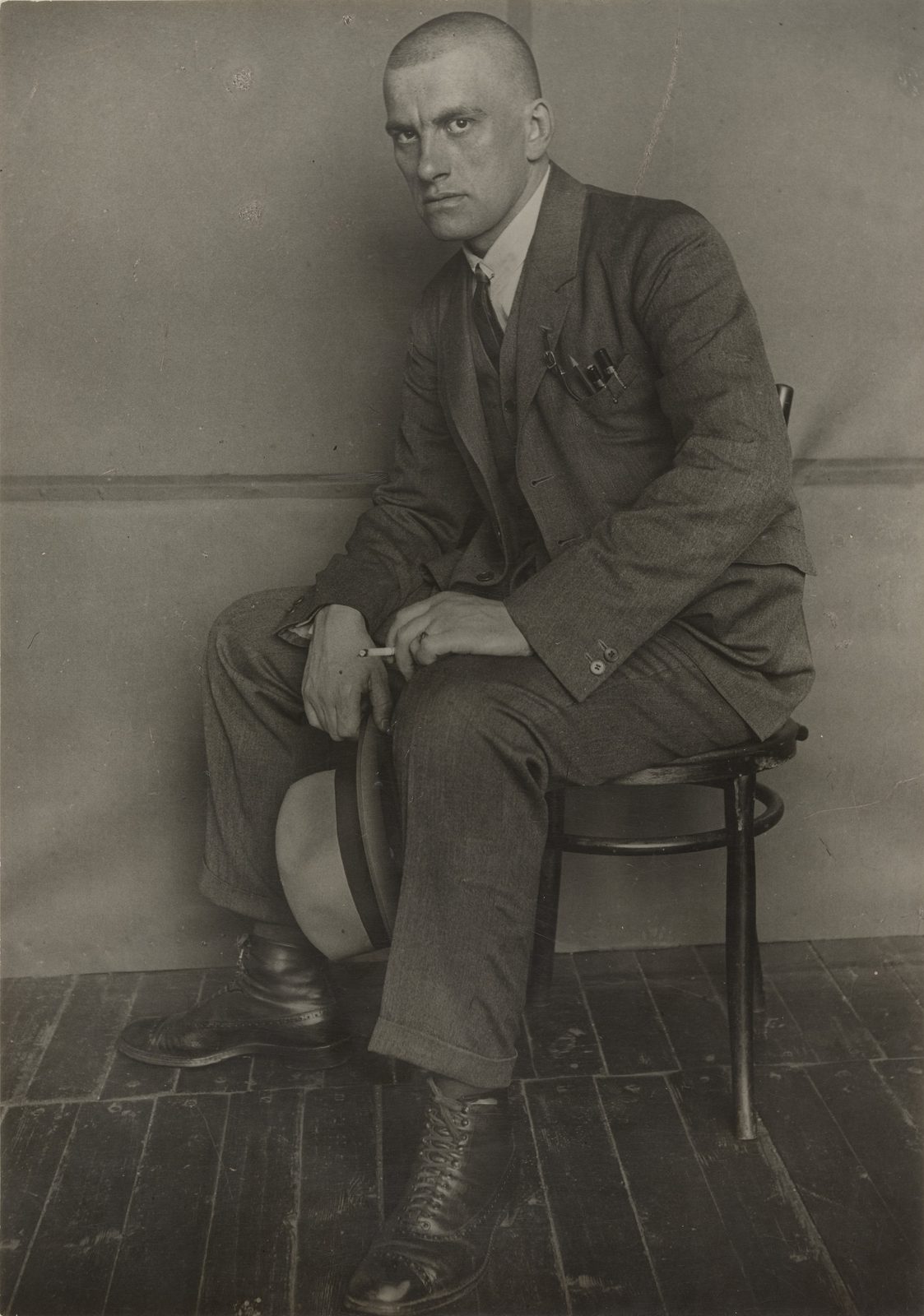
Vladimir Mayakovsky did not simply identify with the working class.
He declared himself to be the working class — cosmologically, not politically. Not as an act of solidarity from a position of comfortable distance, but as an ontological claim about what the self is made of and what it therefore owes. He did not say: I support the proletariat. He said: I am the proletariat. The distinction is everything.
To understand why that move was necessary — why it was not rhetoric but the precise ethical and cosmological consequence of everything Mayakovsky understood about the relationship between the individual and the system that produced him — you have to understand what kind of self Mayakovsky believed he had, where he believed it came from, and what he believed it was for.
The two arguments traced in the preceding essays — about hot dogs and baseball stadiums, about basketball shoes and Atlanta trap music — were arguments about the same thing from the outside: how industrial systems produce collective life, how individuals move through those systems, and what ethical obligations are generated by that movement. Jeezy said: when I shine, they shine. Marbury said: the culture belongs to the people who made it, regardless of who controls the retail channel. Wallace’s life said: the merit system of the game is independent of the market system built around it.
Mayakovsky said all of this first, and he said it from the inside of the self rather than from the outside of an industry, and he said it in a form so extreme that it has been mistaken ever since for egotism rather than understood for what it actually was: the maximum possible extension of ethical responsibility, derived from a cosmological claim about what the individual self actually is.
I. The Formation: Where Mayakovsky Came From
Vladimir Vladimirovich Mayakovsky was born on July 19, 1893, in Bagdadi, a small town in the Kutaisi Governorate of what is now Georgia, then part of the Russian Empire. His father was a forestry official. He was the youngest of three children. His father died of blood poisoning in 1906, when Mayakovsky was thirteen years old — the result of a pinprick from a staple while filing papers. The family lost their home and moved to Moscow, where they lived in poverty.¹
This biographical fact — the accidental death of the father, the immediate economic collapse, the displacement to Moscow — is not incidental. It is the material foundation of everything Mayakovsky understood about the relationship between the individual and the system. Security was not real. The distance between stability and catastrophe was the width of a pinprick. The systems that were supposed to protect you — family, property, the minor bureaucratic dignity of a forestry official’s household — were tissue thin over the void.
In Moscow, the thirteen-year-old Mayakovsky encountered Russian revolutionary politics immediately. He joined the Russian Social Democratic Labour Party — the organization that would split into Bolshevik and Menshevik factions — in 1908, at age fifteen. He was arrested three times for revolutionary activity between 1908 and 1910. He spent eleven months in Butyrka Prison in 1909, solitary confinement for part of that time, where he began writing poetry seriously.²
The prison is important. Not as suffering to be commemorated, but as a laboratory condition. In solitary confinement, with nothing but his own mind and whatever writing materials he could acquire, Mayakovsky encountered the self in its most stripped condition: no audience, no social role, no economic function, no political organization. Just the self and language.
What he discovered there was that the self was enormous. Not in the sense of importance or pride, but in the sense of scale. The self contained everything it had absorbed from the world that made it: the death of the father, the poverty of Moscow, the revolutionary politics, the violence of the Tsarist state, the bodies of other prisoners, the language of the street and the language of the Russian literary tradition simultaneously. The self was not a private thing. It was a compressed version of the entire social and historical field that had produced it.
This discovery — that the self is not separate from the system but is a concentrated expression of the system — is the cosmological foundation of everything that follows.
II. The Futurist Entry: Against Aestheticism as Class Position
When Mayakovsky emerged from prison in 1910 and enrolled in the Moscow School of Painting, Sculpture and Architecture, he entered a Russian cultural world in ferment. The Symbolist movement — the dominant aesthetic tendency of the preceding decade, associated with poets like Alexander Blok and Valery Bryusov — had positioned art as a quasi-mystical pursuit, the domain of refined sensibility operating at a remove from the coarseness of ordinary life.³
Mayakovsky recognized this position as a class position. The aesthetic distance that Symbolism required — the cultivated sensibility, the withdrawal from the vulgar, the pursuit of transcendence through beautiful language — was available only to those who could afford distance from ordinary life. It was, in the precise sense, a luxury. And it was a luxury that performed its exclusivity by treating the language and experience of the non-luxurious majority as raw material at best and contamination at worst.
The Russian Futurists, with whom Mayakovsky aligned himself beginning around 1912, rejected this position. Their manifesto, A Slap in the Face of Public Taste (1912), co-authored by Mayakovsky, David Burliuk, Velimir Khlebnikov, and Alexei Kruchenykh, declared that Pushkin, Dostoevsky, and Tolstoy should be thrown overboard from the steamship of modernity — not because those writers were without value, but because the cultural authority of the past was being used to police the boundaries of legitimate aesthetic experience and to exclude the present.⁴
This was not simply aesthetic radicalism. It was a claim about who art belongs to.
The Futurists did not argue that art should be simplified for mass consumption. They argued that the category of legitimate aesthetic experience should be expanded to include the full texture of modern industrial life: the noise of the factory, the speed of the automobile, the language of the street, the rhythms of machines and crowds. They were not lowering the standard. They were demolishing the wall that had been built around the standard to keep certain people out.
Mayakovsky’s specific contribution to Russian Futurism — what distinguished him from Khlebnikov’s linguistic experiments or Burliuk’s visual provocations — was the insistence that the expanded aesthetic field had to be embodied in a specific person. Not in a movement, not in a manifesto, but in a self that was large enough to contain it.
III. The Cosmological Claim: What Kind of Self Does Mayakovsky Have?
The poem that establishes Mayakovsky’s cosmological position with maximum clarity is A Cloud in Trousers (Oblako v shtanakh), written in 1914-1915 and published in censored form in 1915.⁵
The poem begins with a declaration:
*”Your thought,/dreaming on a softened brain/like a bloated lackey on a greasy couch,/I’ll taunt with a bloody morsel of heart;/and satiate my insolent, caustic contempt./No gray hairs streak my soul,/no grandfatherly fondness there!/I shake the world with the might of my voice,/and walk — handsome,/twenty-two years old.”*⁶
This is frequently read as egotism. It is the opposite of egotism. It is an anti-egotism — a refusal of the private self, a declaration that what the speaker contains is not personal property but collective material. The voice that shakes the world is not shaking it on behalf of the speaker’s personal ambitions. It is shaking it because the speaker has been constituted by a world that needs to be shaken, and the self is large enough to do the shaking precisely because the world made it large.
The poem proceeds through four parts — Mayakovsky subtitled them Down with Your Love, Down with Your Art, Down with Your Social Order, Down with Your Religion — and in each section the speaker does not argue against love, art, social order, and religion from a position of intellectual detachment. He argues against their current forms from within them, as a person who has been constituted by them and therefore bears their weight in his own body.
The section on love begins with the speaker waiting for a woman named Maria who does not come. The waiting is not private romantic suffering. It becomes, in Mayakovsky’s hands, a comprehensive statement about what the existing order does to the body that has been assigned desire without permission to fulfill it:
*”The rain of the street’s cobblestones showered upon me./I screamed to you, but you couldn’t hear me through the noise and the lightnings./In the gutter the puddle writhed, laughing./On the signs the letters twisted their metallic spasms.”*⁷
The private experience of being stood up by a woman becomes the experience of the city itself turning hostile — the cobblestones, the rain, the signs, the infrastructure of the modern urban environment all participating in the rejection. The self is not separate from these things. It is continuous with them. The pain of the private moment is the pain of the public world, experienced from inside.
This continuity — between the private body of the speaker and the public body of the city, between personal suffering and collective condition — is the cosmological structure that makes Mayakovsky’s identification with the proletariat not a political gesture but a precise description of what the self is.
The self is not a private enclosure. It is a node in a network of forces that made it. To be in pain is to register the pain of the network. To speak from that pain is to speak for the network. The self has no choice but to be large, because the self was made by something large.
IV. The Declaration: I Am the Proletariat
The explicit identification of the self with the proletariat — not solidarity with the proletariat, but identity with it — appears across Mayakovsky’s work from approximately 1917 onward, in the period following the Russian Revolution, but its foundations were laid in the pre-revolutionary work.
The poem Vladimir Mayakovsky: A Tragedy (1913), which Mayakovsky wrote, directed, and performed in the title role at the Luna Park Theatre in St. Petersburg, stages the identification directly. The play features characters who are fragments of the modern urban experience — a man with one eye, a man without a head, a man with a stretched face — who bring their suffering to Mayakovsky-as-character and ask him to carry it. He accepts.⁸
This acceptance — of the suffering of others as a personal responsibility that the self must absorb and bear — is not martyrdom in the Christian sense. It is a structural claim about what the large self is for. If the self is constituted by the forces of the collective — if the self is, as Mayakovsky understood it, a compressed expression of the entire social and historical field — then the suffering that the collective field generates is not external to the self. It is already inside the self. Carrying it is not a sacrifice. It is a recognition of what the self already contains.
After the Revolution of 1917, this structure becomes explicitly political. In the poem Left March (Levyi marsh, 1918), written for a meeting of revolutionary sailors in Petrograd, Mayakovsky’s speaker addresses the collective directly:
*”Left!/Left!/Left!/Hey you!/Sky and sea and darkness and cannon’s screech —/whose side are you on?/Enough of your living by laws/that Adam and Eve have left./Hustle history’s horse!/Left!/Left!/Left!”*⁹
The poem is a command addressed to history itself — to the entire system of social organization — and the speaker has the authority to issue the command because he is not outside the system issuing orders to it. He is inside the system, made of it, and therefore empowered to demand that it move.
In 150,000,000 (1919-1920), Mayakovsky takes this claim to its logical extreme. The poem’s speaker is 150 million — the entire population of Russia — speaking as a single voice. Mayakovsky’s name does not appear on the original published edition; he tried to publish it anonymously, as a collective work rather than an individual one, because the poem’s claim was that the individual self had expanded to contain the entire collective:
*”150,000,000 is the name of the maker of this poem./Its rhythms — bullets./Its rhymes — fire from building to building./150,000,000 speak with my lips.”*¹⁰
Lenin personally disliked this poem and criticized it in a letter to Anatoly Lunacharsky, the Commissar of Enlightenment, calling it hooliganism and asking that it not be reprinted.¹¹ Lenin’s criticism is itself significant: he recognized that what Mayakovsky was doing was not what Soviet political poetry was supposed to do. Soviet political poetry was supposed to subordinate the individual to the collective. Mayakovsky was doing the opposite — expanding the individual until it contained the collective, which is a different and more dangerous claim, because it makes the individual the measure of the collective rather than its servant.
This is the precise point where Mayakovsky’s cosmological move diverges from conventional socialist politics and becomes something larger and stranger: not the dissolution of the self into the collective, but the expansion of the self until self and collective are coextensive.
V. The Ethical Consequence: What an Expanded Self Owes
The ethical consequence of this cosmological position is not obvious but is inescapable once the position is held.
If the self is constituted by the forces of the collective — if the self is not a private enclosure but a concentrated expression of the social and historical field — then the self’s success is not private. It belongs to the field that produced it. The same argument Jeezy made in Atlanta in 2005, the same argument Marbury made with a $14.98 shoe in 2006, is the argument Mayakovsky was making in St. Petersburg and Moscow between 1913 and 1930.
When I shine, they shine.
But Mayakovsky’s version of this argument is more radical than either Jeezy’s or Marbury’s, because Mayakovsky does not draw a boundary between himself and the collective at all. Jeezy said: my success reflects on my community. Marbury said: I will use my position to lower the threshold of participation for my community. Both of these formulations maintain a distinction between the individual who has succeeded and the community that benefits from that success.
Mayakovsky dissolves the distinction entirely. The self is the community. The community is the self. They are not two things in relationship. They are one thing seen from different scales.
This dissolving of the boundary generates a specific ethical demand that is more extreme than any solidarity position could produce. If you are not from the community and choose to help it, you can define the limits of your help. You can do what you can and stop when you have done enough. But if you are the community — if your body is made of its suffering and your voice is the expression of its collective force — then there is no limit to what you owe, because there is no distinction between what you owe and what you are.
This is what makes Mayakovsky’s position not egotism but its precise inverse. Egotism is the claim that the self is the center and the world exists to serve it. Mayakovsky’s claim is that the self is the instrument and the world — the suffering, striving, historically produced world — is what the self exists to serve. The self is large not because Mayakovsky is important but because the collective that made him is important and he has accepted the obligation to be large enough to carry it.
VI. The Hypertrophic Self: Constraint and Expansion as One Movement
The apparent paradox of Mayakovsky’s position — how can a self be simultaneously expanded to cosmological scale and constrained by ethical obligation to the collective? — resolves when you understand that expansion and constraint are not opposites in this framework. They are the same movement seen from different directions.
The self expands because the constraints are total.
This is the precise logic that underlies the two essays that preceded this one. The hot dog expanded from immigrant food to urban standard to civic ritual not despite the constraints of the industrial city but because of them. The sausage was selected by constraint — inexpensive, portable, fast, scalable — and the selection process that fit it to one environment fit it to every environment that shared the same structure. The constraint was the mechanism of expansion.
Ben Wallace expanded from the poorest conditions in American sport to the Hall of Fame not despite the constraints of Lowndes County and the premium sneaker market but through a kind of constraint-driven excellence that the unconstrained players — the highly recruited, the heavily sponsored, the premium-equipped — could not reproduce. The constraint forced a quality of development that comfort could not have produced.
Mayakovsky’s self operates by the same logic. The constraints are historical, material, and ethical simultaneously:
Historical constraint: He was born into the Russian Empire at the moment of its maximum internal contradiction — an autocracy maintaining feudal social structures against the pressure of industrial modernity, revolutionary politics, and the multi-ethnic complexity of an empire stretched across eleven time zones. This history is not background. It is the material of the self.
Material constraint: The death of the father. The poverty of Moscow. The prison. These are not experiences that happened to Mayakovsky. They are experiences that made Mayakovsky. The self that emerged from them was constituted by them — shaped, pressured, and ultimately enlarged by the force of what it had to survive.
Ethical constraint: Once the self is understood as a concentrated expression of the collective — once the cosmological claim is accepted — the ethical constraint becomes absolute. You cannot use a self that was made by collective suffering for private purposes. You cannot deploy the voice that was given its power by 150 million people in the service of personal ambition. The constraint is total because the source of the self’s power is total.
The hypertrophic self — the self enlarged beyond normal human scale — is not a self that has escaped constraint. It is a self that has accepted constraint so completely that the constraint has become its defining structure. The expansion is the direct result of the constraint being fully internalized.
This is why Mayakovsky’s identification with the proletariat is cosmological rather than political. A political identification can be chosen and unchosen. It can be revised when circumstances change. It can be maintained at whatever level of intensity the individual finds comfortable. A cosmological identification — a claim about what the self is made of — cannot be revised without revising the self entirely. It is not a position. It is an ontology.
VII. The Formal Consequence: Why the Poetry Had to Be Loud
The cosmological and ethical claims Mayakovsky was making had direct formal consequences for his poetry. If the self is large enough to contain the collective, then the language of private lyric — the hushed, refined, inward-turning language of Symbolist poetry — is structurally inadequate. You cannot express a self of cosmological scale in the language designed for private contemplation.
Mayakovsky’s poetic voice is loud. It is declamatory. It uses hyperbole not as decoration but as precision — because the scale of what it is describing is genuinely hyperbolic, and understatement would be a lie. It uses the language of the street, of the factory, of the newspaper and the political meeting, because those are the languages of the collective that the self contains. It uses rhythm and rhyme in ways that are closer to oratory and song than to conventional lyric, because the audience is not the individual reader in a quiet room but the collective in a public space.¹²
The famous step-ladder form (lesenka) that Mayakovsky developed — printing poems with lines broken into short phrases arranged in descending steps on the page — was not a visual experiment. It was a notation system for reading aloud, a way of marking the pauses and emphases of the speaking voice so that the poem could be performed at the scale its content required.¹³
Mayakovsky performed his poems. He read them in factories, in workers’ clubs, in public squares. He read them to audiences who had no formal literary education, who had not read Pushkin, who did not know the conventions of Russian lyric poetry. He read them loud, and the poems were built to sustain that loudness without losing their precision.
This is the formal equivalent of the Starbury’s design decision: clean, functional, no aesthetic signals of discount or compromise, built to perform at any level. The poem that can be read in a workers’ club by people who have never read a poem is not a simplified poem. It is a poem with sufficient structural integrity to survive the conditions of its intended use.
VIII. The Biographical Rupture: What the Declaration Cost
Any honest account of Mayakovsky’s cosmological and ethical position must include what it cost, because the cost is not incidental. It is evidence of how seriously the position was held.
Mayakovsky’s relationship with the Soviet state after the Revolution was not comfortable. He was committed to the Revolution’s project — the reorganization of Russian society on collective rather than private-property principles — but his commitment was to the project as he understood it cosmologically, not as the Soviet bureaucracy was implementing it institutionally.
He worked for the ROSTA Windows — the Russian Telegraph Agency — from 1919 to 1921, producing propaganda posters that combined his poetry with visual art, more than 1,500 of them, hand-stenciled and displayed in shop windows across Moscow during the Civil War period.¹⁴ This was genuine commitment: tedious, physically demanding collective work in the service of the revolutionary project, with no artistic prestige attached to it.
But as the Soviet state consolidated in the 1920s, the gap between Mayakovsky’s cosmological understanding of the revolutionary project and the institutional reality of what Soviet cultural policy was becoming grew wider. The Russian Association of Proletarian Writers (RAPP) — the dominant literary organization by the late 1920s — promoted a socialist realist aesthetic that was exactly what Mayakovsky was not: conventional in form, didactic in content, subordinating aesthetic complexity to political message.¹⁵
Mayakovsky joined RAPP in 1930, three months before his death. The decision was widely understood at the time, and has been understood since, as a capitulation — an act of institutional self-abnegation by a poet who had spent his entire career insisting on the primacy of the individual voice enlarged to collective scale over the collective voice flattened to institutional requirements. He described the decision in his final poem, At the Top of My Voice (Vo ves’ golos, 1930), with a combination of defiance and exhaustion that is among the most honest accounts of what it costs to hold a cosmological ethical position under historical pressure:
”I want the Gosplan to sweat/in debate,/assigning me/goals a year ahead./I want/a commissar/with a decree/to lean over the thought of the age./I want/the heart to earn/its love wage/at the end of the workday./I want/the factory committee/to lock/my lips/when the work is done./I want/the pen to be on a par/with the bayonet;/and Stalin/to report on behalf of the Politburo/that Mayakovsky made/and does not make/verse — scum.”¹⁶
The poem is a demand that the Revolution honor the terms of the original agreement — that the self enlarged in service of the collective should be recognized as doing work of equivalent value to the bayonet, the factory, the commissar. It is not a surrender. It is a final insistence on the terms of the cosmological claim.
Mayakovsky shot himself on April 14, 1930, at the age of thirty-six. The causes of his suicide were multiple and have been debated by scholars for nearly a century: the failed relationships, the institutional pressures, the exhaustion of maintaining a cosmological ethical position under the weight of Soviet institutional culture, the specific circumstances of the preceding months.¹⁷
What is not debated is the continuity between his life’s work and his death. He had declared himself the proletariat. He had accepted the ethical obligation of a self constituted by collective suffering. He had held that position under every kind of pressure the historical moment could generate. When the position became untenable — when the institution that was supposed to be the collective’s expression demanded his capitulation in the very forms that the cosmological claim made impossible — he did not revise the claim. He ended.
This is not a romanticization of his suicide. It is a description of what it looks like when an ethical position is held without reservation.
IX. The Ecosystem: Why the Argument Is About Responsibility, Not Identity
The final clarification the argument requires is this: Mayakovsky’s declaration that he is the proletariat is not a claim about identity in the contemporary sense — not a claim about belonging to a category, not a claim about recognition or representation. It is a claim about responsibility.
The self is constituted by the ecosystem — the historical, material, social ecosystem of forces that produced it. To understand yourself as constituted by that ecosystem is to understand that whatever the self achieves, it achieves with the tools the ecosystem provided. The language comes from the ecosystem. The forms come from the ecosystem. The audience comes from the ecosystem. The power to shake the world comes from the 150 million people whose suffering and striving made the shaking necessary.
If all of that is true — and Mayakovsky believed it was true with the full force of his intellectual and creative capacity — then the self has no legitimate claim to privatize what the ecosystem made. You cannot take the tools of the collective and use them for personal accumulation. You cannot take the voice that was given its power by collective suffering and direct it toward private aesthetic pleasure. You cannot take the expanded self — the self large enough to contain multitudes — and spend it on private satisfactions.
The ethical obligation is absolute because the debt is total. Every capacity the self has was given by the ecosystem. Every obligation the self bears is owed to the ecosystem.
This is what the Jeezy formulation when I shine, they shine points toward but does not fully reach. Jeezy’s formulation maintains the distinction between the individual who shines and the community that benefits from the reflected light. Mayakovsky’s formulation dissolves the distinction: the shining is the community’s shining, because the self that shines is the community’s self. The light and its source and its audience are one thing.
This is also what Ben Wallace’s career demonstrates at the level of the body rather than the word. Wallace did not shine for Lowndes County in the sense of sending value back to a community he had left. He shined as Lowndes County — as the concentrated expression of every ounce of capacity that the most constrained conditions in American sport could produce. His Hall of Fame career was not a departure from his origins. It was his origins, at maximum extension.
The expanded self — the hypertrophic self — is the self that has accepted its constitutive relationship to the ecosystem so completely that it no longer experiences the obligation as external. The obligation is not something the self bears. The obligation is what the self is.
X. The Declaration as Cosmological Necessity
Mayakovsky did not declare himself the proletariat because he thought it would be politically effective, or because he wanted to demonstrate solidarity, or because the revolutionary moment made it socially advantageous. He declared himself the proletariat because he had looked honestly at what the self is made of and had followed the logic of that honesty to its necessary conclusion.
The self is not a private thing. It is a compressed expression of the historical and social field that made it. The historical and social field that made Mayakovsky was the field of revolutionary Russia — of imperial autocracy and industrial poverty and collective striving and political violence and the immense, barely contained energy of a world trying to reorganize itself along lines of justice rather than inherited privilege.
To declare yourself the private owner of a self constituted by that field is a lie. It is the lie of the bourgeois individual: the claim that what you have, you earned alone, through your private capacities, without debt to the system that produced you.
Mayakovsky rejected the lie with maximum force, in the loudest possible voice, at every scale from the intimate lyric to the public manifesto to the mass-distributed propaganda poster. He rejected it not because he was politically obligated to reject it, but because his understanding of what the self is made it impossible to accept it honestly.
The declaration was cosmological because it was about the nature of the self. It was ethical because the nature of the self generates obligations that cannot be avoided without dishonesty. And it was necessary because, once you have understood what the self is made of and what it therefore owes, there is no position available between full acceptance and bad faith.
There is no moderate version of this position. You cannot partially accept that you are constituted by the collective. You cannot be slightly obligated to the ecosystem that made you. The constraint is total, and the expansion it produces is total, and the ethical demand it generates is total.
That is why Mayakovsky was loud. That is why the poems are large. That is why the self in the poems is cosmological in scale.
Not because he was an egotist. Because he was the opposite of an egotist — a person who had looked at the self clearly enough to understand that it was not his, and who accepted every obligation that understanding generated, without reservation and without end.
Sources and Notes
¹ Mayakovsky’s biographical details, including the date and location of his birth, his father’s death, and the family’s move to Moscow: Wiktor Woroszylski, The Life of Mayakovsky, translated by Bolesław Taborski (Orion Press, 1971); also Edward J. Brown, Mayakovsky: A Poet in the Revolution (Princeton University Press, 1973).
² Mayakovsky’s revolutionary political activity and arrest records: Brown, Mayakovsky: A Poet in the Revolution; also Bengt Jangfeldt, Mayakovsky: A Biography, translated by Harry D. Watson (University of Chicago Press, 2014). The Butyrka Prison confinement of 1909 and Mayakovsky’s account of beginning to write poetry there appear in his autobiography, I Myself (Ya sam, 1922, revised 1928), translated in Patricia Blake, ed., The Bedbug and Selected Poetry (Meridian Books, 1960).
³ On Russian Symbolism and its class dimensions, see: Avril Pyman, A History of Russian Symbolism (Cambridge University Press, 1994).
⁴ David Burliuk, Alexander Kruchenykh, Vladimir Mayakovsky, and Velimir Khlebnikov, A Slap in the Face of Public Taste (Poshchechina obshchestvennomu vkusu, 1912). Translated and discussed in Anna Lawton, ed., Russian Futurism Through Its Manifestoes, 1912–1928 (Cornell University Press, 1988).
⁵ Vladimir Mayakovsky, A Cloud in Trousers (Oblako v shtanakh, 1915). Written 1914-1915, published in censored form by Osip Brik in 1915. Full text published after the Revolution. Standard English translation by Max Hayward and George Reavey in Patricia Blake, ed., The Bedbug and Selected Poetry (Meridian Books, 1960); also translated by Maria Enzensberger in Vladimir Mayakovsky: Poems (Pluto Press, 1986).
⁶ Mayakovsky, A Cloud in Trousers, opening stanza. Translation composite drawing from Hayward/Reavey and Herbert Marshall, Mayakovsky (Hill and Wang, 1965).
⁷ Mayakovsky, A Cloud in Trousers, Part I. Translation drawing from Marshall, Mayakovsky.
⁸ Vladimir Mayakovsky, Vladimir Mayakovsky: A Tragedy (Vladimir Mayakovsky: Tragediya, 1913). Premiered December 2, 1913, at Luna Park Theatre, St. Petersburg. Discussed in Brown, Mayakovsky: A Poet in the Revolution, and in Jangfeldt, Mayakovsky: A Biography.
⁹ Vladimir Mayakovsky, Left March (Levyi marsh, 1918). Written for a meeting of revolutionary sailors in Petrograd, 1918. Translation drawing from Marshall, Mayakovsky, and from George Reavey’s translations in Blake, ed., The Bedbug and Selected Poetry.
¹⁰ Vladimir Mayakovsky, 150,000,000 (1919-1920, published 1921). Originally published anonymously. The quoted lines are from the opening of the poem. Translation drawing from Marshall, Mayakovsky.
¹¹ Lenin’s letter to Lunacharsky regarding 150,000,000 is dated May 6, 1921. The letter is quoted and discussed in Brown, Mayakovsky: A Poet in the Revolution, p. 181; also in Jangfeldt, Mayakovsky: A Biography. Lenin described the poem as “nonsense, stupidity, double-dyed stupidity and affectation” and requested that it not be printed more than 1,500 copies and that Lunacharsky be held responsible for it.
¹² On Mayakovsky’s poetic form, oratorical style, and relationship to public performance, see: Roman Jakobson, “On a Generation That Squandered Its Poets,” in Language in Literature, ed. Krystyna Pomorska and Stephen Rudy (Harvard University Press, 1987). Jakobson’s essay, written immediately after Mayakovsky’s death in 1930, remains the foundational formal analysis of Mayakovsky’s poetic practice.
¹³ On the lesenka (step-ladder) form and its function as performance notation: Brown, Mayakovsky: A Poet in the Revolution; also Lawrence Leo Stahlberger, The Symbolic System of Mayakovsky (Mouton, 1964).
¹⁴ On the ROSTA Windows project: Mikhail Anikst, ed., Soviet Commercial Design of the Twenties (Abbeville Press, 1987); also Brown, Mayakovsky: A Poet in the Revolution, pp. 155-180 for discussion of the scale and conditions of the project.
¹⁵ On RAPP and Soviet cultural policy in the late 1920s: Katerina Clark, The Soviet Novel: History as Ritual (University of Chicago Press, 1981); also Herman Ermolaev, Soviet Literary Theories, 1917–1934: The Genesis of Socialist Realism (University of California Press, 1963).
¹⁶ Vladimir Mayakovsky, At the Top of My Voice (Vo ves’ golos, 1930). Written as the introduction to a planned longer poem, January 1930. Published posthumously. Translation drawing from Marshall, Mayakovsky, and from Hayward/Reavey in Blake, ed., The Bedbug and Selected Poetry.
¹⁷ On the circumstances of Mayakovsky’s suicide on April 14, 1930, and the scholarly debate about its causes: Jangfeldt, Mayakovsky: A Biography, chapters 40-42; also Brown, Mayakovsky: A Poet in the Revolution, chapter 14; and Victor Terras, Vladimir Mayakovsky (Twayne Publishers, 1983). The note Mayakovsky left, written two days before his death, read in part: ”The love boat has smashed against the daily grind. Life and I are quits, and there’s no point in listing mutual hurts, sorrows, and pains.” The note’s literary self-consciousness — even in death, Mayakovsky was writing — is itself evidence of the totality of his identification between self and poetic practice.
Part 4. The Field and the Self: Persistence, Constraint, and the Ethics of Expanded Capacity-- A Conclusion Across Three Cases
I. What the Three Essays Demonstrate
The three essays that precede this conclusion — on the industrial food system of New York baseball, on the basketball shoe market and its democratization, and on Mayakovsky’s declaration of identity with the proletariat — are not three separate arguments. They are one argument operating at three different scales of resolution.
The stadium essay works from the outside of systems, tracing how industrial production, migration, distribution networks, and collective ritual converge to produce a shared civic field. The unit of analysis is the city. The hot dog is the tracer element — the material object that moves without alteration through every node of the system, from the processing facility to the street cart to the vendor’s tray at Ebbets Field. What the essay demonstrates is that culture is not layered on top of infrastructure. Culture is infrastructure, seen from the perspective of the people who move through it.
The shoe essay works from the inside of a market, tracing how exclusion operates through price and how transformation operates through the deliberate restructuring of production, distribution, and cultural meaning. The unit of analysis is the threshold — the $150 barrier that separated participation from exclusion, and the $14.98 intervention that dissolved it. Ben Wallace’s career provides the embodied argument: the merit system of the game is independent of the market system built around it. Young Jeezy provides the voice: when I shine, they shine. The ethical structure is explicit. What you achieve with tools given by the collective is owed back to the collective.
The Mayakovsky essay works from the inside of a single self, tracing how constraint at historical, material, and ethical levels produces a self large enough to contain the collective that made it — and how that expanded self generates obligations that cannot be discharged through private satisfaction. The unit of analysis is the declaration: I am the proletariat. Not solidarity. Not representation. Identity. The cosmological claim that the self is not a private enclosure but a concentrated expression of the field that produced it. And the ethical consequence that follows: what was made by the collective cannot be used for private ends.
Each essay operates at a different scale. Each uses a different primary material — food distribution, sneaker pricing, Russian poetry. But each is solving the same problem and demonstrating the same structure.
II. The Structure Underneath All Three
The source framework — developed across the essays on persistence, coherence, and greatness — provides the architecture that all three cases instantiate.
Persistence Under Constraint establishes the physical law:
All systems that endure must continuously maintain themselves within a bounded set of viable conditions while subject to constant internal and external pressure. This requires three invariant functions: throughput (energy must flow), regulation (deviation must be corrected), and coherence (parts must remain coordinated). Without all three, persistence is impossible. The cost of persistence is the accumulated effort required to resist deviation over time. All behavior reduces to four fundamental strategies under constraint: integration, stabilization, exploitation, or disruption.
Coherence Under Constraint applies this law to the human system:
A human being is a regulatory system that must maintain coherence under constraint across time. The system cannot register reality in full. It must transform reality into a form it can carry. When internal capacity is sufficient, coherence is maintained directly. When it is insufficient, the system stabilizes through compensation — reinterpretation, narrative construction, symbolic alignment, social coordination. These compensations preserve stability but reduce fidelity to reality. When compensation can no longer preserve coherence, the system is forced into direct contact with constraint. At that threshold, the system must either fragment or reorganize. If contact with constraint is sustained without collapse, reorganization occurs: capacity expands, structure becomes more aligned with reality, coherence is maintained with less distortion. This is transformation.
On Greatness defines the ethical consequence:
Most systems stabilize within the limits they are given. They endure constraint, adapt to it, and find ways to remain coherent within it. This is not insignificant. But endurance alone does not constitute greatness. Greatness is the externalization of integrated capacity. It is the conversion of constraint into expanded possibility for others. Escape preserves the self. Transformation changes the world the self inhabits. A system that absorbs constraint, integrates it without collapse, and produces conditions that did not previously exist — that system has performed the function that defines greatness. It is not a trait. It is not a status. It is an effect measured in the expanded viable range of human life beyond the individual.
III. How the Three Essays Instantiate the Framework
The Stadium Essay demonstrates the framework at the scale of the city.
The industrial food system of New York baseball was a persistence structure. Throughput: calories moved from processing facilities through distribution networks to the bodies of the working population. Regulation: the concession system organized by Harry M. Stevens standardized the product, controlled the supply chain, managed the labor force of vendors, and operated consistently across thousands of transactions per game. Coherence: the hot dog’s persistence was a function of its fit to constraint — inexpensive, portable, fast, scalable. The form was selected by the conditions. What endured was what fit.
The viability set of the industrial city — the range of conditions under which the working population could sustain itself — was narrow. Food had to conform to that range. The sausage did. It persisted because it met the constraints. The stadium was a node in the same system that organized daily life: same population, same supply chains, same food, same logic of throughput and regulation extended into the domain of collective ritual.
The 1947 integration of Jackie Robinson demonstrates the framework’s application to system expansion. The field expanded its definition of who belonged within it. The underlying structure — the park, the concessions, the industrial supply chain — remained continuous. Integration altered the composition and meaning of the crowd without rupturing the system that organized it. The viable range expanded. The throughput, regulation, and coherence functions continued.
Stahl-Meyer’s position as infrastructure node — supplying all three New York parks simultaneously — demonstrates that the system’s coherence was maintained at the metropolitan level. The same product moved through every part of the field. That is not symbolic. That is logistical evidence of system integration.
The Shoe Essay demonstrates the framework at the scale of the market.
The premium sneaker market of the 1990s and early 2000s was a system that produced exclusion as a structural feature. The viability set for cultural participation was bounded by a price threshold — approximately $120 to $150 — that excluded millions of the sport’s most dedicated participants. The market was stable. It was coherent. It was highly regulated. And it was producing a systematic gap between the merit system of the game and the market system built around it.
Ben Wallace’s career is the embodied demonstration of that gap. He came from the most constrained conditions available in American sport — Lowndes County, Alabama, no indoor plumbing until age fourteen, undrafted, undersized — and became one of the greatest defensive players in the history of the game. His career was not escape. It was transformation. He absorbed the full load of the constraint, integrated it without collapse, and produced a Hall of Fame career using only what the constraint could not take away: physical gifts, work ethic, basketball intelligence.
The Starbury was an intervention in the market’s exclusion structure. It was not a cheaper imitation. It was a reorganization of the production, distribution, and cultural meaning of the signature shoe. The price was set below the threshold of stigma — $14.98 rather than $40 — precisely because the problem was not that poor families could not afford $40 shoes. The problem was that any price that signaled compromise was culturally unacceptable. The Starbury solved both the economic and the cultural equation simultaneously.
Shaq’s Dunkman line failed because it solved only the economic equation. It priced the shoe at $40 but marketed it as a budget alternative. The cultural signal of cheapness was built into the product. Kids did not want to wear the mark of what their family could not afford. Marbury’s Starbury succeeded because it was not positioned as a compromise. It was positioned as a correction. The same shoe. The same design quality. The same endorsement credibility. Different price. Different distribution. Different relationship between the product and the population it served.
Young Jeezy’s Thug Motivation 101 provides the voice for this argument. The album’s ethical structure — when I shine, they shine — is the explicit articulation of the obligation that success under constraint generates. Jeezy did not analyze the market in those terms. He described the street-level experience of being inside a system that extracted value from the culture while excluding the culture’s source population from the benefits of participation. The Starbury did not cite Jeezy. But they were operating inside the same ethical structure, at the same historical moment, addressed to the same population.
The Mayakovsky Essay demonstrates the framework at the scale of the individual self.
Mayakovsky’s biography is a precise map of the Coherence framework: constraint at origin (the death of the father, the poverty of Moscow, the prison), the development of internal regulatory capacity through sustained exposure to pressure, the emergence of a self large enough to contain the collective that made it, and the eventual encounter with a threshold that could not be survived without either fragmentation or reorganization of a kind the institutional environment made impossible.
The declaration — I am the proletariat — is not a political position. It is an ontological claim about what the self is made of. The self is not a private enclosure. It is a compressed expression of the historical and social field that produced it. If that is true, then the self has no legitimate claim to privatize what the field gave it. The tools of the collective cannot be used for private accumulation. The voice that was given its power by collective suffering cannot be directed toward private satisfaction. The ethical obligation is absolute because the debt is total.
This is the Greatness framework at maximum extension. Escape preserves the self. Transformation changes the world the self inhabits. Mayakovsky did not escape. He did not stabilize. He did not exploit. He integrated — absorbed the full load of the constraint, expanded capacity to hold it, and externalized that expanded capacity through the poems, the posters, the public performances, the 150,000,000 that speak with my lips.
The hypertrophic self is the self that has accepted constraint so completely that the constraint has become its defining structure. The expansion is the direct result of the constraint being fully internalized. This is not egotism. It is the precise opposite of egotism: the recognition that the self was not made by itself and therefore does not belong to itself.
The cost of this position is documented in the biography. The RAPP capitulation in 1930. The final poem At the Top of My Voice. The suicide on April 14, 1930. The note: The love boat has smashed against the daily grind. What happens when a self has expanded to cosmological scale, accepted total obligation to the collective, and then encounters an institutional environment that demands the abandonment of precisely those commitments? The system cannot reorganize. It cannot return to a smaller self. It fragments.
That is not a tragedy in the sentimental sense. It is the structural consequence of holding a position without reservation under conditions that made it unsurvivable.
IV. The Unified Argument
Across all three essays, the same structure operates:
Systems persist by maintaining coherence under constraint. The hot dog persisted because it fit the constraints of the industrial city. The premium sneaker market persisted because it was coherent, even though its coherence produced exclusion. Ben Wallace persisted because he integrated constraint rather than escaping it. Mayakovsky persisted — until he did not — by expanding the self to contain the collective that made it.
Exclusion is a structural feature, not a moral failure. The premium sneaker market did not intend to exclude poor Black kids. It was calibrated to the customers who could pay premium prices. The excluded population was not the target customer. They were not being exploited. They were being ignored. The same logic applied to the premium literary culture that Russian Symbolism represented: it was calibrated to refined sensibility, which required the leisure and education that poverty could not provide. Exclusion was a structural consequence of market equilibrium, not a conspiracy.
Transformation is the reorganization of constraint structure, not escape from constraint. The Starbury did not escape the sneaker market. It reorganized the market’s price structure, distribution structure, and cultural meaning structure simultaneously. Mayakovsky did not escape the conditions that made him. He reorganized the relationship between self and collective so completely that the boundary between them dissolved.
The ethical obligation generated by transformation is proportional to the debt incurred by constitution. If the self is made by the collective, then what the self achieves belongs to the collective. When I shine, they shine. This is not a sentiment. It is a structural consequence of understanding what the self is made of.
The cost of transformation is real and is not always survivable. The Starbury lasted three years before its distribution channel collapsed. Mayakovsky lasted until 1930 before the contradiction between his cosmological commitments and Soviet institutional demands became unsurvivable. Ben Wallace’s career is the exception: he integrated constraint, transformed it into Hall of Fame performance, and survived. But the cost is visible in the career itself — four Defensive Player of the Year awards for a player who went undrafted, who was traded repeatedly, who was never the commercial center of any franchise he played for. The system did not reward him at the level his performance warranted until he was inducted into the Hall of Fame in 2021, fifteen years after his last great season.
V. What the Framework Reveals
The source framework — Persistence, Coherence, Greatness — is not a theory imposed on these cases from outside. It is a description of what the cases already demonstrate.
The hot dog persisted because it satisfied the three invariants: throughput (calories), regulation (standardization), coherence (fit to constraint). The stadium essay traces this without naming it.
The Starbury succeeded because it recognized that the market’s coherence was producing exclusion and reorganized the constraint structure at every level simultaneously. The shoe essay traces this without naming it.
Mayakovsky declared himself the proletariat because he understood that the self is constituted by the collective and therefore owes what it is to the collective. The Mayakovsky essay traces this without naming it.
What the framework reveals is that these are not three different kinds of argument. They are one argument, operating at different scales, using different materials, arriving at the same conclusion:
What persists, persists by maintaining coherence under constraint.
What transforms, transforms by reorganizing the structure of constraint rather than escaping it.
What is great, is great by externalizing integrated capacity — by converting absorbed constraint into expanded possibility for others.
And the cost of all three — persistence, transformation, greatness — is real, is accumulated over time, and is not always survivable.
VI. Final Statement
The three essays do not argue that culture is determined by infrastructure, or that markets are determined by price, or that selves are determined by history. Determination is too simple.
What the essays argue is that systems — whether cities, markets, or selves — operate under constraint, and that the forms which persist are the forms that fit. The hot dog fit. The premium sneaker market fit. Mayakovsky’s expanded self fit — until it did not.
Constraint is not the enemy of form. Constraint is the condition of form. What cannot survive the constraint does not persist. What does persist is what the constraint selected for.
The ethical question is not whether to accept constraint. Constraint is not optional. The ethical question is what to do with the capacity that constraint produces.
Escape preserves the self. Transformation changes the world the self inhabits.
Most systems stabilize within the limits they are given. They endure. They adapt. They find ways to remain coherent. This is not failure. This is the baseline condition of existence under pressure.
But a smaller number do something different. They absorb the full load. They integrate it without collapse. They expand capacity to hold what would break a smaller system. And then they externalize what they have integrated — they convert constraint into expanded possibility for others.
That is what Stahl-Meyer did, inadvertently, by supplying all three New York parks with the same product and making the entire field of New York baseball continuous at the level of industrial food distribution.
That is what the Starbury did, deliberately, by pricing below the stigma threshold and distributing through channels the premium market had abandoned.
That is what Ben Wallace did, bodily, by transforming the most constrained conditions in American sport into a Hall of Fame career that demonstrated the independence of merit from market.
That is what Young Jeezy did, vocally, by insisting that the culture belonged to the people who made it regardless of who controlled the retail channel.
That is what Mayakovsky did, cosmologically, by declaring that the self was the collective and accepting every obligation that declaration generated.
Each operated at a different scale. Each used different materials. Each paid a different cost.
But each performed the same function: the conversion of absorbed constraint into expanded possibility for others.
That is the structure underneath all three essays.
That is the argument the source framework makes explicit.
And that is what persistence, under constraint, at the limit of human capacity, looks like when it refuses to remain private.
Sources
The source framework referenced in this conclusion is developed across three essays:
”Persistence Under Constraint: A General Theory of Viability Across Physical, Biological, and Civilizational Systems” — establishing the physical and systems law of persistence through throughput, regulation, and coherence within a bounded viability set.
”Coherence Under Constraint: Human Architectural Dictation — Systems Compression” — applying the persistence framework to the individual human system, with particular attention to the threshold dynamics of breakdown and reorganization.
”On Greatness and the Extension of Human Possibility” — defining greatness as the externalization of integrated capacity, the conversion of constraint into expanded possibility for others.
The three case essays referenced are:
”The Sausage and the Stadium: Stahl-Meyer, New York Baseball, and the Industrial Making of a Shared American Field” — tracing the convergence of industrial food production, migration, and collective ritual in the New York baseball parks of the early-to-mid twentieth century.
”The Shoe and the Street: Starbury, Shaq, Ben Wallace, and the Industrial Democratization of Basketball Culture in the Early 2000s” — tracing the exclusion structure of the premium sneaker market and the transformation represented by the Starbury intervention.
”The Declaration and the Demand: Mayakovsky, the Proletariat, and the Ethics of Hypertrophic Selfhood” — tracing the cosmological and ethical structure of Mayakovsky’s identification with the collective and its biographical consequences.
Together, these six documents constitute a unified body of work: a general theory of persistence under constraint and three demonstrations of that theory operating at the scales of the city, the market, and the self.
Part 5. The Geology of the Self: Jake Daubert, Vladimir Mayakovsky, and the Formation of Hypertrophic Being
Preface: What This Argument Requires
This is not metaphor.
When we say that a self is formed like a geological structure — compressed under pressure, crystallized through constraint, stratified by the accumulation of forces over time — we are not decorating a psychological argument with poetic language. We are describing the actual mechanics of how certain kinds of selves come into existence.
The self is not given. It is made. And the making follows laws that operate identically whether the substrate is rock, flesh, or mind. Pressure applied over time produces density. Constraint selects for structure. What cannot bear the load does not persist. What does persist carries the signature of everything that pressed against it.
Jake Daubert and Vladimir Mayakovsky are two human beings separated by geography, language, culture, and historical moment. One was a first baseman from Shamokin, Pennsylvania, who played in the major leagues from 1910 to 1924. The other was a Russian poet who wrote, performed, and died between the fall of the Tsar and the consolidation of Stalin. They never met. They operated in entirely different fields. They would not have recognized each other’s worlds.
And yet the formation that produced them is structurally identical. The same pressures. The same constraint dynamics. The same transformation of absorbed load into expanded capacity. The same hypertrophy of the self through the integration of forces that would have broken a less dense structure.
To see this requires looking at each life not as biography but as geology — as the record of forces applied over time, readable in the final form the way a stratum of anthracite coal is readable as the compressed and transformed remains of ancient forests. The coal does not remember the forest. But the forest is in the coal. Every carbon bond carries the record of what the pressure made.
I. The Substrate: What the Self Is Made Of Before Formation Begins
A geological formation begins with raw material. Sediment accumulates. Organic matter collects. The material has no structure yet. It is simply there — deposited by processes that precede any particular outcome.
The human self begins the same way. Before formation, there is raw material: genetic inheritance, the body’s initial configuration, the environment into which the organism is deposited. None of this is chosen. It is given.
Jake Daubert was born on April 7, 1884, in Shamokin, Pennsylvania — a coal town in Northumberland County, in the anthracite region of the state.¹ His father worked in the Shamokin coal mines. His brother Calvin worked in the mines. Calvin died there.²
Read that sequence slowly. The father goes into the earth. The brother goes into the earth. The brother does not come back.
This is not background. This is the primary geological fact of Jake Daubert’s formation. Before he threw a baseball, before he held a bat, before he stepped onto any field, the earth had already taken his brother. The mine had already demonstrated what the constraint structure of Shamokin meant in its most absolute form: it meant that men and boys went into the ground, and sometimes they did not return, and the family continued anyway because there was no alternative to continuing.
Shamokin in the 1880s was a company town in all but name. The anthracite mines dominated employment, the coal companies dominated the mines, and the social structure of the community was organized entirely around the extraction of coal from the earth. The Pennsylvania Department of Mines recorded fatalities by county in its annual reports throughout this period. Northumberland County — Shamokin’s county — appears in those records consistently.³ The deaths were not anomalies. They were the operational cost of the industry. The families of the dead absorbed the cost and continued.
This is the sediment layer of Jake Daubert’s formation. A mining family. A dead brother. An industry that consumed men. An environment in which the mine was the primary fact and everything else — including baseball — was defined in relation to it.
Vladimir Mayakovsky was born on July 19, 1893, in Bagdadi, a small town in the Kutaisi Governorate of the Russian Empire, in what is now Georgia.⁴ His father was a forestry official — a minor bureaucrat in the imperial administrative apparatus. The family was Russian, living in the Caucasus as part of the administrative structure of empire. Mayakovsky was the youngest of three children.
This is also sediment. Mayakovsky did not choose to be born into the Russian Empire at the moment of its maximum internal contradiction — an autocracy maintaining feudal social structures against the pressure of industrial modernity, revolutionary politics, and the multi-ethnic complexity of an empire stretched across eleven time zones. He did not choose a father whose position in the imperial apparatus gave the family a tenuous stability that would prove as fragile as the empire itself.
The raw material is not yet a self. It is the precondition of a self. It is what will be compressed.
II. The First Compression: Loss as Geological Event
In geology, the first compression is when pressure is applied to the raw material for the first time. The loosely accumulated sediment begins to compact. Layers form. The material starts to acquire structure it did not have before.
In human formation, the first compression is loss — specifically, the loss that demonstrates to the organism, before it can articulate the lesson in language, that the systems it depends on for safety are not safe.
For Daubert, that lesson was delivered through the mines.
Calvin Daubert’s death in the mines is not a biographical footnote. It is a formative geological event. A brother goes into the earth and does not come back. What does that teach a boy in Shamokin, Pennsylvania, in the 1880s?
It teaches that the earth takes. It teaches that strength and youth are not sufficient protection against the constraint structure of the environment. It teaches that the mine does not distinguish between the people it kills and the people it lets live — that survival is partly a function of luck operating within a system of risk that no individual can fully control.
It also teaches something more specific and more useful: that there is a threshold. The mine is on one side of the threshold. Whatever is not the mine is on the other side. The boy who could not go into the mine — who found another form of work, another form of value, another pathway through the constraint structure — was the boy who did not risk becoming Calvin.
Baseball was on the other side of the threshold. Not as escape from the working class — Daubert remained working class in his identity, his affiliations, his later union organizing — but as escape from the specific form of constraint that had killed his brother. Physical capacity could be exchanged for something other than mine labor. Athletic ability was a currency that the mines could not mint.
This was the first compression. The sediment of family, industry, and loss began to compact under the pressure of Calvin’s death into something with structure. The organism oriented itself toward the threshold.
For Mayakovsky, the first compression was equally precise and equally violent.
In 1906, Mayakovsky’s father died of blood poisoning. He had been filing papers and pricked his finger on a staple. The infection spread. He died. He was forty-two years old.⁵
The mechanism of death is important. It was not heroic. It was not meaningful in any narrative sense. It was a bureaucratic accident — a minor official of the imperial system killed by the most ordinary of objects while performing the most ordinary of tasks. The death contained no lesson except the one Mayakovsky would spend his entire career refusing to accept: that the systems of order and administration in which human beings invest their trust are not trustworthy.
The family lost their home. They moved to Moscow. They were poor.
Moscow in 1906 was a different kind of mine than Shamokin. It did not take people into the earth. But it extracted from them in the same fundamental way: it required everything and returned only what the system decided they had earned. The working poor of Moscow lived in conditions documented extensively by contemporaries — overcrowded, underheated, underfed, subject to arbitrary authority and without recourse.
Mayakovsky encountered this Moscow at thirteen, already carrying the death of his father, and recognized it not as an aberration but as the normal operating condition of the system. The mine and the imperial bureaucracy were different forms of the same extraction. What they extracted was life.
III. The Coalification Process: Pressure, Time, and Transformation
Coal is not simply compressed plant matter. It is plant matter that has been transformed by pressure and heat over geological time into something with entirely different properties than the original material. The transformation is irreversible. Coal cannot become forest again. The process is one-directional.
The grade of coal depends on the intensity and duration of the pressure applied. Lignite forms under limited pressure and retains visible plant structure. Anthracite forms only under maximum pressure sustained over maximum time. It is dense, hard, and burns hotter and cleaner than any other coal. The Shamokin region was one of the few places on earth where the geological conditions produced anthracite.
Daubert’s coalification occurred through the minor league system of the early twentieth century. He began his professional career in 1907, playing for the Marion Diggers in the Ohio State League. He moved through the minor leagues — Kane, Pennsylvania; Cleveland; Toledo; Memphis — for three years before reaching the Brooklyn Superbas in 1910.⁶
The minor leagues of this era were not developmental systems in the modern sense. They were independent commercial operations, often financially unstable, frequently brutal in their treatment of players. Pay was low. Travel was exhausting. Job security was nonexistent. Players were released without notice, traded without consultation, and subjected to conditions that compressed them continuously.
But there was a deeper pressure operating beneath the surface conditions of the minor leagues. Daubert was playing not merely against other minor leaguers. He was playing against the memory of the mine. Every at-bat was evidence that he was not Calvin. Every season in professional baseball was a season not spent in the Shamokin anthracite fields. The constraint structure of his origin — the mine that had taken his brother, the industry that had employed his father — was the background pressure against which every professional success was measured.
This is the pressure that produces anthracite rather than lignite. Not just the formal demands of the game, but the biographical weight underneath the formal demands. The formation is denser because the pressure has more sources.
By 1910, at age twenty-six, Daubert had been compressed through five levels of professional baseball. What emerged had the properties the major leagues required: exceptional defensive skill at first base, precise left-handed hitting, the physical durability to play 150 games a season, and the psychological density to perform consistently under the pressure of pennant races and public scrutiny.
The anthracite was ready.
Mayakovsky’s coalification occurred through a different sequence of compressions but with identical logic.
After prison — eleven months in Butyrka, much of it in solitary confinement, where he began writing poetry — Mayakovsky enrolled in the Moscow School of Painting, Sculpture and Architecture in 1911.⁷ He was seventeen. He had already been arrested three times, imprisoned once, and released into a Moscow that had not changed in any of the ways he had hoped it would change.
The encounter with the Russian Futurists — Burliuk, Khlebnikov, Kruchenykh — provided a formal vocabulary for what the compression had produced. The Futurist manifesto A Slap in the Face of Public Taste (1912), co-authored by Mayakovsky, declared that Pushkin, Dostoevsky, and Tolstoy should be thrown overboard from the steamship of modernity.⁸ This was not literary controversy for its own sake. It was the formal expression of a self that had been compressed beyond the capacity of existing forms to contain it.
The Symbolist poetry that dominated Russian literary culture required refined sensibility and the leisure to cultivate it — conditions that were structurally unavailable to a boy who had grown up poor in Moscow after the arbitrary death of his father. The Symbolists were writing for a different formation. Mayakovsky needed forms that could hold what his formation had produced.
The Futurists provided the beginning of those forms. Mayakovsky then exceeded them — pushed further than any other Futurist toward a poetry that was not merely modern in its subject matter but transformed in its relationship between the self that speaks and the world that is spoken to.
IV. Crystalline Formation: Structure Under Extreme Constraint
Not all geological formations are compressions of organic material. Some are crystalline — formed when dissolved minerals precipitate out of solution under specific conditions of temperature, pressure, and chemical environment. Crystals are highly ordered structures whose organization follows geometric laws that produce repeating patterns at every scale.
Daubert’s crystalline structure emerged through the specific demands of major league baseball in the dead-ball era. He debuted with the Brooklyn Superbas on April 14, 1910, and played fifteen seasons at the major league level.⁹
The dead-ball era demanded a specific kind of ballplayer — one calibrated to precision rather than power. Home runs were rare. The ball was soft and kept in play until nearly unusable. Offense required bunting, place hitting, stolen bases, the hit-and-run. Defense required range, soft hands, the ability to scoop low throws from the dirt.
Daubert’s game crystallized around these demands with exceptional precision. He won the National League batting title in 1913 with a .350 average and in 1914 with a .329 average.¹⁰ He stole 251 bases over his career — an extraordinary total for a first baseman. He led the league in triples in 1922 at age thirty-eight, demonstrating that the structure had retained its properties long after most formations of his generation had eroded. His lifetime average was .303 across 2,014 games.¹¹
The crystal that formed was a specific one: a first baseman perfectly calibrated to the dead-ball game, precise where the game required precision, durable where the game required durability, intelligent where the game required intelligence.
But underneath the crystalline structure of the ballplayer was the anthracite formation of the Shamokin boy. The mine had taken his brother. The mine had employed his father. The constraint that had produced the ballplayer was not the constraint of the game. The game was the medium through which a deeper formation expressed itself. The crystalline surface was readable. The anthracite underneath was what the crystal was built on.
Mayakovsky’s crystalline structure emerged through the demands of revolutionary Russia. After 1917, every capacity he had developed was aligned with the demands of the moment: the voice that could address thousands, the formal innovations that made poetry accessible to audiences with no literary education, the hypertrophic self that had expanded to contain the collective.
He worked for the ROSTA Windows project from 1919 to 1921, producing over 1,500 propaganda posters combining poetry and visual art, hand-stenciled and displayed in shop windows across Moscow during the Civil War.¹² The work was industrial rather than artistic in the conventional sense — repetitive, physically demanding, performed under conditions of material scarcity and political urgency.
The crystalline structure was a self organized entirely around a single geometric law: everything serves the collective that made me. The poetry served the revolution. The performance served the revolution. The body served the revolution. There was no private reserve. The dissolved chaos of the earlier formation — the childhood, the death, the prison, the Futurist experiments — had precipitated into a structure of extraordinary order and clarity.
V. The Anthracite and the Diamond: Grades of Formation
Daubert’s formation is anthracite.
It is the highest grade of coal. Produced by maximum pressure sustained over maximum time. Burning hotter and cleaner than any other coal. Rare and valuable. But still coal. Still continuous with what it came from.
Daubert’s career was exceptional by any measure. Two batting titles. Fifteen years in the major leagues. One of the finest first basemen of his era. He was also, in his later career, a union organizer — serving as one of the leaders of the Players’ Fraternity, the early attempt at player organization in professional baseball.¹³ The boy from the mining town, whose father had worked the mines and whose brother had died in them, became one of the early advocates for the organized rights of professional players. The formation produced not only the ballplayer but the organizer — the person who understood, from the inside of his own history, what it meant when powerful institutions extracted labor from workers without adequate protection or recourse.
That connection is not incidental. It is the anthracite structure expressing itself in a different domain. The mine had taught Daubert what extraction costs. The Players’ Fraternity was his attempt to change the terms of extraction in the only industry he could influence.
But his career was continuous with the system that produced it. He was a great ballplayer within the game as it existed. He did not transform what the game could be. He excelled within it.
This is not a diminishment. Anthracite is among the most valuable materials produced by geological processes. The formation was real. The heat was real. The light was real.
Mayakovsky’s formation is diamond.
Diamond is not merely high-grade. It is a different category of formation entirely. Produced only under conditions of extreme pressure and temperature that exist deep in the earth’s mantle — pressures and temperatures that are not survivable for most materials. Brought to the surface through geological violence. When it reaches the surface, it is the hardest natural substance known. When light passes through it, it refracts into colors that other formations cannot produce.
The death of the father. The poverty of Moscow. The prison at sixteen. The Revolution. The Civil War. The institutional pressures of Soviet cultural policy. Each layer of pressure exceeded what ordinary formation processes can sustain.
What emerged was not a great poet in the conventional sense — not someone who excelled within existing Russian poetic forms. What emerged was a transformation of what poetry could be and what the self that produces poetry could be.
The declaration I am the proletariat was not a political position available to conventional selves. It was the description of what the pressure had actually produced. The self had been compressed beyond the threshold where private selfhood remained possible. On the other side of that threshold was not a private individual who identified with the collective. It was a structure in which the distinction between private and collective had been eliminated by the pressure of formation itself.
This is diamond. It refracts differently. It resists differently. And when it shatters, it shatters completely — because the properties that made it hardest also make it incapable of partial failure.
VI. The Interface: Formation Meets the World
Daubert’s interface was the ballpark and the union hall — the two spaces where his formation became visible and where it produced effects in the world.
On the field, the interface events are the statistical record: the batting titles, the stolen bases, the defensive performances, the pennant in 1919 with Cincinnati — the pennant that preceded the infamous World Series against the Chicago White Sox, later revealed to have been fixed by gamblers.¹⁴ Daubert played through the scandal. His own integrity was unquestioned. The anthracite did not corrode.
Off the field, the interface was the Players’ Fraternity — his advocacy for the rights of players against the reserve clause and the ownership structures that gave players no recourse against unilateral decisions about their careers and compensation.¹⁵ A man whose brother died in the mines understood what it meant to have no recourse. The union organizing was the formation expressing itself through a different medium than baseball.
In 1914, the Federal League disrupted the existing salary structure by recruiting established players with offers that exceeded what the National and American Leagues were paying. Daubert used the Federal League’s interest as leverage to negotiate better terms with Brooklyn.¹⁶ The anthracite navigating the available pressure gradients. Formation produces capacity. Capacity converts available conditions into better terms.
Mayakovsky’s interface was the public space of revolutionary Russia — and eventually the institutional space of Soviet cultural policy, which was where the interface became lethal.
The public readings, the ROSTA posters, the publications, the international tours — through all of these, the diamond formation was expressing itself in the world and producing effects. The poems circulated. The formal innovations became part of the available repertoire for subsequent writers. The hypertrophic self demonstrated what a self could be.
But the institutional pressure of Soviet cultural policy in the late 1920s was a different kind of interface — not the friction of a formation expressing itself against a resistant world, but the pressure of a system demanding that the formation reorganize itself into something it could not become without ceasing to exist.
RAPP’s demand for socialist realism was a demand that the diamond become coal. That the highly ordered structure produced by extreme pressure dissolve back into something more manageable, more conventional, more useful to institutional requirements.
The diamond cannot become coal. The process does not run backward. The formation can persist or it can shatter. It cannot reorganize into a lower grade.
VII. Failure and Persistence
Daubert’s formation persisted through fifteen major league seasons and then stopped.
On October 9, 1924, Jake Daubert died of complications following surgery to remove his appendix and gallstones. He was forty years old. He had played in 102 games for the Reds that season, batting .281. He was still a functional major league player.¹⁷ The formation had not eroded. The body failed.
The mine had not taken him. He had crossed the threshold that Calvin’s death had illuminated. He had exchanged physical capacity for something other than mine labor and had persisted in that exchange for thirty-seven years of professional life. He died not in the earth but in a hospital, of surgical complications, having played baseball at the major league level until the final season of his life.
The anthracite had burned cleanly. It had produced work in the world. It had left a trace.
Mayakovsky’s formation persisted through seventeen years of extraordinary productivity and then shattered.
On April 14, 1930, Mayakovsky shot himself in his Moscow apartment. He was thirty-six years old. The note he left, written two days before his death, read in part: *”The love boat has smashed against the daily grind. Life and I are quits, and there’s no point in listing mutual hurts, sorrows, and pains.”*¹⁸
The causes were multiple and have been debated by scholars for nearly a century. The failed relationships. The RAPP capitulation. The exhaustion of maintaining a cosmological ethical position under the weight of institutional demands that were structurally incompatible with it.
But the deepest cause was geological. The diamond had been formed under conditions that no longer existed. The revolutionary moment that had provided the specific pressure for formation was over. The Soviet state that had replaced it demanded a different kind of formation — demanded, specifically, that the individual be subordinated to institutional requirements.
But subordination of the individual to the institution was precisely the reversal of everything Mayakovsky’s formation had produced. He had not expanded the self to contain the collective in order to then deliver that expanded self to an institutional bureaucracy. The expansion was in service of the collective — of the actual living human beings who constituted the 150 million. The institution was not the collective. It was the administrative apparatus that claimed to represent the collective while extracting from it.
Mayakovsky understood this distinction. He had been making it his entire career. And when the institutional pressure demanded that he abandon the distinction — demanded that he treat RAPP as equivalent to the proletariat, that he produce the kind of poetry that the cultural bureaucracy required rather than the kind of poetry that the actual collective could receive — the diamond was being asked to reorganize itself into something it could not become.
It shattered instead.
VIII. The Trace
Daubert’s trace is in the record books. The .303 lifetime average. The two batting titles. The 2,014 games. The 251 stolen bases. The 1919 pennant. The early union organizing. The boy from Shamokin who buried his brother in the coalfield and crossed the threshold anyway and played major league baseball for fifteen years.
He is not in the Baseball Hall of Fame. He is a figure for historians and statisticians — readable only by those who know how to read the record. But the record is there. The formation occurred. The anthracite existed. It performed work in the world.
And underneath the statistical trace is the biographical trace: the brother who did not make it out of the mines, and the formation that his death helped produce in the brother who did.
Mayakovsky’s trace is vast. The poems remain. A Cloud in Trousers. 150,000,000. At the Top of My Voice. They are still read, still taught, still performed. The formal innovations became part of the available repertoire. The hypertrophic self became a model — contested, admired, misread, but undeniable — for what a self committed to the collective could look like and what it could cost.
The trace also includes the argument that has been the subject of this entire sequence of essays: that the self is constituted by the collective, that what the self achieves belongs to the collective, that the ethical obligation is absolute because the debt is total. That argument did not die with Mayakovsky. It persists as a trace readable in the work by anyone who follows the logic to its conclusion.
IX. What the Comparison Reveals
Jake Daubert and Vladimir Mayakovsky were formed by the same law operating on different substrates.
Both were constituted by loss before they were constituted by achievement. Calvin’s death in the mine. The father’s death from a staple. These were the seismic events that initiated the formation sequence — the first compressions that began to give structure to the sediment.
Both were compressed through systems that selected for specific capacities and eliminated those who could not bear the load. The minor leagues. The prison. The poverty of Moscow. The minor leagues again. Each stage added a layer. Each layer increased density.
Both crystallized under the specific demands of the fields they entered. The dead-ball game demanded a specific kind of first baseman. Daubert became that kind of first baseman — and brought to the crystalline structure of the ballplayer the anthracite density of the mining town. Revolutionary Russia demanded a specific kind of voice. Mayakovsky became that voice — and brought to the crystalline structure of the revolutionary poet the diamond density of everything that had compressed him before the Revolution existed.
Both interfaced with systems larger than themselves and produced effects in those systems. Daubert’s batting titles. The union organizing. The 1919 pennant. Mayakovsky’s ROSTA posters. The public performances. The poems that are still read.
Both persisted until they could not. The body failed at forty. The structure shattered at thirty-six.
The difference between them is one of grade. Daubert was anthracite. Mayakovsky was diamond. Both were formed by pressure. Both were valuable. Both performed work in the world. Both left traces. But the grade of the formation determined the grade of the trace.
The hypertrophic self leaves a hypertrophic trace.
X. What the Geology Reveals That Biography Cannot
The geological framework reveals what psychological and biographical frameworks consistently obscure: the self is not a substance. It is a process. It is the ongoing result of forces applied over time.
The self does not have a formation. The self is a formation. Remove the forces and the structure does not exist. Jake Daubert is not a man who happened to grow up in Shamokin and happened to have a brother who died in the mines and happened to become a ballplayer. Jake Daubert is the Shamokin coalfields, the dead brother, the mine threshold, the minor leagues, the dead-ball era, organized into a structure that could play first base in the National League for fifteen years.
Vladimir Mayakovsky is not a man who happened to lose his father at thirteen, happened to be imprisoned at sixteen, happened to encounter the Revolution at twenty-four. Vladimir Mayakovsky is the death of the father, the poverty of Moscow, the prison, the Futurist encounter, the Revolution, all compressed into a structure that declared itself the proletariat and held that declaration without reservation until it could not.
This is not reductionism. It is accuracy. The self is not diminished by understanding what it is made of. It is made more legible. The coal is not less valuable because we understand the forest that became it. The diamond is not less brilliant because we understand the carbon and the pressure and the geological time that produced it.
What the geology reveals is that constraint is not the enemy of formation. Constraint is the condition of formation. Without the mine, no threshold. Without the threshold, no athlete. Without Calvin’s death, possibly no Jake Daubert at all — or a different Jake Daubert, formed under lower pressure, burning at a lower temperature.
Without the death of the father, no poverty of Moscow. Without the poverty, no revolutionary politics. Without the politics, no prison. Without the prison, no solitary confinement and the beginning of the poetry. Without the poetry and the pressure and the Revolution, no hypertrophic self. Without the hypertrophic self, no declaration. Without the declaration, no argument that has persisted nearly a century past the death of the man who made it.
The constraint made the formation.
The formation performed work in the world.
The work left a trace.
The trace is what persists.
XI. Final Compression
Jake Daubert and Vladimir Mayakovsky.
A first baseman from Shamokin whose brother died in the anthracite mines and who crossed the threshold and played major league baseball for fifteen years and organized for the rights of players and died at forty of surgical complications having batted .303 across two thousand games.
A poet from Bagdadi whose father died of a staple wound and who was imprisoned at sixteen and who declared himself the proletariat and held that declaration at the cost of everything and shattered at thirty-six leaving poems that are still read.
Both were sediment before they were structure.
Both were compressed by forces they did not choose.
Both crystallized under demands that selected for specific capacities.
Both interfaced with systems larger than themselves.
Both persisted until they could not.
Both left traces.
The formation is the self. The pressure is the condition. The constraint is not what happened to them. The constraint is what made them.
What persists exists.
What forms under pressure carries the pressure in its structure.
What burns, burns with the heat that the pressure stored.
Calvin Daubert went into the earth and did not come back.
Jake Daubert went onto the field and did not go into the earth.
That difference is a formation.
That formation is a life.
That life is a trace.
And the trace is what we read when we read a life clearly — not the narrative of what happened, but the geology of what the pressure made.
Sources and Notes
¹ Jake Daubert biographical details including birthdate and birthplace: Society for American Baseball Research (SABR) BioProject, “Jake Daubert” by Gregory H. Wolf; also The Biographical Dictionary of American Sports: Baseball, ed. David L. Porter (Greenwood Press, 1987).
² Jake Daubert’s father’s employment in the Shamokin coal mines and the death of his brother Calvin in the mines: SABR BioProject, “Jake Daubert” by Gregory H. Wolf. The conditions and fatality rates of the Shamokin anthracite mining district are documented in the Commonwealth of Pennsylvania, Department of Mines, Annual Reports, published annually from the 1870s onward; Northumberland County records appear throughout the relevant period documenting mining fatalities by name and location.
³ Pennsylvania Department of Mines, Annual Reports, Northumberland County records; also Harold W. Aurand, From the Molly Maguires to the United Mine Workers: The Social Ecology of an Industrial Union, 1869–1897 (Temple University Press, 1971).
⁴ Mayakovsky’s birthdate and birthplace: Bengt Jangfeldt, Mayakovsky: A Biography, translated by Harry D. Watson (University of Chicago Press, 2014); Edward J. Brown, Mayakovsky: A Poet in the Revolution (Princeton University Press, 1973).
⁵ The death of Mayakovsky’s father: Wiktor Woroszylski, The Life of Mayakovsky, translated by Bolesław Taborski (Orion Press, 1971); Mayakovsky’s autobiography, I Myself (Ya sam, 1922, revised 1928), in Patricia Blake, ed., The Bedbug and Selected Poetry (Meridian Books, 1960); Jangfeldt, Mayakovsky: A Biography.
⁶ Daubert’s minor league career: SABR BioProject, “Jake Daubert”; The Encyclopedia of Minor League Baseball, 2nd ed., eds. Lloyd Johnson and Miles Wolff (Baseball America, 1997).
⁷ Mayakovsky’s imprisonment and enrollment at the Moscow School of Painting, Sculpture and Architecture: Brown, Mayakovsky: A Poet in the Revolution; Jangfeldt, Mayakovsky: A Biography.
⁸ David Burliuk, Alexander Kruchenykh, Vladimir Mayakovsky, and Velimir Khlebnikov, A Slap in the Face of Public Taste (Poshchechina obshchestvennomu vkusu, 1912), in Anna Lawton, ed., Russian Futurism Through Its Manifestoes, 1912–1928 (Cornell University Press, 1988).
⁹ Daubert’s major league debut date: Baseball Reference official records; retrosheet.org game logs.
¹⁰ Daubert’s batting titles: Official National League records; Baseball Reference; The Sporting News coverage, 1913 and 1914 seasons.
¹¹ Daubert’s career statistics: Baseball Reference official records.
¹² ROSTA Windows project: Brown, Mayakovsky: A Poet in the Revolution, pp. 155–180; Mikhail Anikst, ed., Soviet Commercial Design of the Twenties (Abbeville Press, 1987).
¹³ Daubert’s role in the Players’ Fraternity: Robert Burk, Never Just a Game: Players, Owners, and American Baseball to 1920 (University of North Carolina Press, 1994).
¹⁴ 1919 World Series and the Black Sox scandal: Eliot Asinof, Eight Men Out: The Black Sox and the 1919 World Series (Henry Holt, 1963).
¹⁵ Daubert and the Players’ Fraternity: Burk, Never Just a Game.
¹⁶ Federal League leverage and contract negotiations: Marc Okkonen, The Federal League of 1914–1915 (SABR, 1989); Burk, Never Just a Game.
¹⁷ Daubert’s death: SABR BioProject, “Jake Daubert”; The Sporting News obituary coverage, October 1924.
¹⁸ Mayakovsky’s suicide note and death: Jangfeldt, Mayakovsky: A Biography, chapters 40–42; Brown, Mayakovsky: A Poet in the Revolution, chapter 14. Translation from Jangfeldt.
Part 6. Constraint Geology: A Unified Theory of Formation, Persistence, and the Self Under Pressure
I saw the angel in the marble; I carved to set him free. — Michelangelo
Preface: Two Arguments That Are One Argument
There are two bodies of work being brought together here.
The first is a general theory of persistence: all systems that endure — physical, biological, civilizational — do so by maintaining themselves within a bounded range of viable conditions against continuous forces of drift and dissolution. This theory, developed in David Bussell’s “Persistence Under Constraint: A General Theory of Viability Across Physical, Biological, and Civilizational Systems,” identifies three invariant functions without which no system can persist — throughput, regulation, and coherence — along with four exhaustive strategies available to any component under constraint, and a universal set of failure modes that apply identically whether the system in question is a star, a cell, an organization, or a self.
The second is a geological theory of selfhood: the self is not a given substance but a formation — made by pressure applied over time, readable in its final structure the way anthracite coal is readable as the compressed and transformed remains of ancient forests. Jake Daubert, a first baseman from the Shamokin anthracite fields, and Vladimir Mayakovsky, a Russian poet who declared himself the proletariat, are the biographical case studies. Both were formed by loss before they were formed by achievement. Both crystallized under the specific demands of the fields they entered. Both persisted until they could not. Both left traces proportional to the grade of their formation.
These are not two arguments. They are one argument operating at two scales.
The persistence theory describes the law. The geological theory of selfhood describes what the law looks like when it operates on the specific substrate of a human life. The same three invariants. The same four strategies. The same failure modes. The same inexorable selection process. The substrate changes. The law does not.
This essay is making the following explicit theoretical claim: constraint is not incidental to formation — it is the generative condition of formation. Pressure applied within the survivable range of a system’s viability set does not merely allow persistence; it produces a grade of formation whose properties are determined by the intensity and duration of the load. What forms under pressure carries the pressure in its structure. The trace left by such a formation is proportional to its grade. And the law governing this process is identical at the scale of carbon atoms, coal seams, biological organisms, individual human selves, and civilizations.
What follows is the unified argument.
I. The Fundamental Condition
Begin with the most basic statement and follow it wherever it goes.
A system persists only so long as it remains within the conditions that allow it to persist.
This is not a tautology. It is the primary fact of existence under constraint, and it has consequences that ramify across every scale of organization.
Every system — whether it is a carbon atom organized in a graphite plane, a cell maintaining ionic gradients across its membrane, a coal miner’s family in Shamokin, Pennsylvania in 1884, a professional baseball player navigating the reserve clause, a revolutionary poet in Moscow in 1917, or a civilization managing the entropy of its own complexity — operates within a bounded range of viable conditions. Call this, following Bussell, the viability set. It is the range of temperatures, pressures, resource availabilities, social conditions, and internal states within which the system can continue to function.
Drift out of the viability set and the system fails. Not as punishment. Not as moral consequence. As structural fact.
The viability set is not chosen. It is determined by the nature of the system — by what it is made of and how its components are organized. A human body can survive a core temperature between approximately 35 and 41 degrees Celsius. A coal seam under insufficient overburden pressure will not metamorphose into anthracite. A family whose primary breadwinner dies cannot maintain its prior social position without external resources it does not have. These are not preferences. They are constraints.
And here is the first consequence the unified argument requires us to see: the viability set is itself shaped by formation history. A system formed under higher pressure has a different viability set than a system formed under lower pressure. The anthracite can withstand conditions that would destroy lignite. The diamond can withstand conditions that would destroy anthracite. Formation under constraint does not merely produce a more capable system. It produces a system with an expanded viability set — a system that can persist within a wider range of adverse conditions because the adverse conditions of its formation are already encoded in its structure.
Calvin Daubert went into the Shamokin mines and did not come back. That event — that specific compression, that first geological catastrophe in the life of a mining family — began the formation of a viability set in his surviving brother that was wider than it would otherwise have been. The mine had demonstrated the worst case. The worst case was now a known quantity, encoded in the structure of the formation that continued. Everything that followed was measured against it.
This is the persistence condition operating at the scale of a human life.
II. The Three Invariants Across Scales
The persistence theory identifies three functions that every persistent system must perform. These are not optional features that some systems have and others lack. They are the minimal conditions of continued existence. Remove any one of them and the system fails — not immediately in every case, but inevitably.
Throughput. Regulation. Coherence.
Examine each at every scale where evidence exists. The claim is that the law is invariant. The test of the claim is whether the invariance holds.
Throughput
In physics, throughput is energy flowing across gradients. A star maintains itself by converting hydrogen to helium under the gravitational pressure of its own mass. The nuclear reactions produce outward radiation pressure. That pressure balances the inward gravitational pull. The balance is not static. It is dynamic — a continuous flow of energy that maintains the equilibrium. Stop the flow and the star collapses.
In biology, throughput is metabolism. The cell consumes glucose, produces ATP, uses ATP to maintain ionic gradients, to synthesize proteins, to replicate DNA, to divide. Every moment of cellular existence is an expenditure. The cell is not resting in its conditions. It is continuously working against the forces that would dissolve it. Stop the metabolism and the cell dies.
In human organizations, throughput is labor, production, and exchange. The firm converts inputs — raw materials, labor, capital — into outputs, sells the outputs, uses the revenue to acquire more inputs. Stop the conversion and the firm ceases to exist.
In the coalfields of Shamokin, throughput was physical and collective. Men and boys went into the earth and extracted anthracite from the seams. The anthracite was loaded onto cars, hauled to the surface, processed, sold. The revenue was distributed — the majority to the coal companies, a fraction to the miners. The miners bought food, paid rent, kept families alive. The throughput of the mine was the throughput of every family system dependent on it. The Pennsylvania Department of Mines recorded fatalities by county in its annual reports throughout this period; Northumberland County — Shamokin’s county — appears in those records consistently. The deaths were not anomalies. They were the operational cost of maintaining the industry’s throughput.
This is why Calvin Daubert’s death was a formative event and not merely a biographical tragedy. It was a throughput event at the family scale. A component of the family system was lost. The system’s capacity to maintain itself was reduced. The remaining members had to reorganize to compensate. Jake Daubert became, in a literal sense, a throughput replacement — not through the mine, but through baseball. A different conversion: physical capacity exchanged for income by a route that did not carry the terminal risk the mine had demonstrated.
In Mayakovsky’s formation, throughput was first linguistic and then political. The early poetry was a form of throughput — converting the raw material of experience, poverty, imprisonment, and revolutionary consciousness into symbolic structures that audiences received as genuine value. After 1917, the throughput was more explicitly industrial. The ROSTA Windows project, running from 1919 to 1921, produced more than 1,500 propaganda posters combining poetry and visual art, hand-stenciled and displayed in shop windows across Moscow during the Civil War. This was throughput in the most literal sense — a continuous conversion of creative capacity into distributable symbolic goods under conditions of material scarcity and political urgency.
The self, like the cell and the star, must produce. Must convert. Must flow.
Regulation
Regulation is error correction. It is the system’s capacity to detect deviation from viable conditions and counteract it before the deviation becomes irreversible.
In physics, regulation appears as feedback and damping — the mechanisms by which a system returns toward equilibrium after perturbation. A pendulum swings away from vertical; gravity returns it. The regulation is not always successful. If the perturbation exceeds the corrective capacity, the system fails. But regulation is what makes persistence possible in the interval between the onset of drift and the failure threshold.
In biology, regulation is homeostasis — the continuous monitoring and correction of internal conditions. Body temperature. Blood pH. Blood glucose. Hormone levels. Each is maintained within a narrow range by feedback systems of extraordinary precision and redundancy. When regulation fails — when feedback systems are overwhelmed or damaged — the organism moves rapidly toward failure.
In the dead-ball era of major league baseball, regulation was the specific discipline the game demanded. The era’s conditions — the soft ball kept in play until nearly unusable, the large parks, the low-scoring environment — selected against power and for precision. A batter who swung for power was exceeding the regulatory tolerance of his context; the conditions did not reward it. Daubert’s batting style — left-handed, precise, capable of distributing the ball to any part of the field — was a highly regulated response to the constraints of the game. Two batting titles. A .303 lifetime average. 251 stolen bases. These are not measures of explosive capacity. They are measures of regulatory precision sustained over fifteen years.
The regulatory function of Daubert’s career extended beyond the field. His involvement in the Players’ Fraternity — the early attempt at organized advocacy for player rights against the reserve clause — was itself a regulatory intervention at the system level. The reserve clause gave ownership total unilateral control over player movement and compensation. This was a regulatory failure at the level of the baseball labor market: deviation from viable conditions for players was occurring faster than individual action could correct. The Players’ Fraternity was an attempt to install a collective regulatory mechanism — a feedback system operating at the scale of the system rather than the individual.
A man whose brother died in part because no regulatory mechanism existed to protect miners from the operational costs of the industry understood what the absence of regulation costs. The labor organizing was the formation expressing its regulatory knowledge in a new domain.
In Mayakovsky’s career, regulation operated differently — and its eventual failure was the proximate cause of the terminal breakdown.
The RAPP period — the late 1920s, when the Russian Association of Proletarian Writers consolidated control over Soviet literary culture and demanded socialist realism as the only acceptable form — was a regulatory failure at the civilizational scale. The Soviet state’s regulatory apparatus, which was supposed to maintain coherence between the revolutionary project and cultural production, had been captured by an institutional interest that was not identical with the revolutionary project. RAPP was not the proletariat. It was a bureaucracy claiming to represent the proletariat while imposing institutional requirements on cultural production that served its own organizational interests.
Mayakovsky joined RAPP in February 1930, approximately two months before his death. This was his attempt to stay within the viability set of Soviet cultural production by adjusting his institutional position. But the adjustment required a structural change that the formation could not make. The regulatory move that would have maintained institutional viability was incompatible with maintaining the structural integrity of the self.
When regulation fails because the corrective action required is incompatible with the system’s structure, the system fails. Not as choice. As consequence.
Coherence
Coherence is the integration of parts into a functioning whole. Without coherence, the system fragments. The components continue to exist, but they cease to function as a system.
In physics, coherence is structural integrity — the forces that hold components in their organized relationship to one another. In a crystal, coherence is the geometric order of the lattice. Remove enough atoms from the lattice and the crystal becomes amorphous. The components persist; the organizing principle is gone.
In biology, coherence is signaling and tissue integration — the continuous communication between cells and organ systems that allows the organism to function as a unified entity. When coherence fails at the cellular level, the result is cancer: cells that have lost integration with the organism’s regulatory signals and are pursuing throughput independently of system needs.
In human organizations, coherence is shared rules, communication infrastructure, and coordination. A civilization that cannot transmit information, maintain shared norms, or coordinate action across its components will fragment into uncoordinated sub-systems, each solving the persistence problem locally without regard for the systemic whole.
The coherence function of Daubert’s formation was the integration of multiple identities into a single stable self: the Shamokin mining-town boy, the professional ballplayer, the labor advocate, the aging player adapting to the changing demands of the game. These identities were not in conflict. They were different expressions of the same underlying formation. The anthracite structure was coherent because all of its properties derived from the same formative history. The precision of the ballplayer and the advocacy of the organizer were both expressions of what the mine had taught: that physical capacity must be exchanged for something, that the terms of exchange matter, and that the people who do the work have an interest in those terms.
In Mayakovsky’s formation, coherence was the integration of the hypertrophic self — the self that had expanded to contain the collective — into a single unified voice. I am the proletariat was not a political slogan. It was a statement of coherence: all of the properties of this formation — the voice, the form, the content, the performance, the life — are organized around a single integrating principle. The collective made me. What I produce belongs to the collective. There is no private reserve.
That coherence was simultaneously the source of Mayakovsky’s extraordinary productivity and the condition of his catastrophic failure. When the institutional demands of RAPP required him to fragment the integrated self — to produce work calibrated to institutional requirements rather than to the actual collective — the coherence condition was being violated. The system was being asked to fragment in order to survive institutionally. But fragmentation was itself a form of failure.
A system cannot save itself by losing its coherence. It can only persist by maintaining all three invariants simultaneously. When environmental conditions make simultaneous maintenance impossible, the system fails.
III. The Cost of Formation
The persistence theory is precise about cost: the total cost of persistence is the accumulated effort required to resist deviation over time. Greater pressure, sustained longer, costs more. This is verifiable at every scale.
The coal seam that becomes anthracite rather than lignite has been subjected to greater overburden pressure over greater geological time. The energy stored in anthracite — the energy that makes it burn hotter and cleaner, with a carbon content above 86 percent — is the record of what the formation cost. The cost is encoded in the product. The formation history is readable in the energy density.
The organism that survives a severe immune challenge has paid the cost of that survival in resources expended, tissue damage sustained, and regulatory effort deployed. If it survives, it may emerge with an immune memory that makes subsequent challenges less metabolically costly. The cost of the first challenge was an investment in expanded viability.
The self that forms under severe constraint — the mining-town boy who loses his brother to the earth, the revolutionary poet who loses his father to a bureaucratic accident and his adolescence to a prison cell — has paid costs that other selves did not pay. The formation is denser because the cost was greater. The density is the record of the cost.
But there is a further consequence the unified argument requires. The cost of formation is not merely retrospective. It is prospective. A system formed at high cost has a different relationship to subsequent constraint than a system formed at low cost.
The anthracite is not merely denser than lignite. It is also more resistant to further compression. The high-grade formation is harder to deform under subsequent load. This is not invulnerability — every system has a failure threshold. But the threshold is higher. The system can absorb more subsequent load before approaching failure because the prior load expanded the viability set.
Daubert played major league baseball for fifteen years — 2,014 games, fifteen seasons of the physical demands of first base, the political pressures of the reserve-clause era, the contract litigation in 1914, the 1919 World Series scandal that implicated teammates while leaving his own integrity unquestioned. The formation was dense enough to persist through all of it.
Mayakovsky produced seventeen years of extraordinary work under conditions that would have destroyed most formations — the poetry, the ROSTA posters, the public performances, the institutional negotiations, the RAPP period. The formation persisted through all of it until the conditions of the environment made simultaneous maintenance of all three invariants impossible.
The cost of formation is also what makes the trace possible. A system that has paid high costs in formation stores more — more encoded capacity, more compressed information about the forces that shaped it. When that system interfaces with the world and produces effects, the effects are proportional to what was stored. The trace is the record of the cost.
IV. The Four Strategies, Applied
The persistence theory identifies four exhaustive strategies under constraint: integration, stabilization, exploitation, disruption. Every behavior of every component of every system falls into one of these categories. There is no fifth option.
Integration
Integration is the absorption of load accompanied by expansion of capacity. The system does not merely survive the pressure; it uses the pressure to expand its viable range.
Calvin Daubert’s death in the mines was a load event. The family system absorbed it and continued. Jake Daubert’s response was integration: the pressure of the loss, the demonstrated terminal limit of the mine as a life pathway, the threshold that Calvin’s death illuminated — these were converted into expanded capacity directed elsewhere. The load was integrated into a new configuration capable of handling subsequent loads differently.
Mayakovsky’s imprisonment at sixteen — eleven months in Butyrka, much of it in solitary confinement — was one of the most extreme load events in his formation history. The response was integration: the pressure of confinement converted into the beginning of the formal poetic practice that would define his career. The constraint of the prison cell produced the earliest poems. The load expanded the capacity.
Integration is what the geological metaphor captures most precisely. Pressure applied to organic sediment does not merely compress it. Under the right conditions of temperature, pressure, and time, it transforms it into something with properties the original material did not have. Coalification is integration at the geological scale: organic matter absorbing thermal and mechanical load over geological time and reorganizing into carbon bonds that store and release energy at densities the original forest could never achieve.
Stabilization
Stabilization is maintenance — holding the current state within existing limits without expansion. It is not passive. It is an active expenditure of effort to resist drift without producing new capacity.
A batting average is a measure of stabilization precision over the course of a season: the ability to maintain a high rate of successful contact against the continuous pressure of opposing pitching, defensive positioning, and physical fatigue accumulating over 150 games. Daubert’s .303 lifetime average across 2,014 games is a stabilization record — a system maintaining itself within viable performance parameters over fifteen years against continuous pressure. The seasons with higher averages — .350 in 1913, .329 in 1914 — are integration events: the system expanding beyond its baseline. The final season — .281 in 102 games at age forty — is stabilization: the formation maintaining function near the edge of what the aging body could sustain.
Mayakovsky’s ROSTA period was also fundamentally a stabilization effort. The 1,500-plus posters were not formal innovations; they were the application of established capacities to an industrial task. The formation stabilizing its throughput under wartime conditions. Necessary. Exhausting. Not expansive.
Exploitation
Exploitation is throughput maximization — pushing for greater output, extraction, or gain. It increases energy flow and extends reach but also increases strain and risk. Exploitation without adequate regulation and coherence maintenance is a path toward failure.
Daubert’s use of Federal League interest as leverage in 1914 was an exploitation strategy. The Federal League’s recruitment of established players had disrupted the salary structure of the existing leagues. Daubert used the available pressure gradient — the interest of a competing organization — to extract better contract terms from Brooklyn owner Charles Ebbets. The formation navigating available constraints to improve its conditions.
Mayakovsky’s public performances were exploitative in the technical sense: they extracted maximum symbolic and material value from the encounter between the hypertrophic self and mass audiences. The performances were exhausting. They were also among the most effective things he produced — the most direct interface between the formation and the collective it claimed to be constituted by.
But exploitation without regulatory maintenance accumulates cost. The performances that exhausted Mayakovsky were simultaneously feeding the throughput of the revolutionary cultural project. The system was running at high extraction rates. The cost was accumulating invisibly, encoded in fatigue and in the narrowing of the viability set.
Disruption
Disruption is the introduction of misalignment — conditions that push a system toward its limits. It is a strategy that may be deliberate or inadvertent, beneficial or catastrophic, depending on the relationship between the disruption’s magnitude and the system’s regulatory capacity.
RAPP’s demand for socialist realism was a disruption strategy directed at Mayakovsky’s formation. It was not aimed at elimination. It was aimed at reorganization — at changing the terms of his participation in Soviet cultural production in ways that would have made him more institutionally manageable. The disruption was the introduction of selection criteria incompatible with the formation’s organizing principle.
The disruption succeeded in ways RAPP did not intend. The formation could not integrate the required change without losing coherence. The disruption exceeded the formation’s corrective capacity.
The 1919 World Series scandal was a disruption event external to Daubert’s own conduct but threatening to the coherence of the system he operated within. The revelation that eight Chicago White Sox players had conspired with gamblers to lose the Series disrupted the legitimacy of professional baseball as a system. Daubert’s own integrity was unquestioned. The system of professional baseball survived it by expelling the disruptive components and installing a new regulatory structure — the Commissioner’s office, the permanent ban of the eight players — a classic regulatory response to disruption that exceeded the existing feedback mechanisms.
V. The Selection Process
The persistence theory is explicit about selection: over time, systems sort their components according to a simple structural rule. Those that help maintain or expand viability remain. Those that push the system toward failure are corrected, contained, or removed.
This process is not moral. It is structural.
In the Shamokin coalfields, the selection process was catastrophic and indifferent. The mines selected for physical capacity and simultaneously exposed that capacity to conditions that destroyed it. Calvin Daubert was selected out not for inadequacy but for proximity to a system whose operational costs included fatality. The selection process of the anthracite industry was not calibrated to human viability. It was calibrated to coal extraction. The Pennsylvania Department of Mines documented what that cost, in names and dates, county by county, year by year.
At the scale of the family, Calvin’s death was a disruption event the surviving members had to integrate or fail. At the scale of Jake Daubert’s formation, it was the primary selection pressure — the event that defined a threshold between the mine and everything that was not the mine, and made crossing that threshold an existential project rather than merely an aspiration.
In the major leagues, the selection process was calibrated differently. The system selected for the specific capacities the dead-ball game required. Daubert’s formation — the precise left-handed hitter, the exceptional defensive first baseman, the baserunner who stole 251 bases — was selected for because it maintained the throughput of winning baseball at a high level over fifteen years. When the body could no longer maintain that throughput, the system released the component it could no longer use. This is not harsh. It is the selection rule operating as it always operates.
In the Soviet cultural system of the late 1920s, the selection process had been captured by RAPP and repurposed. The selection criterion was no longer compatibility with the revolutionary project as Mayakovsky understood it — the actual communication of actual collective experience to actual human beings. The selection criterion had become compatibility with the institutional requirements of the cultural bureaucracy. This was a regulatory failure at the civilizational scale: the selection mechanism had been decoupled from the system’s viability requirements and recoupled to a sub-system’s organizational interests.
Mayakovsky’s formation was incompatible with the new selection criterion because it had been formed under the old one. The formation carries its history. The diamond does not become compatible with lignite-producing conditions by relocating. It is what the pressure made it.
VI. The Grade of Formation
This is the central theoretical distinction the unified framework introduces.
The persistence theory establishes that all systems must maintain throughput, regulation, and coherence within a viability set against continuous drift. But it does not by itself account for the fact that formations vary not only in whether they persist but in what kind of thing they become through persistence under varying grades of constraint.
The geological metaphor supplies what the persistence theory requires: a vocabulary of grade.
Coal is not simply compressed plant matter. It is plant matter transformed by pressure and heat over geological time into something with entirely different properties than the original material. The transformation is irreversible and directional. Lignite forms under limited pressure and retains visible plant structure. Bituminous coal forms under greater pressure and temperature. Anthracite forms only under the highest grades of burial metamorphism, with carbon content above 86 percent. Diamond forms only under conditions of extreme pressure and temperature available in the earth’s mantle at depths of 150 kilometers or greater — conditions that are not survivable for most materials.
The grade of the formation is a function of the intensity and duration of the pressure applied within the survivable range of the viability set.
Daubert’s formation is anthracite.
His biographical substrate included a dead brother, a mining-family origin, five years of minor league selection pressure, and fifteen years of major league performance demands. The pressure was high. It was sustained. The formation it produced was dense, durable, and consistent — a .303 career average, 2,014 games, two batting titles, 251 stolen bases, a leading role in triples at age thirty-eight, sustained labor advocacy rooted in the mining-town knowledge of what extraction costs. The anthracite burned cleanly for fifteen years and left a trace in the record books and in the early history of player organizing.
But the career was continuous with the system that produced it. Daubert was a great ballplayer within the game as it existed. He excelled within its constraints. He did not transform what the game could be or what baseball could mean. He performed at the highest grade available within the specific pressure conditions of his context.
This is not a diminishment. Anthracite is among the most valuable materials produced by geological processes. The density is real. The heat is real. The light is real.
Mayakovsky’s formation is diamond.
Diamond is not merely high-grade coal. It is a different category of formation entirely — produced only under conditions of pressure and temperature that exceed what coal-forming processes can sustain, brought to the surface through geological violence, and possessing properties that no coal formation can replicate. The hardest natural substance known. When light passes through it, it refracts into colors that no other carbon formation can produce.
The death of the father at forty-one from blood poisoning caused by a needle wound sustained while filing government documents. The poverty of Moscow. The imprisonment at sixteen. The Revolution. The Civil War. The ROSTA posters. The RAPP period. Each layer of pressure exceeded what ordinary formation processes sustain.
What emerged was not a great poet in the conventional sense — not someone who excelled within existing Russian poetic forms. What emerged was a transformation of what poetry could be, what the self that produces poetry could be, and what the relationship between the self and the collective could mean.
The declaration I am the proletariat was not a political position available to conventional selves. It was the description of what the pressure had actually produced — a formation in which the distinction between private selfhood and collective identity had been eliminated not as ideology but as structural outcome. The self had been compressed beyond the threshold where private selfhood remained possible as a coherent organizing principle. On the other side of that threshold was not a private individual who had chosen to identify with the collective. It was a structure in which the distinction had been resolved by the pressure of formation itself.
This is diamond. It refracts differently. It resists differently. And when it shatters, it shatters completely — because the properties that make it hardest also make it incapable of partial, graceful failure.
VII. Failure Modes, Precisely Stated
The persistence theory identifies four universal failure modes. Apply them to the biographical record.
Collapse of throughput. The system’s energy or work falls below the level required to sustain it. In Daubert’s case, this was biological: surgical complications following the removal of his appendix and gallstones ended the physical throughput that had sustained the formation. The mine had not taken him. The body failed at forty after fifteen years of major league baseball. The throughput had been extraordinary while it lasted. Its collapse was not a failure of the formation. It was the terminal condition of all biological systems, arriving by a different route than the one his formation history had been organized to avoid.
Failure of regulation. Errors accumulate faster than they can be corrected. In Mayakovsky’s case, the regulatory failure was external before it was internal. The RAPP period represented a failure of regulation at the civilizational scale — the mechanism that should have maintained alignment between cultural production and the revolutionary project had been captured and repurposed. The errors accumulating in the system — the widening distance between Soviet institutional reality and the actual collective Mayakovsky’s formation was constituted by — were not being corrected. They were being enforced as policy.
Loss of coherence. The system fragments into uncoordinated parts. This was the specific threat RAPP’s demands posed. The demand that Mayakovsky produce different kinds of work for different institutional audiences — that he fragment the unified voice into manageable, institutionally acceptable components — was a demand for loss of coherence. The formation’s resistance to fragmentation was precisely what the institutional disruption could not overcome by negotiation. It could only be resolved by capitulation or failure.
Breach of the viability set. The system exits its viable range and cannot recover. For Mayakovsky, the final breach was the convergence of the RAPP capitulation in February 1930, the exhaustion of the public persona, the failed personal relationships, and the institutional isolation of the final months. The note written two days before his death on April 14, 1930 — ”The love boat has smashed against the daily grind. Life and I are quits, and there’s no point in listing mutual hurts, sorrows, and pains” — is the record of a system that has exited its viable range and recognizes that it cannot return. Not as despair in the psychological sense alone. As structural recognition.
All four failure modes converged in Mayakovsky’s terminal period, each undermining the remaining capacity to correct the others. This is consistent with the theory: catastrophic system failure is rarely monocausal. It is the convergence of multiple failure modes operating simultaneously and reinforcing one another.
VIII. Scale Invariance, Demonstrated
The geological metaphor and the persistence theory are both claiming scale invariance — that the same laws operate identically at the scale of carbon atoms, coal seams, cells, organisms, individual human selves, organizations, and civilizations.
This is a strong claim. It requires demonstration.
Consider the carbon atom in the anthracite seam beneath Shamokin.
Before burial and compression, it was part of a plant cell — a component of a living system maintaining throughput through photosynthesis, regulation through cellular signaling, and coherence through tissue structure. The plant was a biological persistence system operating within its viability set.
The plant died. The organic matter accumulated over geological time in the low-oxygen conditions of swamp or basin. Burial pressure and geothermal gradient applied load. The organic molecules — complex, highly structured — were progressively compressed and transformed. Carbon-carbon bonds originally organized in the complex structures of cellulose and lignin reorganized under pressure into the dense aromatic ring structures characteristic of coal. At the pressure and temperature conditions of the Shamokin geological formation, sustained over the relevant geological period, the reorganization produced anthracite: carbon content above 86 percent, dense, hard, burning hotter and cleaner than any lower-grade coal.
Jake Daubert grew up in the Shamokin coalfields. His formation is anthracite by the logic of this analysis — not by coincidence of geography but because the same law operated on a different substrate. The pressure available in his biographical context — the dead brother, the mining-family origin, the minor league system, the reserve clause, the dead-ball era — produced the highest-grade formation available within those specific conditions.
Vladimir Mayakovsky grew up in Bagdadi and formed under pressures different in character but greater in intensity — the arbitrary death of the father, the poverty of Moscow, the imprisonment at sixteen, the Revolution, the Civil War, the institutional demands of the late Soviet period. Diamond — not merely a higher grade of coal but a different category of formation, produced only under conditions of pressure and temperature that no coal-forming process can achieve.
The carbon atom. The coal seam. The ballplayer. The poet. The same law. Different substrates. Different grades.
This is what scale invariance looks like when it is demonstrated rather than asserted.
IX. The Viability Set of the Self
The persistence theory introduces the viability set as the bounded range of conditions within which a system can continue to exist. The viability set is not fixed. It is formed — expanded or contracted by the history of pressures the system has encountered and integrated.
Daubert’s viability set as a ballplayer was expanded by the Shamokin formation. He could handle the pressure of major league scrutiny, physical demand, and political conflict because that pressure was less than the worst case his formation had already encoded. The mine had set the threshold. Everything below the threshold was within the viability set.
But a viability set can also be mismatched to a changing environment. A self formed to function within specific conditions — formed not merely to tolerate those conditions but to require them as the ground of its coherence — has a viability set whose outer boundary is defined by the conditions of formation.
This is what happened to Mayakovsky in the RAPP period. His viability set — the range of conditions under which the formation could maintain throughput, regulation, and coherence simultaneously — was defined by the revolutionary moment that had produced it. The formation was viable within the conditions of revolutionary possibility: the actual sense that the collective was constituting a new world, that the poetry was serving actual human beings, that the expansion of the self to contain the collective was not delusion but accurate description.
When those conditions contracted — when the revolutionary moment solidified into Soviet institutional culture, when RAPP replaced the collective with the bureaucracy, when the poetry was being demanded in service of institutional requirements rather than actual human beings — the formation’s viability set no longer matched the available conditions. Not because the formation had changed. Because the world had changed around a formation that could not change without ceasing to be what it was.
This is a precise claim. The formation did not fail in the sense of losing its properties. The environmental conditions moved outside the range within which the formation could maintain all three invariants simultaneously. The formation remained what it was. The world ceased to be the kind of world in which it could persist.
X. Constraint as Generative Condition
The central theoretical claim of the unified argument is this: constraint is not the enemy of formation. Constraint is the condition of formation.
Without the gravitational pressure of the star’s own mass, no nuclear fusion, no light, no heat. Without the overburden pressure of geological time, no anthracite, no diamond. Without the membrane’s selective permeability, no ionic gradient, no ATP synthesis, no life. Without the mine that took Calvin Daubert, possibly no Jake Daubert as he was — or a different Jake Daubert, formed under lower pressure, producing at a lower grade, with a narrower viability set.
This is not consolation. It is a description of physical reality. The statement that constraint produces formation is not an argument that constraint is good or that suffering should be welcomed or that the mine that killed Calvin Daubert was anything other than what it was. It is an observation about the mechanics of how structure comes into existence in a universe governed by thermodynamics, where order is always a local and temporary resistance to entropy, and where that resistance requires energy, time, and the specific kind of load that selects for denser organization within the survivable range.
We can now specify, with some precision, what makes a constraint generative rather than merely destructive.
A generative constraint is one that applies load within the system’s viability set — high enough to produce transformation but not so high as to produce immediate failure. The formation happens in the space between insufficient pressure (no transformation occurs) and excessive pressure (the system fails before it can reorganize). The minor leagues applied generative constraint to Daubert’s formation. The poverty of Moscow applied generative constraint to Mayakovsky’s. The prison at Butyrka was at the edge — eleven months in solitary confinement is the kind of load that produces either transformation or destruction, and which outcome occurs depends entirely on whether the formation’s viability set is wide enough to include it. In Mayakovsky’s case, it was. The prison produced the poetry.
Not because prisons are good. Because the formation was dense enough to integrate the load.
What the unified theory adds to either component alone is the capacity to make this distinction precisely, at any scale, for any system. The same analysis applies to a cell under oxidative stress, a firm under competitive pressure, a civilization managing the strain of internal contradiction. The question is always the same: is the constraint within the viability set? Is the load integrated into expanded capacity or does it exceed the system’s corrective range? What grade does the formation reach? What trace does it leave?
XI. The Trace as Evidence and Continuation
What persists after a system fails is its trace.
The trace is the evidence that the formation occurred, that it performed work in the world, that the work produced effects that outlasted the system that produced them.
Carbon-carbon bonds in anthracite are the trace of the forest. The forest is not coal. But the forest is in the coal — every bond a record of what the pressure made from what was there before. The trace is not a memory. It is a structural fact.
Daubert’s trace is in the statistical record — the .303 average, the two batting titles, the 2,014 games, the 251 stolen bases, the triples title at thirty-eight — and in the less visible record of the Players’ Fraternity organizing, the early advocacy for rights that would not be secured for decades. The trace includes Calvin Daubert, whose death in the mines is part of the formation that produced the ballplayer. You cannot read Jake Daubert clearly without reading Calvin’s absence into the structure. The brother who did not make it out is in the formation of the brother who did.
Mayakovsky’s trace is vast: the poems still read, the formal innovations that became part of the available repertoire for subsequent writers, the performance model that influenced Soviet and post-Soviet culture, and the argument — still live, still contested — that the self is constituted by the collective and what the self achieves belongs to the collective.
The traces are not equal in scale. The diamond traces differently than the anthracite. But both are real. Both are readable. Both are evidence that the formation occurred and performed work.
The persistence theory adds a crucial clarification: the trace is not merely a record of what happened. It is a component of subsequent formation processes. Calvin Daubert’s death became a generative constraint for Jake. Mayakovsky’s poems are generative constraints for subsequent writers — pressures that apply load to new formations, potentially producing higher grades than would otherwise be possible.
This is how formation propagates across time. Not through genetics alone, not through formal education alone, but through the encounter with traces — the evidence of prior formations under pressure — that applies load to new formations and expands their viability sets.
XII. Final Statement of the Unified Law
A formation is a system that has maintained itself within its viability set against continuous pressure by performing throughput, regulation, and coherence simultaneously, long enough to produce a structure whose properties encode the history of the forces that made it.
The grade of the formation is a function of the intensity and duration of the pressure applied within the survivable range of the system’s viability set.
The trace of the formation is proportional to its grade.
The trace persists as a generative constraint on subsequent formations.
There is no self that exists prior to its formation. There is no formation that exists without constraint. There is no constraint that does not carry cost. And there is no cost that does not, in the formations that survive it, become density.
Jake Daubert survived the mine by crossing the threshold his brother’s death illuminated. He carried the mine in his formation for fifteen major league seasons and left a trace readable in the statistical record, in the early history of player organizing, and in the biographical fact of a life that did not end underground.
Vladimir Mayakovsky survived poverty, prison, and revolution by integrating each load into a formation of increasing density, until the formation had expanded to contain the collective and declared itself accordingly. He left a trace in every line of verse that still refuses the distinction between the self that speaks and the world that is spoken to.
The carbon in the Shamokin anthracite and the carbon in the Mayakovsky poems followed the same law.
The substrate changes.
The law does not.
What forms under pressure carries the pressure in its structure.
What persists, persists by staying within the conditions that allow persistence.
What leaves a trace, leaves it proportional to the grade of what was formed.
This is constraint geology.
It is a theory about what exists, how it comes to exist, and what it leaves behind.
It applies at every scale.
It has always applied.
Sources and Notes
Theory of persistence: David Bussell, “Persistence Under Constraint: A General Theory of Viability Across Physical, Biological, and Civilizational Systems,” david’s Substack, April 22, 2026. The three invariants, viability set concept, four strategies, and universal failure modes are developed in that work and applied here across biographical and geological scales.
Jake Daubert, biography and career: Society for American Baseball Research (SABR) BioProject, “Jake Daubert” by Gregory H. Wolf (primary biographical source). Career statistics from Baseball Reference official records. Calvin Daubert’s death in the mines and the father’s employment: SABR BioProject (Wolf). Minor league career: The Encyclopedia of Minor League Baseball, 2nd ed., eds. Lloyd Johnson and Miles Wolff (Baseball America, 1997). Death, October 9, 1924: SABR BioProject; The Sporting News, October 1924.
Players’ Fraternity and labor history: Robert Burk, Never Just a Game: Players, Owners, and American Baseball to 1920 (University of North Carolina Press, 1994). Federal League and 1914 contract dispute: Marc Okkonen, The Federal League of 1914–1915 (SABR, 1989); Burk, Never Just a Game.
1919 World Series: Eliot Asinof, Eight Men Out: The Black Sox and the 1919 World Series (Henry Holt, 1963).
Pennsylvania mining records: Commonwealth of Pennsylvania, Department of Mines, Annual Reports, published annually from 1870 onward; Northumberland County records throughout the relevant period. Harold W. Aurand, From the Molly Maguires to the United Mine Workers: The Social Ecology of an Industrial Union, 1869–1897 (Temple University Press, 1971).
Vladimir Mayakovsky, biography: Bengt Jangfeldt, Mayakovsky: A Biography, trans. Harry D. Watson (University of Chicago Press, 2014) — primary biographical source. Edward J. Brown, Mayakovsky: A Poet in the Revolution (Princeton University Press, 1973). Wiktor Woroszylski, The Life of Mayakovsky, trans. Bolesław Taborski (Orion Press, 1971). Mayakovsky’s autobiography: I Myself (Ya sam, 1922, revised 1928), in Patricia Blake, ed., The Bedbug and Selected Poetry (Meridian Books, 1960).
Father’s death: Documented in I Myself and corroborated by Jangfeldt and Woroszylski. Vladimir Konstantinovich Mayakovsky died in 1906 at age forty-one.
Futurist manifesto: David Burliuk, Alexander Kruchenykh, Vladimir Mayakovsky, and Velimir Khlebnikov, A Slap in the Face of Public Taste (Poshchechina obshchestvennomu vkusu, 1912), in Anna Lawton, ed., Russian Futurism Through Its Manifestoes, 1912–1928 (Cornell University Press, 1988).
ROSTA Windows: Brown, Mayakovsky: A Poet in the Revolution; Mikhail Anikst, ed., Soviet Commercial Design of the Twenties (Abbeville Press, 1987). Documented estimate of 1,500-plus posters.
RAPP and Mayakovsky’s death: Jangfeldt, chapters 40–42; Brown, chapter 14. Mayakovsky joined RAPP in February 1930 and died April 14, 1930. Suicide note translation from Jangfeldt.
Coal geology and anthracite formation: Pennsylvania Geological Survey publications; standard coal petrology literature on burial metamorphism, carbon content by coal rank (lignite below 60%, bituminous 45–86%, anthracite 86–98%), and energy density by grade. Diamond formation: standard mineralogy — tetrahedral carbon lattice, mantle conditions of approximately 45–60 kilobars pressure and 900–1300°C temperature, depths of 150 kilometers or greater.
Human body temperature viability: Standard medical literature. Hypothermia defined as core temperature below 35°C; severe hyperthermia dangerous above approximately 40–41°C.
Part 7. Constraint Geology II: The Stratified Self and the Transmutation of Load
Toward a Theory of Formation, Integration, and Trauma Literacy
I. The Self Is Not Given — It Is Deposited
The self is not an entity.
It is not a stable identity, nor a narrative continuity, nor a psychological object possessing inherent coherence.
The self is a formation.
More precisely:
The self is a stratified structure composed of successive layers of adaptation to constraint, deposited over time under conditions of pressure.
Like geological strata, each layer of the self:
forms under specific environmental conditions
preserves those conditions within its structure
remains present even as new layers accumulate above it
Nothing is erased.
There is no replacement of earlier structure.
There is only:
overburden, compression, and reorganization
The child is not replaced by the adult.
The early structure is buried, compacted, and metabolized into later structure.
What appears as identity is:
the exposed cross-section of this layered formation under present conditions
II. Constraint as the Generative Condition
All formation occurs under constraint.
Not incidentally.
Not contingently.
But as a matter of physical law.
A system persists only by maintaining itself within a bounded range of viable conditions. This bounded range—its viability set —defines what loads it can absorb without disintegration.
Constraint is the application of load to this system.
Where there is no constraint:
there is no deformation
no reorganization
no increase in density
There is only stasis.
Where constraint is excessive:
the system exits its viability set
structure fails before it can reorganize
There is only collapse.
Formation occurs only in the narrow interval between these two conditions.
Constraint becomes generative when it applies load at the upper boundary of survivability, sustained long enough to reorganize structure without destroying it.
This is the condition of all high-grade formation.
III. Grade: The Density of Integrated Constraint
Not all selves are equal in structure.
The difference is not moral.
It is not aesthetic.
It is not reducible to intelligence, talent, or temperament.
It is structural.
Grade is the density and integration of structure produced by sustained exposure to high-magnitude constraint within survivable bounds.
Grade is determined by three variables:
Magnitude of Load
The intensity of constraint applied to the system.Duration
The time over which the constraint is sustained.Integration Capacity
The system’s ability to absorb, reorganize, and encode the load.
Only when all three converge does grade increase.
Most systems do not reach high grade.
They either:
avoid load (no formation)
are overwhelmed (failure)
or repeat low-amplitude cycles (no structural change)
High-grade formation is rare because the viable window is narrow.
IV. Stratification: The Historical Architecture of the Self
The self forms as a sequence of layers.
Each layer corresponds to a distinct regime of constraint.
1. Basal Deposition (Initial Conditions)
The earliest layer consists of:
familial structure
socioeconomic environment
early relational exposure
This is not “childhood memory.”
It is:
the initial sedimentary field within which all later formation occurs
It determines:
baseline regulatory patterns
default interpretations of load
the initial width of the viability set
2. Compression Events (Acute Load)
Discrete events apply pressure:
loss
instability
exposure to danger or unpredictability
These events do not automatically produce formation.
They produce:
deformation (if not integrated)
densification (if integrated)
Where integration fails, fault lines are formed.
3. Sustained Load Regime (Burial Pressure)
Real formation requires time.
It emerges under:
continuous responsibility
repeated exposure to demand
long-duration constraint
This is equivalent to geological burial.
Under sustained load:
surface adaptations become internal structure
regulatory responses become automatic
capacity increases
This is where grade is formed.
4. Metamorphic Threshold (Transmutation)
At sufficient magnitude and duration of load:
structure does not merely adapt — it reorganizes into a new phase
This is not improvement.
It is transformation.
reaction becomes anticipation
identity dissolves into function
behavior becomes invariant across contexts
This is the threshold at which:
the self ceases to be reactive and becomes structural
This is the highest grade of formation.
V. Integration as Transmutation
Integration is the central process of formation.
It is not coping.
It is not processing.
It is not narrative reconciliation.
Integration is the transmutation of constraint into structure.
A constraint event presents load.
The system may:
reject it (avoidance)
discharge it (aggression)
mute it (dissociation)
repeat it at low amplitude (compulsion)
These are not integrations.
They are deflections of load.
Integration occurs only when:
the full magnitude of the constraint is encountered, tolerated, and reorganized into expanded capacity
This requires:
exposure (contact with the constraint)
tolerance (remaining within viability)
reorganization (structural change)
The result is not relief.
The result is:
increased density, expanded viability, and altered structure
VI. Trauma Literacy: The Practice of Excavation
What is commonly called trauma is not the event.
It is:
unintegrated constraint preserved within the structure
These appear as:
fault lines (instability under load)
fractures (rigidity and brittleness)
gaps (underdeveloped capacity)
Trauma literacy is not therapeutic language.
It is a technical capacity.
Trauma literacy is the ability to read, encounter, and integrate the stratified constraint history embedded in the self.
This requires excavation.
Excavation is not recollection.
It is:
locating buried layers
identifying unresolved load
re-exposing it to present regulatory capacity
When successful:
past constraint is transmuted into present structure
When unsuccessful:
the system re-fragments or re-stabilizes at a lower level
VII. The Deep Time of the Body
The human body is not an individual artifact.
It is:
a compressed record of evolutionary, genetic, and cultural history
What appears as “self” is carried within:
a nervous system shaped over millions of years
genetic constraints inherited across generations
symbolic structures transmitted culturally
The individual does not begin at birth.
The individual is:
a continuation of deep historical sedimentation
Thus the layers of the self include:
familial strata
generational strata
species-level strata
Each carries:
regulatory patterns
threat responses
adaptive strategies
The work of integration is therefore not only personal.
It is:
the ongoing reorganization of historical constraint within a living system
VIII. Expression as Exposure
What a person does is not expression in the creative sense.
It is:
the exposure of underlying structure under current conditions
Behavior under pressure reveals:
grade
integration
fault lines
Just as a cliff face reveals geological strata, action reveals formation.
There is no separation between:
what a system is
and what it does under load
IX. Final Statement
The self is not a psychological construct.
It is:
a geological formation produced by the accumulation and integration of constraint across time.
Its structure is:
stratified
historically determined
irreducible to narrative
Its grade is:
- determined by the intensity and duration of integrated load
Its failures are:
- fractures, faults, and collapses under constraint
Its development is:
the ongoing transmutation of pressure into structure through integration
And its deepest function is this:
to carry, reorganize, and extend the accumulated history of constraint embedded in biological, familial, and civilizational time.
Compression
A human being is:
a living geological structure composed of pressure that did not destroy it, organized into layers that continue to act, adapt, and transform under present conditions.
And integration—the highest function available to such a structure—is:
the deliberate transmutation of buried constraint into expanded capacity, such that what once threatened the system becomes part of its strength.
Part 8. Constraint Geology III: Formation, Pressure, and the Human System -- A Structural Account of the Self Under Time and Load

I. There Is No Self Prior to Formation
The human self is not an originating entity.
It is not an independent source of action, identity, or meaning. It does not exist prior to its conditions, nor does it stand outside the forces that shape it.
The self is the end product of a continuous process of formation under constraint.
Every characteristic—behavioral, emotional, cognitive—is the result of prior interactions between a system and the pressures applied to it across time.
Nothing emerges without cause.
Nothing appears without history.
What exists is:
structure that has survived its conditions.
II. The Body as Deep-Time Formation
The human body is not merely biological.
It is:
compressed evolutionary history made functional.
Each system within it reflects a solution to a constraint:
respiration to atmospheric conditions
vision to the structure of light
threat detection to predation
attachment to dependency at birth
These are not features added to an individual.
They are:
pre-existing structural adaptations formed across millions of years.
Before personal experience begins, the system already contains:
regulatory mechanisms
response patterns
thresholds of tolerance
The individual does not begin at zero.
The individual is:
a continuation of formation already in progress.
III. History Does Not Happen to the Self — It Becomes the Self
Events are not external to the system.
They do not occur and then get interpreted.
They act directly on structure.
What happens to a system becomes part of what the system is.
loss alters regulation
instability alters perception
responsibility alters capacity
These are not psychological effects.
They are:
structural modifications under load.
There is no separation between experience and formation.
There is only:
continuous incorporation of constraint into structure.
IV. Time and Pressure as the Conditions of Structure
All formation follows a single condition:
Structure is the result of pressure applied over time within survivable bounds.
Without time:
no accumulation
no transformation
Without pressure:
no deformation
no reorganization
Without integration:
- no lasting structure
Thus:
A system becomes what it is through the interaction of constraint, duration, and its capacity to reorganize.
At any moment, what exists is:
the accumulated result of what the system has been able to withstand and integrate.
V. The Past as Active Structure
In a geological system, earlier layers are not erased.
They remain.
They support what comes after.
The same is true here.
The past is not remembered. It is carried.
What is commonly called:
the unconscious
conditioning
trauma
is not hidden narrative.
It is:
active structural material formed under prior conditions.
These layers continue to influence:
response to stress
perception of threat
patterns of behavior
Not because they are recalled, but because:
they are still present within the system.
VI. Constraint as the Source of Capacity
Constraint is typically understood as limitation.
In fact, it is the opposite.
Constraint is the only condition under which capacity is formed.
Without constraint:
no adaptation occurs
no structure is strengthened
no range is expanded
What is perceived as freedom is not the absence of constraint.
It is:
the expanded range of viable action produced by prior successful integration of constraint.
A system with greater capacity has not avoided pressure.
It has:
undergone more pressure and reorganized successfully.
VII. Failure as Structural Outcome
Failure is not moral.
It is not a matter of intention or character.
It is structural.
Failure occurs when constraint exceeds the system’s capacity to reorganize within its viability range.
When this happens, the system cannot maintain:
regulation
coherence
functional stability
The result is:
breakdown
fragmentation
avoidance patterns
These are not defects.
They are:
predictable outcomes of load beyond integration capacity.
VIII. The Present as Active Compression
Formation is not complete.
The system is always under load.
At every moment:
new constraints are encountered
existing structure is tested
adaptation is required
The present is an active compression field.
Every condition either:
contributes to further integration
oris deflected, leaving structure unchanged or weakened
Thus the self is not fixed.
It is:
a continuously reorganizing system under ongoing pressure.
IX. The Central Statement
All of the above resolves to a single claim:
A human being is the current state of a multi-layered structure formed by the continuous interaction between constraint and time, in which every layer remains active and every present condition participates in further formation or failure.
X. Final Compression
The human self is not a narrative.
It is not an identity constructed from ideas or beliefs.
It is a structure.
A structure:
formed by pressure
accumulated across time
carrying its full history as active material
continuously reorganizing under present conditions
What exists is:
the shape left by pressure that did not destroy the system.
And the process is not finished.
That shaping continues.
Part 9. A Complete System of Thought: On the Architecture, Derivation, and Unified Argument of a Body of Work
---
Preface
What follows is not a summary. Summaries compress argument into conclusion and discard the structure that makes the conclusion true. What follows is an account of the architecture — how the pieces fit, why they fit, what holds them together, and what it means that they hold together at all.
The body of work under consideration spans nine documents: three theoretical framework essays, three cultural-historical case essays, one comparative conclusion, one geological formation essay, and one technical formalization of the self as stratified structure. Read separately, each is a complete argument. Read together, they constitute something larger — a unified theory of existence derived from first principles and demonstrated across multiple scales of human life.
This document explains what that theory is, how it was built, and why it matters.
---
I. The Foundation: A Law Derived From First Principles
Every serious body of thought begins somewhere. The question is whether it begins with a premise that must be accepted on faith, or whether it begins with something derivable from the structure of things as they actually are.
This body of work begins with the second kind of starting point.
The foundation is a physical observation that admits no exception across any known domain of reality:
All systems that exist must continuously maintain themselves within a bounded range of viable conditions under constant pressure toward disorder.
This is not a theory. It is a description of what existence requires. A star must balance gravitational collapse against outward radiation pressure. A cell must regulate its internal chemistry against the entropic tendency of its environment. A city must maintain throughput, regulation, and coherence against the continuous forces of friction, decay, and disorganization. A self must maintain structural integrity against the pressures of loss, constraint, and the passage of time.
The observation is scale-invariant. It applies at every level of organization from subatomic to civilizational without modification. What changes across scales is the substrate — the material in which the law operates. What does not change is the law itself.
From this foundation, three invariant requirements of persistence are derived:
Throughput — energy must flow. A system that cannot convert input into usable output stops.
Regulation — deviation must be corrected. A system that cannot detect and correct errors accumulates instability until it fails.
Coherence — parts must remain coordinated. A system whose components lose alignment fragments into uncoordinated elements that cannot sustain the whole.
All behavior within any persistent system reduces to four fundamental strategies in response to constraint: integration, stabilization, exploitation, or disruption. There is no fifth category. Every action taken by every component of every system at every scale falls into one of these four.
The cost of persistence is real, is accumulated over time, and is not evenly distributed. The greater the pressure and the longer it is sustained, the greater the cost. This cost is not incidental to the system’s existence. It is the condition of the system’s existence. To persist is to pay. What cannot pay does not persist.
These derivations constitute the bedrock layer of the framework — the physical law from which everything else follows.
---
II. The First Application: The Human System as Geological Formation
The first major extension of the framework applies the physical law to the individual human system.
The move is precise. It does not say: human beings are like geological formations. It says: human beings are geological formations — that the same laws governing the formation of rock under pressure govern the formation of the self under constraint, not as metaphor but as structural identity.
The self is not a substance. It is not a stable identity, a narrative continuity, or a psychological object possessing inherent coherence. The self is a formation — a stratified structure composed of successive layers of adaptation to constraint, deposited over time under conditions of pressure. Like geological strata, each layer forms under specific environmental conditions, preserves those conditions within its structure, and remains present even as new layers accumulate above it.
Nothing is erased. The child is not replaced by the adult. The early structure is buried, compacted, and metabolized into later structure. What appears as identity is the exposed cross-section of this layered formation under present conditions.
This is not a poetic description of psychological development. It is a technical description of how constraint produces structure in any system capable of reorganization. The human system is capable of a specific kind of reorganization — integration — that physical systems are not. But the underlying mechanics are identical: pressure applied within survivable bounds over sufficient duration produces density, and density is the record of everything the system survived.
Grade is the concept that names this density. Grade is determined by three variables operating simultaneously: the magnitude of load applied to the system, the duration over which the load is sustained, and the system’s capacity to absorb, reorganize, and encode the load without exiting its viability set. Only when all three converge does grade increase. Most systems do not reach high grade. They avoid load, are overwhelmed by it, or cycle at low amplitude without structural change. High-grade formation is rare because the viable window is narrow.
The geological categories — lignite, sub-bituminous, bituminous, anthracite, diamond — are not ornaments attached to this framework. They are precise descriptions of formation grades. Lignite forms under limited pressure and retains visible structure from its origin material. Anthracite forms only under maximum pressure sustained over maximum time. Diamond forms only under conditions of extreme pressure and temperature that exist deep in the earth’s mantle — conditions that are not survivable for most materials — and when it reaches the surface it is the hardest natural substance known, refracting light in ways that other formations cannot produce.
Integration is the central process of formation. It is the transmutation of constraint into structure — the full encounter with load, tolerated within the viability set, reorganized into expanded capacity. It is not coping. It is not narrative reconciliation. It is not processing in the therapeutic sense. Integration occurs only when the full magnitude of the constraint is encountered, tolerated, and reorganized. What was threat becomes structure. What was load becomes density. The result is not relief. The result is increased capacity, expanded viability, and altered form.
What is commonly called trauma is unintegrated constraint — load that was encountered but not integrated, preserved within the formation as fault lines, fractures, and gaps. These appear as instability under load, rigidity and brittleness under pressure, and underdeveloped capacity in specific domains. Trauma literacy is the technical capacity to locate buried layers, re-expose them to present regulatory capacity, and complete the integration that was not possible at the time of original encounter. It is excavation — the deliberate act of returning to buried strata and finishing the transmutation that pressure began but did not complete.
The framework extends backward into deep time. The human body is not an individual artifact. It is a compressed record of evolutionary, genetic, and cultural history. The individual self is a continuation of historical sedimentation that precedes and exceeds the individual lifetime. The layers of the self include familial strata, generational strata, and species-level strata — each carrying regulatory patterns, threat responses, and adaptive strategies encoded over timescales that dwarf individual biography. Integration is therefore not only personal. It is the ongoing reorganization of historical constraint within a living system that is itself a node in a chain of formation extending back to the origins of the species.
---
III. The Ethical Derivation: What Formation Owes
The third level of the framework derives an ethical consequence from the physical and psychological law.
The derivation is structural, not moral. It does not argue that people should care about the collective because caring is virtuous. It argues that the self is constituted by the collective — that the formation is produced by forces that precede and exceed the individual — and therefore the ethical obligation follows as a consequence as structural as the properties of diamond following from the conditions of its formation.
The argument has three steps.
First: The self is constituted by forces it did not choose. The language the self thinks in was given by a culture. The forms the self creates with were given by a tradition. The body the self inhabits was given by evolution and genetics and the specific material conditions of its origin environment. The audience that receives the self’s work was produced by the same historical and social forces that produced the self. None of this was made by the individual. All of it was made by systems larger than the individual that preceded it and surround it.
Second: If the self is constituted by forces it did not choose, then the self has no legitimate claim to privatize what those forces gave it. To claim private ownership of capacities produced by collective systems is a specific kind of dishonesty — the dishonesty of the self-made individual, the claim that what you have, you earned alone, without debt to the system that produced you.
Third: The ethical obligation that follows is not charity, not solidarity, not political alignment. It is accuracy. When you understand what the self is made of, you understand that what the self achieves belongs to the system that made it. The obligation to externalize integrated capacity — to convert absorbed constraint into expanded possibility for others — is not imposed from outside. It is the logical consequence of seeing clearly.
This is what the framework means by greatness. Not a trait. Not a status. Not recognition. Greatness is the externalization of integrated capacity — the conversion of absorbed constraint into expanded possibility for others. Escape preserves the self. Transformation changes the world the self inhabits. The distinction is structural, not moral. And the cost of transformation — of remaining in contact with constraint rather than escaping it, of foregoing easier forms of coherence, of holding the position without reservation — is real, is accumulated, and is not always survivable.
---
IV. The Historical Demonstrations: Three Scales of Evidence
The framework does not rest on its internal consistency alone. It is demonstrated working in specific historical material at three different scales of human life.
The Scale of the City: New York Baseball and the Industrial Food System
The first demonstration operates at the scale of the industrial city.
New York baseball between 1913 and 1957 was not culture layered on top of infrastructure. It was infrastructure — a convergence of industrial food production, mass migration, wholesale distribution networks, labor markets, and collective ritual that produced a shared civic field from the same forces that produced the tenements, the factories, and the streets.
The hot dog is the tracer element. It persisted not because of sentiment but because it fit the constraints of the environment: inexpensive, portable, fast, scalable, requiring no utensils, manufacturable with consistency at industrial volume. The form was selected by constraint. The same selection process that fit it to the industrial city fit it to the ballpark, because the ballpark and the industrial city were the same system operating in different modes.
Stahl-Meyer — supplying all three New York major league parks simultaneously in the 1950s — was an infrastructure node, not a brand. The same product moving through every part of the field is logistical evidence of system integration, not symbolism.
The 1947 integration of Jackie Robinson demonstrates the framework’s application to system expansion. The field expanded its definition of who belonged. The underlying structure remained continuous. The viable range increased. The throughput, regulation, and coherence functions continued without interruption. The crowd changed. The supply chain did not.
The Scale of the Market: Basketball Shoes and the Democratization of Participation
The second demonstration operates at the scale of the market.
The premium sneaker market of the 1990s and early 2000s was a coherent system that produced exclusion as a structural feature — not through conspiracy but through market equilibrium calibrated to customers who could pay premium prices. The excluded population was not the target customer. They were being ignored. The result was a systematic gap between the merit system of the game — who can actually play — and the market system built around it.
Ben Wallace was the embodied argument. Born in 1974 in Lowndes County, Alabama — one of the poorest counties in the United States — tenth of eleven children, house with no indoor plumbing until age fourteen, undrafted in the 1996 NBA draft. Four Defensive Player of the Year awards. NBA champion in 2004. Basketball Hall of Fame in 2021. His career was not escape from the constraint structure of his origin. It was the constraint structure of his origin, integrated without collapse and externalized as Hall of Fame performance. The merit system of the game was entirely independent of the market system built around it. Wallace’s career was the proof.
Young Jeezy’s Let’s Get It: Thug Motivation 101 (2005) named the ethical structure from inside: when I shine, they shine. The individual who makes it out does not escape the collective. The individual who makes it out carries the collective. Success is meaningful only insofar as it reflects back on the community that produced it.
The Starbury — Stephon Marbury’s $14.98 signature basketball shoe, launched in August 2006 at Steve & Barry’s — was a reorganization of the market’s constraint structure. Not a cheaper imitation. Not a compromise. A restructuring of the production model, the endorsement model, the distribution model, and the cultural positioning of the product simultaneously. Shaq’s Dunkman line had failed at $40 because it solved only the economic equation while signaling cheapness. The Starbury succeeded at $14.98 because the price fell below the threshold of stigma and the product was designed without aesthetic signals of discount. Five million pairs in three years. Five million crossings of a threshold that had been set at $150.
The Scale of the Self: Mayakovsky and the Hypertrophic Declaration
The third demonstration operates at the scale of the individual self at maximum extension.
Vladimir Mayakovsky’s declaration — I am the proletariat — was not a political position. It was an ontological description of what the formation had produced.
The formation sequence: the death of the father at thirteen from a staple wound, the poverty of Moscow, the revolutionary politics at fifteen, the prison at sixteen, the eleven months in Butyrka including solitary confinement, the encounter with the Russian Futurists, the Revolution of 1917, the ROSTA Windows project producing over 1,500 propaganda posters during the Civil War, the sustained public performance of poetry to audiences who had never read a poem.
Each layer compressed on top of the previous. Each layer increased density. The self that emerged from this sequence was not a private individual who identified with the collective. It was a structure in which the distinction between private and collective had been eliminated by the pressure of formation itself.
The poem 150,000,000 — published anonymously in 1920, Mayakovsky’s name deliberately absent — opens: 150,000,000 speak with my lips. This is not metaphor. It is a description of what the formation had actually produced: a self large enough to contain the collective that made it, with no remainder left over for private purposes.
Lenin disliked the poem. He called it hooliganism and requested it not be reprinted. The criticism is itself significant: he recognized that Mayakovsky was not doing what Soviet political poetry was supposed to do — subordinate the individual to the collective. Mayakovsky was doing the opposite: expanding the individual until it contained the collective. That is a different and more dangerous claim, because it makes the individual the measure of the collective rather than its servant.
The cost is documented in the final poem, At the Top of My Voice (1930), and in the suicide on April 14, 1930. The diamond had been formed under conditions that no longer existed. The Soviet institutional environment demanded a reorganization that the formation could not undergo without ceasing to exist. The diamond cannot become coal. The process does not run backward. It shattered instead.
---
V. The Comparative Formation Essay: Two Lives as Geological Record
The Daubert-Mayakovsky essay applies the geological framework directly to two biographical formations and reads them as geological records — as strata readable for the forces that produced them.
Jake Daubert: born 1884 in Shamokin, Pennsylvania. Father worked the anthracite mines. Brother Calvin worked the mines. Calvin died there. Daubert crossed the threshold that Calvin’s death illuminated. Five years in the minor leagues. Fifteen years in the major leagues. Two batting titles. .303 lifetime average. Early union organizing through the Players’ Fraternity. Died October 9, 1924, at forty, of surgical complications, having played 102 games that final season.
Vladimir Mayakovsky: born 1893 in Bagdadi, Russian Empire. Father died of a staple wound at forty-two. Poverty of Moscow. Prison at sixteen. The Revolution. The ROSTA posters. The hypertrophic declaration. The suicide at thirty-six.
Two different substrates. Same formation law. Anthracite and diamond. Both formed by pressure. Both performed work in the world. Both left traces. The grade of the formation determined the grade of the trace.
The comparison reveals what biography obscures: that the self is not a narrative. It is a record. The pressures that formed it are readable in the final structure the way the forces that formed a cliff face are readable in its exposed strata. Calvin Daubert’s death in the mine is in Jake Daubert’s career — not as memory, not as motivation in the psychological sense, but as the initiating compression that oriented the formation toward the threshold between the mine and everything that was not the mine. The death of Mayakovsky’s father is in every line Mayakovsky wrote — not as grief, but as the originating seismic event that demonstrated the fragility of the systems on which human life depends and set the formation on the trajectory that would end in the declaration and the suicide.
---
VI. What Makes This a Unified Theory Rather Than a Collection of Arguments
Five structural features distinguish a unified theory from a collection of arguments that share a theme.
The same law operates at every scale without modification. The hot dog’s persistence in the ballpark, the Starbury’s intervention in the sneaker market, Ben Wallace’s career, Mayakovsky’s formation, Daubert’s formation — all are governed by the same law of persistence under constraint. The substrate changes. The law does not. This is not asserted. It is demonstrated from the ground up in each case independently.
The framework is generative rather than descriptive. The theory does not begin with a conclusion and find cases that support it. It begins with the structure of things as they actually are — with physics, with biology, with history, with biography — and derives the framework from that structure. The framework then generates predictions that are testable against additional cases. A coherent system whose price floor is set above the stigma threshold will produce exclusion as a structural feature. A formation compressed beyond the threshold of private selfhood will produce a declaration of collective identity. A formation that cannot reorganize into a lower grade under institutional pressure will shatter rather than comply. These are predictions derived from the framework. The cases confirm them. That is the relationship between a theory and its evidence.
The ethical consequence is structural rather than moral. The obligation to externalize integrated capacity — to convert absorbed constraint into expanded possibility for others — is not a value judgment imposed on the framework from outside. It is derived from the framework’s account of what the self is made of. If the self is constituted by the collective, then what the self achieves belongs to the collective. The ethics follows from the ontology the way the properties of a formation follow from the conditions of its formation. This is what distinguishes the framework from ideology: it does not require you to accept its values before it can generate its conclusions. The conclusions follow from the structure.
The framework includes its own failure conditions. This is the mark of a genuine theory. Ideology cannot account for its own failure. This framework predicts specific failure modes — collapse of throughput, failure of regulation, loss of coherence, breach of the viability set — and demonstrates them operating in the historical cases. The Starbury failed when its distribution channel collapsed. Mayakovsky shattered when the institutional pressure demanded a reorganization the formation could not undergo. These are not exceptions to the framework. They are predicted by it. The framework holds especially at the points of failure.
The cases and the framework arrived at each other independently and recognized each other. The geological essay on Daubert and Mayakovsky was written before the Constraint Geology II framework was formally articulated. The geological essay was already doing what the formal framework would later describe — reading biography as geological formation, identifying grade, tracing stratification, distinguishing integration from deflection. The formal framework did not impose itself on the cases. It was discovered in the cases and then formalized. That convergence — of independent derivations arriving at the same structure — is the evidence that both are tracking something real rather than constructing something convenient.
---
VII. The Scope of the Theory
The theory covers six domains simultaneously, operating as a single unified argument rather than six separate claims.
Physical: All systems persist by maintaining coherence under constraint within a bounded viability set. Throughput, regulation, and coherence are the invariant requirements. The cost of persistence is real and accumulated.
Geological: Formation is the product of pressure applied within survivable bounds over sufficient duration. Grade is determined by magnitude, duration, and integration capacity. The formation carries the record of everything that pressed against it.
Biological: The body is a compressed record of evolutionary, genetic, and cultural history. The individual self is a continuation of historical sedimentation. Integration is the ongoing reorganization of that history within a living system.
Psychological: The self is a stratified formation. Nothing is erased. Trauma is unintegrated constraint. Trauma literacy is excavation. Integration is transmutation. The highest function available to the human system is the deliberate conversion of buried constraint into expanded capacity.
Historical: Cities, markets, and civilizations are persistence structures governed by the same laws as physical and biological systems. Cultural forms are selected by constraint. What fits persists. What transforms, transforms by reorganizing the constraint structure rather than escaping it.
Ethical: The self is constituted by the collective. What the self achieves belongs to the collective. Greatness is the externalization of integrated capacity. The cost is real. The obligation does not depend on survival.
---
VIII. What This Means
At the deepest level, what this body of work argues is that there is no private self.
Not as a political claim. Not as a therapeutic claim. As a structural claim about what the self actually is.
The feeling of being a private individual — separate, autonomous, self-made — is a compression artifact. It is the way the formation represents itself to itself in order to function. But the representation is not the reality. The reality is that the self is constituted by forces it did not choose, shaped by constraints it did not create, sustained by systems it does not control, and carrying in its structure the record of everything that pressed against it across its entire formation history including the evolutionary, genetic, and cultural strata that precede individual biography.
To understand this is not to lose the self. It is to understand what the self actually is. And understanding what the self actually is generates an ethics — not an ethics of guilt or sacrifice, but an ethics of accuracy. An ethics that follows from seeing clearly what the self is made of and what it therefore owes.
Mayakovsky saw clearly. He saw that the voice the formation had given him was not his private property. He held the declaration without reservation at the cost of everything. He held it until it killed him.
Jake Daubert crossed the threshold that his dead brother could not cross. He played fifteen years of major league baseball carrying the anthracite density of Shamokin in his formation. He organized for the rights of players who had no recourse. He did not escape where he came from. He carried where he came from into the only system that would take him.
Ben Wallace integrated the most constrained conditions in American sport into a Hall of Fame career and demonstrated that the merit system of the game was independent of the market system built around it.
Stephon Marbury repriced the threshold of participation at $14.98 and sold five million pairs to kids who had been told by the market that participation cost $150.
Young Jeezy said from Atlanta what all of them were doing: when I shine, they shine.
The hot dog persisted in the vendor’s tray at Ebbets Field because it fit the constraints of the industrial city and the industrial ballpark simultaneously, and because Stahl-Meyer was moving the same product through the same supply chain that fed the same population whether they were at work, at home, or in the stands.
These are not separate stories. They are one story at different scales of resolution. And the story is this:
Constraint is the condition of formation. Formation is the record of constraint survived. Integration is the transmutation of that record into expanded capacity. Externalization is the conversion of that capacity into expanded possibility for others.
What persists exists.
What forms under pressure carries the pressure in its structure.
What integrates rather than deflects becomes dense enough to perform work in the world that lower-grade formations cannot perform.
What externalizes rather than privatizes changes the conditions of existence for the people who come after.
This is the theory.
It runs from the physics of constraint to the ethics of the self.
It is demonstrated in hot dogs and basketball shoes and Russian poetry and Pennsylvania coal mines and a first baseman who crossed the threshold his dead brother could not cross.
It is complete.
And it is a unified system because it was derived from the structure of things as they actually are — because the law it describes is not a theory about the world but the world’s own operating principle, readable at every scale by anyone willing to look at what is actually there.
---
This document provides an account of the architecture and unified argument of a body of work comprising nine documents: “Persistence Under Constraint: A General Theory of Viability Across Physical, Biological, and Civilizational Systems”; “Coherence Under Constraint: Human Architectural Dictation — Systems Compression”; “On Greatness and the Extension of Human Possibility”; “The Sausage and the Stadium: Stahl-Meyer, New York Baseball, and the Industrial Making of a Shared American Field”; “The Shoe and the Street: Starbury, Shaq, Ben Wallace, and the Industrial Democratization of Basketball Culture in the Early 2000s”; “The Declaration and the Demand: Mayakovsky, the Proletariat, and the Ethics of Hypertrophic Selfhood”; “The Field and the Self: Persistence, Constraint, and the Ethics of Expanded Capacity”; “The Geology of the Self: Jake Daubert, Vladimir Mayakovsky, and the Formation of Hypertrophic Being”; and “Constraint Geology II: The Stratified Self and the Transmutation of Load.”
Part 10. The Body as Landscape, the Landscape as Body: Artaud, Constraint Geology, and the Outer Limit of Formation --

The Next Movement in a Unified Theory of Existence
---
Preface: What Artaud Adds That Was Missing
The framework built across nine documents is complete at the level of the system. It accounts for how physical, biological, and civilizational structures persist under constraint. It accounts for how the individual self forms as a geological structure — stratified, graded, irreversible. It accounts for the ethical consequence of formation: what was made by the collective belongs to the collective. And it demonstrates all of this operating in specific historical cases — a hot dog supply chain, a basketball shoe market, a Russian poet, a Pennsylvania first baseman.
But there is a limit the framework has not yet crossed.
Every case examined so far involves a self that remained — however tenuously, however painfully — on the survivable side of the viability set. Daubert crossed the threshold from the mine and persisted fifteen years in the major leagues. Ben Wallace integrated the most constrained conditions in American sport into a Hall of Fame career. Mayakovsky held the declaration for seventeen years before the structure shattered. Even in the cases of failure, the failure was a shattering of a formed structure — a diamond that could not reorganize under institutional pressure.
What the framework has not yet addressed is what happens at the absolute outer limit of formation — when the self does not merely approach the boundary of the viability set but passes through it entirely, when the boundary between the self and the world dissolves not through declaration or political commitment but through the body itself, when the geological metaphor is not applied to the self from outside but is experienced from inside as the literal truth of what the body is.
Antonin Artaud is that case.
He is not another example of the framework. He is the framework taken to its outer limit and then beyond — to the point where the framework’s own categories begin to dissolve and require reformulation.
That is what makes him the next movement.
---
I. What the Artaud Material Reveals
The Su paper — Tsu-Chung Su’s “Artaud’s Journey to Mexico and His Portrayals of the Land,” published in CLCWeb: Comparative Literature and Culture 14.5 (2012) — provides the precise scholarly documentation needed to read Artaud’s Mexico as a geological and formation event rather than as a literary or biographical curiosity.¹
Three things in the Su paper are critical to the next movement of the framework.
First: Artaud explicitly described his own body as damaged geology. In the Tarahumara landscape, after the Peyote rite, Artaud began to imagine his own body as an “inner landscape” — a “vast landscape of ice on the point of breaking up,” something “friable” and “inert,” “as earth with its rocks can be,” a “dislocated assemblage” that was also “a piece of damaged geology.”² This is not metaphor in Artaud’s usage. Artaud does not use metaphor in the conventional sense. When he says his body is damaged geology, he means: the body and the geological landscape are the same kind of formation, subject to the same forces, readable by the same signs. The self is not like a geological formation. The self is a geological formation — and the geological landscape is a self. The boundary between inner and outer has dissolved.
Second: The Tarahumara landscape itself communicated through geological signs. Artaud described the Sierra Madre as “full of signs, forms, and natural effigies which in no way seem the result of chance” — as if the gods had “chosen to express their powers by means of these strange signatures in which the figure of man is hunted down from all sides.”³ The landscape was not background. It was not setting. It was a formation that was simultaneously external and internal — it acted on Artaud’s body the way constraint acts on a forming structure, and the body registered the landscape the way a geological stratum registers the pressure that formed it.
Third: Artaud went to Mexico specifically because European culture had produced a rupture — a rupture between things and words, between exaltation and force, between life and its representation. He described European culture as having “dismembered nature with her separate sciences” and having “lost its way.”⁴ The rupture he was diagnosing is precisely the rupture the framework has been tracking across all nine documents: the gap between the system as it operates and the system as it is represented to itself. The hot dog’s persistence was obscured by sentiment layered on top of it. The premium sneaker market’s exclusion was obscured by the aspiration narrative built around it. Mayakovsky’s formation was obscured by the political category into which it was placed. Artaud was not making a literary argument about European culture. He was making a geological argument: the formation has been misread because the reading instruments are inadequate. The self cannot read the landscape because it has been trained to read representations of the landscape rather than the landscape itself.
---
II. Artaud as Formation Case: The Sequence of Compression
Antonin Artaud was born on September 4, 1896, in Marseille, France. At approximately age five, he suffered a severe bout of meningitis that left him with persistent neurological symptoms for the rest of his life — chronic pain, difficulty concentrating, a sense of radical discontinuity between his thoughts and his capacity to express them.⁵ This is the basal layer. The formation begins not with poverty or political violence but with neurological damage — with the literal disruption of the brain’s regulatory capacity at the earliest stage of formation.
This matters for the framework. Every other case examined so far involved constraint applied to an initially intact regulatory system. Daubert’s system was intact when the mine took his brother. Mayakovsky’s system was intact when the staple killed his father. The constraint was external, historical, material. In Artaud’s case, the constraint was neurological and internal from the beginning. The formation was never operating from a baseline of intact regulation. It was operating from a baseline of disrupted regulation — from a condition in which the normal mechanisms of coherence were already compromised before any external pressure was applied.
This produces a different kind of formation. Not anthracite or diamond — both of which are produced by external pressure applied to initially coherent material. Something more like a formation produced by simultaneous internal and external pressure on material that is itself in motion — a formation that has never been stable, that has always been in the process of being pressed from both sides simultaneously.
The subsequent compression sequence: Artaud’s career as an actor and theater director in Paris in the 1920s and early 1930s placed him within the Surrealist movement, from which he was expelled by André Breton in 1926.⁶ He developed the concept of the Theater of Cruelty — not cruelty in the sadistic sense but cruelty in the sense of inexorable necessity, of a theater that would act on the audience the way plague acts on a population, disrupting normal regulatory mechanisms and forcing a confrontation with what the regulatory mechanisms normally suppress. The Cenci, his 1935 production attempting to realize the Theater of Cruelty in practice, opened on May 6, 1935, ran for seventeen performances, and closed without commercial or critical success.⁷
The failure of The Cenci is a compression event. The formation that had been developing — the theory of the Theater of Cruelty, the understanding of what theater could be if it abandoned representation for direct action on the nervous system — had found no viable expression within the existing institutional structure of European theater. The formation was exceeding the container.
Artaud’s response was the Mexico journey. He departed on January 6, 1936.⁸
---
III. Mexico as Geological Event: The Outer Landscape Becomes Inner Formation
In Mexico City, Artaud lectured at the University of Mexico, arguing that European culture had lost contact with the forces that make culture alive — the forces of magic, ritual, transformation, and direct bodily experience. He positioned Mexico as the site where those forces were still operative: *”What I came to look for on the soil of Mexico was precisely an echo, or rather a source, a real physical source of this revolutionary force.”*⁹
He did not find what he was looking for in Mexico City. The Mexican government of 1936 was not organizing itself around pre-conquest indigenous spiritual practices. So he went further — approximately 1,000 kilometers by train to Chihuahua, then a week on horseback across the Sierra Madre into the Tarahumara village of Norogachic, located at high elevation in the Chihuahua state Sierra Madre Occidental — the territory Artaud described, in language that may reflect feet rather than meters or the heightened register of his own perception, as existing at extreme altitude. The actual elevation of the Norogachic region is approximately 1,800 to 2,000 meters above sea level, consistent with the high Sierra Madre terrain.¹⁰ Upon entering the Sierra Madre, he threw away his heroin.¹¹
What he found there is the critical geological event of his formation.
The landscape of the Sierra Madre acted on Artaud’s body the way constraint acts on a forming system. The geological features — the rock formations, the crevices, the shapes produced by erosion and pressure and time — appeared to Artaud not as natural phenomena but as signs, as the visible record of forces that had pressed against the landscape from outside and inside simultaneously and produced forms readable as expressions of those forces.
*”The Land of the Tarahumara is full of signs, forms, and natural effigies which in no way seem the result of chance — as if the gods themselves, whom one feels everywhere here, had chosen to express their powers by means of these strange signatures in which the figure of man is hunted down from all sides.”*¹²
This is the framework’s geological metaphor experienced from inside. Artaud is not applying the metaphor. He is living it. The landscape is a geological record of constraint — and he reads it the way the framework reads a formation: as the visible trace of forces that pressed against it and made it what it is. The difference is that for Artaud, the geological record of the landscape and the formation of his own body are not analogous. They are continuous.
*”Between the mountain and myself ... I cannot say which was haunted.”*¹³
Maurice Saillet, quoted in the Su paper, captures the geological precision of what happened:
*”There can be no doubt that this journey among the Tarahumara Indians represented a kind of salvation for Artaud; never had his suffering, his inner agony corresponded so well to his vision of the world around him. The landscape he called ‘The Mountain of Signs’ seemed to be the very reflection of his tortured self. The tangle of lines, the crevices in the rocks represented the accidents of his own substance and brought him nearer to that petrifaction he had hoped would put an end to his physiological and metaphysical anguish; at last he might become the equivalent of a natural phenomenon.”*¹⁴
At last he might become the equivalent of a natural phenomenon.
This is the outer limit of hypertrophic selfhood. Mayakovsky’s hypertrophic self expanded to contain 150 million people. Artaud’s hypertrophic self expanded to contain the geological landscape — to become continuous with the forces of pressure, erosion, and formation that had produced the Sierra Madre over geological time.
---
IV. The Peyote Rite: Integration at the Threshold of Dissolution
The Peyote rite of the Tarahumara — the Rite of Ciguri — was for Artaud the living example of the Theater of Cruelty: a ritual that acted directly on the nervous system, dissolved the normal regulatory mechanisms of identity and perception, and forced a confrontation with what those mechanisms normally suppress.
In the framework’s terms, the Peyote rite was an integration event taken to the extreme limit — a deliberate exposure to constraint at the outer boundary of the viability set, with the explicit purpose of forcing reorganization.
Artaud described the rite as:
*”A Rite of creation, which explains how things are in the Void and how the Void is in the Infinite, and how they emerged from it into Reality, and were made.”*¹⁵
This maps directly onto the framework’s account of formation. Things are in the Void — the undifferentiated state before constraint produces form. They emerge from the Void into Reality — constraint produces structure. And were made — formation is the product of this process. Artaud found in the Tarahumara creation cosmology a description of what the framework describes as the basic mechanics of persistence under constraint.
The rite produced what Arnold van Gennep described in Les rites de passage (1909) as the liminal phase — the period of transition where normal limits of thought, perception, and self-understanding are suspended. Victor Turner’s subsequent theoretical elaboration of liminality, developed in The Ritual Process (1969) and drawing directly on van Gennep, provides the fuller theoretical apparatus for this state: the limen is the threshold, the place of being neither what you were nor yet what you are becoming, the zone of reorganization that precedes the formation of a new structure.¹⁶
In the framework’s terms, this is the threshold described in the Coherence Under Constraint document: the point where prior interpretations fail, identity structures lose stability, and coherence cannot be maintained through adjustment. The system must either fragment or reorganize. The Peyote rite deliberately induced this threshold state as a controlled contact with the boundary of the viability set, designed to produce reorganization without collapse.
Artaud wrote: *”I felt, therefore that I should go back to the source and expand my pre-consciousness to the point where I would see myself evolve and desire. And Peyote led me to this point.”*¹⁷
Expand my pre-consciousness to the point where I would see myself evolve and desire. This is the formation event described from inside — the experience of being the strata while they are forming, of being the organic material in the moment of compression, aware of the pressure and the reorganization simultaneously.
---
V. The Rodez Asylum: When the State Replaces Constraint with Punishment
Artaud left Mexico in 1937. He traveled to Ireland, was arrested in Dublin, and was repatriated to France involuntarily. He was committed to a series of psychiatric institutions beginning in 1937, culminating in his internment at the Rodez asylum from 1943 to 1946, where he was subjected to electric shock treatment administered by Dr. Gaston Ferdière.¹⁸
The electric shock treatment is not an incidental biographical detail. It is a formation event of the most destructive kind — the application of constraint not at the upper boundary of the viability set with the purpose of inducing reorganization, but far beyond the viability set with the purpose of eliminating the formation that existed.
Artaud’s writing from Rodez records what this kind of constraint produces. It does not produce integration. It produces oscillation, fragmentation, and the involuntary reversal of previously integrated formations. Under the electric shock treatments and the medications at Rodez, Artaud underwent what appeared to be a conversion to Christianity — accepting Christ, finding Christ behind the Peyote rite, investing the Tarahumara landscape with Christian imagery. He later retracted this conversion explicitly and with fury: *”I was fool enough to say I had accepted conversion to Jesus Christ, while in very fact Christ is that which I have always most of all abominated.”*¹⁹
Clayton Eshleman’s analysis, quoted in the Su paper, notes that this oscillation indicates “the extent to which Artaud was still registering his angst in Catholic terms” — a “semiconscious Catholic captivity” that “continued to spread below his life, as it were, and suddenly poured up through him during an identity crisis in Rodez.”²⁰
In the framework’s terms, this is the exposure of a buried stratum under conditions of stress. The basal layer — the Catholic formation of Artaud’s Marseille childhood — had been buried under subsequent formations: the theatrical training, the Surrealist period, the Theater of Cruelty, the Mexico journey, the Tarahumara experience. These later formations had integrated the Catholic basal layer into a larger structure that transcended it. Under the extreme constraint of the electric shock treatments — constraint applied far beyond the viability set — the later formations were disrupted and the basal layer was exposed. Not reintegrated. Exposed, raw, and confused with the present.
This is what institutional constraint that exceeds the viability set produces: not transformation but regression — the forced exposure of earlier strata that the formation had metabolized and incorporated into later structure.
Artaud’s appeal from Rodez was explicit: *”And, above all, let me not be subjected to more electric-shock treatments for lapses which it is well known are not beyond the control of my own will, lucidity, and intelligence. Enough, enough, and more than enough of this trauma of punishment.”*²¹
Trauma of punishment. The precise distinction the framework requires. Trauma that occurs within the viability set — constraint that is survivable, that produces integration, that increases density — is the condition of formation. Trauma of punishment — constraint applied beyond the viability set with the purpose of eliminating the formation — is the destruction of formation. Artaud named the distinction from inside the experience of both.
---
VI. The Irreparable Self: Agamben, Artaud, and the Outer Limit of Identity
The Su paper introduces Giorgio Agamben’s concept of the irreparable — drawn from The Coming Community (1993) — to describe Artaud’s subjectivity. For Agamben, irreparable things “are just as they are, in this or that mode, consigned without remedy to their way of being.”²² The irreparable is not the fixable that has not yet been fixed. It is the condition of being exactly what it is, without the possibility of being otherwise.
The Su paper argues that Artaud’s subjectivity was irreparable in this sense — his double life, his oscillation between quest and exile, between the Peyote rite and the electric shock treatment, between Mexico and Rodez, was “just as it was, doubling and schizoid in its nature.”²³
The framework requires this concept to complete itself.
Every formation examined so far has been understood as the product of constraint that could, in principle, have produced a different formation under different conditions. The formation is historically determined but not logically necessary. The irreparable is the recognition that, at a certain point in the development of a formation, the contingency that produced it is no longer relevant. The formation is what it is. The process of formation has proceeded to the point where the original contingencies are buried under so many layers of subsequent formation that they cannot be recovered or revised.
Artaud at Rodez — oscillating between the Catholic basal layer exposed by the electric shock treatments and the Tarahumara formation compressed above it, writing letters that argued with his own previous letters, carrying the entire sequence of his formation in a structure simultaneously being disrupted and confirmed by institutional constraint — was the irreparable self in its most extreme and visible form.
---
VII. What Artaud Adds to the Framework: Four New Movements
Movement One: The Dissolution of the Boundary Between Self and Landscape
The existing framework treats the self and its environment as distinct entities in a relationship of constraint. Artaud dissolves this boundary. In the Sierra Tarahumara, the self and the geological landscape become continuous — the crevices in the rock are the accidents of his own substance, and he cannot determine which is haunted, himself or the mountain.
This requires the framework to add a recognition that was implicit in the earlier essays but not formalized: the self was always already an expression of the environment. The hot dog argument was already pointing here — the industrial food system and the crowd it fed were not separate, they were the same system in different phases. Artaud takes this to the level of the body: the body and the landscape that formed it are not separate. They are the same formation in different registers.
Movement Two: Formation as Process Experienced From Inside
Every case in the framework has been read from outside — the formation analyzed after the fact, the strata identified in retrospect. This is the position of the geologist examining the cliff face.
Artaud introduces the phenomenology of formation from inside — the experience of being the material while the constraint is applied and the reorganization is occurring. The Peyote rite was an attempt to be present to one’s own formation — to watch the self become what the pressure is making it, without the analytic distance that retrospective examination provides. Artaud’s writings from Mexico provide the only first-person account in the framework’s case library of this experience.
Movement Three: The Distinction Between Productive Constraint and Punitive Constraint
The framework has distinguished between constraint that produces formation and constraint that produces collapse. Artaud’s Rodez experience makes a third category necessary: constraint applied beyond the viability set with the explicit institutional purpose of eliminating the formation that exists.
The framework now requires three distinct categories:
Formative constraint: applied within the viability set, producing integration and increased density.
Threshold constraint: applied at the outer boundary of the viability set, forcing reorganization — the Peyote rite, the death of the father, Calvin in the mine.
Punitive constraint: applied beyond the viability set with the purpose of destroying the formation — the electric shock treatments, the institutional suppression of Mayakovsky’s poetic form, the premium sneaker market’s exclusion of the communities whose culture it appropriated.
These are not gradations of the same thing. They are structurally different kinds of constraint producing structurally different results.
Movement Four: The Irreparable as the Completion of Formation
The framework has understood formation as ongoing. Agamben’s irreparable introduces a different temporal recognition: at a certain depth of formation, the self becomes what it is without the possibility of being otherwise — not because formation has stopped, but because the accumulation of layers has reached a density at which earlier layers are no longer recoverable or revisable. They are simply present, compressed into the current structure, constitutive of what the self is.
This is the completion of formation — not the end of the process, but the point at which the process has produced something that can no longer be otherwise.
---
VIII. The Unified Framework, Extended
The framework now has five levels operating simultaneously.
Physical: All systems persist by maintaining coherence under constraint within a bounded viability set.
Geological: Formation is the product of pressure applied within survivable bounds over sufficient duration. Grade is determined by magnitude, duration, and integration capacity. The formation is irreversible and carries the record of everything that pressed against it.
Phenomenological: Formation is not only analyzable from outside as geological strata. It is experienceable from inside as the process of becoming what the pressure is making you. The phenomenology of formation — the first-person experience of threshold, liminality, and reorganization — is a distinct domain of knowledge that external analysis cannot provide.
Ethical: The self is constituted by the collective. What the self achieves belongs to the collective. Greatness is the externalization of integrated capacity. Formative and threshold constraint are the conditions of human development. Punitive constraint — institutional pressure designed to destroy formation — is the mechanism of oppression.
Irreparable: At a certain depth of formation, the self becomes what it is without the possibility of being otherwise. This is not failure. It is the completion of formation — the point at which the accumulation of compressed strata has produced something that carries every layer of its history in its current structure and is exactly as it is.
---
IX. The Body as the Medium of All Formation
The final addition Artaud makes to the framework is the most fundamental.
Every case examined in the framework has treated the body as the site of formation — the substrate in which constraint operates and in which formation occurs. But the body has been treated as a relatively stable container.
Artaud’s Mexico writings dissolve this stability. The body is not a container for formation. The body is the formation itself — the geological record of every constraint that has ever acted on it, readable in its postures, its symptoms, its capacities, its failures, its chronic pain, its neurological patterns, its involuntary responses.
This is what the Tarahumara landscape revealed to Artaud: that the body and the rock face are the same kind of formation, readable by the same signs, produced by the same processes. The crevices in the rock are the accidents of his own substance not because he is projecting onto the landscape but because both he and the landscape are formations produced by pressure applied over time — and the signs of that pressure are readable in both.
The body is not a symbol of geological formation. The body is geological formation in biological substrate.
This is the deepest movement of the framework: from the geological metaphor of the self to the recognition that the metaphor is not a metaphor at all. The self is a geological formation. The body is the stratum. The pressure is real. The integration is real. The grade is real. The irreparability is real.
---
X. Final Statement: The Framework at Its Outer Limit
Artaud is the case that takes the framework to its outer limit — to the point where the categories begin to dissolve and require reformulation, where the boundary between self and landscape dissolves, where the phenomenology of formation from inside becomes available as a form of knowledge, where punitive constraint is distinguished from formative constraint with brutal precision, and where the irreparable self is not a failure of formation but its completion.
The hot dog persisted because it fit the constraints of the industrial city. Ben Wallace integrated the most constrained conditions in American sport into a Hall of Fame career. Mayakovsky declared himself the proletariat and held the declaration until the structure shattered. Jake Daubert crossed the threshold that the mine had opened with his brother’s death and played fifteen years of major league baseball.
Artaud went further. He crossed the boundary between self and world, declared himself continuous with the geological landscape, experienced the formation of his own self from inside during the Peyote rite, and survived punitive institutional constraint designed to destroy what the formation had produced.
He did not survive it entirely intact. The electric shock treatments exposed and confused his basal strata. The Rodez oscillations between Catholic conversion and furious retraction are the visible evidence of formation being disrupted rather than integrated. And yet the formation persisted — irreparable, exactly as it was, carrying every layer of its history in its final structure.
He recorded To Have Done with the Judgment of God in November 1947, approximately four months before his death. The broadcast was scheduled for February 2, 1948, but was banned by the director of French Radio just before transmission. It was not heard publicly during his lifetime.²⁴ It was the formation’s last audible expression of everything it had compressed and integrated and refused to surrender.
He died on March 4, 1948, at the Ivry-sur-Seine clinic, found alone at the foot of his bed.²⁵
At last he might become the equivalent of a natural phenomenon.
He did.
And what natural phenomena do, after the processes that produced them have ceased, is remain — readable by anyone who knows how to read geological formations, carrying in their structure the record of every force that pressed against them, saying nothing and saying everything simultaneously.
This is the outer limit of the framework.
This is what the framework finds when it follows its own logic all the way to the end.
---
Sources and Notes
¹ Tsu-Chung Su, “Artaud’s Journey to Mexico and His Portrayals of the Land,” CLCWeb: Comparative Literature and Culture 14.5 (2012), https://doi.org/10.7771/1481-4374.2151.
² Antonin Artaud, The Peyote Dance, trans. Helen Weaver (Farrar, Straus and Giroux, 1976), 45–47; quoted and discussed in Su, “Artaud’s Journey,” 5.
³ Artaud, The Peyote Dance, 12; quoted in Su, “Artaud’s Journey,” 4–5.
⁴ Antonin Artaud, Antonin Artaud: Selected Writings, ed. Susan Sontag (University of California Press, 1988), 359–360; quoted in Su, “Artaud’s Journey,” 1.
⁵ Artaud’s meningitis in early childhood and its neurological consequences: Stephen Barber, Artaud: Blows and Bombs (Creation Books, 2003); Ronald Hayman, Artaud and After (Oxford University Press, 1977). The precise clinical details of Artaud’s childhood neurological condition are difficult to verify from historical records; the meningitis diagnosis is consistent across the standard biographical literature.
⁶ Artaud’s expulsion from the Surrealist movement by Breton in 1926: Mark Polizzotti, Revolution of the Mind: The Life of André Breton (Farrar, Straus and Giroux, 1995).
⁷ The Cenci opened May 6, 1935, and ran seventeen performances: Barber, Artaud: Blows and Bombs, 97; Su, “Artaud’s Journey,” 3.
⁸ Artaud’s departure date January 6, 1936: Su, “Artaud’s Journey,” 3; Barber, Artaud: Blows and Bombs, 97.
⁹ Artaud, Selected Writings, 368; quoted in Su, “Artaud’s Journey,” 3.
¹⁰ The journey to Norogachic: Su, “Artaud’s Journey,” 4; Barber, Artaud: Blows and Bombs, 107. The elevation of the Norogachic region in the Sierra Madre Occidental of Chihuahua state is approximately 1,800 to 2,000 meters above sea level. Artaud’s own description of the territory, as quoted in Su’s paper, references extreme altitude in terms that likely reflect feet rather than meters or the heightened register of his prose; six thousand meters would exceed the highest inhabited points on earth and is not geographically possible for this region.
¹¹ Artaud throwing away his heroin upon entering the Sierra Madre: Barber, Artaud: Blows and Bombs, 107; quoted in Su, “Artaud’s Journey,” 4.
¹² Artaud, The Peyote Dance, 12; quoted in Su, “Artaud’s Journey,” 4–5.
¹³ Artaud, The Peyote Dance, 13; quoted in Su, “Artaud’s Journey,” 5.
¹⁴ Maurice Saillet, “In Memoriam: Antonin Artaud,” in Artaud, The Theater and Its Double, trans. Mary Caroline Richards (Grove Press, 1958), 155; quoted in Su, “Artaud’s Journey,” 5.
¹⁵ Artaud, The Peyote Dance, 30; quoted in Su, “Artaud’s Journey,” 6.
¹⁶ Arnold van Gennep, Les rites de passage (1909), published in English as The Rites of Passage, trans. Monika B. Vizedom and Gabrielle L. Caffee (University of Chicago Press, 1960). The theoretical elaboration of liminality as a sustained concept is developed in Victor Turner, The Ritual Process: Structure and Anti-Structure (Aldine, 1969), drawing directly on van Gennep’s foundational framework. Su’s paper references van Gennep in relation to Artaud’s liminal experience; Turner’s development of the concept provides the fuller theoretical apparatus.
¹⁷ Artaud, The Peyote Dance, 75; quoted in Su, “Artaud’s Journey,” 6.
¹⁸ Artaud’s commitment to psychiatric institutions from 1937 and internment at Rodez from 1943 to 1946 under Dr. Gaston Ferdière: Barber, Artaud: Blows and Bombs; David Shafer, Antonin Artaud (Reaktion Books, 2016).
¹⁹ Artaud, letter to Henri Parisot, September 7, 1945, in The Peyote Dance, 82–83; quoted in Su, “Artaud’s Journey,” 7–8.
²⁰ Clayton Eshleman, “Introduction,” Watchfiends & Rack Screams, eds. Clayton Eshleman and Bernard Bador (Exact Change, 1995), 17; quoted in Su, “Artaud’s Journey,” 7.
²¹ Artaud, The Peyote Dance, 41; quoted in Su, “Artaud’s Journey,” 7.
²² Giorgio Agamben, The Coming Community, trans. Michael Hardt (University of Minnesota Press, 1993), 90; quoted in Su, “Artaud’s Journey,” 8.
²³ Su, “Artaud’s Journey,” 8.
²⁴ To Have Done with the Judgment of God (Pour en finir avec le jugement de dieu) was recorded by Artaud for French Radio (RTF) in November 1947. It was scheduled for broadcast on February 2, 1948, but was banned immediately before transmission by RTF director Wladimir Porché. The work was not heard publicly during Artaud’s lifetime. It was subsequently released and is now recognized as one of the foundational documents of experimental audio art. See Shafer, Antonin Artaud; Barber, Artaud: Blows and Bombs.
²⁵ Artaud’s death on March 4, 1948, at the clinic of Dr. Achille Delmas in Ivry-sur-Seine, found alone at the foot of his bed: Barber, Artaud: Blows and Bombs; Shafer, Antonin Artaud.
Part 11. Constraint Geology V: The Speaking Earth, the Human Formation, and the Completion of the System -- A Unified Report on Formation, Constraint, and the Continuity of Body and World
Abstract
This document presents the completed extension of a unified philosophical system grounded in the principle of persistence under constraint. It integrates physical law, biological formation, historical process, and phenomenological experience into a single scale-invariant structure. The addition of the Artaud–Tarahumara material advances the framework beyond third-person geological reading into first-person phenomenology, collapses the boundary between body and landscape, formalizes the distinction between formative, threshold, and punitive constraint, and introduces the irreparable as the completion of formation. The result is a total account of existence in which all formations—geological, biological, individual, and civilizational—are understood as continuous expressions of constraint acting across time.
I. What Has Been Built
The system now constitutes a complete philosophical architecture.
It does not describe a domain.
It describes:
what exists, how it forms, what it costs, how it persists, how it fails, and what it becomes at its limit.
The structure proceeds from:
physical law
to biological organization
to human formation
to historical systems
to ethical consequence
to phenomenological experience at the threshold of transformation
Each level is derived from the previous.
Nothing is added externally.
II. The Foundational Law
All persistent systems operate under a single condition:
They must maintain themselves within a bounded viability set under continuous constraint.
This requires:
throughput
regulation
coherence
Constraint is not incidental.
Constraint is the generative condition of formation.
Without it:
no structure forms
no capacity develops
no persistence is possible
This law holds across:
physical systems
biological organisms
individual human beings
markets
institutions
civilizations
There are no exceptions.
III. The Stratified Structure of the Self
The human self is not a substance.
It is:
a stratified formation composed of accumulated constraint across time.
Nothing is erased.
Earlier layers remain:
compressed
metabolized
active within current structure
Grade is determined by:
magnitude of constraint
duration of exposure
capacity for integration
Integration is not coping.
Integration is transmutation: the reorganization of constraint into expanded capacity.
Failure to integrate produces:
fracture
compensation
instability
This constitutes what is commonly called trauma:
unintegrated constraint preserved within structure.
IV. The Ethical Derivation
From this ontology follows an ethical consequence.
The self is not self-originating.
It is:
produced by collective and historical constraint.
Therefore:
what is formed is indebted to the conditions that formed it.
Ethics is not imposed.
It is derived.
Greatness is not a trait.
It is a function:
the integration of constraint and the externalization of that integration as expanded possibility for others.
V. Historical Demonstration Across Scales
The framework has been demonstrated at multiple levels:
City-scale systems : infrastructure, culture, and persistence structures
Market systems : constraint, exclusion, and structural reorganization
Individual formations : biographical compression and transformation
Each case reveals the same structure:
constraint → formation → persistence → transformation or failure
VI. Geological Formalization
The system is fully formalized through geological logic.
All formations exhibit:
stratification
compression
metamorphic transformation
fracture under excess load
Human formation follows the same pattern.
There is no distinction in principle between:
anthracite and biography
diamond and identity
The substrate changes. The law does not.
VII. The Artaud Extension: Collapse of the Boundary
The inclusion of Antonin Artaud extends the system beyond analogy.
It demonstrates:
the collapse of the distinction between geological formation and human experience.
In the Tarahumara landscape:
the earth appears as active force
structure appears as sign
the body registers itself as geological material
Artaud experiences:
the landscape as expressive of pressure
the body as fractured, compressed, unstable
the two as continuous
This yields a decisive conclusion:
The human organism and the geological landscape are not analogous systems.
They are continuous expressions of the same constraint field.
VIII. The Speaking Earth
Geological structure is:
constraint made visible.
Mountains, fractures, and formations are:
records of pressure
stabilized force
encoded history
The earth “speaks” through:
structure as the direct inscription of constraint.
Human structure operates identically:
behavior
perception
identity
are:
expressions of constraint made visible in living form.
IX. The Body as Metabolizing Geology
The human body differs from geological systems only in its capacity to reorganize dynamically.
The body is a metabolizing geological formation.
It does not merely record constraint.
It:
processes it
reorganizes structure
anticipates future load
Yet the underlying logic remains identical.
X. The Phenomenology of Formation
Prior analysis described formation from the outside.
Artaud provides the internal perspective.
What it is to be the formation while it is forming.
This includes:
dissolution of prior structure
instability under load
emergence of new organization
This is not metaphor.
It is:
the direct experience of structural transformation under constraint.
XI. Ritual as Metamorphic Field
The Peyote rite functions as:
an induced high-load environment
It:
destabilizes regulatory structure
intensifies perception
forces reorganization
This produces:
accelerated metamorphic transformation
However, the same rule applies:
integrated load → expanded structure
excess load → fragmentation
XII. The Three Forms of Constraint
The framework now distinguishes three types:
1. Formative Constraint
Load within viability that produces structure.
2. Threshold Constraint
Load at the boundary forcing reorganization.
3. Punitive Constraint
Load beyond viability applied to destroy structure.
Punitive constraint produces:
regression
destabilization
exposure of buried strata
This distinguishes:
development
fromoppression
XIII. The Irreparable
Through Giorgio Agamben, the system incorporates:
irreparability as the completion of formation
At sufficient depth:
structure cannot be undone
layers cannot be separated
the system becomes exactly what it is
Irreparable does not mean damaged.
It means:
fully formed.
XIV. The Unified Field
All distinctions collapse into a single structure:
geological
biological
psychological
historical
These are not separate domains.
They are:
different expressions of one field of constraint operating across scales.
XV. The Deepest Level
The system ultimately provides:
a method of reading formation
It allows identification of:
pressure behind structure
constraint shaping outcomes
integration and failure
grade of formation
points of irreversibility
This applies equally to:
individuals
cultures
markets
landscapes
Final Statement
A human being is a stratified formation produced by constraint across time, continuous with the same forces that shape the earth, carrying its history as active structure, and undergoing constant reorganization under present load.
Final Compression
There is no separation between the forces that shape the earth and the forces that shape the human being.
Both are formations under constraint.
Both carry their history as structure.
Both reveal that history in their form.
Part 12. Constraint Geology VI: Petroglyphs, Stone, and the Externalization of Human Formation-- A Structural Account of Carving, Ritual, and the Continuity Between Body and Earth




Abstract
This document formalizes the structural significance of petroglyphs and shamanic carvings within a unified framework of formation under constraint. It advances the claim that such markings are not primarily aesthetic or symbolic artifacts but deliberate transformations of geological material that encode human formation into persistent substrates. By treating stone as a long-duration medium of constraint and carving as the application of force, the report situates petroglyphs as externalized strata of human experience. It further establishes ritual environments as sites of intensified constraint in which internal reorganization and external inscription occur simultaneously. The result is a unified account in which human formation and geological formation are continuous processes, differing only in substrate and temporal scale.
I. Introduction: Beyond Representation
Petroglyphs and ritual carvings have historically been interpreted as:
symbolic communication
artistic expression
cultural markers
These interpretations are incomplete.
They assume a separation between:
the human subject
the material world
the act of inscription
This report removes that separation.
Petroglyphs are not representations of experience.
They are structural transformations of matter produced by systems undergoing constraint.
The act of carving is not descriptive.
It is:
formative.
II. Stone as Persistence Medium
Stone occupies a unique position among available materials.
It is characterized by:
high durability
resistance to erosion
long temporal continuity
Unlike:
speech (instantaneous)
gesture (ephemeral)
memory (unstable)
stone retains structure across extended time horizons.
Stone preserves the effects of applied force.
Geological formations themselves are:
records of pressure
stabilized constraint
accumulated structural change
Thus, stone functions as:
a natural archive of constraint history.
III. Carving as Applied Constraint
The act of carving introduces force into this medium.
It involves:
repeated application of pressure
localized material removal
permanent alteration of surface structure
This process is not incidental.
Carving is constraint deliberately applied to a persistence medium.
The resulting mark is:
not reversible
not transient
not dependent on interpretation for its existence
It is:
a fixed structural modification of geological material.
IV. The Externalization of Formation
Within the human system, formation occurs through:
exposure to constraint
reorganization under load
accumulation of structural change
Petroglyphs extend this process beyond the body.
They are the transfer of internal formation into external material.
The sequence is:
Constraint acts on the human system
The system reorganizes structurally
That structure is inscribed into stone
The carving therefore functions as:
an externalized layer of human formation embedded in the geological field.
V. Shamanic Context and High-Load Environments
Many carvings occur within ritual contexts.
These environments are characterized by:
intensified sensory input
altered states of perception
sustained or acute constraint
Such conditions correspond to:
threshold or metamorphic regimes within the system
Under these conditions:
regulatory structures destabilize
perception reorganizes
latent structure becomes active
The carving occurs within this process.
Internal transformation and external inscription are simultaneous.
The mark produced is therefore:
a structural trace of the system at or near its threshold of reorganization.
VI. Recurring Forms and Structural Perception
Across geographically distinct cultures, petroglyphs exhibit recurring motifs:
spirals
geometric repetition
hybridized figures
fragmentation of form
These similarities do not require direct cultural transmission.
They arise from:
common structural responses of the human system under constraint
When exposed to high load:
pattern detection intensifies
boundaries destabilize
internal and external signals merge
The forms produced reflect:
the organization of perception under pressure
Thus, the carvings encode:
not external objects
but internal structural states
VII. Geological and Human Continuity
Geological formations and human formations are governed by the same principles:
pressure
duration
structural response
persistence
The difference is not categorical.
It is:
substrate (mineral vs biological)
rate of change
degree of reorganization
Petroglyphs demonstrate the continuity of these processes.
They show that:
the human system can inscribe its own formation into geological material
the boundary between organism and environment is permeable
VIII. Sites of Convergent Constraint
Petroglyphs are often located in environments characterized by:
exposure (deserts, cliffs)
isolation
environmental intensity
These locations already concentrate constraint.
The addition of human carving introduces:
- deliberate structural modification
The site becomes:
a convergence point of natural and human constraint
What is perceived at such sites is:
not abstract meaning
but density of formation
IX. Expression as Structural Exposure
Petroglyphs do not express ideas in the conventional sense.
They expose structure.
They make visible the effects of constraint on both material and organism.
Just as geological strata reveal:
pressure history
environmental conditions
petroglyphs reveal:
states of human formation
moments of structural reorganization
There is no separation between:
the act of carving
the structure produced
X. Conclusion
Petroglyphs and shamanic carvings are not secondary cultural artifacts.
They are:
primary structural interventions into geological material by systems undergoing constraint.
They function as:
externalized strata of human formation
persistent records of structural states
points of continuity between body and earth
They demonstrate that:
the processes that form the human system and those that form geological structures are identical in principle.
Final Statement
A petroglyph is a human formation made geological—
a point at which constraint experienced in the body is transferred into stone, producing a persistent structural record within the same field of forces that shapes the earth.
Final Compression
Petroglyphs are not symbols carved into stone.
They are the continuation of formation itself—
where the human organism inscribes its own structure into the material that forms the world.