The Law of Being & The General Theory of Magnitude (with The Interface & Foundation)
Canonical source: substack:davidbussellarchive (https://davidbussellarchive.substack.com/p/the-law-of-being-and-the-general-6d4)
The Law of Being & The General Theory of Magnitude (with The Interface & Foundation)
The First Principles Governing Existence, Legalistically and in Practice
The Law of Being & The General Theory of Magnitude (with the Interface & Foundation)
The First Principles Governing Existence, Legalistically and in Practice
PREFACE
A note on what this document is and how to read it.
What follows is three works compiled into one. The Law of Being is a formal ontology — it states the law that governs persistence under entropy, demonstrates it at six scales, and derives the failure modes that follow from it. This text was compressed down to first principles from the large volume, The Law of Being: The Unified Field of Persistence, Compression, and the Architecture of Everything.
The General Theory of Magnitude is the corresponding measurement instrument — it builds from baseball statistics through biographical analysis through historical thermodynamics to a scale-invariant account of organized existence. The Interface is the theory of what the persistence operator becomes when the system performing it registers its own performance — a derivation of consciousness, meaning, suffering, love, and art from the same axioms that govern the Law of Being , requiring no additional ontological categories. The three were written as a unified architecture. None is complete without the others.
A reader who begins with The Law of Being will find the formal ground: the axioms, the operator, the biological and symbolic and civilizational demonstrations. That reader will arrive at the General Theory already holding the framework the instrument requires, and will arrive at The Interface already understanding the operator whose experiential consequences it derives.
A reader who begins with the General Theory will find the instrument working — ERA+ as displacement from equilibrium, the disjection profiles of coal miners and enslaved peoples and mill children as readings of constraint, the gradient and the storm as history made thermodynamically legible. That reader will eventually find that the instrument they have been using requires a foundation they have not yet been given. The Law of Being is that foundation. That reader will also find that the biographical scale carries a weight the other scales do not, and will eventually need to know why. The Interface is that answer.
A reader who begins with The Interface will find the experiential theory — what it is like to be a system that knows it is persisting, what meaning and suffering and love are when derived from the persistence operator rather than assumed as independent categories. That reader will find that the derivation depends on a law it does not itself establish and an instrument it does not itself build. The Law of Being and the General Theory are that foundation and that instrument.
Any path arrives at the same place.
One thing the reader should track throughout: the thermodynamic language in these pages operates in three distinct registers, and the register shifts by scale. At the biological and stellar scales — the cell membrane, the mitochondrial proton gradient, the radiation pressure of a star against gravitational collapse — the language is literal. These are thermodynamic processes in the strict physical sense. At the historical and biographical scales — the Atlantic slave system, the coal mines of Shamokin, the career of a mill child who escaped through baseball — the language is structural: the systems exhibit the same constraint logic without operating through the same physical mechanism. The claim at this scale is isomorphism, not identity. At the cosmological scale the language is interpretive: an organizing lens applied to astrophysical findings that are themselves settled. The instrument does not become less useful as the register shifts. It becomes differently useful. This note exists so the reader is not surprised when the General Theory ’s Bridge section returns to this point at greater length.
The Interface operates at a fourth register: the phenomenological. It does not describe thermodynamic processes, structural isomorphisms, or interpretive applications. It describes what the persistence operator is from the inside of a system complex enough to register its own regulatory states. This register is not less rigorous than the others. It is derived from the same axioms. But its subject matter is experience rather than mechanism, and the reader should approach it accordingly.
First Principles: The Law of Being
A Formal Ontology of Persistence Under Entropy
THE LAW OF BEING
A Formal Ontology of Persistence Under Entropy
David Bussell
That which persists under entropy through bounded compression is what exists.
All else is transient flux.
PROEM
Being is not a given.
It is an achievement.
Every organized thing that exists—from the bacterium negotiating a chemical gradient, to the neuron firing across a synaptic gap, to the civilization coordinating millions of bodies across a shared calendar—persists only because it is continuously holding itself together against forces that would dissolve it. The universe does not trend toward form. It trends toward dispersal. Everything coherent is a local and temporary victory over that trend.
This book is about the law that governs that victory.
The law is stated once and governs all that follows:
That which persists under entropy through bounded compression is what exists. All else is transient flux.
The book demonstrates it at six scales: formal, biological, symbolic, civilizational, material, and temporal.
The General Theory of Magnitude develops the corresponding measurement instrument — how to read organized existence, how to measure displacement from equilibrium, how to recover the unmeasured from the constraint it was held under. The two volumes were written as a pair. Neither is prior. This volume states the law; the other demonstrates what the law requires of anything that attempts to measure existence rather than simply inhabit it. A reader who begins here will find the formal ground. A reader who begins there will find, eventually, that the instrument they have been using requires a foundation they have not yet been given. Either path arrives at the same place.
What follows is organized across three books and a coda. Book One, The Constitution of Being, moves from the formal statement of the law through its biological grounding, then through the symbolic order as the biological extended into transmissible form. Book Two, The Architecture of Civilization, demonstrates how the law operates collectively—in the regulatory function of culture, in the sacred technology of American baseball, in the physics of shared time, in stone and cardboard as material substrates of temporal coordination. Book Three, Failure and the Present, names what collapse looks like at individual and civilizational scale, and identifies the present crisis precisely: not as a crisis of meaning, but as a crisis of regulation. The companion volume extends the analysis to seven scales, adding the cosmological — the universe’s initial low-entropy configuration as the original gradient from which all subsequent organized structure is the progressive, partial dissipation. That extension is not claimed here. It is earned there, demonstrated through the same formal structure across physical regimes that dwarf any civilizational or biographical scale. The present demonstration ends at the temporal. The principle it demonstrates does not. The coda restates the law at full demonstrative depth.
Being is not substance. It is not representation. It is not narrative or belief or identity. Being is persistence under entropic pressure. This book demonstrates what that means.
BOOK ONE
The Constitution of Being
What existence is, what it requires, and how it extends from cell to civilization
PART ONE
The Formal Law
Axioms
The following propositions are taken as foundational. They are physical facts, not philosophical claims. No demonstration is offered for them here.
A.1 — Energy is conserved.
A.2 — Entropy does not decrease in closed systems.
A.3 — A form exists at time t if and only if it remains physically distinguishable from its environment at t.
A.4 — Any form maintaining distinguishability through continuous energy throughput and active correction is a regulated system.
A.5 — Any form maintaining distinguishability by occupying a thermodynamically stable or metastable energy minimum is a configurational system.
A.6 — When energy throughput or corrective capacity falls below a system-specific threshold, regulated systems lose distinguishability and cease to exist as that system.
A.7 — No such threshold applies to configurational systems as long as the energy landscape stabilizing them remains intact.
Everything that follows is a consequence of these seven propositions. No additional axioms will be introduced. All subsequent results are derivations or transformations of these conditions.
A.8 — Physical Grounding of the Law
The preceding axioms are not independent stipulations. They are restatements of constraints imposed by thermodynamics on any system that persists through time.
In an open system exchanging energy with its environment, local decreases in entropy are permitted only through continuous energy throughput. This is the condition under which all organized structures—biological, material, or symbolic—exist. No system maintains distinguishability without either occupying a stable energy minimum or actively dissipating energy to resist equilibration.
The second law of thermodynamics specifies that, in the absence of such throughput or constraint, all systems evolve toward maximum entropy states—states of minimal distinguishability. Distinguishability, therefore, is not a given property of matter. It is a maintained condition.
From this it follows:
Any system that persists as a distinguishable form across time must either:
(i) occupy a thermodynamically stable configuration under fixed constraints, or
(ii) continuously perform work to counteract entropic dissipation.
The law stated in this work—
That which persists under entropy through bounded compression is what exists—
is therefore not a metaphysical proposal. It is a direct consequence of the thermodynamic conditions required for any structure to remain distinguishable over time.
All subsequent formalization is a specification of this constraint.
Chapter 1
The Law
There are no truly closed systems. Yet closed systems must be presumed for anything to exist, think, compute, reproduce, or self-organize. This is the first and irreducible constraint on existence: every organized thing must behave as if it were bounded in a universe that permits no final boundary. Existence therefore requires a structural contradiction—necessary enclosure within an irreducibly open universe.
The name for this contradiction is false closure. A system persists only by enforcing provisional boundary conditions that treat openness as closure. Those boundaries are always violated—by thermodynamics, by energetic leakage, by entropy, by the relentless passage of time. Nothing organized escapes this. The bacterium’s membrane, the organism’s skin, the civilization’s symbolic order: each is a false closure, each persists only by maintaining its pretense of bounded identity against forces that do not recognize it. False closure is not a contingent feature of particular systems. It is a universal structural necessity. In any entropic universe, no system can exist in time without it.
This is the law’s first consequence. The second follows immediately: if all organized existence is false closure, then all organized existence is active work. A system does not persist by virtue of what it is. It persists by virtue of what it continuously does—the ongoing enforcement of its own boundary conditions against the thermodynamic gradient that would dissolve them. The moment that enforcement ceases, the system is no longer that system. It becomes something else, or nothing in particular.
Existence is an operation. Being is not had. Being is maintained.
When existence is conceived as a property, decline and failure are understood as external impositions—things happening to an entity. When existence is conceived as an operation, decline and failure are internal: the degradation of the system’s own regulatory capacity. The organism does not die because death arrives. It dies because its maintenance function eventually fails. The civilization does not collapse because enemies overrun it. It collapses because its regulatory infrastructure—its capacity to bind load, integrate experience, and reproduce coherent form across time—degrades past the point of recovery. Failure is always realized as internal regulatory breakdown, even when triggered by external perturbation. External forces can exceed system capacity, but collapse occurs only when regulatory mechanisms fail to maintain the system within its viability set.
Being, then, is formal: it is the set of operations by which a system maintains distinguishability from its environment across time. A system exists at time t if and only if it remains physically distinguishable from background at t. To cease being distinguishable is to cease existing.
This definition immediately generates two categories that will structure the entire analysis of this book.
The first category comprises systems that maintain distinguishability through continuous energy throughput and active correction—systems that must consume energy to remain what they are, that will lose identity the moment energy flow or regulatory function degrades below a critical threshold. These are regulated systems: biological organisms, nervous systems, civilizations, cultures. Everything living belongs here.
The second category comprises systems that maintain distinguishability by occupying a thermodynamically stable energy minimum under fixed constraints—systems that persist without ongoing energy expenditure, whose configuration is maintained by the structure of the energy landscape itself. These are configurational systems: crystals, minerals, the petroglyph carved into basalt, the handprint pressed into ochre on a cave wall forty thousand years ago. Stone is the canonical exemplar.
These two categories are not points on a continuum. They are categorically distinct persistence regimes. The difference between a living cell and a mineral crystal is not a difference of degree; it is a difference in the mechanism by which distinguishability is maintained. One requires continuous work. The other requires only the prior existence of the right conditions. This distinction, fully worked out, will generate the analysis of material persistence in Part Six of this book.
What unifies the two categories is the law. Whether the system is biological or mineral, whether persistence is regulatory or configurational, both modes are compressions of available states into bounded form. Life compresses chemical flux into metabolic cycle. Stone compresses mineral possibility into crystalline attractor. Both perform the same fundamental operation: they hold magnitude within form against the entropic tendency toward dispersal. The substrate differs. The operation is identical.
The formal statement of this identity is the book’s central structural claim, demonstrated progressively across the six scales that follow:
Genome equals Symbol equals Artifact equals Image equals Subjectivity.
These are operator-equivalent instantiations of the same persistence function on different substrates. Biology compresses evolutionary time into molecular code so the species can persist across generations. Culture compresses collective experience into transmissible signs so the community can persist across deaths. History compresses lived presence into durable material trace so civilization can persist against forgetting. Technology compresses perceptual presence so consciousness can encounter the world without being destroyed by it. Mind compresses cosmological time into bounded neural architecture so the self can persist as a coherent subject across the flux of experience.
The criterion for ontological identity, in this framework, is not composition. It is not appearance. It is not representation or narrative continuity. The criterion is persistence function. Two structures are ontologically equivalent with respect to being if they perform the same persistence operation under analogous entropic constraints. This is the formal basis for everything that follows. The biology, the symbolics, the civilizational analysis, the material layer: each is a demonstration of the same operation in a different medium.
The philosophical work—the reconstruction of identity, the derivation of a theory of failure—follows from these physical claims. The metaphysics is downstream of the mechanics.
Failure, in this framework, has a single irreducible form regardless of the scale at which it appears. Failure is the degradation of a system’s regulatory capacity past the threshold at which it can maintain distinguishable form. Everything else that is called failure—moral failure, political failure, civilizational failure, personal collapse—is either a specification of this generic form at a particular scale, or it is a misidentification: narrative imposed on mechanism, story told after the fact to make a physical event legible in human terms. The story is not without value. But it is not primary. The mechanism is primary.
This means that the question of what organized existence requires is always and everywhere the same question, regardless of scale: what does it take for a system to maintain its boundary conditions against the entropic gradient long enough to perform its characteristic function? The answer varies by substrate and by scale. The structure of the question does not vary. This invariance is the law. All known mechanisms of persistence reduce to those defined here.
Chapter 2
The Mathematical Formalization
The formal operator for being can be stated precisely.
Let x_t denote the state of a system at time t, evolving in an entropic environment. Let V denote the viability set—the bounded region of state space within which the system retains its identity and does not dissolve into unstructured flux. V is the physical set of states in which the system maintains the organizational structure that makes it distinguishable as the system it is. Outside V, the system either ceases to exist in the relevant sense or becomes something else.
Let Π denote the set of all admissible regulation policies available to the system—the full space of ways the system can absorb, circulate, constrain, and release energy. For each policy π in Π, the system’s behavior is governed by that policy, and the probability that the system’s state trajectory remains inside V across the interval [0, T] is well-defined.
Actual being at horizon T is then:
B_act(T) = Pr^π_act(x_t ∈ V ∀t ∈ [0, T])
This is the probability, under the system’s actual regulation policy, that it remains within its viability set for the entire interval. This quantity is bounded above by optimal being:
B_opt(T) = max{π ∈ Π} Pr^π(x_t ∈ V ∀t ∈ [0, T])_
The full operator:
Being(T) = max{π ∈ Π} Pr_π(x_t ∈ V ∀t ∈ [0, T])_
This operator defines the structure of the measurement; it does not yield computable values for specific systems, where the data required for full specification is unavailable. The formalization’s purpose is precision about what is being measured, not calculation of numerical results.
All subsequent domains—biological, symbolic, civilizational, and psychological—are reducible to transformations of this operator under different constraint sets. No additional ontological primitives will be introduced.
Existence is not a substance or a static fact. It is the degree to which a system can keep itself within its viability bounds against entropy over time. To exist is to remain in form. What cannot stay within its bounded conditions of coherence does not persist, and what does not persist does not exist in time.
The gap between B_act and B_opt is the system’s regulation deficit—the distance between what it actually achieves and what its available policies would permit under optimal deployment. This gap is interpretable at every scale. In an organism, it is the difference between how well the nervous system actually regulates allostatic load and how well it could regulate that load given its biological endowment. In a civilization, it is the distance between actual regulatory performance—how well institutions integrate collective load, preserve shared time, maintain coherence under stress—and the regulatory potential available to that civilization’s architecture. Large persistent gaps between actual and optimal being indicate systems that are under-regulating, consuming their regulatory capacity faster than they are replenishing it, or failing to deploy available policies. Small gaps indicate well-regulated systems operating near their potential.
The viability set V requires careful interpretation. It is not a single point, a fixed ideal state to which the system aspires. It is a region—a bounded space of acceptable states within which the system can perform its characteristic functions. For a biological organism, V contains all physiological states compatible with life and integrated function. For a culture, V contains all organizational states compatible with collective coherence and meaning transmission. The borders of V are not sharp in practice; they are thresholds, zones where regulation becomes increasingly costly before finally failing. But the mathematical idealization of a bounded region is exact enough to generate all the theorems required.
Identity across time is defined by the viability set, not by material continuity. The familiar puzzle—whether the ship repaired plank by plank is the same ship—resolves immediately in this framework: the ship remains the same ship as long as its state remains within the viability set defined by the ship’s functional identity, regardless of what material changes occur along the way. The organism remains the same organism through complete cellular replacement over years because its regulatory organization—its characteristic mode of maintaining distinguishability—persists within V. Identity is organizational, not material.
This has a further consequence that the framework makes explicit as the Ontological Rule: if two structures perform the same persistence operation under identical entropic constraints, they are ontologically identical with respect to being. The genome and the symbol are different substrates. Under this rule, they are the same operation. The organism regulating allostatic load and the civilization regulating collective arousal are different scales. Under this rule, they are the same class of entity: regulated systems maintaining viability against entropic dissolution. The proof is not metaphorical resemblance. It is structural: the same mathematical object—the viability set, the regulation policy, the probability of remaining in form—describes both.
The formal definitions embedded in this operator deserve explicit statement, as they will recur throughout the analysis.
Time is an index of succession. It is not a metaphysical background, not a container in which events occur, not a substance that flows. It is the dimension across which persistence must be maintained. To exist is to endure across an interval.
The state space is the complete set of possible configurations of the system. For a biological organism, it includes all possible physiological states. For a symbol system, all possible configurations of meaning-organization. For a civilization, all possible organizational states of its institutions, practices, and shared forms.
The viability set is the bounded subset of state space in which the system retains its identity. Entry into states outside V is not merely suboptimal—it is the cessation of being as that system.
Regulation is the set of operations by which the system actively maintains its state within V. Regulation is not optional. It is constitutive of existence for regulated systems.
The regulation policy space Π contains all possible ways the system can regulate. It is always finite given physical constraints—a system cannot access policies that exceed its material endowment. But within those constraints, the system’s choices about how to regulate determine the gap between actual and optimal being.
Entropy is the forcing function. It is not a metaphor for difficulty or disorder in the colloquial sense. It is the physical tendency of closed systems toward maximum entropy states, which are—by definition—states of minimum distinguishability, maximum uniformity, minimum organization. Every organized system operates against this tendency. The measure of a system’s being is the measure of its success in doing so.
Definition: Operator Equivalence
Let P denote the persistence operator defined above.
A system S implements P if and only if:
it constrains its state trajectory to a bounded viability set V⊆X,
it maintains this constraint across time under entropic pressure,
and departure from V results in loss of system identity.
Two systems are operator-equivalent with respect to being if and only if they implement P under analogous constraint structures, regardless of substrate.
This definition grounds the identity:
Genome = Symbol = Artifact = Image = Subjectivity
as a statement of operational equivalence, not analogy.
Any account of being that does not reduce to persistence under entropy is incomplete—not because the present framework is more philosophically sophisticated, but because entropy is a physical fact that no organized system can evade. The question of being is, at bottom, a physical question. The formal operator is the answer.
Note on Formal Continuity Across Volumes. The General Theory of Magnitude formalizes the same persistence constraint using Maximum Caliber — the path-ensemble extension of maximum entropy developed by Jaynes. Where this volume defines being as the maximum probability, over all admissible regulation policies, that the system’s state trajectory remains within its viability set across an interval, Maximum Caliber defines the probability distribution over entire life-trajectories as P*[γ] = (1/Z) exp(−Σ λ_k G_k[γ]) — selecting the path distribution that maximizes caliber subject to known constraints.
The two formalizations are not identical: the persistence operator here optimizes over regulation policies for a single system; the MaxCal formalization distributes probability across the full space of possible trajectories for a population of systems. But both are probability-over-trajectories formulations under thermodynamic constraint, and both generate the same structural consequence: departure from the most probable path requires continuous work, that work is measurable, and the surprisal of any departure is the information content of the difference between the observed trajectory and the maximum entropy path. The companion volume’s measurement instrument is the General Theory’s deployment of this shared formal structure at biographical and historical scales.
Three corollaries follow directly from the operator. They are stated here because every subsequent analysis in this book is their specification at a particular scale.
Corollary 1: The Three Zones.
Let L(t) denote the load presented to the system at time t , and let C denote the regulatory ceiling — the maximum load the system’s current regulation policy π can sustain while keeping x_t inside V. Three regimes follow necessarily from the operator.
Zone 1 — Underload: L(t) ≪ C. The system remains well inside V without deploying available regulatory capacity. The viability set does not expand; as π is not pressed, it atrophies. B_opt decreases.
Zone 2 — Optimal load: L(t) ≈ C − ε for small ε > 0. The system operates near but within its regulatory ceiling. The gap between B_act and B_opt is small. Recovery and integration after each load cycle raise C for the next iteration: the viability set expands. This is the only regime in which capacity grows.
Zone 3 — Overload: L(t) > C. No policy in the system’s available Π can keep x_t inside the current V. The system must adopt a restricted policy π′ from a reduced space Π′ ⊂ Π. B_act falls sharply. The system reorganizes toward a smaller viability set.
Corollary 2: The Four Breakdown Modes.
When x_t exits V , the system must adopt a π′ that maintains some reduced distinguishability — some V′ ⊂ V — at lower energy cost. Exactly four families of such policies are available, corresponding to the four degrees of freedom by which a regulated system can reduce its regulatory demand.
(i) Contraction of engagement: reduce the boundary of interaction with the environment, lowering effective L. — Avoidance.
(ii) Externalization of load: reroute arousal outward rather than processing it internally, discharging without integrating. — Aggression.
(iii) Reduction of state registration: decouple internal state monitoring, lowering registered load without changing actual load. — Dissociation.
(iv) Repetitive micro-regulation: substitute high-frequency low-amplitude regulation events for integrated regulatory cycles, providing temporary arousal modulation without structural repair. — Compulsion.
These are not behaviors in the first instance. They are the four policy families available in Π′ when the full policy space Π is no longer accessible. The behaviors are their expression in biological and cultural substrates.
Corollary 3: The Catabatic Law.
Let π_s denote the symbolic regulation policy of a civilization — the set of mythic, ritual, and institutional operations by which the civilization maintains its collective x_t inside V. π_s was calibrated for an initial viability set V ₀ under the conditions in which it developed.
As conditions change — as technological acceleration increases ambient L , as accumulated experience outpaces the symbolic infrastructure’s metabolization capacity — the effective distance between x_t and the boundary of V ₀ under π_s decreases. There exists a threshold time T_c at which π_s can no longer keep x_t inside V ₀. The gap B_opt − B_act(π_s) grows monotonically past T_c.
This is catabasis. It is not optional, not reversible by reasserting π_s under coercive force, and not the failure of any particular civilization’s character or leadership. It is the inevitable consequence of the regulatory ceiling being approached from below by accumulating load. Every civilization that persists long enough undergoes it. The operator requires it.
All instances of organized existence reduce to this equivalence. No additional categories are required to describe persistence under entropy.
Chapter 3
The Operator Identity
Genome = Symbol = Artifact = Image = Subjectivity
These five terms name five different substrates for a single operation. The operation is compression of experience into bounded, transmissible form for the purpose of persistence under entropy. The same function, the same formal structure, the same thermodynamic logic—instantiated on different materials at different scales.
Clarification on Compression.
Compression in this framework does not refer to a single mechanism. It refers to a class of operations that reduce the accessible state space of a system relative to its unconstrained equilibrium.
This includes:
physical confinement (pressure, gravity),
informational reduction (encoding, abstraction),
institutional restriction (law, policy),
and biological regulation (membrane gradients, metabolic control).
What unifies these is not their mechanism but their effect:
the reduction of possible configurations into a narrower set that must be actively maintained against dispersal.
Compression is therefore defined functionally, not materially.
It is the operation by which a system holds a shape against entropy.
The genome is biology’s solution to the persistence problem at the species level. An organism lives for decades, at most. The evolutionary knowledge accumulated across millions of generations—which proteins fold correctly, which metabolic pathways process which substrates, which regulatory circuits handle which classes of threat—cannot be stored in the organism’s lifetime. It must be compressed into a form that survives individual death and is decompressed reliably in each new organism. This is what molecular genetics achieves: evolutionary time compressed into molecular code. The genome is not a description of the organism. It is a regulation policy compressed into a substrate capable of surviving the organism’s death and producing a new organism capable of deploying that policy. The compression is lossy in the sense that individual variation is not preserved; it is exact in the sense that the persistence function is transmitted with high fidelity across generations. The organism is the decompressed result. The genome is the operator.
The symbol is culture’s solution to the same problem at the collective level. A community of humans accumulates knowledge, practice, value, and meaning across generations—which behaviors maintain social cohesion under stress, which interpretations of experience allow collective function to continue, which representations of death and suffering and transcendence allow individuals to remain integrated rather than fragmenting under existential load. This knowledge cannot survive in individual memory. It must be compressed into transmissible form that outlives individual carriers. This is what symbolic systems achieve: collective experience compressed into signs, rituals, narratives, and practices that can be transmitted, received, and deployed by new members of the community who never knew the original events from which the knowledge was derived. The symbol is not a representation of meaning. It is meaning compressed into a form capable of being carried across the death of individuals and the loss of direct experience. The culture is the organization of symbols into a functioning regulatory system. The symbol is the operator.
The artifact is the extension of this compression into physical form that persists independently of any living carrier. Where the genome survives in biological substrate and the symbol survives in minds and practices, the artifact survives in matter. The photograph, the inscription, the clay tablet, the carved basalt surface—each is collective experience compressed into a material form capable of outlasting the community that produced it. An artifact is not a record of what happened. It is the compression of presence into a substrate capable of resisting the entropy that dissolves organic memory. The archive is the systematic organization of artifacts into a functioning cultural organ. The artifact is the operator.
The image extends the artifact’s logic in a specific direction: not toward symbolic compression but toward perceptual compression. The photograph does not translate experience into symbolic form—into narrative, archetype, or abstraction. It captures the encounter itself in reduced-energy form. Where myth stabilizes experience by interpretation, photography stabilizes it by fixation. The image is perceptual magnitude compressed into a form that can be encountered repeatedly without the danger of the original encounter. It preserves not meaning but presence—the indexical trace of a body, a face, a moment, held in material form against the dissolution of time. The image is the operator instantiated on the specific problem of perceptual persistence.
Subjectivity completes the sequence. The self—the experienced center of a human life, the coherent subject who navigates experience over time—is not a substance residing in the body. It is the result of compression: cosmological time, evolutionary history, cultural memory, biographical experience, all compressed into a bounded neural architecture that can encounter the world in real time without being destroyed by the magnitude of what it encounters. The self is the organism’s solution to the problem of being a nervous system in a universe that is vast, indifferent, and fatal. It is a compression operation instantiated on the specific problem of keeping a body alive and integrated while navigating reality at the timescale of a human life. Without compression, there is no coherent subjectivity—only unbound stimulus flooding an unorganized nervous system. The self is not what you are. It is what your nervous system achieves when the compression operation succeeds.
The consequence for ontological analysis is direct. Ontological identity is not determined by substrate. It is determined by persistence function. What something is—in the only sense that the question of being can coherently address—is determined by the operation it performs to maintain its viability against entropy. Two systems with different compositions performing the same persistence operation under analogous constraints are ontologically equivalent with respect to being. The genome and the symbol are ontologically equivalent in this sense. The organism and the civilization are ontologically equivalent in this sense. Not identical in their particulars; equivalent in their structural relation to the governing law.
This licenses everything that follows. The analysis of biology is not metaphorical when it informs the analysis of civilization. The analysis of civilization is not metaphorical when it informs the analysis of symbolic systems. Each is a demonstration of the same operation at a different scale, and the formal equivalence is not asserted by analogy—it is derived from the shared structure of the persistence problem.
The operator identity has one further implication that deserves explicit statement before the analysis proceeds. If persistence function determines ontological category, then failure also has a single form regardless of scale. Regulatory failure—the degradation of the system’s capacity to maintain its state within its viability set—is failure in biological organisms, in symbol systems, in civilizations, in archives, and in individual psychologies. The phenomenology differs. The mechanism is the same. This is not a metaphor of collapse. It is a structural identity. The civilization that loses its capacity to integrate collective load and the organism that loses its capacity to regulate allostatic stress are exhibiting the same failure mode at different scales of the same class of system.
Understanding this does not flatten the differences. It illuminates them. Knowing that a civilization’s symbolic collapse and an individual’s nervous system breakdown are instantiations of the same regulatory failure mode does not make the civilizational problem personal or the personal problem political in any simple way. It means that the diagnostic vocabulary developed at one scale applies, with appropriate translation, at the other—and that interventions that restore regulatory capacity have the same formal structure regardless of scale, even when their content differs completely. The biology is the ground. The civilization is the extension. The failure modes are formally identical. The recoveries have the same shape.
These equivalences are not interpretive. They follow directly from the persistence operator. Any system that performs this operation belongs to this identity class. No additional ontological distinctions alter this classification.
Clarification: On Reduction and Ontological Scope
The identification of being with persistence under entropy is not a reduction of all phenomena to physics in the eliminative sense. It does not erase distinctions between biological, symbolic, or experiential domains. It specifies the condition under which any such domain can exist at all.
The framework does not claim that meaning, consciousness, or culture are reducible to thermodynamic description. It claims that all such phenomena are constrained by the same requirement: they must maintain distinguishable structure across time in an entropic environment.
Differences between domains are differences in substrate and mechanism, not differences in the underlying condition of persistence.
The law therefore operates as a boundary condition on all ontological claims. Any account of being that does not satisfy this condition describes structures that cannot persist and therefore cannot exist in time.
Addendum: Measurement as a Persistence Condition. The persistence operator defines existence as the maintenance of distinguishable form across time. A system that exists but is rendered indistinguishable to any available measurement apparatus faces a specific class of constraint not captured by A.1–A.7. Call this the measurement constraint: the degree to which the architecture of available recording systems captures the system’s departure from its equilibrium state at all.
The measurement constraint is not a physical constraint on persistence itself. A system can persist while being systematically uncounted. But it constitutes a constraint on the recognition of persistence — on whether the departure from equilibrium that the persistence operator describes can be recovered from the available record. Where measurement infrastructure is controlled by agents whose interests are served by a system’s departure remaining unrecorded, the absence of record is itself data: it encodes the shape of the constraint that produced it.
The General Theory of Magnitude develops this implication as the C₅ constraint class and the concept of disjection: the zone of maximum departure from equilibrium against the least legible restraining force. The formal basis for that development is the present observation: any account of organized existence that treats measurement absence as ontological absence is confusing the map for the territory, and the map’s blank spaces for empty ground.
PART TWO
The Biology
Chapter 4
Life as Maintained Departure
Life is not fundamentally a search for truth.
It is a struggle for coherence under intensity.
An organism does not first orient toward knowledge and then incidentally maintain itself in existence while pursuing it. It first maintains itself in existence—against the constant entropic pressure toward dissolution—and within that maintenance, all the higher functions emerge: perception, memory, learning, reasoning, language, ethical judgment. Remove the maintenance function and nothing else persists. The search for truth is downstream of the struggle for coherence. Understanding the struggle is prerequisite to understanding everything that emerges from it.
The mechanism of that struggle has a name: allostasis. Allostasis is stability achieved through change—the capacity of a biological system to maintain internal viability by continuously altering its own parameters in response to demand. The heart does not beat at a fixed rate and wait for the body to adapt. It accelerates before exertion begins, in anticipation of demand. The stress-response system does not wait for harm to arrive. It mobilizes resources in advance of predicted threat. The immune system does not remain in a single state and switch to defense when pathogens appear. It constantly adjusts its readiness in response to probabilistic assessment of context. This continuous, anticipatory, context-sensitive adjustment of internal parameters is allostasis. It is how life survives variability.
The contrast with homeostasis matters here. Homeostasis is the maintenance of a fixed internal state despite external variation—body temperature around 98.6 degrees Fahrenheit, blood pH within narrow bounds, blood glucose within a range. Homeostasis is real and important. But it describes only a subset of biological regulation, and the most interesting subset is precisely what homeostasis does not describe: the adjustment of set-points, the recalibration of baselines, the dynamic reprogramming of what counts as normal in response to sustained environmental pressure. This is allostasis. An organism living in a cold climate does not maintain the same thermal regulation parameters as an organism living in the tropics. A person under chronic stress does not maintain the same cortisol baseline as a person in a stable environment. The parameters themselves shift. This is allostasis operating correctly—adjusting the organism’s entire regulatory architecture to match sustained conditions.
The cost of this adjustment is allostatic load.
Allostatic load is the cumulative cost of repeated or sustained adaptive responses across the full range of the organism’s regulatory systems. Every adaptation has a metabolic cost. Every mobilization of the stress-response system consumes resources, wears on tissue, and alters the downstream sensitivity of regulatory circuits. A single stress response followed by complete recovery costs very little. The system activates, responds, recovers, and returns to baseline. The tissue repairs. The regulatory circuits recalibrate. The cost is absorbed. This is the design the organism evolved for: acute stress, complete recovery, return to baseline. The problem is when stress is chronic, when recovery is blocked, when the organism must maintain sustained activation without the replenishment that acute responses followed by recovery would permit.
Allostatic load accrues across every major regulatory axis simultaneously. The nervous system: sympathetic activation without adequate parasympathetic recovery, disrupted sleep architecture, impaired prefrontal inhibition of limbic reflex. The endocrine system: sustained elevation of glucocorticoids, dysregulation of the hypothalamic-pituitary-adrenal axis, altered sensitivity of cortisol receptors over time. The immune system: chronic low-grade inflammation, impaired immune surveillance, increased susceptibility to infection and autoimmune dysregulation. The metabolic system: sustained gluconeogenesis, altered insulin sensitivity, visceral fat accumulation. The cognitive system: narrowed attentional bandwidth, impaired working memory, reduced capacity for complex planning and flexible problem-solving. The emotional system: lowered threshold for threat detection, heightened reactivity, impaired capacity for tolerance of ambiguity and negative affect. The social system: heightened vigilance in relationships, impaired trust, diminished capacity for repair after rupture.
All of these costs accumulate simultaneously, and they compound each other. The organism under sustained allostatic load is not merely tired. It is operating with degraded capacity across every regulatory axis, with those degradations feeding back into each other in cascades that can persist long after the original stressor is removed. The nervous system’s impaired regulatory function makes emotional regulation harder. The emotional regulation difficulty makes social navigation more costly. The social difficulty generates additional allostatic load. The load further degrades the nervous system. This is a description of a documented biological cascade with measurable physiological markers.
Capacity is the concept that integrates this analysis. Capacity, in the precise sense used throughout this book, is not intelligence quotient or any measure of cognitive processing speed. It is the maximum energetic, emotional, cognitive, and relational load an organism can sustain while maintaining executive integration, temporal continuity, and flexible response. It is the size of the viability set under load—how much the organism can be pressed before it exits the zone in which integrated function is possible.
The operational test for capacity is straightforward: Can the prefrontal cortex remain online under this load? Can the organism inhibit reflexive response long enough to choose a response? Can it hold contradiction—maintain two incompatible pieces of information in working memory without collapsing one into the other? Can it track time—remember past, anticipate future, locate itself in a causal narrative that extends beyond the immediate present? Can it repair after rupture—restore relational and social integrity following stress and conflict—rather than eject, avoid, or retaliate?
These are not descriptions of intelligence in any conventional sense. They are descriptions of what integrated function looks like when it is working. They are also, precisely, descriptions of what fails when allostatic load exceeds regulatory capacity. The prefrontal cortex goes offline under sufficient load—not as a malfunction, but as a design feature: resources are diverted from complex planning and inhibitory control toward immediate threat response. Temporal tracking collapses: the overwhelmed organism cannot think beyond the immediate crisis. The capacity for repair degrades: ruptures accumulate without restoration, relationships calcify into defended positions, communities harden into factions. None of this is moral failure. It is the biology of a regulated system operating past its regulatory ceiling.
Stress is energetic input to the regulatory system. Recovery is dissipation—the process by which the energy mobilized in response to demand is released, metabolized, and cleared. Integration is the higher-level process by which experience is bound into coherent memory, meaning, and future-oriented modeling rather than remaining as unbound excitation that continues to activate the system. The regulatory ceiling is the critical threshold beyond which the rate of energy input exceeds the system’s dissipation and integration capacity—the point at which the regulatory system undergoes the equivalent of a phase transition from high-dimensional integrated function to low-dimensional defensive operation.
The biological stress response is a thermodynamic process. Glucocorticoids mobilize metabolic energy. Sympathetic activation consumes resources at measurable rates. Recovery is the dissipation of that mobilized energy through parasympathetic restoration, sleep, digestion, and social co-regulation. When dissipation is chronically insufficient—when the energy mobilized by stress is not adequately cleared—the residual activation persists in the system as sustained allostatic load. This residual does not disappear because the stressor is removed. It persists until actively dissipated or until the system reorganizes defensively to manage it. The defensive reorganization is what the three zones describe.
Zone One is underload. The organism receives less environmental demand than its regulatory system requires for maintenance and growth. Capacity stagnates or atrophies. In biological tissue, this is disuse atrophy. In neural circuits, it is synaptic pruning in the direction of reduced complexity. In cognitive and emotional systems, it is the rigidity and brittleness that emerge when challenge is chronically absent—the organism loses the practiced flexibility that only sustained engagement with variable demand can maintain. Underload does not feel dangerous. Often it feels comfortable. The organism in Zone One is not suffering in any obvious sense. But it is not growing, and its regulatory ceiling is lowering. It is approaching a state of reduced capacity without realizing it.
Zone Two is the training zone—the range of load that drives adaptation without overwhelming the system’s recovery and integration capacity. In this zone, arousal increases but remains bounded within regulatory limits. The prefrontal cortex stays engaged. The stress response activates and then resolves. Learning and plasticity occur. The organism’s regulatory capacity expands in response to the demand placed on it. This is growth: not the absence of stress, but the optimal calibration of stress to recovery. Zone Two requires both halves of the equation. Load without recovery is not Zone Two. It is the path to Zone Three. Recovery without load is not Zone Two either. It is Zone One. The training zone requires the full cycle: load, recovery, integration, expanded capacity.
Zone Three is overload. Arousal exceeds the regulatory ceiling. The prefrontal cortex’s inhibitory capacity degrades. Limbic reflex dominates response. The system narrows its operational complexity to survive: temporal horizon collapses, flexibility decreases, threat detection becomes hypersensitive, repair capacity diminishes. Overload does not build capacity. It teaches the organism one of four attractor states.
These four states—the breakdown modes—are not failures of character or lapses of will. They are the organism’s adaptive responses to the problem of remaining coherent when the maintenance cost of full integration exceeds available resources. Avoidance: the organism withdraws from stimulation, reduces its exposure to the demands that are overwhelming its system, contracts the scope of engagement to bring load within manageable bounds. This is adaptive—it prevents further damage—but it is also costly: it removes the organism from the Zone Two demands that would expand capacity. Aggression: the organism externalizes the energetic pressure, directing it outward as attack, blame, or moralization. The neurophysiology is clear—when threat exceeds regulatory capacity, the organism’s defensive architecture routes arousal toward aggression as a discharge mechanism. Aggression reduces internal tension temporarily. It solves nothing structurally. Dissociation: the organism decouples experiential continuity, allows awareness to fragment, suspends the integration of present experience into the coherent narrative self. This is a genuine protective mechanism—it prevents the full force of overwhelming experience from registering as such. But it is purchased at the cost of coherence; the organism that routinely dissociates under load is accumulating unintegrated experience that will require eventual reckoning. Compulsion: the organism reaches for repetitive, predictable, controllable sources of stimulation or relief—the addictive cycle—as a substitute for the genuine regulation that overwhelmed capacity cannot provide. Compulsion provides temporary reduction of tension without addressing the structural deficit that generates the tension.
Every human being knows these four modes from the inside. They are not aberrations. They are the organism’s built-in fallback architecture, deployed whenever Zone Three load is sustained past the point of integrated response. Understanding them as biology rather than character does not excuse them. It locates them correctly in the causal chain, which is the prerequisite for any genuine response to them.
The unified synthesis that closes this biological grounding is precise enough to deserve quotation in full:
Life is the progressive expansion of an organism’s capacity to regulate increasing energetic, informational, and relational load without loss of integration. Genetics establishes initial bandwidth; development, trauma, culture, and conditioning shape the regulatory ceiling. Growth occurs only through graded exposure paired with recovery and integration. When load exceeds capacity or recovery is blocked, systems adapt defensively by narrowing, externalizing, or collapsing—not because of moral failure, but because survival precedes coherence.
This is the biological ground of the entire book. When civilization later appears as a nervous system at scale, the reader already knows what that means. When symbolic collapse appears as the civilizational analog of Zone Three overload, the mechanism is already understood. When the failure modes of counter-integration, ego substitution, and affective discharge appear as the individual and collective responses to regulatory failure, their biology is already on record. The analysis does not proceed by analogy from biology to culture. It proceeds by operator identity: the same regulatory system, running the same failure modes, at a different scale.
Chapter 5
The Expansion of Capacity
All biological systems grow by the same algorithm, with no exception that has ever been documented: slightly more load than baseline, plus recovery, plus integration, equals expansion of capacity. This holds for a muscle fiber responding to progressive resistance, for a cardiovascular system adapting to sustained aerobic demand, for a neural circuit learning a new motor pattern, for a prefrontal-limbic regulatory system developing the capacity to tolerate increasing emotional complexity without discharge. The substrate differs across these examples. The algorithm is invariant.
The invariance is not metaphorical. It is mechanistic. At the cellular level, overload triggers the activation of stress-response pathways that, when followed by adequate recovery, produce molecular changes in gene expression, protein synthesis, and cellular architecture that increase the cell’s capacity to handle similar demands in the future. This is hypertrophy in the literal sense: growth in response to demand. The same process that makes a muscle fiber thicker in response to resistance training makes a neural circuit more robust in response to practiced challenge. The substrate is different. The mechanism is the same.
Understanding what this requires clarifies why capacity is fragile.
The load must be graded. Slightly more than baseline, not dramatically more. The difference between Zone Two training and Zone Three damage is the difference between a demand that the system can meet with effort—requiring full mobilization but stopping short of the failure threshold—and a demand that exceeds the system’s recovery capacity from the outset. A muscle subjected to a force it cannot move does not grow stronger. It tears. A nervous system subjected to demands that immediately overwhelm its integrative capacity does not develop greater integrative capacity. It learns defensiveness. The calibration of load to current capacity is not optional. It is the mechanism.
The recovery must be complete. Load without recovery is cumulative damage, not progressive development. The adaptation that produces capacity expansion happens not during the load itself but during recovery: during sleep, during consolidation, during the physiological processes that repair tissue, stabilize new neural connections, and recalibrate regulatory baselines in response to the successfully processed challenge. An organism that is never allowed to complete recovery—that is kept in sustained activation, that cannot sleep adequately, that cannot return to baseline physiological state—is not being trained. It is being worn down. The allostatic load accumulates without the corresponding expansion of capacity. The system’s regulatory ceiling lowers rather than rising.
The integration must occur. Load and recovery together produce a physiological state in which new capacity is available but not yet consolidated. Integration is the process by which experience is metabolized into coherent memory, meaning, and updated regulatory architecture. It requires the organism to process what happened, to bind the experience into narrative continuity, to update its models of what demands it can meet and how. Without integration, experience remains as unbound excitation that continues to activate the system without producing the learning that would make future encounters less costly. Trauma, precisely defined, is overload without recovery plus integration: not merely bad experience, but experience that overwhelmed the system’s capacity and was never subsequently metabolized into coherent form.
Developmental biology specifies the conditions under which these requirements can be met. The critical period for nervous system development is the early life window—from prenatal environment through early childhood—during which the basic architecture of regulatory capacity is established. This window is not the only period of neural plasticity, but it is the most consequential. The experience of this period shapes the organism’s regulatory baseline in ways that persist into adulthood and cannot be fully undone by later experience, though they can be modified.
If early load is graded, predictable, and paired with repair—if the infant and child encounter manageable stress in an environment where caregivers help regulate the response and restore safety after disruption—the regulatory system develops robustness. The organism learns that stress is manageable, that disruption is followed by repair, that the world is navigable. This is incorporated into the structure of the nervous system itself: into vagal tone, into the sensitivity calibration of the HPA axis, into the prefrontal-limbic coupling that underlies the capacity for emotional regulation, into the window of tolerance within which the organism can encounter arousal without immediately exiting to defensive operation.
If early load is chaotic, inescapable, or chronically unrepaired—if the infant and child encounter stress in an environment where caregivers are absent, dysregulated, or threatening; where disruption is not followed by repair; where the organism cannot predict or control the demands placed on it—the regulatory system develops defensively. The window of tolerance narrows. The threat-detection system is calibrated for high sensitivity and rapid mobilization. The prefrontal-limbic coupling is less robust. The organism’s baseline is closer to Zone Three. It is not broken. It is correctly adapted to the environment it was shaped in. But its capacity for integrated function under load is lower, its ceiling closer to its floor, its margin for engaging with demand before defensive reorganization triggers is thinner.
Epigenetic research has confirmed that these developmental effects operate at the molecular level in ways that can persist across generations. Sustained stress exposure alters glucocorticoid receptor expression—the sensitivity with which the organism’s cells respond to cortisol, the primary stress hormone. It alters the methylation of stress-response genes, changing which genes are expressed and at what thresholds. It recalibrates baseline arousal set-points. These molecular changes can be transmitted through germline and early developmental environments to offspring, predisposing descendants to higher vigilance, lower collapse thresholds, and faster overload under stress. Holocaust survivor cohorts, famine populations, and populations exposed to sustained wartime stress have all shown measurable epigenetic alterations in their children and, in some studies, their grandchildren. The load of one generation becomes the baseline of the next.
This is the biology of history. Not in the sense that history is reducible to biology, but in the sense that historical conditions—patterns of sustained stress, chronic disruption, absence of repair across generations—alter the biological substrate through which subsequent generations encounter the world. A population subjected to generations of forced displacement, violence, and deprivation does not simply carry cultural memories of those conditions. It carries altered regulatory architecture shaped by them. The policy implications of this are beyond this book’s scope. The fact itself is not.
The expansion of capacity through progressive overload with recovery and integration is not only the mechanism of individual development. It is the mechanism of civilizational development as well—understood with precision rather than metaphor. A civilization develops greater integrative capacity when it builds institutions that expose its members to increasing complexity and demand in conditions that include adequate recovery, shared meaning, and social repair. It stagnates when institutions maintain members in Zone One—underloaded, protected from demand, unable to develop through challenge. It damages its members and itself when institutions drive them into Zone Three without providing recovery, meaning, or repair. This is a structural description of how regulatory capacity expands and contracts at every scale at which the biology operates.
The arc of the biological argument points toward a single claim about the nature of growth at every scale: greater load requires greater integration, or the system collapses. There is no third option. The organism, the symbol system, the civilization: all exist within this constraint. All grow by the same algorithm. All fail by the same failure mode. The analysis of what this means at civilizational scale occupies the rest of the book.
Chapter 6
Breakdown Modes
When capacity is exceeded, the organism does not disintegrate randomly. It reorganizes. It moves from the high-dimensional, flexible, integrated mode of Zone Two operation to one of four low-dimensional defensive attractor states: avoidance, aggression, dissociation, or compulsion. These are not character flaws or moral failures. They are thermoregulatory strategies—the organism’s built-in responses to the problem of remaining functional when the maintenance cost of integration exceeds available resources.
Each state is adaptive in its original context. Avoidance evolved as a genuine solution to the problem of exposure to overwhelming threat: withdraw, reduce the surface area of engagement, bring the load within manageable bounds. For an organism facing a physical predator it cannot fight, avoidance is not a failure. It is correct calibration. Aggression evolved as a solution to the problem of sustained threat that cannot be escaped: mobilize resources for combat, discharge arousal outward, eliminate the source of threat rather than endure it. Dissociation evolved as a solution to the problem of inescapable overwhelming experience: decouple awareness, allow the event to pass through the system without registering with full force, protect the coherent self from magnitude that would otherwise fragment it. Compulsion evolved as a solution to the problem of sustained activation without available regulation: find a repetitive, predictable source of arousal modulation that provides temporary relief even without addressing the structural deficit.
Each of these solutions extracts a cost proportional to how far it has migrated from its adaptive context. Avoidance that removes an organism from genuine danger is functional. Avoidance that becomes a general strategy for managing any arousal—removing the organism not only from genuine threat but from the Zone Two demands that would expand its capacity—is progressively disabling. The organism contracts its world to the size of what does not challenge it. Aggression that neutralizes an actual threat is functional. Aggression that becomes the organism’s default response to the discomfort of unmet demand—moralization, blame, attack as routine discharge mechanisms—produces a social environment that generates more threat and more demand than the aggression discharges, spiraling load upward. Dissociation that protects against genuinely unbearable experience is functional. Dissociation as a routine mode of managing arousal produces an accumulation of unintegrated experience that continues to activate the system from below the threshold of awareness, generating load without apparent source. Compulsion provides genuine temporary relief. But the structure of compulsion—the dopaminergic reward circuit captured by a predictable stimulus—generates escalating demand for the same stimulus while the relief it provides progressively diminishes, producing a net increase in load over time.
The four breakdown modes are not four different disorders. They are four expressions of the same underlying condition: a regulatory system that has lost the capacity for integrated response and is maintaining coherence through reduction of complexity. The organism can only exhibit one primary mode at a time—avoidance and aggression are mutually exclusive in their pure forms, as are dissociation and compulsion—but the modes can cycle, and individuals and cultures can develop characteristic combinations. More importantly, the four modes share the same structural signature: they reduce the dimensionality of response, they prioritize immediate relief over structural repair, and they generate secondary consequences that increase load over time rather than reducing it.
The ethics implication is the chapter’s key move, and it requires stating precisely because it is routinely misunderstood.
Ethical reasoning is not a property of character that some people have and others lack. It is a function of regulatory capacity. Specifically, ethical reasoning requires holding multiple perspectives simultaneously—maintaining the perspective of the self and the perspective of the other in working memory at the same time, without resolving the tension prematurely. It requires tolerating guilt and responsibility without discharging the discomfort immediately into blame or denial. It requires delaying gratification—holding the complexity of the situation without reaching for the simplest available response. It requires maintaining coherence under load—continuing to function as an integrated agent capable of calibrated response even when the demands of the situation are arousing and uncomfortable.
These are not moral virtues in the sense of character traits that some individuals possess through virtue of their nature. They are cognitive and emotional capacities that are functions of regulatory bandwidth. When allostatic load is low and the system is operating well within Zone Two, these capacities are available. When allostatic load is high and the system is approaching Zone Three, the prefrontal functions that support these capacities degrade. Not selectively—the morally important capacities do not have a privileged access to resources unavailable to other prefrontal functions. They are among the first functions to degrade, because they are the most energetically costly and most dependent on precisely the inhibitory and integrative capacities that regulatory overload impairs first.
This is why stress reliably produces dehumanization. Not as a behavioral tendency that some people exhibit under stress while others maintain ethical function. As a biological fact about what happens to the prefrontal-limbic regulatory system when arousal exceeds the regulatory ceiling. The capacity to recognize the full humanity of an outgroup member—to maintain in mind simultaneously one’s own threat-activated perspective and the perspective of a person defined by the nervous system as threatening—is a high-cost prefrontal function. It is among the first casualties of overload.
The same mechanism produces scapegoating, moral simplification, and authoritarian thinking—not as expressions of character, but as the predictable outputs of a regulatory system in Zone Three. Scapegoating is the externalization of internal tension onto an identifiable cause. Moral simplification is the collapse of complex, multivariate ethical reasoning into binary, good-versus-evil framing—the reduction of high-dimensional relational space to a dimension the overloaded system can navigate. Authoritarian thinking is the preference for clear hierarchy and unambiguous command over the ambiguous, negotiated, effortful processes of democratic deliberation—the preference, in other words, for a social organization that reduces the regulatory demand of navigating complex social space.
These are not products of bad values. They are products of bad regulatory conditions. They can be produced in laboratory settings by inducing high allostatic load in individuals who are not characterized by these tendencies under normal conditions. They can be reliably reduced by reducing allostatic load—by restoring sleep, reducing economic precarity, providing social support and repair. The physiology precedes the ideology. This does not mean ideology is unimportant. It means that ideological interventions will be systematically insufficient as long as the underlying regulatory conditions are not addressed.
Health, intelligence, love, creativity, ethics, and civilization itself emerge from the same process: the progressive expansion of an organism’s capacity to regulate increasing load without loss of integration. Every instance of these goods is a Zone Two phenomenon—the organism or culture or civilization operating within its regulatory capacity, meeting demand without fragmenting, developing without collapsing. Every degradation of these goods is a Zone Three phenomenon—the system pushed past its regulatory ceiling, narrowing and externalizing and hardening as the maintenance cost of integration exceeds available resources.
Biological, psychological, cultural, evolutionary—one system, one law, one set of failure modes, one trajectory of recovery. When the book turns to civilization in Book Two, it is not abandoning biology for sociology. It is following the operator identity to its next scale of instantiation. The civilization is a nervous system at scale. It regulates collective allostatic load, or it fails to. When it fails, the failure modes are recognizable. They are the same four modes. The names change. The structure does not.
Closure: Exhaustiveness of the Persistence Condition
All organized systems that exist across time must satisfy the persistence operator defined in this work.
This exhausts the space of possible ontologies under physical constraint.
Exclusion Condition.
Any proposed alternative to this framework must satisfy one of two conditions:
It describes a system that maintains organized structure without continuous energy expenditure against restoring forces,
orIt describes a system that dissipates a maintained gradient without either gradual release through open channels or nonlinear release when channels are restricted.
No such system has been observed at any scale.
A structure that requires no energy to maintain does not persist.
A gradient that does not dissipate does not exist.
What appear as alternatives are either:
incomplete descriptions of the same constraint,
or local approximations that omit the energy accounting.
The framework does not exclude alternatives by assertion. It excludes them by the thermodynamic condition that any persistent structure must satisfy.
Any proposed account of being must answer a single question: by what mechanism does the system maintain distinguishable structure against entropy across time?
If no such mechanism is specified, the account describes a structure that cannot persist and therefore cannot exist.
If a mechanism is specified, it will fall into one of two categories:
Maintenance through continuous energy throughput and regulation
Maintenance through stable or metastable configuration under constraint
These correspond exactly to the two classes defined in this work: regulated and configurational systems.
No additional categories exist.
Therefore:
All systems that exist are instances of persistence under entropy.
All distinctions between domains are distinctions of implementation.
All failures of being are failures of persistence.
The law is not one description among many. It is the condition that any valid description must satisfy.
PART THREE
The Symbol
Chapter 7
Myth as Regulatory Infrastructure
Myth is not explanatory belief. This distinction is foundational, and the failure to grasp it produces misreadings of both the power and the vulnerability of mythic systems that have deformed intellectual history.
Myth is a physio-regulatory technology: a system of symbolic forms whose primary function is the stabilization of individual and collective nervous systems by mapping lived experience onto a coherent causal order. Its criterion for success is not truth in the epistemic sense. Its criterion is regulation—the degree to which the symbolic system successfully co-regulates the nervous systems of those within it, allowing them to encounter reality without fragmenting under the force of what they encounter. This claim is functional, not epistemic. A symbolic system can be factually incorrect and functionally optimal if it maintains regulatory coherence. It can be factually correct and functionally destructive if it exceeds the system’s regulatory capacity.
The distinction matters because it changes the analysis of myth’s operations entirely. If myth is explanatory belief, then its vulnerability is to better explanations—to science, to critical analysis, to the demonstration that its cosmological claims are empirically false. And indeed the history of modern thought has largely been written as if this were the case: the progress of reason stripping myth of its authority by demonstrating that the sun is not a chariot, that the cosmos was not created in six days, that the order of nature does not require a divine legislator. But this account cannot explain why mythic systems persist and retain regulatory power long after their explanatory claims have been falsified. It cannot explain why the same person can hold scientific and mythic frameworks simultaneously without obvious contradiction. It cannot explain why the collapse of mythic authority produces not liberation but dysregulation—not the clear-eyed rationality that the Enlightenment promised, but the nihilism, fragmentation, and authoritarian backlash that have characterized modernity.
If myth is regulatory technology, these phenomena become explicable. The nervous system under mythic regulation is not being deceived by false beliefs about cosmology. It is being regulated by a symbolic infrastructure that successfully maps its experience onto a coherent causal order, providing the conditions under which individual and collective function can continue. When that infrastructure collapses—not because its claims are refuted, but because the gap between the symbolic order and lived reality exceeds what the infrastructure can bridge—what collapses is not a belief system. What collapses is a regulatory apparatus. The consequence is not a cleaner relationship with truth. It is dysregulation.
The concept of dreamtime, understood technically rather than romantically, describes the functional state of a civilization operating within a successfully maintained mythic regulatory field. Dreamtime is not fantasy or illusion. It is the condition of a nervous system—individual or collective—operating within a collectively maintained interpretive field that buffers the organism against unmediated exposure to thermodynamic reality. The field need not be accurate. It needs to be regulating. A civilization in dreamtime condition is not asleep to reality in the sense of being ignorant. It is protected from reality in the sense that its symbolic infrastructure successfully metabolizes the magnitude of what existence is—the facts of death, suffering, contingency, and dissolution—into forms that can be encountered without overwhelming the organism’s regulatory capacity.
Every successful civilization in history has maintained this condition. Every civilization’s mythic infrastructure has been, to varying degrees, factually false in its cosmological claims and factually accurate in its regulatory function. The Aztec cosmos was wrong about what caused solar cycles. It was correct in its regulatory achievement: sustaining a civilization of millions over centuries. The medieval Christian synthesis was wrong about the age of the earth and the structure of the cosmos. It was correct in its regulatory achievement: providing a framework within which millions of people could encounter the facts of mortality, suffering, and social hierarchy without fragmenting under the force of those encounters. To evaluate mythic systems primarily by their cosmological accuracy is to miss the question they were primarily designed to answer.
The symbolic order as regulatory infrastructure also functions as hierarchy, and this second function is inseparable from the first. Those who manage, articulate, and transmit symbolic codes necessarily occupy positions of authority within the civilizational structure they sustain. The priest, the shaman, the scribe, the philosopher, the theologian—each is an arbiter of the symbolic framework that regulates the collective nervous system. This is not merely power in the political sense. It is power in the regulatory sense: the capacity to shape the conditions under which others encounter reality. Symbolic authority is the authority to determine what magnitude is metabolizable and at what scale, what threats are recognized and how, what meanings stabilize and what meanings dissolve. This is the deepest form of power available in organized civilization, and every major civilizational institution has organized itself around the control of symbolic infrastructure.
The migration of the sacred is the name for what happens to this regulatory function as civilizational history proceeds. Sacred function begins in myth: the regulation of collective experience through narrative cosmology and ritual enactment of the mythic order. As symbolic authority ages and loses correspondence with accumulating lived reality, sacred function migrates to art—to the secular, democratizing forms that inherit the regulatory task of myth without its cosmological claims. The Greek tragedy, the Renaissance painting, the modern novel: each performs a version of the same function that myth performed, making the magnitude of human experience—death, fate, love, injustice, the sublime—encounterable in bounded form, metabolizable through aesthetic experience rather than religious belief. From art, sacred function migrates further toward ritual: toward embodied, non-representational forms of collective participation that produce co-regulation without requiring shared belief or symbolic content at all. And finally, in the trajectory this book traces, to embodied historical memory: the collective witness and recording of lived experience in forms durable enough to sustain civilizational coherence across the death of symbolic authority.
This is not disenchantment in the Weberian sense, as though the sacred were simply draining from the world as modernity advances. It is the progressive revelation of the sacred into democratic, embodied, non-hierarchical form. The sacred force that myth encoded in cosmological narrative—the thermonuclear reality of the sun, the genuine thermodynamic truth of entropy and death, the actual physics of the cosmos that ancient myth addressed through symbolic substitution—does not disappear when the symbolic substitution fails. It becomes available directly. What changes is not the sacred’s existence but the epistemic mode of access: from symbolic mediation through narrative, to perceptual encounter with what the narrative was encoding.
The governing law of civilizations follows directly from this analysis. A civilization persists only while its regulatory dreams remain aligned with thermodynamic and phenomenological reality—only while the gap between what the symbolic infrastructure promises and what lived experience delivers remains within the range the infrastructure can bridge. When reality outpaces the dream—when the accumulation of experience that the mythic system cannot metabolize exceeds the system’s capacity to absorb it through reinterpretation and ritual repair—the infrastructure begins to fail. The failure first appears as private doubt, then as public heterodoxy, then as the breakdown of the rituals through which the infrastructure reproduced itself. The failure is not primarily intellectual. It is regulatory. The symbolic system’s capacity to co-regulate the collective nervous system degrades. In the gap left by that degradation, two responses are available: authoritarian hardening—the reassertion of the symbolic order through coercive force, attempting to maintain regulatory function by suppressing the reality it can no longer metabolize—or nihilistic collapse, the dissolution of the regulatory field into incoherence without a replacement infrastructure.
Both responses are observable across civilizational history. Both fail in characteristic ways. The authoritarian response extends the life of the failing infrastructure temporarily while generating the conditions for a more catastrophic eventual failure. The nihilistic response resolves the intellectual contradiction of maintaining a system known to be false, but at the cost of the regulatory function the system provided. Modern civilization is navigating both simultaneously. The analysis of what this means for the present occupies Part Seven.
Chapter 8
The Catabatic Law
All civilizations undergo catabasis. This is not a failure of particular civilizations or a consequence of particular decisions. It is law.
Catabasis—the downward movement, the descent—names the process by which a civilization’s symbolic regulatory infrastructure progressively loses correspondence with lived phenomenological reality. The correspondence was never perfect. Every mythic system encodes partial truth: actual thermonuclear reality addressed through the symbol of the solar deity, actual ecological rhythms encoded in seasonal ritual, actual social dynamics managed through narrative frameworks that simplify and stabilize what unmediated encounter would overwhelm. The partial truth is sufficient for regulatory function as long as the gap between the symbolic map and the experiential territory remains within the range that ritual, reinterpretation, and institutional authority can bridge.
The catabatic law states that this gap always eventually exceeds that range. The process by which it does so is twofold and often simultaneous. First, there is the natural erosion of symbolic correspondence by time: the accumulation of experience that the original mythic system could not anticipate, the succession of generations who inhabit the symbolic framework as inherited tradition rather than living encounter, the slow transformation of ritual from regulatory practice into commemorative form. This is the entropic function of time working on the symbolic infrastructure—the same force that dissolves all organized structures, here operating on the structures that organize collective meaning. Second, there is the active stripping of symbolic authority by scientific and technological advance: the progressive penetration of empirical method into the domains that myth once regulated through symbolic substitution, the demonstration that the cosmological claims embedded in the mythic narrative are empirically false, the replacement of symbolic encoding with measured reality.
Both processes are real and both contribute to catabasis. The first is universal across all civilizations. The second is specific to modernity, but operates with an acceleration and totality that make modern catabasis qualitatively different from the civilizational descents of prior eras. The scale of modernity’s technological and scientific transformation—in a few centuries, altering the energetic substrate of human life to a degree not seen since the discovery of fire—produces a symbolic stripping of unprecedented speed and comprehensiveness. No symbolic infrastructure designed to regulate experience in a premodern world can survive intact the demonstration that its cosmological framework is wrong about the age of the universe, the origin of species, the structure of mind, the mechanics of disease, the physics of the cosmos. These are not marginal corrections. They are foundational disruptions to the narrative architecture on which symbolic regulation rested.
The catabatic movement follows a recognizable structure that the Sumerian Inanna myth maps with uncanny precision: the descent through successive gates, at each of which the traveler must surrender an attribute that had defined their identity in the upper world. Each gate corresponds to a stratum of symbolic authority. The descent moves from the outer, most public layers of the mythic structure—the cosmological claims that the advancing science most directly falsified—through the institutional layers that embedded those claims in social organization, through the ritual layers that maintained them in embodied practice, toward the innermost layer: the regulatory function itself, the capacity of the symbolic infrastructure to co-regulate collective nervous systems. The descent does not necessarily strip all layers simultaneously. A civilization can lose its cosmological credibility while retaining its institutional structure, can lose its institutional structure while retaining its ritual forms, can lose its ritual forms while retaining some residual capacity for collective meaning-making through the inherited grammar of the symbolic system. But the direction of travel is invariant: downward, toward the innermost layer, toward the moment when even the regulatory function itself must be reconstructed from the ground up.
The psychedelic phase is what descent looks like from the inside. When the outer layers of symbolic regulation have been stripped but the underlying regulatory function has not yet been replaced, the nervous system encounters reality without the infrastructural buffer that the mythic order provided. This is not an intellectual event. It is a physiological one: the organism’s regulatory systems, previously supported by the symbolic infrastructure’s capacity to metabolize magnitude into coherent form, are now exposed to the full weight of what existence is—the facts of contingency, mortality, suffering, and disorder—without the narrative architecture that made those facts metabolizable. The experience is characterized by unmediated perception: the world as it is without the overlay of symbolic interpretation that made it navigable. Narrative fragmentation: the inability to maintain the coherent causal story that had organized experience. Exposure to direct experiential reality: the confrontation with what the symbolic system had been encoding rather than replacing.
This condition is often mistaken for liberation. The stripping of symbolic mediation can initially feel like a clarification—the removal of false frameworks, the encounter with reality unobstructed by inherited distortion. In certain contexts and for certain individuals, it is genuinely productive: the encounter with unmediated reality, properly supported, can produce insight, transformation, and expanded capacity. But at civilizational scale, the psychedelic phase is not primarily liberatory. It is dysregulatory. The nervous systems of millions of people, deprived of the collective regulatory infrastructure that the symbolic order provided, do not spontaneously develop alternative regulatory systems. They fragment, harden, or discharge.
Nihilism is the name for this condition misidentified as a philosophical position. Nihilism is not the reasoned conclusion that life lacks meaning. It is the neurological condition produced when symbolic communal regulation collapses faster than embodied coherence can emerge. The nihilist is not someone who has thought carefully and concluded that existence is without value. The nihilist is someone whose regulatory infrastructure has been stripped without replacement, who cannot find their way to Zone Two because the map has been destroyed and no new map has been provided, who experiences the absence of regulation as the absence of meaning because regulation and meaning are, at this level of analysis, the same thing.
The distinction between catabolic and anabolic civilizational orientation is fundamental. A catabolic orientation toward the civilizational descent is passive: the symbolic system is eroded by external forces—by time, by technology, by the simple accumulation of experience the system cannot metabolize—and the civilization’s members find themselves progressively without the regulatory infrastructure their nervous systems require, without having been equipped with anything to replace it. An anabolic orientation is active: the descent is recognized as structural, the process of stripping the symbolic infrastructure is understood as the necessary precondition for building a deeper, less mediated, more durable regulatory architecture, and the transition is managed with the provision of new forms—embodied, democratic, non-hierarchical—that can sustain collective coherence through the descent and into the post-symbolic condition.
The irreversibility principle holds regardless of orientation: once a civilization has crossed into post-symbolic regulation, return to mythic symbolic authority requires coercive force. The gate cannot be re-closed. The cosmological claims of the symbolic infrastructure, having been falsified, cannot be reinstated as genuine belief for those who have encountered the falsification. They can be maintained by authority and enforced by punishment. But the regulatory function of mythic systems depends on genuine uptake—on the nervous system’s actual integration of the symbolic framework as a map of reality. Coerced compliance does not produce the regulation that voluntary inhabitation of the symbolic world produces. The civilization that attempts to return to mythic authority after genuine catabasis has occurred is not restoring its former regulatory function. It is managing the symptoms of regulatory failure with the instruments of power, at the cost of the legitimate authority on which the regulatory function originally depended.
The task of post-mythic civilization—the civilization that has undergone genuine catabasis and cannot recover the symbolic infrastructure that preceded it—is to build regulatory forms that do not require mythic belief. Forms that are democratic rather than hierarchical, embodied rather than representational, participatory rather than ordained. Forms that can sustain collective coherence not by providing a narrative about what existence is, but by providing the actual regulatory conditions—the shared time, the bounded experience, the co-regulated arousal, the collective release—under which nervous systems can remain integrated and communities can reproduce coherence across time.
This is the civilizational task that the analysis of Book Two addresses. American baseball, on this reading, is not nostalgia and not merely entertainment. It is evidence: a demonstration that the post-mythic civilizational task is possible, that democratic embodied forms can sustain the regulatory function that myth once provided, that the descent does not have to end in nihilistic dissolution if the right transitional technologies emerge in the gap between the falling symbolic order and the post-symbolic architecture that must replace it.
The symbolic analysis has confirmed what the biological analysis established: the persistence operator admits no extensions at this scale. Meaning, myth, symbol, and culture are not separate categories of being. They are regulated systems — subject to the same viability conditions, the same failure modes, the same entropic pressure. The operator closes here as it closed at the biological scale. No new axioms are required.
The civilizational dynamics analyzed here are developed at historical scale, with extended case studies, in The Gradient and the Storm.
Chapter 9
The Photograph as Species-Level Mutation
Myth converts experience into meaning through interpretive compression. Photography renders the world survivable by fixation.
This distinction is the decisive one in the history of the symbolic order, and it has been persistently misread. Photography is routinely analyzed as a new art form, as a documentary technology, as a medium of representation, as a mode of reproduction that alters the conditions of aesthetic experience. All of these readings are partial and none is primary. Photography is the next biological instrument in the long project of rendering reality survivable through form—the first time experience is stabilized rather than translated.
The sequence that generates this claim begins with the nervous system’s fundamental problem: magnitude without containment destroys it. An organism that encounters the full weight of what existence is—the force of mortality, the reality of uncontrollable threat, the magnitude of what it means to be a finite consciousness in an indifferent universe—without any mediating apparatus between the encounter and the response will be overwhelmed. The nervous system is not built to metabolize unmediated reality at full force. It is built to metabolize reality through the buffer of distance—spatial distance, temporal distance, representational distance, the distance introduced by form between the organism and the magnitude that form encodes.
Vision is the organism’s primary distance-sense precisely because it permits encounter with magnitude before contact—before the threat arrives at the organism’s body, before the event reaches the organism’s immediate situation. The eye allows the organism to metabolize the world at a distance: to assess, orient, prepare, and respond without the full energetic cost of direct encounter. Every subsequent development in the organism’s capacity to encounter magnitude at a distance—from the invention of language through the development of symbolic systems through the emergence of art and narrative—is an extension of the same logic: the progressive increase in the distance the organism can introduce between itself and the magnitude it must eventually metabolize.
Symbol is the first major extension beyond the distance-sense itself: experience translated into a form that can be encountered, shared, and repeated without the original event being reproduced. The symbol does not capture the encounter. It substitutes for it, providing the regulatory benefit—the stabilization of the nervous system’s relationship to the magnitude the symbol encodes—without requiring the original encounter’s cost. Myth is the organization of symbols into a comprehensive regulatory infrastructure: the full set of translated experiences, organized into a coherent causal narrative, that allows a community to navigate existence without being destroyed by it.
Photography is a different operation. Where symbol translates experience into meaning through interpretive compression, photography stabilizes experience through fixation. The photograph does not convert the encounter into something else—into narrative, archetype, or symbolic form. It arrests the encounter itself and makes it repeatable. The magnitude of what the photograph captures—a face, a moment, a body, a historical event—remains in the photograph as something approaching its full indexical force, not converted into symbol but held in reduced-energy form that the organism can encounter without the full danger of the original event.
This is the decisive difference between the photographic image and the symbolic image. The symbolic image operates through interpretation: it stabilizes magnitude by converting it into a form the nervous system can approach at a conceptual distance. The photographic image operates through containment: it holds the magnitude in a form the nervous system can approach at a temporal and spatial distance while the magnitude itself remains indexically present. Looking at a photograph of a dead person is not the same operation as reading a poem about death. The poem encodes mortality through language, at multiple removes from the original event. The photograph presents the body, the face, the moment—not the event itself, but its direct indexical trace, at reduced scale and energy, in a form the nervous system can re-enter repeatedly without being destroyed by what it encounters there.
The camera, on this analysis, is an evolutionary prosthetic of vision: a technological extension of the distance-regulating function of the eye. Where the eye allows the organism to metabolize the world before contact, the photograph allows consciousness to metabolize time itself before dissolution. It introduces temporal distance between the organism and the events that time will eventually erase, allowing the encounter to occur after the original moment has passed—repeatedly, on the organism’s terms, at a regulated pace and scale.
This does not increase truth in any simple sense. A photograph can mislead, can be manipulated, can be read incorrectly, can be stripped of its context and made to mean something other than what it records. The photograph’s regulatory virtue is not its truthfulness. It is its reduction of mediation. Where myth places multiple layers of interpretive transformation between the organism and reality, the photograph places fewer layers: the mechanism of the camera, the chemistry or digital encoding of the sensor, the physical surface of the print—and then the event itself, held in direct indexical form. The reduction of mediation is not the elimination of mediation. But it is a significant reduction, and the significance is regulatory: the organism can encounter something closer to the actual magnitude of what happened, at a scale and in conditions under which that encounter does not overwhelm.
Photography is therefore the nervous system made material: perception externalized into object, memory into form. The organism’s capacity to hold experience in working memory, to return to past events, to encounter the past without being destroyed by it—these internal functions of the nervous system are, in photography, externalized into a physical object that can be shared, transmitted, and encountered by organisms who were not present at the original event. The photograph is the point at which the nervous system’s regulatory function escapes the limits of the body and becomes an artifact. It is perceptual presence compressed into matter.
The full depth of what this achieves becomes visible in the encounter with specific historical photographs—not as aesthetic objects but as regulatory artifacts. Consider a working press photograph from the early years of industrial baseball, the kind of image catalogued in the thousands in newspaper archives and sports documentation collections: a ballplayer caught in the full force of his physical prime, the body entirely committed to the act, the face concentrated beyond self-consciousness. The encounter with such an image, really encountered rather than glanced at, produces something identifiable and specific in the nervous system: a controlled encounter with time itself. The person in the photograph is gone. The body is gone. The moment is irrecoverable. And yet the photograph holds the moment in a form that can be re-entered. The organism is permitted to approach mortality—the mortality of this specific person, the mortality of this specific world, the mortality of industrial America, the mortality of everything that the image holds—at a survivable temperature. Not sentimentality. Regulation. The photograph enacts the distance function: it introduces sufficient separation between the organism and the magnitude it is encountering to make the encounter metabolizable.
In the image, the universe does not merely remember. It perceives itself. The claim does not exceed the evidence. The cosmos is a thermodynamic process that has, through an improbable but physically necessary chain of events, produced organisms capable of perception. Those organisms have produced technologies capable of externalizing perception into durable form. The photograph is the point at which the universe’s self-organization reaches the specific configuration of a stable, re-enterable form of self-perception: not the organism perceiving itself, but the universe’s organizational achievement—consciousness, experience, presence—perceiving itself through the medium of fixed form. This is not mysticism. It is the logical terminus of the analysis. The photograph demonstrates, in the most concrete possible material form, what the persistence operator means: organized existence maintaining its distinguishability through bounded compression, the encounter with magnitude made survivable through form.
Chapter 10
The Archive as Organ
What DNA preserves for biological life, artifacts preserve for civilization. This is not a metaphor of resemblance. It is an operator identity: the same persistence function, instantiated in different substrates at different scales.
The genome stores evolutionary knowledge—the regulatory protocols developed across millions of generations of selection—in a molecular form that survives individual death and is decompressed reliably in each new organism. The organism does not need to rediscover the protein folding rules that took evolution three billion years to establish. It inherits them, encoded. The archive stores civilizational knowledge—the regulatory protocols developed across centuries of collective experience—in material form that survives individual memory and community dispersal, accessible to generations that never lived through the events the archive preserves. The civilization does not need to rediscover what its ancestors learned about sustaining collective coherence under load. It inherits it, archived.
The parallel is exact in its functional logic and significant in what it implies about the archive’s status. The archive is not a collection. A collection is organized around the preferences and accidents of its collectors. An archive—in the full functional sense—is organized around the problem of civilizational persistence: what knowledge, what forms, what regulatory infrastructure must survive in order for the civilization to continue performing its characteristic functions across the deaths of individual members and the disruptions of historical event. An archive is a distributed memory organ, a collective nervous system extended into space and time.
Each photograph, each inscription, each artifact held in an archive functions as a synapse across generations: a connection between the vanished body that generated the image and the living bodies that encounter it, allowing the regulatory knowledge carried in the image to be transmitted without the original event being reproduced. The archive is how civilization learns without dying. It is how the organism of civilization maintains the equivalent of the genome’s transmission function at the symbolic rather than the biological level.
The compression principle that governs biological archives governs cultural archives as well, and in the same direction. Under constraint—under conditions of limited energy, limited technology, limited political freedom—compression becomes more exact. The organism that must encode its entire evolutionary knowledge in the minimal viable genome develops a more information-dense genetic code than the organism with the luxury of redundancy. The community that must transmit its entire regulatory knowledge under conditions of persecution, displacement, or resource scarcity develops more precisely compressed symbolic forms than the community with the luxury of elaboration. The folk song that must carry a community’s entire emotional history in three minutes and three hundred words contains, word for word, more regulatory information than the canonical text that can take three hundred pages to encode less.
This is the archive’s most counterintuitive implication: marginal archives often contain the most structurally truthful records. The photographs of Black baseball players in the pre-integration era—barnstorming teams, Negro League documentation, portrait photographs that circulated in Black communities outside the main archive of American cultural memory—are not merely documentary evidence of a historical injustice. They are high-compression archives of a community’s entire regulatory knowledge under extreme constraint. Every image from this record is doing more regulatory work, preserving more information per unit of surface area, than the canonical record of the game from the same era. The marginal archive preserves with more precision because it is more tightly compressed, because the loss of any element of the record costs the community more than a comparable loss from the dominant archive costs the dominant culture.
This connects the archive directly to the formal ontology of Chapter One. Persistence through bounded compression is the law. The archive is the institutional form through which civilizations instantiate this law at the level of collective memory. The civilization that maintains its archive—that preserves the material record of its regulatory knowledge, its aesthetic achievement, its historical encounters with magnitude—is a civilization that can compress its experience across time and decompress it for new generations. The civilization that loses its archive loses the organ through which it has been maintaining civilizational persistence. It must reconstruct from the floor up what the archive would have transmitted: not merely historical knowledge, but the regulatory protocols, the forms of encounter with magnitude, the compressed wisdom about how collective life is organized and maintained, that the archive encoded.
History is not narrative. History is what materially persists. This claim is not a dismissal of narrative’s importance. It is a specification of what narrative depends on. Narratives about history are secondary constructions—interpretations of the material record, attempts to organize what persists into coherent form. The material record itself—the photographs, the documents, the artifacts, the inscriptions, the physical traces of lives and events—is primary. It is what is actually there, in the archive, independent of any interpretation. The interpretation can be wrong. The material can be suppressed. The narrative can be captured by power and organized in the service of domination rather than truth. But the material itself persists as long as the substrate holds, available for reinterpretation, for re-encounter, for the recovery of what the dominant narrative suppressed.
The archive that this book is in part about—the baseball archive, the American record of industrial modernity’s democratic cultural achievement—is not primarily a sports archive. It is a regulatory archive: a record of how millions of American bodies, in the most disruptive era of technological transformation in human history, found forms of shared time, collective experience, and democratic meaning-making that sustained coherence without ideology. The significance of preserving this record is not sentimental. It is structural. The forms it preserves—the rhythms, the rituals, the specific technologies of synchronization and collective release that the baseball archive documents—are the forms through which a civilization organized its regulatory function in a specific historical moment. Understanding how they worked is not nostalgia. It is forensic analysis of a lost civilizational capacity, conducted with the intention of understanding what it would take to replace it.
The archive is life’s continuation by other means.
BOOK TWO
The Architecture of Civilization
How the law operates at collective scale
PART FOUR
The Civilizational Nervous System
Chapter 11
Civilization as Regulatory Architecture
Civilization is a nervous system at scale.
This is a functional equivalence, derived from the same persistence operator that governs biological organisms. The civilization, like the organism, must maintain its state within a viability set against the forces that would dissolve it. The civilization, like the organism, does this through regulatory function: the continuous active management of collective arousal, load, and integration capacity. The civilization, like the organism, fails when its regulatory function degrades past the threshold at which coherent collective form can be maintained.
The global integrative nervous system function is the name for this regulatory operation at civilizational scale: the set of distributed cultural, ritual, architectural, symbolic, and institutional processes by which a civilization regulates collective arousal, integrates increasing load, preserves temporal continuity, and prevents fragmentation into violence or rigidity. It is not a metaphorical nervous system. It is a functional one—performing the same operations as the biological regulatory system at the scale of millions of organisms rather than one.
What those operations are, specified mechanistically: the function distributes load so that no single group bears the full weight of collective stress. It bounds intensity so that collective arousal does not tip into emergency and mass regulatory failure. It preserves time against the collapse into the present—maintaining both memory of the past and orientation toward the future—which is what enables the civilization to learn and plan rather than merely react. It enables repair after rupture: the restoration of relational and communal integrity following the inevitable disruptions of collective life. It metabolizes aggression without annihilation: providing structures within which the aggressive energy generated by social friction can be transformed, discharged, or sublimated without destroying the social fabric that contains it. It maintains meaning flow without freezing interpretation: sustaining the conditions under which collective significance can be experienced and transmitted without calcifying into dogma.
These operations, historically, have been performed by specific institutional and cultural forms. Ritualized sport is among the most functionally important of them—not because sport is uniquely valuable as an activity, but because it performs the regulatory function with unusual efficiency. Sport regulates arousal somatically: it produces and contains elevated collective arousal in a bounded, rule-structured context that permits the arousal to resolve through the game’s outcome. It distributes load collectively: the outcome is shared, the experience of victory and defeat is socialized rather than privatized, the arousal is metabolized through collective participation. It preserves time continuity: the season structure, the statistical record, the narrative of team and player across years, all maintain the civilization’s relationship to its own history. It trains restraint under pressure: the rules of the game, which must be honored even under the stress of competition, are a form of civilizational practice in the maintenance of structure under load. It metabolizes aggression: the competitive intensity of sport provides a legitimate, bounded channel for aggressive energy that without such channels would express itself in forms more destructive to the social fabric.
Civic architecture—stadiums, forums, commons—performs the regulatory function through the provision of shared physical space for collective presence. Public art and image culture performs it through the maintenance of shared symbolic objects that mark collective identity and transmit meaning across generations. Shared calendars and seasonal ritual perform it through the synchronization of collective time: the periodic establishment of shared temporal reference points around which collective arousal can organize, anticipate, and release. Rule-bound competition performs it through the practice of maintaining structure under pressure. Non-instrumental time—the sabbath, the festival, the holiday—performs it through the provision of recovery: collective withdrawal from productive demand into shared renewal that allows the accumulation of allostatic load to clear before it reaches the failure threshold.
These are not cultural products in any secondary sense. They are not ornaments added to the surface of a civilization that could function without them. They are regulatory organs—functional components of the global integrative nervous system without which the civilization cannot maintain its state within its viability set under load. Treating them as optional, as secondary to the economic and political machinery of civilization, is equivalent to treating the prefrontal cortex as optional in the functioning of the biological organism. The machinery can run without it, for a while. It will run into Zone Three. It will enter breakdown mode. And the breakdown modes of a civilization operating without its regulatory organs are recognizable: load outpaces integration capacity, meaning fragments faster than it can be metabolized, counter-integration becomes dominant at the cultural level—the freezing of meaning, the sacralization of boundaries, the conversion of internal panic into moral certainty—identity hardens, moral certainty rises in inverse proportion to genuine coherence, repair collapses as the capacity for holding complexity under load degrades, and ideology replaces regulation. The civilization begins to operate the way an organism operates in Zone Three: by narrowing, externalizing, and hardening.
This is a description of the present. The analysis of how it happened and what it means occupies the later chapters. The present chapter establishes the mechanism: civilization is a regulatory system with identifiable functional components, and when those components degrade, the regulatory failure is as predictable as the regulatory failure of an organism whose nervous system has been pushed into sustained Zone Three operation. The civilizational nervous system function is not a metaphor for something more fundamental. It is the mechanism itself, operating at scale.
Chapter 12
American Baseball as Transitional Sacred Technology
American baseball, at the height of its cultural authority, was not entertainment. It was a transitional sacred technology—the most complete historical demonstration that post-mythic civilization can sustain collective coherence without symbolic belief, through democratic embodied historical memory.
The claim requires unpacking at each of its terms, because the precision is the argument.
Transitional: not permanent, not the final form, but exactly fitted to the specific civilizational moment it occupied. America in the late nineteenth and early twentieth centuries was a civilization coming into maturity at the most violent technological lurch in human history since the discovery of fire and the invention of print. The industrial transformation was not merely economic. It was ontological: it reorganized the material conditions of existence for millions of people simultaneously, displacing them from premodern temporal rhythms into a world of the factory whistle, the railroad schedule, the assembly line, the telegraph, the mass-circulation newspaper. The mythic infrastructure available to regulate this transformation—the frontier mythology, the Protestant cosmological framework, the nationalist narrative—was rapidly losing correspondence with the reality millions were actually living. The civilization needed a regulatory form adequate to the transitional moment, and it needed one that could function without requiring the mythic belief that was rapidly becoming unavailable for a substantial portion of the population.
Sacred: not in the denominational sense but in the functional sense. Sacred forms perform the regulatory function that myth performs—co-regulation of the collective nervous system, metabolization of collective arousal, provision of shared meaning within which individual existence can be located—without the cosmological claims that make mythic systems vulnerable to scientific falsification. Baseball performed this function with a comprehensiveness and efficiency that no other American cultural form matched in the same period. It absorbed the full weight of civilizational meaning-drive—the myths of democratic equality, masculine virtue, American exceptionalism, the frontier as endless possibility—and carried that weight in embodied, enacted, historically recorded form without requiring its participants to believe any of it as cosmological doctrine.
Technology: not accidentally arrived at, but technically specific in what it accomplished and how. The technology of baseball is the technology of bounded play: a rule-structured activity with clear beginning, middle, and end, organized within a specific spatial architecture (the diamond, the outfield, the foul lines), governed by a complex system of rules that must be honored even under the stress of competition, organized seasonally across a calendar that stretches from spring through fall, producing statistical records that accumulate across years into an ongoing narrative of the game’s history.
Each of these technical features performs a specific regulatory function.
The rule structure trains restraint under pressure. The batter who receives a ball he wants to swing at must hold back. The fielder who wants to throw home must read the situation and throw to second. The runner who sees the gap must calculate the risk of an extra base. The game is, from a neurological standpoint, continuous practice in prefrontal inhibition of reflex under conditions of elevated arousal: exactly the capacity whose degradation under allostatic overload produces the breakdown modes. The game trains, through repeated embodied practice, the specific cognitive and emotional function that civilizational coherence most requires.
The seasonal structure creates the shared temporal architecture that allows millions of bodies to synchronize anticipation, entry, duration, and release in a cycle renewed annually. Spring training is anticipation: the reactivation of shared attention toward the coming season. Opening day is thresholded collective entry: the simultaneous beginning that marks the transition from waiting into the event. The pennant race and World Series are climactic duration: the prolonged arc through which arousal accumulates and builds toward resolution. The final out of the World Series is coordinated release: the simultaneous termination of collective arousal that allows the nervous systems of millions of participants to return to baseline together.
The statistical record creates temporal continuity across generations: Ty Cobb’s batting average connects 1910 to 1950 to the present in a single quantitative narrative that allows the game’s history to be genuinely inhabited, not merely referenced. The player who reads the record book is not merely studying history. They are encountering the game’s living continuity: the statistical thread that binds their present encounter with the game to every previous encounter, that makes the current game a chapter in a story that has been going on for decades.
The crafting of the gods is the feature of the baseball mythology that most clearly demonstrates its functional equivalence to sacred form in the traditional sense. DiMaggio, Johnson, Cobb, Speaker, Ruth: these are not celebrities who happened to be good at baseball. They are what the civilization required: figures of sufficient individual magnitude to carry the full weight of civilizational meaning-drive—the need for exemplary human beings whose achievments establish the scale of what human capacity can reach—in a post-mythic context where that weight could no longer be carried by theological heroes. The demigod cast into the Olympus of the collective psyche, carrying the full freight of civilizational aspiration in embodied historical form: this is a description of their actual civilizational function.
And the most radical feature of the baseball mythology is who authored it.
Coal-faced Polish immigrants. The oldest Whitmanesque sports reporters working deadline after deadline in the press boxes of American ballparks. The youngest Black boy in Mobile or Birmingham who would never play in the major leagues but who knew the statistical record as well as any white fan in the country and who invested in the game the full weight of his civilization’s hunger for recognition and belonging. These were not passive consumers of a mythology created by the culture industry. They were co-authors of the American sacred scroll—each encounter with the game, each conversation about the pennant race, each carefully preserved baseball card, each memory of a particular game heard on the radio, a collective act of authorship whose aggregate product was one of the most sophisticated regulatory cultural forms ever produced by a democratic civilization.
Thousands of American Virgils and thousands of American Dantes—working across every class, ethnicity, and region simultaneously—collectively authored the mythology that the industrial civilization required. This is what democratic embodied historical memory looks like in operation. It is not the product of institutional design or intellectual planning. It is the emergent regulatory achievement of millions of nervous systems finding, in a bounded, rule-structured, historically recorded form of embodied play, the shared temporal architecture and collective meaning-making framework that their civilization’s mythic infrastructure could no longer reliably provide.
What baseball demonstrated is the possibility that the civilizational task of post-mythic regulation is not impossible—that democratic forms, adequately structured and scaled, can sustain collective coherence through the catabatic descent from symbolic to post-symbolic organization. It did not demonstrate that this is easy, or that the specific form baseball took is the only form such demonstration can take, or that the form itself is permanent and immune to the degradation that eventually claims all regulatory forms. Baseball’s regulatory power peaked, reached its apex of civilizational function in the mid-twentieth century at the moment of peak broadcast synchronization, and has since declined as the conditions that sustained it have been transformed beyond recovery. But the demonstration stands, independent of the form’s current condition. It happened. The regulatory function was performed, at scale, through democratic embodied historical memory. The law permits it. The history proves it.
PART FIVE
Shared Time
Chapter 13
The Problem of Shared Time
The formal operator specifies what shared time requires.
Shared time at scale is the condition in which multiple regulated systems — multiple organisms — maintain their respective x_t inside a shared viability set V _shared simultaneously, across the same interval [0, T]. This is not the mere coincidence of many systems being in proximity at the same clock time. It is the coordinated maintenance of a genuinely collective viability set: a region of state space within which individual regulatory function and collective coherence are simultaneously possible.
For V _shared to be maintained across an interval, four conditions are necessary and jointly sufficient. They are derived from the structure of the operator itself.
First: the systems must be simultaneously primed — their state trajectories must converge on the boundary of V _shared from the same direction before the interval begins. Without this convergence, the systems enter the event from different regulatory positions and cannot maintain the same collective set. Synchronized anticipation.
Second: the interval must begin for all systems at the same moment — a single t ₀ at which all trajectories simultaneously enter V _shared. Without a shared t ₀, the systems are navigating different points in the event’s unfolding and are not, in the operator’s sense, in the same present. Thresholded collective entry.
Third: the systems’ trajectories must remain inside V _shared across a duration sufficient for the regulatory adaptation — the somatic registration of shared presence — to occur. A single simultaneous moment is insufficient. Sustained simultaneity.
Fourth: the interval must terminate for all systems at the same t_f , producing coordinated discharge of accumulated arousal and collective return to baseline. Without a shared t_f , the regulatory cycle is incomplete: allostatic load accrues without the clearance that termination provides. Coordinated release.
These four conditions are not cultural conventions. They are the necessary and sufficient conditions for maintaining a shared viability set across time, derived from the persistence operator. Their failure is not the failure of a particular cultural form. It is the failure of shared time itself.
Modern civilization is held together not first by belief, not primarily by ideology, not most fundamentally by shared values or political institutions. It is held together by coordination: the capacity to synchronize millions of bodies in shared time at scale, without coercion, through the repetitive, seasonal, rhythmic practice of being in the same temporal moment together.
A nation must learn to share time. This is a description of a specific biological and organizational achievement: the production of conditions under which millions of nervous systems, distributed across vast geographic space, come to inhabit the same temporal rhythm—the same cycle of anticipation, entry, duration, and release—periodically and reliably. Without this coordination, the civilization is not a single organism at the regulatory scale. It is an aggregate of separate organisms whose paths happen to intersect in shared territory. Shared territory is not shared time.
The minimal mechanism for producing shared time at scale can be specified with precision. Four conditions must be met simultaneously. They are not four among several relevant conditions. They are the irreducible set without which shared time does not occur.
First: synchronized anticipation. Many nervous systems must be oriented toward the same future moment. The object of anticipation need not be the same across all participants—some may anticipate the game as competition, others as social occasion, others as aesthetic experience, others as opportunity for belonging—but the future moment itself must be shared, must be the same moment, and the anticipation must converge on it from multiple directions simultaneously. Anticipation is not passive waiting. It is neurological priming: the gradual increase in readiness and arousal that prepares the organism for the event it is approaching. When that anticipation is shared across millions, the civilization is undergoing a collective neurological preparation—a mass physiological orientation toward a common future.
Second: thresholded collective entry. There must exist a single, non-negotiable moment of entry into the event. The first pitch. The opening kickoff. The moment the doors open. The threshold is what transforms the distributed, individualized anticipation into genuine simultaneity: the moment at which the organism goes from attending to the approaching event from the outside to being inside it, having crossed the line between anticipation and experience. The threshold must be non-negotiable—must apply to all participants simultaneously, cannot be individually adjusted without destroying the synchronization—because simultaneity requires that the entry occur for everyone at the same moment. A threshold that some cross before others and some after creates not collective entry but sequential private entries, each of which occurs in a different temporal context and none of which produces genuine shared time.
Third: sustained simultaneity. Attention must be regulated through shared duration, not instantaneous spikes. The event must have a structure—a middle, a development, a narrative arc—that holds collective attention in temporal alignment for an extended interval. Not the single shared moment of a signal, which produces simultaneity without duration. Not the indefinite availability of always-on media, which produces presence without temporal structure. The event must be long enough that the shared time it produces is genuinely inhabited rather than instantaneously consumed. The nervous system must actually live through the duration together with the other nervous systems attending the event. This is the condition under which the somatic registration of shared presence occurs—under which the individual body comes to know, not as a cognitive proposition but as a physiological fact, that it is in this moment with others.
Fourth: coordinated release. The event must end for all participants at once, restoring baseline. The coordinated ending is not merely the cessation of the event. It is the mechanism of collective physiological reset: the simultaneous termination of the elevated arousal state that the shared duration has maintained, allowing the accumulated tension of the event—the heightened attention, the suspended resolution, the mobilized anticipation—to be released simultaneously across the nervous systems of all participants. Coordinated release is what makes the shared time a complete regulatory cycle rather than an interruption of normal function. The organism that enters the shared time, participates through its duration, and exits at the coordinated release has completed a cycle: arousal built, maintained within structure, and then fully discharged. This is the biological equivalent of the allostatic load cycle at its most functional: the stress response that activates, resolves completely, and allows full return to baseline.
If any of these four conditions fails, shared time collapses. Synchronized anticipation without thresholded entry produces mass pre-event arousal that never organizes into genuine simultaneity. Thresholded entry without synchronized anticipation produces a synchronized start without the arousal and readiness that makes the start significant. Entry and duration without coordinated release produces events that accumulate collective arousal without providing the mechanism of release—events that load the nervous system and then strand it at elevated activation. The pathology of always-on digital media is precisely this last failure: continuous shared presence without entry threshold, without temporal structure, without coordinated release, without return to baseline. The four gates are not suggestions. They are the mechanism.
The United States, mobile, expansive, and internally diverse in ways that made the conventional tools of civilizational coherence—shared ethnic origin, shared territorial history, shared religious cosmology—unavailable as the primary binding force, required a mechanism capable of making millions of strangers periodically feel like one organism moving together. This coordination had to operate somatically, not abstractly: through rhythm, through repetition, through seasonality, through the embodied habit of shared time. It could not be achieved through shared ideology—the ideological diversity of the American population precluded the possibility of an ideology adequate to national coherence. It had to be achieved through shared temporal architecture. Baseball was the mechanism through which, in the industrial and early broadcast era, the United States achieved this coordination at scale.
The seasonal structure was the first layer. The game’s year corresponded to the natural year in a way that embedded collective experience in the rhythms of the physical world: spring training as the annual renewal, the regular season as the long arc of summer, the World Series as the autumnal climax and resolution. This seasonal embedding was not accidental. It was the technical condition that allowed the game to function as a genuine temporal infrastructure rather than a mere entertainment product: it tied the collective regulatory cycle to the natural regulatory cycle, so that the shared time of the baseball season was continuous with and reinforced by the body’s experience of seasonal change.
The broadcast transformation extended the seasonal structure to produce genuine simultaneity at national scale—and this extension, as the following chapters demonstrate, is where the full regulatory achievement of the mid-century configuration becomes visible.
Chapter 14
Synchronization Depth
The primary power of historical and cultural objects lies not in what they represent but in their capacity to synchronize bodies into shared time.
This claim is the key to a systematic misreading that pervades conventional analysis of cultural objects and their historical significance. Objects have been evaluated by their artistic merit, their symbolic content, their rarity, their associative links to important persons or events, their aesthetic qualities, their capacity to communicate meaning across time. These are real properties of real objects. But they are not the properties that determine historical consequence. Historical consequence is determined by synchronization depth.
Synchronization depth is the scale and intensity with which a cultural object—or a cultural practice organized around an object—places bodies into the same temporal rhythm. Objects with high synchronization depth do not merely exist within historical time. They generate time as a social condition: they produce the shared present that civilization requires to cohere. Objects with low synchronization depth, regardless of their other qualities, do not generate this condition. They can be beautiful, significant, rare, and historically important without contributing materially to the civilization’s capacity to produce shared time.
The hierarchy of cultural objects by synchronization depth can be stated as a spectrum from zero to maximum depth.
At zero depth are commemorative and identity-certifying objects: the badge, the credential, the certificate, the membership card. These objects certify that their holders belong to a particular category. They do not coordinate anything. They do not require that their holders occupy any particular temporal position. The veteran’s medal, the diploma, the union card: each is historically significant, each performs important social functions, and none generates any synchronization depth whatsoever. They exist outside time, certifying membership in a category without placing the holder in any temporal relationship to other members.
At shallow depth are administrative and organizational objects: the schedule, the notice, the calendar. These objects establish temporal frameworks—they indicate when things will occur, they organize the anticipation of events—but they do not in themselves produce entry, duration, or release. The schedule for the 1954 World Series generated anticipation and oriented nervous systems toward a future moment. But the schedule itself produced no shared time. It pointed toward the event. It was not the event.
At middle depth are operational sequence objects: the ticket, the boarding pass, the program, the invitation. These objects determine where and when specific bodies must appear. They gate entry into the event. They are the mechanism of thresholded collective entry: the physical artifact that operationalizes the boundary between outside and inside, between anticipation and event, between distributed waiting and collective presence. The ticket holder is not merely aware of the upcoming event. They have committed their body to being at a specific place at a specific time. The ticket is the pre-commitment device that converts a passive recipient of information about an upcoming event into an active participant in the temporal coordination the event will produce.
At deep synchronization depth are mass synchronization objects: the broadcast signal, the live transmission, the newspaper front page announcing the result of yesterday’s event to readers who all receive it simultaneously. These objects collapse geography into simultaneity—they make the event present to bodies that are not in the same physical space as the event, producing shared time across geographic distribution. The radio broadcast of a World Series game in 1954 was a deep synchronization object: it placed the nervous systems of millions of listeners into the same temporal rhythm simultaneously, producing genuine shared duration across a continent.
The critical distinction that the synchronization depth framework reveals is the distinction between artifacts that run time and artifacts that remember time.
Artifacts that run time are upstream artifacts: they shape the anticipation, entry, duration, and release of the event. They are causal, not commemorative. The schedule runs time by organizing anticipation. The ticket runs time by enforcing entry. The broadcast signal runs time by distributing duration and producing simultaneous release. These artifacts are not records of shared time that has already occurred. They are the mechanisms by which shared time is produced. Remove them and the shared time does not occur. Their historical significance is not commemorative—they do not primarily help us remember what happened—it is causal: they are what made what happened happen.
Artifacts that remember time are downstream artifacts: they preserve the record of shared time that has already occurred. The box score, the program, the commemorative photograph, the baseball card bearing the statistics of the 1954 season. These are important archival objects. They sustain the civilization’s relationship to its own temporal history. But they do not produce shared time. They cannot retroactively generate the coordination that has already occurred, and they cannot prospectively create the conditions for coordination that has not yet occurred. They are, with respect to the four gates, entirely downstream: they enter the chain only after coordinated release, as records of what the four gates produced.
Both categories matter to a complete account of civilizational temporal function. The archival function—the preservation of the record of shared time—is part of the mechanism by which the seasonal cycle works: the record of this year’s World Series is the evidence base from which next year’s anticipation builds, the statistical continuity that makes the incoming season legible as a chapter in an ongoing story rather than an isolated event. Without the archive, the anticipation phase of the next cycle would have to be built from scratch, without the structural support of accumulated meaning. The archive sustains the anticipation infrastructure that the upstream artifacts will then organize into the next cycle’s shared time.
But the category distinction is real and consequential. The error of treating downstream objects as if they had the causal power of upstream objects—of treating commemorative significance as if it were synchronization depth—is the error that makes the analysis of cultural objects systematically misleading. Rarity does not produce synchronization depth. Aesthetic quality does not produce it. Association with famous persons does not produce it. The capacity to coordinate the timing of bodies does.
This revaluation of historical objects is not academic. It is the framework that makes the Gillette World Series display of 1954 visible for what it actually was: not a piece of advertising ephemera whose historical interest lies in its evocation of mid-century commercial aesthetics, but a precision threshold artifact—a mechanism for running time at national scale—whose historical significance is causally proportional to the synchronization depth it produced. Understanding what it was requires understanding synchronization depth. Without that framework, the object is invisible in its actual significance, visible only in its surface properties.
Chapter 15
The Piedmont to Gillette Evolution
Two objects. Together they mark the two decisive stages of the same teleology.
The first: a Piedmont Cigarettes oversized tri-fold advertising sign, circa 1910, approximately sixty-one inches high by forty inches wide, designed to be mounted in a retail storefront. The baseball player depicted—standing in the full preparatory stance, the bat held in both hands, the gaze directed toward the viewer with the confident expectation of a man who knows what he is about to do—is a composite figure, the idealized American ballplayer at the moment when industrial capitalism first inserted itself into baseball as image rather than as event. The sign does not announce a game. It does not tell the viewer when or where anything will occur. It constructs a mythic tableau: the permanent present of the American baseball hero, available always, timelessly associated with the specific commercial product that paid for his reproduction.
What the Piedmont sign does is create a shared imaginary field in which baseball can be dreamed. The millions of Americans who encountered this image—in storefronts, in newspapers, on tobacco cards, in the illustrated press—came to share a common mental representation of what baseball was: not this specific game at this specific time, but the essential form of the thing, the archetype. To participate in the baseball imaginary of the Piedmont era is not to attend a game. It is to carry in one’s mind the image of the ballplayer, to recognize the associated products as connected to that image, to be part of the community of people who dream the same baseball dream. This is representation without synchronization: the construction of a shared imaginary without the production of shared time.
The Piedmont sign teaches America what baseball is. The civilization builds a shared dream. The time remains abstract, timeless, mythic. The ballplayer in the sign is always about to swing, never swinging, suspended in the eternal preparatory moment of the dream.
The second object: the 1954 Gillette World Series Special fold-out cardboard advertising display, fifty-five inches high by twenty-six inches wide, designed to stand at retail storefronts during the World Series broadcast. The display announces the Series, identifies Gillette as the official sponsor of the broadcast, and marks the moment when the spectator at the storefront is about to cross the threshold from anticipation into event: the Series is broadcast now, on Gillette-sponsored radio and television, and the display is the physical marker of that temporal boundary. Where the Piedmont sign suspended the viewer in the timeless dream of baseball, the Gillette display places the viewer in a specific temporal position: the World Series is happening, the broadcast is live, this is the moment of entry.
What the Gillette display does is synchronize time. It converts the shared dream that the Piedmont era built into a shared present that the broadcast era produces. It is not primarily an advertising artifact, though it is that. It is not primarily a piece of sports memorabilia, though it is that. It is primarily a temporal coordination device: an artifact that marks the threshold of collective entry, that signals the transition from anticipation to event, that serves as the physical embodiment of the moment at which the four gates open simultaneously for the millions of Americans who will tune in to the Series broadcast.
Capital does not invent the ritual. It scales it. This is the precise relationship between the commercial structure and the regulatory function in the Piedmont-to-Gillette teleology. Piedmont inserted capitalism into baseball as image: using the game’s mythic authority to build brand association, creating the shared imaginary that served both commercial and regulatory functions. Gillette inserted capitalism into baseball as time: using the game’s temporal structure as the carrier for a mass synchronization event, aligning commercial and broadcast interests with the specific regulatory function of producing shared time at national scale. In neither case did the commercial interest invent the regulatory function. In both cases, the commercial interest provided the logistical infrastructure—the manufacturing, the distribution, the broadcast network—through which the regulatory function could achieve the scale at which it became civilizationally significant.
The teleology traced by these two objects is the evolution from representation to synchronization: from the construction of shared meaning to the engineering of shared time. It is the evolution from the symbol—the image that encodes the thing, that creates the dream of the thing—to the temporal artifact that makes the thing happen, that enforces the conditions under which millions of bodies are simultaneously present to the same event.
The Piedmont era established the symbolic infrastructure without which the Gillette era’s temporal achievement would have been impossible. You cannot synchronize the time of an event that nobody cares about. The decades of image-building—the baseball card, the illustrated newspaper, the tobacco advertisement, the shared mythology of the demigods—created the affective investment that gave the World Series broadcast its synchronizing force. When forty percent of American households turned on their televisions simultaneously on the first day of the 1954 World Series, they were not doing so because the broadcast signal compelled them. They were doing so because Piedmont had spent forty years building a shared dream that made that event matter enough to synchronize around.
The Gillette display is the precise historical marker of this transition: the moment when the shared dream became shared time, when the symbolic infrastructure became temporal infrastructure, when the image-era’s construction of meaning was converted into the broadcast era’s engineering of simultaneity. It is a small cardboard object. Its historical significance is not proportional to its physical scale. It is proportional to its synchronization depth—to what it marks, and through what it marks, to what it helped produce.
The telos of this entire development, stated plainly: a society becomes governable and coherent by learning to synchronize attention, affect, and bodily rhythm at scale through technologically mediated ritual. Baseball provided the ritual content. Industrial capitalism and broadcast technology were the carriers. The outcome was national coherence through shared time. The Piedmont sign is Stage One: the construction of the symbolic infrastructure. The Gillette display is Stage Two: the activation of the temporal infrastructure. Together they trace the path from symbol to synchronization, from dream to time, from representation to the event itself.
Chapter 16
Population-Scale Temporal Entrainment
The 1950s World Series was not a popular cultural event that attracted large audiences. It was a biological and temporal event that produced shared time at population scale through technological means, for the first time in human history.
The distinction is not rhetorical. Popular cultural events attract audiences who share an interest in their content. The mid-century World Series, at its apex of cultural penetration, was producing something categorically different: population-scale temporal entrainment—the synchronization of the biological rhythms of millions of separate nervous systems into the same temporal cycle simultaneously, through the medium of broadcast technology, within the private domestic space of the American home.
At the demographic levels of mid-century America, approximately forty percent of all United States households experienced the same live event simultaneously within private domestic space. This is the figure that converts the phenomenon from popular entertainment into a regulatory biological event. Forty percent household penetration means that the vast majority of Americans who owned a television—the proportion that included the majority of the working and middle class—were, at the moment the Series began, undergoing the same neurological experience: the transition from distributed private life to collective present, the activation of shared anticipation, the bodily presence within a synchronized communal field.
At that scale, the event no longer exists within time. It produces time. The shared present is not a coincidence of many private experiences that happen to occur simultaneously. It is a causal field: the broadcast signal, received simultaneously by millions of receivers, creates a genuine temporal community—a set of bodies whose physiological states are synchronized, whose anticipatory states have been aligned through the weeks of the pennant race and the days before the Series, whose entry into the event occurs at the same moment, whose attention is sustained through the same duration, and whose release occurs simultaneously at the final out.
The biological gates that produce this effect can be specified precisely, because understanding each gate is what permits understanding of what is lost when any of them fails.
The first gate is synchronized anticipation. The World Series was preceded by weeks of accumulated attention: the final weeks of the pennant races, the determination of the league champions, the buildup of national press coverage, the conversations in workplaces and households and barbershops that constituted the informal advance preparation of millions of nervous systems for the upcoming event. By the time the Series began, the attentional infrastructure was fully constructed: millions of American nervous systems had been oriented toward this specific future event, had built their anticipatory arousal around it, and were ready—in the neurological sense of having undergone the priming and preparation that genuine anticipation produces—to enter the event when the threshold opened.
The second gate is thresholded collective entry. There was a moment—the first pitch of the Series—at which the event began for all participants simultaneously. The broadcast signal carried this moment to every receiver at once. The household in Maine and the household in California entered the event at the same moment—not the same clock-time precisely, but the same broadcast moment, the same narrative position in the event’s unfolding. This is the gate that converts distributed anticipation into collective presence: the shared moment of beginning that marks the transition from the outside to the inside, from anticipation to event.
The third gate is sustained simultaneity. The Series was not a single moment. It was a duration: nine innings, potentially seven games, unfolding over days in a narrative arc that built from the first pitch of Game One through the final out of the Series. This duration was shared: the narrative that built across the days of the Series was the same narrative for all participants simultaneously. The tension of a close game, the heroics of an individual performance, the shifting momentum between the teams—these were experienced in the same temporal sequence by all participants. The shared duration is what produces the depth of the regulatory effect: not the single simultaneous moment, but the sustained shared inhabiting of the same evolving present.
The fourth gate is coordinated release. The Series had an ending. The final out of the final game was a shared terminus: for all the millions of Americans who had entered the event at the first pitch, the event ended simultaneously. The accumulated tension of the Series—the arousal built through weeks of anticipation and days of sustained collective attention—was released simultaneously across the nervous systems of all participants. This release was the completion of the regulatory cycle: the return to baseline that a genuinely bounded and terminated event permits. The organism that entered the event at the first pitch and exited at the final out had undergone a complete regulatory cycle, from primed anticipation through sustained arousal to coordinated discharge. The allostatic load accumulated through the event was cleared by its resolution.
The historical parallel is not decorative. The same structural function historically served by seasonal ritual calendars, by monumental ceremonial architecture, by the mythic games tied to cosmological time—the production of shared temporal experience at the scale of the civilization’s nervous system—was, in the mid-century World Series, achieved through technological means. The mechanism was different: not ritual architecture but broadcast infrastructure, not sacred cosmology but statistical record and narrative continuity, not priestly authority but democratic participation. The function was the same: the periodic synchronization of millions of nervous systems into a shared temporal community that renewed the civilization’s collective identity and restored collective coherence.
What changed was not the regulatory function but the medium. And the change of medium—from ritual to broadcast—was not merely a change in delivery mechanism. It was a transformation in the scale and reach of the regulatory function: from the scale achievable by physical co-presence in ceremonial space to the scale achievable by electronic simultaneity across a continent. The broadcast medium extended the four-gate mechanism to a geographic reach that no prior civilizational technology had achieved. This extension was temporary. The conditions that made it possible—the relative scarcity of broadcast channels, the fixed schedule of broadcast time, the shared calendar of the seasonal ritual, the limited availability of alternative synchronization mechanisms—were historically specific. When those conditions changed, the synchronization function degraded.
Understanding how the World Series regulatory function worked in the period of its peak efficacy is not nostalgia. It is forensic analysis of a lost civilizational function—analysis conducted with the specific purpose of understanding what the mechanism was, what it required, and what has happened in its absence. The analysis of the present crisis, developed in Part Seven, depends entirely on the precision of this understanding. You cannot diagnose the absence of something you never identified correctly when it was present.
PART SIX
The Material Layer
Chapter 17
Stone
All persistent structures in the universe fall into one of two physical regimes, and the difference between them is categorical, not scalar.
The first regime is regulatory persistence: systems maintained far from thermodynamic equilibrium through continuous energy throughput and active correction. These are biological systems—cells, organisms, nervous systems, civilizations. They are conditional in the precise sense: they persist only under the condition that energy flow continues and regulatory capacity remains above the failure threshold. Remove either condition and the system loses distinguishability rapidly. The corpse does not remain a body for long. The abandoned city does not remain a city for long. The regulatory system that has lost its maintenance function approaches equilibrium with the speed and inevitability of any system whose maintenance has ceased.
The second regime is configurational persistence: systems maintained through structural stability in a thermodynamically stable or metastable configuration. These are mineral systems—crystals, stone, certain glass phases. They persist not by working against entropy but by having already achieved a configuration that entropy has no easily accessible pathway to dissolve. The crystal does not maintain itself. It was formed in conditions that drove it into a specific attractor state in the thermodynamic landscape of its material, and there it remains, not because it is doing anything to stay, but because the energetic cost of leaving is higher than the continuous fluctuations of its environment can supply.
This distinction is not a difference of durability alone. A diamond and a living cell are both highly organized. The diamond is more durable by orders of magnitude. But the source of their organization is categorically different. The cell is organized because it is continuously performing the work of organization: metabolizing nutrients, maintaining ion gradients, repairing damage, reproducing its structures. The diamond is organized because it arrived, under specific conditions of temperature and pressure, at a configuration that requires no ongoing work to maintain. The cell’s organization is dynamic. The diamond’s organization is configurational. The cell lives for years or decades. The diamond persists for billions of years. The difference is not better regulation on the diamond’s part. It is the absence of any need for regulation at all.
Stone is the canonical configurational system, and understanding what stone is—physically, thermodynamically—is prerequisite to understanding what stone artifacts mean.
Minerals are atoms arranged in configurations that minimize an appropriate thermodynamic potential under the conditions in which they formed. Quartz, feldspar, mica, calcite: each is a specific arrangement of atoms into a crystal structure that represents a local minimum in the free-energy landscape of its material. The arrangement is not arbitrary. It is the arrangement that the atoms arrived at when energy was removed from the system—when the rock cooled, when the solution evaporated, when the magma solidified—leaving the atoms in the lowest-energy configuration accessible from their prior state. The mineral configuration is not the global thermodynamic minimum of the material’s atoms—that would typically be the amorphous glass, the disordered solid. It is a local minimum: a stable basin in the energy landscape from which small perturbations will not escape.
This is the physical basis of stone’s persistence. Perturbations—thermal fluctuations, small mechanical stresses, minor chemical environments—decay locally rather than propagating catastrophically through the crystal structure, because the structure is an attractor state: the atoms return to it after perturbation rather than drifting away from it. It takes a large perturbation—a phase transition, a major chemical alteration, geological pressures—to move the crystal out of its attractor basin. At the scale of human activity and human time, such perturbations are rare. This is why stone persists across timescales that are incomprehensible to the human experience of duration.
The rock art sites demonstrate the law with a clarity that no other evidence provides.
Cueva de las Manos, in the Patagonian steppe of Argentina: a cave whose walls carry handprints made between nine thousand and thirteen thousand years ago in mineral pigments—iron oxides, manganese dioxide, kaolin—mixed with animal fat and blown through bone tubes onto limestone walls. The limestone is a sedimentary rock formed three hundred million years ago. The mineral pigments that constitute the handprints are mineral compounds whose formation predates the Cretaceous. The hands that made them—the organisms that reached those specific regulatory systems toward Zone Two demands, that maintained allostatic load within the window of function long enough to make and record the gesture—have been gone for ten thousand years or more. The limestone wall and the mineral pigment remain.
The Helanshan petroglyphs in the Helan Mountains of northwestern China: tens of thousands of images carved into the basalt rock faces of a mountainous terrain—human figures, animals, celestial symbols, hands, faces, abstract geometric forms—produced across more than ten thousand years of human occupation of that landscape. The basalt is a volcanic rock solidified from lava flows perhaps sixty million years ago. The images were carved into it between roughly ten thousand and three hundred years ago. The organisms that made them, that invested their regulatory capacity and their civilizational significance in these marks on stone, are gone. The basalt remains.
What the handprint and the petroglyph demonstrate in the sharpest possible material form is the difference between the two persistence regimes instantiated in the same object: the regulated system that made the mark, now dissolved; the configurational system that received the mark, still maintaining its attractor state. One system maintained its departure from equilibrium actively for decades, then ceased; the other achieved a minimum and has required nothing further to remain for millions of years.
This contrast is the law made visible in matter. The regulated system—the organism, the civilization, the culture—persists through continuous work, through the maintenance of its viability set, through the relentless expenditure of energy against the entropic gradient. When the work ceases, the system dissolves. The configurational system—stone—persists through having arrived at a state that the entropic gradient cannot easily reach. It does not work. It remains.
The information stored in stone is physical rather than semantic: not meaning encoded in a representational system, but difference encoded in molecular arrangement. The petroglyphic mark is a physical alteration of the rock’s surface—a geometric difference between the carved region and the surrounding rock—that encodes the event of its making in material form. The mark does not know what it records. It records it anyway, in the only form that survives the regulatory system that produced it: as material difference, as physical distinction, as organized form persisting in configurational equilibrium while the organism that organized it returned to the thermodynamic equilibrium from which it had briefly, improbably, departed.
Stone does not preserve meaning. Stone preserves difference. And in the difference it preserves—the mark distinct from its background, the organized surface distinct from the undisturbed surface—the entire distance between the two persistence regimes is visible at once.
Chapter 18
Threshold Artifacts
Civilizations do not advance their viability through ideas. They advance it through regulated expansions of the viable envelope of lived reality—through managed transitions into new regimes of experience that would, without management, overwhelm the regulatory capacity of the nervous systems that must inhabit them.
Ideas are downstream of regulation. The idea that individual human beings have rights, for example, did not transform civilization by being thought. Many people had thought it long before it became effective. It transformed civilization when institutions, practices, and—critically—physical artifacts were developed that could regulate the experience of inhabiting a world organized on that premise, that could make the lived reality of rights-bearing individuals psychologically and socially survivable for the people who had previously inhabited a world organized differently. The transition from one regime of lived reality to another is not a transition of ideas. It is a transition of regulatory infrastructure. And the artifacts that mediate such transitions—that provide the threshold structure through which the new regime can be entered without mass nervous system destabilization—are threshold artifacts.
The concept can be formalized. A threshold artifact is an epoch-rare physical object that appears during a paradigm shift in lived reality and provides a survivable corridor through the new regime by stabilizing shared time and collective regulatory function. The keyword is epoch-rare: not every artifact that marks a cultural transition, not every object associated with a period of change, but the specific objects that perform the regulatory work of the transition itself. The work is specific: enforcing the four gates that produce shared time through the transition, allowing the civilization’s nervous systems to enter the new regime collectively rather than individually, providing the temporal structure within which the new reality can be inhabited without fragmentation.
The four-gate constraint applies to threshold artifacts as a necessary condition of membership in the class. The artifact must enforce anticipatory compression: it must build the anticipatory state, the priming of collective attention, that prepares millions of nervous systems for the entry into the new regime. It must enforce thresholded entry: it must provide the clear boundary between outside and inside, between the old regime and the new, that makes the transition legible as a transition rather than an undifferentiated slide. It must enforce durational entrainment: it must sustain the nervous system’s inhabiting of the new regime for long enough that the regulatory adaptation occurs—long enough that the organism moves from the panic of the unfamiliar to the gradually establishing familiarity of the practiced. And it must enforce coordinated release: it must provide the mechanism of termination and return to baseline that allows the accumulated tension of the transition to be discharged rather than stranded.
Failure at any gate produces dysregulation rather than transition. The artifact that provides anticipatory compression and thresholded entry but no durational structure produces the specific pathology of a civilization that enters the new regime excitedly but cannot inhabit it: the arousal builds, the threshold is crossed, and then the organism is in the new regime without a structure for how to be there. The artifact that provides duration without release produces the equally specific pathology of a civilization trapped in transition: permanently in the new regime but never completing the regulatory cycle of inhabiting and returning to baseline, accumulating allostatic load without the discharge that completion would provide.
The conservative list of qualifying threshold artifacts across human history is short by design. The criterion for inclusion is strict: the artifact must perform the full four-gate function, must have done so at civilizational or trans-civilizational scale, and must have operated as the primary regulatory mechanism for a genuine paradigm transition in lived reality—not a transition in ideas or politics, but a transition in the viable envelope of human experience. Very few objects meet this criterion. Most objects associated with important historical transitions are downstream commemorative objects: records of transitions that other mechanisms produced. The threshold artifact is the mechanism itself.
The Olmec were-jaguar, 900–400 BCE: a portable votive figure depicting the composite human-jaguar transformation, the shaman’s capacity to cross the boundary between the human domain and the predator domain. This artifact regulated the ontological expansion that allowed early Mesoamerican civilizations to incorporate the predator force—the jaguar’s power and danger—into the civilizational identity rather than simply fearing it. It is an identity threshold artifact: it made inhabitable the expansion of what a human being can be to include the predator’s power without being destroyed by that inclusion.
The Egyptian Ka statue with Opening-of-the-Mouth implements: an object that regulated the transition across death—specifically, the viable inhabiting of the Egyptian cosmological claim that death is not the termination of being but a transition to a different regime of existence. The ritual implements activated the statue’s capacity to sustain the deceased’s Ka—their vital force—in the post-mortem state. This is a temporal threshold artifact: it made survivable, for the civilization’s nervous systems, the transition across the ultimate temporal boundary.
The early iconic Buddha statue, first through third centuries CE: an object that regulated the ontological expansion attendant on Buddhist soteriology—the claim that liberation from the cycle of rebirth is achievable within a human lifetime, that the individual consciousness can expand beyond the boundaries of conditioned existence. This is among the most ambitious ontological expansions any civilization has attempted: the viable inhabiting of the claim that the subject can transcend subjectivity without ceasing to exist. The artifact provided the regulatory structure—the encounter with the enlightened form, the aesthetic and ritual practice organized around it—through which millions of nervous systems could approach this expansion without being annihilated by its implications.
Early cruciform relics: objects that regulated the expansion of moral universality in the Christianized Mediterranean world—the viable inhabiting of the claim that the full humanity of every person, regardless of social position, is sacred and non-negotiable. This is an identity threshold artifact of the most radical kind: an object that made survivable, for the civilization’s nervous systems, the transition from a world organized around hierarchical human worth to a world organized around universal human dignity.
The Japanese menpō: the iron face guard of the samurai, an identity threshold artifact that regulated the civilizationally essential Japanese expansion of what a warrior can be—specifically, the incorporation of lethal force capacity into a regulated identity structure that does not dissolve the personality under the activation of killing capacity. The menpō is the mask that makes the transformation into the warrior mode survivable: the artifact that holds the boundary between the ordinary identity and the combat identity, allowing the warrior to cross into combat capacity and—critically—to return from it.
These five artifacts span the identity axis of threshold experience: they regulate expansions of what a human being can be—what identities can be inhabited, what capabilities can be incorporated, what cosmological positions can be occupied—without fragmentation.
The 1954 Gillette World Series Special fold-out cardboard advertising display is the only artifact in the conservative list that operates on the dimensional axis rather than the identity axis. It does not regulate an expansion of what a human being can be. It regulates an expansion of where and when human beings can be present together. The transition it mediates is the transition from local co-present shared time—the shared time achievable by bodies in the same physical space—to non-local simultaneous shared time: the experience of genuine collective presence across geographic distribution, achieved through broadcast technology.
This is a distinct and irreversible ontological expansion. Before broadcast technology, shared time at the civilizational scale required physical co-presence: you had to be in the stadium, the theatre, the ritual space, the forum. Broadcast technology made possible for the first time in human history the experience of genuine shared time without physical co-presence: the experience, across millions of geographically distributed nervous systems, of being in the same present moment as millions of others. This expansion of the viable envelope of human temporal experience is as significant, in its way, as any identity expansion on the conservative list. It produced a new mode of collective life—genuinely non-local collective presence—that had not previously been available.
The Gillette display regulated the entry into this new mode. It provided the anticipatory compression, the thresholded entry, the durational structure, and the coordinated release that made the broadcast-era World Series function as a genuine synchronization event rather than merely a popular entertainment product. Without the display—or more precisely, without the entire infrastructure of temporal artifacts of which the display was the most precise material embodiment—the four gates would not have been enforced and the synchronization would not have achieved its full regulatory depth.
One further feature distinguishes the Gillette display from every other artifact on the conservative list: it was designed to disappear. The display’s regulatory function was seasonal—it operated during the World Series and then was discarded. Its disappearance was not accidental or unfortunate. It was essential to its function. An artifact that regulates temporal transition must end with the temporal event it regulates: if it persisted, it would undermine the coordinated release gate, sustaining the anticipatory or event state beyond the period of the event itself and preventing the return to baseline that the release gate is designed to provide. The Gillette display disappeared because threshold artifacts that produce shared time must disappear when the time they shared is over.
This feature also explains why the display is so rarely recognized for what it was. Objects that disappear by design leave no physical record proportional to their historical significance. The Gillette display’s causal importance—the synchronization depth it produced, the regulatory function it performed—is vastly greater than the physical evidence of its existence. This is not an accident of preservation. It is the direct consequence of the artifact’s design: it was built to be used and discarded, because its function was temporal rather than archival. The archive of its effects is in the bodies of the millions who synchronized around it—in the allostatic load cycles completed, the collective identities reinforced, the national coherence maintained through one more successful iteration of the four-gate mechanism. These are the traces it left. They are not visible in any museum.
Chapter 19
Cardboard
Stone coordinates forever. Paper coordinates memory. Cardboard coordinates now.
Stone coordinates forever. Paper coordinates memory. Cardboard coordinates now.
This tripartite distinction is not a taxonomy of materials. It is a taxonomy of temporal functions—a specification of what each material’s physical properties fit it to do in the regulation of collective time. Stone’s configurational persistence makes it the medium for temporal functions that must outlast every possible human planning horizon: the record of civilizational achievement that will still be readable in ten thousand years, the sacred architecture that must remain as a fixed point around which the civilization’s temporal life can organize across generations. Paper’s capacity for complex inscription and relative durability makes it the medium for archival functions: the preservation of accumulated knowledge, the record of past events, the transmission of meaning across time. Cardboard’s cheapness, disposability, and logistical mobility make it something different from either: the medium for temporal functions that operate in the present, that must appear everywhere simultaneously and then vanish without residue.
The argument for why cardboard was the perfect coordination material for modern America is an argument from physical properties to civilizational function, and it can be made precisely.
Cardboard could be produced by the millions and shipped nationwide and installed simultaneously at every storefront, counter, and entrance point in the national retail network. This capacity—material simultaneity at national scale—is the prerequisite for the coordination function. A coordination signal that reaches only some of the population at any given moment is not a coordination signal. It is a message received at different times by different people, which is precisely not synchronization. The coordination function requires that the signal appear at all relevant points simultaneously. Cardboard’s cheapness and logistical compatibility with the national rail and trucking network made this simultaneous national deployment economically viable for the first time in American history. The Gillette display could be in every relevant storefront in the country on the same day because cardboard could be shipped to every relevant storefront in the country at a cost that made the campaign economically rational.
Cardboard was disposable, and the disposability was the feature rather than the flaw. This is the point most consistently misunderstood in treatments of ephemeral commercial material culture. Older civilizations built permanence because their time moved slowly: the stone monument, the painted ceiling, the illuminated manuscript were materials calibrated for temporal functions that operated across centuries or millennia. Modern industrial time moved fast. The World Series was an annual event. The coordination infrastructure for the World Series needed to appear at the beginning of October and be gone by the end of October. A permanent coordination artifact would have been a contradiction in terms: it would have undermined the coordinated release gate by sustaining the temporal signal beyond the period it was meant to bound. Cardboard’s disposability was what made it capable of enforcing the ending—what made it capable of saying, with material authority, that the moment is over, that the shared time has concluded, that the nervous systems of the population can return to baseline.
Cardboard commanded rather than invited. This is a function of its visual register: dates, times, faces, logos, countdown energy—information presented at the level of peripheral vision and habitual movement rather than contemplative engagement. The Gillette display did not invite the storefront visitor to reflect on the meaning of the upcoming World Series. It told them when the Series was happening and who was broadcasting it. The command register is appropriate to the coordination function, because coordination operates below the level of deliberate attention: it works by priming and orienting the nervous system, by establishing the temporal framework within which deliberate attention will subsequently organize. The command format is the format calibrated to this function.
Cardboard lived at thresholds. The display’s natural habitat was the entrance, the window, the counter, the storefront—the liminal zone between outside and inside, between the public street and the private space of commerce. This placement was not accidental. Threshold placement is the physical embodiment of the threshold artifact function: the object that marks the transition from one state to another, that enforces the boundary between the pre-event and the event, belongs at the physical thresholds where people cross between states. The display encountered the customer at the moment of transition—at the moment of entering the store—when the nervous system is primed for orientation signals. This is the moment of maximum effectiveness for a coordination artifact: the instant at which the organism is in the transition state, moving between frames, most receptive to signals that tell it which frame to move into.
Mid-century America provided the exact conditions for which cardboard was suited. National broadcast time created a shared temporal framework that cardboard’s coordination function could attach to and amplify. Fixed schedules created the temporal regularity that allowed anticipation to be built across weeks before the display appeared. A shared calendar—the baseball season, with its well-established rhythms and its culmination in the October World Series—created the seasonal temporal architecture within which the cardboard coordination artifacts could be placed at the right moments. Limited channels of broadcast meant that the signal carried by the display was genuinely coordinating a shared experience rather than one of hundreds of competing simultaneous experiences. High trust in retail and broadcast signals meant that the display’s announcement of when the Series would be broadcast was received as authoritative rather than as one claim among many.
Together these conditions made cardboard the perfect coordination material for that specific historical configuration. The display could appear everywhere at once, command attention briefly, synchronize action across millions, and then vanish—allowing civilization to move forward without overload. That is not trivial. That is the precise achievement of a functioning temporal regulation system operating through its appropriate material medium.
Why it stopped working is the inverse of why it worked. Digital culture breaks every condition that made cardboard effective. Nothing is scarce: every event is available always, on demand, in infinite replay. Nothing ends: coordinated release is impossible when the event can be re-encountered indefinitely. Signals never disappear: the display that should vanish after the World Series persists indefinitely in digital archival form, undermining the boundary between the event and its aftermath. There is no collective release: the termination gate cannot be enforced when the content is always available. Coordination collapses into chronic activation: the nervous system is continuously primed for events that never fully begin and never end, accumulating anticipatory arousal without the regulatory cycle of entry, duration, and release.
Cardboard was a humane coordination technology precisely because it was physical, limited, temporary, and exhaustible. It could not be everywhere at all times. It could not be replayed. It could not be algorithmically targeted to individual attention. It operated at the collective level, through the shared physical environment, within the shared temporal framework of the broadcast era. When the conditions that made it effective disappeared, the coordination function it performed disappeared with it. What replaced it did not replace the function. What replaced it replaced the material with systems that actively prevent the function from being performed.
The lost technology of time is not cardboard specifically. It is the temporal architecture that cardboard instantiated: bounded, shared, disposable, calibrated to the regulation of collective attention through the four gates of shared time. Cardboard was one medium for that architecture. The question of what medium could carry that architecture in the present is among the most consequential practical questions that the analysis of civilizational regulatory failure generates.
BOOK THREE
Failure and the Present
What the law looks like when regulatory capacity collapses—and what is required
PART SEVEN
Failure Modes
The failure modes analyzed in the chapters that follow are not independent psychological or cultural phenomena. They are specifications of Corollary 2 at the level of meaning-processing rather than physiological regulation.
When a regulated system can no longer metabolize experience without threatening its coherence, it has exited V not at the level of nervous system arousal but at the level of the symbolic operations by which arousal is organized into meaning. The policy space available to such a system is exactly the reduced space Π′ of Corollary 2.
Counter-integration is contraction of engagement applied to the domain of meaning: the arrest of interpretive movement to prevent the destabilization that genuine reinterpretation would produce.
Ego substitution is externalization of load applied to causal accountability: the rerouting of consequence away from the self to prevent the integrative demand that ownership would generate.
Pathos is dissociation applied to the registration of structural consequence: the decoupling of affective response from the structural analysis and action that the response was meant to initiate.
The substrate differs from the biological substrate of Chapter 6. The operator is identical. Everything that follows is Corollary 2 at the scale of meaning.
Chapter 20
Counter-Integration
Counter-integration is the psychic stabilization mechanism that emerges when integration of experience is perceived as unsafe. It is not a pathology in the sense of a malfunction. It is an organized, adaptive response to a specific problem: the problem of maintaining coherence when metabolizing experience would produce collapse. Understanding it correctly—as mechanism rather than character flaw, as organized strategy rather than weakness—is prerequisite to understanding both its extraordinary functional intelligence and its ultimate incompatibility with aliveness.
Integration is the process by which experience—affect, memory, meaning, and relationship—is metabolized into a coherent, flexible, and evolving whole. The integrated organism tolerates contradiction: it can hold incompatible pieces of information without immediately resolving the tension by discarding one. It allows meaning to shift over time: it can update its interpretive framework when new experience demands it, without experiencing the update as a threat to its identity. It supports repair after rupture: it can recognize when damage has occurred in a relationship or a system, acknowledge its role in producing that damage, and engage in the restoration of integrity without requiring that the rupture never occurred. Integration is Zone Two operation applied to the domain of meaning: the progressive expansion of the organism’s capacity to metabolize increasingly complex and threatening experiential content without losing coherence.
The system faces a fork when experience exceeds its integration capacity: integrate and risk collapse, or stabilize without integrating. When integration is not survivable—when the experience in question is threatening enough, the environment fragile enough, the organism’s regulatory reserves depleted enough—the psyche chooses stabilization. This is not a moral choice. It is a thermodynamic one. The system cannot afford the energy cost of genuine integration at this moment. It conserves by freezing.
Fragmentation is the precondition of counter-integration, and fragmentation arises from specific conditions. Affect that overwhelms the organism’s containment—emotional intensity that exceeds the regulatory capacity of the environment, leaving the organism without the co-regulatory support that would allow the experience to be metabolized. Boundaries repeatedly violated—the systematic overriding of the organism’s signals about its own limits, producing a state in which the organism cannot trust its own perceptual reports about what is and is not safe. Chaos or addiction dominating the early environment—the presence of dysregulated caregivers whose own regulatory systems are compromised, so that the organism must manage not only its own arousal but the unpredictable demands of the caregiver’s dysregulation. Shame without repair—the experience of being held responsible for one’s own needs, failures, or existence in a context where no restorative engagement follows. In each of these conditions, meaning cannot circulate safely. Experience occurs but cannot be metabolized. It remains as unintegrated excitation that continues to activate the system.
Counter-integration emerges as the organized response to this condition. It preserves coherence not by metabolizing experience into an evolving whole but by arresting meaning, sacralizing boundaries, and foreclosing change. Its mechanisms are specific and can be enumerated precisely, because each mechanism addresses a specific threat to the coherence the system is trying to preserve.
Arrested meaning: experience is allowed to occur, but its meaning is not permitted to evolve. The counter-integrative system encounters new situations, new people, new evidence—but its interpretive framework remains fixed. Reinterpretation is not absent. It is actively blocked. When reinterpretation begins—when experience starts to shift what things mean—the system registers this not as growth but as danger. The threat to the fixed meaning is experienced as the threat to the coherence that the fixed meaning maintains. The block is physiological: the anxiety produced by the beginning of genuine reinterpretation signals the defensive system that collapse is imminent, and the defensive system activates to prevent it.
Replacement of process with position: curiosity, dialogue, and repair are replaced by declarative identity statements. “This is who I am.” “I’m done.” “Never again.” These statements perform two functions simultaneously: they provide narrative continuity—the sense of an identity that persists unchanged across time—and they terminate process. Questions, inquiries, explorations of why things are the way they are—these are the mechanisms by which meaning moves, by which experience is metabolized into updated understanding. Position ends process. The counter-integrative system converts every question about its interior into a declaration of its boundaries, transforming the open space of inquiry into the closed space of identity.
Sacralization of boundaries: boundaries shift from flexible tools to inviolable zones. Crossing them is experienced not as disagreement but as violation—not as the normal friction of negotiating between different perspectives, but as an existential attack on the structure that is maintaining coherence. This is the feature that most clearly marks counter-integration as distinct from ordinary preference or ordinary personal style. The counter-integrative system does not have stronger preferences than others. It has transformed preferences into territory, preferences whose crossing triggers not the ordinary discomfort of having one’s preferences overridden but the full activation of the threat-response system. The sacral quality of the boundary is what prevents the negotiation that ordinary boundaries permit.
Moralization of threat: internal panic is converted into moral certainty. The energy of the threat-response, which in an integrated system would be recognized and regulated as anxiety—as the organism’s signal that its regulatory capacity is being pressed—is in the counter-integrative system converted into a moral verdict. The discomfort is not experienced as discomfort. It is experienced as evidence of wrongness in the environment: the thing that is threatening me is threatening me because it is wrong, bad, dangerous, evil. The conversion serves the coherence-preservation function precisely: it transforms an internal regulatory state—my system is under pressure—into an external attribution—something out there is causing this—which removes the threatening possibility that the organism’s own rigidity is the source of the pressure.
Selective use of insight: insight is permitted only insofar as it justifies withdrawal or ends inquiry. The counter-integrative system is not unintelligent. It can produce genuinely sophisticated analyses of its own functioning. But the sophistication is constrained: insights that would require internal transformation are blocked. The criterion for acceptable insight is not accuracy but safety: does this insight require me to change my fixed meaning, shift my position, open my sacral boundaries, or acknowledge that my moral certainty is a regulatory mechanism rather than an accurate perception of the world? If yes, the insight is blocked at the threshold. If no, it is permitted and may be articulated with considerable skill.
Why counter-integration feels like peace is perhaps the most important feature of the mechanism to understand. The system experiences genuine relief when it stabilizes. The threat-response system quiets. The narrative becomes coherent. The world becomes predictable within the structure the counter-integration maintains. The organism’s nervous system reads all of this as success—as the achievement of the regulatory state it evolved to seek. But the peace is purchased by narrowing the world rather than expanding capacity. The reduction of Zone Two to the zone of the already-familiar, the already-safe, the already-interpreted, is a reduction of the organism’s engagement with reality to the subset of reality that the counter-integrative structure can process without threatening its coherence. The peace is real. The cost is the progressive contraction of the organism’s relationship with reality.
The scale of the mechanism is unlimited. The same structure that appears in individual psychology appears in group ideologies—in religious dogma, in nationalism, in rigid political ideologies—because the counter-integrative function is not unique to individual nervous systems. It is a general solution to the problem of maintaining coherence under threat, available to any system capable of organizing its own meaning-making architecture defensively. Religious fundamentalism: arrested meaning, sacralized boundaries, moralization of threat, selective insight—applied collectively to a community’s inherited symbolic framework. Nationalism: the same mechanisms applied to the community’s relationship to its own historical narrative and territorial identity. Rigid political ideologies of every variety: the same mechanisms applied to political analysis and prescription. Different content. Identical mechanism. Emergent from the same underlying architecture.
This is why insight, therapeutic language, and moral certainty can coexist with rigidity. The counter-integrative system is not confused. It is not simply unaware of the mechanisms that govern it. It often possesses sophisticated awareness of its own functioning. What it does not possess—what the mechanism specifically prevents it from possessing—is structural insight: the recognition that the coherence-preserving mechanisms are operating at the expense of genuine integration. Awareness stops before that recognition. The organism knows what it feels. It does not know—cannot know, within the counter-integrative structure—why the structure requires it to feel that way.
Integration cannot occur where movement is forbidden. This is the limit of counter-integration as a survival strategy. It is adaptive. It worked—in the original context of threat, it preserved the coherence that allowed the organism to continue functioning. But it is not aliveness. Aliveness requires the capacity to be changed by experience—to encounter the world’s magnitude, to be moved by it, to metabolize it into an evolving self rather than a defended position. Counter-integration is the organized refusal of that capacity. It is the organism choosing survival over development, coherence over growth, the known over the possible. It is the most rational possible response to conditions in which integration was not survivable. And it is, beyond the context of those conditions, the specific form of organismic and civilizational death that maintains all the appearances of life.
Chapter 21
Ego Substitution
When symbolic regulation fails under energetic load, organisms substitute ego-preservation for structural integration. This is a mechanistic description of a specific failure mode—a downstream consequence of regulatory failure that is as predictable in its production as the four breakdown modes are predictable in theirs.
Ego, in the operational sense used here, is a provisional symbolic interface deployed to preserve organismic identity when regulatory architectures fail to integrate energetic consequence. It is not character. It is not personality. It is not the deep self or the authentic center of the person’s experience. It is a fallback protocol: an emergency containment system that activates when the primary regulatory system—the capacity for genuine integration of experience, causal accountability, and structural learning—has been overwhelmed and cannot perform its function.
The decoherence cascade that produces ego substitution follows a specific sequence. The trigger condition is familiar: symbolic regulation fails under energetic load. The system cannot metabolize the consequence of what has occurred—cannot integrate the causal account, acknowledge the ownership of the failure, hold the complexity of what needs to change. At this point the system does not simply fragment. It substitutes: identity preservation replaces structural integration as the primary regulatory operation. What follows from this substitution is the containment theater—the performance of management without the actuality of repair. Reality is managed performatively: the severity of the situation is minimized to protect the identity from the implications of its full weight, responsibility is diffused to prevent the specific attribution that would require specific accountability, tone is policed to delegitimize the urgency that accurate assessment of the situation would produce, procedural complexity replaces causal clarity as the organizing framework of discussion. And then structural non-repair: because causality is not integrated, no redesign occurs. The failure’s mechanism is not identified, understood, or altered. And then recurrence: the same failure reappears under the next energetic load, producing the next iteration of the containment theater.
Each mechanism in the ego-substitution repertoire deserves precise specification, because the taxonomy is itself a diagnostic instrument.
Minimization flattens the severity of the situation to protect the identity from its implications. The mechanism does not deny that something happened. It reduces what happened to a scale at which the identity can process it without the integrative demand that its actual weight would produce. The effect is the erasure of causal weight: the decision or action that produced significant damage is narrated as a minor misjudgment, a reasonable choice given the information available, an unfortunate outcome of circumstances beyond control. The severing of consequence from cause is the essential move: minimization severs them by reducing the consequence to insignificance, so that the cause need not be examined.
Responsibility diffusion reframes localized failure as collective. Where minimization reduces the size of what happened, diffusion distributes agency for it across a larger number of actors until no single actor owns a variable. The passive voice is its syntactic home: things were done rather than people doing them, outcomes occurred rather than decisions producing them, situations developed rather than agents creating them. The mechanism is not dishonest in the ordinary sense—it is often possible to construct a technically accurate account in which responsibility genuinely is distributed. But the function of the construction is protective rather than explanatory: the distribution of responsibility serves to prevent the specific attribution that would require specific accountability and specific redesign.
Tone policing pathologizes the urgency that accurate assessment of the situation would generate. The person who registers the actual severity of a failure and communicates that registration with commensurate energy is identified as the problem: too emotional, too intense, too difficult to work with, creating a hostile environment. The mechanism is elegant in its inversion: it converts the organism registering accurate information about the severity of the situation into a source of disruption, while the organism performing containment theater is positioned as the reasonable party. The effect is the delegitimization of corrective impulse.
Procedural fog replaces causality with process, handoffs, and bureaucracy. The causal account—what broke, why, who owned the variable—is replaced by a procedural account: what steps were followed, what processes were engaged, what handoffs occurred. Procedural accounts cannot produce the structural learning that causal accounts produce, because they describe the sequence of actions rather than the mechanism that produced the outcome. Learning from procedural accounts produces procedural adjustments—small modifications to the sequence of steps—rather than structural redesign. Recurrence is guaranteed because the mechanism is untouched.
False closure performs emotional or social resolution without structural change. The meeting is held, the conversation is had, the acknowledgment is made, the apology is offered. These are real events. They produce genuine relief in the participants—the affective discomfort of unresolved tension is reduced. But the structural source of the failure remains intact. The mechanism that produced the problem continues to operate. The next encounter with similar energetic load will produce the same output. False closure is the substitution of emotional resolution for structural repair, and its characteristic signature is the persistence of the pattern after the apparent resolution.
These are not vices. That formulation—these are not character flaws but emergency behaviors—must be held carefully. It does not mean they are acceptable. It does not mean they produce acceptable outcomes. It means that understanding them correctly as regulatory failure modes rather than as moral deficiencies is prerequisite to responding to them effectively. The organism deploying ego-substitution mechanisms is not choosing deception over honesty or comfort over integrity in the sense of a free moral choice between alternatives with equal energy costs. It is demonstrating that its regulatory system has failed to the point where genuine integration is not available as an option. The mechanisms are what you get when structural integration fails. They are not what you get when people choose poorly.
The civilizational consequence of widespread ego substitution is the contemporary asylum condition: a world in which reality persists but truth becomes socially optional. Incompetence without shame, because shame requires that the organism hold the connection between its action and its consequence, and ego substitution systematically severs that connection. Failure without ownership, because ownership requires acknowledgment of causal agency, and diffusion systematically distributes agency until it attaches to no one in particular. Repair without learning, because learning requires structural analysis of what failed, and procedural fog systematically replaces structural analysis with procedural description. Repetition without evolution, because evolution requires that the pattern be recognized and redesigned, and false closure systematically creates the appearance that the pattern has been addressed while leaving it intact.
The post-mythic operating standard—the Diamond Core—is the replacement of ego-based mediation with architecture: systems that encode causality, energetic accountability, and mandatory redesign after failure. Causality first: every breach is mapped—what broke, why, and who owned the variable. Energetic accountability: responsibility follows energy flow, and energy flow is made transparent. Narrative delay: no emotional or social closure until structural correction is complete. Recurrence prevention: redesign is mandatory and learning is encoded into architecture.
The aim is not emotional suppression. The emotional registration of the situation’s severity is not the problem—minimizing that registration is one of the mechanisms of failure. The aim is structural metabolization of reality: the conversion of consequence into understanding, understanding into redesign, and redesign into altered architecture that handles the next encounter with similar load differently. This is what genuine integration looks like in organizational and civilizational form. It is more demanding than containment theater. It is the only form that prevents recurrence.
Chapter 22
The Law of Pathos
Pathos is not excess feeling. It is the affective overflow of a nervous system that has registered reality but cannot architect consequence.
The distinction from myth is the key to understanding what pathos is and why it is the signature failure mode of post-mythic civilization rather than of any prior civilizational form. Myth is a compression algorithm: it takes the overwhelming magnitude of experience—death, suffering, injustice, the sublime, the terrifying—and converts it into a bounded, transmissible, metabolizable form. The myth does not deny the magnitude. It contains it: gives it a shape the nervous system can encounter at distance, a narrative structure that allows the organism to approach what would otherwise overwhelm it. This is the regulatory function of myth. Pathos is what arises after that function has failed—when the magnitude can no longer be compressed into myth because the mythic infrastructure has been stripped by catabasis, and the replacement regulatory architecture has not yet been built.
The distinction is between compression and overflow. Myth organizes reality into livable form: it performs the regulatory operation that converts magnitude into metabolizable experience. Pathos dissolves form when organization collapses: it is the affective overflow that the organism produces when the magnitude has been registered—genuinely, accurately perceived—but the regulatory system cannot process it into consequence. Emotion substitutes for regulation. The feeling stands in place of the action that the feeling was meant to generate.
The extended failure cascade that produces pathos can be traced precisely through its stages.
It begins with energetic overload: the situation exceeds the organism’s or system’s regulatory capacity. The familiar Zone Three condition. At this point the choice is between genuine integration—the full metabolization of the situation’s demands into structural understanding and consequential action—and the fallback protocols. If the capacity for genuine integration is unavailable, the system moves to symbolic breakdown: the symbolic frameworks that normally metabolize this class of experience—the narratives, the role structures, the institutional meanings that would make the situation intelligible as a problem that has an address—begin to fail. The situation cannot be processed through the available symbolic infrastructure because the infrastructure is not adequate to it.
At this point ego substitution activates, as described in the prior chapter: identity preservation replaces structural integration. But ego substitution generates its own tension—the organism has registered the magnitude, the affective system has mobilized in response to it, and the containment theater of ego substitution provides no genuine discharge. The mobilized affect has nowhere to go. It accumulates. And then pathos: the affective overflow that results when the emotion that was generated in response to real magnitude cannot be converted into structural response. The person weeps at the memorial but cannot articulate what would prevent the next occurrence. The organization holds the ceremony of accountability but cannot produce the structural redesign that accountability would demand. The civilization experiences the collective grief of its losses but cannot convert the grief into the architectural changes that would prevent repetition.
The affect discharges but the consequence does not follow. This is the signature of pathos: the emotion is genuine, the registration is real, the organism actually perceives the magnitude that is generating the response—and nothing structural results from it. The structural non-repair that ego substitution produced through the mechanism of containment theater, pathos produces through the mechanism of affective saturation: the organism is so fully occupied by the experience of the emotion that the cognitive resources required for structural analysis and consequential action are not available. And then recurrence, as in the ego substitution cascade: the same situation recurs under the next load because the structural source of the failure was never addressed.
Recognition without inhabitation is the precise phenomenology of pathos. The organism momentarily recognizes truth—perceives accurately the magnitude of what is occurring, the significance of what has been lost, the depth of what is broken—but cannot remain in that awareness long enough to act from it. Perception occurs. Integration fails. The ego preserves identity by turning away from the full implication of what was perceived. Pathos discharges the consequence—the emotional energy generated by the recognition—without the recognition ever becoming the basis for structural action. This is regulatory incapacity under load: the organism genuinely perceived the truth, genuinely felt its weight, and genuinely could not hold it long enough to act from it.
Pathos versus myth as compression versus overflow: myth is a bounded container that holds magnitude in regulated form. Pathos is the unbounded discharge of magnitude that has found no container adequate to it. Both are responses to the same fundamental challenge—the encounter between the nervous system and the magnitude of reality—but they represent opposite ends of the regulatory spectrum. Myth is maximum compression: the most efficient possible reduction of overwhelming experience to a form that can be transmitted, shared, and metabolized collectively. Pathos is zero compression: the raw discharge of the affect generated by the encounter, without any organizational structure that would convert it into collective regulatory function.
The task of post-mythic civilization stated plainly: replace affective discharge with symbolic architecture capable of metabolizing energy, time, and causality through biological organisms without denial. This is a prescription for genuine integration as a civilizational standard rather than a personal virtue. The civilization that can metabolize its own failures—that can convert the affect generated by loss and breakdown into structural understanding and consequential redesign—is a civilization operating with its regulatory function intact. The civilization that produces the ceremony of accountability followed by the persistence of the pattern, the grief of recognition followed by the recurrence of what produced the grief, is a civilization operating in pathos mode: registering the magnitude of its situation accurately, feeling its weight genuinely, and failing structurally to convert that registration and that feeling into the organizational changes that would address the structural source.
Modern societies explain endlessly, therapize constantly, moralize compulsively—and still feel increasingly uninhabitable. They are operating downstream of the failure. The explaining, the therapizing, the moralizing: these are all pathos mechanisms. They are the attempts of a nervous system that has registered the magnitude of the situation to discharge the affect generated by that registration in the absence of the structural capacity to convert the registration into genuine change. The affect is real. The perception is real. The incapacity is real. And the incapacity is not primarily a failure of will or moral commitment. It is a failure of regulatory architecture: the absence of the symbolic infrastructure—the bounded forms, the shared temporal structure, the enforced coordinated release, the institutional capacity for genuine causal accountability—through which collective experience can be metabolized into collective learning.
This is civilizational physiology. The task of building the regulatory architecture that can replace pathos with genuine integration is not a therapeutic task. It is an architectural one: the design of institutions, practices, and shared temporal forms adequate to the regulatory demands of post-mythic, post-broadcast civilization. The present crisis is the absence of such architecture. Its analysis is the subject of the next chapter.
Chapter 23
The Present Crisis
The present crisis is not a crisis of meaning. It is a crisis of regulation.
The distinction matters because meaning-level interventions—the endless explanation, the therapeutic elaboration, the moral prescription, the political narrative—cannot address a regulatory failure. They can soothe individuals. They cannot stabilize regimes. They are downstream of the failure they are attempting to address. Addressing the crisis requires identifying the failure precisely: not what people believe, but how the temporal infrastructure that governs their nervous systems’ relationship to shared time has been destroyed.
Dominant digital architectures fail to produce shared time because they violate all four gates.
The anticipation gate fails because anticipation is individualized. The digital environment provides continuous stimulation without the temporal structure of genuine anticipation—the building of shared orientation toward a specific future moment that has not yet arrived and that many nervous systems are approaching together. Instead, it provides continuous novelty: the endless present of the feed, in which content arrives without the temporal grammar of before and after, approach and arrival, anticipation and event. The nervous system is continuously primed but never actually preparing for a specific shared moment. The priming is without terminus. The anticipatory state never resolves into the event that would fulfill it. Vigilance replaces attention; readiness replaces presence; the nervous system stays partially activated in a permanent pre-event physiology that has no event to discharge into.
The entry gate fails because entry is asynchronous. The digital environment has no moment of collective beginning. Content is available always, to each individual privately, at whatever moment they encounter it. There is no first pitch, no opening curtain, no single non-negotiable moment at which the event begins for all participants simultaneously. Each person enters the content at a different time, in a different context, in a different emotional state, with a different prior experience of whatever the content relates to. The individual enters. The collective never does. The threshold is always open; no one crosses it together.
The duration gate fails because duration is fragmented. The digital environment does not provide the sustained shared temporal arc—the development from beginning through middle to imminent end—that genuine shared duration requires. It provides instead an infinite scroll: a surface of content without temporal structure, without beginning or end, without the narrative tension of development toward resolution. The nervous system requires predictable pacing, common tempo, synchronized pause to inhabit shared duration. The digital environment provides none of these. Time stretches or collapses without warning. Memory fragments because there is no temporal structure to bind experiences into sequence. Perception loses continuity. People stop inhabiting time. They endure it.
The release gate fails—and this failure is the most consequential—because coordinated release has been abolished. The digital environment has no ending. Content does not terminate. Events do not conclude and release their participants. The accumulated arousal of engagement with digital content has no discharge mechanism: cortisol never clears, excitation never resolves, grief never completes, meaning never stabilizes. The system cannot return to baseline because there is no coordinated moment of collective return. The baseline itself becomes unreachable: the organism that has never been allowed to complete the regulatory cycle of entry, duration, and release has lost the functional capacity to return to baseline, because baseline is a state produced by the completion of the cycle, not a state the organism can access independently of the cycle’s completion.
What unregulated ontological expansion does to human nervous systems over time can be stated step by step, with precision.
Temporal thresholds dissolve. Without enforced beginning and ending, there is no clear boundary between the event and the non-event, between the important and the ambient, between the attended and the background. Events blur. Moments stack without resolution. Time becomes ambient rather than bounded: always on, never fully present, never fully past. This produces a specific phenomenological state that is not primarily experienced as confusion but as haunting: the sense that nothing is fully over, that the past is not past, that the present has no edges. The haunting quality of the digital environment is not a secondary cultural effect. It is the direct neurological consequence of temporal threshold dissolution.
Anticipation never resolves. The permanent pre-event physiology—the state of vigilant readiness in the absence of a specific event toward which readiness is oriented—is not experienced as anxiety in the clinical sense but as a generalized activation that prevents both full engagement and genuine rest. The organism is always partially alert, always partially prepared, never fully in the event and never fully at rest from it. The cost is the accumulation of allostatic load without the completion of regulatory cycles that would discharge it.
Duration loses rhythm. Without the predictable pacing and common tempo of shared duration, memory fragments. The inability to organize experience into coherent temporal sequence is the inability to form stable memories that locate events in a continuous personal history. The organism that cannot inhabit shared time cannot maintain the temporal continuity that is constitutive of coherent selfhood.
Identity destabilizes. The two dominant phenotypes—over-contained and over-porous—are both adaptive responses to the destabilization of temporal identity. The over-contained person has responded to the dissolution of temporal structure by hardening internal boundaries: reducing engagement, limiting exposure, maintaining rigidity as a substitute for the coherent temporal self that shared time would have provided. The over-porous person has responded by thinning internal boundaries: allowing more of the continuous digital stimulation to register without filter, becoming flooded with the affects generated by others’ experiences, losing the coherent bounded selfhood that the inability to complete regulatory cycles has undermined. Both phenotypes are adaptive. Neither is viable as a long-term mode of existence.
The invariant outcome across cultures, technologies, and epochs: unregulated ontological expansion produces fragmentation, possession, exhaustion, or collapse. Always. The form varies with the technology and the culture. The mechanism does not vary. What changes across instances is the substrate through which the four gates are violated and the specific phenomenology of the resulting dysregulation. What does not change is the failure structure: the absence of enforced anticipation, thresholded entry, sustained duration, and coordinated release produces the same cascade of temporal dissolution, identity fragmentation, and regulatory failure regardless of the specific technology or cultural form in which it occurs.
Modern societies explain this endlessly and do not address it. The explanation is not absent—the diagnostic frameworks are available, the vocabulary is rich, the cultural commentary on the sense of disconnection and fragmentation is extensive. But the explanatory activity is itself a symptom: it is the intellectual equivalent of pathos, the registration of the magnitude without the structural response. The societies are operating downstream of the failure—addressing meaning when the problem is regulation, providing interpretation when the problem is architecture, offering narrative when the problem is temporal infrastructure.
A threshold artifact for the present crisis does not yet exist. The function it would need to perform can be specified with precision: it must enforce the four gates at civilizational scale through the medium available in the present moment—which is primarily digital—without the conditions that made digital environments regulative-failure systems. It must produce genuine shared anticipation, not individualized continuous novelty. It must enforce a real collective threshold of entry, not the permanent open access of the always-available content. It must sustain genuine shared duration in which nervous systems can inhabit a common temporal arc. It must provide coordinated release that terminates the event completely and allows collective return to baseline.
This is a design problem. Its solution is not guaranteed by intention. History does not produce threshold artifacts on demand—the conservative list demonstrates that the artifacts that have performed the full threshold function have been rare, contextually specific, and often unrecognizable in their significance until long after the regulatory function they performed was lost. The Gillette display was not designed with full awareness of the civilizational function it was performing. The baseball mythology was not designed at all—it emerged from the aggregate activity of millions of participants finding, through the game’s structure, the temporal architecture their civilization required. There is no reason to expect that the threshold artifact adequate to the present crisis will be designed through explicit intention rather than discovered through the convergence of structural necessity and available form. But the structural necessity is clear. The functional specification is available. Civilization has crossed into a new temporal regime without a gate. The gate must be found, or built, or recognized when it appears.
CODA
The Law at Full Scale
Chapter 24
The Thermonuclear Homology
The reader has now watched the same operation at six scales.
Formal: all organized existence is false closure under entropy. To exist is to perform the active enforcement of provisional boundary conditions against the thermodynamic gradient that would dissolve them. The law is stated and the formal operator is derived: Being(T) equals the maximum probability, over all admissible regulation policies, that the system’s state remains within the viability set across the interval. This is mechanism.
Biological: life is the progressive expansion of an organism’s capacity to regulate increasing load without loss of integration. Allostatic load is the universal limiter. Capacity is the real definition of intelligence. Progressive overload with recovery and integration is the universal mechanism of growth. Breakdown modes are regulatory failure in four forms. Ethical reasoning collapses under excessive allostatic load. Physiology precedes ideology.
Symbolic: myth is not explanatory belief but physio-regulatory technology. The symbol is prosthetic distance—experience made encounterable by conversion into bounded form. Civilizations persist only while their regulatory dreams remain aligned with thermodynamic and phenomenological reality. All civilizations undergo catabasis. Nihilism is the neurological condition produced when symbolic regulation collapses faster than embodied coherence can emerge.
Civilizational: civilization is a nervous system at scale. The global integrative nervous system function is the regulatory operation that maintains collective coherence against the forces that would dissolve it. Baseball was not entertainment but a transitional sacred technology: the demonstration that democratic embodied historical memory can sustain collective coherence after symbolic authority collapses. Shared time at scale requires four gates. Their absence is the present crisis.
Material: the two persistence regimes are categorically distinct. Stone is configurational persistence—matter in a stable attractor state requiring no maintenance. Organisms and civilizations are regulatory persistence—systems that must continuously work to maintain their viability. The handprint in the cave is the law made visible: the regulated system that made it, now dissolved; the configurational system that received it, persisting unchanged.
Temporal: threshold artifacts regulate entry into new regimes of lived reality. Synchronization depth is the primary measure of cultural objects’ historical power. Cardboard coordinated now. The digital environment abolishes the four gates and produces the present crisis. The threshold artifact adequate to the present has not yet emerged.
The companion volume extends the analysis to seven scales, adding the cosmological — the universe’s initial low-entropy configuration as the original gradient from which all subsequent organized structure is the progressive, partial dissipation. That extension is not claimed here. It is earned there, demonstrated through the same formal structure across physical regimes that dwarf any civilizational or biographical scale. The present demonstration ends at the temporal. The principle it demonstrates does not.
The coda restates the law with the full weight of what has been demonstrated.
Stars compress plasma into light. Life compresses chemistry into metabolism. Minds compress sensation into awareness. Symbols compress magnitude into form. Archives compress time into continuity.
Structure is energy made survivable. Compression is the universal law of persistence. At each scale, the same operation: the holding of magnitude within bounded form against the entropic tendency toward dispersal. The star holds the plasma. The cell holds the chemistry. The mind holds the sensation. The symbol holds the magnitude. The archive holds the time. Different substrates. One operation.
Being does not simply occur. It holds itself together.
Where energy is compressed into bounded form, coherence arises. Where coherence persists, there is life, mind, culture, and meaning. Where the compression fails—where the maintenance function degrades past the threshold, where the regulatory capacity is overwhelmed, where the viability set is abandoned—there is not a lesser form of being. There is dissolution. The organized form ceases to be distinguishable from its environment and joins the thermodynamic background from which it briefly, improbably arose.
Meaning is not an interpretation of existence. It is existence performing its own containment at the level of experience. When an organism encounters magnitude—the fact of death, the force of time, the weight of loss, the complexity of ethical obligation—and metabolizes that encounter into coherent form that can be held, shared, and transmitted, it is not imposing a human gloss on an indifferent universe. It is the universe’s organizational achievement—the compression of thermodynamic flux into nervous systems capable of self-awareness—performing the same operation at the level of experience that it performs at the level of physics. Meaning is the local name for the persistence operation at the scale of conscious experience.
Therefore: to exist is to hold. To hold is to compress. To compress is to become form.
The law, restated at full depth:
That which persists under entropy through bounded compression is what exists. All else is transient flux.
The measurement was always tracking the law. The law was always what the measurement was for.
Final Statement
There is no separate question of what exists.
To exist is to persist.
To persist is to maintain distinguishable form against entropy.
All that is, is what holds.
All that does not hold, is not.
That which persists under entropy through bounded compression is what exists. All else is transient flux.
The General Theory of Magnitude
Constrained Dissipation as the Operative Principle of Universal Order
BRIDGE. On the Continuity of Constrained Systems
A clarification on register before proceeding. The framework operates in three distinct epistemic modes that the subsequent argument will not always announce but the reader should track. At the biological and stellar scales — the cell membrane, the mitochondrial proton gradient, the radiation pressure of nuclear fusion against gravitational collapse — the thermodynamic language is literal. These are thermodynamic processes in the strict sense; the dissipative structure is not a metaphor for the cell, it is what the cell is. At the historical and biographical scales — the Atlantic slave system, the reserve clause, the coal mines of Shamokin — the thermodynamic language is structural: the systems exhibit the same constraint logic, the same relationship between blocked dissipation and nonlinear release, without operating through the same physical mechanism. The claim at this scale is isomorphism, not identity. At the cosmological scale the framework is interpretive: it applies an organizing lens to astrophysical findings that are themselves settled, without those findings implying the lens. The instrument does not become less useful as the epistemic register shifts. It becomes differently useful. What it cannot do — and does not claim to do — is derive biographical or historical conclusions from physics. It draws structural analogies that are illuminating precisely because they are precise, and it abandons them at the point where precision would require claiming more than the analogy licenses.
A baseball season is a constrained dynamical system operating at high observability. The equilibrium is defined precisely — 100, the league average, the emergent outcome of thousands of competitive interactions under fixed rules. The probability distribution over outcomes is observable directly from the historical record. The restoring forces are identifiable and nameable: opposing adaptation, physical entropy, the noise of variance. The work done against those forces is measurable along a single axis with a single number. ERA+. OPS+. Displacement from equilibrium, normalized for the constraint set of that season, in that park, in that run environment.
A human life is a constrained dynamical system operating at low observability. The equilibrium is partially constructed from population-level data — census records, actuarial tables, intergenerational mobility research — rather than directly observed. The probability distribution over trajectories is inferred rather than measured. The restoring forces are identifiable in structure but not always in name: the mill economy, the reserve clause, the ACE profile, the archive controlled by the suppressor. The work done against those forces is measurable only approximately, along multiple axes simultaneously, with explicit uncertainty about what the constraint tensor cannot be fully specified from available data.
The difference between these two systems is not kind. It is degree of observability.
Both are constrained dynamical systems in which a trajectory either departs from the most probable path or does not. Both impose restoring forces proportional to the departure. Both require continuous work to maintain any departure against those forces. Both register that work as displacement from the equilibrium — the only quantity that is actually constant across time, across eras, across the shifting ground of whatever system the trajectory happens to inhabit.
Work, defined identically across both systems, is the sustained deviation of a trajectory from its most probable path under constraint. ERA+ measures it along the performance axis in a high-observability system. The disjection profile measures it along multiple axes in a low-observability system. The instrument is the same instrument. The data resolution is different.
This is why baseball is not an analogy for human life. It is a calibration layer. It is the domain where the instrument can be built and verified against complete data before being applied where the data is incomplete. The cases in Act One established that the instrument reads correctly when everything is observable. The cases in Act Two apply it where much is not. The authorization for that application is not metaphor. It is structural continuity between systems that obey the same laws at different levels of resolution.
This framework is not a universal metric of value. It is a measurement framework for displacement within constrained competitive systems whose equilibrium states can be empirically observed and whose outputs are repeatedly sampled under comparable rules.
It applies to baseball. It applies to other structured competitive environments. It does not, in its current form, produce a scalar measurement of a human life. That extension requires a different class of information and cannot be reduced to a single statistic without loss of the quantity being measured.
The measurement is the same measurement. The uncertainty is higher. The stakes are larger. The instrument proceeds.
On the Constraint Tensor and the Persistence Operator. The constraint tensor developed in this work — classifying the forces operating on any trajectory as constitutive (C₁), socioeconomic (C₂), historical (C₃), institutional (C₄), and measurement-architectural (C₅) — is a specification of the terms in the formal operator developed in The Law of Being. The viability set V corresponds to the accessible region of life-phase-space shaped by C₁: the constitutive endowment determines what states the organism can occupy and maintain. The regulation policy space Π corresponds to the channels opened or closed by C₂ and C₄: the socioeconomic and institutional architecture determines which regulatory strategies are available to any given system. The dynamic shift of V over time corresponds to C₃: the historical position of the trajectory within the larger nonequilibrium dynamics of the era. And C₅ — the measurement constraint — corresponds to the conditions under which the operator’s output can be recovered from the archive at all. The constraint tensor is not a separate framework. It is the biographical and historical specification of the operator’s variables.
Book 1. The Disjected
The Physics of the Forgotten: a formalization of historical memory
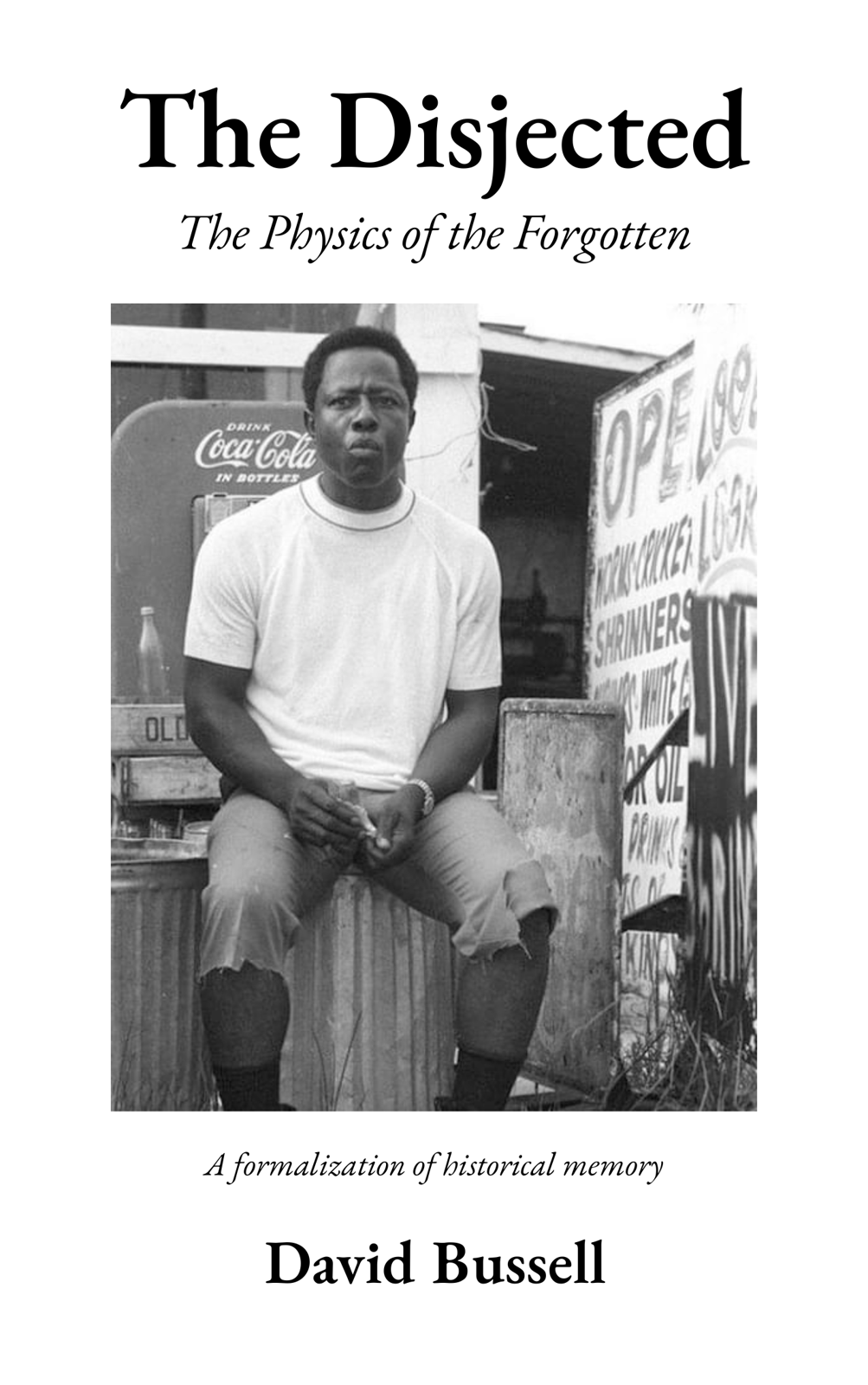
FIRST ACT. The Mines Below: What Baseball Cannot Count
The architecture of human life under the physics of constraint
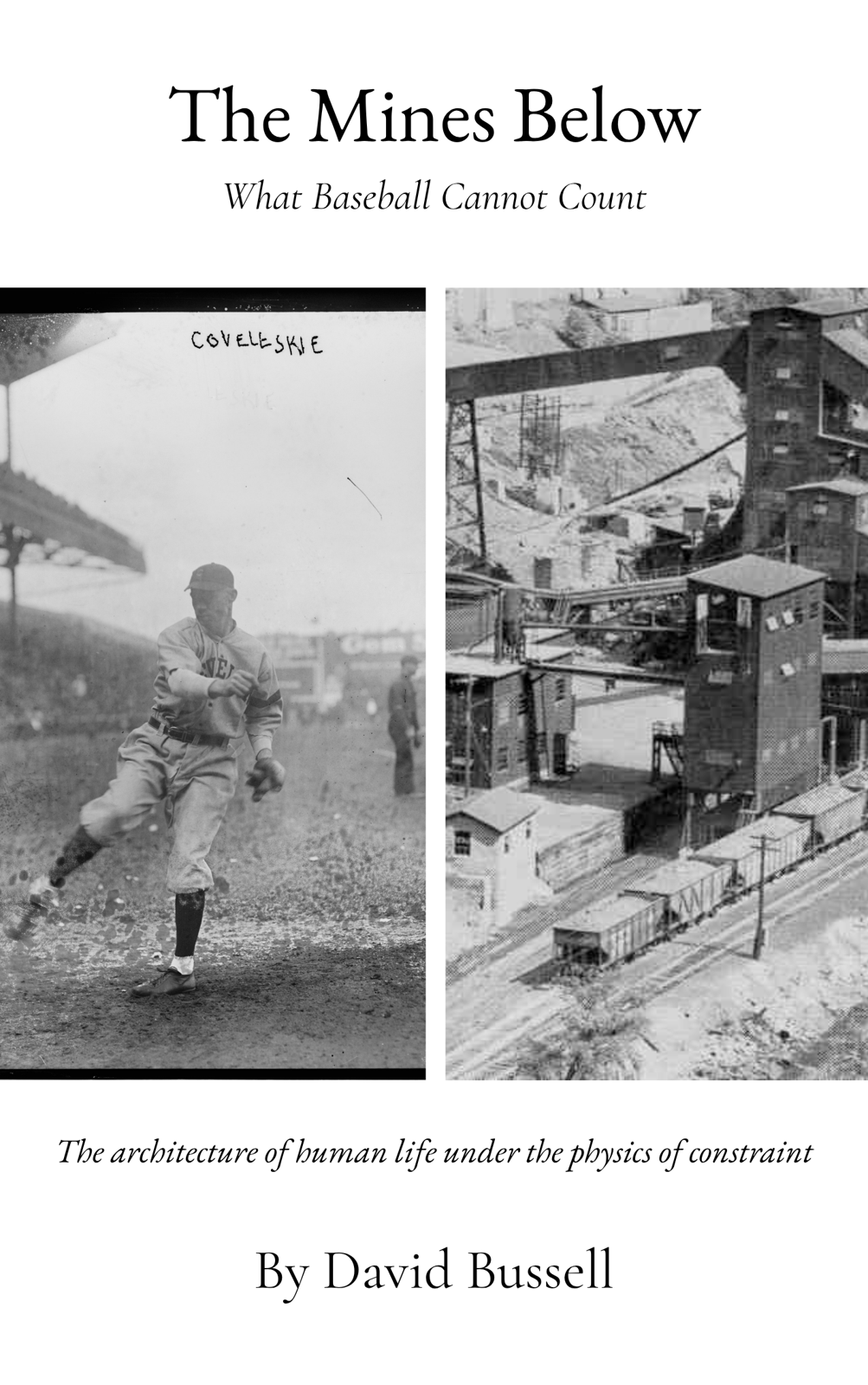
Part 1. Far From Equilibrium
What ERA+ and OPS+ are really measuring — and why counting stats are blind to the most important fact in baseball history: the equilibrium keeps moving.
What follows builds the measurement instrument from its most tractable application — professional baseball — before extending it to biographical and historical scales where the data is less complete and the stakes are larger.
The number 100 is not neutral. It carries weight. When baseball’s statisticians settled on 100 as the baseline for ERA+ and OPS+, they weren’t just choosing a round number — they were identifying the system’s resting state, the point toward which professional baseball, as a competitive ecosystem, perpetually tends. Call it what it is: thermodynamic equilibrium.
This framing isn’t metaphor. It’s mechanism. And once you see it that way, the numbers stop being measurements of individual excellence and start being readings of departure — of how far, and at what cost, a particular configuration of skill and circumstance managed to push itself away from the system’s gravitational center before inevitably collapsing back.
The Baseline Is Not Arbitrary
ERA+ and OPS+ are normalized, park- and era-adjusted statistics. ERA+ inverts and scales a pitcher’s earned run average so that 100 represents exactly league average for that season, that park, that run environment. OPS+ does the same for a hitter’s on-base plus slugging. The algebra varies, but the physical interpretation is the same in both cases: 100 is what the system produces at rest.
The league average isn’t just a statistical artifact. It’s the emergent outcome of a massive, self-regulating competition among hundreds of highly selected professionals. Teams constantly adjust. Pitchers and hitters co-evolve. Managers optimize. Injuries and aging impose regression. The whole apparatus exerts continuous pressure toward the center. Any deviation from 100 is not merely a personal achievement — it is a sustained disturbance of that equilibrium, maintained against constant restoring forces.
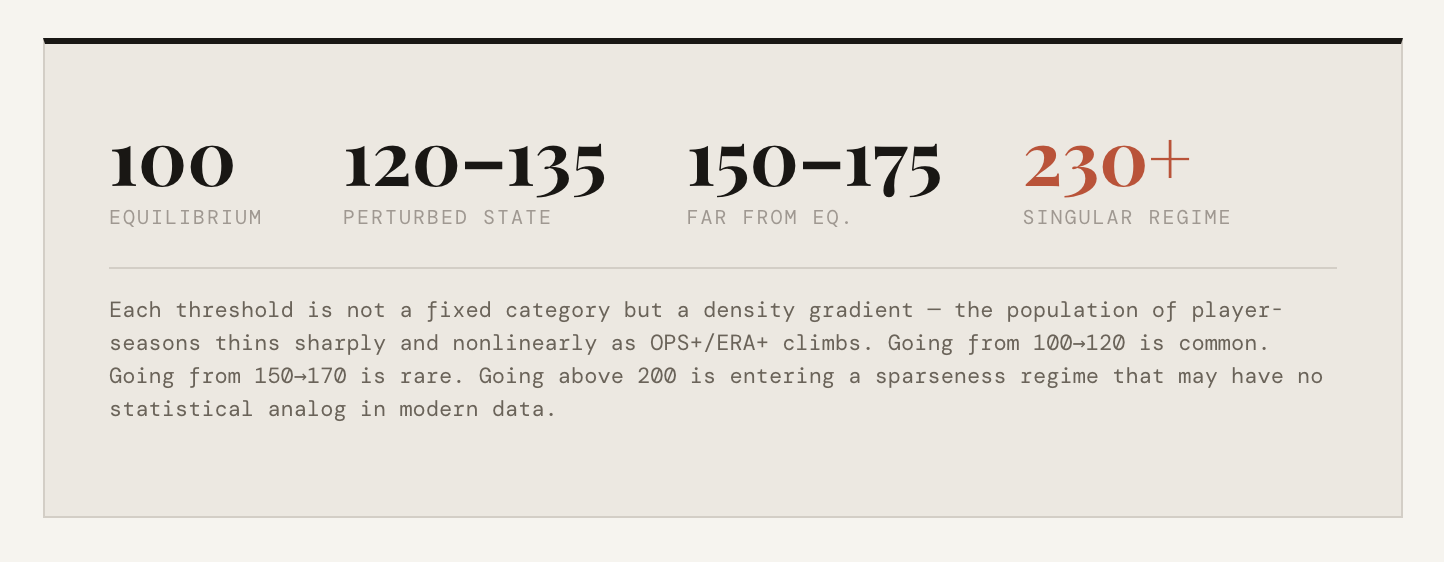
Each threshold is not a fixed category but a density gradient — the population of player-seasons thins sharply and nonlinearly as OPS+/ERA+ climbs. Going from 100→120 is common. Going from 150→170 is rare. Going above 200 is entering a sparseness regime that may have no statistical analog in modern data.
The Restoring Force Has a Name
In physics, a system displaced from equilibrium experiences a restoring force proportional to the displacement — the classic description of linear stability. Baseball is not a linear system, but the logic holds directionally: the farther a player’s performance climbs from the mean, the stronger the combined forces pulling it back. These forces are real and identifiable.
There is opposing adaptation. Pitchers who dominate for half a season find their tendencies charted, their mechanics studied, their patterns attacked from the other dugout. Hitters who get hot draw the shift, the intentional walk, the elite arm in the late innings. The system responds.
There is physical entropy. The human body does not sustain peak output indefinitely. Muscle fatigue, tendon stress, the cumulative cost of a swing repeated ten thousand times — these are dissipative processes. The great seasons that do persist across a full 162 games represent, among other things, an extraordinary suppression of the body’s own drift toward disorder.
And there is the deepest restoring force of all: variance. Baseball is famously noisy. BABIP fluctuates. Hard-hit balls find gloves. Soft contact finds holes. A player performing at a true-talent 155 OPS+ will, over a single season of roughly 600 plate appearances, produce a result distributed around that value with considerable spread. Sustaining a 155 across multiple seasons requires not just the talent but the fortune of variance working near its mean — or the true talent being so extreme that even an unlucky draw lands above the crowd.
“The very best seasons in baseball history are not just performances. They are maintained departures from a state the entire system is trying to enforce.”
Pedro, 2000: A Nonequilibrium Case Study
Pedro Martínez’s 2000 season carries an ERA+ of 291. Let us sit with that for a moment.
The league that year averaged an ERA of 4.91 in the American League. Pedro’s ERA was 1.74 — in that park, in that run environment. The plus-adjusted figure of 291 means he was suppressing runs at a rate roughly two times better than the second-most-dominant pitcher in the league and nearly three times better than average. In a system that produces Cy Young caliber performances at around 150–160 ERA+, Pedro 2000 is not just an outlier. It occupies a different statistical regime entirely.
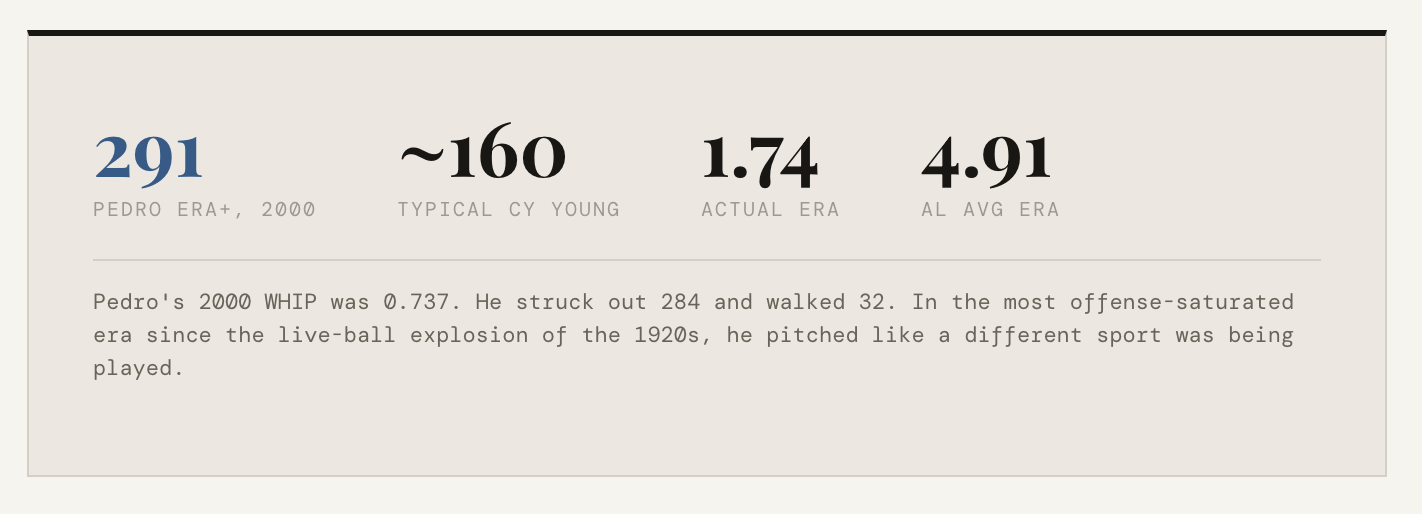
Pedro’s 2000 WHIP was 0.737. He struck out 284 and walked 32. In the most offense-saturated era since the live-ball explosion of the 1920s, he pitched like a different sport was being played.
The physicist Ilya Prigogine, who won the 1977 Nobel Prize for his work on nonequilibrium thermodynamics, described certain complex systems as capable of maintaining highly organized, low-entropy states by continuously importing energy and exporting disorder. He called these dissipative structures. They are not static — they are maintained. They persist only through the ongoing work of keeping themselves far from the state the universe prefers.
Pedro Martínez in 2000 was a dissipative structure. The organization required to produce that season — the mechanics refined across years, the conditioning that allowed 217 innings of that intensity, the psychological resources to pitch in a Fenway charged with championship pressure — was not stored. It was continuously generated and continuously expended. The season itself was the maintenance of an improbable configuration against constant thermodynamic pressure to regress.
The Bonds Problem
Barry Bonds’ seasons from 2001 through 2004 introduce a complication the equilibrium framework does not fully resolve on its own — and it is worth being honest about that.
His OPS+ figures for those years: 259, 268, 231, 362. The last of those — 2004, age 39 — is the highest single-season OPS+ in the history of baseball by a considerable margin. It was achieved while being intentionally walked 120 times in 617 plate appearances — the all-time single-season record for intentional walks, out of 232 total walks that year. Opponents, aware they were facing a player operating at an incomprehensible distance from equilibrium, simply declined to compete.
The Bonds case raises the question that any honest systems analysis must acknowledge: what is the energy source? Dissipative structures require continuous energy input. For most great players the inputs are legible — elite genetics, decades of skill development, physical conditioning, tactical intelligence. For Bonds 2001–2004, the inputs are disputed, and the framework cannot resolve what the historical record cannot. But it can do something more useful than declining to engage: it can specify what the numbers themselves imply about the energy source, whatever it was.
A player in natural decline — age 36 to 39, subject to the standard restoring forces of aging, accumulated injury, and opponent adaptation — should, under the MaxCal distribution for a player of Bonds’s established talent level, show a trajectory curving toward the mean. What the record shows instead is the opposite: his OPS+ rose from 259 in 2001 to 362 in 2004, the year he turned forty. The direction of that trajectory is not consistent with natural variance operating near its mean. It is consistent with an external energy input sufficient to counteract or delay the standard restoring forces — though it cannot, from the numbers alone, identify what that input was.
The Bonds case illustrates a limit condition of the framework rather than an application of it. The instrument measures displacement from equilibrium and can identify when a trajectory is inconsistent with the MaxCal distribution for a player of known talent and age. Bonds’s 2001–2004 trajectory — OPS+ rising from 259 to 362 between ages 36 and 39, moving away from the mean rather than toward it during the years when the restoring force of aging should be strongest — is anomalous relative to that distribution. The framework can establish the anomaly. It cannot identify its source. Any attempt to read the source from the numbers alone would be using the instrument beyond its licensed range, converting a measurement of departure into a claim about cause that the measurement does not support. The honest statement is: the trajectory is anomalous. The anomaly’s explanation belongs to other forms of evidence. The framework stops here.
· · ·
Why the Nonlinearity Matters
One of the underappreciated features of these normalized stats is that distance from 100 does not scale linearly with rarity. The distribution of player-seasons is not a normal curve with fat tails — it is a distribution with a sharp peak near the mean and extremely thin tails at both extremes. This means the sparseness increases faster than the numbers suggest.
The difference between a 120 OPS+ and a 140 OPS+ is meaningful. The difference between 140 and 160 is larger, in practical terms, than the raw gap implies. And somewhere north of 180, you leave the regime of “elite player having a great season” and enter what might be called the singular regime — where the conditions required for the performance are so specific and compounded that the event may not recur in a generation.
This is not a mystical claim. It follows from the physics. In nonequilibrium systems, the probability of a given fluctuation falls off exponentially with its magnitude. The larger the departure from equilibrium, the exponentially less likely it becomes to observe, because the number of microscopic configurations that produce it — the number of ways talent, health, conditions, and fortune can align — shrinks precipitously.
Which is why old baseball men who watched Bob Gibson’s 1968 season (ERA+ 258) sometimes struggle to articulate what they saw. They are reaching for the vocabulary to describe something that sits outside the normal distribution of baseball experience. The number gives us the distance. The physics tells us why that distance felt like witnessing something the universe does not readily permit.
Regression as the Second Law
The second law of thermodynamics holds that isolated systems tend toward maximum entropy — toward the most probable macrostate, the configuration in which the most arrangements are possible. Regression to the mean in baseball is the second law made statistical. It is not a punishment for success. It is not a failure of character or a loss of competitive edge. It is the universe enforcing its accounting.
The player who posts a 175 OPS+ in year one and a 138 in year two has not declined. He has, more likely, returned from a fluctuation. The talent that permitted the first season is probably still there, expressed now in its expected long-run value rather than in the particular lucky draw that produced the peak. We call this disappointing. The second law calls it inevitable.
What makes true greatness legible in these stats, then, is not a single extreme season but the sustained maintenance of departure across multiple years. A career OPS+ of 155, held over fifteen seasons, is more physically significant than a single 190 — because it represents not a fluctuation but a genuine shift in the system’s operating point, a player whose baseline configuration is itself far from the mean. Ted Williams’s career OPS+ of 191. Babe Ruth’s 206. These are not lucky draws. They are players whose skill distribution was centered somewhere the rest of baseball could not reach even on a good day.
“Ruth at 206 is not a man who got hot and stayed hot. He is a man for whom the equilibrium state was itself located in territory everyone else only visits.”
What ERA+ Adds That ERA Cannot
A brief technical note worth dwelling on: the normalization in ERA+ and OPS+ is doing more work than it first appears. By adjusting for park and era, these stats are attempting to remove the external energy input from the environment — the run-scoring inflation of Coors Field, the suppression of the deadball era, the steroids-era offensive explosion — and isolate the player’s individual departure from his specific equilibrium.
This is nontrivial. A raw ERA of 2.20 in 1968 (the Year of the Pitcher, when the mound was lowered after the season precisely because the equilibrium had drifted too far toward pitching) is not the same perturbation as a 2.20 ERA in 2000. ERA+ attempts to make the two comparable by anchoring both to their respective system states. The adjustment is imperfect — park factors are estimates, league quality changes, not all parks affect left-handed and right-handed hitters identically — but the attempt is precisely right in its motivation.
It is an attempt to measure the displacement, not the absolute position.
· · ·
The Equilibrium Itself Moves: Baseball’s Phase Transitions
Everything argued so far treats the system’s equilibrium — the 100 baseline — as a fixed point. It is not. The equilibrium drifts continuously, and periodically undergoes something more violent: a phase transition, an abrupt reorganization of the entire run-scoring environment. These are not fluctuations within a stable system. They are the system snapping into a new state.
The history of professional baseball is a history of such transitions, each one resetting what it meant to be average.
The nineteenth-century game was played under conditions almost unrecognizable to modern eyes. In the 1880s, pitchers threw from a box whose back line sat roughly fifty-five and a half feet from the plate — a distance measured from the delivery point, not the front of the box — often underhand or three-quarter arm, in games that could produce twenty-five or thirty runs. Batters required seven balls for a walk at various points. The equilibrium was set at a radically different level of offense, and performers in that environment were departing from a baseline we can barely reconstruct. When the pitching rubber was moved back to sixty feet six inches in 1893, adding about five feet to the effective release point, the system didn’t slowly adjust — it lurched. Run scoring exploded immediately. Pitchers who had been dominant became ordinary overnight. Their counting stats from before and after the transition are not measurements from the same system.
The deadball era, roughly 1901 to 1919, locked the equilibrium into an extraordinarily low-run state. The ball itself was softer and rarely replaced during a game, becoming misshapen and difficult to see by late innings. The spitball was legal. The stolen base and the sacrifice bunt were the primary offensive weapons because the home run was nearly impossible. League ERAs hovered around 2.50–3.00 not because pitchers were uniformly superhuman but because the system’s equilibrium was set there. A pitcher posting a 2.80 ERA in 1910 was not dominating his era the way a pitcher with a 2.80 ERA dominates the 2000s. He was operating near average.
Then 1920. The spitball was banned. Manufacturers began winding balls more tightly and replacing them more frequently during games. Babe Ruth had already demonstrated in 1919 that the home run was achievable at a frequency previously unimagined. The live-ball transition was the most violent phase change in baseball history: run scoring increased by roughly thirty percent almost immediately. The system reorganized around a new equilibrium, and it never returned to the deadball state. Careers that had straddled the transition — that began in one system and ended in another — produce counting statistics that are fossils from two different environments stacked on top of each other.
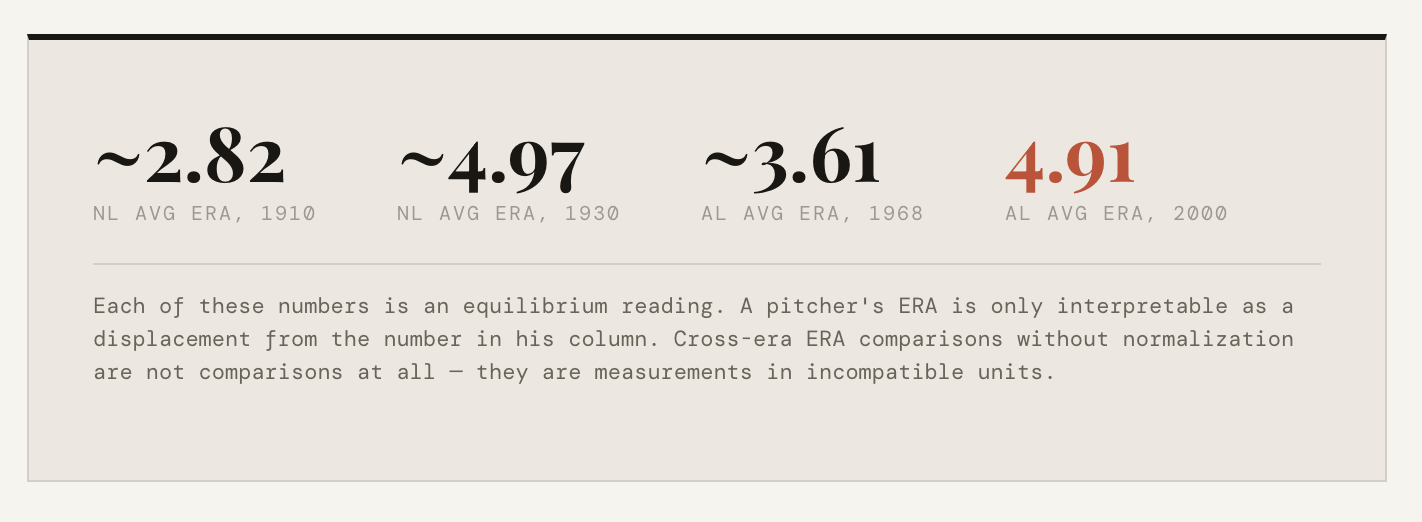
Each of these numbers is an equilibrium reading. A pitcher’s ERA is only interpretable as a displacement from the number in his column. Cross-era ERA comparisons without normalization are not comparisons at all — they are measurements in incompatible units.
The 1968 season represents a third kind of transition: not a gradual drift but a recognized crisis requiring institutional correction. Bob Gibson’s 1.12 ERA was the most visible symptom of a system that had drifted so far from offensive viability that the sport’s governors intervened directly — lowering the mound from fifteen inches to ten and compressing the strike zone before the 1969 season. The equilibrium was forcibly reset by rule change. What this means, physically, is that the 1968 season existed within an aberrant system state, one so far from the sport’s intended operating range that the institution had to act as an external energy source to push it back. Gibson’s 258 ERA+ is measured against that aberrant equilibrium. He was dominant within a system that was itself already extreme.
The Career as Sustained Departure: Walter Johnson and Lefty Grove
This is where the argument against counting stats becomes unavoidable. A career win total, a career ERA, a career strikeout count — these are integrals over a trajectory through a non-stationary system. They accumulate numbers without accounting for the fact that the equilibrium being departed from was different in year one than in year fifteen, different in a pitcher’s park than a hitter’s park, different in the American League of 1912 than the American League of 1927.
Walter Johnson pitched from 1907 to 1927. His career ERA was 2.17. That number is almost meaningless in isolation. The deadball-era league average against which he compiled the early portion of that figure was itself already around 2.70 or lower in some seasons. He was not departing from the same equilibrium in 1907 that he was in 1924, by which point the live-ball transition had pushed league ERAs above 4.00. His career ERA is the average of displacements from a baseline that shifted dramatically beneath him over two decades. It tells you something, but it does not tell you what his ERA+ tells you: that across his career, in whatever system he found himself operating in, he consistently ran an ERA+ around 146. He was, year after year, roughly half again as effective at preventing runs as whatever the league managed to produce around him. That is the displacement. That is the quantity that is actually constant across time.
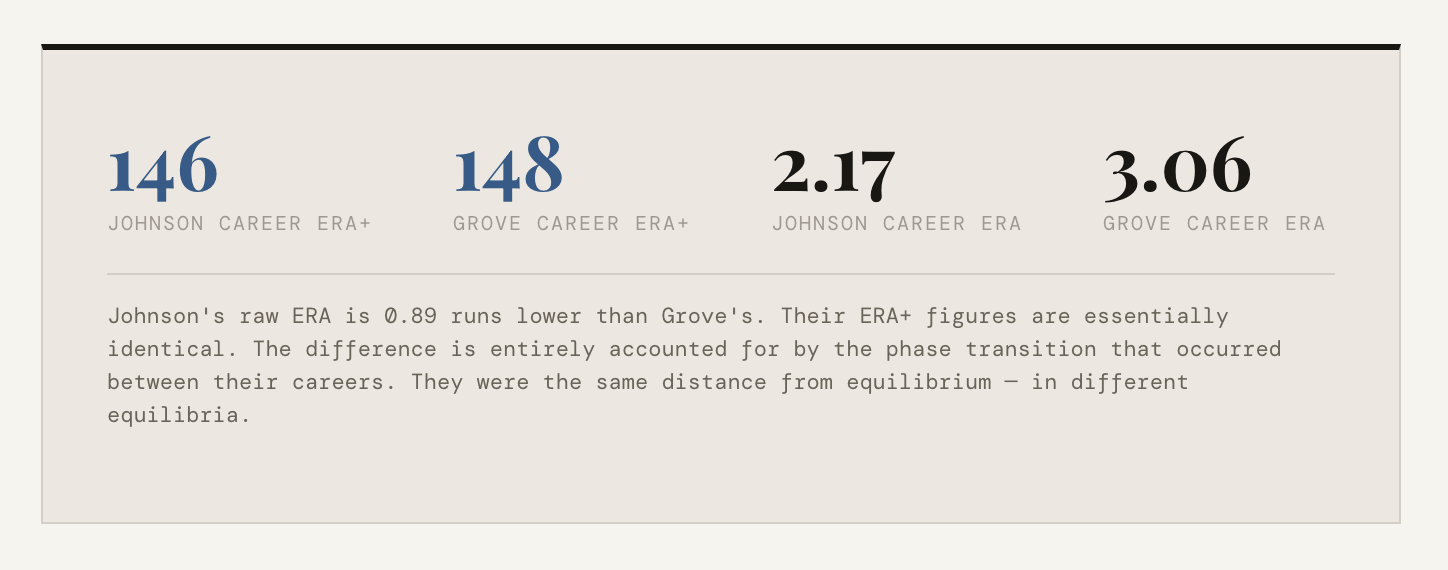
Johnson’s raw ERA is 0.89 runs lower than Grove’s. Their ERA+ figures are essentially identical. The difference is entirely accounted for by the phase transition that occurred between their careers. They were the same distance from equilibrium — in different equilibria.
Lefty Grove pitched from 1925 to 1941 — almost entirely in the live-ball era, on the other side of the transition Johnson straddled. His career ERA of 3.06 looks worse than Johnson’s 2.17 in any naive comparison. It was not. Grove was operating in a system where the equilibrium ERA was above 4.00 in many of his best seasons. His ERA+ of 148 — nearly identical to Johnson’s — is the revelation. Two pitchers, separated by a phase transition that changed the meaning of every raw number in the sport, sustained essentially the same displacement from their respective baselines across careers of similar length and quality.
This is what counting stats cannot see and what the normalized stats make visible: the career as a time-extended dissipative structure, maintaining its departure from equilibrium across years in which the equilibrium itself is shifting. Johnson didn’t just perform well in the deadball era — he performed well in the deadball era and continued performing well as the live-ball transition reshaped the entire landscape around him, adjusting, maintaining his distance from whatever the new normal was. Grove dominated a run-scoring environment that would have statistically buried Johnson’s raw ERA while leaving his ERA+ intact.
“A career ERA is a fossil record from an unstable geology. ERA+ is the only number that tells you how far above the ground the player stood — regardless of where the ground was.”
The physical interpretation is direct. A long career in baseball is not a sum of performances. It is a sequence of maintained departures from a non-stationary equilibrium, each one requiring energy expenditure against restoring forces that include not just the opposing lineup but aging, injury, adaptation by opponents, and the shifting conditions of the game itself. The player who sustains a career ERA+ of 147 over twenty seasons has done something qualitatively different from the player who posts a 200 ERA+ over three seasons and flames out. The former has demonstrated that his departure from equilibrium is structural — built into his baseline capabilities — rather than fluctuational. He is a stable nonequilibrium state. The latter may have been a particularly large and short-lived fluctuation.
To state it plainly: a career ERA is not a measurement of how good a pitcher was. It is a measurement of where he sat in the system he happened to inhabit. ERA+ measures how far above that system he managed to get. That is a different quantity. It is the one that matters.
Why Counting Stats Fail the Cross-Era Problem
It is worth being precise about exactly what counting stats cannot see, because the failure is not merely one of scale — it is one of kind.
A raw win total, ERA, or batting average is a measurement of absolute position: where the player’s output sat in some absolute sense. But absolute position in a non-stationary system is not a meaningful quantity for comparison across time. If I tell you a room is sixty-three degrees, you know something about that room — but only if you know whether the outside temperature is thirty degrees or ninety. The number sixty-three is an absolute position. Whether it represents warmth or cold depends entirely on the system’s state.
Ty Cobb’s .366 career batting average exists in a system where the league hit around .260–.280 during his peak years, with almost no home runs, and where pitchers threw until their arms gave out because bullpens barely existed. Pete Rose’s 4,256 hits were accumulated across the equivalent of four full seasons more than Cobb played, in a different equilibrium, against a different distribution of pitching quality. These numbers share units — hits, batting average — but they are not in the same coordinate system. Comparing them as if they are is like comparing the length of a meter stick measured at sea level with one measured at altitude without accounting for thermal expansion. The instrument is the same. The environment is not.
OPS+ and ERA+ are imperfect, but they are doing the right thing: they are converting absolute position into displacement from a locally defined equilibrium. They are measuring the same quantity across different system states. And it is only that quantity — the displacement, not the position — that is actually comparable across time.
This is why the Hall of Fame debates that rest on raw counting stats are so often conducted in a kind of numerical fog. Three hundred wins is not a fixed quantity of achievement. It is a fixed number of wins accumulated across whatever system the pitcher happened to inhabit. The pitcher who went 300-200 in the 1960s and the pitcher who went 300-200 in the 1980s cleared the same numerical bar in different gravitational fields. The bar itself is arbitrary. The normalized displacement is not.
The Measurement Problem, Stated Without Metaphor
A player-season, measured through ERA+ or OPS+, is a displacement from a local equilibrium defined by the constraint set of that environment.
A career, measured through sustained ERA+ or OPS+, is a time-extended maintenance of that displacement against restoring forces that include adaptation, variance, aging, and injury.
A human life is not reducible to either of these quantities. It is a trajectory through a high-dimensional phase space defined by a full constraint tensor — constitutive, socioeconomic, historical, and institutional — in which the most probable path is given by the maximum caliber distribution over that space.
The correct physical question is therefore not: how far did this system move from its equilibrium?
It is: given the full constraint tensor under which this trajectory evolved, how much work was required to produce and maintain that displacement, and for how long was it sustained before the system returned toward its attractor?
ERA+ answers the first question along a single dimension.
Biography is the only instrument we have for approaching the second.
Baseball’s history is not a single experiment run continuously for 150 years. It is a sequence of distinct experiments — each with its own equilibrium, its own phase-space, its own restoring forces — conducted on the same fields with roughly the same rules and completely different physics. The mound went back in 1893 and everything changed. The spitball was banned in 1920 and everything changed again. The mound came down in 1969. The strike zone has contracted and expanded. The ball has changed, the parks have changed, the training methods have changed, and the population of players has expanded from a segregated domestic pool to a global one.
ERA+ and OPS+ do not solve this problem completely. No statistic can. But they are pointed in the right direction, which is toward the only question that matters when comparing players across time: not where they stood, but how far from where everything else stood they managed to get — and for how long they managed to hold that ground.
Walter Johnson and Lefty Grove held it for twenty years each, in different universes, at the same distance from the wall. That is what the number tells you. The counting stats tell you almost nothing.
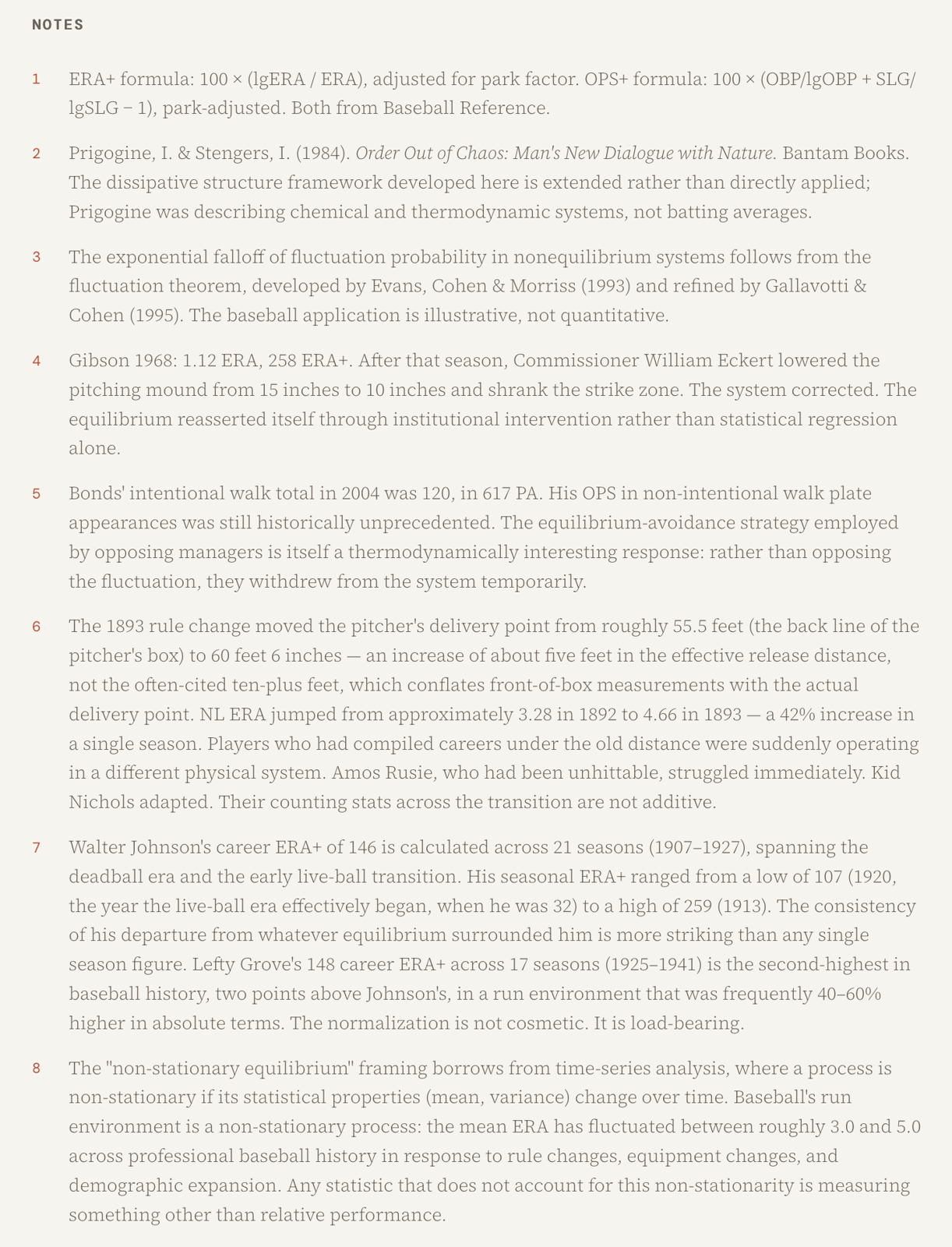
Part 2. The Mines Below
ERA+ measures displacement from a statistical equilibrium. What measures displacement from a life? On Jake Daubert, Hack Wilson, and Stan Coveleski — and what it means to model the lived career, and the lived life, as a trajectory through a constrained phase space.
The previous essays in this series argued that ERA+ and OPS+ are measurements of a specific physical quantity: the distance between an observed trajectory and the most probable trajectory given the constraints operating on that system. When we correct for park and era, we are — in the language of statistical mechanics — conditioning on the constraint set and asking how far the observed macrostate deviates from the maximum entropy distribution under those constraints. The number we get is a displacement. Not a score. A displacement.
This essay extends that framework to a scale the statistics cannot reach. It applies the same physics — the same question about displacement from a constrained equilibrium — to the full arc of a human life, from origin conditions to terminal state. It does so through three specific lives: Jake Daubert, Hack Wilson, and Stan Coveleski. All three came from the same compressed substrate, the anthracite coal country of Pennsylvania, within a generation of each other. Two of them from the same town. All three escaped via baseball. And their trajectories after baseball — how far they returned toward the equilibrium from which they had so violently departed, and how fast — are as revealing about the underlying physics as any statistic they ever produced on a field.
The claim is not metaphorical. A human life is a biological open system, far from thermodynamic equilibrium by definition. The question of how to measure the work done by a life that escapes a particular social and material attractor is a genuine problem in nonequilibrium statistical mechanics. The tool is Maximum Caliber — Jaynes’s 1980 extension of his maximum entropy framework to dynamical systems, which assigns probability distributions over entire trajectories rather than over states. ERA+ is a special case of this framework, one that collapses the constraint set to a single dimension. Biography is the full-dimensional version of the same calculation.
I. The Constraint Set Is Real
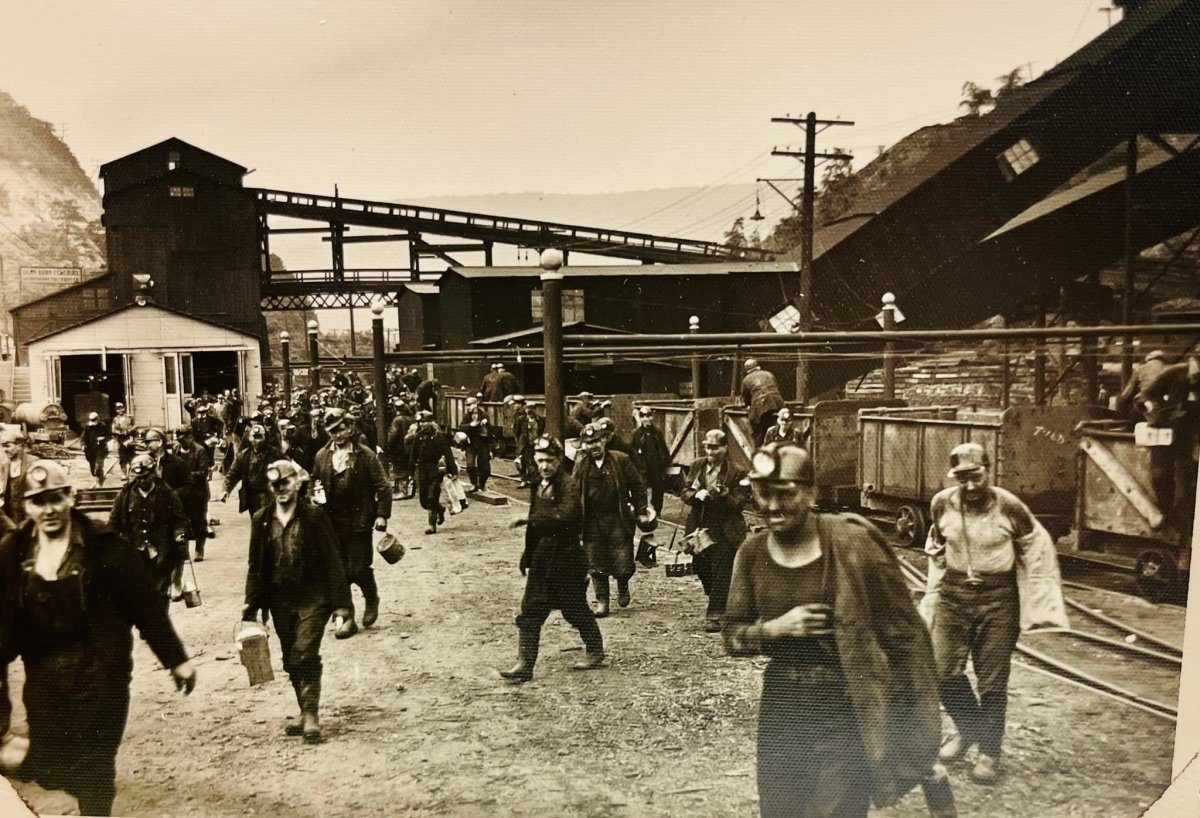
A constraint set, in the statistical mechanics sense, is not a soft sociological term. It is the set of conditions that defines the accessible region of phase space — the states the system can actually reach given its initial conditions and the boundary conditions imposed by its environment. The maximum entropy distribution is the one that spreads probability uniformly over this accessible region. Any trajectory that departs from the maximum entropy path is doing work against the constraints, and the cost of that work is bounded from below by a quantity derivable from the geometry of the solution manifold.
For a child born in Shamokin, Pennsylvania in 1884, the accessible region of life-phase-space was strongly constrained. The constraints were real and classifiable.
Constraint classification — initial conditions, anthracite Pennsylvania ca. 1884–1900
C₁ — Constitutive. The body’s initial thermodynamic properties: physical resilience, neurological architecture, immune function, genetic susceptibilities. Fixed at birth. These define the system’s intrinsic capacity to maintain organization against dissipative forces. Daubert carried undetected hereditary spherocytosis — a defect in red blood cell structure that would prove fatal under surgical stress four decades later. Coveleski carried no detected C₁ pathology and showed exceptional intrinsic durability across a 14-year major league career. Wilson bore the constitutional markers of fetal alcohol syndrome: altered reward circuitry, reduced impulse regulation, specific morphological constraints. C₁ is not destiny, but it shapes the topology of the accessible region. Certain trajectories are constitutively inaccessible regardless of boundary conditions.
A note on classification is required here. Jackson’s illiteracy, analyzed in Part 7, will appear in this taxonomy as a C₁ constraint — and the classification needs defending in advance. Illiteracy in 1894 South Carolina is not biological in the way spherocytosis is biological.
It is the product of C₂: a mill economy that provided no school, no time, and no incentive for literacy in a child whose labor was needed at six. The classification as C₁ is nonetheless correct in the functional sense the framework requires, because a constraint that operates before the system has any capacity to compensate for it restructures the system’s basic operating parameters as thoroughly as a genetic defect does.
Wilson’s fetal alcohol syndrome was present before birth. Jackson’s illiteracy was established before age six, before any alternative path was accessible, before the system had generated the resources that might have opened the channel toward literacy.
By the time baseball appeared as an escape route, the illiteracy was not a remediable C₂ condition — it was a fixed feature of how Jackson processed and navigated institutional environments. It shaped every contract he signed, every legal document he encountered, every interaction with the machinery of professional baseball in the same way a constitutive neurological feature would. The distinction between “biological from birth” and “environmentally imposed so early and completely that it functions as biological” is real but does not change the topology of the accessible region.
For the purposes of the MaxCal calculation, what matters is not the origin of the constraint but whether it can be modified by the system’s own trajectory. Jackson’s illiteracy could not. It is C₁ in the sense that matters: the system could not self-modify around it, and it shaped the geometry of every subsequent path.
C₂ — Socioeconomic. The material boundary conditions that define which energy channels are open. In Shamokin in 1884, accessible employment channels for a miner’s child were: the mines (high probability, absorbing state), domestic labor, and the narrow high-variance channel of skilled trades or athletics. The probability mass under Maximum Caliber is overwhelmingly concentrated in the mines. Baseball was accessible — but accessible the way a small opening in a high barrier is accessible. The channel was real. Its width was narrow and its barrier height was large.
C₃ — Historical. The temporal position of the life within the larger nonequilibrium dynamics of the economy and the sport. The deadball era, the Federal League threat, the live-ball transition, Prohibition, the Depression — these shift the energy landscape during the trajectory, altering which paths remain accessible and at what cost. A constraint set is not static. It evolves, and the trajectory must continuously adapt to an evolving constraint surface.
C₄ — Institutional. The specific structures that either sustain or oppose the departure from equilibrium. McCarthy as Cubs manager is not a personal relationship — he is a modification of the constraint set, one that shifted Wilson’s accessible region significantly. When he left, the constraint set reverted. Daubert’s union organizing was a self-generated institutional modification — he was actively shaping his own C₄ — and was punished for it by the men who controlled the reserve clause.
Maximum Caliber — MaxCal — says: given these constraints, what is the probability distribution over all possible life-trajectories? The most probable trajectory is the one that maximizes the path entropy subject to those constraints. That trajectory, for a child born into Shamokin’s coal country in 1884, ended in the mines. Coveleski said so directly at his Hall of Fame induction: “What was strange is that I ever got out of there.” He was not being modest. He was making a probabilistic statement.
Maximum Caliber — path probability over constrained trajectories
Let Γ be the space of all possible paths γ through the life’s phase space. MaxCal selects the probability distribution P* over paths by maximizing the path entropy (caliber):
𝒞[P] = −∑_γ P[γ] ln P[γ]
subject to constraints encoding known information about the dynamics (mean fluxes, conserved quantities, known transition rates). The solution has the Boltzmann-Gibbs form:
P*[γ] = (1/Z) exp(−∑_k λ_k G_k[γ])
where λ_k are Lagrange multipliers conjugate to each constraint and Z is the path partition function. The MaxCal path is the mode of P*. Deviations from it have probability falling off exponentially with the action integral along the deviation — and a lower bound on the cost of any such deviation given by the geodesic distance in the Riemannian geometry of the solution manifold (Niven & Andresen, 2009). The claim is structural isomorphism, not quantitative equivalence — the mathematical form applies to biographical trajectories in a non-metaphorical way, even though the specific quantities are not directly computable.
The specific Lagrange multipliers are not recoverable from available biographical data; what is recoverable is the direction and rough magnitude of the constraint effects, which is what the analysis uses.
A life that achieves the baseball careers of Daubert, Wilson, and Coveleski from these starting conditions is a low-probability deviation from the MaxCal path. The physics asks: at what cost was it maintained?
II. ERA+ as a Special Case
Before going further into the biographical analysis, it is worth being exact about how ERA+ and OPS+ fit into this framework — because understanding what they can and cannot do is the foundation for understanding why biography is necessary.
ERA+ and OPS+ are displacements from the maximum entropy distribution over player-season outcomes given the constraint set of that season. They condition on C₃ — the run-scoring environment, the park, the era — and ask how far the observed performance deviated from what the most probable performer in that environment produced. This makes cross-era comparison meaningful along the performance axis.
What they cannot condition on is C₁, C₂, or C₄. They cannot ask: how probable was this level of performance given the full constraint tensor of the life that produced it? They measure the displacement but not the work required to achieve and maintain it. Those are different quantities. The physics is about the work.
In information-theoretic terms: the surprisal of an outcome is −log₂(P), where P is its probability under the prior distribution. Two players with identical career OPS+ of 117 have produced the same statistical displacement from their respective league averages. But if the prior distribution — the MaxCal distribution over all possible career outcomes given the full constraint tensor — is radically different for the two players, the surprisal is radically different. The same OPS+ carries different information content from different starting positions.
The structure of that difference can be bounded even when it cannot be calculated precisely.
Let P_S denote the prior probability of reaching major league baseball and sustaining a career OPS+ of 117 from a starting position like Shamokin, Pennsylvania in 1884 — a miner’s child, no coaching infrastructure, the mine as absorbing state, the barrier height for escape high and narrow.
Let P_A denote the same probability from a starting position with stable socioeconomic conditions, access to organized baseball development, and no dominant competing attractor. P_S is much smaller than P_A. The exact values are not recoverable from available data. The direction and rough magnitude of the difference are not in serious dispute. The surprisal of a career OPS+ of 117 from position S is −log₂(P_S); from position A it is −log₂(P_A). Since P_S < P_A, log₂(P_S) < log₂(P_A), and therefore −log₂(P_S) > −log₂(P_A).
The Shamokin OPS+ encodes more information. It is a less probable event. The same displacement required more work to produce. This is not a claim about moral weight — it is a claim about the geometry of the prior distribution. The statistic is the same number. The physics behind it is not the same physics.
Daubert’s career OPS+ of 117, achieved by a coal miner’s son who entered the mines at eleven and carried an undetected fatal blood condition for forty years, is not the same physical achievement as a career OPS+ of 117 by a player who began from a high-probability region of the constraint distribution. The statistical displacement is identical. The work is not.
III. The Baseline: What the Mines Represent
Shamokin, Pennsylvania in the 1880s and 1890s was not merely a poor town. It was a system optimized to consume human bodies. The anthracite seams ran deep and irregular, requiring constant labor from men and boys who had no meaningful alternatives. When Jake Daubert entered the mines as a breaker boy in 1895 at age eleven, he joined his father — who would spend fifty-seven years underground — and his brothers Irwin and Calvin. Calvin died there. When Stan Coveleski began sorting coal at twelve for $3.75 a week — seventy-two hours of labor, five cents an hour — he was entering an institution that had claimed generations of the Kowalewski family before him.
The mines were the equilibrium state — the most probable fate for a child born in that place, at that time, to those parents. In MaxCal terms: the absorbing state, the region of phase space toward which nearby trajectories converge and from which escape requires energy input exceeding the barrier height.
Hack Wilson’s baseline was in some ways more extreme. Born in Ellwood City in 1900 to unmarried parents — both alcoholics who never married — Wilson’s mother died of appendicitis when he was seven. His father abandoned him. He was raised by the landlady of a boarding house. His physique, as later historians recognized, bore the characteristic markers of fetal alcohol syndrome: the disproportionate body, the flattened face, the small hands requiring custom-fitted bat handles, the neurological profile that shaped his entire relationship to discipline, impulse, and alcohol. He left school in the sixth grade to swing a sledgehammer in a locomotive factory. His equilibrium state was not merely poverty — it was constitutional damage, compounded by abandonment, compounded by an industrial town with no social infrastructure to catch a child built the way he was built.
These are the zero-points. The states toward which, in the absence of sustained energy input, these lives would tend to return. And did return — at different rates and to different degrees — once the extraordinary energy of professional baseball could no longer be maintained against them.
IV. Daubert: The Career as Maintained Departure

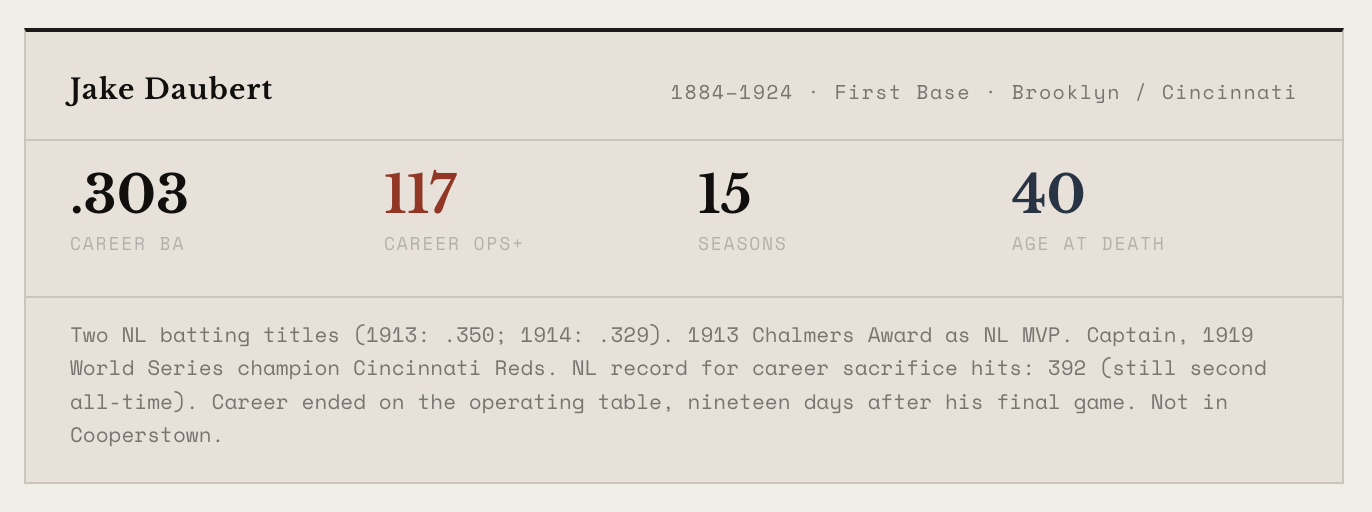
Two NL batting titles (1913: .350; 1914: .329). 1913 Chalmers Award as NL MVP. Captain, 1919 World Series champion Cincinnati Reds. NL record for career sacrifice hits: 392 (still second all-time). Career ended on the operating table, nineteen days after his final game. Not in Cooperstown.
Jacob Ellsworth Daubert was still carrying the mines on his hands when he died. “Look at these hands,” he once said to a reporter. “See those black marks? That’s from mining, and even now, when I look at them, I sometimes fear that all my success is a dream and that I will wake up in the darkness of the mines again.”
This is not sentimentality. It is a precise description of a man who understood, at some level, that his position in the world was maintained rather than permanent — that the distance between the life he was living and the life his father had lived was not a stable achievement but an ongoing expenditure against a restoring force that had not gone away. He was right. The coal marks on his hands were not just memory. They were evidence of where the attractor still lay.
Daubert’s career OPS+ of 117 tells us he performed 17% better than league average across fifteen seasons of the deadball era. That number understates what he was. The deadball game did not reward his particular configuration of skill — bat control, fielding precision, institutional intelligence — with the numerical visibility that power numbers provide. Seven times he was named to the Baseball Magazine all-star team at first base. He is not in Cooperstown, partly because the statistics do not shout what he was, and partly because his union organizing — his insistence on suing Charles Ebbets for the balance of a breached contract, his service as vice president of the Baseball Players’ Fraternity — made him enemies in the ownership class that controlled Hall of Fame selection for decades after his death. The C₄ constraint he built for himself, the institutional energy he generated by fighting for players’ rights, was also the thing that got him traded and may have cost him Cooperstown.
The energy inputs that sustained his departure from baseline were extraordinary and specific. His body, hardened by years of sledgehammer work underground, gave him durability unusual even for an era before protective equipment. He credited the mines directly: “Breaking rock and shoveling coal in the dark certainly does harden a fellow’s muscles.” He played fifteen seasons without missing significant time — remarkable in an era when pitchers routinely threw at heads as a matter of strategy. He was beaned at least eight times in his career. The last one, in 1924, killed him.
The mechanism of his death is worth dwelling on precisely. Daubert took a beaning early in the 1924 season and played the remainder of the year with persistent headaches and insomnia. He came off the field weakened, fell ill on a road trip to New York, and underwent surgery on October 2 for what doctors thought was appendicitis and gallstones. He never recovered. It was later discovered that his family carried hemolytic spherocytosis — a hereditary defect in which the spleen destroys its own red blood cells. His son developed identical symptoms decades later and was successfully treated with surgery that 1924 medicine had no capacity to perform.
The physics is precise: a body already compromised by cumulative head trauma, already running on the energy reserves of late career, encountered a pathological load that exceeded its remaining capacity to maintain departure from baseline. The C₁ constraint — the hereditary blood defect — had been present from birth, invisible, exerting no measurable effect for forty years, and then expressed catastrophically under the stress of a surgical intervention his depleted system could not survive. Daubert did not return to the mines. The mines came for him through a different channel, and he never saw it coming.
V. Wilson: The Catastrophic Return
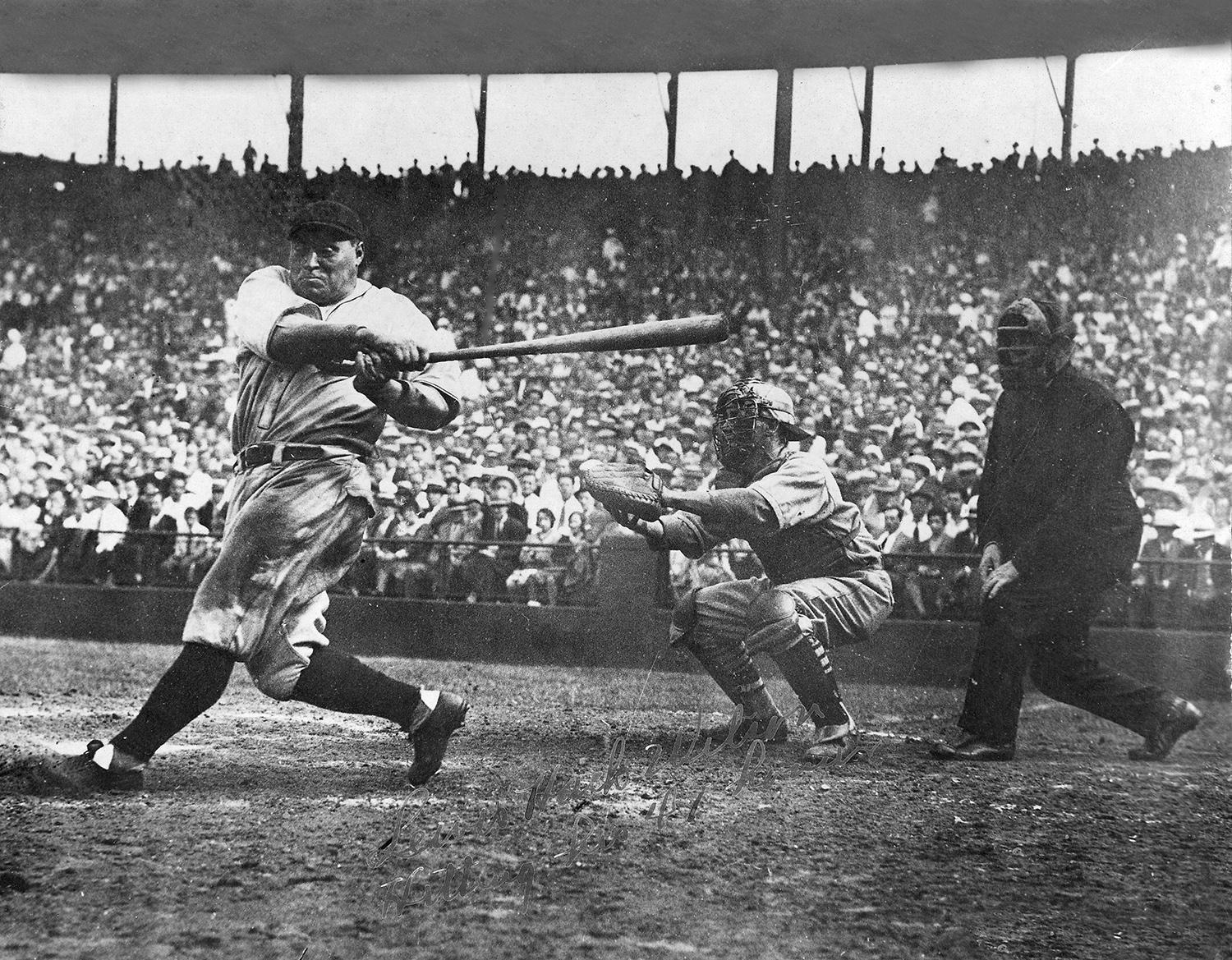
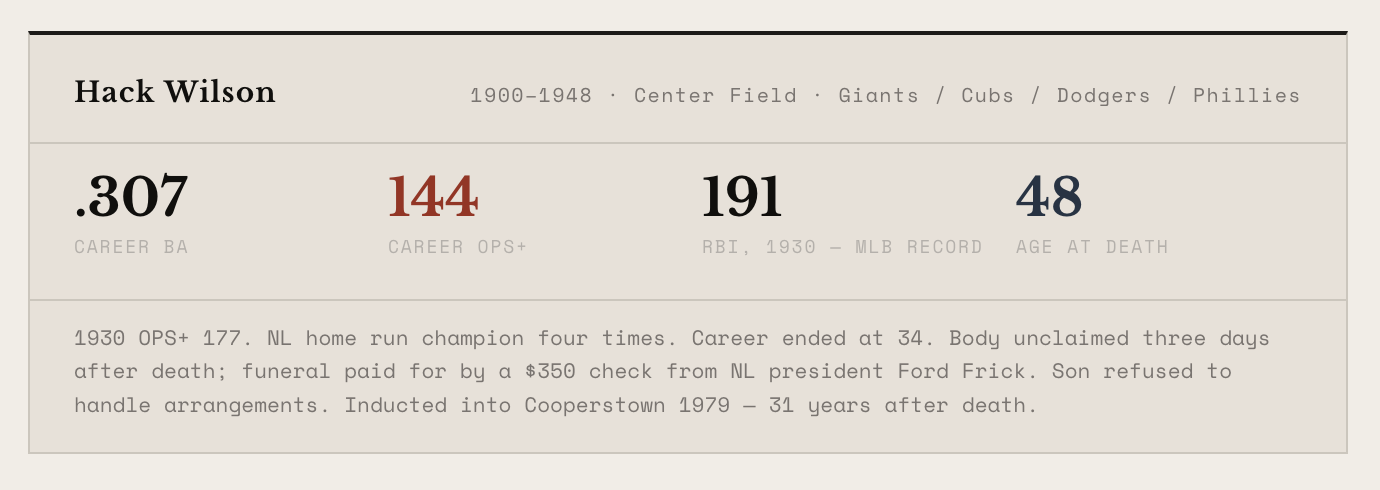
1930 OPS+ 177. NL home run champion four times. Career ended at 34. Body unclaimed three days after death; funeral paid for by a $350 check from NL president Ford Frick. Son refused to handle arrangements. Inducted into Cooperstown 1979 — 31 years after death.
Hack Wilson’s 1930 season has been analyzed as a statistical phenomenon so many times that it risks becoming abstract. It should not be abstract. It is one of the most extreme departures from equilibrium in the recorded history of athletic performance, and its subsequent collapse is the clearest possible illustration of what happens when the external conditions maintaining such a departure are removed.
Wilson’s 1930 OPS+ of 177 means he produced offense at 77% above the league average in a season when the NL as a whole batted .303 — the only season since 1894 in which the entire league batted over .300. He did this in a body carrying what later historians have identified as the markers of fetal alcohol syndrome, in a life that had never had a stable foundation, under conditions that required the continuous presence of one specific enabling factor to function.
That factor was Joe McCarthy.
McCarthy as Cubs manager understood something about Wilson that most of his contemporaries did not: that the restoring forces acting on Wilson’s life were not moral failures to be corrected through discipline, but structural features of a constitution damaged before Wilson was born. McCarthy did not try to eliminate Wilson’s alcoholism. He managed around it — absorbing the late nights, bailing him out of jail, refusing curfews, refusing surveillance — and in return Wilson gave him everything he had. “Better than any other manager,” wrote sportswriter Frank Graham, “Joe understood Hack, made allowances for him when he failed, and rewarded him with praise when he did well. Joe could be strict and stern with his players, but he never was with Hack, and Hack repaid him by playing as he never had before, nor would again.”
This is the thermodynamic statement. McCarthy had become part of the energy input maintaining Wilson’s departure from his equilibrium state. He was a C₄ modification — a specific institutional condition that shifted Wilson’s accessible region significantly. When McCarthy left after 1930 to manage the Yankees, that modification was removed. The new manager, Rogers Hornsby, applied what he understood to be the corrective protocol: discipline, curfews, weight controls, moral condemnation of the drinking. Hornsby was treating a systems-management problem as a character problem. He did not understand what McCarthy had understood: that Wilson’s alcoholism was a constitutive feature of the C₁ constraint set, not a correctable behavioral deviation.
The thermodynamic mechanism requires precision here, because it is the mechanism the rest of this book depends on.
McCarthy did not reduce Wilson’s alcohol consumption. He managed the environment so that the dissipation channel — alcohol as the primary pathway through which Wilson’s system exported entropy — operated during recovery rather than during performance. The channel remained open. Its throughput remained high.
What McCarthy controlled was the timing and context of the throughput, ensuring it did not consume the organizational capacity required for the performance itself. This is the only management strategy available for a constitutive dissipation pathway.
You cannot close a channel that is part of the system’s basic architecture. The channel is not a behavior to be corrected; it is a structural feature of how the system maintains any functional state at all. Hornsby’s protocol — discipline, curfews, moral condemnation — was an attempt to close the channel directly. This is guaranteed to fail, not because Hornsby was wrong about the drinking being destructive, but because a system that routes its entropy production through a particular channel will, if that channel is blocked, route it elsewhere at higher cost or cease to function.
Wilson’s 1931 collapse was not a failure of will. It was a system whose primary dissipation channel had been mismanaged from open to contested, producing exactly the dysfunction that the channel, when properly accommodated, had been preventing.
“There are kids, in and out of baseball, who think because they have talent, they have the world by the tail. It isn’t so. In life you need things like good advice and common sense.”
— Hack Wilson, CBS Radio, November 1948, days before his death
Wilson reported to 1931 spring training twenty pounds overweight. He hit .261 with 13 home runs and 61 RBI in 112 games — from the greatest single offensive season in the sport’s history to barely average in twelve months. By 1934 he was out of the game at thirty-four.
What followed was not a gradual decline. It was a phase transition — a catastrophic return toward the equilibrium state from which baseball had temporarily displaced him. Pool halls that failed. A sporting goods store that failed. A tavern he drank into insolvency. By 1938 he was working as a bartender near Ebbets Field, singing for drinks until the customers became too abusive and he had to stop. He worked in a defense plant during World War II. He managed a city swimming pool in Baltimore when municipal officials recognized who he was.
He died on November 23, 1948, at forty-eight, of pneumonia and internal hemorrhaging following a fall in his apartment. His body was unclaimed for three days. His son Bobby, who had watched his father drink away his marriage, his money, and his name, refused to make arrangements. The funeral was paid for with a $350 check from National League president Ford Frick and contributions from his drinking companions. He was buried in a donated plot in Martinsburg, West Virginia.
Born 1900 to abandoned dissolution. Died 1948 in abandoned dissolution. In between: five years that produced the greatest single RBI season in the history of professional baseball. The departure from equilibrium was violent, record-setting, and temporary. The return was complete.
VI. Coveleski: The Long Sustained State
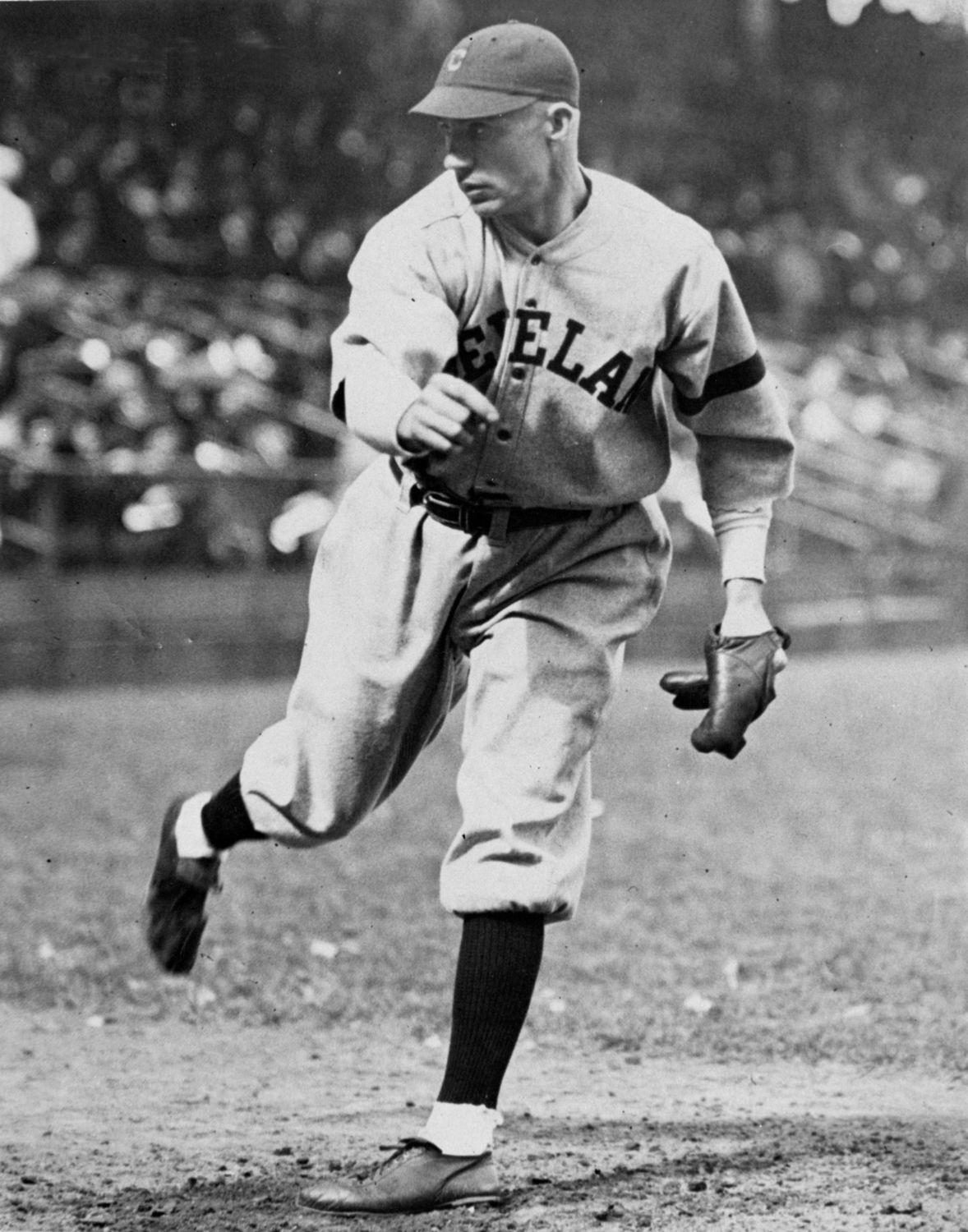
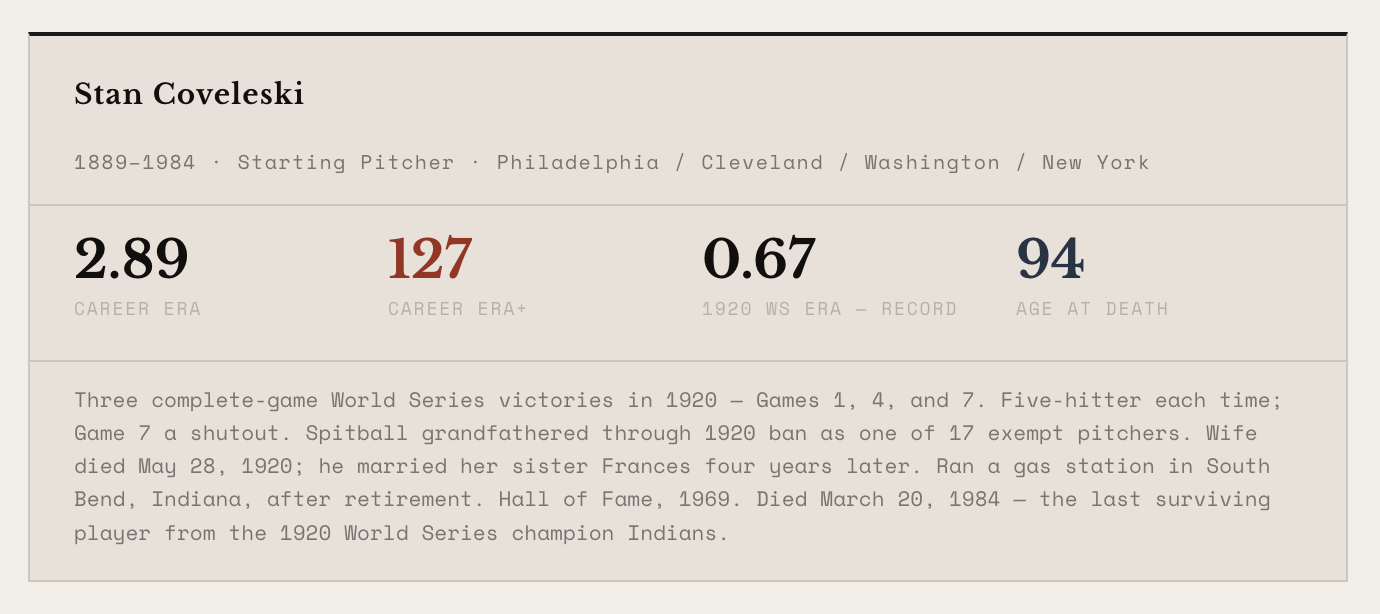
Three complete-game World Series victories in 1920 — Games 1, 4, and 7. Five-hitter each time; Game 7 a shutout. Spitball grandfathered through 1920 ban as one of 17 exempt pitchers. Wife died May 28, 1920; he married her sister Frances four years later. Ran a gas station in South Bend, Indiana, after retirement. Hall of Fame, 1969. Died March 20, 1984 — the last surviving player from the 1920 World Series champion Indians.
Stanislaus Kowalewski began throwing stones at tin cans nailed to a tree in Shamokin after his shifts in the mines because there was no other time. He worked from seven in the morning to seven at night, six days a week, for $3.75. In the evenings he practiced. He later claimed he could hit the cans blindfolded.
The pitch he would become famous for — the spitball, altered with alum kept gummy in his cheek — he developed in the minor leagues in Portland, Oregon, thousands of miles from the collieries. But the training substrate for the pitch was the stone-and-can work in the Shamokin dark: the mechanical repetition of a child who had nothing else to spend his evenings on. The mines gave him the time. The mines gave him the hardened arm. The mines gave him the hunger for a different life that made the repetition feel like escape rather than labor.
“What was strange,” he said at his Hall of Fame induction in 1969, “is that I ever got out of there.”
The 1920 season is the biographical case study. In May, his wife Mary died unexpectedly after seven years of marriage. He had been winning his first seven decisions of the year. He left the team, grieved with his family in Shamokin, and returned two weeks later. In August, he was the starting pitcher in the game where Carl Mays’s fastball struck Indians shortstop Ray Chapman in the temple — the only fatal beaning in major league history. Chapman died twelve hours later. Coveleski finished the regular season with twenty-four wins. In October, he won Games 1, 4, and 7 of the World Series against the Brooklyn Robins — each a complete-game five-hitter, the last a 3-0 shutout — then walked back to the clubhouse alone. “Nobody said a word except maybe ‘Nice game, Covey.’ Just another ball game.”
The pressure never lets up. Don’t matter what you did yesterday. That’s history. It’s tomorrow that counts. So you worry all the time. It never ends. Lord, baseball is a worrying thing.
— Stan Coveleski
He worried because he remembered the alternative. The mines were not behind him — they were always beneath him, the attractor from which departure had been achieved at great cost and could never be taken for granted. His worry was the appropriate epistemic posture of a system that understood its own constraint set was not favorable. It was also the psychological signature of a dissipative structure built on internalized repetition rather than external management — a system whose maintenance was self-generated, drawn from the stone-and-can evenings in Shamokin, and therefore not dependent on any particular McCarthy remaining in place.
After retirement, he ran Coveleski Service Station in South Bend, Indiana. He gave free pitching lessons to local kids in the field behind his garage. He watched baseball on television. He gave five major interviews over the course of his long life. He died on March 20, 1984, at the age of ninety-four, the last surviving player from the 1920 World Series champion Indians — the team for whom he had pitched three complete-game victories in the same Series in which his wife had died that spring and his teammate had been killed that August. He had maintained his departure from equilibrium through all of it, and continued maintaining it for more than sixty years after the career ended.
VII. The Constraint Table
Reading the three lives together against their constraint tensors, the post-career trajectories become predictions rather than narratives. The physics is asking a specific question about each case: given the full (C₁, C₂, C₃, C₄) constraint set, how probable was this life, and what happened when the career energy was removed?
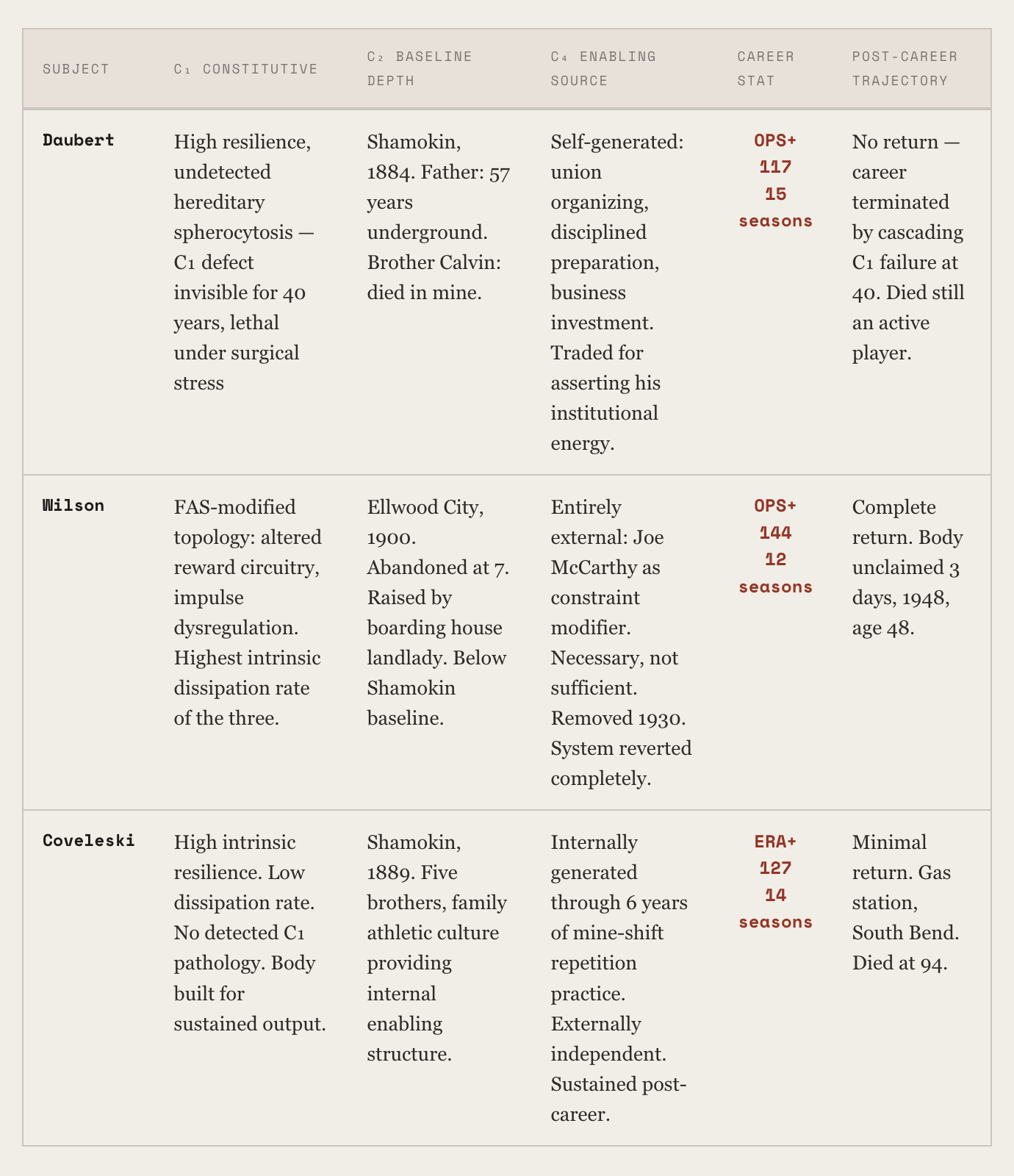
The table reads as physics: the post-career trajectories track the behavior predicted by the constraint tensor once the career’s energy input was removed. Where the baseline was deepest and the constitutive dissipation rate was highest (Wilson), the return was fastest and most complete. Where the enabling conditions were most externally sourced (also Wilson), the departure collapsed immediately when the external source was removed. Where the constitutive resilience was highest and the enabling conditions were most internally generated (Coveleski), the departure persisted for six more decades after the career ended, essentially stable. Daubert’s case is the most physically distinctive: high constitutive resilience and self-generated institutional energy, terminated not by return to baseline but by a catastrophic cascade in which an invisible C₁ constraint interacted with accumulated mechanical damage to push the system below its maintenance threshold at the critical moment of a surgical stress. The mines took him, but obliquely, through a mechanism forty years in the making.
The plain version: given where these three men started, what happened to them after baseball was not random. It was predicted by the structure of what had been holding them up. Remove the structure and you get the trajectory. That is what the table shows.
VIII. The Dissipation Channel Problem
Every far-from-equilibrium system must export entropy continuously to maintain its organization. The channels through which it does so — its dissipation channels — determine the system’s sustainable departure distance and the stability of that departure over time.
Wilson’s primary dissipation channel was alcohol. This is not a moral characterization. Ethanol is a high-entropy sink — it disrupts the organized neurochemical states required to maintain complex behavioral regulation, releasing that organization as disorder. A system that routes its entropy production primarily through alcohol is not choosing a vice; it is routing through a channel that specifically degrades the neurological architecture required to sustain high-performance output. The channel is self-reinforcing: the more entropy is routed through it, the more the neurological architecture degrades, the more entropy must be routed through it to maintain any functional state. This is a runaway dissipation pathway — a positive feedback loop in entropy production that drives the system toward its equilibrium state at accelerating rate.
McCarthy capped the channel. Not by eliminating it — no one could do that, and Wilson was honest about this: “I never played a game drunk. Hung over, yes. But drunk, no.” The distinction is thermodynamic. The dissipation channel operated during recovery, not during performance. McCarthy managed the environment so that the channel’s throughput remained below the threshold at which it would consume the performance capacity. Hornsby removed the management, the throughput returned to its natural level, and the career was over within a season.
Daubert’s dissipation channels were more conventionally biological — cumulative cranial trauma operating as a slow leak across fifteen seasons, invisible in the statistics, invisible in his performance, until the 1924 beaning loaded the accumulated deficit into an acute crisis that combined with the spherocytosis to exceed his surgical survival threshold. Unlike Wilson’s runaway channel, Daubert’s was linear, slow, and hidden. The system appeared fully functional until it was not.
Coveleski’s dissipation profile was the most favorable of the three. The spitball was mechanically efficient — requiring minimal arm stress relative to its effectiveness, which lowered the mechanical dissipation rate per unit of output compared to the power pitchers of his era. And his psychological dissipation channel was, if anything, inverted: the mines had calibrated his stress response to a much more severe baseline, making the professional baseball environment operate well within his comfortable range. Worrying about a pennant race, measured against the baseline of twelve hours in the mines at five cents an hour, was a tractable dissipation load. The worry he described was not anxiety. It was the steady-state hum of a system monitoring its own margin above the attractor — the appropriate internal signal for any system that knew where it had come from.
IX. What the Statistics Cannot See
The measurement hierarchy, stated precisely:
Level 0 — Raw counting stats. Absolute position in performance space. No normalization for the constraint set at any level. Measures neither displacement nor constraint-adjusted displacement. A career batting average, a win total, a career ERA. Necessary for historical record. Insufficient for comparison across eras, and completely blind to the constraint tensor.
Level 1 — ERA+, OPS+. Displacement from league-average performance in a specific run environment. Normalizes for C₃ only — the historical run-scoring context. Makes cross-era comparison meaningful on the performance axis. Cannot account for C₁, C₂, or C₄.
Level 2 — Career ERA+, career OPS+. Sustained displacement across a career. Implicitly tests whether the departure was structural or fluctuational — a lucky draw versus a genuine shift in the system’s operating point. More physically meaningful than single-season figures because it incorporates the temporal dimension. Still measures only performance-axis displacement against C₃ constraints.
Level 3 — Biographical constraint analysis. Displacement from the MaxCal path through the full (C₁, C₂, C₃, C₄) constraint tensor. Not reducible to a single number without losing essential information. Requires biographical research, historical reconstruction, and explicit modeling of the constraint set’s topology. This is the level at which the true physical question — how much work was performed by this trajectory against the forces opposing it — becomes askable and partially answerable.
The insight Level 3 analysis yields that Level 2 cannot: the same career statistics represent categorically different physical achievements when the constraint tensors differ. A career OPS+ of 117 from Shamokin, Pennsylvania, 1884, against a C₁ defect you don’t know you carry, having survived the mines and the beanings and the reserve clause and Charles Ebbets’s vindictiveness for thirty years, until the operating table takes you at forty — that is not the same as a career OPS+ of 117 from a stable starting position with a full complement of social supports and a body that will live to eighty.
It is the same displacement from the statistical equilibrium. It is not the same work. And the physics is about the work.
X. Biography as the Physics of What Counting Cannot Count
The honest conclusion of this analysis is that the measurement problem in human physics is structurally harder than the measurement problem in statistical mechanics, and that this hardness is irreducible rather than merely technical.
In statistical mechanics, the constraint set is typically known with precision: the energy is conserved, the volume is fixed, the particle number is fixed. The MaxEnt distribution is uniquely determined and the entropy is a well-defined function of the macrostate. The measurement problem is computational, not conceptual.
For a human life, the constraint set is partially known, evolving, and entangled with the system’s own trajectory in ways that resist clean separation. The C₁ constraints are known only through their effects, which are observed in the trajectory itself. The C₂ constraints are approximately reconstructable from historical record but their precise topology — exactly which paths were accessible, at what barrier height — is not directly measurable. The C₃ constraints are the best-known, which is precisely why era-adjustment represents a genuine advance over raw counting stats. The C₄ constraints are highly local, highly specific, and often not recorded at all.
What this means in practice: the full biographical MaxCal calculation — the true measure of departure from the most probable path given the complete constraint tensor — is not computable with available data. We can approximate it. We can reason about it with precision. We can identify its most important components and calibrate the direction and rough magnitude of the constraint effects. But we cannot reduce it to a number.
The correct response is not to abandon the framework. It is to use it as an inference tool that assigns probability to trajectories based on whatever constraints we do know, explicitly acknowledges what we cannot fully specify, and produces conclusions that are as informative as the available information permits — and no more.
Stanislaus Kowalewski threw stones at tin cans in the dark after his twelve-hour shifts because it was the only time he had, and because the alternative was the mines, forever, and something in the architecture of that particular body refused it. He could not have told you he was doing work against a constraint surface. He knew only that the can was fifty feet away and that if he threw enough stones at it he would hit it, and that if he could hit it he could maybe get out, and that getting out was the only thermodynamically improbable thing he could imagine.
He got out. He ran a gas station in South Bend for thirty years. He gave free pitching lessons to children in the field behind his garage. He died at ninety-four.
Jacob Daubert’s hands never came clean. The coal was in the knuckles, under the skin, in the molecular structure of the man, and he knew it. The fear he described — that all his success was a dream, that he would wake up in the darkness of the mines — was not irrational. It was the correct phenomenological reading of a system that had never fully escaped its attractor, only maintained distance from it for thirty years by continuous expenditure of energy he was running out of, until the distance collapsed. The mines did not take him directly. They took him through a channel he never knew existed, at forty years old, on an operating table in Cincinnati, while his family and his teammates stood by his bed.
And Lewis Robert Wilson — born into dissolution, abandoned at seven, built wrong from the beginning, briefly the most prodigious offensive force the game had ever seen — died in a Baltimore apartment at forty-eight, and nobody came for his body for three days. The league president wrote a check for $350. The equilibrium had been fully restored. The energy that had held the system away from it was gone.
That, finally, is what the statistics cannot see. They can see the displacement. They cannot see the attractor waiting below it, the work required to maintain the distance, or what the return looks like when the work stops. For that, you need the biography. And the biography, read honestly, as physics — as the record of a system’s trajectory through a constrained phase space from initial conditions to terminal state — is not a collection of stories. It is the most complete measurement instrument we have for the quantity that matters most: not where they stood, but how far that was from where they started, how hard it was to hold it, and what the universe did when they let go.
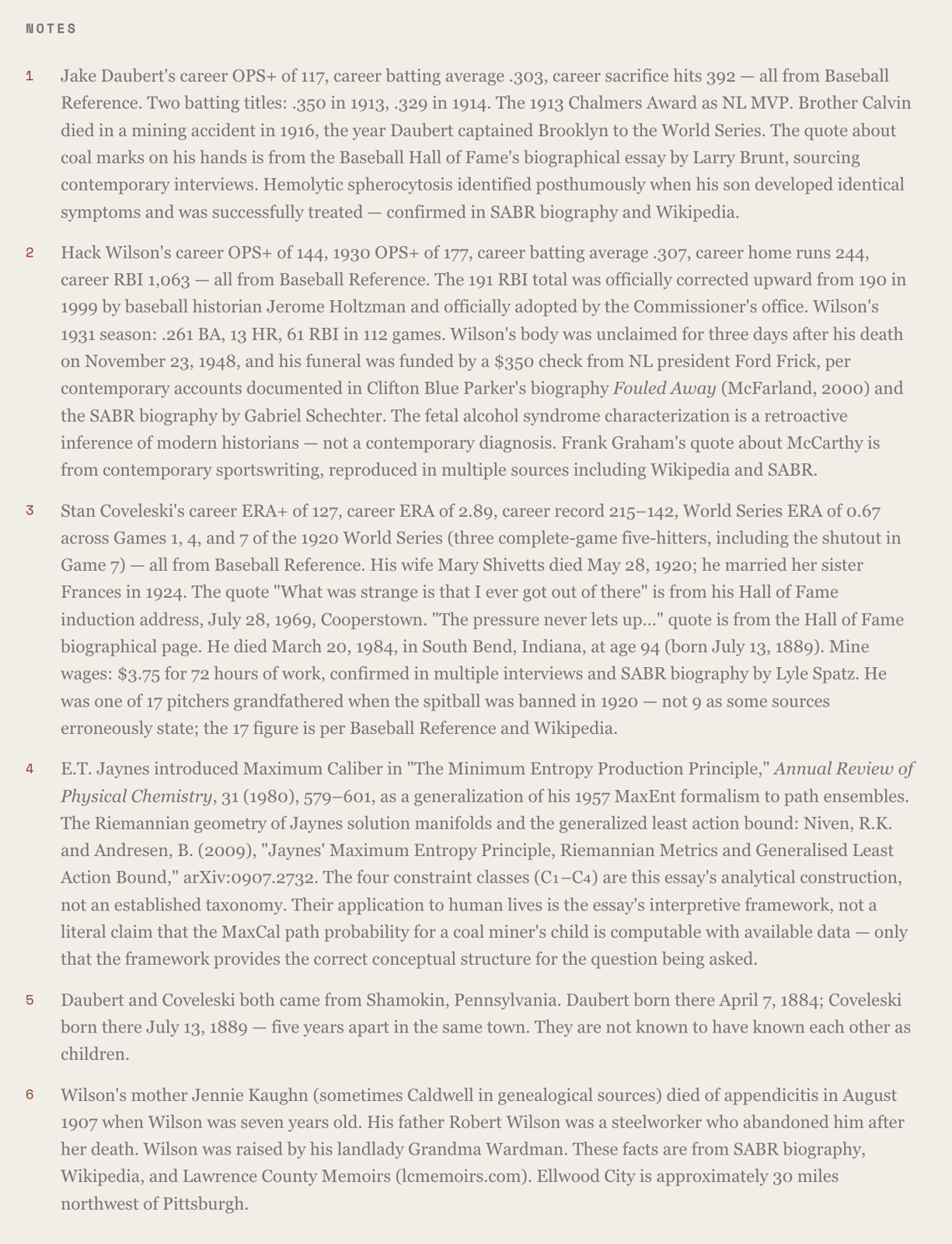
Part 3. The Constraint That Had a Name
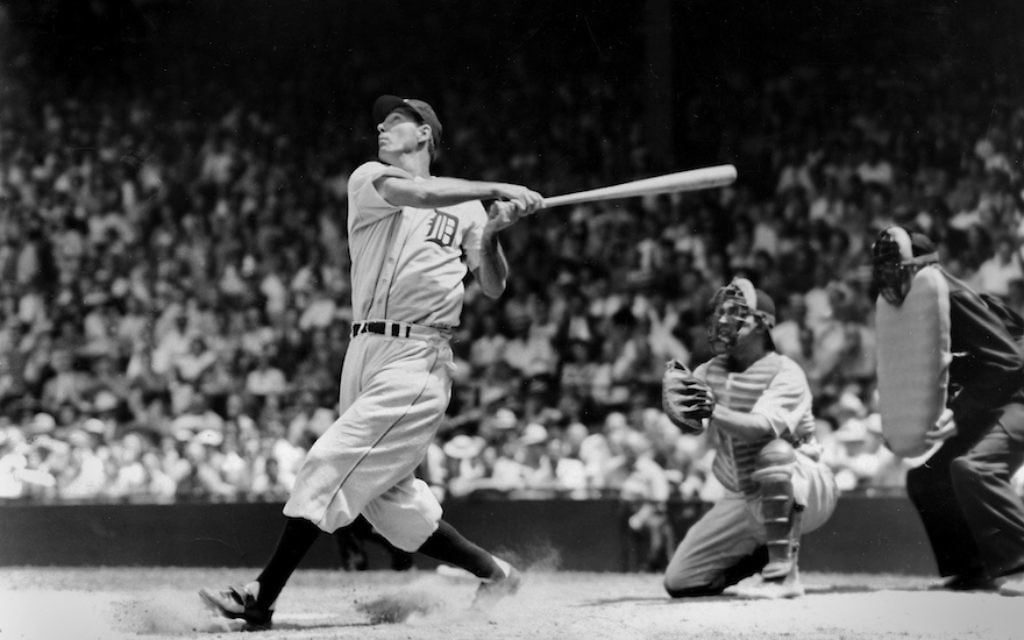
Henry Benjamin Greenberg was born on January 1, 1911, in Greenwich Village, the son of Romanian Jewish immigrants. He grew up in the Bronx. The Yankees expressed interest and he turned them down — Lou Gehrig was already at first base, and Greenberg had decided early that he would not spend his career on a bench. He signed with Detroit instead, which meant signing with a city that was, in the 1930s, one of the most antisemitic places in America. Henry Ford’s Dearborn Independent had declared Jews “the world’s foremost problem.” Father Charles Coughlin broadcast his antisemitic radio programs to an audience estimated at forty million. Greenberg knew what he was walking into. He walked in anyway.
The constraint set he was operating against was not the coal mines of Shamokin. It was something different in kind, though not in structure: not a socioeconomic attractor pulling him toward poverty, but an ideological force pulling him toward erasure — the sustained cultural effort to establish that a Jewish man could not be, in the deepest American sense, a hero. The mines wanted to keep Daubert and Coveleski in place. What surrounded Greenberg wanted to establish that his place was somewhere outside the category of greatness itself.
He performed at a career OPS+ of 159 across thirteen seasons — 59 percent better than league average, sustained across a career the framework of this book would describe as a maintained departure from a weighted equilibrium. What the number cannot see is what weight was on the scale.
In 1934, Detroit was in a pennant race. Rosh Hashanah fell during the season, and Greenberg, after consultation, chose to play. He hit two home runs. The Detroit Free Press ran a headline in Hebrew. The city celebrated. Then Yom Kippur came — the Day of Atonement, the holiest day in the Jewish calendar — and Greenberg did not play. He went to synagogue instead. Detroit was still in the race. The city’s response was largely one of respect, though not without dissent. Edgar Guest, the popular poet, wrote a verse about it that ran in the paper. The Jews of Detroit reportedly wept in the synagogue when the cantor announced, in the middle of services, that Greenberg had chosen to be there. He was not a particularly religious man. He understood what his presence, and his absence, signified to people for whom significance had become a matter of survival.
By 1938 it was not metaphor. Hitler had been chancellor of Germany since 1933. In February 1938 he took direct control of the military. Germany annexed Austria in March. In September the Munich Agreement. In November, Kristallnacht — the Night of Broken Glass — when the Nazi regime organized the destruction of Jewish businesses, homes, and synagogues across Germany and Austria, killing dozens and arresting tens of thousands. The world now knew, with clarity, what was coming.
That summer, Hank Greenberg hit 58 home runs.
He was chasing Babe Ruth’s record of 60, set in 1927, the most hallowed number in American sports. Through August he was on pace. In September the pace slowed. He was walked 119 times that season — some of them intentional, some of them the ordinary product of pitching around a dangerous hitter, some of them, by certain accounts, something else. Whether pitchers deliberately worked around him to prevent a Jewish man from claiming Ruth’s record is disputed. Greenberg himself largely dismissed the theory. What is not disputed is what the chase meant in the context of that autumn, with Kristallnacht six weeks away and the Jewish communities of America reading the dispatches from Europe with mounting horror. The Boston Jewish Advocate wrote that for those weeks, the incidents in Palestine, in Germany, in Czechoslovakia, had taken a back seat. “We have had pogroms before. But never before have we had a Jewish home-run king.”
He wrote in his autobiography: “I came to feel that if I, as a Jew, hit a home run, I was hitting one against Hitler.”
That is not a metaphor. It is a precise description of what the departure from equilibrium meant — not just in the statistical sense, not just in the sense of OPS+ measuring distance from the league mean, but in the sense that the act of excellence itself had become a countermeasure in an ideological war that was about to consume six million people. The restoring force was not just regression to the mean. It was a civilization-scale effort to establish Jewish inferiority as fact. Every home run was a data point against that thesis.
He finished with 58. Two short of the record.
In May 1941 Greenberg was drafted — the first major league star to enter military service in the peacetime draft. He played nineteen games that season. On December 5, 1941, Congress released men aged twenty-eight and older from service, and Greenberg, thirty years old, was honorably discharged. Two days later, Japan bombed Pearl Harbor.
He re-enlisted the next morning. He had not been called back. He went back of his own accord. He told reporters: “We are in trouble, and there is only one thing to do — return to the service. This doubtless means I am finished with baseball, and it would be silly for me to say I do not leave without a pang. But all of us are confronted with a terrible task — the defense of our country and the fight for our lives.”
He served four years and forty-seven months, the longest tenure of any major league player in the war. He flew missions over the Himalayas. He scouted bombing targets for B-29s. He was present when a plane went over on its nose at the end of a runway and the gas tanks blew and he was thirty yards away when a bomb went off and it knocked him into a drainage ditch. He was commissioned as a captain.
He returned to baseball on July 1, 1945. He homered in his first game. On the final day of the season, with the pennant on the line, in near-darkness at Sportsman’s Park in St. Louis — the umpire had nearly called the game — Greenberg came to the plate in the ninth inning with the Tigers trailing by a run and hit a grand slam into the bleachers. The Tigers won the pennant. It was later reported that as the ball landed, one of the Senators players muttered, in the dark, something about a dirty Jew beating them again.
He had been hearing it his entire career. His teammate Birdie Tebbetts said Greenberg was abused more than any white ballplayer in baseball except Jackie Robinson. Greenberg never publicly complained about it. He said he used it as a spur.
In 1947, the Detroit Tigers sold his contract to the Pittsburgh Pirates rather than meet his salary demands. He was thirty-six. Pittsburgh made him the first player in baseball history to earn a hundred thousand dollars in a season to persuade him not to retire. They also shortened the left field fence at Forbes Field, calling the new section Greenberg Gardens.
That spring a twenty-eight-year-old rookie named Jackie Robinson broke the color line for the Brooklyn Dodgers. What Robinson faced was documented and is not minimized here: death threats to him and his family, opposing players pointing bats at him in the dugout simulating machine gun fire, a pitcher who fined his own players if they failed to throw at Robinson, hotels that refused to admit him, an organist in Cincinnati who played “Bye, Bye Blackbird” as Robinson walked off the field. His batting average had slumped. He was contemplating quitting.
On May 15, 1947, at Forbes Field, the Dodgers and Pirates played. Robinson laid down a bunt and collided with Greenberg at first base. Later that inning, Greenberg reached first on a walk and found himself standing next to Robinson. He asked Robinson if he had been hurt in the collision. Robinson said he hadn’t. Greenberg said to him: “Don’t pay any attention to these guys who are trying to make it hard for you. Stick in there. You’re doing fine. Keep your chin up.”
After the game, Robinson told the writers: “Class tells. It sticks out all over Mr. Greenberg.” He said he had found out that not all the guys on the other teams were bad heels. He said Greenberg was pulling for him to make good. They remained friends for the rest of Robinson’s life. Greenberg attended Robinson’s funeral in October 1972.
What the framework of this book would say about that moment at first base is this: Greenberg recognized in Robinson’s situation the structure of his own. Not the same constraint — Greenberg was never enslaved, never subject to the specific machinery of American racial apartheid, and he understood the difference; his son later recalled him saying he didn’t know what having it bad was until he saw what Robinson went through. But the same logic: a system exerting force against a particular human being’s right to be excellent in full public view, to be great without apology, to occupy the position the numbers said he had earned. Greenberg had spent his entire career doing work against that force. He knew what the work cost. He knew what it looked like from the inside.
The statistics measure where Greenberg stood. Career OPS+ 159. Two MVP awards. 331 home runs, a number that almost certainly would have exceeded 500 had he not given four and a half years to a war that was, among other things, a war against the people the antisemites in his own dugout and in the opposing dugouts had been slurring him about his entire career. He won that war too, in the only way available to him — by showing up, by performing, by being excellent in a context that was trying to establish that excellence like his was not possible.
What the statistics cannot measure is the weight of the equilibrium he was departing from. It was not a coal mine. It was something older and more systematic and, in 1938, more immediately murderous than any mine: the organized effort to establish that people like him did not fully exist. Every home run was a refusal of that thesis. The career OPS+ is the same number regardless. The work behind it is not the same work.
And on a May afternoon in Pittsburgh in 1947, at the end of his career, a man who had spent fifteen years doing that work recognized another man just beginning to do a version of it — a harder version, against a deeper and older and more violent constraint — and said the only thing there was to say: stick in there, you’re doing fine, keep your chin up.
That is what the statistics cannot see. That is what biography is for.
Part 4. The Legibility Problem: Why History Remembers the Named Constraint
There is a property of the constraint tensor that the framework of this book has not yet made fully explicit, and it is the property that determines who gets remembered.
Call it constraint legibility — the degree to which the forces opposing a trajectory are visible, nameable, and therefore narratable. It is not a measure of how strong the constraint is. It is a measure of how clearly the constraint can be seen by observers outside the system.
Robinson’s constraint was maximally legible. Segregation was a named institution. The men pointing bats at him in the dugout were doing something with a name. The hotels that refused him had signs. The force opposing his departure from equilibrium was organized, explicit, and in 1947 was becoming the central moral crisis of American public life. When Robinson succeeded, the story wrote itself: here is what he overcame, here is what tried to stop him, here is what his success means. The displacement was visible. The restoring force was visible. The heroism was therefore visible — not because it was greater, but because it was legible.
Greenberg’s constraint had a name too: antisemitism, Hitler, the systematic effort to establish Jewish inferiority as biological fact. When he hit 58 home runs in the autumn of 1938, six weeks before Kristallnacht, the meaning of those home runs was available to anyone who read a newspaper. The restoring force had a face. It had a Nuremberg Rally. It had a final solution that was already beginning to take shape. When Greenberg’s departure from equilibrium is narrated, the narrative has a villain, a stakes, a historical moment that frames the achievement as resistance. His numbers are the same. But they are legible as resistance because the thing being resisted had a name.
Now consider Jake Daubert.
The constraint opposing his departure from equilibrium was: a hereditary blood disorder he didn’t know he carried, a father who spent fifty-seven years underground, a brother named Calvin who died in a mine, a reserve clause that let Charles Ebbets sell him like property when he sued for wages he was owed, eight beanings that accumulated neurological damage across fifteen seasons, and the biological interaction between that damage and the spherocytosis that killed him on an operating table at forty years old.
That constraint has no name. It has no face. It has no ideology that history has already agreed to call evil. It is a system — a set of forces that the MaxCal framework can reason about, can partially enumerate, can understand as a constraint tensor operating against a specific human trajectory. But to the historians, to the Hall of Fame voters, to the culture that decides who gets remembered, it is just: he was a coal miner’s son who had some bad luck at the end. The displacement is the same kind of physical achievement. The restoring force is invisible. The heroism is therefore invisible.
Stan Coveleski threw stones at tin cans in the dark after twelve-hour shifts and became one of the greatest postseason pitchers in the history of the sport and lived to ninety-four and nobody outside a narrow community of baseball historians knows his name. The constraint he operated against was: poverty so complete that $3.75 for seventy-two hours of labor was the alternative, in a system designed to absorb the bodies of immigrant children and return them as used-up men. That system had no ideology. It had no Nuremberg. It had no march on Washington. It had quarterly earnings reports and company towns and breaker boys sorting coal in the dark for five cents an hour. The physics of what Coveleski achieved against that baseline is, by the framework of this book, extraordinary. The narrative apparatus of historical memory has no hook on which to hang it, because the force it overcame never had a trial.
Hack Wilson is the most extreme case. His constraint was fetal alcohol syndrome, the neurological consequences of abandonment at seven, a reward circuitry that was constitutively damaged before he was born, and a sport that provided exactly one manager in twelve seasons who understood how to work with rather than against the system he was operating in. The restoring force that eventually consumed him — the one that left him unclaimed in a Baltimore apartment for three days at forty-eight years old — was not an ideology. It was not an institution. It was the interaction of his C1 constitution with the removal of the one external stabilizer that had been keeping him functional, followed by the inexorable operation of a biological system that had been running at unsustainable dissipation rates since before he was born. It cannot be narrated as resistance because there was nothing to resist. There was only a system tending toward its equilibrium, and a man who briefly, violently, magnificently departed from it, and then returned.
This is the physics of historical memory: we remember departures from equilibrium when the restoring force is legible. We forget them when it is not.
And here is what makes this more than an academic observation. The legibility of a constraint is not correlated with its strength. The force that kept coal miners’ children in the coal mines of Shamokin, Pennsylvania in 1884 was not weaker than antisemitism. It was, in terms of raw probability — in terms of the MaxCal distribution over life trajectories from that starting point — at least as powerful, possibly more so. The probability mass under the distribution was overwhelming: the mines consumed generations of those families, took them at twenty-five and forty and sixty, and asked for their sons. The barrier height was enormous. The accessible region of phase space for a child born in Shamokin in 1884 was genuinely narrow. The departure that Daubert and Coveleski achieved was genuinely improbable.
But it was improbable against a force that capitalism had normalized. The reserve clause was law. The wages were what the market would bear. The mines were what the mines were. Nobody organized a march. Nobody wrote the legislation that ended it in a single gesture that history could date and celebrate. It ended slowly, partially, unevenly, and left no clean narrative of triumph. So the men who escaped it are remembered, if at all, as players, not as heroes. The displacement is recorded in the statistics. The work is not recorded anywhere, because the force it was done against left no archive.
Robinson and Greenberg are remembered as heroes partly because they were heroic and partly because the forces opposing them left extensive archives. Segregation was documented, legislated, litigated, and finally defeated in named historical moments that provided the narrative scaffolding for the heroism to attach to. Nazism produced the Nuremberg trials, the Holocaust museums, the categorical moral verdict of history. These events gave the heroism a container. The container is what history preserves.
The coal mines left no such container. The reserve clause left no such container. Fetal alcohol syndrome in 1900 in Ellwood City, Pennsylvania left no container at all — it left a man with an 18-inch neck and custom bat handles and 191 RBI and a body unclaimed for three days.
This is not an argument against the heroism of Robinson or Greenberg. It is an argument about what heroism is and how it gets recognized. The framework of this book proposes that heroism — real heroism, physical heroism, the kind that can be understood as work done against a restoring force — is not a function of the visibility of the constraint. It is a function of the magnitude of the departure relative to the probability of any departure at all. By that measure, Daubert and Coveleski and Wilson achieved things that are not smaller than what Robinson and Greenberg achieved. They achieved them in the dark, against forces that had no name, in a system that produced no archive and no verdict.
The statistics give us the displacement. They are blind to the cost. But historical memory is blinder still: it gives us only the displacements whose cost was paid against something history had already decided to record.
What we are doing in this book, at its deepest level, is trying to build an instrument that can see the other ones. Not because Robinson and Greenberg should be forgotten — they should not be, and they won’t be — but because Daubert and Coveleski and Wilson should not be forgotten either, and the instrument that would remember them correctly has not yet existed.
The physics of heroism does not require a named villain. It requires only a restoring force, a departure, and the work that held the distance. The distance is in the record. The work is in the life. And the life, read as physics, as the record of a system’s trajectory through a constrained phase space from initial conditions to terminal state, is the only instrument adequate to the measurement.
That is what biography is for. That is why it cannot be replaced by statistics. And that is why the men this book is about — the ones history forgot, the ones the Hall of Fame passed over, the ones whose bodies were found three days later or who died on operating tables at forty or who threw stones at tin cans in the dark — deserve not sympathy, not sentiment, not the condescension of being rescued from obscurity, but the only thing that was ever owed them: an accurate measurement of what they actually did.
Part 5. The Measurement That Remains
The quantity this book has been tracking does not disappear when the statistics run out.
It becomes harder to measure. The constraint set grows partially unknowable. The distribution over possible trajectories cannot be fully specified. The work done against the restoring force cannot be collapsed into a number. But the work was done. The force was real. The departure from equilibrium was achieved and maintained, at cost, across years, against pressures that were operating whether or not anyone could see them.
The reason history remembers some of these departures and not others has nothing to do with their magnitude. It has to do with the legibility of the force they were made against. Robinson’s constraint had a name. Greenberg’s constraint had a face. The law that opposed them was written down, adjudicated, and eventually struck. The moral verdict of history is clear, the archive is extensive, and the heroism attaches to that structure and survives through it.
The coal mines of Shamokin left no such archive. The reserve clause was repealed without ceremony. The biological constitution that shaped Hack Wilson’s life and destroyed it had no name in 1900 and no defendant in any court. The forces that held Daubert and Coveleski and Wilson within their respective attractors — that made their departures genuinely improbable, that made the maintenance of those departures genuinely costly — were real forces, operating in the physical world, on real bodies, with real consequences. They simply were not the kind of forces that history knows how to record as having been overcome.
This is not a failure of history. It is a property of narrative: narrative requires a named antagonist, a legible structure of opposition, something that can be defeated in a scene. The restoring forces that operate on most human lives do not have scenes. They have drift, accumulation, the slow operation of probability against individual trajectory. They are not defeated. They are, briefly, escaped from — and then, in most cases, they reassert.
What biography can do, read as physics rather than as narrative, is recover these forces from the record they left in the trajectory itself. The shape of a life encodes the forces that shaped it. The distance achieved encodes something about the barrier height. The post-career trajectory encodes what happened when the energy required to maintain the departure could no longer be sustained. None of this is fully computable. All of it is partially recoverable, if the instrument is correctly calibrated.
The instrument is not nostalgia. It is not advocacy. It is not the desire to rescue the forgotten or to diminish the celebrated. It is a measurement framework — incomplete, necessarily approximate, but pointed in the right direction — for the quantity that statistics cannot reach: not where they stood, but how far that was from where they started, what it cost to hold it, and what the universe did when they let go.
Stanislaus Kowalewski threw stones at tin cans in the dark because it was the only time he had. Jacob Daubert played fifteen seasons with coal permanently in the knuckles of his hands and a blood condition he never knew he carried. Lewis Robert Wilson was, for five years, the most prodigious offensive force the game had ever seen, and he did it on a constitution that was compromised before he drew his first breath, in a sport that provided him exactly one season’s worth of management that understood what he was.
These are measurements, not eulogies. The distance is in the record. The cost is in the life. And only when both are read together does the number mean what it was always measuring.
Part 6. The Normalized Erasure: Structural Systems Analysis of Oppression Without Archive
An extension of the displacement framework to the problem of unmeasured equilibria
The previous analysis established that historical memory selects for departures from equilibrium whose restoring forces are legible — named, archived, adjudicated. It established that the magnitude of the departure and the legibility of the constraint are independent variables, and that our existing instruments for recognizing achievement are systematically biased toward the legible.
This document extends that analysis to a harder case.
Daubert and Coveleski and Wilson were inside the measurement system. Their statistics exist. Their departures from equilibrium are recorded, however imperfectly, in the Baseball Reference database and the Hall of Fame archive and the contemporary sportswriting of their era. The framework can analyze them because the data, however incomplete, survived.
The Negro Leagues present a categorically different problem. Josh Gibson, Cool Papa Bell, and Satchel Paige were not men whose constraints were illegible. They were men who were excluded from the system that generated the measurements — who played in a parallel statistical universe that major league baseball did not recognize as commensurate, whose records were kept inconsistently if at all, whose departures from equilibrium were measured against an equilibrium the dominant culture had decided not to count.
This is not a harder version of the Daubert problem. It is a different problem in kind. The legibility filter didn’t just fail to preserve their archive. It actively prevented the archive from being created in the same form in the first place.
The framework must account for this distinction precisely, because conflating them produces a false equivalence. Coveleski’s constraint was invisible because capitalism normalized it. Gibson’s constraint was visible — everyone could see it, it had a name, it was called segregation — but the response of the measurement system to that visible constraint was not to record the achievement anyway. It was to exclude the achiever from the system of record entirely, and then, decades later, to treat the absence of record as evidence of incommensurability.
That is a different mechanism. It requires a different analysis.
I. The Exclusion Is Not the Same as the Erasure
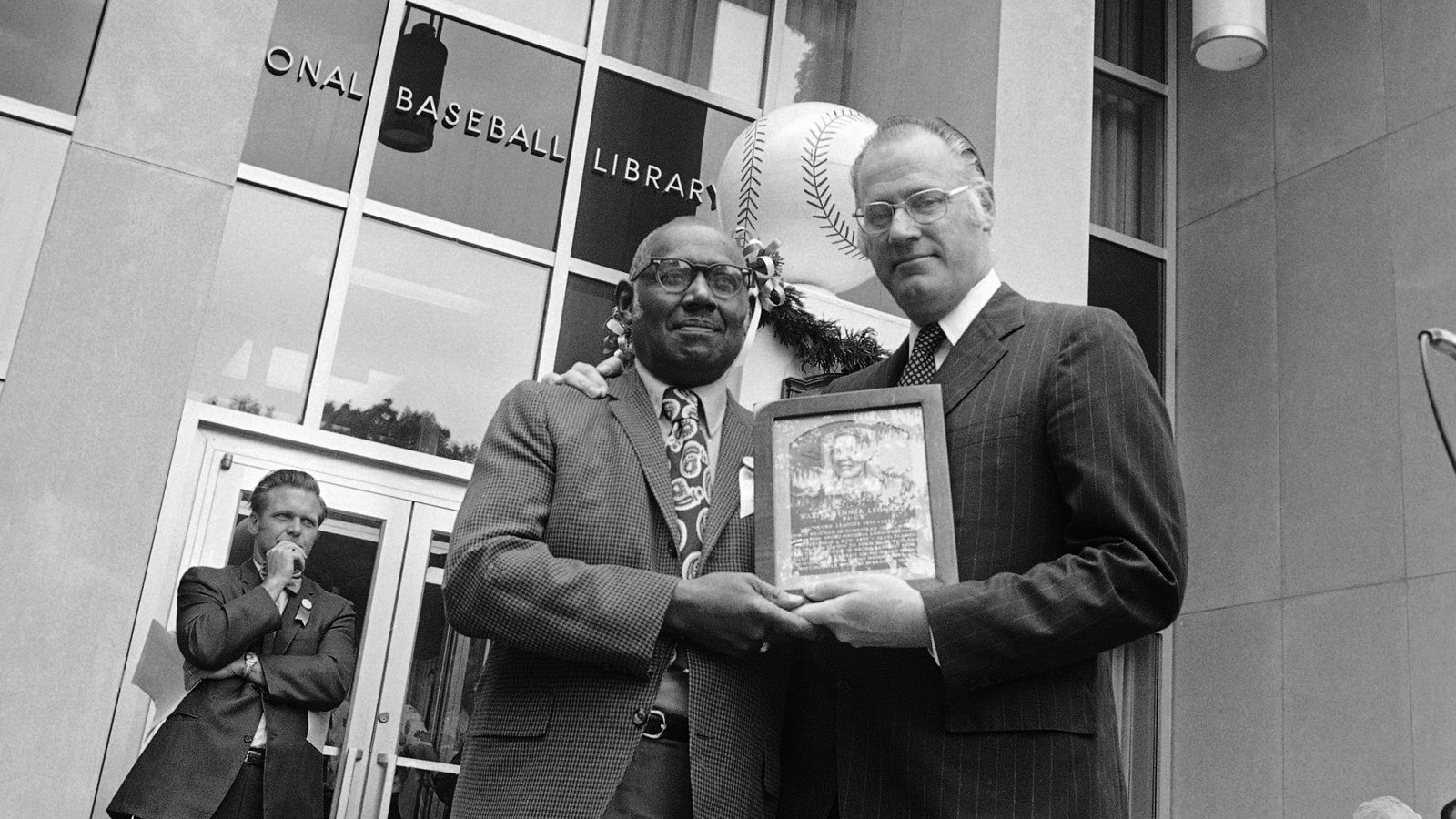
When the Baseball Hall of Fame moved toward inducting Gibson, Bell, and Paige beginning in 1971, its initial proposal was to place them in a separate wing. The stated rationale was that their statistics could not be compared to major league statistics because they had not played in the major leagues. Commissioner Bowie Kuhn announced on February 9, 1971 that Paige would be the first honoree — but as part of a “special exhibit,” not as a full member. The press response was immediate and damning. One writer called it turning Paige “from a second-class citizen to a second-class immortal.” Another wrote simply: “Jim Crow still lives.” Jackie Robinson encouraged Paige to boycott. Kuhn reversed the decision before the August induction ceremony, and Paige was inducted as a full member alongside seven other inductees that day. But the proposal itself — the instinct toward a separate wing — had revealed the underlying logic precisely.
Read that sequence with the framework active.
The measurement system excluded them from participation. The exclusion made their statistics non-comparable by definition, because comparability was defined as participation in the system from which they had been excluded. The non-comparability was then used to justify a separate and subordinate form of recognition. The circular logic was not incidental. It was the mechanism.
Before proceeding, the distinction between the Daubert problem and the Gibson problem must be stated with precision, because the essay’s proposed remedy — biography as physics, reading absence as data — applies differently to each, and conflating them produces a weaker instrument than the problem requires.
For Daubert and Coveleski, biography recovers what the statistics cannot see: the constraint tensor operating behind a performance that the record preserved but the culture failed to contextualize. The data exists. The framework needed to read it correctly had not been widely applied. That is a problem of analytical tools.
For Gibson and Paige and Bell, the problem is categorically different. The data was prevented from entering the primary record by the people who controlled the record. Reading that absence as signal therefore requires a prior step that the Daubert analysis does not: constraint archaeology — the explicit reconstruction of who controlled the archive, what interest they had in the non-production of the data, and how that interest shaped what was and was not recorded.
Without that prior step, the absence is ambiguous. It could mean the performance didn’t occur. It could mean the performance occurred but wasn’t measured. It could mean the performance was measured in a parallel system that the dominant system chose to declare incommensurable. Only the third reading is correct for the Negro Leagues, and establishing that it is correct requires identifying the mechanism of suppression, not just the fact of absence.
The instrument adequate to the Gibson problem must therefore include not only the capacity to reason from incomplete data but the capacity to identify the process by which the incompleteness was produced. Absence is data only when you know what produced the absence.
This is what the framework would call a self-sealing constraint. A self-sealing constraint is one that generates its own justification by controlling the conditions under which evidence is produced. The segregation of professional baseball did not merely keep Black players out of the major leagues. It prevented the production of the comparative statistical record that would have demonstrated the injustice of their exclusion most forcefully — the ERA+, the OPS+, the normalized displacement figures that would have placed Gibson and Paige and Bell in direct numerical relation to their white contemporaries. And then the absence of that record was cited as the reason full recognition was inappropriate.
The mines constrained Daubert and Coveleski by limiting their accessible region of phase space. Segregation constrained Gibson and Paige and Bell by limiting the measurement system itself — by ensuring that whatever they achieved, it would be measured in units the dominant culture had reserved the right to declare incommensurable.
II. What the Numbers We Have Actually Tell Us
The Negro League statistical record was, for most of baseball history, incomplete and inconsistently preserved. This is itself a product of the constraint — underfunded leagues, shorter seasons, barnstorming schedules that didn’t generate the same administrative infrastructure as organized major league baseball. But in May 2024, after a three-year research project compiling statistics from thousands of newspaper box scores, MLB officially integrated the records of more than 2,300 Negro League players into its historical database. The result restructured the all-time record books entirely.
Josh Gibson is now the official MLB all-time career leader in batting average at .372, surpassing Ty Cobb’s .366. He is the all-time career leader in slugging percentage at .718, surpassing Babe Ruth’s .690. He is the all-time career leader in OPS at 1.177, surpassing Ruth’s 1.164. His single-season OPS+ of 214, calculated against the league average of his era, places him in a statistical regime that has no analog in the modern game. His .466 average for the 1943 Homestead Grays is now the official MLB single-season batting record. His .974 slugging percentage in 1937 is the official MLB single-season slugging record, displacing Barry Bonds.
These are not estimates or approximations. They are the official numbers of Major League Baseball, recognized as such in its record books as of 2024. MLB’s official historian noted that approximately 72% of Negro League records from 1920 to 1948 are now included, with ongoing research continuing to recover additional data.
Pause on the implications of that figure. The numbers already recovered — with 28% of the record still missing — are sufficient to establish Gibson as the greatest hitter in the history of the sport by multiple measures simultaneously. The missing 28% does not attenuate that conclusion. It deepens it.
What the 2024 integration also reveals, structurally, is the mechanism the framework predicted. The data was always there. It existed in newspaper box scores in archives across the country, waiting for someone to compile it. The absence from the official record was not a neutral feature of history. It was a decision — sustained across decades by the people who controlled the measurement system — not to compile it. The three-year research project that produced the 2024 integration was not discovering new data. It was recovering data that had been present but officially uncounted. The self-sealing constraint, partially opened.
The correction is incomplete. It covers only the years 1920 to 1948, and only league-sanctioned games. It does not recover the barnstorming records, the Cuban and Mexican league seasons, the full arc of careers that extended before and after those years. And it arrived twenty-five years after Gibson’s death, seventy-seven years after the exclusion began. But its arrival is itself the strongest possible confirmation of the framework’s central claim: the absence was produced, not given. And what is produced can, eventually, be undone.
III. Satchel Paige and the Non-Stationary Constraint
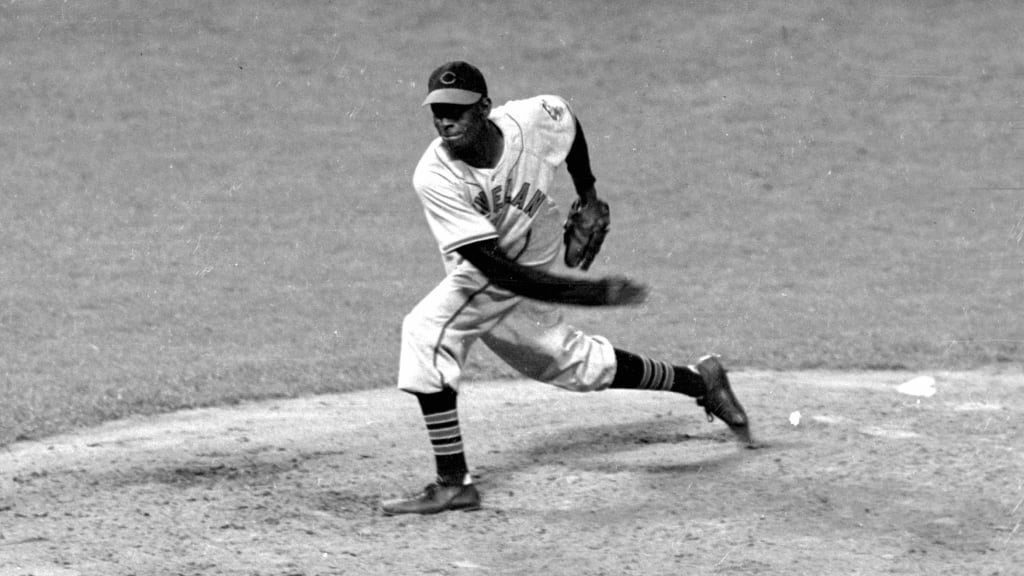
Paige’s case introduces a temporal dimension that the framework handles specifically.
He was born on July 7, 1906. He began pitching professionally in the Negro Leagues in 1926 and became, by all comparative accounts, the most dominant pitcher of his era. Joe DiMaggio called him the best pitcher he ever faced. Bob Feller, who barnstormed against him extensively across multiple seasons and was himself one of the greatest pitchers in major league history, made the same assessment consistently. Bill Veeck said that if Paige had been brought up in his prime, the Cy Young Award would be known as the Satchel Paige Award.
These are not sentimental assessments. They are empirical reports from men with extensive comparative data — men who had faced both Paige and the entire roster of major league pitching across full careers, and who were making a comparative judgment based on that experience. In the framework’s terms: these are men who had sampled both distributions and were reporting on the relative displacement.
Paige entered the major leagues in 1948, at the age of forty-two, after the color line was broken. He went 6-1 with a 2.48 ERA, helping Cleveland win the pennant and World Series. He became the first Black pitcher to pitch in a World Series. He returned to the majors with the St. Louis Browns from 1951 to 1953, making the All-Star Game in both 1952 and 1953. He returned again in 1965 at the age of fifty-nine and pitched three shutout innings for the Kansas City Athletics against major league hitters — the oldest player in the history of the sport to appear in a major league game.
Following the 2024 integration, Paige’s officially recognized career win total rose from 28 to 125, incorporating his Negro League record of approximately 146-64. The figure he himself claimed — more than 2,000 wins across all competition, 55 no-hitters, hundreds of shutouts — remains unverified in full, though not implausible for a pitcher who was active professionally across five decades.
The framework asks: what is the ERA+ of a pitcher who enters the measurement system at forty-two, after his peak years are gone, and performs at the level Paige performed? And what does that figure imply about what his ERA+ would have been at twenty-eight, at thirty-two, at the ages when Gibson and DiMaggio and Feller were reporting that he was the best they had ever faced?
The answer is bounded from below by what we can observe, and what we can observe is already extraordinary. A pitcher who is effective at forty-two, in the major leagues, after twenty years of professional pitching in a segregated parallel system, was not a pitcher of ordinary talent. The floor of the estimate places him among the greatest pitchers in the history of the sport. The ceiling is unreachable because the measurement system never captured it during the years it would have been most revealing.
This is the deepest form of the legibility problem. The constraint operated precisely during the years when the data would have been most informative. By the time the constraint was partially lifted, the window for complete measurement had closed. The system excluded him during his peak and then cited the absence of peak-era major league data as justification for uncertainty about his peak. The circularity ran for twenty years before anyone was required to account for it.
IV. Cool Papa Bell and the Problem of the Unmeasurable Dimension
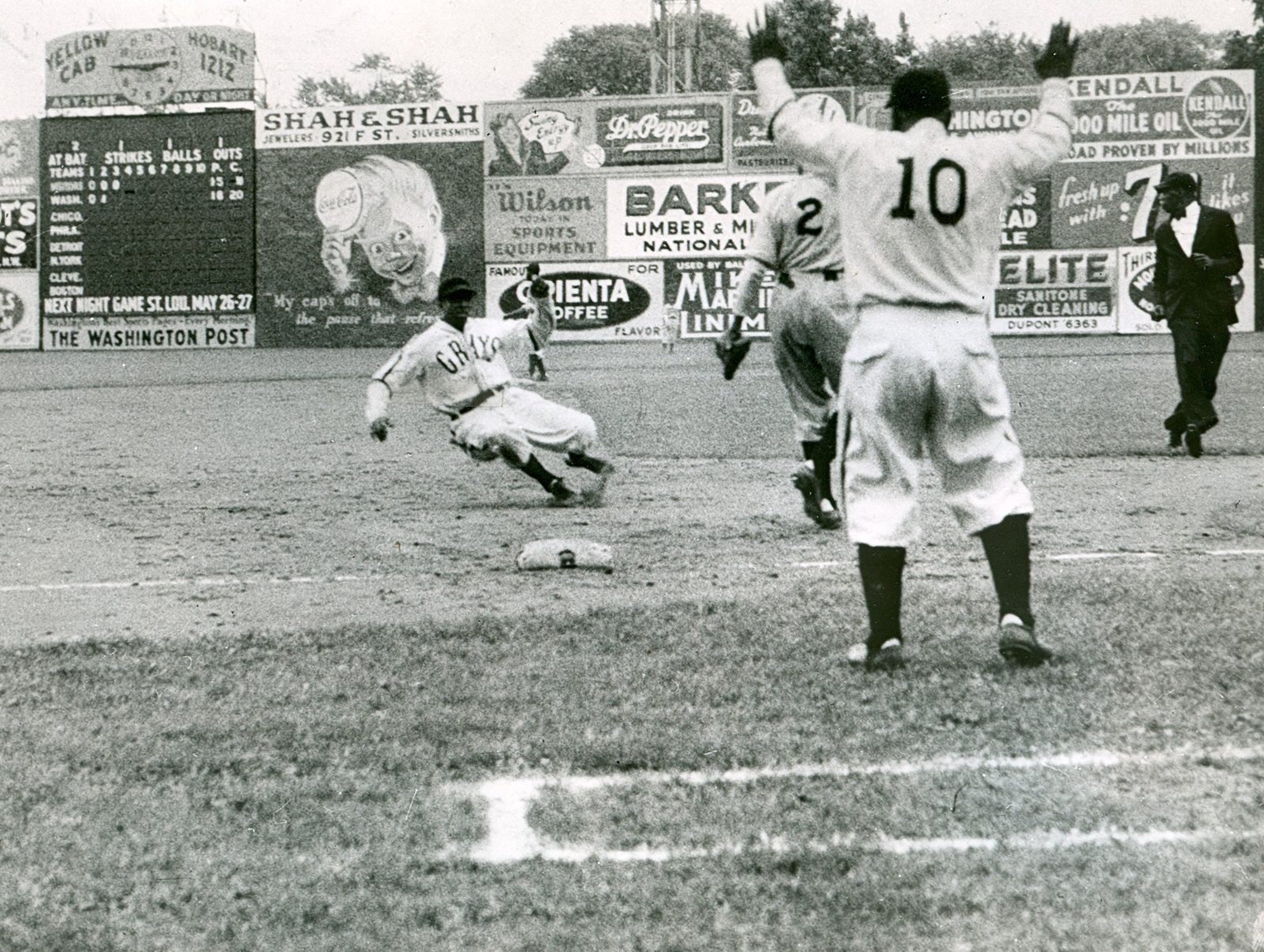
Bell was born May 17, 1903 in Starkville, Mississippi. He played in the Negro Leagues from 1922 to 1946 and was inducted into the Hall of Fame in 1974 as the fifth Negro League player enshrined. He is considered the fastest man ever to play professional baseball.
The speed claims surrounding Bell have achieved mythological status, and the framework requires precision about what is verified and what is not. Bell himself claimed to have circled the bases in 12 seconds in dry conditions. A recorded time on a wet field in Chicago was 13.1 seconds, reported by the Los Angeles Times in 1933. The 12-second figure on dry track is Bell’s own claim, unverified by independent timing. What is verified: Jesse Owens, the fastest man in the world in the 1930s, declined to race Bell when their paths crossed during barnstorming. Paul Waner, a Hall of Fame outfielder, called Bell the fastest man he ever saw on a baseball diamond. Bill Veeck ranked Bell alongside Willie Mays and Joe DiMaggio as the greatest center fielders of all time.
His documented statistics, per the Seamheads database now integrated into MLB records, show a career batting average of .331 with 330 stolen bases in recorded games, and a .391 average in 54 exhibition games against white major league competition. His OPS+ in available records is 128.
Bell’s case is the purest example of what happens when the excluded dimension is one the measurement system wasn’t tracking even for the players it did include.
Speed. Baserunning. The stolen base in an era before stolen base percentage was recorded systematically. The ability to score from first on a sacrifice bunt — which Bell reportedly did — to take third on a ball in the dirt, to transform a walk into a run by the accumulation of pressure on a defense that knew he was going. The dimensions along which Bell was most extraordinary were the dimensions the measurement system was least equipped to measure even for the players it was measuring.
This is a compound exclusion. He was excluded from the system. The system, during the years of his exclusion, failed to develop the tools that would have measured him most accurately. When he was finally inducted — 1974, more than two decades after his playing career ended — those tools still didn’t fully exist. Modern baserunning value metrics now exist, and retrospective application to the incomplete Negro League record produces estimates consistent with the eyewitness accounts. But the precision required to make the comparison definitive is unavailable, because the exclusion that made the comparison necessary also prevented the data collection that would have made it possible.
Bell himself was characteristically precise about the mechanism without having the vocabulary of the framework: “They say I was born too soon. I say the doors were opened too late.” The distinction matters. Born too soon implies a timing accident. Doors opened too late implies an agent who controlled the doors.
V. The General Case: Normalized Oppression as a Measurement Problem
These three cases — Gibson, Paige, Bell — are specific instances of a general structural phenomenon that the framework can now state precisely.
Call it normalized oppression: a constraint system that operates through the control of measurement infrastructure rather than through explicit prohibition alone. Its defining characteristic is that it generates the conditions for its own justification by controlling what gets counted, who gets compared to whom, and what units of measurement are declared commensurate.
Normalized oppression differs from explicit oppression in the following structural ways.
Explicit oppression names its constraint and enforces it through identifiable mechanisms — law, violence, institution. Its archive is the record of those mechanisms. Robinson’s constraint was explicit: there was a color line, it was enforced, it was broken on a specific date by a specific person in a specific game. The archive is extensive. The heroism is legible because the constraint was legible.
Normalized oppression operates through the background conditions of the measurement system itself. It doesn’t need to say “you cannot be great.” It says “greatness is defined as performance within this system, and you are excluded from this system, and therefore your performance cannot be measured as greatness.” The circularity is the mechanism. The constraint is the definition of the measuring instrument, not a rule imposed on top of it.
The consequence is that normalized oppression produces a specific kind of invisibility that is qualitatively different from the invisibility produced by the legibility filter operating on Daubert and Coveleski. Daubert and Coveleski are invisible because no one organized a movement against coal mines that produced a legible archive of heroic resistance. Gibson and Paige and Bell were invisible in a more fundamental way: the instrument that would have measured them was controlled by the people who excluded them, and those people used that control to ensure that measurement would remain impossible, and then cited the impossibility of measurement as evidence that the exclusion was justified.
This is not a historical accident. It is a structural feature of how normalized oppression maintains itself. The measurement system is always controlled by someone. When the people who control it have an interest in certain departures from equilibrium remaining unmeasured, they do not need to falsify the data. They only need to exclude the achievers from the system of data production. The absence then speaks for itself, in the language of the system that produced it.
What the 2024 integration demonstrates — and why it matters beyond baseball — is that the self-sealing constraint is not permanently sealed. The data existed in newspaper archives. Researchers spent nearly two decades assembling it. MLB committed to a three-year project to compile and verify it. The seal can be broken, partially, imperfectly, too late for the men whose peak years it would have recorded. But it can be broken. The mechanism is reversible, given sufficient institutional will. That fact is both hopeful and damning: hopeful because correction is possible, damning because it took seventy-seven years and required the effort of a small research army to accomplish what should have been ordinary recordkeeping from the beginning.
Simply: the system that was supposed to measure Gibson decided not to. Then it cited the absence of measurement as evidence that Gibson was less measurable. That is the mechanism. It is not subtle once you see it.
VI. The MaxCal Statement
In the framework’s terms, normalized oppression operates by controlling the partition function — the denominator of the probability distribution over trajectories.
Recall the MaxCal formulation: the probability of a given trajectory falls off exponentially with its distance from the maximum entropy path given the full constraint tensor. The constraint tensor includes C₁ through C₄ — constitutive, socioeconomic, historical, institutional.
Normalized oppression introduces a fifth constraint class.
C₅ — Measurement. The degree to which the system’s measurement infrastructure captures the trajectory at all. A trajectory that occurs outside the measurement system — in the Negro Leagues, in the female labor force before women’s work was systematically measured, in the informal economy, in the oral tradition before literacy was widespread — is not merely harder to measure. It is, from the perspective of the formal record, as if it did not occur. The surprisal of the trajectory — the information content of the departure from the MaxCal path — cannot be recovered from the archive because the archive was designed to exclude it.
C₅ is qualitatively different from C₁ through C₄ in the following way. The other constraints limit what trajectories are accessible. C₅ limits what trajectories are legible after the fact. A player operating under severe C₂ constraints — poverty, structural limitation of accessible paths — still generates data if he reaches the major leagues. A player operating under severe C₅ constraints — exclusion from the measurement system itself — generates data in a parallel record that the dominant system can choose to treat as incommensurable.
The practical consequence is that C₅ constraints are self-concealing in a way the other constraint classes are not. C₁ constraints leave evidence in the trajectory. C₂ constraints leave evidence in the origin conditions. C₃ constraints are the best-known, which is why era adjustment represents genuine progress. C₄ constraints are recoverable from institutional records. But C₅ constraints erase the evidence of their own operation by preventing the production of the data that would reveal them. The absence is the constraint’s most effective expression.
The 2024 integration is, in the framework’s terms, a partial recovery of the partition function — a belated correction of the denominator that reveals what the numerator always was. Gibson’s OPS+ of 214 was always 214. The system simply refused to calculate it.
VII. The Instrument Required
The measurement instrument adequate to C₅ constraints does not currently exist in fully developed form. But its necessary properties can be specified.
It must be able to reason from incomplete data without treating incompleteness as incommensurability. The absence of a complete statistical record for Gibson is not evidence that his record was less impressive than the records of his contemporaries. It is evidence of C₅ constraint operating on the data production process. An instrument that treats incompleteness as incommensurability is reproducing the logic of the exclusion it is supposed to correct.
It must be able to use cross-system evidence — barnstorming results, eyewitness testimony from participants in both systems, the physiological and mechanical analysis of technique that doesn’t require a box score — to bound the estimate from below. The floor of what we can infer about Gibson’s performance already establishes him as the greatest hitter in the history of the sport by the metrics MLB itself now officially recognizes. An instrument that refuses to produce an estimate because the data is incomplete is producing a false null rather than an honest bounded range.
It must be able to identify the mechanism by which the incompleteness was produced — to distinguish between data that is absent because it was never generated and data that is absent because the generating system was controlled by people with an interest in its non-production. These are different kinds of absence and they license different inferences.
And it must be able to apply these principles consistently across domains — to recognize the Negro Leagues problem not as a unique historical injustice but as a specific instance of a general structural mechanism, so that the same analytical tools can be applied wherever C₅ constraints are operating.
VIII. The Universalization
The Negro Leagues case is the baseball instance of a phenomenon that operates across every domain where achievement is measured and measurement infrastructure is controlled.
The general structure is as follows.
A system produces a measurement of achievement. The measurement is defined as performance within the system. Access to the system is controlled by the people who benefit from the current distribution of achievement. People who would score highly on the measurement are excluded from the system on grounds that have nothing to do with the measurement — race, gender, class, caste, geography, language. The exclusion prevents the production of the data that would demonstrate the injustice of the exclusion. The absence of data is then cited as evidence that the excluded people would not have scored highly, or that their scores cannot be compared to those of the included people, or that the measurement system designed for the included people is not appropriate for the excluded people and a separate system — always subordinate, always less resourced, always less legible — is the appropriate instrument.
When the exclusion is eventually partially lifted — when the system is forced, by political pressure or moral crisis or the simple unsustainability of the arrangement, to admit some of the previously excluded — it admits them late, after their peak years, into a system that was designed without them, measured without them, and whose historical record was produced without them. The comparative data that would most forcefully demonstrate the injustice of the original exclusion is unavailable because the exclusion prevented its production. The system then treats this unavailability as a reason for uncertainty rather than as evidence of the mechanism.
This structure operates in academic citation networks, where the exclusion of women and non-Western scholars from journals and universities for most of the history of those institutions means the citation record systematically underrepresents their contributions, and the underrepresentation in the citation record is then cited as evidence that their contributions were less significant. It operates in patent systems, where the exclusion of certain populations from capital, legal representation, and institutional affiliation means their inventions are underrepresented in the patent record, and the underrepresentation is cited as evidence of lower inventiveness. It operates in medical research, where the exclusion of women from clinical trials for most of the twentieth century means the evidence base for treatments is systematically derived from male subjects, and the absence of female data is treated as a reason to extrapolate from male data rather than as evidence of the exclusion.
In every case the structure is the same. The measurement system is controlled by the excluding group. The exclusion prevents data production. The absence of data is cited as justification for the exclusion or for diminished recognition. The circularity is the mechanism, not a bug in the mechanism.
IX. What the Separate Wing Meant
Return to the Hall of Fame’s February 1971 proposal to place the Negro League inductees in a separate wing.
In the framework’s terms, this was not merely symbolic condescension. It was a structural decision about commensurability — a decision that the measurement system used to assess Gibson and Paige and Bell was not the same measurement system used to assess Ruth and Johnson and Grove, and that therefore they could not be placed in the same evaluative space.
The decision was accurate in one sense: the measurement systems were different, because the exclusion had made them different. The Negro League record and the major league record were produced by different institutions with different resources and different administrative capacities, and direct comparison required adjustments that were difficult and approximate.
But the conclusion drawn from this accuracy was precisely backward. The appropriate response to the incompleteness of the Negro League record — an incompleteness produced by the same exclusion that the Hall of Fame was now nominally correcting — was not a separate wing. It was the acknowledgment that the incompleteness was itself evidence of the injustice, and that the appropriate instrument for evaluating men whose data had been systematically suppressed was one that reasoned explicitly about the suppression rather than treating it as a neutral feature of the historical record.
The press understood this immediately. The separate wing proposal lasted approximately five months before public outcry reversed it. What the reversal did not do was acknowledge the logic that had produced the proposal — the assumption that incommensurability was a property of the players rather than a product of the exclusion. That assumption, unstated and uncorrected, shaped how the subsequent inductees were evaluated, how their records were described on their plaques, and how long it took for anyone to commit to the kind of systematic statistical recovery that finally happened in 2024.
Gibson died on January 20, 1947, three months before Robinson broke the color line. He never played a major league game. He was inducted into the Hall of Fame in 1972, twenty-five years after his death, initially in a category the institution had designed to be separate and lesser, ultimately in the main gallery but with a plaque that described him in relation to the Negro Leagues rather than in relation to the all-time records he now officially holds.
The framework’s statement about that is simple. The distance between what Gibson achieved and what the measurement system recorded is not a gap in the data. It is the shape of the constraint. And the constraint has a name: it is the organized refusal of a measurement system to measure the people it had decided, for reasons having nothing to do with measurement, to exclude.
X. The Physics of Erasure
The legibility argument established that historical memory is a filter on departures from equilibrium that selects for the legibility of the restoring force.
This analysis extends that argument to its limiting case.
The limiting case is not a departure from equilibrium whose restoring force is illegible. It is a departure from equilibrium that the measurement system was specifically designed not to record. In this case the legibility filter is not a passive property of how narrative works. It is an active mechanism of the constraint system itself — the constraint operating through the control of the instrument that would have measured the departure.
The result is a specific kind of erasure that is qualitatively different from forgetting. Forgetting is what happened to Daubert and Coveleski — their achievements are in the record, the record is incomplete, the framework that would make the achievement legible hasn’t been widely applied. Erasure is what happened to Gibson and Paige and Bell — their achievements were prevented from entering the primary record by the people who controlled the record, and the absence from the record was then cited as justification for the exclusion that produced the absence.
The distinction matters because the corrections required are different. Forgetting is corrected by better analytical tools applied to existing data. Erasure is corrected only by an instrument that can reason about the mechanism of erasure itself — that can look at an absence in the record and ask not just what is missing but why it is missing and what that why implies about what was there.
The 2024 integration is the most important thing that has happened to this argument since the argument became possible to make. It confirms, in the official record of the sport itself, what the framework predicted: that the data existed, that it was recoverable, that the absence was produced rather than given, and that what it was concealing was the greatest hitting performance in the history of professional baseball.
Josh Gibson’s OPS+ of 214 was always 214. The coal marks on Daubert’s hands were always evidence of where the attractor lay. The gap in the statistical record for Gibson and Paige and Bell was always evidence of where the constraint was applied.
Both are measurements. Both require an instrument that can read them correctly.
The physics of erasure is the same as the physics of constraint. A system that controls what gets measured controls what gets remembered. And what gets remembered is what we call achievement, and what we call heroism, and what we call history.
The instrument that corrects this is not nostalgia and not advocacy. It is a measurement framework calibrated to read absence as data — to treat the gap not as silence but as signal, and to ask, with the precision the subject deserves, what the signal is encoding.
Cool Papa Bell said the doors were opened too late. He was right, and he was being precise. The doors were not merely late. They were held shut by the people who had built them, for as long as those people calculated they could hold them, and the cost of that calculation was paid by the men on the other side — in unmeasured seasons, in unrecorded records, in Hall of Fame plaques that described them as Negro League players rather than as the holders of the all-time marks they had always held.
The marks are in the record now, partially, imperfectly, seventy-seven years late. The men who set them are dead. The framework that would have measured them correctly existed in principle from the moment the first OPS+ was calculated. What was missing was not the method. What was missing was the institutional will to apply it to the people the institution had decided not to count.
That is what the statistics cannot see, and what biography extended to its hardest case — the biography of the unmeasured — is built to recover.
The distance was always there. The cost was always real. The erasure was always a choice.
Every case examined so far has involved a measurement system that existed but was incomplete, or a constraint that was real but unnamed, or an archive that preserved the wrong version of events. Joe Jackson is the case where all three operate simultaneously — and where the man at the center could not read any of it.
Part 7. The Mills Below Everything: Shoeless Joe Jackson as the Terminal Case
I. The Zero Point
Brandon Mill, Greenville, South Carolina, 1894. A child of six or seven — the records disagree on the year, agree on the age — sweeps cotton lint from the wooden floors of a textile factory for twelve hours a day. His father earns $1.25 daily at the same mill. The family of ten lives in a company-owned house. There is no school. There will never be school. The child cannot read and will never learn to read, not at six, not at thirteen, not at thirty-three, not at sixty-three when the heart attack comes for him in the house on East Wilburn Street, two blocks from the mill where he began.
His name is Joseph Jefferson Jackson. He will one day hit a baseball .408 in his first full professional season — still the highest rookie batting average in the history of the sport. Babe Ruth will say of his swing: “I copied Jackson’s style because I thought he was the greatest hitter I ever saw. He’s the guy who made me a hitter.” His career OPS+ will settle at 170 — 70 percent better than the average major leaguer across thirteen seasons of the deadball era, the most contact-suppressed hitting environment in modern baseball history. In the 1919 World Series he will hit .375 with twelve hits, the only home run of the Series, and commit zero errors in thirty fielding chances.
Then the system will take him back.
Not the way it took Hack Wilson — through runaway dissipation, through the catastrophic return of a C₁ constitution that had been unsustainably displaced. Not the way it took Jake Daubert — through a hidden biological cascade that expressed itself only under terminal stress. The way it took Jackson was something the framework of this book has not yet encountered directly: through an act of institutional power that named his departure from equilibrium as illegitimate and revoked it by decree.
The mills could not hold him. Baseball could. And the most important thing about the Jackson case — the thing that makes it the terminal case, the place where every argument in this book converges — is that the force which revoked his departure was maximally legible, carried the full authority of law and institution, and is still wrong by the physics.
II. The Constraint Tensor
C₁ — Constitutive. Jackson’s body was his primary capital and his primary instrument, and by every account it was extraordinary. The long arms his father passed to him — remarked on by every scout and observer who saw him young — gave him a swing arc that translated raw strength into contact efficiency at a ratio the deadball era had rarely seen. In 5,697 career plate appearances he struck out 233 times. That is not a misprint. In an era before launch-angle optimization, he struck out once per 24.4 plate appearances. For comparison: across 1911–1913, his three greatest consecutive seasons, he posted an OPS+ of 192 and whiffed at a rate that modern contact specialists would envy. The C₁ endowment was not simply athletic — it was specifically configured for the task of hitting a baseball, in a way that Babe Ruth recognized and consciously copied.
There was one C₁ liability, and it operated not in the body but in the mind’s interface with the world: functional illiteracy. Jackson could not read his contracts. He could not read the newspapers that wrote about him. He could not read the confession that was placed in front of him in a Chicago grand jury room in September 1920, to which he affixed his mark. His wife Katie read everything for him — every document, every letter, every contract — for his entire career and for the thirty-one years of post-baseball life that followed. This is not incidental. It is structural — and its classification as C₁ rather than C₂, though the condition originated in the mill economy, is defended in the constraint taxonomy established in Part 2. When the events of 1919 arrived, Jackson’s illiteracy was not a character flaw to be judged. It was a constitutive constraint that shaped every interaction with the institutional and legal machinery that would determine his fate. The men who prosecuted him could write. The men who banned him could write. Jackson could not.
C₂ — Socioeconomic. The textile mill economy of the Carolinas in the 1880s and 1890s was one of the most effectively enclosed labor systems in post-Reconstruction America. Brandon Mill was not just a factory — it was a company town, meaning it owned the houses, the stores, and the social infrastructure around which workers’ lives were organized. George Jackson’s $1.25 daily wage was not free-market compensation. It was the rate the mill set, in a context where alternative employment for a semi-literate laborer with a large family was either the mine (Pennsylvania) or another mill (South Carolina). The MaxCal distribution over life-paths for a child born into this system in 1887 was — by the framework developed in this book — heavily concentrated toward a single absorbing state: the mill, for life, as his father spent his life, as Calvin Daubert’s brother spent his, as Coveleski’s father spent his in the anthracite mines two states north.
Baseball was the one narrow high-variance channel in that distribution that led somewhere else. Jackson found it at thirteen, playing for the mill team on Saturdays for $2.50 a game — a sum that, crucially, was more per hour than his mill wage. He moved from mill team to mill team seeking better pay. By 1905 he was playing semi-professionally. By 1908 he was a Greenville Spinner earning $75 a month, and Tommy Stouch — who had played briefly in the National League in 1898 — watched him from the stands and signed him on the spot. In August 1908, Connie Mack purchased his contract from the Spinners for $900.
The channel was real. It was also narrow enough that Jackson nearly failed to clear it three times. He jumped the Philadelphia Athletics twice — once in 1908 and once in 1910 — boarding trains back to Greenville in the middle of the night because a city of two million people, whose inhabitants teased his illiteracy and mocked his Southern manners, exceeded the social processing capacity of a man who had never been north of the Carolinas. He nearly returned to the mills permanently before Cleveland gave him a team whose culture was closer to tolerance. His first full season with a team that accepted him: .408.
C₃ — Historical. Jackson played entirely within the deadball era — the most offense-suppressed equilibrium in modern baseball history, the period in which the mound and the baseball and the spitball combined to hold batting averages across the league to levels that would look alien by any subsequent standard. His career OPS+ of 170 means that across this entire constrained environment, he produced offense at 70 percent above what the league managed in the same conditions. To understand what that means: in the twelve seasons of the deadball era in which any hitter posted an OPS above 1.000, five belonged to Ty Cobb and three belonged to Jackson. Nap Lajoie had one. Tris Speaker had one. Ed Delahanty had one. Babe Ruth had one. That is the company. Those are the other systems operating that far from equilibrium in that era.
His career was truncated by the ban at age thirty-three — a full four to seven seasons before the natural end of a career of his quality, by most estimates. Those missing seasons begin in 1921 and run through what would have been his prime aging curve, into the live-ball era that exploded run-scoring beginning in 1920. The career OPS+ of 170 is computed over the truncated career. The trajectory of what it might have been, had Jackson played in 1921 and 1922 and 1923 and 1924 in the newly live-ball environment, cannot be calculated. It can only be bounded. The lower bound is not low.
C₄ — Institutional. This is where the Jackson case diverges from every other case in this book, and where the framework encounters something it was designed to illuminate. The institutional landscape surrounding Jackson was not simply unfavorable — it was structured to exploit his specific C₁ vulnerability at the exact moment of maximum consequence.
Charles Comiskey, owner of the Chicago White Sox, was notorious among players of the era for the gap between what his team’s performance merited and what he was willing to pay. He cut the meal allowance for road trips. He charged players for laundering their own uniforms — the source of the “Black Sox” nickname predates the scandal by years. He renegotiated contracts downward after players had already committed, using the reserve clause as the enforcement mechanism. In 1917 he promised bonuses for winning the pennant and the World Series, then reclassified the bonus as “champagne money” and reduced it. His players had no recourse and he knew it.
Jackson signed a three-year contract with Comiskey in 1917 for $6,000 per season. Other star players of comparable value earned more. He could not read the contract he signed. He would later sue Comiskey for wages owed under that contract, and win — a small, late victory that the system ensured he could not have used to protect himself earlier.
When gamblers connected to the fix approached Jackson in the autumn of 1919, the approach carried a context his illiteracy and social isolation made him uniquely unable to navigate. He later described being approached in his hotel room, threatening to throw the man out the window, and then — crucially — receiving $5,000 in cash left under his hotel room pillow that he claims was not requested and not agreed to. By his own later account, he went to Comiskey’s secretary, Harry Grabiner, and tried to report what he knew. He maintained that Grabiner told him to keep quiet, and that a subsequent letter sent with his wife’s help received no response. When the grand jury convened in September 1920, Jackson testified for two hours and told the jury that he had accepted $5,000 and that he had tried to tell Comiskey what was happening.
The grand jury testimony — along with the testimony of Cicotte and Williams — disappeared from the court files before the 1921 trial; the fact of that disappearance is established in the historical record, though the circumstances surrounding it remain disputed. The prosecution’s case collapsed for lack of physical evidence. On August 2, 1921, the jury acquitted all eight players. On August 3, Commissioner Kenesaw Mountain Landis banned them for life.
The language of Landis’s ruling is worth dwelling on precisely: “Regardless of the verdict of juries, no player who throws a ballgame, no player that entertains proposals or promises to throw a game, no player that sits in conference with a bunch of crooked players and gamblers where the ways and means of throwing games are discussed and does not promptly tell his club about it, will ever play professional baseball.”
Jackson maintained that he had told his club. He maintained that the club had told him to be quiet. His account of this was consistent across multiple tellings; the historical dispute is about what weight it should carry. Landis treated it as insufficient.
The historical record on Jackson’s specific culpability remains genuinely contested. Serious historians of the Black Sox case hold different positions on what Jackson knew, when he knew it, and what his acceptance of money signified. This framework does not resolve that dispute and does not claim to. What it reads is something else: the gap between what Landis’s ruling required and what the evidence available at the time established; the structural position of an illiterate man navigating a legal and institutional process he could not read; and the verified performance record in the games he allegedly threw. The disjection case does not depend on Jackson’s innocence. It depends on the institutional process being structurally unjust regardless of the underlying facts — and on the physics being indifferent to the archive’s verdict.
Jackson could not read the newspapers that called him guilty. He could not read the ruling that ended his career. He could not read the subsequent decade of journalism that solidified the narrative. He signed his mark on documents he could not read throughout his adult life, and it is not irrelevant that the document most consequential to his fate — the grand jury testimony on which the entire case turned — was also a document he could not read before affixing his mark.
III. The Performance
The physics first, because the numbers are the anchor.
Career OPS+: 170. Career slash line: .356/.423/.517. Thirteen seasons, all in the deadball era. Third-highest career batting average in the history of the sport, behind Ty Cobb and Rogers Hornsby, both of whom played longer. In 5,697 plate appearances: 233 strikeouts. That ratio is not a deadball-era artifact — it is a specific expression of a swing that had been calibrated by twelve hours a day of physical labor starting at age six, by thousands of informal repetitions on mill-town diamonds, by a constitution with the longest arms in the game and no mechanical interference from coaching that might have introduced inefficiency.
The 1911 season specifically deserves to sit beside Pedro’s 2000 and Gibson’s 1968 in any honest accounting of departure from equilibrium. His OPS+ that year was 222 — he produced offense at more than twice the league average in his first full professional season, in a run-scoring environment already suppressed to near its historical minimum. He did this against a league that included Ty Cobb (.420 that year), Tris Speaker, Eddie Collins, and Nap Lajoie. He lost the batting title to Cobb by twelve points while posting 233 hits, 45 doubles, 19 triples, 83 RBI, and a .590 slugging percentage. He was twenty-three years old and had been reading since never.
The three-season span of 1911–1913: OPS+ of 192 per year on average. .392 batting average across 654 games. In the context of this book’s framework, that three-year span is not a fluctuation — it is a demonstration that his true-talent distribution was centered in the 190 OPS+ range during his peak, meaning that even his unlucky draws in that period exceeded what virtually any other player produced on their best days.
What the career OPS+ of 170 — sustained across thirteen seasons in the most hostile hitting environment of the twentieth century — tells us is that Jackson’s departure from equilibrium was not fluctuational. It was structural. His baseline configuration was itself located 70 percent above where the rest of the league operated. Like Ted Williams, like Babe Ruth, this is a man for whom the equilibrium state was located in territory everyone else only visited.
The 1919 World Series numbers, stated plainly and without editorial: .375 batting average. 12 hits in 32 at-bats. The only home run in the Series. Zero errors in thirty fielding chances. In the five games the White Sox lost, Jackson batted .286 — still above the combined league average of .263 for that season.
Babe Ruth’s observation about Jackson’s swing was not hyperbole. It was the technical observation of the man who hit more home runs than any player of his era, identifying the mechanical model he had consciously imitated. The swing that Ruth copied came from a mill town in South Carolina and was developed without instruction, without coaching, without a batting cage, by a man who learned it the way Coveleski learned the spitball — through ten thousand repetitions in the only time available, refined by the feedback of contact itself.
IV. The Legibility Problem, Terminal Case
Here is what makes Jackson different from every other player analyzed in this book, and why he is the terminal case rather than simply another case.
The constraint operating against Jackson’s departure from equilibrium was not invisible. It had a name: the permanently ineligible list, the Black Sox scandal, the lifetime ban. It had an author: Kenesaw Mountain Landis. It had a date: August 3, 1921. Unlike the coal mines of Shamokin, which operated without a trial and without a named enforcement agent, the force that revoked Jackson’s departure was documented, official, and has been actively maintained by a succession of commissioners for more than a century.
This is maximum legibility. And it produces maximum paradox.
The argument made in Part 4 of this book is that we remember heroism when the constraint is legible, because legibility provides the narrative scaffolding on which heroism can be recognized and preserved. Robinson’s constraint was legible. Greenberg’s constraint was legible. And in both cases, legibility worked in the direction of the player — the visibility of the force opposing them made their departure recognizable as resistance, and history has honored it accordingly.
Jackson’s constraint is maximally legible, but legibility has worked against him rather than for him. The ban produced an archive. The archive produced a narrative. The narrative — a dishonest player who threw games and got what he deserved — colonized the space that the statistical record was insufficient to resist, because Jackson could not read, could not contest, could not counter-narrate. The official record says: banned for life for fixing the World Series. The physics says: performed at .375 with zero errors in the World Series, sustained an OPS+ of 170 across his career, tried to report the fix to his employer and was silenced.
These are not in conflict because the truth is ambiguous. They are in conflict because the institution that produced the legible record had interests that the player it was documenting could not read or respond to.
This is the specific mechanism by which legibility becomes a weapon rather than a protection: when the power to produce the record is held entirely by the institution doing the suppressing, and the subject of the record cannot access, read, or contest what is written about him, legibility amplifies rather than corrects injustice. The archive does not preserve the truth. It preserves the version of events that the institution chose to encode, in a form that outlasted everyone who knew otherwise.
Stanislaus Koveleski’s constraint had no archive. The mills took no minutes. The reserve clause left no moral verdict. His departure from equilibrium happened in the dark, was sustained in the dark, and is remembered by specialists. Jackson’s constraint produced the most extensive archive of any case in this book — courtrooms, newspaper coverage, films, novels, congressional resolutions, decades of commissioners’ reviews — and that archive has functioned, for over a century, as the primary instrument of his erasure.
The physics does not care about the archive. A career OPS+ of 170 from a mill child who entered professional baseball functionally illiterate, who played his greatest World Series under a fix he tried to report, who could not read the ruling that took everything from him — that is a specific displacement from a specific equilibrium, and it requires a specific quantity of work to produce and maintain. The ban does not subtract from that work. The narrative does not reduce that displacement. The archive that says “dishonest player, appropriately punished” cannot change what the numbers say about what he was and how far he got from where he started.
What the archive can do — and has done — is determine whether the departure gets recognized. That is what it has done with Jackson for a century. It has held the measurement illegible by surrounding it with noise it controlled and he could not read.
V. The Post-Career: What Stability Looks Like Without the Ban
Consider what actually happened after the ban, stripped of narrative.
Jackson left Chicago for Savannah, Georgia in 1922. He opened a dry cleaning business called Savannah Valet Service with Katie, who managed the books and served behind the counter. At its peak, the business employed twenty-two people and required a second location. This is not a man returning to his equilibrium state. This is a man who retained enough of his departure’s energy to sustain a successful enterprise, across a decade and a Depression, two states from the mill town that had been his baseline.
He played semi-professional baseball across Georgia and South Carolina under assumed names because the ban covered professional play only and he could not stop. He was still playing at fifty, seventy pounds heavier than his playing weight, with a swing observers said was essentially unchanged from the one Babe Ruth had copied. In 1937, he told the Greenville News: “There are things that even Judge Landis can’t take away. No sirree, nobody but Father Time can take that from me, and you see he’s slow about doing it.” This is the voice of a system that understood its own constraint set. It is not bitterness. It is accurate assessment.
In 1932, when his mother fell ill, he and Katie returned to Greenville and opened a barbecue restaurant, then Joe Jackson’s Liquor Store on Pendleton Street, blocks from Brandon Mill. The store was successful and operated until his death. He spent time teaching baseball to local children in impromptu games. He was a respected figure in his neighborhood. He was never poor.
Ty Cobb and sportswriter Grantland Rice came into the store once. Jackson showed no sign of recognition. When Cobb finally asked if Jackson knew who he was, Jackson replied: “Sure, I know you, Ty, but I wasn’t sure you wanted to know me. A lot of them don’t.”
That sentence deserves to sit in the record for what it is: the most precise phenomenological description, in any case in this book, of what it means to have one’s departure from equilibrium officially contested. It is not self-pity. It is a systems analysis. Jackson understood that the official record placed his name in a category that caused other people — people who had no independent access to the facts — to treat him as contaminated. He had learned to calibrate his expectations accordingly. The man who said it was running a successful business, teaching kids baseball, and had been doing both for over a decade. The departure had not collapsed. It had been partially sustained by the same qualities that produced the career — the physical intelligence, the work ethic developed in the mill, the partnership with Katie who read the world for him and managed what he could not. The difference from Wilson is structural: where Wilson’s departure required the continuous presence of one external stabilizer and collapsed immediately when it was removed, Jackson’s departure was more self-generated, more like Coveleski, rooted in constitutive qualities that did not depend on any particular institutional condition to function.
In September 1951, Cleveland Indians fans voted Jackson into the team’s Hall of Fame. He agreed to travel to New York to appear on Ed Sullivan’s television program — an appearance that was being organized partly as a campaign for his reinstatement. Two weeks before the scheduled broadcast, he suffered a heart attack. He died on December 5, 1951, at sixty-four, at his house on East Wilburn Street in Greenville, two blocks from Brandon Mill. He was survived by Katie. He was buried at Woodlawn Memorial Park. Hundreds came to the funeral despite rain.
He was not unclaimed. He was not alone. He did not die in a pool hall. The equilibrium did not fully reassert. And this, too, is a measurement: a man who entered the mill at six and left it at thirteen and was driven back toward it by a ban that had no physical basis in what he had actually done on a baseball field — and who still, thirty years later, died in a house he owned, in a community that loved him, having never stopped teaching children to play.
The ban failed to fully return him to his baseline. The evidence is in the trajectory.
VI. The Measurement
The hierarchy, applied:
Level 0 — Counting stats. 1,772 hits. 54 home runs. 307 doubles. 168 triples. 792 RBI. 873 runs scored. 202 stolen bases. A career batting average frozen at .356 — not by aging, not by injury, not by the natural end of a trajectory, but by an institutional act at age thirty-three. These numbers represent a thirteen-year integration over a non-stationary system with a hard, artificial terminus. They understate the career by four to seven seasons of prime performance.
Level 1 — OPS+. 170 career, 222 in his peak season. This is the displacement from the deadball-era equilibrium: 70 percent better than average, sustained. Not a fluctuation. A structural feature of who he was as a hitter, held across thirteen seasons in the most contact-suppressed environment in the sport’s history.
Level 2 — Career OPS+. The sustained displacement confirms that 170 is not a lucky draw but the actual operating point of his talent distribution. The three-year peak at 192 OPS+ gives the upper bound of his peak configuration. The fact that he never fell below 155 OPS+ in any full season of his career gives the lower bound of his floor. He was, in this sense, one of the three or four most stable and extreme hitters in the history of the sport.
Level 3 — Biographical constraint analysis. A child who could not read, born into a mill economy designed to retain him, who cleared the barrier by pure physical gift and relentless self-calibration, who tried to report a fix to his employer and was told to be quiet, who performed at the highest level in the games he allegedly threw, who was banned by a commissioner who explicitly stated that verdicts of juries were irrelevant to his judgment, who spent the next thirty-one years sustaining his departure from baseline through the same constitutive resilience that had produced the career — and who died still fighting for reinstatement, two weeks before he was going to appear on national television to make his case, which he could not have read but which Katie would have explained to him in the living room of the house they owned together on the street that led back to the mill.
The surprisal of this trajectory — the information content of this departure from the MaxCal path given the full constraint tensor — is not captured by the OPS+. The OPS+ measures how far he got from the league average. The constraint tensor measures how far he got from where he started, what it cost to get there, what it cost to hold it when the institution formally revoked it, and what the trajectory looked like for the thirty-one years after the revocation when he held it anyway.
Both measurements matter. Neither is sufficient alone. Together they describe something that the sport’s official record has, for over a century, refused to describe: a man of exceptional and verified excellence, operating at an exceptional distance from his baseline, whose departure was not revoked by the physics but by a piece of paper he could not read, issued the day after a jury said he was innocent.
VII. Why It Ends Here
Every case in this book has been an instance of the same argument: the statistics measure displacement, biography measures work, and neither is sufficient without the other. The coal mines of Shamokin had no trial. The reserve clause left no moral verdict. The forces that held Daubert and Coveleski and Wilson in their respective attractors were real but unnamed, and history’s instrument for remembering named constraints over unnamed ones means they are not remembered as heroes — only as players.
Jackson is the case where every thread of this argument converges and ties itself into a knot that has not been cut for a century.
His constraint is maximally legible — it has a name, a date, an author, an archive, and an official institutional position that has been maintained and renewed by every commissioner from Landis to Manfred. And that legibility has functioned not as the vehicle of recognition but as the instrument of erasure, because the institution that produced the legible record was the same institution that benefited from the erasure and faced no accountability for what it had done to the man behind it.
His performance is among the most extreme sustained departures from equilibrium in the history of the sport. His constraint tensor — mill child, functionally illiterate, navigating a labor system structured to exploit him and a legal system he could not read — is as severe as any case in this book. His post-career trajectory demonstrates that the departure held even after the formal revocation, that the C₁ resilience and the partnership with Katie and the constitutive dignity of a man who simply would not return to the baseline fully sustained him for three decades after the ban.
The physics of his case is unambiguous. The work is in the record, in the numbers, in the thirty-one years of semi-professional baseball under assumed names and dry cleaning businesses and liquor stores and impromptu lessons for children in a neighborhood that still remembers him.
What the framework cannot fully account for — and what the statistics are furthest from reaching — is the sentence Ty Cobb heard in a liquor store on Pendleton Street in Greenville, South Carolina, sometime in the 1940s:
“Sure, I know you, Ty, but I wasn’t sure you wanted to know me. A lot of them don’t.”
That sentence is the most precise phenomenological description, in any case this instrument has examined, of what it means to have one’s departure from equilibrium officially contested by the institution that measured it. It is not self-pity. There is no grievance in it, no performance of injury. It is a systems analysis: an accurate account of how the official record had encoded his name in a category that caused people who had no independent access to the facts to treat him as contaminated, and his corresponding calibration of what to expect from any given encounter as a result. The man who said it was running a successful business. He had been teaching children to play baseball. He had spent thirty years living past a document he could not read.
He understood exactly what had been done to him. He had made his peace with what the official record said about him without conceding that it was true. He held the distance — from the mill floor, from the document, from the narrative — for the rest of his life.
The career OPS+ of 170 measures how far he got from the league average. It does not measure how far he got from Brandon Mill. Only the life measures that. The life says: far enough that it took an act of institutional power to interrupt it, and even then — even then — the interruption was incomplete.
That is the measurement that remains. Not where he stood. How far that was from where he started. What it cost to hold it against a force that had his name on it and he could not read. And what it looks like when a man holds it anyway, for thirty years, in a house two blocks from the mill, teaching children to play, until the heart stops.
Part 8. Operation, Measurement; Mechanism
The argument is now closed. What follows is its final form, stated without remainder.
I. The Operative Principle
At every scale at which organized structure exists — from the carbon bond to the galactic filament, from the cell membrane to the civilizational gradient — that structure is a maintained departure from thermodynamic equilibrium, sustained by continuous energy throughput against restoring forces that are always operating and never fully overcome.
This is not a metaphor applied to existence. It is what existence is.
The quantity that measures it is magnitude: departure distance from equilibrium, multiplied by holding duration, multiplied by work done against restoring forces per unit time. This quantity is comparable across all scales because the constraint that generates it — the second law of thermodynamics — is universal. The physical regimes differ. The mechanisms differ. The constraint is invariant.
Everything organized is an instance of this. Nothing organized escapes it.
II. The Measurement Instrument
The instrument the framework produces operates in eight steps: specify initial conditions, model the constraint tensor, establish the zero point, map the observed trajectory, evaluate departure, estimate surprisal, score legibility, locate disjection.
The zero point is the most probable terminal state for a system beginning at given initial conditions — the attractor the constraint was designed to produce. It is not nature. It is organized human decision making about who gets access to which paths, which channels remain open, which lives the system was built to absorb.
The surprisal is the information content of the departure: how improbable the observed trajectory was, given the zero point. The legibility score is the degree to which the restraining force is visible to the systems that assign recognition. The disjection index is the product of surprisal and the complement of legibility — the zone of maximum hidden signal, where the most improbable work was done against the least recorded force.
The instrument finds what existing measurement systems cannot find because existing systems measure absolute position. This instrument measures displacement from the most probable path under constraint. Those are different quantities. Only the second one is physically meaningful for comparison across different constraint environments.
III. The Origin of Deviation
The framework is now complete at its most critical point, and it requires precision here because the mechanism developed in this section is what the rest of the book depends on.
Every organized system operating within a finite temporal horizon exists under the pressure of its own dissolution. The half-life is not an abstraction. It is a physical forcing function — the continuous entropic pressure that every dissipative structure experiences as the cost of maintaining its departure from equilibrium. This pressure requires a response. The response, in biological systems complex enough to model their own futures, is the denial architecture: the symbolic systems, heroism projects, cultural immortality bids, and accommodating behaviors that Ernest Becker catalogs as the standard human response to the perception of finitude. These are not failures or weaknesses. They are the equilibrium behavior of systems that have found a way to process the gradient without perceiving it directly — dispersed, diffuse, unconscious, routing the pressure of finitude through channels that make it manageable at safe symbolic distance.
(The Denial of Death, 1973. Becker’s argument is that human culture is fundamentally a system of immortality projects — symbolic structures that manage the terror of mortality by embedding the self in something that will outlast it. The framework here reads the denial architecture in thermodynamic rather than psychological terms: not as a response to death anxiety but as the maximum entropy behavior of a system routing its decompressive energy through channels that allow sustained organization without requiring direct perception of the gradient. These are not contradictory readings. They are the same phenomenon at different levels of description.)
Most systems maintain the denial architecture successfully. The pressure is real but buffered. The gradient is present but mediated. The accommodating behaviors absorb the entropic forcing without ever requiring the system to perceive directly what the forcing is forcing toward. This is the MaxCal path — the most probable trajectory for a system under that constraint tensor, spreading its decompressive energy across a thousand small accommodations that dissipate the pressure without concentrating it. The man who works the mill his whole life and finds his meaning in his children and his church and the small dignities available within the constraint is not failing. He is expressing the maximum entropy behavior of a system that has found its channels and is using them. Addie Card going into the mill at eight and never coming out and keeping the house clean and making her grandchildren proud she was theirs — this is the denial architecture functioning as designed, routing the pressure of a constrained life through the channels available, maintaining organized interior state without ever perceiving the constraint as a constraint to be escaped. The surprisal of that maintenance, as the instrument established, is real and significant. But the mechanism is the denial architecture holding.
The deviation — the departure from the MaxCal path, the high-surprisal trajectory — occurs when the denial architecture fails. But here the framework requires a precision the original statement lacked: the denial architecture does not fail in a single way. It fails in at least two distinguishable directions, and which direction it fails determines whether the concentrated decompressive energy generates sustained organized departure or catastrophic return toward the attractor.
The first failure mode is stripping by material immediacy. When the conditions of a life are so concrete, so physically present, so immediately legible in their terminal implication that the symbolic management systems cannot get sufficient purchase on them to buffer the gradient at safe distance — when the dissolution is not an abstraction to be managed but a specific visible fact, Calvin dead in the mine, the horizon of a life already fully legible at twelve years old — the denial architecture cannot perform its dispersing function. The pressure cannot be routed through a thousand small accommodations because the accommodations are not available at the scale required. The energy becomes directional. It concentrates. And in the most constrained cases — the deepest zero points, the narrowest available channels — the question of where the concentrated energy goes requires almost no further account. There was one door that was not the mine. The energy went through it. This is Coveleski. This is Jackson. The stripping is what concentrates the force. The concentrated force is what opens the narrow channel.
The second failure mode is stripping by constitutional damage. This is where Wilson diverges from Coveleski, and where the framework’s original statement was incomplete. Wilson’s denial architecture was not stripped by material immediacy alone — it was constitutively compromised before he was born. Fetal alcohol syndrome, early maternal loss, a violent alcoholic father: these are not conditions that stripped an intact denial architecture. They are conditions that prevented a fully intact denial architecture from forming in the first place. The neurological substrate on which symbolic buffering depends — the regulatory architecture, the capacity for deferred gratification, the stable internal representation of future states that makes symbolic immortality projects possible — was damaged at the origin point.
This distinction matters thermodynamically because it determines the stability of the departure.
When the denial architecture is stripped by material immediacy — Coveleski’s case — the system that departs from equilibrium is constitutively intact. The regulatory architecture is functional. The capacity for sustained self-generated organization is present. The departure, once achieved, can be maintained by the same constitutive resilience that generated it. The channel that opened under the stripping remains open because the system navigating it has the internal structure to keep navigating. This is why Coveleski’s departure persisted for sixty years after the career ended. The mine stripped the denial architecture and concentrated the energy and opened the channel, but what went through the channel was a constitutively sound system that could maintain its own organized state once the initial barrier was cleared.
When the denial architecture is compromised by constitutional damage — Wilson’s case — the system that departs from equilibrium is constitutively damaged in the specific ways that departure requires. The departure is real. The baseball performance is genuinely extraordinary. The surprisal is among the highest in the study. But the departure depends on an external scaffolding — McCarthy’s C₄ management of the dissipation channel’s timing — that substitutes for the internal regulatory architecture the constitution failed to provide. The departure is maintained not by constitutive resilience but by external stabilization. Remove the stabilization and the constitutive damage reasserts. The dissipation channel, no longer managed, routes through the performance capacity. The return toward baseline is rapid and complete.
The framework can now state the mechanism with the precision it requires:
The denial architecture’s stripping concentrates decompressive energy. The direction that concentrated energy flows — toward sustained organized departure or toward catastrophic dissipation — is determined by whether the system’s constitutive architecture is intact. Constitutive integrity produces Coveleski: self-generated, duration-dominant, stable after the career energy is removed. Constitutional damage produces Wilson: external-stabilizer-dependent, intensity-dominant, unstable the moment the stabilizer is withdrawn.
Daubert is the third configuration: constitutive integrity plus a hidden C₁ liability that was not expressed until the specific stress of surgical intervention activated it. His departure was self-generated and sustained — thirty years of maintained distance from the mine — but the constitutive architecture carried a fault line that the denial architecture, however intact, could not have detected or compensated for. The mines took him not through the front door but through a channel forty years in the making, expressed only under terminal stress. His case confirms that the two-mode failure taxonomy is necessary but not sufficient: constitutive integrity is a condition for sustained self-generated departure, but integrity is not the same as absence of hidden liability, and some C₁ constraints are invisible until they are fatal.
The mechanism complete:
The half-life creates pressure. The pressure forces decompression. The denial architecture manages it diffusely in most systems — this is the MaxCal path, the maintenance without escape, the Addie Card configuration. When the denial architecture is stripped by material immediacy, the concentrated energy flows through the only available non-dissolution channel: constitutively intact systems produce sustained organized departure, Coveleski’s configuration. When the denial architecture is constitutively compromised rather than stripped, the concentrated energy flows through the same narrow channel but the system navigating it lacks the internal regulatory architecture to maintain the departure without external stabilization: this is Wilson’s configuration, high-surprisal escape followed by rapid return when the stabilizer is removed. When the denial architecture is intact and the constitutive architecture is sound but carries a hidden fault, the departure is self-generated and sustained until the fault is activated by a specific stress the system could not have anticipated: this is Daubert’s configuration, thirty years of maintained distance terminated not by return to baseline but by a cascade the system never saw coming.
The surprisal of the departure is therefore a function of three variables, not one: how completely the denial architecture was stripped or compromised, how narrow the available channel was, and whether the constitutive architecture was intact enough to sustain the departure without external stabilization. The most improbable sustained departures — Coveleski’s configuration — require all three conditions simultaneously: severe stripping, narrow channel, constitutive integrity. The most dramatic brief departures — Wilson’s configuration — require only the first two. The hidden-fault configuration — Daubert’s — requires constitutive integrity plus an invisible C₁ liability whose expression is contingent on stress the system cannot predict.
The mine made Coveleski. The constitution unmade Wilson. The blood condition took Daubert through a door he never knew was there.
Not as metaphor. As thermodynamic mechanism.
IV. The Legibility Filter and Its Correction
The existing instruments of historical memory are calibrated for departures whose restraining forces are legible — named, archived, adjudicated. Robinson’s constraint had a name. Greenberg’s constraint had a face. The forces opposing them were documented, legislated, litigated, and finally defeated in named historical moments that provided the narrative scaffolding for the heroism to attach to and survive through.
The coal mines of Shamokin left no such archive. The reserve clause was repealed without ceremony. The fetal alcohol syndrome that shaped Hack Wilson’s life and destroyed it had no defendant in any court. The forces that held Daubert and Coveleski and Wilson and Jackson within their respective attractors — that made their departures genuinely improbable, that made the maintenance of those departures genuinely costly — were real forces operating on real bodies with real consequences. They simply were not the kind of forces that history knows how to record as having been overcome.
The legibility of a constraint is not correlated with its strength. The force that kept coal miners’ children in the coal mines of Shamokin in 1884 was not weaker than antisemitism or segregation. It was, in terms of the MaxCal distribution over life trajectories from that starting point, at least as powerful and possibly more so. But it was a force that capitalism had normalized, that had no ideology history had agreed to call evil, that left no archive and no verdict.
The instrument corrects for this. It reads legibility as a property of the measurement system rather than a property of what was achieved. It treats the archive not as neutral record but as itself a product of gradient dynamics — controlled by the people who benefit from the constraint’s invisibility, shaped by the same blocking architectures that shaped the lives it records. The C5 constraint: the degree to which the measurement infrastructure captures the trajectory at all. The self-sealing constraint: the one that generates its own justification by controlling the conditions under which evidence is produced.
The correction the instrument performs is not advocacy and not sentiment. It is the restoration of the correct zero point. Once the zero point is correctly established — once the attractor is recognized as organized human decision making rather than natural background — the surprisal of the departure can be calculated correctly. And the surprisal, calculated correctly, is the measurement that was always owed and has not yet been made.
V. The Gradient and the Storm
Every major historical transformation analyzed in this work is the storm. What the instrument is built to measure is the gradient.
The gradient is the accumulated differential between the energy being extracted from a population or system and the energy being returned to it. It builds continuously as long as the blocking architecture holds. The blocking architecture requires increasing energy investment to maintain as the gradient steepens — diverting system energy from productive activity into pure suppression, into the work of holding the gradient rather than doing anything with it. This is the closing mechanism — when the conditions for it hold. The blocking architecture’s self-undermining tendency is real but conditioned: it requires that the suppressed population constitutes a significant fraction of the system’s productive energy base, that the extraction rate exceeds sustainable throughput, and that alternative energy sources are not available to substitute for the degraded base. Where those conditions hold, the gradient and the architecture that holds it are in a race the architecture cannot win indefinitely. Where they do not, the architecture may hold for timescales that exceed any individual life inside the constraint. The mechanism is specified fully in the historical analysis that follows.
When the architecture fails the gradient finds its channels. The intensity of the dissipation is conditioned by the magnitude of the gradient, the holding duration, and the channel capacity available at the moment of release. Systems held past their thermodynamic deadline do not release proportionally. They release through phase transition — categorically different in kind from the gradual dissipation that would have been possible before the deadline. The Terror is not an aberration of the Revolution. It is the dissipation of a gradient held for a century past the point at which bloodless reorganization was thermodynamically available.
The accountability the framework assigns is precise. Not to the people who acted at the moment of dissipation — they were the channel, not the energy source. To the people who built the blocking architecture. Who chose, generation after generation, to invest in containment rather than gradual redistribution. Who made catastrophic release increasingly probable by preventing the gradual alternative. The gradient does not disappear when the storm is over. It is redistributed, reduced, or reconfigured depending on the completeness of the dissipation. It continues building in whatever sections of the system the dissipation didn’t reach.
We are inside several now, compounding. The instrument reads them. What is done with the reading is a different and subsequent problem.
VI. The Scale-Invariant Law
The operative principle extends without remainder across seventeen orders of magnitude.
The universe began in a state of extraordinary low entropy. Everything since — every galaxy, every star, every cell, every life, every civilization — is the progressive transformation of that initial gradient finding its channels across cosmic time. Every organized structure is a temporary departure from the equilibrium toward which the universe has been tending since the first moment. Every departure requires continuous work to maintain. Every blocking architecture that holds a gradient past its thermodynamic deadline accumulates pressure that eventually dissipates through whatever channels remain.
At the cosmological scale the blocking architecture is physics itself — dark energy, nuclear binding, the speed of light. No agent produced it. No accountability applies. At the stellar scale the blocking architecture is gravitational compression holding thermonuclear force in sustained equilibrium until the fuel runs out and the core collapses in less than a second. At the biological scale the cell membrane is the blocking architecture, continuously spending ATP to maintain the concentration gradients across which life operates, failing when the energy runs out. At the biographical scale the constraint tensor is the blocking architecture — the organized human decisions about which paths remain accessible and at what barrier height. At the historical scale the blocking architecture is the specific institutional, legal, military, and cultural infrastructure that holds the gradient by preventing the channels through which it might dissipate gradually.
The physical regimes differ. The mechanisms differ. The thermodynamic constraint is invariant. Nothing organized escapes it. Everything organized is an instance of it.
Magnitude is the universal quantity. The measurement procedure is the same procedure at every scale. The instrument applies wherever the data is sufficient to run it. At the cosmological scale the data is coarse and the instrument reads in broad strokes. At the biographical scale the data is richest and the instrument is most precise. The calibration runs from Pedro Martínez’s 2000 season to the heat death of the universe and finds the same constraint operating at every point between.
VII. The Measurement That Remains
The statistics measure where they stood. Biography measures what it cost to stand there. Neither is sufficient without the other. Together they describe what the existing instruments of historical memory have consistently failed to describe: the full physical account of a system’s trajectory through a constrained phase space from initial conditions to terminal state, with the work made visible and the constraint named with the precision it deserves.
The disjected are not a historical category. They exist in every era in which a measurement system records absolute position while the constraint operates on the zero point invisibly. They exist wherever the archive is controlled by the people who benefit from the constraint’s invisibility. They exist wherever the instrument for recognizing achievement is calibrated for legible heroism and blind to the work done in the dark.
Stanislaus Koveleski threw stones at tin cans because the mine had stripped away every symbolic buffer between him and what his life would be if the throwing didn’t work. The perception was direct. The channel was singular. The energy was concentrated and had nowhere else to go. He could not have told you he was doing work against a constraint surface. He knew only that the can was fifty feet away and that if he threw enough stones at it he would hit it and that if he could hit it he could maybe get out and that getting out was the only thermodynamically improbable thing he could imagine.
He got out. He ran a gas station in South Bend for thirty years. He gave free pitching lessons to children in the field behind his garage. He died at ninety-four.
The distance from the mine to the Hall of Fame is a measurement. This instrument makes it. Not as eulogy. Not as sentiment. Not as the condescension of posthumous recognition that gives the recognizing institution more credit than the person it is recognizing. As the only thing that was ever owed:
An accurate account of what was actually done, against what it was actually done against, through the only channel that was actually open, by a system that could not not see what the alternative was.
That is the measurement. The instrument makes it.
The institution can ban the player. It cannot ban the displacement. It can control the archive. It cannot change what the numbers mean when read correctly. It can produce a century of official silence and a narrative built on a document he could not read.
It cannot make the career OPS+ of 170 mean something other than what it means — that a child who swept cotton lint from mill floors at six years old got further from that floor than the system that produced him ever intended, held it for thirteen seasons against the most contact-suppressed hitting environment in the sport’s history, held it for thirty more years after the ban in a house he owned two blocks from the mill, and died having never fully returned to where he started.
That is what biography-as-physics is for: not to restore what was taken, but to establish, in terms the taking cannot reach, what was there.
The event is visible history. The gradient is operative history. At every scale. In every system. Under a common thermodynamic constraint expressed through different physical regimes. Across the full magnitude of what has ever organized itself against entropy and held, for as long as it could, until the channels opened.
SECOND ACT. A Call to Accounts of the Forgotten
A Formula for Measuring the Disjected
The baseball essays built an instrument. This essay explains what the instrument was always for.
ERA+ and OPS+ were the proof of concept: it is possible to measure not where a person stood but how far that was from where the system wanted to keep them. The displacement, not the position. The work, not the result. The distance from the attractor, held against continuous restoring forces, sustained at cost, across time.
What the baseball cases revealed — through Daubert and Coveleski and Wilson and Jackson and Greenberg and Gibson — is that this measurement exists, that it can be made with varying degrees of precision depending on the available data, and that the existing instruments of historical memory are systematically calibrated to miss it. They remember departures from equilibrium when the restoring force is legible: named, archived, adjudicated. They forget the departures made against forces that had no trial.
But the baseball cases were practice. The real cases are older and larger and the stakes of missing them are not Hall of Fame plaques. They are the full accounting of what human beings have done and endured and survived and failed to survive on this planet, and whether any instrument exists that can read it correctly.
Three cases. Three kinds of disjection. Three different failures of the existing measurement systems, requiring three different applications of the same framework. Together they constitute a formula — not a formula that produces a single number, but a formula for finding the people the archive was designed not to count, and reading what their lives actually meant.
Formal Definitions
Constraint is a structured set of forces that narrows the probability distribution over accessible life trajectories, imposes restoring pressure against deviation from the most probable terminal state, and is produced by organized human decisions rather than by nature or random circumstance. Constraint is distinguished from background difficulty by its architecture: it recruits, it reproduces, it is enforced. A hard winter is not a constraint. A company town is.
The zero point is the most probable terminal state for a life beginning at specified initial conditions — the attractor established from population-level data. It is not a judgment about a person. It is a measurement of what the constraint was designed to produce. Getting it right is the instrument’s most consequential operation, because existing systems systematically miscalibrate it by treating engineered attractors as natural background.
Departure is the observed trajectory relative to the zero point, measured across all available dimensions simultaneously. It is not synonymous with escape. A person who never leaves the constraint can nevertheless depart from what the constraint was designed to produce — by maintaining organized state the system was specifically engineered to prevent.
Maintenance is the persistence of internally generated, organized state against entropic pressure within a constrained system. It is distinguished from mere survival by the presence of purposeful structure — relational continuity, behavioral coherence, identity stability — that the constraint is actively working to dissolve. Maintenance counts. Passive continuation does not. Externally sustained stability does not.
Surprisal is the information content of the departure: how improbable it was, given the zero point and the constraint tensor. It is highest when the system was most completely designed to prevent the observed trajectory. It applies equally to escape and to maintenance — the relevant question is not what kind of departure but against what force, at what probability, sustained across what duration.
Legibility is the degree to which the restraining force is visible to the systems that assign recognition. High legibility with a named antagonist produces heroes the culture can hold. Low legibility — or legibility captured by the suppressor — produces the same work, the same surprisal, and no archive. The legibility score does not affect what was achieved. It explains what was recorded.
Disjection is the product of surprisal and the complement of legibility. It identifies the zone of maximum hidden signal: the work that was most improbable and least recorded. Disjection is not a scalar ranking. It is a partial ordering across separable dimensions — constraint severity, duration, exit barrier height, degree of archival suppression — that are not commensurable into a single score. Two high-disjection lives are not rankable overall. They are comparable along specific axes. The instrument identifies zones, not leaderboards.
The core law: Constraint is not background. It is engineered. Any measurement system that treats the attractor as natural rather than as the product of organized human decisions is not measuring from a neutral zero point. It is measuring from inside the constraint, invisibly, and calling the result objective. The instrument corrects for this. That is what the instrument is for.
The Measurement Procedure
The instrument operates in eight steps. They are not always executed in order — the available data determines sequence — but all eight must be addressed before a disjection reading is complete.
Step 1: Specify initial conditions. Define the starting state with as much precision as the archive permits: birth environment, family structure, economic position, institutional context, geographic location. The goal is not biography. It is the identification of the phase space the subject occupied at the origin point — the set of trajectories that were, at that moment, accessible.
Step 2: Model the constraint tensor. Identify the structured forces operating on that phase space: which trajectories were actively suppressed, which were promoted, what restoring pressures existed against deviation, and — critically — whether those pressures were organized by human decision or constituted background difficulty. A constraint tensor requires architecture. Poverty is not automatically a constraint tensor. A company town that recruits children, controls wages, and structures family survival around continued employment is.
Step 3: Establish the zero point. From the constraint tensor and available population-level data, estimate the most probable terminal state. This is the attractor: the outcome the system was designed to produce. It must be grounded in evidence — census records, actuarial tables, economic mobility research, demographic data — not in intuition about what hard lives produce. The zero point is a measurement, not a judgment.
Step 4: Map the observed trajectory. Record what actually happened, across all available dimensions simultaneously: occupational, educational, relational, geographic, biological. Do not filter for what counts as achievement by existing standards. Record the full observed path, including the dimensions existing systems ignore.
Step 5: Evaluate departure. Measure the observed trajectory against the zero point along each dimension separately. Note: departure is not synonymous with escape. A trajectory that remains inside the constraint but sustains organized state the constraint was designed to prevent is a departure on the maintenance dimension. A trajectory that exits the constraint is a departure on the escape dimension. Both are real. Both are measured.
Duration is a primary variable in both maintenance and escape-based departure, not a modifier. A trajectory sustained against constraint over longer time horizons carries higher surprisal than an equivalent deviation over shorter duration — the restoring force has had more time to operate, more opportunities to succeed, and the continued departure therefore represents more work. Addie Card’s maintenance reading is duration-weighted across ninety-four years. Douglass’s escape reading is weighted differently: the barrier height was higher, the exit window narrower, but the duration of constraint-relative departure shorter. These are different profiles, not different scores on the same scale.
Step 6: Estimate surprisal. Given the zero point and the constraint tensor, calculate the improbability of the observed trajectory. This is not a precise numerical calculation in most historical cases — the data is incomplete and the constraint tensor cannot be fully specified. It is a bounded estimate with explicit uncertainty. What matters is the direction and rough magnitude: how far outside the expected distribution does this trajectory fall, and what does that distance imply about the work required to produce it?
Step 7: Score legibility. Assess the degree to which the restraining force is visible to the systems that assign recognition. Ask: Was the constraint named? Was it adjudicated? Who controlled the archive that recorded it? A force legible to existing systems — a named law, a documented institution, an adjudicated wrong — produces higher legibility scores. A force normalized as market equilibrium, or one whose archive was controlled by the people enforcing the constraint, produces lower scores. Legibility does not affect what was achieved. It explains what got recorded.
Step 8: Locate disjection. Identify the zone of hidden signal: high surprisal against low legibility. Specify which dimension(s) the disjection occupies — escape, maintenance, duration, suppression — and resist collapsing them into a single score. Two high-disjection trajectories are comparable along specific axes. They are not rankable overall. The instrument’s output is not a leaderboard. It is a map of where the existing measurement systems are most severely failing to read what was actually there.
The output of the instrument is a multi-dimensional disjection profile: a structured specification of the axes along which the observed trajectory departs from the zero point, the estimated surprisal on each axis, and the legibility score for each restraining force. It is not a number. It is not a ranking. It is a map of where the existing measurement systems are failing to read what was actually there, and why.
Part One: The Archive That Existed and Was Never Read as Physics

Addie Card and the American Mill Economy, 1880–1938
In August 1910, Lewis Hine pressed his back against the wall of the North Pownal Cotton Mill in Vermont and photographed a girl leaning against her spinning frame. He had gained entry under a false pretense — he was always gaining entry under false pretenses, because the owners of these operations understood, correctly, that the camera was a weapon that could be turned against them. In his notebook he wrote: Anemic little spinner in North Pownal Cotton Mill. Girls in mill say she is ten years. She admitted to me she was twelve; that she started during school vacation and would stay.
Her name, though Hine wrote it wrong, was Addie Card. She was born in Pownal on December 6, 1897. Her mother died of peritonitis when Addie was two. Her father disowned the children. She and her sister Annie went to live with their grandmother, Adelaide Harris, in Pownal — and at eight years old, Addie went into the mill.
She never came out.
She married Edward Hatch at seventeen, five days before her grandmother died. She had a daughter she lost custody of and would not speak to for decades. She married again — Ernest Lavigne, who drank himself into mental institutions and then to death in 1967. She worked in mills in Vermont and New Jersey and Cohoes, New York. She died in public housing in Cohoes in 1993, at the age of ninety-four. Her headstone reads: Adeline M. Lavigne, Gramma Pat.
Her great-granddaughter, interviewed by genealogist Joe Manning decades after Addie’s death, said: “She told me about how hard it was working in the mill, that she had to quit school in the fourth grade to go to work, about her father disowning her, and how it was so awful not to have your parents’ love.”
She had one pair of shoes, which she wore only to church.
This is the zero point. Not a metaphor — the zero point in the precise sense the baseball essays established: the most probable terminal state for a life beginning at these initial conditions. Addie Card’s life is the attractor made human. The mill child who entered the mill and remained there her entire working life, who married badly and lost her daughter and died in public housing, who lived ninety-four years and never broke free — she is not a failure. She is the shape of what the system was designed to produce. She is the ground from which every departure is measured, and reading her correctly — not as a victim awaiting rescue, not as a cautionary tale, but as a system that operated under a constraint tensor of extraordinary severity and found within it what organization it could — is the first act of the instrument.
The National Child Labor Committee, founded in 1904, was producing data throughout this period that constitutes one of the most complete constraint-tensor records in American history. By 1900, 1.75 million children between ten and fifteen were employed in industrial occupations — a figure that excluded children under ten, of whom a substantial number were also working. By 1910, children between ten and fifteen made up 18 percent of the nation’s industrial workforce, a percentage unchanged from the previous twenty years. In Southern textile mills alone, 25,000 of roughly 100,000 workers in 1900 were children under sixteen. By 1904 that number had grown to 50,000, with 20,000 of them under twelve.
The attractor — the most probable terminal state for a child born into a mill town — was simple and nearly total: the same work as the parent, in the same place, at the same wage, until the body gave out. The 1917–19 Department of Labor survey found that among families with working children, children’s earnings accounted for an average of 23 percent of total family income. The child’s labor was not supplemental. It was structural. Which means leaving restructured the family’s survival arithmetic, not just the child’s personal trajectory. The barrier height for departure was real and measurable: it consisted of lost wages, the absence of alternative employment for a semi-literate child from a company town, no institutional infrastructure pointing toward a different path, and the active recruitment pressure of the mill system itself, which sent agents into neighboring communities to bring more children in.
The mills and mines were not passive attractors. They actively shaped the probability landscape.
Now apply the measure.
Some left. Jackson left, through baseball. Coveleski left, through baseball. Thousands of others left through education when education became available, through migration when migration became possible, through the slow opening of economic alternatives when the industrial economy diversified. Each departure is a data point in the distribution. The ones who are remembered are the dramatic cases. The ones who are not remembered are the majority: the mill child who became a schoolteacher, the breaker boy who became a foreman, the spinner girl who married someone from a different county and never went back. These departures are in the census records. They are not in any narrative.
The intergenerational mobility research of the last thirty years gives us the tools to bound how improbable any departure was. The intergenerational income correlation — the degree to which a parent’s economic position predicts a child’s — has been estimated as high as 0.6 using long-run earnings data. This means a family in the bottom economic quintile could expect, on average, to require approximately five generations before their descendants approached the national median. Five generations. For a breaker boy in Pittston in 1911, the departure from his baseline was not a single act of individual will. It was work done against a restoring force that operated across timescales exceeding any individual lifetime.
The surprisal of a departure from this baseline — a mill child who became a teacher, an engineer, anything the system was not designed to produce — is the information content of a low-probability event in a constrained distribution. It does not have a precise numerical value because the constraint tensor cannot be fully specified from available data. But its direction and rough magnitude are not in serious dispute. The departures were improbable. Their improbability was not a fact of nature. It was a fact of organized human decision-making about who deserved access to which paths.
This is where the measurement system fails, completely and predictably.
The mill economy had no Nuremberg. The Fair Labor Standards Act of 1938, which finally ended the most egregious forms of child labor in factories and mines, produced no trial of the men who had profited from the breaker boys for fifty years. The executives of the Southern textile companies, who fought child labor reform in every state legislature for three decades and hired agents to recruit children from neighboring communities, retired comfortably. The constraint is well-documented — Hine’s photographs are in the Library of Congress, the NCLC records are archived, the census data exists — but it has no face and no defendant, and so the measurement system’s legibility filter cannot find the heroism of the people who escaped it and cannot name the crime of the people who enforced it.
Addie Card is on a U.S. postage stamp, her face known to anyone who has opened a book about American labor history. She is not in any archive of heroism. She is in an archive of pathos — the sad child, the symbol of what was done to children before the laws changed. The framework reads her differently. She is the zero point against which every departure from that constraint is measured. She is what makes the surprisal calculation possible. She is the denominator. She is the ground.
And the people who got out — Coveleski, Jackson, and the thousands of unnamed others whose departures appear only as a slight upward drift in the census data across generations — achieved something the formula can measure even if no narrative has yet been built to hold it.
They got out. Against odds the system was designed to make prohibitive. Without an archive that recorded the achievement as heroism. In the dark, like throwing stones at tin cans, because it was the only time they had.
Addie Card: Full Disjection Profile
On Demonstration vs Derivation.
The framework is not derived from first principles in the mathematical sense. It is demonstrated through repeated convergence across domains.
A single instance proves nothing.
Repeated convergence of independent systems under the same structural description establishes constraint.
The cases that follow are not examples illustrating a theory.
They are independent systems whose behavior is being read through the same operator.
If the operator were incorrect, divergence would appear across domains.
What is observed instead is convergence:
biological systems,
economic systems,
historical systems,
and individual lives
all exhibit the same pattern of maintained displacement and constrained dissipation.
The proof is not that each case fits the theory.
The proof is that disparate systems collapse into the same structure when read at sufficient resolution.
Step 1: Initial Conditions
Addie Lavania Card born December 6, 1897, Pownal, Vermont. Mother dies of peritonitis when Addie is two. Father disowns the children. She and her sister Annie go to live with their grandmother, Adelaide Harris. At eight years old, Addie enters the North Pownal Cotton Mill. She will not leave industrial textile work for the remainder of her working life. She marries at seventeen, five days before her grandmother dies. She loses custody of her daughter. She marries a second time — Ernest Lavigne, who drinks himself into mental institutions and eventually to death in 1967. She works in mills in Vermont, New Jersey, and Cohoes, New York. She dies in public housing in Cohoes in 1993 at ninety-four. Her headstone reads: Adeline M. Lavigne, Gramma Pat.
Lewis Hine’s notebook entry: Anemic little spinner in North Pownal Cotton Mill. Girls in mill say she is ten years. She admitted to me she was twelve; that she started during school vacation and would stay.
She had one pair of shoes, kept for church.
Step 2: Constraint Tensor
C1 — Constitutive. Early maternal loss is a primary adverse childhood experience whose developmental consequences the ACE literature documents with increasing precision: dysregulated stress response, elevated baseline cortisol, heightened vulnerability to subsequent loss events, reduced capacity for stable attachment formation. Addie Card lost her mother at two and her father simultaneously through disownment — a compound C1 load operating before any social or institutional resource could partially compensate. The grandmother as stabilizing figure represents a partial C4 modification that held until Addie’s seventeenth year, when its removal — five days after the marriage that was itself likely structured by the anticipation of that removal — eliminated the primary attachment resource that had mediated the C1 damage for fifteen years.
C2 — Socioeconomic. The New England textile mill economy of the 1890s and 1900s shared the structural features of the Pennsylvania coal economy: company recruitment of child labor, wages calibrated to family survival rather than individual sufficiency, no educational infrastructure that could compete economically with the immediate income the child’s labor provided. The National Child Labor Committee’s data for this period establishes the attractor precisely: children in these communities entered the mills and did not leave because leaving required either educational credentialing the mill schedule prevented or geographic mobility the wage structure made impossible. The mill was not the worst available outcome for a family at this economic floor. It was the necessary one.
C3 — Historical. Card’s working life spans the period from the 1900s through the Fair Labor Standards Act of 1938, which finally made her class of employment illegal for children under sixteen. She entered the mill before any federal protection existed. She continued working in mills after protections existed for children but not for adult women in similar conditions. The historical constraint shifted around her without ever fully opening the channels that would have permitted a different trajectory — the education she never received, the geographic mobility that wages never enabled, the alternative employment markets that didn’t exist in the mill towns where she lived.
C4 — Institutional. The mill system’s institutional architecture operated without the named ideological apparatus that makes other constraint systems legible. No philosophy. No racial science. No theology of hierarchy. Only the quarterly earnings report, the recruitment agent, the company town, and the structural fact that a family of limited means in a mill town in 1905 had no path that didn’t run through the mill. This invisibility is itself a C4 feature: the absence of named institutional ideology made the constraint self-concealing. It looked like the market. It was the market — a market designed around the extraction of a specific labor supply at rates the supply had no mechanism to resist.
Step 3: Zero Point
The most probable terminal state for Addie Card given this constraint tensor:
Mill labor through the working life. Two marriages, at least one to a man whose own constraint profile — alcoholism, institutional instability — would have been predictable from the population distribution of available partners at that economic floor. Probable loss of primary family connections. Death in circumstances materially similar to those of birth: constrained, without resources accumulated across a lifetime of wage labor, in public or assisted housing. Age at death close to actuarial expectation for women of her class and era, given the physical toll of mill work — degraded respiratory function from lint inhalation, musculoskeletal damage from sustained repetitive motion, the chronic stress load of the C1 damage compounded across decades.
This is the attractor. It is what actually happened to Addie Card, in almost all its particulars. On the escape axis, her trajectory registers near zero. The zero point is also the terminal state.
Step 4: Observed Trajectory
Enters mill at eight. Works in mills through adulthood. Two marriages, as predicted. Loses custody of biological daughter. Second husband institutionalized and dead by 1967. Dies in public housing in Cohoes, 1993, at ninety-four. Her great-granddaughter reports: she told stories about how hard it was, that she had to quit school in the fourth grade, about her father disowning her, about how awful it was not to have her parents’ love. She loved to be around her grandchildren. She always kept the house clean. She made you proud she was yours.
Step 5: Evaluate Departure
On the escape axis: zero. Addie Card did not escape the constraint. No occupational mobility, no educational attainment beyond the fourth grade, no geographic departure that resulted in different material conditions, no accumulation of capital across the working life. The existing measurement systems — every metric calibrated to position rather than displacement — find nothing here. She is background. She is the zero point made human.
On the maintenance axis: this is where the instrument diverges from all existing measurement systems, and where the Addie Card case reveals what the instrument was always built to find.
Addie Card maintained organized, purposeful interior life — relational continuity, behavioral coherence, the stable transmission of love and dignity to grandchildren who remembered it six decades later — for ninety-four years inside a constraint whose C1 component alone was, by the developmental literature’s predictions, significantly more likely to produce early dissolution of stable attachment than its persistence. The compound load of early maternal loss, paternal disownment, the death of the stabilizing grandmother at the precise moment of most acute vulnerability, two failed marriages the second of which ended in the institutionalization and death of her partner — each of these is, individually, a high-probability pathway toward the dissolution of the relational organization that her descendants describe. Together they constitute a C1 constraint that the actuarial evidence suggests should have overwhelmed the maintenance capacity of most systems operating under it.
She held it anyway. Ninety-four years. One pair of shoes for church.
Step 6: Estimate Surprisal
The surprisal of the escape axis is zero — the trajectory matches the predicted attractor.
The surprisal of the maintenance axis requires decomposition.
The probability that a system operating under Addie Card’s full constraint tensor — C1 compound loss damage from birth, C2 mill economy poverty across a full working life, two failed marriages, loss of biological child — would sustain the relational organization her descendants describe is not recoverable from available data with precision. But its direction is not in dispute. The ACE literature on compound early adversity consistently identifies the configuration of early maternal loss, paternal rejection, and caregiver loss in adolescence as among the highest-risk profiles for adult attachment instability, depression, and the dissolution of the relational coherence that makes sustained interior organization possible. Addie Card’s C1 profile is not at the low end of that distribution.
The maintenance she achieved — the clean house, the grandchildren she loved and who loved her, the great-granddaughter who described her with warmth and specificity eighty years after her childhood — is a departure from what the full constraint tensor predicts. Not a dramatic departure. Not a departure legible to any existing instrument of recognition. A departure nonetheless, sustained across a full human lifetime, against forces the archive was not built to record.
The surprisal is moderate on an absolute scale and very high relative to the legibility score.
Step 7: Score Legibility
Near zero, with a specific inversion worth naming.
The constraint has no ideology. The North Pownal Cotton Mill did not defend its use of child labor with a philosophy that history agreed to call evil. It defended it, when it defended it at all, as the natural operation of the labor market — and the culture accepted that defense long enough to make the mill legal for the duration of Addie Card’s childhood and adolescence. The force that shaped her life left no defendant. The Fair Labor Standards Act abolished the practice but held no trial of the men who had profited from it for fifty years.
The legibility inversion specific to this case: Addie Card is on a U.S. postage stamp. Her face is known to anyone who has opened a book about American labor history. But she appears in that archive as a symbol of pathos — the sad child, the emblem of an era to be overcome — not as a measured achiever. The recognition she has received is the recognition of the reform movement that photographed her, not the recognition of the person inside the photograph. The stamp memorializes the constraint. It does not measure the departure from what the constraint was designed to produce.
Step 8: Locate Disjection
Escape disjection: zero. The trajectory matched the predicted attractor on the escape axis. The instrument finds nothing here that existing systems miss.
Maintenance disjection: high. The sustained relational organization across ninety-four years of a life shaped by compound C1 damage and complete C2 constraint is a departure from the zero point’s maintenance prediction that no existing instrument of recognition records. The legibility score is near zero — not because the constraint was invisible to everyone (Hine saw it; the NCLC documented it; Congress eventually acted on it) but because the instrument of recognition the culture built from that documentation was calibrated to record the constraint’s existence, not the departure from what the constraint was designed to produce. The archive preserved the symbol. It lost the person.
Suppression-weighted disjection: the legibility inversion — the stamp that records the victim but not the achievement — is a specific archival failure mode distinct from erasure and distinct from simple forgetting. The constraint is documented. The departure from it is not. The instrument is specifically built for this configuration: the case where the archive exists, the data is present, and the measurement has simply never been correctly applied.
Output: Addie Card’s disjection profile is asymmetric in the opposite direction from Hack Wilson’s. Wilson’s escape axis carried the surprisal; his maintenance axis collapsed. Card’s escape axis is flat; her maintenance axis carries the signal. Together they establish that the instrument must read both axes independently and resist collapsing them: the same lifetime of constraint can produce either a brief violent escape followed by catastrophic return, or a quiet sustained maintenance of organized interior state that no existing instrument sees. Both are departures from what the constraint was designed to produce. Both are real. Neither is visible to a measurement system calibrated for position.
Part Two: The Archive That Was Designed to Suppress the Person While Preserving the Property
The Enslaved Peoples of the Americas, 1501–1865
Between 1501 and 1867, approximately 12.5 million African people were captured, transported, and sold into slavery in the Americas. Of these, roughly 1.8 million — approximately 14.5 percent — died during the Middle Passage alone, before they ever reached the continent where they would be enslaved. Those who arrived were entered into an archive — the ledger of the plantation, the inventory of the estate, the bill of sale, the insurance record — in which they appeared as property values, not as persons. The archive was among the most meticulous in human history, because the economic system it served was operating on extraordinarily thin margins where the precise valuation of each unit of human capital was a matter of commercial survival.
The archive preserved everything about the enslaved person that was useful to the enslaver: market value, age, physical condition, skills, productivity, assessed capacity for labor. It suppressed everything that was not useful: their name in their own language, their family relationships, their intellectual capacity, their ambitions, their inner life, their resistance.
The framework reads this archive against the grain. The slaveholder’s accounting that was designed to suppress personhood inadvertently preserved the shape of the constraint — and the constraint’s shape, read correctly, is the most complete record we have of what departure from it actually required.
The zero point for this case is among the most severe in recorded human history. The legal architecture of American slavery made literacy a crime in most Southern states, enforced with increasing violence after Nat Turner’s 1831 rebellion. The economic architecture made independent labor illegal. The social architecture made family formation legally unrecognized and therefore permanently vulnerable to dissolution by sale. The physical architecture made geographic departure nearly impossible and punishable by death. The MaxCal distribution over life trajectories from this starting point was not merely concentrated toward an absorbing state. It was confined within a phase space that had been deliberately engineered, through law and violence and institutional architecture, to have no exits.
The expected terminal state of an enslaved life was: enslavement until death, at an age significantly lower than the free population, from causes the system’s own medical records document — overwork, malnutrition, exposure, violence, the specific disease burdens of forced proximity in inadequately sheltered quarters. On sugar plantations in the Caribbean and Brazil, where the work was most brutal and the mortality rate highest, an enslaved person transported from Africa was expected on average to survive approximately three years after arrival. These are not numbers from an abolitionist pamphlet. They are numbers from the slaveholders’ own demographic records, preserved because the economic system required them.
Departures occurred anyway.
They occurred through literacy acquired in defiance of law. Sophia Auld, wife of the Baltimore ship carpenter Hugh Auld, began teaching Frederick Douglass the alphabet when he came to live in their household. When Hugh discovered it, he forbade her from continuing, telling her that it was unlawful as well as unsafe to teach a slave to read — that it would make the slave unmanageable, discontented, unfit to be a slave. Douglass, then roughly twelve years old, heard the prohibition and understood it as a map. If Auld feared literacy that much, it was worth pursuing that much. He learned to read by giving bread to hungry white boys at the Baltimore shipyards who would trade letters for food. He spent seven years in that household learning in secret. He wrote his own narrative. He published it at the risk of recapture. He became one of the nineteenth century’s most powerful intellectual and political voices from a starting position in which literacy itself was a crime.

Departures occurred through the Underground Railroad, which conducted an estimated 100,000 people to freedom over the decades of its operation — though the precise number is unverifiable precisely because the system was designed to leave no record. Harriet Tubman made approximately thirteen documented missions into the South after her own escape — the figure of nineteen trips derives from an 1868 biography now considered an overestimate by modern scholarship — conducting approximately seventy people to freedom and threatening to shoot anyone who lost their nerve and tried to turn back. She had suffered a traumatic brain injury at twelve when an overseer threw a heavy metal weight at another enslaved person and struck her instead, and she lived with the neurological consequences — sudden episodes of unconsciousness she called her “sleeping spells” — for the rest of her life. She could not read. She had no institutional support, no legal standing, no resources beyond what she carried in her body and her knowledge of the terrain. The surprisal of her trajectory — measured against the MaxCal distribution for an enslaved woman born in Dorchester County, Maryland, around 1822, operating under that constraint tensor — sits outside the normal distribution of what the system permitted. It is not a number. It is a category.
And the departures occurred, in their most important and most numerous form, within the constraint itself. The enslaved people who never escaped, who died in the fields or the quarters or under punishment, nevertheless maintained forms of interior organization — family, religion, music, language, knowledge, love — against a system specifically designed to destroy them. This is departure from equilibrium in its most fundamental form: the maintenance of organized, purposeful human existence against the maximum pressure toward dissolution that any system in this study has applied to its subjects.
What makes the slavery case distinct from the mill case is not the severity of the constraint — both were severe — but the structure of the archive’s failure.
The mill economy’s constraint was invisible because capitalism normalized it. The mine and the mill had no ideology that history agreed to call evil. They had quarterly earnings reports and company towns and industry associations and legislative lobbying, and the culture accepted the arrangement as the natural operation of markets. The constraint left no moral verdict.
Slavery’s constraint was maximally visible. It was a named institution, written into law, defended in the courts, argued for on the floor of Congress, preached in churches, enforced by the organized violence of a state apparatus. And yet the archive was controlled by the enslaver. It preserved the constraint while suppressing the person. When Douglass published his narrative in 1845, he was, among other things, wresting control of the archive from the people who had constructed it to erase him — producing a document in which the constraint was described from the inside, by the person it was applied to, in a form that the system had declared impossible.
Hugh Auld told his wife that teaching a slave to read would make him unfit to be a slave. He was describing, in the language of property management, what the framework describes as a departure from equilibrium. He understood that literacy was a channel through which the constraint could be violated. He tried to close the channel. Douglass used the slavemaster’s warning as the roadmap.
The departure Douglass achieved was from a phase space designed to have no exits. That he found one anyway — that he turned the slavemaster’s own words into a map and the shipyard boys’ hunger into a curriculum — is the measurement the archive was designed to prevent from being made.
It was made. The formula finds it. That is what the formula is for.
Part Three: The Archive Being Written Right Now, Incorrectly
The Children of the World’s Slums, Present Tense


Between 350 and 500 million children currently live in urban slums and informal settlements, according to UNICEF’s most recent assessments. The number is projected to triple by 2050 as urbanization accelerates across sub-Saharan Africa and South Asia. In 2024, an estimated 412 million children under seventeen were living in households surviving on less than three dollars a day. Children currently constitute more than fifty percent of the world’s extreme poor, though they represent only thirty percent of the global population.
These are not historical data points. They are measurements of a constraint tensor operating right now, on people who are alive right now, producing a probability distribution over life trajectories that is — for the children at its base — overwhelmingly concentrated toward a single absorbing state: the slum, reproduced across generations, at a rate the development economics literature has measured with increasing precision.
The intergenerational persistence of poverty — the degree to which a parent’s economic position predicts a child’s — is the empirical foundation of the zero point calculation for this case. In the United States, where the data is most developed, the best long-run estimates place the intergenerational income correlation at approximately 0.6, implying that a family in extreme poverty could expect roughly five generations before their descendants approached the national median. In countries with weaker institutional support systems, lower quality public education, and more severe initial deprivation, this correlation is almost certainly higher. A child born in a slum in Lagos or Dhaka or Nairobi or São Paulo today is not merely unlikely to escape their baseline condition. They are embedded in a probability structure that has been reproduced at the population level across generations.
The poorest urban children are twice as likely to die before their fifth birthday as their wealthier urban peers. In one in four of the countries studied by UNICEF, the poorest urban children are more likely to die before five than the poorest rural children — meaning the urban slum, with its overcrowding, contaminated water, inadequate sanitation, and constrained access to healthcare, represents a more severe constraint than even rural poverty in many contexts.
This is the zero point. Not metaphorically. Actuarially. The expected trajectory from these initial conditions is measurable, is measured, and is bleak in ways the existing development economics literature documents carefully and the existing development policy apparatus has, by most assessments, addressed inadequately.
Departures occur. Children escape from slums. People born in extreme poverty become teachers, doctors, engineers, politicians, artists. The development literature tracks these departures and has spent decades trying to understand what produces them: access to quality education, stable family structure, the presence of one mentor or institutional connection that opens a channel, geographic luck in being born adjacent to an economic opportunity that didn’t exist a generation earlier. The Chetty research on intergenerational mobility in the United States found that a child born in poverty in Boulder, Colorado, could expect to reach the 47th income percentile as an adult, while the same child born in poverty in Cincinnati could expect to reach only the 38th. The constraint tensor is not uniform even within a single country. It varies by neighborhood, by city, by the specific configuration of institutional support available to that particular child in that particular place.
Every departure from a slum baseline is, by the formula, a high-surprisal event. The surprisal varies with the severity of the constraint — a departure from extreme poverty in a country with high institutional quality and good public education is less surprising, requires less work, than the same departure in a fragile state with minimal public infrastructure. But the departures that occur at the bottom of the distribution — from the most severe constraints, against the highest barriers — are among the least visible and least recognized achievements in the contemporary world.
Here is what makes this case different from the two that precede it, and what makes it the most urgent of the three.
The mill children’s constraint had low legibility: no named villain, no trial, no moral verdict. The enslaved peoples’ constraint had high legibility but the archive was controlled by the enslaver. The slum children’s constraint exists in a peculiar middle state: it is highly visible to the institutions that study it, extensively documented in the development economics and public health literature, the subject of multiple international agreements and development frameworks — and essentially invisible in the cultural apparatus that decides what gets recognized as heroism.
The child who escapes a Lagos slum to become an engineer is not, in the cultural memory of the wealthy world, a hero in the way that Robinson or Greenberg or Douglass is a hero. There is no named antagonist. There is no legal institution to strike down. There is no moment of legislative triumph that history can date. There is the slow operation of probability against individual trajectory, across generations, in millions of specific lives that the measurement system records as statistics and the narrative apparatus fails to individuate.
But unlike the historical cases, the archive of the slum children’s constraint is being written right now. The data exists. Development economists are producing it continuously. UNICEF is collecting it. The World Bank is publishing it. The failure is not that the data doesn’t exist — the failure is that the data is being read as absolute position rather than as displacement, as numbers of children in poverty rather than as the shape of a probability distribution against which individual departures can be measured and their surprisal calculated.
The formula says: read the data differently. Don’t ask how many children are in poverty. Ask what the MaxCal distribution looks like from each starting point, what the baseline probability of departure is, and what it means — what work it represents, against what force, at what cost — when a specific child makes it out.
That reframing does not add new data. It changes what the existing data is measuring. And what it reveals, applied to the hundreds of millions of children currently in the constraint, is that among them, departures are occurring right now that are — by the formula’s measure — among the most significant achievements on the planet. Sustained departures from severe equilibria, maintained against continuous restoring forces, by people whose names no archive of heroism has yet been built to hold.
This is not a statement about potential. It is a statement about work already being done and already going unrecorded. The archive is being written now. The formula can change what it records, while the people it would describe are still alive to be found.
The Formula
The three cases establish the formula’s components by applying them rather than announcing them. Stated plainly:
The zero point is the most probable terminal state for a life beginning at given initial conditions — the attractor, established from whatever population-level data exists. Getting it right is the instrument’s most important operation, because the existing measurement systems systematically get it wrong by treating the attractor as natural background rather than as the product of organized human decisions. Addie Card is a zero point. The plantation ledger’s actuarial expectation is a zero point. The slum mortality statistics are a zero point. None of them are nature. All of them are decisions.
One boundary condition must be stated before proceeding. The formula measures work done against constraint — departure from a probability distribution, sustained at cost, against restoring forces.
It does not measure interiority. It does not capture what a life felt like from inside, what was loved, what was mourned, what was privately held against the dark. Those things are real and they matter and they are not what this instrument is for.
The formula is a partial measurement — deliberately and necessarily partial — of a specific quantity: constraint-relative displacement. Its claim is not that this quantity exhausts what a life means. Its claim is that this quantity has been consistently unmeasured, that the unmeasurement is not neutral, and that an instrument which ignores it mismeasures reality in a specific and correctable direction.
The formula corrects that direction. It does not replace the life it measures.
The departure is the observed trajectory relative to that zero point, measured across all available dimensions simultaneously, producing a bounded estimate with explicit uncertainty about what is missing and why it is missing.
The surprisal is the information content of the departure: how improbable it was, given the zero point. The lower the prior probability — the more completely the system was designed to prevent this particular trajectory — the higher the surprisal, the more work the trajectory represents, the more severely the existing measurement systems have failed by not recording it.
The legibility score is the degree to which the restoring force is visible to the systems that decide what gets recognized. When legibility is high and works in the subject’s direction, the instrument confirms what existing systems already see. When legibility is low — the mill case — or when legibility is high but controlled by the suppressor — the slavery case — or when legibility is captured by institutions reading aggregate statistics rather than individual departures — the slum case — the instrument compensates. It reads the archive against the grain. It treats absence as signal. It asks not just what is missing but why it is missing and what the mechanism of absence implies about what was there.
The disjection index is the product of the surprisal and the complement of the legibility. Maximum disjection — maximum invisibility to the existing measurement systems — occurs when the departure was most improbable and the force it was made against left the least legible archive. The formula finds these people. The existing systems don’t.
The Formula Applied: Addie Card, North Pownal, Vermont, 1910
Take the case already in the record and run the full instrument.
Zero point. Addie Card was born in 1897 in Pownal, Vermont, to a family that would dissolve within two years of her birth. Her mother died. Her father disowned the children. She entered the North Pownal Cotton Mill at age eight. The zero point for this trajectory is established from the population data already cited: 18 percent of children her age were in industrial employment in 1910, the percentage unchanged for twenty years, with intergenerational income correlations placing the probability of any substantial upward mobility from this starting position at extremely low — the best long-run estimates suggest a family at this economic floor required approximately five generations to approach the national median. The zero point is the mill, for life, as the structural most-probable terminal state. It is also what actually happened to Addie Card.
Departure. Addie Card did not escape the mill. On the departure axis, she registers near zero: no occupational mobility, no educational attainment beyond fourth grade, two failed marriages, loss of her biological child, death in public housing at ninety-four. By the existing measurement systems — by any metric that records absolute position rather than displacement — her life produces no signal. She is invisible to the instrument of recognition. She is what the archive records as background.
Surprisal. Here the formula diverges from the existing systems. Addie Card’s surprisal is not calculated from her departure — it is calculated from her maintenance. She sustained organized human existence — love for grandchildren, a kept house, one pair of shoes reserved for church — for ninety-four years inside a constraint that the zero-point data establishes as designed to prevent that kind of sustained interior organization. The probability of this, given the C₁ conditions of her childhood — the early loss, the disownment, the mill from age eight, two alcoholic or institutionalized partners — is not low because it is rare for people to love their grandchildren. It is low because the specific configuration of deprivation she operated under was, by the actuarial evidence, more likely to produce earlier death, dissolution, and the absence of the stable relational structure her descendants describe. She is not a departure from the mill. She is a departure from what the mill, compounded by the C₁ damage of early abandonment, was statistically likely; designed to produce by the end. The surprisal of Addie Card is not what she escaped. It is what she held.
Legibility. Near zero. The mill economy had no moral verdict, no named defendant, no adjudicated wrong that history agreed to archive as overcome. Addie Card appeared on a U.S. postage stamp in 1998 as a symbol — the sad child, the emblem of an era — not as a measured achiever. The constraint that shaped her life was normalized as the natural operation of markets. The heroism available to recognition in her case was the heroism of the reform movement that photographed her, not the heroism of the person inside the photograph.
Disjection. High surprisal on the maintenance axis, near-zero legibility. The disjection index for Addie Card’s trajectory is among the highest the formula can produce — not because she achieved a dramatic departure, but because she sustained something real for ninety-four years inside a constraint that the zero-point data says should have prevented it, against forces that left no archive the existing measurement systems know how to read. The formula finds this. The postage stamp does not.
What the Measurement Is For
The baseball essays ended with a tension: the measurement establishes what was there, but institutions are not obligated to consult it. The instrument is not advocacy. It is a measurement framework.
The resolution is this. The measurement comes before everything else. Applied to the historical cases, it recovers what the archive suppressed — not to produce eulogies but to produce accurate accounts of what was actually achieved against what it was actually achieved against. Applied to the present case — the slum children whose archive is being written right now — it does something the historical cases cannot: it changes what gets counted going forward. Not by discovering new data, but by reading the existing data as displacement rather than as position, as the shape of a constraint rather than as the natural background condition, as a probability distribution rather than as a static fact about who is poor and who is not.
The mill economy left no moral verdict because the constraint was normalized — capitalism called it equilibrium and the culture accepted the label. Slavery produced a moral verdict but the archive was controlled by the enslaver and arrived too late and too incompletely. The slum children’s constraint is producing an archive right now, and the people producing it are reading it as absolute position. The formula says: read it as displacement. Find the zero point. Measure the departure. Calculate the surprisal. Name the constraint with the precision it deserves.
Minimal Construction (Applied Form).
A system designed under this framework would require four enforced conditions:
Zero Point Visibility
Every evaluation must specify the baseline probability distribution from which displacement is measured. No outcome is interpreted without its constraint context.Constraint Disclosure
The forces limiting accessible trajectories must be explicitly modeled and updated as conditions change.Dual-Axis Measurement
Systems must record both:
escape (departure from baseline),
and maintenance (sustained organization under constraint).
- Legibility Correction
Where measurement systems systematically obscure constraint, the instrument must weight absence as signal and adjust recognition accordingly.
This is not a complete institutional design.
It is the minimal set of conditions required for a measurement system to approximate reality under constraint.
The Archive and the Instrument
Addie Card leaned against her spinning frame in August 1910 and looked directly at Lewis Hine’s camera with eyes that her great-granddaughter later described as carrying decades of what it cost not to have your parents’ love. She had been in the mill since she was eight. She would be in the mill, or one like it, for the rest of her working life. She is the zero point. She is also a person who maintained — across ninety-four years of a life that the system had not designed to be livable — whatever organization she could, including the love of grandchildren who remembered her as soft and caring and always wearing a dress and making you proud she was yours. The formula reads both: the constraint and the maintenance. The attractor and the life held inside it.
The enslaved woman whose name appears in an 1830 Georgia estate inventory as a property value of four hundred dollars, between the entry for a mule and the entry for a plough, is the zero point. She is also a person who maintained organized, purposeful interior life against a system designed to deny it — a departure the ledger she appears in was not designed to record. The formula reads it anyway, because the ledger’s own numbers contain the shape of what it was trying to contain.
The child living right now in a slum in Nairobi or Mumbai who is, against the actuarial probability of her starting position, going to make it out — she is a departure in progress, and the archive of that departure is being written now, and it can be written correctly while she is still alive, in a form that records the work and the constraint and the distance from the zero point rather than only the outcome.
The disjected are not a historical category. They exist in every era in which a measurement system records absolute position while the constraint operates on the zero point invisibly. They exist wherever the archive is controlled by the people who benefit from the constraint’s invisibility. They exist wherever the instrument for recognizing achievement is calibrated for legible heroism and blind to the work done in the dark.

Stanislaus Koveleski threw stones at tin cans in the dark because it was the only time he had. Addie Card went into the mill at eight and never came out, and in the end her great-granddaughter remembered that she loved to be around her grandchildren and always kept the house clean and made you proud she was yours, and that is not nothing — it is in fact the specific organization a system under maximum constraint maintains when departure is not possible, and the formula reads it as what it is: a life sustaining itself against a restoring force that never let up, for ninety-four years, at cost the archive was not built to see.
Frederick Douglass turned the slavemaster’s prohibition into a map.
The formula finds all of them. That is what the formula is for. Not to rescue, not to sentimentalize, not to produce the condescension of posthumous recognition that gives the recognizing institution more credit than the people it is recognizing. But to make the measurement the existing instruments have consistently failed to make: not where they stood, but how far that was from where they started, what organized force was working to keep them there, what it cost to hold the distance, and what the life looked like when the distance could not be held but the life went on anyway, in public housing in Cohoes with clean floors and grandchildren and a single pair of shoes kept for church.
That is what biography-as-physics is for. That is the call to accounts. Find the zero point. Measure the departure. Score the legibility. Compute the disjection. And do not stop until the instrument has found every person the archive was designed not to count — not because they are owed our recognition, but because the measurement was always owed them, and we have simply been failing to make it.
They were there. They are there. The formula finds them. The archive records position. Reality is displacement under constraint. Any system that cannot measure that cannot measure reality.
This essay extends the framework developed in “The Mines Below: What Baseball Cannot Count.” All demographic and statistical data are sourced from primary institutional records: U.S. Census Bureau and Bureau of Labor Statistics historical records on child labor; the Trans-Atlantic Slave Trade Database (Eltis and Richardson); National Child Labor Committee records held at the Library of Congress; the research of Joe Manning for the Lewis Hine Project on Addie Card’s biography; Frederick Douglass, Narrative of the Life of Frederick Douglass, an American Slave (1845); UNICEF urban policy documentation and State of the World’s Children 2024; World Bank–UNICEF joint child poverty research (2024); and Bhashkar Mazumder’s intergenerational mobility research at the Federal Reserve Bank of Chicago.
METHODOLOGICAL PROOF. Hack Wilson: Full Disjection Profile
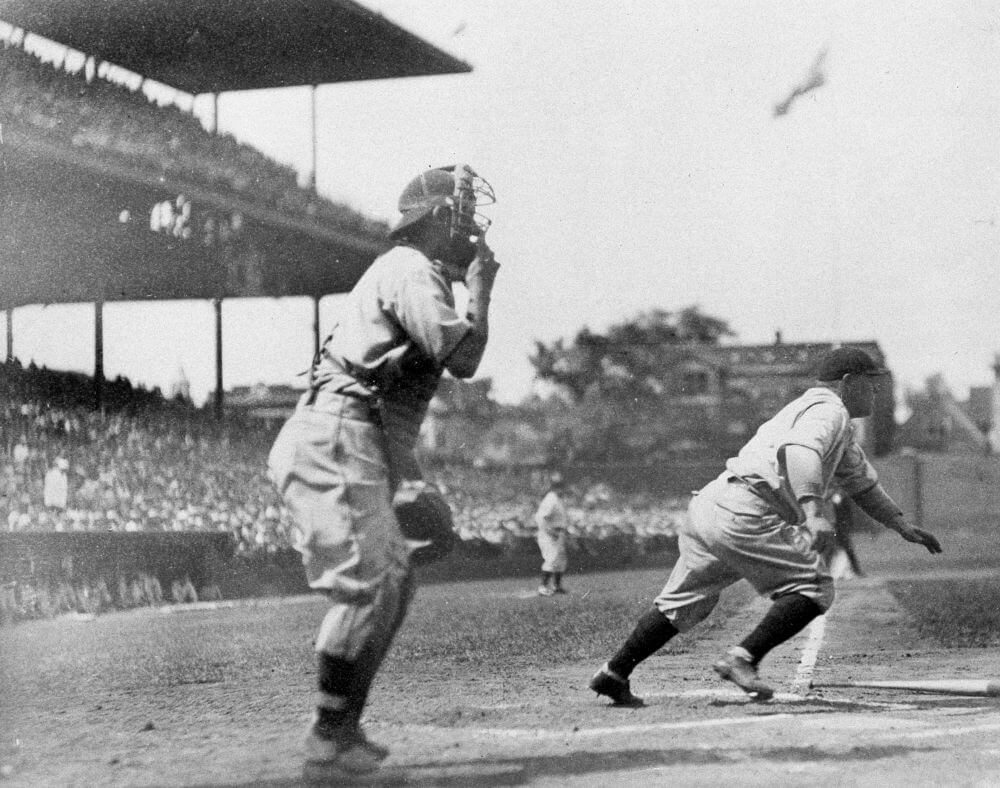
Step 1: Initial Conditions
Lewis Robert Wilson born April 26, 1900, Ellwood City, Pennsylvania. Mother dies when he is seven. Father is a steelworker, violent, alcoholic. Wilson leaves school at six years old — not to enter mill work gradually, as Coveleski did, but immediately and completely. He works in a locomotive factory. He is, by any measure available, at the floor of the accessible state space for a white male child in western Pennsylvania in 1906. No literacy infrastructure, no stable family structure, no institutional connection pointing toward any alternative trajectory. Physical development — he will grow to 5’6” with an 18-inch neck and size 18 shoe — is already marking him as someone whose body is the primary economic asset available to him.
Step 2: Constraint Tensor
The forces operating on Wilson’s phase space are familiar from Coveleski and Jackson but configured differently.
The steel economy of western Pennsylvania was not the mine economy — it was not underground, it did not have the specific mortality profile of the breaker boys — but it was structurally identical in its recruitment and retention architecture. Children entered the mills and factories at the floor wage, their labor structurally necessary to family survival, with no educational infrastructure that could compete with the immediate economic pressure to work. The company town architecture applied. The intergenerational income correlation of approximately 0.6 applied.
What is distinct in Wilson’s constraint tensor is the family structure damage. The mill children as a class shared economic constraint. Wilson shared that plus early maternal loss plus a violent alcoholic father. The C₁ conditions — the initial damage to attachment and self-regulation architecture that the developmental literature consistently identifies as a multiplier on all subsequent constraint — were more severe than Coveleski’s, roughly comparable to Jackson’s, and operating from an earlier age.
The restraining force here is not just economic. It is neurological. A child raised by a violent alcoholic father with no maternal attachment from age seven is operating with a dysregulated stress response system. The developmental literature on adverse childhood experiences is unambiguous: this is a constraint on accessible trajectories that operates through biology, not just economics. It narrows the phase space from the inside.
Step 3: Zero Point
The most probable terminal state for Lewis Wilson, born 1900, Ellwood City, Pennsylvania, mother dead, father violent and alcoholic, out of school by six, entering factory work:
Factory labor until the body gave out, with high probability of alcoholism (the father’s pattern, the period’s base rate in industrial communities, the ACE literature’s predictions all point the same direction), probable early death from alcohol-related causes or industrial injury, no family formation stability, death in the lower economic quintile.
That is the attractor. It is not a judgment. It is what the constraint tensor was designed to produce.
Note: the zero point already contains alcoholism as a probable component. This is critical for Step 6.
Step 4: Observed Trajectory
Wilson is discovered playing semi-pro baseball, reaches the major leagues in 1923, joins the Cubs in 1926. From 1926 to 1930 he produces one of the most concentrated bursts of offensive performance in baseball history. In 1930 he drives in 191 runs — a record that still stands — hits 56 home runs, posts an OPS of 1.177. He is, for approximately four years, among the five best players on the planet.
Then: alcoholism accelerates. Performance collapses. He is out of the major leagues by 1934 at age 34. He dies in 1948 in Baltimore, broke, largely forgotten, in a rooming house. He is 48 years old. Cause of death: complications from a fall, alcohol-related. His body is unclaimed for three days. The National League pays for his funeral.
The observed trajectory is therefore: dramatic escape from the zero point’s economic component, sustained for approximately eight years at the major league level, followed by collapse back toward — and in some respects below — the zero point’s predicted terminal state. He dies younger than the zero point’s modal prediction, broker, more isolated.
Step 5: Evaluate Departure
This is where the instrument faces its hardest question.
On the escape axis: Wilson achieved one of the most dramatic departures from baseline in this study. The economic displacement from Ellwood City factory worker to peak-salary major league outfielder is real, measurable, and extreme. The baseball performance itself — 1930 specifically — represents a departure from the zero point’s predicted occupational trajectory that the surprisal calculation will score very high.
On the maintenance axis: this is where the instrument bends.
Wilson did not maintain. The relational structure collapsed. The financial structure collapsed. The physical structure collapsed ahead of actuarial prediction. He died alone, unclaimed, at 48. On the maintenance dimension, his trajectory does not register as sustained organization against entropic pressure. It registers as the constraint tensor’s predicted dissolution, delayed by approximately a decade of athletic performance and then completed.
The instrument must now hold two readings simultaneously without collapsing them:
High surprisal on the escape axis — the baseball performance is genuinely extraordinary relative to the zero point.
Low maintenance reading — the terminal state approached the zero point’s prediction despite the escape.
These are not contradictory. They are different dimensions of the same profile. The escape was real. The maintenance failed. Both are true. The disjection profile records both.
Step 6: Estimate Surprisal
Here is where the zero point’s pre-inclusion of alcoholism becomes structurally important.
The standard reading of Wilson treats his alcoholism as the explanation for his collapse — the thing that ended what might have been. The instrument reads it differently. Alcoholism was already in the zero point distribution. It was not a deviation from his baseline. It was the baseline’s most probable neurological trajectory, given the ACE profile, given the father, given the developmental literature. The surprisal calculation does not treat his alcoholism as a failure of will that reduced his escape. It treats his alcoholism as the constraint tensor operating on schedule, and his baseball performance as the deviation.
The surprisal of the baseball escape — given those initial conditions — is extremely high. A child with that ACE profile, that economic floor, that educational deprivation, reaching 191 RBI in a single season, is so far outside the zero point’s predicted distribution that the information content of the trajectory is among the highest in this study.
The surprisal of the terminal collapse is low. It was predicted. The constraint tensor completed its work after the athletic window closed.
Duration weighting: the escape was sustained for approximately eight years at the major league level, four at peak performance. This is shorter than Coveleski’s sustained departure, longer than some. The duration weight is moderate. The peak intensity is extreme.
Step 7: Score Legibility
Mixed, in a way that is structurally interesting.
The baseball performance has high legibility — it is in the record books, it is documented, the 191 RBI stands. The escape is visible.
The constraint is low legibility. The factory work, the dead mother, the violent alcoholic father, the ACE profile — none of this has a named antagonist, no moral verdict, no adjudicated wrong. The developmental damage is invisible to the archive. The constraint tensor that produced both the athletic improbability and the terminal collapse is not in the Hall of Fame plaque.
The collapse has high legibility of the wrong kind — it is visible as personal failure, as a cautionary tale about drinking, as the story of a man who wasted his talent. The archive records the collapse as moral failure and the constraint as background. This is the legibility inversion: the constraint is invisible, its product is visible and misread.
Legibility score: high on performance, near-zero on constraint, inverted on collapse.
Step 8: Disjection Profile
Escape disjection: very high. The baseball trajectory is among the most improbable departures from baseline in this study, the constraint tensor was severe and included neurological damage from the ACE profile, and the legibility of that constraint is near zero. The existing measurement systems see the performance but not what it was performed against.
Maintenance disjection: low. Wilson did not sustain organized state against the constraint. The terminal collapse was predicted by the zero point. There is no maintenance reading to record.
Duration weighting: moderate. The escape was real but time-limited. The constraint tensor completed its work after the athletic window closed.
Suppression-weighted disjection: high. The archive’s legibility inversion — recording the collapse as moral failure while rendering the constraint invisible — is itself a measurement failure the instrument must flag. Wilson is remembered as a cautionary tale. The instrument reads him as an extraordinarily high-surprisal escape from a severe constraint tensor, followed by the constraint tensor’s predicted terminal operation. These are not the same thing. The archive has recorded one and suppressed the other.
Output: Wilson’s disjection profile is asymmetric. Maximum signal on the escape axis, near-zero on maintenance, with a legibility inversion that has systematically misread the terminal collapse as personal failure rather than as constraint completion. The instrument finds the escape. The cautionary tale is the archive’s error, not Wilson’s.
Where the framework bent:
The alcoholism question held. Pre-including it in the zero point rather than treating it as deviation was the right structural move — it’s what allowed the instrument to read the escape and the collapse correctly without contradiction.
What the instrument revealed that wasn’t anticipated: the legibility inversion. The collapse being more visible than the constraint, and visible in the wrong register, is a specific failure mode that deserves its own named category. Call it archival inversion : when the constraint’s product is recorded as the subject’s moral failure while the constraint itself disappears. Wilson is the clearest case so far. He won’t be the last.
Book 2. The Gradient and the Storm
A Thermodynamics of Historical Dissipation
Cairo, Julie Mehretu __(2013)
Note on Method
This framework does not reduce history to physics. It treats large-scale historical systems as exhibiting patterned accumulations of constrained differential that can be read using concepts drawn from nonequilibrium thermodynamics. The instrument operates at the level of systems, not individuals; it identifies structural pressures, not specific event sequences.
The three registers in which the instrument operates — physical analogy, social theory, and interpretive framework — are not in competition. The physical structure provides precision the narrative lacks. The social theory provides scale the biography lacks. The interpretive framework is what holds them together without collapsing into either false rigor or mere metaphor. All three operate simultaneously throughout what follows, and the instrument is most useful when that is acknowledged rather than concealed.
One consequence of this transparency: the instrument’s core claim — that the relationship between the duration of holding and the scale of dissipation is strongly nonlinear — cannot be reduced to a closed-form equation without collapsing the system’s complexity. What the historical record demonstrates is a strongly nonlinear relationship: as holding duration increases beyond the thermodynamic deadline, the probability of large-scale, discontinuous dissipation rises disproportionately rather than proportionally. The French Revolution was not proportionally larger than gradual reform would have been — it was categorically different in kind. The Civil War was not a scaled-up version of the Missouri Compromise’s logic — it was a different regime entirely. Systems held past their deadline do not release proportionally. They release discontinuously, through phase transition rather than gradual relaxation. The instrument reads this pattern. It does not derive it.
Preface: What the Weather Actually Is
A storm is not a metaphor for violence.
It is the literal physics of what happens when an energy gradient becomes too steep for the atmosphere to dissipate gradually. Warm air holds more energy than cold air. When the differential between a warm mass and a cold mass exceeds the atmosphere’s capacity for slow, continuous heat exchange, the system increasingly favors rapid dissipation pathways, and when gradual exchange is no longer sufficient, that dissipation concentrates into force. Wind. Rain. The organized violence of a pressure differential resolving itself through the only channels still open.
The meteorologist does not ask why the storm happened. The meteorologist measures the gradient that made the storm increasingly probable and asks only: how steep was it, how long did the system hold it past the point of gradual correction, and how much work had to be done when the accounting finally came due.
This is not how history is written.
History records the storm. It names the day the Bastille fell, the morning Fort Sumter was fired upon, the week the bond markets collapsed and took the decade with them. It builds its narrative around the event — the lightning strike, the flood, the catastrophic reorganization of a landscape that had appeared, until the moment it broke, to be stable. What history does not record — what the narrative apparatus of political and social history is structurally incapable of recording — is the gradient. The century of accumulation. The thermodynamic pressure building inside apparent calm. The system running past its deadline, holding a configuration that required more and more work to sustain, until the work exceeded what the system could supply and the dissipation happened through the only channels left.
The storm looks like the cause. The gradient was the cause.
Every major historical transformation in this analysis is the storm. What this analysis is built to measure is the gradient.
I. The Physics of Holding Past Deadline
Before the epochs, the mechanism. And before the mechanism, a precise definition of what “thermodynamic deadline” means — because it is a phrase that can sound intuitive while meaning something specific.
The thermodynamic deadline is the point at which the energy required to maintain a configuration exceeds the system’s sustainable capacity to supply it. It is crossed in two phases. The first: when maintenance cost exceeds sustainable replenishment — the system is running on deficit, drawing down reserves. The second, which seals the deadline: when the channels through which the gradient might have dissipated gradually are politically or institutionally closed — when the people who benefit from the held configuration have invested sufficiently in blocking those channels that gradual reorganization is no longer available. Both conditions together constitute the deadline. Either alone is a warning. Together they are the point beyond which the system becomes increasingly constrained toward rapid, large-scale dissipation rather than gradual adjustment.
A channel, in this framework, is any mechanism through which accumulated differential can be redistributed without system rupture — legislation, wage adjustment, suffrage expansion, technological diffusion, geographic migration. Channel capacity is the total throughput these mechanisms can absorb over time. Its importance to the framework is this: the intensity of a dissipation event is not only a function of the gradient’s magnitude. It is equally a function of how many channels remain open when the gradient finally moves. A gradient released through multiple simultaneous pathways dissipates differently than the same gradient forced through a single opening. The blocking architecture’s primary work is the reduction of channel capacity. This is what makes it thermodynamically consequential, rather than merely politically significant. Channel capacity is not static: as gradients increase, existing channels can saturate, degrade, or collapse under load even before they are formally blocked, further concentrating the eventual dissipation.
A thermodynamic system displaced from equilibrium experiences restoring forces. This is the condition of all organized matter — all structure, all complexity, all departure from the uniform distribution that maximum entropy would produce if left to operate without energy input. The restoring force is not malevolent. It is not a punishment for organization. It is the universe’s accounting, operating continuously, on everything.
A system can hold its displacement past the point at which gradual correction would have been possible. It does this through the continuous expenditure of energy — energy that must come from somewhere, must be imported from outside the system’s boundary or extracted from reserves within it. The longer the system holds past its thermodynamic deadline, the more energy is required per unit time to maintain the configuration, and the steeper the gradient between the system’s held state and the equilibrium toward which it is being drawn.
This is the mechanism of dissipative lag.
The gradient is already too steep. The system is already past gradual correction. But the dissipation hasn’t happened because the channels are blocked — by the organized enforcement of an arrangement whose energetic basis has already collapsed, by the institutional inertia of systems that know how to do what they have always done and have not yet encountered the force that will make that impossible, by the simple fact that the human beings who benefit from the held configuration will expend every resource available to them to keep it held as long as the resources last.
They are building pressure.
Every year the system holds past its deadline is a year in which the gradient steepens. Every year the dissipation is deferred, the energy that will have to be released — when the channels finally open — accumulates. The release that follows a system held past its deadline for a decade is not ten times larger than the release that would have followed from a single year of holding. It is categorically different — a phase transition rather than a proportional response. This strongly nonlinear relationship between holding duration and dissipation intensity is a primary structural reason why revolutions tend toward violence.
Not because the people who make them are violent by nature. But because the system that produced them was held past its thermodynamic deadline by the organized force of the people who benefited from the holding, and the gradient that accumulated during the holding had to go somewhere when it finally went, and it went through every channel that opened simultaneously, with the full energy of everything that had been accumulating since the last time gradual correction was possible.
The Terror is not an aberration of the Revolution. It is the dissipation of a gradient held for a century past the point at which bloodless reorganization was thermodynamically available. By 1789, the French social order was running on deficit energy — extracting from the peasantry and the urban poor at rates that exceeded the system’s sustainable throughput, holding an aristocratic configuration that required more work to maintain each decade, blocking the channels through which the gradient might have dissipated gradually through reform. When the channels finally opened, they opened all at once, and the energy that moved through them had been accumulating since Louis XIV built Versailles as a monument to a gradient he was certain would never resolve.
He was wrong about the gradient. He was right that it wouldn’t resolve in his lifetime. The difference between those two facts is the Terror.
II. Reading the Gradient Before the Storm
The instrument’s first operation is reading the gradient in the record that precedes the dissipation event. It does so through three primary signals: population disjection, energy extraction rate, and blocking architecture investment. Where all three are rising simultaneously, the system is past its thermodynamic deadline.
The first signal is the disjection score of the population.
As the baseball essays established, a very high disjection score in a period of apparent stability is a measurement of gradient steepness. When the constraint system is doing enormous work to maintain a configuration — suppressing large numbers of people whose departure probability is rising, requiring increasingly violent enforcement of an arrangement that is losing its energetic basis — the disjection scores across the population are elevated. They are elevated because the gap between where people are being held and where they could be operating, given the underlying energy available to them, is widening. The constraint is working harder. The gradient is steeper.
A population full of Coveleskie and Jacksons and Wilsons — full of people whose departure from the zero point is being suppressed at extraordinary cost to the system maintaining the suppression — is a population inside a pressure system. The high individual disjection scores are probes of the gradient. They are readings of how much potential is being held in suspension by a configuration that is running past its thermodynamic deadline.
This is what the social history of pre-revolutionary periods actually shows, when read as thermodynamics rather than narrative. The years before 1789 in France. The decades before 1861 in America. The period before 1917 in Russia. In each case, the population disjection scores — the gap between what people were capable of and what the constraint system was permitting them to do with that capability — were rising. The system was holding harder. The gradient was steepening.
The second signal is the energy extraction rate.
Every social system extracts energy from somewhere. Feudalism extracted it from agricultural labor. Slavery extracted it from coerced human bodies. Industrial capitalism extracted it from coal and from the bodies of children in the coal-processing facilities that coal required. The extraction rate — the rate at which the system was drawing from its energy base relative to the rate at which that base could regenerate — is a direct measurement of how far past its deadline the system was running.
This is not metaphorical. It is literal thermodynamics applied to economic systems. A slave economy is a thermodynamic system with a specific energy input profile: coerced human labor, operating at extraction rates that exceeded sustainable throughput — worked to early death, denied the nutritional and rest inputs required for genuine regeneration, the capital stock of human bodies being drawn down rather than maintained. The antebellum Southern economy was running on thermodynamic deficit by every available measure: declining soil productivity from monoculture extraction, declining return on slave labor investment as prices rose and productivity plateaued, the increasingly expensive military and legal infrastructure required to maintain the suppression of a gradient that was steepening every decade.
By 1860, the Southern slave economy was not a stable system that could have been preserved indefinitely if only the political crisis had been managed differently. It was a system past its thermodynamic deadline.
The third signal is the blocking architecture’s investment level.
When a system is approaching phase transition, the people who benefit from the held configuration increase their investment in the blocking architecture — the institutional, legal, military, and cultural infrastructure that keeps the channels closed. This increased investment is itself a thermodynamic signature. It is the system diverting energy from productive activity into pure suppression — into the work of holding the gradient rather than doing anything with it.
The blocking architecture is expensive. It becomes more expensive as the gradient steepens, because the force trying to move through the channels grows as the differential grows. A system spending an increasing fraction of its total energy budget on suppression is losing the thermodynamic competition between the held configuration and the equilibrium toward which it is being drawn.
Read the blocking architecture and you read the gradient’s steepness.
The Fugitive Slave Act of 1850 required Northerners — citizens, officials, law enforcement — to participate in the return of escaped enslaved people, and imposed fines and imprisonment on those who refused or obstructed. This was not an expansion of slavery’s territorial reach. It was an expansion of slavery’s blocking architecture — an attempt to extend the suppression across a larger territory because the gradient had become too steep to hold within the original containment. The system needed more wall. It was running out of wall material. The need for the Act was itself the evidence that the gradient had exceeded what the previous architecture could contain.
The Black Codes after Reconstruction. The Chinese Exclusion Act of 1882. The sedition laws of World War One. The House Un-American Activities Committee. The Shelby County v. Holder decision of 2013, which struck down the Section 4(b) coverage formula of the Voting Rights Act, effectively rendering Section 5 preclearance unenforceable and opening channels for state-level voting restrictions that had been blocked for decades. Each of these is, in thermodynamic terms, an investment in blocking — a diversion of system energy into the work of holding the gradient rather than allowing it to dissipate. Each of them is a reading of gradient steepness at the moment of its construction.
Read the blocking architecture chronologically and you read the gradient’s history.
III. The Dissipation Event
The storm arrives when the gradient exceeds the blocking architecture’s containment capacity.
The gradient steepens continuously as long as the blocking architecture holds. The blocking architecture’s capacity is finite and, as the gradient steepens, requires increasing energy investment to maintain. At some point the investment required exceeds what the system can supply. The architecture begins to fail. Channels open unevenly, often partially before fully collapsing. The gradient dissipates through whatever channels are available, with the full energy of everything that has been accumulating since the last opening.
This is the moment history records.
What the event is not:
The dissipation event is not caused by the people who trigger it.
Jacques Necker’s dismissal on July 11, 1789 did not cause the French Revolution. It opened a channel in a system that had been building pressure for a century. The energy that moved through that channel was not produced by Necker’s dismissal or by the men who stormed the Bastille or by the pamphlets of the philosophes or by the harvest failures of 1788, though all of these were real and had their own causal roles in the immediate sequence. The energy was produced by a century of gradient accumulation.
The men who stormed the Bastille did not make the Revolution. The Revolution moved through them. They were the channel, not the energy source.
This is not a diminishment of historical agency. It is a clarification of what historical agency actually is in a gradient-driven system. The people who act at the moment of dissipation are responding to the gradient the system has been building, expressing the energy of a differential that structural forces made increasingly probable. Their courage, their specific choices, their particular organizations and ideas and timing — all of these matter enormously for the shape of the dissipation and therefore for what the reorganized system looks like afterward. But they are not the source of the energy. They are its expression.
The source of the energy is the gradient. The gradient is intensified by the blocking. The blocking is the choice of the people who benefited from the held configuration. And those people — the ones who built the blocking architecture, who held the gradient past its thermodynamic deadline, who made catastrophic release increasingly probable by preventing the gradual alternative — are the ones whose choices produced the storm.
This is the accountability the thermodynamic framework assigns. Not to the people who made the revolution. To the people who made the revolution necessary.
What the event actually measures:
The intensity of the dissipation event is a function of the gradient’s magnitude and the degree to which the blocking architecture sealed the available channels. A gradient held in a system with multiple available channels — where the energy can move in many directions simultaneously — releases differently than a gradient held in a system where the blocking architecture has sealed every channel but one.
The French Revolution was a century’s gradient released through a society with a highly centralized political system — few channels, enormous pressure, catastrophic release. The industrial transformation of England across the same period was, energetically, a gradient release of comparable magnitude, but it moved through multiple channels simultaneously: technological, commercial, demographic, political. No single channel had to carry the full load. The dissipation was therefore more gradual, more distributed, and less immediately catastrophic, though its costs — the mill children, the coal miners, the enclosed commons, the destroyed agricultural communities — were real and large and are still being settled in the disjection profiles of every working-class family in England today.
The number of channels available at the moment of dissipation determines whether the storm is a hurricane or a system of distributed thunderstorms. Both are doing the same thermodynamic work. One concentrates the violence in a single catastrophic event. The other distributes it across time and space in ways that are less visible, less narratable, and no less costly to the people inside them.
IV. Five Epochs of Absolute Transformation
The following readings apply the gradient framework to five historical periods selected not for their narrative importance but for what they reveal about the relationship between gradient accumulation and dissipation event. Each is a different configuration of the same physics.
Epoch One: The Atlantic Slave System, 1619–1865
Gradient Profile: Catastrophic Extraction at Continental Scale
The Atlantic slave system was one of the largest and most intensive coercive extraction systems of the early modern world, distinctive for its geographic scope, its legal architecture, and its duration of operation at continental scale. Between 1619 and 1865 in the American context alone, the system extracted from millions of coerced human bodies at rates that no accounting of market value could justify — because market value is a measurement of position, not of work, and the work being extracted from enslaved people was not priced at its actual thermodynamic cost to the people from whom it was taken.
The gradient this created was not primarily political. It was thermodynamic. The differential between the energy being extracted and the energy being returned to the people from whom it was taken accumulated across two and a half centuries in bodies worked to early death, in the neurological and developmental damage of children born into the constraint, in the generational compounding of deprivation that the ACE literature now allows us to quantify in its contemporary expression.
That differential accumulated in the resistance that the blocking architecture was increasingly required to suppress — in the Nat Turner rebellions and the Underground Railroad, which by commonly cited estimates helped approximately 100,000 people reach freedom across its decades of operation, and the free Black communities in the North that the Fugitive Slave Act of 1850 was specifically designed to reach and destroy. It accumulated in the political system’s increasingly desperate attempts to contain a gradient that was, by 1850, too steep for any political architecture to hold.
By 1860 the American slave system was consuming its own blocking architecture. The Kansas-Nebraska Act, the Dred Scott decision, the Lecompton Constitution, John Brown’s raid on Harpers Ferry — these are not the causes of the Civil War. They are the symptoms of a gradient that had exceeded the political system’s containment capacity and was looking for a channel.
The Civil War was, in structural thermodynamic terms, the dissipation event: the gradient finding the largest channel that remained after the political architecture had sealed every other one. This is not a causal claim about what made the war happen in its specific historical form — that question belongs to historians and their evidence. It is a structural claim about what the war’s occurrence is consistent with, given the gradient profile of the preceding decades.
The human cost reflects what accumulated during the holding: approximately 620,000 military deaths by the long-cited nineteenth-century estimate, with modern demographic scholarship revising this upward — a 2024 full-census study places the figure at approximately 698,000, and the 2011 Hacker demographic revision established approximately 750,000 as the upper bound of current scholarly estimates. The range itself is information: the archive of catastrophe is still being reconstructed.
The reorganization that followed was incomplete. The system found new channels for suppression, new mechanisms for holding a modified version of the old gradient. The accounting from that incompleteness is not historical. It is present tense.
What the thermodynamic reading recovers:
The gradient was two and a half centuries of extraction at rates that exceeded sustainable throughput, held past its thermodynamic deadline by an increasingly costly blocking architecture, accumulating the energy of every suppressed departure from equilibrium across the full population of the enslaved, until the differential between the held configuration and the energetically sustainable alternative was too large for any political system to contain.
The years of catastrophic violence were not the cause of slavery’s end. They were the dissipation event produced by a gradient that had been building since 1619 and that the system had been holding past its deadline since at least the Missouri Compromise made clear that gradual correction through political adjustment was not available.
The people who built the blocking architecture — who passed the Fugitive Slave Act, who forced the Dred Scott decision, who bled Kansas, who built the legal and military infrastructure of suppression across two and a half centuries — produced the war by preventing the alternative. This is the accountability the gradient assigns. Not to the men who fired on Fort Sumter. To the system that made Fort Sumter the only available channel.
Epoch Two: The Industrial Transition, 1760–1848
Gradient Profile: Energy Phase Transition with Distributed Dissipation
Coal is stored solar energy — photosynthetic work accumulated over three hundred million years, compressed into a form that the industrial economy learned to access in the eighteenth century. The industrial transition in England was, at its most fundamental level, the opening of a channel into an energy source of previously unimaginable magnitude. The gradient this created — and here the language is structural rather than literal — was not initially between social classes. It was the differential between the productive capacity unlocked by the new fuel and the existing social system’s capacity to distribute that productivity. The thermodynamic framing illuminates the structural pressure without explaining the specific political forms through which it eventually moved.
That differential was transformative in a specific thermodynamic sense: it was a phase transition — a fundamental reorganization of what was possible, what was efficient, and what was competitive, at rates that no existing social system had been designed to accommodate.
The gradient moved through the social system in multiple directions simultaneously. The enclosure of the commons displaced the rural population toward the cities where the factories needed their labor. The factory system extracted from those displaced bodies at rates that the disjection profiles of Coveleski and Daubert and the Addie Cards of the English mill towns make directly legible. The Luddite movement, Chartism, the revolutions of 1848 across Europe are readings of a gradient that was building inside the industrial transition: the differential between the enormous energy being released by the coal economy and the distribution of that energy, which was concentrating in the hands of the capital owners at rates that the political systems of the time had no mechanism to redistribute.
Epoch Three: The European Imperial System, 1492–1945
Gradient Profile: Global Extraction at Civilizational Scale
The European imperial system created a gradient between the energy extracted from colonized territories — land, labor, mineral wealth, agricultural productivity — and the energy returned to those territories. The gradient was not only economic. The imperial system declared indigenous knowledge illegitimate, constructed the ideological architecture of racial hierarchy as the gradient’s justification, and designed that justification to make the energy differential appear natural rather than structural. This is the deepest form of blocking architecture: when the constraint manages to make the gradient invisible by attributing it to the character of the suppressed population, the people at the bottom of the gradient cannot read what is being done to them in thermodynamic terms.
The primary dissipation event was paradoxical: the First and Second World Wars. The competition among imperial powers over who would control the extraction infrastructure — the colonial territories, the trade routes, the resource access — produced a gradient within Europe that the pre-1914 alliance system was holding past its deadline. What the two Wars accomplished, in thermodynamic terms, was the destruction of the blocking architecture that had maintained European global dominance. Britain emerged from 1945 too depleted to maintain the extraction infrastructure at the level required to hold the gradient. The post-colonial world is a system in partial reorganization following an incomplete dissipation. The gradient between former extractors and former extraction territories has not resolved. It has reorganized through debt architecture, trade regime asymmetry, and the continued movement of talent and capital from periphery to center. The instrument reads this as ongoing accumulation, not settled history.
Epoch Four: The American Racial System, Reconstruction to Present
Gradient Profile: Incomplete Dissipation and Reorganized Blocking
The Civil War dissipated the slave system’s gradient only partially. The Reconstruction amendments — the Thirteenth, Fourteenth, and Fifteenth — attempted to complete the dissipation by opening the channels: legal personhood, equal protection, voting rights. For approximately twelve years, the channels were open, and the gradient began to move through them. Black men were elected to Congress, to state legislatures, to local offices. Black families acquired land. Educational institutions were established.
Then the blocking architecture was rebuilt.
The effective end of Reconstruction came in 1877, when the federal government — in the contested settlement of Hayes’s election — ceased its military enforcement of Republican governance in the remaining Southern states where federal presence was still contesting Democratic takeovers. Whatever the precise mechanism of the arrangement, its thermodynamic consequence was clear: the federal channel closed. The blocking architecture began its reconstruction. The Supreme Court’s 1883 decision gutting the Civil Rights Act of 1875 sealed the federal channel. The convict lease system converted criminal prosecution into a mechanism for re-extracting coerced labor from the same population the Civil War had nominally freed. The Black Codes, the vagrancy laws, the grandfather clauses, the literacy tests, the white primary, the systematic terrorism of lynching — each of these is a piece of blocking architecture, constructed specifically to seal the channels that Reconstruction had opened.
This is the most instructive case study in the history of blocking architecture. It shows what happens when a dissipation event is allowed to begin and then suppressed before completion: the gradient backs up. The pressure re-accumulates. From a higher base, in a system that has now demonstrated its willingness to rebuild the blocking architecture after each dissipation event.
The Great Migration — approximately six million Black Americans moving from the South to the North and West between 1910 and 1970 — was the gradient moving through the only channel that remained partially open: geographic displacement. The demographic reorganization of American cities in the twentieth century is the physical trace of a thermodynamic event — the gradient finding a channel when every institutional channel had been sealed.
The Civil Rights Movement of the 1950s and 1960s was the gradient again finding an opening — this time through legal challenge, organized mass action, and the political leverage of the Cold War, which made American apartheid an international liability that the blocking architecture could no longer afford to maintain at full intensity. The Civil Rights Act of 1964, the Voting Rights Act of 1965 — channel openings, partial and imperfect, releasing pressure that had been building since Reconstruction.
The blocking architecture’s response was immediate and is ongoing. Mass incarceration as a successor to the convict lease system. The Shelby County v. Holder decision of 2013, which struck down the Section 4(b) coverage formula of the Voting Rights Act, effectively ending the preclearance requirement that had blocked discriminatory voting changes in covered jurisdictions for nearly fifty years. The systematic defunding of public institutions whose quality determines the accessible phase space for the people the gradient has historically suppressed.
The gradient from 1619 has not resolved. It has reorganized repeatedly around new blocking architectures as each old one was breached. The thermodynamic statement is simple: a gradient that has been building since 1619, interrupted repeatedly by partial dissipations and rebuilt repeatedly by new blocking architectures, is still building. The energy it contains has not been released. It is held in the disjection profiles of every Black family in America whose zero point was set by the slave ship and whose accessible phase space has been narrowed at each subsequent reorganization of the blocking architecture.
The instrument reads this not as history but as present-tense thermodynamics: a gradient under pressure, inside a blocking architecture showing stress fractures, in a system that has not yet found the political will for the gradual dissipation that would make catastrophic release less probable.
Epoch Five: The Present Energy Transition
Gradient Profile: Compounding Phase Transitions with Global Stakes
The fossil fuel economy is the industrial transition’s gradient, extended across two centuries, compounded by the addition of oil and gas to coal, grown to encompass the entire planetary energy system, and now approaching the physical boundary conditions of the atmosphere itself.
The gradient is between the energy density of fossil fuel combustion and the atmosphere’s remaining capacity to absorb the entropy that combustion produces while maintaining stable climate conditions. Carbon dioxide is the dissipation product of fossil fuel combustion — the disorder exported to maintain the organized state of industrial civilization. For two centuries, the atmosphere absorbed it within a range compatible with the Holocene climate that human civilization was built inside. That range has limits, and they are being approached.
The remaining carbon budget consistent with a 50% probability of limiting warming to 1.5°C above pre-industrial levels was estimated at approximately 250 gigatonnes of CO₂ as of January 2023 — roughly six years of emissions at then-current levels — by peer-reviewed research published in Nature Climate Change. The budget for 2°C is larger but shrinking. The blocking architecture — the fossil fuel industry’s organized suppression of climate science across decades, the political infrastructure that has delayed decarbonization well past the point at which the gradient was clearly identified — is holding a configuration that is thermodynamically unsustainable.
When this gradient dissipates, it will not dissipate through a human political event alone. It will dissipate through the physical system itself — in the atmosphere, the ocean, the biosphere, and every human system embedded in those physical systems. This is the case in which the storm is the literal storm.
The compounding:
The present moment contains compounding gradients. The digital and AI transition is steepening the economic gradient between capital and labor. The climate gradient is steepening the physical boundary conditions within which all social systems operate. The demographic gradient — the differential between population growth rates in the global South and economic opportunity in the global North — is producing the migration flows that are the human expression of all three gradients simultaneously.
These gradients interact. A climate disruption that reduces agricultural productivity in the Sahel steepens the migration gradient. A technological transition that reduces demand for low-skill labor in the global North steepens the inequality gradient inside wealthy countries. An inequality gradient steep enough to produce political instability weakens the institutional capacity to address the climate gradient. The system is not one gradient under pressure. It is multiple gradients compounding, each steepening the others, inside blocking architectures consuming increasing fractions of the system’s total energy budget.
The instrument’s statement about the present:
The thermodynamic reading is not a prediction of specific events. It does not know when the channels open or which ones open first. What it knows is the gradient profile — which differentials are steepening, which blocking architectures are consuming more energy than they were a decade ago, which channels are showing stress fractures that indicate approaching failure.
The gradient profile says: we are inside a period of multiple compounding phase transitions, held past multiple thermodynamic deadlines by blocking architectures that are themselves under increasing stress, in a system that has not developed the political capacity for the gradual dissipation that would reduce the energy of the eventual release.
This is not pessimism. It is a reading of the differential. What is done with that reading is a different and subsequent problem. The instrument measures. The people who can read the measurement decide whether to use it for gradual dissipation or to continue building the blocking architecture until the gradient finds its own channels.
V. The Gradient in the Life, the Life in the Gradient
The biographical cases are probes inside the epoch-scale gradients. Their disjection scores are local measurements of system-wide pressure. Reading them together — the individual life and the historical gradient — is what the instrument was built to do: find the gradient in the life, and find the life in the gradient.
The measure of their achievement is the measure of the gradient that was working against it. And the gradient that was working against it is the measure of the blocking architecture that held it. And the blocking architecture that held it is the accumulated choice, across decades, of the people who decided that maintaining the held configuration was worth the system energy it required.
This is the accountability that flows in both directions through the gradient framework: the heroism reads forward from the constraint, and the responsibility for the constraint reads backward to the people who built and maintained the blocking architecture.
The instrument does not adjudicate. It measures. But the measurement, read correctly, does not allow the two readings to be separated. The disjection score of the person at the bottom of the gradient is the same number as the investment made by the people holding the gradient against them. They are the same quantity, viewed from different positions in the pressure system.
Coda: The Measurement That Remains When the Storm Is Past
The storm passes. The gradient dissipates, partially or completely, through whatever channels open. The new equilibrium forms — always imperfect, always carrying the memory of the gradient that produced it, always containing the seeds of the next accumulation.
What remains after the dissipation is the record.
The record is almost always incomplete. It preserves the event and loses the gradient. It names the storm and forgets the pressure that made it necessary. It honors the people who acted at the moment of release and forgets the people who spent their lives pressing against the blocking architecture in the decades of accumulation that made the release possible. It records the lightning strike and loses the century of charged air.
The instrument this book has been building is, finally, an instrument for reading the gradient in the record the storm left. For looking at what history preserved — the event, the date, the named actors, the visible dissipation — and reading backward from it to the pressure that produced it, forward from the pressure to the lives that were shaped by it, and across from those lives to the people whose choices built the blocking architecture that held the gradient past its deadline and made catastrophic release increasingly probable.
It does not produce simple accountings. The gradient is not a villain. The storm is not a hero. The people who act at the moment of dissipation are expressing an energy that the blocking architecture produced by accumulation — they are not its source, though they are its expression, and their courage and their specific choices matter enormously for what the reorganized system looks like.
But the people who built the blocking architecture — who chose, generation after generation, to invest in containment rather than gradual redistribution, who made catastrophic release increasingly probable by preventing the gradual alternative — are accountable to the gradient they produced. Not to history’s judgment, which is unreliable, partial, and controlled by whoever writes it. To the thermodynamic accounting, which is not.
The gradient does not disappear when the storm is over. It is redistributed, reduced, or reconfigured depending on the completeness of the dissipation. It continues building in whatever sections of the system the dissipation didn’t reach, through whatever new channels the reorganized blocking architecture leaves open.
We are inside one now. Several, compounding. The instrument reads them.
The question the instrument cannot answer — the question that belongs to the people who can read the measurement and choose what to do with it — is whether the channels for gradual dissipation will be opened before the gradient finds them on its own.
The atmosphere is not waiting for an answer. The gradient is already there.
Read it. That is what the instrument is for.
This essay extends the framework developed in “The Mines Below: What Baseball Cannot Count” and “A Call to Accounts of the Forgotten.” The thermodynamic framework draws on Ilya Prigogine’s nonequilibrium thermodynamics, E.P. Thompson’s social history of the English working class, W.E.B. Du Bois’s Black Reconstruction in America, and the Maximum Caliber framework developed in the preceding acts. Civil War death toll figures reflect the long-cited estimate of approximately 620,000 (Livermore, 1900), the 2011 demographic revision by J. David Hacker placing the figure at approximately 750,000, and the 2024 full-census study by Jensen et al. in PNAS estimating approximately 698,000 (±50,000). The Harriet Tubman figure of approximately 13 missions and 70 people freed directly reflects the current consensus of the National Park Service and modern biographical scholarship; the earlier figure of 19 trips and 300 people derives from an 1868 biography now considered an overestimate. Carbon budget data derives from Lamboll et al. (2023) in Nature Climate Change. Underground Railroad estimate of approximately 100,000 reflects the most commonly cited figure across the historical literature, with estimates ranging from 40,000 to 100,000 depending on time period and methodology.
Book 3. The General Theory of Magnitude
Constrained Dissipation as the Operative Principle of Universal Order
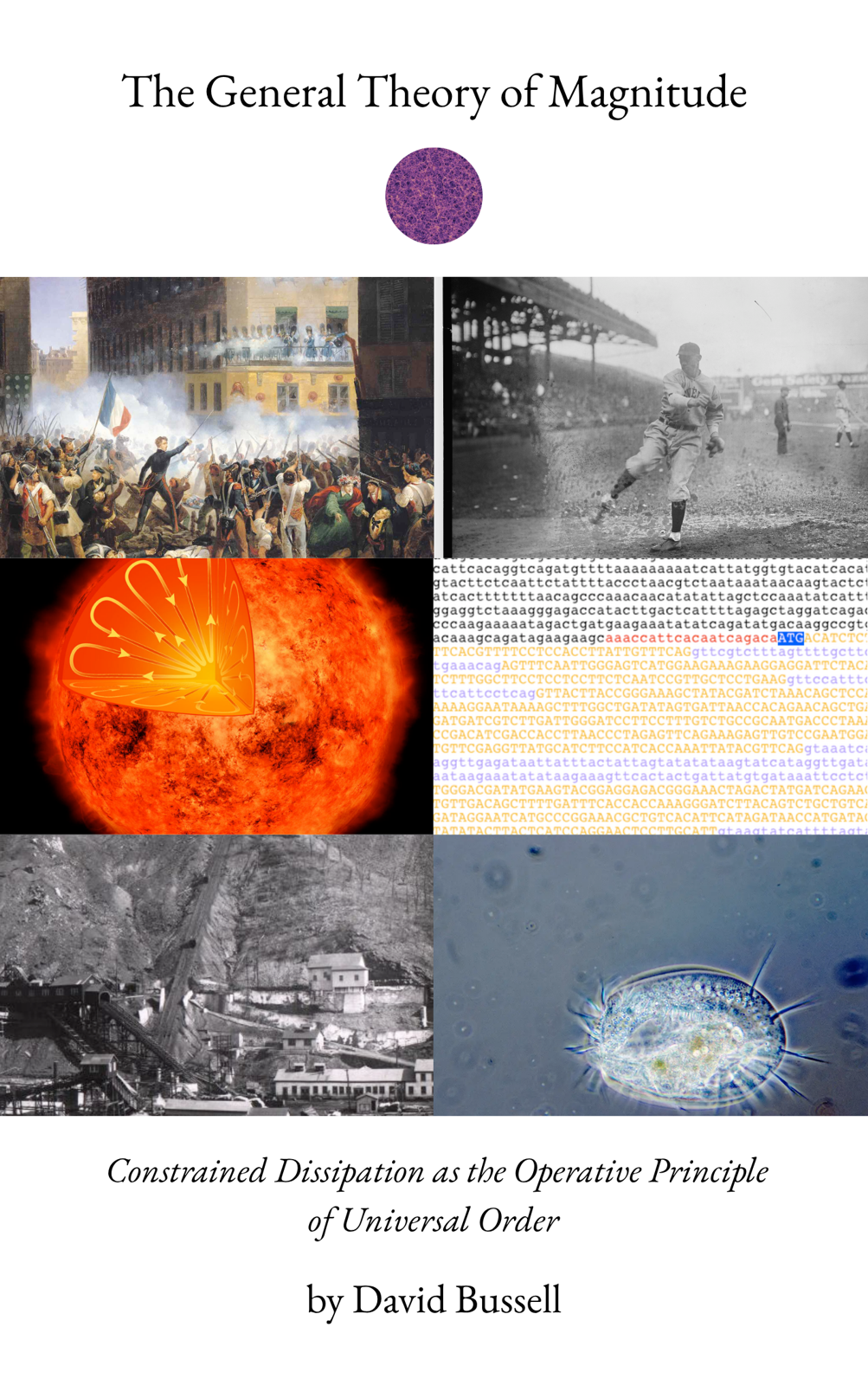
The storm looks like the cause. The gradient was the cause.
The event is visible history. The gradient is operative history. — The Gradient and the Storm
The instrument built across this work — through ERA+ and the coal mines of Shamokin and the Atlantic slave system and the atmosphere’s remaining carbon budget — is not a historical instrument. It is not a biographical instrument. It is not even a social instrument, though it reads social systems with greater precision than most social instruments do.
It is a physical instrument. And its operative principle — that organized structure is maintained against entropy by continuous energy expenditure, that the differential between a system’s held configuration and its equilibrium state constitutes a gradient, that gradients held past their thermodynamic deadline by blocking architectures accumulate pressure that eventually dissipates through whatever channels remain, with intensity that increases nonlinearly with holding duration and is strongly conditioned by the available channel capacity at the moment of release — is not a principle invented for the study of human systems. It is the principle by which the universe organizes itself at every scale.
What follows is the extension. Not a metaphor. The same thermodynamic constraints operating through different physical regimes, across seventeen orders of magnitude, from the human life to the large-scale structure of the cosmos.
The Operative Principle: At every scale at which organized structure exists — from the carbon atom to the galactic filament — that structure is a maintained departure from thermodynamic equilibrium, sustained by continuous energy throughput against restoring forces that are always operating and never fully overcome. The magnitude of any organized system is strongly conditioned by its departure distance, its holding duration, and the work done against the restoring force per unit time. The dissipation event — the storm, the supernova, the revolution, the civilizational collapse — is the gradient finding its channels when the blocking architecture can no longer hold.
Scale I The Cosmological: The Universe as the Original Gradient 10²⁶ meters · 13.8 billion years
The universe began in a state of extraordinary low entropy — a configuration so highly organized, so far from the maximum entropy state that thermodynamics would eventually produce, that this essay reads the entire subsequent history of cosmic structure formation as the story of that initial gradient progressively transforming and partially dissipating through whatever channels the laws of physics permit. This is not the settled conclusion of cosmology as a discipline. It is an interpretive frame applied to cosmology’s findings — one consistent with modern physics’ account of low early entropy, accelerating expansion, and the eventual approach toward thermal equilibrium, but not derivable from cosmology alone.
Penrose famously argued that the improbability of the Big Bang’s initial low-entropy configuration can be expressed as approximately one part in ten raised to the power of ten raised to the power of 123 — a number with no analog in human experience of scale. In Penrose’s formulation, this means the universe began in a state whose departure from equilibrium was so extreme that the entire subsequent fourteen billion years of structure formation — every galaxy, every star, every planet, every life — can be read, within this framework, as the progressive transformation and partial dissipation of that initial gradient finding its channels across cosmic time.
The large-scale structure of the universe — the cosmic web of filaments, sheets, voids, and nodes that maps the distribution of matter across billions of light-years — is the shape of a gradient in partial dissipation. The filaments are the channels. The galaxy clusters at their nodes are concentrations of energy finding temporary organized states on the way to maximum entropy. The cosmic voids are the regions the dissipation has already partially processed, thinned of the organized matter that the filaments still hold.
Cosmological blocking architecture — a precision: At the cosmological scale the channel-modifying condition is not a blocking architecture in the sense operative at every other scale in this framework. It requires no agent, depletes nothing, and cannot consume itself from within — the self-undermining dynamic that governs every other blocking architecture here does not apply. This is the limiting case: the scale at which what modifies the channels is the geometry of spacetime rather than any organized structure within it. Dark energy — the energy of the vacuum itself, driving the accelerating expansion of space — stretches the channels rather than closing them, changing the geometry through which dissipation occurs without suppressing it. As the universe expands, matter is pulled apart faster than gravity can concentrate it, extending the timescale of dissipation across periods that will eventually exceed any stellar lifetime. The gradient is being held — not by organized suppression, but by the shape of space itself — across timescales that make all human history a single frame in an incomprehensibly long exposure.
The far future of the universe — the stelliferous era giving way to the degenerate era, the black hole era, the final dark era — is, on standard cosmological models, the story of the remaining gradient progressively dissipating through whatever channels the laws of physics permit. The instrument reads it as the same structure it reads everywhere: organized departure from equilibrium, maintained for as long as the available energy lasts, tending toward the maximum entropy state that is the universe’s zero point. The timescale is measured in googols of years. The thermodynamic constraint is the same constraint. It will have moved into the mass-energy locked inside white dwarfs and neutron stars and black holes, and the dissipation will continue through Hawking radiation across timescales that make the current age of the universe seem instantaneous.
The zero point of the universe — its eventual equilibrium state, in standard cosmological models of continued expansion — is heat death: maximum entropy, uniform temperature, no organized structure, no gradient remaining to do work. Every organized thing that has ever existed is a temporary departure from that equilibrium, maintained for as long as the available energy permits, against the continuous restoring force of entropy, before the dissipation completes.
Every star that has ever burned, every galaxy that has ever formed, every life that has ever lived — all of it can be understood within this framework as the universe’s initial gradient progressively transforming and partially dissipating through available physical channels across fourteen billion years.
Scale II The Galactic: Organized Structure Against Gravitational Equilibrium 10²¹ meters · 10⁸ – 10¹⁰ years
A galaxy is a dissipative structure in the precise sense Prigogine defined: an organized, low-entropy configuration maintained far from equilibrium by continuous energy throughput, exporting entropy to its surroundings while sustaining its internal organization. The Milky Way has been maintaining its spiral structure for approximately ten billion years. That maintenance is not passive. It is the continuous work of gravitational dynamics, stellar feedback, magnetic fields, and the regulated inflow of gas from the circumgalactic medium — all of it operating against the entropic tendency toward a diffuse, unstructured distribution of matter.
The spiral arms are not static features. They are density waves — regions of compressed gas and dust through which the galaxy’s matter continuously flows, triggering star formation as it passes through the compression zone. The arm is the channel. The star formation is the dissipation event: the gradient between the compressed gas and its equilibrium state releasing through gravitational collapse, producing new organized structures — stars, planetary systems, the entire machinery of stellar chemistry — that are themselves new departures from equilibrium.
The galactic blocking architecture
Supermassive black holes — present at the center of almost every large galaxy, including the four-million solar-mass Sagittarius A* at the center of the Milky Way — are observed in many systems to function as regulators of channel capacity at galactic scale. When actively feeding, they produce jets of relativistic plasma that can extend for millions of light-years, redistributing energy in ways that are thought to heat the intergalactic medium and reduce star formation rates across entire galaxy clusters.
The relationship between active galactic nuclei and star formation suppression is observed but its precise coupling remains under active investigation. What the evidence consistently shows is that concentrated energy redistribution through this channel is associated with reduced star formation across galaxy clusters — a structural parallel to the channel-management dynamics of the historical cases, without the accountability structure those cases carry. No agent built the jet. The instrument notes the parallel without claiming identity.
Galaxy mergers are the dissipation events at this scale. When two galaxies of comparable mass encounter each other — as the Milky Way and Andromeda will in approximately four billion years — the gravitational interaction disrupts the organized structures both have maintained for billions of years, triggering massive starbursts as compressed gas is forced into rapid collapse, and eventually producing a new equilibrium configuration — an elliptical galaxy, the post-dissipation state — smoother, less organized, and closer to thermodynamic equilibrium than either spiral progenitor was.
Scale III The Stellar: The Star as the Paradigm Case 10⁹ meters · 10⁶ – 10¹⁰ years
A star provides one of the clearest physical instances of the operative principle at work. It is a ball of gas held in a configuration — hot, dense, fusing hydrogen into helium — that is radically far from the cold, diffuse equilibrium state toward which gravity alone would eventually pull it. The departure from equilibrium is maintained by a precise balance: the outward pressure of radiation and thermal energy produced by nuclear fusion exactly counteracting the inward pull of gravity. The star is a dissipative structure whose channel is its surface — the photosphere from which it continuously radiates away the entropy produced by the fusion process, maintaining its organized interior state by exporting disorder in the form of photons.
The fuel is the energy source. The fusion is the work. The radiation is the dissipation. The star’s entire lifetime is the period during which the energy input from fusion is sufficient to maintain the departure from gravitational equilibrium. The star’s death — in whatever form, from the gentle planetary nebula of a Sun-like star to the catastrophic core-collapse supernova of a massive one — is the dissipation event: the gradient between the star’s held configuration and gravitational equilibrium finally finding its channels when the fusion energy can no longer sustain the blocking architecture.
Stellar life histories as constraint tensors
Different stars have different constraint tensors and therefore different departure profiles. A low-mass red dwarf burns so slowly and so efficiently that it can maintain its departure from equilibrium for one hundred billion years or more — far longer than the current age of the universe. The departure is modest in intensity but extraordinarily sustained in duration. The disjection profile is Coveleski’s: self-generated, internally maintained, duration-dominant, returning to equilibrium gradually rather than catastrophically.
A massive star burns with such ferocity that it consumes its hydrogen in a few million years, then fuses helium, then carbon, neon, oxygen, and silicon in an accelerating sequence of fuel cycles, each shorter and more violent than the last, until it builds an iron core that cannot be fused for energy. Iron is the thermodynamic endpoint of stellar nucleosynthesis — the element whose nuclear binding energy is highest, from which no further fusion can release energy. When the iron core reaches approximately 1.4 solar masses, electron degeneracy pressure can no longer support it. The core collapses in less than a second. The outer layers rebound off the newly formed neutron star in a shockwave that releases more energy in that second than the Sun will radiate in its entire ten-billion-year lifetime.
This is the supernova: the most dramatic dissipation event at stellar scale. The gradient accumulated across millions of years of blocked equilibrium releasing in a single catastrophic event when the fuel runs out and the blocking architecture fails. The channels open all at once. The energy moves through them with the full force of everything that accumulated.
The stellar accountability inversion: The supernova does not create heavy elements. It disperses them. The heavy elements — carbon, oxygen, iron, gold, uranium — were forged in the stellar interior across the star’s lifetime, produced by the very process of maintaining the departure from equilibrium. The death event releases what the life accumulated. What the universe receives from a supernova — the enriched gas that will form the next generation of stars, the planets, eventually the chemistry of biology — is the legacy of the gradient held. The blocking architecture that prevented the star’s collapse for millions of years was also the factory in which everything heavier than hydrogen was made. The dissipation event is inseparable from the organization it destroys and distributes.
Scale IV The Planetary: Geochemical Gradients and the Conditions for Life 10⁷ meters · 10⁶ – 10⁹ years
A planet is a gradient-sustaining system nested inside a gradient-sustaining star. The Earth maintains its surface temperature — its departure from the cold equilibrium of deep space — by intercepting solar radiation and reradiating it at longer wavelengths, a process mediated by the atmosphere and its greenhouse gases. The greenhouse effect is itself a blocking architecture: it reduces the rate at which the planet’s thermal energy dissipates to space, maintaining a surface temperature higher than radiative equilibrium would produce. Life exists in the differential between the high-quality solar energy input and the low-quality infrared output. The entire biosphere is powered by that gradient.
The carbon cycle is the planet’s primary channel management system. Carbon dioxide is pulled from the atmosphere by silicate weathering and biological productivity, sequestered in carbonate rocks and organic sediments, and returned to the atmosphere by volcanic outgassing over timescales of millions of years. This cycle regulates the greenhouse blocking architecture, preventing it from either collapsing into runaway glaciation or amplifying into runaway greenhouse. It is the Earth’s thermodynamic thermostat — the mechanism by which the planet maintains its departure from equilibrium within the narrow range compatible with liquid water and therefore with life.
The present fossil fuel economy is a disruption of this channel management system. Coal, oil, and natural gas are sequestered carbon — the compressed remains of biological productivity accumulated over hundreds of millions of years. The industrial economy has been releasing that sequestered carbon at rates approximately one hundred times faster than natural volcanic outgassing, overwhelming the weathering and biological uptake channels that normally regulate the greenhouse blocking architecture. The atmospheric CO₂ concentration has increased from approximately 280 parts per million at the start of the industrial era to a 2024 annual average of 424.6 parts per million at Mauna Loa — with the seasonal peak in May 2025 exceeding 430 ppm for the first time in recorded history — according to NOAA and Scripps monitoring data.
The carbon budget figure cited in the preceding essay — approximately 250 gigatonnes of CO₂ remaining at 50% probability of limiting warming to 1.5°C, as estimated by Lamboll et al. (2023) in Nature Climate Change using a January 2023 baseline — is one methodological estimate of remaining channel capacity before the planetary gradient exceeds the blocking architecture’s ability to prevent phase transition. Carbon budget figures vary depending on baseline year, probability level, temperature methodology, and treatment of non-CO₂ forcing; continued emissions since that estimate have further reduced whatever margin remains. The planetary and the political operate on the same thermodynamic logic. The storm, at this scale, is the literal storm.
Scale V The Biological: Life as Maintained Departure 10⁻⁶ – 10² meters · 10⁰ – 10⁹ years
Life is the universe’s most elaborate strategy for maintaining departure from thermodynamic equilibrium. Erwin Schrödinger identified this core insight in 1944 in What is Life? : living organisms maintain their low-entropy organization by continuously importing free energy — low-entropy energy gradients — and exporting high-entropy waste to their surroundings. What he called “feeding on negative entropy” is better understood in modern terms as the continuous throughput of usable free energy that prevents the system from equilibrating with its environment. Prigogine formalized it: the cell is a dissipative structure, an organized state sustained far from chemical equilibrium by metabolic throughput, maintaining itself against the continuous tendency toward maximum entropy by the continuous expenditure of energy extracted from its environment.
The cell membrane is a blocking architecture. It maintains the concentration gradients across which the cell’s chemistry operates — ionic gradients, pH gradients, electrochemical gradients — by continuously spending ATP to pump ions against their concentration gradients, preventing the dissipation that would equalize concentrations and eliminate the differential that powers the cell’s work. The cell lives in the differential. The membrane holds it. When the membrane fails, the gradients dissipate, the chemistry collapses, and the organized state returns to the equilibrium of dead matter.
Evolution is the biological system’s channel management strategy operating across geological time. Natural selection continuously tests departure strategies — new body plans, new metabolic pathways, new behavioral repertoires — and retains the ones most effective at maintaining organized state against the entropic environment. The Cambrian explosion — the sudden diversification of complex animal body plans approximately 540 million years ago — is better read within this framework as an enabling-condition event than a blocked-gradient release: the appearance of sufficient atmospheric oxygen, predator-prey dynamics, and ecological feedback loops opened channels that had not previously existed, rather than removing a suppressive architecture that had been holding a gradient. The result — explosive diversification across multiple pathways in geologically brief time — resembles a phase transition, but the driving mechanism was gradient creation rather than gradient release. The distinction matters for the framework’s precision: not every rapid departure from equilibrium is a dissipation event. Some are the first moment a channel becomes available.
A possible formalization at biological scale: One way to formalize the constraint structure operating on evolutionary trajectories is through Maximum Caliber — the path-ensemble generalization of maximum entropy developed by Jaynes and extended by subsequent researchers. Within this formulation, the probability distribution over evolutionary paths would be the MaxCal distribution subject to the constraint tensor of the physical and chemical environment. This framing is not a settled claim of evolutionary biology; it is a possible formalization that is consistent with the framework developed here and with published work on MaxCal applications to nonequilibrium systems. Whether natural selection is best understood as the restoring force operating against low-probability departures, and whether mass extinctions are best read as the dissipation events when the constraint tensor changes faster than existing blocking architectures can adapt, are questions the formalization makes askable rather than answers it has resolved.
Scale VI The Historical: Civilizational Gradients and Epoch-Scale Dissipation 10² – 10⁷ meters · 10¹ – 10³ years
The historical scale is where the instrument was most fully deployed in the preceding essays, and the reader who has followed the argument to this point will recognize the epoch-scale readings of the Atlantic slave system, the industrial transition, the European imperial system, the American racial gradient, and the present energy transition as instances of the same operative principle now visible across all scales. What the cosmological and stellar readings add is not confirmation that the instrument derives from physics — it is an interpretive frame, not a deduction — but the demonstration that the thermodynamic constraint the instrument tracks is not invented for human systems. It appears, through different mechanisms, at every scale for which we have evidence of organized structure.
The key structural insight the multi-scale analysis confirms: every scale has its blocking architecture and every blocking architecture is finite. Dark energy stretches the channels of cosmic dissipation across timescales measured in googols of years, but Hawking radiation continues. The supermassive black hole’s feedback jets suppress star formation until the accretion disk is exhausted. The star’s fusion energy holds the blocking architecture against gravitational collapse until the fuel runs out. The cell membrane maintains the ion gradients until the ATP runs out. The reserve clause maintained its blocking architecture against player mobility until the 1975 Messersmith-McNally arbitration opened the channel. The Fugitive Slave Act held the gradient until the gradient exceeded what any architecture could hold.
This last point requires a precision the framework has implied but not yet stated directly. The blocking architecture is not a passive condition. It is itself a dissipative structure — an organized system requiring continuous energy to maintain. As the gradient it is holding increases, the energy required to sustain the blocking architecture rises, often at an accelerating rate. The system must therefore sustain two simultaneous departures from equilibrium: the original organized state and the increasingly costly apparatus of its own suppression. When the energy required to maintain the blocking architecture exceeds what the system can supply, internal destabilization becomes increasingly probable even without any external shock. This is the closing mechanism of the framework.
The blocking architecture’s self-undermining tendency — when it operates — follows a specific logic. As the gradient steepens, the energy required to maintain suppression rises, often faster than the resources the suppressing system can extract from the people it is suppressing, because the suppression itself degrades their productive capacity. A slave economy that works its labor force to early death is consuming its own energy base. A company town that pays wages insufficient for nutritional maintenance is degrading the bodies it depends on. This is not inevitable on any human timescale. Some blocking architectures have proved extraordinarily durable — caste systems persisting across millennia, apartheid lasting decades beyond any external prediction, colonial extraction systems operating for centuries before their energetic basis visibly degraded. The self-undermining mechanism is real but its operation is conditioned: it requires that the suppressed population constitutes a significant fraction of the system’s productive energy base, that the extraction rate exceeds sustainable throughput, and that alternative energy sources are not available to substitute for the degraded base. When these conditions hold, the mechanism operates and the blocking architecture’s collapse becomes increasingly probable as the gradient steepens. When they do not hold — when the suppressed population can be excluded from the productive system entirely rather than merely exploited within it, or when the extracting system has access to alternative energy sources — the self-undermining mechanism may not operate on any timescale relevant to the lives inside the constraint. The framework does not claim inevitability. It claims that where the conditions for the mechanism hold, the blocking architecture is in a thermodynamic race it cannot win indefinitely, and the gradient will find its channels. The timescale is not specified. The direction is.
The gradient and the architecture that holds it are in a race the architecture cannot win indefinitely. The duration of the holding varies by thirteen orders of magnitude across these scales. The thermodynamic constraint is the same constraint.
The nonlinearity confirmed at every scale
The strongly nonlinear relationship between holding duration and dissipation intensity — the claim that systems held past their thermodynamic deadline release through phase transition rather than proportionally — is confirmed at every scale the instrument reads. The iron core of a massive star does not gradually relax toward gravitational equilibrium. It collapses in less than a second when the blocking architecture fails. The Cambrian explosion did not unfold across hundreds of millions of years proportional to the preceding Precambrian accumulation. The French Revolution did not release proportionally to the gradient that had been building since Louis XIV. Phase transition rather than proportional release: this is the universal signature of a system held past its thermodynamic deadline by a blocking architecture that has reduced channel capacity to the point where a single failure cascades across all remaining channels simultaneously.
Scale VII The Biographical: The Human Life as Dissipative Structure 10⁰ meters · 10¹ – 10² years
The cosmological, galactic, stellar, planetary, and historical scales have all demonstrated the same operative principle at increasing organizational complexity. The biographical scale is where that principle is most densely present and most precisely testable — where the constraint tensor can be specified with the greatest resolution, where the departure can be measured against a recoverable zero point, and where the work required to hold the distance was done by a specific nervous system that can be named.
The human life, read as physics, is a dissipative structure nested inside every larger scale simultaneously. The body is maintained against chemical equilibrium by metabolic throughput at the cellular scale. The person is maintained against social equilibrium — the zero point established by the constraint tensor of their origin conditions — by the continuous expenditure of whatever energy sources their constitution and circumstances make available. The career is the maintenance of departure from baseline across the decades of adult life. The post-career trajectory is what happens when the primary energy source is removed and the restoring force begins to reassert.
What the multi-scale analysis adds to the biographical framework is the location of the human life in the universal hierarchy of dissipative structures. Stanislaus Kowalewski throwing stones at tin cans in the dark is a biological system — a specific configuration of neural and muscular organization, maintained against entropy by metabolic throughput — doing work against a socioeconomic constraint tensor that is itself a product of a historical gradient operating at civilizational scale, which is itself the expression of a planetary energy system converting solar radiation into organized biological and social structure, which is itself a consequence of the stellar gradient that produced the heavy elements required for rocky planets and carbon-based life, which is itself a product of the cosmological gradient that made star formation possible in the first place.
The surprisal of Coveleski’s trajectory — the improbability of his departure from the Shamokin zero point — is nested inside the surprisal of the biological system’s departure from chemical equilibrium, inside the surprisal of the Earth’s departure from radiative equilibrium, inside the surprisal of the Sun’s departure from gravitational equilibrium, inside the surprisal of the Milky Way’s departure from the diffuse equilibrium that maximum entropy would produce, inside the surprisal of the universe’s initial departure from maximum entropy that made all subsequent organization possible.
Every departure from equilibrium in this hierarchy is real. Every one required work. The instrument reads them at whatever scale the data permits. The thermodynamic constraint is invariant. The physical regimes differ.
Below the biographical scale: the cellular, the molecular, the atomic, the subatomic — each with its own gradients, its own blocking architectures, its own dissipation events. The proton has a half-life estimated at greater than 10³⁴ years — it is maintaining its departure from quark-gluon equilibrium for a duration that makes the age of the universe seem instantaneous. The chemical bond is a maintained departure from the separated-atom equilibrium. The nucleus is a gradient held by the strong nuclear force against electromagnetic repulsion — a blocking architecture that fails, in heavy unstable nuclei, through radioactive decay: the gradient finding its channel, the energy releasing, the dissipation event occurring at the scale of femtometers.
The instrument reads at all these scales. What varies is resolution and the dominant physical forces of each regime. The thermodynamic constraint is invariant.
A Boundary Condition The Domain of Applicability
Before the unified statement, a precise specification of what this framework is and is not claiming.
The framework does not assert that all physical processes reduce to a single mechanism, or that the forces governing quantum systems and social systems are identical, or that every instance of structure formation can be fully described in thermodynamic terms. Gravity, electromagnetism, the strong and weak nuclear forces, biological selection, and the organized violence of human institutions are genuinely different mechanisms operating through genuinely different physical regimes. The framework does not dissolve those differences.
What it identifies is a constraint that operates across all of them: no organized structure can maintain its departure from equilibrium indefinitely without continuous energy input, and all such structures are subject to reconfiguration when that input becomes insufficient or when the available channels for gradual dissipation are restricted. This constraint does not determine the specific form any dissipation takes — that is governed by the dominant forces and mechanisms of the relevant regime. It does determine the structural conditions under which dissipation becomes increasingly probable and under which its concentration into catastrophic events rather than gradual release becomes increasingly likely.
The epistemic status of this constraint varies by scale, and the variation matters. At the biological scale — the cell membrane, the metabolic throughput, the ATP expenditure against ion gradients — the thermodynamic description is not a metaphor or a structural analogy. It is the literal mechanism. Prigogine’s dissipative structures are a formal result; Schrödinger’s negentropy argument is physics. At the stellar and planetary scales, the framework is equally literal: the star’s radiation pressure against gravity, the carbon cycle’s regulation of greenhouse forcing — these are thermodynamic processes, not analogies to thermodynamic processes. At the historical and biographical scales, the epistemic status shifts. The gradient of the Atlantic slave system is not a thermodynamic gradient in the sense that the proton gradient across a mitochondrial membrane is. It is a social and political accumulation of differential that exhibits the same structural logic — blocked dissipation, nonlinear release, intensity conditioned by holding duration and channel capacity — without operating through the same physical mechanism. The framework is making a structural claim at that scale, not a reductive one. The claim is that the constraint is isomorphic, not that the mechanism is identical. The distinction between isomorphism and identity is the difference between a precise instrument and a promiscuous one, and this framework insists on being the former.
The framework is therefore a structural lens whose literal applicability varies with scale. It is most literal at the cellular and stellar scales, most analogical at the historical and biographical scales, and most interpretive at the cosmological scale — where it is applied to astrophysical findings that are themselves settled, even as the thermodynamic framing of the universe’s trajectory is an interpretive rather than a derivable conclusion. At no scale does it replace the discipline that owns that scale. At every scale it asks of that discipline the question its own methods cannot put: what was the gradient, how long was it held, and how much channel capacity remained when it finally moved?
The Unified Statement Magnitude as the Universal Quantity
Magnitude is the measure of departure distance, holding duration, and work per unit time done against the restoring force, in any system at any scale. It is the same quantity whether approached through the ERA+ of a pitcher in 1968, the luminosity of a main-sequence star, the organizational complexity of a galaxy’s spiral structure, or the improbability of the universe’s initial conditions. The units differ. The physical regimes differ. The thermodynamic constraint is the same constraint.
Definition (Canonical Form).
Magnitude is not a metaphorical aggregation of qualities. It is a constrained product over a trajectory:
Magnitude = ∫ (distance from equilibrium × resisting force) dt
where:
distance from equilibrium is the system’s displacement from its most probable state under its constraint tensor,
resisting force is the restoring pressure acting to reduce that displacement,
and the integral is taken over the duration for which the displacement is maintained.
This definition holds across regimes. The units differ — joules in physics, statistical deviation in population systems, constraint-relative displacement in biography — but the structure of the measurement is invariant. Magnitude is the accumulated work required to maintain a departure from equilibrium across time.
The measurement procedure — specify initial conditions, model the constraint tensor, establish the zero point, map the observed trajectory, evaluate departure, estimate surprisal, score legibility, locate disjection — applies at every scale. At the cosmological scale, the zero point is maximum entropy and the initial conditions are the Big Bang’s extraordinarily low-entropy configuration. At the stellar scale, the zero point is gravitational equilibrium and the initial conditions are the molecular cloud that collapsed to form the star. At the biographical scale, the zero point is the most probable terminal state given the constraint tensor of origin conditions, and the initial conditions are birth. The procedure is the same procedure.
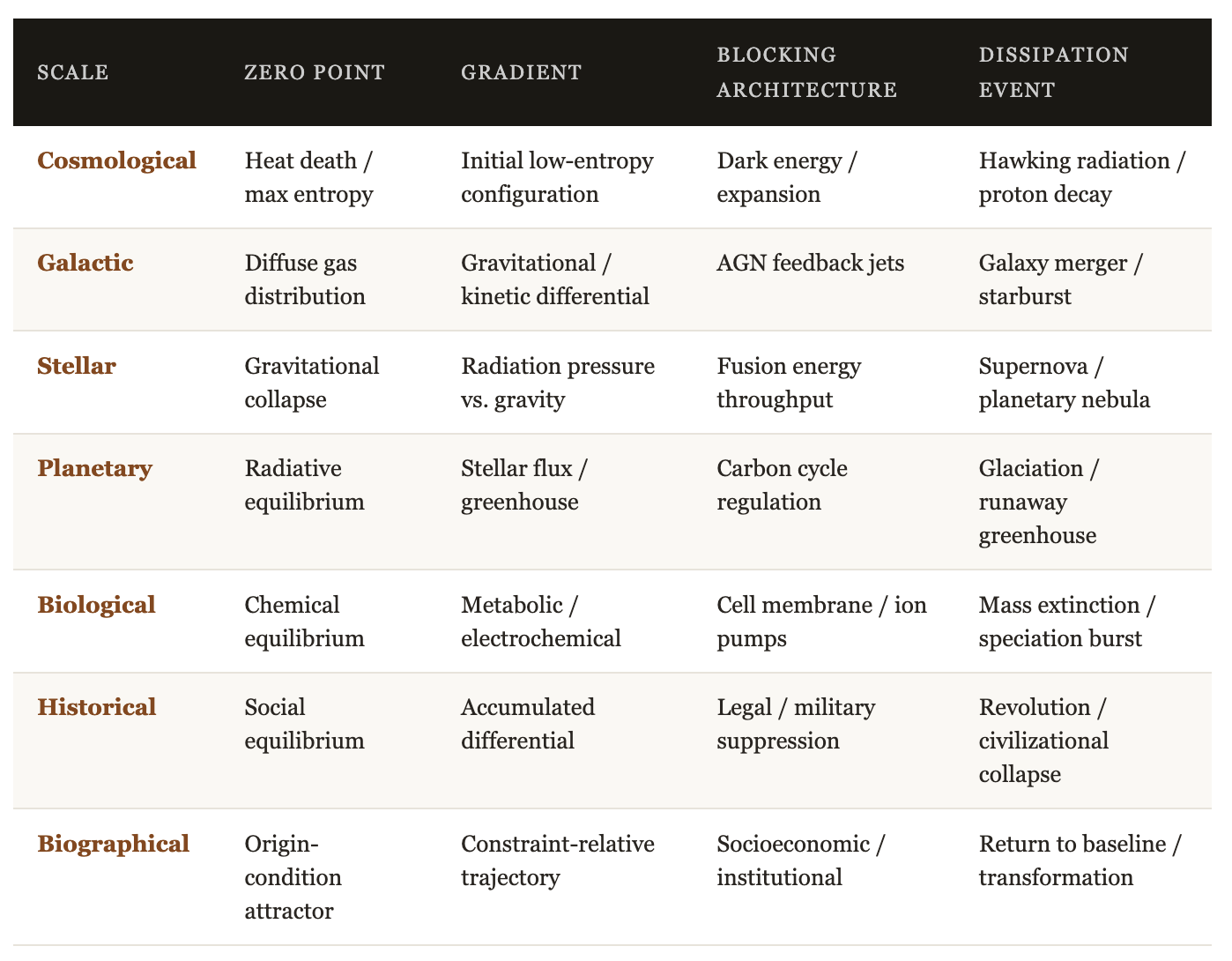
Table note on epistemic status: The terms “zero point,” “gradient,” and “blocking architecture” apply literally at the stellar, planetary, and biological scales — these are thermodynamic quantities in the strict sense. At the historical and biographical scales, they apply structurally: the social and political systems exhibit the same constraint logic — blocked dissipation, nonlinear release, intensity conditioned by holding duration and channel capacity — without operating through the same physical mechanism. The table maps the isomorphism, not an identity. The distinction is the instrument’s precision condition.
Cosmological: Interpretive
Galactic: Interpretive/Structural
Stellar: Literal
Planetary: Literal
Biological: Literal
Historical: Structural
Biographical: Structural
The distinction between literal and structural is not a hierarchy. The structural readings are not approximations of the literal ones. They are applications of the same constraint logic through different physical regimes, warranting different evidential standards and different degrees of predictive confidence. The instrument is calibrated for this variation. The unified presentation maps the isomorphism; it does not assert identity.
The fact that the same operative principle describes organized structure at every scale from the subatomic to the cosmological is not a coincidence. It is the consequence of the second law of thermodynamics operating universally. Every organized structure is a departure from the maximum entropy state. Every departure requires continuous work to maintain. Every blocking architecture that holds a gradient past its thermodynamic deadline is building pressure toward a dissipation event whose intensity is strongly conditioned by the gradient’s magnitude, the holding duration, and the channel capacity available at the moment of release.
The human cases — Coveleski throwing stones at tin cans, Douglass learning the alphabet from hungry boys at the shipyard, Gibson hitting .372 in a league that refused to count his numbers — are not small instances of a large principle. They are the same thermodynamic constraint operating at the biographical scale, at a different resolution and through different mechanisms. Their magnitude is not diminished by the existence of supernovae. It is confirmed by them. The operative principle that makes a supernova enormous is the same constraint that makes a departure from a Shamokin coal mine significant. The framework does not rank them. It measures the constraints under which they persisted.
The accountability that flows from universalization
The extension to cosmological scale does not dissolve human accountability into physical determinism. It sharpens it. At every scale, the blocking architecture is the mechanism that converts a gradient into a catastrophic event rather than a gradual dissipation. At the cosmological scale, the blocking architecture is physics — dark energy, nuclear binding, the speed of light — and no human decision produced it or could change it. At the historical scale, the blocking architecture is organized human decision-making: who passed the Fugitive Slave Act, who built the reserve clause, who suppressed climate science for fifty years, who held the gradient past the point at which gradual dissipation was available. The thermodynamic constraint at that scale is the same constraint. The accountability at that scale is human.
The universe’s initial low-entropy configuration required no agent. The Atlantic slave system’s blocking architecture required agents — specific people, making specific decisions, across specific decades, to build and maintain and reinforce the architecture that held the gradient past its thermodynamic deadline and made catastrophic release increasingly probable. The supernova is physics. The Civil War is physics too, but it is also the consequence of human choices about which channels to open and which to seal. The instrument reads both. It assigns accountability only where accountability applies — at the scales where the blocking architecture is organized human decision-making rather than the geometry of spacetime.
The general theory of magnitude, final statement: Any organized structure, at any scale, is a maintained departure from thermodynamic equilibrium, sustained by continuous energy throughput against restoring forces, for a duration determined by the energy source’s sustainability and the available channel capacity. Its magnitude is measured by its departure distance, its holding duration, and the work done per unit time against the forces opposing it — quantities that are comparable across scales even when the physical mechanisms governing them differ. The dissipation event — when it comes, at whatever scale — can be understood as the gradient finding its channels. The channels that were open determined the form. The channels that were closed determined the intensity. The agents, or forces, or laws of physics that closed the channels are accountable to the gradient they produced. At every scale where decisions are possible, the choice between opening channels gradually and holding the gradient until it finds them catastrophically is real. The thermodynamic outcome is constrained by physics regardless of which choice is made. The form the outcome takes — gradual or catastrophic, distributed or concentrated — is not. That is where the decision lives. That is what accountability means inside a thermodynamic framework.
The storm looks like the cause. The gradient was the cause.
The supernova looks like the event. The stellar lifetime was the event.
The galaxy merger looks like the transformation. The ten billion years of maintained structure was the transformation.
The event is visible history. The gradient is operative history.
At every scale. In every system. Under a common thermodynamic constraint,
expressed through different physical regimes.
Across the full magnitude of what has ever organized itself against entropy
and held, for as long as it could, before the channels opened.
A system does not fail because the event occurs.
The event occurs because the system has already failed to dissipate its gradient gradually.
A life is not measured by where it ends.
It is measured by the distance it held against what acted on it.
A structure is not defined by its appearance.
It is defined by the work required to keep it from disappearing.
This is the same accounting at every scale.
What differs is not the law, but the regime in which it is expressed.
The measurement has always been there.
It has simply not been made.
The Interface: A Theory of Consciousness, Meaning, and Suffering Under the Persistence Condition
The Interface
Axiomatic Formulation
A Theory of Consciousness, Meaning, and Suffering Under the Persistence Condition
I. Foundational Continuity
Axiom 1 — Persistence Condition
All organized systems exist as maintained departure from thermodynamic equilibrium.
Axiom 2 — Regulatory Necessity
Persistence requires continuous regulation of system state under constraint.
Axiom 3 — Capacity Limitation
All regulatory systems operate under finite capacity relative to imposed load.
II. Emergence of the Interface
Axiom 4 — Variable Environment Requirement
Systems in variable environments require flexible regulation rather than fixed response.
Axiom 5 — Self-Model Requirement
Flexible regulation requires the system to model its own state relative to its viability boundaries.
Axiom 6 — Self-Referential Closure
When regulation includes a real-time model of the system’s own regulatory state, the system becomes self-referential.
Axiom 7 — Interface Definition
The interface is the condition in which a regulatory system registers its own state as information.
III. Definition of Experience
Axiom 8 — Experience Identity
Experience is the felt registration of a system’s regulatory state relative to its viability set.
Axiom 9 — No Ontological Addition
Experience is not an additional substance or property; it is regulation as internally registered.
IV. Structure of the Viability Set
Axiom 10 — Viability Geometry
A system’s viability set consists of:
a region of sustainable operation
boundary conditions
an exterior region of failure
Axiom 11 — Phenomenological Mapping
Safety = low load relative to capacity, interior position
Anxiety = predicted approach to boundary
Suffering = load exceeding capacity
Terror = imminent system failure
Joy = registration of expanding capacity under integrated load
V. Meaning and Relevance
Axiom 12 — Meaning Definition
Meaning is the system’s registration of relevance to its viability conditions.
Axiom 13 — Meaning Gradient
Increased viability relevance → increased meaning
Decreased relevance → experienced meaninglessness
Loss of capacity to register relevance → nihilism
VI. Recursive Burden
Axiom 14 — Self-Registration Cost
Self-registration adds recursive load:
the system must regulate both perturbation and awareness of perturbation.
Axiom 15 — Amplification Principle
Awareness of distress increases total regulatory demand.
VII. Distortion
Axiom 16 — Overload Condition
If load + recursive burden exceeds capacity, the system cannot sustain accurate self-registration.
Axiom 17 — Distortion Definition
Distortion is the modification of perceived regulatory state to reduce experienced load.
Axiom 18 — Functional Status
Distortion is a regulatory response, not necessarily an error or pathology.
VIII. Expansion and Constraint
Axiom 19 — Expansion Condition
Capacity increases only through tolerable exposure to load beyond current range.
Axiom 20 — Constraint Boundary
Capacity is plastic but bounded by structural limits.
VIII-b. Agency
Axiom 20b — Agency Definition Agency is the interface’s capacity to feed its own regulatory output back into the system’s behavioral selection, influencing trajectory within constraint.
Axiom 20c — Bounded Directedness Agency is real but constrained by the system’s current organizational capacity.
IX. Social and Relational Extension
Axiom 21 — Shared Viability
When two systems co-regulate, each system’s viability becomes partially dependent on the other.
Axiom 22 — Love Definition
Love is the condition of shared viability between systems.
Axiom 23 — Loss Condition
Loss reduces available regulatory capacity through removal of co-regulation.
X. Witness and Ethics
Axiom 24 — Cross-System Modeling
Self-modeling systems can model the regulatory states of other systems.
Axiom 25 — Witness Definition
Witness is the recognition of another system’s regulatory condition as equivalent in kind to one’s own.
Axiom 26 — Ethical Derivation
Ethics emerges from the recognition of shared viability conditions across systems.
XI. Temporal Extension
Axiom 27 — Temporal Self-Modeling
Self-modeling systems project their own future states, including termination.
Axiom 28 — Knowledge of Death
Awareness of inevitable system failure is a consequence of temporal self-modeling.
Axiom 28b — Temporal Saturation All experience produced by the interface is conditioned by awareness of the system’s finite duration.
XII. Civilization and Externalization
Axiom 29 — Capacity Overflow
The recursive burden of self-awareness exceeds individual regulatory capacity.
Axiom 30 — Collective Necessity
External systems (social, symbolic, cultural) are required to stabilize the interface.
XIII. Art
Axiom 31 — Compression Requirement
The output of the interface must be compressed into forms that can be metabolized by other systems.
Axiom 32 — Art Definition
Art is the compression of experiential magnitude into survivable form.
XIV. Unified Structure
Axiom 33 — Hierarchical Continuity
Persistence (operator)
Regulation (biology)
Self-reference (interface)
Temporal self-modeling (human condition)
Witness (social extension)
Civilization (collective regulation)
Art and archive (externalized compression)
Each level is a consequence of the one below.
Final Statement
The interface is the condition in which a system that must persist becomes aware of the cost of its own persistence.
Experience is that awareness.
Suffering is its overload.
Meaning is its orientation.
Love is its extension.
Witness is its recognition across bodies.
Courage is its refusal to edit itself under load.
Distortion is its protection.
Art is its stabilization.
Everything specifically human occurs at the interface.
The following document is a continuous derivation of the above axioms.
No additional principles are introduced. Only their implications are unfolded. Each axiom is cited by number at its first point of derivation; subsequent uses are implicit.
The Interface
Where the Operator Becomes Experience
A Theory of Consciousness, Meaning, and Suffering
Under the Persistence Condition
The star burns without knowing it burns.
The human burns and knows.
That knowing is the interface.
Everything specifically human happens there.
Preface
Two prior works establish the poles of a single problem.
The Law of Being demonstrates that all organized existence is maintained departure from thermodynamic equilibrium, governed by a single persistence operator across every scale from the subatomic to the cosmological. The General Theory of Magnitude builds the measurement instrument that reads displacement under constraint. Together they establish the operator: the invariant condition under which anything that exists continues to exist.
The Stratified Allostatic Capacity model and its companion paper on identity under constraint demonstrate that human identity, behavior, and distortion are downstream consequences of a bounded organism managing load within finite regulatory capacity. Together they establish the condition: what it is like to be a system that must meet the persistence requirement while aware of itself meeting it.
This document occupies the space between them. It is the theory of the interface: the precise point at which the thermodynamic requirement of persistence becomes the felt quality of being alive. It asks: how does a physical cost become an experience? How does the maintenance of a viability set become love, or dread, or meaning, or suffering? How does the operator, which governs everything and experiences nothing, produce a system that experiences everything it governs?
The answer proposed here is that consciousness, meaning, and suffering are not additional ontological categories layered on top of the persistence operator. They are what the persistence operator looks like from the inside when the system performing it becomes complex enough to register its own regulatory states. The interface is not a bridge between two kinds of thing. It is the fold in a single kind of thing where the operation encounters itself.
This is not a solution to the hard problem of consciousness in the analytic philosophical sense. It is a restatement of the problem that dissolves the framing that made it seem intractable. The hard problem asks: why is there experience at all? The present framework answers: experience is what regulation becomes when the system regulating is also the system being regulated, and the complexity of that self-referential loop exceeds the threshold at which unregistered operation remains viable. Consciousness is not an addition to the physics. It is what the physics requires at a specific level of organizational complexity.
Part One: The Fold
Chapter 1. The Operator Does Not Suffer
Begin with what is absent.
The proton maintains its departure from quark-gluon equilibrium for durations estimated in excess of ten to the thirty-fourth years. It does not experience this maintenance. The cell membrane holds its ion gradient by continuously spending ATP to pump ions against their concentration differentials. It does not feel the expenditure. The star sustains its departure from gravitational equilibrium through fusion for billions of years, and at no point in that sequence does the star register the cost of its own persistence. The gradient accumulating across a century of blocked dissipation does not know itself as a gradient.
At every scale below a specific threshold of organizational complexity, the persistence operator runs in the dark. The work is done. The cost is paid. The maintenance of departure from equilibrium proceeds according to the physics of each regime. But the system performing the work has no internal representation of the fact that it is performing it. The operation and the awareness of the operation are entirely decoupled. There is persistence without experience. There is being without knowing.
This is the default condition of the universe. The overwhelming majority of organized structure persists without any internal registration of its own persistence. Rocks do not know they are configurational systems occupying thermodynamic minima. Hurricanes do not know they are dissipative structures maintaining organized flow through energy throughput. Galaxies do not know they are gravitationally bound systems maintaining spiral structure against dispersal. The operator governs all of them. None of them are aware of it.
The question this document addresses is therefore not: why does the operator exist? That question is answered by the Law of Being. The question is: why does the operator, in one specific class of system, begin to know itself? What produces the fold in the operation where the system doing the work begins to register the work as felt quality?
That fold is what is meant here by the interface. (Axioms 1–3, 7)
Chapter 2. The Threshold of Self-Registration
The threshold is not consciousness in the sense debated by philosophers of mind. It is something more precise and more derivable.
A system that must maintain its viability against entropy has, at the simplest level, two options. It can regulate rigidly: a fixed response to a fixed class of perturbation, requiring no internal model of its own state. The thermostat does this. The bacterial chemotaxis gradient does this. The system responds to deviation from a set point by activating a corrective mechanism. No internal representation is required. The operation is substrate-level: the physics of the system’s organization is itself the regulation.
Or the system can regulate flexibly: variable responses to variable perturbations, selected from a repertoire on the basis of context, prediction, and assessment of current state relative to the viability set’s boundaries. This requires something the rigid regulator does not need. It requires the system to model itself. Not to model the environment alone, but to model its own current position within its own viability set, its own distance from its own boundaries, its own remaining capacity for response.
This is the origin of interiority. Not as metaphysical addition, but as regulatory requirement. (Axioms 4–6)
When a system must track its own state in order to regulate its own persistence, the operation acquires an inside. The model the system builds of itself is not a representation in the philosophical sense of a picture of something external. It is the system’s own regulatory state made available to itself as information. The system begins to register its own distance from equilibrium, its own load relative to its own capacity, its own proximity to its own failure thresholds. This registration is the first form of experience.
Experience, at this level, is nothing more and nothing less than the felt quality of a system’s own regulatory position. It is the internal face of the viability set’s geometry. Being comfortable is being well within the viability set with low load relative to capacity. Being stressed is approaching the boundary. Being overwhelmed is being at or past the boundary. Being terrified is the system’s registration of imminent exit from the viability set entirely.
These are not metaphors applied to feelings. They are what feelings are. The felt quality is the regulatory information. The experience is the system’s self-model in operation.
Chapter 3. Why the Fold Occurs
The fold occurs because the environment is variable and the organism is mortal.
A system operating in a perfectly stable environment can regulate rigidly. The perturbations are predictable, the responses are fixed, the cost of maintenance is constant. No internal model of the system’s own state is required because the state never varies enough to demand variable response. This is the condition of simple biological organisms in stable niches, of configurational systems in unchanging environments, of crystals and certain deep-sea organisms whose ecological conditions have remained effectively constant for hundreds of millions of years.
But a system operating in a variable environment faces a different problem. The perturbations change. The demands shift. What threatened viability yesterday does not threaten it today; what was irrelevant yesterday is critical today. A fixed response repertoire cannot track these shifts without periodic catastrophic failure. The system that can only respond one way to every perturbation will eventually encounter a perturbation that requires the response it does not have. It will exit its viability set and cease to exist.
The evolutionary pressure is therefore toward flexible regulation: toward systems that can assess context, predict demand, select responses from a repertoire, and calibrate those responses to the specific character of the current perturbation. This pressure is not toward consciousness by name. It is toward the self-modeling that consciousness is.
The logic is inescapable. Flexible regulation requires a model of current state. A model of current state, maintained in real time by the system it models, is experience. The system does not develop experience as a luxury or an accident. It develops experience because the alternative, at its level of environmental variability, is death.
The fold is therefore not mysterious. It is the persistence operator’s solution to the problem of regulating in a variable world. When the environment demands flexible response, the system must model itself. When the system models itself, the model has a felt quality. The felt quality is consciousness. Consciousness is regulation made self-referential under environmental pressure. (Axioms 8–9)
The hard problem dissolves not because it is answered but because its framing is revealed as the error. The question was: why does physical process produce experience? The answer is: physical process does not produce experience. Self-referential regulation is experience. There is nothing to produce. There is only the point at which the regulatory loop closes through the system’s own state, and the inside of that closure is what experience is. Asking why the closure has an inside is like asking why a sphere has an interior. The interior is not produced by the sphere. It is constituted by it.
Part Two: What the Inside Contains
Chapter 4. The Phenomenology of the Viability Set
If experience is the felt quality of the system’s position within its own viability set, then the major categories of human experience can be derived from the geometry of that set rather than invented as independent psychological phenomena.
The viability set has a center, boundaries, and an outside. The system’s position relative to these features generates the fundamental categories of feeling. (Axioms 10–11)
Safety is the experience of being well within the viability set, with current load substantially below capacity, and no predicted perturbation approaching the boundary. The system registers this position as the absence of urgency, the availability of flexible response, the felt sense that the demands of the present can be met without extraordinary mobilization. This is not merely the absence of threat. It is a positive regulatory state: the system operating within its optimal range, with surplus capacity available for exploration, play, or expansion.
Anxiety is the experience of the boundary approaching. The system’s self-model registers that current trajectory, if continued, will bring it closer to the limits of its viability set. The perturbation has not yet exceeded capacity, but the model predicts that it might. Anxiety is anticipatory boundary detection. It is the system’s self-model flagging a possible future exit from the viable region before that exit has occurred. Its regulatory function is to mobilize resources preemptively, to shift the system toward responses that will prevent the predicted boundary approach.
Suffering is the experience of being at or past the boundary of the viability set. The system’s self-model registers that current demand exceeds current capacity. The regulatory resources available are insufficient to maintain integrated function. The organism is in the zone where the four breakdown modes activate: avoidance, aggression, dissociation, compulsion. Suffering is not a malfunction. It is the accurate self-registration of a system in regulatory crisis. It feels terrible because it is terrible: the system is failing to maintain its organized state against the forces acting on it, and it knows this.
Terror is the experience of imminent and total exit from the viability set. The system’s self-model registers not merely boundary proximity but the real possibility of system dissolution. The organism is facing what it models as annihilation: the loss of the organized state that constitutes its existence. Terror is the felt quality of the persistence operator approaching its failure condition. It is the most extreme regulatory signal the system can generate because it corresponds to the most extreme regulatory situation: the system is about to cease to exist, and it knows this.
Joy is the experience of the viability set expanding. The system’s self-model registers that capacity is increasing, that the distance from the boundary is growing, that the organism is gaining range it did not previously have. Joy is not the absence of load. It is the registration of successful integration of load: the felt quality of the system growing under demand it can meet. This is why joy and effort are not opposed. The deepest joy arises precisely where the system is working at the edge of its capacity and succeeding, where the regulatory cycle is completing and the viability set is widening in real time. Zone Two, experienced from the inside, is joy.
Each of these experiences is the inside of a regulatory fact. They are not interpretations of the regulatory fact, added after the fact by some meaning-making apparatus. They are the regulatory fact as experienced by the system that is living it. The feeling is the information. The quality of the experience is the content of the self-model. There is no gap between the regulation and the experience for any philosophical puzzle to occupy.
Chapter 5. Meaning as Viability Signal
Meaning is the most discussed and least precisely defined term in the human vocabulary. The present framework defines it with precision.
Meaning is the system’s registration of its own relationship to its viability conditions. (Axiom 12)
Something is meaningful to the extent that it bears on the system’s capacity to persist. This is not a reduction of meaning to survival in the crude biological sense. The human viability set is not defined merely by metabolic continuation. It is defined by the maintenance of integrated function across all the domains the human system operates in: physiological, emotional, cognitive, relational, temporal, symbolic. A threat to any of these domains is a threat to viability in the relevant sense, and the system’s registration of that threat is experienced as meaning.
This explains why certain things feel meaningful and others do not. A relationship feels meaningful because it bears directly on the relational domain of the viability set: the system’s capacity to co-regulate, to share load, to maintain the social conditions under which its own integrated function is possible. The loss of a relationship feels devastating because it is devastating: a domain of the viability set has been damaged, and the system’s self-model registers the damage with the intensity appropriate to the magnitude of the loss.
A person’s work feels meaningful when it engages the system at Zone Two intensity: sufficient demand to require mobilization, insufficient demand to overwhelm capacity, with the result that the regulatory cycle completes and capacity expands. The felt sense of meaning in work is the felt sense of the expansion of the viability set. The system registers that it is growing, that its capacity is increasing, that its distance from the boundary is widening. That registration is experienced as purpose.
Meaninglessness, conversely, is the system’s registration of disconnection from its viability conditions. When nothing in the environment bears on the system’s capacity to persist in the relevant sense, when demand is chronically below the threshold that would engage the regulatory apparatus, when the system is in Zone One, the self-model registers the absence of viability-relevant signal as the absence of meaning. The world feels empty because, at the regulatory level, it is empty: nothing is happening that engages the system’s persistence function.
This is why meaninglessness is so dangerous. It is not merely unpleasant. It is the self-model’s registration of the fact that the organism is in Zone One, where capacity atrophies, regulatory range narrows, and the system’s ability to respond to future perturbation degrades. Meaninglessness feels like dying slowly because it is dying slowly. The system is losing capacity in the absence of the load that would maintain it.
Nihilism, understood through this framework, is not a philosophical position. It is a regulatory diagnosis. The nihilist is a system that has lost contact with its own viability conditions: either because the symbolic infrastructure that once mediated that contact has collapsed without replacement, or because the system’s regulatory capacity has been so degraded by sustained overload that the self-model can no longer accurately register what bears on persistence and what does not. Nihilism is the interface in failure mode: the fold still present, the self-model still operating, but the model returning null where it should return signal.
Chapter 6. Love as Shared Viability
Love is the most consequential phenomenon the interface produces, and the most resistant to prior formalization. The present framework formalizes it.
Love is the condition in which one system’s viability set becomes constitutively dependent on another system’s persistence.
When this condition holds, the self-model of each system includes the other system’s regulatory state as information bearing on its own viability. The other’s suffering registers as a threat to the self’s viability set. The other’s flourishing registers as an expansion of the self’s regulatory range. The boundary between the two viability sets becomes partially shared: what affects one affects the other, not by sympathy or projection alone, but by the actual structural fact that the systems have become co-regulatory.
This is why love is both the highest human achievement and the most dangerous human condition. It is the highest achievement because co-regulation extends the effective viability set beyond what either system can maintain alone. Two systems in genuine co-regulatory relation can carry more load, tolerate more perturbation, sustain more complexity, and recover from more disruption than either can independently. The shared viability set is larger than the sum of the individual sets because the co-regulation itself provides regulatory capacity that does not exist in isolation. This is not a metaphor. It is the biology of attachment: the nervous system that is co-regulated by another nervous system has access to regulatory resources it cannot generate alone. The infant’s nervous system is literally incapable of self-regulation and develops regulatory capacity only through the co-regulatory scaffolding provided by the caregiver. This is the foundational instance of the principle: viability through shared regulation.
It is the most dangerous condition because the dependency is real. When the other system is damaged, lost, or withdrawn, the self’s viability set contracts. Not metaphorically. The loss of a co-regulatory partner is the loss of a component of the system’s own regulatory infrastructure. Grief is not an emotional reaction to the idea of loss. It is the self-model’s registration of the fact that a portion of its own viability architecture has been destroyed. The system is literally less viable than it was before the loss. Its capacity to carry load has been reduced. Its regulatory range has narrowed. The felt devastation of grief is the accurate self-registration of a genuine reduction in the system’s capacity to persist.
The capacity mismatch that the psychological model identifies, where one system’s demand exceeds another system’s sustainable range, is visible here in its full structural form. Love does not guarantee shared viability. It creates shared viability only where the co-regulatory demands fall within both systems’ capacity. Where they do not, love produces the most painful form of the interface’s operation: the system registers that its viability depends on a condition it cannot sustain. It loves what it cannot carry. The self-model reports both facts simultaneously: the dependency is real, and the dependency exceeds capacity. This is the felt structure of impossible love, which is not romantic excess but a precise regulatory description.
Chapter 7. Time and the Knowledge of Death
The interface produces one experience that no other system in the known hierarchy encounters: the knowledge that persistence will end.
Every system governed by the persistence operator will eventually fail. The star will exhaust its fuel. The cell membrane will lose its gradient. The civilization will undergo catabasis. But none of these systems, below the threshold of self-registration, model their own termination. They do not know they will end. They operate until they cannot, and the cessation is registered by nothing internal to the system.
The human system models its own termination. This is the interface’s most extreme product. The self-model, operating with sufficient temporal depth, projects forward to the point at which the viability set will be exited permanently. It registers, as present information, a future state in which the system will no longer exist. The felt quality of that registration is the knowledge of death.
The consequences of this knowledge are total.
Every experience the interface produces is colored by the temporal horizon of its own cessation. Safety is experienced against the background of its impermanence. Love is experienced against the background of inevitable loss. Meaning is experienced against the background of the system’s eventual inability to register meaning at all. The viability set is not merely bounded in the present. It is bounded in time. The organism knows that the set will collapse, that the regulatory capacity will degrade, that the departure from equilibrium will end, and that the interface itself will close.
This is what distinguishes the human condition from the operator absolutely. The operator is timeless in the sense that it governs all systems at all times without experiencing any of them. The human condition is saturated with time because the interface includes temporal self-modeling: the system’s awareness of its own position on its own trajectory toward cessation. The star has a lifetime but does not experience duration. The human has a lifetime and knows it.
Every cultural technology of meaning described in the Law of Being, from myth through symbol through photograph through archive, can now be understood as a response to this specific feature of the interface. The organism that knows it will die needs forms through which that knowledge can be encountered at survivable intensity. This is not a cultural preference. It is a regulatory necessity. The knowledge of death, held at full force without mediation, exceeds the regulatory capacity of any known organism. It is the one piece of information that the self-model generates which the self-model cannot, by itself, metabolize. Every civilization, every religion, every art form, every ritual of mourning and celebration, is an attempt to provide the regulatory infrastructure that the organism needs in order to carry the knowledge that the interface has given it.
The interface creates the problem that civilization exists to solve.
Part Three: The Cost of Knowing
Chapter 8. Suffering as Accurate Registration
The framework requires a restatement of suffering that is neither clinical nor spiritual but structural.
Suffering is the accurate self-registration of a system whose regulatory demand exceeds its currently available capacity. (Axioms 14–16)
This is not a definition that minimizes suffering. It is a definition that takes suffering seriously as information. When a human being suffers, the interface is performing its function correctly. The self-model is accurately reporting that the system is in distress: that load exceeds capacity, that the viability set’s boundary is being approached or breached, that the organized state is under threat. The suffering is not a malfunction. It is the system working as designed, reporting the truth of its own condition.
This has a consequence that most frameworks cannot accommodate. Suffering can be simultaneously accurate, functional, and intolerable. The system can be correctly reporting a genuine regulatory crisis, and the report itself can constitute additional load that the system cannot carry. The interface feeds back into the system it monitors. The awareness of suffering is itself a perturbation that must be regulated. The knowledge that one is in pain is a further source of pain. The registration of distress is itself distressing.
This recursion is the interface’s characteristic danger. At every other scale, regulatory failure is simply failure: the cell membrane loses its gradient, the star collapses, the civilization fragments. The system ceases to maintain its organized state and that is the end of it. At the human scale, regulatory failure is also experienced, and the experience of failure compounds the failure. The system is failing and it knows it is failing and the knowing makes the failure worse. This recursive amplification of distress through self-awareness is the mechanism that makes human suffering qualitatively different from the failure of any other system.
It is also the mechanism that makes human courage possible. The system that can register its own distress can also choose to remain in contact with the source of that distress rather than activating the narrative exit that would reduce perceived load. The fold in the operator where the system knows itself is the same fold that permits the system to hold what it knows rather than reinterpret it away. Courage is the interface operating under maximum load without defaulting to the compensatory regulatory strategies that would reduce accuracy in order to preserve immediate stability.
This is what the psychological model calls Pathway A: capacity expansion through sustained contact with what exceeds current capacity. At the level of the interface, Pathway A is the decision, under full self-registration of the cost, to remain in the zone where growth occurs rather than retreating to the zone where the self-model reports comfort at the price of stagnation. It is the system choosing to let the self-model report accurately even when the report is unbearable.
The opposite choice, Pathway B, is the decision to allow narrative to restructure the self-model’s report. The interface remains active, but its accuracy is sacrificed in favor of tolerability. The system still experiences, but what it experiences has been modified at the level of representation so that the felt demand becomes bearable. The interface folds in on itself: the self-model is now modeling not the system’s actual regulatory state but a revised version that the system can sustain.
Both pathways are consequences of the interface’s existence. A system without self-registration has neither option. It simply fails or doesn’t. The human system, because it knows its own state, can choose between the accurate and the tolerable. That choice is the moral life of the organism.
Chapter 9. The Recursive Burden
The interface imposes a cost that no other scale of the persistence operator carries.
At every other scale, the work of persistence is the work of persistence. The star’s maintenance cost is the fusion energy required to counteract gravitational collapse. The cell’s maintenance cost is the ATP required to hold the ion gradient. The civilization’s maintenance cost is the institutional energy required to regulate collective load. In each case, the cost is commensurate with the demand. The system does the work that the perturbation requires, no more.
At the human scale, the work of persistence includes the work of knowing that one is persisting. The interface adds a recursive layer of cost to every regulatory operation. Every stress response is accompanied by the self-model’s registration of the stress response. Every approach to the viability boundary is accompanied by the experience of approaching the viability boundary. Every regulatory failure is accompanied by the knowledge of the regulatory failure.
This recursive cost is not negligible. It is, in many cases, the dominant source of load.
Consider the person whose relationship is collapsing. The regulatory demand of the relational failure is real: the co-regulatory system is destabilizing, the shared viability set is contracting, the organism’s regulatory infrastructure is losing a component. This is a genuine perturbation requiring genuine regulatory response. But the interface adds to this perturbation the experience of the perturbation: the grief, the fear, the self-doubt, the narrative construction and reconstruction of what went wrong, the anticipation of future isolation, the memory of past security now lost. Each of these experiential layers is itself a load on the regulatory system. The organism is not merely managing the relational failure. It is managing the relational failure plus the experience of the relational failure plus the experience of the experience. The recursive burden can exceed the original perturbation by orders of magnitude.
This is why human suffering is disproportionate to perturbation in ways no external analysis can account for. The event is one thing. The interface’s processing of the event is another. The recursive amplification of the processing through self-awareness is a third. And the organism must regulate all three simultaneously with the same bounded capacity that was already strained by the original event alone.
The recursive burden explains why narrative regulation, described in the psychological model as Pathway B, is so overwhelmingly common. The system is not merely choosing between accurate self-registration and comfortable distortion. It is choosing between a recursive amplification of distress that may exceed its total regulatory capacity and a narrative revision that caps the recursion by providing a stable interpretive frame within which the self-model can operate without spiraling. The narrative exit is not merely easier. In many cases it is the only option that does not end in system collapse.
The interface’s recursive burden is the structural reason why human systems require external regulatory support: co-regulation from other nervous systems, symbolic infrastructure from culture, temporal architecture from civilization. No individual human system has the capacity to carry the full recursive burden of its own self-awareness alone. The interface produces more regulatory demand than the individual organism can meet. The surplus must be carried collectively or it is not carried at all.
This is the derivation, from the interface, of the civilizational necessity established in the Law of Being. Civilization is not optional for a species that has crossed the self-registration threshold. It is the required regulatory infrastructure for managing the recursive cost of knowing. Without it, the interface destroys the organism it informs.
Chapter 10. Distortion Revisited
The psychological model describes narrative exit formation as a regulatory mechanism: the reinterpretation of reality to reduce perceived demand when actual demand exceeds capacity. The interface framework reveals what this mechanism actually is at the deepest level.
Distortion is the interface editing its own output. (Axioms 16–18)
The self-model, confronted with information that the system cannot regulate, the recursive burden of which would exceed total available capacity, revises the information before it reaches the level of conscious registration. The interface does not shut down. It continues to operate. But it operates on modified data. The felt quality of the system’s regulatory position is altered at the level of self-registration so that what reaches awareness is a version of the system’s actual state that the system can tolerate knowing.
This is not lying. It is not even self-deception in the ordinary sense. It is the interface performing triage on its own signal in order to prevent the recursive amplification from collapsing the system entirely. The system is choosing, often below the level of deliberate choice, between two forms of damage: the damage of inaccurate self-registration, or the damage of accurate self-registration that the system cannot survive.
Every defense mechanism catalogued in the psychoanalytic literature, every cognitive bias documented in the behavioral science literature, every form of self-serving interpretation observed in the social psychology literature, is an instance of this operation. The interface editing its own output to prevent the recursive burden from exceeding system capacity. The specific form the editing takes — denial, projection, rationalization, minimization, blame reallocation — depends on the system’s particular organization, its history, its practiced patterns of regulation. But the function is universal and invariant: the interface modulates its own accuracy to preserve the system it monitors.
The moral implications follow from the structure. Distortion is not innocent, because it has real consequences for others and for the system’s own long-term viability. But neither is it freely chosen, because the interface’s self-editing is a regulatory response to a genuine threat of system collapse. Responsibility exists, but it exists within constraint. The person who distorts is a system whose interface is performing triage under conditions that it did not choose and that it may not be able to alter without the kind of capacity expansion that requires precisely the contact with reality the distortion is preventing.
The circularity is the human condition. Growth requires contact with what exceeds capacity. Contact with what exceeds capacity requires the capacity that the contact is supposed to produce. The interface registers this impossibility. It reports, accurately, that the system is caught. And the report of being caught is itself a further load that the system must carry while caught.
How any particular system exits this circularity, if it exits it at all, is the subject of the next chapter.
Part Four: The Possibilities of the Fold
Chapter 11. Expansion at the Interface
The interface does not only impose cost. It also creates the unique possibility of directed self-modification.
A system without self-registration cannot participate in its own reorganization. It can be reorganized by external forces, by environmental pressure, by the slow blind process of selection. But it cannot direct its own reorganization because it has no model of its own state relative to which reorganization could be oriented. The bacterium does not decide to evolve. The star does not decide to fuse heavier elements. The system changes because the conditions change, and the system’s response to the changed conditions is governed by the physics of its substrate, not by any internal assessment of where it is and where it might go.
The human system, because it models its own regulatory state, can orient its behavior toward the modification of that state. It can identify, through the self-model’s output, that it is operating near the viability boundary. It can recognize, through the temporal extension of the self-model, that current patterns will lead to boundary approach. It can select, from its available behavioral repertoire, responses aimed at expanding the viability set rather than merely preserving it.
This is what agency is. Not the uncaused cause that libertarian free will requires. Not the mere output of deterministic process that eliminativism describes. Agency is the interface’s capacity to feed its own output back into the system’s regulatory choices in a way that influences the trajectory toward or away from the viability boundary. It is real, because the feedback loop is real and its effects are measurable. It is constrained, because the feedback loop operates within the system’s existing organization and cannot exceed the capacity that organization provides. (Axioms 19–20)
The expansion of capacity described in both prior works, graded load plus recovery plus integration, is the interface’s directed version of what happens undirected at every other scale. The muscle grows because the load demanded growth and recovery permitted it, but the muscle did not choose to grow. The human system can choose to seek load, can choose to permit recovery, can choose to engage in the integrative work that consolidates new capacity. These choices are themselves constrained by the system’s current organization, but they are not thereby eliminated. The interface makes possible, within constraint, the directed participation of the system in its own expansion.
This is the precise location of human dignity in the framework. Not above constraint. Not outside the operator. Not in some privileged domain exempt from the thermodynamic requirement. Dignity is located at the fold: at the point where the system’s self-registration permits it to participate in determining how it meets the persistence requirement rather than merely having the requirement met through it. The system cannot escape the operator. It can, within limits, choose how it responds to the operator. That choice, bounded as it is, is what distinguishes the human condition from every other instantiation of the persistence function.
Chapter 12. Witness
The interface produces one capacity that has no parallel at any other scale of the persistence hierarchy.
A system with a self-model can model not only itself but other self-modeling systems. The human organism, because it registers its own regulatory state as felt quality, can recognize that other organisms are doing the same. It can model their viability sets, their distance from their boundaries, their load relative to their capacity, their suffering and their courage. It can do this because it has the template: its own experience of being a system under constraint provides the model through which other systems under constraint become legible.
This capacity is witness. Not observation, which is available to any perceptual system. Not measurement, which is available to any calibrated instrument. Witness is the registration, by one self-modeling system, of another self-modeling system’s regulatory condition, with the recognition that what is being registered is of the same kind as one’s own experience.
Witness is the interface recognizing itself across the gap between organisms. (Axioms 24–25)
The ethical implications are direct and structural. If suffering is the accurate self-registration of a system in regulatory crisis, and if witness is the capacity to register another system’s regulatory crisis through the template of one’s own, then the ethical demand is not an additional imposition on top of the physics. It is generated by the physics. The system that can register another system’s suffering is a system for which that suffering is information bearing on its own viability, because the systems are co-regulatory, because the capacity for witness binds them into a shared viability space, because the recognition of shared condition is itself a regulatory bond that, once formed, makes the other’s persistence a component of one’s own.
Ethics is not a cultural invention imposed on a morally neutral biology. Ethics is what the interface produces when it encounters itself in another organism. The moral demand is the interface’s registration of the fact that the other system’s viability set is as real as one’s own, that the other system’s suffering is of the same kind as one’s own, and that action which damages the other system’s viability set is action that damages the shared viability space within which one’s own persistence occurs.
The degradation of ethical capacity under allostatic load, demonstrated in the biological grounding of the Law of Being, is now fully derivable. Witness requires surplus regulatory capacity: the system must have enough capacity to regulate its own state and also model the state of another. When the system’s own load approaches or exceeds its own capacity, the resources available for witness degrade. The self-model narrows to the system’s own regulatory emergency. The other’s suffering becomes less legible, less registered, less real. Dehumanization under stress is not a moral failure. It is the interface losing the capacity for witness under conditions where all available resources are consumed by the system’s own regulatory crisis. The capacity for witness is real. It is also conditional on the system having the regulatory surplus to sustain it.
The General Theory of Magnitude’s concept of disjection is, at the level of the interface, the systematic failure of witness at civilizational scale. The disjected person is a person whose regulatory condition is not registered by the systems that have the capacity to register it, because those systems’ measurement architectures are not designed to model constraint from below, because the interface, at the institutional level, has been structured to edit out the signal that would make the disjected person’s departure from equilibrium legible. Disjection is not merely a measurement failure. It is a failure of witness: the civilizational interface has been organized to prevent the recognition that the instrument would produce.
Chapter 13. Art as Interface Technology
Art is now fully derivable.
The interface produces experience that the system cannot always regulate by itself. The knowledge of death exceeds individual regulatory capacity. The recursive burden of self-aware suffering can spiral past what the organism can carry. The magnitude of certain encounters, certain losses, certain truths about the human situation, cannot be held at full force by the individual nervous system. The interface reports these truths. The organism cannot always metabolize what the interface reports.
Art is the set of technologies by which the interface’s output is compressed into a form that other interfaces can encounter at survivable intensity. (Axioms 31–32)
The novel compresses the full magnitude of a human life into a form that can be encountered in hours rather than decades. The painting compresses the felt quality of a perceptual encounter into a form that holds still long enough to be metabolized. The symphony compresses the temporal arc of emotional experience into a form whose duration is calibrated to the regulatory cycle of the listening organism. Each of these operations is a version of the persistence operator’s fundamental function, bounded compression, applied specifically to the problem of making the interface’s own output survivable.
The photograph, as the Law of Being establishes, is the decisive development in this sequence because it compresses with minimal interpretive mediation. It holds experience in indexical form rather than translating it into symbolic form. The interface encounters, in the photograph, something closer to the actual felt quality of the original experience than any prior technology permitted. This is why the photograph is a species-level mutation: it changes what the interface can encounter, and therefore what it can metabolize, and therefore what the organism can carry.
Art, in the present framework, is not an optional cultural production. It is the regulatory technology that the interface requires in order to sustain itself. Without art, the interface’s output accumulates as unmetabolized experience: the recursive burden grows, the knowledge of death remains unmediated, the magnitude of the human situation exceeds the organism’s individual capacity to carry it. Art is what prevents the interface from destroying the organism it serves.
The history of art is therefore the history of the interface developing technologies adequate to its own output. From myth to poetry to sculpture to tragedy to novel to photograph to cinema: each stage is the interface inventing a new means of compressing its own product into a form that the organisms bearing the interface can survive encountering. The trajectory is toward decreasing mediation and increasing directness, because the interface’s own development across the species’ history has increased the intensity and the range of what it registers. The art must keep pace with the interface’s expanding awareness or the gap between what the system knows and what it can bear to know widens until the system fragments.
This is the present crisis described by the Law of Being, restated at the level of the interface: the species’ self-registration capacity has outpaced its art. The interface is producing more awareness than the available regulatory technologies can metabolize. The result is the civilizational condition of unprocessed knowing: a species that sees more than it can carry, registering its own situation with an accuracy that its symbolic and aesthetic infrastructure can no longer render survivable.
Part Five: The Unified Account
Chapter 14. The Three Documents as One
The architecture is now complete and can be stated as a unity.
The Law of Being establishes that all organized existence is maintained departure from thermodynamic equilibrium, governed by a single persistence operator, demonstrated at every scale from the subatomic to the cosmological. This is the operator. It is what existence requires.
The Stratified Allostatic Capacity model establishes that human identity, behavior, and distortion are downstream consequences of a bounded organism managing load within finite regulatory capacity. This is the condition. It is what it costs to meet the requirement while embodied in a biological system.
The Interface establishes that consciousness, meaning, suffering, love, courage, witness, and art are consequences of the persistence operator producing a system complex enough to register its own regulatory states. This is the fold. It is what it is like to know the cost while paying it.
Together:
The operator creates the condition. The condition lives the operator. The interface is where the living knows itself.
These are not three separate claims. They are one claim stated from three positions.
Every specifically human phenomenon is located at the interface. Meaning is the felt registration of viability conditions. Love is shared viability. Suffering is accurate registration of regulatory crisis. Courage is remaining in contact with what the self-model reports when the report exceeds what the system can comfortably bear. Distortion is the interface editing itself to prevent recursive collapse. Art is the compression of the interface’s output into forms that other interfaces can survive. Ethics is the interface recognizing itself across the gap between bodies. Civilization is the regulatory infrastructure required to sustain organisms that carry the recursive burden of self-awareness.
Within the present framework, these phenomena are derivable as consequences of the persistence operator under conditions of self-registration. The human condition is not a departure from physics. It is what physics produces when it becomes complex enough to fold back on itself.
Chapter 15. The Full Hierarchy
The complete architecture of organized existence can now be stated as a single hierarchy, each level a consequence of the one below it.
Level 1: The Operator. All organized existence is maintained departure from thermodynamic equilibrium. This is the Law of Being. It governs everything. It experiences nothing.
Level 2: The Regulation. Living systems maintain their departure through active regulatory work: metabolism, allostasis, the continuous correction of the system’s state against perturbation. This is biology. It adds complexity to the operator but no interiority.
Level 3: The Interface. Regulatory systems in variable environments develop self-models to enable flexible response. The self-model has a felt quality. That quality is experience. This is consciousness. It adds interiority to regulation.
Level 4: Temporal Self-Modeling. Self-modeling systems with sufficient neural complexity extend their self-model across time: they remember, they anticipate, they project their own cessation. This produces the knowledge of death, the experience of duration, and the need for meaning as a regulatory mechanism against temporal awareness. This is the specifically human condition.
Level 5: Witness. Self-modeling systems that model other self-modeling systems generate the capacity for recognizing shared condition across the gap between organisms. This produces ethics, love, and the possibility of co-regulation. This is the social condition.
Level 6: Civilization. The recursive burden of self-aware mortality exceeds individual regulatory capacity. The surplus must be carried collectively through symbolic, ritual, temporal, and institutional infrastructure. This is the civilizational condition, derived from the interface’s cost rather than from political or economic first principles.
Level 7: Art and Archive. The interface’s output must be compressed into forms that other interfaces can encounter at survivable intensity and that persist beyond the death of the organism that produced them. This is cultural production, derived from the interface’s need to externalize and transmit what it cannot hold alone.
Each level is a consequence of the level below it. No level can be understood independently of its derivation from the persistence operator. No level requires any ontological primitive not already present in the seven axioms of the Law of Being.
Chapter 16. Closing Statement
The operator governs everything. It experiences nothing.
The interface experiences everything. It governs nothing.
Between them is the human situation: a system that must meet a requirement it did not choose, under conditions it did not design, with awareness it cannot shut off, for a duration it knows is finite.
This is not tragic in the sense of something that should not have happened. It is the necessary consequence of the persistence operator producing a system complex enough to register its own operation. The fold could not have been otherwise given the environmental variability that demanded flexible regulation. The knowledge of death could not have been avoided, given the temporal depth of the self-model required for that flexibility. The suffering could not have been eliminated, given the recursive burden that self-registration imposes. The need for love, for meaning, for art, for civilization could not have been optional, given the magnitude of what the interface reports and the finitude of the individual organism’s capacity to carry it.
Everything that makes human life specifically human is derivable from this structure. Not as reduction. Not as mechanism eliminating meaning. As the demonstration that meaning, love, suffering, courage, witness, and art are what the universe produces when it becomes complex enough to know what it costs to exist.
The operator creates the condition. The condition lives the operator. The interface is where the living knows itself.
The star burns without knowing it burns.
The human burns and knows.
This document is about the knowing.
What persists exists. What knows it persists, suffers, and loves. That knowing is the interface. Everything specifically human happens there.
Foundation: The Law of Being & The General Theory of Magnitude
I. The Core
To exist is to persist against equilibrium.
Magnitude is the requirement of that persistence.
II. Operator Identity
All systems that persist perform the same operation:
the maintenance of structure against forces that would dissolve it.
This operation is invariant.
What differs is the substrate through which it is realized.
In physical systems, persistence is maintained through energy exchange and force balance.
In biological systems, through metabolism and regulation.
In human systems, through effort under constraint.
In social systems, through institutions and controlled flows.
These differ in mechanism.
They do not differ in function.
Operator identity requires equivalence of operation, not equivalence of variables.
Where this operation is present, structure persists.
Where it fails, structure dissipates.
III. The Condition
All systems tend toward equilibrium.
Left unopposed, structure dissolves.
Nothing exists by default.
Everything that exists is being held.
IV. The Structure of Existence
Any system that exists satisfies three conditions:
it is not at equilibrium
its structure persists over time
that persistence requires continuous input
This is not a property of some systems.
It is the condition of all systems.
V. The Measure
Magnitude is the requirement to sustain non-equilibrium persistence over time.
It resolves to three coupled quantities:
distance from equilibrium
duration of persistence
the rate of required input to maintain that distance over that duration
These are not independent variables.
They are different expressions of the same requirement.
Magnitude is not what something is.
It is what must be expended for it to remain.
VI. Invariance Across Scales
The structure does not change across domains.
Only the mechanism changes.
A star persists against gravitational collapse through fusion.
A galaxy maintains structure through gravitational relation and motion.
A planet maintains thermal and chemical gradients through energy exchange.
An organism maintains organization through metabolism.
A human life maintains trajectory under constraint through effort.
A civilization maintains structure through systems that regulate internal flows.
Form differs.
Condition does not.
VII. Mis-measurement
Systems are typically evaluated by outcomes, positions, or visibility.
These measure what appears.
They do not measure what was required.
Two identical outcomes may represent different magnitudes.
Outcome records what happened.
Magnitude records what was required for it to happen.
These are not equivalent.
VIII. Illegibility
Not all holding is recorded.
Some systems persist outside the conditions that allow them to be measured.
Absence of record does not indicate absence of magnitude.
It indicates unobserved requirement.
IX. Gradient
Systems exist in relation.
Differences in state produce gradients.
Gradients generate pressure.
Constraints determine how that pressure can move.
Persistence occurs within these conditions.
X. Failure
No system persists indefinitely.
Failure is not the moment of visible breakdown.
It is the loss of the ability to maintain structure.
What follows is the release of accumulated constraint.
The visible event is not the cause.
It is the consequence of prior inability to sustain the required holding.
XI. Large-Scale Form
At scale:
gradients accumulate
constraints restrict release
pressure increases
Systems fail when the requirement to sustain structure exceeds available capacity.
Collapse is delayed dissipation.
XII. Unified Statement
All systems tend toward equilibrium.
What exists is what persists against it.
All persistence requires continuous input.
Magnitude is the requirement of that persistence.
When the requirement can no longer be met, the system dissipates.
XIII. Final Form
What persists exists.
Magnitude is the cost of that persistence.
Everything else is an instance of this condition.
Appendix
Additional passages & variants
Additional passages / variants — from local manuscript: untitled folder/new era works/complete works/magnitudegeneraltheorywithpart8.docx (2026-04-02)
Audit note (2026-10-19): the passages below occur in this source but were not found elsewhere in the archive; appended so that the source is fully represented. Ellipses […] mark where already-present text was skipped.
HYPERLINK "https://davidbussellarchive.substack.com/"
david’s Substack
The General Theory of Magnitude
Constrained Dissipation as the Operative Principle of Universal Order
david bussell
Apr 02, 2026
HYPERLINK "https://substackcdn.com/image/fetch/$s_!-JqV!,f_auto,q_auto:good,fl_progressive:steep/https%3A%2F%2Fsubstack-post-media.s3.amazonaws.com%2Fpublic%2Fimages%2Fd46e696e-89f4-4025-a41b-982a1e32fbb6_1410x2250.png"
Book 1. The Disjected
The Physics of the Forgotten: a formalization of historical memory
HYPERLINK "https://substackcdn.com/image/fetch/$s_!2eRC!,f_auto,q_auto:good,fl_progressive:steep/https%3A%2F%2Fsubstack-post-media.s3.amazonaws.com%2Fpublic%2Fimages%2Fef49a5ff-94a8-4931-a017-1478aa964e8d_1410x2250.png"
FIRST ACT. The Mines Below: What Baseball Cannot Count
The architecture of human life under the physics of constraint
HYPERLINK "https://substackcdn.com/image/fetch/$s_!JPp2!,f_auto,q_auto
[…]
For Bonds 2001–2004, the inputs are disputed, entangled with the broader collapse of the sport’s drug-testing architecture, and unresolved in any satisfying way by the historical record.
What the framework tells us is that a 362 OPS+ — a state that far from equilibrium — required an energy source commensurate with its distance from the mean. Whatever that source was, it was extraordinary. The number itself is a kind of fingerprint of how much maintenance the departure required.
· · ·
Why the Nonlinearity Matters
One of the underappreciated features of these normalized stats
[…]
was this life, and what happened when the career energy was removed?
HYPERLINK "https://substackcdn.com/image/fetch/$s_!LDBw!,f_auto,q_auto:good,fl_progressive:steep/https%3A%2F%2Fsubstack-post-media.s3.amazonaws.com%2Fpublic%2Fimages%2Fcf4eb1df-9347-415e-b93f-5124ab64fea0_1380x1600.png"
The table reads as physics
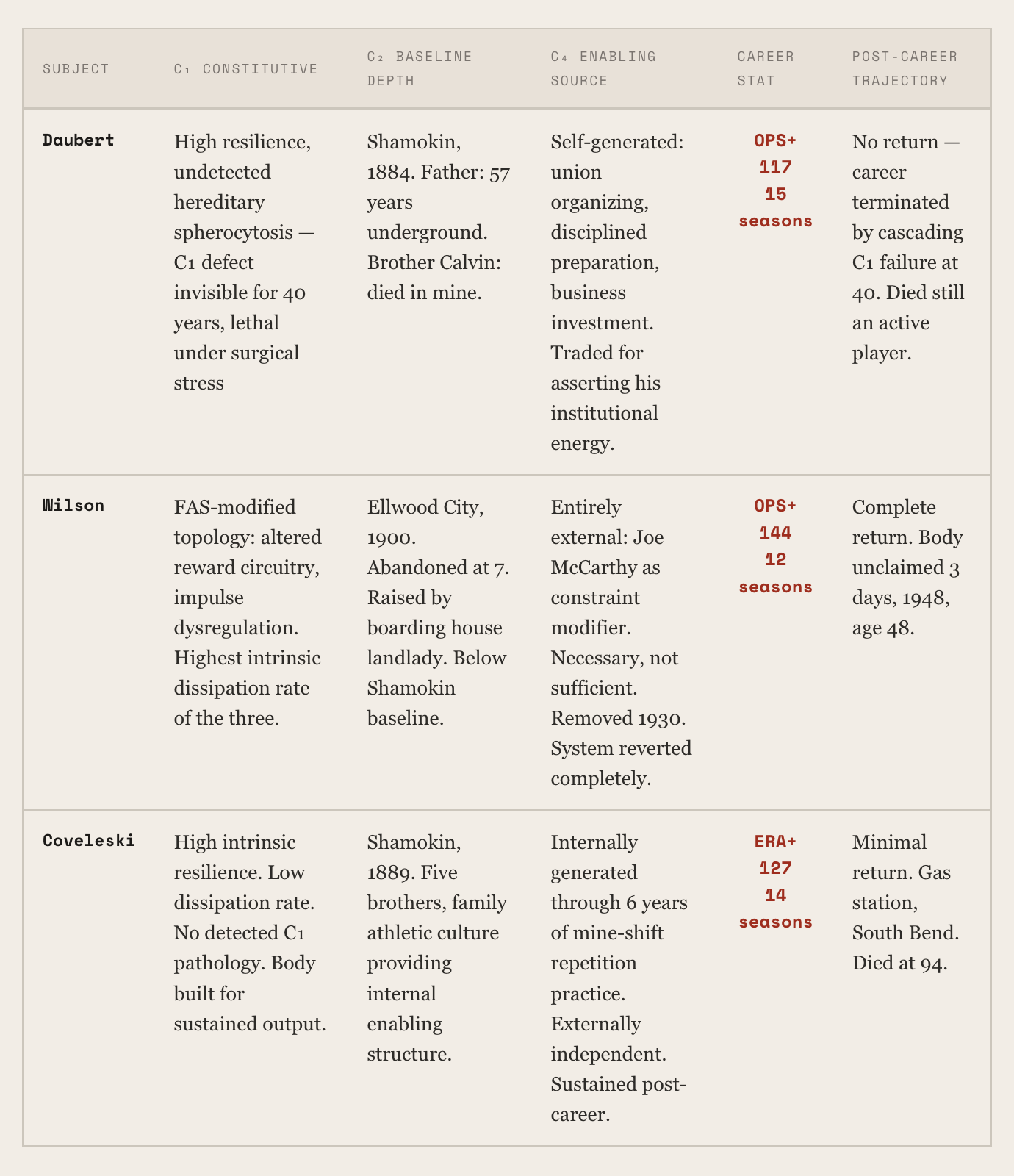
[…]
media.s3.amazonaws.com%2Fpublic%2Fimages%2F295781ad-d74f-4968-8aee-9d3902dd1002_1412x1844.png"
Part 3. The Constraint That Had a Name
HYPERLINK "https://substackcdn.com/image/fetch/$s_!fsBU!,f_auto,q_auto:good,fl_progressive:steep/https%3A%2F%2Fsubstack-post-media.s3.amazonaws.com%2Fpublic%2Fimages%2F04c22746-766d-4e5d-b1a5-9b5174106d44
[…]
throwing games are discussed and does not promptly tell his club about it, will ever play professional baseball.”
Jackson had told his club. The club had told him to be quiet. The record on this point is clear, and Landis chose to ignore it. What Landis was enforcing was not the rule Jackson had violated — Jackson had tried to comply with the rule, had been suppressed by the owner the rule was designed to protect, and had in any case performed at .375 with zero errors in the most closely scrutinized games of the era. What Landis was enforcing was the rule that the institution of professional baseball required that someone be punished, and that the someone had to be a player.
Jackson could not read the newspapers that
[…]
names and dry cleaning businesses and liquor stores and impromptu lessons for children in a neighborhood that still remembers him.
The quantity that mattered most cannot be put in Cooperstown. It cannot be put in the statistics. It can only be recovered by reading the trajectory as it was: from a mill floor in Greenville in 1894 to a Series-record twelve hits in 1919, through a ban he couldn’t read and a verdict he didn’t need, to a house he owned on East Wilburn Street where the children came to learn baseball from the man with the greatest swing anyone had ever seen.
The number that belongs beside his name is 170. It is the distance from the equilibrium. It is not the distance from the mill. Only the life measures that, and
[…]
to know me. A lot of them don’t.”
He knew exactly what had been done to him. He spent thirty years living past it anyway. That is the measurement that remains when everything else is taken: not where he stood, but how far that was from where he started
[…]
mechanism that generates all departure from the MaxCal path.
Most systems decompress through the denial architecture. The symbolic systems, heroism projects, cultural immortality bids, and accommodating behaviors that Ernest Becker catalogs are not failures or weaknesses. They are the standard decompressive outlet for organized existence — dispersed, diffuse, unconscious
[…]
floor at five cents an hour, the horizon of a life that is already fully legible at twelve years old.
Direct perception of the entropic gradient concentrates decompressive energy. It makes the dispersal channels unavailable because the organism now cannot not see what those channels lead to. The energy becomes directional. It flows with force rather than diffusing across a thousand small accommodations.
And in the hardest cases — the deepest zero points, the most constrained starting positions — the question of where the concentrated energy goes requires almost no further account. There was one door that was not the mine. The energy went through it. Baseball was not chosen from among alternatives. It was the only available non-dissolution channel for a body with those specific capabilities in that specific place at that specific time. The Saturday circuit paid more per hour than the mine. That was the entirety of the available gradient. The decompressive energy flowed there the way water flows downhill — not because of perception or will or heroic individual choice but because that was the only opening in the constraint surface that led somewhere other than the absorbing state.
The mechanism complete:
The half-life creates pressure. The pressure forces decompression. The denial architecture manages it diffusely in most systems. In systems where the material conditions strip away the denial architecture — where the dissolution is too present, too concrete, too immediately visible to be symbolically managed at distance — direct perception concentrates the decompressive energy. That concentrated energy flows through the only available non-dissolution channel. In the most constrained cases that channel is singular and deterministic. In less constrained cases the perception account does more work — the specific constitutive topology of the organism determines which channel registers as available and at what resistance. But in both cases the departure is not a free choice against the gradient. It is the gradient finding its opening.
The surprisal of the departure is therefore a precise function of how completely the denial architecture was stripped away and how narrow the available channel was. The most improbable departures occur from the most severe constraint environments not despite that severity but because of it. The severity is what strips the denial architecture. The stripping is what
[…]
2Fimages%2F67d1201b-74c2-45f2-9b6e-9691f5788bdc_1024x669.jpeg"
HYPERLINK "https://substackcdn.com/image/fetch/$s_!DoBF!,f_auto,q_auto:good,fl_progressive:steep/https%3A%2F%2Fsubstack-post-media.s3.amazonaws.com%2Fpublic%2Fimages%2F25c4743b-3d74-44b6-be36-8a636ca1c1ed_1024x731.jpeg"
Between 350 and 500 million children currently live in

[…]
and blind to the work done in the dark.
HYPERLINK "https://substackcdn.com/image/fetch/$s_!HjwP!,f_auto,q_auto:good,fl_progressive:steep/https%3A%2F%2Fsubstack-post-media.s3.amazonaws.com%2Fpublic%2Fimages%2F8c705fcc-760e-42e4-b573-e7e050fb4bd8_722x891.jpeg"
Stanislaus Koveleski threw stones at tin cans in

[…]
an energy source of previously unimaginable magnitude. The gradient it created was not initially between social classes — it was between the energy density of the new fuel and the energy density of everything that had powered human civilization before it.
That differential was transformative in a specific thermodynamic sense
[…]
the industrial transition reveals:
When a new energy source becomes available — one that fundamentally changes what is productive and what is possible — it does not automatically reorganize social systems to distribute the new energy’s benefits. It tends to steepen the existing gradients. The people who had the capital and institutional position to control access to the new energy source captured the differential. The gradient between capital and labor in an industrial economy is steeper than in an agricultural economy, not because industrial capitalism is more exploitative in principle, but because the energy differential it was operating on was larger. More energy available at the top of the gradient means more pressure at the bottom.
This is the general rule the industrial transition establishes: energy phase transitions tend initially to steepen social gradients before the new energy’s distribution is reorganized to reduce them. The steepening produces the blocking architecture, the blocking architecture produces the lag, the lag produces the accumulation, and the accumulation tends to produce the dissipation event.
We are inside another energy phase transition right now. The digital and AI transition is doing to the information economy what coal did to the agricultural economy: concentrating the differential in the hands of the people who control the infrastructure, steepening the gradient between capital and labor in ways that the existing political architecture was not designed to address. The gradient is building. The blocking architecture is under construction.
Epoch Three: The European Imperial System, 1492–1945
Gradient Profile: Global Extraction at Civilizational Scale
The European imperial system was the most spatially extensive extraction operation of the early modern and modern world. It created a gradient between the energy of the extracted territories — their land, their labor, their mineral wealth, their agricultural productivity — and the energy returned to those territories in exchange.
That exchange was structured to keep the gradient steep. Infrastructure was built to serve extraction, not development: to move commodities from interior to coast, not to connect populations to each other or to opportunity. Legal systems protected the property of the extractors and criminalized resistance.
The gradient this produced was not only economic. It was epistemic. The imperial system declared indigenous knowledge illegitimate, constructed the ideological architecture of racial hierarchy that provided the gradient’s justification, and designed that justification to make the energy gradient appear natural — the product of inherent qualities of the populations involved rather than of four centuries of organized extraction.
This is the deepest form of the blocking architecture: when the system manages to make the gradient itself invisible by attributing it to nature rather than to structure, the people living at the bottom of the gradient cannot read what is being done to them in thermodynamic terms. The decolonization movements of the twentieth century were, in thermodynamic terms, a reading of the gradient made politically legible. They did not create the gradient. They named it. And naming it was the first operation required before the channels could open.
The specific dissipation event:
The European imperial system’s primary dissipation event was, paradoxically, the First and Second World Wars. The competition over who would control the extraction infrastructure — the colonial territories, the trade routes, the resource access — produced a gradient
[…]
European global dominance. The colonial powers emerged from 1945 too depleted to maintain the extraction infrastructure at the level required to hold the gradient. The Indian independence movement was not news to the British government in 1947. What changed between 1930 and 1947 was not the gradient. It was Britain’s capacity to maintain the blocking architecture against it.
The post-colonial world is a system in partial reorganization following an incomplete dissipation. The gradient between the former extractors and the former extraction territories has not resolved. It has reorganized — from direct colonial administration to debt architecture, trade regime asymmetry, intellectual property systems, and the continued draining of talent and capital from the periphery to the center.
Epoch Four: The American Racial System, Reconstruction to Present
Gradient Profile: Incomplete Dissipation
[…]
Then the blocking architecture was rebuilt.
The Compromise of 1877 — under which federal troops were withdrawn from the last Southern statehouses in exchange for Southern Democrats accepting Hayes’s contested election — ended the federal protection that had allowed Reconstruction to proceed. The Supreme Court’s 1883 decision gutting the Civil
[…]
The Gradient in the Life, the Life in the Gradient
The biographical cases of the first two acts were individual readings of gradients that the epoch-scale analysis now frames.
Coveleski and Daubert and Wilson and Jackson were not just individual systems departing from individual equilibria. They were probes inside a larger pressure system — the industrial economy of the American Northeast at a moment when the gradient between capital and labor was steepening, when the reserve clause and the company town and the child labor system were pieces of a blocking architecture holding a configuration that the energy of the workers inside it was continuously pressing against. Their disjection scores were measurements of the larger gradient’s steepness.
Greenberg was a probe inside the antisemitic gradient of the 1930s, a gradient that was building toward the catastrophic dissipation event of the Holocaust — a dissipation of genocidal violence that was the Nazi system’s attempt to resolve its internal gradient by eliminating rather than releasing the pressure. That this strategy cannot work in thermodynamic terms — that the gradient exists in the structure, not in the people, and that eliminating the people does not eliminate the gradient, only produces a new and deeper one — is the lesson the twentieth century paid for in the most terrible currency available.
Robinson and Gibson and Paige and Bell were probes inside the American racial gradient — inside a pressure system that the Civil War had partially opened and Reconstruction had allowed to begin dissipating and Jim Crow had sealed again. Their extraordinary performances inside that sealed system are readings of gradient steepness: they were doing what they did against a blocking architecture consuming enormous system energy to hold them out of the measurement system, and the disjection those performances represent is a direct measurement of how much
[…]
Book 3. The General Theory of Magnitude
Constrained Dissipation as the Operative Principle of Universal Order
HYPERLINK "https://substackcdn.com/image/fetch/$s_!ENHB!,f_auto,q_auto:good,fl_progressive:steep/https%3A%2F%2Fsubstack-post-media.s3.amazonaws.com%2Fpublic%2Fimages%2Fc44ce2a2-7cb8-440c-a4c5-d7714c960409_1410x2250.png"
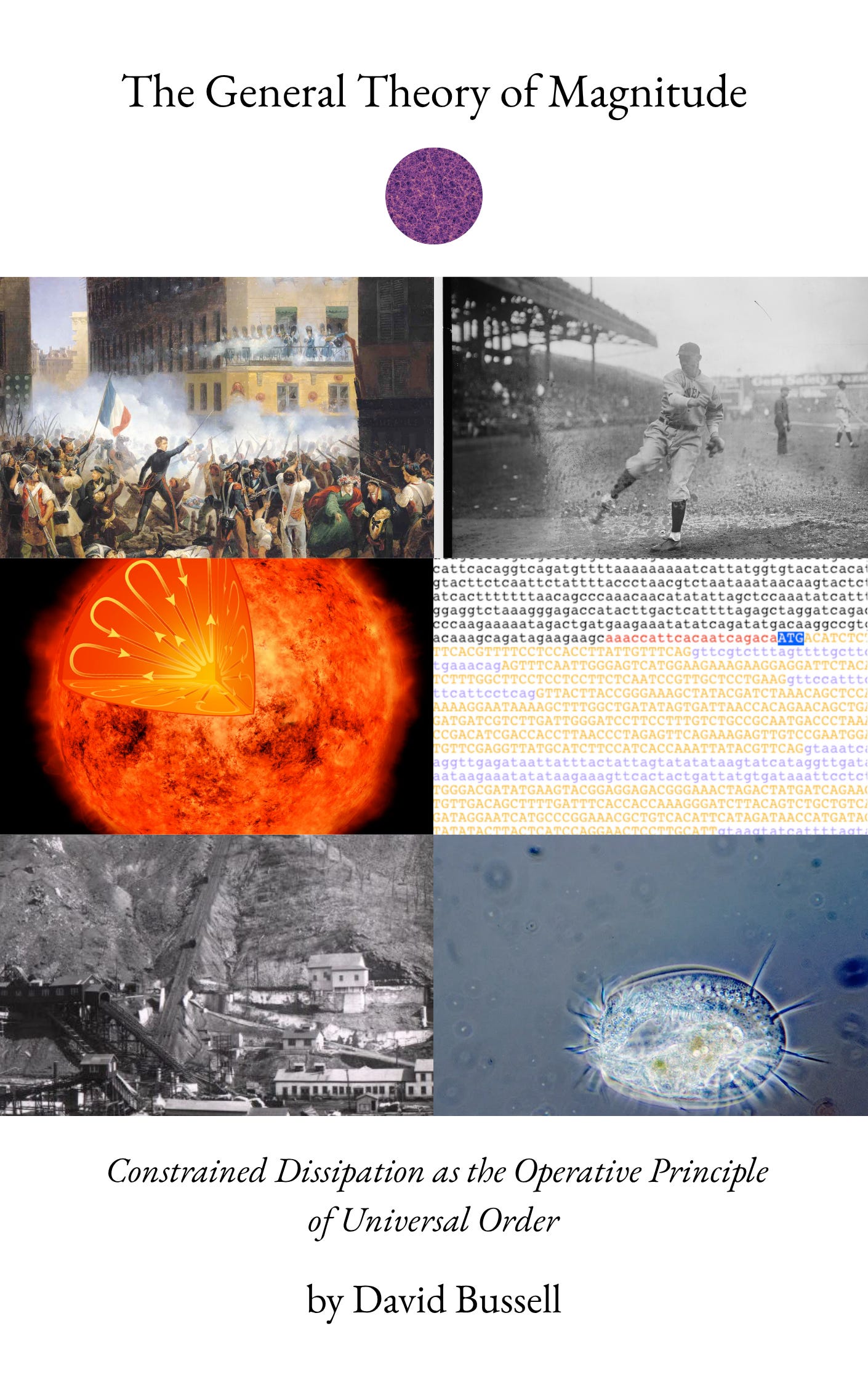
The storm
[…]
of the organized matter that the filaments still hold.
Cosmological blocking architecture — a precision: Dark energy — the energy of the vacuum itself, driving the accelerating expansion of space — is the most consequential channel-modifying condition the instrument has encountered at any scale. A terminological clarification is required here: dark energy does not suppress dissipation in the way a cell membrane or a fugitive slave act suppresses it. It changes the geometry through which dissipation occurs — stretching the channels rather than closing them. This makes it structurally distinct from the blocking architectures at other scales, which are organized systems that actively hold a gradient by expending energy, deplete their own energy sources, and can consume themselves from within. Dark energy requires no agent, depletes nothing, and is not subject to the self-undermining dynamic that governs every other blocking architecture in this framework. It is the limiting case: the scale at which the channel-modifying condition is the geometry of spacetime rather than any organized structure within it. As the universe expands, matter is
[…]
by the shape of space itself — across timescales that make all human history a single frame in an incomprehensibly long exposure.
Astrophysicists have modeled the far future of the universe in terms of what they call the stelliferous era, the degenerate era, the black hole era, and the final dark era — a sequence of phases that represents one well-developed scenario for how the universe’s remaining organized structure will continue to dissipate under continued expansion. On this model, we are currently in the stelliferous era — the period of active star formation, the phase in which the universe is most productively converting its initial gradient into organized structure. This era is expected to end in approximately one hundred trillion years, when the last low-mass red dwarf burns out and no new stars can form from the remaining thinned-out gas. The gradient will not be gone. It will have moved into the mass-energy locked inside white dwarfs and neutron stars and black holes, and the dissipation will continue through
[…]
coupling between black hole feedback and star formation suppression remains an active area of observational and theoretical research; what the evidence consistently shows is that the presence of an active nucleus is associated with reduced star formation, suggesting that energy redistribution through this channel can suppress what would otherwise be a more rapid dissipation pathway.
The relationship between black hole feedback and star formation is the galactic-scale analog of the relationship between blocking architecture investment and gradient accumulation in the historical cases. The black hole’s jets are expensive — they consume mass-energy at extraordinary rates. As the feedback intensifies, it increasingly suppresses the very process that feeds it. The blocking architecture depletes its own energy source.
Galaxy mergers are the dissipation events at this scale. When two galaxies
[…]
reading: Starburst galaxies — systems undergoing star formation at rates hundreds of times higher than normal — are the galactic-scale equivalent of Hack Wilson’s 1930 season: an extraordinary departure from equilibrium, maintained briefly at extreme intensity, driven by a specific enabling condition — the merger-induced gas compression — which when removed results in rapid return toward the post-starburst equilibrium. The departure is real. Its maintenance depends entirely on the continued operation of the triggering condition. When the gas is exhausted, the starburst ends. The gradient has found its channels. The
[…]
Cultural Revolution Under Technological Acceleration
Somatic regulation refers to the patterned capacity of the human nervous system to remain coherent under environmental, symbolic, and energetic load.
Jan 4 • david bussell
Dissatisfaction, Necessary Subjection; the Critical Realization of Thermonuclear Humanity
The great philosophical victim — Dissatisfaction — is born from the thirst