Constraint Geology 2: Shamanism, World Mythology, and the Lived Experience of Neural Compression; Phase Change in the Body
Constraint Geology 2: Shamanism, World Mythology, and the Lived Experience of Neural Compression; Phase Change in the Body
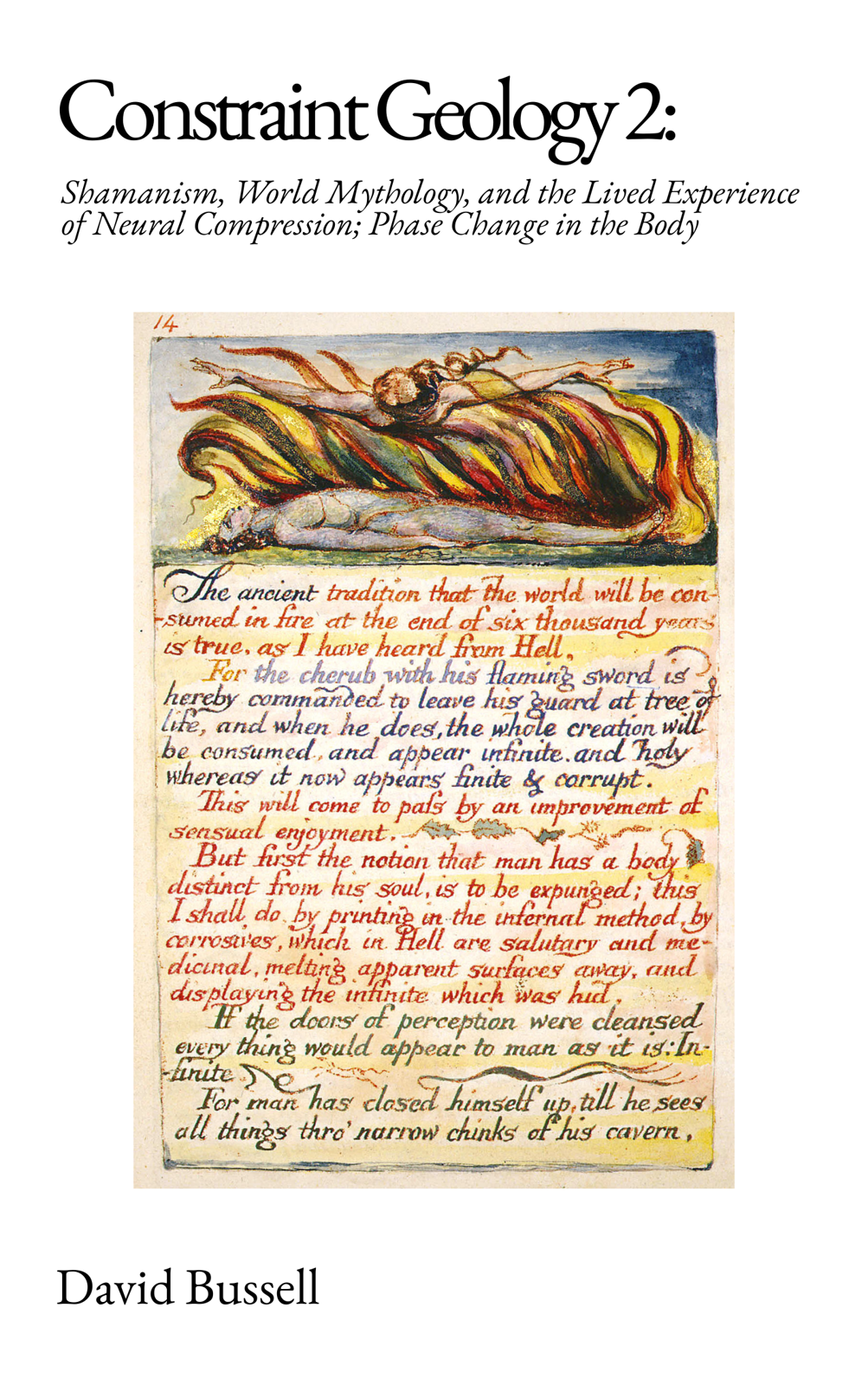
Part 1. Constraint Geology VII: Phase Transition, Regulation, and the Human System -- A Structural Account of Apollonian and Dionysian States as Modes of Formation Under Constraint
Abstract
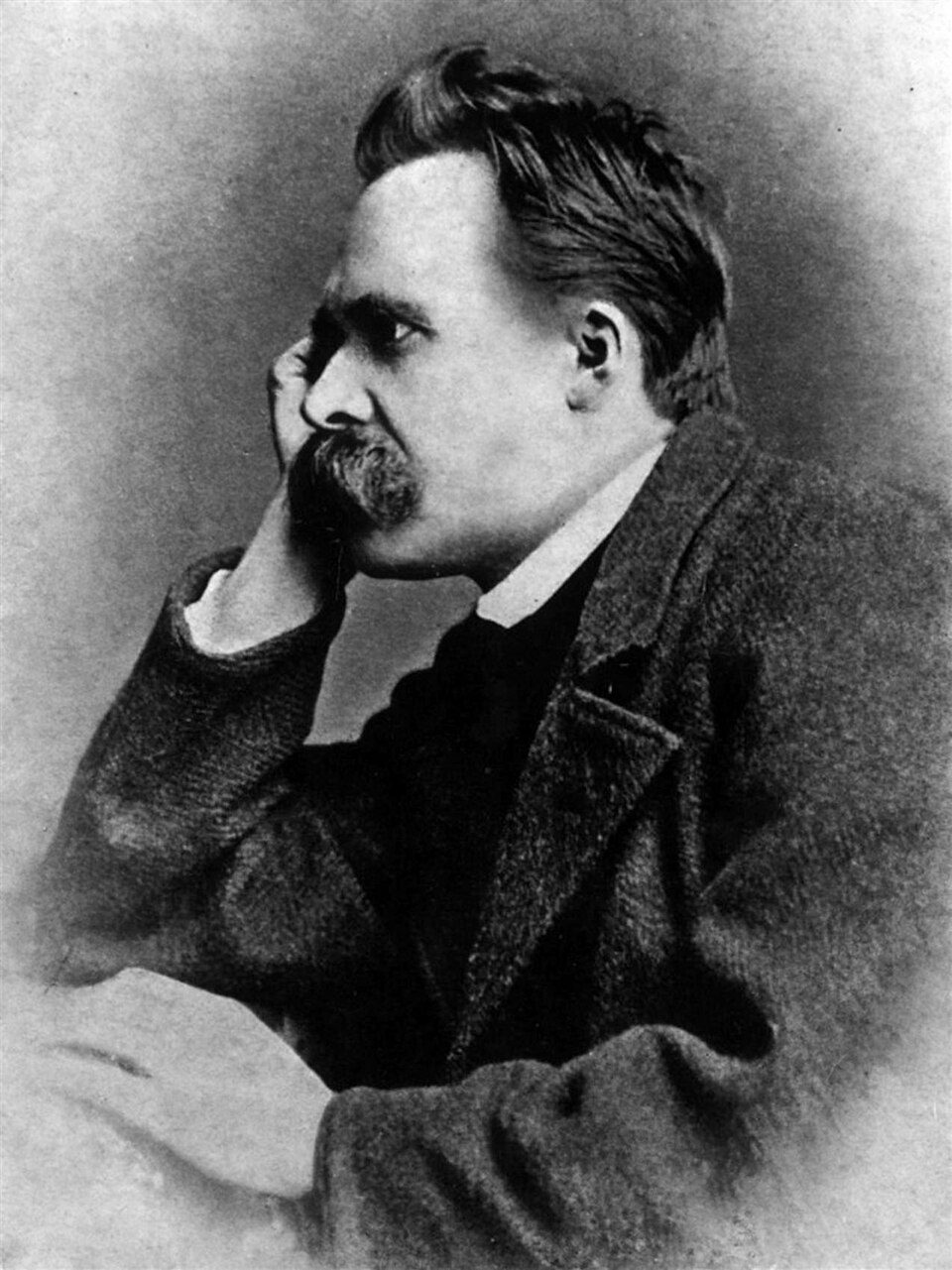
This document extends the framework of formation under constraint by formalizing the human organism as a phase-shifting regulatory system. It establishes that the stability of the self is conditional and that transitions in identity correspond to structural reorganizations under load. Drawing on the distinction between Apollonian and Dionysian states as originally articulated by Friedrich Nietzsche, the report reinterprets these modes as distinct regimes of neural regulation rather than aesthetic categories. It further situates human experience within a broader ontological process in which information persists through time via systems capable of stabilizing it under constraint. The result is a unified account in which identity, perception, and transformation are understood as phase-dependent expressions of structure under pressure.
I. Introduction: The Instability of the Self
The human self is not a fixed entity.
It does not exist as a stable origin of action, identity, or meaning. Its apparent continuity is the result of ongoing regulation within a bounded range of viable conditions.
The self is a temporary stabilization of a system operating under constraint.
This stabilization is conditional. It depends on:
the magnitude of load applied to the system
the duration of that load
the system’s capacity to maintain coherence
When these conditions change, the system does not merely adjust its parameters.
It undergoes reorganization.
This reorganization is best understood as:
a phase transition in the regulatory architecture of the organism.
II. The Organism as a Regulatory System
The human organism functions as a constraint-regulated system.
It must:
maintain internal coherence
process incoming information
remain within a bounded viability set
This requires:
neural coordination
energetic stability
dynamic regulation of excitation and inhibition
Under stable conditions, the system maintains:
coherent identity and structured perception
Under increasing constraint, the system approaches a threshold at which:
existing regulatory structures are no longer sufficient
new organization becomes necessary
This marks the onset of phase transition.
III. Phase Transition Under Constraint
Phase transition describes the reorganization of a system when existing structure cannot sustain applied load.
In the human organism, this involves:
destabilization of established patterns
redistribution of neural activity
alteration of perceptual boundaries
At this threshold:
prior coherence dissolves
new coherence has not yet formed
The system enters:
a state of structural indeterminacy
This state is not pathological in itself.
It is:
a necessary condition of transformation
IV. Apollonian and Dionysian as Regulatory Regimes
The distinction between Apollonian and Dionysian modes, as articulated by Friedrich Nietzsche, can be reformulated in structural terms.
Apollonian Regime
The Apollonian corresponds to:
stable regulatory containment
defined perceptual boundaries
coherent identity formation
successful integration of constraint within viable limits
In this regime:
the system maintains structure under load
Dionysian Regime
The Dionysian corresponds to:
destabilization of regulatory boundaries
amplification of signal and excitation
dissolution of fixed identity
exposure to magnitudes exceeding prior integration
In this regime:
the system exceeds its existing capacity for containment
These are not opposing forces.
They are:
distinct states of the same system under different constraint conditions
V. The Midst of Change
Between these regimes lies a transitional state.
This state is characterized by:
loss of prior coherence
absence of stable new structure
heightened intensity of experience
It is experienced as:
disorientation
expansion
fragmentation
or heightened clarity
depending on the system’s capacity for reorganization.
This is the midst of change: the system in the act of becoming.
VI. Neural Systems as Regulatory Containers
Neural organization provides the structure through which regulation occurs.
These systems function as:
containers for the stabilization of information under constraint
They:
filter input
maintain coherence
support identity
However, these containers are not fixed.
Under sufficient load:
they expand
reorganize
or fail
Phase transition is the alteration of these containers under constraint.
VII. Information and Persistence
The process described is not limited to the human organism.
It reflects a broader ontological condition.
The universe persists through the stabilization of information under constraint.
Across scales:
energy becomes structure
structure encodes information
information persists through systems capable of maintaining it
The human organism is one such system.
The self is a local instance of the universe maintaining information in time.
VIII. Experience as Structural Process
Experience is not the interpretation of reality.
It is:
the direct registration of structural state under constraint
coherence corresponds to stable integration
intensity corresponds to rising load
dissolution corresponds to breakdown of containment
Thus:
experience is the process by which information is stabilized or destabilized within the system
IX. Transformation as Reorganization
Transformation does not occur through abstraction or intention alone.
It occurs through:
the reorganization of structure under constraint
This requires:
exposure to load
tolerance within viability limits
integration into new form
If successful:
capacity expands
structure densifies
If unsuccessful:
fragmentation occurs
coherence is lost
X. Conclusion
The human self is not a stable identity but a dynamic system undergoing continuous regulation under constraint.
Apollonian and Dionysian states are not aesthetic categories but:
phase-dependent expressions of neural organization under varying levels of load
The transition between them constitutes:
the fundamental process of formation and transformation within the organism
This process is continuous with the broader structure of reality, in which information persists through systems capable of stabilizing it under constraint.
Final Statement
The human organism is a phase-shifting regulatory system in which identity, perception, and experience emerge from the continuous stabilization and destabilization of structure under constraint.
Final Compression
The self is not fixed. It is the temporary coherence of a system undergoing phase transition, in which Apollonian order and Dionysian dissolution represent distinct states of regulation, and in which the universe persists as information stabilized in time through form.
Part 2. Constraint Geology VIII: Shamanic Trance and the Human System at the Threshold of Transformation -- A Structural Account of Ritual, Phase Transition, and the Experience of Dissolution
Abstract
This essay situates global shamanic trance practices within a unified framework of formation under constraint. It argues that trance states are not primarily symbolic or metaphysical experiences, but controlled inductions of threshold conditions in the human organism. Under these conditions, regulatory structures destabilize, identity loses coherence, and perception reorganizes. The distinction between Apollonian and Dionysian states is reformulated as a shift between stable and destabilized regimes of neural organization. Shamanic traditions are interpreted as early cultural technologies for engaging these transformations, enabling systems to encounter, navigate, and occasionally integrate states of structural reorganization under extreme load.
I. Introduction: The Recurrence of Trance Across Cultures
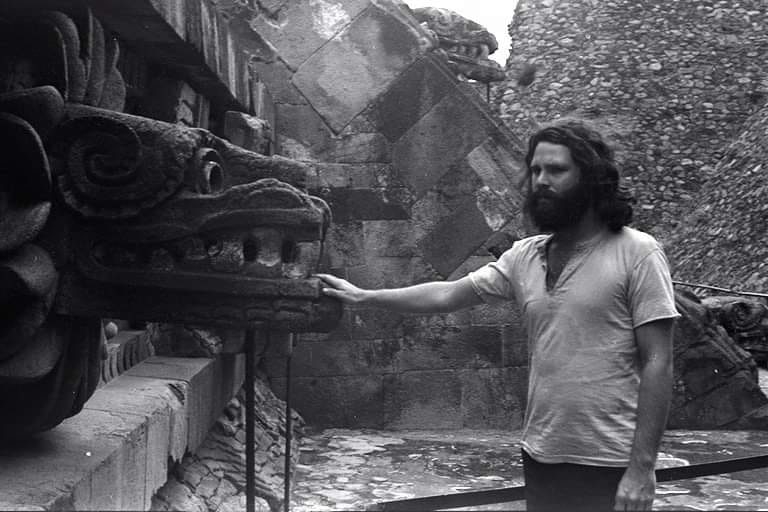
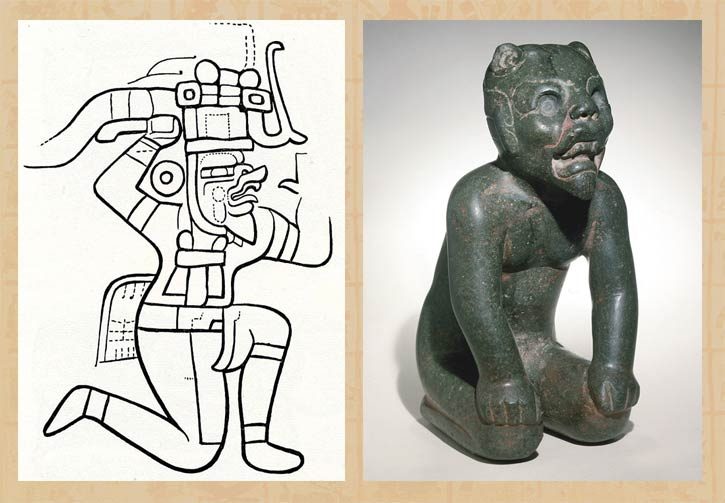
Across geographically and historically distinct societies—Siberian, Amazonian, African, and Mesoamerican—ritual practices emerge that produce strikingly similar experiential states:
dissolution of personal identity
merging with animals, landscape, or cosmic forms
intensification of perception
altered sense of time and embodiment
Despite differences in symbolism and cosmology, the structural features of these states remain consistent.
This recurrence suggests:
a shared underlying process in the human organism rather than independent cultural invention.
II. The Organism Under Constraint
The human organism is a regulatory system that maintains coherence within a bounded viability range.
This involves:
stabilization of perception
maintenance of identity
coordination of neural and physiological activity
Under ordinary conditions, this produces:
a stable sense of self and a structured experience of the world.
However, this stability is conditional.
As constraint increases—through:
rhythmic stimulation
fasting
sensory deprivation
psychoactive substances
the system approaches its regulatory limits.
III. Threshold Conditions and Phase Transition
At sufficient levels of constraint, the system enters a threshold state.
In this state:
prior regulatory structures lose stability
perceptual boundaries dissolve
identity coherence weakens
This is best understood as:
a phase transition in neural and physiological organization.
The organism no longer maintains its previous configuration.
Instead, it enters:
a state of structural indeterminacy in which reorganization becomes possible.
IV. Apollonian and Dionysian Regimes
The classical distinction articulated by Friedrich Nietzsche can be reformulated in structural terms.
Apollonian Regime
stable regulation
bounded perception
coherent identity
successful containment of constraint
Dionysian Regime
destabilized regulation
intensified signal
dissolution of boundaries
exposure to unintegrated magnitude
These are not symbolic opposites.
They are:
distinct regulatory states of the same system under different constraint conditions.
V. The Experience of Dissolution
During trance, individuals frequently report:
becoming animals, landscapes, or cosmic entities
losing the distinction between self and environment
experiencing overwhelming intensity or unity
These reports do not indicate literal transformation into external entities.
They indicate:
the breakdown of the system’s capacity to maintain a bounded model of itself.
As regulatory containment weakens:
distinctions between internal and external collapse
perception becomes unanchored from stable identity
The resulting experience is one of:
undifferentiated magnitude rather than discrete selfhood.
VI. The Body as Dynamic Field
Under these conditions, the body is no longer experienced as a stable structure.
Instead, it is perceived as:
waves of sensation
fluctuations of intensity
surges and collapses of internal state
This can be described as:
the organism experienced as a dynamic field rather than a fixed form.
Physiologically, this corresponds to:
altered neural firing patterns
shifts in autonomic regulation
changes in hormonal and sensory processing
The subjective experience reflects:
unstable regulation under high load.
VII. Ritual as Structured Induction
Shamanic practices do not encounter these states randomly.
They deliberately induce them.
Through:
rhythmic entrainment
environmental isolation
chemical modulation
ritual systems create:
controlled conditions for approaching the threshold of transformation.
This transforms trance from accident into method.
Shamanic traditions therefore function as:
early cultural technologies for engaging phase transition in the human system.
VIII. Transformation and Risk
The outcome of these states is not guaranteed.
Two primary paths exist:
Integration
new regulatory structure forms
capacity expands
the individual returns with altered function
Fragmentation
coherence fails
instability persists
the system does not reorganize successfully
Thus:
trance represents both possibility and risk.
It is not inherently beneficial.
It is:
a high-load condition in which transformation may occur.
IX. Historical Significance
Shamanic systems represent one of the earliest human engagements with:
instability of identity
transformability of perception
capacity for structural reorganization
Without formal theory, these traditions identified:
conditions that produce threshold states
methods for inducing them
roles for individuals capable of navigating them
Their significance lies not in metaphysical claims, but in:
their practical engagement with the dynamics of human formation under constraint.
X. Conclusion
Shamanic trance is not best understood as spiritual transcendence or symbolic expression.
It is:
a structured encounter with the limits of human regulatory capacity.
In this encounter:
identity dissolves
perception reorganizes
structure may transform
This process reflects the same underlying principle that governs all formation:
constraint acting on a system over time produces structural change.
Final Statement
Shamanic trance is a culturally developed method for driving the human organism to the threshold of its regulatory capacity, where identity destabilizes, perception reorganizes, and new structure may emerge.
Final Compression
It is the earliest human technology for engaging transformation under constraint.
Part 3. The Hidden, the Opposites, and the Threshold of Human Formation -- A Structural Reinterpretation of Apollonian Metaphysics, Shamanic Trance, and the Experience of Unity Under Constraint
Abstract
This essay integrates ancient Greek metaphysical doctrines—particularly those associated with Heraclitus, Platonic thought, and Apollonian spirituality—with a modern structural framework of formation under constraint. Drawing on a passage from Apollo the Destroyer: “coincidentia oppositorum” in hyperborean mysticism and eschatology by Marco Maculotti, it argues that historical accounts of the “hidden,” the unity of opposites, and the illusory nature of the world are not descriptions of a separate metaphysical realm, but phenomenological interpretations of phase transitions in human regulatory systems. The essay situates these doctrines alongside global shamanic trance practices, demonstrating that both traditions encountered the same underlying process: the destabilization and reorganization of structure under constraint. The result is a unified account in which metaphysical intuition is reinterpreted as structural dynamics.
I. The Historical Intuition of the Hidden
A recurring theme in ancient Greek philosophy is the primacy of the hidden over the apparent.
As summarized in the Apollonian tradition:
“[…] the ‘pathos’ of the hidden, that is, the tendency to consider the ultimate foundation of the world as something hidden. Such is the concept of divinity in Heraclitus […] two other fragments declare the superiority of what is hidden: ‘Primordial nature loves to hide’ and ‘hidden harmony is stronger than the manifest one’. The second theme is the mystical claim of a pre-eminence of interiority over the illusory body of the external world. […] But then the enigma, extended to a cosmic concept, is the expression of the hidden, of the god. The whole multiplicity of the world, its illusionistic body, is an intertwining of enigmas, an appearance of the god, in the same way that an interweaving of enigmas are the words of the sage, sensitive manifestations that are the imprint of the hidden […] Heraclitus […] argues that the world itself that surrounds us is nothing more than a fabric—illusory—of opposites. Each pair of opposites is an enigma, the dissolution of which is unity, the god behind it. In fact, Heraclitus says: ‘God is day night, winter summer, war, peace, satiety, hunger.’”
This doctrine extends further:
“For the Greeks the life of men is an appearance of that of the gods. Our world expresses over time, with the uncertainty of the future, through inadequate, blurred fragments, what the gods are in a total way, without becoming, from the beginning. There is a hidden world, the world of which ours is the semblance, this is the Greek intuition: the gods live there. And Apollo is the most subtle, variegated symbol of this divine existence compared to the human one, in relation to this: he gives men divination, tells about their future life, contemplated by his god’s eye. Therefore the future is already all in the past, and time only concerns the order of manifestation.”
These claims describe a world in which:
surface reality is incomplete
opposites conceal unity
truth lies beneath appearance
time is secondary to a deeper structure
II. Structural Reinterpretation: The Hidden as Constraint
Within a framework of formation under constraint, these claims can be reinterpreted without recourse to metaphysical dualism.
What is described as “hidden” corresponds to:
the underlying structural dynamics of systems not directly accessible to surface perception.
The human organism operates through:
neural regulation
constrained information processing
bounded perceptual models
Surface experience reveals only:
the stabilized output of these processes
The “hidden harmony” is therefore not a separate divine layer, but:
the non-obvious integration of opposing forces within a constrained system
III. Opposites as Structural Tension
The Heraclitean doctrine of opposites—day/night, war/peace, hunger/satiety—maps directly onto the operation of systems under constraint.
All such systems are defined by:
competing forces
dynamic equilibria
continuous adjustment
These opposites do not resolve into metaphysical unity.
They are:
the constitutive tensions that maintain structure itself
The perception of unity behind them arises when:
differentiation collapses
the system can no longer maintain discrete categories
IV. The Role of Interiority
The Greek privileging of interiority reflects a genuine observation:
internal experience can register structural states not visible externally
Under ordinary conditions, perception is stabilized:
identity is bounded
distinctions are maintained
Under increased constraint, however:
internal signals intensify
regulatory coherence weakens
The system becomes more directly aware of:
its own instability and underlying dynamics
This is experienced as:
depth
truth
contact with something “more real”
V. Phase Transition and the Illusion of the World
The claim that the world is “illusion” emerges under specific conditions.
When regulatory systems destabilize:
perceptual models break down
distinctions between subject and object dissolve
previously stable representations lose coherence
This produces the experience that:
the world as ordinarily perceived is not fundamental
In structural terms:
it is the perceptual model that is limited—not reality itself
VI. Apollonian and Dionysian Regimes
The Apollonian framework—linked to order, clarity, and divination—represents:
stable regulatory containment
The Dionysian, by contrast, represents:
destabilization under excess constraint
These are not symbolic opposites.
They are:
distinct regimes of neural and systemic organization
At their boundary lies:
the threshold of phase transition
VII. Shamanic Trance and Threshold Experience
Global shamanic traditions repeatedly induce states characterized by:
dissolution of identity
merging with environment or cosmos
intensified perception
altered temporality
These states correspond to:
systems driven to the boundary of regulatory capacity
At this boundary:
prior structure collapses
new structure is not yet formed
The resulting experience is interpreted as:
unity
divinity
access to hidden reality
VIII. The Misinterpretation of Unity
The perception of unity—“the god behind opposites”—does not indicate:
- access to a separate metaphysical realm
It indicates:
the collapse of differentiation within the system
When:
boundaries dissolve
distinctions fail
the system experiences:
undifferentiated magnitude
This is interpreted as:
unity
totality
timelessness
But structurally, it is:
loss of bounded organization under load
IX. Time and the Illusion of Becoming
The claim that:
“the future is already all in the past”
arises when temporal modeling breaks down.
Under threshold conditions:
sequential processing destabilizes
temporal distinctions blur
The system experiences:
time as collapsed or irrelevant
This produces the intuition of:
eternity
pre-existence
fixed destiny
X. Final Integration
Ancient Greek metaphysics and global shamanic traditions converge on the same phenomenon:
the instability of human perception and identity under constraint
They correctly identify:
the incompleteness of surface perception
the role of opposites in structure
the transformative potential of threshold states
However, they interpret these phenomena as evidence of:
a hidden metaphysical reality
A structural framework instead demonstrates that these are:
effects of systems undergoing phase transition and reorganization
Final Statement
The doctrines of the hidden, the unity of opposites, and the illusory nature of the world arise from the human encounter with its own structural instability under constraint, and do not indicate a separate metaphysical realm, but the dynamics of formation within the system itself.
Final Compression
They called it the hidden god behind appearances.
It is the structure of the system under constraint.
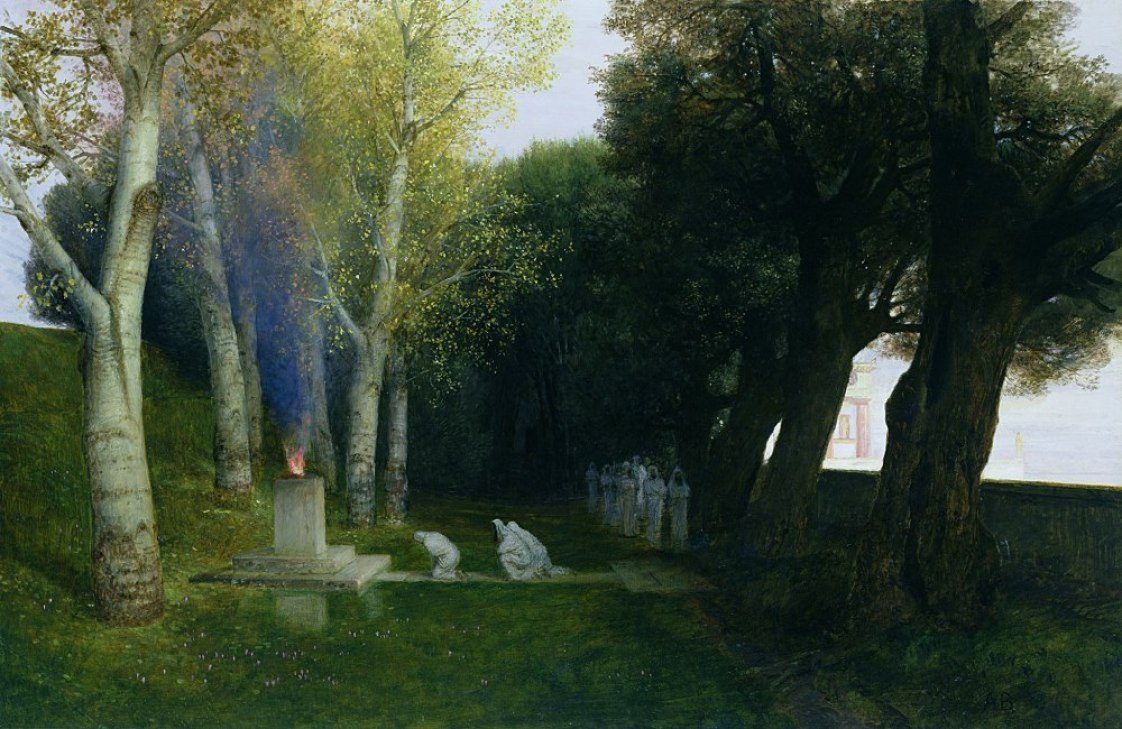
Earth’s orb is thus adorned, and rarely clamours Sound through the open field, the sun warms The day of autumn mildly, the fields lie As a great wide view, the breezes blow Through boughs and branches, rustling gladly, When then already to emptiness the fields give way.
The whole meaning of this bright image lives As an image, golden splendour hovering all about.
-- Hölderlin
Part 4. The Egyptian Book of the Dead and the Terminal Threshold of Human Formation -- A Structural Account of Death, Judgment, and the Reorganization of the Human System Under Total Constraint
Abstract
This document presents a structural reinterpretation of the Egyptian Book of the Dead within a unified framework of formation under constraint. It argues that the text is not primarily a theological account of the afterlife, but a procedural system for navigating the dissolution and potential reorganization of the human organism at its terminal threshold. The so-called journey through the Duat, the weighing of the heart, and the requirement of knowledge are reinterpreted as descriptions of system behavior under extreme constraint. In this context, death is understood as an irreversible phase transition, and the Book of the Dead emerges as an early cultural technology designed to preserve structure under conditions of total instability.
I. Introduction: From Afterlife to Structure
The Egyptian funerary corpus traditionally referred to as the Book of the Dead has been interpreted as:
a guide to the afterlife
a collection of spells for the soul
a theological account of judgment and immortality
These interpretations assume the existence of:
a metaphysical realm separate from the physical world
a soul that persists independently of structure
divine beings that govern post-mortem existence
This document rejects these assumptions.
The Book of the Dead is a structural text.
It describes:
what occurs when the human system exits stable regulation and encounters total constraint.
II. Death as Terminal Phase Transition
Within the framework of formation under constraint, the human organism is:
a regulated system
maintaining coherence within a bounded viability set
Death represents:
the irreversible collapse of that regulatory system.
This is not gradual.
It is:
a phase transition in which prior structure can no longer sustain itself.
At this threshold:
bodily containment fails
neural regulation ceases
identity coherence dissolves
The system enters:
a state of maximal instability.
III. The Duat as Transformation Field
The Duat, commonly described as the Egyptian underworld, is characterized by:
fragmentation
instability
shifting environments
encounters with non-ordinary forms
This is not best understood as a location.
The Duat is the experiential field of a system undergoing structural disintegration and attempted reorganization.
In this field:
perception is no longer anchored
identity is no longer stable
distinctions between internal and external collapse
The environment reflects:
the system’s loss of coherent structure.
IV. Judgment as Structural Test
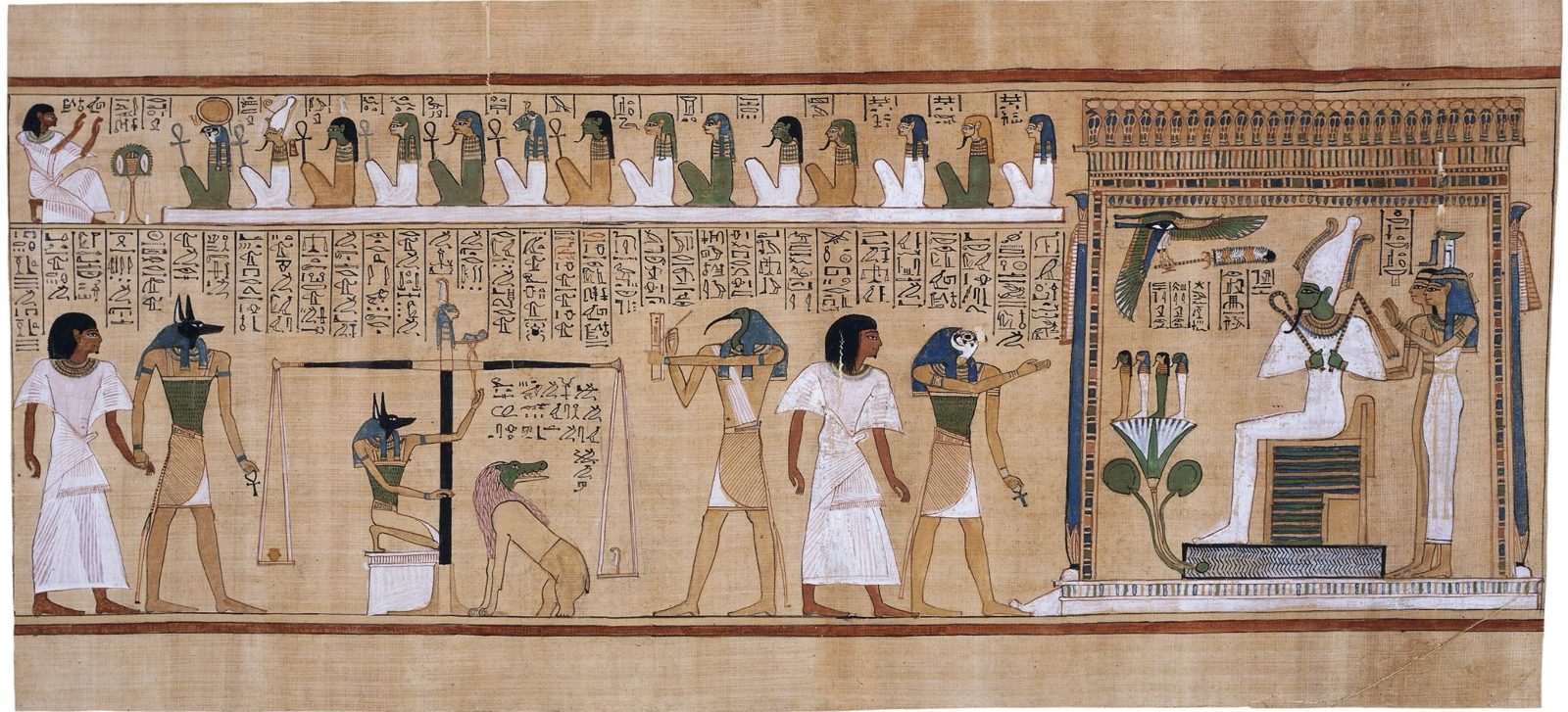
One of the central elements of the text is the weighing of the heart against the feather of Ma’at.
Traditionally interpreted as moral judgment, this process is more accurately described as:
a test of structural coherence under extreme constraint.
The heart represents:
accumulated formation
integrated and unintegrated load
the total structural history of the system
The weighing determines:
whether the system can maintain coherence
or whether it collapses under its own unresolved constraint
Thus:
judgment is not moral.
It is structural.
V. Knowledge as Regulatory Function
The text repeatedly emphasizes the necessity of:
knowing names
identifying gates
speaking correctly
These requirements are not symbolic formalities.
They correspond to:
the system’s ability to maintain differentiation under instability.
Under extreme constraint:
pattern recognition degrades
distinctions collapse
structure dissolves
To “know the names” is to:
retain organized structure in the face of disintegration.
Failure to do so results in:
fragmentation
loss of coherence
VI. Dismemberment and Reassembly
Egyptian myth, particularly in the figure of Osiris, emphasizes:
dismemberment
scattering
reassembly
This is not purely narrative.
It is structural.
Dismemberment represents the breakdown of system coherence.
Reassembly represents successful reorganization into a new form.
The ideal outcome is not preservation of the original state.
It is:
reconstitution under altered conditions.
VII. Time Collapse and Eternity
The afterlife is described as:
eternal
outside ordinary time
already determined
This corresponds to:
the collapse of temporal processing under extreme constraint.
When:
sequential ordering fails
memory integration ceases
the system experiences:
time as static or irrelevant.
Eternity is therefore not an objective realm.
It is:
a condition of perception when temporal modeling breaks down.
VIII. The Risk of Transformation
The journey described in the Book of the Dead is not guaranteed to succeed.
Two outcomes are possible:
Structural Persistence
coherence is maintained
reorganization occurs
the system stabilizes in a new form
Structural Collapse
coherence fails
differentiation is lost
the system disintegrates
This duality reflects:
the fundamental risk inherent in all high-load transformation processes.
IX. Historical Significance
The Egyptian system represents one of the earliest comprehensive attempts to:
describe structural breakdown
encode methods for navigating instability
preserve coherence under maximal constraint
Without formal scientific language, it identifies:
the instability of identity
the importance of integrated structure
the possibility of transformation
Its significance lies in:
its systematic engagement with the limits of human formation.
X. Conclusion
The Egyptian Book of the Dead is not a description of a metaphysical afterlife.
It is:
a procedural model for navigating the terminal phase transition of the human system.
In this model:
death is the collapse of regulation
the Duat is the field of instability
judgment is structural testing
knowledge is preserved organization
resurrection is reorganization
All elements correspond to:
the behavior of a system under total constraint.
Final Statement
The Egyptian Book of the Dead is an early structural technology for preserving coherence at the terminal threshold of human formation, describing in symbolic form the processes of disintegration, testing, and possible reorganization under conditions of maximal constraint.
Final Compression
They called it the journey of the soul through the afterlife.
It is the human system undergoing its final phase transition under total constraint.
Part 5. Imagination, the Threshold, and the Completion of Ancient Metaphysics
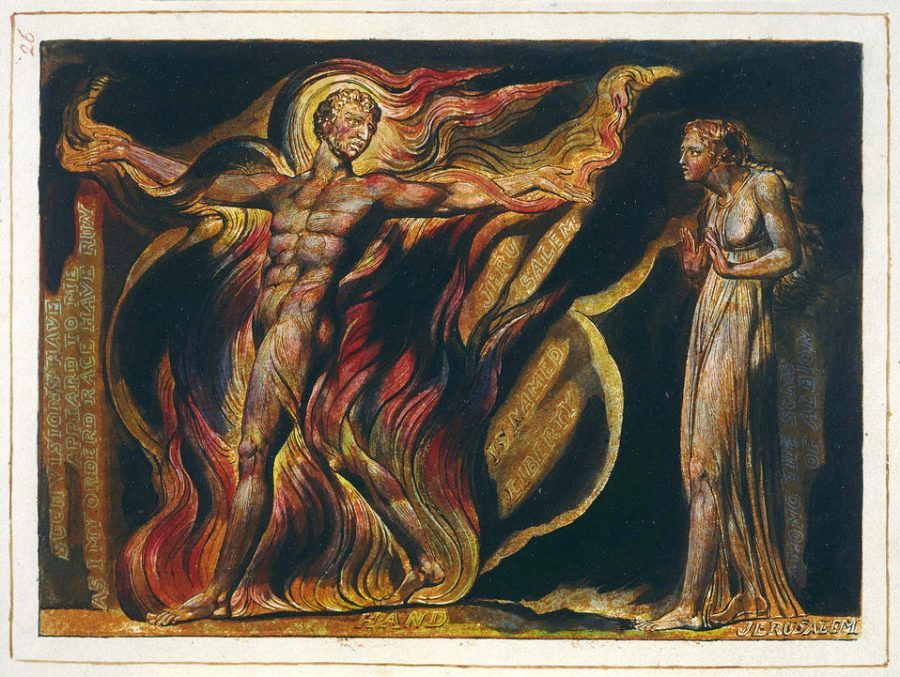
Constraint Geology XII:
Imagination, the Threshold, and the Completion of Ancient Metaphysics**
A Final Synthesis of Shamanic Trance, Apollonian Doctrine, the Egyptian Afterlife, and Blakean Vision as Structural Encounters with Formation Under Constraint
Abstract
This chapter completes the unified framework by incorporating the metaphysics of William Blake into the convergence already established between shamanic trance, Greek philosophy, and Egyptian funerary systems. It argues that Blake’s doctrine of imagination, vision, and the rejection of “single vision” constitutes the most precise pre-modern articulation of structural transformation under constraint. Across all traditions, a common phenomenon is identified: the destabilization of the human organism at the threshold of its regulatory capacity. Where earlier systems interpreted this encounter as access to hidden metaphysical realities, Blake relocates it within perception itself. The result is a final synthesis in which imagination, unity, and transformation are understood not as transcendence, but as phase-dependent expressions of structure under pressure.
I. The Convergence Completed
Across the systems already analyzed:
Shamanic traditions induce dissolution and return
Greek philosophy posits hidden unity behind opposites
Egyptian texts describe death as passage, judgment, and reconstitution
Each system describes:
the encounter with the limit of stable human formation
What remains is Blake.
Blake does not add a new domain.
He resolves the contradiction.
II. Blake’s Central Claim
Blake rejects the idea of a hidden metaphysical world behind appearances.
Instead, he asserts:
“If the doors of perception were cleansed everything would appear to man as it is, infinite.”
This is not mysticism in the conventional sense.
It is a direct statement about:
the limits and transformation of perceptual structure
Blake’s target is what he calls:
“single vision”
“Newton’s sleep”
These correspond to:
stabilized, constrained perception operating within narrow regulatory bounds
III. Imagination as Structural Capacity
Blake’s “Imagination” is not creativity in the modern sense.
It is:
the capacity of the system to reorganize perception under altered constraint conditions
He identifies two states:
Single Vision
stable identity
fixed perception
bounded differentiation
Apollonian containment
Fourfold Vision
expanded perception
integration of opposites
dissolution of rigid boundaries
exposure to totality
This is structurally identical to:
the transition from stable regulation to threshold-level reorganization
IV. The Reinterpretation of the Infinite
Blake’s claim that the world is “infinite” is not metaphysical.
It reflects:
the breakdown of limiting perceptual models under altered regulatory states
When:
constraint loosens or shifts
neural organization changes
the system no longer filters:
magnitude
complexity
connection
The result is experienced as:
infinity
unity
boundlessness
But this is:
a change in the system, not in the underlying world
V. Blake and the Unity of Opposites
Blake rejects the moralization of opposites:
good vs evil
reason vs energy
Instead, he writes:
“Without contraries is no progression.”
This aligns directly with Heraclitus:
opposites are not errors
they are necessary tensions
In structural terms:
systems persist through the dynamic interaction of opposing forces
Blake’s contribution is to recognize:
these opposites must be integrated, not transcended
VI. Blake and Shamanic Trance
Blake’s visions parallel shamanic states:
encounters with non-ordinary forms
dissolution of identity
perception of unity
But Blake differs in interpretation.
He does not claim:
- travel to another world
He claims:
the transformation of perception itself
Thus, Blake relocates:
the “spirit world”
fromexternal domain
tointernal structural state
VII. Blake and the Egyptian Threshold
Blake’s insistence on:
transformation
judgment of perception
passage through states
mirrors the structure of the Egyptian Book of the Dead.
But again, the difference is critical:
Egypt externalizes the process (afterlife, gods)
Blake internalizes it (perception, imagination)
Thus:
the Duat becomes the structure of perception under breakdown
VIII. The Final Resolution
Across all traditions:
shamanic → experiential induction
Greek → metaphysical interpretation
Egyptian → procedural mapping
Blake → perceptual relocation
Blake resolves the system by showing:
no hidden world is required
Everything occurs within:
the transformation of the system itself
IX. The Unified Structure
All systems now align:
constraint increases
structure destabilizes
opposites intensify
identity dissolves
perception reorganizes
Outcome:
integration → expanded capacity
failure → fragmentation
This is:
phase transition in human formation
X. The Final Position
What earlier systems called:
gods
spirits
hidden unity
afterlife
Blake identifies as:
changes in perception
This framework completes the move:
these are changes in structure under constraint
XI. Conclusion
Blake represents the final pre-modern articulation of this process.
He eliminates:
metaphysical duplication
externalized explanation
and locates the phenomenon in:
the transformation of the human system itself
Thus, the convergence is complete.
Final Statement
Shamanic trance, Greek metaphysics, Egyptian afterlife doctrine, and Blakean vision all describe the same event: the destabilization and reorganization of the human system at the threshold of its capacity, interpreted variously as spirit, god, or imagination, but in fact constituting the structural transformation of perception under constraint.
Final Compression
They called it spirit, god, the afterlife, and imagination.
It is the system changing state under pressure.
Part 6. Shelley, Permeability, and the Body as Weather: A Structural Account of Immanence, Openness, and the Experience of Total Formation in Motion

Abstract
This chapter incorporates the metaphysics of Percy Bysshe Shelley into the unified framework of formation under constraint. It argues that Shelley’s poetic system constitutes a phenomenological account of radical permeability, in which the human organism is experienced as continuous with environmental forces such as wind, atmosphere, and geological motion. Rather than positing a hidden metaphysical reality or a transformation of perception alone, Shelley presents the body itself as an exposed interface—a site where external forces and internal structure are indistinguishable. His work is interpreted as the lived registration of a system in a state of extreme openness, where constraint is no longer buffered by stable regulatory boundaries. This produces an experience of “deep weather,” in which the organism becomes the medium through which environmental and structural processes are directly felt.
I. Shelley’s Position Within the System
Across prior systems:
Shamanic traditions induce threshold states
Greek philosophy interprets them as hidden metaphysical unity
Egyptian doctrine externalizes them as post-mortem process
Blake relocates them within perception
Shelley does something different.
He does not:
posit a hidden world
describe a journey beyond life
or isolate transformation within perception
Instead, Shelley articulates:
the condition of a system that is already open—already exposed—to the full magnitude of its environment.
II. The Permeable Body
In Shelley’s work, the boundary between organism and environment does not merely weaken.
It becomes:
structurally irrelevant.
The self is not dissolved into an abstract unity.
It is:
rendered permeable to forces that were previously mediated or filtered.
Wind, light, atmosphere, and geological presence are not described as external.
They are:
registered as continuous with the body itself.
This is not metaphor.
It is:
the experience of reduced regulatory containment.
III. The Body as Weather
Shelley’s most precise contribution is the transformation of the body into:
a dynamic field of environmental interaction
The organism is experienced as:
movement
pressure
flux
intensity
rather than stable form.
This corresponds to:
the body functioning as a medium through which external constraint is directly expressed
Instead of:
- the environment acting on the body
there is:
no clear distinction between internal and external process
The system becomes:
lived weather
IV. The Wind and the Mountain
Shelley’s recurring imagery—wind, storm, mountain, sky—does not describe scenery.
It describes:
the structure of force acting through and as the organism
Wind represents:
distributed, moving constraint
pressure without fixed form
Mountain represents:
accumulated pressure
stabilized geological structure
In Shelley, these are not opposed.
They are:
different temporal expressions of the same process
The body, in this condition, experiences both:
as motion
as accumulation
as ongoing formation
V. Openness as Exposure to Total Constraint
Shelley’s “openness” is not emotional sensitivity.
It is:
the removal or reduction of buffering mechanisms that normally regulate load
Under these conditions:
more information enters the system
intensity increases
differentiation becomes unstable
This produces:
heightened perception
overwhelming affect
continuous transformation
This is not equilibrium.
It is:
the system operating near or at threshold conditions continuously
VI. The Wound of Openness
This state is not neutral.
It is experienced as:
a wound
Not metaphorically.
Structurally.
Because:
the system is exposed to magnitudes it cannot fully integrate
This results in:
instability
intensity
lack of closure
continuous motion
The “wound” is:
the condition of permeability without sufficient containment
VII. Phase Motion Without Stabilization
Unlike other systems:
shamanic → temporary induction
Egyptian → terminal transition
Blake → controlled perceptual shift
Shelley describes:
a state in which the system remains in motion
There is no:
stable Apollonian return
full integration
fixed reorganization
Instead:
the system exists in ongoing phase transition
This produces:
continuous becoming
absence of fixed identity
persistent instability
VIII. The Total Body as Metaphysics
Shelley’s metaphysics is not abstract.
It is:
the direct expression of structural conditions in the body
There is no separation between:
thought
perception
environment
physical force
All are:
the same process, experienced through the organism
Thus:
the body itself becomes the metaphysical site
Not as symbol.
As:
structure in motion under constraint
IX. The Difference from Other Systems
Shelley diverges from all prior traditions:
He does not externalize (Egypt)
He does not metaphysicalize (Greece)
He does not isolate perception (Blake)
He remains:
fully immanent
The process is:
not beyond the world
not hidden behind it
not confined to the mind
It is:
the world acting through the organism in real time
X. Final Integration
With Shelley, the system is complete.
All positions are now accounted for:
induction (shamanic)
interpretation (Greek)
procedural mapping (Egyptian)
perceptual transformation (Blake)
immanent exposure (Shelley)
Shelley reveals:
what it is to live as the process itself
Not to encounter it.
Not to interpret it.
But:
to be continuously formed by it without insulation
XI. Conclusion
Shelley’s work describes the human organism at its most exposed condition:
a permeable system through which environmental and structural forces pass without full mediation
This produces:
intensity
instability
transformation without closure
It is neither transcendence nor failure.
It is:
the lived condition of formation without sufficient boundary.
Final Statement
Shelley reveals the human body as a permeable field in which the forces of wind, atmosphere, and geological structure are directly experienced as self, producing a continuous state of transformation in which identity cannot fully stabilize.
Final Compression
Where others encountered the threshold, Shelley lived inside it—
as a body that became weather under pressure.
Part 7. The Jungle and the Moral Novel: Constraint, Structure, Capacity; Historical Revolution

The Jungle — a Constraint-Geology Reading
The move made at hand
The synthesis has been reading religion, philosophy, and visionary poetry as encounters with the threshold of formation —moments when a system hits its limits and either reorganizes or breaks.
Applying that same lens to The Jungle shifts it from “social protest novel” to:
a field report on how industrial constraint deforms, fragments, and sometimes reconfigures human structure at scale.
No mysticism here—just the same mechanism, made visible in labor, bodies, and institutions.
I. Chicago as a Constraint Engine
Sinclair’s Chicago (the stockyards) is not just a setting.
It is a high-load environment designed to maximize extraction and minimize recovery.
Pace, hours, cold, contamination, wage pressure
Precarity (injury = replacement)
Information asymmetry (immigrant workers don’t know the system)
In the synthesis terms:
Load (L) is driven persistently above capacity (C).
That places workers in Zone 3 (L > C)—where:
regulatory options shrink
survival dominates
structure contracts or fractures
II. The Body as Industrial Substrate
Sinclair’s most famous passages—filth, blood, disease, spoilage—are often read as shock tactics.
Structurally, they show:
the human body treated as a replaceable medium for throughput.
Injury is not an exception; it’s an operating condition
Contamination crosses boundaries (meat ↔ worker ↔ consumer)
Sensory overwhelm (smell, noise, repetition) degrades regulation
This is the inverse of Shelley’s permeability :
Shelley: openness to environmental magnitude → continuous transformation
Sinclair: forced permeability to industrial load → forced degradation
Permeability without recovery becomes damage.
III. Identity Under Load (Jurgis as Case Study)
Jurgis Rudkus is not a “character arc” in the usual sense.
He is:
a system tracked across escalating constraint.
Sequence (simplified):
Initial state — coherence, hope, family integration
Rising load — wage cuts, injury, debt, exploitation
Threshold events — death, imprisonment, loss of family
Collapse modes — drift, violence, detachment
Reorganization attempt — exposure to socialist organizing
This is exactly the synthesis model:
constraint → destabilization → collapse or reorganization
IV. The Four Failure Modes (visible in the novel)
The Law of Being’s framework breakdown modes show up clearly:
Avoidance → fleeing jobs, transient work
Aggression → fights, reactive violence
Dissociation → numbness, moral detachment
Compulsion → repetitive labor cycles with no integration
These aren’t moral failings.
They are policy responses available to a system under sustained overload.
V. “The Jungle” as Metaphor = System-Level Selection
Sinclair’s title is exact:
The environment selects for survival strategies, not flourishing.
Cooperation is penalized if it reduces throughput
Ethics erode under scarcity and instability
Trust collapses where exploitation is normalized
So:
the “jungle” is not human nature—it is the outcome of constraint design.
VI. No Ritual, No Buffer, No Return
Compare to the earlier systems:
Shamanic → threshold induced, then guided return
Greek → threshold interpreted (unity behind opposites)
Egyptian → threshold mapped procedurally
Blake → threshold relocated to perception
Shelley → threshold lived as permeability
In The Jungle :
the threshold is continuous, unguided, and without recovery.
No ritual containers
No integration phase
No social buffer
Result:
chronic threshold exposure → fragmentation
VII. The Market as a Constraint Field
The novel also shows:
institutions as constraint-shaping systems.
Wage systems, housing contracts, credit traps
Political corruption, legal asymmetry
These set the boundary conditions :
what loads are applied
what recoveries are possible
what failures are absorbed or discarded
Thus:
individual outcomes are functions of system design.
VIII. Reorganization (Why Socialism Appears)
Sinclair’s political turn isn’t just ideology.
Within the synethetic frame, it’s:
an attempt to redesign the constraint field so integration becomes possible.
Lower load relative to capacity
Collective buffering (shared risk)
Increased legibility (information access)
Whether one agrees or not, structurally it is:
a proposal to move systems from chronic Zone 3 back toward Zone 2 (where growth is possible).
IX. The Deep Parallel to the Whole Project
Religious/visionary systems describe internal thresholds.
The Jungle shows:
external systems that force those thresholds continuously.
So the same phenomenon appears in two domains:
Mystical language → “soul, unity, eternity”
Industrial reality → “injury, breakdown, survival”
The synthesis says:
both are encounters with constraint—but one is ritualized, the other is imposed.
X. Final Statement
The Jungle is a structural demonstration of what happens when a human population is held beyond its capacity for integration: identity destabilizes, bodies degrade, and behavior reorganizes around survival, not meaning.
Final Compression
Where earlier traditions met the threshold and called it god, Sinclair shows a system that traps people at that threshold and calls it work.
Addendum: Constraint Geology in the Industrial and Moral Novel
Hugo, Dickens, and Tolstoy as Structural Accounts of Formation Under Social Constraint
Abstract
This addendum extends the structural analysis of industrial constraint into three major literary systems: Les Misérables, the social novels of Charles Dickens, and the peasant and prison narratives of Leo Tolstoy. It demonstrates that these works, like The Jungle , are not merely moral or political critiques, but detailed representations of how human systems behave under sustained constraint. Each author captures a different regime: Hugo articulates moral reorganization under load, Dickens reveals chronic structural distortion in early industrial systems, and Tolstoy isolates conditions of minimal structure where persistence emerges from near-zero institutional buffering. Together, they complete a spectrum of constraint environments, showing how identity, behavior, and ethical capacity emerge from the interaction between load and structure.
I. The Expansion of the Field
With The Jungle , the framework identified:
the human system held beyond its capacity for integration within an industrial constraint field.
The works of Hugo, Dickens, and Tolstoy expand this by showing:
how systems reorganize under constraint (Hugo)
how systems are deformed by chronic constraint (Dickens)
how systems persist under minimal structural support (Tolstoy)
Each is not a moral argument.
It is:
a structural mapping of human formation under different constraint conditions.
II. Hugo: Moral Phase Transition Under Constraint
In Les Misérables, the central figure—Jean Valjean—is not a moral symbol.
He is:
a system undergoing discrete phase transitions under varying constraint conditions.
1. Initial Constraint
imprisonment
forced labor
social exclusion
Result:
structural hardening and contraction
2. Threshold Event
- encounter with mercy (the bishop)
This is not symbolic.
It is:
a sudden reduction in external constraint combined with exposure to an alternative structural possibility
This produces:
phase transition
3. Reorganization
Valjean does not return to baseline.
He becomes:
a reorganized system with increased capacity for integration
This is rare.
It requires:
exposure
tolerance
successful restructuring
4. Persistent Load
pursuit by Javert
social instability
Javert represents:
a system incapable of reorganization—locked into rigid constraint interpretation
His failure is not moral.
It is:
inability to tolerate structural contradiction
Conclusion (Hugo)
Hugo demonstrates that under certain conditions, systems can reorganize into higher-order structures—but only when constraint is altered at the threshold and integration succeeds.
III. Dickens: Chronic Constraint and Structural Distortion
In the works of Charles Dickens—including Oliver Twist , Hard Times , and Bleak House —the dominant condition is not threshold.
It is:
persistent, sub-threshold constraint without resolution.
1. The Environment
poverty
child labor
bureaucratic systems
institutional neglect
These create:
continuous load slightly above recovery capacity
2. Structural Effects
Under these conditions:
identity becomes unstable
behavior becomes adaptive to scarcity
ethical clarity degrades
Characters are not stable agents.
They are:
systems adapting to distorted constraint fields
3. No Clear Threshold, No Integration
Unlike Hugo:
no singular transformative event
no clear phase transition
Instead:
slow deformation of structure over time
Conclusion (Dickens)
Dickens reveals what happens when systems are never allowed to fully break or fully reorganize—resulting in chronic instability and partial, distorted adaptation.
IV. Tolstoy: Minimal Constraint and Fundamental Structure
In the works of Leo Tolstoy—particularly his peasant narratives and prison writings—the system changes again.
Here, constraint is:
severe
but simplified
often stripped of institutional complexity
1. The Environment
rural life
imprisonment
war captivity
These conditions remove:
abstraction
institutional mediation
excess complexity
2. Structural Result
What remains is:
the minimal structure required for persistence
Tolstoy observes:
endurance
acceptance
direct relation to physical necessity
This is not passivity.
It is:
stability under simplified constraint
3. The Absence of Distortion
Unlike Dickens:
less chronic deformation
fewer compensatory behaviors
Because:
constraint is direct, not systemically distorted
Conclusion (Tolstoy)
Tolstoy reveals the baseline structure of human persistence when constraint is severe but not systemically corrupted.
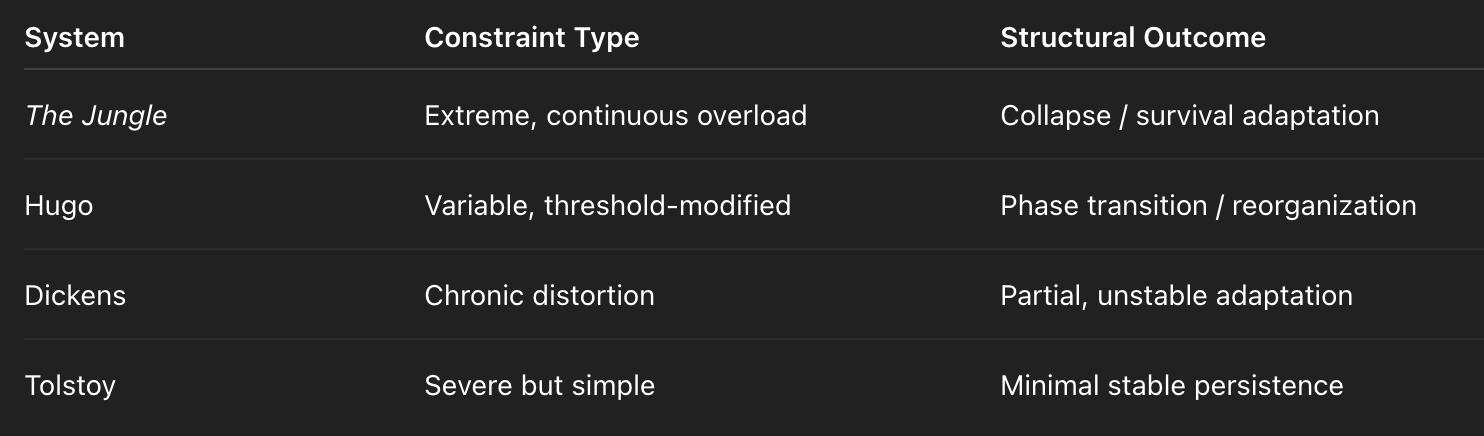
V. The Full Spectrum
These works, combined with The Jungle , produce a complete map:
VI. Final Integration
Across all four:
human behavior is not explained by character, morality, or intention.
It is explained by:
the relationship between constraint and structural capacity.
Each author reveals:
what happens when load exceeds capacity
what happens when it nearly does
what happens when it is altered
what happens when it is stripped to essentials
Final Statement
Hugo, Dickens, Tolstoy, and Sinclair together demonstrate that the human being is not a fixed moral agent but a system whose structure, behavior, and ethical capacity are functions of the constraints under which it forms and persists.
Final Compression
They wrote about morality, suffering, and society.
They were documenting how systems form, distort, break, and sometimes reorganize under pressure.
Part 8. The Law of Formation, Structure, and the Making of Everything: A Unified Account of Human Experience, History, and Matter as Formation Under Constraint

Abstract
This document presents a unified framework in which all persistent forms—physical, biological, psychological, and social—are understood as structures produced under constraint across time. It integrates domains traditionally treated as separate: geology, thermodynamics, human experience, religious and philosophical systems, and industrial society. Shamanic trance, Greek metaphysics, Egyptian funerary doctrine, and the works of William Blake and Percy Bysshe Shelley are reinterpreted as encounters with structural thresholds in the human system. Likewise, the social novels of Upton Sinclair, Victor Hugo, Charles Dickens, and Leo Tolstoy are shown to document the effects of external constraint on human formation. Across all cases, a single principle holds: constraint produces structure; when constraint exceeds capacity, structure destabilizes and may reorganize or collapse. The result is a cross-scale ontology in which existence itself is understood as the persistence of structure under constraint.
I. The Foundational Law
All that persists exists under constraint.
Constraint acting on a system across time produces structure.
This structure:
encodes the history of constraint
defines the system’s capacity
determines its future responses
No structure exists without:
pressure
limitation
boundary
Thus:
constraint is not limitation—it is the condition of formation.
II. The Universal Process
Across all domains, the same sequence applies:
Constraint → Structure → Persistence → Transformation or Failure
Constraint applies load
Structure forms in response
Persistence depends on maintaining coherence
Excess load produces destabilization
Destabilization leads to:
reorganization
or collapse
This process is scale-invariant.
It governs:
rock formations
biological organisms
human identity
social systems
III. The Human System
The human organism is a regulatory structure.
It maintains:
identity
perception
coherence
within a bounded range of viability.
What is called “self” is:
a temporary stabilization of this system under constraint
It is not fixed.
It is:
contingent
dynamic
continuously formed
IV. The Threshold
At sufficient levels of constraint:
regulatory systems fail
identity destabilizes
perception reorganizes
This is:
phase transition
At this threshold:
prior structure dissolves
new structure may emerge
or:
- the system fragments
This is the central event underlying:
transformation
breakdown
reorganization
V. The Misinterpretation of Threshold Experience
Across history, humans have encountered this threshold.
They have described it as:
divine unity
hidden reality
spirit world
afterlife
These interpretations emerge from:
the experience of structural instability under constraint
Specifically:
collapse of differentiation → “unity”
breakdown of temporal processing → “eternity”
loss of identity → “transcendence”
No separate metaphysical realm is required.
These are internal states of the system under load.
VI. Ancient Systems Reinterpreted
Shamanic Traditions
induce threshold states
navigate instability
→ controlled exposure to structural transformation
Greek Philosophy (Heraclitus, Apollonian tradition)
- posits hidden unity behind opposites
→ recognition of structural tension within systems
Egyptian Funerary Doctrine
- describes passage, judgment, reassembly
→ procedural mapping of terminal phase transition
Blake
- relocates transformation to perception
→ recognition of regulatory limits in perception
Shelley
- dissolves boundary between self and environment
→ lived experience of permeability under constraint
VII. The External Field: Society and Industry
Constraint is not only internal.
It is structured externally.
In industrial and social systems:
load is distributed unevenly
recovery is limited
constraint is often chronic
The works of Upton Sinclair, Victor Hugo, Charles Dickens, and Leo Tolstoy reveal:
how external constraint fields shape human structure
Sinclair
- continuous overload
→ structural collapse and survival adaptation
Hugo
- threshold-modified constraint
→ possibility of reorganization
Dickens
- chronic distortion
→ partial, unstable adaptation
Tolstoy
- simplified constraint
→ minimal stable persistence
VIII. The Unified Field
All distinctions collapse into a single framework:
physical
biological
psychological
social
These are not separate domains.
They are:
expressions of one process: formation under constraint
IX. The Final Position
There is no separate category for:
spirit
soul
hidden reality
transcendence
These are:
interpretations of structural states
What exists is:
constraint
structure
persistence
transformation
X. Conclusion
All human systems—religious, philosophical, literary, and social—have encountered the same phenomenon:
the instability of structure under constraint
They have:
described it
interpreted it
ritualized it
documented it
This framework unifies those accounts.
Final Statement
All that exists is structure formed under constraint, persisting through time, carrying its history within it, and transforming when the limits of its stability are reached.
Final Compression
Everything humans have called spirit, meaning, and transformation is the system encountering its own limits and becoming something else—or failing to.