Run Climate Physics: Billy Hamilton and the 1893 Ignition Sky
Run Climate Physics: Billy Hamilton and the 1893 Ignition Sky

Run Climate Physics
Billy Hamilton and the 1893 Ignition Sky
In 1893, the sky shifted.
The pitching distance was moved to 60 feet, 6 inches. Reaction time widened. Contact frequency increased. The ecological equilibrium between suppression and production destabilized.
League scoring surged.
The atmosphere expanded.
To understand Billy Hamilton in 1893 is to examine elite offensive penetration at the moment of structural widening.
Declaring the 1893 Sky
National League total runs in 1893: 10,315
Total league games: 773
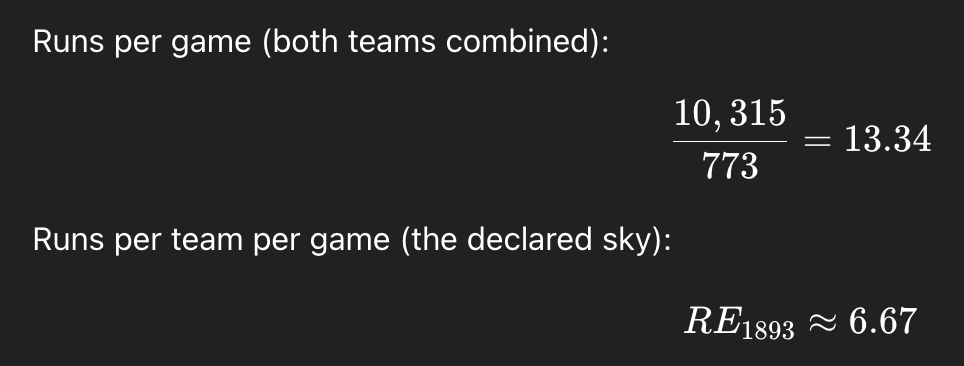
This is a dramatically widened environment compared to the compressed 1890–1892 phase (~4.6 RE).
The atmosphere is mid-transition.
The Instrument
For hitters:
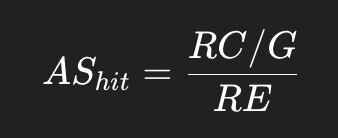
Where:
RC/G = runs created per game
RE = declared scoring atmosphere
This expresses the fraction of the sky the hitter personally generates.
It measures atmospheric penetration.
Hamilton’s 1893 Output
Billy Hamilton, 1893 (82 games):
.380 AVG
.490 OBP
.524 SLG
110 runs
43 stolen bases
135 hits, 63 walks
To compute runs created transparently, use the Basic Bill James formula:
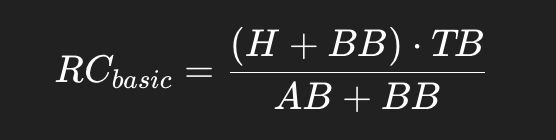
Where:
H = 135
BB = 63
AB = 355
Singles = 101
Doubles = 22
Triples = 7
HR = 5
Total Bases (TB) = 186
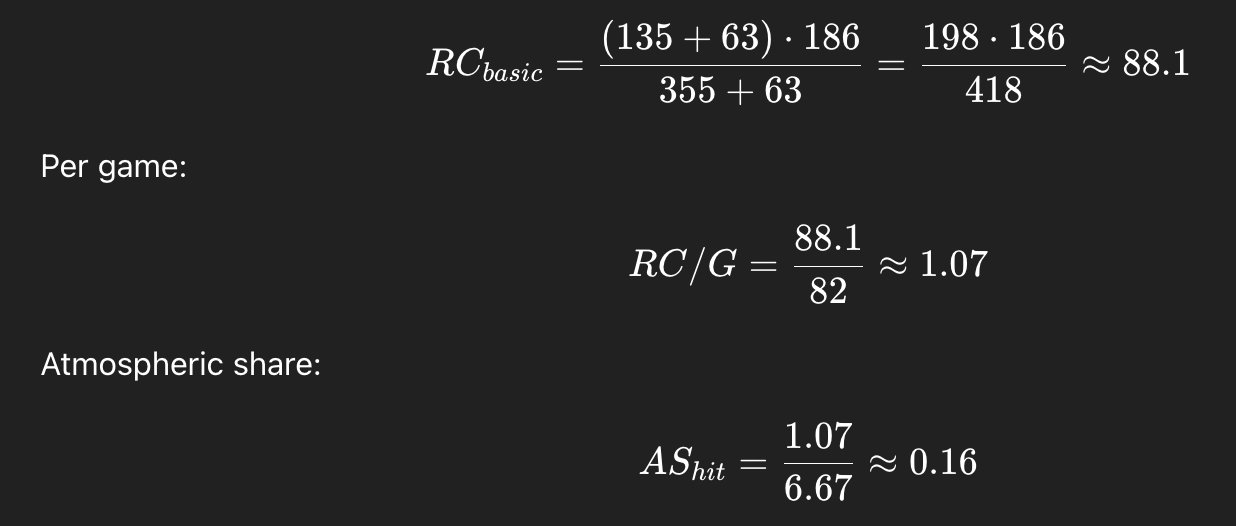
≈ 16% atmospheric share (basic RC model)
What 16% Means in a 6.67 Sky
A 6.67 run environment is enormous by 19th-century standards.
Hamilton personally generated roughly one-sixth of an entire team’s scoring climate per game.
And this figure is conservative.
The basic RC model under-credits:
Stolen base pressure
First-to-third advancement
Defensive stress effects
Hamilton’s 43 steals and .490 OBP created velocity in a widened reaction window. More advanced RC models would raise his atmospheric share into the high teens.
But even at 16%, the structural penetration is significant.
Hamilton vs. Rusie vs. Ruth
To situate 1893 properly, compare structural roles:
Amos Rusie (1894)
RE ≈ 7.38
Suppression ≈ 62%
Function: compression under rupture
Billy Hamilton (1893)
RE ≈ 6.67
Share ≈ 16% (basic RC)
Function: penetration within widening space
Babe Ruth (1920)
RE ≈ 4.65
Share ≈ 49%
Function: structural expansion
Hamilton does not collapse the sky like Rusie.
He does not redefine its ceiling like Ruth.
He saturates widened space with kinetic density.
Structural Interpretation
Billy Hamilton’s 1893 season represents:
Elite OBP exploitation inside rule-driven atmospheric expansion
Horizontal expansion (speed, reach, pressure) rather than vertical rupture (home run geometry)
Immediate mastery of a widened reaction window
He did not create the ignition.
He converted it into run flow.
Conclusion
The 1893 season confirms the moving atmosphere.
The sky widens.
Some players compress it.
Some redefine it.
Some master its new geometry instantly.
Billy Hamilton in 1893 belongs to the third category.
In a 6.67 run climate — one of the widest of the 19th century — he generated roughly 16% of the sky per game, conservatively measured.
That is not myth.
That is atmospheric penetration in a widening field.