Run Climate Physics: Rusie, Grove, Ruth — Compression and Expansion at the Edge of the Sky
Run Climate Physics: Rusie, Grove, Ruth — Compression and Expansion at the Edge of the Sky

Run Climate Physics
Rusie, Grove, Ruth — Compression and Expansion at the Edge of the Sky
Baseball history is not a flat statistical plane.
It is a sequence of atmospheric states.
Scoring environments expand and compress. Reaction windows widen and narrow. Rule changes destabilize equilibrium. Talent interacts with climate.
If performance is to be measured coherently across eras, the sky must first be declared.
Once declared, dominance becomes physics.
The Instrument
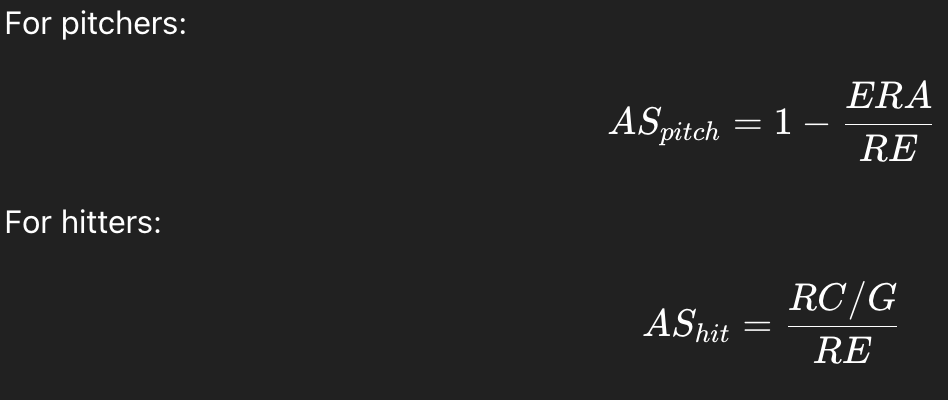
Where:
RE = league average runs per game (the declared sky)
ERA = earned runs allowed per nine
RC/G = runs created per game
Pitchers erase the sky.
Hitters penetrate it.
These are inverse thermodynamic acts within the same atmospheric field.
I. Amos Rusie — Compression at Maximum Rupture (1894)
The Widest 19th-Century Sky
In 1893, the pitching distance was moved back to 60’6”. The reaction window expanded abruptly. League scoring surged.
By 1894:

This is one of the widest offensive climates in MLB history — wider than most live-ball seasons of the 20th century.
The ecosystem did not inflate gradually.
It ruptured.
Rusie’s Performance
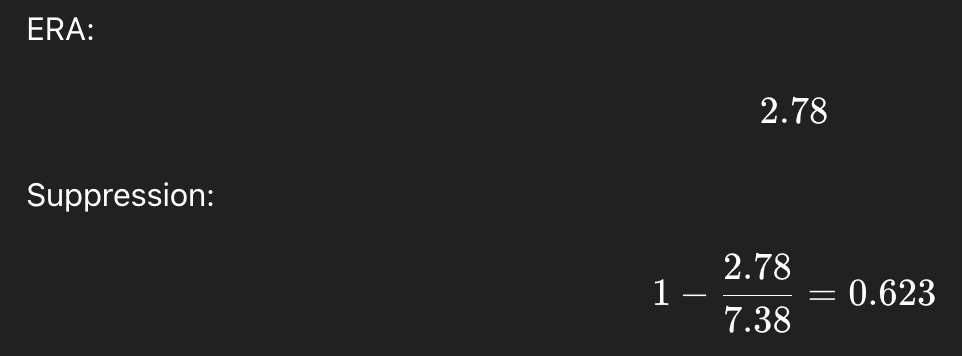
≈ 62% atmospheric suppression
In a sky approaching 7.4 runs per game, Rusie erased nearly two-thirds of the environment.
This is not merely dominance relative to peers.
It is contraction against a broken physics field.
Most pitchers’ ERAs ballooned.
Rusie remained below 3.00.
The sky expanded.
He forced it inward.
II. Lefty Grove — Suppression in a Stabilized Live-Ball Sky (1931)
Now consider Grove’s peak season.
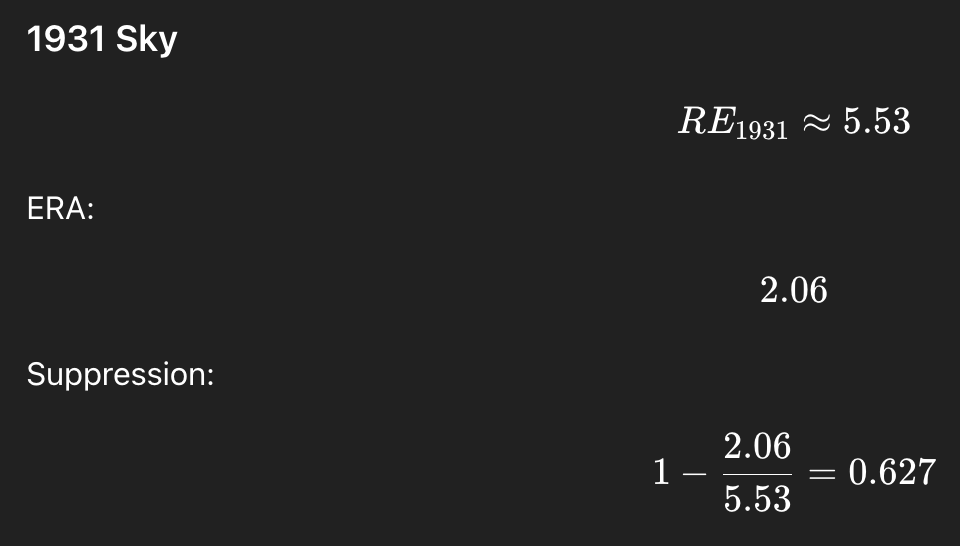
≈ 63% suppression
Numerically, Grove matches Rusie’s peak compression.
But the ecological state differs.
The live-ball era by 1931 was stabilized.
Offensive expectations were high but structurally integrated.
The volatility field was lower than 1894’s rupture shock.
Grove compressed a mature, normalized live-ball climate.
Rusie compressed an exploded one.
The percentages are similar.
The atmospheric violence is not.
III. Babe Ruth — Expansion as Generative Force (1920)
Ruth does not operate on the suppression axis.
He operates on expansion.
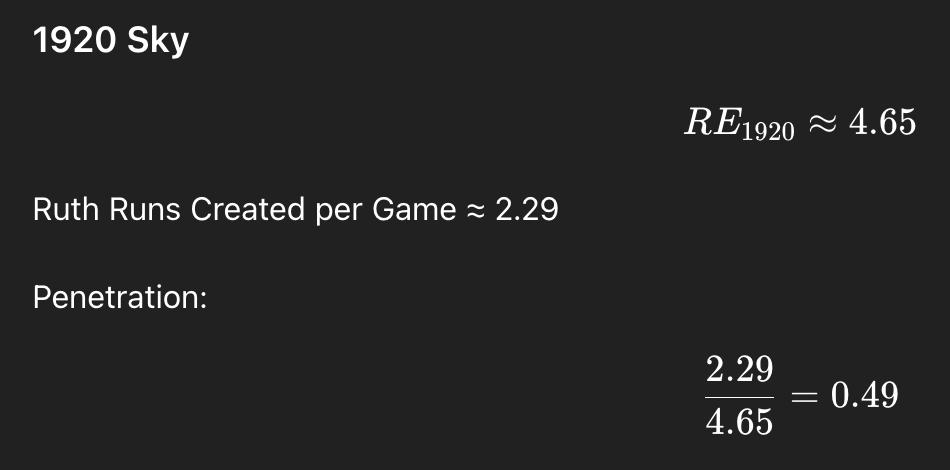
≈ 49% atmospheric share
Ruth was personally generating nearly half of a league run climate per game.
But the structural difference is crucial:
Rusie resisted a widened sky.
Grove compressed a stabilized live-ball environment.
Ruth widened the environment itself.
After 1920, league scoring rises and remains elevated.
Ruth did not suppress a sky.
He redefined its ceiling.
Compression vs Expansion Physics
Rusie (1894)
Sky: 7.38
Suppression: 62%
Function: contraction under rupture
Grove (1931)
Sky: 5.53
Suppression: 63%
Function: contraction under stabilization
Ruth (1920)
Sky: 4.65
Share: 49%
Function: expansion under transition
All three are extreme.
But they are extreme along different vectors.
Rusie and Grove operate on the defensive thermodynamic axis.
Ruth operates on the generative axis.
Structural Synthesis
The mid-1890s were the widest sustained scoring sky of the 19th century.
Rusie’s 1894 season represents:
Compression against maximum expansion
Stability inside ecological shock
Erasure of over 60% of a ruptured scoring field
Grove’s 1931 season represents:
- Compression against a high but normalized offensive baseline
Ruth’s 1920 season represents:
- Expansion that reshaped the atmospheric baseline itself
If run climate is the governing physics of baseball history, then:
Rusie’s 1894 stands as one of the most extreme single-season suppression events ever recorded.
Grove matches its magnitude in percentage terms, within a different climate density.
Ruth represents the inverse act — atmospheric amplification rather than contraction.
The sky moves across history.
Some players erase it.
Some widen it.
Rusie in 1894 did not merely dominate his league.
He compressed the widest 19th-century sky ever observed.
That is the peak act of suppression.