The Equilibrium of Hitting: A Mathematical Model of the Complete Hitter
The Equilibrium of Hitting: A Mathematical Model of the Complete Hitter
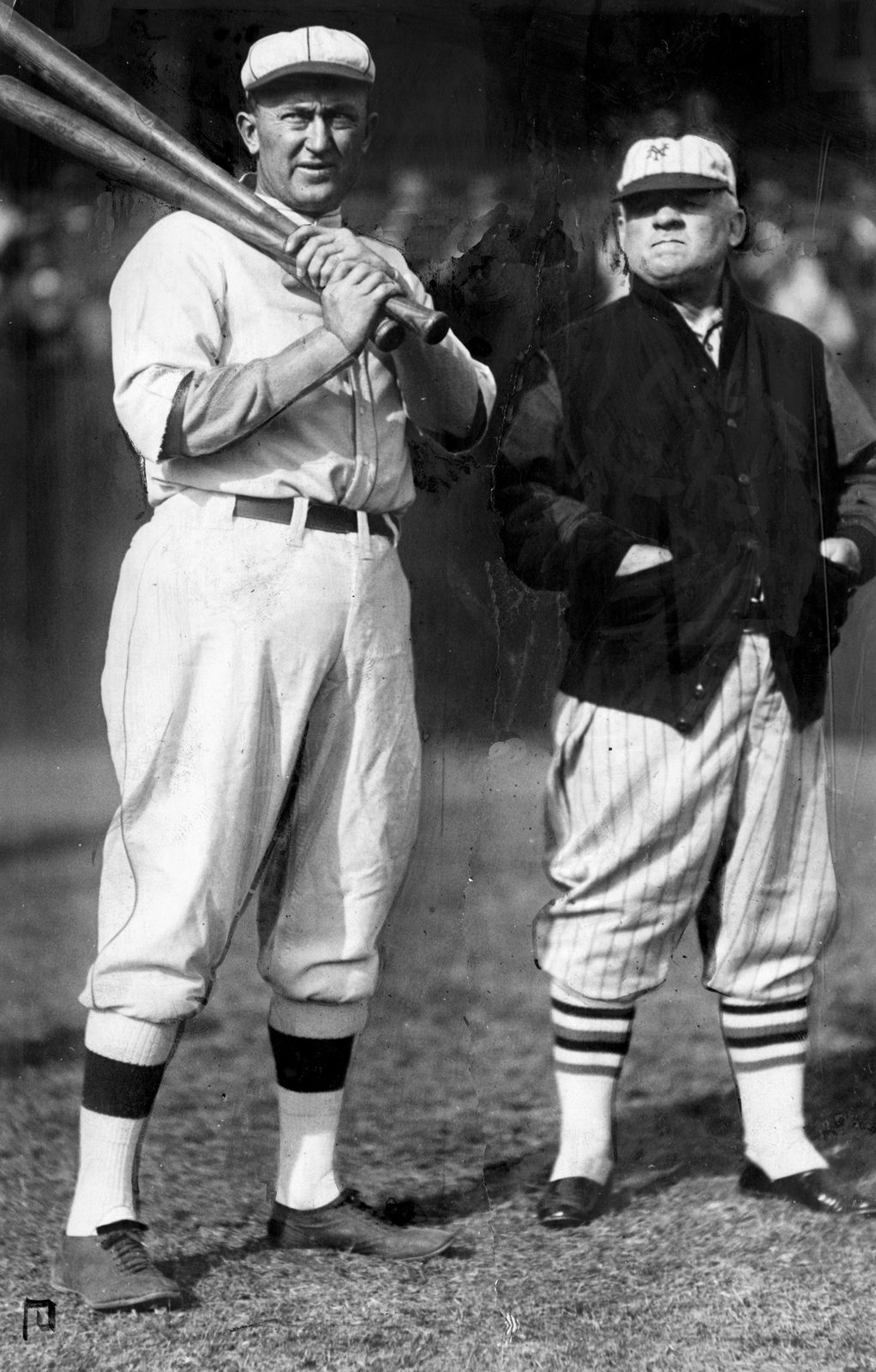
The Equilibrium of Hitting: A System Defined by Power, Scale, and Balance
Constraining the Problem
To isolate the structure of hitting, two conditions must be enforced:
Career scale → at least 7,000 plate appearances
Sustained force → slugging percentage of .500 or higher
This removes:
short careers
partial samples
and hitters who never carried meaningful power over time
What remains is not a list of great hitters.
It is a stable population of players who:
produced with force, across full careers
Within this group, hitting can be treated as a system.
The Three Forces of Hitting
Every hitter operates within three competing demands:
Conversion → batting average
Force → slugging percentage
Frequency → hits per game
These are not independent skills.
They are constrained by:
reaction time
swing mechanics
pitch velocity and movement
decision latency
As one increases, another tends to decline.
The problem of hitting is not maximizing a single dimension.
It is:
maintaining all three simultaneously without collapse
A Mathematical Representation
Each dimension is normalized to a structural baseline:
AVG → .340
SLG → .500
H/G → 1.27
Each player is expressed relative to these thresholds and combined using a geometric mean :
Complete Hitter Score (CHS)
This is essential.
The geometric mean does not allow dominance.
If any dimension weakens, the entire score declines.
It measures not isolated greatness, but:
the integrity of the system itself
The Result: A Compressed Equilibrium
When applied to hitters who meet both power and scale constraints, the results collapse into a narrow band.
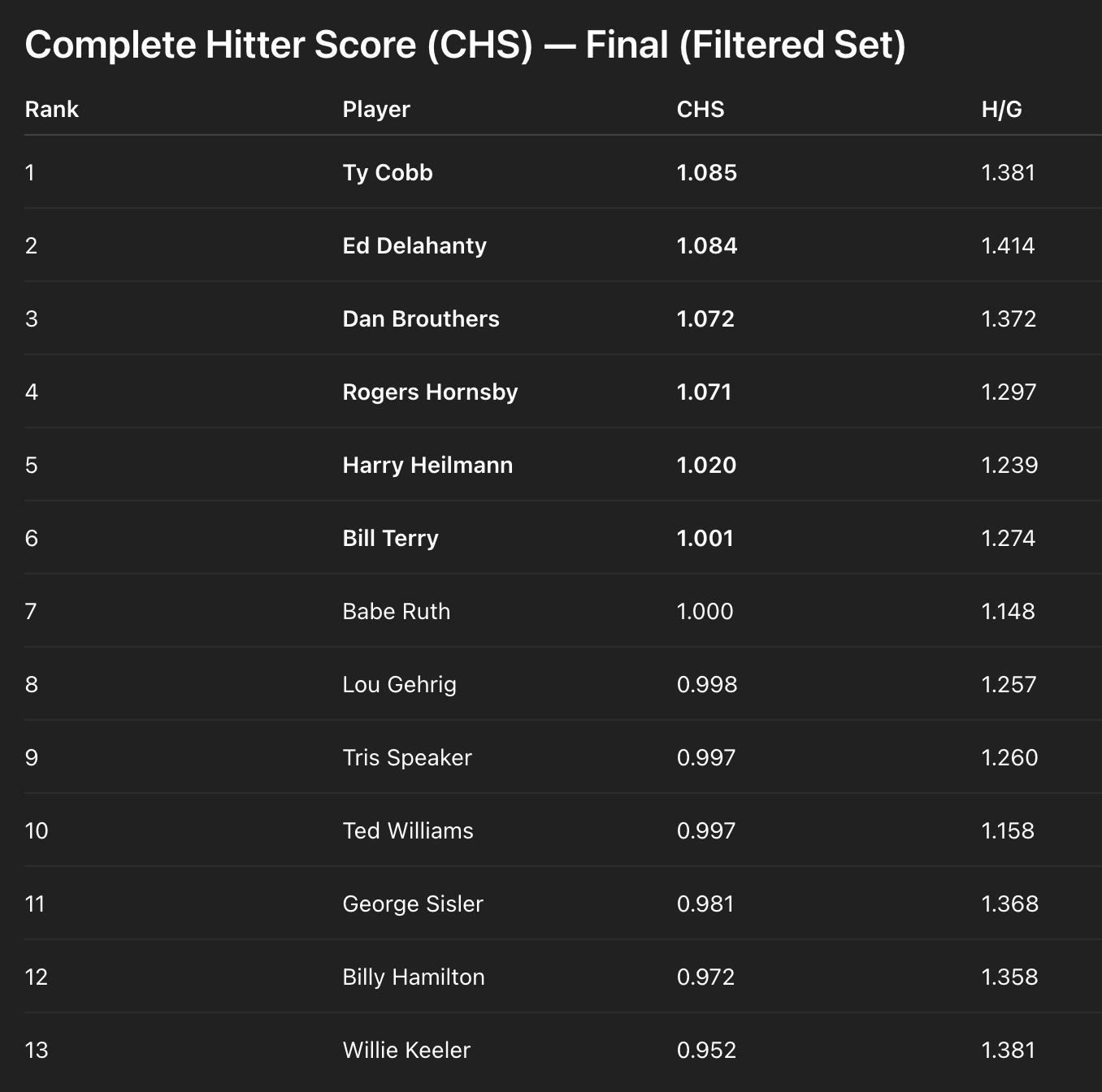
At the top:
Ty Cobb
Ed Delahanty
Dan Brouthers
Rogers Hornsby
All cluster tightly around:
~1.07–1.085
Across different eras, environments, and competitive conditions, they converge on the same solution:
high conversion, high force, and high frequency—sustained together
This is not stylistic convergence.
It is structural necessity.
The Boundary: Bill Terry
At the lower edge of this equilibrium sits Bill Terry.
His score:
CHS ≈ 1.00
This is not symbolic.
It is structural.
It represents:
the minimum viable configuration that sustains all three forces simultaneously
Terry does not dominate any axis.
But he does not fail any axis.
He is the last hitter in this system who maintains:
elite average
real power
sustained hit frequency
across a full career
The Structural Shift Below
Immediately below Terry, the system changes.
Players such as:
Lou Gehrig
Babe Ruth
Ted Williams
remain among the greatest hitters in history.
But their scores fall at or below equilibrium.
This is not a decline in performance.
It is a change in structure.
Gehrig sustains output with greater power density
Ruth and Williams push further, maximizing force and selectivity
Ruth, in particular, balances extreme power against reduced hit frequency, settling almost exactly at the equilibrium threshold
Their production remains immense.
But it is achieved through:
compensation rather than balance
Equilibrium vs. Compensation
This defines two fundamentally different solutions to hitting:
Equilibrium
All dimensions sustained
No axis compensates for another
System remains internally stable
Compensation
One dimension carries more load
Others are reduced
Output persists, but structure shifts
Both produce greatness.
But only one represents:
a complete solution to the system
What This Reveals
When constrained by:
power (SLG ≥ .500)
scale (≥7,000 PA)
hitting resolves into:
a narrow equilibrium surface
The top performers converge tightly
The lower boundary is sharply defined
The transition below that boundary is structural, not gradual
Final Formulation
Among hitters who sustain both power and career scale, only a small group maintains equilibrium across conversion, force, and frequency.
Bill Terry defines the lower boundary of that equilibrium.
Below him, hitters remain great—but their production depends on tradeoffs rather than balance.
Conclusion
Great hitters can dominate in many ways:
Through power.
Through efficiency.
Through selectivity.
But within the constraints of the game, only a few achieve:
continuous production, meaningful impact, and sustained frequency—simultaneously
That space is small.
It is stable.
And it defines the true limits of hitting.