The Reaction–Time Constitution of Baseball History: A Formal Theory of Run Climate, Perceptual Sovereignty, and Somatic Equilibrium (1871–1969)
The Reaction–Time Constitution of Baseball History: A Formal Theory of Run Climate, Perceptual Sovereignty, and Somatic Equilibrium (1871–1969)
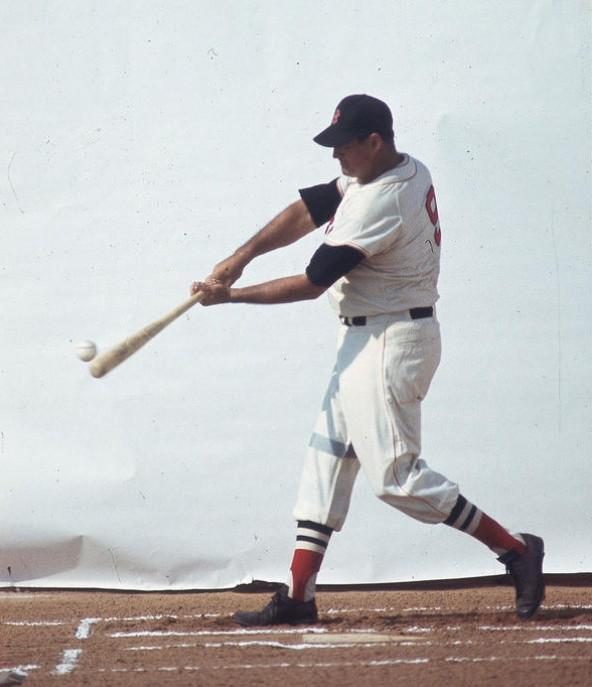
Baseball history can be modeled as a closed perceptual–somatic equilibrium system governed by reaction-time distribution.
The Reaction–Time Constitution of Baseball History
A Formal Theory of Run Climate, Perceptual Sovereignty, and Somatic Equilibrium (1871–1969)
Abstract
Baseball history is typically segmented into eras defined by narrative labels: Deadball, Live-Ball, Integration, Year of the Pitcher. These labels describe outcomes but not causes.
This document formalizes a unified architecture across all eras:
Baseball is a closed perceptual–somatic equilibrium system whose output (runs per game) reflects the distribution of reaction-time advantage between hitter and pitcher.
Run climate is not aesthetic.
It is the thermodynamic readout of perceptual control under mechanical constraint.
This theory integrates geometry (distance, mound height), visibility (ball condition, lighting), somatic mechanics (kinetic chain efficiency), and cognitive decision architecture (swing selection) into a single governing variable:
Reaction Window Distribution.
I. The Governing Variable
1. Reaction Window
Define:

Where:
( FT ) = effective pitch flight time (milliseconds available for perceptual processing)
( MT ) = motor initiation threshold (milliseconds required to execute the swing sequence)
The hitter operates under constraint:

If ( MT ) is large or ( FT ) is small, reaction window compresses.
If ( FT ) expands or ( MT ) decreases, reaction window widens.
2. Reaction-Time Distribution
Let:
( RW_H ) = hitter’s effective reaction window
( RW_P ) = pitcher’s effective disruption window
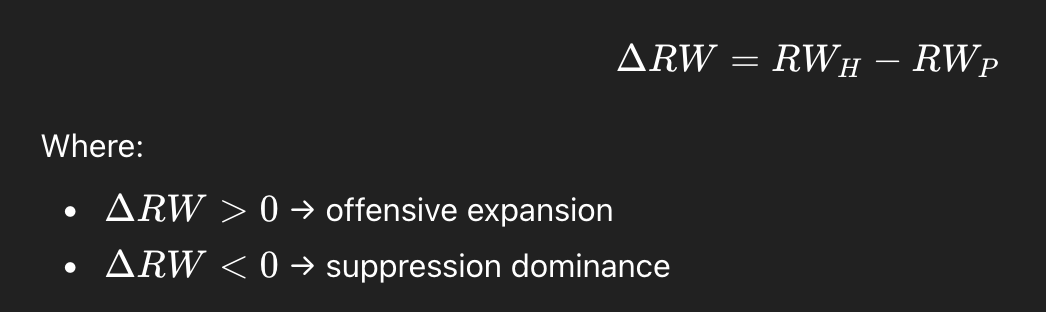
The competitive equilibrium is defined by:
3. Run Climate as Output Signal
Let:

Where:
( RC ) = runs per game
( E ) = environmental modifiers (park geometry, ball composition, strike zone enforcement, mound height)
Runs per game is therefore:
The emergent thermodynamic signal of reaction-window distribution.
II. Environmental Architecture (Hardware Layer)
The system is mechanically modulated by:
1. Distance Geometry (1893)
Increasing pitching distance increases ( FT ), expanding ( RW_H ).
1893 → hitters gain milliseconds → run spike.
2. Visibility Regime (1900–1919 vs 1920)
Darkened/scuffed balls reduce perceptual certainty → functional ( FT ) decreases.
1920 reforms (cleaner balls, spitball restrictions) increase perceptual legibility → effective ( FT ) rises.
3. Mound Physics (1969)
Mound height affects:
release extension
perceived velocity
vertical approach angle
Lowering mound reduces pitcher leverage → decreases ( RW_P ) → restores equilibrium.
Environmental shifts redistribute milliseconds.
They do not create talent.
They reallocate perception.
III. Somatic Architecture (Embodied Layer)
The system is not purely perceptual.
It is somatic.
The swing is a constrained energy sequence:
Ground force
Hip torque
Torso separation
Barrel acceleration
Motor initiation threshold ( MT ) is the time required for this chain to unfold.
Elite hitters reduce ( MT ) through mechanical efficiency:
Minimal pre-load noise
Controlled stride
Balanced torque sequencing
Extended bat-path geometry
Reducing ( MT ) expands effective ( RW_H ).
Thus:
Perceptual sovereignty depends on somatic economy.
IV. Cognitive Architecture (Decision Layer)
Perception alone is insufficient.
Let:

Ted Williams formalized strike-zone mapping as expected value optimization.
He restricted swing decisions to high-probability cells.
Thus:
Perceptual clarity → selective discipline
Selective discipline → reduced regret
Reduced regret → optimized run production
The reaction window becomes consciously governed.
V. Era Reinterpretation Under Unified Model
1870s – Open System
High ( RC ). Inefficient defensive conversion.
System not stabilized.
1880s – Suppression Consolidation
Professionalization increases disruption control.
( \Delta RW ) shifts negative.
1893 – Distance Transfer
Flight time increases.
( \Delta RW ) shifts positive.
Run spike.
1900–1919 – Deadball Cavern
Opacity + ball decay + large parks reduce effective perceptual clarity.
Pitchers regain time.
Suppression stabilizes.
1920–1935 – Ruthian Expansion
Visibility restored. Carry increases.
Hitters exploit widened ( RW_H ).
Run climate expands.
1939–1960 – Williamsian Formalization
Perceptual mapping becomes conscious system.
Motor efficiency integrates with decision discipline.
Reaction-time economy becomes rationalized.
1968–1969 – Suppression Overreach and Correction
Pitcher dominance peaks.
League lowers mound.
System equilibrium restored.
VI. Metastructural Interpretation
Baseball is not linear progress.
It is oscillatory equilibrium.
Define:

When imbalance exceeds tolerance:
Environmental correction occurs
Mechanical innovation diffuses
New equilibrium emerges
The curve of runs across history is a waveform of perceptual sovereignty.
VII. Metasomatic Interpretation
The body is not incidental.
Baseball is a species-level coordination ritual in which:
Perception
Decision
Torque
Timing
are fused under constraint.
The hitter’s body becomes an instrument converting milliseconds into mechanical energy.
The pitcher’s body becomes an instrument compressing milliseconds into deception.
Run climate is the physiological output of this duel.
Thus:
Baseball history is a chronicle of somatic adaptation under shifting perceptual regimes.
VIII. Formal Statement of the Theory
Baseball is a closed perceptual–somatic system.
Reaction-time distribution governs offensive output.
Environmental geometry redistributes perceptual time.
Mechanical efficiency modulates motor threshold.
Cognitive discipline governs commitment probability.
Runs per game is the thermodynamic signal of these interactions.
Era transitions are equilibrium corrections in reaction-time distribution.
IX. Conclusion: The Constitutional Engine
Across 1871–1969, baseball evolves not as narrative fluctuation, but as controlled oscillation in milliseconds.
The Deadball era compresses time.
The Ruthian era expands it.
Williams formalizes its governance.
1969 restores equilibrium.
The run curve is not aesthetic history.
It is the readout of who owns perception.
And baseball’s deepest constant is this:
The struggle over the right to see, decide, and convert time into force.
That is the constitutional architecture of the game.
This is the formal theory.
It integrates:
Geometry
Biomechanics
Cognition
Environmental physics
Historical regime shifts
into a single governing variable.
And it holds across eras.