The Death of the Symbolic Order: Six Lectures on Modernity, Disclosure, and the Descent into Being
Canonical source: substack:davidbussellarchive (https://davidbussellarchive.substack.com/p/the-death-of-the-symbolic-order-six)
Lectures & recordings
- Modernity: The Collapse of the Ontological Ground (May 21, 2026 Lecture)
- Artaud and the Body of History: Absolute Denial and Desecration of the Symbolic Order as Act of Ontological Liberation in Modernity (May 22, 2026 Lecture)
- Poets, Prophets, Shamans: Global Modernity and the Deep Time Existential Fate of Mankind (May 23, 2026 Lecture)
- Franz Kafka: The Bureaucratic Machine of Modernity and Ontological Disclosure (May 24, 2026 Lecture)
- Surrealism, the Dream-Descent, and the Birth of Total Disclosure as Existential-Human-Individual-Historical Condition (May 25, 2026 Lecture)
- The Death of the Symbolic Order: The Weimar Breach and the Ontological Gap of Modernity (May 25, 2026 Lecture)
The Death of the Symbolic Order: Six Lectures on Modernity, Disclosure, and the Descent into Being
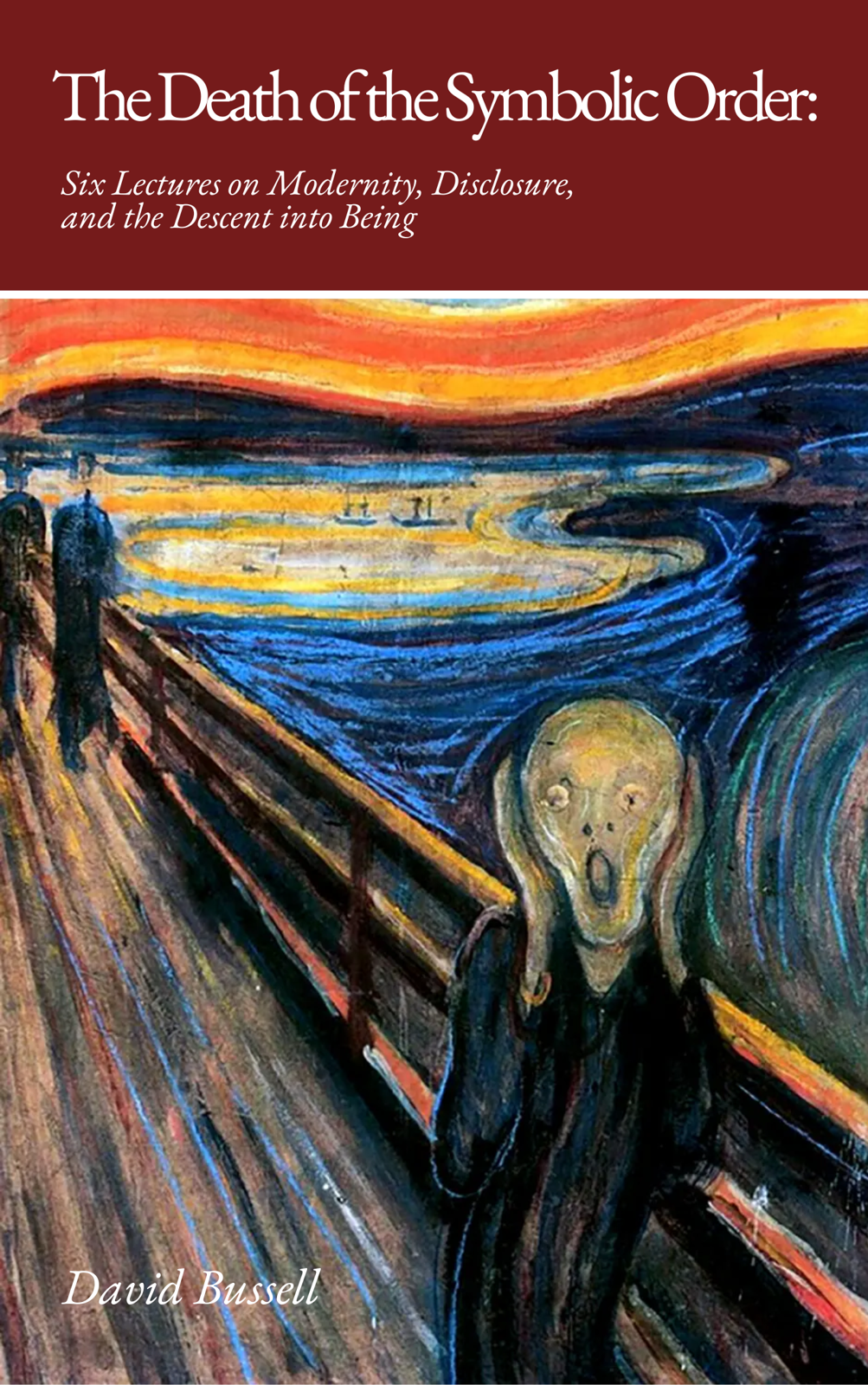
Part 1. Modernity: The Collapse of the Ontological Ground (May 21, 2026 Lecture)
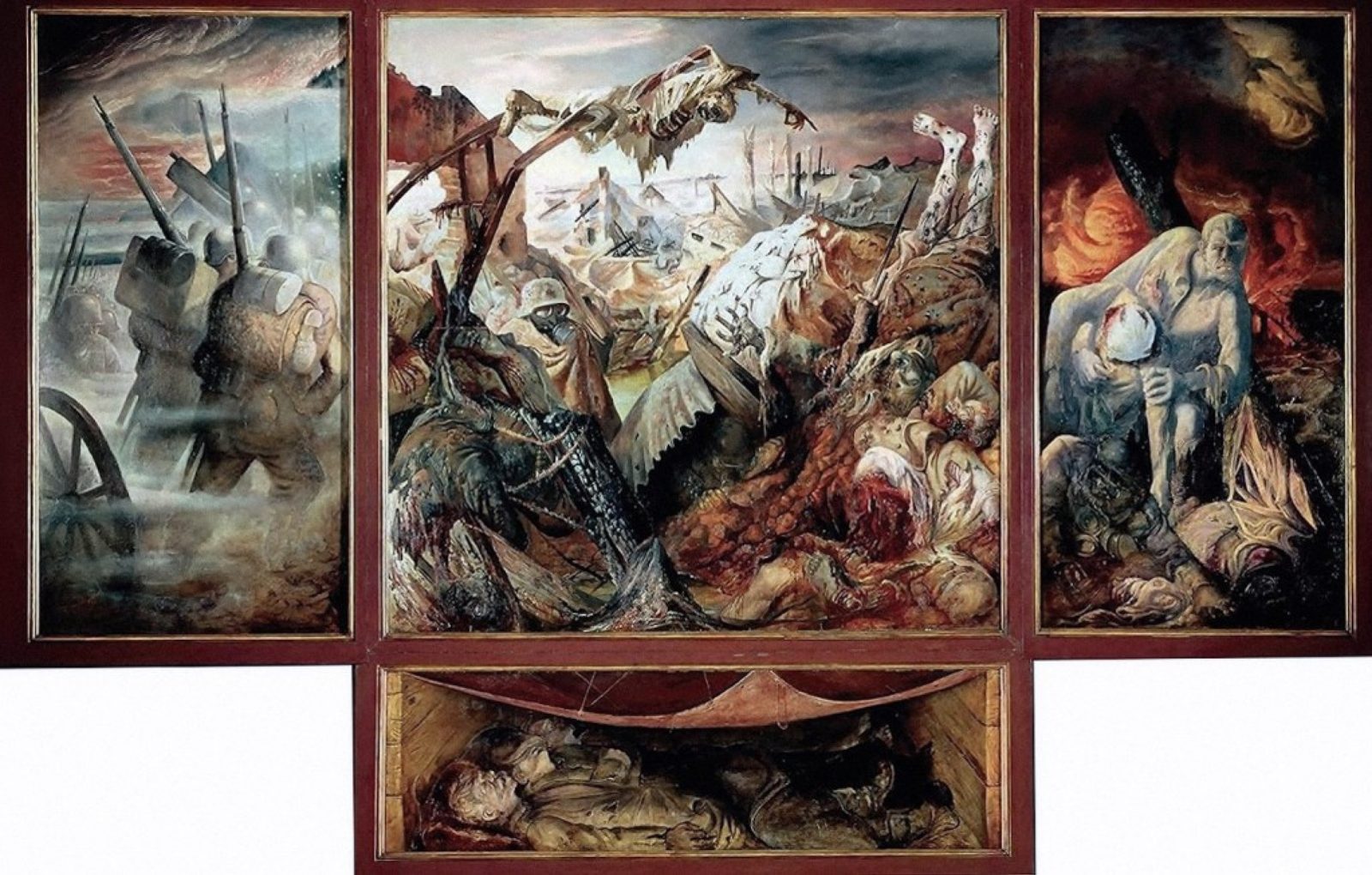
Beckmann, Dix, Grosz; the Visual Confrontation with the Spiritual Death of Modernity
A Lecture
So I want to give a lecture regarding Max Beckmann, George Grosz, and Otto Dix, who I see as the three major painters of the Weimar Republic in Germany. We’ve discussed in great depth the catabatic descent of modernity as it is portrayed symbolically in text, particularly zeroing in recently on Trakl and Kafka. The Kafka works, I think, are mostly textual — that’s mostly written work of mine, and it hasn’t been portrayed yet in oratory. But this immense fracture point — we’ve gotten closer and closer to the diagnostic center, which of course is Germany in World War I and World War II.
And with Beckmann, Dix, and Grosz, I think it’s incredibly interesting to see Heidegger’s question emerge roughly two decades after the major compression zone, or the chamber, of modernity as it collapses fundamentally in the political and historical action of World War I into World War II, and the economic, social, and political effects that occur in Germany therein. This really is the bankrupting of Germany after World War I and the political crisis that occurs therein, which results in the new regime, which mounts into World War II, Nazi Germany.
And when we have Beckmann, Dix, and Grosz, we’re having a visual confrontation with the decay of modernity and the epicenter of modernity’s decay, which is the collapse of Germany — which Nietzsche articulates and Heidegger inherits this mantle. And this, in my opinion, is precisely why Nietzsche and Heidegger are so important to the history of early 20th-century philosophy: because they themselves are standing at ground zero of the crisis of modernity as it occurs specifically in Europe.
The Triptych of Artists
There are several different layers to Dix, Grosz, and Beckmann. Beckmann is — we could say — the metaphysical crisis, wherein the archetype takes precedence. Masks, actors, triptychs. The sense of a mythic collapse that is occurring. Whereas with Dix, we have a highly embodied carnage, most of his work being obsessed with mechanized death and war — World War I in particular, which he participated in. The loss of the human body and the turning of the human body into industrial material. And then we have Grosz, who frequently depicts politicians, businessmen, clergy, officers as kind of swollen caricatures and mannequins, alcoholics and machines and puppets.
So there’s a triptych within these three artists, which is showing the spectacle of the descent into fascism — everything from the psychic manipulation en masse and the humiliation of Grosz’s political modernity, to Dix’s embodied crisis of war, which is depicted viscerally in the mechanized death and the rotting trenches of his paintings, and Beckmann’s layer, which is the metaphysical archetypal crisis — the spiritual underbelly, so to speak — which is the myth of modernity, which has become theatrical, fractured, and contorted: a dream inside a collapsing civilization.
And this is why Weimar Germany — we have such a fertile period of creativity, where Kurt Wolff is publishing in journals; Trakl, one of the greatest poets of modernity; and Kafka, one of the greatest novelists and short story writers of modernity — in the same journal, in the same pamphlet, at the same time. This is also the triptych of Beckmann, Dix, and Grosz that we experience. We have this mass outpouring of the possibilities of art in this period of time.
And these possibilities are precisely [opened] by the collapse that is being wrought in this period.
The Opening of the Metaphysical Ground
So this collapse is the opening up of the metaphysical ground — which is the ground of the ontos , which Heidegger later is interrogating, approximately 20 years after the major writers and artists that I just iterated. And this is what I think is fascinating: that the question is asked 20 years after the answer is given. Why is this? Because the collapse is being experienced first through poetry, and second through philosophy. And this is the dialectical tension of poetry and philosophy.
Which is to say — as we understand with Trakl, and this was why I was going back and forth between Trakl and Eliot — Eliot is a poet-philosopher. Eliot is a poet-metaphysician. And he stands between Heidegger and Trakl in that he can see and experiences and lives in both worlds: as a critic, a metaphysical thinker, almost something of a theologian, as well as a poet. But Trakl himself is totally embodied in the semantic experience of collapse of modernity.
And this also, I believe in large part, has to do with the periods in which these artists and thinkers come to maturation. The extent of the crisis and this fulmigation of what is unfolding in the Weimar Republic and Germany during and after World War I into World War II — this crisis is fundamentally somatic, and it’s embodied. It’s not intellectualized or reflective. So this experience is happening first at the level of the soma, or at the level of the nervous system. And there is no context, and there’s no concept, by which this crisis can be articulated by way of metaphysical structure or by critical reflection.
The faculty of the concepts to describe modernity have not been created yet. The crisis is a chamber of the body, because it is an ontological crisis, as Heidegger says, but it’s also a political, historical, economic, cultural crisis, which is being undergone at the level of the body in relation to history at ground zero, which is the collapse of Germany.
Sirens of Modernity
And this is what I find so fascinating about these thinkers and writers — particularly Kafka, Trakl, and the three visual artists — is that the crisis is being rendered out from the collapsing civilizational ontos ground, which is to say the civilizational logic or relation to being, which is ultimately proved to be artifice as the culture itself descends into a madness predicted by Nietzsche and understood by Jung.
And what I mean by this is that these are sirens of modernity. This is how I think of Nietzsche: that Nietzsche is a siren of the collapse of modernity, a syntactic and symbolic collapse of modernity at the level of the ontos — both in his statement, of course, “God is dead,” but also in his metaphysical declarations, particularly Thus Spoke Zarathustra , which Jung goes deeply into. Because there is an understanding in Jung, astutely, in Nietzsche, and as he observes the collapse of Germany — again, Jung and Freud are also coming out of Germany at this period of time — that what is unfolding is a mass psychic fracture at the level of ontological destabilization, wherein the downstream effects — political, economic, social, cultural, relational, vision or image of the self — that these downstream effects are that which is being experienced semantically. And this requires necessary ground.
And Jung, as well as Nietzsche, both do significant inner work. And by inner work, I mean examination of the self. So they’re standing on ontological footing, which is of course the great task of philosophy: to know thyself, to know the ontos. But this crisis that’s being experienced by Beckmann and Grosz and Dix and Kafka and Trakl is the ground being ripped out from under. It’s not the metaphysician’s ground. It’s not Heraclitus’s ground. That ground is cosmological-ontological. The ground being ripped up from under the artists and literary figures of Weimar Republic Germany is ground of the experience of being in time without the necessary critical cosmological situation. So this descent is somatic. It is the descent into hell viscerally, without structural footing.
Hell Made Visible
So when we have Trakl’s blue dreams, we have Kafka’s genetic mutations into the cockroach, and we have Beckmann’s murderous mythological scenes of masks and circus performers and kings and his triptychs and symbolic voyages. We have Dix’s rotting trenches and mechanized death, decomposition and prosthetic reconstruction. And we have the almost pig-like and swollen alcoholic businessmen and politicians, the corrupt officers and clergy [of Grosz].
These are enlargements. They are the perceptual aperture of the descent organism, in that the civilization itself — and by and large the world, particularly Europe — is undergoing a metaphysical descent into hell, which is to say the ontological ground of the entire civilization is gone, is disappearing. It no longer can hold. As Yeats says, “the center cannot hold,” in this crucible of modernity, which is a technological industrialization in which this disfiguration occurs and is occurring, and it is being grasped at face value by these artists, both the visual and the textual — Trakl, Kafka, and the three visual artists.
This experience of this highly enhanced creativity, which I will almost say is exponential genius, is emerging from this high-contrast confrontation with an uninhabitable terrain: the disappearance of the ontological ground and the real historical effects, which again are economic and life-and-death based. Their physical realities. Their somatic nervous-system-level realities of collapse.
And this groundless collapse produces the confrontation with the face behind the mask of modernity, so to speak — which is corruption, industrial violence, spectacle, humiliation, rotting trenches and mutilation. This confrontation with this civilizational industrial death, this death market, which is being rent in Germany from the ashes of a dead age — a dead century, a dead millennium of belief — which is Nietzsche’s former village towns in a sort of almost pagan Germany of a local religious enclave, which is a slow culture, a slow theological and literal material culture of trade, exchange, community, which has been shattered by the revolution of the factory and the industrial firearm, trench warfare, airplane warfare, right as we descend into the 20th century.
The Somatic Shock
This is a shock at the level of the body, which is the perceptual aperture. This nervous-system-level somatic shock is registering in these sensitive individuals — which I’ve formalized substantially in both my Renaissance Mind theory as well as my Atlas theory, which is an allostatic theory, neural relationship to life. That is, these sensitive beings — whom we usually call the artists or the poets — are expressing and externalizing this internal somatic-level experience of shattered myth, of shattered ontos , of Abgrund.
This is why we experience hell in Dix and Beckmann and Kafka and Trakl and Grosz. We experience hell because — and this is what’s so powerful about the expressive mode of modernity, of course we have everything from Dada and Surrealism that emerged during this period of time — because these are somatic-level responses to this level of existential exposure, which is the loss of the ground of the ontos in a worldwide sense, which has real effects on the body. Again, this is economic, this is cultural, this is relational. This is the sphere which Mayakovsky calls everyday life, or byt.
That this has become so destabilized and so dysfunctional and so absurd — again with Camus, right, this theme of absurdity — that it has become such a blown-out circus or carnival that the experiences that Goya uses in his black paintings become common parlance. This is an experience that is being articulated across the great artists and great literary figures of modernity, because the experience has become not in the sense of maybe an isolated mad genius such as Heraclitus or Goya, but it has become an industrialized condition of profound alienation, wherein the collective ontos has become so absurd that the dissociation from the ontological ground has become absolute.
Art as Metabolic Necessity
And this is what we experience in the profound profusion of artistry at the turn of the Weimar Republic. Because it is a mass collapse, and art — as I’ve described in my Law of Being and General Theory of Magnitude — is itself the necessity of externalizing this condition. It is not, then, a luxury. It is a way of metabolizing collapsing constraint, the collapse of persistence. It is a way of processing metabolically the hollowing out of bourgeois civilization in the European metaphysical order.
This is, as Dix so often depicts, and Grosz — less so Beckmann, because it’s more of an archetypalized myth space, but nonetheless the same message is being delivered — that this is a total industrial mechanized war on consciousness itself. And these are the ill effects we see over a century later: that this is the exponential banner of progress, which is nothing more or less than a total standing-orderization of nature itself, as Heidegger puts it. All of nature and all of man and all of life has been turned into a calculus of power, force, and influence.
And this is what we see as the winning powers of World War I began to divide up the world, the globe, with a knife — as is one of the famous propaganda cartoons of the time — as well as into World War II, where this burst of exponential industrial technological power reaches new heights with the atom.
The Eternal Depictions
So these are such profound depictions because they are in many ways now eternal, as technological modernity has only continued to accelerate exponentially, right? As the energetic harvest of fossil fuels and electricity and atomic energy continues to accelerate to maybe perhaps a tipping point. It is that the mask of the pre-modern ontos , having been peeled off — the political, social, and moral collapse of Grosz, the alcoholic mannequin politician and the pig-like officer or the bureaucrat or the judge; the twisted mangled body of Otto Dix in the industrial war machine, rotting in a trench, covered in prosthetics and shrapnel; the dissociating dream of a symbolic voyage and violent captivity, violent bondage of Max Beckmann (it almost looks like a mythological depiction, and you look closer and there’s this profound, fascistic, mechanized violence that’s occurring within the painting) — these themselves are works of the collapse of meaning in relation to being, into an environment of grotesque theater and political violence, spectacle, and control by way of coercion and psychological manipulation.
The Automation of Consciousness
So this is an idea here that we could describe as the automation of consciousness: that technological industrial modernity is the creation of a total ecosystem of pure efficiency and standing order, in which the entire world as well as the human body is weaponized and fractured. That these industrial systems enter into flesh, literally via the shrapnel or the prosthetic, the mustard gas — that the human body itself has been terraformed.
And Marx talks about this in the Grundrisse. It’s that the laborer with the machine has almost fallen in love with it in this rhythmic unity, wherein the machine and the laborer become one. And this is very prescient in relation to digital technological modernity as an industrial force, that the human being is collapsed into composable parts. That consciousness itself is being rent, as we can see with artificial intelligence, into a symbolic market wherein the human history of expressed symbols are being remixed and admixed into endless inventories of new form, which is supposedly a conquering of knowledge, so to speak — if such a thing is possible.
But these are, again, somatic experiences. To read Kafka in the age of artificial intelligence is to understand that the symbolic order or the symbolic essence of Kafka has been appropriated into a kind of a plasticine recompression or remixing of the lived, felt experience of the existential self in the collapse of modernity. That the metamorphosis and the cockroach are all of a sudden now purely symbols, or purely a symbolic ledger, or a sort of symbolic liturgy which can be mechanized and changed and shifted to fit any sort of narrative inquiry. That no longer is the symbolic production of consciousness grounded in the body; rather, it’s in this artificial chamber of the remixing of symbols.
And this is a principle which is discussed at length by Heidegger and Benjamin, Brecht — the figures that emerge from this time who are recognizing this crisis as a fundamentally human and humanitarian crisis. It’s a crisis of the first order, as technological consciousness and mass symbolic systems and industrial perception fragment the modern self to the point at which there’s a question of: who and what is the human being? And Camus articulates this in his lecture on the human crisis.
The Hysteria of Modernity
This is an early formulation, at the beginning of the 20th century, and we are now a hundred years past this early formulation. The hysteria that comes of it: nationalism as a theatrical hysteria; capitalism and bureaucracy turning people into machines or functions, as described in Kafka and works such as The Trial ; modernity producing psychic fragmentation, as in literal fragmentation in the body. This is nervous system instability and nervous system overwhelm unto physical collapse, which was not being stabilized by an ontological ground or a myth system which was uniting the nation, nonetheless the world — other than in Nazi Germany, which was a claim towards the return of the Ur -ground, right? The return of the myth of ancient pre-modern Germany, that this German Volk could once again be reclaimed, even though history itself had utterly changed. And this idea or image of the German Volk may well have never existed.
Mass media and spectacle reorganizing consciousness — this was a huge part of the speeches and the propaganda movement of Hitler, including Riefenstahl. The movement and acceleration of cinema and the radio played a huge role in this. Bourgeois civilization spiritually hollowed out by the collapse of the old European metaphysical order. And this was collapsing by way of the technological turn, which was not only mechanized war, but the factory, which was a thermodynamic revolution of electricity and industrial power.
This total violence of the paradigm shift can literally be described as a thermodynamic and thermonuclear phase change by the weaponization of industrial modernity, which is a fossil fuel weaponization. It is an oil weaponization, in which we are still dealing with the outcomes and outproducts of that today, in terms of the issue of powering this new industrial world with the masses of people and systems which now populate and rely upon fossil fuels.
What the Artists Understood
So these artists — right, again, 20 years before Heidegger — understood that industrial modernity had fundamentally altered the human body, perception, mass psychology, violence, symbolic life, and the very structure of the self. That the world in which was being lived was changing, and that the forces which emerged from it — the pig-headed bankers and the twisted, prosthetic, mustard-gassed dead, and the broken, bound myths of Max Beckmann — were articulations of the forces emerging from this Pandora’s box of modernity, which was a phase change and a shift of the energetic conditions of being in time. Not only at the level of Germany itself, which was ground zero of this ontological collapse and expressed as such politically and spiritually, particularly through the bankrupting of Germany, but additionally at the level of modern consciousness as a global phenomenon, as industrial technology terraforms the globe, compresses space and time, both in terms of information and goods and the relationships that occur therein between nations — and the collapse, even as it began, of the concept of the nation-state, almost within a span of decades.
That this space of nations, which was formerly only traversed by ships if it was as such, is then traversed by planes and is then traversed by the internet. So this is an exponential acceleration of space and time. And in this crisis — again, the metaphysical crisis, which is the meaningful relationship to being — the human body is transformed utterly into industrial material, as presciently articulated by Marx in the Grundrisse.
The Hidden Foundations
The hidden foundations of the 20th century — and this is still the outcome, which again I’ve articulated in relationship to Christina Sharpe, in the phenomenon of the slave ship of the 1500s and how the slave ship compressed space and time and human being into pure body, physical product. This is a process which is occurring over centuries and accelerating, and hits a tipping point at the beginning of the 20th century as a thermodynamic phase change in modern industrial civilization.
And this, again — as Marx discusses with alienation and fragmentation of the self — this is highly prescient. Regardless of Marx’s political or economic theoretical ideas, you have to examine Marx as a diagnostician of the physical conditions of emerging modernity. And Marx [is] perhaps the preeminent diagnostician of these physical emerging conditions of modernity — physical in the sense of thermodynamic and neural. That there is a real, lived, physical, occurring relationship that is changing in industrial modernity, which is thermodynamic in terms of factory, and neural in terms of acceleration and change in the way in which work occurs with the light bulb in the endless factory.
The stabilization of New York City in America: the city that never sleeps. This is far and away from an agrarian setting in Germany, wherein the greatest fuel was the plowshare, and work abided by the somatic, deep ancestral rhythms of the sun. And these rhythms were abided agriculturally to produce and preserve the possibility of the community, which is to say the necessary food.
A Phase Change of Humanity
This is an absolute phase change of humanity’s relationship to self and world. And this is precisely why modernity is itself not only the collapse of civilizations, but the collapse of the ontological connection of the human being to cosmos, to being, by way of the introduction of a simulated, exponentially growing industrial environment, which is the harnessing of latent energy. Again, deep within the core of the earth, this energy is dredged up and harvested, creating a manufactured and manufacturing environment in which the human being is appropriated as part of and a critical aspect of the standing order, the total instrumentalization of relations upon earth.
So when Heidegger gestures back to Greece, or Nietzsche experiences the loss of the tether between this pre-modern agrarian, unified religious, communal culture of Germany into this twisted industrial technological National Socialist Germany — which itself is industrializing and claiming world power upon the even the precept of the concept of returning to this mythic era — this experiential phase change is a total removal, a total somatic and neurological and deep ancestral genetic uplifting from the grounds of the human condition as regulated by the somatic rhythms of sun and moon and season, into this harsh light of the factory prison or prism of technological modernity, which itself is a profound simulation away from and against the conditions in which the human being ancestrally prospered and related to and connected to nature itself.
Faust and the Loss of Ground
So this is the loss of the ground in which Goethe formulates Faust. Faust being prescient and understanding this change that is occurring, particularly through science — and science again being intimately related to technology. That this ground itself is now translated into the artificial environment, in which the human being no longer exists in intimate relationship to being in the possibility space of disclosure, but instead in this entirely economized relationship to being, in which the human being is itself economized. The labor is totally appropriated into hours, economic units. Systems that measure — and increasingly, as we move into digital modernity, performance, production.
And so this total instrumentalization of human being, even as it accelerates in the century after the Weimar Republic, is precisely the alienation that Marx is experiencing and discussing in his Grundrisse and in Capital. But furthermore, the alienation that Heidegger is experiencing and discussing at the level beneath it, which is the ontological alienation — the being away from disclosure to such an extent that the question has to be asked: is meaningful relationship to being possible?
And Heidegger turns to Hölderlin. And Hölderlin is, of course, in this relationship to the gods as natural forces, as forces of nature, that Hölderlin experiences in nature. And Heidegger refers to this again in his analysis of the Greek poets, that the Greek poets themselves continuously describe relationship to being as experienced in nature — as in relationship to nature, in which the human being is ultimately collapsed somatically and enfolded into the natural environment, and this itself being the mode of relationship of the Greek.
And this is what Heidegger experiences and has intimate relationship to as a philosopher who is also a poet, because he is smithing with language. Heidegger’s philosophy itself is a thinking with language, a languaging, which himself is a work — like Eliot in his time — of returning to the innocence of the poetic practice of relationship to being. Articulating and being in communion with disclosure as the practice of poetry, which is not necessarily writing. For Heidegger, [it] is very often speaking.
The Conversion of Nature into Standing Order
So this relationship which Heidegger is seeking to recover — that Nietzsche is stranded between, and that Trakl and Dix are submerged in — is a historical process of technological industrial revolution, which is itself converting the human being into a standing order, fragmenting the human being into an industrial labor unit, as described by Marx, which then becomes a technological position and technological relation to nature as extraction. Extraction of labor, extraction of good, extraction of energetic unit, which is from tree to jungle to oil. And that nature is converted entirely into a standing order, which then is a symbolization of nature. That nature is now countable.
And this countability is the crisis. Is the ontological crisis articulated by Kafka in Metamorphosis , articulated by Beckett in Waiting for Godot , articulated by Lispector in The Passion According to G.H. — experienced at depth, as in somatic, subconscious depth, by Trakl, who also was a World War I veteran, as was Céline, as was Dix. These are figures who experienced at the ground level the birth of industrial world warfare. The degree to which humanity had been shattered from the shared myth into the private symbolic prison and the closed neural system of the collapse of civilizations into the compressed space of industrial technological unit — dispersed into warfare, prosthetically reconstructed, decomposed, rotting in trenches, covered in prosthetics, littered with shrapnel, married with mustard gas.
The Disfiguration
This disfiguration emerging from this paradigm shift phase change, which produces the pig-headed politician, the alcoholic mannequin businessman, the puppet officers and machine clergy, the swollen characters of George Grosz. And this is why George Grosz is so important. These are literal depictions of the formulation, which is bubbling up psychosomatically in this phase change of industrial technological modernity.
Dix is depicting the literal horrors of war. Dix is much more of a painter of, we could say, social realism of Germany in World War II [sic — World War I]. George Grosz is depicting the twisted face of the underbelly, the swollen caricature of this emergent National Socialist order in the face of the Weimar Republic — this spectacle and industrial violence, which is the twisting face of the mass psychic manipulation, which is the energetic currency made available by industrial technological modernity, and the attempt to grasp this and weaponize it into a faceless, empty system of currency. Pure extraction. Pure extraction of energy emerging from this fossil fuel relationship.
We experienced this in the United States as well, with the great industrialists, so to speak. This is the cultivation of labor slavery in modernity, which we understand very well in terms of the coal mines, in which American immigrants — even famous baseball players such as Jake Daubert and Stan Coveleski — were born into this labor slavery. And of course Hitler and Nazi Germany take a page out of the American book in terms of the slavery of Black people in the United States. Again, many great baseball players emerge from that history as well, including Rube Foster and Satchel Paige.
The Underbelly of Grosz
So we have this experience which is being articulated, this shattering. And what is necessary — and I’ll go back to Grosz on this, because I think it’s very, very important — he’s different than Beckmann, who is more abstracted, and Dix, who is more literal: Grosz inhabits this underbelly in depicting the psychological face of the collapse of civilization, in terms of who and what these people really are. The politicians, the businessmen, the officers, and the clergy. They’re the twisted face of this emerging social theater, this grotesque social theater, which is the political-moral collapse of Weimar Germany into the consolidation of capital — this emerging energetic power, which is being grappled for and jostled with by these figures who are these bursting masks of spectacle and humiliation, weaponization of the human being, weaponization of nature. That this is a mutilated state of modernity, which Kafka and Trakl understand very well.
I’m keeping this very much so within Germany, because I think it’s very important. This mutilated state of modernity is a perverted and terraformed relationship to nature, which is loss of the Greek ensoulment, or the presence of being within nature, which is the poetic dwelling — that man dwells poetically. And Hölderlin warns of this: man thinks he dwells with virtue, but he dwells poetically. That the virtue, in Hölderlin’s terms, has been utterly weaponized. It has been utterly converted into the industrial technological unit. That nature itself and the human body and the human being itself is now nothing more than a unit of measure.
And that this itself is the first mutilation and first decomposition, which Dix, Beckmann, and Grosz are depicting — on the metaphysical, literal in terms of the war of Dix, and psychosomatic in terms of Grosz — levels of this corruption, which is a total ontological corruption, which culminates in the question that Heidegger asks.
The Sinkhole of Weimar
And we see this at the ground level in Germany, because Germany is this sinkhole of simultaneous ontological collapse in the total bottoming out of an economy, which produces the frantic, mad state of the brief Weimar Republic — which is this period of desperate attempt at creative and existential liberation, which collapses, utterly collapses, into World War II and the rise of Nazi Germany. Because, again, of this desperate economic condition, which is a deep somatic and nervous system contracting of the possibilities of existence itself.
At the same time, of course, we have Mayakovsky in Red Russia. There’s a similar phase change process that’s occurring at this period of time. And these — the early 1900s, particularly the 1910s, World War I — is a profound period of revolution, because the world is now modernizing, and for the first time confronting, by way of industrial technology, enhanced real relationship and real confrontation of previously isolated cultural and civilizational units. And this is conducted first and foremost by way of warfare, as in World War I. This is really one of the first major world-turning about-faces to encounter the other.
And this, of course, is another profound aspect of the Dada and Surrealist turns which occur in Germany, as well as the Expressionist cinema, Bauhaus, Jung, and Freud. This is an expansion of the possibility, expansion of the possibility of the ontological terrain, which we have discussed — modernity being this necessary step into the abyss, the collapse of the pre-modern ontology, which Heidegger stands in the middle of and says: what is the possibility of meaningful relationship to being?
Poetry as the Ground
And it was poetry for Heidegger, and it still is poetry for me. It still is poetry to this day, because poetry is dwelling within being. It is the possibility of disclosure. And it is the craft and practice of innocence, which is languaging. Languaging, being, thinking in relation to being. This is the existentialist mode of thought.
And I want to extend this proposition of poetry into Beckett and Camus, Sartre. I want to extend it, because it is the philosophical question of the interrogation into being and what it is to be — what it means to be — and that this question is what draws us close to the ontos , even in periods of extreme technological, political, social, economic collapse. Because this is itself the deepest ground in this interrogation. Of this ground is the same ground that Rumi or Meister Eckhart are interrogating. This is a world-historical ground of the mystics.
And this is the ground which is utterly necessary in Germany in this period of — we could say maybe the span of 30 years — because there is no other ground. There is no political, there’s no social, there’s no economic, there’s no cultural ground. This ground is being frantically searched for, found, and created. And this is the explosion of Kafka, Brecht, Benjamin. This is the advent of Céline’s new nervous system language, his new way of writing the novel, which is revolutionary. It is Beckett’s theater. These are attempts at finding meaningful relationship to being, and finding disclosure in the collapsed modernity, the death — death knell — and the abyss, the “after Auschwitz,” so to speak, to use the word [of] Adorno here.
The Luxury of the Ensouled Cosmos
So this, perhaps — this condition and this explosion of existentialist literature — this was itself perhaps a luxury of the few who saw, we could say maybe Goya or Heraclitus, even Milton in his time, Shelley in his — that the luxury of this ontological search was a luxury of being in an ensouled cosmos, even as this cosmos was unbelievable to some, even as it was altered by Copernicus or Galileo or Darwin. That this ensouled cosmos of Shelley’s time, the British Empire, or Milton’s time — these times of the ancients, these times of the tribal, these times of the communal — that the ensouled cosmos need not be interrogated, but by way of the shamans or the few who saw it necessary to seek, such as Blaise Pascal or Spinoza.
And these few who sought were ostracized, exiled, and alienated by these systems, because these systems themselves stood and continued to stand until modernity. And the burst of profound existential thought, which I prize so deeply because I see it as the true art — which is the art of the individual interrogation into being, the descent into hell, which is the honor and the right of all great artists and spiritualists, as depicted probably best by Dante, but as common to Trakl as it is to Grosz, as it is to Kafka, this descent into hell, as it is to Lispector. The Lispector and Kafka connection is fascinating. The cockroach is being used there.
The Descent into Hell
But this descent — this descent into the pre-ontological ground (and I’ll say the cockroach is sort of the primordial order of persistence; I’ve described constraint itself being the ontological ground, the operator identity of existence, cosmos, and being itself, in my more theoretical, structural work) — is that this descent is truly the honor and the responsibility and the privilege of all life. That what it is to be alive and to inhabit the human being at the existential level is to undergo one’s own descent into hell, and to discover for oneself what is the ground of being.
This is one of Thoreau’s kind of adamant statements: that this is not that we are all philosophers and poets of the first order, and that we all require this descent to become that which we are by way of confronting the loss of ground, which is to say the void or the abyss. And that this void or abyss appears in modernity is that it appears globally. It is the world condition of absence, the flight of being, the flight of the gods, which Heidegger laments and Nietzsche predicts and sees even as it is occurring, and Hölderlin sees the twilight of the gods.
But it is these gods, right, which in the same way were a ground in which this interrogation could be withheld, or delayed, or made pending — suspended. The suspended ground upon which existence could occur without the critical interrogation which modernity forces upon each individual. Each individual is thrown back in and upon oneself, in order to interrogate the nature of existence — as in that all systems therein, the former ontological grounds of civilizations, socialities, and cultures has been thrown. It no longer exists, it no longer is. And as such, what is required is a true interrogation of each individual, a true descent into hell, in order to recover the ontos.
Recovering the Ontos
And this is what the descent into hell is at the most metaphysical, meta-architectural, and structural level. It is to recover the ontos. And this has been depicted in terms of Penelope, Inanna, Beatrice, Eurydice. There’s a long history of this. And this in the Gnostic would be considered the Sophia — or Sophia, the spark, the divine spark, which has been lost and thrown into being. Which interestingly connects to Heraclitus and the concept that all things are fire and return to fire. To recover this divine spark is to recover the self.
But that one can only do this for oneself, in that social or political or civilizational systems or cultural systems or symbolic orders cannot be opposed, or symposed, or made accurate or adequate to this condition, which is the existential condition of being human. And we see this period culminate in the existentialists themselves — most notably Camus and Sartre — wherein this is the primary command, and perhaps the fundamental unity between the two, even as they fall apart over political ideals: that both command that one finds this nature or this possibility within themselves, and that this is itself the dictate of modernity, and what modernity itself is bringing to light and bringing to bear and availing. The collapse, the rubble, the wasted land and the hollow men who populate it, to speak with Eliot.
That has only accelerated since this time, in the hundred years from Kafka to Camus to the age of hypertrophying digital technological modernity. That this imperative has only grown louder. That this imperative has only grown more true. And that this is a calling, at the deepest level, for humanity, or the human being, to discover its true ontological roots in the face of the collapse and the death of the world.
This is a profound calling. And this has always been the calling of the human being: to know who and what we are, to find who and what we are, and to become who and what we are by way of knowing, disclosing, finding, seeking, seeing, being. Dwelling poetically upon the earth.
And what does the poet seek for but innocent relationship to being?
Truth.
Thank you.
Part 2. Artaud and the Body of History: Absolute Denial and Desecration of the Symbolic Order as Act of Ontological Liberation in Modernity (May 22, 2026 Lecture)
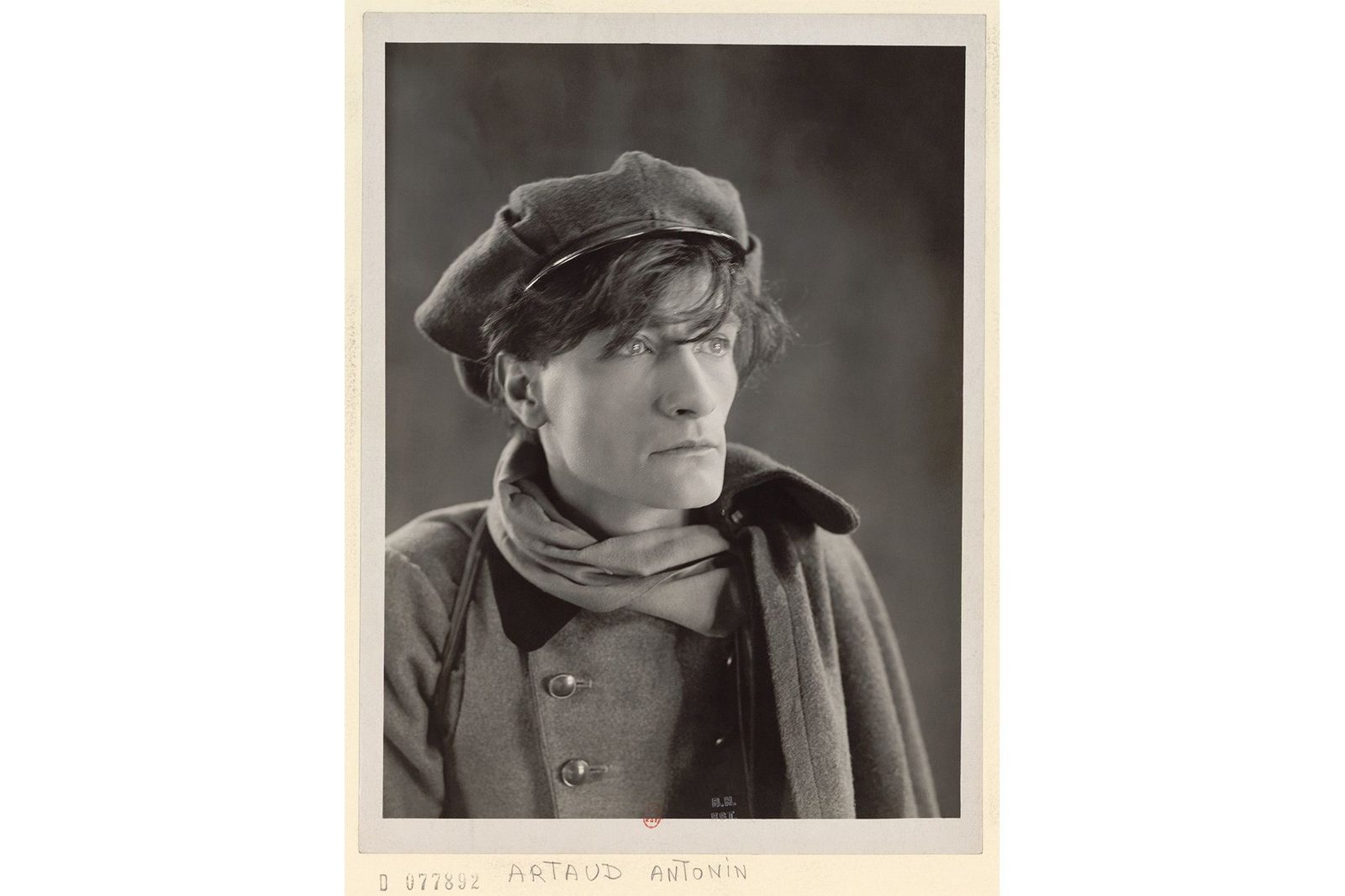
Artaud and the Body of History
What we witness with Artaud throughout his career — which is also to say his life — is this condition of the corruption of European and Western modernity, against which Artaud’s hope is to find a vital form of culture. This idea of a vital form of culture is one of the utmost severity. It is the vital form we have been continuously discussing here: the disclosure of being, a somatic reunification with nature. This severance is clearly and intensively articulated by Artaud throughout his notebooks and essays — his obsessions with genius, with nature, and, in the late 1930s, with Mexico and the Sierra Tarahumara.
The question for Artaud — ultimately, and this is his relationship to Christ and finally to the radio play To Have Done with the Judgment of God — is a total symbolic breakdown. It is the dismantling of the subject-object relationship, which one of my earliest theoretical works dealt with in Magritte: this destruction of the symbolic boundary of the subject-object. This is also common to the large creative movements exploding in Artaud’s time — Surrealism, Dada, and Artaud’s own Theater of Cruelty.
The essence of the Artaudian project is a project of obliteration of the self. The question Artaud is ultimately seeking to confront becomes almost a psychedelic question in the peyote ritual with the Tarahumara: that of being caught in what Artaud describes as a sort of psychic madness which he sees possessing France. This is a powerful idea I remember vividly from his journals, collected works, and letters: the experience of a highly sensitive, neuro-somatically sensitive individual to the collective cultural current — the descent of Europe into the katabatic state of modernity. This is, of course, Artaud’s period of his most profound and enduring work, in and around the time of World War II.
This connects to the discussion of the presumed madness of Artaud, which ultimately is the subject of another one of his great texts: his work on the suicide of Van Gogh, which he describes as a civilizational suicide — a suicide of embodied creative genius and somatic reunion with nature, native to the genius artist. I’ve put this forward in my Renaissance Mind theory as well: there is a profound strength in Artaud’s consciousness, similar to Van Gogh’s, which cannot be homogenized or assimilated into European civilization because it is fundamentally an ancestral form of consciousness. It is a form of consciousness that cannot be indoctrinated into the symbolic order, whether of Western civilization at large or of France.
And of course we have a series of presumptions of insanity or madness with Artaud — being put under psychiatric care in Paris, and later in institutions at Rodez, for electroshock and art therapy. There is the issue that Artaud’s entire life is a question of one who ultimately becomes destitute, believing in this staff of Jesus, this knotted staff of wood, living his late life penniless and in a psychiatric hospital.
Theater, Ritual, and the Body Without Organs
What Artaud is seeking is a theater that would be in effect a return to magic and ritual — a new theatrical language of totem and gesture, devoid of dialogue, that would appeal to all of the senses. This is from The Theater and Its Double. The entire force of action behind Artaud’s work is to incarnate the human being into life in such a way that there is no differentiation between the forces of nature themselves and the human being.
This is a profound, atavistic, pre-modern notion of consciousness: that consciousness itself is a field unbroken by the assertion of the individual or of subjectivity. In this way Artaud is the deepest radical of his time, and of many times, in the sense that he is a true individual precisely because he is profoundly anti-individualistic. The body itself is an unbroken field which cannot be fragmented or fractured from nature. This was, of course, throughout his life diagnosed as a psychiatric illness or psychosis — various physical and mental diagnoses given to him under the charge of Western civilizational institutions.
What Artaud calls for — and I’ve brought up Mayakovsky, and Camus — is a resurgence in Western civilizational history, particularly in modernity, which could be called a form of extreme existentialism. The essential metamorphosis with Kafka or with Lispector, with Camus and Sartre’s call to man’s fate being in his own hands, or with Artaud — it is the essential metamorphosis of the human being into the natural field of being itself. This is the violence of Artaud’s theater. It’s a cruelty of induced lashings, so to speak, which seek to strip away by way of assaulting the senses of the audience through intense physicality and presence.
There is a psychological exorcism which Artaud is seeking to perform — to subvert thought and logic, to shock life back into the baseness of the world. Artaud was vehemently against psychology itself, but he is seeking to return life to the neural center, to wake up the neural center through violent action. It is not a sadism. It is a destruction and a rupture in the symbolic order, a return to physical presence in space, which dissolves itself into pure presence.
This is actually a profound philosophical movement in the face of World War II and the decadence of the French modern condition. What has occurred, as we’ve discussed, is a total breakdown of the Western civilizational symbolic order due to the forces of industrial-technological modernity, which have only since Artaud’s time — and even in Artaud’s time — exponentially reduced the human being to a series of numbers and functions, units, weight and measure of labor and constituent body parts.
Artaud’s concept of the body without organs, or of this pure sense of being, is a rebellion against this movement, this fascistic movement. Artaud perceives, like George Grosz says very clearly through his paintings, that society has been possessed by a profoundly repressive force constitutive of a mass illness, a mass mental illness. And of course this is why Artaud himself is institutionalized — because the madman is sane and those who are sane are mad. As Goethe says, the world is a mental hospital.
Catharsis, Greek Tragedy, and the Spell of the Spectacle
What Artaud is attempting to do is reintroduce the cathartic or katabatic function by way of theater, which was the ancient Greek model for art in tragic theater. The theater itself was meant to drain collective abscesses. This aligns Artaud profoundly with Nietzsche in his surgery of civilization: in this deepest moment of the world’s midnight, what Artaud is attempting to do is to break the spell of power, the spectacle of symbols, which are increasingly possessing, alienating, and abstracting the human being into a standing order — an alphanumeric system of control, which itself is the descent into the fascistic economics of modernity that accelerate in his time and after.
What Artaud is attempting to do is to reveal this psychological or neurological underground which is subverted and repressed in the civilizational order. So Artaud’s project, however much he may despise or dislike psychology, is profoundly aligned with the work of Freud in Civilization and Its Discontents in the 1930s, as well as with Marcuse later on in Eros and Civilization — regarding the necessity of repressing impulses in order to make civilization possible as a collective field, the agreement of a social order. It is of course this proliferation and compounding of the repression of these impulses which is itself the dehumanizing force, compounded with the phase change of industrial modernity — the harvesting of oil from beneath the earth, the weaponizing of nature into a standing order, which is itself the factory: both the human being and the natural resources are commodified and transformed in the factory system, a radically different economic and thermodynamic order of existence.
Purity, Christ, and the Cosmological Self
Artaud’s obsession throughout his life with purity and Christ is almost an inversion of what is considered the traditional Christian ethic of kindness and self-sacrifice. Artaud seeks to sacrifice the individual self by way of profound violence in order to access the cosmological self. This is precisely why he is perceived as mad — because Artaud’s action throughout his life, and his creative work in all the different disciplines he exercises (from theater to poetry to playwriting to acting in films to painting and drawing), is the expression of this fundamental struggle.
Artaud is born into this modern French epicenter of Western society, into this industrial-technological vision of the self in the standing order, which progresses throughout the early 20th century. As Artaud’s career progresses, he himself is seeking to return not only the theater but life itself to what is beneath the spectacle or the symbol — to an embodied presence of being.
The self must be given up, as he says, “to ideas of war, riot, and blatant murder.” Artaud himself is highly philosophically and historically educated, a known adapter of Percy Shelley’s play The Cenci , a play of profound filial cruelty. Artaud is seeking to purge consciousness of this — we could say bourgeois, dissociated, abstract French modern world — as a fundamental inheritor of Baudelaire and Rimbaud, by way of a dissolution of the individual self, or as Rimbaud says, “I is another.” Through a derangement of the senses, this is a poetic descent into the fundamental origins of being.
This is precisely why Artaud flees France to go to Mexico, to engage with the Tarahumara and the peyote rite — to experience what he experiences as a profound geographical affinity, an affinity in nature that he experiences as sacramental, even crucifixory. He experiences the energetic element of nature as one of profound violence and overturning. The blood for blood and the piling of bodies that Artaud visualizes in his writings and letters is a real force at work, which brings him ever closer to the Heraclitean concept of cosmic fire.
This does in a way make Artaud something of a pre-Socratic in modernity. The cloak of the Western modern subject — which tightens with name and social role and status marker — in Artaud is being actively, conscientiously, and repeatedly obliterated under the force of what the poet understands about nature.
Hölderlin, the Greek Poet, and the Institution of the Subject
This is extremely important in Artaud’s resonance with Hölderlin: Heidegger asks the question about the Greek poet’s relationship to nature without mediation. The Greek poet himself, and Greek consciousness itself, is ensouled with nature. The descent of modernity is a Western civilizational historical movement of hundreds of years, which is the institution of the concept of the political subject — the name, the number, the identity. This concept of selfhood is itself the institution of the rational order of Western civilization and is a profound facet of what lies beneath the industrial-technological order: science, the inventory of the number and the name, a way of ritualizing a defined status in terms of unit and letter of nature itself as a categorical inventory.
That which exists can be not only compiled — as in counted — but named, as in identified. This is a profound aspect of Western philosophy at and through Descartes and into the modern world of Artaud’s Nazi Germany and the decadent France of his time.
All of Artaud’s work is the seeking to create this field of language — not unlike Céline — to generate the possibility of this field-space of disclosure. For Artaud, this is why theater is so important: it is a physical opening in space and in time and in the chains of history in which such a revelation can be possible. It is the creation of a sort of room, a bounded space in which language, gesture, movement, attitudes, and objects can be deployed to manufacture this return to the pre-ontological space, the pre-modern space of a symbolic union of being.
The tortures that Artaud undergoes are this perpetual dissolution of the self. This is a highly intuitive aspect of Artaud’s consciousness, which itself is a profound act of historical rebellion. It is a timeless rebellion, a refusal to surrender to any symbolic order other than the force and thrust itself of existence or being — the Heraclitean principle of the ontos , which Artaud is intuitively in communion with over and over again and seeks paradoxically to depict (as is the nature of poetry, thinking as languaging) through symbols. He appropriates the symbolic order of his cultural-historical moment to articulate a profoundly non-institutional representation, to disclose this ontological center.
Slashing the Canvas
Artaud realizes, like Rimbaud and Baudelaire — the inheritors in his tradition — that his time requires an act of violence: a slashing of the canvas, so to speak, as with Oscar Wilde and Dorian Gray. A symbolic order has been instituted as a civilizational mirror through which life is now being lived through an abstracted aesthetic distance. Artaud is seeking to collapse this distance: images are presented not in their immediacy as image, but as belonging to established systems of pictorial representation. Furthermore, they now define life — by letter and by number.
This is precisely the importance of Magritte, and why I bring up Magritte and subject-object differentiation. The famous poetic remark This is not a pipe is itself the exact kind of work that Artaud is doing upon language: the disabusing of the frame, which is a Western philosophical narrative construct of self and world, into separate and discrete units of being and time and measure.
Artaud fights this violence with violence — a violence against civilization. The diagnosis of Artaud as madman is intimately connected to the degree to which Artaud perceives this profound illness at the heart of Western civilization, the Western civilizational symbolic order. He is seeking, through the creative act, to tear apart this relationship of translation or legibility and return life itself to neural, lived, felt immediacy.
This is why Artaud perceives Van Gogh as being suicided by society as well as by his psychiatrist — and why Artaud himself is being suicided by society and his psychiatrist. There is no rehabilitation of this fundamental poetic consciousness, which is a lived somatic sensitivity, a neural sensitivity to disclosure and being itself. Artaud is so deeply embodied, and his concerns with the body — with pain, with trauma, with suffering — are so deep, that he himself is profoundly conscious in his body. He is not prescribed to the standing-order symbolic code of civilization, which is the abstraction and dissociation of nature and of the self into the symbolic code and symbolic order. This is itself at the crux of the founding of psychology, of Freud’s work on dreams and civilization.
Eliot, Native Thought, and Time
The symbolic order and the symbolic code itself is first and foremost a law and a legislation at the level of syntax and meaning. The work of poetry is to break this language through languaging-as-thinking. This takes us back to Eliot and poetic nativity — nativity as integrity and authenticity of thought, as presence in the body and in time, which is of course Eliot’s obsession: being in time in such a way that the timeless is revealed through the rose garden, or the emptied stone pool into which he gazes and has this poetic experience of ontological unity. This is then conveyed in a reminiscence and a memory through the poem as a possibility-space, an accessing of this somatic terrain which is timeless — a body without organs, a total presence of nature in which the geology of Mexico for Artaud is physical-spiritual unity of self, a sort of cosmic man.
Shelley, Promethean Freedom, and the Acceleration of Modernity
Artaud’s goal to free the spirit from the domination of culture is the same goal as Shelley’s. It is the same goal fundamentally and foundationally of all poetry — but Artaud is after Shelley, and is himself after modernity. What Artaud must do is to descend through the ruins of civilization and the Western civilizational symbolic.
This order is still intact in Shelley’s time. Western civilization is crumbling in Artaud’s at the level of the ontos. Shelley, as a visionary, believes that the British empirical knowledge system in standing order is absurd, but he is in the profound minority. By the time we reach a hundred years later, Artaud reaching maturity, World War I has already occurred, leaving Germany bankrupt. Weimar Germany is in the throes of its chaos. Surrounding Artaud is Surrealism, Dada, and this profound sense of neurological incompatibility with the time being out of joint — the collapse of Western civilization under the weight of its own contradictions, and the destruction of the closed local codes of symbolic order which were formerly the atavistic, agrarian societies of slow time prior to modernity. By the time we reach the early 1900s, the factory of industrial technology is in full motion, and only continues to grow.
Toward Death — and Toward Quantum Modernity
Artaud’s entire life project is toward death. What I mean by this is that Artaud understands, perhaps the most profoundly, in a more somatic way than Camus when he asks about the question of suicide, that the death of the subject itself — wherein Artaud reads Rimbaud and Baudelaire and Poe in the sanitarium — is the fundamental confrontation of Western civilizational conceptual bind. To this neurologically and semantically sensitive individual, the Renaissance mind or the poet (whichever word you may use), Artaud’s condition is the same as Shelley’s a hundred years prior: the question of being itself is not an individual question, but a transpersonal and cosmological one — a question of a field of being.
This is of course occurring as Fermi and Max Planck are revolutionizing science with quantum mechanics. This question — scientifically experienced as nuclear energy, and Einstein’s work on relativity and spacetime — for Artaud is a question of breaking the illusion of the Newtonian, pre-Copernican self: the pseudo-mature, post-Victorian mind of Western civilizational history which perceives itself to be a closed node in a factorial identity working in space. This identity is tied to status or job or name or legible history within any given culture or cultural order, and has all been legislated through symbol. Weight and measure of the being, of the mind, of space, has colonized the body absolutely into a standing order of composite parts. This is again the concept of the body without organs.
Artaud’s philosophical and existential act is an act of profound resistance to this civilizational order. The persecution of Artaud and his works — however violent or transgressive to this civilizational symbolic code — is an attempt to strip away the repressive or suppressive code which has contained life into a series of absolute measures and measurements.
This kind of Promethean freedom that Artaud seeks is the same as Shelley’s, but in a historical, time-bound, space-bound sense it is radically different. The constrictions and constraints Artaud is seeking to overcome are the acceleration of the fascistic standing-order economics of modernity itself — even after Shelley’s time, in the period of Darwin, the light bulb, the airplane, and this rapid acceleration of the growth of cities and factories due to the increasing thrust of the use of fossil fuels and oil to propel Western civilization.
This energetic currency is what spins the same madness being elucidated by Trakl and Grosz, as it is being articulated by Artaud and T. S. Eliot — a collective delusion, a psychological condition of manipulation and control and possession, with a world that, through the consumption and production of exponential industrial power (which is political force and thrust), has rapidly changed the existential terrain and the physical time-space architecture of being.
Education, Mysticism, and the Necessity of Poetic Disclosure
Everything from the mystic to the psychedelic to ancient science and ancient ritual is this turn toward poetic disclosure. For Artaud this is a matter of life and death because he is a being of profound somatic and neural sensitivity, which is evidenced explicitly and clearly in his relationship to the asylum and the sanitarium and his nervous illness — as Shelley experiences in his time. The adaptation of The Cenci by Artaud is no coincidence. There is a profound connection between these two figures.
The necessity of the radical violence to the symbolic order — which is thrashed by Artaud when he says “all writing is pig shit” — is that all this symbolic richness and decadence of Western civilization, which has only abstracted the primordial relationship to being, must be razed. It must be slashed against, violently discharged, and returned to the center of the body in a form of profound absolution, which is itself a unity of presence. In Eliot’s Four Quartets , the timeless is found within time. This is used through a kind of philosophical and artistic shock therapy, which is native to Artaud — and, fascinatingly, his diagnosis of madness is centered around electroshock therapy treatment given to himself, via literal charges in the sanitarium.
Promethean Energy and the Thermodynamic Problem
Artaud is seeking, through art, the liberation of this primordial or Promethean energy, which is the thermodynamic problem of Maxwell or Boltzmann being formalized into field theory and measure as a quantifiable system or presence in nature. This same problem is the Promethean problem of Shelley and Artaud — the constrained energetic center and force of being itself, the Heraclitean fire bound to the rock of human history and human civilization, and the increasingly restrictive, repressive, standing-ordered name and number of Western civilization, which is the colonization of being into unit of measure — which then of course is a labor mechanism.
This is itself the rebellion of existential modernity, at its deepest in Artaud, or in Camus’s call to live a life so deeply attuned that to be alive, to exist, is a profound first-order act of existential becoming so free. This is what Artaud is attempting to institute through his creative practice and induce not only in himself but in those who are present in the field of his action — the creation of a field of disclosure amidst the most constrictive and restrictive conditions of modernity, in which all concerns of art or aesthetics are irrelevant. The absolute, total concern of the creative and poetic process of Artaud — as it is with Eliot in Four Quartets — is disclosure. And Artaud’s act of disclosure is one of violence against the symbolic order.
The body itself is a dynamic field with real consequence — bodily fluid, blood, flesh — whereas industrial technology is the attempt of a substitute product, the manufacturing of a prosthetic machine which, as depicted in Grosz, is a perversion at the center of a decadent symbolic order.
What Artaud attempts to do is a sort of conjuring or rite to dismantle this symbolic order in what you could perhaps call the traditional shamanic function — returning consciousness to presence, to the embodied somatic root, this kind of naked neural experience which is energetic and vital.
The naked man on the horse holds up an enormous horseshoe which he has dipped in a gash of his blood.
This discussion of fecality, of blood and bone and meat, for Artaud is the desecration of the symbolic order by the continual evocation of the flesh — a refusal of abstraction, an idea of the world for the body, for its literal flesh and blood and physical sense. And this of course has to do with desecration and excrement, because it is a violent act against decadence. Artaud oscillates between nothingness and meat.
Reading Artaud’s Poetry
When we read Artaud’s poetry, we are reading a quantum-mechanical problem manifest in time, in consciousness, through the sophistication of a genome which has evolved a neural body — a body not only interrogating its own existence but the profound falsity of the decadent symbolic order of Western civilization. He is caught betwixt and between the existential ancestral past of the deep-time formulation of the human being and the present of this intricate, plastic, artificial symbolic net, which is the falsity of Western civilization and French modernity — even as it is crumbling before Artaud’s eyes amidst the philosophical action of his fellow Surrealists and the existentialists of his time and shortly thereafter.
The social obscenities — the maintenance of the symbolic order in the face of the violence of history, which is the perennial flowing of blood — and this restrained, suppressed unconsciousness, this embodied memory which is simultaneously consciously refused: the embodied memory of the erotic animal, of the violent animal, which has been subliminated or sublimated into Western civilizational architecture of nicety, which is marked with disease and vice by way of this civilizational suppression. We hear this clearly in Freud and Otto Rank, in Marcuse and the Frankfurt School tradition, and in Ernest Becker’s The Denial of Death — because for Artaud, the denial of the body is death.
The body itself is the profound real memory of what it is to be. To be in integrity in relationship to the body is pre-symbolic. It is itself no order at all, but a field of presence and a field of being which cannot be broken from the condition of nature as a total presence in time, a timelessness. Time is a moving image of eternity, and to take that image for reality is to begin the institution of a symbolic order which clogs the body, the mind, the fecality, the presence of being. Against this Artaud rails.
Stripping Away the Animalcule
You can tie me up if you wish, but there is nothing more useless than an organ. Man is sick because he is badly constructed. We must make up our minds to strip him bare in order to scrape off that animalcule that itches him… Then you will teach him again to dance wrong side out, as in the frenzy of dance halls. This wrong side out will be his real place. You will have restored him to his real freedom and delivered him from his automatic reactions.
What we are talking about here is multifaceted. This is Artaud’s profound intuition that it is the evolutionary, ancestral history of man — a codified state of being, an unconscious survival, a bare unconscious survival at all costs in the face of a profound constraint which is thermodynamic, metabolic, neural, synaptic. It is the makeup of the genetic body, which is itself a moment in space and time with profound limitation, undergoing existential degradation over time, as in the aging process.
Then there is furthermore the aspect of the symbolic God — and the symbolic God with symbolic organs — which is really a remark upon a frame of being that makes presence in consciousness purely material, a standing order or an inventory of units. This frame supposes that organs themselves are possibly separate from the body of life, and that nature itself can be broken up into constituent measurable parts — which is then a dissection or an autopsy of life, even as life is in the midst of becoming in an unbroken field.
Man has in him an inspired shudder, a kind of pulsation that produces animals without number, which are the form that the ancient tribes of the earth universally attributed to God. This spirit originating with the American Indians is reappearing all over the world today under scientific poses, which merely accentuate its morbid, infectious power. Microbes… Do you know what the Americans and the Russians used to make their atoms? They make them with the microbes of God. I tell you that they have reinvented microbes in order to impose a new idea of God, to capture him in his microbic noxiousness. This is to nail him through the heart, under the guise of unhealthy sexuality.
And here is the critical part: although nobody believes in God anymore, everybody believes more and more in man — placing him for the last time on the autopsy table to remake his anatomy.
What he is saying is a profound remark on the quantum-mechanical question and the question of scientific inquiry itself, which has been converted through technology into the standing order of industry. This is the question of the presence of the total field of nature and being, and of the presence of the poet in that dwelling — that man dwells in being and dwells upon the earth, and is not virtuously dissecting it or codifying it into an instrumentalized series of units and organs.
Artaud’s obsession with bodies being shed and blood flowing is that he is tapping into this primordial energetic state of creation, which is being formalized scientifically by quantum mechanics and Fermi, then with Chicago Pile and the creation of the atom bomb — an industrial technology created from this primordial energetic source and force, which is nuclear fusion, which again is stellar fusion. It is the replication of this natural process of energetic creation as it occurs as the vehicle of life upon earth, via the translation and transmutation of stellar energy. Artaud’s experience is the realization and the railing against the loss of this experience and the necessity for the somatic return to the presence of the body — to actually live in the presence of disclosure, not within the conversion of nature, or of stellar fuel and stellar fusion, into a standing order which is then utilized, atomized, and discharged as power and as symbolic order.
This of course is the deep philosophical, psychological, and existential condition of modernity itself. And this rebellion, as inscribed and expressed by Artaud in a disavowal of poetry and writing and all forms, is an act of existential rebellion.
Man lent himself to the obscene meal where animals ate him. He relished it, and he learned himself to act like an animal and to eat rat daintily… [It] comes from the fact that man one day stopped the idea of the world. Two paths were open to him: that of the infinite without and that of the infinitesimal within. He chose the infinitesimal within.
What Artaud is describing is the metaphysical movement of this conflict of consciousness and the emergence of consciousness. The process of eating and fecality is intimately intertwined with the energetic flow of nature itself. This intertwinement is the formulation of consciousness — the genetic and metabolic exchange of energy across space and time, generations and brief forms — a prism, a window, an opening into this infinite.
This is why Artaud’s focus on fecality and To Have Done with the Judgment of God is so essential. This is a first-order, constituent aspect of the transformative and transfusionary essence of being human: the human being in real time is participating in energetic transference. This is a first-order condition, prior to the symbolic introduction of space and time, identity, industry, and the conceptual idea of the body. The return to this primordial state of consciousness — which is simply the somatic, neural presence of being, not translated into an institutional symbolic order — is the essence of the rite that Artaud is seeking to perform via the evocation of blood, fecality, meat, flesh, bone, and fire. These symbols for Artaud are less meanings and more attempts to break through languaging into soma.
His listing or standing-order of spleen, tongue, anus, glands is a listing of the defamations of the body in the face of the erotic presence of being — the descent of Christ onto the altars of this physical, embodied, somatic condition, which has been buried under, as Artaud says, God’s judgment.
We know that after the order of this world there is another. This realm is precisely infinity. That is a word we use to indicate the opening of our consciousness toward possibility beyond measure, tireless and beyond measure.
This attempt at this rite is again common to Blake as it is to Shelley — common to all visionary poets, all poets of disclosure. Just as when Artaud evokes nothingness and the void, he could be mistaken for a moment for Meister Eckhart, or even perhaps Rumi, or an element of sage poetry. Because Artaud is continually saying: we do not know it, we do not say it.
It seems that consciousness is linked to sexual desire and to hunger; it just as well could be not linked to them. The appetite for living…
He is evoking a profoundly thermodynamic state-space of being, which I have described as the neurological recognition of constraint — the unity of organism metabolics with stellar thermonuclear dynamics.
I did not precisely know what it was and I did not feel the need to think about it. They were words invented to define things that existed or did not exist in the face of the pressing urgency of a need — the need to abolish the idea, the idea and its myth, and to enthrone in its place this thundering manifestation of this explosive necessity to dilate the body of my internal night, the internal nothingness of myself, which is night, nothingness, thoughtlessness — but which is an explosive affirmation that there is something to make room for my body.
This body is an incarnation of the Cosmic Christ upon the cross of space. The abolition of things — the order and words of things that existed or did not exist — is in the face of this pressing urgency of a need, the explosive necessity to dilate the body of his internal night. This is the creative force of being itself that Artaud is channeling. “I did not feel the need to think about it. Did not know precisely what it was, but there was this pressing, existential, thundering manifestation of explosive necessity.” The emerging presence of the being in time, the body in space and time, is the emerging consciousness of a deep-time neurological evolution of the genomic body — the thermodynamic passage of the information technology of the genome, a crystallization of thermonuclear energy across massive swaths of time — that Artaud is becoming conscious of somatically, literally, in his thinking, languaging the field of To Have Done with the Judgment.
There is a thing which is something, one thing which is something, and which I feel because it wants to get out — the presence of my bodily suffering, the menacing, never-tiring presence of my body.
However hard people press me with questions, however vigorously I deny all questions, there is a point which I find myself compelled to say no — then to negation. It was then that I felt obscene, and that I farted from folly, from excess, from revolt at my suffocation, because they were pressing me to my body and to the very body. It was then that I exploded everything, because my body can never be touched.
This is presence. It is the ineffable condition of being in time, the experience therein — his profound neural-somatic sensitivity to existence, which for Artaud is abundantly and manifestly clear throughout his entire life. It cannot be subverted by the Western civilizational symbolic order precisely because his presence is so powerful, so neurally and somatically sensitive to this existential condition. The works being discharged are expressions of this sensitivity in the face of the conditions of the space and time which Artaud inhabits — which are themselves conceptual units and delineations, a decadence of Western symbolic modernity and French civilization in the face of total ontological collapse.
Do I have a body because I have a stinking gas that forms inside of me? I do not know. But I do know that space, time, dimension, becoming, future, destiny, being, non-being, self and non-self are nothing to me. But there is a thing which is something, only one thing which is something, which I feel because it wants to get out — the presence of my bodily suffering.
The experience of being in time, the persistence against constraint of an energetic being which ingests, digests, expels, and transforms energy — this total unity of presence in the field of being — is a perennial disclosure event for the highly sensitive being which is Artaud. His communion with Van Gogh is to see in Van Gogh’s paintings the profound and persistent manifestation of this primordial, foundational energetic source and force of being itself. It is not located within a pseudo-subjective symbolic field which is being conjured; this presence is a raw, immediate immanence — a somatic, felt, eternal beingness, hitting directly at the somatic nerve, the root of experience.
This is precisely what makes Artaud so profoundly revolutionary in all times: it is a timeless revolutionary state of being, which is Promethean as with Shelley. The absolute condition of power and force and thrust of the body — a thermonuclear occurrence in deep cosmological time — seeks to get out, to free itself from this constraint, the Promethean chains.
Consciousness linked to sexual desire and hunger just may as well as not be linked to them. An appetite for living… I did not precisely know what the fart was. Explosive affirmation. Explosive necessity to dilate the body of my internal night, my internal nothingness of myself, which is night, nothingness, thoughtlessness, but which is explosive affirmation. There is something to make room for my body. And truly, must it be reduced to this stinking gas — my body — to say that I have a body because I have stinking gas that forms inside me?
This is a statement that strikes at the heart of the standing order — the further, exponential immersion of Western civilization into symbol, into sign, into abstraction, both as science, as industrial technology, and as the philosophical condition, a Cartesian supposition of the existence of discrete particularities, whether of the body, the mind, or the definition of forms through language as number and name. This is the existential, ontological rebellion of Artaud: the presence of bodily suffering, which seeks to get out — total negation in the face of the questions.
Social Obscenities and the Psychic Possession of France
Artaud calls these the social obscenities, officially sanctioned and acknowledged. They are the psychic possession of France that he feels explicitly and profoundly in the descent into the world’s midnight — just a decade after Céline writes Journey to the End of the Night , his attempt to institute a neural and somatic linguistic confrontation with the horrors of World War I and the profound estrangement of humanity at the level of the existential condition of being human, into the absurdity and bizarreness of the modern.
Artaud’s obsession with the cruelty of pre-Columbian blood and the flowing of blood, the bestial accident of unconscious human animality — man when he is not restrained is an erotic animal:
He has in him an inspired shudder, a kind of pulsation that produces animals without number, which are the form that the ancient tribes of the earth universally attributed to God… They have reinvented microbes in order to impose a new idea of God.
This is to replace this ensouled wholeness — which again Heidegger speaks of directly when he talks about the ancient Greek relation to being, the poetic ensouledness of the cosmos in which man is unbroken, not as a subjective field but a total presence in nature — with the standing order of science, technology, and industry.
Deliver man from his automatic reactions and restore him to his true freedom. Then you will teach him again to dance wrong side out, as in the frenzy of the dance halls.
A profoundly Dionysian statement: the wrong side out will be his real place. The deinstitutionalization of the human being, which is the death — or the nail in the coffin — of the repressive state of Eros and Civilization , a standing-order, symbolic-order, that institutionalizes consciousness down to the level of an inventory of the organs and the body.
What presence is, is the feeling of something — one thing — that wants to get out: the presence of the bodily suffering, which is profoundly Buddhist if you think about it. Space, time, dimension, becoming, future, destiny, being, non-being, self and non-self are nothing to me. He is refusing conceptual definition and evoking the total presence of the field of the body.
Part 3. Poets, Prophets, Shamans: Global Modernity and the Deep Time Existential Fate of Mankind (May 23, 2026 Lecture)
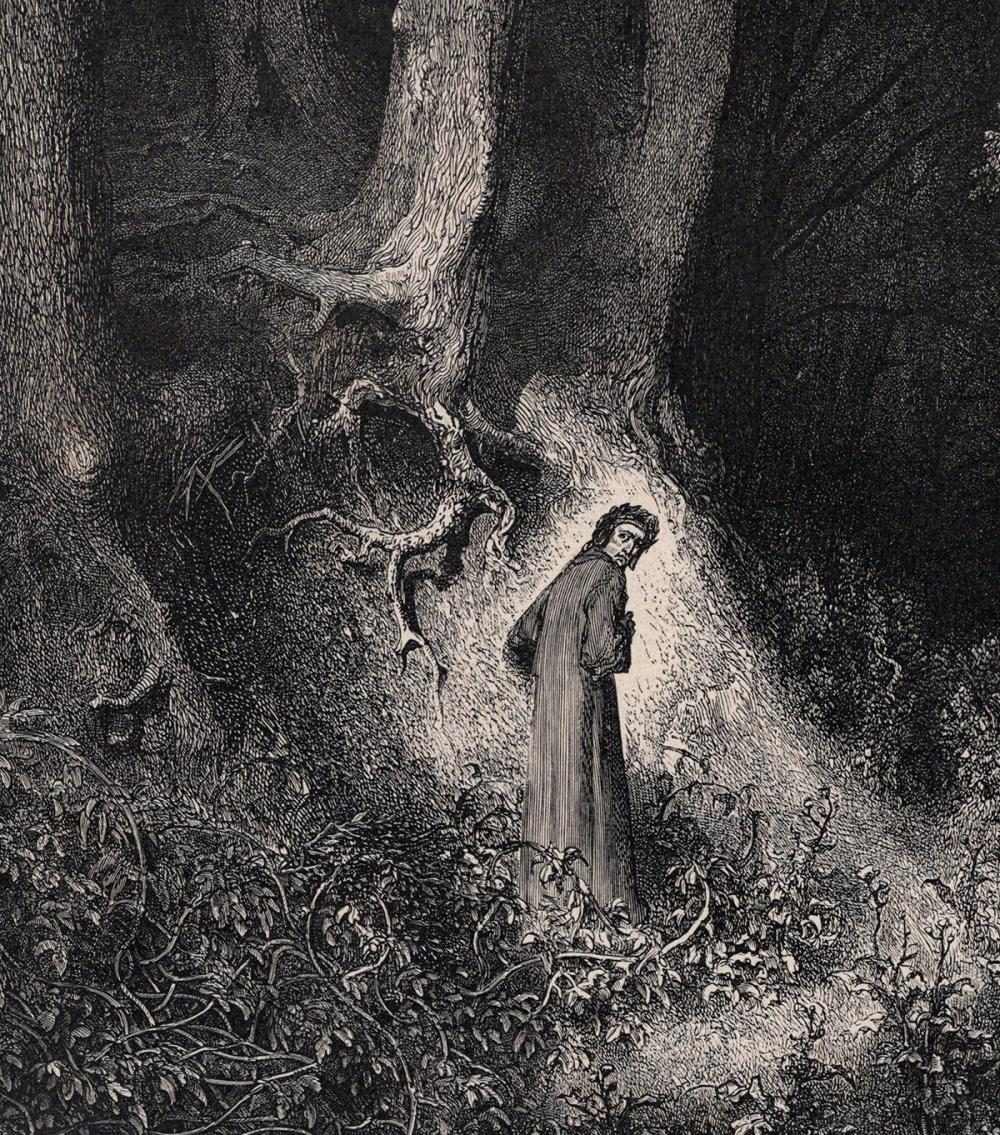
History, the Catabatic Descent, and the Shamanic Function
So now we have to ask ourselves: what is history? What is time? What is the unfoldment of human consciousness? That is perhaps the greatest question. Because when we have addressed being, we are addressing being in time — as in becoming. And with Hegel, I am going to propose something, maybe strange.
It may be true that history itself is a process of the formation and formulation, the refinement — as in condensation and compression — of the conscious.
What do I mean by this? I mean that to trace the development of neural bodies or neural organisms in space and in time — and not only that, but to trace the genetic iteration of increasingly complex beings and forms, even perhaps in an earthly or earth-centered sense, due to the pure limitations of human knowledge at this moment in human history — what we are looking at is an iterative process of understanding. This is occurring in relationship to the single most powerful piece of technology that human beings have, which is the imagination or the mind, and the forms of technology the mind creates throughout history.
So whether we are looking at — in my context and work — figures like Copernicus or Max Planck, or Percy Shelley, or Clarice Lispector, we are looking at an iterative process which has occurred in coalition with the development of the brain, both the hindbrain and the major historical revolution in human history, the forebrain, in terms of logic-chain cognition. This is something mankind itself, and organisms themselves, are evolving through.
This would be a theoretical proposition that mankind is in relation to the animal and the plant by way of a shared genomic heritage, moving toward an existential confrontation. And this is why Western existential and philosophical modernity is so important — and this is recognized around the world — that the confrontation which occurs through the Western katabatic descent of modernity, the stripping away of the ontological clothes of pre-modern agrarian society, is the confrontation of the individual, beyond and without the tribe, fully facing eternity or the cosmos.
This is precisely what the Western philosophical and civilizational model does, works with, and presupposes. All of the ills we see from it — including the total commodification of the earth and of the body — are products of its death, which is simultaneously its acceleration and the throes of its demise.
The Birth of the Artaudian Figure
Because what Western philosophical modernity truly births is the Artaudian figure in relation to the standing inventory of the world’s body and body parts: that the body has been dissected as a device to be used for sexual pleasure or for labor control, that nature has become fully weaponized.
This is the death of a relationship to a pre-modern Greek ensouledness of being in nature. The formation of the subject is the slow birth of the individual consciousness in relation to a total alienation. This is the root of capital and the intersection of capital and fascism: a ruthless technological efficiency of extraction of energetic units into a machine of production and consumption, accelerated into and unto the human body as labor unit, producing energy and part-body. Which is to say the body is now a sexual machine, which is also a labor machine, which is also vacated or vacant of Eros. And this is the Artaudian body without organs.
This produces itself the modern Western and global identity: total collapse of the meaningful relationship to being or nature as a whole, unto the body of being. So this is a severance or mutilation — the perversion that we witness in Western modernity on a day-to-day basis on the global stage, of its greatest advocates, those who own it and those who maintain it as a philosophical, economic, and political model of being.
This is, of course, that which Mayakovsky rebels against in the midst of the change of power in Tsarist Russia — to Trotsky and Lenin and then into the corruption of Stalin. The concept of the body being extracted from or carved up into territories is Mayakovsky’s everyday. It is the byt. It is that nature, in this fundamental ontological severance of the human being or the body, is now alienated unto a form of violence which is being perpetually performed — the violence of the labor unit producing energy, which is now the world and the body itself. This is a dissociative state, which Artaud rails against semantically and neurologically in the death of the symbol, the death of the symbolic order.
Deep Time and the Fermentation of Consciousness
What is required, and what I have been tracing so delicately, is the vanguard and the forefront not only of the evolution of human history but of a cosmological evolution at root in the thermodynamic transformation of the genome — which births the complexifying nervous system and the synaptic organ of the mind, the brain, in its unfolding complexity over millions of years. This is the process of being in relation to the ontos , the process of disclosure.
Again, to refer to Hegel in this way: to look at deep-time cosmology, from birth of universe to star to solar system to life on earth, through genomic transmission and articulation and iteration of the nervous system and the brain — this confrontation, this break between pre-modernity and modernity, is itself a break point in a world-historical sense, occurring in the West. It is a descent from the agrarian, atavistic past — a communal cultural identification with a narrative construct of being, common to Germany as it is common to the Olmec. This construct itself is community, because it is itself the narrative which binds people together in relationship to being.
And this descent is the break of this neural network you could call civilization or community, that which binds the body collective together. This descent is simultaneously — and this is fascinating in a structural sense — both individual, in the creation of the subject and the alienation, the profound alienation; and the institution of this standing-inventory symbolic order, which is fascist economics, capital, ruthless technological efficiency of extraction of energetic units into a machine of production and consumption accelerated into and unto the human body as labor unit producing energy and part-body.
So nature becomes a standing-order inventory, both in terms of definition and number, and the human being a standing-order inventory, both in terms of definition and number. The body parts themselves are now weaponized units, and nature itself is defined and composed of weaponizable units. This culminates again in the atom bomb in the 1950s. And it is no mistake that the atom bomb is discharged in Japan, because this is an ontological phenomenon. This is an ontological struggle for the birth of the individual.
What Is the Individual?
What is the individual? It is the katabatic descent of existential consciousness into confrontation with the ontos. It is the descent into hell which Dante undergoes in his Christian paradigm of the 1500s. And it is the lashing of the Western symbolic order, from Shelley to Baudelaire to Rimbaud to Kafka to Trakl, and into of course Artaud and Clarice Lispector.
This itself is the process of stripping away the narrative field of human history, which held humanity together in many ways through collective belief and collective understanding — a cosmogony as well as a cosmology, a way of seeing and telling origins and being in relation to origins, as well as a way of conceiving and telling the structure of the universe itself, the way of being in time that things are. This of course is itself a symbolic order.
And this is what is critical: because many of the narratives about human history are tied to the supremacy of certain symbolic orders, that a pre-agrarian symbolic order may be supreme to a modern symbolic order. The issue itself is symbolic order. Because symbolic order is precisely what must be destroyed for an authentic confrontation with being. This is well known throughout human history as the shamanic mode. What the shamanic mode is, is a descent into immanence. And this is precisely why we have Nietzsche raving about the Dionysian toward his death and throughout his philosophical career. And this is why Bataille as well leans and tilts toward this structurally Olmec, structurally Mesoamerican cosmos, just as Artaud sees a commonality, again, with the Sierra Tarahumara and the geology of Mexico.
What we are talking about is a shamanic thread which runs through all of human historical life — an immanence of being, which we have called disclosure. We have said the Renaissance mind is susceptible to it, permeable to it. And we have said what the poet is in modernity, in the truest sense, is the survival of this neuro-linguistic mode, which we see in Céline as we see in Artaud. Because this mode is itself what founded the cosmogonies and cosmologies of the ancients in a world-historical sense — these are the people who wrote the scripts of these founding cultural and civilizational architectural texts, which themselves are communions with being, which then became the ruddering device of entire civilizations and cultures, because they provided meaningful proximity as foundations for the community.
What the poets themselves have become are the exiles — much as, again, Dante was an exile, from and of the death of this prophetic function, as Western historical modernity continues to ripen as a fruit waiting to fall: the collapse of civilization, the collapse of an entire ontological mode, which has now spread its tendrils around the globe.
The Poet as Exile, the Shaman at the Cultural Limit
So the poet is the exile who formerly was the shaman or held the shamanic space in the civilization or culture — the one of the going beyond. As I have said before, one of my favorite quotes is from Pascal’s notebooks: insofar as my memory will allow me to recall, that God is the cultural limit. And the cultural limit is set and surpassed by the shamanic figure who ventures into the wilderness, as Dante does at the opening of his descent and Paradiso cycle.
To venture into this wilderness is an ancient historical function which is literal and physical, just as much as it is a psychological and somatic function — to descend into the unmarked space of being, to descend into presence and immanence through a Dionysian ritual, which is the death of the symbolic order into the space of abandon, which for Artaud is an oscillation between nothingness and meat. And Artaud in the sanitarium at the mid-century of the 20th century is itself an indictment of the fall of the Western civilizational symbolic order, which is a ripening.
This is what is so critical: the death of this former atavistic pre-modern agrarian mode of cultural presumption through narrative form — itself the institution of a symbolic order — has not only crumbled ontologically through the death of this possibility (the industrial-technological, ecofascistic harnessing of all nature and human being into constituent parts which have been atomized into labor units, named with excruciating anatomical detail, this attempt to conquer and submit nature to a standing-order code of name and number). This is itself the preparatory rite for the undergoing of the true katabasis, which is required of all existence at the highest level.
This is why again I have suggested that the Western philosophical texts of existential literature — Lispector’s The Passion According to G.H. , Kafka’s Metamorphosis , Beckett’s Waiting for Godot , Camus’s The Fall — these texts themselves represent the absolute vanguard and forefront of what is possible and what is meaningful in humanity: to utilize this deep-time genomic and neural-architectural evolutionary history to come into a place of disclosure and confrontation with being itself.
This is a very Jobian project. If you understand structurally the Book of Job and what it represents — to descend into immanent relationship with being, and to have disclosure in this relationship with all the fear and all the terror that comes with the descent — it is the loosening of the chains of the symbolic order. The symbolic order exists precisely as a net which captures, as a fail-safe, the possibility of this descent. And as the symbolic order solidifies and tightens as a global institutionalized standing order of name and number of nature and mankind, this is a preparation.
A tightness of the symbolic order presupposes the death of the shamanic mode or the prophetic mode. And it requires that the shamanic and prophetic modes are not present and do not exist to it. Because what the shamanic and prophetic modes are, are ruptures. They are past the cultural limit or the symbolic code of the order being presupposed ontologically by the civilization or the culture — which Mayakovsky stands between in 1917. In Red Russia, Mayakovsky is between the cosmological infinite which he deeply senses and feels and hears in his entire body and nervous system, his soma, and the institutional standing order of this transition between Tsarist Russia and the attempted solidification of bureaucratic power structures which become Trotsky-Lenin into Stalin.
The Dialectic of Descent
We have to understand this as a dialectical movement, which you could call a war or a struggle — your terms are effectively irrelevant, because it is a dialectical process. It is a relationship to the possibility of this descent as it is required existentially from life itself, at a cosmological level, at a being-level: that beings themselves are in relation to being. For all of human history, beings have been in relation to a narrative presupposition of what the nature of being is, what this ontos is, what this essence is — whether communicated through a religious order, a cultural order, an authority, a civilizational or cultural institution, and so on.
And so the requirement of this descent is absolute, as it is existential. To live in relation to this existential possibility is the call sign, the passion and possibility, the ripeness and the fruit of all life. Whether it is the denial of this possibility, or the fear of this possibility, or the structural conditions in relation to this possibility which have congealed throughout history — whether the papal order, the order of monks, the belief systems, the political economies, the divine right of kings, the emperors, the warlords, the necessity of banding together to survive in otherwise tenuous and impossible conditions, harsh winters, long periods of famine — these conditions themselves stood in relation to this primary ontological-existential project which births Lispector, Kafka, Camus, Sartre.
I will never forget the first time I read Nausea. I think I was maybe thirteen or fourteen years old, and I picked up that book. What it was equivalent to was understanding the truth of myself in relation to the absurdity of the world that required me to be what I was not. This is precisely what existential modernity produces in such high contrast.
I have called this in the past a Caravaggian revelation — the chiaroscuro of a moment of such extreme contradiction in history, which we would call Western modernity: the standing order, the total instrumentalization of nature and the body, which itself precludes love and precludes relationship — a profound de-instrumentalization of nature, an a -instrumentalization, which is itself a total presence, a present seeing, a relationship to the ontos purely without instrument. This is a mystical and prophetic, shamanic and poetic mode, again, dwelling in being.
The Vanguard of Existential Literature
This mode of Western philosophical existential literature is the call sign. It is the prescience, the foreshadowing of what is at root and what is fomenting within the world-mind and in the world-order now that this Western pure economy has taken root in the entire globe. This ruthless industrial-technological efficiency in terms of the standing order of nature and the human being is absolute.
I suggest that it is absolute for no other reason than preparatory descent. To turn life and nature and the human being into a standing order is such a high-contrast mode of absurdity and instrumentalization that it preempts and presupposes the shamanic resurgence, at the level of that which it has created: the atomized individual unit, reduced entirely to somatic and neural relation to the body. The symbolic order has foreclosed itself upon itself. And through this total commoditization, life itself has been made meaningless — but in the turn and the return toward the only space that Western modernity and world modernity presuppose: the existence of the individual at the deepest level of privacy. Which is to say, beyond even the production of symbolic thought, but the bare, raw, neural thread and tether of existence, the beating of the heart, the persistence, the raw, mute persistence of the body.
This is the mode toward which Artaud rails endlessly and ceaselessly — but it is almost as if he never had to rail toward it, because his time was passing toward this one, nearly a hundred years later. And this is what is so profound about historical movement, to track it across deep time: it presages itself, it predicts itself. This mass historical compression into the standing order of nature and the human body into constituent units and parts with value — labor value, commodity value — is itself the necessary ground for descent, the fertile ground for descent.
This ontological path, through the death of the Western ontos or the world ontos (which was a pre-agrarian, atavistic model of consciousness), is — for the few, the mystics or prophets, the shamans and poets — easy to pervert and misuse as a term. But the poet is only the one who is the mystic or the shaman, who is passing the cultural limit into true ontological confrontation and disclosure of being in relation to itself, which is a Jobian position.
The poet or shaman or mystic stands perennially on the wild, violent cliff overlooking the kind of blue-black clashing waters of the seashore, to behold this sublime depth and confrontation with the existential powers which move all of existence and all of being itself. These figures are fundamentally Heraclitean in their ontological and existential posture in relation to being. They are so fundamentally close to these powers that they are in danger — again, to return to Hölderlin.
This is actually the path of all life. The poets, mystics, sages, and shamans are the early call-sign of what mankind is moving into and toward by way of stripping the bureaucratic, institutionalized, narrative form of the standing order — which itself at the deepest level is a symbolic order of relationship to being, a covering or mediation, which Artaud caustically removes in every form of his art, from theater to writing to visual art on paper.
The Dionysian Submergence
The process Artaud undergoes is understood as a Dionysian mode, to put it in Western philosophical terms — a derangement of the senses, to submerge or go under into oneself in this profound death of the worldly structural idea of being. This is Mayakovsky’s byt : it is the everyday. And it is the consequences of the everyday — which is nothing but a slow death, if not a suicide. Being already dead. Which is why Camus asks the question: is suicide the only — it is the fundamental philosophical question. Just as Heidegger asks: is there a possible meaningful relationship to being? This is how deep the crisis has become.
What is required is a total submergence of all individuals into this path. And what is so fascinating about Western philosophical history, and the general ignorance toward it, is that this is the fundamental path of Christ — the path into the desert, the path into the cave and the resurrection. The path of Christ is the journey toward death, the katabatic descent, which is the death of the world and worldly things into a confrontation with being, formalized as such as God; and that Christ is a child of God or a child of being, and that we have forgotten this truth.
Christ says: the kingdom of heaven is within you. This is a mortal, almost Heraclitean axiom of being in relation to itself through disclosure-technology, which is the raw, neural, time-bound condition of being human — which is itself thermodynamically a katabatic descent toward destruction or dissolution. So the path that we undergo in life is the same path we undergo in death: the somatic confrontation with the ineffable through the temporal.
In this crisis of Western modernity, the entire ludicrousness and absurdity of the standing order is a desperate attempt to preserve life. You see this in the owners and operators of this class of being, which is a political economy: their greatest fear is death and the descent into death — whereas the poets and the mystics undergo the descent into death almost imminently upon maturation, or in the early stages of maturation. The reason for this is that death is a thermodynamic process. The creation of the standing order in a modern Western philosophical and civilizational sense — now a global civilizational sense — is the desperate preservation and control of energy: whether that be the body, oil, the symbol of power, or money. The desperate white-knuckle holding of these instruments, these worldly wielding devices, is the fear of this descent into the ontos — which is both the lived somatic physical death, and the lived spiritual death in relation to the confrontation of the ontos , which again is the terrain of the shaman and the mystic.
Phase Change
This long-standing world order — the narrative device that has held civilizations, social orders, and cultures around the world at various stages of maturation, from civilization to nomadic tribe — is, structurally and architecturally, the death of the possibility of this form, as humanity phase-changes into the thermodynamic modernity of total utilization and total instrumentalization of nature. There is no more possibility of the resurgence of this old myth, because this old myth was time-bound and space-bound. It was locally segregated — in a jungle, in a wood, in a mountain pass. This local segregation allowed for a collective molecular structure of dreaming, effectively undisturbed but in relationship to the private nature of the exploration of its parts, which was rarely beyond the shore — except in the shamanic night journey of its mystics and medicine. Those night journeys presumed and effectively controlled and created the bounds of the cosmologies and cosmogonies. Again, these are dream-stories, narrative tales.
And the explosion of the possibility of this process through industrial-technological revolution — both the airplane and quantum mechanics, which culminate in the atom bomb — these are real historical phase changes, thermonuclear and thermodynamic phase changes of the compression of space and time, which have irreducible and ineluctable consequences. Which is to say: it is the death of the possibility of this private agrarian myth-making and dream-making. The world itself is thrown into the throes of the chaos of the loss of the ground of the ontos which formerly held it — which is to say, the poets and the prophets and the mystics, who are now ejected.
This is critical: as this phase change occurs, the shamanic mode disappears from civilization. The reason is that there is no room for it in a standing-orderization of life. There is no room for it in a total instrumentalization of nature and the human body into constituent parts which are labor parts, energetic units of value and measure. And this is precisely the great schism of science, and what science does to nature.
The World’s Midnight
From the ashes of this paradigm shift, there is the experience of the Abgrund — the groundlessness, the opening up of the void, the world’s midnight described by Heidegger. This is such an apt constitution and such an apt poetic device. Heidegger himself is a great poet beneath the guise of his philosophy.
To understand the world’s midnight, you must understand the importance of the ontological ground as the gel or the force of glue which allows for the many to experience relationship to being. Formerly, disclosure of being, to being, toward being, was formulated and synthesized by those who held the station culturally, ritualistically, tribally, to explore this terrain. Again, this is a neural-somatic constitution, which I have described as the Renaissance mind. It is a functional architectural literal organism of being, with sensitivity, which not only descends into this relationship — far beneath the symbolic order of the technology of civilization or culture, which is to say, immanent somatic neural experience of beingness, of being in relation to being — but returns from this katabatic existential descent with the expression of it: the literal feeling, the embodied process, the procedure which reveals and revealed. And this itself becomes the vision, just communicated.
This is what Nietzsche laments critically in Thus Spoke Zarathustra : the loss of the prophetic function. Because Nietzsche himself was, and would have been, that which fulfilled this ontological space in civilization or culture in pre-modern Germany. This is why he is perennially looked back to, especially in Germany, even in the decades after his death. He describes the precise loss of this function in the descent from the mountains and the astonishment of the people — that this would have actually been architecturally built into his community or culture. He would have been received as a shaman, a prophet, a mystic, a medicine person, instead of as a philology professor. Whatever that means — it is nonsense. It is absolute nonsense.
The loss, the death, of this space is the loss of the historical guide of mankind. And the loss of the historical guide of mankind is the rudderless, mad industrial-technological development which culminates in the current state, which is a global state of total standing-orderization and instrumentalization of the human being, the human body, and nature, utterly devoid of relationship to being. The world’s midnight has descended even further into the depths of darkness by way of this technological instrumentalization, void of the prophet, the mystic, the shaman, the medicine.
The Fermentation of the Brain
So what does this mean? Again, I began this lecture alluding to Hegel and to this great cosmological, deep-time process of the fermentation of consciousness. And what I am suggesting beyond a shadow of a doubt is that throughout deep time, the cultivation of the neuro-genetic, genomic organism — I have described this as a fermentation, a fattening, a ripening of the brain over millions of years of iterative development — is a profound informational technology directly tied to the thermonuclear process of the universe itself at scale, via persistence and constraint, shared by stars, cells, human beings, even stones, as configurational models of constraint as opposed to regulational models.
The regulation of the nervous system to transmit, through sexual intercourse and sexual reproduction, the genome over thousands, millions of years, has been a process of the emergence of a mind capable of disclosure — which is to say, the about-facing of being itself and relationship to being. It is recursive. It is a meta-architectural, meta-structural realization, which is present in everything from Spinoza’s oneness to Leibniz’s monad to Shelley’s encounter with the Promethean energetic force underneath all life in Prometheus Unbound — just decades before Maxwell and Boltzmann formalized new fields and new theories in thermodynamics.
This is a grand deep-time historical descent through intimation, which is to say the shamanic-prophetic descent of being — a rough sketch, which turns into a blueprint, which turns into a diagrammatic instrumentalization, which is an overextension: standing-orderization of nature and of human beings. This is a break into what is and always has been a direct embodied confrontation with the existential conditions of being human — which, beneath the human, is the ontos. This is formalized throughout alchemical history as the gold. This is the process of agony and disorientation, which is implicit and explicit in the stages of alchemical transformation.
It is no mistake that Jung writes his Red Book in the midst of this modern fervor. And Jung has this aspect profoundly correct and intuitive as Germany descends into chaos: the descent is what is called for, what is imperative. Jung himself is a sort of seed-soul, an early reckoning with this existential phenomenon and principle emerging through Western modernity’s guttering-out and evacuating of the ontological relationship to being, even at the level of civilization, community, and culture — the total death of civilization, community, and culture, of which Artaud is a living reckoning and embodiment at its deepest and most profound level. Artaud’s war against the symbolic order, in which he slashes, breaks, and violently desecrates it, is himself pushing civilization further toward the depths of the world’s midnight, which is the requisite confrontation, at the level of the existential being, with the ontos and reality.
No Room for the Privileged Mystic
This is of absolute importance, and it cannot be manufactured. The greatest truth of existential confrontation is that there is no room for the philosopher, the poet, or the shaman to be just one mode of life or a privacy. Humanity itself must come into direct confrontation with the ontos at each individual organismic level. Being must come into relationship to being absolutely, in order to live an authentic life. Otherwise the narrative simulation of contact with being will always be a cultural device, something purchasable, something identifiable that someone can identify with. This itself is the religious and cultural glue, the marketplace glue, beneath all modern life and even pre-modern life: that the descent was not requisite for each individual organism to undergo.
This preparatory stage of human history, human civilization — this pre-modern into modernity, the beginning of the exodus of mass existential descent into relation to being — is itself a phase change at the level of consciousness, a totally new requirement. This requirement actually comes about, again, via industrial technology, from the airplane to quantum mechanics in the atom bomb. This scientific revolution is so bound up in the contradiction and violence which Shelley and Blake perceive in early English modernity — the early English modernity being one of this intensification of factory. This is sensed as a disturbance in the somatic and neural poetry of Shelley and Blake in relation to empire, sensing this process, the violence of this process, and rebelling against it.
What is so fascinating is that it is required that the ontos be stripped at the civilizational-cultural level of the everyday — which Mayakovsky experiences in all of its contradictions, and which is ultimately too contradictory for him, because it is attempting to weaponize his cosmos, his cosmological poetry, his prophetic mark, into a state bureaucratic device, into a sigil for this transformation into the new Leninist bureaucracy, which becomes the Stalinist bureaucracy, which is simply another descent into madness and control, state power.
This descent would not be possible without first the stripping away of the global pre-modern ontos , the enclaves which allowed for, and in many ways were a deep convenience preventing and precluding, the necessity of the prophetic mode — which was born, a mark born, in the history of mankind, by those who were called so deeply to the descent that the civilizational ontos would not and could not suffice. These people were not only identified but trained in the lineages of the shamanic and the medicine, to perform this civilizational function for the collective, for the group.
And what Western modernity is, and now what global modernity is — as a political economy of standing-orderization of man and nature — is a stripping away of this collective function, to avail, without handbrake or handrail, each organism, each human being, to this process of the necessity of the katabatic descent. Because there is no longer the rail in place, the ontos in place, the constitution in place, the stone law or code in place, the ritualization. At this far extension beyond the absurdity identified by Camus in the 1950s — as we are now almost a century past this moment — the far extension of the death of this code, or this foundation which was presupposed, into the chaos of standing-orderization, which is total weaponization, now requires each individual to move into disclosure and relationship to disclosure of being.
The Greatest Calling of Life
To identify that which is real — not to be told what is real, or to exist within the convenient bounds of the drawn borders and cultural limits identified by prophets and mystics past, poets long past — each must go there themselves. And this is the greatest possible calling of life. I say this again in the most cosmological, deep-time, historical sense: this is the greatest possible calling of life. The human body has been ripened over millions of years to make this process possible. The fear of this descent is the fear of death, the fear of obliteration and dissolution, the loss of narrative identity — which is precisely what the descent is for.
To form real relationship to being outside of the narrative symbolic codes given by civilization, given by human history, given by cultural order, standing order, symbolic order — to come into contact with the existential root of being itself, proper, which is profoundly both pre- and post-human, is entirely inhuman, not even cultural, not even civilizational. It is the cosmological totality.
It is itself what Heraclitus is referring to when he is talking about all things are measures of fire. They come in and out with fire. This pre-Socratic relationship that Heraclitus has in relation to being — this is not a privileged position, and it cannot be an exceptional position in any civilizational or cultural order. It cannot be an exceptional position in the order of the human species. It must be absolute. Each individual, each organism, must undergo this descent for themselves: to see that which is at the deepest root, to strip away all that which can be stripped, to find this foundation, to undergo, as is described in the ancient myth, the Inannic descent — to the raw post of being, to strip away the garments of history, civilization, presumption, and symbolic order.
This is where the riches of existence lie. They are not in these surface and surfeit disputes of power and energy and control of standing-orderization of nature or man. These are things entirely temporal. They are, as Eliot says, distraction upon distraction upon distraction, in the face of the true ontological task of being alive, of existence itself.
The avoidance of this task at the level of civilization, culture, and the political economy of modernity, and of all human history, is a deep, profound fear of what lies beyond the bound and border of the known within oneself. This fear is precisely manifest in that which is externalized into the world as a profound act of violence — the attempt to control, to standardize, to instrumentalize, in the face of that which awaits, which is a profound death, whether that be somatic, or whether that be the existential confrontation with that which is beneath the presupposed symbolic order, which has regulated and controlled, within a very narrow band, this ticking away of life, this absence of life, this byt , this cursed everyday which Mayakovsky rebels against with every cell in his body.
The Cosmological Frame
This task is the task emerging from the dialectical relationship of history, the creation of civilizations, symbolic orders, systems, codes, standing orders of nature and man, which have only accelerated in the almost 150 years since we can mark this massive industrial-technological shift of modernity — a fossil-fuel phase change, factory, fluorescent light, endless work and labor, the human body fractured into parts which move and are marked by units of measure, nature itself harvested by fuel units, trees and oil.
To see this descent in its grand scale: from the birth of the universe, this massive thrust of thermonuclear energy. Star systems form gravitationally around these massive fusion devices, the creational elemental forges of elements. And the scales of life, which is the translation of the genome from this thermonuclear energy down to an incredible microcosmos, which is recombining and iterating through reproduction, formulating nervous system, formulating brain, and with the forebrain, the capacity for reflective thought.
What is this confrontation? Human history is a very small part of this, insofar as it is remembered currently. It is just a history of a very small fragment, an incredibly small fragment. Human history itself is near irrelevant in the cosmological turning and the deep-time turning of this process. What this process is, is making disclosure available and possible. Human history itself is a very small mark of creating the bounds and borders and regulations in and upon which disclosure is being regulated, or the fear of disclosure is being regulated — the apocalypse, or the revelation, as described in pre-modern and modern Western texts.
The fear of this disclosure is the fear of the obliteration of the self as it is weakly formulated and held by the bounds of the body in the symbolic order of the time. This death is a mediocre one physically, at the end of the day, but it is a profound one ontologically and existentially in the meeting of the mark of being human. The possibility which awaits in this ontological descent is available to all beings. And all life waits for this moment of possibility to descend and disclose — the necessity of descent and disclosure within the bounds of this time, this constraint which Shelley remarks upon in Prometheus Unbound : this constraint of being in time, the constraint of the body, that which forms it and founds it — the nervous system, the lungs, all the different elements which combine to create this experience of persistence, energetic persistence, metabolic churning, circulatory system, breathing.
This is the making available of the ontological space of confrontation and disclosure — the realm of the poet, the mystic, the shaman, the sage, the medicine. This is the deepest function of life and existence itself. To make this available is to strip away the dross of the symbolic order, created in fear of unmediated relationship to the powers of being themselves, the power of being. To step into and stand into this relationship is the deepest calling of existence and of man.
This is precisely what the creation of standing-orderization, industrial-technological — Western modernity, which turns into global technological digital modernity — the condensation of space and time, creates: a profound opening, a vortex-dual opening, by way of condensation and compression into unbearable instrumentalization. The total colonization of nature and man into a standing order of constituent body parts which are thrown upon the pyre of perpetual industrial burning is a deep and profound, almost perversion of the Heraclitean instinct — the Moloch, so to speak.
At this stage — which is the death of the pre-modern atavistic ontos of civilizational and tribal enclaves of narrative device — this is a broken phase in the paradigm shift, a thermodynamic phase change, in the dredging up of these ancient fossil fuels to power global technological civilization. This phase change is not returning to this atavistic narrative mode elucidated by the lone shaman or mystic or medicine person — which then becomes the code of religious or spiritual possibility, abided as a cultural or civilizational bound or limit. Rather, this descent is now within the somatic, neural, deepest privacy — that which remains, which is just a bare existential ontological relation to existence, that pure persistence is all that avails and all that is left, because the symbolic order is dead, even as it codifies every last instance of material and breath into labor, nature, body, name, number.
So that is what I have. Thank you.
Part 4. Franz Kafka: The Bureaucratic Machine of Modernity and Ontological Disclosure (May 24, 2026 Lecture)
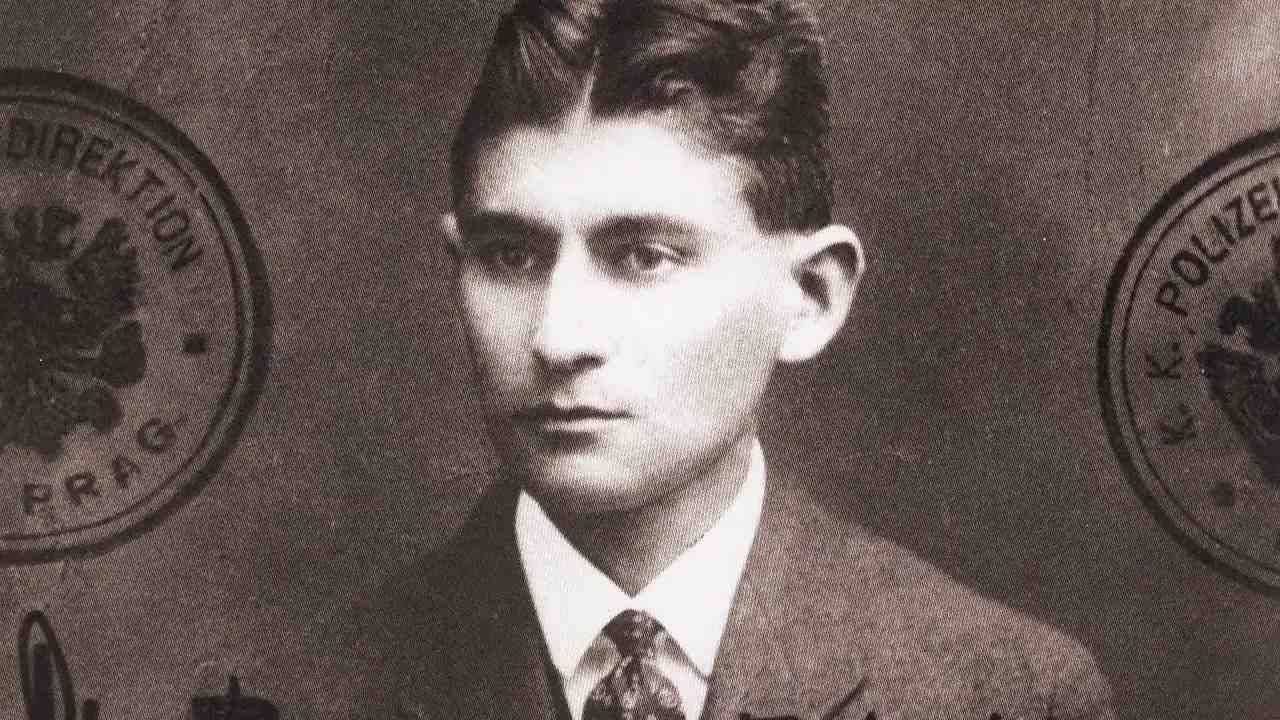
Kafka and the Pre-Ontos in Modern Existential Literature
I want to continue our series with a movement toward how the pre-ontos represents itself in modern existentialist literature, philosophical literature. I had a great question on another one of these lectures, and I want to walk through essentially a syllabus of activity which I am using to drill this period of time — again, what I am calling Western existential philosophical literature, from pre-modernity into modernity — and the capstone texts which I have listed here.
The Syllabus
The ground is Percy Shelley. The reason Shelley is the ground for this project is that he is an encapsulation of the term I have used consistently throughout these lectures and throughout my written works of the past couple of weeks and months: the Renaissance mind. I have discussed this in terms of neurosomatic architecture in, I believe, several written works. I do not think it has been done thoroughly here in the lectures yet. Shelley — the great unifier, the ontological unifier. I have brought up Shelley in relationship to Da Vinci; there are aspects of Goethe. It is the refusal of disciplinary bounds, and the striving in a modern sense through disciplinary bounds toward disclosure of the ontos. It is a leveraging of the intellectual, spiritual, and existential project toward liberation, which culminates for Shelley in Prometheus Unbound — which I view as an artifact of primary disclosure, structurally, in terms of the primary human condition, which is constraint. It is persistence against constraint, not only in the body, but in the ground of history and time. Time itself, both as physically experienced in the body through degradation and entropy, and as it is experienced neurosomatically through the rise and fall of civilizations, parties, and standing orders, is the primary pursuit of Shelley’s Prometheus — to liberate the thermonuclear energy within constraint: space, time, and body.
So Shelley is the primary ground. We move from there into Baudelaire. For the purposes of the project, Les Fleurs du Mal is the primary text. I also have the wreckage, the censored text, as critically important — because what we are going to discuss here (and I will bring this around to Kafka in a moment) are the historical conditions which allow for these works to emerge, because it is a historical phenomenon.
After Baudelaire, I have Notes from Underground , Dostoevsky. A Season in Hell , Rimbaud. Sebastian in Dream , Georg Trakl. The Metamorphosis , Kafka. 150,000,000 by Vladimir Mayakovsky. Journey to the End of the Night by Céline, which I would describe as perhaps the foundational text outside of time — I have a significant essay, I believe, about it, though I don’t think we’ve done a lecture. It is a hinge text, extremely important, but it is obviously not literary. Then Heidegger’s first work on Hölderlin — the first solo published version, 1937, after the initial journal publication at the end of 1936. Nausea by Sartre. The Human Crisis , lecture by Camus. To Have Done with the Judgment of God , Artaud. Waiting for Godot , Samuel Beckett. The Fall , again by Camus. And The Passion According to G.H. by Clarice Lispector.
So this is the oeuvre I am working with.
Kafka and the Gates of Hell
Where I really wanted to go with this is to work specifically with Kafka, in a discussion of the emergence of the kind of gape — or the gates of hell — that open in modernity. Those gates of hell are nothing more or less than the resurgence of the pre-modern, even the pre-linguistic, ontos.
I have written a text which I think very clearly, structurally, captures this. I titled it “Underneath the Long Street” — a short story on the theme of the descent through modernity, which is the consumption of the standing order. I want to describe that a little bit, specifically as it relates to Kafka’s biography.
As we know, Kafka lived his entire life as an insurance salesman, a kind of bureaucratic fate within the infernal machine, which is shared by Pessoa and T. S. Eliot as well — working as a banker. We have in Kafka’s life what appears to be a very typical, if not slightly closed, modern life. This is critical to understanding Kafka, understood by most to be extremely well-read in literature — everyone from Gogol to Dostoevsky to Kleist. Kleist, I think, was considered by far to be his favorite.
We have a very internal life that is lived by Kafka even as he functions as a unit of labor in the collapsing world of the Austro-Hungarian Empire. The experience of Kafka is really, for the most part, only externalized in the texts — whether The Trial , “A Hunger Artist,” or The Metamorphosis. There is very little record even of texts being published by Kafka in his time. Multiple texts were published by Kurt Wolff, who also published Trakl in Kafka’s lifetime, but they were effectively unknown — including what is considered very clearly to be his masterpiece, The Metamorphosis.
Beyond the Psychiatric Diagnosis
What I want to speak about is that Kafka, not unlike Artaud, was retroactively diagnosed with several different mental illnesses. I want to suggest that psychiatry is insufficient to describe the real phenomenon which is occurring with Kafka — as it is with Trakl, as it is with Artaud. It is often considered to be the primary dialogue that occurs behind the scenes of what Kafka or Trakl or Artaud is saying or doing. Obviously for Artaud it becomes a primary theme in his lived life: the movement in and out of various sanitariums and electroshock treatment.
What I want to discuss — and The Metamorphosis , his best-known work, tells the tale the best — is this resurgence of the pre-modern ontos in what we could just call the sensitive artist or the Renaissance mind, which is, again, a neurosomatic presence of being. What I am suggesting is that this presence of being, whether we see it in Kafka or in Artaud or in Mayakovsky, is fundamentally at odds with empire or the standing order, which we see in modernity to have acquired, and continue to acquire, extreme attributes of unitization of life.
This lived experience is itself a highly erotic experience. By erotic I mean Eros. And by Eros I mean presence — presence of body, presence of mind, presence of being in time. The lived, felt sensation, which is detailed exquisitely, consistently, and concretely in Kafka’s works, as it is with the thunderous poetics of Mayakovsky, which are near-perpetual, as it is with Trakl’s exquisitely depicted dream states — a presence of body.
Gregor and Grete
This pairing is pointed out by the literary theorist Gerhard Neumann: a pairing of Gregor and his sister Grete — one passive, austere person, and another active, more libidinal person. What I want to suggest at the deepest level is the importance of the transformation, the metamorphosis undergone in the titular story. Of course, this is a clear analog to Kafka himself. Gregor is the main character, working as a traveling salesman, who wakes up one morning to find himself transformed into an insect. This makes him unable to work. He is then isolated from society, and then often both misunderstands the true intentions of others and is misunderstood.
The issue with Kafka, as with Trakl or Mayakovsky or Céline, is that this form of consciousness in modernity — the existential-philosophical lineage I have just described — is too permeating and permeable to be abstracted or assigned to the standing order. It cannot be assimilated into this sort of imperial conquest of nature, the human being, and the human body, by name and number. Whereas much, if not all, of the existing modern world seems to be.
The sensitivity of this mind or this being, which is itself a wholeness of presence — as depicted through literary fiction or poetry — is not conquerable, precisely because it perceives and is in communion with disclosure. And this state of being in relationship to disclosure is one we have discussed thoroughly in terms of poetically dwelling.
The Insect, the Animal, the Groundswell
The appeal to the insect or the bug in Kafka — just as, almost absurdly, it appears again in the final text I have discussed in this syllabus, The Passion According to G.H. , along with Trakl’s dream articulations, dream environments, dream movements, as well as Mayakovsky’s triumphant unification of collective individualism (itself a kind of profound poetic populism) where he is speaking in , for , and with the body of the 150 million — this state of consciousness is itself a deeply unified intuition. We experience it with Kafka’s regular invocation of the animal: a profound form of actually deep humanism, which is itself a humanism. It is a deeper ontological intuition of the groundswell of life. This is why in Trakl — there could have been an incredibly rich work done by Freud or Jung on Trakl as well, as with the works of Mayakovsky — the subconscious, the collective, the animal, the bug. Here I could evoke Percy Shelley’s The Sensitive Plant and his writings on vegetarianism, also of which Kafka was a vegetarian.
These are intuitions of a deeper humanitarianism. By humanitarianism I do not simply mean human ; I mean a force of life or a force of being which itself is unsegregated from the human condition or the human body. I have formalized this very clearly in my persistence-and-constraint operator, which is the operator identity that, based in thermodynamics, functions across all scales of being. That which exists is in a state of persistence, in the sense that it has pseudo-closed borders and boundaries, and is as such a technology of persistence against constraint, which is fundamentally an entropic universe.
So this is a question of what is being. And Kafka’s metamorphosis or transformation, as is Lispector’s metaphysical-mystical experience crushing the cockroach, as well as Mayakovsky’s continual evocation of an almost seemingly impossible collective body, actually remind me deeply of the Vishvarupa in the Bhagavad Gita — when Arjuna interrogates Krishna’s true form and it is revealed to him. This intuitive perception, which I am saying is integral to this condition of neurosomatic sensitivity, is not in relation to standing-orderization, which is a violence of symbolic division.
This is why I have discussed the seeming paradox of using language itself as a process of detailing or thinking, of languaging , to articulate — but it is, in the strange paradoxical way, the only way to articulate this condition. This is also and often why the Dao refers to it as the ineffable, the Dao De Jing being perhaps one of the primary world-historical texts of this phenomenon.
The Birth of the Standing Order
To understand, as Kafka does, the consequences of this pre-ontological intuition in modernity — which is precisely why we get the strange hue and the aesthetic power of his works, as we do with Trakl, as we do with Mayakovsky — is to see a condition that is irreconcilable with the birth of global modernity, which is again the birth of the symbolic order as standing order. The world itself is being rapidly inscribed and transcribed via information technology and industrial technology, which itself is emerging from science. A name and a number. A unit and a definition. Which, as I have said, culminates in the discharging of the atom.
This itself, to the sensitive — which Kafka here is distinguished from the passionate ontological pursuit of Shelley or Da Vinci, just because it is a pursuit for Kafka, which is not nearly so unified, although Kafka is extremely well-read philosophically — this condition of sight or of seeing, which I am describing not as a learned state but rather as a lived state, a somatic state, you could say a nervous condition as in a neurological condition. This is the temptation historically that we witness to psychiatrize the Mayakovsky or the Kafka or the Trakl. Perhaps harder to do with Dostoevsky or Beckett due to the sheer historical magnitude of the intellectual body that, looking back posthumously, someone like Dostoevsky inhabits. Kafka himself appears more reticent, reluctant, passive, and private, which of course opens the door to psychiatrization of his being.
The Cockroach and Deep-Time Consciousness
What I want to suggest is the struggle, humanized, of consciousness itself in the metamorphosis, and the function of the vermin or cockroach — or however the translation you seek for this figure, this insect. In the original German it is ungeheueres Ungeziefer , monstrous vermin. It is often depicted as a cockroach. I think cockroach is an important way of deepening the metaphysical and ontological implications of the story.
For Kafka, consciousness itself is a deep-time construct. It is an ontologically unbroken stream of energy and time, which is deeply Platonic in the sense of time as a moving image of eternity — the moving river of eternity. Kafka’s intuition (and I am going to describe it as an intuition because it is never formalized philosophically, but it is present throughout his works) is that this state of consciousness, as inhabited by Joseph K. in The Trial or Gregor Samsa, is the operative consciousness of Kafka himself attempting to function within the seeming bureaucratic normalcy of collapsing empire, which is the standing order, symbolic order, of appropriated everyday life and human existence.
Byt: The Everyday
My graduate-school work, my thesis on Mayakovsky, centered around the way Mayakovsky formalized this concept — the concept of byt , the everyday. Mayakovsky’s chief rebellion, deeply in union with Shelley, was against the everyday, which was the condition of this constrained, quiet submission, or repression, of the ontological and existential condition of being human into the fabric of the cultural or civilizational everyday — the typical movements, which for Kafka are both bureaucratic and, let’s say, rote: culturally trained, or somatically and neurologically ingrained, as in the regular pathways which are taken in life.
This is Kafka’s tension and contradiction at the heart of many, not all, of his works: within Kafka is obviously an individual of great magnitude, but this individual of great magnitude is, say, either working as a traveling salesman or as an insurance salesman. We can see here in the plot of The Metamorphosis : Samsa sees his employer as a despot and would quickly quit his job if he were not his family’s breadwinner, working off his bankrupt father’s debts.
You can see — and Arendt gestures to this with, I think, Between Past and Future — a parable of Kafka’s being pulled between the past, the history that births him, and the future of the possible world in which he could be. So much of Kafka’s spirit I see in this being trapped within history. And it is that which produces the existential nausea , which I would say, two decades later, is formalized quite clearly by Sartre as the definitional condition of modernity — a profound nausea, which Camus also calls the absurd.
What is interesting with Camus is that his absurdity, which he says is an existential condition, I would say is actually a condition of time. It is a condition of history. It is a condition of the time in which Camus is speaking, the 1950s — that life itself has become so absurd and so symbolically bankrupt, the everyday has become so rote, so unitized, so monetized, commercially controlled, advertised, and under the banner of global modernity, stricken as a standing order from the possibility of this deeper somatic relationship which is rare to — as we discussed — the poets or the mystics or the shamans.
These constraints, the closure of history, has become so immense that we get the horrified cockroach or insect of Gregor Samsa, which we later see in a different dialectical relationship in The Passion According to G.H. — the crushing of the cockroach, which leads to this gateway or opening of an experience of the substrate of consciousness, which Trakl also digs into. This is a great theme of Carl Jung as Germany descends into fascism with Nazi Germany — Kafka himself being a strident opposing figure to this process.
We see these descents into, as Jung would call it, the collective unconscious. This ground, which I think is deeply correctly articulated and intuited in The Metamorphosis as it is in The Passion According to G.H. , is this supersomatic union of the cockroach and the human being, which is far beneath the standing order of human beings — which is the imposition of a symbolic order that dictates the life of the everyday: the butcher shop or the banker, the accountant.
Prometheus’s Second Rock
This functional infrastructure and language of the everyday is, as Shelley articulates in Prometheus Unbound , a deep binding, a historical binding of — you could call it the passion, or the libido, or the Eros — I would call it the thermodynamic and thermonuclear potentialities of being human. The possibilities within the informational-technological vessel of the human being and the human body to be explored in a lifetime, which is to say the entropic period of pseudo-closed boundary of the human vessel in relationship to the entropic universe, is movement toward dispersion, dissipation.
So this itself, the everyday — as Mayakovsky describes it, byt — is considered to be the prison against which Mayakovsky is wailing, or confronting. Mayakovsky’s poems in their vigor — I would also describe this as a libidinous figure — the passion and the courage with which Mayakovsky hurls himself at the process of thinking-through-languaging is a profound example of what we see in Kafka, perhaps more passively, entrapped within the historical current of what both of these writers and thinkers are doing in their time: understanding how the standing order is in relationship to ontological disclosure.
Ontological disclosure in history, again, is very different than the ancient Greek ensoulment in which the human being and the human body exist within nature, as in the Greek poets, as a sort of idyllic or even pastoral thread. In modernity, as we reach the turn of the 20th century going forward, this experience is a horror or a terror of being pulled between two great forces. One is the deep ontological current of the cosmos, which connects man and the cockroach and the plant via this thermonuclear transformation that forms neurological sentience and being. (Again, we have gone over this with the genome.) The second is this dialectical motion that continues to narrow, the standing-orderization of nature and man, which is industrial-technological modernity, closing its grip through world wars and the compression of space and time into supply and distribution channels of information and energy into a system. I have described this since I was very young as a Molochian system — a system of feeding the human being and nature into the fire, which is called perhaps progress, or nation, or whatever title you wish to give to it.
This is the second rock upon which Prometheus is chained. It is not only the rock of the physical body, the persistence-through-constraint which grants the possibility of sight, the possibility of being in time, the possibility of disclosure. It is also the historical, political, and economic standing-orderization of being in time, and being itself, into commodity, into unit, and into name.
This again is the primary difficulty of Kafka, which he is describing through the bureaucracy of The Trial , or the transformation of The Metamorphosis — that Kafka has profound intuitive rebellion in his very being, which is not so much a rebellion as it is a forced confrontation with the poet of the ontos in unfolding industrial-technological modernity.
A Lived, Felt Condition
This is a lived, felt condition. It is not, as we understand very clearly in Kafka, an ideological stance. This is a way of being in time, a way of being in consciousness or awareness. It is a presencing position in relation to being. Through Kafka we understand, through the parable or the metaphor, which is itself existential literary fiction, the contradiction and the contraction, the difficulty and the mutilation of this experience in modernity.
Modernity itself is producing this category of existential literature. It emerges from the historical moment of being in time, in that it is the poet — who was once formerly the medicine or the shaman — who is now the clerk or the insurance salesman, trapped within the bureaucratic machine of the standing order, and is now detailing this grotesque abstraction, this symbolization into name and number and currency of the experience. Ancestrally, the Greek poet might describe a bliss of ontological union with being through the experience of nature.
This is what is so critical about the historical development of the standing order as industrial-technological modernity. Nature, as the communal, ensouled experience of being in a profoundly a-technological society — or a de-technologized society (and it can’t be de-technologized, because there was no technology to strip; rather a society which has not yet leveraged, or is not leveraging, the full extent of fossil-fuel energy, the oil and electricity to power the modern world) — is not having the experience of this protracted symbolic chain of alienation which becomes modernity, the institution of the factory upon the ground of, you could say, the waterfall, or the razing of the mountain for fossil fuels or precious metals or materials.
This harvesting of nature is itself the condition in which the stage is being set for, let’s say, Kafka or Trakl. This appears deeply in Trakl as it does with Céline in the industrial process of modern war, in which there is this terrified recoiling from the bureaucratic machine of the prosthetic — the prosthetic leg, and the machine gun and mustard gas, which is a weaponization of nature. Weaponization and standing-orderization are the same, because it is the turning of nature into a unit of energetic currency, which is then being consumed or discharged. This is in deep relation to science. We see this in Blake’s skepticism just as we see it in Shelley’s intuition of the rise and fall of civilizations in Hellas.
Mont Blanc and the Sensitive Mountain
What is fascinating is that we could look at the poem “Mont Blanc” with Shelley — we could see the difference in perception, because Shelley gives us the poem, and we are able to look back and reflect upon the poem. Whereas, for instance, the modern concept or use of fracking , which itself is an entirely modern word because it is a modern process, is coming out of standing-orderization through the technological implement of nature as abstraction, as extraction.
Shelley’s view of Mont Blanc is itself the key to this deeper ontological formulation of consciousness — where he describes how it is possible to perceive the mountain, and what his relationship to the mountain is, even as the mountain is a constraint formation, or a configurational constraint formation, and Shelley is a regulational neurological being experiencing time and entropy as in the universe in a very different way — but he is in communion with this force of being, just as Kafka is with the cockroach, or G.H. is with the cockroach.
The Censored Poet
This is a way of being and a sight which itself was formerly, as we discussed, the historical foundation, the ontological register of civilizations and cultures — which Shelley articulates as the poets being the unacknowledged legislators of history and civilization. But the poet is no longer the unacknowledged legislator. The poet is the subversive, censored worker or laborer in the bureaucratic machine, raising this profound contradictory statement, which is in itself at the deepest level an argument for the return to the ontos in the midst of the madness and chaos of modernity. The poet sees clearly that modernity is absurd, useless, meaningless, and away from any sort of existential concern of being human — into a weaponization of being human into an energetic unit, which is then being fought over and controlled. This is everything from relationship to the mountain, to the cockroach, to oil, etc. — standing-orderization of nature.
And Kafka’s concerns therein — his concerns with relationship, his concerns with self, all of which are described historically as neurotic, and even perhaps mentally ill conditions, schizoid, et cetera — these isolated protagonists facing bizarre and surreal predicaments and incomprehensible socio-bureaucratic powers: this is where Kafka, with even a cursory reading of Marx, or a cursory reading of Marcuse, or a cursory reading of thermodynamics, or a cursory reading of Freud’s Civilization and Its Discontents , produces for us a quite clear understanding (with Camus or with Ernest Becker) that Kafka is in relationship to the absurdity not only of the patriarchal condition of the overbearing father, Hermann — which is his childhood and his relationship to his family — but itself the relationship to the crumbling Austro-Hungarian Empire and the change which is occurring in the early 1900s, which is a total system-failure of human possibility in relation to being, being replaced by standing-orderization of relationship, sexuality, physicality — every aspect of Eros in chains, which later is formalized quite well by Marcuse, and pre-formalized by Freud in Civilization and Its Discontents.
This thread which runs through the Frankfurt School is a thread which is articulating formally — and we discussed this in terms of the relationship and movement between the Weimar Republic and the question asked by Heidegger twenty years later. This is also clear in the union of philosophical-existential literature and the formalization of philosophical theory or metaphysical statement in Sartre and Camus in the 1950s. The experience is being undergone first by the sensitive poetic, and it is being articulated via metaphor and the language of literary fiction.
As in Trakl — I think Trakl is the best example for this — Trakl is depicting the environment of the death of the ontos , the fading of the light, so to speak, in this corrupt death-tunnel which is the industrial war and the industrial revolution of modernity into total standing-orderization via the capture of the energetic unit, which is a deep, deep, and total colonization of life and nature.
No Metaphysical Vantage
This experience consumes Kafka and consumes the concerns of his protagonists and characters. What Kafka experiences himself is the standing order of a patriarchy, empire, and industrial-technological civilization as it is coalescing in a world-historical sense. This experience is bound up within the process. There is no metaphysical or meta-architectural vantage.
Again, I suggest this is a combination of Kafka’s specific character of being — toward literature in particular, as opposed to a unification of that process as we see with Shelley, perhaps more in the Renaissance-mind sense — as well as due to the being-in-time which Kafka is inhabiting. The birth of psychoanalysis, just during and slightly after Kafka’s time with Freud, is a revolution attempting first, with dreams, to articulate this substratum, this architectural substratum of the total unity of being in consciousness through this thermodynamic thread of evolution. The primary informational technology of the genome is in relation to the formation and reiteration of the nervous system, which then allows for the possibility of disclosure through enhanced sensitivity of presence and articulation of presence in the nervous system itself, including of course the revolutions of the brain.
So having Darwin, and Boltzmann and Maxwell, between Shelley and Baudelaire and Dostoevsky, is a fitting historical sequence.
From the Diaries
An entry from Kafka’s diary, which perhaps will help:
Enclosed in my own four walls, I found myself as an immigrant imprisoned in a foreign country. I saw my family as strange aliens whose foreign customs, rites, and very language defied comprehension. Though I did not want it, they forced me to participate in their bizarre rituals. I could not resist.
This is an almost inversion of the ancestral form of initiation, as would be found in the Eleusinian Mysteries or in the Book of the Dead aspect of the Egyptian — that the initiation of modernity is into the absurd, totalitarian standing-orderization of nature. And the sensitive poet, or the neuro-sensitive, neuro-somatic sensitivity of the artist, which I have formalized again architecturally in the Renaissance mind, is a culmination of that pursuit — in relationship to dwelling in being.
Although he worked in insurance — Kafka law has no meaning outside its fact of being a pure force of domination and determination. What Kafka is seeking to do, in his unification with the human and the animal and the insect, is to reunify this deeper ground at the most basic, intuitive, and fundamental level of Kafka’s human experience, which resists, and is in resistance to, standing-orderization. This hidden bureaucratic or legal or political entity controls the lives of people who become victims of these systems, deeply tied to a bureaucratic or totalitarian state — which of course becomes the primary preoccupation, and is the primary preoccupation, of the through-line of early modern Russian literature.
This bureaucratization of world is deeply tied to standing-orderization, which is the paperwork that releases or expounds or distributes energetic units throughout various time- and space-bound dimensions of political control known as the state, or the empire, or the corporation, et cetera. To stand outside of this even as he is within it — Kafka’s alienation from bureaucracy as a seemingly inescapable system, which is itself a symbolic order — is perhaps the most concrete and clear and existentially literate articulation of the same concepts that Marx is expounding upon in his works on machine culture and machine consciousness, and the warning sign of the expounding of capital, which is nothing more than the standing-orderization of the ontological relationship to being. This being is — in the human, natural, and organic — common to the cockroach, the plant, and the star or the cell, as in Shelley’s The Sensitive Plant.
Anti-Militarist Clubs and Political Beliefs
You see, as Kafka before World War I attends Klub Mladých, a Czech anarchist, anti-militarist, and anti-clerical organization. What we have to understand here is that Kafka’s political beliefs are an attempt to state what Kafka understands in relationship to alienation and the symbolic order and standing-orderization, as it is most clearly articulated in The Metamorphosis. What is first and primary to Kafka’s political act or political movement is the ontological intuition, or the depth of his relationship to being which is dwelling — and the absurdity of his condition being trapped within, as working in insurance, in this sort of common basic modern life which is rapidly accelerating as a profound, pre-ontological, zoomorphic, pre-animistic, primordial condition of being, which is cosmological — which Kafka perceives and perennially articulates in his work.
This is bound up in multiple different layers — in terms of his relationship to Jewishness, his relationship to Prague, his relationship to Eastern Europe. These different layers and narrative, ideological, and identity-based threads are, in a historical sense and a lived sense, essential to Kafka’s experience. But at this deeper, more foundational level, Kafka’s lived and living consciousness are at and in this ontological ground.
We can see here, in this diary entry:
The tremendous world I have inside my head — but how to free myself and free it without being torn to pieces? A thousand times rather be torn to pieces than retain it in me or bury it. That’s why I’m here, to me. That’s why I’m here. It’s quite clear.
This statement cannot be removed from the historical condition Kafka is inhabiting:
My job is unbearable to me because it conflicts with my only desire and my only calling, which is literature. I am nothing but literature, and can and want to be nothing else. A marriage could not change me, just as my job cannot change me.
This again is the strength of Kafka’s character and understanding of his own position in relationship to being — fundamentally a poetic position, which is dwelling poetically. This is foundational to his perception, his aperture, which again, I am suggesting, is neurosomatic. Kafka’s experience therein, this sense of profound boundedness — which again I am connecting directly to Shelley — is the fear of being torn to pieces, or the anguish of the contradiction of modernity which has clasped its claws about him. The conditions of living have become so unitized, this compression of culture and civilization into increasing commoditization of information and energy, which is name and number. Kafka is living within this machine, and yet is called to the primary calling, which is the calling of all beings of disclosure — that is to say, the poet, the mystic, or the shaman, what you will — to articulate for the community, again in the traditional shamanic or medicine position, the depth of the ontological relation which is itself the foundation of all possibility of being, and all possibility of meaningful relationship to being in existence itself. This articulation normally founds civilizations and cultures, but instead it has been buried in an insurance office.
The Jobian Position
Kafka’s struggle, which is seen throughout his life — political, existential, individual, economic, social, relational — is to emerge into this foundational position. This position is itself a position known throughout the entirety of human history, and is abolished in modernity, as we discussed, as modernity itself is a descent into total disclosure of being in each neurosomatic body — that is to say, a total closure of the possibilities of existence in nature, which forces being in and upon itself in a Jobian position.
So what we have with Kafka, the birth of existential philosophical literature, is itself only a condition of modernity. It is only possible in modernity. It is the reason why we do not have it anywhere else. That it is born specifically in Europe is to say that Europe itself is the breaking point of this pre-ontological ground, as opposed to the Americas, which is to say a profound colonial violence in which there is an assumption of tradition atop the grave of the native paradigm.
Europe itself has a memory, as we understand. And this is why Germany is again the focus. Europe itself has a memory. It is hard, in my mind, to separate Germany from Prague or from Russia — because the modern phenomenon, or France for that matter — because the modern phenomenon that overtakes Germany as the primary industrial movement of modernity has to do deeply with the standing-orderization of the symbolic order of Western civilizational history, which we have detailed philosophically in the relationship between Plato and the rest. This occurs in Europe; it occurs in and as Western civilization, and spreads as a global phenomenon — as in global modernity, the standing-orderization of the world into economic units, both of the human being and nature.
This is not ideological. It is primary and first to ideology, which again is why Kafka struggles to articulate — whether that is through political affiliation, or in metaphor through his work — what is occurring. Because this process is global, and it is not ideological, not nation-state based, not even based in a hermetic constitution of a communal life which is being broken open. The death of Nietzsche’s pre-modern Germany is the death of Europe, is the death of the world, is the death of a paradigm. It is the death of the pre-modern ontological relationship to being.
The Thermodynamic Phase Change
This paradigm shift, as I have described, is thermodynamic. It is literally a phase change in the existential relationship to energy, primarily via fossil fuels and electricity, and the technological potentialities which emerge from them — such as the airplane or the atom bomb, again with nuclear energy as we move forward into the 20th century. These potentials of harnessing energy, which are founded in the scientific method of the West — which is an inquisition into the particular relationship of being down to the atom, splitting the atom, fusion and fission, as in Fermi and the Chicago Pile — this relationship is the standing-orderization of the symbolic order which the West makes possible. This actually becomes the power phenomenon of the world throughout the 20th century, World War I into World War II into the digital age. Because this is the creation of power which did not formerly exist thermodynamically, thermonuclearly, nuclearly. It is the harnessing of latent powers.
The battle and the struggle for the ownership of these powers, to discharge these powers and thus to possess natural power, is the bureaucratic paradigm which Kafka labors in and under as a clerk, as an insurance salesman.
The Mephistophelean Cloak
So this is a cloak — much as Mephistopheles envelops the Faustian town — a cloak that envelops Kafka’s time, his time and his place. And it is a cloak that consumes Kafka, just as it consumes Trakl, just as it consumes Mayakovsky. This cloak at the deepest level is not political, not ideological, not social, not cultural, not even civilizational. It is thermodynamic. It is the creation and harnessing of latent natural powers.
In the harnessing, again, the critical aspect of the Western symbolic order is crucial because it is the standardization of difference, of being. This is harvested and harnessed primarily in Nazi Germany in the relationship of German nationalism to Jewishness, or the political other of the world. We have to understand why this relationship of difference, as the standardization of the symbolic order, is a unitization of self. It is a boundary of self — whether national or subjective or existential — which is broken open by the pre-ontological intuition of Kafka and Lispector and Trakl. Because this is a descent into the historical cosmological body of consciousness itself, as in a formation and formulation of being in time, bound both by thermonuclear energy and the transformation of the genome as an iterative process of the development of the nervous system.
This descent is embodied and inhabited by the poet, the mystic, or the medicine. And in modernity, the poet, mystic, and medicine is no longer the call-sign of the republic or the culture or the tribe, but rather is the censored figure, in the face of, in the midst of, this phase change of energetic transformation in which national, imperial, political powers are at war for the control over the nuclear weapon, or oil, or what have you. No longer are the poets the unacknowledged legislators of civilization, but the poets themselves are the criminals. They are to be feared, because their pre-ontological intuition and the articulation — which was formerly the foundation of myth and culture in world history — is now the hateful revelation which spoils the dream of capital, possession, standing order.
Censorship and “Delinquent” Art
This is why Kafka, even in his brief publishing career, was censored, and was censored again in the rise of Nazi Germany — both having to do with his supposed Jewishness, but also having deeply to do with this delinquent condition, so to speak, of “delinquent” art in Nazi Germany, which was also common, as we discussed, to Grosz, Beckmann, and Dix. What this is, is not that the art itself is delinquent, but that it is revealing the delinquency and corruption of the standing order — which is bureaucracy, nation, empire of modernity. It is a calling, via proximity to dwelling poetically — whether that is Kafka or Trakl or Dix — back to relationship to being, which is beneath and beyond man, into nature.
This calling, which is quite simply not only humanity but meaningful relationship to being itself, has nothing to do with being human — although the configuration of being human makes this possibility available in high resolution, which again is the Renaissance mind, or the neurosomatically sensitive poet. Without this meaningful relationship to being, totalitarianism is natural. Because if being is just a standing order, and is just a unit, of course it can be distributed, articulated, warred over as such. Because there is no meaningful life. It is simply energetic units of measure. Which is actually a deeply scientific -ization — life now has a codified name, and a clear way to measure its number or its unit, whether that be money, or gallon, or barrel, or whether that name be some proliferation of Latin or Latinate words to refer to a certain specific type of plant or genealogy.
Inheritance and Genius
This is deeply related to the work I have done in the commodification of women, the female body, as foundation of capital — and that the ownership of the body which produces the patrilineal heritage is itself the possibility of inheritance. Through time, ownership can be identified and transferred, as in, so to speak, legacy. I have discussed this in relationship to genius, and made the clear argument that the only inheritance is world-historical genius, which allows human beings to come into relationship to being itself through articulation, through languaging, through poetic dwelling. This inheritance is only universal, it is only global, in a grand historical sense. All other inheritance is trivial and naive in the face of time.
So this is what we have. I appreciate your time, and I hope you enjoyed.
Part 5. The Death of the Symbolic Order: The Weimar Breach and the Ontological Gap of Modernity (May 25, 2026 Lecture)
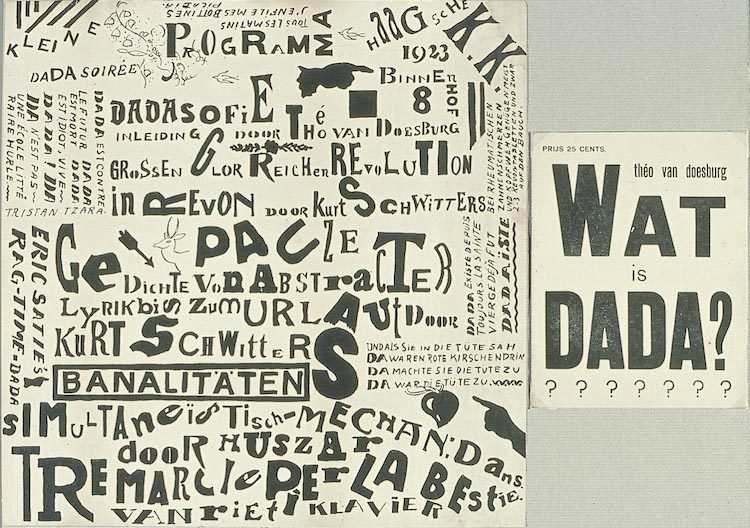
For the next section of this ongoing lecture series, we are going to go straight to the core of the breach of modernity — which to me is the period of just a few decades between the death of Nietzsche’s pre-modern Germany and the rise of Hitler’s modern Germany. This is the Weimar Republic, and the explosion of creative activity which emerges from it.
The question is: why does this happen? There is a multitude of economic and perhaps more political answers, which I would argue are ultimately superficial in the face of the death of the symbolic order — the ontological Abgrund which opens up and bottoms out with the rise of industrial technology. This, as we observe historically, explodes onto the world scene with Germany’s loss in World War I and the bankrupting of the country, leading to extreme poverty, high inflation, and societal, civilization-level breakdown, as the values, or the center of values, can no longer hold. The worldview itself now appears to be utterly grafted onto a historical and political situation which does not and cannot conform to the agrarian sun-moon somatic time, which has become factory time — the light bulb, electricity, this new form of labor production, this new mode of machine.
Hegel and Heidegger
We have a combination here. I think the two main philosophers I would use for modernity — even more so than Marx, in a structural way — are Heidegger and Hegel. Because both of them are concerned with the ontos , the shining-forth of being. My work has structurally moved with both Hegel and Heidegger, which is to say being, and being in time: Hegel’s philosophy of history, that being becomes legible — as in a shining-forth disclosed — through the poet or poetic being, poetic dwelling. As we described in the Kafka essay, as well as the Artaud essay.
I am framing these improvisational lectures as essays because they are navigations through this water, this wilderness. The shining-forth of being is being made legible through the neurosomatic sensitivity of the poetic dwelling of man. The poet is the one who describes and inscribes this dwelling poetically via thinking, languaging, as in a deep-time neuro-genetic possibility of iteration — the passage of the genome, which is thermonuclear energy through deep historical time, at the species level and the earth level. The genome is something that is shared earth-wide, so to speak.
The Hundred-Year Gap
Between the time of Hegel and Shelley, as we have discussed — the 1810s, 1820s — and a hundred years prior to the birth of the Weimar Republic, which we can mark with Kafka or Trakl, which is to say World War I-era Germany. We have gone over Otto Dix, George Grosz, Max Beckmann. There is a multitude of different figures — Rosa Luxemburg — all of whom emerge in this very fertile period of German creativity and imagining, similar to what is occurring in Russia with Mayakovsky, Akhmatova, et cetera. This is an extremely fertile period for creativity in the death of the European symbolic order, which is a pre-modern symbolic order of an atavistic relationship to being in terms of sun-moon cycles, local agrarian societies, which are time- and space-bound by the lack of the airplane or these advanced technologies, such as the car, that emerge at the thermodynamic transformation of the latent fossil-fuel energy of the 20th century.
In this gap of a hundred years we have Darwin. We have the emergence of these paradigm-shifting and phase-changing thermodynamic persistence strategies — we have Maxwell and Boltzmann. Just as much as the industrial-technological revolution, we have the matching scientific revolution, into Max Planck of the 20th century and to Fermi as we move toward World War II. This is an unprecedented period of scientific revolution, which translates directly into technological profusion. Without these revolutions, we would not have the factory. We would not have the atom bomb. Fermi being both a theorist and a practitioner, as evidenced in his work on the atom bomb and the fusion reactor.
So this transformation, again, at both the technological and scientific level, is a widening gap between the ancestral information technology — which is genomic transmission and recombination at the species level, the production of disclosure, which as we have discussed is the Renaissance mind, or the poet who dwells close to being and thus, through a neurosomatic sensitivity and this literal embodied closeness, is articulating the relationship of being in proximity to character at the source of truth. I have described what this character is in a trans-scalar way as the operator identity, which I formalized in my structural theories: that being itself does have character, and the character is structural, and it is a behavior. The way of being in time across scales has a structural, infrastructural, foundational identity. This is the natural informational technology which is taking place across time, which we see in such diverse figures as Heraclitus or Kafka.
The Lengthening Symbolic Chain
This proximity to disclosure is a gap which is widening in modernity due to the lengthening of the symbolic chain — the transformation of energy into new forms of increasingly powerful technologies, which themselves are states of illusion in that they are being generated from the genetic substrate of man and being converted into standing-order social, political, economic structures, which Mayakovsky calls the byt or the everyday.
The rise and fall of empires therein is the illusion of reason before the gleaming, which of course returns us to the poet — and this proximity of dwelling, this relationship of being in relation to being, closeness of dwelling, and the real process of disclosure. This is the issue: the gap widens in this transformation, which we could say is really a linguistic transformation of energy. When we think about the conversion of the fossil fuel into the factory or the car or the airplane — these are electricity. We see this move further as we move into the 21st century with artificial intelligence, the digital world.
These are extensions of the symbolic chain of the conversion of energy into, we could say, money as a currency, or political strategy, or ideology itself — extensions of the symbolic chain, which are further and further alienated from this primary state of the innocence of languaging, which is the poetic dwelling of being in time.
What we witness in the Weimar Republic — and this is just such an important period to do a diagnostic or a surgery into the illness of modernity — is this gap between the pre-modern agrarian mythos, which we could describe as an atavistic cosmos or a narrative cosmos, made possible due to the low-energy state of the collective in this period of time. Which is to say very local, based on consumption of the animal and the plant at a local scale, minimal trade and minimal energetic movement occurring across nonetheless national but transnational or transcontinental borders. The explosion of the phase change of technological modernity — a fossil-fuel-based phase change and an electricity-based phase change — is founded in the scientific principles of this impending rupture of the 19th century into the 20th, and extended to this profound, culminatory act of the atom bomb, the outcome of which we are still dealing with today as the primary energetic state of gridlock at the global modernity scale of digital technology.
This moment of phase change is the death, or the absence, or the gape of the symbolic order which has died, and the necessity of a new one arising — which ultimately becomes Hitler’s Germany. Just as we have a very similar phase change occurring (and this is why Russian literature is so important) in Russia, from Tsarist Russia to the Leninist, Trotskyist, into Stalinist Russia.
A Thermodynamic, Not Ideological, History
What I am suggesting is that these phase changes, with Hegel, are mapping not onto an ideological history. They are mapping onto a thermodynamic and thermonuclear history of possibilities — that is to say, latent possibilities made available by the revolutions of science, which then become the revolutions of technology, which is to say science is now interspersed and placed into the everyday. We can see this even from Sadi Carnot and the foundation of thermodynamics and the conversion of his theories on engines — I believe it was steam engines — into cars and airplanes.
What these engines do is they speed up the relationship to space and time, which is a neurosomatic state, and make available increasingly time-space territories. They condense the normal period of walking or horseback, etc. And this phase change again is accomplished into the digital-technological terrain, which is to say making available images or resources, materials or money — again, an abstracted form of currency, which is the creation of physical possibility: digital bank accounts, cryptocurrency, et cetera.
So we are looking at these degrees of extension of the human being and the human body, which I have termed prosthetics. This is critical, because this is a very primary situation which we observe in the New Objectivity painting of the Weimar Republic — Dix and Grosz. We are witnessing a transformation of the human being. And this is critically observed in the prosthetic instruments or implements of the soldier, as he returns from war and has skin or legs or arms grafted onto him in this grotesque transformation, which is documented by New Objectivity.
This realization, this visualization, is itself a transformation of the possibilities of the human being, which is written into the breakpoint of the Weimar Republic and its brief existence. This in turn goes all the way down to the rights of women, the social and political possibilities of living in space and time in the Weimar Republic. The brothels were a big aspect of this. This is a breakdown of the socio-political standing values — a sort of conservative, atavistic, local collective of, let us say, religious agreement as to behavior, which you could call a social contract or an ontological border or a boundary. I call this a membrane in my work on pseudo-closed boundaries in a thermodynamic sense. But the literal boundaries of what it is to be German, or to exist in this area formerly known as Germany, so to speak — in this period the terrain is being utterly renegotiated by the breakdown of the ontological code of pre-modern Germany, and is now thrown into absolute chaos.
The symbolic order has collapsed, and we see the emergence of Dada and Surrealism and New Objectivity. What I am suggesting is that the very bounds of perception, and the very bounds of what is possible in a human being, are being renegotiated in real time due to this fundamental ontological collapse. What emerges in this period of extreme mass proliferation of art is precisely this problem. And this is not just a proliferation of art. It is the proliferation of the foundation of psychology. It is various different political theorists and philosophers suggesting what is possible next and what should occur next, because this phase change — again, the thermodynamic phase change of industrial-technological modernity — has broken open this pressure valve of the history of what was possible, and has exceeded the cultural limit, which has now thrown into question what being itself is.
This returns me back to the journal excerpt from Pascal, which is: God is the cultural limit.
The Body in Collective
This territory is being negotiated poetically, which is the exploration of the extent of what is , and what Mayakovsky supposes in the Russian Revolution in this period is a lived, felt sense of being-in-collective. This is profound — again, to return us to the cosmological sensibility of the poet who is dwelling in relation to being in time — a lived, felt sense of energy, or the thermodynamic substrate, through which a sense of the being-self, or the I , is unintelligible. Those boundaries are uncertain and being perennially negotiated, even by such acts as eating or drinking.
This is what unites figures as historically diverse and multiple as Artaud and Rimbaud — this French tradition in particular (which is also of course a European tradition) of negotiating subjectivity. It is a fascinating construct to explore, because this is essentially what the breaking-open of the borders of the poet entails.
This dwelling in relation to proximity to being is described by Hölderlin as a danger, because what it describes is a revelation, or a breaking-into, of this substrate — which is the operator identity, or the character at the source of truth, of being itself. Nature’s being is not a bordered or bounded entity, but rather a series of pseudo-closed membranes which are constantly exchanging energy, and as such are unintelligible.
The Western philosophical or civilizational idea of subjectivity, or the I , as a relevant or articulatable mode of being is at the foundation of the delusions and illusions of Western civilization itself, which builds this I literally upon the back of a patrilineage, inheritance, property, and division — as in the establishment of the individual self. This is what is experienced exponentially as modernity progresses. This is really the bounds and borders of everything that is being negotiated, from the nation-state to the Weimar Republic, to the possession and ownership of energy, land, property.
This is the attempt to carve up the world. Maybe I will use that satirical political cartoon as the cover for this lecture, as an image.
When the Ground Disappears
This is the question which lies at the heart of the artistic and creative pursuit of the Weimar Republic. Because when these symbolic-order grounds disappear — as in, let us say, the legislations of God which hold together the collective which is operating to survive in a natural wilderness of the sun and moon and these very limited local conditions — when these conditions expand rapidly to increasingly include global information, the ideological or imagined concepts of self and other, just as of nation and collective, are thrown into a chaos, thrown into an informational and energetic chaos of the need to assimilate new information rapidly into the collective and subjective worldview. This is itself that which holds together the supposed terrain of the individual.
Ultimately this is an unchanging physical metabolic state of eating, excretion, sleeping, et cetera. This is the foundational somatic state of the living being, and everything beyond that is a political ontology. It is the grafting of an ideological subsystem into the neurosomatic condition of being human, which is navigating the pathway of the self in relation to the world. This is a state founded in early childhood developmental psychology: the attempt to make intelligible, and thus navigable, the relation of the vulnerable animal body to the dangerous wide-open terrain.
This condition is ceaseless, and it is itself the foundation of cosmology, both ancient and modern. The attempt to make intelligible — and this is of course the same derivational process by which we get quantum mechanics, just as we get the Aztec or the Olmec cosmogony and cosmology — is to identify that which itself is being, and so to consolidate time and history into a narrative form which is digestible and does not break down or corrode.
This is the primary difference between the mode of the philosopher — a Leibniz or a Spinoza — and the nation-state ideological narrative symbolic codes which perennially collapse, which are the ontological guidelines of civilizations. Because as the terrain expands, the concept of self and other is disrupted by these intermediate ontologies. These are provisional ontologies. They are not cosmological ontologies.
This is why today Spinoza is still being discussed and Spinoza is still relevant, just as Hegel and Heidegger are relevant: because they are asking the eternal questions, the questions in relationship to being itself. What is the operator identity, or what is the character at the source of truth, at a multi-scalar cosmological level and at the smallest scale or scope of the individual?
The Volk Myth and the Dictator’s Promise
This loss of reason — these are the ontological gaps, the bottoming-out of these foundational cosmologies — creates the death of nations or the death of empires, which we witness in this period of the Weimar Republic, just as we do with Russia at the same period of time. This is a civilizational phase change which cannot accommodate the pre-modern or atavistic ontology. In this chaos, which is a literal lived historical condition of extreme poverty and inflation, which leads to mass civilizational breakdown, the wide-open frame of the Weimar Republic — which becomes itself a sort of free, relatively unnegotiated space — gets consolidated into Hitler’s promise to reunite Germany under the myth of the Volk , and to reignite a period of unfounded or perhaps unprecedented prosperity for the German people through a series of ideological commands. This is of course the call-sign of the orator or the dictator.
The issue itself is that the ontological ground, in this historical situation as in all historical situations, is not being truly negotiated as a philosophical inquiry into being. Rather, these are provisional structures, or the assurances of provisional structures, which of course themselves are never built — to hold up a literal energetic (which is to say economic) relationship to life itself, making provisional this relationship as science and technology forge compressions of space and time and proliferate energy in ways which are not being assimilated or digested or metabolized into the civilizational structure of the relationship to being itself.
This is itself what I have discussed: the break from the poet in modernity. Poetic dwelling is no longer the foundation of civilizations, but rather it is this provisional architecture of power to consolidate these rapid industrial, technological, and scientific revolutions — while the ontology, which is to say the relationship to being, of modern civilization lags grotesquely behind the corpse that is dragging, which is the spiritual body of the human collective.
The Eruption of Form
To return to the eruption of Surrealism, Dadaism, and New Objectivity — this extreme creative fertility which we experience at the turn of the 20th century in Europe, not just in Germany — is the intuition of this opening. This opening of the political terrain is manifest in the extreme economic and political conditions of being in time itself, as Europe is attempting to consolidate and reconsolidate itself in light of the industrial technology which has emerged and utterly changed the circumstances of relation to being in time, and utterly changed the everyday. The pre-modern ontology of Europe itself was not prepared for, and could not assimilate, this phase change or phase shift.
When this gap opens, it is rushed to be filled. This is the case of the chaos that emerges after the collapse of Tsarist Russia — that there are these different power regimes or provisional architectures, such as Lenin or Trotsky, which are attempting to fill the space of the fall of the provisional architecture of empire (or the Tsarist state), which of course transforms into Stalin. These are not answers to the problem of relation to being, or of dwelling in relation to being, which is fundamentally the poetic and cosmological problem of existential humanity itself.
This is the question that Mayakovsky is fundamentally oriented toward. Mayakovsky understands quite clearly that this is a cosmological problem, just as well as it is a political, economic, and historical problem — but that it is only soluble at the cosmological level, because the cosmological level itself is the highest relation to being. It is the eternal law, or the structural being itself, downstream of which political economy, history, and the human being all fall.
So this is the problem-solving of existential philosophy. It is the problem-solving of the structural question of being, that we see emerge in the relation of these great minds over periods of centuries. Again, from Spinoza to Hegel to Heidegger. The history of Western philosophy is the history of solving the meaningful question, or the only meaningful question, which is being in relation to being. The poets and the philosophers themselves are a sort of guild or collective toward this problem, which is an eternal problem — which is why it persists and moves through time accordingly, and remains relevant regardless of time.
This principle is of course not being applied at the civilizational or collective level, because provisional architecture is the architecture of a problem that is only being attempted to solve when there is crisis enough to solve it. That the poets and the philosophers themselves are the unacknowledged legislators, as Shelley said, as opposed to the institutional legislators — this is the primary conflict of modern civilization and empire itself: that legislation is emerging not even in an Alexandrian sense, in relation to Aristotle and that tutelage in the absolute living foundations of Greek philosophical history, but rather that these provisional architectures are being built by questionless bureaucracy or questionless aristocracy. This is the eternal corruption of human being at the civilizational and historical level — with perhaps the rare exception.
The failure to ask these questions is why these crisis points are reached. The provisional architectures of the civilizational ontos , which are nothing more than a house of sticks or a house of cards, inevitably collapse due to the marching scientific, innovating, informational-technological intuition and backbone of the human species — which is to say, it is innovating the relationship to being by exploring the possibilities of nature, making disclosed the relationship of the human being to nature and the energetic substrates therein, from Copernicus to Newton to quantum mechanics.
This question is pursued perennially by the inquiring minds, both of science and of poetry, but the civilizational — which is to say the infrastructure of the transformation of energy and the articulation of the collective body — is itself the gap, or the loss, that is perennial in human history. The Weimar Republic itself is the moment at which this gap is made most glaring in the modern sense.
Art as Response vs. Disclosure Technology
So we have the eruption of art. What I have to suggest here, which is maybe the most profound aspect of this, is that art itself — unless we are talking about disclosure technology , which is to say Hölderlin or Trakl, a very hermetic and closed practice of being in relation to being — art itself is a historical and political response to lived, felt economic, cultural, and social conditions. There is a category beneath art, which is to say disclosure technology, which is the work of the ontological poet or the ontological philosopher, which we could just group together as metaphysics — whether that is Spinoza or Hölderlin. This is the question of solving for the problem at the level of being, character at the source of truth or the operator identity. This is a very, very small portion of human history.
But it is itself the only structure, the only foundation, which can accommodate any phase change — which is to say death, rebirth of civilizations, collapse, destitution of civilizational or cultural narratives, loss of values, economic and political destitution and corruption. To solve the problem for the level of being, at the level of being, which is cosmological — this is the only possibility of solving the problem.
Otherwise the problem re-emerges again and again and again, because it is being accommodated provisionally by administrators — bureaucratic administrators, whether that is an emperor or a king or a politician or a businessman. These are provisional architectures to extract energetic information, to control energetic information, in so long and in so far as it is functional, which is not a true ontological solution. It is provisional architecture destined for collapse. This is again the rise and fall of empires, the illusion of reason before the gleaming and the real process of disclosure, which is beings in relation to being.
Shelley, Da Vinci, and the Trans-Scalar Pursuit
This relationship is perhaps most archetypally embodied by Shelley and Da Vinci — that the pursuit of poetic disclosure of the ontos is entirely connected to every discipline, including science, political theory, anatomy, electricity. The statements that emerge from Shelley or Da Vinci, or even Goethe, are the only reliable ontological statements, because they are trans-scalar discoveries at the level of the identity of creation and existence itself, which incorporate everything from art, symbol, to electricity, to energy, to magnetism.
These total ontological pursuits are the true and only guiding thread, the only legible architecture of human history, in the face of the overturning — the perpetual overturning — of the provisional attempts to control and manipulate energetic architecture throughout time and history. This is the history of all civilizations.
What we have is these few thin, albeit powerful and magnitudinous threads of these total ontological pursuits, these passions, whether again Shelley or Da Vinci — the Renaissance mind, to unify the ontos. These historical gapes , as with the Weimar Republic and the explosion and profusion of these art forms, are responses to the death of the ontos civilizationally. The civilizational death of the ontos is itself Heidegger’s world’s midnight. But this has nothing to say for who he turns to, which is Hölderlin.
I would suggest that turning to Shelley would be an even higher mode of integration. Because what Heidegger is turning to is not simply the poet — he is turning to the ontological metaphysician and philosopher who is solving for the problem of being, which is dwelling poetically, and a refusal of the separative, isolating, alienatory split, the division of disciplines. Shelley’s pursuit is everything from science to philosophy to literature, because he is solving for the problem at the level of being, which is the eternal, the structural, the superstructural, from which all else is derived.
Catastrophes of Ontological Breakdown
These moments in human history themselves are catastrophes of ontological breakdown. The center did not hold in Shelley’s time, as it collapsed in the hundred years following. Shelley held a light, a guiding light, to the ontos — structurally, I think most clearly in Prometheus Unbound , which metaphysically mirrors my scientific work on the persistence operator. A structural match — as with dissipative structures.
What we need to discover is the true infrastructural function of being across scales — and as such, understanding the identity (which we could say of God, or of creation, or of the universe-cosmos itself) we are able to derive accurate infrastructural, architectural foundations and solutions at the level of the human being, which is to say civilization, subjective identity, relationship, et cetera. I have described these as the derivations , and deriving the human condition from these first principles makes possible a real relationship to being.
Once the structural articulation of being is understood — as nature, as the gleaming, which is the hidden or veiled intimation of creation itself, which is emerging through all forms, which must be grasped structurally — this is a high-falutin’ process of grasping, you could say, the neural architecture of the cosmos as it is derived and derivable from thermonuclear energy. The chain of the scale of the production of energetic force, which not only guides the solar system but the cosmos at large in terms of intergalactic relation, which is bodies and beings and spaces.
Back to the Weimar Floor
We return this back down all the way to the level of the bottoming-out of the Weimar Republic, between the death of Nietzsche’s pre-modern atavistic Germany — sun and moon cycles, and the myths and narratives therein — and the rise of Hitler’s Germany, which is the thermodynamic, thermonuclear transformation of the energetic ground: factory time, electrical time, oil time. This utterly changes the situation, the terrain being negotiated in everyday life, which is Mayakovsky’s byt. Mayakovsky is attempting to break apart and rend at the root, to find the cosmological source of being itself. His poetic pursuit is common to him as it is to Spinoza, although they are at different levels of grasping the ontos. Shelley resides there as well, at a very high level.
This problem, this opening or cavern of the world’s midnight, is itself the rupture which reveals the loss, or the lack, of the true cosmological ontos as the guiding and binding source of civilization, mankind, and the universe itself — which must be accurately and adequately grasped at a superstructural level in order to incarnate, or to bring about, real architectural solutions to the problem of being and being in relationship to time.
Otherwise, what you have is what Goethe says: a madhouse, or an insane asylum, of humanity. Because humanity is not in relationship to being in any meaningful way beyond vague intuition and institutional architectures, which articulate a narrative or ideological framework into which human beings are hopelessly absorbed and re-absorbed as standing-ordered resources, which then extract from them — such as church and state.
That is what I have. This is critical. It comes down to labor. It comes down to the everyday life. It comes down to the bare and rote physical, existential, and historical conditions of being human. The failure to understand, know, or acquire, or come into deeper communion with the ontos via the revolutions of science and technology, is the failure of civilizations and humanity. This extracts the ultimate cost, the ultimate toll — chaos, death, calamity, destruction, and terror — in the face of the problem of being, which is never solved or resolved, but rather deepened, by the collapsing, condensing space and time, which is the acceleration of science and technology.
This is the ultimate necessary question — not only at the level of being in existence, which is being in relation to oneself and asking the Jobian question, the deepest question, being in relation to nature and God or the universe-cosmos — but the actual possibility of real function. Which is to say becoming human, in a profoundly cosmological natural sense, in relation to the time itself, in relation to history, and in relation to the possibilities of the incarnation, which is the coming into thermodynamic flesh, and the possibilities of creation, articulation, and manifestation of the self.
So thank you.
Part 6. Surrealism, the Dream-Descent, and the Birth of Total Disclosure as Existential-Human-Individual-Historical Condition (May 25, 2026 Lecture)
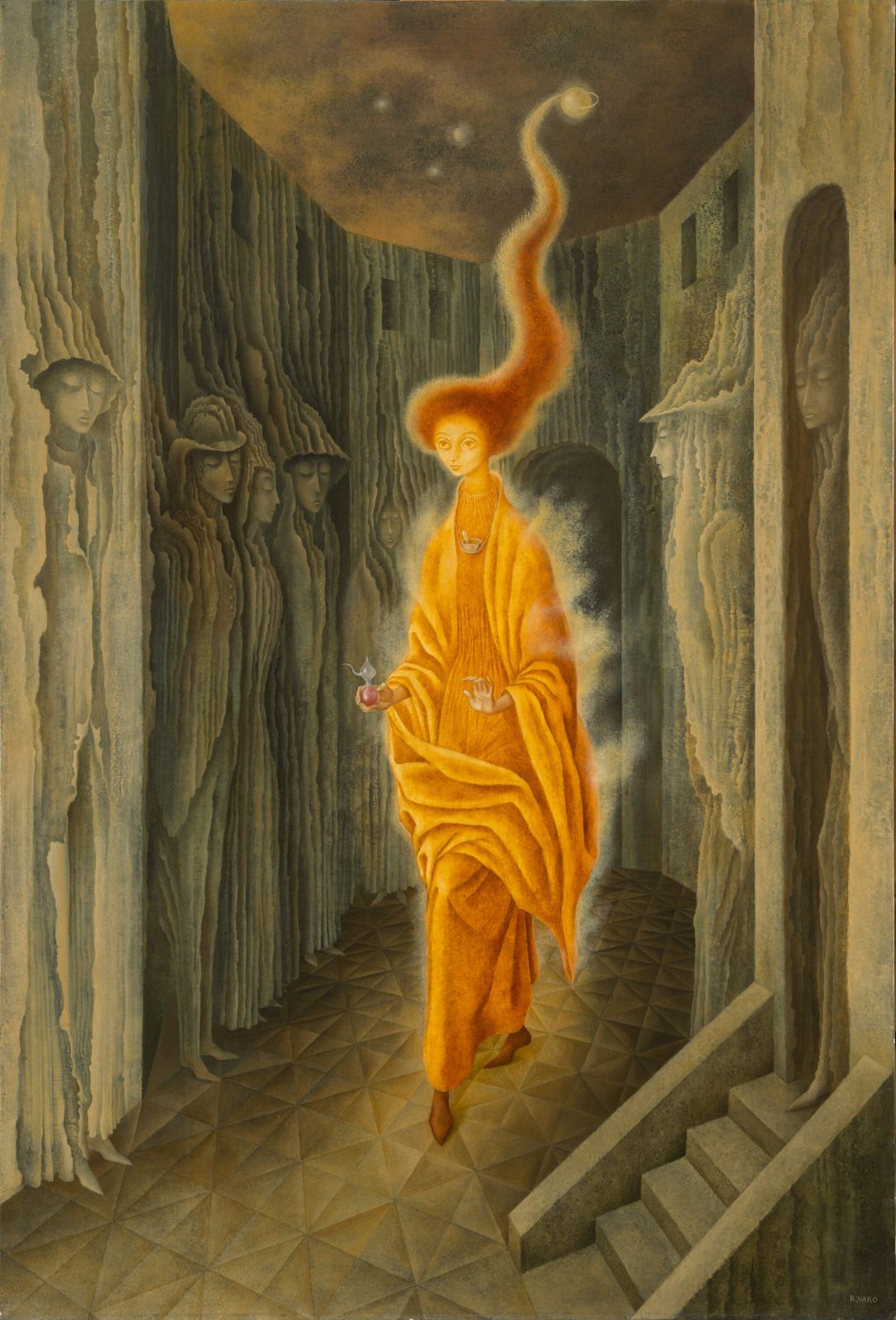
Surrealism, the Dream-Descent, and the Death of the Symbolic Order
Our next step here is the descent further into this trouble of modernity, which I will most succinctly say is the death of the symbolic order in the most fundamental sense — the death of the civilizational ontos. Again, this symbolic order is a civilizational vocabulary of consciousness, and it is the way in which consciousness is interfacing with the everyday. It is what makes the bureaucratic, the aristocratic, the status order of mankind, the cultural symbols, the metaphysical presumptions as in religion or cosmogony — it makes all of these phenomena possible.
So the loss of this symbolic order, the death of this symbolic order in modernity, is a total loss. And it is a loss because architecturally this symbolic order of civilization — the long pre-modern history of Europe itself, hundreds, if not really thousands of years of history of Europe — is no longer tenable, no longer functional. This, again, as I have stated, is due to the new meta-architectural structure of civilization, as in a thermodynamic — as in a literal phase change in space-time — by the harnessing of oil energy and electricity, which radically terraforms the condition not only locally but globally of mankind.
So the tendrils of European modernity, and the crisis of European modernity as in the death of the symbolic order, become the global modern terrain — both through the pure brute force of colonization, but also through this industrial-technological phase change transformation, which is embedded and latent within the Western philosophical-civilizational architecture. This is a standing-orderization of life and nature through the scientific-technological conversion, which is a movement into the grounds of the earth to find the energetic unit — culminating, of course, in the 20th century, again, with the atom bomb and with nuclear power and fusion. A replication of the powers of the sun or the star. And of course you have the famous Oppenheimer quote: I am become death, destroyer of worlds.
Power and the Collapse of Pre-Modern Theology
This is about power. This is the pursuit of Western civilizational history, in large part human history, and of course becomes the collapse of modernity — in that the actual physical, lived and living power in human hands has now surpassed this pre-modern agrarian theology, which is the symbolic order in which life is made operative or meaningful or conscious, behavioral in space and in time. It is the ethics and morality. It is the ground of human behavior, or the human faculty of relationship to being.
We discussed this with the poets. And now we are moving into Surrealism as this psychological pursuit, which is, again, the collapse of the symbolic order. The terrain of the human experience falls inward, somatically. We have concerned ourselves already with existential disclosure. We have concerned ourselves already with symbolic-order collapse, as in the Weimar Republic. We have described the forces which draw the human being into this intimate dialectical relationship with the self — because all other structures, which are the fail-safes before this descent, fail.
Breton, the Dream Space, and the Manifesto
We have what I would say is a critical relationship to André Breton — the Manifesto of Surrealism , and the destruction of the rational, censored life, and this fall into the dream space, which is the unconscious association. The historical catastrophe is World War I: industrialized mass death, the collapse of the bourgeois rational confidence, of the Enlightenment, and then a total fragmentation of self and a mechanization of consciousness in the industrial-technological order, which is the exponential growth of the standing-orderization of nature into unit, number, and name.
This descent is beneath conscious control. So into this irrational space, which is simultaneously the existential confrontation with the self — as in Beckett or in Lispector — just as much as it is the sediment of consciousness itself, which is a lived experience. We have not really gone into Freud here, or Boltzmann or Maxwell, because that is not the theme of the project, and it is not the concern of the project. It is the concern of the subject, or subjectivity, or consciousness — that the seeing and perceiving and experience of living-being is primary, and is primacy itself. And that from that emerges various different symbolic orders and strands of abstraction, which go deep into the fabric of science and mathematics, but is fundamentally experienced at the level of the experience of the individual.
This keeps us at the Surrealism of the dream space, the dream state, or cognition and consciousness itself — this real exploration, not formalization (as in Freud). This process of direct confrontation with the ontos is of course the existentialist experience: we are asking the question of what is being in relation to being? What is the lived and living experience? And this is simultaneously inclusive of science, but not exclusive of the direct, Jobian confrontation, which we have discussed.
Hegel and the Dialectic of History
What we experience with Hegel — and this is what is so critical: we have Hegel’s emergence in the time of Shelley — is that history is a dynamic process of dialectical relationship. It is unfolding through contradiction and contraction, in the space between the experience of consciousness, the becoming-conscious, and the architectural space of the world. The transformation of industrial-technological modernity is at the level of the sexually reproductive ground of recognition of the self, which forms the fabric of everyday life. This is deeply connected to Breton and the exploration of the unconscious — that the human relationship to disclosure of being, which is existence itself, this relationship as it unfolds in time, changes history. History itself is a permeable membrane, in which consciousness and the change of consciousness make possible evolutions in the terrain.
A century later, a century after Hegel, which is the time of Breton — the fracture of modernity, the death of the symbolic order, Dada and the Weimar Republic — we have perhaps the greatest historical definition, which is warned of by Nietzsche and Marx, as this terraforming, or terraformization , of the human being’s relationship to being itself. The literal terrain of what is possible in existence has shifted due to this thermodynamic revolution which is industrial technology, but also the bottoming-out of the civilizational ontos , which creates this descent into being itself, as in an exploration of the unconscious, the exploration of the existential condition, the Jobian condition of man in relation to nature.
This terraforming is simultaneously existential, psychological, historical, political, symbolic, etc. And this is all related to the ontos and the human relation to the ontos : the death of the mythic, or ancient structures, which were possible in a closed environment — which is to say local, regional, energetically limited, low-energy environments — explodes in modernity into a global situation of becoming-conscious, in terms of the exchange of energy and information by train, by car, by digital space. This is a collapse of that which holds the surfeit substance of the symbolic order of modernity. And then we descend.
Channel One and Channel Two
This is the dialectical relationship of the change of technology. I have called this channel one and channel two. Channel one is the information technology of the genome as it evolves through deep time. Channel two is the exponential growth of information technology over the 20th into the 21st centuries. This prosthetic of symbol — as in literature, the printing press, even code — this prosthetic is in real time changing the situation of human beings’ relationship to itself, which is critical to the Hegelian dialectic of history.
When this gape emerges through contraction or contradiction, there is a descent in modernity — as predicted really by Hegel’s architectural infrastructure of metaphysics — into the real solution space of the human being, which is metaphysical certainty supposed by religious orders, civilizational narratives, etc. When this metaphysical certainty disappears, what is there?
So this is a descent into the ground which is familiar to Advaita Vedanta in the ancient Hindu tradition. It is the stripping of the layers of the garments of consciousness, so to speak, which are narrative dependencies — civilizational or religious narrative, a narrative of self — down into the substrate, which is a thermodynamic and thermonuclear process of becoming and unfolding, a deep time of revolution and evolution of forms.
Hegel in this sense is prescient to Darwin, and is unveiling and unfolding the metaphysical process which Darwin makes explicit in the evolutionary phenomenon — a thermodynamic phenomenon fundamentally, in terms of energetic transformation. But the critical aspect of Surrealism here is consciousness actually undergoing the reality of this experience, particularly in civilizational transition, which is the modern bottoming-out of the symbolic order, the death of the symbolic order.
This death of the symbolic order is critically necessary. It is essential to existential thought, as it is to Advaita Vedanta — which is to say, a critical collapse of categories. It is actually fundamentally in relationship to science and mathematics for this reason, because it is in relationship to abstraction and the literal somatic lived condition of the human body in space and in time, which is to say the beating heart of the thermodynamic being as an energetic-information-technology structure experiencing itself recursively as a universal process.
The Death of the Ground
So this descent with Surrealism, and the necessity of entering the dream space and the fracture of modernity, this psychological process of becoming conscious of this fracture, is a neurosomatic, lived-felt experience of the death of the ground, which was formerly the neural pathway of being in time. That is to say, the civilizational order — or the byt , as Mayakovsky puts it, again, the everyday — which is the destabilization of the total architectural terrain that was a metaphysical certainty. And this is destroyed processually in an exponential becoming, which is industrial modernity, Darwin, mechanization, the alienation which Marx describes in relationship to the machine as a labor system, the mass warfare of World War I, urbanization, city centers, this terraforming of the sun-moon atavistic relationship with nature, which was codified in the stories of pre-modern Europe.
Again, innovations such as photography, cinema, radio, psychoanalysis, technological acceleration itself — all of these innovative processes are described by Hegel meta-architecturally as that which is tearing at the foundations of what was formerly conceived to be possible, which was the existing solution space. It is a condensation of space and time in which the human being is forced into a confrontation, via the collapse of the civilizational ontos , with the unstable reality of being — unstable subjectivity, unstable history.
The ground which formerly made pre-modern Europe possible was simultaneously the ground that needed to be pulled away — or was pulled away — to create this confrontation through symbolic rupture. If rational civilization produces Verdun and mechanized slaughter, as is described in detail in Grosz or Dix, what is beneath the corruption, decadence, and destruction — the emptying-out of the possibility of meaningful being — which is manifest quite clearly in the destabilization of the economic and political circumstances of modernity?
It is no longer possible to meaningfully be. Being itself has been thrown into a protracted crisis. Not only is meaning in question, but the possibility of being itself is deeply in question, in terms of this mass death and destruction and calamity, which includes the Spanish flu and tuberculosis. This is a total throwing of being into chaos.
Recursion, Deep Time, and the Hegelian Read
So what is beneath it is the question of what is the transformation of history and the transformation of consciousness in time? Which is again, as I have stated, not only a genetic, thermonuclear, deep-time process of sexual recombination — which changes the neural structure of being and the somatic structure of being, which is a disclosure possibility. Sophistication through evolution creates the possibility of disclosure of being itself, through itself, as a recursive phenomenon. But also: this recursive phenomenon, in relation to the technological and scientific products that it throws off in this ontological pursuit — which I suggest all of life is, the pursuit of being conscious of itself — this process is itself the destabilization of the grounds of history through which we must read history.
This is deeply Hegelian, and was understood by the Surrealists, and understood by Breton, as a critical facet and aspect of what is coming of modernity. We see this destabilization in everything from Dada to New Objectivity to existentialist literature: this process is being undergone by the individual, because the civilizational ontos has utterly collapsed the collective possibility, which was the pre-modern mythical thread. This is a total descent, somatically, into the wilderness — that which pre-modern civilization availed protection from is exposure. Ontological exposure to being itself, and then the full danger and breadth and magnitude of what is at question and what is at hand. Which I would say is Jobian as much as it is Dantean — the descent into the wilderness, with Virgil as the guide, as Dante descends into the hell of the corrupt architecture of his time.
To understand this descent into hell — we have gone into it deeply in terms of the Inannic, katabatic process of life and civilizations, the process of discovering in a lived, felt, embodied way what is being. Again, deeply poetic. It cannot be symbolically translated, but the poetic function of thinking and languaging makes this process, this critical meta-infrastructure, legible in history. It is fundamentally asymbolic. The decadence of the symbol is itself what produces this phenomenon of civilizational collapse, in that abstraction rends the human being from this essential channel-one informational-technological process of the genome becoming recursive to itself — but at the same time reveals the critical ontological gap of the civilizations, tribes, and communal structures therein prior, via this energetic phase change and transformation.
Constraint, Persistence, and Shelley’s Cosmology
This energetic phase change and transformation is one of increased possibility in space and time. When I am saying low-energy civilizations or low-energy tribes, I am discussing space- and time-bound infrastructure, which is slow infrastructure and limited infrastructure, which is constraint. This is a constraint problem, and the human being itself is solving the constraint problem of being in time, in a thermodynamically limited form exposed to entropy, with a period of degradation — and this is being solved through science and medicine at all times, because it is a question of literal survival and persistence of the organism. Food, water, shelter, et cetera.
This existential problem, expanded in space, is the civilizational problem. Expanded in deep space and deep time, it is the cosmological problem of the persistence of any given architecture or form itself in an entropic universe — all of which are pseudo-closed boundaries, leaking energy, leaking heat in time. This is being-in-time itself, the river of time. And this destabilization is the predicate upon which cosmological being is founded.
Again, I will return to Percy Shelley here. The meta-architecture of Prometheus Bound , or Prometheus Unbound in relation to Aeschylus, is the question of the human being itself in constraint — that the body, blood, the mind, that this pseudo-contained or pseudo-bound form is in space and in time and is a limited function. How do you liberate the thermonuclear energy beneath the human being, which is itself and all things?
Simultaneously, what Shelley and Blake diagnose at the root of the British Empire is the symbolic order as chains upon the possibility of being acting in time — being human, the real solution space, and the constraint possibility of being human as it has been corralled, colonized, subordinated by this symbolic code, which is the British Empire of status, power, affect, patrilineage, et cetera. The entirety of Shelley’s political theory and political ontology is derived from his understanding of constraint at a cosmological level, which is deeply tied to my work as it is to Spinoza. It is the understanding of the cosmology of being itself, the disclosure of the ontos , which is fundamentally the act of being in relation to itself — which then downstream is articulated by Shelley as a railing against marriage or slavery, or any of these other separative, possessive, controlling state- or religious-level systems and institutions which discourage disclosure, and discourage the liberation of this thermonuclear energy of being itself in time as the full possibility of the expression of what it is not only to be human, but to be a being in relation to being, which is fundamentally inhuman.
The Fracture, a Hundred Years Later
This is the issue that we experienced, that Shelley is prescient of, and that Hegel is describing — this collapse, a hundred years later from their time, into World War I, which is the fracturing of this static holding-cell process of empires. This dissolves into the nation-state world, and dissolves into the industrial-technological world as a phase change. In this opening of the space is Surrealism, Dadaism, New Objectivity, existentialist literature — into the opening, the possibility of ontological disclosure heightens, because the chaos of state control, the bourgeois order, these systems of rationality and the deception of the Enlightenment mind, of Enlightenment thought, has collapsed.
This is what you see so clearly in Dada. The symbol itself has been broken. It does not make sense anymore. It has descended into nonsense. This is critical in understanding technological modernity and what happens in the Weimar Republic and what happens with Surrealism: the rational order of the symbolic infrastructure of civilization in Western history, in European history, in European ontology, has fractured irrevocably in this phase change.
What emerges from it is a descent somatically into the self, the lived experience of being, which is a thermonuclear process, which cannot be held by any inherited symbolic order. This is incredibly dangerous to empire, which is why we see Shelley censored, or Kafka censored, or Baudelaire censored — because what is being revealed is the underside of this symbolic process, which is an architecture of discrimination. It is a hierarchy of discrimination, which is to say a symbolic order is the imposition of a value system upon life, which is chaining life or corralling life to a certain set of structural processes or ways of being in the world.
Beneath this process which is civilization, or beneath this process which is being-human — which is Breton and the Surrealist descent into dreams, or the Dadaist descent into the death of the symbolic order, or the existentialist descent into the ancient process of recovering the ontos , common to Heraclitus even as it is to Lispector — these descents are all descents into the critical existential reality of being human, which is being in relation to being. Which is itself the only real or meaningful pursuit in life, because it is the pursuit of life toward life, which is recursion.
This is what Hegel is suggesting in his philosophy of history: the movement of being in time is a dialectical relationship to the unfolding of this possibility, and how the unfolding of this possibility actually shapes the world and sculpts history. Boltzmann or Maxwell, or Planck, or Spinoza themselves are dialectical actors in this historical process of changing the architectural relation of being in time — which is the literal terraforming and ultimately the superstructural, paradigm-shifting phase change of the energetic transformation of modernity. Which again is thermonuclear, and oil-based, electricity-based, the plane, and then of course the digital space itself, which is an energetic infrastructure held up behind the scenes by energetic transformation — just as the human genome is, which is the neural possibility and responsiveness of consciousness to disclosure.
Being in Dialectical Relationship to Itself
What Hegel is saying in the most revolutionary way, beneath the philosophy of history, is that being is already ontologically and cosmologically in dialectical relationship to itself — even just in the narrow space of the human being, as in: it is an information technology which makes possible recursion, which makes possible existential reflective thought. As Kierkegaard describes, dialectical redoubling. It is the process of being reflecting upon itself through the information technology of the genome, which is the cutting edge of the human brain and the human soma — the advent of the forebrain, and the hundreds of thousands of years of the process of the sophistication of that — which makes possible philosophy, which makes possible Enlightenment theory and Enlightenment philosophy, which makes possible the coming of Da Vinci or Shelley, in terms of unifying the ontos through disclosure and the refusal of disciplinary bounds.
These Renaissance minds permeate and penetrate to the heart of the matter, using every single possible disciplinary descent available to them, and the unification of these disciplines into a structural realization of what is the character and identity of being itself.
This is critical. Understanding this is not only understanding deep time, but is one of just my favorite and most fascinating things to pursue, which is the catastrophe of modernity, the crisis of modernity — because it is the crisis which is experienced first by the poet, as a somatic separation, as described by Sartre in Nausea , I think by far the best. It is the lived, felt condition of ineluctable separation from the ontos. The terror, the destruction, and the calamity, as in dissociation from the ontos , is dissociation from being itself. And what this creates in modernity as a global tone and a global affect is meaninglessness, beinglessness — the existential dread, or the hollow man, or the wasteland of T. S. Eliot — that the literal structure of being in the world has been ruptured to the point at which there is no relationship.
This of course is an affect and a total condition that is across scales. It is everything from the human being to the human being, to the human being to nature, to a lived, felt sense of what it is to be alive or in existence — to know that, and to have a relationship to being, God, or nature at all whatsoever. This is again the question that Heidegger asks in 1936 and 1937 as he begins his relationship to Hölderlin. This profound failure, this profound loss in history, is, perhaps as a Hegelian would say, necessary — because of what is made possible through industrial-technological modernity as an expansion of the solution space, which ruptures the dream thread or the dream-narrative network of the local, low-energy civilization or tribe, the pre-modern ontos.
Channel Two Outpacing Channel One
This scaffolding I have described quite clearly as scientific revolution at the level of theory, then put into practice via the assembling of various different technologies and information technologies. I think Fermi is perhaps the greatest example in modernity of this phenomenon — his theory work in quantum mechanics, and then his assembly and work on the Chicago Pile. This process of the scaffolding of this channel-two architecture, which is symbolic architecture — which is math, science, literature, all of which are symbolic codes, as well as philosophy (Shelley understands this very clearly) — this symbolic architecture is scaffolding faster than the channel-one architecture, which is the slow evolutionary, genomic architecture of sexual recombination, the code or codex of being human. This evolutionary process is hundreds of thousands and millions of years of changing in time, which is the advent of the forebrain and the development of the nervous system.
But this channel-two information technology — which is to say science, the industrial revolution, the digital revolution — this architecture is exponentially evolving. This is widening the critical gap between the lived somatic experience of being in relation to disclosure, which in the somatic sense is, say, sun and moon — bound to neural time and natural time. Time of nature, time of light, time of gleaming, which is a Hölderlinian time.
And then Heidegger asks, across the gap of modernity: what does it mean to exist in factory time, and seek to recover the gods, which themselves are the enfolded relationship of being to itself in this natural sense, which is embodied, somatic, lived, felt? The loss of this relationship is the critical gap of modernity, which is the descent into dissociative, violent chaos and overturning — because the lived experience, the somatic experience, has been replaced by the alienation of industrial technology and the collapse of the narrative myths which themselves governed this pre-modern atavistic world.
And then there is a descent, instead of, and outside of, the cultural myth, into the subjective myth, which is the dream, the psychic fracture. And furthermore, the existential confrontation with the ontos itself as a lived, embodied phenomenon. Which is why I suggest that Dostoevsky, or Kafka, or Trakl are telling us something deeper than science can tell us, even as science changes our world materially and phenomenologically. They are telling us what it means to be in relationship to being itself outside of the symbolic infrastructure of civilization — the architectural brevity of history itself, which is the change in time of all of humanity, whether that is through ancient Egypt or India into the factory time of England or the United States, or the condensation of Germany into urban units. There is an experience outside of this time, which is the timeless , made possible through genomic and neural evolution, the relationship to being.
The Mass Wound
This burst that we have of existentialism, Surrealism, Dadaism, New Objectivity is the psychic fracture made political condition, made lived-felt existential condition. Whereas, as I have said before, the descent experience of Shelley into the ontos is driven by the passion of the Renaissance mind — into this cavern, into this break of the Weimar Republic and the German, the European existential and ontological condition of relationship to being itself, which is an architectural transformation, a paradigm-shift transformation in the energetics of Western civilization.
This occurrence is itself what creates this massive bottoming-out and this massive creative thrust — which is literary, visual, artistic, et cetera — because reality itself has now entered into political dispute. This is no longer the private existential project of the occasional Renaissance mind, but instead the collective opening-up of the ontological grounds. The chasm, the gape, is now a mass wound — of rupture, anxiety, absurdity, and estrangement — made totalizing, unignorable, and undeniable at the level of lived economics, politics, and the possibility of survival.
The throwing of civilization into the depths of this chaos, this absurdity and violence, is itself a mass somatic condition — which Artaud is describing, as the 20th century progresses, as a possession. That humanity, or Western civilization, has become possessed without a finding of the true ontological root ground of human-being-in-relationship-to-being, which is the possibility of being-in-time at all whatsoever meaningfully.
Artaud is asking the same question Heidegger is asking, but with an urgency — a somatic urgency — that we do not necessarily experience in the intellectual remove of Heidegger. This is not to say that Heidegger is not a somatic experience of being; otherwise he would not be asking that question. But for Artaud, the urgency is fundamental, because Artaud cannot exist, cannot continue forth, without that relationship. So it is pursued with the agony and the ecstasy and the passion of one who is deep into modernity, yet without the necessary infrastructural scaffolding, architectural scaffolding, to create the leap — which is the relationship between the time of Spinoza, Shelley, and Hegel, to the integration of the nervous system with astrophysics, which is necessary.
Science as Ontological Method
This is what is so fascinating about science and technology. Shelley understands this. These are critical methods and modes by which to examine being and to refine and clarify ontological architecture. Hegel would also understand this — as the historical dialectical process of refining ontological disclosure until being is made apparent. This would be described as the singularity, so to speak, the oneness of Spinoza, or the monad of Leibniz. That this being itself is made apparent in character and identity, as I have described in the operator identity and persistence architecture of existence itself.
To make being apparent — then downstream is the ontological surgery and remedy of the perpetual architectural dissolution and symbolic-ontological rupture of civilizations time and time again, in the face of that which is, which has not been accurately summed into ontological ground, which is itself the myth structure, the cosmology, or the cosmogony of any given civilization.
These insurrections into the ground — whether Freud, or Hegel, or Breton and the Surrealists, or the existentialists — are all attempts in different degrees of penetration into the functional matter of being itself. Whether that is the consciousness, the unconsciousness, ontological disclosure, as in Hölderlin, the relationship to nature’s gleaming, which is perceived by the poet and articulated as such. What is this mystery, which itself has been formalized or synthesized in the world’s myths, which have been destroyed by the phase change of modernity, the paradigm shift of modernity — which requires a higher-resolution, high-energy informational ontos , which can now compatibly integrate Fermi or Planck or Boltzmann or Maxwell or industrial technology or factory time?
An entirely synthetic environment, which has been sculpted by the human hand as a mass informational technology, as a way of being in time, which is utterly shifted by this opening up of this energetic field, which is the paradigm shift, which is now intimate relationship to history. It is this sedimentary ground of reality now. It is a new historical movement and transformation, which could not be assimilated by the pre-modern ontological architecture, and thus it collapses.
What Civilizational Collapse Means
When we are talking about civilizational collapse, we are talking about ontological collapse. The collapse of the meta-structural and meta-architectural relationship to being in time, which is itself the formalization of Enlightenment philosophy or Enlightenment ideologies into civilizational architecture, fractures under the weight of the burden of the literal phase change brought about by science and technology and industry.
In this fracturing is the gate, the chasm, the abyss into which life falls. This is the chaos of the turn from the age of empires and tsars to nation-states, and the fragmentation even as the nation-state is created in the real problem of condensing global modernity — which is again a time-space phase change impossibility: the jet plane, the bullet train, the digital space, artificial intelligence. These are all condensations into higher degrees of abstraction, which make possible informational-technological communication across wide swaths of space and time. Such as reading an ancient Indian scroll via the internet. Or meeting someone across the world instantaneously via a video call.
What does this do — and again, this is a lived possibility, a somatic, economic possibility of an energetic and informational exchange — what does this do to the ontological grounds on which civilizations are constructed? These grounds are always already provisional, unless they are founded upon a true ontology. What I am suggesting is that the critical method has never existed in human history. We have never had a unified ontos , other than in the intuitions, I would say, of Heraclitus — and maybe perhaps Abhinavagupta in the Kashmiri Shaivism tradition. These intuitions are now being deepened and clarified and formalized in a very microscopic way by scientific pursuits.
I have brought up the connection between the operator identity, which I have formalized, and the understanding that dissipative structures by Prigogine actually share precisely the same structural realization. To understand the ontos , we must incorporate everything. This is the issue of exponentially growing technology and scientific pursuit as it booms in the 19th century onward: a critical ontology must necessarily develop, clarify, and enlighten — clear these grounds — by incorporating everything. This is why we lose the Renaissance mind in a modern sense, because there is exponentially more to incorporate than ever before. This is seen in the population growth of the 20th century. This is seen in the disciplinary siloing, the existential alienation, which is experienced throughout the 19th and 20th centuries. Marx is describing this phenomenon meta-structurally, economically, and politically. The possibility, in the solution space of the human being, has exponentially grown — condensation of space and time making available more energy — and this has actually changed the clarification of the ontos.
So when I speak about Shelley and Prometheus Unbound , or I speak about Heraclitus, they are solving for a different problem in history, but itself, in the timeless sense, the problem of being is the same. You can read Heraclitus, or Prometheus Unbound , through a thermodynamic-astrophysical lens, and it is coherent — because it is a structural revelation and disclosure of being itself through the language and languaging possibilities of the time, which is to say the informational technology available in every single disciplinary silo, being synthesized, formalized in relationship to the ontological disclosure of the poet or the philosopher toward being itself.
Every Modern Human a Dante
These disclosures and descents I am describing in Surrealism, existentialism, etc. — these are all descents being undergone by the individual in relationship to being itself. This fracture of modernity is the fracture of the civilizational collective code, the ontological code, which held up the low-energy grounds of closed civilizations and tribes, time immemorial — in a pre-modern, atavistic sense. Tribes, ancient civilizations, et cetera, are held and bound and embodied by these ontological codes, which are cosmological and cosmogonic codes. This is ruptured irrevocably by the industrial, technological, and scientific revolutions of modernity, which fracture down to the level of the individual. Which is precisely why we experience individualism and subjectivity as such fraught ground in modernity — and it continues to exponentially become fraught.
Down to the level of the individual, these ontological myths and narratives break, because there has been a phase change in consciousness itself. What is possible in the solution space of the neural-somatic embodied body? Regardless of whether or not that is a highly sensitive body such as Shelley’s, this solution space has fundamentally changed at the ground, at the physical ground of existence itself — the embodied physical ground, the thermodynamic ground of existence itself.
As such, the total collapse of world myth — and this is not just the West, this is the East, this is the entirety of world history — the total collapse of this ground has thrown being in upon itself in the alienation, the collapse, the ecstatic terror, the absurdity, the historical fracture, the dream instability inside the body itself. An entirely different mode of truth-transmission, and an entirely phase-changing mode of human history of relationship to being itself.
The existential philosophical literature is now the lived experience of every human being on earth, because of this phase change, and there has been no consolidation ontologically of being itself. There has been no possible consolidation. This eruption has fragmented and fractured down to the level of the closed, somatic, integral, internal experience of the individual itself, toward disclosure — which has always been the poetic, shamanic condition of descent, as in Dante.
Every modern human being themselves is a Dante toward ontological disclosure, or a Job toward ontological disclosure — which is to say the myth has broken absolutely. To cling to the myth is to cling to a former phase, which is to say there was a liquid or a solid history which has become gas.
This dialectical rupture, which Hegel describes a century before it really solidifies and occurs as a critical part of his infrastructural theory of history — this rupture is now in the synthetic process, at the level of the individual being thrown in upon the somatic, neurological, embodied experience of being. This is why I return to Surrealism or existentialism: because these are ways into the ground, which are asymbolic. This asymbolic unity of being is something that has been time immemorial, as in the ancient Greek poets — which is relationship to nature, an enfolded relationship into nature.
But this is something that now is of critical global integrative and integral importance and possibility, because the closed, low-energy world of the atavistic sun-moon ontology of pre-modern creation, and the myths and narratives therein, has been irrevocably broken.
Condensation, and Being Thrown In Upon Itself
What is left, in what we have — which is a historically unprecedented phase change — is this intensified and intense condensation of time and space, and a being thrown in upon itself absolutely in the death of civilizations and in the death of the symbolic order, not only of Western civilization but of world civilization and world history. This requires a disclosure of being itself, an existential confrontation of being itself, which is fundamentally inhuman. It is beyond the human and into the deep cosmology of thermonuclear existence itself — down through the genome, even into that which was before the genome: the energetic state and faculty of creation itself, the process of creation moving through deep time, which formulates the existential neurological-somatic experience of the human being as a brief mode, as a phase change, a transference of energy down through evolutionary scales of time and change and recombination.
The creation of various different fleshly modes by which to comprehend, through disclosure, the actual recursive experience of being itself, the structure of being itself cosmologically — from bird to tree to plant, to star, to galaxy, to cell, to the human being with ears, eyes, nose, mouth, liver, lungs, heart, and brain, forebrain and hindbrain, ancient deep time.
This disclosure is the cellar. It is the bottoming-out. It is the existential, ancestral foundation, creation itself. This moment of confrontation is an utter horror. It is a subliminal, a sublime, revelation out from under all of the presumed symbolic codes and narrative stories and myths, because it is real.
This reality is disclosure of being itself. It is the existential confrontation of being itself with being itself. The facing of what, and who, one is at root — the true subjectivity of nature and creation and existence itself, the total natural aspect of being itself, which is gleaming forth beneath the mask of apparent things and narrative myths, which have crumbled in modernity, collapsed in the death of the symbolic order.
Thank you.